
In mobile computing, performance is defined by the energy cost of operations. The limiting factors for modern Systems on a Chip (SoC) are thermal headroom and battery constraints, shifting the architectural focus to the infrastructure that feeds the silicon.
The power delivery network (PDN) design for the Snapdragon X Series utilizes a bifurcated, two-stage Point-of-Load (PoL) architecture. This design effectively decouples voltage transport from voltage regulation, a strategy engineered to optimize voltage levels for individual silicon blocks.
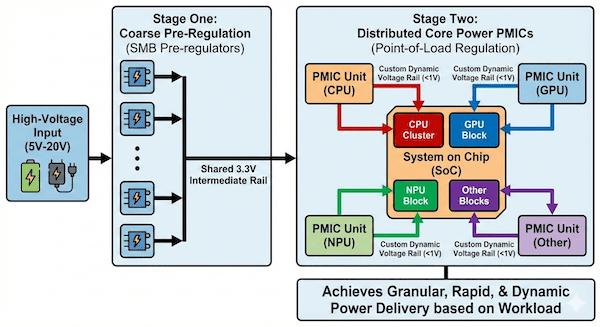
Stage One: The Efficiency Step
The system begins by addressing the voltage differential between the source and the destination. A battery or charger provides high voltage (ranging from 5V up to 20V) for transport, while the logic gates within a CPU core operate at sub-1V levels.
The Snapdragon design manages this via an intermediate “Efficiency Step.” The system utilizes multiple parallel “SMB Pre-regulators” (Switched-Mode Buck regulators) to step the high-voltage input down to a stable, intermediate core power rail of 3.3V.
By standardizing this intermediate rail, the system isolates bulk voltage conversion from precision power delivery. The 3.3V rail serves as a clean, shared reservoir, ensuring that the final regulators operate within a highly efficient conversion window.
Stage Two: Point-of-Load Regulation
The second stage—the “Dynamic Step”—utilizes a distributed network of distinct “PMIC” units physically surrounding the SoC. This is Point-of-Load (PoL) regulation.
By locating the regulators immediately adjacent to the silicon they serve, the design addresses resistance losses (IR drop) in the wiring. This proximity allows the PMIC to supply the exact voltage required at the transistor level. The system supplies the precise energy needed for the operation without requiring a voltage surplus to account for transmission distance.
Granularity and Independent Rails
This distributed architecture enables extreme granularity in power delivery. The design maps specific PMIC resources directly to specific internal SoC blocks—creating distinct rails for the CPU clusters, the GPU, and the NPU.
Under this model, the power delivery is unbundled. If a workload requires high GPU performance but low AI utilization, the system can ramp the GPU rail to peak voltage to sustain high clock speeds, while simultaneously maintaining the NPU rail at near-threshold levels. This supports aggressive Dynamic Voltage and Frequency Scaling (DVFS). The system responds to workload spikes on specific cores by instantly raising the voltage on that specific rail, and dropping it back down immediately upon task completion.
Conclusion: The Just-in-Time Electron
Ultimately, the Snapdragon X Series power architecture represents a fundamental inversion of traditional SoC design. By abandoning the monolithic power model in favor of a distributed, two-stage hierarchy, Qualcomm has effectively transformed power delivery from a static utility into a dynamic performance engine. The architecture systematically eliminates the three historic “taxes” on battery life—thermal conversion waste, resistive transmission loss, and the inefficiency of shared rails—replacing them with a system of microscopic precision. This design successfully operationalizes the concept of “Just-in-Time” manufacturing for the electron, ensuring that battery life is no longer burned by the system’s infrastructure, but consumed exclusively by the user’s actual workload.