
The funny part of writing reviews/reports/talking about hardware is you never really know what you want to talk about until you sit down to write about it. When doing this for the iPhone Duo, I've spent the past week (technically 6 days, but close enough) using it and thinking about what I wanted to talk about and felt was important to understand the device. I think one of the key note, the thing that if you come away with nothing else from this, is that the iPhone Duo is just a fun piece of technology and an absolute pleasure to use.
Before getting into the specifics of the iPhone Duo, I want to talk about some of the objective benefits of a foldable device. There are genuine productivity advantages to two apps at once. Most of what I was doing was taking notes during calls while having a full size screen, or in a lot of cases scrolling X while copying posts on specific topics to my notes. We, at Creative Strategies, have been working a lot more on financial modeling around data centers and AI infra build out. Being able to keep two Safari tabs or my email and Calendar side by side is really nice. This is genuinely useful productivity that makes working on my phone far easier than any other device, including traditional foldables. For entertainment, it is also fantastic. Last week I was heading into Manhattan on the train, and there was something fantastic about watching a show on Apple TV with the larger display. I want to specifically call out Apple TV here, because they tend to do the best job at supporting HDR content, which makes the colors and brightness on the Duo far more striking and better looking than it would be in other apps. Disney+ and Netflix also tend to do a great job, but Apple TV is second to none here.
Oh and I want to go on a bit tangent here about the iPhone Duo's nano texture and how cool it is. Normal nano-texture (Studio Display, iPad Pro, MacBook Pro) is etched into the glass. The goal of nano texture is to refract external light across the display, so the reflection doesn't get back to your eye causing glare. The downside is these micro-grooves (at the nanometer level) also refract some of the light coming out of the display panel itself, causing some of that shimmer and lost contrast, as well as reduction of clarity. On iPhone Duo, the nano-texture coating is etched into the polymer cover using maskless laser lithography that essentially writes a micro-lens over each pixel individually. Yes, each pixel. With this technology, it let's the light from the pixel be directed through the nano-texture layer while also refracting the external light being reflected against the surface. This allows the display to keep the contrast, color reproduction, clarity of text and fine detail, while also getting rid of the reflections and glare on the surface. But think about this, laser etching at a nanometer level a micro-lens into a custom plastic blend to fix the issues of normal matte coatings. It's just so cool.
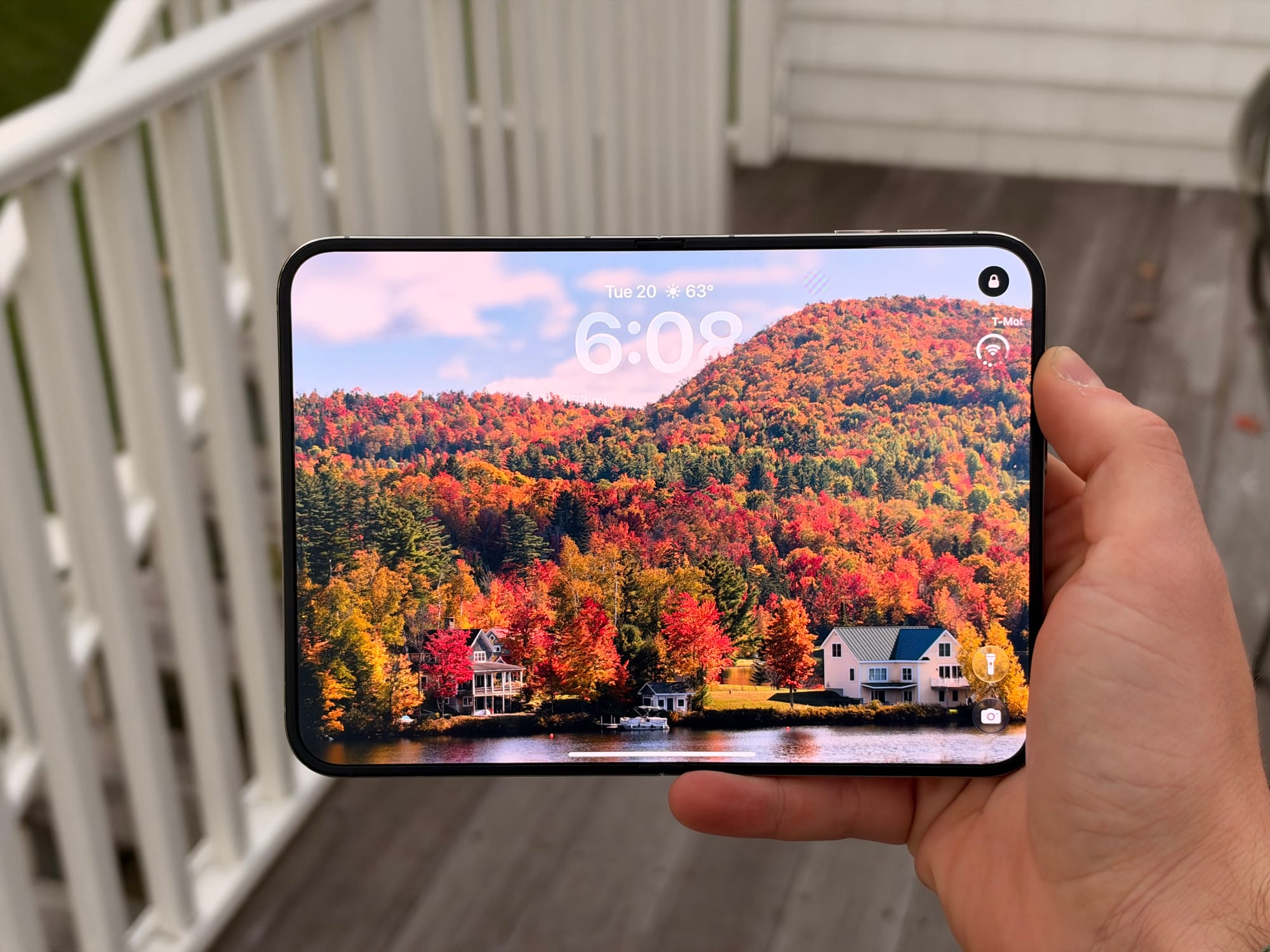
When Apple was talking about the size and shape, the company mentioned that quite a bit of this was based around scaling content between the two display sizes, 5.4-inch and 7.6-inch. What's interesting is the way content scales vs. most phones, the controls move to the right side when folded and unfolded, and when in split screen it moves it to the right or left depending on it's position. This is important because content that is normally at the top and bottom of your display like time, signal, navigation controls are moved to the left and right leaving the viewable content roughly identical between an iPhone 18 Pro and iPhone Duo. Depending on the app, there can be more content or roughly the same, very rarely less.
Speaking of apps here, there's some nuance to apps and how a developer would go about supporting the iPhone Duo. There are essentially three categories of iOS apps relevant here: apps compiled with iOS 26 SDK, iOS 27 SDK, and iOS 27.1 SDK. Building for iOS 27 did require apps to support adaptive screen sizes for iPhone app mirroring, and that did lay the groundwork for iPhone Duo support in iOS 27.1. If an app uses Apple's native SwiftUI and doesn't have too much custom built on top, it tends to be one-click support by just downloading and using Xcode 27.1. Apple also gave developers agent skills built into Xcode to help optimize apps, these skills were done by the design and engineering teams at Apple and tend to be very good to get your app there with a single prompt in Claude Code.
The reason I want to bring this up is because over the ~6 days I've been using my iPhone Duo, apps went from not at all optimized (except for Perplexity and Claude), to nearly half of them being updated. I spent the past week or so chatting with developers to see what's going on with their apps, and most should be ready for customer pickup on Friday. While the reviewers experiences probably weren't that great, I have no doubt that customer experiences a few days later will be far better. This is to say, Apple has a great track record of developer support and getting their apps supported in the age of AI agents, this should totally be fine.
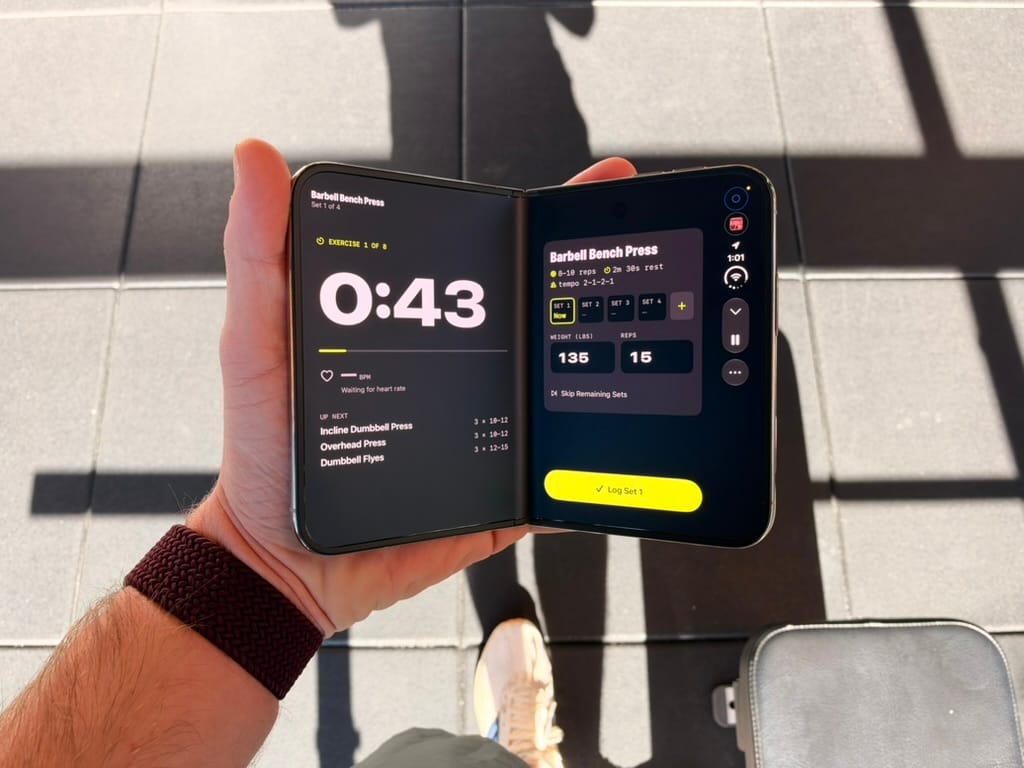
This software support for iPhone Duo, developer community and tools, and AI being so extremely good at Apple software development is a great sign in the age of AI. Apple stands to be one of the biggest winners of AI software development when it's incredibly simple to just update using AI to support an entirely new form factor like iPhone Duo, and other platforms (like HomeView, CarPlay, Apple Watch, Siri, etc) are likely to benefit as well. It is under-estimated how easy it can be for supporting these new platforms when Apple provides agent skills and AI-first developer tooling, assuming developers take advantage.
Some quick things too just to get them out of the way:
- Performance is great, A20 Pro is the best mobile chip and performs well
- Cameras are good, they are iPhone cameras! I do miss the telephoto, but ultrawide and main sensor are pretty great
- Battery life is outstanding, roughly the same or better than my iPhone 18 Pro
- Connectivity is great, the phone has the Apple C2 modem and N1 WiFi/Bluetooth chip
- The displays are bright, they are fantastic, and I love nanotexture on the internal display
- The crease is probably the best on a foldable, but is more visible than I initially saw at the Apple event
- The phone can get warm, but never uncomfortably so. The vapor chamber stops it from throttling, though
- iOS feels buggier than normal iOS. Random re-springs, UI elements being placed in the wrong place, URL bar in Safari disappearing. None of these are too prevalent or too annoying, but worth mentioning it's not as bug-free as the iPhone 18 Pro Max I was using prior
Oh here are some camera samples!









iPhone Duo camera samples, feat. Malibu
If you want more specifics on these, I highly recommend looking for some other reviews from creators or journalists who likely went into far more detail on some of these topics!
What I think is most important about the device and why I think this device will be a hit for Apple is just because it's fun to use. Genuinely, it is such a pleasure in a way that I don't think many other foldables have been. It's really hard to articulate that, and I don't know if everyone will feel it in the same way I do, but I'm going to try my best!
When you pick it up, it feels premium. The edges are soft with no sharp corners, the beveled titanium rails of the frame feel incredibly comfortable in the hand. It has weight to it, a heft like you might feel with a premium watch. It's not off putting, but you feel it. The phone has a feeling of intention and purpose. It's one of those product that feels premium, you don't feel the seam between the glass and the frame. The components flow into each other. It feels extremely premium.
It's slightly wider than what you would normally expect, it looks strange but cool at first. As you use it, the design makes sense with the controls shifted to the right side under the hole punch. It's simple and makes it easy to reach. It also looks really cool.
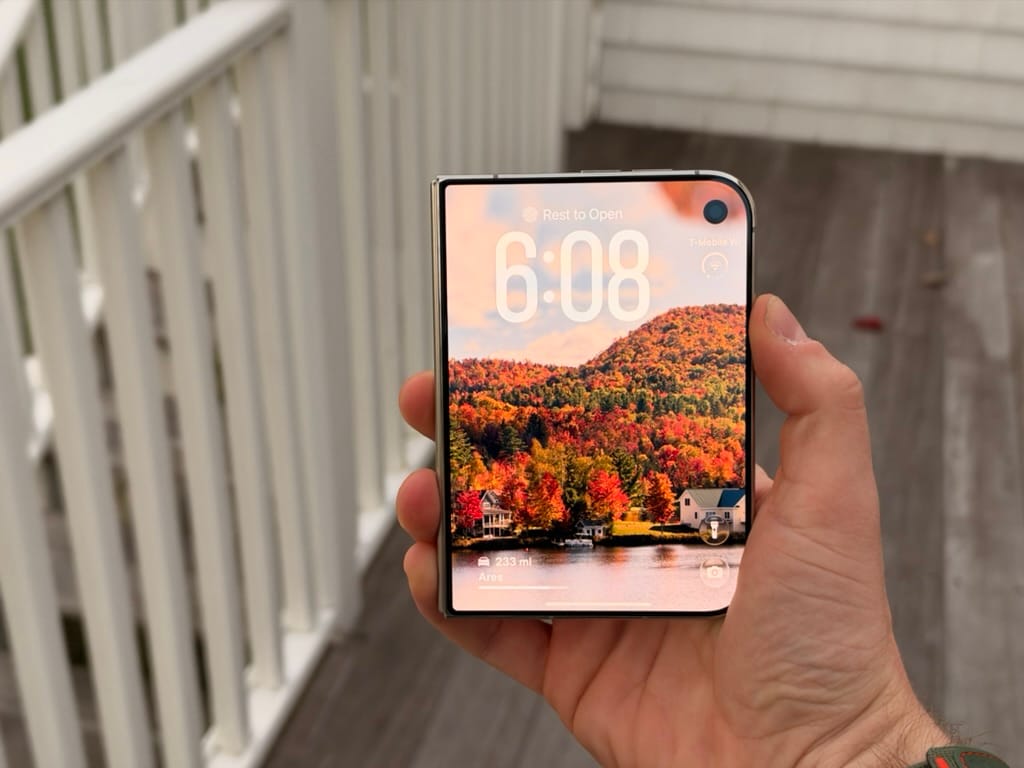
I think part of the reason I like this slightly wider form factor is the changes made to the OS and where system UI elements are placed, so you get this unique feeling with the new width while not having the downside of traditionally wide form factors of cutting off content and less viewable space. It's actually similar to an iPhone 18 Pro!
This gets into something else I don't know if I've experienced before, a sense of freedom. Generally with a foldable Android device, there is some lag or change of experience when you fold and unfold. You have to essentially intentionally choose which display you want to use. Sometimes apps wouldn't adapt either, so you would need to save your work, open the display, then have to close then open the app again for it to adapt to the larger size. On the iPhone Duo, it's seamless and it's fast. It's so seamless and fast, I found myself doing it to do simple things like fill out a form a little quicker or close it to type on a smaller screen then open again a moment later. It was freeing and felt like I didn't need to think about it very much. It feels like how a foldable should be, and it's not something I really realized mattered to me or even changed my habits until using the iPhone Duo. It sounds like a small thing, but that animation, having two screens on at once, and the overall speed (plus frankly better app developer frameworks) make this all possible.
Something I've also found myself enjoying a lot about the iPhone Duo is actually the fact that multi-tasking is a bit more limiting. This may sound strange, but I think there's a few reasons for it. First, it keeps the user (me, in this case) from being able to do something stupid. Opening a tiny window of an app is not a good experience, though it can show you some content that you may like, like maybe a single post on X at a time while having Gmail and Chrome open. This makes each window slightly worse, but I did it because I want to and could. Generally, I don't do this because there's a reason just because I can. I don't speak for every user here obviously. Being forced into just 2 apps means both apps are given better space. It also means app developers only need to focus on optimizing for 2 (maybe 3) windows! The front display and split screen are the same, then full width tablet mode apps on the foldable Duo display. Yes, you have vertical internal Duo display too, but I didn't really find myself using it (and it's the same shape as the outside screen). Being more limited gives developers less work to do and more time to optimize for the form factors! It tends to just be better.
There are also just fun animations around, like when you turn off the under display camera it looks like a ripple where you're dropping a stone into water or popping up from below the surface. When it disappears, it looks like it's just shrinking away. When you unfold the Duo, the idea is that the screen you're looking at mostly stays the same, and the content expands to the left to fill in the now available space. Sorta like you're lifting a glass panel to show more content. When you do this on the home screen, the left side apps actually settle from the animation a moment after the right, since the left side is settle physically a moment later. There's so many fun animations and tweaks and experience throughout, it's just fun.
The iPhone Duo is the first phone in a long time, probably 7 years 1 month (since the Galaxy Fold hit the US market), since I've had an experience of a fun being fun to use and just makes me smile every time I touch it, open it, and use it. Genuinely, I pick this thing up and just smirk a little. Do you know how long it's been since technology was fun or had this reaction for me? As someone that sees and uses practically everything, it's been a LONG time. iPhone Duo was the first one that did it.
It's not just me! When I got it, I was heading into Manhattan, I opened the MTA Train Time app for my ticket so it could be scanned. The guy scanning looked at it and said "woah what is that" and my reply was just "oh the iPhone Duo." His response, with literally no other details about it or knowing it existed before this interaction was "I'm buying that." I told him that it preordered opened Friday and was going to tell him a bit more, his response was "I don't even care, I'm getting that" as he walked away to scan the next persons ticket.
Obviously, anecdotal, but I think the general sentiment stands. People love their iPhones, people love cool technology, when you mix the two there interest is going to be there.
And this is where we get into the more analytical research/analyst view on the iPhone Duo. I posted a quick video on this a few days ago on X, but I view Apple has having what is essentially three categories of iPhone now. They have what I think you could consider: value, pro, and luxury.
And on a quick tangent, all products are bought on the perception of value. Different people have different values. Some may value camera more than weight, others may value performance more than display, others may value low price over good features. All of these are still value inherently, and users all have different values that shape their purchasing decisions. Every product needs to hit these for each person to get any adoption.
The iPhone 17e and iPhone 17 are what I would consider value phones. These focus on providing you the best experience at the lowest cost for what they provide. This doesn't mean cheap, but for the price you are paying, you are getting the most they can provide. I think both fit into that category extremely well.
The next category is pro, with 18 Pro and 18 Pro Max. These are devices that target creators and gamers, the ones that want the undebatable best performance, quality, battery, etc. This is purpose built for it, with thicker bodies and material like aluminum designed to handle heat that sustain that performance. These are devices who's value proposition target people who need what it offers, and for those people, it is a great value.
The last category is luxury, these devices are what I think focus on the experience or form factor. These devices are, obviously iPhone Air and iPhone Duo. These are what I think base their value proposition on a unique experience and device. iPhone Air is about being strikingly thin and light in the hand, it's truly an unreal experience to hold and use one of these. It feels like nothing! The iPhone Duo, obviously, is it's folding design.
I think it's worth mentioning this because this has allowed Apple to also allow what I think is the majority of users to have options outside of the Pro iPhone that aren't the value ones. I'm a user that doesn't want the iPhone 17, there's no reason I couldn't use it, but I want more. I want better performance from an A__ Pro chip and I want something that's just a little more. What the 18 Pro Max offers me, I really like! The cameras, performance, and battery are the best. What I value more than that is something unique and fun. I'm price insensitive and like technology. That's the iPhone Duo. I'm one of the targets for the iPhone Duo.
This market for the iPhone Duo isn't small, some equity research I've read leading into the iPhone Duo puts Apple's supply chain targets for iPhone Duo between 11 and 17 million units over the next year. For reference, the entire foldable market up until today is around ~18M units. I believe, genuinely, Apple will sell as many devices as they can manufacture. This is a proven category, there is enough demand for it to sustain itself and financially justify it's existence.
I think Apple's focus on fine detail mixed with experience, as well as fixing the issues that have plagued foldables. It does not fix them all, cameras are still slightly worse than the Pro iPhones (A for Duo vs. A+ for Pro), the crease and feeling of softness could still use a tad bit of work, but overall I do think this is the best foldable to date and I think Apple truly nailed this thing. I have enjoyed every second of using it, and I believe they will continue to nail this form factor.