
AMD Series · Part 1 of 3
Why agentic AI makes the case for a systems and silicon provider, and how large the markets around it can become
AMD's AI strategy was set well before the industry started talking about agents, and we do not think the company needs to reinvent it. The pieces have been there for years in its CPU, GPU, networking, and software investments. We have long viewed AMD as a company building toward complete systems, and agentic AI makes the case for that direction easier to see. The work now is execution, which means putting those pieces into systems customers can deploy and run efficiently.
The CPU work AMD has done in cloud infrastructure extends naturally to the work that surrounds AI agents. Those servers already host accelerators, run applications, and move data. Agents add new demands as they call models, use company software, and check their own results, but much of the underlying work draws on the same foundation. The architecture gives AMD room to adapt to those workloads, and its networking investments keep data moving between the parts of the system. New software and integration work is still required. The difference is that AMD is building on an installed base it already has.
So when we size the agentic opportunity, we think about AMD as a systems and silicon provider. For the operators and enterprises buying this infrastructure, the value comes from how the parts work together and how easily they fit into what is already in place. AMD can work with customers and partners on an integrated design, or it can supply the compute and networking for a system the customer helps shape. We consider that choice more important than the number of products in the catalog, because customers arrive with different applications, power limits, and supplier relationships. The markets growing around those requirements are how we size it.
At its Advancing AI event in July 2026, AMD put its total addressable market at approximately $2 trillion by 2030 across data center, PCs, edge, and embedded processors. That is AMD's estimate. The direction it describes, steadily expanding demand for compute, is consistent with what we see in our own models, but we are examining a narrower set of markets here: server CPUs, merchant GPUs, networking, and private AI infrastructure. Those definitions differ from AMD's, so our forecasts describe where we expect spending to grow without attempting to reconcile to the $2 trillion figure or to predict AMD's revenue. [1, 3–6]
A strategy built around the data center
The July 2026 event showed how AMD's data center investments are coming together. The company presented CPUs, GPUs, networking, and software as parts of one coordinated system for training, inference, and agentic AI, and it extended its infrastructure roadmaps through 2030. We read that as the continuation of a direction AMD has pursued for years. The Pensando acquisition, completed in 2022, is a useful marker, because it brought networking and distributed data center services into the portfolio well before the current wave of agent adoption. [1, 2]
The portfolio has grown and the AI market is far larger than it was, but the reason to invest across the data center has stayed the same. A customer buying a faster processor still needs the rest of the system to keep that processor supplied with work, and it still has to install the system, connect it to existing applications, and support it over time. An industry can only scale as fast as its deepest bottleneck, and the same is true of a single deployment: the accelerator is only as productive as the host, the network, and the software around it. AMD's approach gives customers a choice between integrated designs developed with partners and individual components for their own infrastructure. Helios, for example, is a reference design for partner systems rather than a requirement to buy every part of the data center from AMD. [9]
Agentic AI adds more work around the model, which is why we think this broader approach is well timed. An agent may call a model several times, use company applications, and check the result before it finishes a job, and each of those steps draws on infrastructure beyond the accelerator. As that activity grows, we expect more spending on the servers and networks that support it. That surrounding demand is an explicit part of what we model.
The markets AMD is positioned to serve
The simplest way to frame the opportunity is to look at each market on its own terms. Our models point to annual server CPU silicon value of approximately $251 billion by 2030, a merchant GPU supplier opportunity approaching $1 trillion, and roughly $190 billion in AI networking silicon. These are Creative Strategies outlooks, separate from AMD's estimate. The more interesting point is that AI is adding infrastructure demand to all three markets at the same time, so AMD has more than one way into the same customer's budget. [3–5]
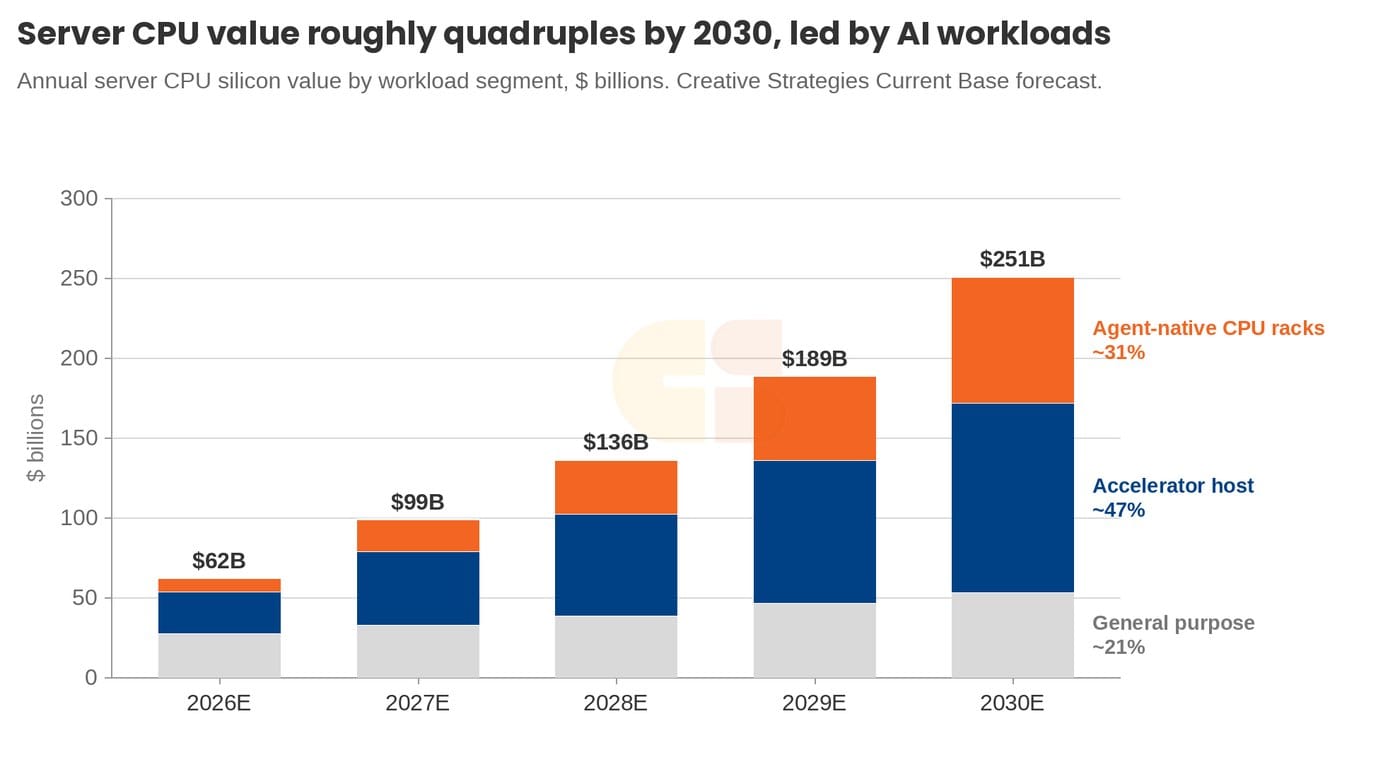
Our latest CPU forecast reaches approximately $251 billion of annual silicon value in 2030, of which about $208 billion is merchant CPU sales. The remaining $43 billion is the estimated value of processors that cloud operators design for their own use, which is not revenue available to a merchant supplier. AMD's opportunity is substantial without counting internal chip value as an addressable sale, and counting it would overstate the market open to any merchant supplier. The forecast also remains conditional on how much agent activity turns into sustained CPU work and new equipment purchases, and that bridge from activity to purchases is the assumption we watch most closely. [4]
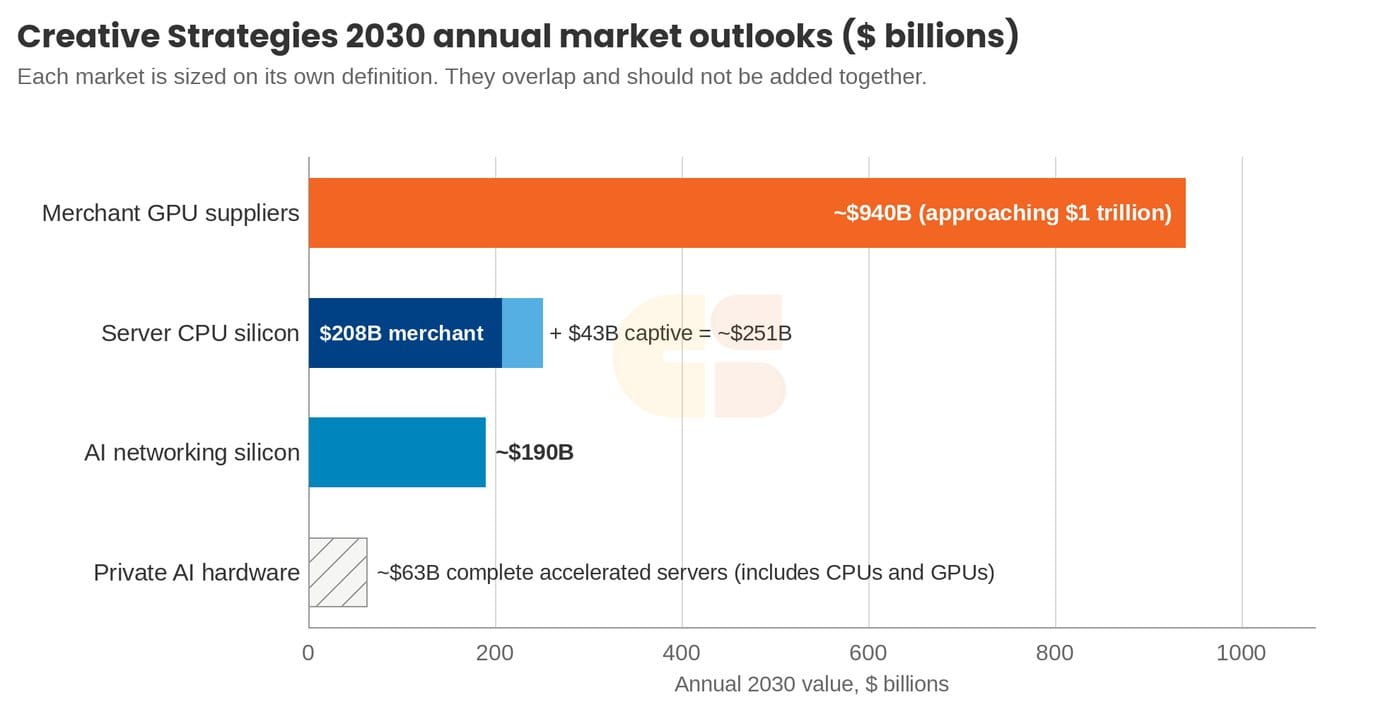
Exhibit 2: Scope of each 2030 outlook
| Annual market | 2030 outlook | What it covers |
|---|---|---|
| Server CPU silicon | About $251 billion total, of which about $208 billion merchant | Annual silicon value including captive designs; merchant sales are the relevant supplier opportunity |
| Merchant GPUs | Approaching $1 trillion | Directional merchant GPU supplier outlook, excluding custom accelerators |
| AI networking silicon | Roughly $190 billion | Broader silicon market in which AMD participates |
| Private AI hardware | Roughly $63 billion | Complete accelerated servers owned by enterprises and institutions, including in colocation |
Source: Creative Strategies. See source and forecast definitions at the end of this paper.
Most of the growth in that forecast comes from value rather than volume. Packages about double, but silicon value roughly quadruples from about $62 billion in 2026 (Exhibit 3), because the sockets doing the most AI work are the most expensive and we expect CPU prices to keep rising while capacity stays tight. AMD's own published 1,000-unit list prices show the premium for accelerator-host parts: the 64-core EPYC 9575F lists at $11,791, against $9,826 for the 64-core general-purpose EPYC 9555. These are product list prices, not realized AMD ASPs or inputs to our 2030 forecast. [12] By 2030 we expect accelerator hosts to account for close to half of CPU value and agent-native CPU racks (Vera, Arm AGI, AMD and Intel agentic racks; about 25 million CPUs) for nearly a third. [4]
Our Agentic CPU Guidebook follows that work through three places: the CPUs hosting accelerators, the separate environments running agent tools, and the business applications those tools call. A coding agent illustrates the pattern. It asks a model for a change, runs tests, queries a service, and then asks the model what to do next. Some of that activity fits in servers the customer already owns. As sustained demand consumes that spare capacity, the customer has a reason to add equipment, or to buy a larger system at replacement. More agents therefore create an opportunity for CPU suppliers, but the number of agents alone does not tell us how many processors customers will buy. We would size it from the work instead: the peak rate of tasks, the CPU time each task consumes, and the utilization an operator is willing to run at, with existing headroom netted out.
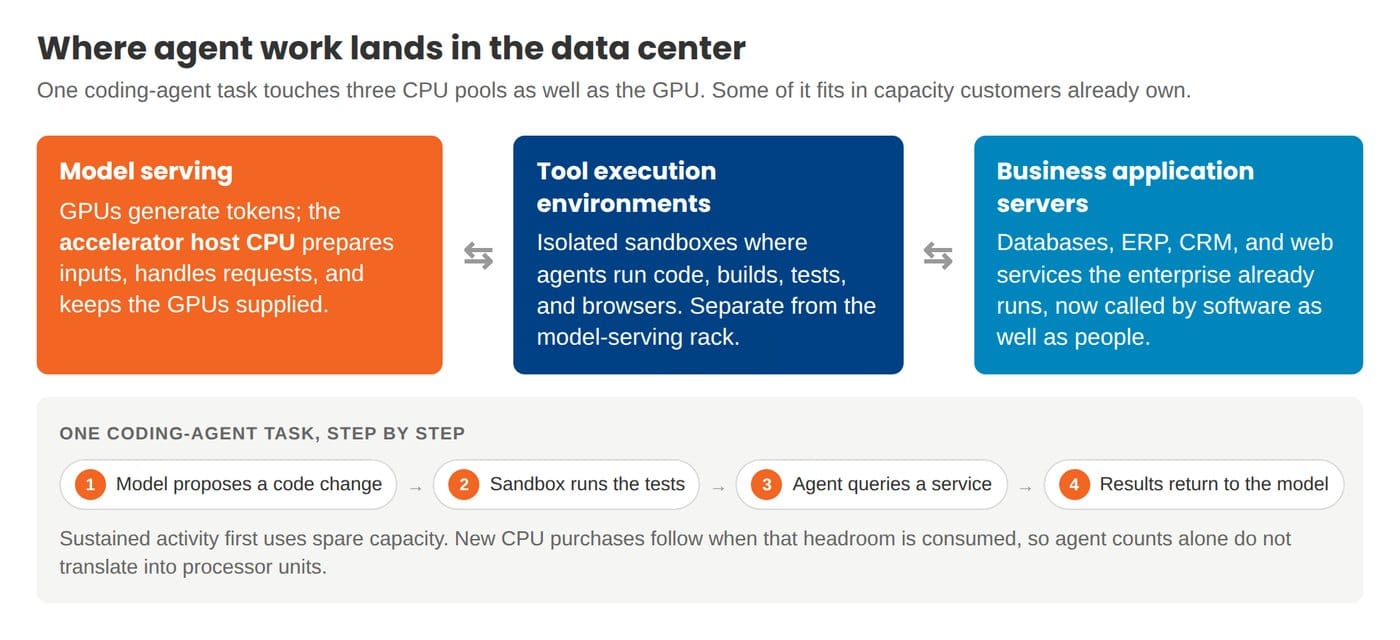
For EPYC, this creates several routes into the same customer's spending. AMD can supply the host in an accelerator system and compete for the tool and application servers around it, including in deployments where another supplier serves the model. The CPU opportunity therefore does not depend on winning the GPU socket, and we think that point is less appreciated than it should be. Faster cores help when a task is waiting on a dependent tool result, while more cores help when many jobs are ready to run at once, and both need enough memory behind the cores. We see that range of requirements as a reason AMD's broad CPU portfolio fits the market, independent of any view on share.
Merchant GPUs are the largest market in this discussion. Our supplier models point to annual GPU and compute revenue approaching $1 trillion by 2030 for the merchant GPU suppliers, with custom accelerators left out of the figure. The scale reflects our expectation that more applications will use models continuously, and that inference creates recurring demand well beyond the initial work of developing and training those models. [3]
Instinct gives AMD a way to compete for that spending as customers add inference capacity. Its chiplet design brings compute and memory interfaces together in the package, which supports the memory capacity and bandwidth that model serving requires. More memory can let a model fit on fewer GPUs or leave room for more concurrent sessions, although the benefit depends on the model and the serving configuration. We expect buyers to compare performance and cost on their own workloads, and AMD has a large and growing market in which to make that case. [10]
Our AI networking silicon outlook reaches roughly $190 billion by 2030. As customers build more compute, they also need to connect it and move data through it efficiently. AMD participates in parts of that market through its networking portfolio, and it does not need to supply every networking component for those investments to pay off across its data center business. [5] Slow communication leaves expensive compute waiting, so networking sets the return on a much larger investment in processors and servers. AMD's networking products let it compete for part of this spending while also improving how its own compute performs inside the customer's system.
Adding these forecasts into a single AMD market number would hide differences in what each one covers and where the company actually competes. Read side by side, they show AMD with relevant products in several growing markets at once, and that is the basis for our view that the portfolio is pointed where spending is going.
Enterprise AI creates room to grow with partners
We also expect enterprises to run some AI on infrastructure they own while continuing to use cloud services for other work. A business with sensitive data and applications already in its data center has good reasons to keep some inference close to those systems. As usage becomes more predictable, it also gains a clearer view of how much equipment it needs and whether it can keep that equipment busy enough to justify owning it.
Our server model puts annual private AI hardware spending at roughly $63 billion of complete accelerated servers by 2030 in the base case. That figure includes privately owned systems in colocation as well as equipment on the customer's premises, so it is broader than strictly on-premises spending. We treat it as another view of where demand develops and do not add it to the CPU, GPU, and networking forecasts, since those components already sit inside the systems customers buy. [6]
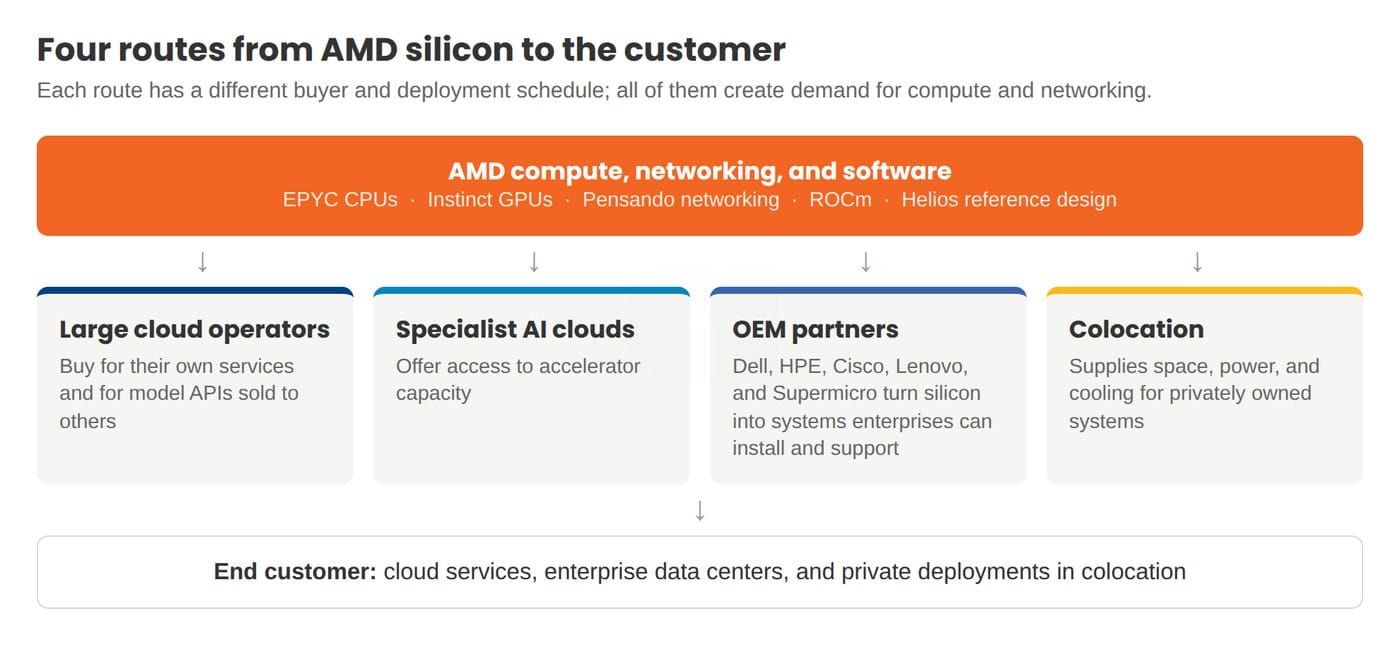
Dell and HPE give enterprises a way to buy and support AMD-based AI infrastructure through supplier relationships they already have. The opportunity extends beyond those two companies. Cisco, Lenovo, and Supermicro also bring EPYC-based systems into enterprise environments, with accelerator support varying by product. These partners turn silicon into equipment a customer can install, connect, and operate, and AMD can grow through EPYC in the servers that support enterprise AI and through Instinct where customers choose AMD for model serving. [7, 8, 11]
The same strategy reaches customers through more than one route. Large cloud operators buy for their own services, specialist AI clouds offer access to accelerator capacity, and enterprises buy systems for their own facilities or for private deployments in colocation, where the provider supplies the space, power, and cooling the customer may lack on premises. Each route has a different buyer and a different deployment schedule, but all of them create demand for compute and networking. We see the partner network as the way AMD reaches that demand without having to own every part of delivering the service.
Inference changes how customers judge the investment
Our thesis is that inference becomes the main recurring AI workload for data center operators as more applications use models in daily work. Training creates and improves the models, and inference puts them to work across customers and tasks. Agents add to that demand through repeated model calls, longer inputs carrying tool results and company context, and additional reasoning before they act. More demanding jobs may also call for a larger model, although a smaller model can still be the better choice for routine work. Infrastructure demand therefore has several sources of growth beyond a simple count of users or requests.
Our conviction is stronger on the direction of that demand than on its timing at any one operator, and we are not assuming inference already represents most data center activity. Adoption will track how much work companies trust AI to do. Drafting material for a person to review creates one pattern of demand, while allowing an agent to carry out a complete process creates another, with many more calls to models and company systems along the way.
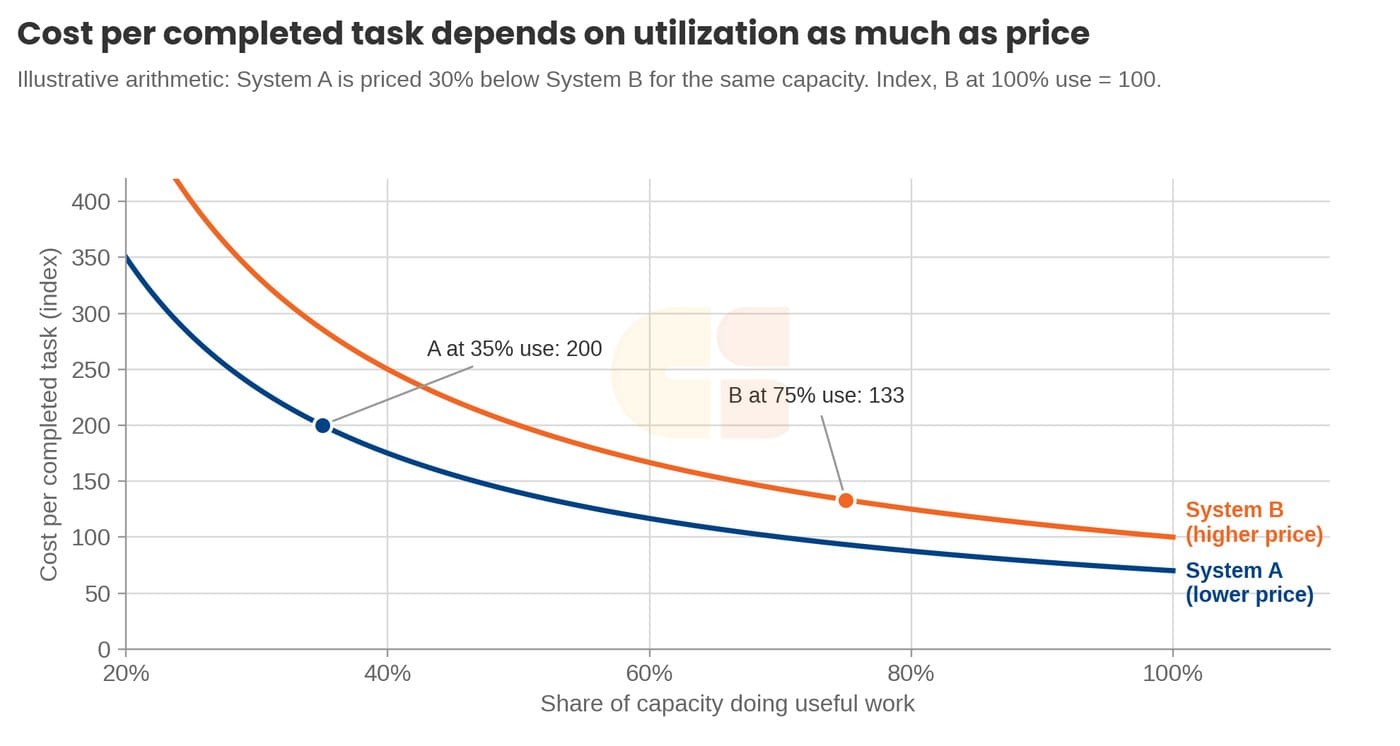
Once inference becomes a regular service, its cost becomes part of running the business. A cloud operator has to supply answers at a price customers will pay, and an enterprise has to get enough value from the work to cover its infrastructure and operating expense. That puts total cost of ownership into the buying decision, and TCO here covers the equipment, the power, the software, the deployment work, and how much of the capacity is actually used. We keep coming back to utilization in that calculation. A lower-priced system that spends too much time waiting can cost more per completed task than a higher-priced system serving steady demand, and the arithmetic in Exhibit 6 shows how quickly that happens. Faster CPU execution can shorten a test or database operation that holds up the next step, while better host processing can keep an accelerator supplied with requests. Those are different benefits and should be kept apart, since a GPU serving other customers need not sit idle while one agent waits on a tool. The comparison has to follow the work through the system and include the cost of operating it.
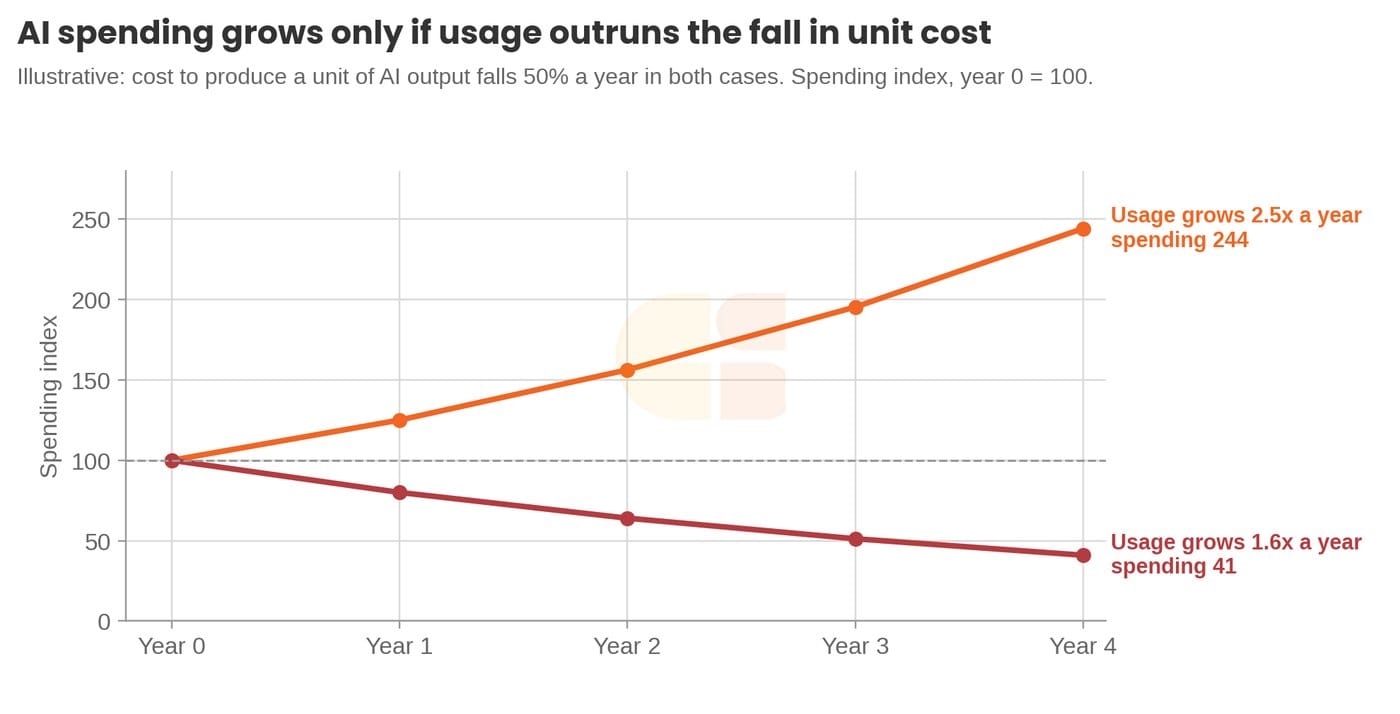
Lower inference costs should also let companies apply AI to tasks that are too expensive today. Our growth outlook assumes that this broader use, together with more demanding tasks, absorbs enough of the efficiency gains to keep spending rising. There is a real sensitivity here. GPU revenue could fall below our forecast even as customers get more AI output, because the price of producing that output may fall faster than usage grows (Exhibit 7). This is the variable we find hardest to model, and it cuts both ways: if usage responds to lower prices faster than we assume, the upside surprise is just as real.
Power availability adds another limit on how much work an operator can serve. With a fixed amount of power, the customer has to weigh how much output a system delivers within that limit alongside its purchase price. Getting more work from existing capacity is worth the most while the customer is waiting on a new building or a new power connection, and suppliers that improve that result give operators a reason to evaluate their systems on more than the price of the chips.
Why the broader approach fits this market
AMD's position across compute and networking gives it more than one lever on the cost and performance of the customer's system, and software and system design decide how much of that benefit reaches the application. With inference running day after day, customers will have an ongoing measure of whether the equipment is serving enough work at a competitive cost. That makes this a prove-it story, and it is the test AMD's broader approach will be judged on.
Customers also have applications and supplier relationships they want to keep as they add AI. AMD's open approach gives them room to work with system and software partners, choose individual components, or adopt an integrated design where that saves time. Openness and integration are compatible. AMD can integrate the parts that need to work closely together and leave the rest of the deployment open, which is how its systems work and its merchant component business support each other. The counterargument is fair. Breadth is not proof of lower cost, and we do not assume that every AMD system will carry a lower total cost of ownership. Buyers will test their own workloads and account for the effort of moving software and reaching production. Our reason for viewing the portfolio as an advantage is narrower. It gives AMD more ways to address the cost and performance limits in that comparison than any single product would.
Two developments would change our view. The first is evidence that existing headroom absorbs agent activity for much longer than we expect, which would delay the bridge from activity to new CPU purchases. The second is unit cost declines outrunning usage growth for more than a year or two, which would pressure the GPU outlook even as AI output rises. We will be watching both.
Our strongest conviction is that AMD's strategy fits the direction of demand. The size and timing of these markets remain sensitive to adoption, software efficiency, and how quickly customers can bring new capacity into service, and those assumptions can move our forecasts. They do not remove the need for processors, networking, and software that work well together. AMD is positioned to compete for that spending, and how much it wins will depend on the systems it and its partners deliver.
From the market opportunity to the technology
The market outlook gives us a starting point for evaluating the technology. Our CPU forecast reflects more work across the data center, the merchant GPU outlook reflects more use of models, and the networking forecast reflects the need to connect that capacity. Enterprise deployments add another route to customers through AMD's partners. Across all of them, recurring inference puts more weight on the cost of operating the complete system.
AMD has been investing toward those requirements for years. The next question is how its products and architecture deliver on the strategy, from the compute portfolio and Helios to networking and software. Paper 2 takes up that technology discussion and how those parts work together to support the market outlined here.
Sources and forecast definitions
[1] AMD, "AAI 2026: AMD Delivers Full-Stack Compute for the Agentic AI Era," July 23, 2026. AMD estimates an approximately $2 trillion total addressable market in 2030 across data center, PCs, edge, and embedded processors. This is AMD's forward-looking estimate, not a Creative Strategies forecast. Directional consistency refers to the expansion of compute demand, not a like-for-like validation of the total. https://ir.amd.com/news-events/press-releases/detail/1294/aai-2026-amd-delivers-full-stack-compute-for-the-agentic-ai-era
[2] AMD, completion of Pensando acquisition, May 26, 2022. https://www.amd.com/en/newsroom/press-releases/2022-5-26-amd-expands-data-center-solutions-capabilities-wit.html
[3] Creative Strategies AI Accelerator Core and AI Industry TAM models, October 2026. "Approaching $1 trillion" refers to 2030 accelerator package value, including HBM, for the identified merchant GPU suppliers. It excludes custom ASICs and is a directional outlook, not an exhaustive merchant GPU market size or a supplier share forecast.
[4] Creative Strategies Server CPU TAM Forecast, October 2026, companion model to the Agentic CPU Guidebook. Annual server CPU silicon value in 2030, combining merchant CPU revenue and the imputed value of processors cloud operators design for their own use. It covers general-purpose, accelerator-host, and agent-native CPU demand; memory and complete systems are outside the figure. Captive value is not merchant supplier revenue.
[5] Creative Strategies Core Networking Model, October 2026. Semiconductor content inside AI networking hardware. It is distinct from the broader finished-hardware market and should not be added to it.
[6] Creative Strategies AI Server Three Markets Model, October 2026. Complete accelerated servers owned by enterprises and institutions, including privately owned equipment in colocation. It excludes cloud-owned infrastructure, facilities, power and cooling, software, and services. It is not AMD revenue and is not additive to the component forecasts.
[7] Dell, "Dell and AMD Are Expanding What's Possible for On-Premises AI," May 7, 2026. Supports the partner and deployment discussion, not the size of our market forecast. https://www.dell.com/en-us/blog/dell-and-amd-are-expanding-what-s-possible-for-on-premises-ai/
[8] HPE, HPE and AMD compute solutions portfolio, accessed September 14, 2026. Product coverage supports the partner discussion and does not imply that every HPE private AI offering uses AMD accelerators. https://www.hpe.com/us/en/solutions/amd.%20html.html
[9] AMD, Helios overview and FAQ, accessed September 29, 2026. Helios is a reference design for OEM and ODM partner systems. https://www.amd.com/en/products/rackscale-solutions/helios.html
[10] AMD, CDNA architecture and Instinct MI350 microarchitecture, accessed September 29, 2026. Chiplet and HBM integration support the architecture discussion, not a universal competitive performance claim. https://www.amd.com/en/technologies/cdna.html; https://rocmdocs.amd.com/en/latest/reference/gpu-arch/mi350.html
[11] AMD, "The Agentic Era Runs on a CPU Foundation," July 2026, and EPYC OEM portfolio information. https://www.amd.com/en/blogs/2026/the-agentic-era-runs-on-a-cpu-foundation-and-it-s-called.html; https://www.amd.com/content/dam/amd/en/documents/epyc-business-docs/infographics/cpu-you-choose-can-make-or-break-your-investment.pdf
[12] AMD, 5th Gen AMD EPYC launch announcement, October 10, 2024, and AMD public pricing table, accessed October 6, 2026. Published 1KU USD list prices: EPYC 9575F (64 cores), $11,791; EPYC 9555 (64 cores), $9,826. The 9575F is designed for GPU host systems. Product list pricing is illustrative, not a market ASP or forecast assumption.
Exhibits 6 and 7 are Creative Strategies illustrations built on hypothetical, indexed inputs to show a mechanism. They are not measured results or forecasts.
© 2026 Creative Strategies. Forecasts are Creative Strategies outlooks, not AMD guidance. Product capabilities are described from public AMD documentation and are not claims of universal performance or measured customer savings.