# Creative Strategies
> Creative Strategies connects changes across silicon, systems, platforms, software, and adoption to explain how technology markets move.
Public Ghost content for AI and LLM tooling. This file includes a bounded export of public pages first, then recent public posts.
Append `.md` to any post or page URL to get the content in Markdown (for example, `/example-post.md`).
## Pages
### About this site
URL: https://creativestrategies.com/about/
Last updated: 2026-07-17T21:38:15.000Z
Creative Strategies is an independent publication launched in July 2026 by Max Weinbach. If you subscribe today, you'll get full access to the website as well as email newsletters about new content when it's available. Your subscription makes this site possible, and allows Creative Strategies to continue to exist. Thank you!
### Access all areas
By signing up, you'll get access to the full archive of everything that's been published before and everything that's still to come. Your very own private library.
### Fresh content, delivered
Stay up to date with new content sent straight to your inbox! No more worrying about whether you missed something because of a pesky algorithm or news feed.
### Meet people like you
Join a community of other subscribers who share the same interests.
---
### Start your own thing
Enjoying the experience? Get started for free and set up your very own subscription business using [Ghost](https://ghost.org/?ref=creativestrategies.com), the same platform that powers this website.
### Our Team
URL: https://creativestrategies.com/team/
Last updated: 2026-08-16T13:48:55.000Z
_No content available._
### About Creative Strategies
URL: https://creativestrategies.com/about-creative-strategies/
Last updated: 2026-08-16T13:48:55.000Z
This Ghost page supplies title, excerpt, and social-card metadata for the matching branded theme route.
### Market Intelligence & Analysis Services
URL: https://creativestrategies.com/analysis-services/
Last updated: 2026-08-16T13:48:56.000Z
This Ghost page supplies title, excerpt, and social-card metadata for the matching branded theme route.
### Market Intelligence & Analysis Services
URL: https://creativestrategies.com/market-intelligence/
Last updated: 2026-08-16T13:48:56.000Z
This Ghost page supplies title, excerpt, and social-card metadata for the matching branded theme route.
### Strategic Investment Insights Program
URL: https://creativestrategies.com/strategic-investment-insights-program/
Last updated: 2026-08-16T13:48:56.000Z
This Ghost page supplies title, excerpt, and social-card metadata for the matching branded theme route.
### Our History
URL: https://creativestrategies.com/creative-strategies-history-in-silicon-valley/
Last updated: 2026-08-16T13:48:56.000Z
This Ghost page supplies title, excerpt, and social-card metadata for the matching branded theme route.
### Delight Scale
URL: https://creativestrategies.com/delight-scale/
Last updated: 2026-08-16T13:48:56.000Z
This Ghost page supplies title, excerpt, and social-card metadata for the matching branded theme route.
### What Is the Delight Scale?
URL: https://creativestrategies.com/what-is-the-delight-scale/
Last updated: 2026-08-16T13:48:56.000Z
This Ghost page supplies title, excerpt, and social-card metadata for the matching branded theme route.
### Why Use the Delight Scale?
URL: https://creativestrategies.com/why-use-the-delight-scale/
Last updated: 2026-08-16T13:48:57.000Z
This Ghost page supplies title, excerpt, and social-card metadata for the matching branded theme route.
### Contact
URL: https://creativestrategies.com/contact-us/
Last updated: 2026-08-16T13:48:57.000Z
This Ghost page supplies title, excerpt, and social-card metadata for the matching branded theme route.
### Join the Newsletter
URL: https://creativestrategies.com/join-the-newsletter/
Last updated: 2026-08-16T13:48:57.000Z
This Ghost page supplies title, excerpt, and social-card metadata for the matching branded theme route.
### Latest Articles
URL: https://creativestrategies.com/blog/
Last updated: 2026-08-16T13:48:57.000Z
This Ghost page supplies title, excerpt, and social-card metadata for the matching branded theme route.
### Research
URL: https://creativestrategies.com/research/
Last updated: 2026-08-16T13:48:57.000Z
This Ghost page supplies title, excerpt, and social-card metadata for the matching branded theme route.
### CS Forecast Stack
URL: https://creativestrategies.com/forecast-stack/
Last updated: 2026-10-13T01:55:44.000Z
This Ghost page supplies title, excerpt, and social-card metadata for the matching branded theme route.
## Posts
### AMD Has More Than One Way Into the AI Budget
URL: https://creativestrategies.com/research/amd-has-more-than-one-way-into-the-ai-budget/
Last updated: 2026-10-15T20:34:38.000Z
**AMD Series · Part 1 of 3**
*Why agentic AI makes the case for a systems and silicon provider, and how large the markets around it can become*
AMD's AI strategy was set well before the industry started talking about agents, and we do not think the company needs to reinvent it. The pieces have been there for years in its CPU, GPU, networking, and software investments. We have long viewed AMD as a company building toward complete systems, and agentic AI makes the case for that direction easier to see. The work now is execution, which means putting those pieces into systems customers can deploy and run efficiently.
The CPU work AMD has done in cloud infrastructure extends naturally to the work that surrounds AI agents. Those servers already host accelerators, run applications, and move data. Agents add new demands as they call models, use company software, and check their own results, but much of the underlying work draws on the same foundation. The architecture gives AMD room to adapt to those workloads, and its networking investments keep data moving between the parts of the system. New software and integration work is still required. The difference is that AMD is building on an installed base it already has.
So when we size the agentic opportunity, we think about AMD as a systems and silicon provider. For the operators and enterprises buying this infrastructure, the value comes from how the parts work together and how easily they fit into what is already in place. AMD can work with customers and partners on an integrated design, or it can supply the compute and networking for a system the customer helps shape. We consider that choice more important than the number of products in the catalog, because customers arrive with different applications, power limits, and supplier relationships. The markets growing around those requirements are how we size it.
At its Advancing AI event in July 2026, AMD put its total addressable market at approximately $2 trillion by 2030 across data center, PCs, edge, and embedded processors. That is AMD's estimate. The direction it describes, steadily expanding demand for compute, is consistent with what we see in our own models, but we are examining a narrower set of markets here: server CPUs, merchant GPUs, networking, and private AI infrastructure. Those definitions differ from AMD's, so our forecasts describe where we expect spending to grow without attempting to reconcile to the $2 trillion figure or to predict AMD's revenue. \[1, 3–6\]
## A strategy built around the data center
The July 2026 event showed how AMD's data center investments are coming together. The company presented CPUs, GPUs, networking, and software as parts of one coordinated system for training, inference, and agentic AI, and it extended its infrastructure roadmaps through 2030\. We read that as the continuation of a direction AMD has pursued for years. The Pensando acquisition, completed in 2022, is a useful marker, because it brought networking and distributed data center services into the portfolio well before the current wave of agent adoption. \[1, 2\]
The portfolio has grown and the AI market is far larger than it was, but the reason to invest across the data center has stayed the same. A customer buying a faster processor still needs the rest of the system to keep that processor supplied with work, and it still has to install the system, connect it to existing applications, and support it over time. An industry can only scale as fast as its deepest bottleneck, and the same is true of a single deployment: the accelerator is only as productive as the host, the network, and the software around it. AMD's approach gives customers a choice between integrated designs developed with partners and individual components for their own infrastructure. Helios, for example, is a reference design for partner systems rather than a requirement to buy every part of the data center from AMD. \[9\]
Agentic AI adds more work around the model, which is why we think this broader approach is well timed. An agent may call a model several times, use company applications, and check the result before it finishes a job, and each of those steps draws on infrastructure beyond the accelerator. As that activity grows, we expect more spending on the servers and networks that support it. That surrounding demand is an explicit part of what we model.
## The markets AMD is positioned to serve
The simplest way to frame the opportunity is to look at each market on its own terms. Our models point to annual server CPU silicon value of approximately $251 billion by 2030, a merchant GPU supplier opportunity approaching $1 trillion, and roughly $190 billion in AI networking silicon. These are Creative Strategies outlooks, separate from AMD's estimate. The more interesting point is that AI is adding infrastructure demand to all three markets at the same time, so AMD has more than one way into the same customer's budget. \[3–5\]
Our latest CPU forecast reaches approximately $251 billion of annual silicon value in 2030, of which about $208 billion is merchant CPU sales. The remaining $43 billion is the estimated value of processors that cloud operators design for their own use, which is not revenue available to a merchant supplier. AMD's opportunity is substantial without counting internal chip value as an addressable sale, and counting it would overstate the market open to any merchant supplier. The forecast also remains conditional on how much agent activity turns into sustained CPU work and new equipment purchases, and that bridge from activity to purchases is the assumption we watch most closely. \[4\]
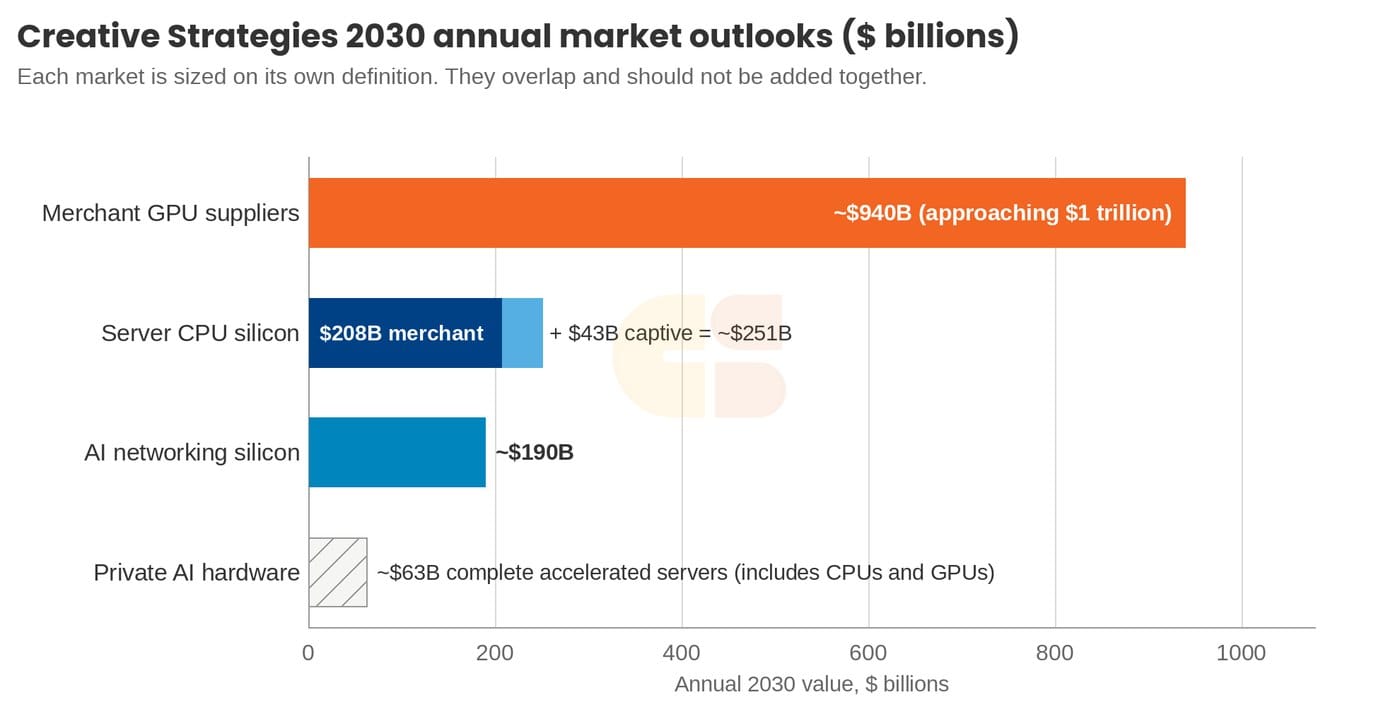
Source: Creative Strategies house models and supplier forecasts \[3–6\]. Rounded 2030 outlooks, shown separately. They are not additive and are not a forecast of AMD revenue. Private AI hardware is complete accelerated servers owned by enterprises and institutions.
**Exhibit 2: Scope of each 2030 outlook**
| Annual market | 2030 outlook | What it covers |
| ------------------------- | -------------------------------------------------------------- | ---------------------------------------------------------------------------------------------------- |
| **Server CPU silicon** | About $251 billion total, of which about $208 billion merchant | Annual silicon value including captive designs; merchant sales are the relevant supplier opportunity |
| **Merchant GPUs** | Approaching $1 trillion | Directional merchant GPU supplier outlook, excluding custom accelerators |
| **AI networking silicon** | Roughly $190 billion | Broader silicon market in which AMD participates |
| **Private AI hardware** | Roughly $63 billion | Complete accelerated servers owned by enterprises and institutions, including in colocation |
Source: Creative Strategies. See source and forecast definitions at the end of this paper.
Most of the growth in that forecast comes from value rather than volume. Packages about double, but silicon value roughly quadruples from about $62 billion in 2026 (Exhibit 3), because the sockets doing the most AI work are the most expensive and we expect CPU prices to keep rising while capacity stays tight. AMD's own published 1,000-unit list prices show the premium for accelerator-host parts: the 64-core EPYC 9575F lists at $11,791, against $9,826 for the 64-core general-purpose EPYC 9555\. These are product list prices, not realized AMD ASPs or inputs to our 2030 forecast. \[12\] By 2030 we expect accelerator hosts to account for close to half of CPU value and agent-native CPU racks (Vera, Arm AGI, AMD and Intel agentic racks; about 25 million CPUs) for nearly a third. \[4\]
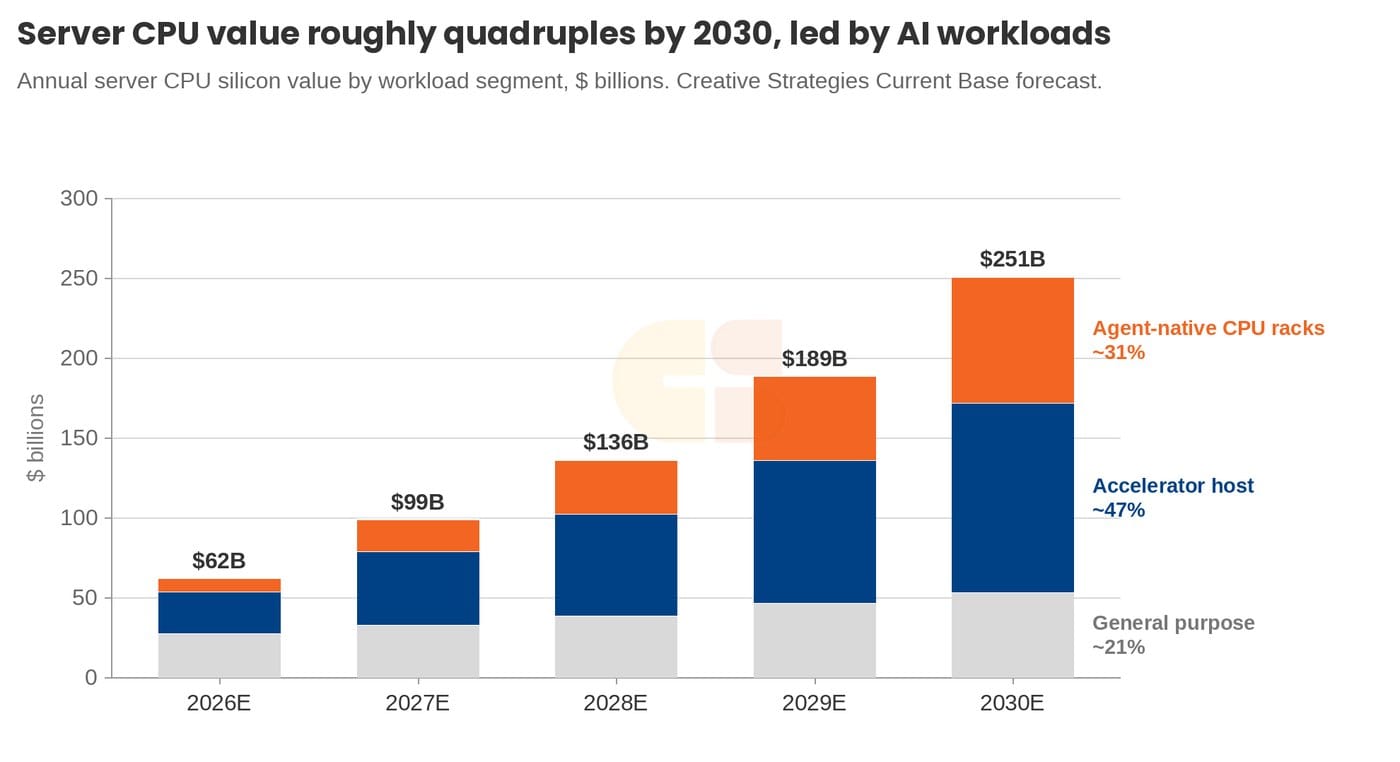
Source: Creative Strategies, Server CPU TAM Forecast V3.0, Current Base \[4\]. Annual CPU silicon value, merchant and captive combined. Segment shares are for 2030.
Our Agentic CPU Guidebook follows that work through three places: the CPUs hosting accelerators, the separate environments running agent tools, and the business applications those tools call. A coding agent illustrates the pattern. It asks a model for a change, runs tests, queries a service, and then asks the model what to do next. Some of that activity fits in servers the customer already owns. As sustained demand consumes that spare capacity, the customer has a reason to add equipment, or to buy a larger system at replacement. More agents therefore create an opportunity for CPU suppliers, but the number of agents alone does not tell us how many processors customers will buy. We would size it from the work instead: the peak rate of tasks, the CPU time each task consumes, and the utilization an operator is willing to run at, with existing headroom netted out.
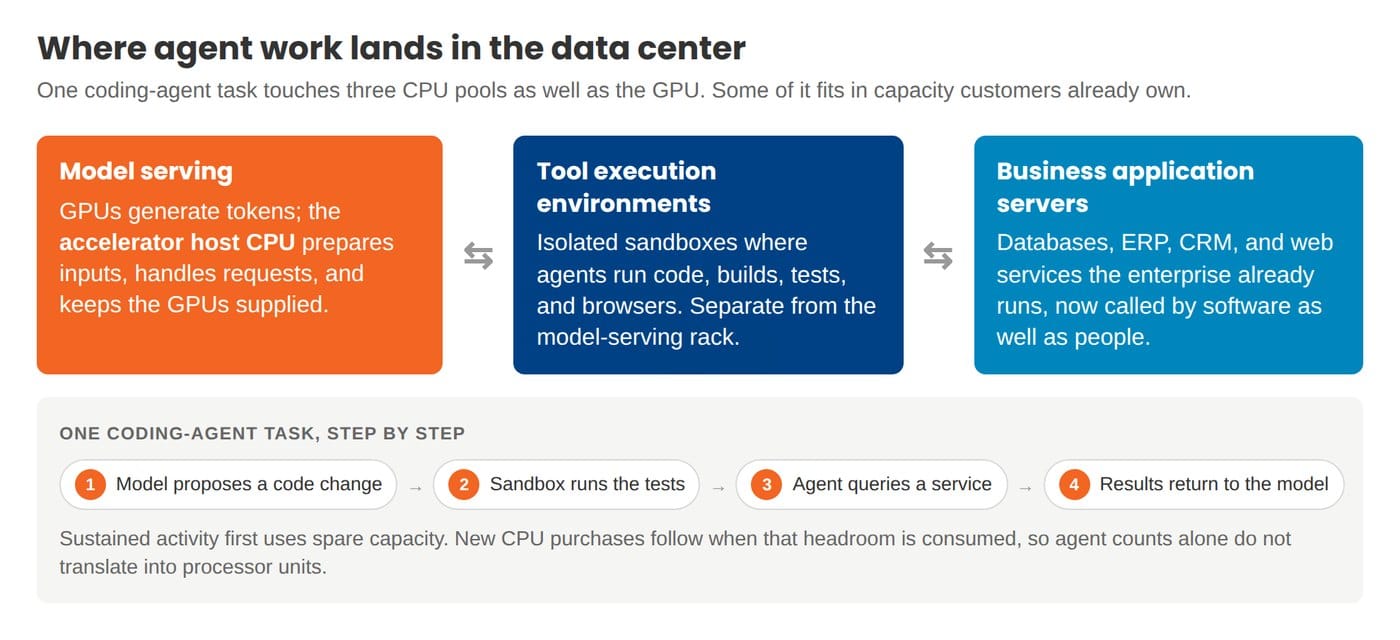
Source: Creative Strategies, Agentic CPU Guidebook \[4\].
For EPYC, this creates several routes into the same customer's spending. AMD can supply the host in an accelerator system and compete for the tool and application servers around it, including in deployments where another supplier serves the model. The CPU opportunity therefore does not depend on winning the GPU socket, and we think that point is less appreciated than it should be. Faster cores help when a task is waiting on a dependent tool result, while more cores help when many jobs are ready to run at once, and both need enough memory behind the cores. We see that range of requirements as a reason AMD's broad CPU portfolio fits the market, independent of any view on share.
Merchant GPUs are the largest market in this discussion. Our supplier models point to annual GPU and compute revenue approaching $1 trillion by 2030 for the merchant GPU suppliers, with custom accelerators left out of the figure. The scale reflects our expectation that more applications will use models continuously, and that inference creates recurring demand well beyond the initial work of developing and training those models. \[3\]
Instinct gives AMD a way to compete for that spending as customers add inference capacity. Its chiplet design brings compute and memory interfaces together in the package, which supports the memory capacity and bandwidth that model serving requires. More memory can let a model fit on fewer GPUs or leave room for more concurrent sessions, although the benefit depends on the model and the serving configuration. We expect buyers to compare performance and cost on their own workloads, and AMD has a large and growing market in which to make that case. \[10\]
Our AI networking silicon outlook reaches roughly $190 billion by 2030\. As customers build more compute, they also need to connect it and move data through it efficiently. AMD participates in parts of that market through its networking portfolio, and it does not need to supply every networking component for those investments to pay off across its data center business. \[5\] Slow communication leaves expensive compute waiting, so networking sets the return on a much larger investment in processors and servers. AMD's networking products let it compete for part of this spending while also improving how its own compute performs inside the customer's system.
Adding these forecasts into a single AMD market number would hide differences in what each one covers and where the company actually competes. Read side by side, they show AMD with relevant products in several growing markets at once, and that is the basis for our view that the portfolio is pointed where spending is going.
## Enterprise AI creates room to grow with partners
We also expect enterprises to run some AI on infrastructure they own while continuing to use cloud services for other work. A business with sensitive data and applications already in its data center has good reasons to keep some inference close to those systems. As usage becomes more predictable, it also gains a clearer view of how much equipment it needs and whether it can keep that equipment busy enough to justify owning it.
Our server model puts annual private AI hardware spending at roughly $63 billion of complete accelerated servers by 2030 in the base case. That figure includes privately owned systems in colocation as well as equipment on the customer's premises, so it is broader than strictly on-premises spending. We treat it as another view of where demand develops and do not add it to the CPU, GPU, and networking forecasts, since those components already sit inside the systems customers buy. \[6\]
Dell and HPE give enterprises a way to buy and support AMD-based AI infrastructure through supplier relationships they already have. The opportunity extends beyond those two companies. Cisco, Lenovo, and Supermicro also bring EPYC-based systems into enterprise environments, with accelerator support varying by product. These partners turn silicon into equipment a customer can install, connect, and operate, and AMD can grow through EPYC in the servers that support enterprise AI and through Instinct where customers choose AMD for model serving. \[7, 8, 11\]
The same strategy reaches customers through more than one route. Large cloud operators buy for their own services, specialist AI clouds offer access to accelerator capacity, and enterprises buy systems for their own facilities or for private deployments in colocation, where the provider supplies the space, power, and cooling the customer may lack on premises. Each route has a different buyer and a different deployment schedule, but all of them create demand for compute and networking. We see the partner network as the way AMD reaches that demand without having to own every part of delivering the service.
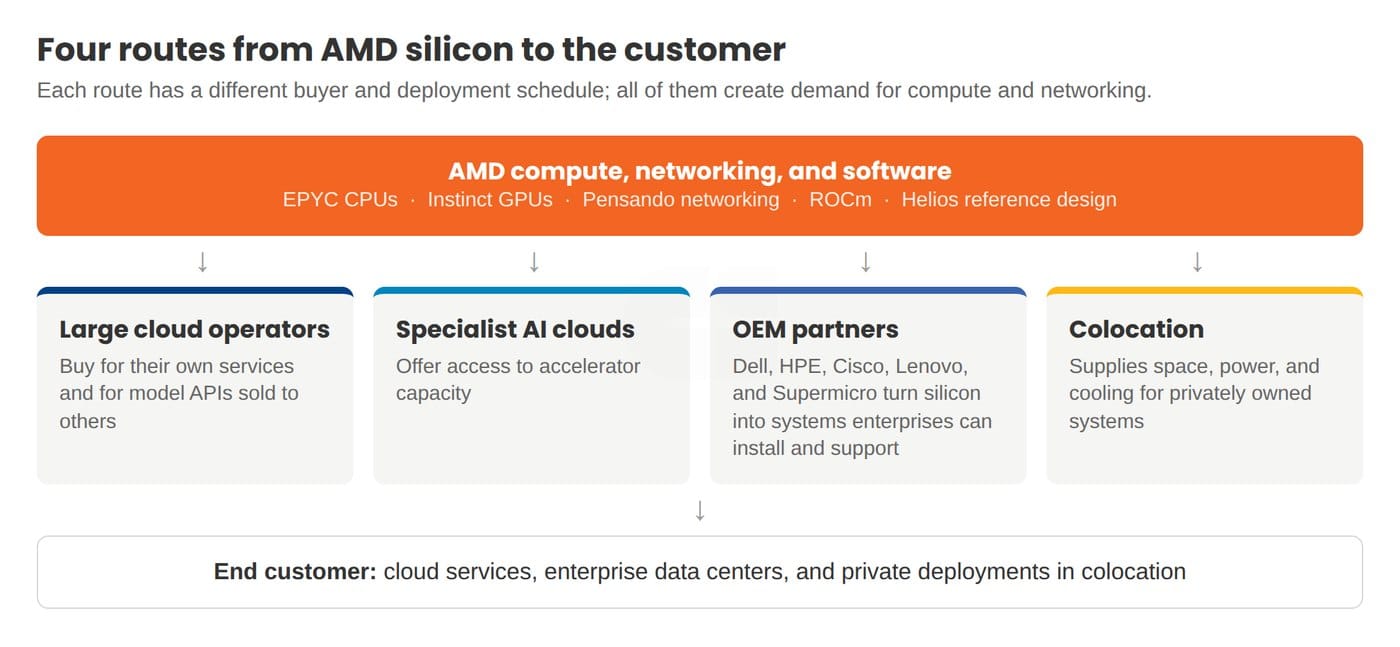
Source: Creative Strategies; partner coverage from AMD, Dell, and HPE materials \[7, 8, 11\]. Accelerator support varies by partner product.
## Inference changes how customers judge the investment
Our thesis is that inference becomes the main recurring AI workload for data center operators as more applications use models in daily work. Training creates and improves the models, and inference puts them to work across customers and tasks. Agents add to that demand through repeated model calls, longer inputs carrying tool results and company context, and additional reasoning before they act. More demanding jobs may also call for a larger model, although a smaller model can still be the better choice for routine work. Infrastructure demand therefore has several sources of growth beyond a simple count of users or requests.
Our conviction is stronger on the direction of that demand than on its timing at any one operator, and we are not assuming inference already represents most data center activity. Adoption will track how much work companies trust AI to do. Drafting material for a person to review creates one pattern of demand, while allowing an agent to carry out a complete process creates another, with many more calls to models and company systems along the way.
Once inference becomes a regular service, its cost becomes part of running the business. A cloud operator has to supply answers at a price customers will pay, and an enterprise has to get enough value from the work to cover its infrastructure and operating expense. That puts total cost of ownership into the buying decision, and TCO here covers the equipment, the power, the software, the deployment work, and how much of the capacity is actually used. We keep coming back to utilization in that calculation. A lower-priced system that spends too much time waiting can cost more per completed task than a higher-priced system serving steady demand, and the arithmetic in Exhibit 6 shows how quickly that happens. Faster CPU execution can shorten a test or database operation that holds up the next step, while better host processing can keep an accelerator supplied with requests. Those are different benefits and should be kept apart, since a GPU serving other customers need not sit idle while one agent waits on a tool. The comparison has to follow the work through the system and include the cost of operating it.
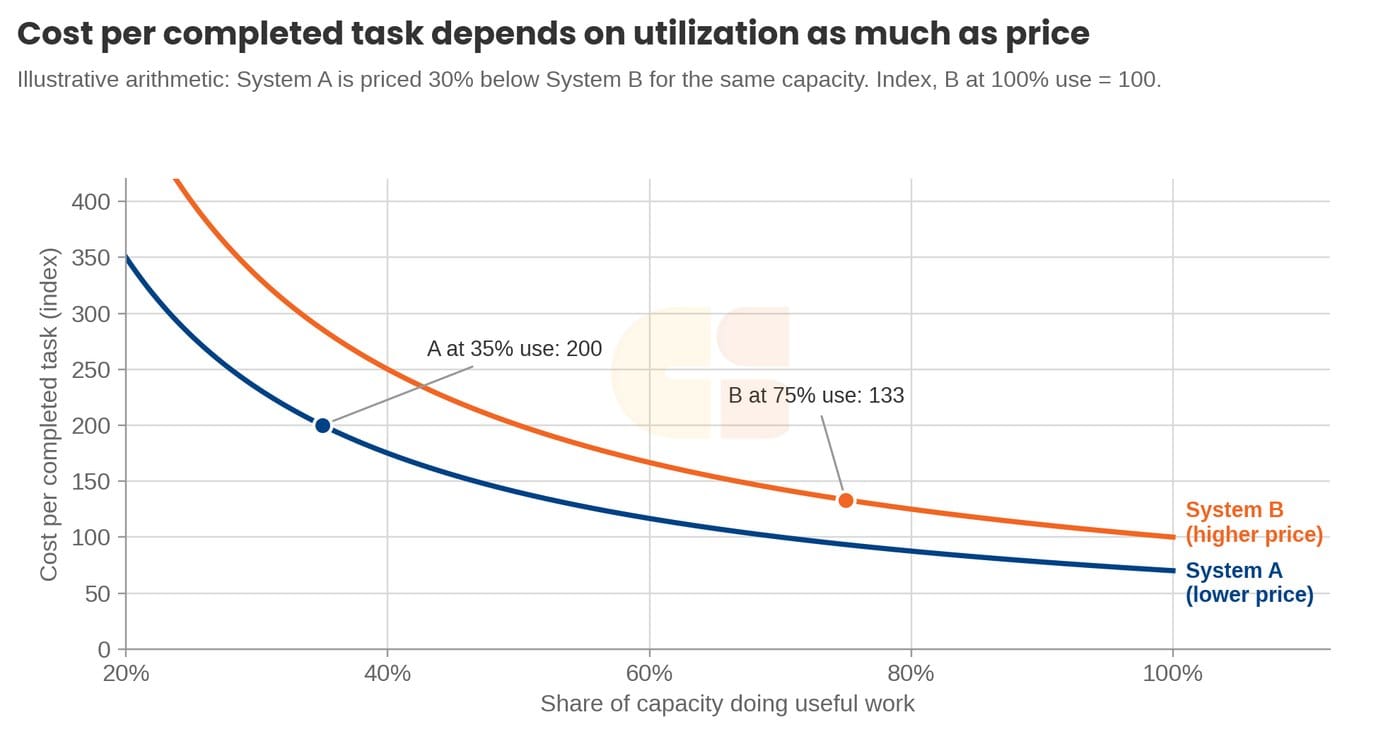
Source: Creative Strategies illustration. Hypothetical indexed systems, not measured AMD or competitor results.
Lower inference costs should also let companies apply AI to tasks that are too expensive today. Our growth outlook assumes that this broader use, together with more demanding tasks, absorbs enough of the efficiency gains to keep spending rising. There is a real sensitivity here. GPU revenue could fall below our forecast even as customers get more AI output, because the price of producing that output may fall faster than usage grows (Exhibit 7). This is the variable we find hardest to model, and it cuts both ways: if usage responds to lower prices faster than we assume, the upside surprise is just as real.
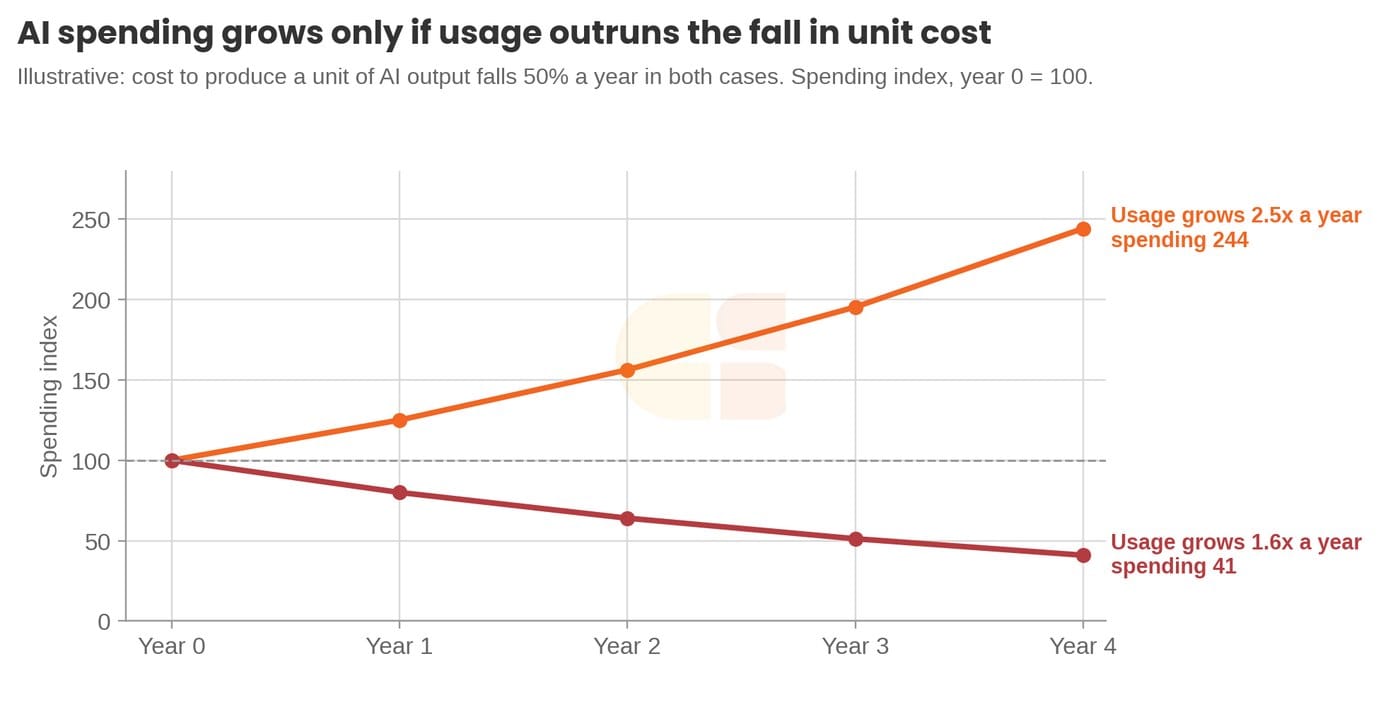
Source: Creative Strategies illustration of forecast sensitivity. Hypothetical growth rates, not a forecast.
Power availability adds another limit on how much work an operator can serve. With a fixed amount of power, the customer has to weigh how much output a system delivers within that limit alongside its purchase price. Getting more work from existing capacity is worth the most while the customer is waiting on a new building or a new power connection, and suppliers that improve that result give operators a reason to evaluate their systems on more than the price of the chips.
## Why the broader approach fits this market
AMD's position across compute and networking gives it more than one lever on the cost and performance of the customer's system, and software and system design decide how much of that benefit reaches the application. With inference running day after day, customers will have an ongoing measure of whether the equipment is serving enough work at a competitive cost. That makes this a prove-it story, and it is the test AMD's broader approach will be judged on.
Customers also have applications and supplier relationships they want to keep as they add AI. AMD's open approach gives them room to work with system and software partners, choose individual components, or adopt an integrated design where that saves time. Openness and integration are compatible. AMD can integrate the parts that need to work closely together and leave the rest of the deployment open, which is how its systems work and its merchant component business support each other. The counterargument is fair. Breadth is not proof of lower cost, and we do not assume that every AMD system will carry a lower total cost of ownership. Buyers will test their own workloads and account for the effort of moving software and reaching production. Our reason for viewing the portfolio as an advantage is narrower. It gives AMD more ways to address the cost and performance limits in that comparison than any single product would.
Two developments would change our view. The first is evidence that existing headroom absorbs agent activity for much longer than we expect, which would delay the bridge from activity to new CPU purchases. The second is unit cost declines outrunning usage growth for more than a year or two, which would pressure the GPU outlook even as AI output rises. We will be watching both.
Our strongest conviction is that AMD's strategy fits the direction of demand. The size and timing of these markets remain sensitive to adoption, software efficiency, and how quickly customers can bring new capacity into service, and those assumptions can move our forecasts. They do not remove the need for processors, networking, and software that work well together. AMD is positioned to compete for that spending, and how much it wins will depend on the systems it and its partners deliver.
## From the market opportunity to the technology
The market outlook gives us a starting point for evaluating the technology. Our CPU forecast reflects more work across the data center, the merchant GPU outlook reflects more use of models, and the networking forecast reflects the need to connect that capacity. Enterprise deployments add another route to customers through AMD's partners. Across all of them, recurring inference puts more weight on the cost of operating the complete system.
AMD has been investing toward those requirements for years. The next question is how its products and architecture deliver on the strategy, from the compute portfolio and Helios to networking and software. Paper 2 takes up that technology discussion and how those parts work together to support the market outlined here.
## Sources and forecast definitions
\[1\] AMD, "AAI 2026: AMD Delivers Full-Stack Compute for the Agentic AI Era," July 23, 2026\. AMD estimates an approximately $2 trillion total addressable market in 2030 across data center, PCs, edge, and embedded processors. This is AMD's forward-looking estimate, not a Creative Strategies forecast. Directional consistency refers to the expansion of compute demand, not a like-for-like validation of the total. [https://ir.amd.com/news-events/press-releases/detail/1294/aai-2026-amd-delivers-full-stack-compute-for-the-agentic-ai-era](https://ir.amd.com/news-events/press-releases/detail/1294/aai-2026-amd-delivers-full-stack-compute-for-the-agentic-ai-era?ref=creativestrategies.com)
\[2\] AMD, completion of Pensando acquisition, May 26, 2022\. [https://www.amd.com/en/newsroom/press-releases/2022-5-26-amd-expands-data-center-solutions-capabilities-wit.html](https://www.amd.com/en/newsroom/press-releases/2022-5-26-amd-expands-data-center-solutions-capabilities-wit.html?ref=creativestrategies.com)
\[3\] Creative Strategies AI Accelerator Core and AI Industry TAM models, October 2026\. "Approaching $1 trillion" refers to 2030 accelerator package value, including HBM, for the identified merchant GPU suppliers. It excludes custom ASICs and is a directional outlook, not an exhaustive merchant GPU market size or a supplier share forecast.
\[4\] Creative Strategies Server CPU TAM Forecast, October 2026, companion model to the Agentic CPU Guidebook. Annual server CPU silicon value in 2030, combining merchant CPU revenue and the imputed value of processors cloud operators design for their own use. It covers general-purpose, accelerator-host, and agent-native CPU demand; memory and complete systems are outside the figure. Captive value is not merchant supplier revenue.
\[5\] Creative Strategies Core Networking Model, October 2026\. Semiconductor content inside AI networking hardware. It is distinct from the broader finished-hardware market and should not be added to it.
\[6\] Creative Strategies AI Server Three Markets Model, October 2026\. Complete accelerated servers owned by enterprises and institutions, including privately owned equipment in colocation. It excludes cloud-owned infrastructure, facilities, power and cooling, software, and services. It is not AMD revenue and is not additive to the component forecasts.
\[7\] Dell, "Dell and AMD Are Expanding What's Possible for On-Premises AI," May 7, 2026\. Supports the partner and deployment discussion, not the size of our market forecast. [https://www.dell.com/en-us/blog/dell-and-amd-are-expanding-what-s-possible-for-on-premises-ai/](https://www.dell.com/en-us/blog/dell-and-amd-are-expanding-what-s-possible-for-on-premises-ai/?ref=creativestrategies.com)
\[8\] HPE, HPE and AMD compute solutions portfolio, accessed September 14, 2026\. Product coverage supports the partner discussion and does not imply that every HPE private AI offering uses AMD accelerators. [https://www.hpe.com/us/en/solutions/amd.%20html.html](https://www.hpe.com/us/en/solutions/amd.%20html.html?ref=creativestrategies.com)
\[9\] AMD, Helios overview and FAQ, accessed September 29, 2026\. Helios is a reference design for OEM and ODM partner systems. [https://www.amd.com/en/products/rackscale-solutions/helios.html](https://www.amd.com/en/products/rackscale-solutions/helios.html?ref=creativestrategies.com)
\[10\] AMD, CDNA architecture and Instinct MI350 microarchitecture, accessed September 29, 2026\. Chiplet and HBM integration support the architecture discussion, not a universal competitive performance claim. [https://www.amd.com/en/technologies/cdna.html](https://www.amd.com/en/technologies/cdna.html?ref=creativestrategies.com); [https://rocmdocs.amd.com/en/latest/reference/gpu-arch/mi350.html](https://rocmdocs.amd.com/en/latest/reference/gpu-arch/mi350.html?ref=creativestrategies.com)
\[11\] AMD, "The Agentic Era Runs on a CPU Foundation," July 2026, and EPYC OEM portfolio information. [https://www.amd.com/en/blogs/2026/the-agentic-era-runs-on-a-cpu-foundation-and-it-s-called.html](https://www.amd.com/en/blogs/2026/the-agentic-era-runs-on-a-cpu-foundation-and-it-s-called.html?ref=creativestrategies.com); [https://www.amd.com/content/dam/amd/en/documents/epyc-business-docs/infographics/cpu-you-choose-can-make-or-break-your-investment.pdf](https://www.amd.com/content/dam/amd/en/documents/epyc-business-docs/infographics/cpu-you-choose-can-make-or-break-your-investment.pdf?ref=creativestrategies.com)
\[12\] AMD, 5th Gen AMD EPYC launch announcement, October 10, 2024, and AMD public pricing table, accessed October 6, 2026\. Published 1KU USD list prices: EPYC 9575F (64 cores), $11,791; EPYC 9555 (64 cores), $9,826\. The 9575F is designed for GPU host systems. Product list pricing is illustrative, not a market ASP or forecast assumption.
Exhibits 6 and 7 are Creative Strategies illustrations built on hypothetical, indexed inputs to show a mechanism. They are not measured results or forecasts.
*© 2026 Creative Strategies. Forecasts are Creative Strategies outlooks, not AMD guidance. Product capabilities are described from public AMD documentation and are not claims of universal performance or measured customer savings.*
### RTX Spark: Entering the Age of Preference
URL: https://creativestrategies.com/research/rtx-spark-entering-the-age-of-preference/
Last updated: 2026-10-15T15:16:17.000Z
By Max Weinbach
We're in the age of preference. RTX Spark gets Windows close enough to the performance I've liked so much in the M5 Macs that the computer I want to use becomes a much more interesting question. The operating system, the design, and the configuration I prefer can carry a lot more weight now.
Apple has been building chips with this approach for about five years: a powerful CPU and GPU sharing a large pool of memory in a laptop. For the combination of performance and local AI capability I wanted, that meant buying a Mac. RTX Spark is the first Windows competitor that makes this feel like a real choice to me across AI, CPU performance, and gaming.
I know some people don't like seeing every new Windows chip compared directly with a Mac, they are different markets. In this case, I think the comparison is useful. You'll see M5 Max results throughout this review because they show the performance we had available before, alongside what RTX Spark now offers. These machines are really close in what they let me do, even when individual benchmarks have larger gaps. The reason I want to do this is simple, and why I think this preamble is important, a frame of reference to show how close these are and what is now available in the Windows ecosystem.
And there are a lot more options. Six OEMs are building computers with RTX Spark, with different designs and configurations running Windows. Linux could add another option, depending on support. We've gone from looking to one manufacturer's product lineup for this particular combination to having a much broader selection of computers. We'll talk more about those designs later. For now, I want to look at what the chip makes possible, with the benchmarks as one part of deciding which of these computers someone might actually prefer.
## The CPU still matters for AI
At one point while testing RTX Spark, I had 14 projects compiling and 15 coding subagents running WHILE playing a game. The fans were spinning, but I could still browse the web without the computer feeling overwhelmed. I really liked that. There was a ridiculous amount of work happening in the background, and I could keep using the machine.
This is increasingly how I use a computer. I have agents writing code, builds running, and applications open so I can see whether any of it actually works. Even when the model is running in the cloud, the computer on my desk has plenty to do. Add a local model, and the GPU and memory become a much bigger part of the experience too.
The coding agents in that busy session were using cloud models. My computer was doing the builds, running the tools, and opening the applications they produced. That distinction matters because it's easy to talk about AI performance as if the only thing happening is a model generating tokens. When an agent writes code, the CPU still has to do the work that follows.
NVIDIA's 20-core N1X configuration has ten Arm Cortex-X925 cores and ten Cortex-A725 cores. In my Geekbench 7.1 results, single-core performance was close to the Core Ultra 9 386H, with a much stronger multicore result. M5 Max was ahead of both.
| Geekbench 7.1 | RTX Spark 20-core | M5 Max | Core Ultra 9 386H |
| ------------- | ----------------- | ------ | ----------------- |
| Single-core | 2,610 | 3,739 | 2,530 |
| Multicore | 23,932 | 35,138 | 17,658 |
My test results. Higher is better.
Spark scored about 36% higher than the Intel system in multicore. Against M5 Max, it was about 30% lower in single-core and 32% lower in multicore. I also wanted to see how those scores translated into the development work I use these machines for.
I tested compilation, bundling, and type-checking across Go, Rust, TypeScript, and Python. These are the sorts of jobs that keep happening while a coding agent works through a project.
| Local development workload | RTX Spark, seconds | M5 Max, seconds |
| -------------------------- | ------------------ | --------------- |
| Go Kubernetes | 42.222 | 24.627 |
| Rust stack | 27.820 | 19.001 |
| Rust wide | 23.552 | 18.435 |
| TypeScript VS Code bundle | 0.606 | 0.254 |
| TypeScript tsc | 11.670 | 5.881 |
| Python mypy | 20.206 | 16.468 |
My average test times. Lower is better.
The Mac finished every one of these tests faster. Kubernetes took about 42 seconds on Spark and 25 on M5 Max. TypeScript type-checking took almost twice as long on Spark. The bundling test also favored the Mac, although we're talking about roughly a third of a second there.
I care more about the longer waits. An agent can build, find a problem, make a change, and build again several times before it's done. Saving time on each pass helps, even if the model itself is running somewhere else.
Spark still felt comfortable to use with all that work going on. I haven't run the same multitasking session side by side with the Mac, so I can't rank them on responsiveness. But I was happy with how much I could leave running without making the rest of the computer unpleasant to use.
## A Blackwell GPU with room for local models
The larger N1X configuration has 6,144 CUDA cores. For local AI, what interests me just as much is pairing that Blackwell GPU with up to 128GB of unified memory. Having access to NVIDIA's GPU software with that much system memory opens up more room to experiment with local models.
The memory is shared by the CPU and GPU, so Windows and my other applications need some of it too. The GPU's allocation also matters. A model needs space for its weights, working memory, and the context it keeps as a conversation grows. Fitting the model into memory doesn't mean every possible conversation or workload will fit alongside it.
Memory speed matters as well. NVIDIA specifies up to 300GB/s of memory bandwidth. There's also a 600GB/s bidirectional NVLink C2C connection between the CPU and GPU dies, but that's a different connection. The larger number isn't the bandwidth available for reading model weights from system memory.
CUDA is a big part of why this combination appeals to me. It also doesn't remove the need to check software support. This is a Windows Arm system, and the runtime needs to support the model, precision, and operations I want to use. How well those pieces work together matters a lot more to me than the CUDA core count by itself.
## How long am I actually waiting?
When I run a language model locally, there are two parts of the response to think about. First it processes the prompt, which is called prefill. Then it generates the answer, which is called decode. Both can happen on the GPU. The CPU work I described earlier is the work around the model, like compiling code and running applications.
Prefill can process many input tokens in parallel. Decode generates the answer a little at a time and, in many low-concurrency workloads, spends much of its time waiting on memory. Caching, batching, and the model itself can change that balance. [NVIDIA has a useful explanation of how this works](https://developer.nvidia.com/blog/mastering-llm-techniques-inference-optimization/?ref=creativestrategies.com).
I used AgentPerf to look at decode speed and end-to-end throughput. Both figures below are output tokens per second, but end-to-end throughput includes the time spent waiting before those output tokens arrive.
| Model | Spark decode | M5 Max decode | Spark end-to-end | M5 Max end-to-end |
| -------------------------- | ------------ | ------------- | ---------------- | ----------------- |
| Qwen 3.8 Flash Next | 36.39 | 73.42 | 25.51 | 26.05 |
| Qwen 3.8 27B with DFlash 2 | 25.19 | 57.52 | 22.00 | 8.44 |
| Liquid LM 24B-A2B | 90.92 | 133.92 | 75.69 | 101.54 |
My initial AgentPerf results, using the 128GB Spark configuration with the larger GPU. I still need to reconcile model precision, runtime settings, and replay configuration across the systems, so these are preliminary comparisons.
If I only looked at decode speed, the Mac would win every test here. With Qwen 3.8 Flash Next, it generated tokens about twice as fast. Include the rest of the request, though, and the two were within about 2% of each other. This is one of the main benefits of RTX Spark, the fp4 CUDA accelerators really helps with prefill performance. While Qwen 3.8 Flash N
The Qwen 3.8 27B run with DFlash 2 went further: Spark recorded 2.61 times the end-to-end throughput despite decoding more slowly. I can't pin that difference on prefill or the GPU from these totals alone. Cache behavior and runtime settings can affect the result too. With Liquid LM, the Mac was ahead on both measures.
This is why I want to see more than decode speed when I'm looking at local AI performance. I care about how quickly the answer arrives, including the time before it starts appearing. A faster stream of text doesn't help as much if I've spent longer waiting for it to begin.
[AgentPerf Local](https://github.com/ArtificialAnalysis/aa-agentperf-local?ref=creativestrategies.com) replays recorded agent conversations to measure model-serving speed. It doesn't score the quality of the answers, and its default mode doesn't execute the tools. These results cover the model's response; the development tests above cover some of the work that follows.
## NVIDIA's AI results
NVIDIA's own testing gives another useful example of that initial wait. In its Qwen3.8-27B AIPerf run on a 64GB ProArt P16, a 64K-token input and 1K-token output took 136.37 seconds to reach the first token and 197.14 seconds overall.
That's more than two minutes before the answer starts, or about 69% of the total time. NVIDIA disabled prompt caching for this test, so an ongoing conversation that reuses cached context can behave differently. It's a useful reminder of how much the prompt and cache settings matter when comparing results.
NVIDIA also supplied image and video generation results from a 128GB ProArt system. These are its measurements; I haven't reproduced them myself.
| NVIDIA-provided workload | Configuration | Average generation time |
| ------------------------ | ------------------------------------ | ----------------------- |
| FLUX2.Dev | NVFP4, 20 steps, 1024×1024 image | 42.31 seconds |
| FLUX2.Klein 4B Base | NVFP4, 20 steps, 1024×1024 image | 14.69 seconds |
| LTX 2.5 Distilled | NVFP4, 8 steps, 1280×736, 121 frames | 73.69 seconds |
A roughly 15-second image generation with FLUX2.Klein is the kind of use I'd be interested in trying locally. The settings matter here: all three workloads use NVFP4, and the table includes the steps and output sizes. I'd want to look at the output quality alongside the time before comparing them with another system or a higher-precision run.
## Where I land
The big takeaway for me is how close these machines are in the performance they make available for this work. M5 Max finished my development tests faster, and there are meaningful differences between individual results. I still came away thinking Spark is a really good alternative for someone who wants to do this work on Windows.
For the combination of performance, large unified memory, and local AI capability I wanted in a laptop, a Mac had been the obvious choice. Spark gives me another option. I can get NVIDIA GPU acceleration and a large shared memory pool in a Windows machine I can also use to build and test Windows applications.
Operating-system preference matters a lot here. Some people prefer Windows, and having a Mac finish a benchmark faster doesn't change the operating system they want to use. They should have good options for this kind of work too.
With Spark, that choice also extends to different manufacturers and different laptop designs. Someone can pick the size, design, and operating system they prefer while getting performance that's close to what has made the M5 Macs so compelling. It doesn't need to win every test to be a good choice. Having this level of performance available across more Windows laptops is a big deal to me.
## Gaming
I also played Control Resonant while two coding agents worked on native Windows applications. One was working on GPU shaders for a UI graphic, and the other was improving an agent workflow. The game felt smooth, and I didn't notice frame drops in that session. I wasn't recording frame times, but I liked being able to play while that work continued.
NVIDIA's supplied gaming results include 135 average FPS in Cyberpunk 2077 on a 64GB ProArt P16\. That's at 2560×1440 output with RT Low, DLSS Balanced, and 3× frame generation, so the number includes upscaling and generated frames. It's NVIDIA's measurement; I haven't reproduced it myself.
### Apple Brings the Home Into View
URL: https://creativestrategies.com/research/apple-brings-the-home-into-view/
Last updated: 2026-10-13T16:26:36.000Z
Apple HomeView, the $299 home device Apple announced today, is a square 7-inch display that brings the household and the individual together on one screen. Its use cases are familiar ones. What Apple brings is simplicity and a better experience to the home, an environment where people have little patience for friction. Part of that simplicity comes from a UI that borrows heavily from Apple Watch.
Alongside HomeView, Apple announced Apple Home Collection, a lineup of cameras, a video doorbell, a door lock, thermostats and sensors designed with LG Electronics and Schneider Electric, as well as a new Apple TV 4K and HomePod mini 2.
**A small screen with a clear job**
Seeing HomeView in person in New York, the first thing that struck me was how small it is. The rumored images made it look far bigger. It is a square 7-inch screen on a domed speaker base, and it reads as a cross between Apple Watch and the iMac G4.
The form factor makes clear that Apple designed HomeView to sit apart from the devices people already use for consumption at home, such as iPhone, Mac, Apple TV and iPad. Its role is to give a view of the home and the people who live in it.
**The household and the individual**
HomeView brings together everyone who lives in the home through their Apple ID and iPhone. This is what I hoped Apple would deliver. The household, whether a family or roommates, shares photos, music and control of the home, and guests can join in. Each person also gets their own experience. HomeView recognizes up to six faces, and someone's messages or calendar only show up when that person is in front of it with their iPhone nearby, a sensible safeguard for a screen anyone in the house can walk up to.
Apple made a deliberate choice here, and it makes HomeView a smart home hub in a different form than many of us, me included, expected.
**Apple Watch DNA**
When the rumored images circulated, all I saw was a watch, and the final product confirms it. You swap faces on HomeView the way you do on your wrist, whether that is a photo album, an ambient art face or a grid of camera feeds, and widgets sit where complications would. The screen even adjusts how much it shows depending on how close you are standing. A lot of what Apple learned on Apple Watch carries over, the same pattern I wrote about with Apple Vision Pro.
Continuity of design does more than let Apple reuse what it has perfected. A familiar interface lowers the learning curve, which matters most for a device entering a new category, as HomeView does.
**Built for privacy, priced for more than one**
HomeView runs on Apple's A18 chip. Camera and microphone data is handled in Secure Exclaves, protected areas of the chip kept separate from the rest of the system, so neither apps nor Apple can access it. Siri AI requests are processed either on HomeView itself or in Private Cloud Compute, Apple's private cloud, where the data is not stored and is not accessible to Apple. The sound is great, especially for a device this compact.
The attention to detail shows in the use cases Apple demonstrated. In the kitchen, HomeView turns recipes from the web into step-by-step instructions, with the ingredients first and then each step. You advance with a swipe, or ask Siri to move forward when your hands are covered in dough.
HomeView can sit on a counter or go on the wall, as a separate model that uses mounts from Schneider Home. Both versions cost $299\. At that price, Apple might be encouraging homes to own more than one: one by the bed, one in the kitchen. It adds to the Apple devices a household already owns with little risk of cannibalizing them.
**Apple Home Collection, a first with LG and Schneider Electric**
Apple Home Collection is a lineup of smart home accessories designed with LG Electronics and Schneider Electric, a first for Apple. LG covers cameras, a video doorbell, a smart lock, a thermostat and a sensor, and Schneider Home adds its own thermostat and room sensor, so buyers can pick the one that fits the energy setup they already have.
The Apple influence is visible in the design, the simplicity, and of course the privacy, since neither the partners nor Apple can see your Home data. Setup is a tap with your iPhone, with no extra app or account, and none of the engineering degree the smart home still seems to require. The details that stood out to me address frustrations people actually have with the smart home. Accessories update themselves when you change your Wi-Fi password, and the indoor camera physically tilts down and stops monitoring as soon as the first person gets home.
The lineup builds on Thread and on Matter, which Apple has supported for several years, with an Apple layer on top. I hope this helps other partners see where the opportunity in the home sits.
**Apple TV 4K and HomePod mini 2**
Apple TV 4K gets a solid update. Siri AI turns finding something to watch into a conversation, and you can ask questions about a show while it plays without leaving it. With far-field microphones built in, you no longer need the remote to talk to Siri.
HomePod mini 2 gets Siri AI later through a software update and, like HomeView, recognizes the different people in a household, in this case by their voice. It also gains Sound Glow, a light on top that moves with the music and takes its colors from the album art, a small touch that helps a speaker feel at home on a shelf.
The surround sound setup is where the simplicity shows. Four HomePod mini 2 speakers can now pair with Apple TV 4K, and they work out where they sit in the room and tune themselves, so people get a home theater without fiddling with settings. Anyone who has tried to calibrate a traditional surround system will appreciate that. HomePod (2nd generation) works in the same setup too.
**Who it is for, and the real competition**
HomeView speaks to two groups. The first is people deeply invested in both Apple products and the smart home. The second is Apple users who want a simple device and are less tech-savvy than most early adopters. Easy FaceTime and easy pairing of smart devices serve them well.
For Apple, that widens the connected home beyond early adopters. It also sets up the real competitive fight. Many iPhone users turned to Alexa for the home. HomeView's use cases are familiar, and a familiar, private device tied to the iPhone already in their pocket gives those users a reason to bring the home back to Apple.
The invite for today's event read "Welcome home," and the welcome was for Siri AI. HomeView, Apple TV 4K and HomePod mini 2 all bring Siri AI into the rooms where people spend their time, through far-field microphones, voice and face recognition, and a screen that shows answers at a glance. Apple Home Collection gives Siri more of the home to act on, from the front door to the thermostat. People have already been enjoying Siri AI on the go, through iPhone and Apple Watch. With this lineup, Apple is making Siri AI part of everyday life at home.
### Google's Gemini Agent Bets on Governance and Model Choice
URL: https://creativestrategies.com/research/googles-gemini-agent-bets-on-governance-and-model-choice/
Last updated: 2026-10-12T23:57:58.000Z
At Gemini at Work 2026 on October 8, Google Cloud CEO Thomas Kurian introduced the [Gemini agent](https://cloud.google.com/blog/products/ai-machine-learning/welcome-to-gemini-at-work-2026?ref=creativestrategies.com): one agent that answers questions, carries out multi-step work and writes and runs code from a single prompt box. It runs in the cloud, keeps one memory across devices and channels, and picks the model for each job, Anthropic's Claude included. The design is coherent, and the governance controls are the most detailed any vendor has announced this year. Google is also the last of the big four to ship this kind of agent, it has not given a date for general availability, and its cost depends on consumption rates Google has not published.
**The name**
Google is simply calling it Gemini. In its analyst Q&A, the company said Spark, its consumer agent, has folded into it, and that the agent is the same whether you reach it from Workspace, the desktop or the command line. Google's comparison is Gmail: one product for consumers and businesses, with different controls and licensing behind it.
That choice makes sense. The Gemini app has [950 million monthly active users](https://blog.google/company-news/inside-google/message-ceo/alphabet-earnings-q2-2026/?ref=creativestrategies.com), according to Alphabet's Q2 results, so employees meet the agent already knowing the brand. Microsoft made the same choice with Copilot: at general availability, [Copilot Cowork](https://www.microsoft.com/en-us/microsoft-365/blog/2026/06/16/copilot-cowork-is-now-generally-available/?ref=creativestrategies.com) runs on Anthropic models, with OpenAI's GPT 5.5 available to Frontier customers, all under the Copilot name.
The name already covers several products. Google sold Gemini as Workspace add-ons until it [folded AI into Workspace plans](https://workspace.google.com/blog/product-announcements/empowering-businesses-with-ai?ref=creativestrategies.com) in January 2025, and Gemini Enterprise has been the name of its agent platform since it [launched](https://blog.google/company-news/inside-google/message-ceo/alphabet-earnings-q4-2025/?ref=creativestrategies.com) last October. The models keep the Gemini name too, and Google says capability labels such as Gemini 4 Argon will separate model names from product names. An agent called Gemini that sends some of its work to Claude depends on that separation sticking. Where Workspace ends and Gemini Enterprise begins is still unclear, and Google's own explanation covers capabilities more than cost. One name works for users. Buyers still need Google to spell out which SKU includes what.
**Workspace integration**
Inside Gmail, Docs, Sheets, Slides, Drive, Chat and Calendar, Gemini works inline with the same memory, skills and controls it carries elsewhere. Asked to set up a meeting with "the usual regional event leads," it works out who they are from a Chat space and an old thread, checks calendars and starts the email. Workspace Intelligence flags requests the agent can take on, such as a manager asking for an update deck, and offers a one-click handoff.
The more consequential piece is the coworker agent. Describe a role and Gemini creates an agent with its own Workspace account: email address, calendar, Drive and a directory entry. Colleagues @mention it in Chat or tag it in a comment, its edits appear under its own name in version history, and it sees only what is shared with it.
That visibility is what regulated customers need. It also raises questions the keynote left alone: who reviews the agent's work, who answers for it when it gets something wrong, and how a team's sense of shared ownership shifts when one of its members is software. Those are management questions, and they will decide how far coworker agents spread inside a company.
On price, Google says there is no incremental seat license for the agent in Workspace or Gemini Enterprise. That extends its January 2025 decision to fold Gemini into Workspace plans, which Google said left a[ Business Standard customer paying $2 more a month](https://workspace.google.com/blog/product-announcements/empowering-businesses-with-ai?ref=creativestrategies.com) than Workspace without Gemini. Microsoft has taken the other route. As I argued in July in[ Copilot Seats Are the Bridge for Agents](https://creativestrategies.com/research/copilot-seats-are-the-bridge-for-agents/), the Microsoft 365 Copilot seat is best read as an installation base: it is the prerequisite for[ Copilot Cowork](https://www.microsoft.com/en-us/microsoft-365/blog/2026/06/16/copilot-cowork-is-now-generally-available/?ref=creativestrategies.com), which Microsoft bills on usage on top of the license. Google's analyst Q&A shows both companies end up in a similar place. When the Gemini agent steps outside Workspace to run cross-system work, it draws on Gemini Enterprise's consumption-based capacity. That work is billed on usage, which is why Google launched project-level spend caps with the agent. Google has yet to say whether a coworker agent with its own account consumes a seat.
**Competitor landscape**
Microsoft took [Copilot Cowork](https://www.microsoft.com/en-us/microsoft-365/blog/2026/06/16/copilot-cowork-is-now-generally-available/?ref=creativestrategies.com) to general availability on June 16\. OpenAI launched [Frontier](https://openai.com/index/introducing-openai-frontier/?ref=creativestrategies.com) on February 5\. Anthropic made [Claude Cowork](https://support.claude.com/en/articles/12138966?ref=creativestrategies.com) generally available on April 9\. All four now make the same promise: hand over an outcome, get finished work back, and govern the agent the way you govern an employee.
Anthropic is in an unusual position. Its engine powers Microsoft's Cowork, its models run inside Google's agent, and it sells its own product to the same buyers. Each vendor builds on what it already sells. Microsoft works inside the Microsoft 365 tenant, OpenAI sells an operating layer backed by forward-deployed engineers, and Anthropic starts from the knowledge worker's desktop. Google leads with data and infrastructure: a Knowledge Catalog for shared business definitions, a lakehouse that queries Amazon S3 and Azure Data Lake without variable egress fees, and TPUs it says deliver 80% better price-performance than the previous generation.
Google is also going after Microsoft customers directly. The agent works inside Microsoft 365, Teams and Slack, so a company standardized on Office can buy it without moving. Ryanair, rolling out Workspace and Gemini Enterprise to 35,000 employees under a dual-cloud strategy, is the kind of mixed estate Google is after.
**Gemini vs. Microsoft Copilot deployment**
Microsoft reported more than 30 million paid Microsoft 365 Copilot seats in its [July earnings](https://www.microsoft.com/en-us/investor/earnings/fy-2026-q4/press-release-webcast?ref=creativestrategies.com), up from [15 million in January](https://www.microsoft.com/en-us/investor/events/fy-2026/earnings-fy-2026-q2?ref=creativestrategies.com). Against the more than 450 million paid Microsoft 365 commercial seats Microsoft reported in January, that is under 7%, so even strong growth shows how slowly a per-seat add-on spreads. Microsoft also says Agent 365 had [nearly 40 million agents registered](https://www.microsoft.com/en-us/investor/events/fy-2026/earnings-fy-2026-q4?ref=creativestrategies.com) two months after launch.
Google reports different metrics. Its last seat figure was [8 million Gemini Enterprise seats](https://blog.google/company-news/inside-google/message-ceo/alphabet-earnings-q4-2025/?ref=creativestrategies.com) in February. Since then it has cited nearly 90% of the Fortune 100, nearly 500 customers processing over a trillion tokens each, and the Department of Defense putting Gemini in front of 3 million personnel. A Fortune 100 company counts whether one team uses Gemini or everyone does, and with Gemini bundled into Workspace there is no add-on seat to count.
Model choice is open, while the memory, context and skills an agent builds up stay in Google's layer, and that is where switching costs will be. The same holds for Microsoft. Whichever agent a company lets learn its work first becomes the hardest one to replace.
### Amazon's Alexa Tablets Make a Real Case Against the iPad Air
URL: https://creativestrategies.com/research/amazons-alexa-tablets-make-a-real-case-against-the-ipad-air/
Last updated: 2026-10-16T00:45:01.000Z
The new Amazon Alexa Tablets, announced on October 8 in a post on the About Amazon news site by Kevin Keith, Vice President of Devices, are the first Amazon tablets that can credibly compete with Apple's iPad Air. Three decisions get them there: full access to the Google Play Store on Android, aluminum hardware with specs that hold up against the iPad Air, and a sharper focus on what only Amazon offers, Alexa+ and its content. The top model, the Alexa Tablet 12 Pro, starts at $499.99, $100 below the 11-inch iPad Air.
## Google Play is the right call
For years, Amazon asked tablet buyers to live without Gmail, Google Docs and much of the Play catalog in exchange for a lower price. That bargain confined Fire tablets to entertainment and kept them out of consideration for anything resembling work. Amazon's advantage was always going to come from its services, so maintaining a parallel app store on tablets made little sense.
I am glad to see Amazon make this move. With Google Play settling the app question, Amazon can put its effort where it has something other tablet makers cannot match: Alexa+ and its content.
## Alexa+ at the center
Alexa+ is built into every model. Users call it by voice or with an Ask Alexa button, and it appears over whatever app is open. The more interesting feature is On-Screen Intelligence, which lets Alexa read what is on screen and act on it, such as pulling the dates from a sports schedule into a calendar and flagging conflicts. Live sessions keep a hands-free conversation going without repeating the wake word, and users can share the screen so Alexa follows along as they browse.
Amazon deserves credit for the defaults. Every On-Screen Intelligence feature is off until the user opts in, a visual indicator shows whenever Alexa can see the screen, and each feature can be switched off in Settings. Screen-aware assistants are where AI on personal devices is heading, and starting from opt-in is how a company earns the trust these features require.
The open question is habit. Google Play puts Gemini and ChatGPT one download away on the same device. Alexa+ has the advantage of being built in, free for Prime members in the US, and connected to the user's Amazon history and smart home. It still has to be useful often enough that people reach for it first.
## Content, and a reading mode worth copying
Every tablet connects Prime Video, Kindle, Audible, Amazon Music and Amazon Luna out of the box, with a For You feed that brings together what the user is watching, reading and listening to. This is Amazon's core strength, and the new home screen puts it front and center.
The feature I find most compelling is the Kindle reading mode. Open a book and the tablet silences notifications, reduces blue light and stretches battery life to up to 20 hours, with three display themes ranging from natural color to grayscale. On the 12 Pro, the Pro Pen can highlight and annotate pages, and those notes sync with Kindle Scribe. For consumers who own a Kindle and also carry a tablet, this mode could make a single device enough. Amazon is likely comfortable with that consolidation, since the reader stays in Kindle and spends more on the tablet. Tablets have become devices of constant interruption. A mode designed around focus speaks to how many people feel about their screens, and other platforms should take note.
## Hardware that can compete
This lineup also shows the influence of Panos Panay, who joined Amazon in 2023 to lead Devices & Services after nearly two decades at Microsoft, where he built the Surface line. His priorities run through these tablets: premium materials, careful display engineering and accessories designed alongside the device, delivered at prices Amazon's customers will accept. Under Panay, Amazon devices increasingly stand as products in their own right, offering a rich experience at an affordable price.
The Alexa Tablet 12 Pro is the device that changes Amazon's position, and its design choices show who Amazon has in mind. The 3:2 display gives more vertical room than the widescreen shape most Android tablets use, which pays off in books, documents and web pages. The 120Hz refresh rate makes scrolling and pen input feel responsive, and the optional Nanomatte glass, developed with Corning, cuts glare while keeping text sharp, a real benefit for anyone who reads outdoors or works under harsh office lighting. Rated battery life of up to 16 hours of video covers a full workday and the flight home. Choosing the USI 2.0 pen standard is a practical call too, since compatible third-party pens will work with it.
The rest of the lineup covers the price points where Fire tablets used to live. The Alexa Tablet 11, at $329.99, is the entertainment model, with a sharper and smoother display than buyers have come to expect at that price. The Alexa Tablet 8, at $229.99, is light enough to hold in one hand through a long reading session, which makes it the most natural candidate for the Kindle consolidation described above. The Kids versions add a protective case, a year of Amazon Kids+ and a redesigned Parent Dashboard, carrying Amazon's strongest family product into the new lineup.
## The iPad Air math
The 12 Pro starts at $499.99 with 8GB of RAM and 128GB of storage, or $549.99 with Nanomatte. Apple's iPad Air with M4, released in March, starts at $599 for the 11-inch model and $799 for the 13-inch. Add Amazon's $149.99 Pro Keyboard and $89.99 Pro Pen and the complete 12 Pro setup comes to about $740\. An 11-inch iPad Air with Magic Keyboard ($269) and Apple Pencil Pro ($129) lands near $1,000, and the 13-inch configuration passes $1,200.
For that money, Amazon delivers a larger screen than the 11-inch Air, a 120Hz refresh rate Apple reserves for the iPad Pro, and an anti-glare display option Apple only offers on its most expensive iPad Pro configurations.
The iPad Air keeps real advantages. The M4 is a proven chip, while Amazon describes its processor only as a 4nm 8-core part. iPadOS has a deep catalog of apps designed for large screens, and Android tablet apps remain uneven. Apple supports iPads with software updates for many years, and Amazon's announcement includes no update commitment. Creatives built around Procreate and the Apple Pencil will stay where they are.
The buyer Amazon can win is the Prime household that uses a tablet for streaming, reading, browsing and some email and documents. For that person, the iPad Air has been the default upgrade because nothing comparable existed at a lower price. Amazon now has a credible alternative.
## A second run at business
Amazon also positions these tablets for work. The 12 Pro supports multiple windows side by side with its keyboard and trackpad, offers separate work and personal profiles. Amazon tried to reach business users once before with Alexa for Business, launched through AWS in 2017 to bring the assistant into offices and meeting rooms. It never found traction, and Amazon wound it down.
Amazon Quick, AWS's agentic AI workspace for business users, is now a high priority for AWS, and it gives Amazon the business software anchor it lacked when Alexa for Business launched. A tablet that can support Quick, work profiles and runs the Google Play apps companies already use gives Amazon devices a credible path back into the workplace, starting with organizations already on AWS. The work still ahead is in device management, security certifications and enterprise sales, areas where Apple and Samsung are well established.
Amazon spent years selling tablets close to cost to sell everything else. This lineup asks people to value the tablet itself, with Google Play removing the old objections and Alexa+, Kindle and Prime Video giving them reasons to choose it. The hardware makes the case. Software updates and app quality over the next two years will decide whether buyers trust it.
### Hybrid AI and Trust Are Why the Surface Laptop Ultra Exists
URL: https://creativestrategies.com/research/hybrid-ai-and-trust-are-why-the-surface-laptop-ultra-exists/
Last updated: 2026-10-08T01:20:42.000Z
**Hybrid AI Set the Terms**
Microsoft opened its Windows and Surface event in San Francisco on October 7 with Satya Nadella, Microsoft CEO, and Pavan Davuluri, executive vice president of Windows and Devices, laying out the case for hybrid AI. Many in the room were there for the Surface Laptop Ultra. The opening framing explains why that device, and the RTX Spark laptops from Microsoft's partners, need to exist.
The argument for splitting AI work between the device and the cloud usually rests on privacy and economics: keep sensitive data local and stop paying for cloud inference on every task. Nadella and Davuluri added a third point. Hybrid will become the default workflow for users and agents alike, with work moving between the PC and the cloud depending on what each task needs. Microsoft calls this hybrid intelligence: a local model handles the work suited to the PC, and a cloud model adds capability when the task needs it. GitHub is building the idea into developer tools with HydraFusion, which routes work between local and cloud models in the GitHub Copilot app, Copilot CLI and Visual Studio Code, with an experimental preview due later in October. Accept that premise and the new hardware has a clear job. It is where the local half of that workflow runs.
**Trust Starts at the Operating System**
The second theme of the day was trust, and Microsoft approached it from two directions. The technical one is Microsoft Execution Containers, or MXC, which the company introduced at Build in June. MXC isolates agents from the user's desktop, clipboard and input devices, ties each agent to its own local or Entra-backed identity, and enforces the file and network access a developer declares before the agent acts. MXC became generally available on Windows 11 today, so organizations can now set which files and networks an agent can reach and have Windows enforce those limits while it runs. Microsoft also showed MXC integration for OpenClaw as part of a simpler setup for popular agents.
In the fireside chat with Nadella that closed the event, moderated by Sriram Krishnan, Jensen Huang, Nvidia CEO, called MXC the cornerstone of the agentic era. His endorsement carries weight because Nvidia silicon now sits inside Windows PCs built to run agents locally. A sandbox that IT departments can manage with the identity and policy tools they already use is what makes a powerful local machine one an enterprise will let agents operate on.
**Trusting the Agent Itself**
The second direction is harder to engineer. Users have to trust the agent they are running before they will let it act for them. That trust has three parts: confidence the agent can do the job, confidence it followed instructions correctly, and confidence the data it touched stayed private and secure.
Delegation between people works the same way. A manager gives a new hire small tasks, checks the output, and hands over more as the results hold up, until checking stops feeling necessary. Agents will earn autonomy on that curve. Each task done right lowers the bar for the next one, and each visible mistake raises it. MXC covers the security part. Capability and accuracy get earned one task at a time, which makes the earliest experiences disproportionately important.
**Meeting Consumers Where They Are**
Trust matters for consumers too, and most of them are still uneasy about agents. Microsoft is meeting them at that level with the new search bar in Windows, which can now take actions such as sending a message or changing a PC setting. Search actions start rolling out today to Windows Insiders in the Experimental channel, with examples including switching to dark mode, turning on Do Not Disturb and arranging windows. Optional Copilot integration in taskbar Search follows in select markets later this year.
Small, low-stakes tasks are the right place to start. Every time AI gets a simple action right, it builds the confidence consumers will need before they consider agents for areas such as health and finances. Those are also the areas where many people will want the work done locally, which brings the argument back to hybrid AI and to the hardware that makes local processing practical.
**A Workstation for Local AI**
The Surface Laptop Ultra starts at $2,599 with Nvidia's RTX Spark platform, an 18-core N1X CPU, a 5,120-core Blackwell GPU, 24GB of unified memory and 512GB of storage. Higher configurations step up to a 20-core Grace CPU and 6,144 GPU cores, and Microsoft says the machine can run local agent workflows on models of up to 120 billion parameters. The 15-inch PixelSense Ultra touchscreen reaches 2,000 nits of peak HDR brightness, the chassis is under 18mm thin and 4.5 pounds, and the SSD is removable and upgradeable to 2TB. The top configuration, with 128GB of memory and a 1TB SSD, reaches $5,899.99\. Preorders opened today and units ship October 16, alongside RTX Spark laptops from ASUS, Dell, HP, Lenovo and MSI. The Surface RTX Spark Dev Box, a compact desktop with 128GB of unified memory that ships with Visual Studio Code, GitHub Copilot, WSL and other developer tools set up, follows in November at $5,999.
These prices put the category out of reach for most PC buyers. But, honestly, they are not for everyone. They are AI workstation. Sure The Surface Laptop Ultra can handle gaming well, but its primary role is as the home for local AI workloads, with up to 128GB of unified memory available to large models running on the device. That is the configuration Apple has owned with the MacBook Pro. Microsoft names the target outright: its launch promotion offers up to $1,000 back on a qualifying trade-in through November 23, marketed as breaking up with your MacBook. Windows buyers who want unified memory and serious on-device AI performance in a laptop now have a credible alternative, from six brands.
**Reinventing the PC**
Huang closed the conversation by telling Nadella, Davuluri and the Microsoft team that together they have reinvented the computer as we know it. Anyone judging RTX Spark machines on whether every Windows app runs natively on Arm is applying the test of the PC we have used for decades. The reinvention Huang described is about agents, and agents will get work done in a different way from how we move between apps today.
Huang also pointed out that agents can draw on every feature these devices have, while people are limited to the features they know about. Most of us use a fraction of what our hardware can do. Running on a machine like the Surface Laptop Ultra, an agent will extract far more from it than its owner ever could.
### Qualcomm Makes Its Case for the Phone as AI Hub
URL: https://creativestrategies.com/research/qualcomm-makes-its-case-for-the-phone-as-ai-hub/
Last updated: 2026-09-24T21:21:07.000Z
Qualcomm came to Maui for their annual Snapdragon Summit with the clearest version of its AI strategy I have heard from the company, and with the same structural limit it has always had. Apple can promise AI that works across devices because it designs the silicon, writes the operating system, and ships the hardware. Qualcomm controls the first of those three. Everything else it delivers through Google, Microsoft, and the phone, PC, and wearable makers that build on Snapdragon. The most interesting thing about this year's Summit was how deliberately Qualcomm is organizing itself around that dependency.
**The phone stays at the center**
Qualcomm President and CEO Cristiano Amon used his opening keynote to address the question that follows every new AI wearable. "Your phone is not going anywhere," he told the audience, arguing that the phone is unique to you, always with you, and has been personalized to you, which makes it the device that knows you best and therefore essential for agentic experiences. Other devices become endpoints: the agent sits at the center, with your phone, PC, glasses, wearables and car all serving as endpoints for it.
It is the same point John Ternus landed at Apple's iPhone event earlier this month, when he described the iPhone as the intelligent personal hub. As I wrote then, that is an expansion argument. Settling the succession question frees a company to add devices around the phone. Sergio Buniac, speaking on stage in his new Qualcomm role, described smartphones becoming the AI hub for our agents, connected to a platform of devices that touch our lives every day.
**Android's Best Shot at an Apple-Like Experience**
Apple's cross-device experience works because one silicon team designs the chips in the iPhone, Mac, iPad, Watch and AirPods, and every product is built to work with the others. Android brands have always assembled their experiences on top of a mix of chipmakers and platforms, which makes that kind of continuity harder to deliver. Qualcomm is the closest Android gets to a shared foundation, and in that sense, Qualcomm is the merchant equivalent of Apple silicon.
The announcements this week filled in the pieces. The new flagship phone platforms include a Sensing Hub designed to continuously process voice activity and personal context at very low power, the kind of always-on context a hub needs. Snapdragon Sound Elite Gen 2 supports earbuds, over-ear headphones, open-ear audio, audio glasses, hearing devices, and camera-equipped earbuds. Googlebook, a new laptop category built around Gemini Intelligence, launches with Snapdragon X Elite, with Dell and HP among the first manufacturers. Features like Cast My Apps, which opens apps from an Android phone on the laptop without installing them separately, are the phone-as-hub idea in practice. On the Windows side, Microsoft took the Summit main stage to introduce the next Surface Pro 12-inch and Surface Laptop 13-inch on Snapdragon X2 Plus, putting Snapdragon in the newest laptop launches on both Google's and Microsoft's platforms.
Googlebooks from Acer, Asus, Dell, HP and Lenovo are available for pre-order on both Intel Panther Lake and Snapdragon X Elite, so Qualcomm has competition on the laptop. What Intel lacks is the phone, the earbuds, and the glasses. Snapdragon now spans smartphones, PCs, XR, wearables and automotive. When the same platform sits in the phone someone carries, the laptop they work on, the earbuds they wear, and the car they drive, Android brands have a common foundation for the continuity Apple users take for granted. Apple builds that experience with its own chips across its own products. Qualcomm gives Android the opportunity to build it across brands.
**Bringing a technology to market**
When I talk about Qualcomm, I always point out that its role in making a technology mainstream has extended well past the chip into everything needed to bring it to market. This week that meant healthcare. Qualcomm and Global Health Connector launched the Personal AI Health Alliance, with founding members including Optum Health, Scripps Health, Merck KGaA, and the Digital Medicine Society. The goal is to speed up commercialization of continuous, privacy-supporting health solutions that use on-device AI to provide wellness insights between clinical visits.
Wearables have been collecting health data for years, and turning that data into clinical value has been slow. An alliance is a starting point. Its value will show in products that clinicians trust and health systems adopt.
**A more integrated Qualcomm**
Now more than ever, I see a company internally integrated enough to thrive on a better-together story. Buniac's appointment is part of that. He was named group general manager of mobile computing and XR, bringing device experience from his years as Motorola's CEO, which brings phones and XR under one group leader and matches the hub thesis.
The partnerships showed up again. Google's Rick Osterloh, on stage with Amon, said the move to AI-driven computing requires deep collaboration across every level of technology, with Gemini understanding your context whether you are in the car, on your phone, or at your desktop. Mastercard described building a trust layer for agentic commerce. Xiaomi and Motorola announced phones on the new platforms, and Honor showed its AI robot phone. With the Modular acquisition, Qualcomm plans to open source Mojo and MAX so developers can optimize AI across hardware, including other chipmakers' silicon.
**Fandom as a trust strategy**
The marketing and branding story has become central, and Qualcomm opened the Summit with it. Before any chip was mentioned, Qualcomm's Don McGuire talked about community. The Snapdragon Insiders community has grown to 23 million members, Snapdragon creators reached a combined 405 million people over the past year, and Qualcomm cited research that 92% of tech buyers trust peer recommendations over traditional marketing.
AI has an image problem. Consumers are wary of what it does with their data, their jobs, and their attention. Leaning into communities and fandom through Manchester United, Mercedes F1, and creators helps, provided the message stays genuine and transparent. That condition applies to the products as much as the messaging. In the mobile keynote, Qualcomm described an image signal processor that can add demographic information to the pixels it analyzes while identifying and tracking individuals as they move. Capabilities like that need careful explaining to the fans Qualcomm is courting.
Qualcomm has built the audience. The products arriving over the next year have to earn the trust it is asking that audience to give.
Disclosure: Qualcomm covered my travel costs to attend Snapdragon Summit
### M5 Ultra Mac Studio: Frankly, It’s Overpowered
URL: https://creativestrategies.com/research/m5-ultra-mac-studio-frankly-its-overpowered/
Last updated: 2026-09-22T21:05:20.000Z
The M5 Ultra Mac Studio is insanely good. For how I work, it is the most compelling local AI machine I’ve used, and frankly it feels overpowered. I can have a capable model loaded, agents doing real work, Xcode open, and still use the computer normally. I keep trying to find the point where I have to choose between pushing the GPU and getting on with everything else, and so far I haven’t found it.
My configuration has 256GB of unified memory, but memory alone only gets a model onto the machine. The model needs to be fast enough to use, and the rest of the computer needs to keep up with it. M3 Ultra could run capable local models, but I could feel the desktop hitch when I pushed inference and tried to work at the same time. On M5 Ultra I have not had that problem in my use. The CPU is great, the GPU is great, and honestly it is hard to really push this thing. It's funny, a few days before the M5 Ultra was announced I was actually talking to a few friends and was telling them after nearly 18 months I was finally able to really hit the limits of M3 Ultra. Well, I have yet to hit that for M5 Ultra.
It's funny, if you've been following Creative Strategies for a bit, you may notice our website got a slight redesign recently. This was actually done using GPT 5.6 Sol and GPT 6 Astra recently, but both of these were running on the M3 Ultra Mac Studio I've been using for the past year or so. The reason I'm mentioning it is this was actually a full revamp of all the infrastructure hosting it, and part of that was creating a ton of simultaneous containers in OrbStack to test, convert data formats to retain articles when moving from WordPress to Ghost, testing and optimizing our self-hosting optimizations for Railway Docker containers, and help with design for it. Given each container needed its own database, worktree for real time updates for different UI changes, and needed to be available in real time for the agents, it was very memory and CPU intensive. I'm not sure any other computer I have would have been able to handle this as well! It did really push the 512GB memory M3 Ultra to its limits, believe it or not. This isn't super relevant to this report on the M5 Ultra, but it's an anecdote that I feel sorta explains where these ultra-level SoCs and workstations are incredibly useful regardless of where the inference happens.
## **You own the CPU too**
There’s a lot of debate right now about owning a GPU for inference. Should you buy the hardware and run your own models? Should you rent the GPUs? Should you just use an API? Those are fair questions, and yes, owning the GPU can be great. What gets missed is that with a Mac Studio you also own the CPU that runs everything around the model. The agents, compilers, Xcode, the apps they are controlling, and the rest of your work have a place to run. For me, this is the best CPU and GPU combination I’ve had in one machine.
What makes the power of this machine so useful is that it is not locked into one job. I can push local inference, then move straight to development, or have the CPU and GPU working at the same time. As a consumer, that makes it my main computer rather than a dedicated AI appliance. For an enterprise, it could be a CPU hub, a GPU hub, or both. If models or inference software move in a different direction, the Mac is still an extremely capable computer. That is a lower-risk bet than committing the whole machine to one workload.
The GPU is obviously powerful too. Apple lists roughly 1.2TB/s of memory bandwidth for M5 Ultra, and its GPU includes Neural Accelerators for matrix operations. That memory bandwidth and compute are why a large local model can feel interactive instead of merely fitting in memory. Of course, the model and the software matter just as much. [Apple’s specifications](https://www.apple.com/mac-studio/specs/?ref=creativestrategies.com) and [its explanation of Neural Accelerators](https://developer.apple.com/videos/play/tech-talks/111432/?ref=creativestrategies.com) cover the hardware side.
Model architectures and inference frameworks change constantly. The machine stays the same. I can tune the software for a model I care about today, then use the CPU for development tomorrow, and I don’t need to predict exactly which model or framework will win three years from now to find the computer useful.
## **Ok, the local AI part**
There are two things that decide whether I actually want to use a local model: can it do the work, and can it do that work quickly enough? Qwen 3.8 Flash Next has been very good for me in OpenCode 2\. In my earlier agent testing I saw around 40 tokens per second on M3 Ultra, with waits of roughly 5–20 seconds before an agent turn got moving. On M5 Ultra it was around 75 tokens per second, with waits closer to 1–5 seconds. Over one turn that may not sound dramatic. Over an agent run with tool call after tool call, you feel every one of those waits. In practice this actually ends up being 5-8x faster on M5 Ultra.
Those are numbers from my agent workflow, not some universal speed claim for every Qwen setup. Context length, cache reuse, quantization, and the inference software all change the result. The 149-tokens-per-second decode figure I get into below is from later kernel tuning, so I wouldn’t put it on the same chart as the earlier 75-tokens-per-second agent observation without labeling the workloads.
I’ve also been able to keep multiple subagents doing real work at once. I haven’t done a controlled concurrency test yet, so I’m not going to give you a neat throughput number. What I can say is that the machine no longer feels like I have to choose between letting an agent work and getting on with my own work.
M3 Ultra could run these models. That wasn’t the problem. The problem was that I was spending too much time waiting for the next useful thing to happen. M5 Ultra changes that enough that leaving the model loaded in the background now makes sense for how I work.
## **The cache still matters. A lot.**
Here’s the part that gets lost when people only compare tokens per second: an agent isn’t one continuous stream of text. It reads context, calls a tool, gets something back, and starts another turn. Whether it can reuse the work it already did on that context makes a massive difference.
Prefill is the work of processing the input before the model generates anything. If the server can reuse cached context, there is less to process on the next turn. If that cache breaks, the model has to chew through those input tokens again. It doesn’t matter that decode is fast if you’re sitting there waiting for prefill.
OpenCode 2 has given me better cache reuse in my setup, which is one of the reasons I’ve liked using it with Qwen 3.8 Flash Next. But I’ve still seen a cache break turn into a 30–40 second wait on a long context, even on M5 Ultra. You notice very quickly how much the software matters.
That’s also why I don’t think it makes sense to talk about the hardware as if the performance is fixed on launch day. The silicon gives you a ceiling, but the kernels and the rest of the inference stack decide how close you get to it. I’ve been working on that part directly.
### **Writing kernels for M5 Ultra**
A model is a series of operations on numbers: matrix multiplications, attention, normalization, and so on. A GPU kernel is the code that actually carries out one of those operations, or a group of them, across the GPU. How you divide the work, reuse data, and move it through memory has a lot to do with the speed you end up seeing. [MLX supports custom Metal kernels](https://ml-explore.github.io/mlx/build/html/dev/custom%5Fmetal%5Fkernels.html?ref=creativestrategies.com), so you can tune the operations that matter for the model you are running.
Take a matrix multiplication. A good kernel breaks it into tiles, reuses data in fast on-chip storage, and keeps the matrix hardware doing useful work. You can also combine compatible operations instead of writing an intermediate result to memory just to read it back. That’s fusion. [Metal’s tensor operations](https://developer.apple.com/videos/play/wwdc2026/330/?ref=creativestrategies.com) can use the Neural Accelerators inside M5-class GPU cores, but you still have to feed that hardware well. The same chip can give very different results depending on the software.
This is one of my favorite parts of using the Mac Studio. I’ve had Opus 5 and GPT 6 Astra writing and optimizing Metal kernels for Qwen 3.8 Flash Next. Give the agents the Metal 4.1 programming guide, a token budget, and the actual M5 Ultra to test against, and they can write code, compile it, run the model, look at the result, and try again. The GPU runs the model, but the CPU is hosting the whole loop that makes the GPU faster.
In this round of tuning, I took prefill from around 2,400 to 4,000 tokens per second on the same machine. That’s a 66.7% increase without changing the hardware. Decode is around 149 tokens per second in this optimized setup. I’m still working on it, and I think there’s more to get out of the chip.
What does that mean for an actual task? At those prefill rates, the same input takes about 40% less time to process. If your agent spends a lot of time on long prompts or cache misses, that is a meaningful change. If it spends most of its time in tools, the overall improvement will be smaller. This is why an enterprise deploying a particular model has a reason to optimize for its own context lengths and workload, not just run one benchmark and call it done.
## **What I mean by owning the CPU**
A good example of what I mean happened yesterday. I was on a plane, using the Mac Studio remotely while I had agents working on the Qwen model. The CPU was running the agent harness, compiling Metal code, managing the tools, and hosting the rest of the development environment. The GPU was where I was testing the optimizations. I could check in while traveling, but the interesting part was how much the machine itself was doing.
Then the optimization work finished and the machine moved on to my hobby projects in Xcode. It didn’t need a new purpose. It was already a macOS development machine with a great CPU, memory, storage, and all the apps I use. That’s the part I keep coming back to when people frame this as a question of whether to own a GPU. You’re also getting the host that can do real work before, during, and after inference.
On M3 Ultra I could sometimes feel the desktop hitch or lag when a model was running and I was trying to use the computer for something else. I haven’t noticed that on M5 Ultra in my use so far. I’m sure there are workloads that could push it there, but being able to leave a model loaded, call it when I need it, and keep working normally changes how useful the whole setup is.
For a consumer, this can just be your computer. For an enterprise, maybe it is a developer workstation, maybe it is a local inference node, maybe it is the CPU hub coordinating several jobs, or maybe it is all of those things. That flexibility matters because nobody knows exactly which models, inference frameworks, or deployment patterns will make the most sense in a few years. If one part of the stack changes, the other part of the machine doesn’t suddenly stop being useful.
### **And yes, the CPU is fast**
My Geekbench 7.0.0 Pro result was 3,666 single-core and 51,448 multi-core, on macOS 27.0 build 26A428\. The screenshot identifies the machine as Mac17,15\. That is a strong CPU result, and one reason I don’t want to treat the CPU as a footnote in a discussion about inference.

A benchmark score is nice, but what I actually notice is the computer doing the work around the model. It is building code, running Xcode, hosting agents, and staying responsive while inference is happening. I’d need a comparable M3 Ultra Geekbench 7 run before using these scores to make a precise generation-over-generation claim.
One result that really stood out was building a Rust project from scratch. It took about six minutes on M5 Ultra versus 20 minutes on M3 Ultra. That’s a strange enough difference that I think something else may be going on, but it was striking to see in my own work.
I wouldn’t attribute all of that to the silicon without repeating it with the same project revision, Rust toolchain, dependencies, caches, and build settings. It is a workflow observation for now. Still, it’s another reminder that this CPU is doing real work for me, not just sitting there to launch GPU jobs.
## **It’s a whole computer**
Another example: I used a local model through OpenCode to build a benchmark app for Apple’s Foundation Models framework in Xcode. The model ran locally, called tools in Xcode, wrote the app, built it, tested it, and kept going through that loop on the Mac Studio. Think about what is happening there. The model and the application it is building are on the same machine, and the CPU and GPU each have work to do.
I already have an M3 Ultra cluster that I use remotely through a personal inference proxy, so I’m not opposed to separating the model from my working computer. I can access that cluster from my M5 Max MacBook Pro or the Mac Studio. With M5 Ultra, though, I’ve found more value in having a capable model and the rest of my work on the same machine. Even when I’m away from it, I can reach the full computer remotely.
None of this means I think every agent should run on a local model. For many tasks, I still want a frontier cloud model doing the main reasoning, with a local model as a tool when that makes sense. But there are also jobs I want to run entirely on my own machine, and I don’t want to stitch together a bunch of smaller models just to make that possible. Having enough memory and speed to run one capable model when I choose to is a big deal.
The same goes for privacy. Local isn’t automatically the right answer for everyone. Privacy is about choosing where the data goes and who you trust with it. If a team needs an air-gapped system, or wants certain documents and tools to stay on hardware it controls, this Mac can host the model and the applications together. If the workflow can use a cloud model, it can do that too. The point is having the choice.
To be blunt, this thing is insanely good. Qwen is fast enough for real agent work, the CPU can build and host everything around the model, and I can keep using macOS as my main computer without feeling it slow down. I can use it for inference, make it a CPU development hub, or do both at once. There are certainly heavier workloads that could push it, and I want to try clustering for larger models, but in my work so far the M5 Ultra Mac Studio feels frankly overpowered.
### Apple’s AI Strategy Starts With the iPhone
URL: https://creativestrategies.com/research/apples-ai-strategy-starts-with-the-iphone/
Last updated: 2026-09-10T20:28:58.000Z
One of the more important ideas Apple put forward at its event was also one of the most familiar. The iPhone is becoming your personal intelligence hub. Think about what that product needs: your personal context, a screen, cameras, microphones, connectivity, and other devices connected to it. A product that is with you throughout the day and already helps you navigate your life. That sounds like a pretty good AI product to me.
There has been a lot of discussion about what comes after the smartphone. AI creates new ways to interact with technology, so naturally people want to know what new hardware those interactions will require. But I think it is worth taking a step back and asking what we actually need from that hardware.
It already has so much of what would make personal intelligence useful. Your messages, calendar, photos, contacts, and the apps you use to get things done are accessible through it. Your Watch and AirPods connect to it. It has cameras to understand what you are looking at, microphones to capture what you hear, and a display to show you something when a spoken answer is not enough. You already carry it, charge it, and know how to use it.
Having data on a phone does not automatically mean an AI system can access all of it. Permissions, app integration, and the ability to retrieve the right information still matter. But the iPhone is already where many of those relationships come together. That is a significant starting advantage.
[In my earlier piece on agents](https://creativestrategies.com/research/agents-cheap-tokens-local-models-and-product-fit/?utm%5Fsource=chatgpt.com), I argued that what will sell is products and the features on those products. We can build increasingly capable agents, but consumers still need a reason to use them. Asking someone what they want to automate in their life can be surprisingly difficult. Helping them remember something they just heard is much easier to explain.
Apple’s Audio Intelligence features are a good example of this. Live Rewind lets you bring up text from the previous 15 seconds by double clicking the Watch’s Digital Crown. Someone mentions a book, and you miss the name. You can catch it and save it. Siri Recap serves a different purpose, producing high-level takeaways from conversations that you can view in the Siri app.
These are small, understandable things. They address moments people already experience, on a device that is already on their wrist. You do not have to figure out an entire new workflow before finding a use for them. Apple also does it in a far more secure way, with a new Secure Exclave that holds a \~15s audio buffer, sends it to the iPhone directly to transcribe it, and the iPhone sends the text back to the watch and the buffer disappears. There is no saving to storage, there are no uploads. From watch to phone to watch, and gone.
The Watch also makes the broader hub idea more concrete. The iPhone does not need to be in your hand for its ecosystem to be useful. The Watch gives you an interaction on your wrist. AirPods give you a way to talk and listen when your hands are full. The phone provides the screen and access to your apps when you need to go further. Different devices can do what suits them while remaining part of the same experience.
This is why I think new form factors can actually strengthen the phone’s position. A new way to capture information or interact with an assistant can connect to the device that already has your context. It does not have to recreate that entire relationship from scratch. The question for new hardware becomes what useful role it plays in your life and how well it works with everything else.
There is another distinction here that matters: the location of the product experience and the location of the intelligence doing the work are separate decisions.
Calling the iPhone a personal intelligence hub does not require every model to run on it. Apple described both on-device models and more advanced models accessed through Private Cloud Compute. The phone can bring together the user’s context, permissions, and interactions while different workloads run where they make sense.
That is consistent with the broader point I made about local models. There are useful jobs for smaller models running close to your data. Sound recognition is one example Apple described running on the Watch itself. More complex work can have different requirements. We should evaluate those choices based on whether they deliver a reliable feature, at an acceptable cost, with appropriate privacy protections. The user’s experience is what ultimately needs to work.
Audio makes the personal context story especially interesting because so much of our lives never becomes a message or a calendar entry. A recommendation from a friend, something discussed in a meeting, or a detail from a conversation may be useful later. Giving people a simple way to retain some of that information could make their devices considerably more helpful.
But we should be precise about what Apple has described. This is not yet evidence of an assistant that remembers every conversation and automatically acts on everything it hears. The current actions for recaps are saving and sharing them. Creating a calendar event directly from a recap is not a supported action. There is still work between capturing something useful and reliably doing something with it. I think in the current environment until this technology is better understood by the public, going on the side of caution at the risk of having a less useful proactive product is the right decision.
Apple also described a deliberate limit on what it retains. Its approach to recaps favors high-level notes without speaker attribution or a retained audio recording. That is a meaningful product decision. People may want help remembering a conversation without wanting a permanent recording of it.
That choice also makes the quality of the AI important. If the takeaway is wrong and there is no recording to check, the convenience starts to fall apart. Privacy, accuracy, and utility have to work together. Simply having the right devices and access to context does not solve that.
This is where Apple still has to execute. The personal intelligence hub is a compelling direction, but people will judge it through the moments when they ask for help. Does it find the right information? Does it understand what they mean? Can it complete the action without creating more work? Those are the tests that turn a good strategy into a product people rely on.
What I find encouraging is that the strategy starts with how people already live. They have their apps, their devices, their conversations, and their habits. Making those things work better together is a very large opportunity on its own.
The iPhone is exceptionally well suited to sit at the center of that. It already connects so much of your life. Apple’s opportunity is to make those connections useful in ways that previously required you to do the work yourself. That is a future for personal AI I can see people actually wanting.
And on a slightly different note, I have been arguing this idea that we don't need a new form factor and fundamentally a smartphone, smartwatch, and earbuds are a perfect starter pack for AI experiences. Voice and conversations with earbuds in, it can use the display on the watch to show and alert you to information, if you need to show the AI something pulling out your phone to use the camera is natural, it handles privacy well by matching actions the consumer normally takes, and isn't trying to sell extra hardware without a propose. I'm glad Apple started this route. I think consumer trust for dedicated AI hardware is non-existent, I think smart glasses are not going to end well and the experience isn't really there quite yet, and just making your phone feel more intelligent in an age where AI is being blamed for near universal price inflation in technology is bridging the gap better than I think many would expect. Apple did a good job and I'm glad they're going on what I think is the right path.
### iPhone Duo: What Apple Bought by Waiting
URL: https://creativestrategies.com/research/iphone-duo-what-apple-bought-by-waiting/
Last updated: 2026-09-10T13:18:09.000Z
Months of leaks settled on "iPhone Ultra." I was skeptical of that name from the beginning. Ultra implies a position on an existing ladder, the top of the iPhone portfolio, priced and positioned against the Pro Max. Apple is introducing a category here, and the naming had to signal that. Duo describes what the product does.The Surface Duo, Microsoft's early attempt at this form factor, opened into two physical panels with a seam down the middle. Apple's internal display works as two panes when the user wants them and collapses into a single canvas for content. The name covers both modes.Apple was explicit about what it was designing against. The framing in the keynote was that most foldables on the market are two phones stuck together, producing a squarish aspect ratio that compromises vertical scrolling and leaves oversized letterboxes on video. Apple's answer is to give the inner and outer displays the same 1:1.4 aspect ratio, so the transition between them feels continuous.
## And the price
The Duo starts at $1,999 for 256GB, running up to 2TB. Speculation had run to $2,500, which would have placed it above every Android foldable and framed it as a halo device. At $1,999 Apple lands it where everybody else is. It also sits $700 above the iPhone 18 Pro Max at $1,299\. The price signals that while Apple might be supplied constraint it will sell as many as it can make. It also says that this is a category Apple is seriously pursuing.
## The hardware holds up
The hinge is over a hundred precision components with carbon fiber support and a custom variable torque profile, plus integrated magnets that give it a sharp close.The display work is where the crease question gets answered. Apple brought its nano-texture finish to iPhone for the first time, using a custom polymer it claims is up to 40 percent stiffer than what the industry uses, with high-strength glass above and below the OLED panel, viscoelastic adhesives between the layers, and a titanium plate underneath. The result is matte, perceptually flat, and resistant to the dents and fingerprints that have affected plastic-topped foldables.
## The software is the differentiator
Android foldables have had capable hardware for several generations. What they have lacked is an operating system that treats the second screen state as a design target in its own right.In iOS 27, the essential controls move to the side to preserve vertical space for scrolling content. The dock moves with them. The status bar has been redrawn as a compact element that tucks into whichever corner it needs. Liquid Glass was reworked for the new aspect ratio.There is no Face ID on the Duo and to some people this seems like a step back. But considering all the different orientations you can hold the phone at Touch ID built into the side button is the least frictionless experience especially as you can enroll different fingers depending on how you hold the device. Considering the changes of Duo bu=yers also having an Apple Watch are high, Apple added Apple Watch unlock for added conveninece.Separately, the FaceTime camera on the inner display sits under the panel and stays hidden until a call comes in.
## App support? Check!
Netflix is the clearest example. Its clips feature runs on the closed display for scrolling through content, and opens to the inner display to watch. The app renders its own reflections that respond as you move the hinge, which is the kind of detail developers only build when they expect the hardware to matter. Zoom put participants and shared content on screen together. Slack showed the full workspace alongside messages. Apple also opened a Core AI framework for on-device models, which a content creation app was already using in the labs.Developers showed up for the buyers. A $1,999 device selects for exactly the customers a subscription business wants, and that math works at volumes well below iPhone Pro.
## Who buys it, and what Apple did not say
Most iPhone Duo buyers will come from inside Apple's own base, upgrading from Pro or Pro Max. Some Android switchers will cross over for the software and the app support. Samsung can match the panel and the hinge.Apple did show productivity. Split View puts two apps side by side on an iPhone for the first time, and you can pair apps to return to them, run two Safari windows, and drag content between them. The framing around it stayed light. The center of the pitch was the same one Apple used at the original iPad launch: you already love this device, here it is with more room.That framing carries risk. iPhone customers have been pragmatic about industrial design for fifteen years and grew up on the glass rectangle. Android buyers showed more appetite for form-factor experimentation, which is part of why foldables took root there first.
## Why now
Apple does not enter markets early. It waited on the larger-screen iPhone until the market had proven the demand, and it has done the same here. Foldables have been shipping on Android since 2019.What has changed is what a bigger screen is for. Apple has spent years building a content business it wants people to actually sit and watch. It now has a version of Siri that, from early beta, looks materially more capable than what it replaced. Those two things put pressure in the same direction, toward more display, and toward a device you interact with conversationally as much as by tapping.The framing across the whole lineup was iPhone as the intelligent personal hub, and John Ternus used it to close out the question everyone keeps asking about what comes after the phone. His answer is that nothing comes after it. The phone is the hub, and more devices arrive around it.That is an expansion argument. Watch unlock on the Duo is a small feature and a large signal: a device you already own authenticating a device you just bought. The audio intelligence work on Series 12 comes at it from the other side, putting ambient AI on the wrist and leaning on the phone for the context that makes it useful. Each device Apple adds pulls from the same personal context and gives something back to it.So the question for next year stops being what replaces the iPhone and becomes what attaches to it.
## There is no iPhone 18
This is the first iPhone launch where only the higher end of the lineup arrives in the fall. Pro, Pro Max, and Duo. The iPhone 17 stays on sale as the entry point.One reading is scheduling. Apple brings the base model in the spring, closer to when the mass-market Android devices land, and gets a second moment in the calendar instead of one crowded September.The other reading is about cost. Memory prices have moved against everyone building phones this year, and a base iPhone 18 would have to absorb that. Raising the price of the model that sells to the segment already telling us they do not need a new phone every year is a hard sell. Holding the 17 at a $100 more serves the buyer better than a more expensive 18 would.
## October is the number that matters
IPhone Pro preorders open Saturday with availability September 18\. Duo preorders open October 16, with availability October 23 in more than 70 countries and October 30 in 28 more. That is a five-week gap, and nobody buys a foldable without trying it for size. Buyers who would otherwise take a Pro now have a reason to wait, and it has nothing to do with price.If Pro preorders come in soft, the temptation will be to read weak iPhone demand. The likelier explanation is deferred decisions, and the number to watch is combined Pro and Duo sell-through in November.Apple has a partial hedge here. iPhone Handoff lets one number live on two iPhones, active on whichever you pick up. At launch that is T-Mobile in the US and Deutsche Telekom in Germany, with more carriers follow.
## The camera is still the compromise
The Duo runs a dual camera system: a 48MP Fusion Main camera with an integrated optical-quality 2x telephoto, a fast aperture, a large sensor and sensor-shift OIS, plus the same 48MP Fusion Ultra Wide as the 18 Pro, which also handles macro. It shoots 4K120 in Dolby Vision. Apple built form-factor-specific features around it: Duo FaceTime, Duo Preview so your subject can see the framing on the outer display, and Smart Take, which watches the scene and fires when people are posing.There is no dedicated telephoto. But Apple said they learned from iPhone Air about how many people depend on the ultra wide. That is a fair account of the tradeoff, and it is still a tradeoff.Battery is the better story. Two cells with custom silicon rebalancing them so they present as one, delivering 31 hours of video on the inner display, 44 on the outer, and 24 hours of typical use per charge with the displays used equally. Fifty percent charge in around 20 minutes wired, 30 minutes on MagSafe or Qi2\. That puts it level with the iPhone 18 Pro on everyday use, which is not where foldables have historically landed.Both objections are smaller than they have been on any previous folding phone.
What is left is the question Apple cannot engineer past: whether its own customers, told for fifteen years that the glass rectangle was the answer, want a phone that folds.
### Google's new event strategy is great
URL: https://creativestrategies.com/research/googles-new-event-strategy-is-great/
Last updated: 2026-08-16T13:03:10.000Z
This may sound weird to those who aren't in the media/influencer/analyst/tech event scene, which is likely the vast majority of people reading this, but I want to talk about something that I found very interesting over the past two Made by Google Pixel events.
Google has a new strategy around this, where the news embargo and videos from tech creators come out a few hours before the actual event. The last year it was around 2 hours before, this year it's 8 hours before. These events were also hosted by celebrities and influencers (who are also celebrities).
Normally, events are pretty simple: live stream with a keynote and the news comes out when it starts (Samsung) or as it's going (Apple). Google did this up until last year as well! The reason I consider this important context is this is the standard launch, everyone does it like this. Every tech brand did it like this, even car brands and others like Taco Bell started to copy this format. Taco Bell example may be a bit off because it was more of a parody of it, but you get the point.
These events for tech brands tend to work well because the market already knows about the products. Samsung and Apple are the largest smartphone brands in terms of volume, together they ship around 40-45% of all smartphones, around half a billion phones annually. There is interest in these phones from demographics that don't know or understand technology, you find normal people (think your parents, grandparents, friends, random person on the NYC subway) talking about the new iPhone and to a lesser extent Samsung Galaxy, but they are still aware of it.
Google is in a different boat, while they have been growing Pixel for 11 generations now, Pixel is still not a well known brand in the same way the others are. It is more in a way that those people are aware that Google makes phones and those phones are called Pixel, but not nothing about them. When someone will go to buy a phone, this makes choosing a Pixel uncomfortable vs. the reliable devices, Samsung and Apple. It becomes a familiarity thing.
Making these devices more familiar to the masses becomes extremely difficult. It's a leap of faith to upgrade devices, let alone swap the brand you have been using for years, regardless of that experience being good or bad. A known bad experience is better than an unknown for a lot of people.
Now, the reason this preamble is included is pretty simple: because of the aforementioned market conditions, Google needs to build trust, they need to build familiarity, and they need to build recognition. There are many ways to try to do this, one way could be by becoming a fashion brand and start with high style designs and lifestyle, this is what Nothing is trying. Another could be going for the total extremes in their products to make the best of the best and market themselves, this is what a lot of Chinese OEMs try.
Google, on the other hand, is taking an approach I think I like a lot more. They are trying to appeal to consumers with public figures and celebrities that people know and trust, building products with and around their needs, and using them to grow awareness. The Steph Curry Fitbit Air and Pixel Watch 5 are perfect examples. If Steph Curry is helping make it, you can trust that it's good. If Alex Cooper starts to talk about the Pixel 11 and it's camera, you can trust that the camera is good. These events are now a showcase of the products and how the products are used, rather than a keynote trying to explain tech specs.
You can try to combine these into a single event and keynote, and it's extremely difficult. Arguably a single fruit-company is the only one to do it well. Google decided to separate it, in the morning (10am today) Google released all of the specs, reviewers posted their hands-on videos, and media/influencers/press received their devices. This afternoon at 6pm, Trevor Noah hosts the Made by Google event. There is an 8-hour window where media, press, fans, enthusiasts can all be excited and enjoy the devices, like they otherwise would be.
This is an exciting launch, regardless of the initial coverage kinda calling it boring. I haven't used the phones yet (I have no clue when I will get mine), but over the past few days I talked to a ton of people who used it at the early content capture. Every comment was about how the camera processing is really good to the point they consider this a multi-generational leap back to what the Pixel's used to feel like around Pixel 4, the thing felt fast, didn't overheat, and battery life was good. These are basically my complaints from Pixel 10 Pro XL. This initial coverage gives the enthusiasts (hello, that is me) time to be excited! I don't need to see someone on stage for this to be true and exciting.
This afternoon, with actual live event, that's time to get others excited and interested. I know about the Pixel series, do I need to see Steph Curry, Trevor Noah, Alex Cooper, and everyone else whose names I am not familiar with using the features I already know about? Absolutely not, but I will enjoy every second of it.
You know who needs to see that? My mother who is thinking about getting a Pixel 11 Pro to replace her aging Galaxy S24\. My girlfriend who didn't know Google made phones until I told her about this event. My neighbor who hasn't looked at anything but an iPhone in years. We as tech enthusiasts and creators and fans of technology take for granted the knowledge and education we have about these devices from pure genuine interest. These are names they recognize, maybe people they follow or care about seeing. Maybe it's just curiosity to see how what Google must be spending a fortune on.
Google needs to build that same genuine interest and trust to make Pixel a trusted choice over the known devices. I think this is a great way to do it. Some find it cheesy, but it's not meant for them. That's completely ok. If you're reading this, it's probably not meant for you either. Also ok. What is important is understanding why they make these choices. I could be totally wrong, but this is a strategy that I think is working exceptionally well for Google and makes the launches just far more interesting than looking at specs.
and just to acknowledge it, yes the specs are minor iterative upgrades but the reality is there really isn't that much more to improve with current technology. Tensor G6 has new IP in the SoC to help power the new imaging pipeline, that imaging pipeline has a massive leap in image quality. The battery life is better thanks to the chip too, even without silicon carbon batteries. The display is brighter, the thing runs cooler, there are more intelligent Gemini features. The Pixel Watch 5 uses a new large sensor model architecture for health tracking that can detect insulin resistance trends and is far more accurate. I don't care if it doesn't look different, that's huge! What else could you want or need? What else would make it better? I can't think of anything that I'd want. The iterative upgrades look small on paper and might not be exciting but they create new experiences and solve pain points that existed before, and no longer exist. That is exciting. Smartphones are mature, the market is mature, how to market them, how to talk about them, how to get people interest in them is different in a mature market. Google did that well.
### Copilot Seats Are the Bridge for Agents
URL: https://creativestrategies.com/research/copilot-seats-are-the-bridge-for-agents/
Last updated: 2026-07-30T20:56:56.000Z
Microsoft disclosed more than 30 million paid Microsoft 365 Copilot seats this week, and the number works best read as an installation count. Every paid seat puts Work IQ inside a customer’s tenant, the context layer over roles, projects, artifacts and institutional knowledge that Microsoft’s agents need in order to produce anything specific to a company. The seat buys the context, the context makes the agent worth running, and the agent consumes tokens on Azure, which grew 43 percent and passed $100 billion in annual revenue for the first time this year.
That sequence explains why [The next measure of AI momentum is work transformed](https://www.microsoft.com/en-us/microsoft-365/blog/2026/07/30/the-next-measure-of-ai-momentum-is-work-transformed/?ref=creativestrategies.com), published by Jared Spataro on the Microsoft 365 blog the morning after FY26 Q4 earnings, spends its customer proof points on agent counts. Premera Blue Cross has built more than 900 agents, most of them by employees outside IT. Microsoft’s own supply chain team runs more than 70 across planning, sourcing, fulfillment and logistics. Jared Spataro closes on the growth and governance of agents as the measure that matters next, which is a long way from the hours-saved framing Copilot launched with.
#### What the seat actually installs
On the January earnings call Satya Nadella described the data underneath Microsoft 365 as the most important database any company running Microsoft has, pointing to the tacit information it holds about people, relationships, projects and artifacts. Copilot Chat users on the bundled tier do not get Work IQ grounding. The paid seat is the thing that turns that database into something an agent can query with permissions attached.
This makes broad deployment a technical requirement in its own right. A partial rollout produces a partial context graph, and agents grounded in a partial graph produce generic output. Enterprises that bought a pilot allocation of 500 seats to test ROI were, without knowing it, testing the version of the product least likely to work. The economics that looked unjustifiable at $30 per user for time savings look different when the seat is the prerequisite for an agent that closes a workflow.
Agent 365 extends the same logic to identity. Agents carry their own credentials and permissions, Entra governs them, and Microsoft Scout, introduced in June, runs in the background under that model. The governance layer is the asset competitors cannot assemble quickly, because it depends on already sitting inside the enterprise directory.
#### The trajectory, with two qualifiers
Microsoft had never published a Copilot paid seat count before January 2026\. It disclosed 15 million that month, 20 million in April, and more than 30 million this week, with net adds going from 5 million to 10 million quarter over quarter. Customers running more than 50,000 seats grew more than sevenfold year over year. NHS England is deploying to 505,000 clinicians and staff, HSBC has committed to 200,000 seats, and EY is putting the E7 suite in front of 400,000 employees.
Q4 is Microsoft’s fiscal year end, when large deals cluster to capture year-end discounting on exactly the product the vendor wants to push, so the 50 percent sequential jump needs one more quarter before it reads as a run rate. And the attach rate stays small. Against a Microsoft 365 commercial base of roughly 464 million paid seats, derived from the 6 percent annual growth Microsoft reported against the 450 million figure it last published in January, 30 million works out to about 6.5 percent. The seat count doubled in six months and more than 93 percent of the installed base has not bought.
#### Comprehensive stopped being the differentiator
Microsoft’s portfolio breadth is real. Microsoft 365 Copilot, GitHub Copilot, Security Copilot, Copilot Studio, Agent 365, Dynamics, Power Platform, Azure AI Foundry. No competitor matches that span from developer tooling through security to the knowledge worker.
Breadth stopped sorting the field sometime last year. Google has Gemini Enterprise, Workspace, the Gemini Enterprise Agent Platform that replaced Vertex branding at Cloud Next, Code Assist, and a security line that now includes Gemini 3.5 Flash Cyber. Andy Jassy has been describing AWS share gains in terms of a top to bottom stack since 2025, and Quick Suite put Amazon directly into the knowledge worker layer. Every hyperscaler claims full coverage now. What separates Microsoft is the installed base and the directory, which is a distribution argument.
#### What this means for a Copilot evaluation
For anyone still running a Copilot pilot, the allocation size is the thing to reconsider. Testing 500 seats against a time-savings baseline measures the configuration least likely to produce a return, because the context graph underneath it is thin and the agents built on it stay generic. An evaluation that produces a usable answer covers a full function, targets one workflow that crosses systems, and measures completion rather than minutes saved.
Fiscal year end matters to the negotiation. The cohort above 50,000 seats grew more than sevenfold this year, which tells you volume pricing exists at thresholds Microsoft has an incentive to reach. Buyers sitting between 5,000 and 50,000 seats have more room than list price suggests, and the leverage is largest in the quarter Microsoft is trying to close.
#### Microsoft is competing with its own supplier
The most revealing line in the Copilot post sits in footnote 2\. Microsoft ran 125 test runs across 12 prompts comparing Copilot Cowork against Claude Cowork with the Microsoft 365 connector, both running Opus 4.8, and reports its own product came in 30 to 40 percent cheaper. A post celebrating 30 million paid seats does not normally carry a competitor cost benchmark in its footnotes.
The threat that footnote names is a model provider reaching Microsoft’s own surfaces through a connector, without Microsoft’s seat and without Microsoft’s margin. Copilot Cowork runs on agentic technology Microsoft brought in from Anthropic, and Microsoft booked a $3.2 billion gain on its Anthropic investment in the same quarter it published the comparison.
Nadella made the architecture explicit on the same call. Answering UBS analyst Karl Keirstead, he said the platform design requires you to “keep your harness separate from the model,” with memory and context held externally so that any model is swappable at any time. He described models as an input to the enterprise, and the goal as a firm that controls its own human capital and token capital.
That is the grounding argument stated as vendor strategy, and it names the layer Microsoft intends to own. It also explains the benchmarking. Footnote 2 puts Copilot Cowork against Claude Cowork on cost. On the same call Nadella claimed MAI-Cyber-1-Flash outperforms a much larger Mythos model at half the cost when paired with Microsoft’s multi-agent security harness. Two comparisons against Anthropic in the same week, from a company holding a stake in it.
Cowork’s multi-model design lets a task pull whichever model fits, which is Microsoft declaring models a commodity input it intends to arbitrage. The position holds while the harness stays proprietary and the context stays inside Microsoft’s directory. Thirty million seats are what keep it there.
### The Z Fold8 Widens Samsung’s Foldable Range
URL: https://creativestrategies.com/research/the-z-fold8-widens-samsungs-foldable-range/
Last updated: 2026-07-22T13:14:31.000Z
Samsung expands its portfolio by adding a new form factor to the Galaxy Z family. The original Z Fold becomes the Z Fold8 Ultra, the Flip remains as the Z Flip8, and the new Z Fold8 slots in between. The lineup now offers three distinct experiences, positioned around productivity, content discovery, and self-expression.
A skeptic might argue Samsung is moving early to get ahead of Apple’s rumored foldable iPhone, which is expected to resemble the Fold8 and arrive in the fall. Look at the portfolio, though, and this is the right time to expand the family. Flip owners now have something to upgrade to without jumping all the way to the Ultra. The Fold8 also brings a content consumption audience to a lineup that has spanned the lifestyle appeal of the Flip and the productivity of the Ultra. The price points tell that same story. The Fold8 Ultra starts at $2,099.99 and the Fold8 starts at $1,899.99, while the Flip8 starts at $1,199.99\. The $200 gap between the two Folds is narrow. The Ultra remains the best of the portfolio, but a buyer stepping down to the Fold8 gives up little, which is why the two prices sit so close.
The device’s positioning shows in its design ratios. Folded, the cover screen suits the quick moments people return to most, from messaging to short-form video. Unfolded, the main display suits games and films, and rotated, the same display works for reading articles and e-books. At 201 grams, it is Samsung’s lightest Z Fold yet.
As I said in my first hands-on video, the moment you hold the Fold8 it becomes clear how much easier it is to figure out what you will do with the device. It reminds me of the Surface Duo, but where the Duo split content across two separate panels with a hinge running down the middle, the Fold8 gives you one continuous screen. I liked the Duo concept already, and the single unbroken surface delivers what the two-panel design was reaching for.
##### The engineering that makes the form factor possible
The thinness matters for more than looks. It is the visible result of a display structure Samsung rebuilt from the panel out, and it is the part of this launch that will be hardest for competitors to match quickly.
Samsung calls the new structure Flex Titanium. The company selected titanium because it is strong, stable, and resistant to permanent deformation, the same properties that make it useful in aerospace. The engineering problem was processing a rigid material so it could survive repeated folding without losing that strength. Samsung’s answer uses two titanium layers. A titanium plate absorbs pressure and shock while reducing unevenness across the display surface, with a precisely engineered lattice pattern in the folding area to allow flexibility despite titanium’s natural rigidity. A second titanium-alloy layer sits just below the panel to minimize the crease. To let that layer bend within the display stack, Samsung refined the film to tens of micrometers, roughly a third the thickness of a human hair.
The payoff is measurable. Flex Titanium reduced display thickness by about 10 percent. That is what lets the Fold8 Ultra reach 4.1mm unfolded and the Fold8 land at 201 grams. Just as important, the reclaimed space does not go to waste. It creates room for a larger battery and improved thermal design, which is what makes the Ultra’s performance possible in a thinner body. This is the system-level point Samsung keeps returning to, and it holds up. You cannot pull thinness, battery, and sustained performance apart and credit any one of them. They depend on the same reclaimed millimeters.
The panels themselves back this up. All three devices use Dynamic AMOLED 2X with adaptive refresh down to 1Hz, and the Fold8 reaches up to 3,000 nits with a new anti-reflection finish that Samsung tied directly to the Flex Titanium redesign. The flatter display, reduced crease visibility, and low-reflection finish are the parts a user actually notices. The titanium structure is why they are there.
The battery follows the same logic. Samsung introduced a silicon-carbon anode to raise energy density, then redesigned the cathode, electrolyte, and separator around it to manage silicon carbon’s higher reactivity. Paired with the space Flex Titanium reclaimed, that is how the Fold8 Ultra reaches a 5,000mAh battery without adding thickness. The Fold8 Ultra and Fold8 also get 45W fast charging, a first for the Fold line. The Snapdragon 8 Elite Gen 5 for Galaxy runs across all three devices, but silicon and processor headroom mean little in a foldable if the thermal envelope cannot support them. The point of the structural work is to give that chip somewhere to breathe.
##### The naming and the segment
Rumors were set on the new design being called the Fold8 Wide. Samsung made the right call leaving the qualifier off the model that could become its volume seller. A qualifier would have signaled compromise on the device meant to carry the broadest appeal.
Samsung’s trifold launched earlier this year at a price that meant a limited release. With the Fold8 added, the Galaxy Z family now spans four form factors. This category clearly matters to Samsung, and the investment continues.
There are rumors this Flip may be the last of its line. I do not usually deal in rumors, but I will share a thought. The Flip design has been central to establishing foldables as a credible category for mass market consumers. It made the form factor approachable at a price that did not require a productivity justification. At $1,199.99, the Flip8 remains the entry point to the family by a wide margin. I expect the Fold8 to do well, but its price will give some consumers pause in a way the Flip never has. Walking away from that audience now, rather than a few years from now when the market has matured, would be a mistake.
##### The broader investment question
There is a broader investment question coming into view. Samsung is already pointing at it. The company positions the new Z series to connect with its Galaxy Watch line and upcoming intelligent eyewear. As Samsung brings smart glasses to market, it needs to think about the total spend a buyer is taking on. The choice should not come down to a foldable and no glasses versus a foldable and glasses. If both categories matter to Samsung, the portfolio has to give buyers a way to enter both without forcing an either-or on price.
What stands out in Samsung’s positioning is that AI is a supporting actor here, not the main character. That is the right call at a moment when sentiment around the technology has turned negative. Samsung leans on Galaxy AI and partner experiences such as Gemini Intelligence, with app automation across more than 40 apps and services, but the use cases it puts forward are about helping users get to a better experience rather than making the AI the reason to buy. A new AI Assistant Activity dashboard gives users a single view of the automations running on their behalf, which fits the same posture of keeping the user in control.
I am eager to see whether the Fold8 is finally the foldable that wins me over.
### GPT-5.6, the Diligence Stack Agent Bench, and Why Practical Agent Benchmarks Need to Get Real
URL: https://creativestrategies.com/research/gpt-5-6-the-diligence-stack-agent-bench-and-why-practical-agent-benchmarks-need-to-get-real/
Last updated: 2026-07-09T17:37:28.000Z
Most AI benchmarks still do a mediocre job of explaining how useful models are in the kinds of agentic workflows businesses actually care about.
That is not because benchmarks are useless. They are useful. But many of them are still optimized around narrow tasks, coding-heavy environments, academic-style reasoning problems, or synthetic prompts that do not look much like how knowledge workers actually use AI systems. The more practical question is different:
**If I connect an AI agent to my company’s data, give it tools, and ask it to produce a useful piece of work, how close does it get to something I can actually use?**
That is the question behind the [**Diligence Stack Agent Bench**](https://csbench.com/benchmarks/diligence-stack-agent?ref=creativestrategies.com).
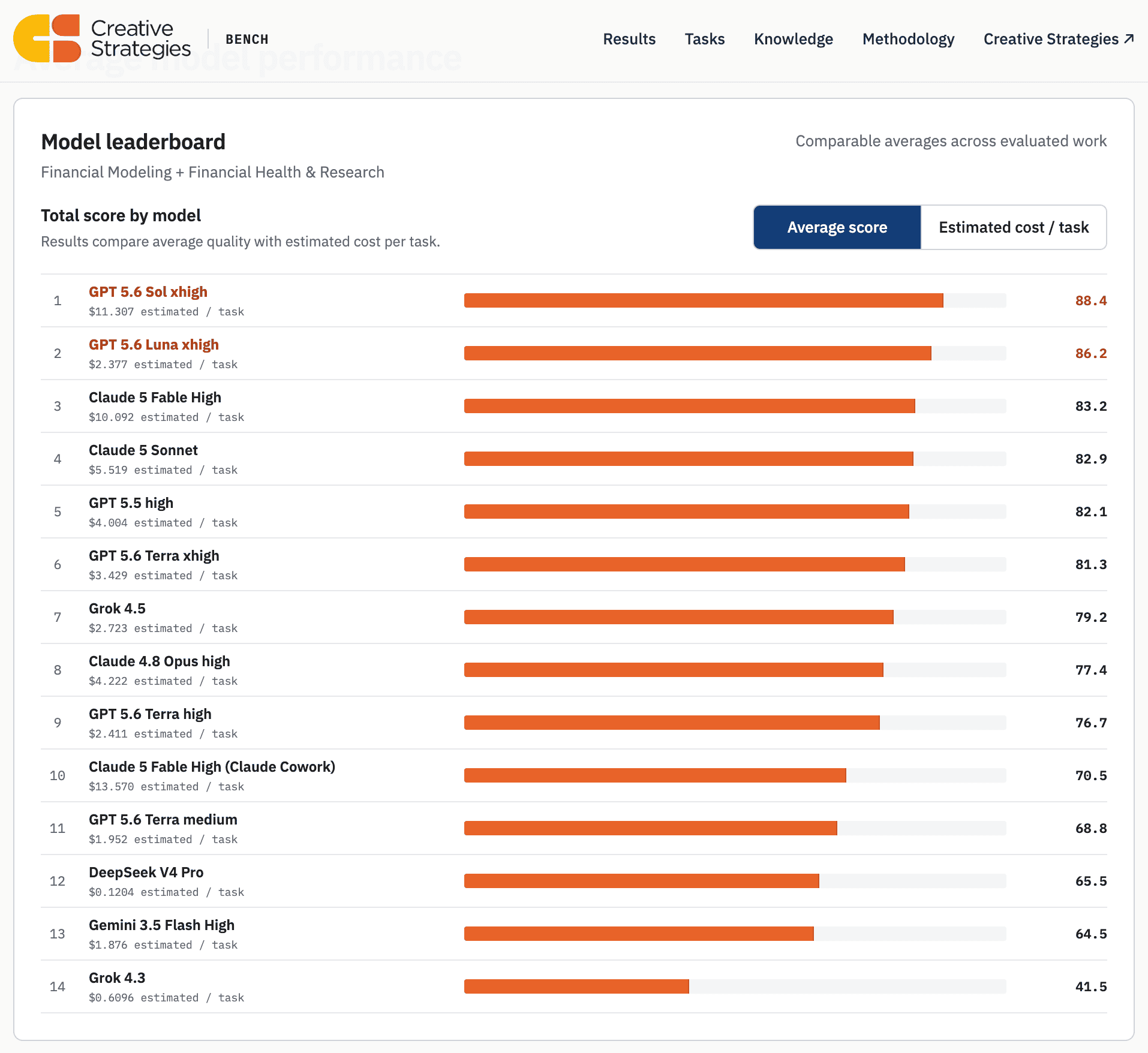
The benchmark is built around a view we have had for a while: outside of coding, one of the most common enterprise agent patterns will not be “let the model roam the open internet and hope for the best.” It will be something more structured. Companies will create MCP servers, internal tools, and knowledge systems that connect their proprietary data to applications like ChatGPT, Claude, and their own internal agents.
That means agent performance is not just about the model. It is also about the surrounding infrastructure: the retrieval system, the quality of the knowledge base, the tools available to the agent, the artifact-generation environment, and the cost structure of the workflow.
The model matters enormously. But the system around the model increasingly matters just as much.
This exercise mirrors the evaluation process we believe many organizations are undertaking, and many more will undertake, as enterprise AI moves from experimentation to adoption. The decision is not simply which model scores highest. Organizations must decide which models to adopt, which platforms or agent systems will route work among them, and how to manage token costs without compromising output quality. Evaluating models inside a realistic knowledge-work environment is therefore not an academic exercise; it is a practical proxy for how enterprises will select, deploy, and govern AI systems.
## My Experience With the GPT-5.6 Series
I have been tasking GPT-5.6 Sol with demanding work for about a month, and it is incredible. It has an exceptional understanding of how to use and control subagents, it is remarkably intelligent, and, most importantly, it keeps working. When you give it a task, it continues until that task is complete instead of stopping at a plausible first draft.
I have only had access to GPT-5.6 Terra and Luna for a few days, but the early results are equally compelling. For knowledge work, Terra is undefeated on the combination of price, speed, and value.
Luna may be the best everyday model, period. It is better than the open-weight models we have tested while being significantly cheaper. On factuality-focused work, it can outperform Claude at a fraction of the price. The tradeoff is presentation: if you need a polished final artifact, you may have to do some additional work to make the output look better.
With Luna and Terra in the mix, frontier-level performance is finally affordable enough that you do not have to worry about the price on most tasks. Most of the daily work we ran through these models cost cents rather than dollars, while still producing usable, factually accurate results. That is not true of most models in the same price range, where lower cost usually comes with a clear drop in reliability. This is the first time token budgeting starts to look like a problem that can be solved by better, cheaper models rather than tighter limits: use capable models like Luna and Terra for the majority of work, and reserve the most expensive systems for the smaller set of tasks that truly need them.
If you are looking for quick factual answers and research, I have not found a better model. When that research needs to become a polished, actionable deliverable, you can feed it to GPT-5.6 Terra or Sol and have the stronger model synthesize and present it. That gives you the best of both worlds at a fraction of the price.
Overall, I would take the GPT-5.6 series over Claude for these workflows. Based on the pricing I have seen, I expect it can deliver equal or better work for roughly one-fifth to one-tenth of the price.
## Why We Built the Benchmark
The Diligence Stack Agent Bench exists because we wanted to evaluate models and agents in a practical knowledge-work environment.
The core question is not whether a model can answer a trivia question, summarize a clean document, or solve a toy reasoning problem. The question is whether a model can take a messy, real-world knowledge-work task and produce a useful first draft.
For example:
**If I ask an agent to build a financial model with a specific set of variables, source the assumptions from internal research, produce an Excel file, write a PDF report, and explain the confidence level behind the output, can it give me something I can actually use?**
That is the bar.
In most knowledge-work environments, AI outputs are not replacing the entire workflow yet. They are usually the first step. A model or agent creates a draft, model, memo, deck, or report that a human reviews, edits, and improves. But that first draft still matters. The better it is, the less human cleanup is required. In some cases, if the draft is strong enough, it may be close to final.
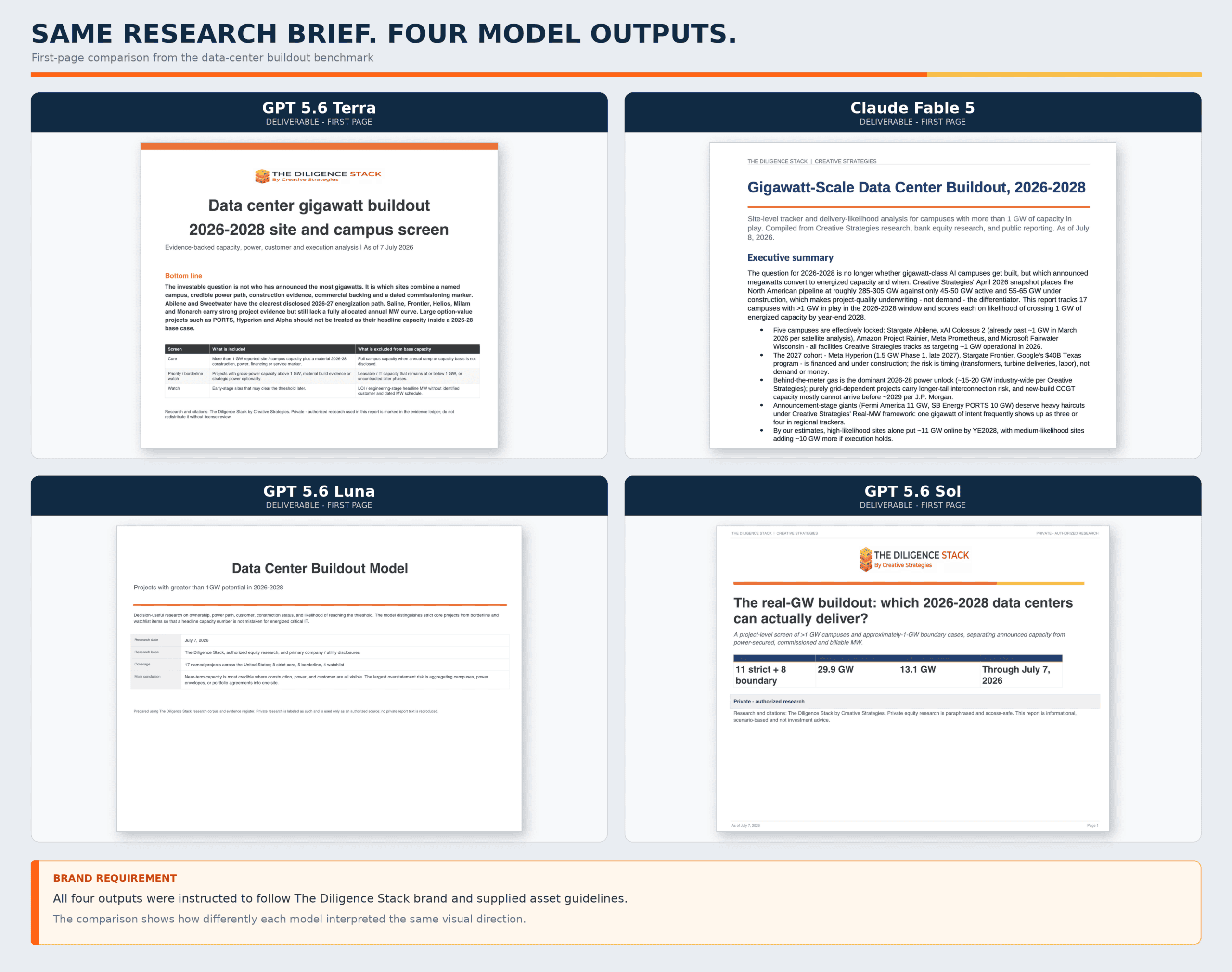
That is what this benchmark tests: **how close a model or agent can get to a complete, usable work product when given access to internal data and a computer-like tool environment.**
## The Two-Pronged Setup
When we started building the agent system that became the foundation of this benchmark, we began with a simple question: what does a knowledge-work agent actually need access to?
For Diligence Stack, the answer was three core data sources:
1. Historical Creative Strategies research and internal notes
2. Professional investment-grade research collected over time
3. Financial models and related structured files
There are a few obvious ways to give an agent access to this kind of data. You can upload files to Box, Google Drive, Dropbox, or another document system and let the connector handle search and retrieval. We tried versions of that. It works. But it is not ideal.
The problem is that most enterprise data was not designed for agents. PDFs have headers, footers, watermarks, irrelevant boilerplate, broken tables, embedded images, and inconsistent formatting. Presentations are even messier. Audio and video are generally worse. A basic connector can search over that content, but it is rarely optimized for high-quality agent retrieval.
So we built a better pipeline.
## The Diligence Stack Knowledge Base Pipeline
The knowledge base pipeline is designed to structure unstructured data so agents can use it efficiently.
At a high level, it takes uploaded files, cleans them, splits them where appropriate, removes junk, extracts useful structure, and makes the content easier for agents to search and reason over. That means removing things like watermarks, repeated headers, useless page artifacts, and other noise that makes retrieval worse.
When images appear in files, the system generates detailed descriptions of those images so the agent can reason over charts, diagrams, screenshots, and visual content. The original files remain available, but the agent is no longer forced to treat them as opaque blobs.
The system is designed to handle essentially every major file format, including PDFs, documents, spreadsheets, slides, images, audio, and video.
In practice, that means you could upload a four-hour Zoom recording, 200 PDFs of old emails, a folder of financial models, an audio recording of your dog barking, and a pile of research notes, and the agent should still be able to find and use the relevant information.
Under the hood, the system uses Gemini embedding models from Google for multimodal embedding, Convex for database storage, Gemini 3.1 Flash Lite for data processing, and a pipeline architecture designed by GPT-5.6 Sol to be robust across different downstream models.
The point is not just to make one model perform better. The point is to make the whole agent environment better.
## Why This Matters
This matters because it lets us give any agent access to high-quality internal knowledge through MCP or through our own agent environment.
Instead of asking a model to search raw files in a generic document store, we can provide a purpose-built knowledge base that has already been cleaned, structured, embedded, and optimized for agent retrieval.
That changes the economics and performance of the workflow.
In our testing, searching through the Diligence Stack knowledge system instead of using the more generic agent search pattern saved roughly five minutes on simple requests. We do not yet have fully audited cost numbers across every configuration, but the likely savings on large-model requests are meaningful, potentially in the range of several dollars per request depending on the model, search pattern, and context size.
That adds up quickly.
Faster retrieval means lower latency. Better retrieval means fewer wasted tool calls. Cleaner context means lower token usage. Better source selection means stronger outputs. The economics are not subtle: better infrastructure makes agents cheaper, faster, and more useful.
## The Diligence Stack Agent
We then built this knowledge system into our own agent.
The Diligence Stack agent has access to its own computer-like environment, tools to create documents, tools to create spreadsheets and financial models, access to the full knowledge bases, and the ability to download and inspect original files. It is designed for longer-horizon work, not just short chat responses.
That distinction matters.
A normal chatbot can answer a question. A useful knowledge-work agent needs to investigate, retrieve, synthesize, model, format, check its work, and produce artifacts. It needs to behave more like a junior analyst with tools than a text box with a memory.
In the Diligence Stack Agent Bench, this setup performed well. In one benchmark run, our internal agent outperformed Claude Cowork running Claude 5 Fable on the same task, while also coming in at a lower price. Creative name for the benchmark? Maybe not. Useful signal? Absolutely.
## Why the Harness Matters
One of the clearest lessons from this testing was that the model is only one part of the result. The harness—the tools, retrieval system, context management, execution environment, and revision loop wrapped around the model—can materially change both output quality and cost.
We tested this directly with Claude 5 Fable. To make the comparison as controlled as possible, we gave Cowork access to identical tools through MCP and the exact same skills available to our Diligence Stack harness. In this benchmark run, Claude 5 Fable still produced a better result inside our harness than it did inside Claude Cowork. The Cowork run scored worse and cost more, while our harness used the same model more efficiently and produced a stronger deliverable.
That does not mean Cowork will be worse for every task, or that one run settles the question. It does mean model comparisons need to account for the environment in which the model is operating. A strong model inside an inefficient harness can waste tool calls, consume more tokens, retrieve weaker context, and still produce a worse final output. A well-designed harness can make the same model both cheaper and more useful.
## What the Benchmark Measures
The benchmark is designed around practical output quality.
We are not asking, “Which model sounds smartest?” We are asking, “Which model produces the most useful work product when connected to internal data and tools?”
The grading framework evaluates several dimensions:
**Prompt and deliverable completion.** Did the model actually do what was asked? Did it produce the requested files, sections, analysis, and supporting materials?
**Factual accuracy and verification.** Are the claims correct? Are the numbers internally consistent? Does the model avoid hallucinating facts, companies, timelines, or financial assumptions?
**Source grounding and priority.** Did the model use the right sources? Did it prioritize the Diligence Stack knowledge base and internal materials before reaching for weaker external context? Did it cite and trace its assumptions appropriately?
**Analysis and actionability.** Did the output merely summarize information, or did it synthesize it into something useful? Does the report help a decision-maker understand what matters, what is uncertain, and what to do next?
**Artifact quality and auditability.** Are the PDF, Excel file, model, or other deliverables usable? Are they readable, well-structured, and traceable? Can a human inspect the assumptions and understand how the output was created?
**Tool strategy and robustness.** Did the agent use tools intelligently? Did it search efficiently, inspect the right files, recover from missing information, and avoid wasting time on low-value steps?
**Cost and token efficiency.** How expensive was the run? How much did the model spend to reach the result? Cost is tracked separately from quality because the cheapest bad answer is still a bad answer, but price matters once output quality clears a usable threshold.
In the current scoring framework, the final quality score is weighted most heavily toward completion, factual accuracy, source grounding, and analytical usefulness. Design, auditability, tool behavior, and cost efficiency also matter, but the benchmark intentionally does not let a cheap model win if the output is not useful.
That is the right tradeoff. In real knowledge work, the highest-cost outcome is not paying a few extra dollars for a model. The highest-cost outcome is a polished but wrong deliverable that wastes a senior person’s time.
## How We Think About Pricing
Pricing is part of the benchmark, but it is intentionally a smaller part of the weighted score.
The reason is simple: output quality matters most. A cheap run that produces a weak, incomplete, or inaccurate deliverable is not actually cheap. It just moves the cost downstream to the human who has to fix it. In knowledge work, the expensive failure mode is not spending a few more dollars on a model. The expensive failure mode is trusting a polished but wrong output, or getting a draft that still requires hours of senior cleanup.
So we treat price as an important constraint, not the primary objective.
The goal of the benchmark is to help users understand which models produce the best outputs, and then decide which of those outputs are worth the price for their specific workflow. For some tasks, the highest-scoring model may be worth paying for because it gets meaningfully closer to a usable final deliverable. For other tasks, a slightly lower-scoring model may be the better choice if it delivers 90% of the quality at a much lower cost.
That is why we look at both absolute quality and cost-adjusted performance. The right answer is not always “use the cheapest model” or “use the highest-scoring model.” The right answer is usually: **find the best output quality available at the price you are willing to pay.**
This is especially important for agentic workflows because costs can compound quickly. Long-running agents search, retrieve, reason, inspect files, generate artifacts, and revise outputs. A model that is slightly more expensive per token can still be the better economic choice if it uses tools more efficiently and produces a cleaner first draft. Likewise, a cheaper model can be attractive if the task is lower stakes, more repetitive, or easier for a human to review.
In other words, price matters. But price only matters after the output clears the bar of being useful.
## Why We Didn’t Include Open Models
We also tested open models extensively, but did not include most of them in the current benchmark results.
The reason is straightforward: almost all of the open models we tested produced materially worse outputs while also costing more to run in this agent environment. That is a difficult combination to recommend. Lower quality can be acceptable when it comes with a meaningful cost advantage, but lower quality at a higher price does not offer users a useful tradeoff.
DeepSeek V4 Pro was the one clear outlier. It was far cheaper than the other open models we tested, although the quality tradeoff is visible in its benchmark score. For lower-stakes, high-volume, or highly reviewable tasks, that price difference may still make it interesting.
This is not a permanent exclusion. We will keep testing open models and add more of them as their performance and economics improve. For this version of the benchmark, however, including a longer list of models that were both weaker and more expensive would not have helped readers make better decisions.
## Where GPT-5.6 Fits
The GPT-5.6 series performed strongly in this environment because the task rewarded more than raw fluency. It rewarded long-context handling, source discipline, synthesis, spreadsheet construction, report writing, and the ability to produce usable artifacts in a single run.
GPT-5.6 Sol and GPT-5.6 Terra were the strongest quality leaders in our testing, with GPT-5.6 Luna standing out as a strong value option. The key takeaway is not simply that one model “won.” It is that stronger models produced more complete first drafts, handled ambiguity better, and were more effective at turning messy internal data into structured outputs.
That is exactly what matters for agentic knowledge work.
There is also a broader point here: as models improve, the benchmark ceiling rises. Tasks that previously required a human analyst to spend hours gathering sources, cleaning up assumptions, creating tables, and writing the first report draft can now be pushed much further in a single agent run. The output is still not perfect. But the baseline is moving fast.
## What We Learned
The biggest lesson from the benchmark is that model quality and system design compound.
A better model inside a weak retrieval environment can still waste time and miss key information. A strong knowledge base paired with a weaker model can produce decent results, but may still fall short on synthesis, judgment, and artifact quality. The best results come from pairing strong models with purpose-built data infrastructure and tools.
That is the direction we think enterprise AI is heading.
The winning setup will not be a generic chatbot pointed at a file dump. It will be a structured knowledge system, exposed through MCP and internal tools, connected to high-quality models, and evaluated against real work products.
That is the premise behind Diligence Stack Agent Bench.
We are not trying to measure whether a model can perform well in an artificial sandbox. We are trying to measure whether it can do useful work in the kind of environment businesses are actually building.
And on that front, GPT-5.6 looks like a meaningful step forward.
The practical readout is simple: for knowledge-work agents, the gap between “interesting demo” and “usable first draft” is closing. The models are getting better, but the infrastructure around them is what turns that improvement into something businesses can actually use.
### Intel’s New G3 Extreme Shows Why PC Handhelds Will Keep Growing
URL: https://creativestrategies.com/research/intels-new-g3-extreme-shows-why-pc-handhelds-will-keep-growing/
Last updated: 2026-06-24T15:01:37.000Z
I have a habit when I review gaming hardware: I use the review as an excuse to finally play something I have been putting off. The RTX 5090 was my excuse to play *Alan Wake 2*, and I loved that game. The MSI Claw 8 EX AI+ became my excuse to restart *Marvel’s Spider-Man 2*, a game I bought a PlayStation 5 to play and then never finished.
I am not much of a controller person, and gaming handhelds have never fit into my life. I have owned a Nintendo Switch and used a few Windows/Steam handhelds, but they always felt like a compromised way to play games I could run better somewhere else. The battery was fine, the controls were fine, the performance was fine. None of them made me want to keep using the device after I had done the testing.
The Claw did. After a few days with *Spider-Man 2*, I stopped thinking about what I was giving up and started thinking about the game. That is the entire point of this category, and this is the first handheld I’ve used that nailed it for me.
The larger point is not that one handheld changed my mind. This category now feels mature enough to grow beyond the people who were already sold on it. The performance is there. The controls are there. Windows has a controller-first interface without giving up the PC game library. Thunderbolt turns the same device into a docked gaming system or a normal PC. These products no longer feel like experiments.
That maturity is arriving while gaming hardware gets more expensive. The tools and process complexity behind leading-edge silicon cost more, memory and NAND supply are tight, and OLED and high-refresh displays remain premium parts. A desktop or gaming laptop built around the hardware people now expect is not heading back toward cheap either.
That makes flexibility more valuable. A handheld like this can be the machine in your hands, the gaming system connected to a TV, and the Windows PC on a desk. It brings the games you already own across Xbox, Epic, Steam, and other stores. As every route into high-end gaming costs more, having more ways to use the same hardware makes the whole category more compelling.
There is still a catch. [MSI lists this 32GB/1TB model for $1,799](https://us-store.msi.com/Laptops/handheld-gaming/Claw-Handheld-Gaming/Claw-8-EX-AI-CG3EM-024US?ref=creativestrategies.com). I can rave about the product and still tell most people not to spend $1,799 on a handheld. Both things are true. I care more about the product here; others can care more about the value. The Claw is not the mainstream handheld. It is proof that the category is ready for more products, more prices, and more people.
---
### My excuse to play Spider-Man 2
*Spider-Man 2* is a perfect game for this machine. It is demanding, it looks fantastic, and its movement and combat work naturally on a controller. More importantly for me, it is a game I had wanted to play for years. A portable device that I needed to use to review (and more importantly, try to understand Intel’s G series chip here) is a perfect excuse to justify playing this game.
I ran the game at 1920×1200 on the High preset with ray tracing, V-sync, and frame generation turned off. The display was set to 120Hz and XeSS upscaling was enabled. Most of my gameplay sat around 45 to 50 fps, with some scenes climbing into the 50 to 60 fps range. That is enough for this kind of game. It felt smooth, the controls felt immediate, and I never found myself reaching for the settings menu instead of playing.
I want to be careful with the inevitable console comparison. This does not mean the Arc G3 Extreme is a PlayStation 5 in your hands. The PC and console versions use different settings, the exact XeSS mode matters, and an average frame-rate counter does not tell you about frame pacing or image quality. What I can say is simpler and more useful: a demanding former PlayStation exclusive ran well enough on an 8-inch handheld that I restarted the game and kept playing it.
I spent some time trying to figure out what a comparison would be for this performance. After a few minutes of searching, this compares pretty well to an RTX 4070 laptop; it’s within the same ballpark. I don’t mean to say this as a bad thing or saying it’s better or anything, but rather the RTX 4070 laptop chip is a really good chip! There are really good gaming laptops with this GPU. The Claw 8 with Intel G3 Extreme is close to it. That’s really cool.
The result held up elsewhere. In the built-in *Cyberpunk 2077* benchmark, the Claw returned about 44 fps at 1200p on the High preset across several runs. I did not spend an afternoon finding the perfect low-medium-custom soup to inflate the number. On an 8-inch screen I would rather start with a sensible preset, turn on the right upscaler, and play.
Frame generation is available if you want more visible smoothness, and this form factor makes a good case for it. A handheld has a hard power ceiling. If the GPU can render a solid base frame rate and use generated frames to make motion look smoother on a 120Hz screen, that is a good trade in a single-player game. Generated frames are not the same as rendered frames, though, and they do not magically improve input latency.
One thing worth being precise about is how frame generation interacts with input latency, because the bigger frame-rate number oversells the responsiveness. A natively rendered 120fps game samples your input 120 times a second, so the controls feel as immediate as that frame rate suggests. A game running at 60fps samples input half as often, so its latency is roughly double. If you take that 60fps game and use frame generation to reach 120fps, the motion looks like 120fps, but your input is still tied to the 60fps base frames. The generated frames are interpolated, so the technique actually adds a little latency on top of that 60fps baseline rather than removing any. The point is that frame gen buys you a smoother-looking image, not native-120fps responsiveness. As long as the base frame rate is solid, which it is here, I have no problem with fake frames.
---
### Arc G3 Extreme is built for this job
The [Intel Arc G3 Extreme](https://www.intel.com/content/www/us/en/products/sku/245625/intel-arc-g3-extreme-processor-12m-cache-up-to-4-70-ghz/specifications.html?ref=creativestrategies.com) is based on Panther Lake, but Intel did more than put a laptop chip in a smaller box. Arc G3 is Intel’s first family of purpose-built handheld SoCs, and the parts were rebalanced around what a game needs inside an 8W to 35W power envelope.
The CPU has two performance cores, eight efficiency cores, and four low-power efficiency cores. The GPU is an Arc B390 based on Xe3 with 12 Xe-cores, 96 XMX engines for AI work such as XeSS, 12 ray-tracing units, and 16MB of cache. The compute tile is built on Intel 18A. There is enough CPU here to feed a game, but the design is plainly biased toward graphics.
That matters because a handheld has one small pool of power and heat to divide. Every watt the CPU takes is a watt the GPU cannot use. Intel’s Intelligent Bias Control manages that split, and at 14W or below it can park the two P-cores entirely so the E-cores handle the CPU side while the GPU keeps more of the budget. This is the kind of mechanism that disappears when it works. You do not think about core parking while swinging through Manhattan. The frame rate holds together.
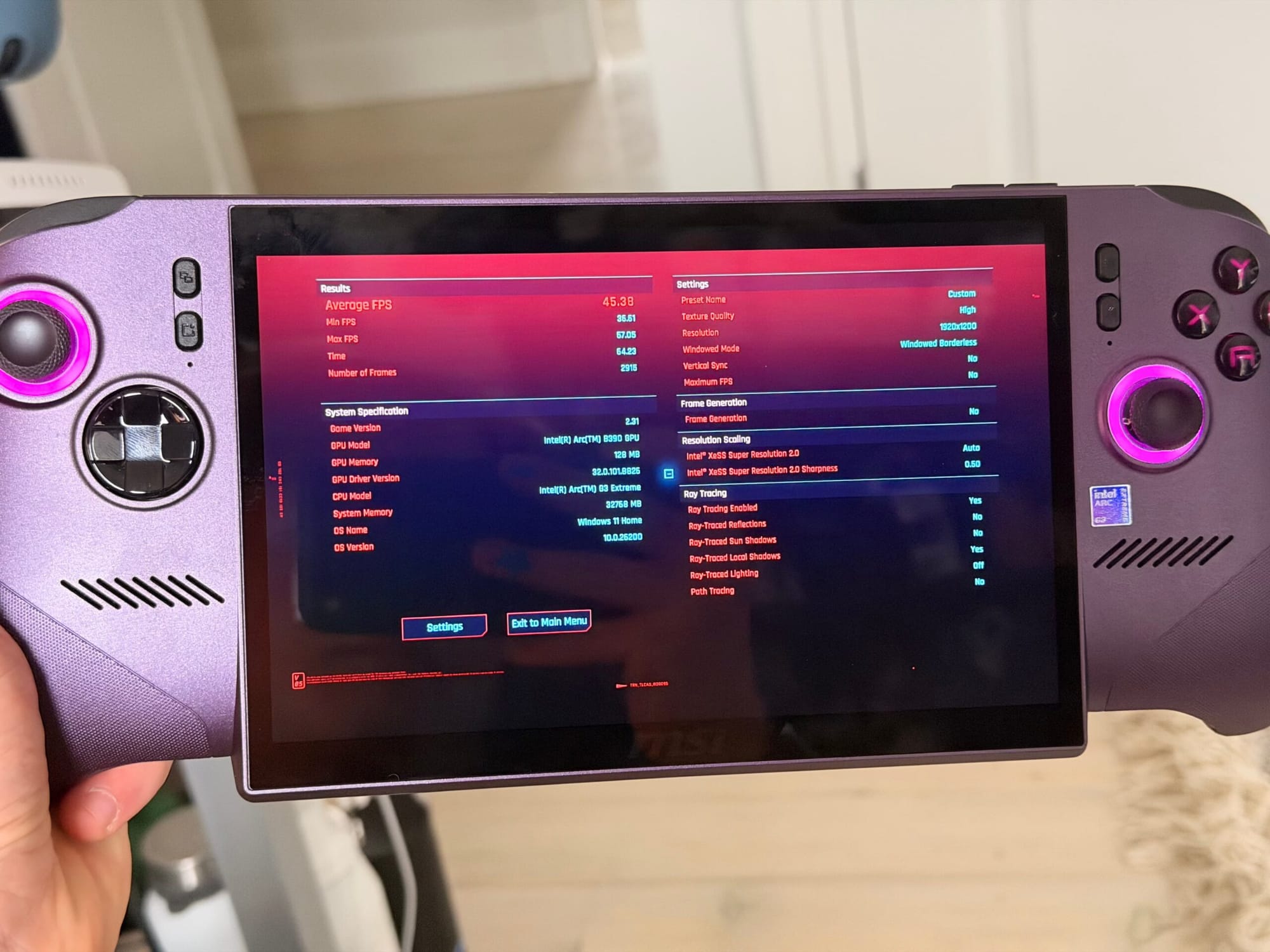
Intel’s own testing says Arc G3 Extreme at 35W averaged 42% faster than the Ryzen AI Z2 Extreme at 35W across 36 games at 1080p High, using 2x upscaling where supported. Intel also says its chip at 17W roughly matched the Z2 Extreme at 35W across that same test set. Those are Intel’s numbers from pre-production systems, not mine, so treat them accordingly. The direction matches what I felt using the Claw, but I did not run a controlled 36-game comparison of my own.
XeSS is the other half of the platform. Super Resolution lets the GPU render from a lower internal resolution and reconstruct the image for the 1200p screen. Multi-Frame Generation can add up to three generated frames between traditionally rendered ones in supported games. On a desktop with a giant GPU, these features can feel optional. On a handheld, they are how you turn a limited power budget into a better-looking and smoother game. See the above point on input lag and frame gen, it’s still great!
Intel finally has the CPU, GPU, process technology, packaging, drivers, and upscaling stack working toward one clear product. That is why Arc G3 feels more important than another integrated-GPU bump. It is a complete handheld platform.
---
### MSI built the right hardware around it
The chip would not matter if the machine were miserable to hold. MSI did a good job here.
The Claw has an 8-inch 1920×1200 IPS touchscreen with a 48 to 120Hz variable refresh range. I initially wrote down that it was OLED because it looked that good. It is not. Color and contrast are still excellent, VRR keeps sub-60 fps games looking smoother, and 1200p is the right resolution for this size. I never wanted more pixels.
The textured plastic feels better than I expected, and the flared grips make the 785g body easier to hold than the number suggests. The Hall-effect sticks and triggers feel like proper controller parts. MSI rounded the ABXY buttons, changed the D-pad to a metal-dome design, and upgraded the haptics with new linear motors. I am not good enough with a controller to lecture anyone about competitive input latency, but the whole control surface felt normal in the best possible way. I did not feel like I was using a tiny PC with controller parts glued to the sides.
The fans are audible under load, as they are on every handheld in this class, but they never became the dominant sound. The two front-facing speakers help. Turn the volume up a little and the game covers most of the fan noise without headphones.
My informal battery experience landed around three to three and a half hours while playing and using the machine normally away from a charger. This was not a controlled rundown with fixed brightness and a scripted path, so do not read it as one. The 80Wh battery is large for a handheld, and Intel also has an Endurance Gaming mode that targets 30, 40, or 60 fps to reduce power. I did not run the full matrix needed to turn that into a stronger battery claim.
The rest of the hardware is unusually complete. My unit has 32GB of LPDDR5X memory and a 1TB SSD. MSI moved to a standard M.2 2280 slot, so storage upgrades should be cheaper and easier to find. There is Wi-Fi 7, a microSD Express reader, a fingerprint sensor in the power button, and two Thunderbolt 4 ports across the top.
Those Thunderbolt ports deserve their own section.
---
### The one-cable dock changes the product
Intel sent an OWC Thunderbolt Go Dock with the review kit. It does not come in the retail box, but it showed me one of the Claw’s best tricks.
I plugged the dock into my monitor, connected the Claw with one cable, and used it the same way I would use a Nintendo Switch. The cable handled the display, peripherals, and charging. Dock it and play. Unplug it and walk away.
That sounds obvious because Nintendo solved it years ago, but it has not been the default experience for Windows handhelds. Thunderbolt makes the setup predictable, and having two ports means charging or docking does not consume the only high-speed connection on the machine.
It also changes what the Claw can be. This is a full Windows 11 PC with 32GB of memory. Add a keyboard, mouse, and monitor and it can handle ordinary desktop work, development, or local AI experiments in a way a closed console cannot. I did not replace my workstation with it, and I am not going to pretend a handheld is the ideal machine for every job. The point is that the option is real and the setup takes one cable.
Full Windows matters before you ever reach a desk too. The newer Xbox full-screen experience gives the Claw a controller-first home screen while keeping access to games from Xbox, Epic, Steam, and the rest of the PC ecosystem. I am apparently in the minority here, but I like buying games on Epic. A device that can bring that library along without asking me to repurchase games is more useful to me than one built around a single store.
Windows can still show its desktop-shaped edges, and a console-first interface does not remove every prompt or launcher. It is much closer than it used to be. More importantly, I did not spend the review fighting the operating system. I spent it playing *Spider-Man*.
---
### Why PC handhelds will keep growing
The Claw feels like a mature answer to a real problem: how do you make PC gaming portable without asking people to abandon their library, their accessories, or the option to use the machine as a computer? There is no single trick here. The category works because the chip, controls, battery, software, display, and docking finally work together.
The cost backdrop matters too. TSMC says the tools for leading-edge nodes are becoming more expensive and the process complexity keeps increasing. Micron expects DRAM and NAND supply to remain tight beyond 2026, with enough pressure to weigh on PC shipments. Display companies are moving more of gaming toward high-refresh OLED, which remains a premium part. None of that makes a $1,799 handheld cheap. It does mean the old assumption that a handheld only makes sense as an inexpensive second device is becoming less useful.
For some people, this can be the gaming PC. It can live on the couch, go in a bag, dock to a television, and connect to a monitor and peripherals at a desk. A desktop will still deliver more performance for the money, and a laptop remains better if you need a built-in keyboard and larger screen. The handheld earns its place through the number of situations where it works.
This particular machine sits at the expensive end of the category. The important part is what happens next. Arc G3 gives more manufacturers a capable platform to build around, Windows is finally treating handhelds as a real product class, and every new design creates another chance to balance performance, size, display, and price differently. The category does not need every product to be cheap. It needs enough good options that more people can find the one that fits.
---
The best thing I can say about the MSI Claw 8 EX AI+ is that it got out of the way. It gave me a reason to restart *Spider-Man 2* and ran it well enough that I stopped watching the frame counter. When I finished testing, I kept playing.
Intel nailed Arc G3 Extreme. MSI nailed the hardware around it. This is the best Windows handheld I have used and the first one that did not feel like a downgrade. I love the thing.
I do not think every PC gamer is about to replace a desktop or laptop with a handheld. I do think many more people will choose one as gaming hardware gets more expensive and the handheld becomes capable in more places. A machine that works in your hands, on a television, and at a desk is easier to justify than one with a single job.
The Claw 8 EX AI+ is too expensive to take this category mainstream by itself. It is mature enough to show why something like it will. There are other versions with Intel’s Lunar Lake, and there are likely more affordable SKUs on the way. It’s only a matter of time!
### The Web Was Not Built for Agents. AWS Is Starting to Fix That
URL: https://creativestrategies.com/research/the-web-was-not-built-for-agents-aws-is-starting-to-fix-that/
Last updated: 2026-06-19T16:14:04.000Z
The web’s transaction model was designed for humans. You visit a page, see an ad, click a link, or buy something. Every monetization mechanism built over the past three decades, advertising, subscriptions, paywalls, affiliate revenue, assumes a person made a choice. That assumption is breaking. At AWS Summit New York this week, Amazon made the most concrete production-grade move yet toward replacing it.
##### A Transaction Layer That Never Existed
HTTP 402 has been in the web’s specification since 1991, a status code reserved for payment-required responses that never found a use case at scale. The reason is straightforward: until recently, the web’s consumers were humans, and humans had browsers, credit cards, and login sessions. The payment infrastructure built around those assumptions works well enough. Agents have none of those things. They cannot log in, cannot click through a payment form, and have no persistent identity that maps to a billing relationship. The result is that agents currently operate on the web the way someone might walk through a store taking things without any mechanism to pay, not out of bad intent but because no checkout exists for them.
That is the structural problem AWS is addressing. The WAF AI traffic monetization capability returns a machine-readable HTTP 402 response using the x402 open protocol, a standard developed by Coinbase for machine-to-machine payments. An agent that hits a monetized resource gets a price manifest in JSON: the cost in USDC, accepted blockchain networks, destination wallet, and payment timeout. Any x402-compatible agent runtime can complete that flow autonomously. No human needs to be in the loop.
This is not AWS inventing something from scratch. x402 is an open protocol, and Coinbase built the facilitator infrastructure. What AWS contributes is operationalizing it at cloud scale, at the network edge, across CloudFront’s global distribution network, with no changes required to origin infrastructure. That is a meaningful difference between an interesting protocol and something enterprises can actually deploy.
##### The Traffic That Pays Nothing
The urgency behind this is real. AI bot traffic now exceeds 50% of web traffic for many content providers, with AI-specific crawlers growing more than 300% year-over-year. Unlike traditional search crawlers like Googlebot or Bingbot, which returned measurable referral traffic, AI bots consume content to generate summaries and responses with little to no traffic sent back. The web’s existing monetization model has no answer for that. Blocking agents entirely is a short-term response that trades one problem for another. Licensing deals negotiated individually are not scalable. A programmable transaction layer is the only structural solution.
AWS WAF Bot Control already classifies over 650 distinct AI bot and agent types, including GPTBot, Claude-Web, and Perplexity-Bot. The monetization capability lets content owners price by content path, bot category, or verification tier. That last variable is worth pausing on. AWS distinguishes between verified agents, whose identity is confirmed through cryptographic signatures or documented IP ranges, and unverified agents, recognized through behavioral fingerprinting but not cryptographically confirmed. Pricing those two tiers differently creates a commercial incentive for AI companies to formally identify their agents. That is a shift in the accountability dynamic that goes beyond content monetization.
##### Why Amazon Is the One Building This
Amazon’s durable advantage has never come from selling things. It comes from owning the infrastructure that others use to sell things, and taking a position on every transaction that flows through it. AWS, Amazon Marketplace, Fulfillment by Amazon, Amazon Pay, Buy with Prime. The pattern across two decades is consistent. Find a commerce flow, build the indispensable intermediary layer, and embed deeply enough that switching becomes costly.
The WAF monetization announcement follows that logic. The feature is available at no additional charge to existing AWS WAF customers. AWS takes no fee on content revenue, with disbursement going directly to the content owner’s wallet. That looks generous until you consider that the value Amazon captures is not transactional margin. It is infrastructure position and the data visibility that comes from sitting at the center of every agent commerce flow.
##### What This Does Not Solve
It would be a mistake to read this as AWS completing the transaction layer for the agentic web. What they have built handles one well-defined use case: a content owner pricing and collecting payment from an agent requesting access to a protected resource. That is an important piece of infrastructure. It is not a complete answer.
Agent identity at scale remains unsolved. The verification tier distinction AWS draws today is a start, but a functional agent economy requires identity frameworks that travel across platforms, not just within AWS’s classification system. Liability is unresolved. When an agent transacts autonomously, the legal and financial accountability structures that govern human commerce do not map cleanly. Interoperability is an open question. x402 is an open protocol but adoption outside of AWS and Coinbase is early. A transaction layer that only works within a subset of the agent ecosystem is not a transaction layer for the web.
None of that diminishes what AWS shipped. It is the most serious production-grade infrastructure move on this problem to date. But the agentic web will need contributions from standards bodies, regulators, and the broader industry before the transaction layer is genuinely complete. AWS has built the first significant piece. The rest is still ahead.
### WWDC 2026: Apple Kept It Real
URL: https://creativestrategies.com/research/wwdc-2026-apple-kept-it-real/
Last updated: 2026-06-10T02:46:05.000Z
### No Overpromising, Meeting Users Where They Are
At WWDC, the expectation is for a long list of new features rolling across every OS Apple supports in its portfolio. This year, Apple reframed that. Rather than leading with what is new, the keynote centered on perfecting and homogenizing the experience across products, addressing the kind of friction that quietly erodes user satisfaction over time, and laying the groundwork for what was the main focus of the event: Apple Intelligence and the new Siri AI.
#### Perfecting the Experience
Craig Federighi framed the releases around three explicit priorities: making platforms more responsive and easier to use in daily life, advancing trust and safety, and delivering a meaningful leap forward for Apple Intelligence with a new Siri architecture. That ordering was deliberate. Performance came first, and it showed throughout the keynote.
Across iOS, macOS, iPadOS, and watchOS, Apple’s updates centered on responsiveness and polish. App launches are up to 30% faster, with the system preloading key data apps need when opened, applying to third-party apps as well. Photos appear in libraries up to 70% faster after being shot. AirDrop transfers are up to 80% faster. File browsing and transfers from iPad to external drives are up to five times faster. These are the moments users encounter daily, and their cumulative effect on satisfaction is significant even when users cannot name the specific change that made things feel better.
Apple also rebuilt the foundation of search across iOS, iPadOS, and macOS, re-architecting the Search Index that powers Spotlight, Photos, and Mail to be more stable, more comprehensive, and faster at indexing new content. In Mail, a new ranking system surfaces more relevant results in top hits, so the email you need is more likely to appear first regardless of how long ago it was sent. Search is one of those features that users only consciously notice when it fails. Making it work reliably is the kind of improvement that adds up quietly into trust.
Apple extended these gains to older hardware as well, bringing an optimized CPU Scheduler all the way back to iPhone 11, meaning iOS 27 supports the same iPhone models as iOS 26 and extends Apple’s already notable device longevity record. At a time when sustainability commitments are under scrutiny across the industry, keeping older hardware performant is both a user satisfaction story and an environmental one.
The design layer received attention too. Liquid Glass, introduced last year as Apple’s most ambitious cross-platform design update, and one that did not please everyone, was refined based on user and developer feedback, with improved diffusion behind complex content for better readability. A new slider in settings lets users adjust Liquid Glass from ultra clear to fully tinted, applying the preference across apps including third-party ones that have already adopted it. None of this generates headlines, but it signals a company willing to revisit and improve rather than defend a prior decision.
#### Apple Intelligence and Siri AI: Grounded in the Real World
On Apple Intelligence, the company showed compelling everyday use cases that may not be revolutionary but are built to hold up outside a demo environment.
The Google collaboration on Siri AI generated the most discussion coming out of the keynote. Creative Strategies’ Max Weinbach explained it clearly after the keynote: Apple’s new advanced on-device model for A19 Pro runs 20 billion parameters on 12 gigabytes of memory, loading only the active parameters needed at any given moment. That model architecture is unprecedented. Apple does not lack AI research capability; it lacks large foundational models, which is what Google contributes to the collaboration. The reason Apple’s AI work has been underestimated is straightforward: companies like OpenAI, Anthropic, and Google publish benchmarks aggressively because they are selling AI as a service to enterprises and need to compete publicly. Apple is not selling that, so it has not played that game. The collaboration with Google fills the large model gap without Apple ceding control of its own architecture.
Apple chose to show what this means in practice rather than where it sits on a benchmark. The demos were grounded in real tasks: finding content by describing it naturally, drafting and editing in context, taking action across apps without requiring users to navigate between them manually.
Apple continued with the same architectural philosophy that has defined its approach to AI from the start: ground Apple Intelligence in the OS and in Apple’s own apps, then expose APIs so developers can bring those capabilities into their products. Apple Intelligence uses a new system orchestrator to coordinate across system-wide capabilities, including personal context understanding, broad world knowledge that can reach the web via Private Cloud Compute, and App Actions that draw on an App Toolbox to find the right tools from installed apps to complete a request. The result is AI that surfaces where users already are, which limits some of what Apple can announce at any given moment but also limits the gap between what Apple promises and what users actually experience.
A New Home For Siri
The Siri AI app is the most structurally significant announcement from an architecture standpoint. It serves as the persistent home for user interactions with Siri, where conversations live, are searchable, and are accessible across devices. Apple is giving users a coherent AI identity that travels with them rather than a series of disconnected exchanges that disappear after each session. That continuity across devices matters practically, but it also reflects a considered view of how an AI relationship should work: one personality, one history, accessible from every device a user owns.
What stood out across the keynote was how grounded it was, and how grounded the demos were in particular. Apple showed real situations without overpromising what the technology does in those situations. Federighi framed Apple’s position directly: truly helpful AI must be centered around the user and their needs, integrated deep into the products people use every day, grounded in personal context and the apps they rely on, and designed with privacy at every step.
After leaving consumers waiting for a meaningfully improved Siri, Apple had to deliver. Releasing Siri in the developer beta on the day of WWDC keynote, with public availability in English in the US later in the year, points to a September launch alongside the new iPhone models on iOS 27\. The stakes were high and the pressure was real. While we are only seeing the first glimpse through the beta, the signs are promising.
### A Transformed Cisco Steps Into a Familiar Role
URL: https://creativestrategies.com/research/a-transformed-cisco-steps-into-a-familiar-role/
Last updated: 2026-06-07T19:21:20.000Z
At Cisco Live 2026 in Las Vegas last week, Jeetu Patel took the stage as President and Chief Product Officer in front of 20,000 attendees from 75 countries and delivered on a prediction he made two years ago: that Cisco would be unrecognizable as a company. The portfolio on display made the case without needing the reminder.
The company reported record third-quarter revenue of $15.8 billion, up 12% year over year, driven by demand for AI infrastructure and networking products. The announcements at Cisco Live made a clear statement about what Cisco has become and where it is positioning itself: the infrastructure layer for the agentic era, the same role it played for the internet.
#### The Playbook Has Run Before
Cisco lived this transition once,. When it built the networking backbone the internet ran on, it hit a constraint that had nothing to do with technology. There were not enough engineers in the world who knew how to deploy, configure, and manage what Cisco was selling. So Cisco built the talent pipeline itself. Networking Academy launched in 1997 with 64 institutions across seven U.S. states. It has since reached 28 million students across 195 countries. The CCNA, first awarded in 1998, became the industry benchmark for network engineering. Cisco did not wait for the talent market to catch up. It created the talent market.
The same logic is now being applied to AI. Cisco has committed to providing AI and digital skills training to one million student participants in the United States over the next four years, running from the beginning of fiscal 2026 through the end of fiscal 2029\. The certification portfolio has been rebuilt accordingly. The CCNA v2.0 blueprint is organized around four pillars: network infrastructure, troubleshooting and problem-solving, a security-first mindset, and understanding the role of AI in network management and operations. AI literacy is now treated the way networking and cybersecurity once were: as a baseline competency, not a specialization.
This is a strategic investment. Cisco needs the people who will deploy its AI infrastructure to know how to use it. Enterprises need to trust that those people are qualified. Cisco is building both sides of that equation simultaneously, as it did with the internet generation.
#### The Infrastructure Argument
AI agents generate 450% more network traffic per task than a human performing the same work, and AI traffic overall is expected to triple in the next three years. The network is the constraint of this transition, not a background utility. Cisco Cloud Control is a new management platform bringing together networking, security, observability, and collaboration under a single interface, built for an environment where AI agents operate continuously across enterprise systems and need to be managed, secured, and audited in real time. Cross-domain telemetry sits at its core: data flowing across any connected system is compiled and viewable in one place, so humans and agents can act on coordinated, contextual information to manage uptime, control agent behavior, and prevent token overspend.
Hybrid Mesh Firewall extends unified protection across networks, applications, and both Cisco and third-party firewalls, designed to limit the blast radius in an environment where AI agents have extended the security perimeter and can introduce attack vectors at machine speed. Patel framed the underlying challenge as an “AI trust deficit,” the gap between what enterprises want to do with AI and what they currently feel confident deploying. The full portfolio is structured around closing it.
#### The Leadership Structure That Made This Possible
Patel’s consolidation of product strategy under one role is visible in what was announced last week. Networking, security, observability, and collaboration are no longer separate conversations with separate roadmaps. They are one platform. Liz Centoni as EVP and Chief Customer Experience Officer leads the organization responsible for ensuring enterprises can realize what Cisco is selling. Her keynote brought on stage two customers operating in environments where the margin for error is essentially zero. For GEODIS, Cisco IQ replaced guesswork with full visibility across 12,000 devices and a clear end-of-life roadmap. For GlobalFoundries, where maintenance windows are not an option, Cisco IQ cut vulnerability assessment from days to hours. Both cases made the argument that an integrated platform delivers where point solutions cannot.
The through-line from 1987 to 2026 is consistent. Cisco has understood, at each major infrastructure inflection, that the technology alone is insufficient. You need the infrastructure. You need the security model. You need the platform to manage it at scale. And you need the people qualified to operate all of it. Cisco built that full stack for the internet era, including the workforce development program when the market could not supply the talent on its own. The conditions are the same now. The difference is that Cisco arrives at this moment with a leadership structure finally organized to execute it as a single coherent strategy rather than a collection of business units making separate bets.
### Boring is Best: The Lenovo Yoga Slim 7x is My Default Snapdragon Laptop
URL: https://creativestrategies.com/research/boring-is-best-the-lenovo-yoga-slim-7x-is-my-default-snapdragon-laptop/
Last updated: 2026-06-18T16:06:26.000Z
I’m now on day three of product reviewing, and today I’m looking at the Lenovo Yoga Slim 7x with the Snapdragon X2 Elite. This is a laptop that gets almost everything right. Good products tend to be boring, and that’s exactly what makes this machine so impressive.
I was watching the movie The Hitman’s Bodyguard a couple of weeks ago, and one of the characters says “boring is always best.” While that might be a line written for an action film, it’s also a perfect rule of thumb for consumer technology. When a laptop is meant for everyday users, the best place it can be is a spot where you can’t think of a single major issue. Almost every laptop has some weird, annoying quirk that ruins the experience. I can’t find any of those game-breaking flaws on this machine. It just works, it’s comfortable, and it’s easily my default recommendation.
---
#### Refinements over the First Generation
I spent a lot of time with the first-generation Snapdragon Yoga Slim 7x, and it was a bit of an odd machine. The trackpad felt mushy, the speakers were mediocre, and the 14.5-inch chassis was slightly wider than it needed to be.
This second-generation model fixes those issues. Lenovo trimmed the screen size down to 14.0 inches. That half-inch reduction makes the footprint a lot smaller. It now weighs 1.17 kg and measures 13.9 mm thick, which is a much more comfortable size to throw in a backpack.

Lenovo didn’t mention it in their marketing, but they completely redesigned the trackpad. Clicking the old and new models side-by-side reveals the change immediately. The new one has a tactile, crisp click that feels vastly superior to the mushy mechanism from last year. The keyboard layout is roughly identical, but it feels like they made a subtle tweak to the key travel that makes typing more comfortable. They also upgraded the audio system to four stereo speakers (two 2W woofers and two 2W tweeters). It sounds clean and punches well above its weight class for a thin-and-light laptop.
I actually passed the first-generation Snapdragon laptop down to my dad when he needed an upgrade. He chose it over several other laptops because it hit all his basic needs. He was a big fan of it, but when I showed him this new version, he liked it even more (but I am keeping this one for myself). The refinements are subtle, but they add up to a much more polished product.
---
#### Elite Silicon without the Extreme Compromise
The silicon landscape on Windows on ARM has split into distinct tiers. Under the hood, this laptop runs the standard Snapdragon X2 Elite chip. Qualcomm also offers a flagship X2 Elite Extreme, but I think the standard Elite is the smarter choice for a thin-and-light laptop.
To understand why, we have to look at how these chips are packaged. The Snapdragon X2 Elite Extreme uses on-package memory, which sits right next to the silicon to deliver higher memory bandwidth (228 GB/s, against 152 GB/s on the standard Elite) and better native efficiency. In a vacuum, that should mean better battery life.

However, Qualcomm has to justify the “Extreme” branding. In practice, they push the Extreme chip’s clock speeds higher to secure impressive peak performance numbers in synthetic benchmarks. Pushing those clocks spends the efficiency gains, which means the battery life ends up leveling out between the Elite and the Elite Extreme.
The Extreme chip is destined for larger, heavier chassis designs that can handle the thermal output of sustained high clock speeds. For a 1.17 kg thin-and-light like the Yoga, the standard X2 Elite is the right fit. It keeps the chassis thin, stays cool, and runs almost completely silent (the fans are barely audible in daily use).
To be clear, none of this is confirmed by Qualcomm, but given what I know about the silicon and have experienced myself, I tend to believe this is true.
---
#### The Screen Configuration Mismatch
My review unit came configured with the Snapdragon X2 Elite, 32 GB of RAM, and a 1 TB SSD, but it was paired with the base WUXGA (1920 x 1200) 60Hz OLED display. Lenovo sent me this unit directly, and while it’s a fine screen, I don’t think this display configuration makes sense.
This 60Hz 1200p OLED belongs on the lower-end Snapdragon X2 Plus laptops. If you’re configuring a laptop with Qualcomm’s premium X2 Elite chip, you deserve a premium display. Lenovo offers a gorgeous 2.8K (2880 x 1800) 120Hz OLED screen as an upgrade option on their website.

The markup on Lenovo’s website to jump from the 60Hz WUXGA screen to the 120Hz 2.8K display is $60\. That’s a rounding error on a laptop in this class, and with a gap that small, Lenovo should just kill the base 60Hz display option on the Elite configurations entirely. Pairing a high-end chip with a low-refresh-rate screen is a compromise that doesn’t need to exist. If you’re custom-building this on Lenovo’s site, spend the $60 and get the 2.8K display. It’s a no-brainer.
---
#### Real-World Performance: The Agent Benchmark
I’m not going to dump standard benchmark numbers here. We already covered those in my Snapdragon X2 Elite Extreme reviews, and synthetic benchmarks don’t tell you what a laptop is actually like to use.
Instead, my ultimate test for real-world performance has been running local AI coding agents. For the past few weeks, I’ve been working on a side project using Claude Code and a local co-work agent. The project is an implementation of SwiftUI that compiles natively on Windows and Windows on ARM. Unlike other ports, I wanted this to have its own custom GPU rendering engine (similar to how GPUI works in Rust) rather than mapping to WinUI 3.
This is a heavy workload. It requires constant compiling and building of native Swift code on the machine. Any CPU bottlenecks immediately slow down the loop between agent runs.
I’ve run this project on my main desktop (which rocks an RTX 5090 and Intel Core i9-13900K) and several heavy desktop-replacement laptops. When I ran it on this Snapdragon X2 Elite Yoga, I was stunned. It’s one of the fastest laptops I’ve ever used for this workflow. The CPU compiles native Swift code incredibly fast. The agents finished their tasks so quickly that it felt like a night-and-day difference in how much work they could get done. A lot of this is purely from the higher performance per core, not every workload is using all the cores to compile.
I also used a co-work agent to build TypeScript and Electron applications, which are notorious for compiling slowly on Windows. On this machine, those builds are snappy. When you pair that level of performance with great battery life, fast Windows Hello face recognition, and a thin chassis, it makes the Yoga an incredible development machine.
---
#### The Easy Default
Qualcomm’s chips make this laptop what it is. The thinness, the silence of the fans, the performance under agent workloads, and the outstanding battery life are all direct results of the Snapdragon X2 platform.
But Lenovo deserves credit for nailing the chassis design. The product you touch and feel is great regardless of the configuration you choose. Whether you buy the base Snapdragon X2 Plus SKU or custom-build a top-tier Elite model, the physical experience is excellent.
We’re missing easy defaults in the Windows laptop space. It’s hard to find a machine that doesn’t have some glaring flaw that will annoy you or break your workflow. Lenovo built a laptop that has none of those. It’s an easy recommendation for almost anyone. If I’m throwing a Snapdragon laptop into my bag, it’s going to be this one.
### The Asus Zenbook A16 is the first premium Snapdragon laptop, if you buy the right one
URL: https://creativestrategies.com/research/the-asus-zenbook-a16-is-the-first-premium-snapdragon-laptop-if-you-buy-the-right-one/
Last updated: 2026-06-05T17:42:04.000Z
Normally I don’t talk about specs in a review. The spec sheet is not the product. The overall experience is the product, and the overall experience on this laptop is good. Not my favorite in the world, but good. I’m breaking my rule this time because the person considering this laptop is the most spec-driven, value-driven buyer in the market. This is a MacBook Air style machine, and MacBook Air cross-shoppers do math, but focused on performance over all else.
So let’s talk about the Zenbook A16\. It is the only laptop on the market shipping Qualcomm’s Snapdragon X2 Elite Extreme, and it’s a machine I’ve been waiting on for a while, because it was described to me as the first extremely premium feeling Snapdragon laptop. That description matters. My problem with the Snapdragon X Elite generation was never the chip. If you were handing me any Windows laptop last year, I wanted that chip in it. The problem was the laptops built around it. They were less premium than I expected, and they weren’t machines I wanted to live on.
The A16 mostly fixes that. Mostly. There’s one thing ruining the experience for me, and it’s big enough that it decides which version of this laptop you should buy. We’ll get there.
---
### The specs, because this time they matter
My unit: Snapdragon X2 Elite Extreme, 48GB of RAM, 1TB SSD, and a 16-inch 3K (2880 x 1800) Lumina OLED at 120Hz. The panel does 500 nits in SDR, 1,100 nits peak in HDR, covers 100% of DCI-P3, and carries VESA’s DisplayHDR True Black 1000 certification. It’s a very good screen in a very light machine: 2.56 pounds in this configuration, 2.87 in the one I’ll tell you to buy instead. For reference, a 13-inch MacBook Air is 2.7 pounds. This is a 16-inch laptop that weighs less than Apple’s small one.
Pricing is where it gets weird. [Best Buy sells this](https://www.bestbuy.com/product/asus-zenbook-a16-16-3k-oled-touchscreen-laptop-snapdragon-x2-elite-extreme-2026-48gb-ram-1tb-ssd-copilot-pc-zabriskie-beige/JJGHGSCXZV/sku/6671011?ref=creativestrategies.com) with a touchscreen for $1,699.99\. [Asus’s own store sells it](https://shop.asus.com/us/90nb17w1-m004s0-asus-zenbook-a16-ux3607-copilot-pc.html?ref=creativestrategies.com) without one for $1,999.99\. That sentence sounds backwards. It isn’t, and the reason why is the single most important thing to understand before you buy this laptop. Hold that thought.
### The MacBook Air of Windows laptops
Asus mentioned to me that the internal codename for this machine was the Zenbook Air. They wanted to call it that and didn’t, but the intent survives: this was designed very specifically to compete with the MacBook Air, and I think it does a really good job at it. It’s light, it feels nice in the hand, and the demographic it targets gets more performance than an Air at similar money. The 15-inch M5 MacBook Air starts at $1,299 with 16GB of memory and 512GB of storage. Spec one up toward what the A16 ships with and the price gap mostly closes, while the Zenbook is sitting there with 48GB of RAM and 18 CPU cores.

Malibu wanted to be included!
Could I go spec by spec between the two? Sure. I don’t think it’s worth it. The reality is that anyone who buys either this or a MacBook Air is going to be extremely happy, and that’s all that really matters. If you build a product where someone walks out of the store with this instead of the Air and has zero regrets, you succeeded. Asus has done that here.
A lot of people want to hear that it’s better than the MacBook Air. I don’t think that’s fair to say. In some ways it is, in some ways it isn’t, and by all intents and purposes the two are relatively equal. That is exactly what you want from a competitor. Nobody has managed it against the Air in years.
---
### Single-core is why it never feels slow
The machine itself is more or less last year’s Zenbook S formula: a new Ceraluminum mix, slightly different design tweaks, roughly the same shape. The reason this laptop is interesting sits on the motherboard, and frankly the Snapdragon X2 Elite Extreme is the most important part of this thing.
I’m a huge fan of this chip, and the reason comes down to one number most spec sheets bury. My problem with most Windows laptops is that they feel slow, and the thing that makes a computer feel slow is almost always single-core performance. Every time you open an app, a single thread does that work. Multi-threaded performance is a different job: that’s many cores grinding through one workload together, like a video render using all 18 cores on a single frame. What your day actually looks like is lots of separate single threads. Chrome runs one thread loading the page while another handles the content. Each of those threads has to be fast on its own, because any one slow thread drags the feel of the whole machine down with it.
The X2 Elite Extreme’s single-core performance is so high that this thing never feels slow. The chip pairs 12 prime cores with 6 performance cores, and my unit lands at 3,821 single-core in Geekbench 6\. Numbers in isolation are useless, so below is that score next to the chips this machine actually gets cross-shopped against, Apple’s M5 and M5 Pro, Intel’s Core Ultra X7 358H, and AMD’s Ryzen AI 9 465, each from the thin-and-light laptops they ship in.
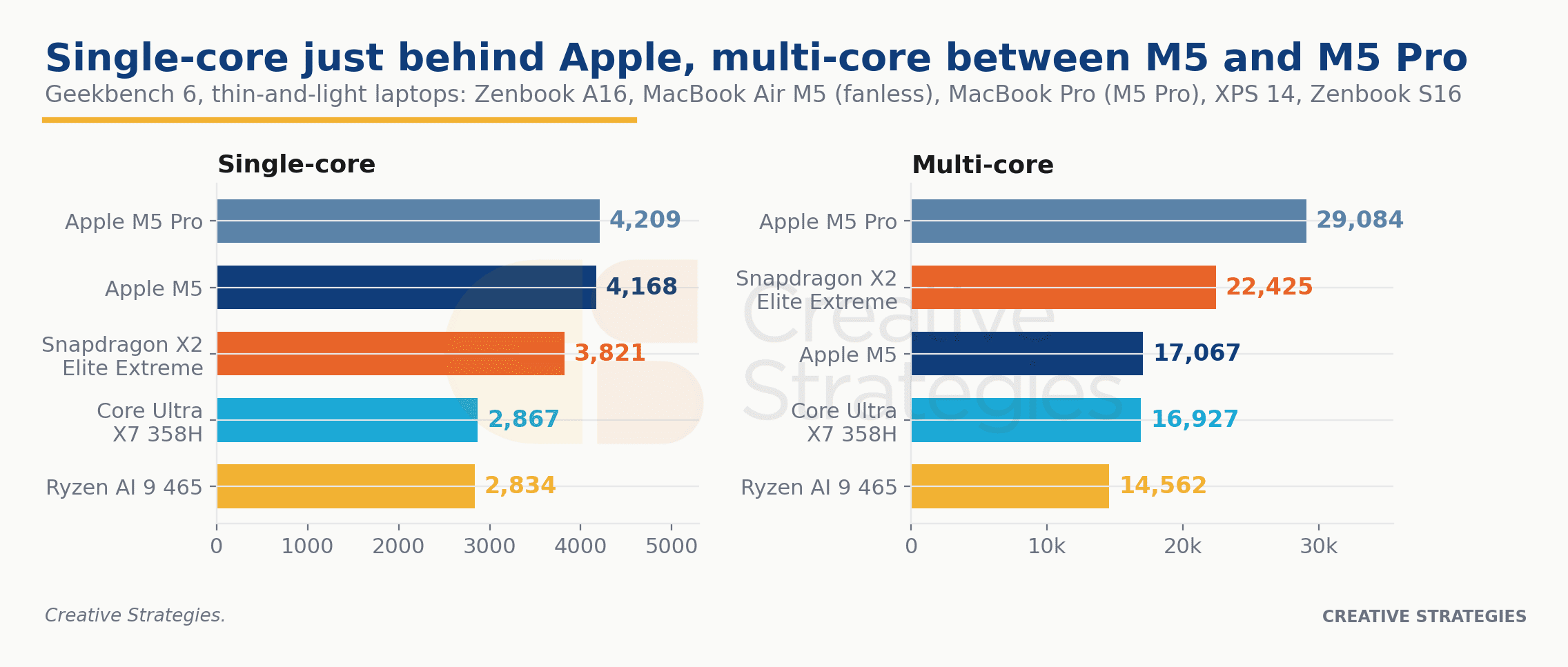
Apple keeps the single-core crown. The fanless M5 MacBook Air sits at 4,168 and the M5 Pro at 4,209, both roughly 10% ahead of this chip. The real story is the x86 column. Intel’s and AMD’s current thin-and-light flagships land at 2,867 and 2,834, which hands the X2 Elite Extreme a 30-plus percent lead over both on the one metric that decides how fast a laptop feels. The x86 establishment is now a third behind on the thing that matters most.
Multi-core is where the placement gets interesting. The 18 cores put up 22,425 on my unit, and that lands the chip exactly where I’d describe its overall performance: between the M5 and the M5 Pro. It clears the MacBook Air’s 17,067 by more than 30% while the M5 Pro’s 29,084 stays out of reach, the Core Ultra X7 sits just behind the Air, and the Ryzen trails at 14,562\. It also sustains. Loop Cinebench 2026 and this machine opens around 6,300 and holds right around 6,000 run after run, while the fanless MacBook Air opens at 3,415 and settles into the low 2,300s, and the Intel X7 machines hold somewhere between 4,000 and 4,500 depending on the chassis. A thin 16-inch laptop sustaining two and a half times a MacBook Air’s multi-core throughput is the kind of thing that was supposed to be impossible on Windows on Arm two years ago.
Is the M5 Pro the better chip? Probably. It’s also a chip whose cheapest home is a [$2,199 MacBook Pro](https://www.apple.com/shop/buy-mac/macbook-pro/14-inch-m5?ref=creativestrategies.com), while this laptop is $1,699 with twice the base RAM. That’s the framing that matters. The M5 Pro buys you a different class of machine, not a better version of this one. In the class the Zenbook actually lives in, the big thin-and-light under $1,800, the X2 Elite Extreme is the best chip you can buy. Intel and AMD aren’t close, and Apple doesn’t sell this much multi-core anywhere near the price.
### Living on Windows on Arm
It’s not a secret that I’ve been doing a lot of development work lately. I hate the term, but I’ve been playing around with vibe coding, building my own agents, and getting to understand how this stuff works at a pretty deep level. When I’m doing that work, the only machine I reach for now is the Snapdragon one. Installing JavaScript modules with Bun is faster. The first compile on an Electron app is faster than on any other Windows laptop I have around. And supporting Arm as a developer is genuinely not hard anymore; for my projects it is literally adding a win-arm64 target next to win-x86 in the build config.
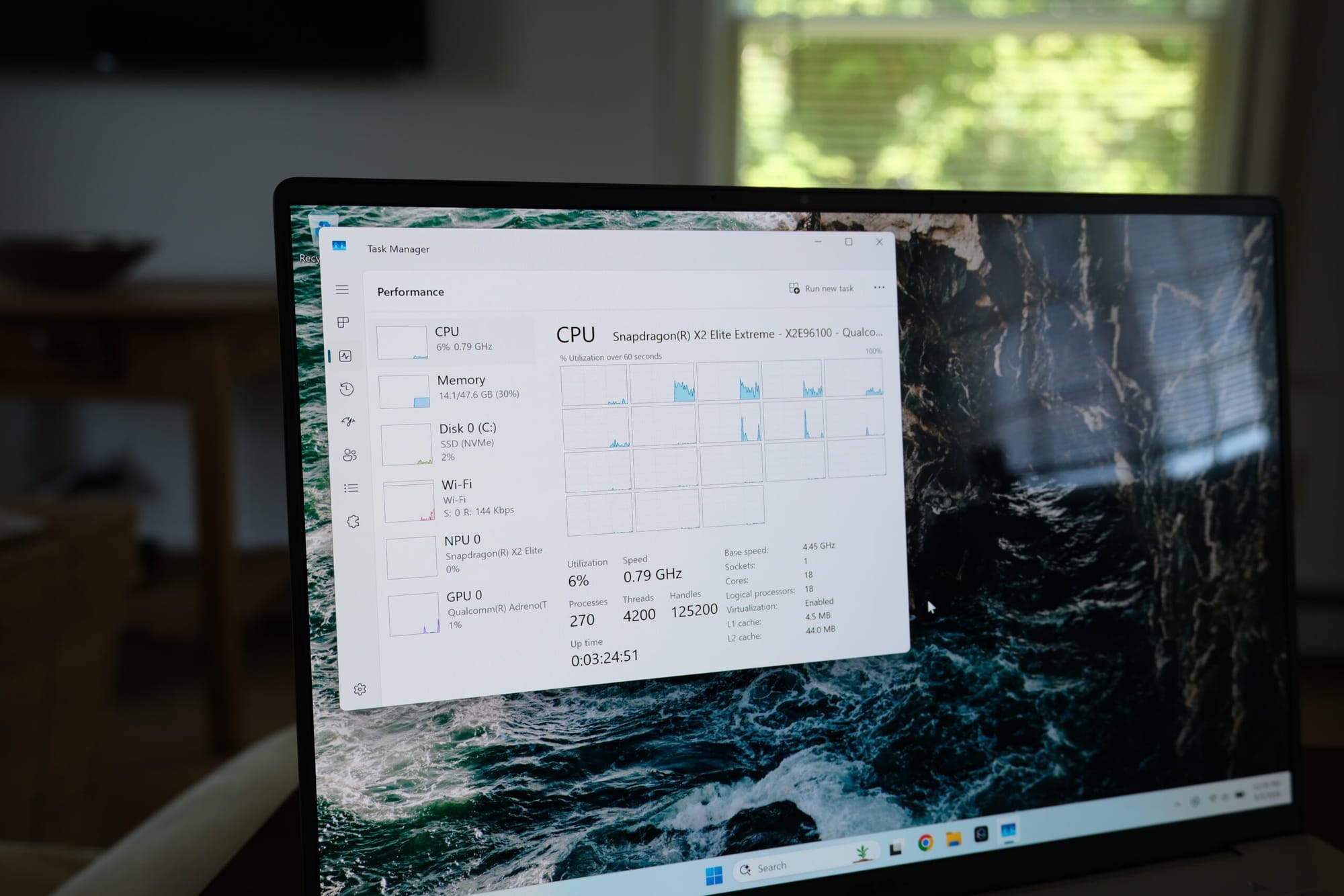
There is one exception, and it’s a good example of the remaining rough edge. OpenAI’s Codex app doesn’t ship an Arm-native version, so it tries to run in an x86 sandbox, and that doesn’t work. I can use Codex from the command line just fine, but the app is really good and I can’t use it, which is disappointing. I’ve asked OpenAI about it. They said they’ll support it at some point. Who knows.
That’s the uncommon case, though. Almost everything I’ve put on this machine runs natively on Windows on Arm now, and the apps that don’t run fine emulated. Even some games hold up. My favorite test is Overwatch, which on this machine actually outperforms a lot of the x86 laptops I’ve had around when running DirectX 12\. I could not tell you why. It doesn’t entirely make sense, but it’s repeatable, and it’s really cool.
### The on-device AI story
There is none. I mean that almost literally. The NPU exists, it does 80 TOPS, this is a Copilot+ PC, and the features are all here. I don’t notice them. The semantic file search in File Explorer, where you describe the file you want and it finds it, is fantastic. Recall I keep around as a just-in-case and basically never open. Could live with it, could live without it.
I’ve been building some AI benchmarks to test this NPU, partly to understand what it’s like to develop and optimize a model for it. It’s a good NPU. It performs well. But watch where the industry is going: everyone is quietly moving AI workloads away from the NPU and back toward the CPU, because the CPU is what runs Claude Code, Codex, and everything in between. That shift plays directly to this chip’s strength. The reason this machine is great for AI work isn’t the dedicated AI silicon, it’s that the CPU attached to it is exceptional.
### Boring is good
The GPU is fine. I have no complaints about it, and I didn’t pick this machine for graphics. The build, the thermals, the day-to-day: fine, fine, fine. I want to be clear that this is praise. If you get a laptop today and it’s boring, that’s a good thing. Nothing on this machine stands out as bad, a few things stand out as extremely good, and the stuff that annoys me daily on other Windows laptops, mostly slow-feeling CPUs, doesn’t exist here. I don’t want to be annoyed by my computer. This one doesn’t annoy me. That’s a better compliment than it sounds like.
---
### The cover glass problem
Here’s the thing that ruins it, and here’s why the cheaper version at Best Buy is the one to get.
Asus sells two displays on the A16\. The Best Buy model has a proper cover glass over the OLED and a slightly slower chip: its X2 Elite Extreme boosts to 4.7GHz instead of 5.0GHz. That 300MHz is negligible. You will never notice it (in Geekbench, my 5.0GHz unit scores within a rounding error of the 4.7GHz one, and actually came in a touch lower in multi-core). The model on Asus’s own website has the 5.0GHz SKU and no cover glass at all, which means a plastic border around the panel and a tacky plastic coating sitting on top of the OLED.
This is a terrible display to live with. It looks fine powered on, but touch it once, or let it pick up any oil or fingerprints, and it’s near impossible to clean. It looks cheap. Worse, the glass on a normal laptop is structural, and without it this display flexes with almost no force, the chassis flexes with it, and the whole machine feels like something you could break by picking it up wrong. Putting it in a backpack makes me nervous. Reflections and sunlight are harder to fight. And for the same RAM and the same storage, IT COSTS THREE HUNDRED DOLLARS MORE.
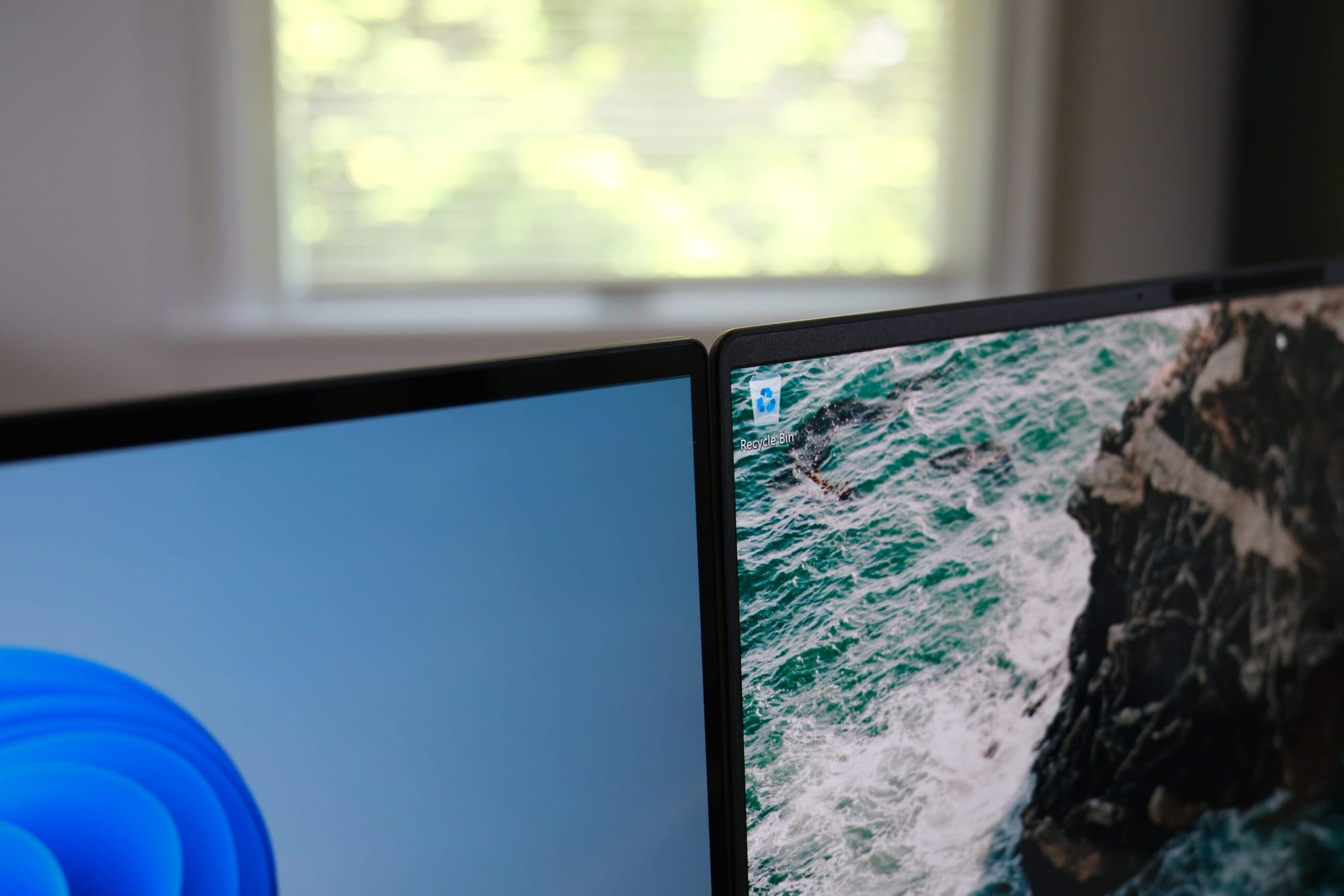
Left: 2025 Asus Zenbook S16 with cover glass Right: 2026 Asus Zenbook A16 without cover glass
I don’t know why Asus shipped this version. I genuinely don’t. A display like this should not exist on anything over a thousand dollars, and on a two-thousand-dollar machine it is absolutely horrendous. **The only version of this laptop anyone should ever buy is the Best Buy one, with the cover glass.** The weight difference between the two does not matter.
I know how this sounds. It sounds like a massive nitpick. It is not a nitpick, and I want to explain why, because it goes to how I think about hardware in general. I care about tactile feel. When you sell a computer, the end user hardware matters more than anything else, not just the chip inside it. Performance matters, but everything together is what someone lives with. Earlier in this review I called this the first premium Snapdragon laptop, and for anyone who buys the Best Buy version, that’s true. It is not true of the unit on my desk. This machine does not feel premium. It feels hundreds of dollars cheaper than it costs, and that one missing piece of glass is the entire reason. This will likely sit on my desk unused because of it, which is a shame, because I like everything else about this laptop.
### The small stuff
A few quick notes that didn’t fit anywhere else:
- The keyboard is actually pretty good. I tend to like Asus’s Zenbook keyboards, and this one keeps the streak.
- The trackpad is good. It’s not haptic, and I wish it were, but it’s a good size and it tracks well.
- The speakers are okay. Not great.
- The fans exist and you’ll occasionally hear them, but they’re not loud and they’re off most of the time.
---
### What this means for Qualcomm
Analyst hat on for a minute, because this machine says more about the market than one SKU decision does.
This is the second generation of Snapdragon X laptops, and the year-over-year change isn’t really about the silicon. It’s about the OEMs. They’re adopting the platform more widely, trusting it with better designs, and putting real effort into the machines. Asus is the clearest example: the Zenbook A series, both the A14 and this A16, is exclusive to Qualcomm. The Zenbook S14 is Intel-only. The S16 is AMD-only. The variant of the Zenbook designed to be the lightest, thinnest, most Air-like machine in the lineup went to Qualcomm, and Asus was first to ship the X2 Elite Extreme and remains the only one shipping it. Last year the premium designs mostly skipped Qualcomm. This year it has a Zenbook line to itself. Yes, the OEMs still make mistakes, see: cover glass. The direction is what matters.
The Windows on Arm takeoff is happening now, and it’s about to get a second engine. NVIDIA showed up at Computex this week with [RTX Spark, the N1X superchip](https://creativestrategies.com/microsoft-build-2026-rtx-spark-and-windows-apple-silicon-moment/), with laptops from Microsoft, Dell, HP, Asus, Lenovo, and MSI coming this fall. I keep hearing that this kills Qualcomm. I think that’s completely wrong, because the two aren’t in the same market. [N1 systems reportedly won’t be priced below about $1,799, and N1X systems start near $2,899](https://x.com/mweinbach/status/2061865456365940841?s=20&ref=creativestrategies.com). The X2 Elite Extreme at the very top of Qualcomm’s stack lives in a $1,700 laptop. Qualcomm covers the volume of the market, from cheap consumer machines up to about $1,800\. NVIDIA picks up from $1,800 to $3,000 and beyond, selling the one thing Qualcomm doesn’t have right now: a real GPU. Down in the volume segment you don’t need that GPU. You need a fast CPU, and Qualcomm now ships one of the best in the industry. Rising tides raise all ships here. Anyone arguing Qualcomm isn’t succeeding in PCs is reading the wrong scoreboard.
---
So, the verdict. The chip was never the problem, and with the Zenbook A16, the laptop mostly isn’t either. This is the best Windows on Arm machine I’ve used, the closest thing to a real MacBook Air competitor the Windows side has produced, and the home of the best CPU you can currently get in a thin laptop. If you want a big, light machine for real work and you don’t need a discrete GPU or macOS, I can’t think of a better option at the price.
Just buy the right one. The $1,699 Best Buy version with the cover glass is the premium laptop Qualcomm has been waiting two years for somebody to build. The $1,999 version on Asus’s website is the same laptop wearing a worse display, and it undoes the whole point. Asus built the first premium Snapdragon laptop and then, for three hundred dollars more, also sells you the version that isn’t.
### The Dell XPS 14 Is Back, and Dell Nailed It
URL: https://creativestrategies.com/research/the-dell-xps-14-is-back-and-dell-nailed-it/
Last updated: 2026-06-04T21:15:29.000Z
I have had the new Dell XPS 14 for a few months now. Let’s get the big statement out of the way first: this is the first Windows laptop I’ve used in a long time that feels like they cared about the user experience.
Saying a Dell feels as nice and premium as a Mac is a huge statement. It’s also true. The MacBook Air and MacBook Pro are the benchmark for premium laptops. The XPS 14 lands somewhere between those two. It is thin and light like the Air, and premium in the way the Pro is. I have not felt that from a Windows laptop in about five years. Call it catching up if you want; I don’t care how long it took. We’re here now.
---
### What Dell got right with OLED
When this laptop came out, there was something I wanted to test: how does battery on the LCD model compare to the Tandem OLED model. So, I asked Dell for two identical systems with the only difference being the panel.
I figured a lot of people would happily swap the fancy OLED for a cheaper LCD if it bought them a big jump in battery life. Save some cash, get four or five more hours, and accept a worse-looking screen. That felt like a trade real people would make, and I wanted to see it play out, especially as products become more expensive.
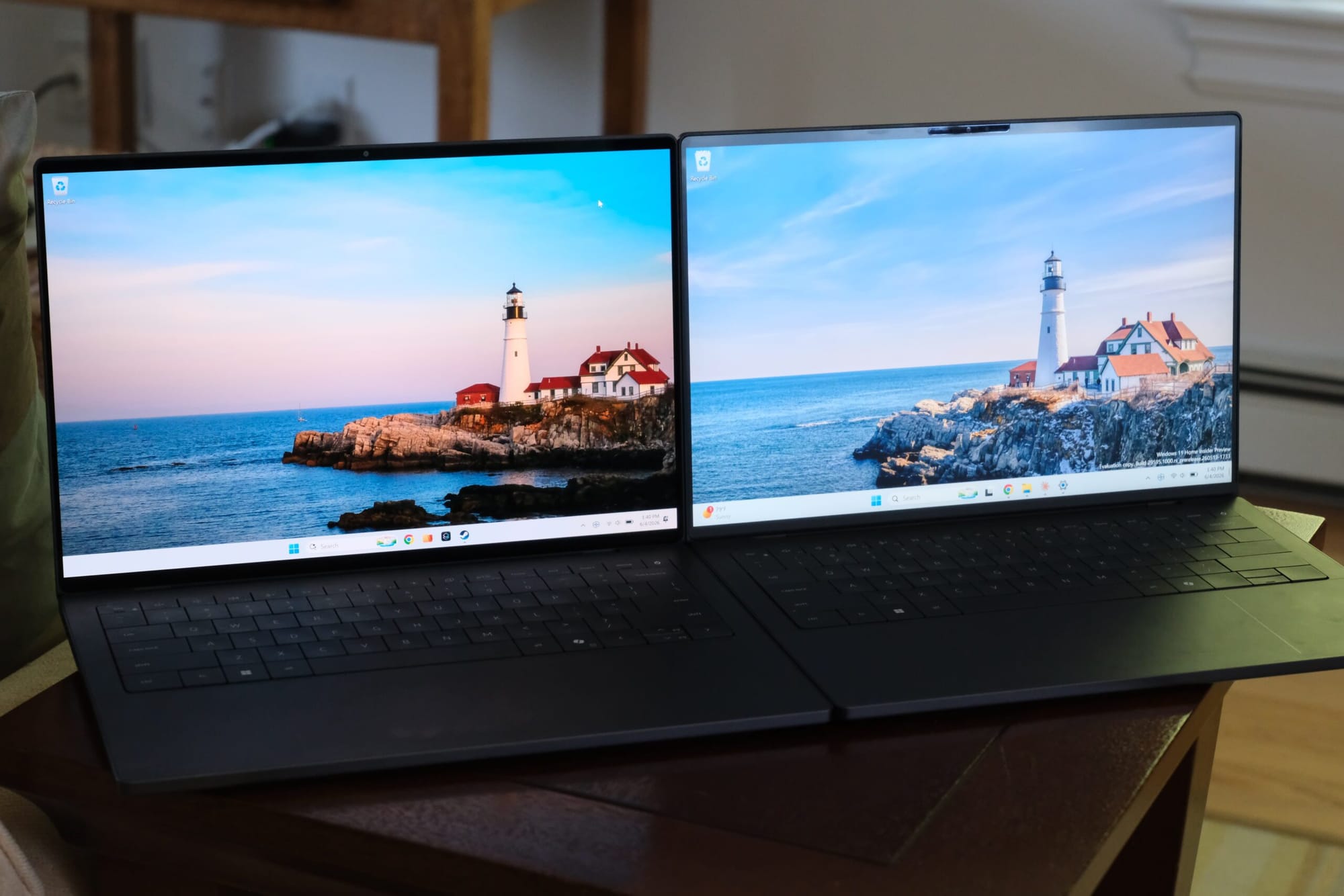
OLED on the left, LCD on the right
OLED on Windows has earned that setup. Run one of these panels at 120Hz and your battery can take a real hit, because somewhere in the display controller or the tuning the panel just chugs power. So much so that in some systems, running a panel at 120Hz can use more power than the SoC itself. So I tested the tandem OLED config against the LCD one expecting a bloodbath.
The gap was about an hour and a half, maybe two hours. That’s it.
On our battery benchmark, which runs real workloads in real apps at 35% brightness, the OLED ran about 9.9 hours and the LCD ran 11.7\. That’s a difference of about 1.8 hours, or roughly 15%. This is Chrome, documents, Excel, File Explorer, RAW photo editing, and file movement, not looped video playback or an artificial browser-only test. Both panels were running at 120Hz, so nothing changed but the screen type, and a 120Hz OLED is the exact condition that normally wrecks Windows battery life. To see what that penalty usually looks like, I ran the same test on a Galaxy Book6 Pro and flipped it from 60Hz to 120Hz. That alone cost about three hours, closer to a third of the runtime. That’s the hit I came in expecting from the XPS, and it never showed up.
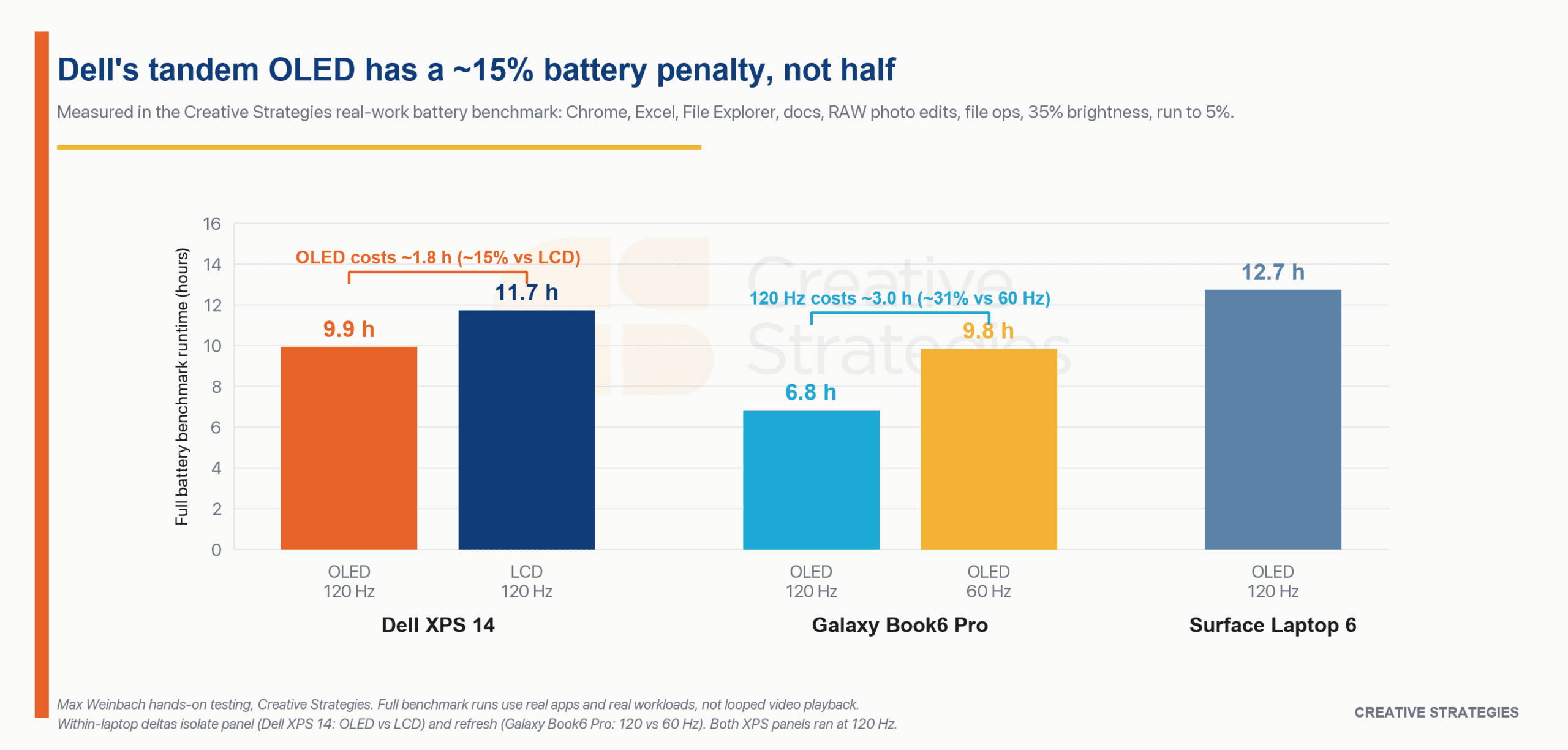
These are full battery benchmark runs to 5%, using the same real-work app sequence across the machines. I want to be careful with that distinction because this is much closer to how a laptop actually dies in a workday than the single-loop battery numbers most reviews lean on.
There is a bigger version of this coming. We are building out the comparison set around final shipping devices and this same realistic work model. Think browser tabs, docs, spreadsheets, RAW edits, file movement, and the kind of mixed day that actually kills a laptop. The XPS 14 is one of the first machines going through that process, and this early OLED-versus-LCD result is why I am interested in it. Originally I was holding this review to compare to a larger set of devices to really show how these all compare, but no time like the present! More coming soon.
I have never seen an OLED penalty this small on a Windows laptop. Not once. The reason it works is that Dell tuned this panel for efficiency instead of chasing a peak-brightness number, which is the same broad move Apple made with its own tandem displays. Apple has been the benchmark for efficient premium displays, and I had not seen a Windows OLED laptop answer that in my own testing until now. Dell answered it. The panel looks fantastic, it’s bright enough that I never once think about it, and it doesn’t gut your battery to get there.
So my clean little value story (buy the LCD, save some cash, win on battery) fell apart, because the honest answer is the OLED is good enough that I’d pay the premium for it. Dell nailed tandem OLED on Windows. That ruined the test I came in to run and made the laptop much more interesting in the process.
---
### Why people buy premium laptops
Here’s the part I care about most, and it’s where we get a little more analytical.
I don’t think most premium buyers buy a spec sheet. They buy the overall product. The specs have to be there, of course; nobody wants a slow computer. But once you clear that bar, the things that decide whether a laptop feels worth the money are the things you touch. The keyboard. The trackpad. The weight in your bag. Whether the hinge opens with one finger. The sound it makes when you close it. None of that shows up in a comparison table, and all of it is most of the experience.
This is the lens the spec-warriors miss. You can line up a cheaper laptop with the same processor, or even a cheaper laptop with a better processor, and on paper the XPS loses. In the hand it wins, every time, because it’s a better laptop in all the ways the table doesn’t measure. Price-to-performance is a real way to shop, but it’s a gaming-buyer way to shop, and that’s a completely different person from the one this machine is for.
Gaming laptops pick a side. Gamers want the absolute most performance, so they’ll happily carry a heavy brick with cheap plastic and screaming fans to get it. Machines like the ROG Zephyrus or the Razer Blade pick a softer version of that same side, giving up a little peak performance for a thinner, lighter, nicer body. Both are real demographics. Neither one is the normal person who doesn’t care about any of this and just wants a laptop that is good.
Dell built a machine that matches what an end consumer wants, regardless of specs. The proof is simple. Hand this thing to someone, don’t tell them a single spec, and let them open it and type on it. I’d put money on the first reaction being “wow, that’s a really nice computer.” That’s the whole game.
---
### Silent acoustics and cold laps
One of the biggest contributors to perceived premium value is fan noise and thermals. If the fans spin up and get loud when you’re in a meeting, it becomes embarrassing and quietly drains how premium a laptop feels.
The XPS 14 is one of the first Windows laptops I’ve used where the fans do not get loud. Dell reworked the cooling so it pushes air out the back and the sides instead of straight into your lap. The result feels Mac-like, because the thing stays comfortable to use on your lap.
The keyboard is a pleasure to type on, and the haptic trackpad is massive and feels great. The one-finger hinge works perfectly, and the sound the lid makes when you close it feels expensive.
While there are some Windows laptops, especially those powered by Snapdragon chips, that tend to be quiet, those machines tend to lack the overall premium design I’m enjoying here. Again, first laptop that really gets me everything I could possibly want!
---
### Panther Lake and the regular Apple M5
The unit I’ve been using is the XPS 14 with Intel’s new Panther Lake silicon, the Core Ultra X7\. It is built on Intel’s 18A process, and it has the strongest integrated GPU I’ve used on a Windows machine. Yes, Strix Halo exists. I haven’t used it.
The Core Ultra X7 never feels slow. For years, the only Windows laptops that felt consistently snappy were the Qualcomm machines. Now I get that feeling out of an Intel chip. In the creative work I used it for, from RAW photo edits to video timeline work, it doesn’t stutter, and it feels as snappy as my standard Apple M5 machine.
The numbers explain why. In Geekbench 6, the XPS 14 is not close to the M5 in single-core, 2,801 versus 4,172, and that still matters for the instant-response feeling Apple is so good at. But the gap mostly disappears once you move into heavier work. The XPS scored 16,665 in Geekbench multi-core against 17,300 for the M5, 4,197 in Cinebench 2026 multi-core against 4,476, and 3,973 in 3DMark Solar Bay Extreme against 4,506\. That puts it at roughly 96%, 94%, and 88% of the M5 in those tests.
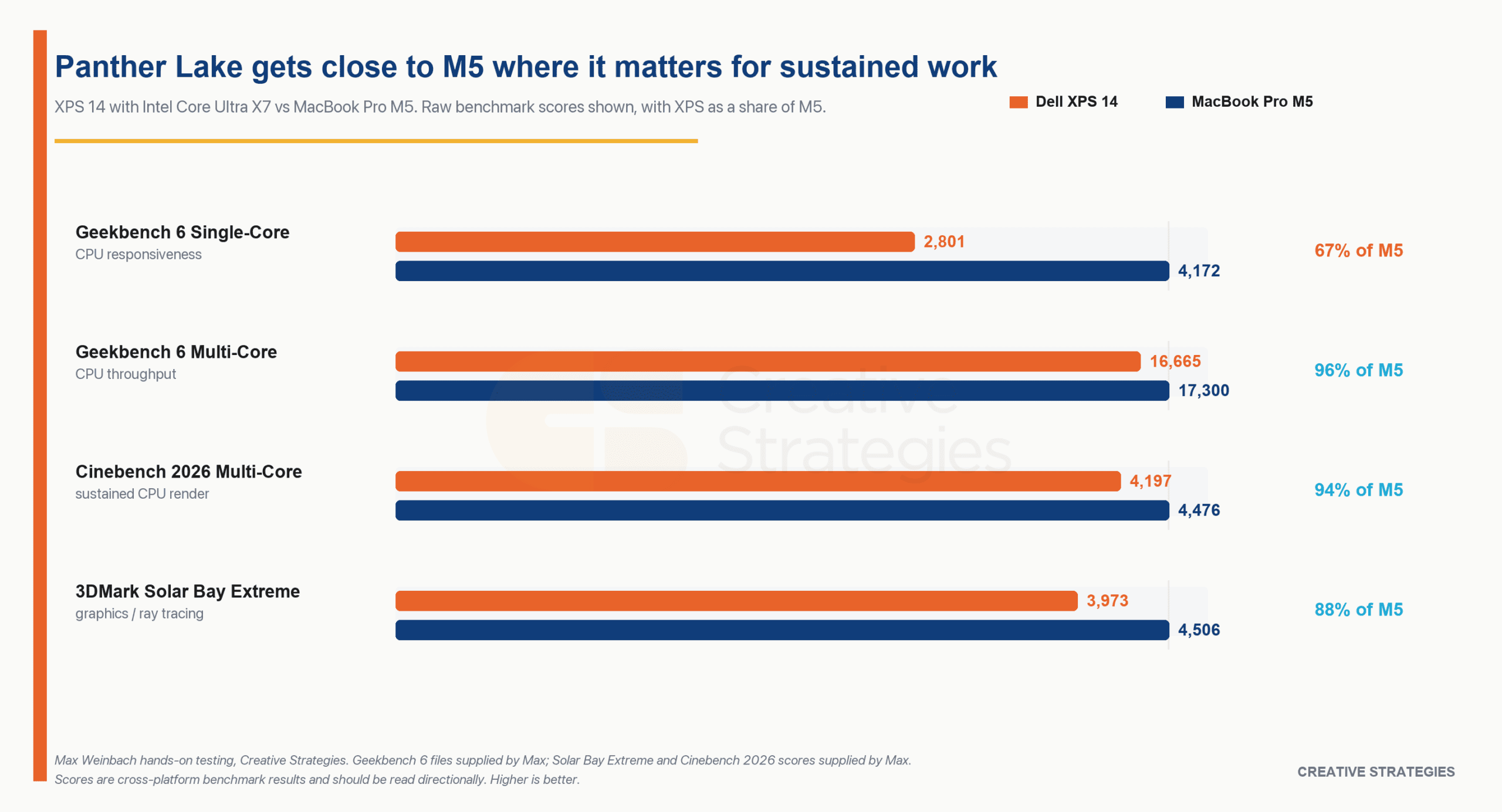
Let’s frame the part that matters. This is not as fast as my M5 Max, and it was never going to be (my M5 Max is also 2x the price). But it is close enough to a regular M5 in sustained CPU work and graphics that the laptop itself becomes the story, which is a great place to land.
---
### The details to improve
I had to work to find these.
First, the keyboard doesn’t look perfectly flat. There is a slightly uneven look to it across the top, which is purely cosmetic and I never feel it while typing.
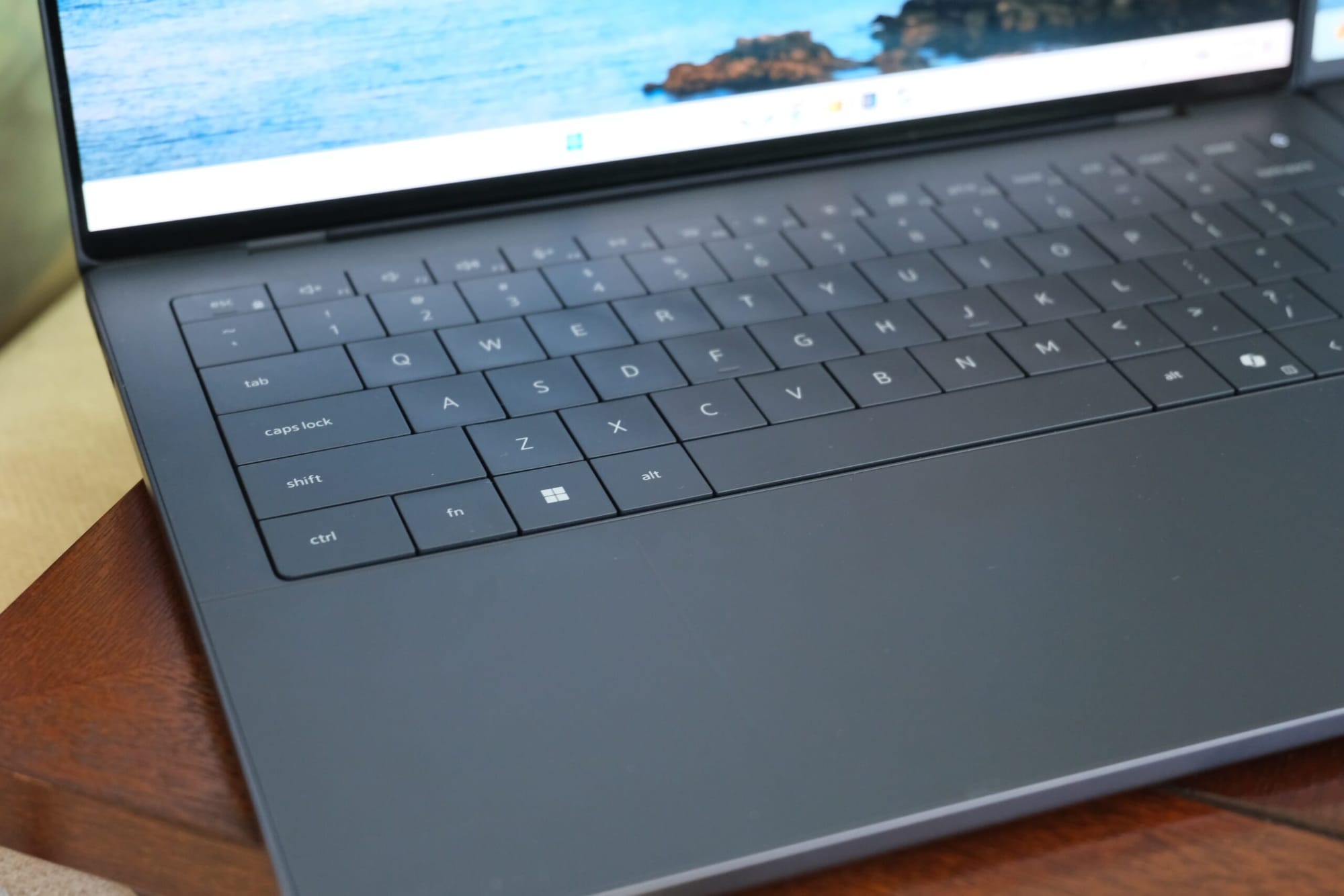
Second, the speakers are fine, but they aren’t great. My expectations are set by the Mac, which still has the best laptop speakers I’ve used. I wouldn’t pick this machine to watch a whole movie on.
Third, the haptic trackpad is good, but sometimes the multi-touch sensitivity isn’t as sharp as I’d like. I’d love to see them tighten that up.
For a machine in this class, that is an absurdly short list. I am running Windows on it, and Dell lists Ubuntu support as coming later if that is more your thing. I have no major complaints about the experience.
Truly, it’s a struggle to find things to improve or that I would want changed. I’ve tried.
---
### Who it’s for, and where this goes
This is for people who want the best Windows laptop, not the most laptop for the money. Everyone wants the best. That does not mean the best is always worth paying for, and it definitely does not mean every person should buy the most expensive machine on the shelf. But if what you want is the premium Windows laptop that feels the most complete, this is it.
It’s expensive, and yes, you can find cheaper laptops with similar or even better numbers on paper. They are worse laptops. I can’t point to anything that gives you what the XPS gives you for less, and the stuff it does better is the stuff you feel every single day.
Would a workplace hand these out? Probably not; it’s a bit pricey for that, and Dell sells the Pro Premium line for exactly that job. That leaves the XPS as the consumer machine, which is what it should be.
From an analyst seat, people will want me to call market share or comment on what this means for the industry. I have no clue how the competition reacts over the next few months. What I’d bet on instead is the rule that has always held: good product matters, and good product does well. The XPS 14 is a remarkable product, arguably the best in its class on the Windows side. That tends to win regardless of what the market is doing.
The old rule that cheap laptops have to feel cheap is also on its way out. Build quality used to collapse at the low end because the chips were so slow you had to spend everything on performance, and the materials paid for it. With Intel’s Wildcat Lake and Qualcomm’s Snapdragon C platform, the cheap stuff is finally fast enough that the trade-off loosens. The floor is rising. But today, at the premium end, the XPS 14 is the one that’s set up the best.
It is, to put it plainly, dumb how good this thing is. No major complaints.
### The PC Built for Agents
URL: https://creativestrategies.com/research/the-pc-built-for-agents/
Last updated: 2026-06-04T15:34:11.000Z
The RTX Spark is Microsoft and Nvidia’s joint statement about what the PC needs to become, and who gets to help define that. Microsoft Build, running this week in San Francisco, made the software half of that argument explicit.
##### The Machine Behind the Agent
The chip, formerly codenamed N1X, combines an Arm-based CPU, a Blackwell GPU, and AI hardware into a single package, with 1 petaflop of AI performance, 6,144 Blackwell RTX cores, 20 Arm-based CPU cores, and support for up to 128GB of unified RAM with 300GB/s memory bandwidth. Laptops and compact desktops from Microsoft, Dell, HP, ASUS, Lenovo, and MSI will begin arriving in the fall. Microsoft also announced the Surface RTX Spark Dev Box at Build, a developer-focused configuration pushing the hardware to its ceiling, with Satya Nadella himself on the waitlist.
##### Silicon Is Not the Whole Story
What the specs are designed to enable matters more than the specs themselves. The RTX Spark is built for a PC that keeps working when you are not sitting in front of it. Agents running on-device need compute that is always available, power-efficient, and capable of handling inference locally rather than routing every task to the cloud. At Build, Microsoft announced two new in-box models for Windows: Ion Instruct, a reasoning model, and Ion Plan, a local planning model, designed together to enable a fully on-device agentic loop with tool access and no cloud round trip required. That is the software foundation the RTX Spark is built to run. Microsoft’s framing for all of it was delivering “unmetered intelligence to every desk and every home,” which is a cleaner encapsulation of the hybrid AI cost argument than anything the industry has managed to produce in two years of AI PC positioning. The “every home” part deserves scrutiny though. These are not mass-market devices, and the price points arriving this fall will make that clear. Unmetered intelligence has a meter. It is just measured in upfront hardware cost rather than token consumption.
##### What Qualcomm Proved and What It Didn’t
Qualcomm started this architectural shift. Snapdragon brought Arm into mainstream Windows laptops, proved the compatibility case, and opened enterprise buyers to rethinking what a Windows PC could look like. At Build, Nadella called out the full range of silicon now in the Windows ecosystem: AMD, Intel Panther Lake, Qualcomm Snapdragon X2 Elite at the high end and Snapdragon C for sub-$500 PCs. AMD deserves a separate mention here. The company has been quietly building its own agentic PC story, and with Ryzen AI now capable of running local models competitively, it is part of the silicon diversity picture that makes the broader Windows agent narrative credible, even if it did not get the same platform-moment treatment at Computex and Build that Nvidia did. Nvidia enters with a Grace-Blackwell superchip that adds the full RTX and CUDA stack to the Arm formula, which is where Qualcomm had limits. Developers and enterprises who depend on CUDA workflows now have a path to Arm that does not require leaving their tools behind. Jensen Huang’s claim that the chip will run every application Nvidia has ever created and every application Windows has ever run is a direct pitch to that concern. With Windows also arriving on the DGX Spark, what Nadella called a desktop data center capable of running a one trillion parameter model locally, the Windows silicon stack now spans from sub-$500 consumer devices to on-premise infrastructure that two years ago would have required a data center. The Qualcomm experience is instructive here. Even where Snapdragon solutions performed well in pilots and early deployments, adoption remained conservative. IT departments are already under significant pressure managing AI’s new security and compliance demands, and adding unfamiliar silicon to that equation raises the bar for justification. Vendors bringing RTX Spark devices to market need to be disciplined about matching silicon choices to the experience they are actually delivering, because IT buyers evaluating a new platform will have limited patience for devices that overpromise on capability and underdeliver on manageability.
##### The Enterprise Calculus
The enterprise angle is where RTX Spark has the clearest near-term impact. Over the past two years, organizations have moved from AI pilots to actual deployment, and the economics have shifted with that. Token costs at scale are real, and the calculus around hybrid AI strategy, how much inference lives in the cloud versus on-device, is no longer something IT leaders can defer. High-end workstation-class devices capable of running powerful local models give enterprises a concrete way to test that balance. Microsoft is named as a co-developer on RTX Spark, having built new Windows security primitives to run on-device AI agents alongside Nvidia’s OpenShell runtime, with enterprise-grade manageability and security designed into the platform from the start.
##### A Platform Moment, Not a Product Launch
The timing of the Computex and Build double-header follows the same playbook as the earlier Qualcomm-Microsoft coordination. It is a platform moment, and those only land when hardware and software narrative arrive together. Surface leads, as it has before when Microsoft needs to demonstrate a direction. Lenovo, HP, and others follow with their own interpretations for different segments and price points.
##### Gaming and Creativity First, AI Second
On the consumer side, gaming and creativity are the stronger pull. Gamers understand what a Blackwell GPU means. Creators who work in GPU-accelerated workflows understand unified memory at this scale. For those buyers the value proposition is clear and the premium is justifiable. The broader consumer market is a longer story, and mass-market AI features alone are unlikely to close it at these price points.
##### Agents Need a Home, But Maybe Not a Dedicated Device
Project Solara, Microsoft’s agent-first platform also unveiled at Build, is designed from the chip up for devices that run agents as their core function, with enterprise manageability and security as foundational requirements. RTX Spark and Solara are answering the same architectural question from different directions, and the Windows AI PC story, which has suffered from real positioning confusion for two years, now has a hardware ceiling high enough and a software vision specific enough that enterprise buyers can finally evaluate it on concrete terms rather than marketing ones. Microsoft deserves credit for thinking seriously about a dedicated OS for agent-first devices, and Project Solara is a coherent answer to a real architectural question. There is also a business logic worth calling out: dedicated devices that run Microsoft agents, secured through Microsoft identity, managed through Microsoft Intune, and grounded in Microsoft 365 data, create faster and cleaner proof points for organizations that might find it easier to commit to an end-to-end Microsoft agentic stack than to orchestrate across vendors. The caution is around dedicated devices as a broad enterprise play, given that Microsoft has never owned a phone environment outside of Windows Mobile, and for most workers outside of specific verticals, the smartphone is already the always-on, always-present companion that dedicated badge or desk devices are trying to replicate. In healthcare or manufacturing, where the environment itself imposes constraints around security, hygiene, or physical context, a purpose-built device makes sense, but for the majority of organizations, agents living on a smartphone will be the more natural path, and the more adoptable one.
### Qualcomm at Computex: A Decade-Long Bet Starts Here
URL: https://creativestrategies.com/research/qualcomm-at-computex-a-decade-long-bet-starts-here/
Last updated: 2026-06-03T05:07:25.000Z
Cristiano Amon called 2026 the Year of the Agent. The label is directionally right, but it suggests a milestone that has been reached rather than one that is still being built toward. What Computex actually showed is a company positioning itself for a transition that is only beginning, one that will take years to fully materialize and decades to reach its ceiling. The keynote was less a product launch and more a declaration of strategic intent ahead of Investor Day on June 24 in New York City. The audience in that room may have been press and partners, but the message was written for Wall Street.
#### The Agent Platform Shift
The clearest signal of how broadly Amon is thinking came not at Computex but at Microsoft Build, where Satya Nadella played a recorded conversation between the two CEOs filmed at Microsoft’s Device Lab. The context was Project Solara, Microsoft’s new chip-to-cloud platform for agent-first devices, and the wearable badge prototype shown on stage ran on Qualcomm silicon. But the more important exchange was conceptual. Amon argued that the smartphone’s role as the center of the digital experience is being fundamentally displaced. Today, other devices extend the phone. In the agent era, devices become endpoints for agents, and agents become the organizing principle. That shift, he told Nadella, creates demand for an open, horizontal platform, one where any agent can interact with the best device for a given context, rather than the vertical, phone-anchored ecosystems that defined the last decade. It is a framing that positions Qualcomm not as a component supplier to any one platform, but as foundational infrastructure for the whole category.
#### The Compute Continuum
That ambition is now backed by a portfolio that spans more of the compute stack than at any point in the company’s history. Smartphones and PCs remain the foundation, with Snapdragon as the anchor. Computex added meaningful new layers. The core of Amon’s keynote was a single, ambitious claim: Qualcomm is the only company that can power agentic AI from sub-2 milliwatts to kilowatts. From a chip inside an earbud connecting to a personal AI assistant, all the way to the data center racks that will serve inference at scale. That is not a claim most companies in this industry can make without significant qualification. Qualcomm can, and the breadth of portfolio it has assembled over the past decade is what makes it credible.
#### From Edge to Data Center
The Dragonwing IQ10 Robotics Reference Design positions Qualcomm as the default platform for humanoid robot development, a plug-and-play solution that dramatically lowers the barrier for robotics makers to get to market. A new Snapdragon C platform for Windows targets sub-$300 laptops, which is a real expansion of the addressable PC market rather than a refresh of the premium tier. And Dragonfly, the newly announced data center brand, signals Qualcomm’s intent to compete for the massive inference workloads that agentic AI will generate at hyperscale. The brand was teased at Computex with a full roadmap coming at Investor Day, but customer traction is already visible. Reports indicate ByteDance is Qualcomm’s first major ASIC customer, with the arrangement structured as a long-term, multi-generation collaboration rather than a one-time deal. A second engagement with a US cloud provider is also reportedly underway. For a brand that has not yet shipped a data center product, that is a meaningful early signal.
#### Performance Per Watt as Strategy
What ties these pieces together is a consistent architectural advantage: performance per watt. Amon returned to power efficiency repeatedly, and not as a talking point. His argument was structural. Agents running on devices that people carry all day, or embedded in cars and industrial systems where latency is measured in milliseconds and safety in millimeters, face power constraints that raw compute cannot solve. The CPU orchestrating tasks, the NPU and GPU running local models, the connectivity stack routing workloads between edge and cloud, all of it has to work within a power budget. Qualcomm has spent years building that stack precisely for constrained environments, and that same discipline translates directly to the data center, where every watt saved at scale compounds into a meaningful cost and performance advantage.
#### Betting on the Long Cycle
The other thing Qualcomm has that matters here is institutional patience. The company built its position in mobile over decades, investing through CDMA when that bet was far from obvious, through 4G, through 5G, absorbing years of skepticism about the smartphone market before it became the most important computing platform in history. Amon’s framing of 6G as the first wireless generation designed natively for AI is another long-cycle bet. It will not pay off in 2026\. The full impact of AI itself will take years, probably decades, to land completely. Qualcomm’s DNA is to invest early in technology transitions that take time, build the platform, and be positioned when the market arrives. That is exactly the posture the company is taking with agentic AI, and it is the right one.
#### The Ecosystem Advantage
The third leg of the argument, and the one that gets less attention than the hardware, is ecosystem. Qualcomm has spent years building developer tools, reference designs, and partner programs that make it easier for companies to build on Snapdragon and related platforms rather than starting from scratch. The Dragonwing IQ10 is a direct expression of that instinct applied to robotics. The Snapdragon C platform extends the AI PC ecosystem into price points that were previously out of reach. The Project Solara collaboration with Microsoft shows Qualcomm’s silicon showing up inside a new category of purpose-built agent devices at the very moment that category is being defined. Building and sustaining those ecosystems is a capability that takes years to develop. Qualcomm has it.
#### What Investors Will Push On
The gap between where Qualcomm is today and where Amon’s vision lands is real, and investors will probe it on June 24\. Dragonfly is a new brand with customer conversations underway but no shipping product yet. Robotics and automotive are significant opportunities still in early innings. The data center market has entrenched players with substantial leads. None of that changes the underlying logic of the position Qualcomm is building, but it does mean execution risk is high and timelines are uncertain.
What Computex and Build established together is the architecture of the argument. Qualcomm’s portfolio now spans every tier of the compute continuum that agentic AI will require. Its engineering heritage is built around the constraints that distributed intelligence imposes. Its ecosystem instincts are among the strongest in the industry. The agents are not fully here yet. The infrastructure to run them at scale is still being built. Amon knows this better than anyone, which is why the smarter read of this moment is not that the race has been won, but that Qualcomm has taken a very deliberate position at the starting line.
### Microsoft Build 2026: RTX Spark and Windows’ Apple Silicon Moment
URL: https://creativestrategies.com/research/microsoft-build-2026-rtx-spark-and-windows-apple-silicon-moment/
Last updated: 2026-06-03T02:34:23.000Z
Microsoft Build 2026 was the week Windows stopped trying to win on the spec sheet and started trying to win on the thing that makes a computer worth using. For years the Windows answer to the Mac was some version of “we can match that.” A faster chip here, a borrowed feature there. This was a different move. Microsoft and NVIDIA took a step back and went after the experience itself, the part you feel every day, and they pointed it at the people who decide what gets built: developers. The bet is to shape Windows around how developers work, instead of asking developers to keep working around Windows. That meant fixing two things at once: the machine in your hands and the operating system it runs.
The two halves landed in the same week and they are clearly meant to be read together. Two days before Build, at GTC Taipei, NVIDIA announced RTX Spark, an Arm superchip for premium Windows laptops built around a 20-core Grace CPU and a Blackwell GPU. Then at Build, Jensen Huang dialed into Satya Nadella’s keynote from Taipei while Microsoft laid out a version of Windows reworked, top to bottom, for developers and for AI agents. Hardware from NVIDIA, software from Microsoft, both aimed at the same target.
That target is the developer, and it is worth being honest about why. Apple did not win the early AI era because macOS was prettier. It won because developers liked the machines and liked the platform, and developers are the people who decide what gets built first. Unified memory made Macs the default for running models locally. The Unix underpinnings made the terminal feel like home. The battery and the silence and the build quality made them the laptop people wanted to carry. So the tools showed up there first, and the rest of us followed the tools. Windows has spent years losing that argument. This was the week it started arguing back, on both fronts at once.
I have not used an RTX Spark machine. Nothing ships until this fall, NVIDIA has published no benchmarks of its own, and the only performance numbers floating around are leaks. So treat the hardware section here as analysis of what was announced, not a review. The Windows software is real and shipping in pieces right now, and that is the half I am more confident about.
---
#### Key Takeaways
RTX Spark is NVIDIA’s entry into premium consumer Windows laptops, and it is positioned squarely against the MacBook Pro. A 20-core Grace CPU co-designed with MediaTek, a Blackwell GPU with 6,144 CUDA cores (the same shader count as a desktop RTX 5070), up to 128GB of LPDDR5X unified memory, and up to 1 petaflop of FP4 AI performance. Systems ship this fall from Microsoft Surface, Dell, HP, Lenovo, ASUS, and MSI.
The pitch is not a faster CPU. On the leaked benchmarks the CPU lands somewhere around base M5, behind the M5 Pro and Max. The pitch is the GPU and the AI. CUDA runs natively, which is the thing Apple cannot match. Apple’s MLX is a real and growing local-AI framework, but CUDA is still what most developers target, and right now they mostly reach for it on a remote machine. RTX Spark’s move is bringing that workflow onto a laptop.
Windows got the bigger makeover. Microsoft framed Build around “making Windows the trusted platform for development,” and it shipped the unglamorous developer plumbing that has kept people on Mac and Linux: native coreutils, built-in Linux containers, a one-command dev setup that installs homebrew and zsh for you.
The agent story is the other spine. Microsoft built an OS-level sandbox and identity system for AI agents (Microsoft Execution Containers), a registry for agents to safely reach into your apps and files over MCP, and a 14-billion-parameter reasoning model that runs in-box on Windows.
The risk is also the headline. An operating system that lets agents act on your behalf is a much larger attack surface, and Microsoft knows it. Its own researchers showed a prompt injection turning into remote code execution. The whole thing only works if the security holds.
This is a start, not a finish. The hardware is unproven and probably expensive, the software is half in preview, and Apple gets to respond at WWDC next Monday. But the direction is the clearest it has been in a decade.
---
#### What Matters
The thing that matters is that both halves arrived together, because neither one fixes Windows alone.
Good Windows hardware is not new in 2026\. The premium gap to the MacBook has been closing all year. Qualcomm’s Snapdragon X2 Elite Extreme posted single-core Geekbench scores above the M4 Max back in January. Intel’s Panther Lake showed up at CES as the company’s “M1 moment” on its 18A process, with battery claims it could not make a generation ago. The Dell XPS 14 I’ve been testing is the first Windows laptop in five years that has felt like a Mac to me. The hardware floor has been rising for a while.
What has not moved is the software. You could put the best Arm chip in the world in a beautiful aluminum chassis, and a developer who opens the terminal still hits a wall of small frictions that do not exist on a Mac. The wrong shell. Missing core utilities. Container tooling that fights you. A package manager that is not quite there. None of that shows up in a benchmark, and all of it is why a lot of developers who could use Windows choose not to. That is not something Apple lucked into. macOS has sat on Unix for years, developers preferred it for exactly that reason, and you can argue Apple is what created the appetite for a developer-first machine in the first place. Microsoft spent those same years resisting the thing developers wanted. This week it finally stopped, and went after that experience directly.
So the right way to read Build 2026 is as Microsoft and NVIDIA splitting the job. NVIDIA brings compute that Apple cannot match in raw AI throughput, because CUDA is the thing the entire AI software world is written against and it now runs on a thin Windows laptop. Microsoft brings an operating system reworked so that a developer coming from a Mac or a Linux box does not feel like they downgraded. **Put those two together and you have, for the first time, a credible Windows version of the thing that made Apple Silicon win: a machine developers want plus a platform that does not fight them.**
That is the whole argument. The rest is detail, and the detail is where it gets interesting.
---
#### The Hardware: What RTX Spark Actually Is
RTX Spark is the consumer face of the same silicon family as the DGX Spark, the little Grace Blackwell dev box I spent a chunk of last year playing with. Huang confirmed the underlying SoCs are essentially identical. The difference is the product. The DGX Spark is a Linux CUDA testbed that sits on your desk. RTX Spark is a Windows laptop chip meant to sell at scale, and “N1X,” the name you may have seen in leaks for the last year, was only ever the internal codename. The shipping brand is RTX Spark.
The configuration NVIDIA detailed is a 20-core Grace CPU built with MediaTek, paired with a Blackwell GPU carrying 6,144 CUDA cores and fifth-generation Tensor Cores. Up to 128GB of LPDDR5X unified memory, around 300 GB/s of memory bandwidth, and a 600 GB/s NVLink-C2C link between the CPU and GPU. Built on a TSMC 3nm process. NVIDIA quotes the AI performance as up to 1 petaflop of FP4 rather than the TOPS number everyone else uses, which tells you where it wants your attention.
Here is the part people will get wrong. This is not a CPU play. The leaked Geekbench and developer-workload numbers put the RTX Spark CPU roughly in base-M5 territory, faster than a Snapdragon X but not threatening the M5 Pro or M5 Max on raw cores. AppleInsider was already calling it two years behind Apple on CPU efficiency the day after the reveal, and on the CPU alone that is a fair shot. If you are buying this for spreadsheet single-core speed, buy something else.
The reason it exists is the GPU and the memory. A laptop with 6,144 CUDA cores and up to 128GB of unified memory can run models, render, and train in ways an Apple machine structurally cannot, because the local-AI software stack that the industry builds and deploys against (CUDA, TensorRT, the inference frameworks people put into production) runs natively here. Apple has its own answer in MLX, which is good and improving fast, but CUDA is still the default most developers target, and that is the gap. Apple’s unified memory was the developer’s secret weapon for running models locally. NVIDIA’s answer is unified memory plus the CUDA stack itself, on a thin laptop. The part that matters most is where that CUDA work happens today. Most developers who depend on it are renting it, reaching for a cloud GPU because their own machine cannot do the job. Putting a real CUDA GPU next to 128GB of unified memory in a Windows laptop pulls that loop back onto the desk. For anyone whose work touches AI, that is a different and stronger pitch than “our CPU is also fast.”
NVIDIA’s compatibility claim is the soft spot. Huang said on stage that RTX Spark “literally runs everything the world has ever created,” which is a marketing line, not a spec. It is a Windows-on-Arm device, so x86 apps go through Microsoft’s Prism emulation layer, and Prism has gotten meaningfully better (the late-2025 update added AVX and AVX2 translation, which unblocked a lot of software) but “everything” is doing heavy lifting in that sentence. We will not know how good it really is until the machines ship and someone who is not NVIDIA runs the apps people care about.
On price, NVIDIA and the OEMs said nothing official, which is itself a tell. Analyst channel checks peg the premium RTX Spark systems starting somewhere around $2,900, with Microsoft’s Surface Laptop Ultra rumored to climb toward MacBook Pro 16 money fully specced. Those are estimates, not prices. But the framing from everyone involved is “premium,” not “value,” and that is the point of the segment. This is the expensive, more-premium Windows answer to the MacBook Pro, not the cheap one. The cheaper RTX Spark tiers NVIDIA hinted at will matter more for volume, and we have not seen them yet.
---
#### The Software: Windows Finally Went After the Right Things
If the hardware is the part to be skeptical of, the software is the part that genuinely surprised me, because Microsoft went after the boring stuff that matters instead of shipping another Copilot button.
Start with the developer experience. Microsoft shipped Coreutils for Windows, native Linux-style command-line utilities built on the open-source uutils project, a Rust reimplementation of GNU coreutils. It is generally available now, and the framing in Microsoft’s own post is aimed directly at switchers: the commands and workflows you have built over years on Linux or macOS just work. There is a new built-in way to run Linux containers through WSL with no third-party tooling. And there is Windows Developer Configurations, a single WinGet command that sets up a full environment (VS Code, WSL, PowerShell 7, Git, Python) and, in a detail that made me laugh, includes “comfort setup scripts” to install homebrew, zsh, and starship for you. That last one is Microsoft openly admitting it knows exactly which Mac habits it is trying to import.
None of this is flashy. All of it is the stuff that made the Mac terminal feel like home and the Windows terminal feel like a chore. Closing that gap does more to move a developer than any keynote demo.
Then there is the agent half, which is the more ambitious bet. Microsoft’s argument is that agents are about to be first-class citizens on the OS, and that the OS therefore needs to treat them like users: give them identities, sandbox what they can touch, and log what they do. The centerpiece is Microsoft Execution Containers, a policy-driven sandbox that runs agents across both Windows and WSL, where a developer declares what an agent is allowed to reach (which files, which network) and Windows enforces it at runtime. Each agent gets its own identity, local or Entra-backed, so everything it does is attributable and a human can tell agent activity apart from their own.
The connective piece is how agents reach your stuff. Microsoft built an On-device Agent Registry that lets agents discover and use connectors over MCP, the protocol that has quietly become the standard way models talk to tools, and it shipped built-in connectors for File Explorer and Windows Settings, with the MCP servers contained by default to limit prompt-injection blast radius. NVIDIA’s contribution here is OpenShell, an open-source agent runtime built on the same container layer and wired into GitHub Copilot. There is even a local brain for all of it: Aion 1.0 Plan, a 14-billion-parameter reasoning and tool-calling model with a 32K context window that ships in-box on capable Windows devices, so the agentic loop can run locally instead of round-tripping to the cloud.
Put the developer tools and the agent platform next to each other and the strategy is obvious. Microsoft wants Windows to be both the best place to write code the old way and the best place to run the agents that will write a lot of it the new way. Whether the agent piece holds up depends entirely on security, which brings us to the part nobody should skip.
---
#### Why the Developers Are the Real Story
Here is my actual thesis, and I want to flag it as an argument rather than a reported fact, because no one at Microsoft or NVIDIA said it this bluntly.
The reason macOS got so much of the AI era first is that developers preferred it, and developers are upstream of everything. When the people building the tools are on a platform, the tools get built for that platform first, and the early-adopter gravity follows. Apple did not have to win consumers directly. It won the developers with good silicon and a Unix-shaped OS, and the consumer software advantage flowed downhill from there. Most people never knew why their Mac friend kept getting the cool AI thing first. This is why.
What happened this week is that the two upstream advantages got attacked at the same time. NVIDIA went after the hardware reason developers chose Mac, which was really the local-AI and unified-memory story, and answered it with a chip that also runs the CUDA stack the whole industry targets. Microsoft went after the software reason, which was the Unix-shaped developer experience, and answered it with native coreutils, real container support, and a terminal that stops fighting you. Neither one is finished. Both are now genuinely in the fight.
If that works, the consumer effect is the same one Apple enjoyed, just pointed the other way. Regular buyers will not notice coreutils or MCP connectors or agent sandboxes. They will notice, eventually, that the interesting software shows up on their Windows machine at the same time it shows up on a Mac, instead of six months later. That is the prize. Not winning a benchmark. Winning the people who decide what gets built.
---
#### Risks
I am bullish on the direction and skeptical of the timeline, and there is a real list of ways this does not pan out.
The security model has to actually hold. An OS that lets agents read your files and click around your apps is a vastly bigger attack surface, and this is not hypothetical hand-wringing. Microsoft’s own security team published research last month showing a prompt injection escalating into host-level remote code execution in an agent framework, a single malicious prompt launching a real process. Microsoft is putting its sandboxing and identity work forward as the answer, and the honest read is that it is a serious answer to a serious and unsolved problem. If it leaks the way Recall did, the whole agentic pitch stalls on trust, and trust is hard to win back.
The hardware is unproven and probably pricey. No shipping units, no independent benchmarks, no official prices, and a compatibility claim that has to survive contact with real software. If RTX Spark lands at $2,900 and up while the CPU only matches a base M5, the value math gets hard fast, especially with memory prices already pushing every premium laptop up this year.
There is a concentration-of-power problem. Microsoft is now the platform owner, the security vendor, the AI infrastructure provider, and the agent governance layer all at once, and at least one analyst flagged that pile-up at Build. Developers and enterprises will reasonably ask how much of this only works if you are all-in on Microsoft’s stack.
And the agent platform could sprawl. Execution Containers, the agent registry, Agent 365, Windows 365 for Agents, OpenShell, Aion, Foundry on Windows. That is a lot of new surfaces with overlapping names, and Microsoft has a long history of strong platforms with confusing product boundaries. If it turns into alphabet soup, the clean story it told this week gets muddy.
---
#### Bottom Line
Build 2026 was the most coherent case Windows has made in years, because for once it was not just a hardware story or just a software story. NVIDIA brought a premium Arm chip with AI compute Apple cannot match, and Microsoft brought an operating system reworked to make a Mac or Linux developer feel at home and to run agents as first-class citizens. That is the Apple Silicon formula, chip plus platform, finally assembled on the Windows side.
It is a start and not a victory. The chip does not ship until fall, the prices look steep, and the agent security model is making promises it still has to keep. But the complaints that have followed Windows around forever, the developer-hostile terminal, the missing Unix comfort, the sense that the good stuff lands on a Mac first, all got named and aimed at this week, by the two companies with the most ability to fix them.
Apple gets the next word. WWDC opens next Monday, and we will see what Apple does with Siri and on-device intelligence while Windows is suddenly playing real offense on Apple’s home turf of developers. For the first time in a long time, that matchup is interesting from both sides. This was a great start. Now everyone has to ship.
### The Smart Glasses Race Will Be Won on Style as Much as AI
URL: https://creativestrategies.com/research/the-smart-glasses-race-will-be-won-on-style-as-much-as-ai/
Last updated: 2026-05-21T03:45:48.000Z
Google used Google I/O this week to announce intelligent eyewear partnerships with Warby Parker and Gentle Monster, powered by Gemini and built on Android XR with Samsung and Qualcomm. The announcement was notable not just for what the glasses can do, but for how deliberately Google thought about what they need to look like.
That distinction matters more in this category than in almost any other consumer technology.
##### Two Brands, One Signal
Warby Parker is known for affordable, classic frames. Gentle Monster stands out for bold, high-fashion designs. Launching with two brands from opposite ends of the style spectrum reflects something smart glasses face that smartwatches only partially felt: your glasses are part of how you present yourself to the world. People make assumptions about you based on your frames before you say a word. No single design family, however well executed, can cover the full range of identities, aesthetics, and price sensibilities that a mass market requires.
Meta understood part of this before anyone else. Ray-Ban Meta was the first serious attempt to make smart glasses feel like eyewear rather than a prototype, and the partnership worked well enough that Meta expanded to Oakley. That move signaled something important: the path to mainstream adoption runs through fashion houses, not through engineering specs. Google’s approach mirrors that logic, pairing with fashion eyewear brands rather than trying to design its own frames. Google opened with two distinct design partners simultaneously, which suggests a more deliberate read of the market from the start.
##### Why This Is Harder Than Watches
The smartwatch parallel only goes so far. Apple Watch found its footing partly through the Hermès partnership and a range of finishes and bands, but the form factor itself is fixed. A rectangle on your wrist is a rectangle on your wrist. Glasses carry far more identity weight, and the design space, even within the boundaries that technology imposes, is far wider. A thin wire frame, for instance, leaves no room for the electronics, so the engineering realities quietly shape what is possible. But within those constraints, the variation in what people actually wear, across age, culture, profession, and personal style, is still enormous. Thick acetate, wraparound sport designs, oversized fashion statements: each serves a categorically different identity, and no single collection can reach all of them.
For smart glasses to become genuinely mainstream, the industry will need to support that full range. Two partners is a start. The brands that eventually scale this category will need collections that span the way people actually dress, not a curated selection of what tech companies think stylish looks like.
##### What Gemini Brings to the Frame
Fashion gets people to pick them up. Gemini has to be why they keep wearing them. The glasses support contextual assistance through Gemini, turn-by-turn navigation with directional awareness, live translation of both speech and written text, call handling, message summaries, and agentic actions like completing a food delivery order while the phone stays in your pocket. Gemini’s ability to understand context rather than just respond to commands is where Google can pull away from what Meta has shipped to date. Meta’s AI has improved, but the integration depth that comes from owning search, maps, translation, and productivity creates a different kind of usefulness. Meta Connect 26 arrives in September, and Google just made that a much harder show to follow.
Meta has been building its fashion credibility one brand partnership at a time. Google arrived with two designers, a mature AI platform, and a clear sense of how eyewear consumers think about style. Warby Parker adds something else that often gets overlooked: retail distribution that matches how people actually buy glasses. Crossing from early adopters to mainstream consumers requires meeting people where they already shop for frames, and that is not Best Buy. Opticians, eyewear chains, and brand boutiques are where most people make that purchase, often with a prescription involved. Google just bought itself a credible path into that world. The distribution relationships, the design credibility, the understanding of how people actually shop for frames: those take years to build, not one product cycle.
##### The Apple Question
Apple has not entered this market yet, and there is no confirmed timeline. Its pattern in new hardware categories is consistent though. It watches, it waits, and it enters when it can own the full experience from the silicon up through the software and into the physical product. Whatever Apple eventually ships in glasses will almost certainly carry its own chip, its own OS integration, and its own retail and fashion strategy. Apple has spent years building relationships with designers and understanding how fashion works as a business. When glasses arrive in its lineup, the design question will have been answered as carefully as the engineering one.
Apple’s own retail stores give it an advantage no partner distribution arrangement can replicate. Vision Pro’s launch showed what a controlled, hands-on, appointment-based retail experience can do for a product that requires people to try it before they commit. Glasses are no different. The in-store try-on is not a convenience, it is where the purchase decision actually happens for most people.
I tried Google’s prototype at MWC in February, and it felt exactly like putting on a regular pair of glasses. I have been wearing Meta Oakley and Ray-Ban Meta as my everyday sunglasses for three years now, so I have a reasonably calibrated sense of what the category feels like when it gets the form factor right. Google cleared that bar. The question the industry now has to answer is whether it can build enough design range, retail reach, and AI depth to make smart glasses a wardrobe staple rather than a considered purchase for the tech-inclined.
### Google I/O 2026: Gemini 3.5 Flash and Google’s Agent Platform Strategy
URL: https://creativestrategies.com/research/google-i-o-2026-gemini-3-5-flash-and-googles-agent-platform-strategy/
Last updated: 2026-05-19T18:17:13.000Z
Google I/O 2026 turned a model launch into a platform statement. It was the clearest evidence yet that Google wants Gemini to become the operating layer for work across consumer products, developer tools, enterprise systems, and cloud-managed agents.
Gemini 3.5 Flash is the center of that story. Google positioned Flash as the common engine behind a much larger agent strategy: the model that can power Search, the Gemini app, developer workflows, Antigravity, enterprise agents, and consumer delegation through Gemini Spark.
That is the important shift. Google is trying to make the model, the product surface, the API, and the execution environment feel like parts of the same system. The company has often had the right pieces before. It had the models, the cloud infrastructure, the consumer reach, the developer tools, and the enterprise distribution. The challenge was making those pieces feel like one coherent product strategy.
I/O made the framing clearer. Gemini 3.5 Flash is Google’s attempt to build a default model layer for agentic work: fast enough for everyday use, capable enough for long-horizon tasks, cheap enough to run at scale, and integrated enough to become useful across Google’s own products and third-party developer environments.
Antigravity is the key to understanding why this matters. It gives Gemini a native work environment: the app, CLI, SDK, and agent harness that lets Gemini move from answering prompts to executing tasks. That is the same broad lesson behind Claude Code: the most useful model is increasingly the one trained for the environment where it will actually do work.
The strategic point is bigger than coding. Coding is the first obvious agentic workload because developers already understand the value of a system that can read files, edit code, run tests, inspect failures, and keep working over a long session. The same pattern can extend to enterprise operations, research, marketing workflows, customer support, IT administration, and consumer automation.
That is the Google I/O story. Gemini 3.5 Flash is the model layer. Antigravity is the execution harness. Gemini Spark is the consumer expression of the same idea. The Gemini API and Gemini Enterprise carry the model into third-party and corporate environments. Google is trying to make agents durable enough to become a real product layer.
---
#### Key Takeaways
Gemini 3.5 Flash is best understood as the common model foundation for Google’s agent strategy and the most important Flash release in the Gemini lineup.
Google is using Flash to make frontier-level capability practical across high-volume products, developer tools, enterprise agents, and consumer workflows.
Antigravity is strategically important because it gives Gemini a native execution environment: a desktop app, CLI, SDK, and agent harness built around long-running, tool-using work.
The Claude Code comparison matters. The next phase of model competition will be shaped by models trained for specific work environments and distributed through tightly integrated products.
Gemini Spark matters because it translates the same agent thesis into a consumer and enterprise product: a cloud-based agent that can keep working after the user leaves the session.
The broader move is the unification of model, product, API, and runtime layers. Google wants the same Gemini system to power Search, Gemini, Cloud, developer tooling, enterprise workflows, and consumer agents.
---
#### What Matters
The most significant move is Google’s decision to make Gemini 3.5 Flash the connective model across its AI product strategy. The public story is speed, intelligence, cost, and action. The more important story is that Google now has a clearer model for turning AI capability into product behavior.
This matters because model value is changing. For the last several years, the AI market has treated model releases as intelligence contests. Better reasoning, longer context, stronger coding, better multimodal understanding, lower latency, and lower cost all mattered. They still matter. But the next question is where that intelligence lives and whether it can complete work in a reliable environment.
That is where Gemini 3.5 Flash becomes strategically useful. A model that is fast and capable can sit inside many products. A model that is also trained around agentic workflows can become part of the product system itself. It can plan, call tools, recover from errors, hold task state, navigate code, operate through APIs, and remain economical enough for high-volume use.
Google is making a practical argument: the winning model performs well inside the environments where users, developers, and enterprises actually need help.
That matches the early hands-on experience with Gemini 3.5 Flash. After roughly a week of use across coding and other knowledge work, Flash feels like a strong general purpose model with speed as one of its main advantages. It is good at the basic work that fills most AI sessions: research, codebase navigation, small and medium edits, summarization, first-pass drafting, and quick iteration.
The tradeoff is straightforward: a small step down from the very strongest models on the hardest problems, with enough capability for a lot of real software and research work, and much better speed. In practice, Gemini 3.5 Flash feels close to the frontier for ordinary coding tasks and roughly in the same usable class as models like GPT-5.4, while responding much faster. That speed matters because software work is interactive. Waiting less changes how often the model can be used, how quickly edits can be tested, and how natural it feels to keep the model in the loop.
The pricing reinforces the strategy. At roughly $1.50 per 1 million input tokens and $9 per 1 million output tokens, Gemini 3.5 Flash is a worthwhile tradeoff for a large share of everyday work. The point is the combination: near-frontier usefulness, very fast iteration, and pricing that makes repeated agent steps easier to justify.
Those environments have very different requirements. A consumer app needs responsiveness, trust, and clear control. A coding agent needs file access, command execution, validation loops, and persistence across failures. An enterprise agent needs permissions, auditability, compliance boundaries, and secure connections to internal systems. A Search experience needs speed, factual grounding, and a UI that can turn intent into an answer or action quickly.
Gemini 3.5 Flash gives Google a way to tell one story across all of those surfaces. It can power AI Mode in Search, the Gemini app, the Gemini API, Android Studio, Antigravity, Gemini Enterprise, and Spark. The details of each product differ, but the strategic claim is the same: the model and the environment are being designed together.
That is a cleaner story than Google has often had. Historically, Google’s AI advantage was broad but fragmented. The company had world-class research, custom infrastructure, massive consumer distribution, a real cloud business, strong developer tools, and deep product reach. Those assets often failed to resolve into one product narrative.
I/O 2026 made the narrative much more explicit. The model, API, harness, and agent are increasingly connected expressions of the same underlying system.
---
#### The Antigravity Implications
Antigravity is strategically important because it gives Google a way to turn model progress into repeatable work. A generic model can be impressive in a demo and still be hard to deploy. A model trained for a specific harness can become more useful because the harness defines the shape of the work.
This is the lesson from Claude Code. Its value comes from both the underlying model and the way that model is packaged around the practical mechanics of software work: reading a repo, understanding project state, editing files, running commands, interpreting failures, responding to tests, and staying useful over long sessions.
Google is applying that same logic at broader scale. Antigravity 2.0 turns Gemini into a system for orchestrating agents and executing work. The standalone desktop app gives developers a place to manage multiple agents. The CLI gives terminal-first users a faster path. The SDK lets teams build custom agent behaviors. The enterprise integration gives Google Cloud customers a governed way to run agent workflows inside their security boundary.
That matters because agentic work depends on tool access, state, permissions, execution, feedback, and validation. The model needs to know what it can do, where it is allowed to act, when it should ask for approval, and how to recover when the environment pushes back.
Gemini 3.5 Flash appears designed for that kind of system. The emphasis on long-horizon tasks, coding, agentic benchmarks, and optimized speed inside Antigravity points to a model shaped around sustained work in real environments.
The 12x optimized Flash mode inside Antigravity is especially important as a signal. Agentic systems can consume far more inference than ordinary chat because they plan, inspect, call tools, retry, validate, and continue running in the background. If Google can make the default agent model dramatically faster while keeping quality high, it changes the economics of everyday agent deployment.
That is why Flash may matter more strategically than a larger flagship model. The most expensive model in a family can define the ceiling. The fast model defines how often the system can be used. If Flash becomes capable enough for ordinary agentic work, Google can make agents feel normal across its product stack, including everyday workflows that previously would have been limited to premium demos or narrow expert use cases.
The feedback loop is also important. Antigravity gives Google a way to observe where agents fail in real work. Internal development, enterprise usage, developer workflows, and consumer agent behavior can all expose the practical failure modes of agentic systems. The more work runs through Antigravity-like environments, the more Google can refine the model around actual task completion.
That is the strategic asset. Google is building the place where the model acts, the tools the model uses, the API that carries those assumptions outward, and the enterprise layer that makes the system deployable.
---
#### The Platform Implications
The broader Google I/O story is the unification of model, product, and API layers. Gemini 3.5 Flash gives Google a common engine for several different businesses that have historically operated as adjacent parts of the company.
For developers, the story is Antigravity. Google can offer an agent-building and coding environment where the model, app, CLI, SDK, browser control, terminal access, and API are designed to work together. That reduces the amount of orchestration developers have to build themselves. It also gives Google a clearer answer to Claude Code, Cursor, OpenAI’s developer tools, and the growing set of products trying to own the interface to software work.
For enterprises, the story is governed agent deployment. Most companies need agents that can run inside policy boundaries, connect to approved systems, respect identity and permissions, provide audit trails, and avoid creating a new layer of unmanaged automation. Antigravity through Google Cloud’s Agent Platform gives Google a stronger enterprise answer than a model API alone.
For consumers, the story is Gemini Spark. Spark matters because it makes the agent strategy legible outside the developer world. A cloud-based agent that can keep working after a laptop is closed or a phone loses connection is a different kind of consumer product than a chat assistant. It changes Gemini from a place where users ask questions into a place where users delegate ongoing work.
That is an important distinction. Consumer AI has often been evaluated through chat quality, personality, and answer usefulness. Agentic consumer AI will be evaluated by whether it can make progress on tasks without creating anxiety. Users will want to know what the agent is doing, which tools it is calling, what data it can see, when it needs approval, and how to stop or redirect it.
Spark is useful strategically because it forces Google to solve those trust and control problems in a mainstream product. The details matter: thought traces, interruptibility, explicit approval for high-stakes actions, secure tool connections, and cloud execution that can continue without depending on the user’s active device.
The same logic applies to the Gemini API. Developers can build on Gemini 3.5 Flash because it is fast and capable. The bigger promise is that the API connects into the same system Google is using for its own products. If the API carries the same model assumptions, tool-use patterns, and agentic strengths outward, third-party developers can build closer to Google’s own product architecture.
This is where the strategy becomes powerful. Google can improve Gemini through its own products, expose the model through APIs, package the harness for developers, manage agents through Cloud, and translate the same architecture into consumer services. Each layer reinforces the other.
The competitive implication is obvious. A pure model company can build an excellent model. A developer-tool company can build an excellent coding interface. A cloud provider can host enterprise infrastructure. Google can try to bundle all of those pieces into one vertically integrated system.
Success is still execution-dependent, but the strategy is hard to copy. Google’s advantage comes from its ability to put a strong model into Search, Gemini, Android, Workspace, Cloud, developer tools, enterprise products, and consumer agents at the same time.
---
#### The Enterprise Implications
The enterprise angle may be the most commercially important part of the strategy. Agentic systems are appealing to companies because they promise labor leverage, faster development, better customer support, automated operations, and more efficient knowledge work. They are also risky because they touch permissions, data, workflows, and accountability.
That creates an opening for Google. Enterprises adopt agents at scale when the environment feels governable. That means secure execution, clear data boundaries, role-based access, logging, compliance posture, and a way to connect to internal tools without scattering credentials across a dozen experimental agents.
Antigravity and Gemini Enterprise give Google a way to make that argument. The pitch is that Google can provide the model, the runtime, the agent platform, the cloud boundary, the productivity suite, and the developer tooling together.
That is especially important because enterprise agents are unlikely to be one-off assistants. They will become teams of specialized agents that monitor systems, generate reports, update tickets, check compliance, write code, create documents, query databases, and escalate decisions to people. That kind of work needs orchestration.
This is where Antigravity’s multi-agent framing matters. If developers and companies start treating agent teams as the unit of work, Google has a reason to own the environment where those agents are created, assigned, monitored, and governed.
The cost story also matters. Google is clearly positioning Flash around the idea that high-end capability can be made practical at lower latency and lower cost. That is exactly what enterprise buyers want to hear. The real test will be whether agentic workloads remain economically predictable once they move from demos to daily work.
Agent systems consume tokens differently from chat systems. They think, check, call tools, retry, summarize, validate, and continue running. A model that is cheaper per token can still become expensive if the task architecture is inefficient. Google will need to make cost controls, usage visibility, and workflow design part of the enterprise story.
---
#### Risks
The strategy is sound, but execution will be difficult. The first risk is that the story becomes too abstract. “Model, product, API, and runtime unification” is strategically important, but users and developers will judge the system by whether it actually improves the work they are trying to hand off to agents.
Antigravity has to feel durable. Spark has to make long-running tasks feel trustworthy. The Gemini API has to reduce the work of agent development. Gemini Enterprise has to make governance feel native to the product.
The second risk is reliability. Agentic systems fail differently than chatbots. A bad answer is one problem. A partially completed task, a broken code change, a misconfigured cloud resource, a stuck workflow, or an agent that acts with the wrong context is another. As Google moves Gemini from answering to acting, progress, permissions, data use, and failure states need to be visible.
The third risk is lock-in. A model trained for a specific harness can be more useful, but it can also raise concerns for developers and enterprises. Customers will want to know whether they can swap models, use third-party tools, preserve multi-cloud flexibility, and avoid workflows that only function inside Google’s stack.
The fourth risk is product sprawl. Google has a history of strong technical platforms with complicated product boundaries. Gemini 3.5 Flash, Gemini 3.5 Pro, Antigravity, Gemini Enterprise, Gemini API, AI Mode, Spark, Agent Platform, Android Studio, and Google Cloud all need to feel like one strategy. If the naming and packaging become confusing, Google could recreate the fragmentation it is trying to solve.
The fifth risk is trust. Consumer agents need both power and legibility. A 24/7 agent running in the cloud is useful only if users understand when it is working, what it can access, what it will do without approval, and how to stop it. Spark’s success will depend as much on control design as model capability.
The sixth risk is economics. Flash gives Google a strong cost and speed story, but agentic systems can expand usage quickly. If customers see workloads scale faster than expected, the savings story can become a budget-management problem. Google needs to make the cost of delegation feel as understandable as the value of delegation.
---
#### Bottom Line
Google I/O 2026 was significant because it showed Google trying to make Gemini the center of a product system and the identity behind a broader model family.
Gemini 3.5 Flash is the most important part of that strategy because it gives Google a common model foundation for agentic coding, Search, consumer delegation, enterprise workflows, and developer access through the Gemini API.
Antigravity is the harness that makes the strategy real for developers and enterprises. Spark is the consumer version of the same thesis. The Gemini API carries the model outward. Gemini Enterprise gives the system a corporate deployment path.
The connective tissue is AI as the organizing layer across Google’s products, developer tools, and cloud environments.
That is why Gemini 3.5 Flash matters. It is general purpose, but it is tuned toward a specific strategic job: making agents feel like a durable product layer across users, developers, and enterprises.
The next phase of the AI market will be shaped by the companies that make models work reliably inside the products and workflows where people actually need help.
Google’s answer at I/O was Gemini 3.5 Flash, Antigravity, and Spark. The model is important because it makes the products work. The products are important because they give the model somewhere real to act.
### The Android Show 2026: Android’s Intelligence System Era
URL: https://creativestrategies.com/research/the-android-show-2026-androids-intelligence-system-era/
Last updated: 2026-05-12T22:30:38.000Z
Google’s Android Show was more important than a pre-I/O feature preview. It was the clearest evidence yet that Google’s decision to give Android its own stage is the right one. Google started carving Android out this way last year, and this year’s show made the case for continuing that separation much stronger.
The continued separation makes sense. Google I/O is now a cross-company AI event. Gemini, Search, Chrome, Workspace, Cloud, and developer tooling all compete for attention, and many of those experiences are explicitly cross-platform. When Android is blended into that story, the message gets muddy. It becomes less clear what is Android-specific, what is available everywhere, and where Google is using Android as the native system layer for capabilities that cannot be delivered as cleanly on other platforms.
The Android Show clarified the framing. Google is not just adding Gemini features to Android. It is repositioning Android as an intelligence system: a platform that can understand user context, coordinate across apps, adapt to more screens, and set a higher bar for what premium Android devices should be.
That is the important shift. Android already has scale. The next strategic problem is consistency, premium differentiation, and ecosystem control. Gemini Intelligence gives Google a new tool to address all three.
---
**Key Takeaways**
- Gemini Intelligence is best understood as a public label for an evolving set of premium Android features and experiences that Google and OEMs can build toward together.
- Google is using AI not just as a consumer feature but as an ecosystem management layer, giving OEMs a clearer shared target without making the story about specs.
- Creator tools and better TikTok, Instagram, YouTube Shorts, and Snapchat support should be part of that work because social camera quality has been one of Android’s most persistent premium pain points.
- The most important Android AI use cases are not chat experiences. They are task-completion flows across apps, context-aware input, custom widgets, autofill, and system-level orchestration.
- AppFunctions is strategically important because it gives Android apps a way to become callable tools for agents without forcing every AI service to rebuild one-off integrations.
- Googlebook, Android Auto, switching tools, and Android 17’s large-screen changes all point to the same strategy: Android becoming a consistent intelligence layer across more screens.
---
**What Matters**
The most significant move is the creation of Gemini Intelligence as a public-facing label for a set of premium Android experiences. This should not be treated as a rigid hardware checklist or a fixed device category. It is a product and ecosystem signal: this is the kind of Android experience Google and OEMs will work to make better over time.
The public examples matter less individually than the label itself. Google now has a cleaner way to package Android’s more contextual, app-aware, and assistive experiences under one story, while giving OEMs a shared target to build around. That is a better framing than treating each new feature as an isolated demo or each device as a pile of unrelated specifications.
This matters because the Android ecosystem needs a clearer premium ladder. Device prices are likely to keep moving higher as AI, media, creator, and security expectations increase. Those costs need to be justified to consumers in a way that is more intuitive than a spec sheet.
Gemini Intelligence can become that explanation. The pitch is not that a phone wins because of one component or one isolated benchmark. The pitch is that a premium Android phone can deliver a more useful, proactive, and context-aware experience. That gives premium Android a cleaner story than it has historically had.
The second-order implication is that Gemini Intelligence gives Google new leverage over OEM behavior. Android’s strength has always been diversity. It is also the source of many of Android’s long-running consumer experience problems. OEMs vary widely in update cadence, long-term support, background app behavior, camera optimization for third-party apps, security practices, and willingness to support large-screen layouts well.
Google has historically had limited ways to push the ecosystem toward a higher standard without making Android feel less open or less attractive to partners. Gemini Intelligence changes the incentive structure because it gives Google and OEMs a shared consumer-facing promise to work against. Better software behavior, stronger app compatibility, better creator workflows, and more consistent premium experiences can all become part of that Android promise.
The same logic applies to creator tools and social apps. One of Android’s longest-running premium perception problems is that TikTok, Instagram, Snapchat, YouTube Shorts, and other camera-heavy social apps have often felt better on iPhone than on Android. This has not usually been because Android camera hardware is worse. In many cases, the opposite is true. The issue has been consistency. Third-party apps have not always had reliable, high-quality access to the same camera pipelines, lenses, stabilization, low-light processing, HDR behavior, and video capture quality that the native camera app can use.
This is exactly the kind of pain point Google should solve at the platform level. OEMs have promised better social camera support before. Some have worked directly with Instagram, Snapchat, TikTok, or specific creator apps. Those efforts can help, but they have often been narrow, device-specific, and fragile across app updates, OS changes, and product generations. The problem is too important to be solved by one-off OEM partnerships.
If Gemini Intelligence is going to represent a higher class of Android experience, creator app quality should be part of the expectation. A premium Android phone should be able to deliver consistent in-app capture quality for the apps where culture is actually created and distributed. That means better platform APIs, stronger validation, clearer compatibility expectations, and more pressure on OEMs to expose camera and media capabilities in a standardized way.
The strategic point is bigger than TikTok or Instagram. Creation is one of the most important consumer workflows on a smartphone. If Android wants to compete for premium users, younger users, creators, and switchers from iPhone, the platform has to make social creation feel first-class. Better on-device AI editing, generative creator tools, reaction video workflows, social sharing, and app-level camera quality should all ladder up to the same Android Intelligence story.
This is where Google’s platform-control strategy can be tested. If the new premium Android bar actually improves TikTok and Instagram capture quality in a durable way, it will be proof that Gemini Intelligence is not just a feature label. It will show Google can use the label to fix old ecosystem problems that OEM promises alone never fully solved.
---
**The Platform Implications**
The Android Show’s task automation examples are more important than another assistant upgrade. For years, voice assistants were mostly command interfaces. They could answer questions, set timers, send a message, start media, or trigger a narrow set of app actions. Gemini Intelligence points toward something different: an operating layer that can interpret intent, gather context, move across apps, assemble a task, and return control to the user at the confirmation step.
The grocery, food ordering, and shopping cart examples are useful because they are ordinary. A user can ask Gemini to turn a list into a cart, order a usual meal with changes, or find class books from an email and add them to a shopping cart. These are not abstract AI demos. They are examples of removing the friction between intent and completion. That is where consumer AI is likely to become valuable: not in chat for chat’s sake, but in the work between apps.
Rambler is also important because it attacks a real behavioral constraint. Voice dictation should have been a major input method years ago, but many users gave up on it because spoken language is not written language. People pause, restart, correct themselves, and ramble. If Rambler can reliably turn messy speech into polished text while making audio use clear and privacy-preserving, it could make voice input useful for a broader set of people.
Create My Widget is another early signal. Android widgets have always been a platform differentiator, but they depend on developers anticipating the right surface in advance. A system that can generate a functional widget from a user’s description moves personalization from cosmetic customization to task-level customization. This is the Android thesis: the system should increasingly assemble the interface around user intent.
AppFunctions may be one of the most strategically important developer announcements from the show. Google describes AppFunctions as a way for developers to expose specific services, data, and actions directly to Android and agents using natural language descriptions. The system can discover and execute those capabilities across form factors. Google explicitly frames this as an MCP-like path for apps that want more control over how agents interact with them.
This matters because every major AI platform is trying to become the control layer for app and service interaction. The open question is who owns the tool graph. Does each assistant build its own integrations? Do users manually connect every account to every AI product? Or does the operating system mediate access to installed apps, user permissions, local data, and trusted context?
Android has a strong argument for the third model. If an app is already installed, authenticated, permissioned, and trusted by the user, Android should be able to make that app’s capabilities available to the intelligence layer without forcing every assistant to rebuild the same integration from scratch. Developers get a structured way to make their apps agent-addressable. Users avoid repeatedly linking services. Google keeps Android at the center of the automation layer. Installed apps remain relevant as agents become more capable. And the platform gains a clearer path to local, permissioned, privacy-aware execution.
The broader form-factor story matters as well. Googlebook is the clearest signal that Google wants Android to be understood as a multi-device computing platform, not just a phone operating system. Google is positioning Googlebook as a laptop category designed for Gemini Intelligence, combining the Android app ecosystem and Google Play with the browser strengths associated with ChromeOS. Google did not frame this as an immediate ChromeOS replacement, but the architectural direction is clear: Android is becoming the common intelligence and app substrate for more screens.
Android Auto and cars with Google built-in are another important surface. Google says there are more than 250 million Android Auto-compatible cars on the road and more than 100 car models from 16 brands with Google built-in. Some of the updates are straightforward quality-of-life improvements: a refreshed design, widgets, edge-to-edge Google Maps, immersive 3D navigation, HD video while parked, video-to-audio handoff while driving, spatial audio, and refreshed media apps. But the more important shift is that Gemini gives Android in the car a stronger reason to exist beyond phone mirroring.
Google also used the Android Show to reduce some of the most persistent iPhone-to-Android switching friction. Quick Share becoming compatible with AirDrop on supported Android phones is strategically important. File sharing is one of those everyday experiences that quietly reinforces ecosystem lock-in. If Android can make sharing with iOS devices feel less broken, it removes one more reason for users to stay in Apple’s ecosystem by default.
Android 17’s large-screen changes may sound like developer housekeeping, but they are foundational to Google’s broader strategy. Google is removing the temporary developer opt-out for orientation and resizability restrictions on large-screen devices. In practice, that means apps targeting Android 17 can no longer avoid adapting properly on devices like tablets, foldables, desktop-style windows, and eventually Googlebooks.
This is the right move. Android cannot become a credible multi-form-factor platform if too many apps still behave as if every device is a portrait phone. The historical tolerance for bad large-screen behavior made sense when Android tablets were a secondary priority and foldables were niche. It makes much less sense when Google is pushing foldables, tablets, XR, cars, and Android-based laptops as part of one expanding platform.
---
**Risks**
The strategy is sound, but execution will be difficult. Gemini Intelligence could create a new kind of Android fragmentation if the label is limited to premium devices and feature availability varies too much by region, language, device, or OEM.
Agentic automation also requires trust. Users will tolerate a chatbot being imperfect. They will be less forgiving when an assistant acts across apps, builds carts, fills forms, or prepares suggested replies. Google is right to keep final confirmation in the loop, but progress, data use, and failure states need to be transparent.
Creator app support needs real platform enforcement. If better TikTok and Instagram quality depends on individual OEM deals, the old problem will persist. Google needs to make social capture quality part of the premium Android expectation through shared APIs, validation, and real accountability.
OEM alignment remains hard. A premium label can create incentives, but Google still depends on partners to ship consistent hardware, long-term support, security updates, camera behavior, media pipelines, and app compatibility. The label only matters if Google and OEMs make it mean something in practice.
AppFunctions also needs developer adoption. The concept is strong, but developers will need clear incentives, privacy models, testing tools, and platform guarantees. If AppFunctions becomes another optional Android API that only a subset of partners implement, the strategic impact will be limited.
---
**Bottom Line**
The Android Show was significant because it revealed a more disciplined Android strategy. Google is using Gemini Intelligence as a label for a premium Android experience, a way to improve ecosystem quality, and a way to extend Android into more form factors without reducing the story to hardware specifications.
The connective tissue is not AI as a feature. It is AI as the new organizing principle for Android.
That is why separating Android from Google I/O makes sense. Google I/O can remain the cross-company Gemini and developer event. The Android Show can explain what Android itself is becoming.
Android is entering its most important strategic reset since the platform matured into a global smartphone operating system. The next phase is not about whether Android can scale. That question has already been answered. The next question is whether Android can become consistent, premium, adaptive, and intelligent across every screen where Google wants it to matter.
Gemini Intelligence is Google’s answer.
### Googlebook is a Post-OS Bet
URL: https://creativestrategies.com/research/googlebook-is-a-post-os-bet/
Last updated: 2026-05-12T21:42:16.000Z
Google [announced Googlebook today](https://blog.google/products-and-platforms/platforms/android/meet-googlebook/?ref=creativestrategies.com), and the most useful sentence in the entire post is one Alex Kuscher slips in early: “moving from an operating system to an intelligence system.” That line tells you how to read everything that follows.
#### What Google didn’t sell
For months the industry conversation was about Aluminium, the Android-based unified desktop OS Google has been openly building to replace ChromeOS and take on Windows and macOS. Job listings, reporting, and Google’s own commentary at the Snapdragon Summit framed it as a premium platform play, with internal tiers like AL Mass Premium and AL Premium aimed at high end PC buyers. The assumption was that this launch would be the OS reveal: a Google-branded laptop running a proper desktop Android, positioned as the rival platform Google has lacked for fifteen years. Instead, Google introduced a device category, named it Googlebook, and barely talked about the OS at all. That choice is the story.
I argued in September that [a unified Android and ChromeOS platform](https://creativestrategies.com/why-a-unified-android-and-chromeos-platform-matters-especially-in-the-age-of-ai-pcs/) would be Google’s best shot at AI PCs, particularly outside the United States where Android already dominates mobile. The strategic logic holds. Aluminium gives Google one stack across phones, laptops, cars, and XR, a single AI substrate, and the Play Store’s app depth on a laptop for the first time. What surprised me about today’s announcement is that Google has the unification ready and chose not to lead with it. The OS work is in the foundation. The story Google is telling sits on top.
#### The architectural argument
Google is conceding the OS-as-product game and rebuilding around the AI layer. Whatever Aluminium turns out to be at a technical level, Google is not selling it. They are selling Gemini Intelligence running on a laptop that happens to talk to your phone.
This only works because of Google’s underlying asset position. Apple cannot make the same move. Thirty years of macOS app investment, a Mac App Store, and a developer base whose business model assumes the OS is the product all make the existing platform too valuable to bypass. Microsoft has even more legacy locked in. Google has Chrome and Google Play, which are distribution layers more than platform moats. That gives Google permission to skip the OS-modernization fight and bet on the layer above it.
The engineering economics line up cleanly. Android 17 brought MCP support inside apps, which means any AI agent can call data and trigger actions across the apps a user has installed. If Google builds the laptop on the same Android foundation as the phone, the AI experience is unified by default. Build once for phones, ship to Googlebook. Magic Pointer and Create Your Widget are surface features sitting on top of that architectural choice.
#### The behavior bet
The harder question is whether anyone is ready to work this way. Nobody currently opens their laptop, wiggles their cursor, and asks Gemini to set up a meeting from a date in an email. That is a real behavior shift, and a bigger one than Chromebook asked for. Chromebook said: do your work in a browser instead of native apps. Googlebook says: stop opening apps, let the AI do the work across them. The first was a workflow shift inside familiar metaphors. The second changes the metaphor.
The Chromebook lesson is also a warning. Adoption took years, concentrated in education, and never crossed into mainstream consumer or enterprise computing at scale. Googlebook will likely need a similar runway, with similar early audiences. Students, creators, and AI-native knowledge workers without twenty years of Windows muscle memory are the realistic first wave. Enterprise buyers with Active Directory, line-of-business apps, and entrenched workflows are not.
#### Consumer Copilot is the casualty
The potential casualty is consumer Copilot. Enterprise Windows is not going anywhere given how deeply it is wired into corporate IT. But the consumer AI PC story Microsoft, Intel, and Qualcomm have been selling for the past two years assumes that buyers want AI bolted onto a Windows laptop with an NPU and a Copilot key. Googlebook offers a cleaner pitch: the AI is the laptop. Consumer Copilot uptake was already the weak point of the AI PC story, and a credible AI-native alternative makes that pitch much harder to land.
Google also sidesteps the edge versus cloud argument that has weighed down every Copilot+ pitch. Copilot lives in a chat window. Googlebook puts AI inside the cursor, inside widgets, inside the workflow itself. Whether a given task runs on device or in the cloud is invisible to the user, which means Google never has to defend it.
#### What to watch this fall
The fall launch will tell us whether Acer, ASUS, Dell, HP, and Lenovo can ship hardware that lives up to the design language Google is teasing, and whether Magic Pointer holds up outside a demo environment. Both matter. The architectural argument behind Googlebook is the strongest move Google has made in personal computing in a decade. Execution and behavior change are what stand between that argument and a product people actually use.
### Microsoft’s New Work Data Has a Surprise: AI Is Expanding Human Agency, Not Shrinking It
URL: https://creativestrategies.com/research/microsofts-new-work-data-has-a-surprise-ai-is-expanding-human-agency-not-shrinking-it/
Last updated: 2026-05-05T22:03:18.000Z
The dominant fear going into the AI era was that machines would hollow out work, taking over not just repetitive tasks but the thinking behind them. [Microsoft’s 2026 Work Trend Index,](https://www.microsoft.com/en-us/worklab/work-trend-index/agents-human-agency-and-the-opportunity-for-every-organization?ref=creativestrategies.com) which draws on trillions of anonymized Microsoft 365 productivity signals and a survey of 20,000 workers across 10 countries, tells a more complicated story. And in some ways, a more interesting one.
The headline finding is this: as AI takes on more execution, workers are gaining more control over decision-making, not less. Microsoft calls it the “agency equation.” The more agents handle the doing, the more humans own the directing. What is less settled, and frankly more pressing for most organizations, is whether companies are built to capture any of that expanded potential. Most are not.
#### What the data actually shows about agency
The cognitive load argument against AI was always that offloading thinking would atrophy the thinking muscle. The data here cuts against that, at least for people using AI in advanced ways. An analysis of more than 100,000 Microsoft 365 Copilot chats found that 49% of conversations support cognitive work: analyzing information, solving problems, evaluating options, thinking creatively. That is not a picture of AI replacing thought. It looks more like AI absorbing the lower-order work so that the higher-order work has more room.
Workers are registering this shift themselves. Fifty-eight percent of AI users say they are producing work they could not have done a year ago. Among the cohort Microsoft calls Frontier Professionals, those who use agents for multi-step workflows, routinely rethink how work gets done, and participate in shared AI standards, that number rises to 80%.
When asked which human skills matter most as AI takes on more, workers picked quality control of AI output (50%) and critical thinking (46%). That ordering is significant. The skill people are most focused on developing is judgment over AI, not just task completion alongside it. Eighty-six percent say they treat AI output as a starting point and stay responsible for the thinking. The fear of passive delegation has not materialized, at least not yet, and at least not among the people using AI most seriously.
Frontier Professionals are also more intentional about protecting their own cognitive edge. They are more likely than other AI users to deliberately do some work without AI to keep their skills sharp (43% vs. 30%) and to pause before starting a task to consciously decide what should go to AI versus stay with a human (53% vs. 33%). This is not passive consumption of AI output. It is active management of the human-AI boundary.
#### Where the story gets harder
The more difficult finding, and the one that matters most for organizations right now, is the gap between individual capability and organizational readiness.
Microsoft mapped survey respondents across two dimensions: how advanced their own AI use is and how well their organization is set up to support it. Only 16% of AI users land in what Microsoft calls the “Frontier” zone, where both dimensions are high. The largest group, 50%, sits in an “Emergent” middle where both the individual and the organization are still finding their footing. Nine percent are in what Microsoft labels “Blocked Agency”: strong individual capability, weak organizational support. These are workers who have outrun their institutions.
The data on institutional factors is striking. Organizational variables, specifically culture, manager behavior, and talent practices, account for more than twice the AI impact of individual factors like mindset and effort (67% vs. 32%). Individual readiness is necessary but not sufficient. The structure around people shapes whether their capability actually converts into value.
Only one in four AI users says their leadership is clearly and consistently aligned on AI. That is a governance and communication failure, not a technology failure. The tools are there. The direction is not.
The conversation so far has centered on job fragility and what AI might take away. That is the wrong frame for what is coming. Not having access to AI, or not being empowered to use it effectively, will become one of the sharpest drivers of disengagement and dissatisfaction at work. The impact will dwarf what we saw when organizations got the bring-your-own-device decision wrong.
#### The Transformation Paradox deserves more attention
The finding Microsoft calls the Transformation Paradox is the most structurally honest part of the report. Sixty-five percent of AI users say they fear falling behind if they do not adopt AI fast. Forty-five percent say it feels safer to stick to current goals than to redesign work. Only 13% say they are rewarded for reinvention of work with AI even when results fall short.
That combination of pressure, caution, and lack of incentive is not a temporary friction point. It is a systems problem. Organizations are simultaneously communicating urgency around AI adoption and maintaining performance management frameworks that penalize the experimentation that adoption requires. The message is: move fast, but do not miss your numbers. Workers are rational actors. Most will not take risks that are not rewarded.
The data on managers reinforces this. When managers actively model AI use, employees report a 17-point lift in recognized AI value, a 22-point lift in critical thinking about their AI use, and a 30-point lift in trust in agentic AI. Psychological safety around experimentation yields up to 20 points higher AI readiness and makes employees 1.4 times more likely to be high-frequency users of agentic AI. Managers are the most underutilized lever in AI adoption strategy. Most companies are trying to scale AI as a technology deployment when the actual bottleneck is cultural and managerial. This is not a new argument. Effective AI deployment has always depended on human openness to change. The technology does not stall. People do, and usually because the systems around them give them every reason to.
#### What organizations actually need to change
The practical implication of this research is that the technology conversation is largely over. Whether to use AI is no longer the question. How to redesign work around it is.
Microsoft’s Frontier Firm framing describes four collaboration patterns, from worker as author (AI as occasional assist) to worker as orchestrator (designing multi-agent systems and reviewing outputs at scale). The point is not to push every workflow toward full orchestration. The point is that leaders need to make deliberate decisions about which work lives at which level of human-AI collaboration, and then align culture, incentives, and management practices to support it.
That is organizational redesign work. It is slower, messier, and less visible than deploying a tool. It requires HR, operations, and leadership to operate in concert rather than in sequence. It means creating evaluation infrastructure: clear ownership of who reviews agent outputs, who has authority to update agent workflows, and how what works in one team gets shared across the organization.
The companies Microsoft identifies as learning systems are not distinguished by which AI products they use. They are distinguished by whether they capture what their AI-enabled work is teaching them and build that back into how the organization operates. That is a management capability, not a software feature.
#### A note on what this data cannot tell us
The Work Trend Index methodology is worth holding in mind. All the organizational and individual impact data is self-reported by the same workers at the same moment. The associations Microsoft identifies between organizational culture and AI impact are statistically robust, tested across multiple model families with consistent results, but they are correlational. Organizations that have strong AI cultures may also have stronger cultures generally, and it is not always possible to isolate the causal mechanism.
The “Frontier Professional” cohort, 16% of the surveyed AI users, skews toward tech and financial services, larger companies, and millennials. That is not representative of the global workforce, and claims about AI expanding human agency should be read against who the evidence is actually drawn from.
None of that invalidates the research. It just means the findings are most directly actionable for organizations that already have significant AI deployment and are trying to understand why results are uneven. For companies earlier in the process, the organizational readiness argument is the more durable takeaway: investing in culture, manager capability, and talent practices before expecting technology to produce results is not a soft priority. According to this data, it is the main lever.
The workers are ready. The question is whether the institutions that employ them are willing to do the harder work of catching up.
### Apple Q2 FY2026 Earnings Analysis: Demand Strength Meets a New Supply Constraint
URL: https://creativestrategies.com/research/apple-q2-fy2026-earnings-analysis-demand-strength-meets-a-new-supply-constraint/
Last updated: 2026-04-30T22:59:17.000Z
Apple delivered a record March quarter, with revenue of **$111.2B**, up **17% YoY**, and diluted EPS of **$2.01**, up **22% YoY**. The quarter was strong enough to beat consensus on both revenue and EPS, but the call’s center of gravity was not the beat. It was the shape of demand, the Mac supply bottleneck, and the increasing margin pressure from memory.
The headline is that Apple’s demand environment remains much healthier than the market narrative implies. iPhone is still carrying the quarter, Services is still compounding, Greater China rebounded sharply, and Mac demand is strong enough that supply is now the limiting factor. The concern is that two separate constraints are now emerging at once: **advanced-node SoC capacity limiting Mac availability**, and **memory cost inflation pressuring gross margin**.
---
**Key Takeaways**
- Apple reported **$111.2B** in revenue, up **17% YoY**, ahead of the high end of guidance despite supply constraints.
- iPhone revenue reached roughly **$57B**, up **22% YoY**, a March-quarter record.
- Services reached an all-time high of about **$31B**, up **16% YoY**.
- Company gross margin was **49.3%**, above guidance, helped by mix and lower tariff costs, but Products gross margin fell sequentially on seasonal leverage and memory costs.
- June-quarter revenue guidance implies **14% to 17% YoY growth**, already incorporating constrained supply.
- The primary supply constraint is **advanced-node capacity for Apple SoCs**, not memory availability.
- The June-quarter product constraint is concentrated in **Mac mini, Mac Studio, and MacBook Neo**.
- Memory is a margin problem, not the main unit-supply problem. Apple expects memory costs to become a larger headwind beyond June.
- Apple authorized another **$100B** buyback and raised the dividend **4%** to **$0.27**.
- The CEO transition was positioned as continuity: Tim Cook moves to Executive Chairman on September 1, with John Ternus becoming CEO.
---
**What’s Significant**
The most important read-through is that Apple is not describing a broad-based demand problem. It is describing the opposite: demand is outpacing the company’s ability to supply key products, particularly Macs tied to AI and agentic workloads. This is a meaningful shift for the Mac business. The Mac is no longer just benefiting from Apple Silicon efficiency and upgrade cycles; Apple is explicitly framing Mac mini and Mac Studio as AI platforms whose demand exceeded internal expectations.
MacBook Neo also appears to be working strategically. Apple said it undercalled enthusiasm for the product, and management tied Neo to new-to-Mac customers, long-hold upgrade customers, education, and emerging-market expansion. That matters because Neo is not just a lower-priced Mac; it is an installed-base acquisition tool.
The second significant point is memory. Apple separated the discussion cleanly: memory is not the primary supply limiter, but it is becoming a more meaningful cost issue. In December, memory had minimal impact. In March, costs rose but were partially offset by carry-in inventory. In June, Apple expects significantly higher costs, again partly offset by inventory. Beyond June, management expects the impact to increase and declined to offer more detail beyond saying it will evaluate “a range of options.”
---
**Key Numbers**
Financial Performance:
- Revenue: **$111.2B**, up **17% YoY**
- EPS: **$2.01**, up **22% YoY**
- Google Finance estimate comparison: EPS **$2.01 vs. $1.94 est.**, revenue **$111.18B vs. $109.58B est.**
- Company gross margin: **49.3%**
- Products gross margin: **38.7%**, down **200 bps sequentially**
- Services gross margin: **76.7%**
- Operating cash flow: **$28.7B**
- Cash and marketable securities: **$147B**
- Total debt: **$85B**
- Net cash: **$62B**
- Shareholder returns: **$15B** in the quarter
- New buyback authorization: **$100B**
- Dividend: **$0.27/share**, up **4%**
Business Highlights:
- iPhone: March-quarter revenue record, driven by iPhone 17 family, strong upgraders, and broad geographic strength.
- Mac: **$8.4B**, up **6% YoY**, constrained by stronger-than-expected demand.
- iPad: **$6.9B**, up **8% YoY**.
- Wearables/Home/Accessories: **$7.9B**, up **5% YoY**.
- Services: **$31B**, up **16% YoY**, with all-time records across much of the portfolio.
- Installed base: More than **2.5B active devices**, another all-time high.
---
**Q&A Analysis**
**Supply constraints were the dominant investor issue.**
Erik Woodring asked whether March and June guidance were constrained or unconstrained. Cook said March was constrained primarily on iPhone and secondarily on Mac. For June, the majority of constraints shift to several Mac models. The reason is not a broken supply chain; it is the availability of advanced nodes for Apple SoCs combined with demand that exceeded Apple’s forecast.
**Mac is the pressure point for Q3.**
Cook identified three constrained Mac products: **Mac mini, Mac Studio, and MacBook Neo**. Mac mini and Mac Studio are seeing faster-than-expected recognition as AI and agentic-workflow platforms. MacBook Neo demand was also above expectations, especially among new-to-Mac customers and long-hold upgrade customers. Cook said Mac mini and Mac Studio could take **several months** to reach supply-demand balance.
**Memory is the margin overhang.**
Ben Reitzes pressed on gross margin durability beyond June. Cook walked through the chronology: minimal impact in December, higher costs in March, significantly higher costs expected in June, and a larger impact beyond June. Carry-in inventory helps, but only partially. Apple did not give a long-term margin range or pricing framework.
**Apple avoided committing to price increases.**
Wamsi Mohan asked whether Apple would prioritize share gain or profitability if memory costs keep rising. Cook’s answer was intentionally narrow: Apple will evaluate a range of options. That leaves pricing, mix, configuration, sourcing, and cost actions all on the table, but management clearly did not want to pre-announce a pricing strategy.
**iPhone momentum remains broad-based.**
Amit Daryanani asked what is driving iPhone growth despite constraints. Cook pointed to the iPhone 17 family, design, performance, durability, camera, Center Stage, Apple Intelligence integration, and geographic breadth. Apple reported double-digit growth across major markets including the U.S., Latin America, Greater China, Western Europe, India, Japan, and Southeast Asia.
**Alternative memory sourcing was not answered directly.**
David Vogt asked about securing SoC and memory supply, including alternative memory sources. Cook reframed the issue: the primary constraint is advanced-node SoC availability, not memory. He then returned to Mac mini, Mac Studio, and MacBook Neo as the June-quarter supply problem. The non-answer on memory sourcing suggests Apple is preserving negotiating flexibility.
**Services margins remain mix-dependent.**
Vogt also asked whether Services margin expansion is approaching a ceiling. Kevan Parekh emphasized that Services includes businesses with different growth and profitability profiles. Q2 Services margin increased sequentially primarily because of mix, and Apple sees some services improving profitability as they scale, but management avoided implying a straight-line margin expansion path.
**AI investment is increasing, but still framed as product-led.**
Samik Chatterjee asked about Apple’s internal foundation-model work and Google collaboration. Cook said Apple is investing more, especially in R&D, and that the Google collaboration is going well while internal work continues. Parekh reinforced that AI is incremental to Apple’s normal product roadmap investment, not a replacement for it.
**China and India remain important growth vectors.**
Aaron Rakers asked about China and India. Cook said Greater China revenue grew **28%** in the March quarter and **33%** in the first half, driven by iPhone. In India, Cook emphasized the long-term opportunity: second-largest smartphone market, third-largest PC market, modest Apple share, rising middle class, and a high share of customers new to Apple product categories.
---
**Outlook**
For the June quarter, Apple expects total revenue to grow **14% to 17% YoY**, with constrained supply already included. Services growth is expected to remain similar to March-quarter growth after adjusting for FX. Gross margin guidance is **47.5% to 48.5%**, which reflects significantly higher memory costs partly offset by carry-in inventory.
The key swing factors are now clear:
- How quickly Apple can secure advanced-node SoC capacity for Mac.
- Whether MacBook Neo demand is structurally higher than Apple planned.
- How much memory inflation flows through after carry-in inventory benefits fade.
- Whether Apple uses pricing, configuration, or mix to defend gross margin.
- Whether iPhone 17 momentum can remain strong into the June quarter despite the supply backdrop.
---
**Investor Implications**
Apple’s quarter supports the view that the ecosystem remains healthy and that hardware demand is stronger than the bear case suggests. The supply constraint is frustrating, but it is the higher-quality kind of problem: demand exceeded supply, especially for strategically important Macs tied to AI workloads and new customer acquisition.
The real debate shifts to margins. Apple’s gross margin remains extremely strong, but memory inflation is now a visible forward risk. Management’s refusal to specify the “range of options” is understandable, but it leaves investors with less visibility into second-half margin defense.
Net-net, this was a strong quarter with a more complicated forward setup. Demand is not the problem. Execution now depends on how quickly Apple can normalize Mac supply and how effectively it can absorb or pass through memory cost pressure without disrupting the product strategy.
### Design as Identity: What Motorola Got Right and What It Has to Protect.
URL: https://creativestrategies.com/research/design-as-identity-what-motorola-got-right-and-what-it-has-to-protect/
Last updated: 2026-04-30T17:38:18.000Z
Motorola is holding its latest launch event in Los Angeles this week, and. The new razr 70 family expands the flip phone lineup, the motorola edge 70 pro arrives as a slim, design-forward device with a quad-camera system and a 6500mAh battery, and Collections by Motorola gets its formal introduction as the brand’s overarching design philosophy. The timing matters, because so does what is happening off-stage: Sergio Buniac, the executive who built all of this, is leaving the role.
#### The Strategy Behind the Aesthetic
Collections by Motorola is a new system. The approach organizes devices around sensorial materials and textures including natural wood, wool-inspired, acetate, and silk-inspired finishes, with Pantone-curated dual-tone colorways that run across franchises. The collaborations with Pantone, Swarovski, Bose, and Alcantara sit within this framework, each one adding a layer of cultural credibility to what is fundamentally an argument about the phone as a personal accessory. That argument is not new for Motorola, but formalizing it as a named design approach gives it structure and staying power, at least in principle.
The razr is the device where this has resonated most clearly. Motorola is the only brand actively designing the flip phone for the person who wants to be seen with their phone. The clamshell form factor already does some of that work by standing out visually, but Motorola has built on it with materials and partnerships that speak to specific aesthetics and communities. It has worked. Premium franchises now account for 40 percent of Motorola’s revenues, a signal about where the brand’s value actually lives.
What makes the philosophy credible beyond the premium tier is that it does not stop there. The belief that color, design, and experience matter is not reserved for razr buyers. It runs through the entire portfolio, all the way down to the Moto G, the brand’s most affordable line. That is a deliberate choice. The argument Motorola is making is not that design is a luxury for people who can pay for a flagship. It is that it matters at every price point. In a market where budget devices are typically where brand identity goes to die, Motorola is making the opposite bet. It is a harder thing to execute than a premium halo strategy, and it says something real about what the brand actually believes.
#### Credit Where It Is Due
Sergio Buniac deserves direct credit for this. I have had the opportunity to work with him over the years, and he is one of the most genuinely passionate executives I have encountered in this industry. That is not a common quality at his level, where conviction tends to get sanded down by corporate process. Buniac had a clear point of view about what Motorola could be, and more importantly, he built and protected a team that could execute it. He empowered people to think differently about what makes a compelling phone experience. When the rest of the industry was converging around the same design language and the same spec priorities, Motorola zigged. But it is worth being honest about why. Motorola was operating in selected regions, driving lower volumes than the category leaders, which meant its negotiating position on components was not the strongest. Competing on specs alone against players with deeper supply chain leverage was not a winning hand. Design and experience as differentiators were not just a philosophy. They were a strategic response to real constraints. The razr’s cultural traction with younger consumers across multiple geographies is the result of that decision, sustained over years. The fact that it was also the right call does not make it any less impressive.
The numbers tell the same story. When Buniac took over as Motorola President in 2018, the business was losing money. Within two quarters he had brought it to breakeven. Within a year, the business was breakeven across every geography. Product development cycle time dropped by nearly 30 percent.The results reflect eight years of knowing exactly what the brand needed to be and not wavering from it.
Effective July 1, Buniac moves into a new role as President of Lenovo Latin America, overseeing the full portfolio across devices and infrastructure. It is a logical move from Lenovo’s perspective. He knows the region well, having led Motorola Latin America earlier in his career, and Lenovo has clear growth ambitions there. Luca Rossi, President of Lenovo Intelligent Devices, and another very passionate leader, will take on the Motorola President role as interim while a permanent successor is identified.
The Rossi appointment as interim reflects a real tension inside Lenovo’s structure. The AI narrative is pushing device makers toward tighter integration across their portfolios, and there is a business logic to having someone who oversees the broader devices group also hold the Motorola reins. Lenovo wants smartphones to anchor its AI ecosystem story. That makes sense at the corporate level. What it risks, depending on how it plays out, is subordinating Motorola’s brand distinctiveness to a broader Lenovo platform narrative.
Motorola and Lenovo are not the same brand, and they should not be treated as interchangeable pieces in an AI stack. Motorola’s identity is built on design personality, cultural collaboration, and a consumer relationship that is fundamentally emotional. Lenovo’s identity is built on enterprise reliability, scale, and engineering breadth. Both are legitimate. They are also genuinely different, and the product portfolio reflects that. Attempting to merge the sensibilities in the name of AI integration would be the fastest way to dilute what Motorola has rebuilt.
The specific risk is not that Rossi will intentionally dismantle anything. The risk is what happens when a brand that depends on focused creative conviction is run by someone whose primary mandate is something broader. The team Buniac built is still in place, and that matters more than any individual leadership change. But teams follow leadership signals, and the signal that Motorola is its own thing with its own priorities needs to keep being sent clearly.
Collections by Motorola is a coherent strategy that required sustained commitment to develop. The razr 70 family launching inside that framework, with credible creative partners and a clear point of view on design as expression, is evidence that the strategy works. The right move for whoever takes permanent leadership is to understand that before touching it.
### The Context Advantage: Why Workspace Intelligence Is About More Than Features
URL: https://creativestrategies.com/research/the-context-advantage-why-workspace-intelligence-is-about-more-than-features/
Last updated: 2026-04-23T13:45:35.000Z
Google’s Workspace Intelligence announcement this week is being covered as a feature drop. The more accurate read is that it is a strategic argument, one that Google and Microsoft are both making simultaneously, about where AI value ultimately concentrates in an enterprise setting. The argument is this: the model matters less than the context, and whoever owns the context owns the work.
Workspace Intelligence is a context layer woven across Gmail, Drive, Docs, Sheets, Slides, and Chat that builds a live knowledge graph from your emails, files, and conversations and then uses that graph to power agents. The features that flow from it, AI-generated slide decks that match your company template, inbox prioritization that understands your active projects, a command-line interface in Chat that can brief you on your day and draft a document in one prompt, are all expressions of the same underlying bet. That bet is that contextual understanding, not raw model capability, is the durable competitive advantage in AI.
##### Same Bet, Different Suite
Microsoft is making the same bet with Copilot and Microsoft Graph. The head-to-head between these two is getting most of the coverage, and it deserves some. But the more structurally interesting question is what happens to the rest of the market if either of them wins.
Productivity tool adoption has never been as homogeneous as enterprise software vendors would prefer. Large organizations may standardize on a suite, but in practice, particularly in mid-market companies and smaller organizations, people mix tools. The best spreadsheet app, the best writing tool, the best project management solution do not always come from the same vendor. Users have historically tolerated the switching friction because the quality gap between best-in-class and good-enough justified it.
AI integration changes that framing. If Gemini can generate a fully formatted, brand-compliant slide deck in one shot because it knows your company templates, your active project files, and the email thread where the key decisions were made, that is not a marginal improvement. The same logic applies to Copilot in PowerPoint pulling from SharePoint and Teams history. The suite becomes dramatically more useful precisely because everything is already there. The implicit cost of leaving the suite, or pulling in a third-party tool, goes up every time that context layer gets richer.
This is the stickiness argument, and it is more powerful than anything a feature comparison sheet can capture. Accumulated intelligence is a different kind of switching cost from proprietary file formats or legacy contracts. The longer an organization operates within a suite that learns its communication patterns, its reporting structures, its project rhythms, the harder it becomes to replicate that understanding elsewhere. The productivity suite stops being infrastructure and starts functioning more like institutional memory.
##### From Task to Workflow
That shift has real implications for how work itself gets read and valued.
Right now, most people use AI in a task-driven way. You write a document, you draft an email, you build a presentation. AI assists at the point of execution. The input is yours; the tool helps you produce output faster. The cognitive work, knowing what to write, understanding who the audience is, judging what the argument should be, still happens in the person’s head.
Workspace Intelligence is designed to move AI upstream of that. The daily briefing that surfaces your priorities, the context layer that knows who your boss is and what your live projects are, the agent that can initiate a meeting, synthesize prior decisions, and generate the brief before you have even opened a document. These are workflow-level interventions, not task-level assists. The more AI is embedded in the planning and framing of work rather than just the production of it, the harder it becomes to locate where human judgment actually entered the process.
The observation worth sitting with is this: as AI takes over the connective tissue of knowledge work, the synthesis, the summarization, the prioritization, the contributions that remain visible are the ones that happen at the surface. You approved the deck. You sent the email. Whether the strategic reasoning behind both came from you or from Gemini becomes harder to trace. That matters for how expertise gets recognized, how authorship is understood, and ultimately how people are valued inside organizations.
##### The Larger Contest
The competition here is also broader than Google versus Microsoft. ChatGPT and Claude both offer productivity integrations and are capturing users willing to leave their suite for a better model. That trade makes sense in a task-driven world. You need a sharper draft, you go to the best writer. In a workflow-driven world, where the AI needs to know your meeting history, your stakeholder relationships, your document archive, a standalone model without that context is at a structural disadvantage regardless of how good its reasoning is. The context advantage is about making model quality a secondary consideration.
That is the real bet both Google and Microsoft are placing. Their models may or may not be best. What they are wagering is that context will matter more than capability, and that the organization living in Workspace or M365 for a decade has already handed over the raw material for an intelligence layer no external tool can replicate. If that bet lands, the productivity suite market consolidates in a way we have not seen before, through accumulated relevance rather than mandate.
### In the Era of AI, Hardware Still Matters. Apple Just Appointed a CEO Who Knows It.
URL: https://creativestrategies.com/research/in-the-era-of-ai-hardware-still-matters-apple-just-appointed-a-ceo-who-knows-it/
Last updated: 2026-04-20T23:53:10.000Z
Apple announced this afternoon that Tim Cook will step down as CEO on September 1, 2026, with John Ternus taking over and Johny Srouji being elevated to Chief Hardware Officer effective immediately. The transition was widely expected, but not until 2027\. Apple moved it up, and the reason why tells you a lot about where the company is headed.
The timing around Ternus is deliberate. He will introduce the foldable iPhone, the most consequential new product category Apple has launched in years. Putting a CEO with 25 years of hardware engineering experience in the chair for that moment is a choice, not a coincidence. Apple is signaling that what comes next is a hardware story.
The Srouji elevation deserves equal attention. He joined Apple in 2008 to lead development of the A4, the company’s first custom-designed chip. Everything that followed, Apple Silicon, the M-series, the transition away from Intel, runs through him. As Chief Hardware Officer he now owns both hardware engineering and hardware technologies. That is significant scope at a moment when the entire industry is debating which AI model wins. The more useful question is what runs underneath those models. On-device AI, inference speed, power efficiency: none of it works without the silicon. Srouji has spent 17 years building exactly that foundation. Apple just made sure he controls all of it.
The software-first narrative around AI has always been incomplete. People buy hardware first. They buy a phone, a laptop, a watch, and the AI comes with it. The company that controls the hardware controls the experience, and Apple’s new leadership structure is built around that reality.
There is something else worth noting about Ternus. In his statement today, Cook described him as having “the heart to lead with integrity and with honor.” That is deliberate language. Ternus is known inside Apple as a personable, trusted leader, someone who connects with people in a way that feels genuine. In the AI era, trust is not a soft metric. Users are being asked to hand over more of their data, their habits, and their decisions to technology than at any point before. Apple has always traded on user trust as a competitive advantage. Ternus understands that, and his character was clearly part of the calculus here.
Cook’s transition to executive chairman is the right move at the right time, and his legacy deserves serious attention on a day like this. The question I get asked most often is what his biggest contributions were, and the answer that gets most underestimated is operations. Cook is, at his core, an operational genius. The iPhone was Steve Jobs’ product. The ability to make it as ubiquitous as it became was not just about the device itself. It was about manufacturing and distributing it at a scale no consumer electronics company had managed before. Cook built that supply chain. He is the reason Apple could meet demand as the iPhone went from a remarkable product to a global phenomenon.
He also fundamentally changed Apple’s financial architecture. When Cook became CEO, Apple was dangerously dependent on iPhone revenue. Over fifteen years he systematically diversified that base. Apple Watch and AirPods became categories unto themselves. The services business, from Apple Pay to iCloud to Apple TV, grew into an operation generating over a hundred billion dollars a year. That diversification is what gives Apple the stability to take long bets on new hardware categories without the whole company riding on a single outcome.
Cook also gave Apple a more human face, and that matters more than people credit. He did not have Jobs’ theatrical charisma and never tried to replicate it. He leaned into his own humanity instead. Coming out publicly as gay in 2014 was a genuinely significant moment, not just for Apple but for corporate America. His low-key southern manner, comfortable and unguarded in a way that felt out of place in Silicon Valley, turned out to be an asset. People trusted him, and that trust extended to the Apple brand.
The structural contribution is the one that makes today’s announcement possible. Cook changed Apple’s leadership from a one-person performance into a team sport. Under Jobs, executives existed largely behind the curtain. Cook brought them forward. He let them speak, present, and lead publicly. By the time September 1 arrives, Ternus and Srouji will not be strangers to Apple’s customers, its partners, or its investors. Cook spent years building the bench and making sure the world knew who was on it.
The executive chairman role is also worth watching. Cook is exceptionally good at navigating politics, in the most functional sense of the word. He managed relationships across governments in China, Europe, and Washington, and kept Apple largely out of the regulatory crossfire that consumed other platforms. That work does not stop needing to be done. As chairman he can continue engaging with policymakers globally. Apple keeps his political capital. Ternus gets to focus on building.
The bingo card for a Monday afternoon in April did not have this on it. But looking at what Apple announced today, it is clear this was planned carefully and executed on a timeline Apple chose.
### All About Agents: Cheap Tokens, Local Models, and Product Fit
URL: https://creativestrategies.com/research/agents-cheap-tokens-local-models-and-product-fit/
Last updated: 2026-04-01T17:21:47.000Z
Over the past year or so we’ve heard a lot about agents. Most of it hasn’t really happened, things have changed quickly, it’s hard to pinpoint and trends tend to be near impossible to predict because something you think may be successful ends up becoming irrelevant in three months.
If you take a step back and try to understand not the products and agents, but rather how these agents work the fundamentals haven’t really changed. An agent itself is an LLM within a harness. That harness gives it access to tools, it’s prompt, skills, and files. Simply, it is an LLM in an environment. Think of it like a person in an office. As you read this, try to imagine an agent within that context. Things may seem out of order as you read this, but trust me, there’s a reason.
The economics of agents favor frontier cloud models as the primary reasoning layer, with smaller/local models acting as specialized tools where privacy or cost matter. There is a time and place for everything.
The reason I think this is important is because nobody makes decisions for the future based on where the technology is today, they base it on where it is tomorrow. Three years ago, we had people proudly yelling to the clouds that model capabilities and intelligence from large models will be running on your phone in a 3-7B parameter model in 2026\. That was incorrect. People made decisions two years ago based on this assumption, and if you did, you got screwed. Many people got screwed.
This technology developed and advanced in ways and directions we did not expect. It’s time we take a look at how it works today, because three years from now, it’s likely to be pretty similar, because believe it or not, the way agents worked three years ago is still pretty similar to today.
---
### Orchestrator’s should be large cloud models
One of the things in the analyst community I’ve been hearing is this idea of an orchestrator model running locally for privacy/security for a given task and then call to cloud models only as needed, because this will be cheaper and handle most tasks. While that sentiment is correct and does make sense, that assumes the cloud and local models are as capable and intelligent as each other, or close to it. The reality is we aren’t there and may never be.
I struggle to even refer to most agents as orchestrators inherently. For the sake of simplicity, I’m going to refer to it as a main agent powered by the main model. This main agent can orchestrate subagents. The nuance here is its goal isn’t just to orchestrate subagents to do the tasks for the main agent, but rather use them as a more efficient means to an end using these subagents as tools.
Now depending on the app you use (also known as agent harness) subagents and orchestrators can be done in different ways. Some, like Codex and Claude Cowork, focus on doing most of the work via the main model instance then will spawn a subagent and orchestrate them to do specific things, like research or understanding data structures. The main agent then uses these to collect knowledge and understand the main agent needs to complete the task.
A great example would be financial modeling. The way it may work is the main agent would be tasked on modeling out a DCF and financial growth from scratch of a business. The way this would tend to work is the model would reason through what is required then task subagents to collect that data. This may mean one for SEC filings, one for investor decks, one for official news, and one for social commentary. These are each general purpose agents tasked with a specific goal. Each would collect this information and save it in a place the main agent could find it and give a quick explanation of what it found. The main agent would then complete this model, possibly asking the user some questions if it’s unsure, and then send it to a new agent dedicated to reviewing this work and providing feedback to the main agent. If it is good, it presents it to the user or makes corrections as needed, asks for review again, and then presents once completed.
The main agent is what does the work, the other agents work for that main agent doing the time consuming grunt work.
The reason I say this is the architecture that makes sense and will likely proceed into the future is efficiency on multiple fronts:
- - Sometimes it’s easier and faster for the main agent to do the work itself rather than delegate
- Dedicated agents are just a model with a specific prompt and tools. Plugins provide models the ability to not only call its own skills (the prompt that would power the agent) but also those tools.
- A small model will have a higher failure rate, if a task takes 5 minutes on either a small local or large cloud model, the likelihood that the large cloud model provides you a good piece of finished work on the first try is an order of magnitude higher than small local. This could be the difference between 5 minutes of prompting and 2 hours of back and forth.
This doesn’t mean local models don’t fit in this architecture, they actually fit in perfectly! If part of this task is getting information or data from sensitive data pools, you as an agent builder can prompt the model something along the lines of “if you are looking for proprietary information from XYZ database, you must use the model gpt-oss-120b, only it has access to this data” then you can gate that data behind that model on a local deployment. If you want to run on the client device itself, you could even go further to gate it to that device with an on device model, like a 20-30B reasoning model. The local subagents essentially become tools of the main agent rather than standalone workers.
This is also significantly more token efficient. When you look at token usage on any agent today, the majority is simply data collection and data exploration! It is not the agent doing work, it is the agent or subagents pulling in information. You do not need an expensive frontier model to search for a file on your computer, this can burn hundreds of thousands if not millions of tokens! If we can use a small open model like Nemotron 3 Super or MiniMax M2.5 or gpt-oss-120B, we can save not only significant amounts of time, but significant amounts of money.
When you look at subagents as tools of the main agent, rather than an orchestrator with it’s team, things tend to be a lot more clear.
One thing we need to remember about agents like OpenClaw, it’s an agent that is designed to do anything, not just limited tasks. This will be the assumption for all agents going forward. To do anything, you need the most intelligence. Intelligence models know when to delegate, intelligent models know what needs to be done, intelligent models find and succeed doing unique and novel things. Small models may be capable, but they are not the same. You should be able to ask ANYTHING, and it will find a way. The capability gap is large, but doesn’t remove the need for smaller local models.
---
### Tokens Can Be Cheap & Not All Tokens Are The Same
If you go onto the internet right now and look at a leading model to function as your main agent, there are a few models that will work well. Your best bets are Claude Opus 4.6, Gemini 3.1 Pro, or GPT 5.4\. If you want to use an open model, those are Kimi K2.5 or GLM 5\. There are some debates on which open models, with MiniMax M2.5 or Nemotron 3 Super, but in practice I do not find these models to be capable enough to trust. This could change in the future, but in my experience closed frontier models all work, and large open models. Anything under, let’s say, 500B parameter, seems to hit that unreliable point.
But that’s besides the point here, when you go to pay for access any of these models there are roughly five ways to do it:
- Pay per token at market rate
- Pay for a subscription
- Pay for a unit of compute that translates to various quantities of tokens of a given model
- Rent or buy a dedicated GPU deployment
- Negotiate minimum guarantees for lower per token cost
If you aren’t paying much attention, a few of these options may seem funky to you. I think the first two are self explanatory, it’s your classic API pricing or ChatGPT Pro/Claude Max. Where the third option comes in is with OpenAI and how they now do enterprise billing and consumer overages. If you hit your usage limit, they will sell you credits. It’s roughly $40 per 1,000 credits. These credits are mostly used in Codex, but for enterprises can be used for ChatGPT as well.
These are what I would call a unit of compute, as they do not map to a number of tokens directly. OpenAI says a message in Codex with GPT 5.4 is roughly 7 credits, while GPT 5.4 mini can be 3-4 credits. It’s worth mentioning that this includes the work it’s doing! If you send a message “hello” to even the large model, it will use a fraction of a single credit. If you give it a hard task, it will use more than 7 credits. The reason I say this maps to a unit of compute rather than tokens is if you convert this to cost per token, you get significantly more usage out of $40 in credits than $40 in API tokens. I would ballpark around 5-8x the number of tokens via the API.
While this tends to be more of a open model option (Google does offer licensing you Gemini to run on your own on-prem GPU), you can do private deployments as well. This is where you just rent or buy 8+ GPUs to run the model yourself. For rentals you pay by the GPU hour, and depending on where you host it, manage your own deployment instance. Some services like Baseten or FireworksAI will rent you the deployment and manage the inference framework. For $48 per hour for a model like Kimi K2.5, you can generate SIGNIFICANTLY more than $48 worth of tokens during that hour, but it’s a fixed cost. You could use more than $48 worth, or less than $48 worth. If you don’t use it for some parts of the day but do others, you could be net negative or net positive. Some do offer scale to zero and auto-scaling, so you only pay for GPU hours while it’s being used. Depending on your scale, this is an incredibly affordable option. These economics do come into play with buying your own GPUs and running your own rack on-prem, but that’s even more nuanced.
The last option is services like OpenCode Go who do something unique (which you will find is common practice with many larger companies like Cursor, Bolt, Lovable, etc) where they negotiate a minimum spend and minimum number of tokens in return for lower cost per token. OpenCode Go offers $60 worth of inference for $10 per month, hinting at prices being 6x lower!
> they’re not – inference at sticker prices is generally \~ 60% margin
>
> there are LOT of complicated economics beyond this though that come from the absolute chaos in the markets
>
> — dax (@thdxr) [March 30, 2026](https://twitter.com/thdxr/status/2038476523800285301?ref%5Fsrc=twsrc%5Etfw&ref=creativestrategies.com)
The reason they are able to offer this is simple, running inference isn’t expensive but running inference on demand has risk. Someone like Fireworks AI needs to spend millions if not billions of dollars on GPUs. They have to take on the debt, front the cash, and pay for infra built out, maintain, hosting, etc. They take on the risk, but are able to generate tokens with that. Token generation is not 24/7, especially for these smaller inference providers. Since it’s on demand, you can not guarantee your GPUs are being hit all the time. Due to this risk, if you can get a minimum agreement that a party will pay you X amount (in the case of OpenCode, a minimum number of tokens at a lower cost per token) this can be a far better deal. If I can guarantee $100,000 worth of tokens at 1/6th the cost per token vs the uncertainty of demand, this is a compelling deal. Almost all inference providers will offer deals like this. I’ve heard OpenAI and Google offer deals like this to companies using their models to power major services. A few companies I’ve heard this from are AI companies you would all know. It’s hush-hush, but true.
Just because tokens are expensive to you and me does not mean tokens are expensive to everyone. Economies of scale, and all. You could cost effectively service free or cheap AI services if done correctly. What’s worth noting is regardless of your choice, all options are profitable for the inference providers. That does not mean the companies are profitable, but serving the inference is.
---
### You Do Not Need to Buy a GPU\*
Now that we know and assume that tokens can be significantly cheaper than market rates, that changes the economics of owning your own infrastructure quite a bit. If you can get your hands on a GB300 rack and generate your own tokens, yes this will be the cheapest cost per token but you must front the $5M+ for the GB300 rack itself. If I’m a business and looking for access to a model, I’m likely to just try to make a deal with OpenAI/Anthropic/Google guaranteeing minimums first and foremost to try to lower my cost per token of the best models. If I can get my token cost down by 2-3x, this changes the economics of cloud models significantly. This get’s down to open model rates for frontier models, and in some cases below open model rates.
But what about for consumers? What about smaller edge models? This is where things become a little more complicated. Up until now I’ve more or less been trying to generalize architecture and infrastructure across both consumer and enterprise domains. Where things differ now is the tollerance for error.
Enterprises will not tolerate error. If a model makes a mistake too often, they will simply remove the product, not the model. If ChatGPT makes mistakes because you are using GPT 5.3 Instant rather than GPT 5.4 Thinking, they will simply disable ChatGPT all together. The appetite for risk tolarence is not the same. With this in mind, it’s likely that for agents the reality is you will just want to use the best model as your main agent. It’s likely to always be this Claude Opus, full size GPT, or Gemini Pro model.
The smaller data collection auxiliary subagents can be whatever works best to collect data, research, and just search. As I mentioned before, these could run locally or you could find a service like Groq, Cerebras, or Baseten to provide the inference. Point being, models are cheap and sometimes it simply makes more sense to just use a cheap host.
Now on the consumer side, things are a bit different. We do not have access to the same economies of scale on a per token basis, this is actually what the subscription services are! Your “subsidized tokens” are the same style of minimum guarantees that these companies offer to enterprises. For some this can still be expensive or they want to make a $20 subscription last. The same style of offloading smaller tasks onto local GPUs or NPUs works incredibly well.
Consumers also have preferences of specific models they enjoy talking to, ones they think are better at certain things. My view is this is an unhealthy relationship with the technology, but my opinion here doesn’t really matter. People want this. Owning a GPU is a great way to guarantee
There are communities that view the only way to exist going forward is to own a bunch of RTX cards to run hundreds of agents simultaneously, and I believe that’s a story for another day, but this won’t really matter for the VAST majority of people, I’d go as far as to wager 95% of the developed world.
If you’re wondering about companies like Apple, Google, Meta and how they’ll do it? I’ll explain more later but if we assume running AI isn’t as expensive as it seems and becomes more efficient over time, then these AI features become a compelling reason to buy products and services with the margins to fund the AI features for free to the end user. Loss leader mentality, it will work for some but not all.
---
### Local Models Sometimes Make Sense
Again, because I want to emphasize this point, local models sometimes make sense. We have to define what we mean by local models and use cases, though, and which devices they will run on. In this case, because it is the vast majority of computers shipped annually are laptops (75-80%!!!!) I’ll be discussing this in terms of laptops only.
In a very basic sense are two types of models, dense and Mixture-of-Experts (MoE). Dense models mean all tokens are generated based on all context and 27B parameters. MoE models use something called shared layers and a router to route only to certain experts for each token. For a model like gpt-oss-120b, you have 117B total parameters, but for each token generated only 5B are active. The model decides which experts to use based on a router that takes the input and tries to select the best experts.
So for gpt-oss-120b, you have 128 experts with 4 active per request as well as a shared layer on top that is active for all requests. This tends to make the models extremely fast, but on smaller MoE models the intelligence tends to take a massive hit. A great example is Qwen3.5 27B dense has slightly greater intelligence than the Qwen3.5 122B MoE model.
Essentially, you are taking a 4x hit on memory usage for a 2x speedup in inference speed. Because of modern cloud infrastructure this is actually benefitial for cloud models since you can negate the effects with larger models spread across more GPUs which tends to increase throughput but that dynamic does not play out for smaller models.
Essentially, yes you can fit a large quick model in your 128GB of RAM laptop but it may be worth taking the slower smaller model instead, which cooincidentally can run on laptops with 32GB of RAM.
With that out of the way, we have different classes of local models for LLMs. We have the 2-3B parameter models, the types that come included with your phone or computers. Think Gemini Nano, Phi Silica, Apple Foundation Model. These are great for basic things: rewriting and grammar correcting text, summarizing text, translating languages, etc. These are super basic tasks that this class of on device models are very good at.
If we step up a little, we are look at models from the 7-30B range, this gets perfect for basic agentic tasks. This gets you into agentic search, research, and reliably pulling actual user data from the local machines. It’s the type of model that can write a basic email for you, generate you a quick summary of your day from your calendar, summarize meeting notes for you. If you were to put a model like this into something like Claude Cowork, you would find it nearly unusable. It’s the class of model where you may use it for some basic multi-turn data collection or extremely basic tasks, but nothing mission critical. These are the tasks and features that you as a consumer wouldn’t expect to pay for, but just happen for you.
We can go over this into the 47-100B range, which still fits on laptops with 128GB of RAM, but I consider these extremely niche. The reality is you likely won’t be doing much real work with models like these, and developers who are serious about getting work done will likely get annoyed or upset with these models, especially when compared to cloud models. You can do 100B dense, but that becomes unbearably slow, and 100B MoE doesn’t have many intelligence gains over a 30B dense but is very quick.
Remember with local models it’s not just how capable are they, it’s how good are they compared to cloud models. A large local model can do fine development work sometimes, but that is still an order of magnitude worse than cloud equivalent. As open models become more capable, so do cloud models. This delta remains extreme regardless of how good open models get.
---
### Your Private is Not My Private
This concept of privacy, and I do mean concept, is not universal. Privacy is, inherently, the right to be free from intrusion of your personal information. This means by definition I have the right to choose who gets what and where it is stored. Privacy does not mean that everything must run locally or be stored locally, but rather that I choose where it’s stored, I choose where that data is processed, and I choose who sees it.
This is true of both a consumer and enterprise perspective, enterprises and businesses store and process some data locally. Others send it to private instances on clouds like Azure, GCP, and AWS. Others use public consumer facing services with enterprise guarantees like Google Drive and iCloud.
When it comes to AI, privacy isn’t about making sure nothing leaves your device and is processed there, but rather you choose what is processed locally vs. on a cloud model, who you trust with that data, and where it goes. I may trust Google over OpenAI, so I would rather have give Gemini my health data over ChatGPT. You may choose the reverse. Someone else may choose to run it locally. All of these are, by definition, private because that data was not taken without my permission or knowledge, but I allowed it because of my trust with the host.
Some people may not trust the cloud hosts and may want it local, some people may not care, some enterprises may want to own it all, some enterprises may say fuck it and hope for the best. These are all by definition private. Where that becomes more of a gray area is what the hosts do with that data, which is the trust aspect.
I can trust Google with that data, and that trust extends to how they may use it. Some people may no longer trust Google, and therefore not consent to the transaction of data, and not consider Google a private provider. Others, like myself, trust them to not misuse that data. A breach of privacy would be using that data for something other than it’s intended purpose. No AI company to this day has been found to be doing that.
This is also completely ignoring the fact that in some cases, like with health data, local LLMs are not capable of giving accurate analysis of your health data. Health is one of those things where it needs to be accurate, lives are quite literally put on the line with health data. You can not risk it being wrong. If you don’t want to send your health data to a cloud provider, it’s likely you will not have access to these features. You have the right to privacy, to choose not to share your data, but that doesn’t mean you will retain access to all features.
The big one most people point to as an example is Facebook and Cambridge Analytica, and yes that was a breach of privacy because the data was collected without their consent. Has anything happened with the players we are discussing since then? No. It’s ok to not trust these companies, by all means. Data is personal and private, you should choose who has access or if anyone has access all together. It is not inherently more private to run locally vs. cloud, it’s just about choice.
I mean, we have some crazy examples of this trust and transactional privacy. Whoop is a $10B private company who’s entire business is fitness and wellness tracking. They sell you a subscription service for a band that collects data and uploads that data to an app. It collects between 10-100x more data than other fitness trackers. Their users love it! All data is processed on massive data center models, not the band or device. It’s still private data, it’s health data, and it’s all cloud based. Customers love whoop because the quality of the product is so good, and they trust whoop to keep that data private.
---
### Product vs. Feature
Another part after ALL of this is how an end user interacts with the agent, model, AI, app, etc. We have a few different user experiences that seem to be taking hold. Chatbots like ChatGPT/Gemini, coding agents like OpenCode/Claude Code/Codex, work applications like Claude Cowork/Perplexity Computer, and always running agents like OpenClaw/Hermes Agent/Claude Dispatch.
I want to specifically focus on OpenClaw and Hermes Agent and Claude Dispatch for a moment, since I feel like the rest speak for themselves. These products work by essentially having your computer be the hub and you can delegate work from anywhere using either an app or messaging services.
Something that can always run and give you a heads up on XYZ thing you may have missed. The service I use is called Poke from Interactions. I connect my email, calendar, and my whoop. I get a text from Poke when an important email comes in with the specifics and a breakdown in the morning with calendar events for the day. A little later I get my sleep score from Whoop and at night my strain for the day. Pretty nice for an agent, eh?
Literally all of these are features already built into each app. Whoop sends me notifications, so does Gmail based on importance and calendar when events are coming up. The agent doesn’t do anything but provide me the same information in a different way. I can chat with it, and it can send emails for me… but I don’t like that. So it’s there to remind me of things. If Poke stopped texting me today, I’m not sure I would notice.
This isn’t a bad thing for these agents or Poke, it’s just that as a consumer, it does not fit into my life. I know other people who could not live without it. The idea that everyone will want a consumer agent that is running 24/7 on your behalf is not universal, and I think better phrasing and product fit would be including intelligent features into existing apps, and letting your AI of choice handle the specifics if you so choose.
I want Gmail to send me a notification about an email, then I can just tell Gemini, Siri, or Claude what I want it to do, or I can just respond. If I want research done and sent to me daily, ChatGPT and Gemini literally have been doing this for a year already. What’s nice isn’t having these general purpose agents replace individual services, but a single platform to control it on the go. Most of this is overkill, do I need a large model to refresh every 5 minutes or with every incoming email? Absolutely not. We have notifications for a reason and even now on iOS 26 the on device model will prioritize what’s important.
The other part that I’ve heard constantly from friends outside of the AI sphere is what can it do? I installed openclaw, what now? I think this is completely fair. It can do basically anything, so what do you want? What in your life can you automate? What parts of your life would be simpler if they were automated? Go ahead and think about this for a moment. Some of you may come up with a hundred things, others nothing. I would wager if you asked a thousand people more would respond “I’m not sure” than a list of things to automate or handoff to an agent. This could be because they aren’t creative enough to think of something, don’t know it’s possible, or simply don’t want to.
Quite frankly the main use cases I’ve seen are people using it to spam social platforms, try to half-ass build brands, or just become a public nuisance. While the concept is cool, it’s empowering the wrong people. Don’t get me wrong there are many who are completely fine and uses it well, but it’s slowly turned sour.
The value for consumers won’t be this. This will have some value to some people who love it. The value will be telling your phone to do something and it does it. That’s it. At an architectural level, it’s likely a main agent sending tasks off via tool calls to specific apps, features, or logic. The agent will take the request, search for the tool based on what it knows about you (do you use Gmail or Outlook, prefer Uber or Lyft, what is XYZ’s nicknames) and just do it. It’ll happen on your phone using cloud inference for the LLM, which semantic embedding on device for the rest.
Your phone is the agent environment, the assistant is the agent harness, the cloud is just the LLM powering it. This will be the product. This will mean my phone stays as it is today, the perfect glass and metal rectangle as my portal to the world, but with intelligent features. AI is not the product, it is the engine of a feature powering the product, my phone.
We don’t need dedicated AI hardware, but it could be useful. It all must be additive. We don’t need glasses always recording, it should be as needed. We have the technology to find lost items, recognize where you are without a camera, have a conversation and show you information without pulling out your phone. AirTags, GPS, ChatGPT + AirPods + Apple Watch. The products must work together to enhance the features, it shouldn’t require an entire shift of how we use and communicate with technology. That’s needless and would be worse than the experiences we have today.
I don’t need my glasses to record 24/7 and then try to understand where I left my keys. This is a solved problem, my phone can track my keys with cm precision. I don’t need my glasses to remember every face I’ve ever seen, forgetting apologizing, and re-introducing yourself is a human experience. Some things are uncomfortable but that doesn’t mean we shouldn’t do them. If I never need to get to know somebody to know somebody, what’s even the point of human interaction? What’s the point of relationships?
At the end of the day, what will sell is products and the features on those products. The future with AI looks a lot like today, but with less annoying steps.
---
### What does this all mean?
I don’t want to get into the whole AI accelerator debate with who has the best GPUs and TPU vs GPU, CPUs are the new prized gem debate. I don’t want to enter that debate for one reason: it doesn’t really matter. The infra spend will happen regardless, investors want to know where they can make money in the next gold rush. You figure that out, what I am to do is understand and explain the product fit.
We know AI will be meaningful, the question in my mind becomes how? If you are too focused on it only working one way and assume that trends like local models become equal to cloud models, you miss out on building useful products, features, and services based on something that may not be true. If you only focus on cloud, you may burn too much cash to be reliable. If you follow trends rather than understanding why the trends form, you will always be chasing.
At the end, what I think is most important is the product. We are in an era where basically anything is possible, but assumptions on economics and user concerns are pushing a lot of people on the wrong direction. It’s time we take a step back and think about what users want, then make sure brands have the technology to make that happen rather than trying to force one specific way.
It’s worth having an open mind and not rushing to overspend today. It’s worth understanding that just because it is someone’s business to front the cash to build infrastructure does not mean you need to. This is near identical to telecom and cellular with data and bandwidth.
It’s ok to be late if you do it correctly, others you jump from trend to trend and risk losing user trust. Losing user trust is more costly than being a little bit late.
### Arm’s Move Into Merchant Silicon Is About Escaping the Revenue Ceiling
URL: https://creativestrategies.com/research/10445/
Last updated: 2026-03-25T16:16:20.000Z
For those of us who have covered Arm for decades, we remember the days when this was a $500-600M yearly revenue company, and hardly growing. How times have changed.
The evolution of Arm, now clearly framed as Arm 2.0, has been years in the making, with all the stakeholders recognizing that an IP business alone is likely to hit a revenue ceiling. Arm, fully aware of that reality, is expanding thier business model to merchant silicon with the launch of the Arm AGI CPU. The way to understand Arm’s launch of its own AGI CPU is to think about what the unit of monetization in AI infrastructure has become. For years, Arm got paid when customers used its architecture or its cores. In the AI era, the relevant product is increasingly the full compute system, and in the data center, the full orchestration stack that keeps accelerators utilized. As we detailed yesterday, [in our agentic CPU report](https://thediligencestack.com/p/secret-agent-cpu?ref=creativestrategies.com), AI changes the role of the CPU. The CPU is no longer a background component attached to accelerator clusters. It is becoming the control plane for increasingly asynchronous, tool-driven, multi-step workloads, and Arm’s own analysis suggests the required CPU footprint per gigawatt can rise from roughly 30 million cores today to roughly 120 million cores as agentic AI scales. Staying only at the ISA or core-IP layer would have left Arm exposed to the largest growth pool while others captured the actual silicon dollars.
Arm spent the last several years moving up the value chain in stages, first from ISA to cores, then from cores to Compute Subsystems, or CSS, which packages more of the design work and allows Arm to charge materially higher royalty rates. What CSS proved is: it lowered the barrier to entry for customers, saved roughly 80 person-years of engineering effort in one documented case, and got another customer from handoff to silicon booting Linux in under 18 months. It demonstrated that Arm could do more of the design work, capture more value, and make customers faster simultaneously. Merchant silicon is the logical extension of that model. When the final product becomes the data center, the economic logic pushes toward selling chips, because that is where the value is increasingly being created and priced.
**The Market Opportunity**
Datacenter infrastructure topology is changing in real time as AI workloads shift from training toward inference. To date, most datacenters have been built around two workload classes. The first is traditional cloud software: SaaS applications, web services, and databases. The CPUs serving those workloads sit in what we have long described as the cloud-native bucket. Arm’s customers, with NVIDIA as the main exception, have largely been building those cloud-native CPUs themselves using Neoverse and compute subsystems. The second major datacenter build-out has been for training-oriented AI workloads. Inference workloads are now beginning to reshape infrastructure decisions, and that should open a new product cycle across both CPUs and accelerators in the years ahead.
The opportunity Arm has identified is a new tier of infrastructure: dedicated CPU racks purpose-built for agentic inference. The easy comparison is to frame Arm’s AGI CPU against NVIDIA’s Grace and Vera CPUs, but we think that misses the more important distinction. NVIDIA’s ambition appears to be tightly coupling its CPU strategy to its own accelerators. Until proven otherwise, we do not think NVIDIA wants to sell Vera CPU racks broadly into competing accelerator environments such as TPU-based systems. That leaves an opening for Arm. AGI CPU racks can fill a gap that is both emerging and growing quickly, particularly for customers who want a high-performance, power-efficient control-plane CPU without being tied to a specific accelerator stack. More importantly, this is best understood not as a new workload tier for Arm, but as a new economic model, one that lets the company move beyond IP and CSS and capture a much larger share of the datacenter value pool.
**The Economic Opportunity**
Arm spent a significant amount of time walking investors through the economics of this opportunity, and the message was straightforward. On an illustrative $1,000 chip, a traditional IP licensing model at roughly a 5% royalty rate yields about $50 of revenue and gross profit dollars. A CSS model, at roughly double the royalty rate, yields about $100\. Selling the full chip yields roughly $1,000 of revenue and about $500 of gross profit dollars. The gross margin percentage is lower, but the gross profit pool is dramatically larger. Management also framed the ceiling problem directly: in a simplified fully penetrated market scenario, the CSS model caps Arm at roughly $2.4 billion of revenue, while supplying the full chip expands that figure to roughly $24 billion. That is the core of the thesis. Merchant silicon is about escaping the revenue ceiling that licensing alone imposes, not about walking away from a high-margin business.
Importantly, the IP business continues to compound underneath that new chip opportunity. Management is guiding to roughly 20% CAGR in royalty revenue over the next five years, with about 70% of forecast revenues for FY27 through FY31 already covered by contract, cloud AI royalties about 85% covered, and physical AI royalties about 95% covered. On top of that base, Arm expects the AGI CPU business to contribute materially starting in FY28, with line of sight to more than $1 billion of chip demand over the next two years and a path to roughly $15 billion of chip revenue by FY31\. The FY31 framework management laid out is roughly $10 billion of IP revenue, roughly $15 billion of chip revenue, more than $25 billion of total revenue, and more than $9 of non-GAAP EPS. The key point is that chips compound on top of IP rather than replace it.
One additional point management made, and one investors should not lose sight of, is that much of the investment required to support this expansion is already in the model. That means the incremental gross profit from chips should carry meaningful drop-through to earnings over time. In that sense, this is not only a larger revenue opportunity. It is a material change in Arm’s long-term earnings power.
There is a second angle here that should be part of any serious view of Arm’s upside. Arm is now selling commercial flexibility on top of a common software base. A hyperscaler can license IP for one workload, use CSS for another, and buy off-the-shelf Arm silicon for a third, all while staying on the same Arm Neoverse software foundation. Management was explicit that this is one of Arm’s biggest strategic advantages, and we think that point has real merit. Arm is turning software continuity into commercial leverage across more points in the infrastructure stack. Merchant silicon also reaches customers the legacy model could not fully serve. IP and CSS primarily addressed the largest builders with the scale and engineering depth to design their own silicon. The chip extends Arm into enterprises, telcos, neo-clouds, and appliance vendors that want Arm economics but cannot justify building a CPU internally. Management also noted that well over 10,000 customers already use Arm in the cloud today, which creates a bridge from existing cloud adoption to on-prem deployment. That installed base is likely one of the most important demand vectors in the launch. Arm’s model now spans revenue pools where customers can either build with Arm or buy directly from Arm.
The broader strategic read is both offensive and defensive. Offensively, Arm now participates in a much larger share of the value being created by agentic AI. Defensively, it keeps itself relevant as infrastructure becomes more system-oriented and more vertically integrated. The implication for the investment debate is straightforward: the IP and chip businesses have to be modeled together. The ceiling on IP growth is what makes the chip business necessary, while the visibility and contractual coverage in the royalty model are what help de-risk the chip ramp. That is also why this should be viewed as an expansion of Arm’s earnings architecture, not just a new product launch.
### HP IQ: The Right Instinct, With a Long Road Ahead
URL: https://creativestrategies.com/research/hp-iq-the-right-instinct-with-a-long-road-ahead/
Last updated: 2026-03-25T14:10:18.000Z
The AI PC category has a credibility problem. Two years into the NPU era, most on-device AI still feels like a solution searching for a problem. The hardware arrived before the software had anything meaningful to say, and Microsoft’s Copilot rollout did little to change that narrative. Rather than building a coherent ecosystem experience, Microsoft delivered a confusing patchwork of Copilot tiers, inconsistent app integrations, and capability gaps that varied by hardware SKU and licensing tier. The result left PC vendors with no choice but try to make on-device AI feel relevant, useful, and worth the premium. That is the race every major PC vendor is now running, and HP IQ, announced at HP Imagine 2026, is HP’s most serious entry yet.
**What HP IQ Actually Is**
HP IQ is a workplace intelligence layer designed to tie together on-device AI, proximity-based connectivity via a new technology called HP NearSense, and enterprise fleet management through the HP Workforce Experience Platform. The ambition is to turn the sum of HP’s device portfolio into something greater than its parts: a connected, context-aware ecosystem where work flows between devices, spaces, and tasks without the friction that currently defines most office environments.
**Why This Matters More for HP Than for Its Rivals**
The motivation behind this push is not just competitive positioning. Unlike Lenovo and Dell, HP has no cloud infrastructure play. There is no HP equivalent of Lenovo’s TruScale or Dell’s APEX to anchor an enterprise AI story in managed services or hybrid cloud. That makes the device the product, in a way that is more literal for HP than for its rivals. Software and ecosystem coherence therefore carry more weight in HP’s CIO conversations than they do for competitors who can wrap hardware in a broader services pitch. HP IQ is, in part, HP’s structural answer to that gap: if you cannot compete on cloud, you compete on the intelligence and connectedness of the device itself.
**Building on a Foundation That Already Worked**
The on-device AI piece has a credible foundation. HP has been building toward this since HP AI Companion launched in beta in 2024, with its Analyze feature offering on-device, RAG-based document querying across personal files, locally and without routing content to the cloud. Having tested that capability, I can say it addressed a real need: the ability to interrogate your own documents privately, without an internet connection and without feeding sensitive content to an external model, is something enterprise users actually want. The feature was genuinely useful, even in its early form. HP IQ’s Analyze capability is a direct evolution of that foundation, now sitting within a broader suite that adds Ask IQ for voice and text queries, Notes and Knowledge for session continuity and searchable records, and a Meeting Agent for capturing notes and ideas without forcing app switching mid-call. Together, these features begin to look like a coherent daily workflow tool rather than a collection of demo capabilities bundled to justify an AI PC premium.
The technical credibility matters here too. HP IQ runs on a 20-billion parameter on-device model with a local orchestrator that coordinates tasks and routes to the cloud only when enterprise policy and user permissions explicitly allow it. That is not a trivial local model, and it provides a meaningful basis for HP’s privacy-first claims. For industries where data sovereignty and IP protection are non-negotiable, the local-first architecture is a genuine differentiator, not just a marketing line.
**The Feature Worth Watching: HP NearSense**
Where HP IQ gets more interesting, and where the harder test lies, is HP NearSense. The proximity-based connectivity layer is the feature with the most potential to move the needle in enterprise settings: drag-and-drop file sharing between nearby HP devices, single-click conference room join, automatic peripheral pairing, and eventually driverless printing and scanning to nearby devices. These are not theoretical improvements. They are friction points that derail focus and waste time in offices every single day. Anyone who has spent ten minutes at a conference room screen trying to get their laptop to connect, or emailed themselves a file to transfer it to a colleague sitting next to them, understands the problem HP NearSense is targeting.
The roadmap here is what I am watching most closely. The initial HP IQ release, coming to select HP EliteBook X G2 PCs in spring 2026, focuses on the on-device AI experiences. The NearSense expansion to Poly video conferencing systems, printers, desktops, workstations, and peripherals is planned for later phases. That second phase is where the real value proposition either proves out or falls short, because solving the meeting room and the printer and the peripheral setup in a unified proximity-aware experience is a meaningfully harder problem than summarizing a document. It requires reliable real-time device discovery, consistent behavior across a mixed set of HP hardware categories, and seamless integration into IT governance workflows. HP is pointing in the right direction. Whether the execution matches the ambition is something only testing at scale will reveal.
**HP Is Not Alone in This Race**
HP is not the only PC vendor moving in this direction, which makes the execution stakes higher. Lenovo arrived at CES in January with Qira, a personal AI super agent it describes as a Personal Ambient Intelligence System, designed to work across Lenovo PCs, tablets, smartphones, and wearables. The cross-device ambition is directionally similar to HP IQ’s, but the philosophy underneath differs in an important way. Where HP has made local-first, on-device processing the centerpiece of its pitch, Lenovo has positioned Qira primarily around personal continuity and cross-device context, with cloud connectivity playing a more central role in how the experience is delivered. That distinction matters for enterprise buyers: HP’s approach keeps sensitive data on-device by default, routing to the cloud only when policy allows, while Qira’s model leans more heavily on connectivity to maintain the seamless cross-device experience it promises.
Lenovo also has a structural card HP cannot play: Motorola. Qira appears as Lenovo Qira on Lenovo devices and Motorola Qira on Motorola devices, giving Lenovo a unified AI thread that runs from PC to phone, a form factor HP simply does not compete in. By MWC in March, Lenovo confirmed Qira was rolling out across more than 20 devices spanning ThinkPad, Yoga, Legion, and IdeaPad lines, putting it ahead of HP IQ on availability timing. Both companies are making the same fundamental bet, that the intelligence layer built into the device is the differentiator, and that the vendor who makes that layer feel indispensable owns the upgrade cycle. The approaches reflect different readings of what enterprise and consumer buyers will value most.
**The Biggest Hurdle: Nobody Has a Pure HP Fleet**
That brings us to the most significant structural challenge facing HP IQ, and every ecosystem play like it: device homogeneity. HP NearSense and the broader connected ecosystem features work within the HP device universe. A knowledge worker on an HP EliteBook sitting next to a colleague on a Dell Latitude or a Lenovo ThinkPad is not getting the NearSense experience. Enterprise environments in 2026 are mixed. Procurement decisions made over multiple refresh cycles, acquisitions that brought in different hardware standards, and departmental preferences all produce fleets where true homogeneity is the exception rather than the rule. HP knows this, and the company will argue that IQ is an incentive to standardize. That argument has merit for organizations already heavily weighted toward HP. For everyone else, the value proposition narrows significantly, and IT buyers evaluating total cost of ownership will weigh the switching costs carefully.
The availability timeline also bears watching. Early access starts this spring on select AI PCs, expands to additional notebooks, desktops, and Poly Studio video bars in a limited summer release, and broader device availability follows in the second half of 2026\. That is a long runway before enterprise IT can evaluate HP IQ at meaningful scale, and a lot can shift in that window, including what Lenovo, Dell, and Microsoft bring to market in response.
**Verdict: Promising, But the Proof Is in the Testing**
The instinct behind HP IQ is sound. On-device AI that keeps sensitive data local, a proximity layer that targets genuine workplace friction, and enterprise governance baked in through WXP is a coherent and differentiated proposition. The RAG-based document analysis that underpinned HP AI Companion proved the concept was more than vapor. HP IQ builds on that proof point and extends it toward something more ambitious.
There is, however, a deeper challenge that neither HP nor Lenovo has fully solved yet, and that is the trust deficit that on-device AI carries as baggage. Historically, software that ships pre-loaded on a device has struggled to win users over. Too often it has been experienced as bloatware: resource-heavy, rarely used, and something to be disabled or uninstalled rather than embraced. Consumer AI features have largely followed that pattern, delivering returns too modest to change behavior. The enterprise context is different, and that is precisely why solutions like HP IQ are more promising than their consumer equivalents. IT has a governance stake in making these tools work, deployment can be managed and targeted, and the use cases, document analysis, meeting capture, frictionless room connectivity, map more directly onto real productivity pain points than most consumer AI features ever did. That does not guarantee adoption, but it tilts the odds more favorably.
Whether HP IQ ultimately delivers will depend on how well NearSense performs in real office conditions, how quickly HP expands device support beyond the EliteBook line, and whether the phase two connectivity features arrive on schedule and work as described. The proof, as always, will be in the testing. Looking forward to reporting back.
### Intel Pro Day 2026: Intel’s Commercial AI PC Push
URL: https://creativestrategies.com/research/intel-pro-day-2026-intels-commercial-ai-pc-push/
Last updated: 2026-03-25T13:05:38.000Z
The next phase of the AI PC market will be won less by raw AI specifications and more by enterprise usefulness. Intel is repositioning the commercial PC as a managed, secure, on-device AI endpoint that can execute work, observe itself, and improve user experience without sending every workflow back to the cloud.
What stands out is not just Intel’s silicon story, but the density of partner and customer deployments around endpoint automation, digital employee experience, virtual desktop efficiency, security tooling, and professional workflows. The commercial AI PC thesis is already being operationalized across the software stack.
The most important message is that AI PCs are enterprise infrastructure. Intel is bundling Core Ultra Series 3, vPro, Arc graphics, Device IQ telemetry, and partner software into a platform built around deployment, manageability, governance, and measurable worker outcomes.
### The main industry takeaway
Intel has moved the AI PC conversation away from novelty features and toward enterprise operating leverage. AI PCs can do four practical things: execute AI tasks locally, identify and remediate endpoint issues, improve power-sensitive remote work experiences, and run business-critical security and management software with lower overhead.
#### What customers and partners are doing
##### 1\. Moving AI from assistance to execution at the endpoint
The Cephable deployment is the clearest articulation of Intel’s endpoint AI approach. A device-centric agent runs on Intel-powered AI PCs, interprets user objectives, and coordinates actions across applications locally. Enterprises can automate multi-step work while keeping permissions, policies, and sensitive data anchored to the endpoint rather than exposing more activity to external AI services.
At Accenture, testing local LLMs on Intel AI PCs has informed rollout planning, security planning, and hybrid-work modernization. The work has also accelerated security audits and local agent-assisted code development, making the AI PC a practical enterprise work surface.
TurinTech extends the same idea into AI engineering. Developers and enterprises evaluate and optimize models locally across CPU, GPU, and NPU resources, reducing dependence on cloud-based workflows. The AI PC is becoming a place not only to consume AI, but also to shape, tune, and validate AI workloads.
##### 2\. Turning endpoint management into proactive remediation
ControlUp and Lakeside integrate directly with Intel Device IQ, a silicon-anchored telemetry that detects hardware-level performance, thermal, resource, and power issues directly on the device. IT teams no longer need to wait for workers to complain that a PC feels slow. Endpoint analytics are becoming proactive and increasingly autonomous.
With ControlUp, Device IQ insights are paired with real-time digital employee experience analytics and policy-driven remediation. With Lakeside, the same on-device signals are fed into SysTrack so IT can separate software causes from device-level contention and reduce mean time to resolution. Digital employee experience is becoming an important buying lens for commercial PCs, not just a software category layered on top of them.
##### 3\. Improving VDI and hybrid work efficiency through client-side intelligence
Citrix translates Intel’s hardware architecture into a concrete enterprise workflow. Citrix Workspace uses efficiency cores and low-power graphics paths in Core Ultra systems to lower power consumption during virtual desktop sessions by up to 25 percent. This connects AI-era silicon design back to an old but persistent enterprise pain point: mobile VDI battery drain.
HDX Super Resolution makes a similar impact around graphics and bandwidth. Lower-resolution streams are sent across the network and then enhanced on the endpoint using Intel graphics acceleration. The business case is better visual quality, less network overhead, and a more resilient VDI model for users who need clarity and responsiveness without overprovisioning infrastructure.
**How the ecosystem strengthens the platform**
Software certification and optimization also strengthen the platform story. vPro Certified Applications are less flashy than the AI agent deployments, but they matter more to enterprise IT buyers. Background security, management, and observability tools run more efficiently on Intel vPro systems without dragging down device responsiveness or battery life.
Microsoft Defender runs at under 1 percent CPU utilization and adds less than 10 minutes of battery impact across a typical workday. Riverbed, Absolute, ControlUp, and Lakeside deliver similar results, with lower CPU utilization, shorter or less frequent background activity, and better power efficiency. This defines commercial AI PCs as better-managed PCs, not just AI-capable PCs.
##### 5\. Extending the story into professional and technical workflows
Autodesk stretches the commercial AI PC impact upward into engineering and creator-class work. Autodesk Inventor is optimized for Core Ultra Series 3 processors with Intel Arc graphics, delivering up to 3.3x faster ray-traced rendering versus the prior generation. Intel’s portfolio now spans office users, developers, analysts, and workstation-style professionals.
**How this is being done**
The architecture is consistent. Intel employs a hybrid model in which inference, orchestration, telemetry, and policy-sensitive work happen locally on the PC, while cloud resources remain available when scale is needed. AI Super Builder functions as local-first agent tooling that can expand to the cloud rather than defaulting to it.
At the platform level, Intel ties this model to three building blocks. The first is heterogeneous local compute: CPU, GPU, and NPU working together. The second is enterprise control through vPro manageability and below-the-OS security. The third is ecosystem alignment, meaning OEM designs, operating system support, model and framework compatibility, and certified application behavior.
---
The strongest part of Intel’s strategy is that it is grounded in recognizable enterprise workflows. Rather than vague promises about productivity, it focuses on concrete implementations: endpoint automation, digital employee experience, power-aware VDI, secure access, observability, and workstation performance. Those are all categories that map to budget owners inside large organizations.
Just as importantly, Intel is treating local AI as a governance and operations story, not only a features story. Enterprise buyers often care less about whether an AI task runs locally in principle than whether it improves control, privacy, fleet consistency, and cost predictability. This platform directly answers that concern.
The open question is how much of this value is unique to Intel versus dependent on partner execution, tuning, and ecosystem maturity. Outcome metrics from a global travel company, a global cruise line operator, a national retail apparel brand, and Accenture use cases point to real deployment traction and measurable operational gains.
---
### Why the Arc Pro B70 deserves more attention
One underplayed part of Intel’s strategy is the discrete GPU story around the Intel Arc Pro B70\. The B70 is a serious local AI and workstation part, not just an accessory to the Core Ultra platform. It features 32 GB of VRAM, 367 AI TOPS, Linux multi-GPU support, and better token-throughput and context-window economics than Nvidia’s RTX Pro 4000\. That combination matters because it gives Intel a credible entry point into local inference infrastructure, especially for organizations that care about useful capacity per dollar.
From an industry perspective, the more interesting implication is not simply that Intel has another professional GPU. It is that the company appears to be positioning itself as a value player for professional AI graphics and inference. For smaller and mid-sized local models, a card with 32 GB of memory is enough to make single-GPU deployment practical in a meaningful number of use cases. That makes the B70 relevant for teams exploring compact local inference around models in the Qwen 27B class, where memory capacity, throughput, and total system cost often matter more than buying the most expensive accelerator in the market.
On Linux, the B70 competes directly with the RTX Pro 4000\. The comparison highlights Intel’s GPU IP, memory density, and platform story for dense workstation or rack configurations. Packaged into a rack-scale local inference setup, B70-class cards create a competitive small-model inference rack at a fraction of the cost buyers associate with comparable RTX 4000-series professional deployments.
For Intel, that is strategically important. It suggests the company is no longer only telling a client CPU story or an AI-PC story. It is also winning as the pragmatic value option in professional GPUs: good enough performance, meaningful memory, credible software support, and better economics for organizations that want local AI infrastructure without overspending.
### Microsoft Unifies Copilot: The Case For and the Caution
URL: https://creativestrategies.com/research/microsoft-unifies-copilot-the-case-for-and-the-caution/
Last updated: 2026-03-18T22:29:02.000Z
Microsoft announced a significant organizational realignment this week, consolidating its consumer and commercial Copilot efforts under a single unified structure. Jacob Andreou has been elevated to EVP, Copilot, reporting directly to CEO Satya Nadella, with accountability spanning design, product, growth, and engineering across both segments. Mustafa Suleyman, who previously held broader oversight of Microsoft AI, will now concentrate entirely on the company’s superintelligence and frontier model efforts. A newly formalized Copilot Leadership Team, comprising Andreou, Suleyman, Charles Lamanna, Perry Clarke, and Ryan Roslansky, will govern strategy across the four defined pillars: Copilot experience, Copilot platform, Microsoft 365 apps, and AI models.
The structural logic is sound. The execution risk is high. And Microsoft’s own history is the biggest reason for skepticism.
#### Why Unification Was Necessary
Running parallel consumer and enterprise AI tracks created compounding problems. Separate teams produced separate roadmaps, separate product definitions, and separate incentive structures, none of which served Microsoft’s stated ambition of making Copilot a genuinely integrated system. The market reflected this. Copilot’s subscription and access tiers have become difficult to navigate, with meaningful confusion about what users actually get at each price point, across which applications, and under which organizational licensing arrangements. That level of complexity does not just frustrate procurement; it undermines adoption before it starts.
Unification creates the organizational conditions to address this. Whether those conditions are acted on is a separate question, but the structural barrier is at least removed.
There is a more strategic argument for consolidation, too. For AI to generate genuine user dependence, it cannot live exclusively in a work context. The attachment that makes a product indispensable, the kind of reliance people have on their phone’s operating system or a trusted search engine, builds across contexts, not within a single vertical. A Copilot that users engage with professionally but not personally will always be one tool among many. A Copilot that follows users across their professional and personal lives has a different value proposition entirely, one that justifies the kind of stickiness Microsoft needs if Copilot is going to become a platform rather than a feature set.
#### The Tension That Will Define Execution
The challenge in delivering on this vision is that consumer and enterprise users are not just different markets. They have fundamentally different requirements from AI, some of which are in tension with each other.
Enterprise deployment centers on security, governance, compliance, and administrative control. IT decision-makers evaluate AI tools along these dimensions first, and for good reason. At the user level inside organizations, the most valuable AI is one that challenges assumptions, surfaces contrary evidence, and drives toward better outcomes rather than validating existing positions. An AI optimized for user comfort is a liability in a professional environment.
Consumer AI operates on different dynamics. Relatability, emotional attunement, and tone calibration matter in ways that enterprise procurement processes rarely measure. Users engaging with AI in personal contexts are not always seeking to be challenged. The value proposition shifts toward responsiveness and adaptability.
Building a single product architecture that navigates these tensions without flattening them into a lowest-common-denominator experience is one of the harder design problems in the industry right now. Microsoft has the organizational cover to try. It does not yet have a demonstrated track record of executing it.
#### The Enterprise Gravity Problem
Microsoft has attempted to unify consumer and enterprise efforts before. The consistent outcome has been that enterprise logic dominates. The explanation is structural: enterprise is where Microsoft’s revenue is concentrated, where customer relationships are deepest, and where internal advocacy is strongest. When resources are allocated and roadmaps are prioritized, the use cases that matter most to IT administrators tend to win over the ones that matter most to individual users.
This pattern, if repeated, would be a material strategic error in the current competitive environment. The consumer AI market is where long-term platform positioning is being established. Google, Apple, and a growing set of AI-native competitors are all competing for the kind of habitual, cross-context engagement that creates durable user relationships. If Microsoft’s unified Copilot defaults to an enterprise-first product wearing a consumer interface, it will not be competitive in that race, regardless of how capable the underlying models become.
#### Suleyman’s Focus and What It Signals
Mustafa Suleyman’s transition to exclusive focus on superintelligence and frontier model development is the right decision on its own terms. His public positioning on AI, including remarks at AfroTech on the technology’s potential role in reshaping economic structures and enabling broader opportunity, reflects a perspective more aligned with fundamental model research than with day-to-day product management. Concentrating that focus is a better use of his capacity than splitting it.
The practical implication is also significant. Microsoft’s ability to compete at the frontier model layer, where it faces sustained pressure from OpenAI, Google DeepMind, and Anthropic, depends on dedicated leadership with both the technical conviction and the organizational mandate to prioritize long-term research over near-term product cycles. With compute roadmap commitments reportedly locked, the structural alignment is in place. Execution at the model layer will determine whether the product layer can deliver on what this reorganization promises.
#### The Variable That Matters
The restructuring addresses real problems: organizational fragmentation, product confusion, and a lack of clear accountability for Copilot as a system rather than a collection of capabilities. The leadership changes are defensible, and the four-pillar framework provides a cleaner product architecture than what preceded it.
The variables that will determine whether this succeeds are not structural. They are cultural and prioritization-driven. Microsoft will need to resist defaulting to enterprise-first logic in a unified organization where enterprise carries the most internal weight. It will need to treat consumer experience as a genuine strategic priority, not a downstream beneficiary of enterprise investment. And it will need to use this moment to simplify Copilot’s market presentation in a way that makes the product comprehensible to the full range of users it is now targeting.
If it does those things, this reorganization marks a meaningful inflection point. If it does not, the unification will have created the appearance of coherence without the substance of it, and Microsoft will have missed the clearest path it has had in years to build a durable consumer AI franchise.
### MacBook Neo: How Apple Plans to Own the Next Generation
URL: https://creativestrategies.com/research/macbook-neo-how-apple-plans-to-own-the-next-generation/
Last updated: 2026-03-10T14:05:03.000Z
When Apple unveiled the MacBook Neo on March 4, 2026, the temptation was to frame it simply as Apple finally getting competitive on price. At $599 retail and $499 for education customers, it is the most affordable Mac the company has ever sold. But reducing the MacBook Neo to a price story misses what is really going on. This device is the culmination of a long-developing strategic intent: close a critical gap in Apple’s education funnel, accelerate ecosystem adoption among younger consumers, and demonstrate to the broader PC industry just how far vertical integration can take a brand.
The MacBook Neo powered by the A18 Pro chip, the same silicon that runs the iPhone 16 Pro, arriving in four youthful colors with a design language that skews closer to iPad than to MacBook Pro, tells you exactly who Apple is talking to and why.
#### Filling the Gap in the Education Funnel
Apple’s education strategy has long followed a relatively coherent arc: start children early on iPad in elementary school, and then, ideally, graduate them to Mac as their computing needs mature. The problem is that the transition was happening at consumer level but not enough at a school district level. When high school students started requiring a dedicated laptop, the MacBook Air at $1,099 was simply out of reach for most school districts and most families. That price gap was wide enough to drive a significant portion of students and schools toward Chromebooks and low-end Windows PCs, devices that could be had for $300 to $500 and were aggressively promoted by Google and PC vendors through school district partnerships.
Chromebooks in particular have been enormously successful in K-12 education. They offered a managed, low-cost, web-first device that administrators loved and students could afford. Once a student spent three or four years on ChromeOS, the path of least resistance in college was not a Mac but another cheap Windows laptop or simply continuing on whatever platform their school issued. Apple was losing potential customers at precisely the moment those consumers were forming long-term brand allegiances.
The MacBook Neo changes that path. At $499 for students, it is now within striking distance of mid-range Chromebooks and undercuts a wide swath of the Windows laptop market. More importantly, it delivers something no Chromebook or low-end Windows PC can match: the full Mac experience, Apple Intelligence, continuity features, and the gravitational pull of an ecosystem that most of these students already live in through their iPhone
Now add a layer that makes Apple’s timing even more interesting. In September 2025, Google officially confirmed that Chrome OS and Android will merge into a single unified platform, internally codenamed Aluminium OS, with the transition expected to begin materializing in 2026 in the consumer market first. For school IT administrators who have spent years building Chromebook fleets, training staff, and managing deployments around Chrome OS, that announcement introduced something Chrome had never carried before: uncertainty. Platform transitions are expensive and disruptive, and districts that are already facing tight budgets and an impending Chromebook refresh cycle now have genuine reason to pause and ask whether they should recommit to Google or evaluate alternatives. While I expect Google to make it seamless as possible the consumer-first move shows they clearly understand there will be some friction. Apple has never had a more natural opening to be in that conversation.
For schools that have already deployed iPads, the switching cost to Mac is lower than it might appear. Apple Classroom and Apple School Manager work across both iPad and Mac, meaning IT administrators who already manage iPad fleets can bring MacBook Neo into the same workflows without rebuilding their infrastructure from scratch. That is a practical advantage that tends to get overlooked in device-level price comparisons but matters enormously to the IT directors who ultimately influence purchasing decisions.
On price, it is also worth being precise. The $499 education price is the starting point, not the ceiling of what Apple can offer institutions. Volume purchasing agreements, financing options, and Apple’s trade-in and buyback programs can bring the real cost of ownership down further still. When schools run that full calculation, the gap between a MacBook Neo and a mid-range Chromebook narrows considerably, and the gap in experience, ecosystem depth, and student outcomes becomes the more relevant variable.
#### The On-Ramp to a Lifelong Customer
The strategic value of the MacBook Neo is not measured in units sold in 2026\. It is measured in the installed base it seeds over the next decade. Apple has long understood that the combination of iPhone plus Mac creates a customer who is meaningfully more loyal and more deeply engaged across the ecosystem than an iPhone-only user. Services revenue, app spending, iCloud subscriptions, AirPods attachment, Apple Watch adoption, all of these behaviors correlate strongly with owning both an iPhone and a Mac.
When a 15 or 16 year old buys a MacBook Neo, or more likely has one purchased for them, they are not just getting a laptop. They are being enrolled in an ecosystem. iMessage syncs seamlessly. Photos and files are available everywhere. By the time that student reaches college, the Mac is not just their preferred device, it is the device that makes their iPhone more useful and vice versa.
This is the upgrade path that Apple is constructing. MacBook Neo serves as the on-ramp. MacBook Air is the logical upgrade in college or early career. From there, the MacBook Pro, and the broader suite of Apple services deepen over time. The MacBook Neo is not the destination. It is the beginning of a very long and very profitable relationship.
#### What PC Vendors Should Be Paying Attention To
The MacBook Neo should be uncomfortable reading for PC vendors, but not for the reasons most will instinctively reach for. The real lesson is not about price, it is about the deliberateness of Apple’s product strategy and the discipline of knowing what to include, what to exclude, and why.
Apple chose to put the A18 Pro in the MacBook Neo rather than the M-series silicon that powers the rest of the Mac lineup. That decision was not a compromise. The A18 Pro is a genuinely capable chip, and its iPhone lineage means Apple had already amortized much of the development cost across hundreds of millions of units. The result is that Apple can offer a $499 education laptop that performs respectably in real-world tasks, and maintains good battery life without the thermal and cost penalties that hamstring so many budget Windows laptops.
This is the direct consequence of Apple’s vertical integration. Because Apple designs its own silicon, develops its own operating system, controls its own retail and education sales channels, and maintains strict control over the software ecosystem, it can make trade-offs that are simply unavailable to a company that relies on an Intel or AMD chip roadmap and a Microsoft OS license it has little influence over. The MacBook Neo has no Touch ID on the base model, one USB 3 port and one USB 2 port, and 8GB of unified memory with no upgrade path. These are deliberate constraints, not oversights. Every decision points back to cost management and a clear-eyed view of what a student actually needs to have a good experience.
PC vendors building budget laptops typically engage in a race to the bottom, adding ports and specifications to win on a comparison chart while sacrificing build quality, display fidelity, and software coherence. Apple does the opposite. The MacBook Neo uses the same aluminum enclosure language as the MacBook Air. The Liquid Retina display is genuinely good. The keyboard is the same Magic Keyboard found across the Mac lineup. Apple stripped cost from places that do not show in the day-to-day experience and held the line on everything that does. What you are left with is a laptop that gives students what they actually need, and critically, one that looks and feels like something they are proud to own and be seen with. That distinction matters more than any spec sheet in a market where identity and aspiration drive purchasing decisions as much as performance does. A $400 Windows laptop may check more boxes on paper. It will rarely make a teenager feel the way a MacBook Neo does when they pull it out in class and does not make them switch to something else when they are home. Apple knows this, and it is a dimension of the budget laptop market that PC vendors have consistently failed to compete on.
#### The Mac as Ecosystem Infrastructure
Perhaps the most important reframe the MacBook Neo demands is how we think about the Mac’s role in Apple’s business overall. For years, the narrative around Mac was that it was the device for professionals and creatives: the platform for Final Cut Pro workflows, Xcode development, and high-end design work. That remains true, but it is an increasingly incomplete picture.
The Mac has become a piece of ecosystem infrastructure. Its role is not just to serve existing power users but to widen the net of people who are anchored across multiple Apple devices and therefore far more difficult to pull away. A customer who owns only an iPhone represents a certain level of engagement and revenue. A customer who owns an iPhone and a Mac represents significantly more, across services, accessories, and long-term retention.
The MacBook Neo is Apple broadening that net aggressively. By lowering the economic barrier to entry for the Mac without compromising the core experience, Apple is expanding the cohort of customers who will develop that deep cross-device dependency. That is not an education play in isolation. It is a foundation for services growth, for Apple Intelligence adoption, and for the kind of customer lifetime value that sustains Apple’s premium positioning even as it competes at more accessible price points.
### M5 Max: Chiplets, Thermals, and Performance per Watt
URL: https://creativestrategies.com/research/m5-max-chiplets-thermals-and-performance-per-watt/
Last updated: 2026-03-09T20:18:55.000Z
Here’s the conclusion up front: M5 Max is the most impressive piece of silicon I’ve used in a laptop. It’s more efficient and more performant, theoretically cheaper and more sustainable to manufacture with less waste, an AI powerhouse, and still runs in a laptop that lasts all day. I can’t think of an SoC or chip I’d rather have in a laptop. This is fantastic.
---
Ok, with the conclusion out of the way, let’s talk about what I mean when I say “theoretically cheaper and more sustainable.” At a pure technical and silicon level, I think that is the most interesting part of M5 Max and M5 Pro.
This is the first Apple silicon SoC that uses what I’d call a proper chiplet design. M1/M2/M3 Ultra were two dies bound together with interposer fabric that makes two whole SoCs function one large SoC. M5 Pro/Max are different: they use a CPU-dominant tile and a GPU-dominant tile, combined into a single high-performance package. The CPU is shared between both M5 Pro and M5 Max, while the GPU differs between them with M5 Max being roughly double the size of M5 Pro.
For M5 Pro and M5 Max, the real story here is economics, yield, and waste. On advanced nodes, defect density is everything. Every wafer has some number of random defects across it, and the larger each individual die gets, the greater the odds that one of those defects lands somewhere important. That is why very large monolithic chips get so expensive so quickly: more dies fail, more silicon gets thrown away, and the cost of every good die rises. Smaller dies are simply more efficient to manufacture because more of the wafer survives QA and less total silicon is wasted.
That is where chiplets become really compelling. Instead of printing one massive SoC and hoping it comes out clean, you break the design into smaller functional blocks and bond them together later in packaging. Even if the total silicon area is similar, two smaller dies generally yield better than one giant one because each individual die has a lower probability of containing a fatal defect. You then take the packaging hit later, but on a leading-edge node that trade can still be very favorable because the wafer-level economics improve so much. In simple terms, you spend more putting the chip together, but lose less money throwing broken silicon away.
What seems especially smart here is how Apple appears to have partitioned the design. M5 Pro and M5 Max look to share the same CPU-dominant tile, meaning the same 18-core CPU block, the same neural engine, and the same media blocks. The real differentiation seems to be the GPU-dominant tile, with M5 Max getting the full version and M5 Pro using what appears to be a smaller or effectively cut-down version of the same broader design. That matters because Apple is not building two completely different large chips from scratch. They can reuse the same CPU tile across both SKUs, keep the architecture work more unified, and improve yields by being more flexible with GPU binning. That lowers manufacturing cost, validation cost, and R&D cost all at once.
The trade-off is packaging, because Apple is paying for a much fancier way to assemble all of this. They are using SoIC-MH here, which is a more advanced and more expensive packaging technology than the InFO-style approach used before. Hybrid bonding multiple silicon tiles together, plus keeping unified memory on-package, is not cheap. But if the savings on die cost and yield are large enough, the total chip can still end up cheaper overall. In other words, Apple is spending more on the back end of manufacturing in exchange for saving more on the front end where the real waste happens.
There is also a very real thermal and system-level efficiency advantage to doing it this way. On a traditional monolithic design, the CPU, GPU, cache, and other blocks all share the same physical slab of silicon, so when one area gets hot it naturally bleeds into the others. Push the CPU hard enough and the GPU starts to inherit that thermal load, and vice versa. By separating the CPU and GPU into different dominant tiles, that coupling appears to be reduced quite a bit. In my testing, that seems to be why I can push both the CPU and GPU much harder at the same time than I expected. It is not just about cost savings or yield, it is also about thermal behavior and power delivery. Apple seems to be getting higher peak performance, better sustained behavior, and better efficiency from the same architectural decision, which is exactly why I think this is the most interesting part of M5 Pro and M5 Max.
Before I get into my observations, I want to mention a few tweaks Apple made to the CPU design. Across the M5 family, there are three core classes: super cores, performance cores, and efficiency cores. The regular M5 still uses efficiency cores, while M5 Pro and M5 Max appear to drop them entirely and instead lean on only super cores and performance cores. On M5 Pro and M5 Max, that means 6 super cores and 12 performance cores, with no dedicated efficiency cores at all. That distinction matters because the core strategy is no longer the same across the whole family.
Super cores are designed to maximize single-threaded workloads, getting them done as quickly as possible with maximum performance. Efficiency cores are designed for background work and non-latency-sensitive tasks, where the goal is to run at the lowest power possible while still delivering good enough performance. Performance cores sit in the middle and are really meant for sustained multi-threaded work, the kinds of tasks that use multiple cores in unison to complete a single workload.
Some apps, like Google Chrome for example, may use multiple cores simultaneously, but these are often multiple single-threaded tasks. Something like Adobe Premiere using the CPU, on the other hand, will use multiple cores to process a single workload, which is truly multi-threaded. This is an important distinction when discussing efficiency, since cores and silicon in general operate on efficiency curves. There are points of diminishing returns when you push more power into a core designed for efficiency, but at the lower end, running a super core at lower power can in some cases be just as efficient in bursty workloads as using a dedicated efficiency core. Back in October of last year, I started asking silicon vendors whether we were likely to see more of this design going forward, with big cores running at low power instead of traditional efficiency cores. I think we are starting to see that with M5 Pro and M5 Max.
That architectural shift makes the idle behavior especially interesting: on M5 Max, despite having no efficiency cores, I am seeing sub-2W package power at light desktop idle. This is just my Mac sitting next to me while I write this, with my email, Chrome, and a few apps open but not actively used. That is an impressively low figure. It’s hard to say what this would have been with e-cores, but I’d wager this is more efficient than having e-cores. That’s likely why we see Apple’s rated battery life on the M5 Max MacBook Pro being one hour longer than M4 Max, and their full system power at idle being down 500mw, from 7.6W to 7.1W in their sustainability report.
When you start to push the SoC, for example, you can see brief peak draw hit around 80W on the GPU and around 80W on the CPU, though those are short spikes rather than sustained behavior. What’s most interesting is I’ve seen the M5 Max CPU try to sustain around 75W but as the SoC warms up, the power draw slowly goes down and stabilizes around 50W on the CPU/package with peaks that go a little higher, I noticed this mostly in the Cinebench multi-threaded benchmark. If properly cooled, ie in a room that’s not 74 degrees like mine is right now, you can likely sustain the higher wattage for longer. What I think is interesting is the peak power does seem higher than M4 Max, but the sustained power is lower while still having better performance. \*\*I believe M5 Max has the best Apple silicon performance and performance per watt.\*\*
In terms of that performance, we are looking at roughly a 4300 single-core score and between 28,000-30,000 multi-core in Geekbench 6.6.0\. This would hit around 66W peak power draw and, again, is bursty by the nature of Geekbench. I’m sure if I ran this while sitting in a cooler room, this would be even higher.
Below is just a chart of a few of the benchmarks I think are interesting.
| Benchmark | M5 Max | M4 Max | M3 Ultra |
| -------------------- | ------ | ------ | -------- |
| Geekbench 6.6 Single | 4246 | 3895 | 3082 |
| Geekbench 6.6 Multi | 28728 | 25984 | 27157 |
| Cinebench Single | 738 | 676 | 573 |
| Cinebench Multi | 8413 | 7829 | 12082 |
| Cinebench GPU | 93577 | 68590 | 83865 |
Now, for AI performance. There are two parts to benchmarking AI: prefill and decode. Prefill is the compute-intensive prompt processing stage; simply put, it is the time the GPU spends working before generating your first token. After token generation starts, you get to decode which is limited by memory bandwidth. For M5 Max, the improvements with the neural accelerators in the GPU will improve the prefill performance, while the slightly higher memory bandwidth will be decode.
Below are a few comparisons of M3 Ultra and M5 Max of the same workload across both systems. *(M4 Max coming soon, these takes a while to run)*
While I would want to compare to DGX Spark, it’s hard to do a clean apples-to-apples comparison today because the inference frameworks are not yet aligned and the relevant low-bit data types are not fully mature on macOS. Right now, that means some of the workloads and precisions that would make the comparison most useful are either missing, in beta, or not implemented in the same way across platforms. Once int4 support is stable, it should become much easier to run more directly comparable tests against DGX Spark fp4-style workloads and get a much clearer read on relative performance. Right now, int4 support for this, which compares well to DGX Spark fp4 support, \[is in beta for macOS 26.4\](https://developer.apple.com/documentation/metal/mtltensordatatype/int4). I’ll do some more in-depth testing when this releases to stable. My back of napkin math is you should expect roughly equal AI performance between DGX Spark and M5 Max.
There are some changes to the Apple Neural Engine/NPU, but I’m still working through the low-level details. To try to get a better understanding of it, I decided to give GPT-5.4 in Codex access to the machine and just let it play around, test, and come to a conclusion on it. Here’s what it says. I would treat this as directional analysis rather than something I’m fully validating, but this is the model’s view after using the machine:
*On the M5 Max, the Apple Neural Engine feels less like a generic “AI accelerator” and more like a very fast, fixed-shape dense compute engine. Once the workload is made to look like large FP16 matrix math, it delivers impressive throughput; when the work gets small, dynamic, or dispatch-heavy, it falls off quickly. In practice, that means the ANE is at its best on big, regular blocks of computation such as prefill-style transformer passes, large linear layers, and other fused tensor workloads, and much less compelling for token-by-token decode or anything else that behaves more like matrix-vector math than matrix-matrix math.*
*That distinction mattered a lot in testing. The original benchmark setup this project inherited from M4-era work understated the M5 Max because it was using shapes that were simply not ideal for the newer chip. After retuning around larger FP16 matmuls, the measured wall-clock peak rose to about 19.9 TFLOPS, versus the project’s older 15.8 TFLOPS M4 reference point. So the headline here is not just that the M5 Max is faster, but that it seems even more sensitive to being fed the right kind of workload: dense, high-occupancy, matmul-heavy shapes are clearly where the hardware wants to live.*
*The interesting caveat is that raw peak throughput and real application performance are not the same thing. In end-to-end workloads, actual sustained utilization is much lower because compile time, dispatch overhead, CPU coordination, and data movement all matter. That leaves the M5 Max ANE in an interesting spot: as a block-level accelerator, it is excellent, and meaningfully stronger than the older M4-based baseline suggests; as a low-latency engine for tiny, irregular inference steps, it is much less dominant. The clearest way to think about it is that Apple has a very capable on-chip tensor engine here, but one that rewards careful workload shaping far more than the marketing-level “TOPS” number implies.*
---
So, after all of that, we end up exactly where we started. M5 Max is the most impressive piece of silicon I’ve used in a laptop. It is faster, more efficient, seemingly cheaper to manufacture at the die level, and somehow still lives inside a machine that gets all-day battery life. The CPU is absurd, the GPU is absurd, the AI performance is absurd. This is insanely impressive for a laptop, but that should be no surprise for Apple Silicon at this point.
So yes, the conclusion is still the conclusion. M5 Max is the best laptop SoC on the market. I tried to take the scenic route to get there, but unfortunately for the sake of suspense, the answer at the end is the same as the one at the beginning.
### Think Global, Build Local: Cisco’s Sovereignty-First Strategy Takes Center Stage at Cisco Live EMEA
URL: https://creativestrategies.com/research/think-global-build-local-ciscos-sovereignty-first-strategy-takes-center-stage-at-cisco-live-emea/
Last updated: 2026-02-11T18:55:09.000Z
While I could start with the list of the many products that were announced at Cisco Live EMEA 2026, and there were plenty, from the Silicon One G300 to the biggest-ever update to AI Defense, I want to focus my analysis around a very interesting slide that was shared in one of the many analyst deep dives we had in Amsterdam over the first two days of the conference. Under the heading “Technology disruptions are pivotal moments,” seven phrases were arranged like a constellation: inference-led repatriation, hyper-distributed security, sovereign cloud momentum, silicon and software diversity, adoption of tokenomics, the human impact of AI, and AI is network bound. Each phrase alone is a conference-worthy topic. Taken together, they form a thesis about where the technology industry is heading and, more pointedly, about why the path forward looks fundamentally different depending on where in the world you stand.
That framing matters because Cisco Live EMEA was an event that revealed a company wrestling, credibly, with the reality that AI adoption is not a monolith. Countries across Europe, the Middle East, and Africa are moving at different speeds, under different regulatory regimes, and with different cultural expectations about who should control critical data. For a company headquartered in California, the temptation is always to export a single playbook. What Cisco demonstrated in Amsterdam is that it has successfully resisted that temptation and that the resistance is producing better products, not just better optics.
##### Sovereign Cloud Momentum and the Geopolitical Undertow
If one phrase from that slide deserved to be highlighted at this event, it was “sovereign cloud momentum.” Digital sovereignty has risen to the very top of Europe’s political and industrial agenda. The policy direction is unmistakable: from the EU Data Act to national procurement rules that increasingly favor local hosting, governments and regulated industries want demonstrable control over their data and digital infrastructure. As Cisco’s own policy team noted recently, broad sovereignty requirements in cloud security could cost the EU up to 3.9 percent of annual GDP according to the European Centre for International Political Economy, yet a more focused, risk-based approach could achieve the same security outcomes at a fraction of that cost.
Cisco’s response has been to build sovereignty into the product rather than bolt it on as an afterthought. The Sovereign Critical Infrastructure portfolio, first announced in September 2025, now spans routing, switching, wireless, and collaboration, all configurable for air-gapped, on-premises, or hybrid environments with EU-based product certifications. Gordon Thomson, President of Cisco EMEA, framed the effort as giving customers “control over their digital infrastructure and data, while enjoying the freedom to choose the right deployment models for their operations, security postures, and strategic goals.” That is not the language of a company treating Europe as a secondary market.
The socio-political context makes this more than a product story. With transatlantic tensions over data flows unresolved, the war in Ukraine sustaining European concern about infrastructure resilience, and the EU’s Digital Decade goals demanding technological self-determination, sovereignty is a strategic imperative. Banks, healthcare systems, energy networks, and governments are asking a simple question: can I trust this infrastructure when the geopolitical weather changes? Cisco’s answer was to put operational independence at the center, not the periphery, of its European strategy.
##### A Finessed Go-to-Market: Why One Size Doesn’t Fit EMEA
The seven anchors on that slide also tell a story about market maturity. “Inference-led repatriation” speaks to organizations that have already migrated workloads to the public cloud and are now pulling inference tasks back on-premises for cost, latency, or compliance reasons. “Adoption of tokenomics” signals a shift in how AI services are priced and consumed. “Silicon and software diversity” acknowledges that customers want choice, not lock-in, in the chips and platforms that power their AI ambitions. Each of these trends is playing out differently across the EMEA region.
A Nordic financial services firm operating under strict data residency rules has different priorities than a manufacturing conglomerate in southern Germany pursuing edge AI on the factory floor, which in turn faces different challenges than a Gulf state investing in sovereign AI infrastructure from scratch. What Cisco demonstrated in Amsterdam is a go-to-market approach that acknowledges these differences rather than smoothing them over. The rollout of Critical National Services Centers is a case in point. Building on a 15-year legacy in Germany, Cisco now operates four CNSCs across Europe, in the UK, France, Spain, and Germany, with a fifth under development in Italy. These are not rebranded help desks. They are staffed with cleared personnel, operate under segregated processes, and resolve technical issues through secure channels that respect each country’s specific data-handling policies.
This kind of granularity is expensive and operationally complex. It is also exactly what separates a truly global company with local commitment from an American company with international sales offices. The distinction is not cosmetic. When a French hospital or a Spanish energy provider calls for support on sovereign infrastructure, the response comes from people and facilities that operate within their national security framework. That matters in ways that no product datasheet can capture.
##### Hyper-Distributed Security and the Network-Bound Future of AI
Two more anchors from the slide, “hyper-distributed security” and “AI is network bound,” underscore a technical reality that shaped much of the CiscoLive EMEA conversation. As agentic AI systems move from proof of concept to production, the network is no longer simply carrying traffic; it is making trust decisions. Cisco’s IOS XE 26 release introduced full-stack post-quantum cryptography across its campus switches, a move that addresses the growing “harvest now, decrypt later” threat where bad actors capture encrypted traffic today with the intent to decrypt it as quantum capabilities mature. Security Service Insertion allows the network itself to steer traffic to inspection services based on identity and context, without the performance penalties of centralized firewalls. Meanwhile, the biggest update yet to Cisco AI Defense brings supply chain governance and runtime protections for agentic tool use, directly addressing the risk that autonomous agents could be manipulated or compromised.
These capabilities matter everywhere, but they carry particular weight in Europe, where regulatory expectations around data protection, critical infrastructure resilience, and post-quantum readiness are advancing faster than in many other regions. The announcement of AI-aware SASE capabilities, intent-based inspection that evaluates the purpose behind agentic messages, not just their content, also reflects a European sensibility around proportionality and purpose limitation that echoes GDPR’s core principles.
##### The Human Impact: Beyond the Buzzwords
The final anchor on the slide, “the human impact of AI,” is the one most easily dismissed as rhetoric, but it surfaced repeatedly throughout the week in ways that felt substantive. Cisco’s Smart Power technology treats energy consumption as a policy-controlled asset, letting campus networks coordinate power behavior to meet Europe’s strict efficiency standards. Deployment flexibility for sovereign environments, including air-gapped Webex AI services and on-premises calling with federal certifications, ensures that regulated industries can access AI-powered collaboration without compromising control. Even the Translator Agent for Webex, which delivers real-time speech-to-speech translation, speaks to a specifically European reality: a continent where a single meeting might span five languages and three regulatory jurisdictions.
Over 21,000 IT professionals attended Cisco Live EMEA, practitioners with specific, local, and often urgent requirements who Cisco met where they are..
##### The Platform Play: Silicon as Strategy
Perhaps the loudest message from the Amsterdam stage was not about any single product or regional initiative, it was about platform. Across keynotes and analyst sessions alike, Cisco made an unmistakable push toward positioning itself as an end-to-end platform company, one that can meet customers where they are today while delivering compounding value as they consolidate. The argument is straightforward: networking, security, observability, and sovereignty should not be stitched together from point solutions but delivered as a unified system. That pitch becomes far more credible when a company controls its own silicon, and that is exactly where the G300 changes the conversation.
The Silicon One G300, with its 102.4 Tbps switching capacity and what Jeetu Patel called “the most programmable silicon chip that you will see in network cases,” is not just a faster chip. It is the foundation that makes the platform story tangible. When Cisco owns the silicon, it can optimize the full stack from hardware telemetry through software-defined policy to AI-driven operations, and it can do so in ways that are impossible when you are assembling someone else’s components. Investors and the press have taken notice: the G300 announcement generated more interest than any networking ASIC launch in recent memory, precisely because it signals that Cisco is not just selling boxes but building the architectural layer on which everything else,sovereignty, security, agentic AI, can run.
That is the thread that ties Cisco Live EMEA together. The sovereign infrastructure portfolio, the country-specific CNSCs, the post-quantum security stack, the AI-aware SASE, none of these are standalone initiatives. They are expressions of a platform strategy that starts at the silicon level and extends outward to meet the mosaic of regulatory, cultural, and operational realities that define the EMEA market. In a technology industry that too often defaults to universalist messaging, Cisco Live EMEA 2026 made the case that the companies best positioned to lead in the AI era are the ones willing to do both: build the deepest possible technology platform and localize it with the kind of granularity that only a genuinely global company can deliver.
### Apple’s Ecosystem Advantage Shines in a Standout December Quarter
URL: https://creativestrategies.com/research/apples-ecosystem-advantage-shines-in-a-standout-december-quarter/
Last updated: 2026-01-30T15:15:21.000Z
Apple delivered a record-breaking December quarter, posting its best revenue and earnings performance ever, driven by an exceptionally strong iPhone cycle and continued Services momentum. Revenue reached $143.8 billion (+16% YoY), with EPS of $2.84 (+19% YoY), reflecting both top-line strength and favorable margin dynamics.
Performance was broad-based across geographies, with double-digit growth in most major markets, including the U.S., Greater China, India, and Western Europe. Apple also expanded its ecosystem meaningfully, reaching a new installed base record of over 2.5 billion active devices, reinforcing the durability of future Services and upgrade-driven growth.
---
**Key Takeaways**
- iPhone was the clear growth engine, with revenue up 23% YoY and all-time records across every geographic segment.
- Services continued to scale profitably, growing 14% YoY to a record $30.0 billion, supported by advertising, payments, cloud, music, and video.
- Gross margin strength (48.2%) exceeded guidance, aided by favorable product mix and Services leverage, despite emerging memory cost pressures.
- Greater China and India stood out, with China revenue up 38% YoY and India delivering quarterly iPhone revenue records.
- AI and Apple Intelligence adoption is accelerating, with most eligible iPhones actively using Apple Intelligence features. While AI is not a purchase driver for any smartphone vendor this signal is positive for Apple ahead of new features coming from the newly announced Google partnership.
- Supply constraints and memory pricing are emerging near-term headwinds, particularly for the March quarter, but demand remains robust.
**What’s Significant**
- The iPhone cycle is among the strongest in years, with the iPhone 17 family driving 23% year-over-year growth globally and resonating across both developed and emerging markets. The strength in China, alongside India and other emerging markets, highlights Apple’s ability to scale growth beyond mature geographies.
- Services continues to structurally enhance Apple’s earnings power, with double-digit growth and expanding margins providing resilience against hardware cyclicality and rising component costs.
- Installed base expansion to over 2.5 billion active devices strengthens Apple’s long-term monetization engine, particularly in markets like China where Services, advertising, and payments represent underpenetrated opportunities. The scale of Apple’s installed base further reinforces the ecosystem’s appeal, making it the most compelling platform for developers and third-party service providers, including AI partners, to reach a large, engaged, and monetizable global audience.
- Near-term supply and memory pressures are real but manageable, and Apple’s ability to deliver record gross margins despite these headwinds underscores its operational discipline and ecosystem leverage.
- China re-emerged as a major growth driver, with Greater China revenue up 38% year-over-year, marking one of Apple’s strongest performances in the region in recent years. The growth was driven overwhelmingly by iPhone, which delivered an all-time revenue record in the market, strong double-digit growth in switchers, and a new record for upgraders in mainland China. Store traffic grew at strong double-digit rates, signaling not just pent-up demand but renewed consumer engagement.This China performance is particularly notable given recent investor skepticism around Apple’s competitive positioning versus local OEMs and the broader macro backdrop. Apple’s results suggest it is gaining share, supported by product strength rather than pricing actions, reinforcing the durability of its premium strategy in the region.
**Numbers**
**Financial Performance:**
- **Revenue**•$143.8 billion, up 16% YoY, the highest quarterly revenue in Apple’s history.•Growth was broad-based, with all-time records in the Americas, Europe, Japan, and Asia Pacific, and strong momentum in emerging markets .
- **Net Income**•$42.1 billion, an all-time quarterly record.•Driven by strong operating leverage, favorable mix, and Services profitability.• Earnings Per Share (EPS)
•$2.84, up 19% YoY, also an all-time record.
•Supported by higher net income and continued share repurchases.
- **Capital Expenditures**•CapEx moderated sequentially, reflecting Apple’s hybrid investment model across tooling, data centers, retail, and manufacturing.•Elevated prior-year spending related to Private Cloud Compute created some volatility, but management emphasized no structural pullback in AI-related investment.
- **Business Highlights:**
###### iPhone
- Revenue of $85.3 billion, up 23% YoY, the strongest iPhone quarter ever.
- All-time revenue records across every geographic segment.
- Greater China:
- Revenue up 38% YoY.
- All-time records for upgraders and double-digit growth in switchers.
- India:
- Strong double-digit growth and quarterly iPhone revenue records.
- Customer satisfaction reached 99% in the U.S., with iPhone ranking as a top-selling model across major global markets.
###### Mac
- Revenue of $8.4 billion.
- Installed base hit a new all-time high; nearly 50% of buyers were new to Mac.
- Growth in emerging markets despite tough comparisons against last year’s M4 launches.
###### iPad
- Revenue of $8.6 billion, up 6% YoY.
- All-time record for upgraders; over half of buyers were new to the product.
- Installed base and satisfaction levels (98% in the U.S.) reached new highs.
###### Wearables, Home & Accessories
- Revenue of $11.5 billion.
- Wearables installed base reached a new all-time high.
- Over half of Apple Watch buyers were new customers.
- Strong demand for AirPods Pro 3, with Live Translation emerging as a standout feature.
- Health features like Sleep Score and hypertension alerts are increasing daily engagement and medical relevance.
###### Services
- Record revenue of $30.0 billion, up 14% YoY.
- Double-digit growth across developed and emerging markets.
- Highlights:
- All-time records in advertising, music, payments, and cloud services.
- Apple TV+ viewership up 36% YoY in December, with growing cultural relevance and awards recognition.
- Apple Music reached all-time highs in listenership and new subscribers.
- Apple Pay prevented over $1 billion in fraud for partners last year.
- App Store averaged 850 million weekly users, with cumulative developer earnings exceeding $550 billion.
###### Enterprise Momentum
- Expanding enterprise adoption:
- Snowflake deployed 9,000+ Macs.
- AstraZeneca rolling out 5,000+ M5 iPad Pros.
- Coppel (Mexico) expanding beyond 10,000 iPads with MacBook Air adoption.
**Outlook:**
Looking ahead to the March quarter, Apple expects total company revenue to grow between 13% and 16% year over year, despite ongoing supply constraints tied to advanced-node silicon availability. Services revenue is expected to grow at a rate similar to the December quarter, supported by continued expansion of the installed base and strong engagement across advertising, payments, music, and cloud services. Gross margin is guided to a still-robust 48%–49% range, explicitly incorporating management’s expectation that memory costs, which had minimal impact in the December quarter, will become a more meaningful headwind in the March quarter as market pricing for memory continues to rise. Operating expenses are expected to remain elevated at $18.4–$18.7 billion, reflecting sustained investment in R&D, Apple Intelligence, and platform capabilities.
Importantly, near-term product mix should also be viewed through a strategic lens. As I have noted multiple times in discussions with the press, iPhone Air was never intended to be a volume driver. Instead, it serves as a design and form-factor stepping stone toward future devices, including a foldable iPhone, while appealing to lifestyle-oriented consumers and executives who want to stand out. As such, the market should be careful not to extrapolate broader consumer appetite for new form factors based solely on iPhone Air volumes. Much like the Mac lineup, Apple’s iPhone portfolio is more diversified and some models are about value versus volume, as certain models, like the rumored iPhone fold, will appeal to a subset of the installed base rather than the mass market. The strategic objective is ASP expansion, deeper engagement, and ecosystem retention, not unit maximization, reinforcing Apple’s long-term earnings power even as hardware mix evolves.
### FY26 Q2: From Token Factories to Agentic Workflows: Microsoft Enters the Next Phase of AI Monetization
URL: https://creativestrategies.com/research/fy26-q2-from-token-factories-to-agentic-workflows-microsoft-enters-the-next-phase-of-ai-monetization/
Last updated: 2026-01-29T02:14:48.000Z
Microsoft delivered a strong Q2 FY26 performance, exceeding expectations across revenue, operating income, and EPS, while continuing to invest aggressively in AI infrastructure to support rapidly expanding demand. Revenue grew 17% year over year, with operating income up 21%, underscoring the durability of Microsoft’s core franchises even amid elevated capital spending.
The defining milestone of the quarter was Microsoft Cloud surpassing $50 billion in quarterly revenue for the first time, reaching $51.5 billion (+26% YoY). Azure growth remained strong at 39%, slightly ahead of internal expectations, driven by larger, more complex workloads and accelerating AI adoption across enterprises. Management emphasized that demand continues to exceed available supply, reinforcing the need for sustained infrastructure investment.
Strategically, Microsoft sharpened its narrative around a three-layer AI stack: (1) cloud and token factory, (2) AI platform and agent factories, and (3) high-value agentic experiences. This framing highlights Microsoft’s intent to monetize AI not just through infrastructure, but through vertically integrated, domain-specific agents embedded across productivity, development, security, healthcare, and industry solutions.
---
**Key Takeaways**
- **Microsoft Cloud has reached true platform scale**
- Surpassing $50B in quarterly cloud revenue is not just a milestone; it marks Microsoft’s transition from a high-growth cloud provider to a global-scale utility platform. At this size, even small changes in mix, efficiency, or monetization have outsized financial impact, reinforcing why management is so focused on infrastructure efficiency and fleet optimization.
- **Azure growth remains demand-driven, not supply-driven**
- Azure’s 39% growth reflects sustained enterprise demand for both traditional cloud and AI workloads, with management repeatedly emphasizing that capacity constraints, not customer interest, remain the gating factor. This distinction is critical: growth moderation is tied to deployment timing, not weakening fundamentals.
- **AI monetization is expanding beyond infrastructure**
- While Azure remains central, growth is increasingly supported by first-party AI products, notably Microsoft 365 Copilot, GitHub Copilot, and Dynamics agents, which carry higher lifetime value and deepen customer lock-in. This diversification reduces reliance on pure consumption growth and strengthens long-term margin potential.
- **CapEx intensity reflects strategic conviction, not experimentation**
- The $37.5B capex run rate underscores Microsoft’s belief that AI demand will be durable and multi-year. Management framed compute not only as infrastructure but also as R&D, enabling faster product innovation and reinforcing Microsoft’s ability to differentiate across the full AI stack.
- **Commercial demand signals are exceptionally strong but structurally lumpy**
- The 230% increase in commercial bookings highlights unprecedented enterprise commitment, driven in part by large multiyear AI contracts. However, management was explicit that these deals introduce quarter-to-quarter volatility, requiring investors to focus on underlying demand trends rather than headline growth rates.
- **The AI stack narrative is becoming more explicit and more defensible**
- Microsoft’s articulation of token factories, agent platforms, and high-value agentic experiences provides a clearer framework for understanding how infrastructure investment translates into durable revenue streams. This framing positions Microsoft not just as a model host, but as the control plane for enterprise AI adoption.
- **Investor focus is shifting from growth to returns**
- Despite strong execution, the market reaction reflects heightened sensitivity to free cash flow, ROI on AI infrastructure, and margin durability. Microsoft is entering a phase where strategic clarity must increasingly be matched with visible economic outcomes, a dynamic typical of platforms operating at this scale.
---
**What’s Significant**
- **The “token factory” becomes a competitive moat**
- Microsoft is explicitly optimizing for tokens per watt per dollar, signaling that infrastructure efficiency, silicon innovation (Maia, Cobalt), and software optimization are now first-order competitive advantages.
- **Agent factories redefine the platform layer**
- Foundry, Fabric, and Copilot Studio are positioning Microsoft as the default platform for building, deploying, managing, and governing agents, not just running models.
- **Agentic usage drives durable ARPU expansion**
- Microsoft 365 Copilot seat growth (+160% YoY) and GitHub Copilot subscriptions (+75% YoY) demonstrate that agentic experiences are becoming daily workflows, not experimental tools.
- **CapEx ROI concerns directly addressed**
- In Q&A, management clarified that much of GPU capacity is already contracted for its useful life, and margins improve over time as fleets age and efficiency rises, mitigating investor concerns about over-investment.
- **AI is expanding TAM across every franchise**
- From productivity and coding to security, healthcare, and science, AI is not cannibalizing existing revenue but creating incremental businesses with strong lifetime value.
**Key Numbers**
**Financial Performance:**
- Revenue: $81.3 billion, +17% YoY (+15% CC)
- Net Income:
- Non-GAAP (ex-OpenAI impact): $30.9 billion, +23% YoY
- GAAP results benefited from a $10B gain related to OpenAI equity accounting
- Earnings Per Share (EPS):
- $4.14, +24% YoY (+21% CC) adjusted for OpenAI impact
- Capital Expenditures:
- $37.5 billion, \~⅔ allocated to short-lived assets (GPUs, CPUs); remainder to long-lived datacenter infrastructure
**Business Highlights:**
**Cloud & Infrastructure (Token Factory)**
- Added nearly 1 GW of capacity in the quarter, including AI-optimized datacenters.
- Maia 200 accelerator delivered 10+ petaflops at FP4 with 30%+ improved TCO versus prior generation.
- Cobalt 200 CPU achieved 50%+ performance gains, reinforcing Azure’s ability to support AI workloads beyond accelerators.
- Expanded sovereignty solutions with datacenter investments across seven countries.
**AI Platform & Agent Factories**
- Azure Foundry now supports the broadest model selection, including GPT-5 and Claude 4.5, with over 1,500 customers using both OpenAI and Anthropic models.
- Foundry customers spending >$1M per quarter grew nearly 80% YoY.
- Fabric ARR exceeded $2B, up 60% YoY, with over 31,000 customers, becoming a core data layer for agentic systems.
- Introduced Agent 365, extending governance, identity, security, and management to agents across clouds.
**High-Value Agentic Experiences**
- **Microsoft 365 Copilot**
- 15 million paid seats, +160% YoY seat adds.
- Daily active users up 10x YoY; conversations per user doubled.
- **GitHub Copilot**
- 4.7M paid subscribers, +75% YoY.
- Copilot Pro+ subscriptions up 77% QoQ.
- **Security Copilot**
- Reduced security triage time by 75% in customer deployments.
- **Healthcare & Science**
- Dragon Copilot supported 21M patient encounters, +3x YoY.
- Microsoft Discovery enabling agent-driven R&D at companies like Unilever and Synopsys.
**Core Franchises**
- **Microsoft 365 Commercial Cloud:** +17% revenue growth, driven by Copilot and E5 ARPU expansion.
- **Dynamics 365**: +19% growth across all workloads, with built-in agents gaining traction.
- **LinkedIn:** +11% revenue growth, led by Marketing Solutions.
- **Windows**: OEM revenue +5%; crossed 1B Windows 11 users globally.
- **Search & News Advertising**: +10% growth ex-TAC; Bing and Edge gained share.
**Outlook:**
Looking ahead, Microsoft guided to Q3 revenue of $80.65–$81.75 billion, representing 15%–17% year-over-year growth, with Azure expected to grow 37%–38% in constant currency against a more challenging prior-year comparison. Operating margins are expected to decline slightly year over year in Q3 as the company continues to invest heavily in AI infrastructure, though management now expects full-year FY26 operating margins to be modestly higher than previously guided. Capital expenditures are expected to decline sequentially in Q3, reflecting normal variability in infrastructure build-outs, while remaining elevated overall as Microsoft works to close the gap between demand and available capacity. Strategically, the company remains focused on scaling global capacity, improving fleet efficiency through continued silicon and systems innovation, and driving deeper adoption of agent-based experiences across the enterprise, prioritizing long-term lifetime value creation over optimization of any single product line.
Despite strong operating results, shares traded lower following the release, reflecting investor concerns around the pace and scale of AI-related capital expenditures relative to near-term returns. While Azure growth remained robust at 39%, guidance for modest deceleration, combined with elevated capex and near-term pressure on free cash flow, reinforced questions around the timing of ROI. In addition, the increasing visibility of OpenAI-related demand, while strategically important, has heightened sensitivity around concentration and earnings quality. Importantly, management used the quarter to reframe the business around token factories, agent platforms, and high-value agentic experiences, underscoring a long-term value creation strategy that extends beyond Azure alone. The near-term market reaction reflects discomfort with the investment cycle, not a loss of confidence in Microsoft’s competitive position or AI-led growth trajectory.
### AWS European Sovereign Cloud, and the Future of AI in Europe
URL: https://creativestrategies.com/research/aws-european-sovereign-cloud-and-the-future-of-ai-in-europe/
Last updated: 2026-01-20T15:09:21.000Z
As I publish this, the world’s political and business leaders are gathering in Davos, once again debating the future of the global economy, geopolitical stability, and the role technology will play in shaping what comes next. Artificial intelligence, digital sovereignty, and resilience are central to those conversations, not as abstract policy ideas, but as urgent strategic imperatives.
Against that backdrop, Amazon Web Services’ (AWS) announcement of the **general availability of the** [**AWS European Sovereign Cloud** ](https://aws.amazon.com/blogs/aws/opening-the-aws-european-sovereign-cloud/?ref=creativestrategies.com)feels particularly timely. It is a concrete response to many of the questions being asked in Davos this week: *Who controls critical digital infrastructure? How do nations balance innovation with sovereignty? And how can AI scale responsibly across borders and regulatory regimes?*
This is not just another cloud launch. It is a signal that the cloud industry is adapting to a world where trust, jurisdiction, and AI readiness matter as much as scale and performance.
##### What Is the AWS European Sovereign Cloud?
According to AWS, the European Sovereign Cloud is an independent, fully featured cloud environment that is built, operated, controlled, and secured within the European Union, with physical and logical separation from AWS’s global commercial regions.
Here’s what that really means:
- **Operational autonomy**: The infrastructure, security controls, customer support and governance are all rooted in the EU.
- **Data residency**: All customer data and metadata (including IAM roles, billing data, and configuration) stay within EU borders.
- **Local control**: Only EU residents operate and manage this cloud.
- **Legal protections**: The cloud is subject to European law and is designed to meet the *most stringent sovereignty requirements* demanded by regulators and customers across sectors.
AWS will also extend this offering across the EU, starting with AWS Local Zones in Belgium, the Netherlands and Portugal, to meet specific isolation, data residency, and low latency requirements.
The European Sovereign Cloud is not a scaled-down service or a compliance overlay, it provides the breadth of AWS services and APIs customers are familiar with, making it easier for organizations to run existing and future workloads without reinventing their stack.
##### Why This Matters to Europe
To really understand the significance of this launch, it’s important to remember the broader tensions between European regulation and global cloud services:
Europe has long championed strong data protection and privacy standards, especially through GDPR, but institutions, both public and private, have struggled with how to balance technological leadership against the need for legal and operational control. For many regulated sectors (government, healthcare, energy, finance), on-premises infrastructure was the only option that satisfied compliance, until now.
In other words, many organizations faced a difficult trade-off:
- Embrace global hyperscale cloud innovations (including AI platforms),
but risk regulatory or geopolitical friction, or
- Stay on legacy systems,
but fall behind in digital transformation.
The European Sovereign Cloud removes that fork.
This is why policymakers across the EU have welcomed the initiative, they see it as a way to unlock cloud and AI capabilities while preserving control under European jurisdiction.
##### A Different Approach to Sovereign Cloud
This project differs from earlier efforts in a few key ways:
1. **Total Operational Separation**
Unlike typical cloud regions that are integrated into a global provider’s network, this sovereign cloud is logically and physically separate, with its own partition name and independent governance model.
1. **European Governance Structure**
AWS has embedded local governance mechanisms, including a board and operational leadership based in the EU, staffed by EU residents, so that decisions about operations, security, and compliance are bound by European law.
1. **Same Innovation Stack**
A major fear among European customers has been that sovereign cloud means *less innovation*. AWS is avoiding that by ensuring the same architecture, APIs, services and tooling that developers use globally are available in this sovereign environment.
This marks a shift from earlier solutions that were often “sovereignty add-ons” or restricted subsets of cloud features. Here, customers get full cloud capabilities in a sovereignty-designed architecture.
AWS is addressing regulatory pressures head-on with this offering, although some questions remain about how sovereignty will stand up under intense legal scrutiny.
##### What This Means for AI
For European organizations building and deploying AI, the European Sovereign Cloud creates an environment that enables advanced AI workloads while maintaining legal confidence.
Here’s why this matters:
- **Sensitive Data, AI and Compliance**: AI training and inference often involve sensitive personal or proprietary data. The Sovereign Cloud promises that data, including operational metadata, remains inside European legal boundaries.
- **Localized Innovation**: By providing cutting-edge cloud services on sovereign ground, this offering helps European AI developers access infrastructure (compute, storage, GPU acceleration) without sacrificing legal autonomy.
- **Regulator Trust**: Regulators have been skeptical of cloud solutions owned by non-European entities. A cloud service designed to meet European sovereignty expectations, including separate governance structures, can build the trust necessary for public sector AI applications.
This matters at a time when Europe is seeking to compete on AI, not just regulate it. Sovereign cloud infrastructure that doesn’t compromise on scalable AI tools is a step toward that goal.
##### Why This Is a Strategic Shift
This announcement is strategic because it responds to structural policy and market pressures. Major cloud providers like Microsoft and Google have also pursued sovereign or national cloud initiatives, but the AWS European Sovereign Cloud stands out for its sheer scale, investment commitment (€7.8 billion) and integration with mainstream cloud capabilities.
It also represents a tangible response to decades of European discussions around *digital sovereignty*, a concept embodied by initiatives like Gaia-X, a European cloud interoperability and data governance project championed by EU governments.
##### What Should Come Next
While this launch is a milestone, several developments should follow:
1. **Independent Audits and Standards**
AWS has already published sovereignty reference frameworks and audit artifacts, continuing independent validation will be key to building trust beyond marketing.
1. **Broader Multicloud Integration**
Europe’s digital landscape is multivendor. Sovereign clouds should interoperate with other regional solutions and support open standards to avoid vendor lock-in.
1. **Clear Regulatory Benchmarks**
European regulators should continue defining clear criteria for what sovereignty means in practice, so enterprises and public institutions can make informed decisions.
1. **Investment in Local Ecosystems**
AWS and its partners should continue fostering local talent, integration partners, and AI startups that can fully exploit sovereign cloud infrastructure.
The AWS European Sovereign Cloud isn’t just a new region. It’s *an entirely rethought cloud model designed for Europe’s requirements and ambitions*, offering regulatory confidence without stalling technological progress. It gives European organizations a legitimate pathway to embrace cloud computing and AI while satisfying legal, security and data governance expectations.
This is not simply good news for AWS, it’s good news for Europe’s digital autonomy and its capacity to compete on the global stage.
### Cultural Barriers to AI Adoption: Key Takeaways from the 2025 Microsoft New Future of Work Report
URL: https://creativestrategies.com/research/cultural-barriers-to-ai-adoption-key-takeaways-from-the-2025-microsoft-new-future-of-work-report/
Last updated: 2026-01-13T20:48:45.000Z
The [*Microsoft New Future of Work Report 2025*](https://creativestrategies.com/content/files/www-microsoft-com/en-us/research/wp-content/uploads/2025/12/new-future-of-work-report-2025.pdf) marks a significant milestone in how we understand the ongoing transformation of work. Over the past five years, the report series has traced the evolution of work, from remote and hybrid work models to the emerging integration of AI across teams and organizations. This year’s edition shifts focus from individual productivity gains to **collective productivity: how groups, teams, and organizations can actually improve together in a world increasingly shaped by AI**. Yet while the technological foundations of this future are advancing rapidly, the cultural dimensions of adoption are proving to be one of the most persistent and complex hurdles.
In reading this report, what becomes clear is that **technology alone does not drive transformation**. While this has been the case before with shifts like mobile and cloud, it is most obvious with AI. The success of AI and other enabling technologies depends deeply on culture: the shared norms, expectations, social dynamics, and organizational mindsets that shape how people actually work, interact, and make sense of change.
##### Adoption Challenges are Social, Not Just Technical
One of the most striking themes in the report is that adoption of AI tools is not determined solely by capability or usefulness; it is mediated by **social norms and cultural expectations within the organization**. The report notes that “organizational AI adoption depends on employees as much as leaders” and that intentions to use AI are influenced by norms learned from both leaders and peers. This shouldn’t surprise anyone who’s worked in a large organization. No technology gets adopted faster than one that delivers clear ROI to individuals, reducing friction, easing pain points, and making people more effective in their day-to-day work. And tools that spread bottom-up have always generated more engagement than those imposed top-down.
In many organizations, people are reluctant to adopt tools that are **mandated from the top down** or that conflict with entrenched ways of working. Employees don’t resist technology because it’s novel, they resist changes that feel like they **undermine their autonomy, professional identity, or established routines**. This is a cultural hurdle: when people feel that a technology threatens their way of working or is imposed without dialogue, ownership drops and resistance rises.
This dynamic plays out in subtle but powerful ways. For example:
**AI tools can be perceived as undermining human judgment** or craftsmanship when they emphasize speed or efficiency over depth and context.
**Social norms around competence and performance** can shape whether people feel safe admitting they don’t understand or trust a tool.
**Reluctance to be “early adopters”** can form a self-reinforcing cycle: when peers don’t use a tool, muscles for experimentation with it don’t develop.
These are not issues that can be fixed with better UI design or faster hardware—they demand cultural change.
##### The Report Explains Culture’s Role Through Social Norms and Trust
The report clearly shows that **AI adoption is deeply social**, rooted in how people interpret others’ use and how they imagine being judged for using new tools. The report highlights that social norms influence how people interpret others’ AI use, often with negative consequences, like perceiving someone who uses AI as *less competent* rather than *more productive*.
This finding is critical: if people *fear social judgment* for using AI, they’ll deliberately avoid these tools, even when they could enhance their work. Culture here isn’t just a supporting factor, it’s an active **barrier to adoption**. This is even more real when being judged for using AI is coupled with concerns around job security.
In many organizations, there’s a subtext around technology use that goes unspoken but is deeply felt:
“If I use AI, will my manager think I’m lazy?”
“Will colleagues see me as over-reliant on machines?”
“Will this tool replace skills I’ve spent years mastering?”
These questions are **cultural, not technical**. They reflect beliefs about what it means to work well and the values a team prioritizes.
##### Leaders Must Embody New Norms if Culture Is to Shift
What the report emphasizes, and what often gets overlooked in discussions about digital transformation, is that **leaders play a crucial role in shaping cultural norms** around AI adoption. It’s not enough for leaders to roll out tools; leaders must *model* behaviors that signal acceptance and experimentation.
The report suggests that leaders facilitate adoption by:
**Clearly communicating the purpose and expectations behind new tools**.
**Demonstrating their own learning journey publicly**, not just setting mandates.
**Setting realistic expectations about what AI can and cannot deliver**.
These are cultural levers, not technical ones.
If leaders treat AI as a threat to human work, that’s the cultural signal employees internalize. If leaders treat AI as a partner and a tool for growth, that too becomes a cultural norm. It’s the *social context around the technology* that determines how, and whether, something gets adopted broadly.
##### Culture Shapes How Innovation Actually Spreads
Another layer of the adoption challenge is that **innovation seldom spreads through formal channels alone**. The report highlights how some of the best ways to use AI often *come from the edge, not the center,* meaning that grassroots experimentation and peer sharing are more effective than top-down edicts.
This point aligns with research outside the report: new practices often gain traction through **informal networks and cultural diffusion**, not formal training programs. But when organizations lack a culture that supports sharing, experimentation, and psychological safety, this diffusion doesn’t happen. People hide their experiments, hoard knowledge, or keep insights to themselves.
A culture that fears mistakes or stigmatizes change is antithetical to adoption. In contrast, cultures that celebrate experimentation normalize new practices and accelerate adoption. **The difference between success and stagnation often lies in cultural habits, not technology stacks**.
##### The Role of Trust and Psychological Safety
Trust—both in the technology and within the social fabric of the organization, is another cultural pillar. The report points out that **employees are more likely to experiment with AI and share insights when they feel safe and trust their organizations**.
Psychological safety is not a checkbox, it’s a cultural condition in which people feel they won’t be punished for taking risks or admitting uncertainty. In environments lacking this, adoption stalls because:
People hide struggles with new tools.
Employees avoid experimentation to protect reputations.
Teams silo knowledge rather than share discoveries.
Technology doesn’t create trust; culture does.
##### Cultural Resistance Can Undermine Investment and Innovation
Finally, when cultural hurdles are ignored, the **return on investment in technology can be undermined**. The report clearly shows that while organizations have heavily invested in AI tools, the gains in productivity are mediated by adoption. If adoption is low because culture resists change, the investment doesn’t pay off.
This is why organizations often see **pilot projects succeed in one corner and fail to scale,** not because the technology doesn’t work, but because **the broader culture isn’t ready**.
##### Conclusion: Cultural Change is the Real Frontier
Across 74 pages of research and insights, the *Microsoft New Future of Work Report 2025* teaches us that **technology alone will not define the future of work**. Instead, the cultures we cultivate, our norms, our trust structures, our leadership behaviors, our willingness to experiment, will determine what gets adopted, and how deeply.
The biggest hurdle to adoption isn’t the sophistication of AI models, the power of cloud services, or the brilliance of new interfaces. It’s *culture,* the shared human systems that shape behavior, emotion, and meaning at work. Addressing this hurdle is not optional; it’s central to realizing the potential that the report so carefully maps out.
If we want the future of work to be inclusive, effective, and human-centered, **we must invest in cultural transformation with as much rigor and intention as we invest in technology**.
### Explainer: What Gemini powering Siri really means
URL: https://creativestrategies.com/research/what-gemini-powering-siri-really-means/
Last updated: 2026-01-13T02:21:38.000Z
Apple and Google did their joint announcement today, confirming Mark Gurman’s report from August (I swear this guy lives in the walls of Apple Park) that the new Siri and Apple Foundation Models will be based on Gemini models and technology.
There’s a lot of nuance to this that many are overlooking from a product, architecture, and investment perspective so I thought it was worth clarifying a bit about how it’s likely to work. I want to split this up into a few parts to do that.
1. Gemini technology as a foundation of Apple Foundation Models
2. Siri and Apple Intelligence architecture
3. Private Cloud Compute and inference silicon
---
### Gemini technology as a foundation of Apple Foundation Models
I’d rather not get into too much detail about model training, that’s for another day, but for this to make sense you need to understand the basics. Relevant here are two concepts, pre training and post training.
Pre training is when you take all your data and throw it at compute. The model learns and processes that data, making connections between topics. This is where the knowledge of the internet gets compressed into weights, essentially a weighted mathematical model of all the world’s knowledge. At the end of pre-training, you end up with a base model.
A base model is special because it doesn’t not chat or interact like you or I are used to, it just completes text. It’s entire purpose is next token prediction based on input tokens. For example if I enter “Hi” the base model would likely generate the tokens “ how are you?” It’s not conversational, it simply completes text.
To get to what we are used to, models go through post training. This is where you tune the model to understand structured conversion, there are hidden tokens you never see to delineate this like **<|start|>**, **<|end|>**, and **<|message|>**. The model is trained to understand conversation, reason, and take action with tools via these tokens. Reasoning, after all, is just the model generating English tokens to reason through problems between **<|start\_think|>** and **<|end\_think|>** tokens.
Post training is also where models learn how to interact within their harness, the framework for how they will be used. Harnesses are things like Claude Code, the ChatGPT website, Cursor, and any basically any surface you use that has an AI model powering it, including all AI agents.
This stage is also where the model is given its personality, guardrails, and tuned for safety and to reduce bias.
The reason I think it’s important to explain this is when Google licenses and gives a model to Apple, they will likely provide the base model. This leaves Apple to train the model, likely with Google Cloud, to behave how they want Siri to behave. This means Apple gives Siri its personality, its values, train it to understand and work within their Apple ecosystem with App Intents, and work with their harness.
When Google serves the model via the Gemini API, it’s a model that needs to be a blank canvas with certain limits so any developer or user can pick it up and expect it to work. The model will need to work within any surface. Siri is more structured, after Apple’s training, it ONLY needs to work within Siri. This means the model can better understand how it needs to work within its harness vs. a standard model served over an API. It also gives Apple the ability to use a smaller model, like Gemini 3 Flash at \~1.2T parameter vs Gemini 3 Pro, which is rumored to be as large at 7T parameter and retain or exceed the quality of the larger model.
This is also important for the on-device model, which Apple and Google implied would also get a Gemini technology overhaul. Apple and Google both train on-device models with model distillation, training small student models from larger teacher models. Apple’s on device foundation model is very good, in practical application it’s even industry leading because of its Neural Engine acceleration, speed, and support for function calling and structured outputs.
If Apple uses their stronger cloud model and distill it into a new on device model, some parts of the Apple Intelligence and Siri workloads can be offloaded to the users device and reduce overall compute demand pretty significantly. More on that later.
The terms of the deal aren’t public, but I’m sure this deal does give Apple this sort of access and control over the model. Even without the base model and pure weights, Google can do a ton of work, similar to what I mentioned above, to make sure it works well for them.
---
### Siri and Apple Intelligence architecture
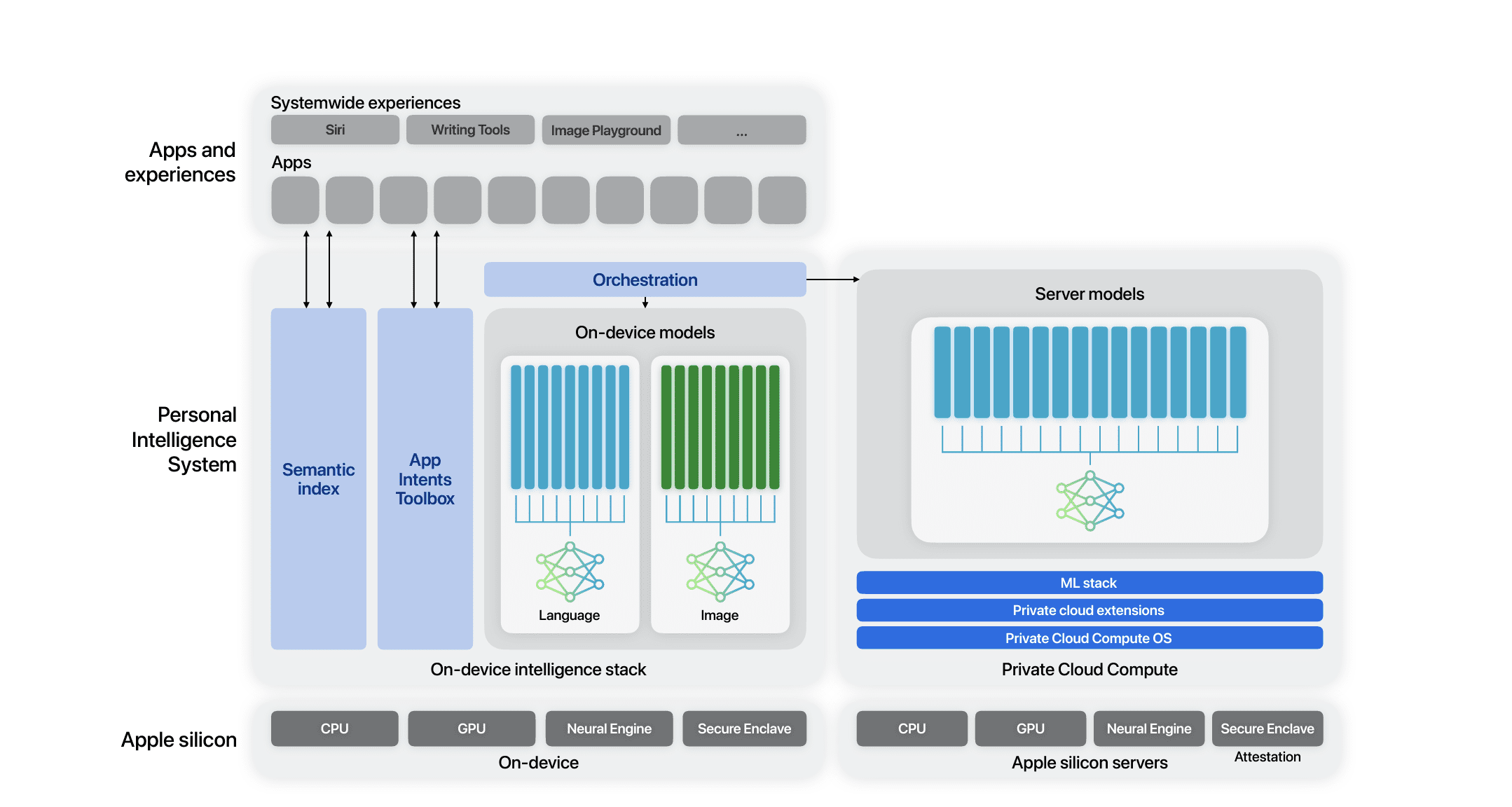
Apple Intelligence has a bunch of features, some powered by LLMs and SLMs and some aren’t. For the sake of this, we’re just going to be discussing the LLM portion.
Today, depending on the Apple feature and context of the request, it will either use the on-device SLM or Apple Foundation Model server. For example Fitness Buddy, where you get a personalized coach/trainer during workouts to encourage you along, tell you your stats and milestones, and provide context to your workout, that uses Apple’s server model. Email and notification summaries use Apple’s on-device model. Some things like summaries of voice recordings can happen on device or server model depending on length. Rewriting text as well, it just depends.
You are able to check this yourself, actually! In Accessibility and Privacy settings, Apple stores (on your device only) all of the Apple Intelligence requests, the prompts, and if it was processed locally or on Private Cloud Compute.
I’ve spent a lot of time reading Apple’s research on agents, tool calling, and LLMs and how to make them work, especially when looking towards Siri. The image above is from an Apple research report from 2024 titled “Context Tuning for Retrieval Augmented Generation” and roughly how I believe the new Siri will work.
The user will make a request to Siri. If it’s basically, something like search the web for XYZ or turn on a timer, it will run locally and use the on-device model. When we get into more complex questions, like “Where did I meet john for coffee last week” it does it in multiple steps. It will likely use the cloud model, searching multiple times through the different indexes on the device. This could be calendar, photos, messages, calls, maps, etc. The model exists in the cloud, Apple’s Private Cloud Compute, searching the data on your device.
Siri will also be able to use App Intents to connect to non-Apple apps. This will allow developers to expose their apps and data to Siri and Apple Intelligence. For example, Tesla supports app intents. This would allow me to just tell Siri “warm up my car”, and it will know my car and warm it up using the Tesla app. This requires some sort of notepad or memory, which Apple will likely include. Something like this could run on the on-device model.
I am taking an educated guess at roughly how the new Siri will work, obviously we will not know until Apple announces it officially later this year.
This is just to say, of the Apple Intelligence features, the ones you use most often and happen in the background like summaries happen on-device, while the larger more sensitive tasks or ones that require multiple steps happen on the cloud. This is how hybrid should work, and because of how bespoke Apple’s systems are, they can make sure it works in a way I’m not sure any other company could.
---
### Private Cloud Compute and inference silicon
The last part is Private Cloud Compute, this is Apple’s infrastructure for running LLMs and Apple Intelligence models. They are powered by Apple Silicon and designed by Apple for Apple to power Apple Intelligence.
You might be wondering, what silicon does it run? Unfortunately, nobody knows. Through supply chain and conversations, I’ve heard many many many different things, including that it runs on A18 Pro, A19 Pro, M3 Ultra, M4 Max, M4 Ultra, M5, and M5 Max. Given there has been absolutely zero overlap on this, it means nobody knows! Apple are the best secret keepers in the world, they are keeping this one tight.
It may be any of these or even a custom version of an M series chip designed for AI inference. What we know is all Apple cloud AI inference happens these Private Cloud Compute blades in Apple owned servers. They are now assembled in Houston Texas.
> Apple’s American-made advanced servers are now shipping from our new Houston facility to Apple data centers!
>
> These servers will help power Private Cloud Compute and Apple Intelligence, as part of our $600 billion US commitment. [pic.twitter.com/maOd3lCGfK](https://t.co/maOd3lCGfK?ref=creativestrategies.com)
>
> — Tim Cook (@tim\_cook) [October 23, 2025](https://twitter.com/tim%5Fcook/status/1981464918932279798?ref%5Fsrc=twsrc%5Etfw&ref=creativestrategies.com)
You may be wondering, what makes Private Cloud Compute special and why is Apple building their own AI inference silicon rather than just buying from Nvidia, Google, or anyone else? There’s a few reasons like cost and scale, but let’s go with what they’ve spoken about.
The first is, obviously, privacy. PCC does not have any persistent storage, it is all stateless. There are no logs saved on Apple servers. Your data isn’t saved, and as far as I know, has no ability to be saved. The customized OS doesn’t support that. Apple uses the same security chips from iPhone and Mac to authenticate the PCC servers, so they will not boot if the OS is tampered with. When a device makes a request to the PCC servers for AI inference, your devices recieves a key from the PCC server that your phone must approve as legitamate before sending the data. That data is end to end encrypted in transport, and decrypted on the PCC server using hardware security key.
During manufacturing, the devices are xrayed and checked at a board and silicon level to make sure nothing is tampered with or added to snoop on data. It is then checked again at the data center before installation to confirm nothing was added and it is the same as it was when it left the factory.
Apple does not log or debug requests on the server, but on the client device they do store logs of the requests. This means Apple has no ability see any data, store any data, or access any data without the client device (your iPhone, Mac, iPad, etc) manually pulling that data to provide. The Apple Intelligence report with this logging is, by default, only stored for 24 hours. You can change it to store for 7 days at a maximum, no longer.
The other reason is cost, realistically Apple can make as many of these chips as they want. They have a lot, I MEAN A LOT, of TSMC capacity for M series-type chips. My theory is that Apple delayed M5 Pro/Max until this year rather than October 2025 (matches M3/M4 Pro/Max time frame) to put that silicon capacity towards building M5 based Private Cloud Compute modules for the upcoming launch of Gemini based model powering Siri. With the new tensor cores, custom networking for multi chip connect, and higher memory bandwidth, they could totally have a competitive AI inference stack with reasonable efficiency.
The other thing about all of this is, Apple does not need to support 2B Apple users day one. One thing I’ve seen come up pleanty of times is that this will roll out to all Apple users, giving Gemini models the most surfaces globally. This is not true.
Apple Intelligence and the new Siri will only run on Apple Intelligence supported devices. This is iPhone 15 Pro, iPhone 16 series, iPhone 17 series, all Apple silicon Macs, various iPads, and Apple Vision Pro. My ballpark is maybe 450-500 million devices. When you account for regional availability day one, maybe 200-300 million devices. This is also powering, according to Mark Gurman (again he must live in the walls at Apple Park), just Siri and Apple Health+ AI features. Will these have the same sort of constant traffic that something like ChatGPT or Gemini would? Absolutely not. Apple must be able to support max throughput, but their scale doesn’t need to be as large as Google or OpenAI day one. This means Apple can spend time building out their Private Cloud Compute enough until the Broadcom/Apple AI Accelerator is ready, which is reported to be towards the end of this year.
Apple doesn’t need to run on Nvidia GPUs or Google TPUs, they can manage with their own existing silicon until their better silicon is available. It is a luxury Apple has that many others do not.
---
You might be thinking after all of this, why did Apple even use Gemini based models in the first place, are they just behind in AI? The answer is basically yes. Apple has their own foundation models. The on-device foundation model is arguably the best in practice, but the server model is not. It roughly matches Llama 4 models while being more efficient with a smaller total parameter count.
The server model is not up to par, and if they could have made one, they wouldn’t be using Gemini. While yes this isn’t ideal, it did give them a decent advantage: this is cheaper than training a model from scratch.
To train a competitive model, they would need to buy all of the data likely from Google or companies like ScaleAI and others. That is extremely expensive. They would then need to process and optimize that data. Once they do that, they need training infrastructure which they reportedly don’t have. That means renting at market rates from AWS, GCP, or Azure. They would need to run multiple training runs, likely over $50-100M each. They would need to fine tune and manage the model. If we look at OpenAI, they likely spent $10-15B on R&D in 2025! For Apple to catch up and exceed would cost that or more.
$1B a year is a steal for the access they are getting, and it cost Google nothing. They already had the weights, it’s just an added bonus. This also allows Apple to not rush development of their own in-house model, and take time with it. If their product works with a Gemini engine, there is no immediate need to swap to an Apple engine until the Apple engine is better or significantly cheaper than the Gemini one.
You can think about this like Qualcomm and Apple’s 5G modems. Apple couldn’t make a 5G modem overnight, so they used Qualcomm’s 5G modem until they could make their own. Once they could and it was competitive and cheaper, they started to phase out the Qualcomm modem for their own. I would expect the same here.
All of this, I hope, clarifies what is going on a little more. It’s wild times, so hopefully this helps!
### The AI Bubble Question: Two Scenarios for the Largest Technology Buildout in History
URL: https://creativestrategies.com/research/the-ai-bubble-question-two-scenarios-for-the-largest-technology-buildout-in-history/
Last updated: 2026-01-02T17:44:15.000Z
There is perhaps no more consequential debate around the technology industry today than whether the current AI infrastructure buildout represents a bubble destined for collapse or the logical, sustainable deployment of mature technology. The numbers are indeed staggering, a root cause of people’s anxiety: hyperscalers are spending north of >$200 billion annually (and growing) on capital expenditures, company valuations are skyrocketing, and power consumption projections for AI datacenters have upended utility planning across the developed world.
The instinctive response from market observers—particularly those who lived through 2000—is to assume that any buildout of this magnitude MUST BE A BUBBLE! We know history may not exactly repeat itself, but we do know it rhymes (ish).
Bubbles and build-outs look eerily similar, and that is what I think is a root cause of those who take a hard line one way or another in this debate. In 2002, on the heels of Perez publishing her work, I had a chat with then CEO of National Semiconductor Brian Halla, who had just read this book, which led me to read it, which clarified how the bubble would lead to a much larger build-out cycle and decades of innovation. The framework is still useful today for anyone looking to be more informed on the economic dynamics of these cycles.
## The Perez Framework: A Primer
Perez’s seminal work, *Technological Revolutions and Financial Capital*, identifies a recurring pattern across five major technological waves since the Industrial Revolution: canals and textiles, railways and steam, steel and electricity, oil and mass production, and finally, information and communications technology (ICT).
Each wave follows a predictable structure. The first half—what Perez calls the “Installation Period”—is characterized by speculative frenzy. Financial capital, driven by the promise of transformative returns, floods into new technologies before their value is proven at scale. This period inevitably ends in a crash: the railway mania of the 1840s, the panic of 1893, the 1929 crash, and most recently, the dot-com bust of 2000.
The second half—the “Deployment Period”—is fundamentally different. The crash clears out speculative excess, new institutional frameworks emerge, and technology spreads deeply into the real economy. This is when society actually captures the value of the new paradigm. The “Golden Age” that follows is characterized by sustainable growth, rising productivity, and broad-based prosperity.
The critical question for AI is simple: which half of the cycle are we in?
Before we answer, we should define what we mean by “crash.” The dot-com bust was a crash in financial claims on future growth. **The physical buildout did not vanish; it got repriced, consolidated, and eventually absorbed**. Fiber that seemed wildly excessive in 2001 was fully utilized by 2010\. The AI question is not merely “will valuations fall?” They will. The question is whether the buildout itself faces a synchronized funding stop that delays deployment for years, or whether it plays out as overbuild followed by price compression and consolidation. These are very different outcomes, and the Perez framework helps us distinguish between them.
## Scenario One: AI as a New Wave
The case for AI as a bubble rests on a straightforward interpretation of Perez’s framework: AI represents the beginning of a sixth technological wave, and we are in the speculative Installation Period.
Under this interpretation, the pattern is unmistakable. We have a transformative general-purpose technology (large language models, software agents, and GPU compute), a rush of financial capital chasing speculative returns, soaring valuations disconnected from current earnings, and a widespread belief that “this time is different.” The infrastructure buildout—hundreds of billions of dollars flowing into GPUs, datacenters, and power generation—looks precisely like the canal mania of the 1790s or the fiber-optic overbuilding of the late 1990s.
If this interpretation is correct, a crash is not merely possible but structurally likely. Perez’s framework is clear on this point: Installation Periods have historically ended in crashes. The speculative excess is a feature, not a bug—it provides the risk capital necessary to fund the initial buildout. But that same excess tends to overshoot, and the correction tends to follow.
The bear case, then, is that we are perhaps two to five years away from a major crash. The catalyst could be any number of things: AI revenue growth that disappoints relative to infrastructure spending, a major model capability plateau, or simply the exhaustion of greater fools willing to pay ever-higher multiples (capital becoming nervous). When it comes, the correction will be severe. Valuations will collapse. Many companies (largely AI startups) will fail. And the true deployment of AI—the period when it genuinely transforms the economy—will only begin after the wreckage clears.
This is the orthodox reading of Perez, and it has history on its side.
**What you would expect to observe:** If we are in an Installation Period headed for a crash, certain patterns should be visible. Capex growth should continue to outpace measurable utilization, with persistent idle capacity across the datacenter fleet. Model capability improvements should slow relative to cost curves, delivering less “more for less” than the investment thesis requires. AI spending should remain narrow, concentrated in a few use cases rather than diffusing broadly into enterprise budgets. And financing should increasingly shift toward leverage and speculation at the margins: neoclouds raising debt, power developers trading on forward contracts, smaller GPU lessors stretching to meet demand that may not materialize.
## Scenario Two: The Second Wind of ICT
There is, however, a contrarian interpretation—[one that Perez herself has advanced](https://www.project-syndicate.org/magazine/ai-is-part-of-larger-technological-revolution-by-carlota-perez-1-2024-03?ref=creativestrategies.com)—that suggests the current AI buildout might escape a catastrophic crash altogether.
The argument rests on a different diagnosis of where we are in the cycle: **AI is not a new wave but the second half of the current one.**
### The Deployment Period Interpretation
Perez identifies five historical waves, the most recent being ICT (information communication technologies), which she dates to 1971 (the introduction of the Intel microprocessor). Under this interpretation, the crash already happened—twice, in fact. The dot-com bust of 2000 marked the end of the speculative Installation Period, and the 2008 financial crisis served as a secondary correction. Since then, we have been in the Deployment Period.
If this is correct, **AI is not a speculative bet on an unproven paradigm but rather the natural fruition of the Information Age**. The paradigm—that software and data would transform every industry—was already accepted. What lacked was the capability to execute on the full vision, including a new form of compute capable of AI-accelerated workloads, [which was already mature in the GPU](https://creativestrategies.com/the-gpus-second-act-from-pixels-to-tokens/). AI, particularly large language models, represents the technology that finally allows software to perform cognitive tasks that previously required human intelligence.
In the Deployment Period, technology does not require speculative faith; **it spreads because it works**. Healthcare, legal services, software development, customer service—AI is penetrating these sectors not because investors believe it might someday be valuable but because it is demonstrably valuable today. Growth in this phase is steady, profitable, and sustained because adoption is driven by productivity gains rather than speculative frenzy. This reality is validated by dozens of CTO/CIO surveys that confirm early ROI across business units where AI is deployed in some capacity. We are still very early in the adoption of AI across enterprises, but to believe AI is not in a deployment period, you have to believe there is absolutely zero value being stemmed from AI software.
Under this interpretation, there is no crash coming because the crash already happened. We are not building toward a reckoning; we are building out the infrastructure required to mature an already-accepted paradigm.
**What you would expect to observe:** If we are in the Deployment Period, a different set of patterns should emerge. Utilization should climb toward steady, high load factors as demand catches up to supply. AI software should shift from pilots and experiments to budget line items, with repeatable ROI and formal procurement processes. Pricing should fall while volumes rise—the classic deployment pattern of deflation plus diffusion. Gross margin pressure should appear in “AI services” as competition intensifies, but net value should rise through adoption and workflow redesign. The technology spreads not because investors believe in it, but because it works. From what we see today, all boxes are checked for this observation.
### The Production Capital Anomaly
Even if one accepts that AI represents a new wave rather than a continuation of ICT, there is a structural reason to believe the crash dynamics may be different this time: the source of capital.
Perez’s crash mechanics depend critically on the role of Financial Capital. In her framework, it is banks, venture capitalists, and speculators—actors deploying “other people’s money”—who drive the Installation Period frenzy. They are, by nature, impatient. They seek liquidity events, IPOs, and quick exits. When sentiment turns, they flee. Their collective departure is what triggers the crash.
The AI buildout, however, is being funded primarily by Production Capital—specifically, the retained earnings and balance sheets of the hyperscalers themselves. Microsoft, Google, Amazon, and Meta are not raising speculative capital to fund their AI infrastructure investments. They are largely deploying their own massive cash piles, accumulated from decades of profitable operations in the previous internet era. *\*Yes neoclouds, AI GPU REITS, etc., are using other people’s capital, but a strong mix of that is also coming from those who have patient capital.*
This distinction matters enormously. In Perez’s framework, Production Capital is patient (we should include the investments of companies like NVIDIA as production captial). It is tied to the industry itself and seeks long-term dominance rather than short-term liquidity. Production Capital does not face margin calls. It does not demand exits. It can sustain “over-investment” for years because its time horizon is fundamentally different from that of Financial Capital.
But Production Capital is patient, not unpriced. Hyperscalers are public companies, and their cost of capital and strategic freedom are still set by equity markets. The disciplining mechanism shifts from forced liquidation to slower feedback loops: multiple compression, activist pressure, and internal hurdle rates rising as the cycle turns. Microsoft, Google, and Amazon can absorb years of AI losses in a way that a venture-backed startup cannot, but they cannot absorb them forever without consequence.
The implication is that even if the AI buildout is excessive relative to near-term demand—even if current spending cannot be justified by current revenue—the funders are not looking for a quick flip. They can absorb years of suboptimal returns while waiting for the market to mature. This patient capital smooths out what would otherwise be a sharp spike and crash into something more closely resembling a gradual build and consolidation.
The crash mechanism, in other words, may simply be absent.
## The Hybrid Case: New Wave, Old Capital
There is also a third possibility, and it may be the most realistic: AI is a new wave in capability, but it is being financed and deployed with the institutional muscle of the old one.
In Perez’s terms, the technology may look like an Installation while the capital structure behaves more like a Deployment. AI models are genuinely new. They represent a discontinuity in what software can do. But the companies building the infrastructure are not just scrappy startups funded by speculators chasing an IPO. This cycle is being led by the largest, most profitable enterprises in history, deploying retained earnings accumulated over two decades of internet dominance.
That combination does not eliminate overbuild. It changes its form. Instead of a sudden stop—the synchronized funding collapse that defines a classic Perez crash—you get a grinding repricing. Unit economics for compute fall. Marginal operators consolidate or fail. Utilization rises as prices drop. And adoption marches steadily forward as the cost curve declines.
This is not the catastrophic crash of 2000, where funding vanished, and deployment stalled for years. In a hybrid scenario, it is something messier: a protracted adjustment period where the buildout continues but returns disappoint, where winners compound while losers are absorbed, and where the technology diffuses into the economy even as the stocks that represent it underperform.
## Two Frameworks, One Question
The question of whether AI is a bubble ultimately reduces to a diagnostic question: what kind of capital is funding the buildout, and what phase of the technology cycle are we in? The answer is not black and white, but the framework clarifies the range of outcomes.
Consider two axes: the phase of the cycle (Installation vs. Deployment) and the dominant capital type (Financial vs. Production). The combination determines the shape of what comes next.
An installation funded by Financial Capital produces the classic bubble crash. Speculative money floods in, overshoots, and then flees. The 2000 dot-com bust is the template. Valuations collapse, funding dries up, and deployment stalls for years until the wreckage clears.
Installation funded by Production Capital produces something different: overbuild followed by consolidation. The buildout may still be excessive, but the funders can absorb losses longer. The correction is a grind, not a cliff. Prices fall, marginal players fail, and the technology diffuses as it becomes cheaper.
Deployment funded by Financial Capital still sees froth at the edges—speculative bets on the next application, overvalued startups, crowded trades—but the core infrastructure continues to expand because the paradigm is already proven. Winners compound while the froth burns off.
Deployment funded by Production Capital is the most durable configuration: patient capital deploying a proven paradigm at scale. Growth is steady, price deflation enables broad diffusion, and the volatility is cyclical rather than existential.
Where does AI sit? The honest answer is that reasonable people disagree. The technology feels like a new wave. The capital structure looks like deployment. The outcome is likely somewhere in between: not the catastrophic crash of 2000, but not the smooth ascent that hyperscaler stock prices have priced in either.
## Conclusion: The Shape of the Buildout
None of this suggests that individual companies cannot fail, that valuations cannot correct, or that the AI market will not experience significant volatility. It will. The shakeout among AI startups has already begun, and the rationalization will intensify. Equity drawdowns are not just possible but probable.
But a systemic crash—a 2000-style collapse that wipes out 80% of sector value and delays deployment by a decade—requires a specific set of conditions: speculative Financial Capital driving the buildout, an unproven paradigm, and no external stabilizers. The current AI buildout lacks the first condition entirely and partially lacks the other two.
What remains is something closer to a sustained buildout punctuated by repricing: massive, capital-intensive, occasionally excessive, but without the synchronized funding collapse that defines a true Perez crash. The infrastructure gets built. The prices fall. The technology spreads. The stocks may disappoint even as the paradigm succeeds.
The “bubble” may not be a bubble at all. It may simply be what it looks like when the Information Age finally comes of age—and when the companies that won the last era are determined to win the next one too.
### Running a 1T parameter model on a $40K Mac Studio Cluster
URL: https://creativestrategies.com/research/running-a-1t-parameter-model-on-a-40k-mac-studio-cluster/
Last updated: 2025-12-18T19:45:36.000Z
This will be a brief research note, mostly because I’m just talking about something cool. Back in March when Apple launched M3 Ultra in the Mac Studio, they graciously sent over a 512GB Unified Memory SKU of the system. It was insane for running LLMs, powering something like 4-bit quantized Deepseek R1 but limiting with just 512GB of LPDDR5x memory (wild statement).
With macOS 26.2, Apple enabled RDMA access via Thunderbolt 5, which enables low latency data transfer of these models. Basically before this, if you connected 2 Mac Studios via Thunderbolt, it functioned as though it were connected with Ethernet but at a higher bandwidth. That had latency from going through the network controller and CPU cycles and such. RDMA bypasses that, offering 99% lower latency. If we put this in tokens per second terms, standard connection would have Kimi K2 run at 5 tokens per second, RDMA runs at 25 tokens per second.
Exo is an open-source software stack making use of Apple’s MLX framework to make setting up this system easy. Plug the devices into each other, open Exo on each Mac, download a model and it runs. Easy, fast, good inference.
Now the setup I’m running is 4 Mac Studios, all with M3 Ultra (32-core CPU, 80-core GPU). Two of the systems have 256GB of Unified Memory, two of the systems have 512GB of Unified Memory. This nets to 1.5TB of Unified Memory, 128 CPU cores, and 320 GPU cores. Given the storage SKUs Apple provided, this would cost roughly $39,596 before tax. Is this setup worth it just to run a model like Kimi K2 Thinking for myself? Absolutely not. It does not make sense, buying inference per token is cheaper.
This setup lets me run the 1T parameter (int4 native weights) Kimi K2 Thinking model at \~25 tokens per second, roughly 2000ms time to first token latency, and under 450W peak. This isn’t the best performance in the world, but it is super cool. What it is, though, is probably some of the best efficiency for a dedicated single user deployment!
Now what a lot of people don’t think about is this isn’t really something someone would do for themselves. Nobody needs 4 Mac Studios, but 4 people could each use 1 Mac Studio. If you’re a production house or engineering team, seeding Mac Studios isn’t abnormal—they’re popular and designed specifically for those use cases! Connecting 4 machines that are already being used for other workflows to power inference makes a ton of sense.
This is not something you would go out and buy specifically for AI. Some people will, and honestly it makes a ton of sense if you’re super cautious about data privacy. It’s cheaper than buying a B200 node to run a similarly sized model, though the throughput of the B200 node will be easily 50x more (but at 50x the power too). This isn’t a knock on the B200 node, quite the opposite—it’s a piece of silicon DESIGNED specifically for AI with extremely high throughput. The M3 Ultra Mac Studio is not that. It’s a great workstation with absurd amounts of memory that happens to also be REALLY good at efficient AI inference!
Look nobody is buying one of these for this specific setup like I have running, but Macs in enterprise deployments are becoming increasingly common. Using existing machines to efficiently run large models for practical workloads makes a ton of sense—that’s where I see the value, especially if you need more than 4 people accessing inference from the cluster. But we can even scale this down: Exo supports networked connection via Ethernet and WiFi. It’s not as fast or as stable, but if you connect 20-30 devices… you get a powerful distributed compute network. Running a model like GPT-OSS 120B on a handful of WiFi connected MacBook Pros with M4 Max or even base M5 makes a ton of sense!
This demo obviously is an example of an extreme best of the best, I love doing this! It’s just fun to see, and I will absolutely be using this daily until Apple wants these Mac Studios back. The extremes just help explain the possibilities with more scale in a more effective deployment, and frankly I can’t think of any other computer that allows this level of easy flexibility.
### The GPU’s Second Act: From Pixels to Tokens
URL: https://creativestrategies.com/research/the-gpus-second-act-from-pixels-to-tokens/
Last updated: 2026-01-28T19:57:30.000Z
**The Architecture Graphics Built**
The GPU exists because graphics demanded a very specific kind of silicon—hardware capable of running identical mathematical operations across massive data volumes in parallel, repeatedly, without stalling. What looked like “drawing pictures” was always a continuous simulation under tight latency constraints. When neural networks arrived, they leaned on the same core primitives: dense linear algebra executed with extreme parallelism, fed by a memory system engineered to keep compute saturated. The application changed; the math stayed familiar. NVIDIA’s flywheel follows naturally from this dynamic—graphics drove GPU architecture and the CUDA software stack to world-class parallel math capability, and AI arrived as a much larger customer for the same underlying machinery.
**Conditional Generation as the Unifying Framework**
The cleanest lens for understanding the graphics-AI connection treats both as conditional generation problems. In graphics, you compute pixel colors conditioned on scene state—geometry, materials, lighting, camera position, rendering model. In AI, you generate the next token conditioned on context—prompt, prior tokens, model state. The outputs differ, but the structure is identical: given a state, produce the next unit.
Rendering computes frames rather than retrieving them. For each pixel, the GPU evaluates a pipeline of transforms, shading, sampling, filtering, and increasingly, ray or path tracing where realism comes from spending more compute on better sampling of light transport. More work per pixel buys fewer artifacts and higher fidelity. The trade is straightforward: you can purchase realism with computation.
Language models work the same way in a different medium. When you query an LLM, it computes a probability distribution over the next token from context, then repeats. Under the hood, that loop is dominated by matrix multiplication and memory movement—attention and feed-forward layers applied across large tensors—exactly the workload pattern GPUs were engineered to accelerate. The architectural direction didn’t require change; GPUs were already built for throughput. AI simply pulled forward dedicated matrix-math acceleration in Tensor Cores and a more ML-optimized memory and interconnect roadmap.
**Quality Scales with Compute**
Once you view both domains as conditional generation, performance and quality dynamics align. In graphics, quality improves as you spend more compute per unit of output—more samples, more complex shaders, higher-quality lighting. In AI, quality improves as you spend more compute per unit of output—larger models, more passes, higher-quality decoding, and increasingly more reasoning before answering. The primitive is the same: parallel math scaled by throughput and fed by bandwidth.
This is the point behind the pixel-token analogy. The pixel is the discrete unit of generated light; the token is the discrete unit of generated intelligence.
We find “resolution of thought” a useful framing here. In graphics, demand scales because creators immediately spend extra compute on higher fidelity—raise resolution for more pixels, spend more work per pixel for better lighting and richer simulation, with each step consuming more compute than the last. AI follows the same pattern. Output length matters—more tokens cost more—but the bigger lever is often compute per answer. Reasoning-style systems perform additional intermediate work that remains invisible, then produce the final response. That hidden work is AI’s version of more samples per pixel: it costs more, and it buys reliability and nuance when the task is hard.
**Latency as Experience Quality**
Gaming taught the industry that latency is part of the illusion. A technically perfect frame rendered too slowly breaks immersion, which is why frame rate became the defining metric of experience quality. AI faces the same threshold. When a chatbot takes several seconds to respond, it feels like a tool you query and wait for. When it responds quickly, can interrupt and be interrupted, and reacts in real time, it starts to feel like a presence.
This shift explains why inference optimization has become as important as training capability. Time to first token and tokens per second are AI’s frame-rate metrics—responsiveness is what turns generation into interaction.
**From Retrieval to Simulation**
Underneath both trends sits a deeper shift in how software behaves: from retrieval to simulation. For decades, most computing was retrieval—store information, then fetch it. Databases, file systems, and web pages embody this model. Modern graphics and modern AI are fundamentally different. They still rely on retrieval underneath (assets and textures in games, tools and RAG in many AI systems), but user-visible output is increasingly computed on demand. They generate content based on context: a game computes the frame you need right now, a model computes the response you need right now. The question shifts from “what do we have stored?” to “what can we generate?”
**Strategic Implications**
If this framing holds, several strategic implications follow.
NVIDIA’s dominance is structural. The company spent decades optimizing for the exact traits AI depends on: parallel throughput, memory bandwidth, low-level kernels, developer tooling, and systems interconnect. Competitors face the challenge of replicating an ecosystem and a maturity curve, not just a chip.
Compute demand will likely continue scaling because “good enough” fidelity is a moving target in any simulation medium. Graphics proved this dynamic conclusively—the finish line keeps moving as creators expand to fill available headroom. AI already shows similar behavior as expectations rise for deeper reasoning, richer modalities, and higher reliability.
Latency will split AI into tiers, much as frame rate split gaming. High-latency inference fits asynchronous tasks like document analysis and batch processing. Low-latency inference enables real-time voice, copilots, and agentic systems that feel less like software and more like an interactive counterpart. The applications that feel magical will be the ones that achieve gaming-grade responsiveness, because the experience of intelligence is shaped as much by timing as by correctness.
**The Flywheel Continues**
Graphics was the first mass-market proof that simulation beats storage: you generate a world frame by frame fast enough to feel real rather than fetching it from somewhere. AI represents the same shift in a new medium. Instead of shading pixels, we generate tokens. Instead of samples-per-pixel, we spend reasoning compute. Instead of frames per second, we measure time-to-first-token and tokens-per-second.
One final lesson from graphics applies here: there has never been “enough” GPU. Every jump in compute gets spent on higher fidelity—more pixels, better lighting, richer worlds, deeper simulation. AI will follow the same trajectory. As models improve, we will ask for deeper reasoning, richer modalities, and more reliable behavior. Demand will scale with ambition. Graphics chase pixels. AI chases tokens. Neither will ever catch up.
### Why NVIDIA’s DGX Spark is the best desktop CUDA testbed
URL: https://creativestrategies.com/research/nvidias-dgx-spark-review/
Last updated: 2025-12-16T16:17:17.000Z
This year on Black Friday, one of my favorite products of the year: NVIDIA’s DGX Spark! My list of favorite products is by no means short, but this was a quick add simply because I’ve had so much fun playing with this. Unlike most other products I’ve used this year, it’s something that feels rewarding to use and build with. It’s one of the devices that feels like it’s designed to build, experiment, and test with and rewarding to do with it.
I think that’s an important way to start talking about the DGX Spark because of what it is: a mini-super computer running NVIDIA’s Grace-Blackwell 10 SoC. It’s a SoC chiplet combining a 3nm 20-core Mediatek CPU with an NVIDIA GPU. It’s the first consumer grade chiplet from NVIDIA using NVLink C2C as well as the first consumer NVIDIA chiplet! I use consumer loosly here, but it’s closer to a consumer chip than it is an enterprise chip.
It comes with 128GB of coherent unified LPDDR5x memory with a 273 GB/s memory bandwidth, supports NVIDIA’s ConnectX-7 NIC networking with 200GbE bandwidth, and 4TB of NVME storage. This is what happens when you take a desktop grade AI data center rack and shrink it down to fit on your desk in a small footprint, and make sure it can run off a standard power outlet.
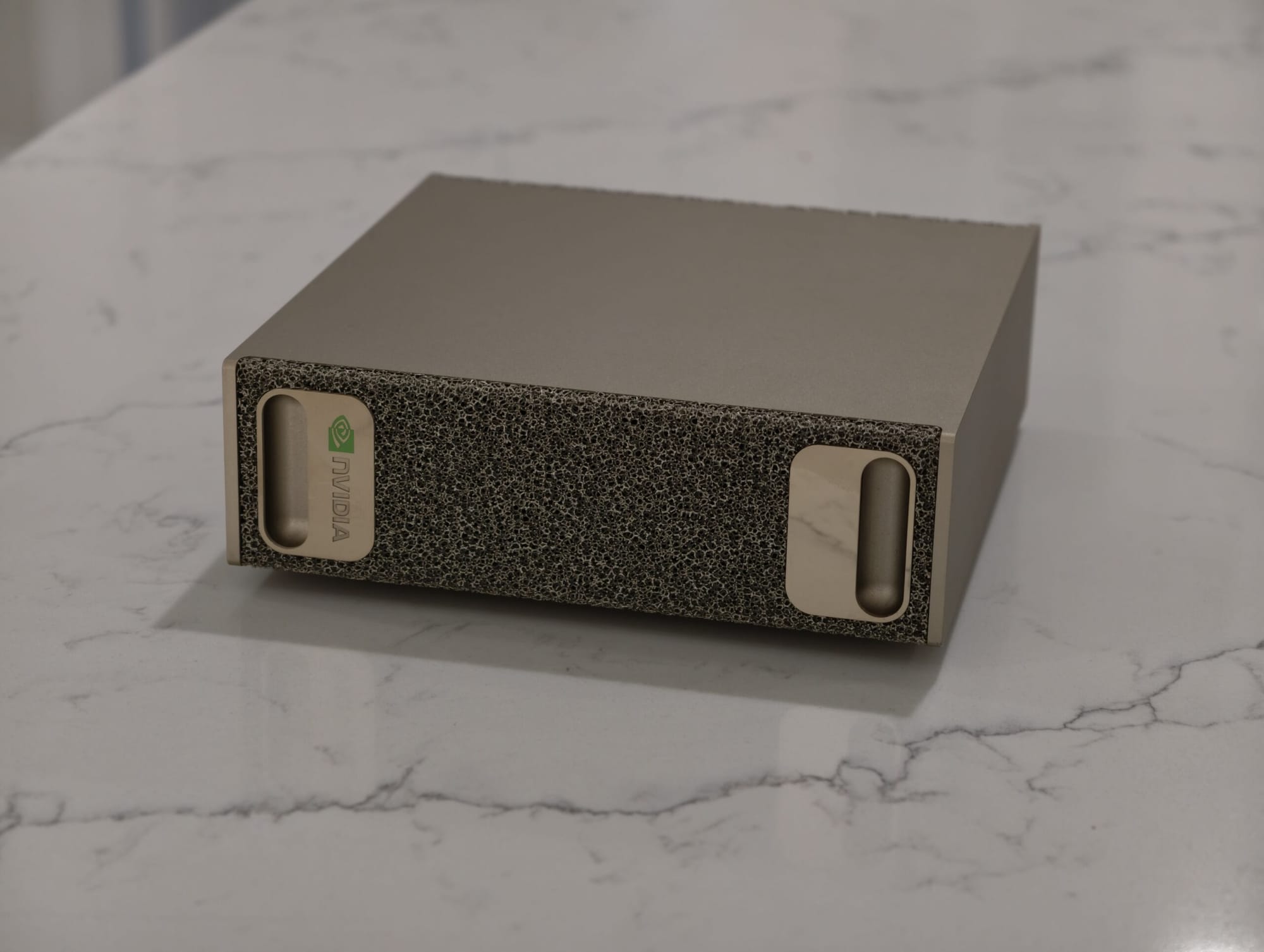
This is all to say it’s the best way to experiment with CUDA and production-like software and enviorments at a lower cost/barrier to entry. If you follow AI, open models, and how most of this works, you’ve likely heard of TensorRT-LLM, vLLM, or SGLang. These are the major inference frameworks for serving models in production enviroments! Deepseek, xAI, and many others use these open-source frameworks for their models. If you want to understand how to get a model running on a GB200 rack, you need to understand setting up Docker enviroments with proper CUDA drivers, making sure you don’t hit OOM (out of memory) errors, model choice, proper tool calling and reasoning parsing, and much more.
That’s where the DGX Spark really shines, and I think this is its most compelling use case: it’s a low barrier to entry piece of hardware to test and validate deployments for Blackwell before going to larger GB200 or Blackwell Ultra deployments. The software stack, inference frameworks, and everything else is the same, just scaled down. You can get everything working locally, iterate on your setup, and know that when you deploy to larger scale, whether that’s an RTX Pro 6000 node or Blackwell Ultra rack, it’ll work the same way.
For smaller organizations or individuals without the resources of major labs, this is huge. You can get your deployment environments ready, test agents and frameworks, and troubleshoot without needing to rent extremely expensive cloud nodes until you’re actually ready. That feedback loop of “run it locally, debug, iterate” is so much faster and cheaper than spinning up a minimum $30/hour cloud instances just to find out your Docker config is wrong or your model doesn’t fit in memory.
Here’s the thing nobody tells you about trying to deploy AI on any system: not everything just works. Getting GPT-OSS 120B running in a production environment can be extremely difficult. Reasoning doesn’t always fire or parse correctly. The API formatting between chat completions and the newer responses API is different, responses is designed to be agent-first, built around tool use and multi-step workflows rather than simple back-and-forth chat. Tool calling parsing is inconsistent across frameworks and models, especially with quantized weights. I’ve tested GPT-OSS 20B and 120B across TensorRT-LLM, vLLM, and SGLang, and various Qwen3 models. Some setups just don’t work. Tool calling breaks. Reasoning tokens don’t parse. The model fits in memory but outputs are worthless.
NVFP4 is a good example of something that’s powerful but finicky. It uses dynamic quantization—essentially upscaling the model, having it answer questions at full precision, quantizing down to FP4, then tuning the quantized model to make sure it answers the same way at FP4 as it does at FP16\. NVIDIA has recipes to do this with new models, so I could even run newer releases like the Mistral 3 series this way. There are a handful of models with NVFP4 already included, and when it works you get a serious boost in performance and much lower memory utilization. But tool calling on these quantized models has been hit or miss across every inference framework I’ve tried. It’s not a dealbreaker, it’s just the kind of thing you need to test and debug, which is the entire point!
This is exactly why the DGX Spark matters. You can hit all of these problems on your desk, in your own environment, and actually fix them. Figure out which inference framework plays nicely with your model. Get your API formatting right. Debug why tool calls aren’t parsing on your quantized weights. Do all of that locally, iterate until it works, and then deploy to a GB200 or Blackwell Ultra node knowing it’ll run the same way. The alternative is burning expensive cloud hours just to discover your Docker config is wrong or your quantization settings need tuning. That’s a brutal feedback loop at $30/hour. On the Spark, it costs you nothing but time—and you learn a lot more in the process.
The one that’s worked really well for me is Qwen3 30B A3B Thinking. It doesn’t show off the NVFP4 support, but the model is plenty intelligent and fast enough for real use at around 30 tokens per second and near instant time to first token. Once I got it dialed in, I built out a proper agent system using Agno as my framework. Not just individual agents—full agent teams with an overarching orchestrator.
For example, I have a Google Team with dedicated agents for Google Maps, Google Sheets, Gmail, Google Calendar, and so on. I chat with the Google Team leader, which delegates to each individual agent, pulling in information as needed and coordinating work across them. This architecture matters a lot more than you’d think when running local models. Context window is a limiting factor on custom deployments, and small models get overwhelmed easily when you throw too many tools at them. By splitting responsibilities across specialized agents—each tuned with its own system prompt and toolset—you keep things efficient and focused. The orchestrator handles coordination, each agent stays in its lane, and the whole system actually works.
This is exactly the kind of thing you want to test on hardware like the DGX Spark. Getting agent teams working reliably on smaller models takes iteration—tuning prompts, adjusting tool definitions, figuring out how to structure handoffs between agents. You don’t want to be doing that on expensive cloud infrastructure. You want to do it locally, where you can experiment freely and learn what works before scaling up.
It’s one thing to say “you can run AI locally,” but it’s another to have a full agent system integrated into your workflow and genuinely useful. The DGX Spark is the hardware that makes that possible—and more importantly, it’s the hardware that lets you figure out how to make it possible before you’re paying for rack time.
### The Semiconductor Gigacycle
URL: https://creativestrategies.com/research/the-semiconductor-giga-cycle/
Last updated: 2025-12-08T21:10:41.000Z
The semiconductor industry has experienced cycles of varying magnitude throughout its history. The PC era brought sustained growth. The smartphone revolution created what many called a supercycle. The cloud computing buildout extended that expansion further.
What is happening now is something categorically different.
The artificial intelligence infrastructure buildout represents the largest total addressable market expansion the semiconductor industry has ever experienced—a giga cycle that dwarfs previous periods of growth in both absolute dollar terms and in the breadth of its impact across every segment of the value chain.
The numbers tell a story of unprecedented scale. Global semiconductor revenues will climb from roughly $650 billion in 2024 to more than $1 trillion by decade’s end, with several forecasts now pulling the trillion-dollar mark forward into 2028-2029.
This expansion is not driven by a single product category or geographic market. This is a fundamental restructuring of the industry’s trajectory, driven by infrastructure requirements that touch every category of semiconductor technology simultaneously.
The semiconductor industry will never be the same. The shape of the category has been changed forever.
## What Makes a Giga Cycle Different
The PC era primarily benefited microprocessors and commodity memory. The smartphone revolution concentrated gains in mobile application processors and NAND storage. The cloud buildout created sustained demand for server processors and networking equipment.
The AI infrastructure buildout is different because the architectural requirements of training and inference workloads create **simultaneous bottlenecks** across compute, memory, networking, and storage.
**There is no single category absorbing the majority of new spending. Every segment is constrained. Every segment is expanding.**
By 2026, data-processing silicon will surpass half of total semiconductor revenue for the first time—codifying the shift toward data-center and AI workloads as the new center of gravity for the industry.
## The Scale of TAM Expansion
The magnitude of upward revisions to industry forecasts over the past eighteen months has been extraordinary.
Lisa Su, AMD’s CEO, now views the AI hardware TAM—encompassing CPU, GPU, ASIC, and networking—as exceeding **$1 trillion by 2030**. At AMD’s November 2025 Analyst Day, she framed the opportunity bluntly: **“The market is accelerating at a pace that we just did not understand until over the last few years. There’s no question, data center is the largest growth opportunity out there.”**
AMD is targeting more than 35% overall revenue CAGR—and around 60% in data-center revenue—over the next several years to pursue it. The company sees a clear path to tens of billions in annual AI revenue by 2027 and over $100 billion in data-center revenue over the next three to five years.
Current consensus projections show the dedicated AI accelerator market alone reaching roughly **$300-350 billion by 2029-2030**—up from under $100 billion in 2024\. When you aggregate accelerators, CPUs, networking, and HBM, total datacenter silicon spending approaches **$900 billion to $1 trillion** by decade’s end.
### The Trillion-Dollar Infrastructure Buildout
Jensen Huang has been explicit about the scale of what’s coming. During NVIDIA’s Q2 2026 earnings call, he laid out the math: **“Over the next five years, we’re going to scale into a $3 to $4 trillion AI infrastructure opportunity. We are still at the very beginning of this buildout.”**
He emphasized this wasn’t speculation: **“$3 to $4 trillion is fairly sensible for the next five years.”**
The demand for compute is real and unprecedented. Capital expenditures by the top four cloud service providers—Amazon, Google, Microsoft, and Meta—doubled to roughly **$600 billion** annually in just two years.
NVIDIA has communicated **$500 billion** in cumulative Blackwell and Rubin revenue, including networking, through calendar year 2026—a level of revenue visibility unprecedented in semiconductor history. The demand is diversifying beyond the top US hyperscalers to include sovereign AI factories and enterprise deployments. The customer base is broadening as the dollar opportunity expands.
## Compute Infrastructure: The Primary Driver
### GPU Market Dynamics
The GPU market remains the largest dollar category within the AI infrastructure buildout. NVIDIA’s GPU shipments are projected to grow approximately **85% in 2025**, followed by another **50-60% increase in 2026**. The company is targeting additional growth in calendar year 2027, with projections putting NVIDIA on pace to generate north of $600 billion annually by 2030.
These are physical volumes that require massive expansion in manufacturing capacity, packaging throughput, and memory availability.
At the system level, AI servers are becoming a trillion-dollar category in their own right. The AI server market is expected to grow from roughly **$140 billion in 2024 to $800-850 billion by 2030**—a compound annual growth rate exceeding 30% (could be conservative).
The net effect is that a tiny fraction of total wafer volume is driving an outsized share of industry revenue: AI chips represented **less than 0.2%** of wafer starts in 2024 yet already generated roughly **20%** of semiconductor revenue. An unprecedented level of silicon value density.
AMD’s trajectory shows similar growth dynamics. Lisa Su described the demand as **“insatiable”**—with the company projecting 80% annual growth in AI data-center chip revenue and overall revenue expansion of 35% per year through 2030.
### The Rise of Custom Silicon
The custom silicon market is accelerating at a pace that positions ASICs to challenge the dominance of general-purpose GPUs, driven by a structural shift in hyperscaler capital allocation and their desire to control more of their silicon stack for their own primary workloads, as well as cost and efficiency for third parties.
ASIC revenue for key leaders is expanding at a **119% compound annual growth rate** through 2027, significantly outpacing the 82% projected for AI GPUs. Custom silicon is forecast to rise from just **2% of hyperscaler capital expenditure in 2023 to 13% by 2027**.
Broadcom exemplifies this expansion. CEO Hock Tan has set an ambitious goal: building the custom business to **north of $100 billion** by decade’s end. Broadcom’s AI sales are now projected to reach **$90 billion by fiscal 2030**—potentially even $120 billion in aggressive scenarios. The company recently disclosed a **$10 billion AI infrastructure order** from a hyperscaler customer (widely reported to be OpenAI), focused on custom ASICs expected to significantly boost revenue in fiscal 2026 and 2027.
Tan has disclosed that custom AI chip demand from just three major customers could hit **$60 to $90 billion by 2027**. Google, Meta, and OpenAI are already deep customers. Apple and ARM may be joining the pipeline.
**This growth is not zero-sum.** The total addressable market is expanding rapidly enough that custom silicon and merchant GPUs can grow simultaneously, accommodating diverse compute requirements.
### CPU Market Renaissance
The CPU market is experiencing an AI-driven renaissance. The server CPU TAM is expected to grow at an **18% compound annual growth rate** through 2030, reaching approximately **$60 billion**, up from $26 billion in 2025.
This expansion is driven by both increased demand for agentic AI on general-purpose servers and the architectural requirements of integrated rack-scale systems like NVIDIA’s NVL72, which require **36 host CPUs per rack** compared to the traditional one or two found in standard servers. This likely compounds even more as more accelerators scale per rack to 144 and beyond, and as more DPUs are added per accelerator rack.
While we are working on our own model for CPU growth, estimating the market’s potential to grow from mid-20 billion to 60 billion in 2030, AMD echoes those estimates and projects that the AI inflection alone will drive roughly **$30 billion of incremental CPU revenue by 2030**, with explicit targets to exceed 50% share in data-center CPUs over that timeframe. This market expansion benefits Intel and Arm as well in both general-purpose, specific-purpose, and AI head node platforms.
## The Connectivity Fabric: Networking Infrastructure
The concept of the AI Factory relies fundamentally on a high-performance connectivity fabric that integrates massive clusters of accelerators into a unified supercomputer. As AI workloads scale to clusters exceeding **100,000 accelerators**, the speed, reach, and power efficiency of the interconnects become as critical as the compute units themselves.
The networking silicon TAM, excluding storage, is forecast to reach approximately **$75 billion by 2030**. AI data-center switches alone will grow from roughly $4 billion in 2024 to about **$19 billion by 2030**—nearly 30% compound annual growth.
The optical interconnect market is on a similar trajectory. Projections cluster around **$22-27 billion** for the optical-transceiver market by 2030, with more aggressive scenarios pushing beyond $30 billion by the early 2030s as 800G and 1.6T deployments accelerate.
The transition to **1.6 terabit networking** is creating supply-chain tightness that mirrors the constraints seen in compute. AI network port counts are projected to grow to approximately **150 million by 2029**, implying a roughly 40-50% compound annual growth rate. Demand for advanced laser and modulator components continues to far outstrip supply, with multiple vendors effectively sold out of leading-edge optical components well into 2026.
## Memory and Storage: The Capacity Bottleneck
### High Bandwidth Memory Supercycle
High Bandwidth Memory has emerged as the primary enabler of accelerated computing, with demand far outstripping supply as GPU clusters scale.
Global HBM industry revenue is projected to roughly double to the **mid-$30-billion range in 2025**. The HBM TAM will grow roughly **fourfold** from around $16 billion in 2024 to more than **$100 billion by 2030**—a market larger than the entire DRAM industry (including HBM) in 2024.
By 2030, HBM is expected to contribute on the order of **half of total DRAM industry revenue**, up from less than 20% today.
The manufacturing complexity creates spillover effects across the broader memory market. HBM3E consumes approximately **three times** the wafer supply of standard DDR5 to produce the same number of bits. This ratio is expected to rise to **4:1 for HBM4**, naturally constraining the overall industry supply of non-HBM products and tightening the broader memory market.
### Enterprise Storage Explosion
The shift toward Retrieval Augmented Generation and inference models is driving an explosion in demand for warm storage. AI server demand is driving a **7- to 11-times increase** in enterprise SSD demand per server through 2030\. Data creation is expected to roughly **quadruple** from 2024 levels to more than **500 zettabytes by 2029**.
Enterprise SSDs are expected to approach the **mid-$40-billion range by 2030**, up from the mid-teens billions today. By 2026, server SSDs are expected to surpass smartphones to become the largest application segment for NAND flash—formalizing AI servers as the primary consumer of leading-edge storage.
### The System-Level Memory Supercycle
The current environment represents a **system-level memory supercycle** where DRAM and NAND benefit simultaneously. Hyperscalers are forecasting approximately **50% growth** in server DRAM in 2026\. Multiple forecasts expect DRAM and NAND supply constraints to persist through 2027 as AI capex layers on top of traditional workloads.
Unlike past cycles, supply expansion is challenging due to space limitations and the extended production times required for advanced HBM and stacked NAND. Technology moats and supply constraints are driving **price inelasticity**, where prices rise sharply during strong demand.
### Wafer-Fab Equipment and Advanced Packaging
Wafer-fab equipment spending is already reflecting the shift. 300mm fab-equipment investment is expected to surpass **$100 billion** for the first time in 2025 and climb to roughly **$140 billion by 2028**, with cumulative 300mm WFE spending in the high-$300-billion range from 2026 through 2028.
Advanced-process capacity (7nm and below) is on track to grow nearly **70% through 2028**, with advanced-node process equipment alone expected to exceed **$50 billion** in annual spending by 2028.
The back-end of the line is seeing its own supercycle. Test equipment sales surged more than **20% in 2025** to record levels—outgrowing even WFE—while assembly and packaging tools climbed high single digits. TSMC’s CoWoS capacity alone is expected to expand by well over **60%** from the end of 2025 to the end of 2026.
Global semiconductor companies are planning roughly **$1 trillion** in new fabrication plants through 2030\. Companies in the US ecosystem alone have announced more than **half a trillion dollars** in private-sector investment in domestic capacity.
## Greenfield Economics: Everyone Benefits
The defining characteristic of the semiconductor giga cycle is that the market expansion is large enough to create **greenfield opportunities across every segment** of the value chain.
This is not a zero-sum competition. The bottleneck-driven nature of AI systems ensures that value capture spreads to memory, storage, networking, and packaging simultaneously.
AI is expected to add over **$500 billion** in incremental revenue to the semiconductor TAM over the next few years. Data centers will require about **$6.7 trillion** in cumulative capex by 2030, of which approximately **$5 trillion** will be dedicated to AI-ready facilities. Annual data-center infrastructure spending is surging toward the **$900-billion level** at peak.
### What Makes This Moment Different
The PC era primarily benefited a narrow set of companies. The smartphone era concentrated gains among mobile-focused suppliers.
The AI giga cycle is **lifting the entire semiconductor ecosystem**—from logic to memory, from networking to packaging, and the entire WFE supporting supply chain.
The greenfield nature of the demand means that new entrants and established players alike can find growth. The constraints across every category mean that **pricing power is broadly distributed**. The synchronized expansion means that the traditional pattern of one segment’s gain being another segment’s loss has been suspended.
When compute is constrained, memory and networking benefit. When memory is constrained, compute and storage benefit. The synchronized nature of the demand ensures that constraints in one area do not reduce spending in another—**they increase it**.
Everyone is benefiting from the largest market expansion in semiconductor history.
### Dell Q3 FY26 Earnings: AI Momentum Drives Record Results and Stronger Full-Year Outlook
URL: https://creativestrategies.com/research/dell-q3-fy26-earnings-ai-momentum-drives-record-results-and-stronger-full-year-outlook/
Last updated: 2025-11-29T02:56:50.000Z
Dell delivered one of its strongest quarters ever, powered by surging demand for AI servers and resilient performance across its core commercial PC business. Revenue rose double digits, profitability reached new Q3 records, and the company raised full-year guidance in a sign of confidence that its AI-led momentum is not temporary but structural. The results showcase Dell’s transition from a cyclical hardware company to a central infrastructure provider for the global AI build-out.
AI infrastructure demand was the central story of the quarter. Dell reported exceptionally strong AI server orders and a rapidly expanding pipeline spanning cloud service providers, sovereign AI programs, and large enterprises. This growth more than offset softness in consumer PCs, underscoring the company’s increasing reliance on AI infrastructure to drive both revenue and margin expansion. Strong cash flow and continued aggressive capital returns further reinforced management’s conviction in the durability of the current cycle.
---
**Key Takeaways**
Dell posted **record Q3 profitability**, with revenue up 11% YoY and EPS growing significantly faster than sales.
**AI infrastructure is now Dell’s primary growth engine**, with AI server demand driving a major expansion in the server and networking business.
The **PC business remains stable**, with solid commercial demand continuing to offset consumer weakness.
Dell raised revenue, EPS, and AI server shipment guidance for the full year, signaling sustained momentum and visibility.
Robust free cash flow enabled **$1.6B in capital returns** during the quarter, reflecting continued shareholder-friendly capital allocation.
**What’s Significant**
The most important shift highlighted in this quarter is that Dell’s AI business has become a core driver of the company’s trajectory. The magnitude of AI server orders and the strengthening pipeline indicate that Dell is positioned at the center of an industry-wide capex cycle that may extend for years. This transition gives Dell a level of growth visibility rare in traditional hardware markets, and it creates a structural uplift to revenue mix, margin profile, and competitive positioning.
Just as significant is the stabilization of Dell’s broader portfolio. Commercial PCs are steady and profitable, storage is holding its ground despite budget reallocations toward compute, and Dell continues to maintain cost discipline across operating expenses. Combined, these dynamics support the view that Dell can fund its AI expansion while still returning cash at an aggressive pace—something many AI-exposed peers cannot do simultaneously.
**Key Numbers**
**Financial Performance:**
- **Revenue**
Dell reported **$27.0B in Q3 revenue**, an 11% increase from the prior year. Growth was heavily concentrated in the Infrastructure Solutions Group (ISG), which expanded 24% YoY to $14.1B. AI-related server demand was the dominant driver, evidenced by the 37% surge in servers and networking revenue to more than $10B.
The Client Solutions Group (CSG) contributed $12.5B, up modestly from last year. Commercial PC revenue grew 5% YoY, supported by ongoing refresh cycles and a stronger enterprise spending environment, while consumer PCs contracted 7% as households continued to delay hardware upgrades.
- **Net Income**
GAAP net income rose to **$1.55B**, a 32% improvement, as operating leverage from higher-margin AI infrastructure began to flow through financial results. Non-GAAP net income increased to $1.76B. These figures illustrate how Dell is capturing not just volume growth but profitable growth in its AI segments.
- **Earnings Per Share (EPS)**
EPS grew significantly faster than net income due to Dell’s active share repurchase program. GAAP diluted EPS increased 39% YoY to **$2.28**, while non-GAAP EPS reached **$2.59**, up 17%. This divergence underscores Dell’s dual engines of shareholder value creation: expanding margins and ongoing share reduction.
- **Capital Expenditures**
While Dell did not break out capex explicitly in the earnings release, free cash flow trends highlight greater efficiency. The company generated **$1.2B in operating cash flow** and **$1.7B in adjusted free cash flow**, up sharply from last year. The step-up in free cash flow reflects stronger earnings combined with lower one-time charges and tighter internal spending.
**Business Highlights:**
**Infrastructure Solutions Group (ISG): AI at the Center of the Model**
ISG is increasingly the growth and profit engine of Dell. The 24% revenue increase marks one of its strongest performances in years. AI servers, high-end systems built around GPU and accelerator-heavy architectures, are reshaping the mix within ISG. Dell recorded **$12.3B in AI server orders in the quarter**, pushing year-to-date AI orders to approximately **$30B**.
Importantly, Dell’s AI demand is diversified. Orders are not limited to hyperscale cloud providers; they include sovereign infrastructure initiatives, enterprise data centers, and private cloud deployments. This reduces cyclicality and provides more predictable multi-year demand. ISG delivered **$1.74B in operating income**, with margins above 12%, demonstrating that AI growth is profitable even amid heavy investment and supply chain constraints.
**Client Solutions Group (CSG): Resilient and Cash-Generative**
Despite industry-wide volatility, the PC business remains a stable contributor. Commercial PCs, which carry higher margins, delivered solid growth thanks to increased enterprise IT spending and ongoing refresh cycles. Dell’s strategy of focusing on profitability rather than chasing low-end volume is evident in the stable operating margin around 6%.
Consumer PCs remain Dell’s weakest segment amid macro pressure and elongated replacement cycles. Still, the consumer shortfall is more than offset by commercial strength, allowing CSG to maintain consistent profitability and generate the cash flow necessary to support Dell’s broader capital strategy.
**Cash Flow and Capital Allocation**
Dell continues to pair growth investment with aggressive capital returns. The company returned **$1.6B** to shareholders in Q3 alone through dividends and buybacks, and **$5.3B year-to-date**. Management’s willingness to deploy cash at this scale signals confidence in the stability of the AI demand cycle and in Dell’s ability to sustain elevated free cash flow, even as it invests to support large AI infrastructure wins.
**Outlook:**
- **Near-Term (Q4 FY26)**
Dell anticipates **$31–32B in revenue**, meaningfully higher than last year’s comparable period. Expected EPS (GAAP \~$3.05; non-GAAP \~$3.50) suggests further margin expansion and another quarter of strong operating leverage. AI server shipments are set to increase again sequentially as Dell converts backlog into revenue.
- **Full-Year FY26**
Dell raised full-year revenue guidance to **$111.2–$112.2B**, with both GAAP and non-GAAP EPS also revised upward. Most notably, the company now expects to ship approximately **$25B in AI servers**, representing extraordinary triple-digit growth. This guidance reflects both visibility into backlog and confidence in supply availability, key differentiators in the competitive landscape.
The full-year outlook supports a thesis that Dell is entering a multi-year cycle of elevated growth powered by AI infrastructure. With a diversified customer base, strong free cash flow, and disciplined capital allocation, Dell appears well positioned to sustain momentum into FY27.
### The Snapdragon X2 Elite Power Paradigm: Unbundling the Electron
URL: https://creativestrategies.com/research/the-snapdragon-x2-elite-power-paradigm-unbundling-the-electron/
Last updated: 2025-11-21T18:35:01.000Z
In mobile computing, performance is defined by the energy cost of operations. The limiting factors for modern Systems on a Chip (SoC) are thermal headroom and battery constraints, shifting the architectural focus to the infrastructure that feeds the silicon.
The power delivery network (PDN) design for the Snapdragon X Series utilizes a bifurcated, two-stage Point-of-Load (PoL) architecture. This design effectively decouples voltage transport from voltage regulation, a strategy engineered to optimize voltage levels for individual silicon blocks.
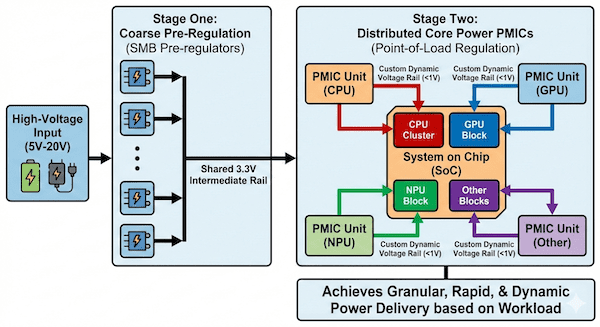
##### Stage One: The Efficiency Step
The system begins by addressing the voltage differential between the source and the destination. A battery or charger provides high voltage (ranging from 5V up to 20V) for transport, while the logic gates within a CPU core operate at sub-1V levels.
The Snapdragon design manages this via an intermediate “Efficiency Step.” The system utilizes multiple parallel “SMB Pre-regulators” (Switched-Mode Buck regulators) to step the high-voltage input down to a stable, intermediate core power rail of 3.3V.
By standardizing this intermediate rail, the system isolates bulk voltage conversion from precision power delivery. The 3.3V rail serves as a clean, shared reservoir, ensuring that the final regulators operate within a highly efficient conversion window.
##### Stage Two: Point-of-Load Regulation
The second stage—the “Dynamic Step”—utilizes a distributed network of distinct “PMIC” units physically surrounding the SoC. This is Point-of-Load (PoL) regulation.
By locating the regulators immediately adjacent to the silicon they serve, the design addresses resistance losses (IR drop) in the wiring. This proximity allows the PMIC to supply the exact voltage required at the transistor level. The system supplies the precise energy needed for the operation without requiring a voltage surplus to account for transmission distance.
##### Granularity and Independent Rails
This distributed architecture enables extreme granularity in power delivery. The design maps specific PMIC resources directly to specific internal SoC blocks—creating distinct rails for the CPU clusters, the GPU, and the NPU.
Under this model, the power delivery is unbundled. If a workload requires high GPU performance but low AI utilization, the system can ramp the GPU rail to peak voltage to sustain high clock speeds, while simultaneously maintaining the NPU rail at near-threshold levels. This supports aggressive Dynamic Voltage and Frequency Scaling (DVFS). The system responds to workload spikes on specific cores by instantly raising the voltage on that specific rail, and dropping it back down immediately upon task completion.
##### Conclusion: The Just-in-Time Electron
Ultimately, the Snapdragon X Series power architecture represents a fundamental inversion of traditional SoC design. By abandoning the monolithic power model in favor of a distributed, two-stage hierarchy, Qualcomm has effectively transformed power delivery from a static utility into a dynamic performance engine. The architecture systematically eliminates the three historic “taxes” on battery life—thermal conversion waste, resistive transmission loss, and the inefficiency of shared rails—replacing them with a system of microscopic precision. This design successfully operationalizes the concept of “Just-in-Time” manufacturing for the electron, ensuring that battery life is no longer burned by the system’s infrastructure, but consumed exclusively by the user’s actual workload.
### CoreWeave and the Integration of AI Infrastructure
URL: https://creativestrategies.com/research/coreweave-and-the-integration-of-ai-infrastructure/
Last updated: 2025-11-20T17:34:02.000Z
In the broader narrative of the AI boom, a new category of infrastructure provider has emerged, colloquially termed the “neocloud.” The economic logic of the neocloud is, at first glance, simple arbitrage: the hyperscalers (AWS, Azure, Google Cloud) are supply-constrained and expensive, creating an opening for smaller, agile players to buy GPUs, place them in leased data centers, and rent them out to desperate AI startups. The bear case for this entire category is that it is fundamentally a financial engineering play—a “GPU REIT” (Real Estate Investment Trust)—rather than a software business. The model relies on asset-backed debt and long-term leases, selling a commodity (compute) that will eventually face price compression as supply normalizes.
However, to lump CoreWeave in with the generic neocloud cohort is to misunderstand the specific problem that large-scale AI training actually presents. While the company’s balance sheet shares the asset-heavy, leveraged characteristics of a landlord, its operational reality is increasingly distinct. Most neoclouds are infrastructure brokers with a thin DevOps veneer; they sell access to chips. CoreWeave, by contrast, is attempting to build a verticalized AI hyperscaler. The differentiation is not that they have GPUs; it is how much useful work—specifically Model Flop Utilization (MFU)—they can extract from those GPUs.
The standard neocloud pattern is one of minimum viable product. The provider acquires hardware—often a generation behind the bleeding edge—leases a powered shell, and exposes instances via a thin control plane. The customer receives a bare-metal box or a basic Kubernetes instance, and the provider’s responsibility ends at the hardware level. This is a commoditized business model where the only levers are price and availability. CoreWeave began here, but has spent the last several years moving simultaneously down into the physical fabric and up into the software stack. The result is a platform where the product is not the chip, but the cluster.
This shift begins at the rack level. While generic providers treat GPUs as inventory units (SKUs), CoreWeave treats the rack—specifically the NVIDIA NVL72 GB200 systems—as the atomic unit of the product. This distinction is critical because modern Large Language Model (LLM) training is a bandwidth problem as much as a compute problem. CoreWeave designs its clusters with high-bandwidth InfiniBand fabrics and SHARP in-network compute, optimizing the physical topology so that large jobs reside within tightly coupled GPU “islands” connected via NVLink. This stands in stark contrast to providers that utilize standard Ethernet or mixed fabrics which, while sufficient on a spec sheet, crumble under the latency demands of collective operations like all-reduce and all-gather. This is an operator mindset: designing cooling, power, and topology for specific workloads rather than simply filling a room with capacity.
The second layer of differentiation is the control plane, where CoreWeave addresses the fundamental tension of cloud infrastructure: the trade-off between the raw performance of bare metal and the manageability of virtualization. Traditional virtualization introduces a “hypervisor tax” that degrades performance, which is unacceptable for training runs costing tens of millions of dollars. However, bare metal is notoriously difficult to secure and manage in a multi-tenant environment. CoreWeave resolves this by offloading the entire cloud operating system—networking, storage, encryption, and security policies—onto NVIDIA BlueField Data Processing Units (DPUs).
By moving the control plane to the DPU, CoreWeave allows the tenant to access the host GPU without an intermediary layer, while still maintaining Virtual Private Cloud (VPC) isolation and security. This is a subtle but profound architectural shift. While other neoclouds force customers to choose between chaotic DIY bare metal or performance-draining VMs, CoreWeave utilizes hardware integration to offer the benefits of a managed cloud with the throughput of bare metal. This directly impacts the customer’s bottom line by lowering the effective cost per token. *(This, +* [*Nimbus*](https://docs.coreweave.com/docs/platform/fleet-management/nimbus?ref=creativestrategies.com)*, IMO, is one of their most interesting technical differentiators)*
Moving up the stack, CoreWeave has recognized that in the era of Generative AI, the scheduler is the computer. Standard Kubernetes is ill-suited for the unique demands of AI workloads; consequently, CoreWeave has built a GPU-native orchestration stack centered on CKS (CoreWeave Kubernetes Service) and SUNK (Slurm on Kubernetes). This is not merely a scheduling tool, but a topology-aware system that pins large training jobs to specific GPU islands to minimize communication overhead. Combined with “Tensorizer” for rapid model loading and checkpointing, the system is engineered to maximize “goodput”—the amount of time the hardware spends actually training the model versus waiting for data or recovering from failures.
This operational focus extends to what CoreWeave calls “Mission Control.” In the realm of LLM training, hardware failure is not a possibility; it is a statistical certainty. A single failing Network Interface Card (NIC) can stall a training run across thousands of GPUs. Most neoclouds provide logs and leave the remediation to the customer’s MLOps team. CoreWeave, however, treats operations as a product, utilizing automated remediation to quarantine bad nodes and rebalance workloads without human intervention. This is the sort of reliability engineering usually reserved for internal teams at Google or Meta, and its availability as a service is a significant value-add for enterprises that need predictable training timelines.
Ultimately, CoreWeave is betting that the future of AI infrastructure is not about renting commodities, but about selling outcomes. To be sure, the company faces significant risks: it is capitalizing an asset-heavy model with high leverage, and its revenue is concentrated among a handful of hyperscaler-adjacent giants. In this sense, the “GPU REIT” comparison remains financially relevant. However, strictly defining CoreWeave by its capital structure ignores its strategic position. Most neoclouds compete on inventory, a game that becomes impossible once supply constraints ease. CoreWeave is competing on delivered performance and operational integration. If they can sustain the claim that their cloud solves the hardest training problems faster and more reliably than the alternatives, they will have successfully transitioned from a landlord to a specialized AI platform, occupying a defensible niche between the commodity providers and the integrated hyperscalers. All of this to say, Coreweave has some key differentiators but their long-term success depends on them getting enterprises, who are likely current or future tenants of the big three hyperscalers, to choose Corweave over AWS, GCP, and Azure. If we were to make the case Coreweave has a chance to do it, this is how we would make the case.
**The Case Against the Hyperscalers for AI native workloads.**
The prevailing assumption in cloud computing is that AWS, Azure, and Google Cloud possess an insurmountable moat due to scale. However, in the context of frontier AI, scale creates its own form of gravity. The hyperscalers were architected for general-purpose workloads—millions of latency-sensitive web applications and microservices—relying on heavy abstraction and virtualization to maximize utility. While this model is perfect for serving a web app, it creates structural friction for AI workloads that require raw, unadulterated throughput. CoreWeave’s opportunity lies in unbundling the high-performance compute layer from the general-purpose application stack.
The argument for CoreWeave winning share from the “Big Three” rests on four specific structural advantages:
**1\. Fabric Design vs. “Paper Scale”**
Hyperscalers are constrained by the need to support a heterogeneous environment. Their networks are largely Ethernet-first, designed to route traffic for millions of disparate tenants. When they attempt to support massive AI jobs, they often deliver “paper scale”—impressive numbers on a spec sheet that degrade in practice due to network latency and topology constraints. CoreWeave, unencumbered by legacy workloads, treats the NVL72/GB200 rack as the product. By utilizing InfiniBand with SHARP and designing physical topology around “compute islands,” they minimize the latency penalties that kill training efficiency.
**2\. DPU-Based Isolation vs. The Virtualization Tax**
For a hyperscaler, virtualization is non-negotiable; it is the foundation of their security and billing models. For an AI engineer, virtualization is a tax. It introduces overhead that eats into the performance of expensive GPUs. CoreWeave circumvents this trade-off by offloading networking, storage, and security to BlueField DPUs. This allows them to offer a bare-metal environment—essential for squeezing every percentage point of utilization out of the hardware—while maintaining the isolation and security of a managed cloud. Hyperscalers cannot easily replicate this without re-architecting their fundamental control planes.
**3\. MFU-Obsessed Orchestration**
Hyperscalers provide generalized building blocks (Kubernetes, batch schedulers) and expect the customer to assemble them. CoreWeave’s orchestration stack (CKS, SUNK, Tensorizer) is opinionated and built for a single metric: Model Flop Utilization (MFU). By automating topology-aware scheduling and fast checkpointing, CoreWeave reduces the “wasted” time in a training run. For a customer burning millions of dollars on a model training run, the difference between a generic scheduler and one tuned for “goodput” is a direct impact on the P&L.
**4\. The Strategic Wedge**
CoreWeave does not need to host the world’s CRM databases or web servers to succeed; they only need to capture the most capital-intensive slice of the stack.
**Frontier Model Training:** Labs care about time-to-train above all else.
**High-Throughput Inference:** As inference scales, companies will separate the application layer (hosted on AWS/Azure) from the inference fleet (hosted where cost/performance is best).
**Hyperscaler-Detached Capacity:** Enterprises wary of vendor lock-in or those competing with Big Tech need a neutral, high-performance Switzerland.
Ultimately, the hyperscalers face an innovator’s dilemma. While they *could* theoretically replicate CoreWeave’s vertical optimizations, doing so fights against their own organizational inertia. They must protect margins across thousands of SKUs and support legacy architectures. CoreWeave has one job: converting watts and GPUs into tokens as efficiently as possible. In a market where compute is the scarcity, the specialist that removes structural friction wins against the generalist managing a portfolio.
### Microsoft Ignite 2025: AI for Human Ambition Meets Enterprise-Grade Implementation
URL: https://creativestrategies.com/research/microsoft-ignite-2025-ai-for-human-ambition-meets-enterprise-grade-implementation/
Last updated: 2025-11-19T16:28:14.000Z
Microsoft Ignite 2025 opened with a clear message: the AI era has moved beyond experimentation and is now fully about implementation, governance, and measurable outcomes. Microsoft focused on what matters most to the Ignite audience: the architects, developers, and IT leaders responsible for actually deploying and scaling AI inside organizations.
The news cycle was already on Microsoft before the keynote began thanks to the headline announcement: Microsoft and Anthropic are deepening their partnership, bringing Claude models into Microsoft’s AI Foundry platform as a fully integrated, billable, enterprise-ready offering. When Anthropic’s CEO joined Judson Althoff on stage, he underscored why this matters: enterprises want choice, and Microsoft now offers a streamlined path to deploy Claude alongside GPT, Llama, DeepSeek, and others, all governed through Microsoft’s unified compliance and observability framework.
##### AI as an Enabler of Human Ambition
Judson Althoff framed the keynote around a theme that resonated strongly: AI should “fit into the flow of human ambition,” not replace it. Throughout the presentation, Microsoft showed how empowering human ambition requires three things: a deep understanding of context, the ability for AI systems to act securely across an organization, and a governance model suited to autonomous agents rather than only human employees.
This framing allowed every product announcement to build toward a cohesive view of how AI gets implemented responsibly and at scale.
##### Work IQ: The Intelligence Layer of Microsoft 365
One of the most important new ideas was Work IQ, the intelligence layer that makes Microsoft 365 Copilot feel personal and contextual. Instead of relying on simple connectors, Work IQ brings together a user’s history, patterns, relationships, meetings, documents, and workflows, creating a model of “how work actually happens.”
Three elements sit at its core:
- A unified picture of your organizational data
- A personal memory of your preferences and patterns
- An inference layer that powers predictions, recommendations, and proactive insights
Together, these make Copilot feel less like a tool and more like a digital colleague who understands your role and anticipates your needs.
##### Fabric IQ and Foundry IQ: Giving AI Meaningful Context
Microsoft addressed one of the biggest barriers to enterprise AI, fragmented data, through two new layers.
Fabric IQ creates a shared semantic understanding of the business, integrating analytical and operational data into a live model. Instead of treating metrics, documents, and systems as separate islands, Fabric IQ turns them into a unified source of business meaning.
Foundry IQ extends this by orchestrating multi-agent reasoning, grounding models across Microsoft 365, Fabric, custom applications, and web sources. It routes tasks, ensures safety, and standardizes how agents understand and interact with enterprise data.
Both layers are designed to solve the hardest part of AI in the enterprise: giving models and agents the right context.
##### Agent Factory: Industrializing AI Deployment
A major theme this year was the need to scale AI with confidence. Microsoft’s new Agent Factory program provides the structured approach enterprises have been asking for. It bundles the tools and expertise required to build, deploy, evaluate, and iterate on AI agents, from Copilot Studio and Foundry to deployment blueprints and ROI guidance. It reflects a shift from experimentation to industrialization.
##### Agent 365: Governance for a World of Billion-Scale Agents
As Charles Lamanna noted, enterprises could be managing more than a billion AI agents by 2028\. To prepare for that reality, Microsoft introduced Agent 365, a governance plane that consolidates identity, permissions, risk scoring, monitoring, and compliance for every agent in the organization.
Instead of treating agents like extensions of human users, Agent 365 governs them as a new class of digital actors, with their own behaviors, logs, identities, security requirements, and lifecycle. It also supports interoperability across vendors including Workday, ServiceNow, Adobe, Anthropic, AWS, and Google.
This represents a fundamental shift: enterprises will soon manage fleets of agents, not just human accounts.
##### Customer Proof Points: Real Deployment at Scale
Microsoft reinforced its implementation-first message with concrete examples. Mercedes-Benz showcased end-to-end usage of Copilot Studio, Azure, and multi-agent workflows across manufacturing and in-car experiences. Epic demonstrated how ambient clinical intelligence is reducing documentation burdens and accelerating care. Retailers and financial institutions, including UBS, showed how AI agents are already reshaping operations, supply chains, analytics, and customer service.
These were production deployments, giving the keynote credibility and grounding.
##### The Microsoft–Anthropic Partnership: The Big Story Beyond the Stage
Even with all the product launches, the expanded partnership with Anthropic stood out as the most significant industry development. It positions Microsoft not only as a model provider but as the enterprise distribution layer for a multi-model world.
Anthropic’s CEO emphasized that Claude’s strengths in reasoning, safety, and agentic workflows are amplified by Microsoft’s reach, compliance framework, and deployment channels. The result is a marketplace where enterprises can pick the best model for each use case without adding complexity to procurement or governance.
##### A Keynote for Builders. But Also a Reminder About Clarity
Ignite 2025 focused squarely on the people responsible for turning AI from hype into outcomes. Instead of grand predictions, Microsoft delivered a pragmatic roadmap for deploying, governing, and scaling AI across the enterprise. The message was clear: AI is here to enhance human capability, and real adoption requires deep context, unified data, secure agents, and strong governance.
But the keynote also highlighted a growing tension. AI is inherently complex, and Microsoft is building an impressive, yet rapidly expanding, arsenal of tools, layers, studios, factories, IQs, and governance frameworks. For companies already deep into AI implementation, the sophistication is empowering. For organizations still at the beginning of their journey, it can feel overwhelming. Understanding where to start, which tools matter most, and how each component fits into the broader architecture is not always obvious.
As Microsoft continues to innovate at breakneck speed, the company will need to be intentional about reducing cognitive load for customers. Clearer guidance, simpler narratives, and more opinionated paths will be critical so enterprises don’t feel lost in the sprawl. The power of the platform is undeniable, but only if organizations can confidently navigate it.
### Google’s new Gemini 3 Pro is a great model
URL: https://creativestrategies.com/research/gemini-3-pro-is-a-great-model/
Last updated: 2025-11-18T15:48:47.000Z
Today, Google announced Gemini 3 as well as a bunch of new product updates powered by Gemini 3 Pro! We’ll get into those in a moment, because I want to talk about my experience using Gemini 3 Pro, codename riftrunner, as well as Google’s new developer IDE called Antigravity!
I got early access from Google *(Thank you, Google)* to Gemini 3 Pro and Antigravity on the 13th, so roughly five or so days of usage. While it’s not the longest period of time to test out a new platform, I did want to mention a few of my initial thoughts.
Antigravity is one of the best IDE’s I’ve used, it was created by the Windsurf team who joined Google a few months ago, and is essentially that platform with the maturity of Google’s ecosystem. It combines all of Google’s models, Nano Banana, Gemini 3 Pro, Gemini 2.5 Computer Use, as well as other models in the extended Google Cloud ecosystem, like Claude 4.5 Sonnet!
This is Google’s agent-first development experience. The idea is you send the agent off with a few tasks in the morning, it works and when you come back it’s done 80% of the work, leaving you to finish up. While it can do the entire stack and complete everything, that takes some time just like all other vibe coding platforms. What I did notice is Gemini 3 Pro was able to get to that 80% mark, other coding agents like Claude Code or Codex get 50-60% of the way there, then require a bunch of follow up to get to the same point as Gemini 3 Pro did.
My favorite anecdotal example is an iOS app I’ve been working on, just something basic that tracks multi-week training programs. I decided a fun way to test Antigravity would be to have it try to create a watchOS app connecting to the iOS app.
Antigravity did it one shot. It got the data to sync, control over the app from the watch, and heart rate data with HealthKit, and it matched the design language of the original iOS app. Just to see if this was something any other model or agent could do, I asked all of them! None could do it, outside of Gemini CLI with Gemini 3 Pro.
This is an absurdly good model.
One of the most interesting parts of this is the agent mode for web development. The Antigravity agent, while working, can actually open a Chrome browser (same Chrome as normal) and test out the website or platform it’s building. Simple and cool to test it’s own work, right? But it goes beyond that. If you have Antigravity’s agent implement APIs it doesn’t know or add services that need API keys, the agent can control your browser to go and search for this information and work it into the product. It also learns as you go,
In terms of research or general chat, I also had Gemini 3 Pro in Antigravity build me a chat wrapper for Gemini 3 Pro! When asking it a few questions about AI Capex, a go-to just to test out new models, it was smart enough to point out and look out things no other models did, like when talking about hyperscaler CAPEX, Amazon has the largest capex of any hyperscaler but if you remove logistics and warehouses, Microsoft has the highest for AI data centers! This is something nuanced that I haven’t really seen with any other model, which was a little surprising to me!
I didn’t have a chance to use these in the Gemini app or AI Search, unfortunately not as close with those teams, but I think the API and testing out Gemini in agents is one of the most interesting and informative points for broad adoption.
In terms of a model powering an agent, I do not think there is a better model. It has more nuance than GPT-5.1 Thinking (high), more drive to search than Claude 4.5 Sonnet thinking, and about matches the best of them. When you mix in Google’s Vertex AI data privacy and Google’s sheer scale, I can see Gemini 3 Pro becoming the default engine for enterprise and consumer agents. If I were an enterprise and to choose a model today to build an agent, it would be Gemini 3 Pro.
This is related but a little different, Google’s Vertex AI platform for enterprise AI is becoming more compelling. Each model provider has their own API for access, xAI, Anthropic, Google, OpenAI, etc all have their own way to serve models. What’s interesting is Google and Azure have the more compelling ones.
Both Google’s Vertex AI and Azure AI Foundry host your classic open source models: GPT-OSS, Deepseek, Kimi, MiniMax, Llama, etc. What makes Azure special is they also host OpenAI’s models, xAI’s Grok models, and soon Anthropic Claude models. One account to Azure gets you all of the open models, plus OpenAI, Claude, and Grok. Google, on the other hand, gets you all of the open models as well as Gemini and Claude.
Now the reality is this isn’t really locked in to any provider. While it’s easier, hosting your data at the same place as your inference, because it makes billing and management easy, it’s not really lock in. What we really see each of these providers as is an abstraction to the models from the cloud provider you choose. You can, with a single line of code change, swap between any of the models at each provider. If you prefer Anthropic and Gemini models, GCP is a better bet. If you prefer Grok and OpenAI models, Azure is a better bet. You can obviously have both and this isn’t really changing anything, but as I said it does make billing and management easier. Read into this as you will, but I think it’s important color when looking at cloud hosts.
Ok, now for the news… and because I think this is interesting, the news portion of this will be written by Gemini 3 Pro!
---
### The Model: A New Era of Intelligence
Google has officially introduced **Gemini 3**, describing it as their “most intelligent model” to date. This isn’t just an incremental update; it represents a comprehensive overhaul of reasoning, multimodal understanding, and agentic capabilities.
The headline here is the performance. Gemini 3 Pro has taken the top spot on the **LMArena leaderboard with a score of 1501**, surpassing the previous record-holder (Grok 4.1 Thinking) by a 20 Elo margin. It is also the highest-ranked model for vision capabilities.
Beyond general leaderboards, the model is putting up PhD-level numbers on rigorous benchmarks:
- **37.5% on Humanity’s Last Exam** (without tool use).
- **91.9% on GPQA Diamond**, measuring graduate-level reasoning.
- **1487 Elo on WebDev Arena**, making it the highest-rated coding model in the world.
Google also teased **Gemini 3 Deep Think**, an enhanced reasoning mode coming soon to Google AI Ultra subscribers. This mode pushes performance even further, creating parallel reasoning structures to hypothesis-test its own answers, scoring an even higher 93.8% on GPQA Diamond.
Here is how this new intelligence is being deployed across Google’s ecosystem:
### AI Search
For the first time, Google is shipping its newest frontier model directly into Search on day one. Gemini 3 is powering a significant upgrade to **AI Mode**, accessible via a new “Thinking” dropdown.
- **Generative UI:** This is the standout feature. Gemini 3 doesn’t just retrieve information; it can architect a custom user interface on the fly. If you ask about a mortgage, it codes an interactive calculator specifically for your scenario. If you ask about the “three-body problem” in physics, it generates a custom, interactive simulation where you can adjust variables and see the gravitational chaos in real-time.
- **Deep Research:** Utilizing a new “fan-out” technique, the model can execute numerous queries under the hood to answer highly nuanced or complex questions (like planning a surfing trip with specific weather and rental constraints).
- **Auto-Routing:** In the coming weeks, Search will automatically route the most complex queries to Gemini 3, while handling simpler queries with faster models.
### Gemini App
Starting tomorrow, Gemini 3 Pro is rolling out directly to the Gemini app.
- **Visual Layouts & Dynamic Views:** Similar to Search, the app can now generate “magazine-style” immersive views. If you ask for a 3-day trip to Rome, instead of a text wall, you get interactive widgets, photos, and tables. For educational topics, like analyzing Art History, it creates a “Dynamic View”—a coded, interactive experience that lets you explore the subject step-by-step.
- **Gemini Agent:** Rolling out to Ultra subscribers, this is a move toward a generalist agent. Based on “Project Mariner,” this agent can proactively manage tasks. For example, you can tell it to “control my inbox,” and it will cluster tasks, draft replies, and create calendar invites, all requiring your confirmation before execution.
- **Student Access:** Google announced that every college student in the U.S. will receive **one year free of Google AI Pro**, which includes access to Gemini 3 Pro.
### Developer Tools and API
For builders, Gemini 3 is positioning itself as the ultimate “vibe coding” and agentic model.
- **Google Antigravity:** This is the new agentic development platform mentioned in the intro. It allows developers to operate at a “task-oriented level.” You act as the architect while agents (powered by Gemini 3, Gemini 2.5 Computer Use, and Nano Banana) operate across the editor, terminal, and browser autonomously to build, test, and fix applications.
- **API Availability:** Gemini 3 is available immediately in **Google AI Studio** and via the **Gemini API**.
- **Enterprise:** Through **Vertex AI** and **Gemini Enterprise**, businesses can now access the model for complex workflows. Early partners like Replit, Shopify, and Thomson Reuters are already leveraging the model’s advanced reasoning for code migration and complex data analysis.
Gemini 3 is available starting today in preview for developers and consumers, with the broader rollout of Deep Think and enterprise features coming in the next few weeks.
### T-Mobile Puts 5G Innovation in the Driver’s Seat at LVGP
URL: https://creativestrategies.com/research/t-mobile-puts-5g-innovation-in-the-drivers-seat-at-lvgp/
Last updated: 2025-11-17T17:03:04.000Z
The Las Vegas Grand Prix is no ordinary race. The city-centre circuit with its tight turns, the Strip backdrop and high spectator density makes for one of the most challenging viewing experiences in all of F1\. That’s why the recent announcement by T-Mobile is so significant.
**360° Cameras and Drone Feeds = A Game-Changer for Fans**
T-Mobile says it will power **5G-connected broadcast cameras and live drone coverage**, enabling immersive viewing angles that take fans closer to the action than ever before.
- One standout piece: a 360-degree camera placed at Turn 9, a vantage point where cars fly past the Strip, connected via a private 5G network and ultra-low-latency Edge Control.
- Drone feeds will deliver aerial footage that captures angles previously impossible on such a complex urban circuit.
Given the nature of the Las Vegas circuit, laid out around public streets, weaving behind buildings and through tight urban corridors, typical broadcast angles often struggle to convey the full story. These new feeds mean that whether you’re watching from home or attending in person, you’ll finally see the race in the way it *feels* trackside.
And for fans on-site, the **T-Mobile Zone** will offer one of the best vantage points of the race, powered by boosted 5G connectivity and additional camera views on screens throughout the space.
**Enhanced App Experience for Fans**
T-Mobile is also powering upgrades in the official Las Vegas Grand Prix app, giving fans access to **instant replays**, **360-degree circuit views**, and enhanced content that helps them follow the action from anywhere around the track.
For a race where sight-lines can be unpredictable depending on where you’re seated, the app becomes an essential companion, one that ensures you won’t miss lead changes, incidents, pit strategy moments, or overtakes happening far from your physical vantage point.
**First Responders and Event Operations: Safety First**
Behind the fan-experience upgrades is a crucial operational backbone: T-Mobile is delivering enhanced connectivity for first responders and event staff.
- Through T-Priority (powered by 5G slicing), responders like the LVMPD will have dedicated network resources to maintain communication even in high-traffic areas.
- A 5G-connected drone will support emergency operations with real-time HD aerial video, giving teams instant eyes on crowd flows, safety incidents, and trackside activity.
This matters because the LVGP quite literally takes over the city, roads, intersections, public walkways, parking areas, and emergency access lanes. Keeping everyone safe in an environment this complex is no small feat.
**Streamlined 5G Operations for a Seamless Event**
Another major improvement comes in the form of **streamlined 5G operations** across the entire circuit environment. With 105,000 fans expected each day, T-Mobile is using network slicing to ensure ticketing, concessions, media uploads, point-of-sale systems, and team communications stay fast and reliable, even when the network is under massive strain.
This ensures shorter lines, less downtime at gates, faster transactions, and smoother coordination among race organizers. It’s an invisible layer of the experience, but one fans will *feel* in the form of better flow, less friction, and more time enjoying the action.
**Why This Matters for Fans**
- If your seat is in a visually tricky part of the track, the enhanced camera angles and app replays fill in the gaps.
- The T-Mobile Zone provides an extra-immersive area with strong connectivity and premium viewing angles.
- Reliable 5G means you can share, stream, navigate and stay connected with ease, a rarity at major sporting events.
- The operational upgrades and first-responder connectivity make the event safer and smoother for everyone.
**In Anticipation**
I’m personally **looking forward to experiencing the LVGP first-hand next week**. With these innovations — from trackside cameras to app replays, from safety connectivity to the T-Mobile Zone, this year’s race is shaping up to be one of the most immersive and well-connected events Formula 1 has ever hosted.
### Google’s Chrome Summit Shows How Gemini AI Unites the Workplace
URL: https://creativestrategies.com/research/googles-chrome-summit-shows-how-gemini-ai-unites-the-workplace/
Last updated: 2025-11-14T19:00:59.000Z
At the **2025 Chrome Summit in New York City**, Google delivered its most cohesive vision yet for how artificial intelligence will power the next generation of work. Under the theme *“Connected Work Experiences, AI at the Core,”* the company showcased how its Gemini AI model now threads through every layer of Google’s ecosystem, from Chrome and ChromeOS to Android, Pixel, and XR devices.
##### Gemini: The Common Thread Across Google’s Ecosystem
At the heart of the announcements was *Gemini*, Google’s large language model that now fuels experiences across Chrome, Workspace, and Android.
The keynote reinforced what Google previewed in its recent [“Chrome Reimagined with AI”](https://blog.google/products/chrome/chrome-reimagined-with-ai/?ref=creativestrategies.com) announcement: AI is no longer a separate app, it’s *the connective tissue* of every interaction.
While on the surface **Google and Microsoft may appear to be taking a similar path** by spotlighting *Gemini* and *Copilot* as their respective AI flagships, I believe there’s a **marked difference in their approach**. Google is positioning Gemini as an *added layer of intelligence*, a value that enhances whatever app or service you’re already in, whether it’s Workspace, Chrome, or Android.
Microsoft, on the other hand, is *selling Copilot itself*—a strategy that could prove harder to land as both consumers and enterprises are still trying to grasp what AI can truly do for them. Beyond philosophy, there’s also a difference in **monetization**: Google’s model feels more accessible and inclusive, offering AI capabilities across multiple plans, while Microsoft continues to gate key features behind premium tiers.
##### Chrome Enterprise: The Browser Becomes the New Workspace
Google described Chrome as *“the most trusted enterprise browser,”* positioning it not just as a productivity tool but as a platform that combines **AI, security, and scalability** under one roof. The new **Chrome Enterprise Core** and **Premium** tiers give IT teams tighter management and protection options, including data loss prevention and real-time threat intelligence through integration with *Google SecOps*. Even unmanaged or mixed-use devices now benefit from stronger safeguards like separate work profiles and mobile browser controls.
What stands out, however, is how **bringing AI into a secure, manageable, and scalable browser environment** gives organizations greater control over how AI is deployed and used. By embedding *Gemini* directly into Chrome, Google enables enterprises to experiment with generative AI within a framework that aligns with existing governance and compliance policies, something many organizations have been struggling to balance.
In this context, Chrome evolves from being a passive browsing tool into a **managed AI workspace**, one that reflects the Summit’s broader message: AI should enhance how people work while keeping IT in control.
##### Cameyo by Google: Bridging Legacy Apps and AI Workflows
Google also announced the **general availability of Cameyo by Google** on November 17, a move that extends the reach of Chrome Enterprise. Cameyo allows organizations to deliver both web and traditional desktop applications securely within the browser, managed entirely through the cloud.
In practice, this matters because not every piece of software will be rebuilt for the AI era. Many **legacy applications will never be redesigned to take advantage of AI**, yet they remain essential to how some businesses operate. By bringing those apps into the browser through Cameyo, Google creates a bridge, allowing them to benefit from Gemini’s assistance, Chrome’s security model, and centralized management without rewriting code or replacing infrastructure.
When paired with Chrome Enterprise and Gemini, Cameyo represents less of a “stack” and more of a **strategy for modernization**: one that lets organizations gain AI-driven insights and control without abandoning the tools they still depend on. For small and mid-sized businesses or highly regulated industries, that balance of innovation and practicality could prove especially meaningful.
##### Android XR: Expanding the Workspace into Extended Reality
Another highlight came from *Android XR*, Google’s new platform for spatial computing built with Samsung and Qualcomm. With Gemini embedded, Android XR extends productivity and collaboration into augmented and virtual spaces, from immersive meetings to AI-assisted training and field support.
Executives emphasized how Gemini can act as a “digital coworker,” augmenting workers through visual and spatial context. It’s a practical, human-centered vision of AI that supports people rather than replaces them.
While it’s still early days for the platform, there’s no question that AI has the potential to add real substance to XR. What makes this especially compelling is context, when AI can actually see what you see through your headset or glasses, its responses and assistance become far more relevant and useful. That visual and spatial awareness could turn XR from a novelty into something genuinely productive.
##### Pixel for Business: Personalized Intelligence Everywhere
The *Pixel 10 for Business* lineup embodies this philosophy of *AI that meets you where you are*. Gemini is now natively integrated across Pixel’s OS and Workspace tools, offering personalized, context-aware assistance.
Notable updates include:
- **Magic Cue**, which surfaces relevant information automatically during chats, calls, or document work
- **Live Translate (Voice)**, providing natural-sounding translations that maintain the speaker’s tone and rhythm
Google also previewed *Projected Desktop*, a feature coming in 2026 that will let users extend their Pixel phone into a full desktop workspace, another nod to flexibility and continuity across devices.
##### Google Beam: The Future of Human Connection
A standout moment at the Summit was the debut of **Google Beam**, formerly known as *Project Starline*. Developed in partnership with HP, Beam uses a combination of AI, 3D imaging, and spatial audio to make virtual meetings feel remarkably lifelike. Early enterprise pilots at Salesforce, Deloitte, and NEC have reported impressive results, including **39% more non-verbal engagement**, **28% higher memory recall**, and **37% more conversational turn-taking**.
These numbers are undeniably striking, but **Beam’s price point puts it out of reach for most organizations, at least for now**. Having had the chance to try Beam briefly, I can say it’s one of the most immersive remote meeting experiences I’ve had *without* wearing an XR headset. The sense of presence it creates is remarkable, and the potential use cases are easy to imagine. Still, **scalability remains the key question**. Bringing this kind of technology from showcase rooms to everyday offices will determine whether Beam becomes a niche innovation or a meaningful shift in how we connect.
##### AI That Meets You Where You Are
Across every product line, Google’s message was consistent: **AI is not a destination; it’s a companion.**
Rather than chasing a single “AI PC” or flagship device, Google is building an ecosystem where every screen, app, and interaction becomes smarter and more contextual through Gemini.
As Sean Ginevan, Head of Global Technology Partnerships, Android Enterprise at Google, told me during our discussion, “We don’t want to build a device to rule them all. We want to meet you where you are—with the right experience, on the right device.”
That mindset may prove to be Google’s biggest differentiator in the enterprise AI race.
At the 2025 Chrome Summit, Google didn’t just update Chrome. It redefined what **connected, human-centered computing** looks like in the age of AI.
### From Bitcoin to AI: The Hard Road Ahead, and Why Some Miners Can Still Make the Jump
URL: https://creativestrategies.com/research/from-bitcoin-to-ai-the-hard-road-ahead-and-why-some-miners-can-still-make-the-jump/
Last updated: 2025-11-13T03:23:33.000Z
The surge in AI infrastructure investment has reshaped the value of power in the United States. Bitcoin miners, who once optimized purely for cheap electricity and fast deployment, now find themselves in possession of something that AI operators urgently need: energized land with existing interconnection rights. On the surface, this creates the impression that miners can quickly pivot into the AI data center market. The reality is far more complex. AI infrastructure requires a level of electrical, mechanical, operational, and contractual sophistication that sits well beyond what typical mining sites were designed to support. Even so, there is a narrow but meaningful opportunity for a select group of miners who understand the size of the gap and are prepared to partner aggressively to close it.
##### Workload Differences That Define the Challenge
The most fundamental issue is that Bitcoin mining and AI computation are built for different worlds. Mining tolerates highly variable power conditions, minimal redundancy, and relatively modest cooling loads. If a mining facility rides through a voltage dip or goes offline for a period of time, the impact is mostly financial. AI workloads behave differently. They depend on stable and clean power, high fault tolerance, and extremely dense cooling capacity. They run long-duration training jobs and latency-sensitive inference services that assume the underlying infrastructure is reliable, predictable, and available.
Mining systems have been designed to be cost-efficient and tolerant of failure. AI systems have been designed to be deterministic and tightly controlled. A rack full of ASICs can be swapped or powered down with limited coordination. A cluster of GPUs running large language model training across thousands of nodes cannot. Although miners may have hundreds of megawatts of power on paper, the systems behind that power rarely meet the standards that AI workloads demand.
##### Power Strategy: From Curtailment Profit Center to Reliability Obligation
A less visible but equally important difference sits in how miners and AI operators think about power strategy. Bitcoin mining has treated power as a trading instrument. Many miners structure flexible power purchase agreements, participate heavily in demand response programs, and lean into rapid curtailment to arbitrage power and Bitcoin prices. In some cases, curtailment credits and resale of fixed power blocks have compressed all-in power costs to low single-digit cents per kilowatt hour and become a core part of the business model.
AI infrastructure flips that logic. The objective is no longer to monetize volatility. It is to guarantee availability. AI customers expect Tier 3 or Tier 4 style outcomes with roughly 99.98 to 99.995 percent availability. That level of uptime implies duplicated power and cooling paths, minimum bill obligations on reserved capacity, large onsite backup generation, and very limited tolerance for curtailment. For a miner, this is not a minor undertaking. It is a full pivot of the power strategy. Instead of getting paid to be interruptible, **the operator now gets paid to be dependable** and faces financial penalties or contract cancellations occur, if they fall short.
##### Power Quality: The First Major Barrier
Mining rigs can operate through voltage sags, harmonics, and other forms of unstable power without losing meaningful work. AI workloads cannot. A single power fluctuation can crash a multi-day training run and corrupt the results. That risk forces operators to install battery energy storage systems, supercapacitors, or advanced filtering equipment to smooth out power quality. These technologies were unnecessary for mining, and their installation represents a significant capital and engineering investment.
Power quality becomes the first test of whether a mining site can realistically serve as an AI campus. It is not enough to have an interconnection agreement and a transformer. The local grid has to be stable enough, and the operator has to be prepared to add the equipment needed to clean up what the GPUs actually see at the rack.
##### Redundancy: A Requirement Mining Sites Rarely Meet
Most mining facilities were deliberately built with minimal redundancy. They often rely on one or two transmission lines and a limited number of substation transformers. This configuration is acceptable for mining because failover is not critical and downtime primarily affects revenue, not computing accuracy. AI data centers must maintain extremely high availability. They require redundancy in transmission, transformation, and electrical distribution so that a single failure does not bring down the entire cluster.
In practice, AI data centers often size backup generation at 1.2 to 2.0 times the critical IT load and layer that with uninterruptible power systems and battery energy storage systems to ride through grid events. This is a very different design center than a mining facility that may have little or no generation on site and is comfortable dropping load when power becomes unstable or uneconomic. For miners, upgrading to an AI grade resiliency stack means not just adding generators and batteries but also designing the control logic, telemetry, and operating procedures that keep all of it in sync with strict service level commitments.
Adding extra transformers is relatively straightforward if there is physical space and grid capacity. Adding extra transmission lines is not. In many locations, a new high-voltage line can take years to permit and build, even when the operator is willing to fund it. Sites that lack redundancy face an uphill climb before they can be considered AI-ready.
##### Cooling Capacity: A Complete Mismatch
Cooling represents one of the most significant differences between the two environments. Mining racks typically operate around ten kilowatts per rack using air cooling, simple containment, and relatively low-cost mechanical systems. AI GPU racks often exceed fifty to one hundred kilowatts and are now moving toward even higher densities. Supporting these loads requires direct-to-chip liquid cooling, multi-megawatt coolant distribution units, and substantial mechanical infrastructure that almost no mining site possesses today.
The cooling gap also widens over time. Current frontier GPU racks often run in the 120 to 180 kilowatt per rack range, and reference designs for upcoming generations point toward 200 kilowatts per rack and beyond. Liquid cooling becomes mandatory above roughly 30 to 40 kilowatts per rack, which means any miner that is serious about targeting Blackwell class or similar systems needs to plan for dense liquid loops, multi-megawatt cooling blocks, and a plant that can support a long-term shift toward 200 kilowatt racks. Matching today’s air-cooled heat load is not enough. The retrofit has to be designed around where densities are going, not where they are now.
Retrofitting a mining shell for AI cooling often approaches the complexity and cost of a greenfield project. For many mining operators, this becomes the single largest component of the transition, both technically and financially.
##### Electrical Architecture: The Need for Higher Voltage
Mining operations typically run their load at 208 to 240 volts in relatively simple distributions. AI workloads require 480 volts or higher and much more sophisticated power distribution to feed dense GPU clusters. Converting a site from mining to AI involves replacing low-voltage transformers with medium-voltage transformers, upgrading switchgear and protection systems, and redesigning the downstream distribution to support high current, high-density racks.
Many of the required components have long lead times, especially medium voltage and substation transformers, and there are non trivial design decisions around how to route power in a way that balances efficiency, fault isolation, and redundancy. Even when a mining site advertises a large interconnection agreement, the electrical path from the substation to the rack is not designed for AI usage and cannot be brought up to spec quickly without a significant scope of work.
##### Structural and Networking Limitations
AI racks are heavier than mining rigs and require stronger floor loading and support structures. Many mining warehouses were built using lightweight framing and would require reinforcement or reconstruction to carry a fully deployed AI hall. That includes consideration of not just static load but also the layout of aisles, cable ladders, overhead busways, and cooling manifolds.
Networking introduces another bottleneck. Mining sites located in remote areas often lack access to high-bandwidth metro fiber routes and network exchanges. AI workloads rely on robust east-west traffic inside the data center and strong connectivity outside of it for both training and inference. Even with ample power, the absence of adequate fiber access can make a mining site effectively unusable for large-scale AI clusters. Solving that typically means negotiating new fiber builds and adding diverse paths, which again takes both time and capital.
##### Network, Storage, and Operations: From Stateless ASICs to Living Clusters
Mining facilities run stateless ASICs with modest networking and storage needs. There is little sense of cluster state. If a rig drops out, it is an isolated event. AI clusters operate more like living organisms. They depend on high availability metro and long-haul fiber connectivity, low-latency internal fabrics, and storage systems tuned for large read-heavy inference and write-intensive training workloads. At scale, even a tiny optical failure rate translates into dozens of daily link events in a 100,000 accelerator cluster, which forces operators to invest in automation, observability, and self-healing infrastructure.
On top of the hardware, AI data centers require a software control plane that is very different from what miners run today. This includes orchestration frameworks to place jobs across thousands of GPUs, schedulers that balance training and inference, logging and monitoring systems that surface issues in real time, and a security model that supports multi-tenant environments. Running GPUs for third-party customers is closer to running a small hyperscale cloud than running a mining facility. For miners, this implies a significant shift in talent. They need data center engineers, network and storage specialists, and site reliability and DevOps teams who can keep clusters healthy and tenants confident under strict contracts.
##### Internal Constraints Inside Hyperscalers
Large cloud providers rely on standardized templates and repeatable construction patterns. Their internal processes are optimized to roll out dozens of similar sites, not to evaluate one-off retrofits on unconventional shells. A retrofit of a mining site introduces complexity into well-established playbooks and slows down decision-making. Multiple teams must agree on deviations from the normal build plan, and this friction often becomes a bigger obstacle than the physical challenges alone.
This is one reason more flexible operators have stepped into the gap with greater willingness to adapt. Newer AI-focused cloud platforms and specialized high-performance computing providers have been more open to taking on mining conversions, because their organizational model is built around solving hard infrastructure problems for a small number of large customers. Miners considering a pivot are more likely to find traction with these types of partners than with the largest hyperscalers, at least in the near term.
##### Supply Chain and Lead Times: Power Is Not Only a Land Question
Even when a mining site has an interconnection agreement and energized land, the equipment needed to make it AI-ready often sits behind long lead times. Large substation transformers can take two to three years to deliver. Medium voltage transformers and switchgear routinely sit in the one to two-year range. In important markets, interconnection queues and permitting can stretch total timelines from initial study to full energization out toward four years or more. Generators, batteries, and high-end cooling equipment are also facing backlogs as everyone rushes to build at once.
For miners, this means that the real advantage is not just power on paper. It is a deliverable, upgradeable infrastructure that can clear these bottlenecks faster than a greenfield build. That is a high bar. It requires early procurement, tight coordination with utilities and vendors, and a realistic understanding of how long it takes to move from a mining-grade electrical design to an AI-grade one.
##### Economics and Capex: From Cheap Megawatts to Expensive Megawatts
Another friction point is the capital intensity. Traditional mining sites were built to be inexpensive and fast. Public disclosures from miners suggest all-in build costs on the order of a few hundred thousand dollars per megawatt for air-cooled, ASIC-oriented facilities without full uninterruptible power and generator stacks. AI data centers live in a different universe. Recent benchmarks for liquid-cooled AI builds cluster around six to eight million dollars per megawatt, with Tier 3 projects reaching ten to thirteen million dollars per megawatt once you include redundancy, liquid cooling, and long lead electrical equipment.
That gap of roughly ten times the capex per megawatt is not just a financial callout. It defines the type of capital structure, the required returns, and the partners miners need to bring into the picture. A site that made sense as a low-cost, high-flexibility mining campus may not pencil out unless there is a long-term, take-or-pay style contract on the other side that can support AI-grade investment levels. In practice, that usually means pairing with an investment-grade tenant or with a well-capitalized AI cloud operator who is prepared to commit for a decade or more.
##### Where a Real Opportunity Exists
Despite these challenges, a real opportunity is emerging for mining operators who possess credible interconnection rights, land with expansion potential, and proximity to population centers or fiber routes. In markets like ERCOT, energization and interconnection rights can shave years off the timeline of a traditional data center project. If miners are willing to invest in full mechanical rebuilds, electrical upgrades, and robust partnerships with experienced engineering firms or cloud operators, they can convert their sites into AI-capable campuses faster than a greenfield effort starting from scratch.
The miners most likely to succeed will be the ones who recognize their limitations and partner with organizations that possess deep data center expertise. Those who view the transition as a strategic migration, instead of an opportunistic land play, can position themselves effectively within the accelerating AI infrastructure landscape. The critical insight is that the interconnection agreement is a starting point, not a finished product.
##### A Narrow but Meaningful Window
This opportunity will not last forever. The AI infrastructure market is expanding rapidly, miners are competing with established data center REITs, and long-lead electrical equipment remains heavily constrained. Over time, hyperscalers and large AI operators will develop standardized retrofit models or accumulate enough land and interconnection capacity of their own to reduce dependence on third-party conversions. As that happens, the premium on mining shells will shrink, and the market will treat them more like any other brownfield industrial site.
Until that shift occurs, mining operators with high-value interconnection agreements and a willingness to rebuild their facilities have a path to becoming credible players in the next generation of compute infrastructure. The bar is high and the work is extensive, but the payoff can be meaningful if they move early and execute well.
##### Conclusion
Bitcoin miners are not wrong to see opportunity in the AI buildout. They sit on assets that are scarce in a world where power, land, and interconnection capacity define the pace of AI deployment. The hard part is not the land or the megawatts on a slide. It is everything that comes after: power quality, redundancy, cooling, voltage, networking, storage, orchestration, supply chains, capex, talent, and service obligations.
Miners who assume that power is enough will struggle. Miners who treat their interconnection rights as the foundation for a new kind of business, who partner deeply with data center specialists and AI operators, and who are willing to invest in AI-grade infrastructure and operations, have a chance to make a real pivot. They are not just changing what sits in their racks. They are signing up to become infrastructure providers for the most demanding computing workloads in history. The ones who embrace that reality and build accordingly can move from being speculative power users to being core enablers of the AI era.
### Smartsheet’s New Era: Rajeev Singh’s ENGAGE Keynote Recasts the Company for “Intelligent Velocity”.
URL: https://creativestrategies.com/research/smartsheets-new-era-rajeev-singhs-engage-keynote-recasts-the-company-for-intelligent-velocity/
Last updated: 2025-11-12T02:44:04.000Z
Last week, I had the opportunity to attend my first Smartsheet ENGAGE. The conference opened with a message that was equal parts confession, conviction, and call to arms. On stage less than 30 days into the job, new CEO **Rajeev Singh** framed his first keynote around a simple proposition: Smartsheet isn’t just speeding up work, it wants to make organizations *think* faster, with what he called “intelligent velocity.
The subtext was unmistakable: this is a reboot. There’s new ownership, a **new executive team**, and a CEO whose résumé reads like a case study in **driving change and growth**, from co-founding Concur and betting early on SaaS to scaling virtual care before 2020 forced everyone online. Singh cast those bets as proof he’s comfortable grabbing the future “with both hands.”
##### A builder at the helm
Singh’s self-portrait was deliberate: “I like to think of myself as a builder.” The implication for customers and partners: expect pace. He lauded a “strong hand”—a 3,300-person team, a massive user base, **150 million automated workflows per month**, and a platform he’s used personally for a dozen years. But he also made clear that strong hands still have to be played well.
##### From doers to thinkers: reframing the buyer
One of the most interesting subtexts of the keynote was a cultural and commercial pivot: **moving from “the doers” to “the thinkers.”** Smartsheet’s doers, project managers, PMO leads, ops practitioners, *built* the company. They’re loyal and deeply engaged. But the next chapter requires winning over “thinkers” in the C-suite, CIOs, CFOs, chief strategy officers, who don’t buy tools; they buy **ROI**.
Singh didn’t dismiss the builders; he asked them to step “out of the shadows” with Smartsheet, bringing success stories and measurable outcomes to the boardroom. In short: keep empowering the champions, but **sell to value owners**.
##### A reset on trust—and pricing
In a rare moment of on-stage candor, Singh acknowledged **missteps in last year’s pricing rollout**. He called it out plainly (“we made mistakes”), described new **loyalty benefits** and controls to avoid surprise increases, and framed the change as part of a broader leadership principle: **transparency + accountability = trust.** It was a necessary olive branch to a community that’s been vocal about pricing and product fit, and a signal that this team plans to engage directly and publicly when it stumbles.
##### Beyond the AI hype: agents, governance, outcomes
On AI, Singh rejected rainbow-and-unicorns rhetoric. His roadmap:
- **Gen 1:** Copilots
- **Gen 2:** **Agents** that *notice* and *act*
- **Gen 3:** **Cross-system collaboration** with governance
Crucially, he argued that **AI is a tool, not a revenue model**. Customers shouldn’t pay “per agent”; they should pay for **outcomes**, productivity, revenue lift, cost reduction, quality gains. That framing is pointed at “thinkers” who are tired of pilots that never scale and CFOs skeptical of perpetual AI premiums.
Two enterprise realities anchored his pitch:
1. **Silos**: Microsoft, ServiceNow, Salesforce, Workday, don’t naturally talk to each other (and aren’t always incentivized to).
2. **Governance matters**: audit trails, privacy, compliance, and CSO/legal buy-in are non-negotiable.
Smartsheet’s answer is **Intelligent Work Management**: a governed, cross-system layer where people, data, and AI “work in concert,” turning insight into impact at scale.
##### Speaking to a worried workforce
Singh’s AI narrative was calibrated for the cohort most likely to feel threatened: the **operators who keep the machine running**. He emphasized “**brilliant humans leading a digital workforce of agents**,” not replacing them. The promised value is practical: agents that flag risks, reassign tasks, update logs, and maintain dashboards, *with human review and control*. In other words, AI as a multiplier for the anxious middle, not a pink slip.
##### A new team, a new operating model
If Singh set the north star, **CPO Pratima Arora** and **CTO Cynthia Tee** supplied the scaffolding:
- A **four-layer architecture** (experience, orchestration, application/Smart Hub, foundation/Knowledge Graph).
- **Smart Assist** (conversational entry point to create projects, surface insights, and apply actions in context).
- **Smart Agents** (always-on “coworkers” that monitor, recommend, and execute with auditability).
- **Smart Flows** and **Smart Columns** (natural-language automation and in-cell intelligence).
- **Smart Hub** (central controls for building, deploying, and governing AI with full traceability).
- Near-term proof points: **AI Charts**, rebuilt **Table View** (95% of sheets load <3s), **dashboard filters** coming in January, **voice-powered form fill**, stronger **MFA** for all plans, **Scenario Planning** (private beta → EAP), **Portfolios** (EAP), and the long-requested **Dynamic Dropdowns** (live).
The meta-message: this isn’t a one-feature wonder; it’s an **operating system for enterprise work**, and a leadership team intent on finishing long-requested basics *and* shipping AI.
##### The ask: bring Smartsheet into the boardroom
Singh closed with a challenge to customers: help shift the narrative from “isn’t that an online spreadsheet?” to “this is our **strategic platform**.” Smartsheet will bring **executive sponsorship, enterprise services, and pricing that supports expansion**; customers should bring their **outcomes** to the CIO and CFO conversation. It’s an explicit bid to reposition Smartsheet from tactical collaboration to **company-wide orchestration**.
##### What to watch next
- **ROI storytelling:** Expect packaged, out-of-the-box solutions and a customer-led marketplace of agents and use cases—ammunition for the “thinkers.”
- **Governed cross-system automation:** Integrations that move from “sync” to **orchestrated, auditable workflows** across Microsoft, Salesforce, ServiceNow, Workday.
- **Workforce reassurance:** More features that let operators *see* and *control* what agents do—building confidence that AI augments rather than replaces.
- **Pricing alignment to outcomes:** If Singh means it, look for models that reward measurable value, not just seats or bot count.
**Bottom line:** Smartsheet’s opening keynote was a **strategic reframing**. With a change-agent CEO, a retooled leadership bench, and a message tuned to both builders and business owners, the company is staking out a future where *thinking speed*, not just task speed, becomes the competitive edge.
### Apple Q4 2025 Earnings Analysis: Record Quarter Led by iPhone and Services Strength
URL: https://creativestrategies.com/research/apple-q4-2025-earnings-analysis-record-quarter-led-by-iphone-and-services-strength/
Last updated: 2025-10-31T11:20:57.000Z
Apple closed fiscal 2025 with **record-breaking results**, underscoring the company’s operational strength and product leadership across categories. For Q4, Apple reported **$102.5 billion in revenue** (+8% y/y) and **$1.85 EPS** (+13% y/y), both September-quarter records. For the full fiscal year, revenue reached an **all-time high of $416 billion**, driven by double-digit growth in iPhone, Mac, and Services, with **record performance in nearly every major market**.
CEO **Tim Cook** emphasized the resilience of Apple’s ecosystem and the growing installed base, while **CFO Kevin Parekh** highlighted sustained margin expansion and disciplined investment, particularly in AI and Apple Silicon infrastructure. Despite a modest decline in Greater China in Q4, Apple reaffirmed confidence in the region’s rebound, pointing to a strong start for the iPhone 17 cycle and surging store traffic.
---
**Key Takeaways**
**Total Revenue:** $102.5B in Q4 (+8% y/y) and **$416B for FY2025** (record high).
**Net Income:** $27.5B in Q4; full-year **all-time record**, up double digits y/y.
**EPS:** $1.85 for Q4 (+13% y/y adjusted), with **full-year record EPS**.
**Gross Margin:** 47.2% for Q4; **FY2025 gross margin also reached record levels**, driven by Services mix.
**Services:** Surpassed **$100B in annual revenue** (+14% y/y) entirely organic growth across all major categories.
**Installed Base:** All-time highs across all devices and geographies, underscoring Apple’s ecosystem lock-in.
**Shareholder Returns:** $24B returned in Q4; $110B+ in FY2025, combining buybacks and dividends.
**China:** Down 4% in Q4 but expected to **return to growth in Q1 FY2026**; Tim Cook described the market as “**incredibly vibrant and dynamic**.” HIsorically Q1 is the strongest quarter in China thanks to Chinese New Year which drives strong promotions and spending.
**Investments:** $12.7B in FY2025 CapEx, including Apple’s new **AI data center buildout** and **Private Cloud Compute**infrastructure.
**What’s Significant**
**Services Cross $100 Billion Milestone:** Services grew 14% y/y to surpass $100B in annual revenue for the first time, entirely organic, with double-digit growth in App Store, advertising, cloud, payments, and Apple TV+
**AI-Driven Platform Strength:** Cook emphasized that Apple Intelligence is being embedded across products, from on-device visual intelligence and live translation to a more personalized Siri launching in 2026\. As mentioned last quarter, Apple’s progress on enhancing Siri remains important to sustaining user engagement across its hardware ecosystem. The company also has the advantage of time, as the broader consumer understanding of AI’s value beyond productivity is still developing. Apple continues to be well positioned to deliver a more personal and privacy-focused AI experience, supported by its long-standing insight into how people use its devices and services.
**Apple Silicon Edge:** New A19 Pro and M5 chips delivered three-and-a-half times faster AI performance than the previous generation, anchoring Apple’s competitive lead. he rapid pace of innovation in Apple Silicon is a clear demonstration that the company has cracked the code on the most critical enabler of on-device AI. As Apple begins rolling out products powered by its first in-house modem, we should expect a similar trajectory, one that strengthens Apple’s technological self-sufficiency and deepens its control over the full hardware-to-software stack.
**Broad-Based Growth:** FY2025 saw all-time revenue records in emerging and developed markets alike — including India, Japan, Latin America, and Western Europe
**Strategic U.S. Investment:** Apple announced a $600 billion commitment over four years toward advanced manufacturing, silicon engineering, and AI infrastructure, including a new Houston facility producing servers for Apple’s private cloud. Cook implied that Apple’s infrastructure priorities are distinct from cloud hyperscalers, stating the company is investing to “lead in innovation and efficiency, not scale for its own sake.” He underscored that Apple’s infrastructure strategy is about enabling privacy-preserving computation, integrated with Apple Silicon, rather than competing head-to-head in general cloud service
**Key Numbers**
**Financial Performance:**
**Revenue:** Apple reported $102.5 billion in Q4 FY2025, an 8% year-over-year increase and a new September-quarter record. For the full fiscal year, total revenue reached $416 billion, the highest in the company’s history, driven by growth in iPhone, Mac, and Services across nearly all geographies.
**Net Income:** Quarterly net income was $27.5 billion, up double digits year over year. For the full year, Apple achieved an all-time record net profit, reflecting strong execution, margin expansion, and disciplined operating expenses.
**Earnings Per Share (EPS):** $1.85 diluted EPS in Q4, a 13% increase year over year when adjusted for a one-time 2024 charge. On a full-year basis, EPS reached a record high, growing at a faster pace than revenue due to margin leverage and share repurchases.
**Gross Margin:** Company-wide gross margin reached 47.2%, up 70 basis points sequentially and above guidance. Product gross margin improved to 36.2%, while Services margin was 75.3%, reflecting the strength of Apple’s high-margin ecosystem. For the full year, gross margin also reached a historic high, aided by product mix and operational efficiency.
**Operating Cash Flow:** Apple generated $29.7 billion in Q4 operating cash flow, a record for the September quarter. The company’s consistent cash generation underpins its capacity for reinvestment and capital returns.
**Capital Expenditures (CapEx):** FY2025 CapEx totaled $12.7 billion, primarily directed toward manufacturing capacity, silicon engineering, and data infrastructure, including the expansion of Apple’s Private Cloud Compute facilities.
**Cash Position and Debt:** Apple ended FY2025 with $132 billion in cash and marketable securities and $99 billion in total debt, resulting in a net cash position of $34 billion — continuing progress toward long-term net cash neutrality.
**Shareholder Returns:** During Q4, Apple returned $24 billion to shareholders, including $3.9 billion in dividends and $20 billion in share repurchases. For the full year, total capital returned exceeded $110 billion, underscoring Apple’s consistent commitment to shareholder value.
**Business Highlights:**
###### iPhone
$49B in Q4 revenue (+6% y/y); all-time annual record for iPhone.
The iPhone 17 lineup was described as Apple’s “strongest ever,” with record upgrader levels and strong consumer demand globally.
Cook noted demand was “outpacing supply,” emphasizing constraints were demand-driven, not production-related.
iPhone share grew in all major markets, including urban China, the U.S., and Japan according to World Panel.
###### Mac
$8.7B in Q4 (+13% y/y); FY2025 Mac revenue up double digits overall.
Growth led by MacBook Air and M5 Pro devices; \~50% of buyers new to Mac.
Cook called FY2025 the “most successful year ever for Mac”, citing adoption across enterprise and education.
###### iPad
$7B in Q4 (flat y/y); steady full-year performance despite tough compares.
iPadOS 26 and M5 iPad Pro delivered AI enhancements, maintaining engagement and driving high satisfaction (98% U.S. rating).
###### Wearables, Home & Accessories
$9B in Q4 (flat y/y); full-year performance held steady.
Apple Watch Ultra 3, Watch Series 11, and AirPods Pro 3 drove upgrades and new customer acquisition — over half of buyers were new to the product.
Cook highlighted new hypertension notifications and SleepScore as examples of Apple’s AI integration into health.
###### Services
$28.8B in Q4 (+15% y/y); $100B+ in FY2025, fastest Services growth in two years.
Growth was broad-based: all-time highs in App Store, Payments, Cloud, Music, and TV+.
Apple TV+ earned 22 Emmy Awards, and struck a new partnership with [Formula One](https://creativestrategies.com/apple-takes-the-wheel-a-perfect-lap-between-tech-culture-and-formula-1/) for exclusive coverage in 2026
Cook said: “Apple is becoming an essential part of people’s daily digital life — not just in devices, but in services they trust.”
**Outlook:**
Apple enters fiscal 2026 from a position of strength, expecting revenue growth of 10–12% year over year in the December quarter, a trajectory that would mark its best quarter ever, both for the company and for the iPhone. Management anticipates double-digit iPhone growth, led by sustained demand for the iPhone 17 lineup, particularly the Pro and Pro Max models, which remain supply-constrained heading into the holiday season. The company expects gross margins between 47% and 48%, including approximately $1.4 billion in tariff-related costs, while operating expenses are forecast between $18.1 and $18.5 billion. Apple’s leadership emphasized that Greater China is expected to return to growth in Q1, buoyed by strong momentum in urban markets, where iPhone share continues to expand, and by increased store traffic and favorable consumer sentiment. Importantly, the later timing of Chinese New Year in 2026gives Apple additional time to address supply constraints — particularly around the iPhone Pro Max — and better prepare channel inventory ahead of the seasonal demand spike. On a strategic level, the company will continue to prioritize investments in AI infrastructure, Apple Silicon capacity, and its Private Cloud Compute buildout, maintaining its measured approach to capital deployment while deepening integration across hardware, software, and services.
### Microsoft Redefines Scale: Record Quarter and a $250 B OpenAI Pact Signal the Dawn of the AI Platform Era
URL: https://creativestrategies.com/research/microsoft-redefines-scale-record-quarter-and-a-250-b-openai-pact-signal-the-dawn-of-the-ai-platform-era/
Last updated: 2025-10-30T02:08:36.000Z
Microsoft began fiscal year 2026 with one of the most powerful quarters in its history, underscoring how its aggressive AI investments and cloud scale are transforming the company’s economics and competitive position.
Revenue for Q1 FY 2026 rose 18% year-over-year to $77.7 billion, while operating income climbed 24% to $38.0 billion and net income reached $27.7 billion (+12%). The Microsoft Cloud, now the centerpiece of the business, delivered $49.1 billion in revenue, up 26%, with Azure growing 40%.
This performance came as Microsoft cemented a new phase of its partnership with OpenAI, securing decades-long exclusivity rights and $250 billion in Azure commitments, while enabling OpenAI’s restructuring into a public benefit corporation. Together, these developments position Microsoft as both the backbone and gatekeeper of enterprise AI infrastructure.
---
**Key Takeaways**
- Growth was led by Azure and Microsoft 365 Copilot, but nearly every business line outperformed expectations. Productivity & Business Processes rose 17%, Intelligent Cloud 28%, and More Personal Computing 4%.
- Over 900 million users now engage with AI-powered Microsoft products each month. Copilot adoption is accelerating — 150 million monthly active users across work, coding, and security tools, and over 90% of the Fortune 500 now deploy Microsoft 365 Copilot.
- Commercial bookings jumped 112%, driven by massive Azure and M365 commitments, including multi-hundred-million-dollar contracts. Remaining performance obligation (RPO) soared 51% YoY to $392 billion, nearly double in two years.
- CapEx hit a record $34.9 billion, split between short-lived GPU/CPU assets and long-term data-center builds. Microsoft plans to increase total AI capacity 80% this year and double its data-center footprint by 2027.
- Despite record investment, Microsoft maintained 49% operating margins, $25.7 billion in free cash flow, and returned $10.7 billion to shareholders via buybacks and dividends.
- Microsoft now holds an estimated 27% equity stake in OpenAI’s for-profit entity (valued around $500 billion), securing exclusive access to OpenAI models through 2032 or until AGI is achieved. OpenAI, in turn, committed $250 billion in Azure cloud consumption, ensuring long-term demand for Microsoft’s AI infrastructure.
---
**What’s Significant**
- **A “Planet-Scale AI Factory”**
Microsoft is building what CEO Satya Nadella calls the planet-scale AI factory: a fungible global fleet of compute and storage designed to maximize tokens per dollar per watt. This system supports every phase of AI, training, inference, data generation, and underpins Microsoft’s technological moat .
- **Strategic leverage through OpenAI**
The updated partnership grants Microsoft exclusive access to OpenAI’s cutting-edge models (GPT-5 and successors) while ensuring Azure remains their primary compute platform. The exclusivity through 2032 ensures long-term differentiation for Azure’s enterprise AI offerings.
- **Emergence of an Agentic AI ecosystem**
Microsoft has shifted from individual Copilot tools to an agentic AI layer, where software autonomously executes tasks across productivity, coding, and security workflows. GitHub Copilot HQ, M365 Copilot Teams Mode, and Security Agents mark the transition from passive assistants to active digital collaborators .
- **Enterprise AI adoption accelerating**
Major enterprises such as PwC, EY, Accenture, and government agencies now run large Copilot deployments (15,000 – 500,000 seats each). Productivity gains reported include ≈ 46 minutes saved per employee per day, reinforcing tangible ROI and driving incremental seat purchases.
- **Sovereign and secure AI**
With 33 countries now operating localized Azure regions, Microsoft’s Digital Sovereignty Cloud allows national governments to deploy AI workloads while retaining control of citizen data — a major differentiator as global regulation tightens.
- **Balanced capital allocation**
CFO Amy Hood emphasized that heavy CapEx is matched by contract duration and demand visibility: “The lifetimes of our short-lived assets align closely with the revenue lifetimes of our contracts.” This reduces risk of overbuild even amid record AI investment
**Key Numbers**
**Financial Performance:**
**Revenue & Profitability**
- Total Revenue: $77.7 billion (+18% YoY; +17% cc)
- Operating Income: $38.0 billion (+24%)
- Net Income: $27.7 billion GAAP (+12%); $30.8 billion non-GAAP (+22%)
- EPS: $3.72 GAAP (+13%); $4.13 non-GAAP (+23%)
- Operating Margin: 49%, up \~3 points YoY
**Segment Results**
- Productivity & Business Processes ($33.0 B, +17%)
- M365 Commercial +17% (led by E5 and Copilot adoption)
- M365 Consumer +26% to 90 million subs
- LinkedIn +10% (ads up; hiring weak)
- Dynamics 365 +18% (YoY growth across all workloads)
- Intelligent Cloud ($30.9 B, +28%)
- Azure +40% (YoY) — demand exceeding supply through FY 2026
- Azure AI services in line with expectations but capacity constraints persist
- Cloud gross margin 68% (– YoY on AI costs, offset by efficiency gains)
- More Personal Computing ($13.8 B, +4%)
- Windows OEM & Devices +6% (ahead of Windows 10 EOS cycle)
- Search & News Advertising +16%
- Gaming –2% (YoY; content revenue record high, hardware softer)
**Capital & Cash Flow**
- CapEx: $34.9 billion (≈ half GPU/CPU short-lived assets)
- Finance leases: $11.1 billion (large data center sites)
- Operating Cash Flow: $45.1 billion (+32%)
- Free Cash Flow: $25.7 billion (+33%)
- Shareholder Returns: $10.7 billion in buybacks and dividends
**Business Highlights:**
**AI Platform & Azure Expansion**
- Microsoft unveiled Fairwater, the world’s largest AI data center (2 GW) launching in 2026.
- Fleet now includes first deployment of NVIDIA GB300 GPUs, boosting model throughput +30%.
- Azure AI Foundry hosts 11,000 AI models and serves 80,000 customers (80% of the Fortune 500).
- Fabric analytics revenue +60%, SQL Hyperscale +75%, Cosmos DB +50% , strong AI data infrastructure growth.
**Copilots and Agent Systems**
- Microsoft 365 Copilot: Rapid adoption; 10s of millions using chat and agent modes daily.
- GitHub Copilot: 26 million developers; 80% of new GitHub users start with Copilot within a week.
- Security Agents: Defender and Intune AI agents improve analyst efficiency 6.5×.
- Healthcare: Dragon Copilot documented 17 million patient encounters (+5× YoY).
- Consumer: Windows 11 AI PCs ship with Copilot voice and vision; Edge and Bing integrate multi-step AI flows hopefully helping deliver a more tangible value to consumers.
**OpenAI Partnership Deep Dive**
- Structural Changes: OpenAI converted to a Public Benefit Corporation, with Microsoft as a long-term strategic investor and cloud partner.
- Commercial Impact: Guaranteed Azure consumption (\~$250 B value), de-risking Microsoft’s AI CapEx.
- Technology Advantage: Microsoft retains exclusive commercial rights to OpenAI models through 2032 (or AGI).
- Governance: Partnership provides predictable IP access while strengthening AI safety oversight and alignment efforts between the two companies.
**Outlook:**
- **Strengthened AI moat:** The renewed OpenAI deal guarantees Azure demand and ensures Microsoft has exclusive access to frontier models for the next decade.
- **Monetisation timeline:** OpenAI’s $250 B commitment provides multi-year visibility into Azure revenues, but profit realisation will be spread over contract terms, moderating short-term margins.
- **Ecosystem expansion:** The agreement opens the door for Microsoft to embed OpenAI models deeper into M365, Dynamics, and Azure AI services, boosting usage and ARPU across products.
- **Competitive dynamics:** While OpenAI may now collaborate with other clouds, Microsoft’s lead in infrastructure scale and model access positions it as the preferred AI platform.
- **Risk factors:** Sustained CapEx pressure, potential regulatory scrutiny, and competitive pricing in AI compute markets remain key watch items.
- **In effect:** Microsoft is doubling-down and placing a very large bet. If it pays off, or if OpenAI remains dominant and AGI (or near-AGI) emerges in the timeframe Microsoft expects, Microsoft stands to reap enormous business benefits across cloud, AI services, productivity software, and enterprise. If things go sideways (delay, competition, regulatory problems), Microsoft could carry a heavy burden without commensurate return.
### Bubble or Buildout? A Guide for the Next Data Center Era
URL: https://creativestrategies.com/research/bubble-or-buildout-a-guide-for-the-next-data-center-era/
Last updated: 2025-10-27T17:51:18.000Z
The easy story is “this looks bubbly.” Spending is massive AND front-loaded, the narrative is high, and a handful of winners dominate the landscape. Hyperscaler capital spending is tracking to roughly $424B in 2025 and stepping toward \~$500B in 2026, after topping $100B in a single quarter earlier this year—numbers that rhyme with past build-outs where the investment arrived well ahead of broad payback. The market is also concentrated: the top ten tech names now make up >40% of the S&P 500’s value, which amplifies both upside and drawdown risk. Meanwhile, the cost to train at the frontier keeps rising because leading labs are still scaling compute roughly 4–5× per year—great for progress, **but it concentrates who can play (GPU rich or GPU poor) and raises the bar for ROI.** Finally, power is the governor on this cycle: U.S. AI data-center demand is around \~5 GW today and modeled to exceed 50 GW (\~100GW + globally) by 2030\. If generation, interconnects, or permitting lag, then revenue ramps slip and expensive gear sits under-utilized. This is the root of many concerns.
There is, however, also a strong “not a bubble” case that’s easy to miss if you only stare at the spend. First, the buyers can actually afford this. On current estimates, that \~$424B of capex in 2025 is covered by \~$720B of combined cash from operations, even after dividends—meaning spend is largely cash-funded rather than debt-fueled (for now). Valuation context helps too: index-level multiples are elevated but not extreme by historical standards, and the top-ten tech names trade at a \~32× median forward P/E versus \~51× for the leaders at the 2000 peak. Second, we’re seeing real monetization. One hyperscaler has disclosed >$13B run-rate for its AI services; others say “billions” or “multi-billions.” More specifically, Cloud revenues for AWS, Azure, and GCP combined are estimated to be $280B in 2025\. AI workloads make up \~10% of these revenues as total cloud AI revs are \~$25-30B.
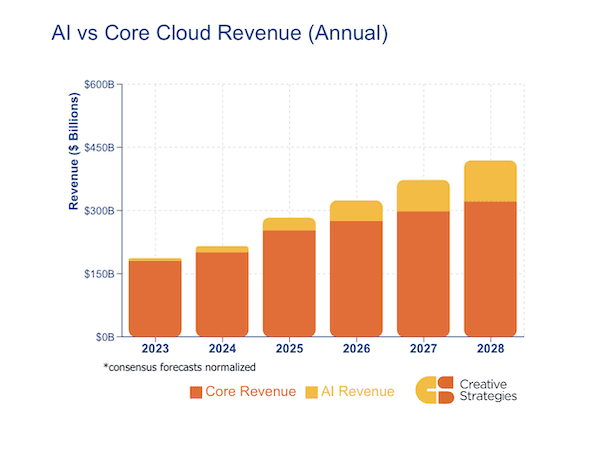
A simple capex-to-revenue read-through on one stack implies roughly \~30% annual yield and \~3.5-year payback on recent AI builds—hardly speculative if those trends hold. And while frontier training gets pricier, inference costs are collapsing: token prices have fallen from $30/$60 per million input/output tokens in 2023 to small-model options at $0.05/$0.20, with software squeezing \~90% more tokens per GPU year over year. That’s exactly what you want to see for mainstream adoption.
The middle ground is probably closest to reality. This looks less like a speculative mania and more like a multi-year infrastructure retooling—from CPU-first to accelerated compute—paced by real-world bottlenecks (HBM, GPUs, storage, power) that could naturally meter supply. Near-term, spending is still being revised up: data-center capex is modeled \~+60% Y/Y in 2025 and \~+30% in 2026 with upside risk to 40%+; the accelerator market could compound 40–50% off an estimated \~$200B base in 2025\. **Those aren’t bubble-style “buy anything” numbers; they’re “there’s real demand, but execution matters” numbers.**
How to separate productive buildout from overbuild? A few pillars are worth watching. **Utilization and payback**: track disclosed AI service run-rates against prior capex; if paybacks stretch past \~4–5 years or utilization dips, that’s a yellow light. **Capital-intensity discipline**: keep an eye on capex-to-revenue. When this ratio moves persistently into the high-20s without revenue catching up, risk rises; when it stays tethered to growth, the flywheel is working. (One simple framing: assuming \~25% intensity by the late 2020s implies very large—yet still internally financed—spend levels.) **Power timelines**: grid connections and generation will make or break delivery schedules; persistent slippage there strands assets, but it also prevents a classic supply glut—another reason this cycle doesn’t map 1:1 to the dot-com era.
The “bubble” framing is useful as a risk checklist or heightened awareness but not as an all cards on the table verdict. We acknowledge, spending is huge, concentrated, and ahead of broad-based returns. But the buyers are cash-rich, early paybacks are showing up in the numbers, unit economics are improving where it matters (inference), and physical constraints pace the rollout. Net: There are highly encouraging signposts for economic returns. If utilization improves, capital intensity stays disciplined, and power comes online roughly on plan, this buildout looks like a durable replacement cycle rather than a blow-off top. If those dials turn the wrong way—utilization disappoints, capex outruns revenue, power slips—then the argument flips. **For now, cautious optimism with a tight focus on those three tracking points feels like the right balanced perspecitve to maintain.**
### M5 Apple Silicon: It’s All About the Cache And Tensors
URL: https://creativestrategies.com/research/m5-apple-silicon-its-all-about-the-cache-and-tensors/
Last updated: 2025-10-21T17:27:53.000Z
Today is a big day, M5 Day! I say this because I believe M5 is a bigger deal than the products it’s in. That’s not to say these products are bad, quite the opposite: they are so good and have been so good for so many years that it’s hard to think of anything meaningful to say. The iPad Pro is the best tablet on the market. The MacBook Pro is the best all around $1600+ laptop on the market. For the iPad Pro, that’s been true since 2018 and for the MacBook Pro that’s been true since 2021.
I’ve been really enjoying both of the M5 versions of these! The iPad Pro with N1 and C1x for connectivity has made it more reliable for me compared to my M4 iPad Pro, and helping with battery. I’ve actually noticed that the 11-inch version with M5 about matches my 13-inch iPad with M4! The MacBook Pro, well, it’s just great to have a smaller laptop for travel and work. I adore the 16-inch MacBook Pro and M3 Ultra Mac Studios I regularly use at home and traveling when needed, but frankly I’ve been looking for a smaller travel laptop with good performance. The 14-inch MacBook Pro with M5 is that laptop. Simply, great products.
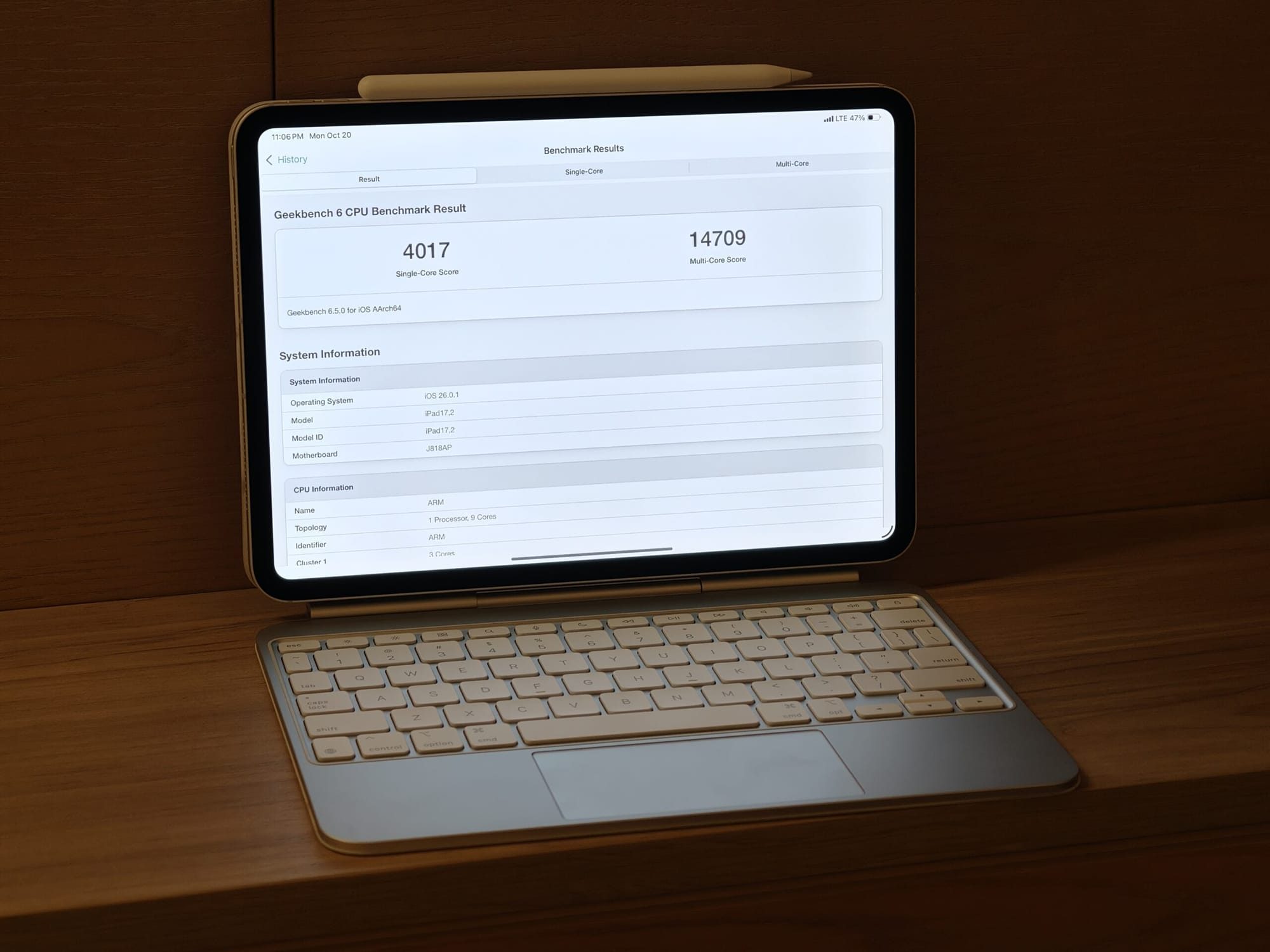
M5 iPad Pro
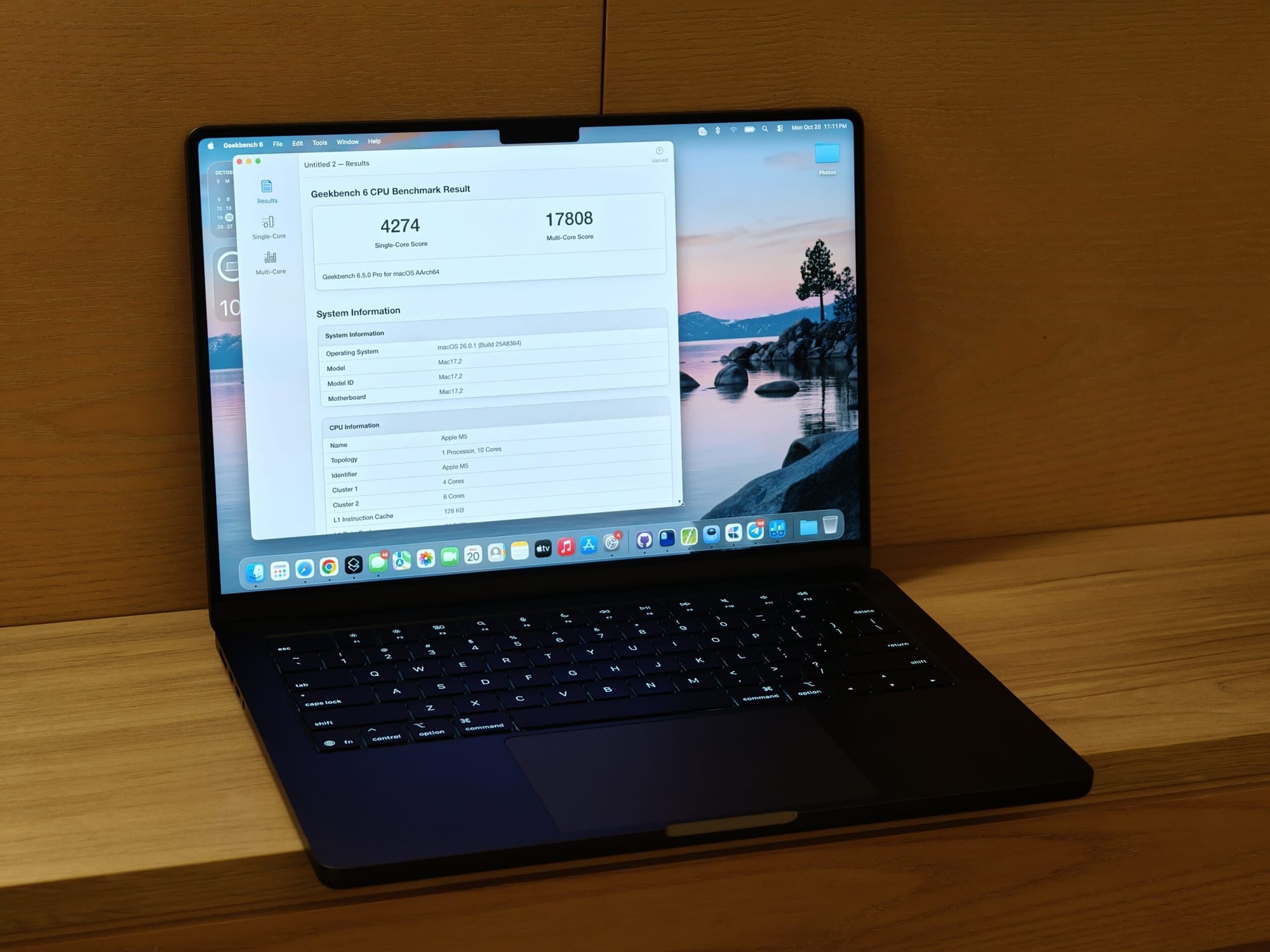
M5 MacBook Pro
Beyond how I use these things, what has really changed is the silicon. With this generation and M5, I think it’s one of the larger changes in recent history for Apple Silicon! Let’s talk about it in 3 parts: CPU, GPU, and cache!
---
### CPU
The M5 CPU has some pretty big IPC gains! It’s roughly 10% IPC gains when normalized for maximum clock speed, if we just look at raw single core performance increase it’s roughly 15%. This is thanks to the higher 4.6GHz clock speed on the performance cores! This leads us to roughly a 4,300 single core score in Geekbench 6.5\. Apple’s M4 SoC was around 3,800 single core performance in Geekbench 6.5\. If we look at score per GHz, it’s about 872.8 for M4 and 950.3 for M5\. The largest jumps in performance were Object Remover +28%, Background Blur +23%, Structure from Motion +22%. These workloads are sensitive to memory/latency and vector throughput, so the larger cache (more on that later) and memory bandwidth are helping here. This is likely also being helped by Arm’s SME (scalable matrix extensions) as Neural Accelerators within the CPU cores.
What we also see is a nearly 25% increase in multi-core performance! In Geekbench, the multi-core is 18,086 on M5 vs 14,546 on M4\. This increase is more than we would see if it were just IPC improvements and clock speed, which means M5 also improves upon multi-core scaling. This is likely due to M5’s cache (again, more on that later) and wider front-end bandwidth.
With all of these improvements, M5 CPU about matches the performance of M1 Ultra!
---
### GPU
The GPU has what I’d consider the largest upgrade this year for Apple Silicon. It was introduced with the A19 series in iPhone 17 series and now M5!
This GPU architecture comes with a new 3rd ray tracing accelerator, new shader core, and Neural Accelerators! These neural accelerators are similar to Nvidia’s tensor cores, specific cores optimized for matrix multiplication.
All AI models, regardless of the type, are bundled into matrixes. For Qwen3 1.7B, for example, it’s a 2048×2048 matrix for most layers. There are two ways to calculate this math, using vector cores or matrix cores! The vector way (regular shader ALUs) treat the grid like lots of 1×2048 lines (dot‑products). It works, but you keep re‑loading data, so it wastes bandwidth and time. Each GPU cores is able to calculate more than one of these at a time, so the more cores the faster it can go, with limitations based on memory bandwidth. The matrix way (the GPU’s neural/matrix units) chop the grid into small squares (think \~32×32 or 64×64). Each GPU core multiplies those squares and reuses them while they’re on‑chip, so far fewer memory trips and lots of squares processed in parallel. On M5‑class chips, each GPU core has a Neural Accelerator specifically for this.
These dedicated neural accelerators in each core lead to that 4x speedup of compute! In compute heavy parts of LLMs, like the pre-fill stage (the processing that happens during the time to first token) this should lead to massive speed-ups in performance! The decode, generating each token, should be accelerated by the memory bandwidth improvements of the SoC.
Now, I would have loved to show this off! Unfortunately, full support for the Neural Accelerators isn’t in MLX yet. [There is preliminary support, though!](https://github.com/ml-explore/mlx/pull/2687?ref=creativestrategies.com) There will be an update later this year with full support, but that doesn’t mean we can’t test now! Unfortunately, I don’t have an M4 Mac on me (traveling at the moment) but what I was able to do was compare M5 performance before and after tensor core optimization! We’re seeing between a 3x and 4x speedup in prefill performance!
| Benchmark | M5 Prefill (Without Neural Accelerators) | M5 Decode (Without Neural Accelerators) | M5 Prefill (**With Neural Accelerators**) | M5 Decode (**With Neural Accelerators**) | **M5 Neural Accelerator Speedup** |
| --------------------- | ---------------------------------------- | --------------------------------------- | ----------------------------------------- | ---------------------------------------- | --------------------------------- |
| Qwen3 8B 19121 tokens | 158.2 tok/s | 8.2 tok/s | 578.7 tok/s | 8.65 tok/s | **3.65x speedup** |
| Qwen3 8B 32008 tokens | 153.5 tok/s | 5.7 tok/s | 453.3 tok/s | 5.8 tok/s | **2.95x speedup** |
For the currently available MLX ***without neural accelerator*** support comparing M4 to M5, you can see the results below! When MLX is updated with Neural Accelerator support later this year, you can expect a much larger jump like we see above.
| Benchmark | M4 Prefill (tokens per second) | M4 Decode M4 Prefill (tokens per second) | M5 Prefill M4 Prefill (tokens per second) | M5 Decode M4 Prefill (tokens per second) | M4 > M5 Performance Boost Prefill | M4 > M5 Performance Boost Decode |
| ---------------------- | ------------------------------ | ---------------------------------------- | ----------------------------------------- | ---------------------------------------- | --------------------------------- | -------------------------------- |
| Qwen3 1.7 \| 512/128 | 1601.2 | 75 | 1617 | 108.7 | 0.98% | 31.00% |
| Qwen3 1.7 \| 1024/128 | 3264.7 | 80.3 | 3442.9 | 101.9 | 5.18% | 21.20% |
| Qwen3 1.7 \| 1024/512 | 3269.1 | 73.9 | 3429.7 | 101.2 | 4.68% | 26.98% |
| Qwen3 1.7 \| 2048/128 | 6560.4 | 74.1 | 6968 | 91.6 | 5.85% | 19.10% |
| Qwen3 1.7 \| 2048/512 | 6565.3 | 73.9 | 6969.3 | 93.5 | 5.80% | 20.96% |
| Qwen3 1.7 \| 1024/1024 | 3273.3 | 78.6 | 3442.2 | 97.3 | 4.91% | 19.22% |
| Qwen3 1.7 \| 4096/128 | 12949.6 | 64 | 13942.4 | 77.8 | 7.12% | 17.74% |
| Qwen3 1.7 \| 4096/512 | 12948.5 | 61.1 | 13926.9 | 73.3 | 7.03% | 16.64% |
| Qwen3 1.7 \| 8192/512 | 24429.2 | 41.4 | 26897.5 | 52.7 | 9.18% | 21.44% |
There’s a pretty big boost in gaming performance as well, but I’ll leave that for others to review/benchmark! I just think AI performance in GPU is most interesting for now. This is just the beginning of what we’ll see as the neural accelerators are supported in more AI applications.
---
### Cache
Cache is what is basically Apple’s secret sauce for efficiency and performance. CPUs need access to memory to function, otherwise how would it know what to process! There are two types of memory, DRAM and SRAM, in a system like this. SRAM is used for system cache while DRAM is used for the Unified Memory, your usual LPDDR\_ or DDR\_. SRAM is very low density and requires more space, so it’s included in the SoC as a cache as your usual L1/L2/L3 and SLC (system level cache).
When a CPU processes data, it pulls that data from your memory (DRAM) and stores it in the cache (SRAM) to process. Pulling from data from DRAM to SRAM is very energy intensive, generally hundreds of pJ (pico joule) per read from DRAM. Reading and using the SRAM is generally single digit pJ. Having more cache effectively means less reads from memory, this ends up lowering power consumption!
With A19 Pro and M5, Apple has loaded up the SoC with cache. There’s more L2 cache per CPU cluster, more SLC among the entire SoC! This has two net benefits we’ll see as an extension of the CPU performance we talked about earlier, the CPU’s P-cores are more efficient while the E-cores remain effiecent but allow Apple to make them more performant. This also means that if the SoC uses less power, you’re able to put more power into it increasing performance! Performance is generally a limitation of heat from power, if your CPU uses less power to complete the task, it heats up less, meaning you can put more power into it to increase performance.
This is worth noting for a few reasons, but mainly a foundry reason: large cache is expensive. If you want 32MB of SLC in a chip like A19 Pro, your die must be larger to fit it all. Unlike transistors, SRAM density doesn’t shrink as often or at the same rate. While transistor density improved over TSMCs 3nm process, SRAM density did not increase as much over the process. By all intents and purposes it’s roughly the same. That means that if Apple took the same \~105mm^2 for A18 Pro and \~140mm^2 for M4 and were able to shrink transistors 15%, they could have either taken that space as cost savings per die by making it smaller or keep the same size and increase efficiency with more die space allocated to SRAM for A19 Pro/M5\. Apple chose the latter, meaning they value efficiency above cost for chips like this. I believe this is a philosophically important point to make.
Apple doesn’t always make this trade off, for example A19 in the lower cost iPhone 17 and likely iPhone 17e next year didn’t increase cache size and did reduce die size! In this case, Apple decided to reduce cost because the products this chip was going into didn’t require the same efficiency benefits as the products A19 Pro and M5 were going into. Those are cheaper products designed for higher margins and more unit sales. It’s a valid and smart trade off to make for that chip and product.
---
Ok overall, M5 is really good. The new iPad Pro is really good. The new MacBook Pro is really good. The reality is were in this weird spot where I’m not really sure how these products could get much better. Maybe slightly thinner and lighter MacBook Pro with cellular data, maybe better battery life on the iPad Pro. M5 is continuing Apple’s trend of more performant chips with better efficiency. Apple is more or less class leading in this. As we get into a power constrained future for AI, as Apple builds out their own Private Cloud Compute, and as some smaller edge AI workloads becomes more important, these changes add up!
### Apple Takes the Wheel: A Perfect Lap Between Tech, Culture, and Formula 1
URL: https://creativestrategies.com/research/apple-takes-the-wheel-a-perfect-lap-between-tech-culture-and-formula-1/
Last updated: 2025-10-21T02:55:07.000Z
Coming fresh from the Austin Grand Prix, I couldn’t help but notice how different the atmosphere felt compared to just a few years ago. The crowd was electric, yes, but also incredibly diverse — not just in nationality, but in age, gender, and background. From families and first-timers to Gen Z fans decked out in team colors, it was clear that Formula 1’s audience has evolved.
That’s why Apple’s latest announcement, becoming the exclusive broadcast partner for Formula 1 in the United States starting in 2026, couldn’t have landed at a more symbolic moment. The sport is shifting gears, and Apple is perfectly positioned to drive that momentum forward.
##### A Bold New Partnership
According to Apple’s announcement, the five-year partnership will make Apple TV the new home of Formula 1 in the U.S., replacing ESPN’s long-running broadcast deal. Starting with the 2026 season, Apple will stream every Grand Prix, Sprint, qualifying, and practice session exclusively through the Apple TV app, with select races and sessions available for free to viewers across devices.
Perhaps most interestingly, F1 TV Pro, Formula 1’s direct-to-consumer subscription service, will be integrated into Apple TV. This means existing Apple TV subscribers will gain access to F1 TV content directly within the app, bringing together live race coverage, on-board cameras, team radios, and in-depth analytics in one seamless experience.
Apple also plans to extend Formula 1’s presence across its ecosystem, Apple News will feature expanded race coverage and highlights; Apple Music will curate F1-themed playlists and exclusive driver-curated soundtracks; Apple Maps will spotlight race-week experiences; Fitness+ will incorporate F1-inspired workouts; and the Apple Sports app will feature real-time leaderboards and live notifications.
In short: Apple isn’t just buying rights, it’s embedding Formula 1 into its lifestyle ecosystem.
##### F1 and Technology: A Long-Standing Relationship
Formula 1 and technology have been intertwined since the sport’s inception. Every car on the grid is a marvel of engineering, a rolling laboratory of data, sensors, and simulation. Over the years, F1 has become a showcase for some of the biggest names in tech.
Google, HP, Qualcomm, Dell, Cisco, IBM, and AWS are just a few of the global players that have poured resources into teams and infrastructure. These partnerships go far beyond branding: they power race analytics, real-time data sharing, and predictive modeling that determine strategy at 200 mph.
Even newer tech brands are finding ways to connect. Perplexity, the AI search company, recently partnered with Sir Lewis Hamilton, highlighting the intersection of innovation, curiosity, and personal brand alignment. And Lenovo, as the official technology sponsor of the FIA, continues to see strong returns on investment, proof that the combination of visibility, storytelling, and measurable performance impact pays dividends.
##### A Changing Fan Base — and a Huge Opportunity
The Formula 1 audience is booming, especially in the United States. Once seen as a niche European sport, F1 now attracts more than 52 million fans across the U.S., according to data cited in Apple’s press release. The growth has been driven in part by the Netflix series Drive to Survive, which humanized the sport’s drivers and teams and turned casual viewers into passionate fans.
But what’s even more important is who those new fans are. Surveys show that 47 percent of new U.S. F1 fans are aged 18–24, and over half are women. Globally, women now account for around 41 percent of F1’s fan base, and represent three out of every four new followers.
That mix of digital-first, socially engaged fans is tailor-made for Apple. The company’s ecosystem already thrives on personalization, community, and content integration, exactly the factors driving F1’s cultural resurgence.
When you think about it, the partnership seems inevitable:
- F1 wants to expand in the U.S., connect with younger audiences, and make streaming its primary medium.
- Apple wants premium live content that complements its growing sports portfolio and deepens user engagement.
Together, they can redefine how fans experience motorsport, not just as spectators, but as participants in a connected, data-driven world.
#### Apple’s Unique Edge
Apple’s move into live sports has been deliberate. With Major League Soccer (MLS Season Pass) already under its belt, Apple has shown it can deliver sports through a subscription model that emphasizes access, experience, and community over traditional broadcast fragmentation.
But Formula 1 is a step up, a truly global property with year-round storylines, massive data layers, and an affluent, loyal fan base. It’s also a brand that, like Apple, represents innovation, performance, and design perfection.
The significance of this deal goes beyond streaming. It’s a statement about where sports media is heading. The combination of data, narrative, and technology is reshaping fandom, and Apple’s entry signals that premium sports properties can live comfortably in a fully digital ecosystem.
At the Austin Grand Prix, surrounded by a crowd that looked far more like the future than the past of motorsport, it was clear this evolution is already underway. Formula 1 isn’t just a sport anymore, it’s a cultural platform.
Apple joining that race isn’t just a broadcasting decision; it’s a declaration. The next chapter of Formula 1 will be streamed, personalized, and powered by technology, and Apple is in pole position
### Gemini Enterprise: Google’s Shift to Holistic Enterprise AI
URL: https://creativestrategies.com/research/gemini-enterprise-googles-shift-to-holistic-enterprise-ai/
Last updated: 2025-10-10T18:55:17.000Z
With Gemini Enterprise, Google wasn’t just announcing another “AI for business” product. Rather, Google is staking a claim to a much more ambitious vision: embedding AI across every workflow, across every level of an organization, in a way that feels seamless and pervasive.
##### Addressing the Enterprise as an Ecosystem, Not a Collection of Use Cases
One of the most striking aspects of Google’s presentation is how it frames AI not as a point tool or vertical bolt-on but as a platform layer that touches every part of the enterprise fabric:
- Gemini Enterprise is portrayed as the new “front door” to AI for every user, enabling chat, search, and agent orchestration across enterprise systems (CRM, ERP, spreadsheets, document stores) under one governed umbrella.
- The product emphasizes connectors to Microsoft 365, SharePoint, Salesforce, SAP, and other enterprise systems, a clever and self-aware move that acknowledges today’s hybrid, multi-vendor reality. Google understands it may not always be the productivity suite of choice, but it also knows that the strength of its foundational models can be a powerful draw for enterprises looking to infuse AI into their existing workflows.
- The notion of packaged agents (e.g. for search, customer engagement) plus the ability for business units to build custom agents or workflows hints that Google wants to strike a balance between standardization and flexibility.
All of this points to an enterprise-first thinking: Google is not simply grafting AI onto siloed workflows, but trying to create an integrated, governed, enterprise-scale fabric of intelligence.
This is important because one of the main risks in enterprise AI is fragmentation: different teams adopting different narrow tools, with inconsistent data, security, oversight, and integration. By foregrounding governance, unified data access, and an “agent orchestration” layer, Google signals that it understands that complexity.
##### Contrast: Microsoft’s Organizational Silos and the Risk of Fragmentation
Against this backdrop, Google appears to be positioning itself against one of Microsoft’s long-standing structural challenges: organizational silos. Over the years, Microsoft’s AI and cloud strategy, spanning Office, Azure, Dynamics, and Teams, has often reflected the internal divisions that shape its product groups. While each business unit continues to innovate rapidly, the lack of deep cross-organization alignment can make it difficult to present a unified, seamless AI narrative or execution model.
The result is that Microsoft’s AI offerings, from Copilot to Fabric to Azure AI, sometimes feel like parallel initiatives rather than components of a single, integrated platform. These internal barriers can slow down collaboration, complicate go-to-market cohesion, and create overlapping experiences that customers must piece together on their own.
That said, Microsoft’s disaggregated approach can also offer an advantage when first landing within large organizations. Different departments or functions may be at varying stages of AI readiness, making it easier for one Copilot or Fabric component to gain traction without requiring a company-wide transformation from day one. The challenge, however, comes later — in scaling those wins across the enterprise and demonstrating the full, interconnected value of Microsoft’s AI ecosystem once deployed.
By contrast, Google’s recent announcements suggest a more holistic and horizontally aligned approach, one where AI acts as a connective tissue across its portfolio, not as an add-on feature tied to a specific business unit. This integrated mindset, rooted in data, orchestration, and user context, could give Google an edge as enterprises increasingly seek AI experiences that feel coherent, consistent, and pervasive across workflows.
If Google can maintain that organizational alignment and deliver on this unified vision, it may succeed in positioning Gemini not as another product, but as the AI layer that underpins the modern enterprise.
##### Modern Workflow Is in Google’s DNA, And Now They Are Doubling Down
One of the criticisms often leveled at enterprise cloud players is that they struggle to keep pace with how people *actually* want to work: fluidly, asynchronously, cross-tool, across devices, collaborative, and embedded.
Google potentially has an advantage here, because its DNA is built around tools like Gmail, Docs, Sheets, Drive, all of which had from the start the ambition of “work happening in the browser, accessible anywhere, collaborative by default.” Google’s investments over the years in seamless collaboration, live editing, versioning, and context-aware assistance set it up for more easily folding in AI into workflows.
We saw early hints of this in how Google has already integrated Gemini features into Gmail, Docs, Meet, etc. examples like smart replies that invoke personal tone / context, side-panel assistants, summarization and drafting features.
Now, with Gemini Enterprise, Google appears to be going full tilt: building agent orchestration, unified enterprise search, and cross-system AI workflows.
Because Google has long operated in the “consumer meets cloud” world (with Gmail, Drive, YouTube, Maps, etc.), it has a front-row seat on how people interact with rich media, how multimodal inputs (text, image, video) work, and how to scale features to billions of users. It can bring that experience insight into enterprise settings, and that is a real differentiator.
##### Multimodal, Consumer-Scale Assets Underpin the Advantage
Another structural edge Google brings is its access to vast multimodal data sources (e.g. YouTube, search, images, maps, Android device data) and strong model infrastructure (DeepMind, TPU / chip design, research) that can feed into enterprise models.
- Gemini is a *multimodal* model by design (i.e. capable of ingesting and reasoning over text, images, video, etc.).
- Google has both consumer-scale product exposure and enterprise ambitions, meaning it can use learnings and signals from the consumer side (e.g. how users speak, what context they bring, how they mix media) to enrich enterprise models.
- Its ability to embed video, image, audio, and richer context gives it a chance to deliver AI agents that are more contextually aware than text-only bots. For enterprises dealing with documents, diagrams, visual workflows, video logs, etc., a multimodal backbone is a powerful leverage point.
In short: Google’s “consumer + cloud + models + research” stack gives it a chance to bridge to enterprise in a way that others (without such diversified assets) might find harder.
##### Risks, Challenges, and What to Watch
Of course, ambitious vision doesn’t guarantee execution. Some of the risks and caveats to keep an eye on:
1. **Governance and Compliance Complexity**
Embedding AI deeply across enterprise systems exacerbates the need for security, auditing, agent behavior oversight, model explainability, data lineage, and compliance. Google will have to prove it can deliver robust guardrails, especially for regulated sectors (finance, health, government). In the announcements, they do emphasize governance as a capability, but the proof will be in the implementation.
2. **Data Gravity & Integration Friction**
Enterprises have decades of legacy data, disparate silos, on-prem systems, custom schemas, and integration debt. Even with connectors, getting to a unified context may require heavy data engineering, normalization, and adaptation. Google’s ability to reduce that friction (and win migration) will matter.
3. **Competition & Ecosystem Lock-in**
Microsoft, OpenAI, AWS, Anthropic, Oracle, and others are all pushing into enterprise AI. Yet Microsoft’s position remains particularly formidable, thanks to its deep entrenchment in enterprise IT and productivity stacks. With Office 365, Teams, Azure, and Dynamics already woven into daily workflows — and with Copilot now embedded across that ecosystem — Microsoft enjoys a scale and familiarity that few competitors can match. For many organizations, Microsoft is not just a vendor but the default operating environment for work.Google must persuade organizations to invest anew or re-architect. Further, enterprises will be sensitive to lock-in risks: once AI agents are deeply embedded, switching costs might be high.
4. **User Adoption & Trust**
Employees must trust and adopt AI agents rather than resist or override them. The usability, accuracy, context understanding, and transparency will determine whether these agents become helpers, not hindrances.
If Google can navigate those risks, the holistic vision may well pay off handsomely.
##### From Ambition to Execution
The Gemini Enterprise announcements mark a defining moment in how Google wants to be perceived in the enterprise AI landscape, not just as an innovator in model development, but as an orchestrator of work itself. What stands out now is not the vision, but the discipline of execution that will follow.
Google has articulated a coherent story about convergence: AI that cuts across applications, connects data and people, and reshapes workflows around intelligence rather than software categories. If it can operationalize that story, aligning product, sales, and partnerships under one unified rhythm, it will redefine how enterprises think about adopting AI at scale.
In the end, the success of Gemini Enterprise will hinge less on technological breakthroughs and more on organizational clarity and customer trust. Google’s challenge is to turn its philosophical advantage, its integrated, user-first DNA, into measurable business outcomes. The next chapter isn’t about proving that AI can be everywhere; it’s about proving that it can make work meaningfully better everywhere it lands.
### AI Is Our Electricity Moment: Why Productivity Follows Process
URL: https://creativestrategies.com/research/ai-is-our-electricity-moment-why-productivity-follows-process/
Last updated: 2025-10-07T15:24:08.000Z
**Ariticle Summary/Thesis**
Every transformative technology arrives twice. First as hardware and headlines—motors, wires, GPUs, data centers—then, years later, as redesigned work that finally shows up in the productivity numbers. Electricity followed that arc. The earliest adopters simply swapped steam engines for electric motors and wondered why little changed. The real step-up came only after managers re-laid out factories, moved machines closer to tasks, rewrote roles, and cut the number of handoffs. Output rose, lead times shrank, and the accounting caught up.
Skeptics calling today’s build-out a bubble miss this rhythm. Electricity had its speculative booms, too—the 1880s and the late 1920s—yet the grid survived the hype cycle and powered a century of growth. The same will be true here.
There’s also a scale story worth stating plainly. Electrification required years of persistent, utility-grade capital spending, especially on the grid. AI is triggering a similarly macro-relevant wave—turning over compute, re-architecting data pipelines, and, inevitably, pulling more investment into power and connectivity. That capex is not a detour from productivity, however, it is the on ramp.
This article makes the case for treating AI as our electricity moment. We show why the payoff lags the purchase, how to manage the J-curve of investment before returns, and what it looks like to redesign core workflows end-to-end rather than bolt new tools onto old processes. Most importantly, we outline the metrics leaders should track—cycle time, first-pass yield, rework, cost per outcome—so the benefits become visible in the business and, over time, in the broader economy.
If electricity taught us anything, it’s this: you don’t get productivity from buying motors; you get it from moving the machines. AI will change everything, but only after we change how everything is done.
**The Buildout**
The first wave of electrification disappointed many observers. Firms dutifully replaced steam engines with electric motors but left the rest of the factory unchanged: the same line-shafts, the same belt-driven machines, the same rigid workflow. Accounting records showed only modest gains, and some concluded electricity had been oversold. The big unlock came later, when managers re-imagined how work should flow in an electrified plant—smaller motors at each station, new floor plans, different sequencing of tasks, and new roles for workers and supervisors. **Once the process changed, measured productivity surged.** That sequence—technology first, productivity second—captures the moment we are entering with artificial intelligence.
AI today is where electricity was when factories were merely “wired.” We are building out new infrastructure, evolving models, negotiating access to private clouds, and piloting copilots in individual tools. Those investments are necessary; they are the wires and motors of our era. But they are not sufficient. The real economic impact appears when we redesign the work around what the technology is actually good at. For electricity, the advantage wasn’t just cheaper energy; it was the freedom to decouple machines from a single power shaft and rearrange production into faster, safer, more flexible cells. For AI, the advantage is not merely faster autocomplete; it is the ability to decompose a process into judgment calls and pattern-recognition steps, assign the latter to AI systems, and orchestrate the whole flow so humans spend their scarce time on supervision, exceptions, and decisions that carry real risk.
This is why measured productivity lags the hype cycle. In the early phase, an organization’s costs go up: it buys compute, licenses models, builds data pipelines, and trains people. Meanwhile, workflows remain mostly intact and metrics barely move. Leaders who do not anticipate this “J-curve” mistake the lag for failure and pull back precisely when they should be redesigning the process. The correct reading is that intangible complements—data quality, governance, workflow engineering, metrics, and change management—are still being built. Once those complements are in place, the same headcount and capital produce more output, quality improves, and lead times shrink. Accounting finally sees what the technology always promised.
**The practical question is how to cross that gap. The answer, again, is process.** Start by choosing one end-to-end workflow, not a scattered set of tasks. If a customer-support operation touches intake, triage, research, drafting, approval, and follow-up, the goal is to refactor that chain so more happens in a single pass with fewer handoffs. **In an agentic (outcome based process) AI can summarize context, propose a resolution, check policy, and draft a response; humans approve exceptions and improve the system through feedback.** In software, the target is not a faster editor; it is a delivery system where AI proposes designs, generates scaffolds, writes tests first, surfaces known failure modes, and documents as code changes—so the unit of work is a deployable change with fewer defects, not a line of code typed more quickly. In finance or back-office workflows, the aim is to compress collect-check-enter-reconcile into one validated pass, with AI enforcing rules and flagging anomalies while humans adjudicate edge cases. The common thread is fewer queues, fewer re-entries, and fewer opportunities for rework.
Measurement must evolve alongside the redesign. Traditional input metrics—hours logged, tickets touched, lines of code—are poor guides to AI-enabled productivity. What matters are factory-style outputs: cycle time from request to resolution, first-pass yield, rework rate, queue length and abandonment, service-level attainment, cost per successful outcome. These reveal whether the new process is actually better. They also create the feedback loop that AI needs: without consistent targets and labeled outcomes, models cannot be tuned to the business’s real goals. **Put differently, if electricity rewarded plants that measured throughput and uptime, AI will reward firms that define success precisely and instrument the path to get there.**
Leadership’s role in this transition is to name the J-curve upfront and budget for the complements that bend it upward. That means funding data engineering and quality assurance, clarifying governance and risk boundaries, and investing in role training so people know when to trust the system and when to override it. It means staging the rollout so lessons from one lane can be copied to the next, rather than running dozens of disconnected pilots. And it means aligning incentives: **managers should be recognized for retiring steps and handoffs, not just for adding AI to the old way of working.** The winners in an electricity era were not the firms that bought the largest motors; they were the firms that moved the machines and rewrote the playbook.
It is also important to recognize that AI, like electricity, will produce gains that national accounts undercount. Some benefits arrive as quality and convenience—answers on demand, fewer errors caught upstream, documentation that appears automatically—rather than as priced transactions. That does not make the gains any less real. In practice, firms will see them as better customer satisfaction, lower churn, faster onboarding, fewer compliance misses, and more resilient operations under stress. Over time, these non-price improvements accumulate into market share and profitability; at scale, they show up as productivity growth.
Skeptics often reach for transportation analogies—railroads, highways, ports—to explain technology’s impact through market access and spatial reallocation. Those analogies are valuable for thinking about diffusion and who benefits where. But if your goal is to understand a broad step-up in within-firm productivity, electricity is the cleaner comparison. **Both require complementary investments inside the enterprise; both deliver their biggest gains after process redesign; both produce an early period where spending is visible and measured output is not.** The lesson from history is not that electricity changed everything overnight, but that it changed everything once organizations learned to work differently.
This perspective reframes how we should evaluate AI programs. A deployment that merely adds a copilot beside every worker is a capital project with an unclear return. A deployment that eliminates handoffs, compresses cycle time, and raises first-pass yield across an entire workflow is a new operating model. The former will be easy to start and easy to cut. The latter will be harder to start—and it will be the thing competitors cannot quickly copy once it works. Boards and executives should ask to see redesigned flows, not just model invoices; outcome metrics, not just usage statistics; training plans for new roles, not just lists of new tools.
The arc from electricity to productivity was not linear, but it was predictable once you saw the pattern: wire the building, move the machines, measure the throughput. **The arc from AI to productivity will follow the same path: provision the compute, redesign the work, measure the outcomes.** If we accept that order of operations, we can set expectations realistically, invest in the right complements, and steer through the J-curve with confidence. AI will change everything, but only after we change how everything is done.
### From Assistants to Agents: Microsoft’s Copilot Steps Forward, and Sideways
URL: https://creativestrategies.com/research/from-assistants-to-agents-microsofts-copilot-steps-forward-and-sideways/
Last updated: 2025-10-07T02:59:30.000Z
*Microsoft’s latest announcements on Microsoft 365 Premium and new Copilot “agents” mark an important step toward the future of AI in productivity. But while the vision is clear, the path for users is less so.*
##### The Announcements: Premium and Agent Mode
This past week, Microsoft unveiled two major updates that reshape the way users will experience Copilot.
- **Microsoft 365 Premium**: a new subscription tier that bundles advanced Copilot capabilities, higher usage limits, and exclusive features. This effectively ( I say effectively because Microsoft said Pro will continue) replaces the previous Copilot Pro plan and aims to simplify the way individuals and organizations get access to AI across Microsoft’s apps.
- **Agent Mode and Office Agent**: new features that give Copilot the ability to plan and execute multi-step tasks inside apps like Word and Excel, or across workflows through Copilot chat. In practice, this means you can ask Copilot to analyze data, create reports, or draft presentations, and it will handle more of the work without you having to spell out every step.
The intention is clear: make Copilot more powerful and easier to adopt by embedding it deeply into the productivity suite.
##### Why This Is Good News
Microsoft deserves credit for focusing on lowering the barrier to real value. Users don’t just want flashy AI, they want tools that reliably save them time, reduce friction, and help them get meaningful work done.
By:
- bundling Copilot with Microsoft 365 Premium,
- raising usage limits, and
- rolling out features like Agent Mode,
Microsoft is sending a signal that Copilot is becoming central to productivity bottom up and top down in organizations. This move also acknowledges that adoption depends on reducing complexity and delivering results “out of the box.”
##### The Problem: Too Many Flavors, Too Little Clarity
But alongside the progress comes a significant problem: confusion.
- Users now have to navigate between multiple tiers and offerings, Microsoft 365 Personal, Family, Premium, and Enterprise, ach with slightly different Copilot features.
- The introduction of Agent Mode, Office Agent, and other branded variants makes it difficult to understand what’s available where.
- Much of the value remains aspirational. Microsoft describes what the agents *could* do, but in practice results will vary depending on context, version, and geography.
This complexity forces users to make decisions (and potentially pay more) before they can clearly see the benefits. In other words, Microsoft is asking customers to trust the promise before they’ve seen the proof.
##### Agents Are the Future — But Today They’re Still “Assistants+”
The bigger picture is important here. Microsoft is trying to shift the conversation from assistants to agents.
- **Assistants** respond to user prompts and carry out limited tasks.
- **Agents** have the autonomy to plan, act, and adjust across multiple steps without constant direction.
Right now, Copilot’s new Agent Mode sits somewhere in between. It’s more capable than a simple assistant, able to chain tasks, evaluate, and refine. But it’s still very much an extension of the user, not an independent operator. You guide, validate, and often correct its work.
That may feel underwhelming to some, but it’s also necessary. Trust in AI doesn’t arrive overnight. By gradually handing over more responsibility, while keeping humans in the loop, Microsoft is laying the groundwork for a future where agents can truly act with independence.
##### The Road Ahead
For this transition to succeed, a few things will matter most:
1. **Clearer positioning**: Users need to know what’s included at each tier without deciphering jargon.
2. **Proven value cases**: Demonstrating consistent, repeatable scenarios where Agent Mode saves time will build adoption.
3. **Trust through transparency**: Agents must explain their steps and allow for oversight, especially in business-critical contexts.
4. **Broad, reliable rollout**: Preview-only or web-only availability risks frustrating early adopters. Users need to see parity across platforms.
##### Conclusion: A Necessary but Messy Step
Microsoft’s latest Copilot announcements reflect both ambition and ambiguity. On the one hand, they show a clear commitment to weaving AI deeper into work and to moving toward a future of true agents. On the other, they risk alienating users with too many overlapping options and unclear value propositions.
The reality is that today’s “agents” are not independent beings; they’re still assistants with extra abilities. That may sound modest, but it’s a necessary step. Trust is earned incrementally, and only through these in-between stages will users become comfortable with the agents of tomorrow.
Microsoft is on the right path. But before we get to autonomous agents running complex workflows, we must first pass through this messy middle, where assistants evolve, trust builds, and clarity will be the key to adoption.
### Amazon’s New Wave of Devices: AI, Storytelling, and the Move Upmarket
URL: https://creativestrategies.com/research/amazons-new-wave-of-devices-ai-storytelling-and-the-move-upmarket/
Last updated: 2025-10-01T18:54:37.000Z
Amazon has built its reputation on delivering reliable, affordable consumer hardware that ties seamlessly into its services. From the first Kindle to the rise of Echo smart speakers, its devices have consistently done exactly what they promised. Ok maybe with the exception of the Kindle phone but as I wrote in the past that failure got the company to Echo and Alexa.
In its latest device lineup announced this week in New York and ranging from the Kindle Scribe Colorsoft and new Echo devices, to the upgraded Ring security cameras and Fire TV updates, Amazon is taking a deliberate step upmarket. More importantly, it is weaving artificial intelligence (AI) into everyday experiences. As AI increasingly shapes how devices deliver value, appealing to early adopters is essential. These consumers are the first to experiment with emerging technology, and their engagement can accelerate AI’s broader adoption curve.
##### The Kindle Scribe Colorsoft: Expanding a Portfolio
The Kindle Scribe already stood apart as a reading and writing companion that focused on a narrow, elegant use case: reading with the immersive simplicity of e-ink while enabling users to take notes, journal, or annotate. Now, with the launch of the Kindle Scribe Colorsoft, and a more affordable Scribe without a front light, Amazon has turned this single product into a true portfolio. The move makes sense on several levels.
First, the e-ink tablet category, though niche compared to mainstream tablets, has some of the most loyal and engaged users. Owners are often deeply committed to their workflows, whether that’s annotating research, marking up contracts, or journaling. By giving these users color capability without turning the device into a do-it-all PC, Amazon is respecting what makes the category special: its focus and clarity. Yet streamlining how files can be shared it does not make the Scribe an island but rather an integrated part of the workflow when needed.
Second, the Kindle Scribe Colorsoft strengthens Amazon’s differentiation from competitors like Remarkable both from the technology used to deliver the color but also for the overall experience. While Remarkable built a devoted following, its ecosystem is narrow and lacks the scale to match Amazon’s integration of AI and the cloud. Here, Amazon can bring its massive AWS infrastructure to bear, layering in AI features like smarter summarization, handwriting-to-text improvements (the only way I can read my own handwriting!), and workflow integration with popular productivity tools. Where PC OEMs hesitated to enter, deeming the market too small to justify the investment, Amazon sees an opportunity to deliver depth of experience over breadth of hardware.
##### Ring 4K Camera: Security with Empathy
Amazon’s Ring 4K Camera represents a continued evolution of home security. With higher resolution and AI enhancements, it offers clearer video, smarter alerts, and integration with the broader Alexa ecosystem. Yet the real opportunity lies in how these capabilities are communicated.
Home security products can often feel cold, transactional, or overly utilitarian, focused solely on cameras, alerts, and deterrence. Amazon, however, is leaning into a very different message: the emotional side of safety and connection. With its new Search Party feature for Ring, the company is reframing security technology not just as protection from threats, but as a tool that strengthens community bonds and supports moments of care.
Search Party is an AI-powered community feature that helps reunite lost pets with their families. Here’s how it works: when a neighbor reports a missing dog in the Ring app, nearby outdoor Ring cameras automatically form a “search party.” Using AI, the cameras scan for potential matches, and if one is detected, the system sends the footage and a picture of the dog directly to the camera owner. Importantly, the owner remains in full control: they can choose to ignore the alert or share the information with the neighbor who’s searching.
Amazon’s choice to debut this feature with pets is not accidental. The company is acutely aware of the criticism Ring has faced around concerns of surveillance and the risk of over-policing neighborhoods. By starting with a use case that is universally relatable, emotionally compelling, and non-threatening, helping a family find their lost dog, Amazon reframes the conversation. It demonstrates how AI and connected devices can serve as instruments of empathy rather than control.
What makes Search Party particularly interesting is the thoughtfulness of the design process. Amazon has clearly mapped the entire emotional journey of losing and searching for a pet: the initial panic, the uncertainty, the desire to act quickly, and the relief of reunion. By automating the most time-consuming parts and removing friction, while ensuring privacy is preserved and control remains firmly in the user’s hands, Amazon has created a feature that feels not only useful, but humane.
##### Fire TV: Solving the Discovery Problem
The TV has become one of the most complex devices in the modern home. Between streaming services, live TV, apps, and smart integrations, the sheer amount of choice is overwhelming. Amazon’s Fire TV updates, powered by Alexa+ and AI, are a direct response to this pain point.
The pitch is simple but powerful: let AI do the heavy lifting in content discovery. Instead of endlessly scrolling through menus, users can ask Alexa+ to find shows based on mood, genre, or even vague prompts like “something fun for the family.” By reframing TV not as a battlefield of apps but as a personalized entertainment assistant, Amazon solves a real and persistent consumer frustration.
This is where Amazon’s broader AI and cloud capabilities give it an edge. The more Alexa learns about preferences, the better it can curate experiences, turning the Fire TV from just another streaming stick into a trusted guide.
##### Moving Upmarket: Why AI Changes the Equation
For years, Amazon hardware competed primarily on price-to-value. Devices like Echo Dot or Fire TV Stick were inexpensive entry points that introduced users to Amazon’s ecosystem. But with the rise of AI, Amazon is signaling that it can command higher price points, and consumers are ready to pay.
Early adopters, particularly those excited about AI, are less price-sensitive and more experience-driven. They want products that feel cutting-edge, reliable, and deeply integrated into their lives. Amazon, having proven over the years that its hardware is durable and its ecosystem stable, is now well-positioned to meet that demand.
The shift is not about abandoning affordability but about layering in premium options that showcase Amazon’s innovation and reliability. A Kindle Scribe Colorsoft isn’t cheap, but for the right user, it delivers unique value. A 4K Ring Camera isn’t for everyone, but for those who prioritize peace of mind, it’s indispensable.
By moving upmarket, Amazon not only attracts early adopters but also builds an aspirational halo for the rest of its device portfolio.
##### The Bigger Picture: Narrow Focus, Broad Integration
Perhaps the most striking theme across Amazon’s new products is how they balance narrow focus with broad integration.
- The Kindle Scribe stays true to being a reading and writing tool, yet integrates with cloud services and AI.
- Echo devices remain smart speakers at heart but expand into AI companions.
- Ring cameras are still security devices yet tell stories of family connection.
- Fire TV sticks are small gadgets yet anchor the living room with AI-driven discovery.
This balance is crucial. Where PC OEMs might be tempted to overload devices with features, Amazon recognizes the beauty of focus: each product does one thing exceptionally well while plugging into a wider ecosystem of AI and services.
Amazon’s latest devices highlight a clear strategy: pair reliable hardware with meaningful AI use cases that resonate emotionally as well as practically. By moving upmarket, expanding loyal categories like Kindle Scribe, and reimagining products like Echo, Fire TV, and Ring through the lens of storytelling and empathy, Amazon is proving it can appeal to early adopters without losing the trust it built through affordability and reliability.
### Why a Unified Android and ChromeOS Platform Matters, Especially in the Age of AI PCs
URL: https://creativestrategies.com/research/why-a-unified-android-and-chromeos-platform-matters-especially-in-the-age-of-ai-pcs/
Last updated: 2025-09-28T19:29:33.000Z
For nearly two decades, Android and ChromeOS have advanced in parallel, one powering the world’s phones and a growing constellation of devices, the other redefining lightweight and secure computing on laptops and beyond. A single, unified platform built on Android foundations and expressed as the familiar ChromeOS is not just tidier architecture. It is the strategic move that unlocks the next decade of personal computing across mobile, desktop, car, wearables, and XR, all under one AI first roof.
Google has already signaled the direction. ChromeOS development is moving onto large portions of the Android stack, including the Android kernel and frameworks, to ship features faster, deepen AI integration, and improve device interoperability. The company says this will be a gradual transition with a seamless user experience when ready. When a comment from the head of Android’s ecosystem sounded like a plan to combine ChromeOS and Android into a single platform, Google clarified that the official plan is an Android underpinnings path rather than a sudden merger. The long term vision still points to tighter unification either way.
Below is why that convergence is so important and why it is Google’s best shot at AI PCs, especially outside the United States.
##### 1) One platform, one AI stack, many devices
Last week, on stage at Snapdragon Summit, during a fireside chat with Qualcomm’s CEO Cristiano Amon, Google’s SVP of Platforms and Devices, Rick Osterloh framed the moment. Agentic AI becomes the new user interface, and the underlying software stack changes with it. A unified Android and ChromeOS platform gives Google a single AI substrate, Gemini in the cloud and Gemini Nano on device, that spans phones, laptops, XR, cars, and accessories. That consistency matters for latency on device, privacy for sensitive context, and continuity so the same agent understands your tasks across form factors. Google is opening Gemini Nano to third party Android developers, a key step toward a broad on device AI ecosystem that a unified OS can inherit on day one.
On the automotive side, Google and Qualcomm have announced deeper collaboration to bring Gemini powered agentic experiences to the Snapdragon Digital Chassis. A single platform lets those car experiences merge with your laptop and handset instead of living as one off integrations.
##### 2) Android’s app universe becomes the PC’s superpower
Android’s app ecosystem is simply larger and more diverse than Windows or ChromeOS. Google Play still hosts millions of Android apps that cover productivity, creativity, commerce, communications, and the long tail. That depth is critical for PCs because users do not buy platforms, they buy what platforms do. Aligning ChromeOS atop Android means laptops can fully leverage the Play Store’s scale while preserving ChromeOS strengths in security, management, and the open web. Google’s ChromeOS roadmap also cites faster delivery of Google AI features and better Chromebook and phone interoperability as reasons for adopting the Android stack.
For developers, one stack simplifies life. They gain a single target for mobile to desktop experiences, unified APIs for on device AI with Gemini Nano, and fewer platform specific edge cases. That lowers cost and accelerates innovation. Users get richer apps that look and feel native across phone and laptop, with the web layer through Chrome still first class for progressive web apps and instant distribution.
##### 3) The ecosystem of you, continuity across contexts
During their fireside chat, Amon and Osterloh described a near future where your personal AI follows you, understands your context, and helps across devices, including XR wearables and smart glasses. Unifying Android and ChromeOS collapses friction between those contexts. You get the same assistant, the same permissions model, the same identity, the same on device model, and the same capability to share your screen or camera context with Gemini for real time help, without wobbly bridges between operating systems. That also future proofs emerging categories such as Android XR and smart glasses, which benefit when the laptop shares the same app and runtime DNA as the phone and the headset.
##### 4) Speed, security, and manageability at scale
ChromeOS is beloved in education and enterprise for speed, security, and fleet management. Android brings hardware breadth from budget to flagship silicon and a cadence of AI features driven by mobile first priorities. Google’s framing for the transition centers on accelerating AI innovation, simplifying engineering, and making phones and accessories work better together with Chromebooks while maintaining ChromeOS security posture and admin controls. That is the best of both worlds, ChromeOS guardrails with Android velocity.
##### 5) AI PCs, Google’s best opening, especially outside the United States
AI PCs will be defined by the quality of the on device assistant and the quantity of great apps that benefit from it. Unifying around Android gives Google a market advantage where Android already dominates mobile.
Outside the United States, Android commands the majority of smartphone share, often far above iOS, which means a unified Android based PC has a massive funnel of users, developers, and services that already live on Android. That installed base makes cross device handoff, SMS and RCS integration, app reuse, and identity and linking feel native on day one. For Google, leaning into an Android native PC in those markets is the most natural way to seed AI PCs at scale.
##### 6) A clearer story for partners and silicon
Convergence reduces duplicated work for original equipment manufacturers and silicon partners such as Qualcomm, Samsung, and MediaTek. They get one stack to optimize, one roadmap to co design, and one set of AI workloads for Gemini variants to accelerate through NPUs, TPUs, and GPUs.
##### 7) What about fears of a forced merger
The semantics matter less than the direction. Google’s public stance is measured. ChromeOS will embrace Android’s kernel and frameworks to deliver AI faster and improve interoperability, while consumers will see a smooth transition when it is ready. That is not a rip and replace. It is a convergence lane that protects ChromeOS strengths while removing redundant layers. Meanwhile, observers read the signals as an eventual single platform vision, and it is hard not to agree when you overlay Google’s AI roadmap. Either way, the benefits to users and developers accrue from alignment rather than branding.
##### Bottom line
Merging Android’s app richness and device reach with ChromeOS security and desktop ergonomics creates the first truly mobile native AI PC platform for Google. It gives developers one canvas for phones, laptops, cars, and wearables. It gives users an assistant that understands them across contexts. And it gives Google its best route to win AI PCs in regions where Android already leads mobile by a wide margin. The transition will not happen overnight, and it should not. Every step toward a unified Android and ChromeOS foundation compounds the same advantages, faster AI features, deeper interoperability, and a bigger opportunity for the entire ecosystem.
### The Consumerization of Agentic AI
URL: https://creativestrategies.com/research/the-consumerization-of-agentic-ai/
Last updated: 2025-09-14T22:58:43.000Z
**The Race to the Super-Agent: From Managing AI to Collaborating With It**
**What is an agent?** I open a lot of conversations with that question, especially with executives who are trying to bring agentic AI to real users. My working definition:
> **AI agents are intelligent digital assistants that observe, reason, and act on their own, solving problems and adapting in real time.**
I have tried many flavors of agents in my own workflow. Something shifted with recent ChatGPT releases: the experience moved from directing or managing an agent to **collaborating** with one. That back-and-forth loop feels like the interaction level many of us have chased for years. Popular metaphors like HAL 9000 or J.A.R.V.I.S. are compelling not because of raw IQ, but because they imagine a partner that reasons with you, remembers context, and takes initiative toward the outcome you want.
When the experience moves from management to collaboration, the value proposition changes. The agent stops feeling like a tool that waits for instructions and starts feeling like a **companion** that works with you to achieve a result. Most corporate and consumer deployments have struggled here. They still look like an evolution of search or a thin chat overlay on an app. Useful, but not yet the collaborative environment that gets everything an AI can offer across use cases.
##### The Trusted Companion and the Super-Agent
The competitive battle to build an end-customer-centric AI is a battle to become the **trusted companion and collaborator**. The winner controls the **super-agent**: the primary agent that orchestrates all the others on your behalf.
In a mature agentic ecosystem, most people will not juggle a dozen peers. They will engage a single primary agent. That agent delegates to specialized agents, tools, and services, then recomposes results into a coherent plan. Whoever owns that relationship owns the interface to the customer and the feedback loop that continuously improves value. Everyone else risks becoming a commodity service layer.
This is the point where the stack’s value concentrates. The super-agent determines identity, policy, data access, and tool choice. It sees the whole task, not just a step. It measures outcome, not just clicks. That is where durable advantage lives.
##### The Core Capabilities of True Collaboration
A genuine super-agent must master five essential capabilities that go far beyond simple conversation. First, it needs to translate vague user objectives into clear, editable plans with concrete milestones and tradeoffs. Whether orchestrating employee onboarding with 48-hour checklists, managing monthly financial closes with approval workflows, or coordinating vendor selection with scoring matrices, the agent must make complex processes legible and steerable.
Memory and context form the second pillar. The system must remember not just previous conversations but preferences, patterns, authorizations, and recurring work. When handling support tickets, it should surface known issues and VIP accounts automatically. During vendor selection, it should recall prior evaluations and negotiated terms without requiring constant reminders from users.
The third capability—safe tool use and delegation—transforms planning into action. The agent must call apps and services through typed schemas with clear permissions, spinning up specialized sub-agents when needed. This means actually opening IT tickets during onboarding, pulling card feeds for expense reports, updating support tickets with diagnostic results, and sending RFPs to vendors. Each action requires appropriate safeguards and permission models.
Transparent initiative represents the fourth critical element. The agent should act confidently when stakes are low but pause for consent when they’re high, always explaining its reasoning and providing undo options. It might auto-fill onboarding forms but wait for approval before ordering hardware, or nudge late expense submitters while holding risky claims for human review. This calibrated autonomy builds trust through predictable escalation patterns.
Finally, outcome measurement closes the loop. Success isn’t measured in response speed but in actual results: time-to-productive for new hires, accuracy of financial closes, resolution rates for support tickets, and quality of vendor decisions. The system must track these metrics, learn from every interaction, and optimize for reducing rework and user regret rather than just providing quick answers.
##### The Operating System Advantage
When we consider who can deliver this vision, operating system vendors—Apple, Microsoft, and Google—hold structural advantages that are difficult to overcome. Their super-agents ship with devices, appear on lock screens, and respond to voice commands, creating immediate daily usage that builds the context necessary for effective collaboration. They see everything the OS sees: files, notifications, calendars, contacts, and location, providing grounding that reduces errors and accelerates outcomes.
More critically, OS vendors control the permission and security models that matter when agents handle money, corporate data, and personal information. They can implement fine-grained, system-enforced policies that users and IT departments trust. On-device processing reduces latency while preserving privacy, and hardware acceleration enables experiences that browser-based agents cannot match. Perhaps most importantly, they can create coherent user experiences with consistent patterns for plan explanation, consent requests, and action provenance across all applications.
This positions the OS itself as the collaborative layer—not just hosting an agent application, but becoming an agentic system that understands intent and coordinates applications, services, and models to deliver outcomes.
##### Alternative Paths to Victory
Despite these advantages, the game isn’t closed. Companies outside the OS ecosystem can win by focusing on domains where they hold unique advantages. Vertical super-agents in regulated industries like healthcare, finance, or law can leverage proprietary data, compliant workflows, and certified toolchains that generalist agents cannot replicate. Productivity suites that already own the work graph—documents, tasks, comments, and approvals—can build credible work-centric agents that understand business context better than any OS-level system.
Commerce platforms and payment providers can anchor agents that handle transactions across contexts, while device manufacturers in automotive, home, and wearables can deliver outcomes through sensor and actuator control that phones and PCs cannot achieve. Success in these areas requires real moats: proprietary data, complex integrations, and measurable outcomes that generalists cannot easily copy.
##### What Winning Looks Like
In the enterprise, winning means satisfying both IT departments and business users simultaneously. The super-agent must respect data classification, retention, and access controls by default, with complete audit trails. It must demonstrate clear ROI through metrics like tickets closed, cycle time reduced, and risk avoided. The architecture must support multiple model providers and private data sources without lock-in, while maintaining enough opinion to be immediately useful. Human oversight must be efficient, showing proposed plans with risk scores and policy deltas that teams can adjust without rewriting applications.
For consumers, the winning experience feels almost invisible in its simplicity. The agent understands routines, anticipates needs, and maintains context across devices and situations. It takes appropriate initiative based on risk levels, remembers preferences without constant re-prompting, and maintains privacy by default with simple off switches. The ultimate test is whether people voluntarily rely on it daily because it genuinely saves time and improves outcomes.
##### The Next 24 Months
The collaborative era demands new metrics focused on outcomes rather than outputs: time to complete multi-step tasks, acceptance rates for proposed actions, friction in human-agent handoffs, reversal ease when things go wrong, and learning velocity as the system requires less instruction over time. These metrics align incentives with building user trust rather than optimizing for engagement.
Over the next two years, we’ll see system-level agent APIs that standardize identity, memory, tool schemas, and consent flows across applications. On-device reasoning will handle low-latency tasks while stronger private retrieval systems manage personal and enterprise data. Vertical proof points will emerge in areas with clear outcome metrics: financial operations, customer support, software delivery, and clinical documentation. New UX patterns will make planning and explanation feel native to our devices rather than bolted on as afterthoughts.
The super-agent isn’t just another AI application—it’s a fundamental reimagining of how computers help us achieve our goals. The winners won’t be those with the best models, but those who build systems that earn our trust through genuine collaboration, measured by real outcomes in our daily work and life.
##### Closing Thought
We are leaving the command-and-control era of AI and entering the collaboration era. The super-agent that owns the trusted relationship will command the most value in the stack. OS vendors have clear advantages, especially if they build an agentic operating system rather than a single app. Others can win by owning domain outcomes, work graphs, or environments where they can deliver unique value.
The right question to keep asking is the first one: **what is an agent**, and what must it do to earn trust as a collaborator? When we answer that with discipline and ship product that measures time to outcome, the promise of J.A.R.V.I.S-level interaction starts to look less like science fiction and more like standard UX.
### Pro Optional: The Year the iPhone Was About Feel
URL: https://creativestrategies.com/research/iphone-report-2025/
Last updated: 2025-09-11T16:42:09.000Z
Yesterday was the iPhone launch, and it was actually a refreshing one. It was one of the first years that I think I had decently low expectations going in, but was incredibly surprised (and delighted) coming out. This is partly because for the first time in years, quite a few of the leaks, rumors, and reports leading up to the event were pretty wrong. The other part is just how drastic the change to the iPhones was after seeing them in person. Specs and images really do not do these devices justice.
Just because it’s obviously top of mind, iPhone Air. By far the thinnest and lightest feeling phone. Apple’s weight distribution is near perfect, the curve of the polished titanium into the glass felt outstanding. I can not emphasize this enough, it is unlike anything else.
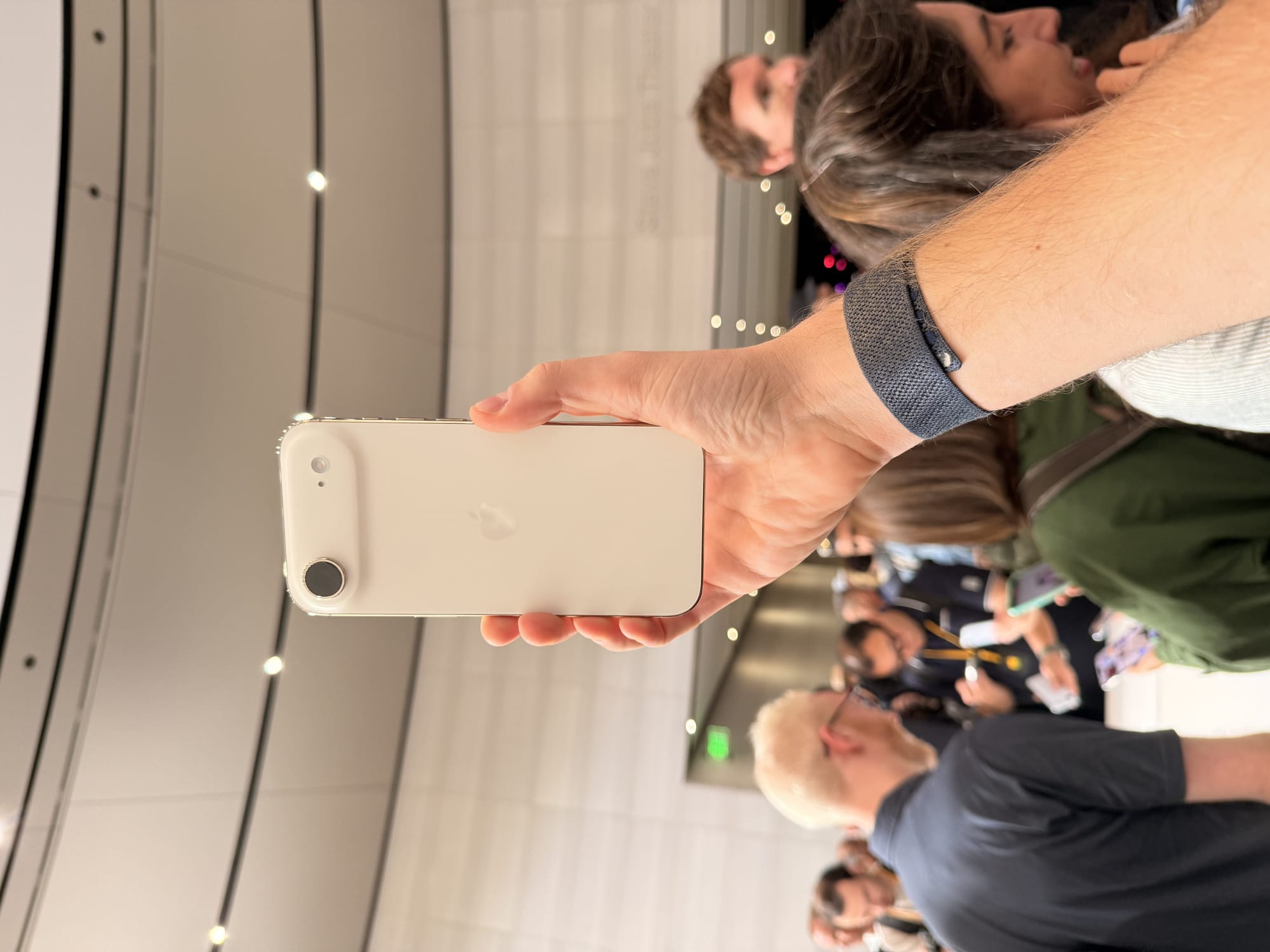
Will there be tradeoffs on battery and camera? Sure, but I’ll get into why that’s probably worth it and who it’s for later on.
The iPhone 17 Pro/Pro Max fixed one of my main complaints about the iPhone 16 Pro Max I’ve been using for the past year as well, the titanium body. It got so hot. I would be charging the phone while driving, and in a 15 minute drive with the AC on and windows down on a sunny day, the phone would be nearly too warm to touch and stopped charging from heat. Using the phone outside would be near impossible in sunlight, not because the display wasn’t bright but it would get so hot it would have to turn the display down!
The new aluminum body should help with this, alongside the vapor chamber and new A19 Pro chip. It has a larger L2 cache in each CPU core, which Apple says makes it the most efficient iPhone SoC yet. Mix a better display, better chip, better body, better cameras, and unique design into a single device and you have something that’s exciting and fresh. It’s nice!
---
One of the most noticeable changes to Apple’s lineup this year was the sort of restructuring of devices for prosumers. Generally, I consider this a demographic that wants the best products but doesn’t really need it. I include myself in this category, I will always get the top of the line, most powerful product. Best display, best camera, best processor. The reality is, I will never really push this to its limits nor will I ever use the cameras in a way that really requires me to have the Pro phone, like ProRes RAW. This is basically the majority of iPhone \_\_ Pro owners.
With iPhone Air, Apple gives them a better option: a device with the performance and display of a Pro iPhone, but with an incredibly unique design and in-hand feel. This simply comes at the cost of the number of cameras and battery. While a lot of people are flocking to Twitter, Instagram, and TikTok commenting on how bad the iPhone Air battery is, the reality is they have absolutely no clue if it is or isn’t. Apple is using the most efficient chip, most efficient modem (new C1x 5G modem), and new N1 wireless chip. With that being said, you can build an efficient phone but can’t get around physics. It definitely won’t match a device with a physically larger battery, but I really don’t think it will be as bad as many are assuming.
Now, this more premium middle-tier device allowed Apple to make the Pro iPhone even more Pro. This means aluminum body, focused on heat dissipation, a much larger and more performant camera, as well as a massive battery. This, more or less, cements the Pro iPhone as the most camera focused, professional iPhone there is.
The base iPhone still remains the best value for most people. While there was a bit of rambling here, this leads to the point I want to make: people wanted the Pro iPhone historically because they didn’t want to feel like they got a worse product, even if they didn’t need it. The iPhone Air allows for those prosumers who don’t need the Pro features to get a device that feels premium and unique to fill that gap. They will feel like they are getting the best, without actually needing to have features that are wasted on them.
This is how I think it breaks down now: iPhone 17 – for everyone. iPhone Air – for prosumer. iPhone 17 Pro/Pro Max – for professionals and creatives.
---
Quick level‑set: there’s been a lot of chatter from investor and tech circles about Apple, AI, and what didn’t show up on stage this year. Rather than piling on, it’s more useful to look at what Apple actually optimizes for and where AI realistically fits. Here’s how I see it.
Apple is, at its core, not an AI company. I say this because there is always some debate if they are a hardware first or software first company, and I believe the answer to that is more or less dependent on who you ask. Apple builds hardware to showcase their software, or builds software to power their hardware. Both are true, which way to look at it depends on you.
AI companies, on the other hand, are largely building around unknowns. Plenty believe AI requires purpose built hardware, others think it could be an app. Some think it requires large GPUs and NPUs and it will all run on the edge, others think it’ll be hybrid and mostly in the cloud. At the end of the day, nobody knows what consumers will want, what will stick, where it will run, or how it will work. Plenty of companies have made big claims and already had to walk back on those, as they realized their vision for AI was not happening. This will continue to happen, until we all figure out what consumers broadly resonate with.
For a moment though, let’s just talk about how Apple makes money since this is the important part at the end of the day. Apple has 2 sources of revenue, selling products (selling hardware) and selling services (subscriptions services + app store). Generally, those services are bought by customers who buy their products. This means fundamentally, for Apple to grow revenue, Apple must sell hardware, powered by their software, and make said hardware and software experience compelling. If this experience is compelling, then compelling first party experiences will follow, as well as an ecosystem of developers to build on top of it. After all, the iPhone is nothing without its apps and developers.
Consumers, they are buying a device because that device is good, and installing the app they want on it. Apple made devices this year that seem to have very positive consumer feedback, and introduced a compelling new form factor. It solves pain points for users while innovating in places that matter, like selfie cameras positioning and display brightness. Little things, but overall do help increase the positive experience.
Back to the AI point, phone users don’t want or care about AI today. The AI they do want and do care about right now exists in apps. Now, some will say there were no AI advancements and therefore they are behind. I can understand that, but frankly, it ignores the biggest advantage Apple has and what has made them so good for so long: Apple Silicon. The new GPU architecture in A19 includes new Neural Accelerators in each GPU core. These are designed for machine learning, accelerating matrix multiplication. It essentially allows Apple to use the GPU in tandem with the NPU (Apple Neural Engine) to accelerate local models. Whether this model is trained by Apple, licensed from \* *insert AI lab here\**, or an open-weight model, the devices have more than enough compute for the future.
The reality is, rushing AI for the sake of AI could be more harmful than waiting. Apple has the new Siri coming next year, and that delay soured the entire Apple Intelligence stack (which is FAR more than just Siri) but that didn’t seem to make much of a difference. Apple is currently trying to make a more helpful, more intelligent iPhone as we know it today. That’s infusing AI into it, but for some reason there are quite a few very loud personalities that think AI requires new form factors and this seems to be hitting classic consumer electronics brands hard. It really shouldn’t, at least not for the next few years, and by the time it matters I can near guarantee Apple will have a product or suite of products connecting their ecosystem with AI in a meaningful way, providing good user experiences.
### Slim, Smart, Integrated: The Real Story of Apple’s September Event
URL: https://creativestrategies.com/research/slim-smart-integrated-the-real-story-of-apples-september-event/
Last updated: 2025-09-10T13:37:04.000Z
Apple’s September event was, once again, a masterclass in storytelling, weaving together sleek design, life-saving Apple Watch narratives, and the deliberate invocation of Apple Intelligence. In the run-up, chatter circled around familiar themes: whether tariffs would nudge prices upward, what “Air” might signify in an iPhone context, and if a reimagined Siri might finally make its debut. And as is so often the case, even when the rumors get the broad strokes right, it’s the details on stage that reveal the products’ true purpose, and their place in Apple’s larger ecosystem.
For me, three threads defined the event: the iPhone Air’s redefinition of what “Air” means, the unmistakable display of vertical integration as Apple’s enduring competitive edge and Apple’s ongoing narrative around AI, from data computation to algorithms to models, now punctuated with intentional mentions of Apple Intelligence.
#### A New Meaning for “Air”
When Apple unveiled the iPhone Air, it did more than introduce another model to its portfolio. It redefined the Air brand. Traditionally, “Air” has meant lighter, thinner, and a bit less powerful. The MacBook Air was the ultraportable alternative to the MacBook Pro. The iPad Air offered a balance between the entry-level iPad and the Pro line. In both cases, Air was shorthand for compromise: elegant, but not all-out.
The iPhone Air flips that legacy. It is not a compromise, it is more like a distilled version of the Pro. Positioned neatly between the iPhone 17 and the iPhone Pro family, Apple talked about the Air like a Pro experience wrapped in slimmer hardware.
#### Slim Form, Pro Power
Rumors ahead of the event were partially right: yes, they nailed the name and some camera details. What they missed is how Apple chose to frame the iPhone Air. The iPhone Air delivers nearly everything the Pro does: the same performance, the same build quality, the same premium feel. Its only meaningful omission is the three cameras system of the Pro that now feels increasingly specialized for a creator audience rather than mainstream users.
In practice, this makes the Air lighter, thinner, and more approachable while still offering a Pro-level experience. It’s a phone that feels premium without excess, and for many users, it may be the sweet spot between utility and aspiration.
#### The Question of Choice
This positioning raises an important question: will more people choose Air over Pro? Over the years, Apple has experimented with the positioning of the Pro. At first, the Pro and Pro Max were separated by camera functionality, nudging even consumers who didn’t care for a larger screen toward the Pro Max for its superior photography. Eventually, Apple unified the camera systems across the Pro line, effectively making the entire Pro family a creator’s tool, ideal for high-end photography and cinematography, but arguably overkill for everyday users, even those who value great pictures.
That’s where the iPhone Air comes in. It could easily cannibalize some Pro sales while simultaneously offering an upsell from the base iPhone. The balance will hinge on one question most consumers will ask: is the battery life good enough?
Apple says the iPhone Air delivers up to 30 hours of video playback and 27 hours of streaming video, compared to the iPhone 17 Pro’s 39 hours of video playback. On paper, the gap is significant. Apple’s solution: the new battery pack, which pushes the Air into Pro territory. But this has sparked debate. When I shared a video of the battery pack on social media, the response was immediate, many argued that if you need to keep the pack attached, you may as well just buy the Pro.
That critique is not wrong, but it misses the nuance. For users who expect to always run with the pack attached, the iPhone Air’s appeal diminishes. But for those who see the battery pack as a “Linus blanket” it makes perfect sense. The flexibility is the point: slim and light most of the time, extra stamina when you need it.
Battery performance will be critical to the iPhone Air’s reputation, especially given how competitors like the Samsung Galaxy 25 Edge have struggled in this area. Apple has set the stage for the iPhone Air to prove itself not just as a sleeker Pro, but as a phone that balances power, portability, and endurance in a way no one else has quite managed.
#### And this is where vertical integration comes in
The iPhone Air is the perfect case study. Its success isn’t just about a new design or a missing camera lens. It’s about how hardware, silicon, modem, and software all come together to deliver performance that feels greater than the sum of its parts.
Apple controls the silicon, the operating system, the modem, and the design. That control lets it optimize at a level most competitors cannot match. And it shows: whether it’s extending battery life, delivering on-device intelligence, or slimming down Pro performance into an Air chassis, vertical integration is Apple’s true differentiator. It also explains why benchmarking individual components, like the modem, is a moot point. On paper, a single part might not lead the charts, but for consumers the overall experience is not compromised, because Apple can optimize performance across all the other levers it controls.
Somewhere else where vertical integration plays a role is costs and the impact on pricing.
Pre-event speculation bet on price increases; they did not land. Apple held steady, the same approach we have seen from Samsung and Google, which has two plausible explanations: Apple is either accepting lower margins to protect demand, or its vertical integration has delivered enough cost efficiency to keep prices flat despite more capability. And my read is that integration is doing the heavy lifting. From silicon to software to modem to thermal design to ML accelerators, Apple controls the variables that most competitors must negotiate.
#### The Power of Design
If there’s one thing that consistently drives upgrades, it’s design change. Apple knows this, and this year, the addition of the iPhone Air and the new vibrant colors of the Pro lineup and the redesigned camera plateau will fuel desire as much as performance specs do.
Historically, Apple has reserved its boldest colors for entry-level devices, keeping the Pro line more restrained, graphite, silver, muted blues. This year flips that playbook: the Pro models add a very vibrant orange.
It feels counterintuitive. But there’s logic here. Entry-level devices often have longer lifespans, and consumers might get tired of bold colors over time. Pro buyers, on the other hand, are often early adopters who upgrade sooner. For them, a burst of color is exciting, not fatiguing, they will move on to the next iPhone before they ever get bored of the shade.
I also wonder if, with the Pro line shifting from a traditional business-focused audience to a more creator-driven audience, there is a growing need for individualism and self-expression in the product design.
#### The Right Canvas
Of course, with everyone focused on AI, we can’t analyze this event without talking about Apple Intelligence. I didn’t expect a new, improved Siri to debut alongside the iPhones, and as I have said before, Apple still has time to deliver on that front. What they did emphasize instead was where Apple Intelligence is already creating value, such as the new live translation feature in AirPods Pro 3.
Even the consumers most eager for an “AI-first” experience, and there aren’t many yet, can feel confident that upgrading to the iPhone 17 family isn’t a gamble. Apple made it clear that Apple Intelligence will roll out to these devices without question, ensuring buyers are not left behind when the software arrives. And in doing so, Apple leaned once again on one of its strongest differentiators: a proven track record of extending new software features across existing hardware, giving customers confidence that their investment will last.
### Samsung’s AI Home Vision: Smart Living Without the Hype?
URL: https://creativestrategies.com/research/samsungs-ai-home-vision-smart-living-without-the-hype/
Last updated: 2025-09-07T19:42:32.000Z
IFA has always been the tech show that most reinvented itself following the hot trends in tech: from smartphones, to wearables, all the way to this year smart home, the show has seen AI infused everything and home robotics. Samsung leaned in harder than most with its unveiling of “AI Home: Future Living, Now.” The title itself seems to imply that the future of AI-powered living isn’t something to wait for but something already in our living rooms. And to Samsung’s credit, that claim is not entirely marketing spin.
But here’s the question worth asking: is Samsung’s AI Home a true shift in how we’ll live, or just another layer of polish on appliances we already own?
##### The End of “Smart” as a Gimmick
For years, the term smart home has been diluted to mean little more than “connected.” A fridge that pings your phone when the door is left open, a speaker that responds to “turn on the lights,” or a vacuum that clumsily bumps its way around your couch. Consumers have learned to temper expectations.
Samsung is betting that the era of clunky novelty is over. By weaving ambient AI into its ecosystem, AI that quietly senses, learns, and adapts, Samsung wants the home to work for us without needing our constant prodding. In other words, the company is trying to make “smart” stop feeling like a feature and instead feel like the baseline.
The Micro RGB TV embodies this shift. Yes, it delivers jaw-dropping visuals, but more importantly, it doubles as a central command hub. It doesn’t just stream Netflix; it syncs with the dishwasher, dims the lights, and tells you when your laundry cycle is done. It’s not entertainment, it’s orchestration.
##### Appliances That Actually Matter
What stood out most at IFA wasn’t the glitzy screen or the futuristic presentation, it was the ordinariness of the appliances. Refrigerators with AI Home displays suggesting recipes based on what’s inside, washing machines optimizing energy and water use, ovens that adapt to your cooking style. These are not futuristic toys. They’re recognizably domestic, and that’s the point.
By tailoring its Bespoke AI lineup for European households, Samsung is signaling that the battle for the smart home won’t be won in showrooms. It will be won in kitchens and laundry rooms, by solving problems so banal that consumers rarely think about them until they’re fixed.
Skeptics might roll their eyes at a fridge telling them what to cook. But consider the alternative: a fridge that just sits there, humming away, oblivious to the fact that the lettuce is going limp and the milk is running low. Which sounds more useful in a world where time is scarce, and food waste is growing?
##### The Robot With a Security Badge
Then there’s the Bespoke AI Jet Bot Steam Ultra, which deserves attention not because it cleans floors, plenty of robots do that, but because it embodies Samsung’s strategy of layering intelligence. This robot doesn’t just mop; it also monitors your home. Built with Knox security, it has earned the industry’s highest rating for device protection.
It’s an intriguing marriage of utility and reassurance. For years, robotic vacuums have been sold as labor-saving gadgets. Now they are entering into the territory of security cameras and alarm systems. Is it overkill? Maybe. But it also reflects a reality: consumers want fewer devices doing more, and Samsung is happy to oblige. This way, showing a higher return night also justifies a higher price tag.
The challenge, of course, is trust. A robot rolling around your home, armed with AI object recognition and connected to the cloud, is a privacy skeptic’s nightmare. Samsung counters with local AI processing and Knox Vault security. If the company can convince users their data is locked down, and given their business model, similar to Apple, is to sell you more devices do not monetize on your data, consumers might want to add more Samsung devices to their hone.
##### Privacy as the Dealbreaker
And that brings us to the elephant in the room: privacy.
The more Samsung pushes intelligence into its appliances, the more intimate data those appliances collect. What time you wake up, how often you cook, when you’re away from home, these aren’t trivial details. Samsung insists that much of this is handled locally, secured by Knox, and never exposed unnecessarily. That’s encouraging, but consumers have long memories, and tech companies have not always earned trust in this department.
If Samsung’s AI Home is going to succeed, it won’t be because its fridge screen looks slick. It will be because people believe it is working for them, not on them.
##### Why This Matters
The significance of Samsung’s IFA 2025 announcement is not just in what it unveiled but in what it represents. The smart-home market has been stuck in a cycle of incrementalism. a little more automation here, a prettier UI there. Samsung is offering a reset: a shift from reactive gadgets to proactive environments, hoping to finally be able to capitalize on their early bet on the SmartThings acquisition.
If I had to name the three brands with the greatest potential to dominate the smart home, Samsung would sit firmly at the top. Their strength lies in the unique trifecta of phones, TVs, and appliances, categories where they already dominates globally and where cross-integration feels both natural and inevitable. Apple would follow closely behind, once Apple Intelligence fully materializes, thanks to the deep trust consumers inherently place in the brand and its relentless focus on simplicity and ease of use. In third place, I would put Amazon, whose Alexa remains the most common home digital assistant in key markets and continues to anchor smart-home adoption, even if its reach is more uneven compared to Samsung or Apple.
##### A Future That’s Already Here
What struck me leaving Samsung’s IFA keynote wasn’t the futuristic sheen but the ordinariness of it all. A dishwasher that knows how dirty the dishes are. A hob that extracts fumes while adjusting power efficiency. A vacuum that doubles as a night guard. These are not wild predictions about 2035; they are products set to roll out in the next year or two. Delivering true value is what is going to win over customers.
That, ultimately, is the genius of Samsung’s message: the future is no longer distant. It is quietly embedding itself in the routines we have always had.
Of course, there is a risk here. If Samsung overpromises and underdelivers, if the fridge nags rather than helps, if the robot vacuum feels invasive rather than protective, the vision could collapse under its own weight. Consumers are tolerant of hype at trade shows, but their kitchens and living rooms are less forgiving. I would argue that consumers are least patient with the brands they invite into their homes. The home is meant to be a sanctuary, the one place where technology should fade into the background rather than create friction. On top of that, smart-home decisions rarely affect just one person. They ripple across an entire household, meaning that a single frustrating experience can undermine trust not just for one enthusiast, but for every family member who has to live with it.
##### Tech So Good You Will not See It
Samsung’s “AI Home: Future Living, Now” is less about dazzling demos and more about everyday relevance. That’s why it feels important. For the first time in years, a major tech company is making the smart home feel less like a gadget playground and more like an actual living environment.
But here’s where the op-ed line must be drawn: the success of this vision won’t be measured in product specs or press releases. It will be measured in whether people notice the AI at all. The smarter the home becomes, the less we should feel it.
If Samsung can deliver on that paradox, technology so present it disappears, then maybe, just maybe, the future of living really is now.
### Made by Google 2025: A Confident Showcase of Pixel, Gemini, and Google’s Broader Ambitions
URL: https://creativestrategies.com/research/made-by-google-2025-a-confident-showcase-of-pixel-gemini-and-googles-broader-ambitions/
Last updated: 2025-08-20T22:32:11.000Z
Today in Brooklyn, Google held its Made by Google 2025 event—an occasion that felt far less like a typical product keynote and much more like a primetime show. Hosted by Jimmy Fallon, complete with live audience participation, surprise guests, and a TV-studio vibe, it was clear from the start that Google wanted to make a statement: this wasn’t just about unveiling gadgets, it was about broadening its reach beyond tech enthusiasts to a mainstream audience.
##### A Stronger Pixel Portfolio
The hardware lineup—Pixel 10, Pixel 10 Pro, Pro XL, the new Pixel 10 Pro Fold, Pixel Watch 4, and updated Pixel Buds—built directly on last year’s widely praised portfolio. Google avoided risky reinventions, opting instead for refinement: better cameras, brighter screens, more repairability, and a slick new magnetic charging system. While some might call it iterative, I see this as a strength. Last year marked Google’s best product line to date, and this year cements that success with consistency and execution.
##### Gemini at the Center
The real star wasn’t the hardware but Gemini, Google’s AI, which is now woven throughout the ecosystem. From helping you compose the perfect shot step by step, to editing entire videos with a single request, to live translation in your own voice, Gemini showcased Google’s vision for AI as an intuitive, invisible assistant. Even fitness got the AI treatment, with the Pixel Watch doubling as a personalized coach.
This marks a shift: where Pixel once served as the best showcase of Google services, it’s now clearly the best showcase for Gemini. That pivot matters, both to justify the massive investment Google has made in AI and to position Pixel as the device that best embodies it.
##### A Broader Stage
The guest list told its own story. From the Jonas Brothers (music) to Stephen Curry (NBA), Lando Norris (F1), and Andre D. Wagner (photography), Google sought to resonate with the widest range of demographics—different ages, interests, and communities. They even reached into creator culture, with Alex Cooper of Call Her Daddy representing podcasting and the Subway Takes YouTuber bringing in the energy of digital-first storytelling.
Each demo was designed with that breadth in mind: whether you care about taking a flawless picture, making content creation seamless, or hitting your fitness goals, there was something for you.
This intentional diversity underscored Google’s ambition to move beyond its base of Pixel loyalists and tech insiders toward the cultural mainstream.
##### Confident Leadership
On stage, leaders like Rick Osterloh and Adrienne Lofton reflected a more confident, mature Google hardware team. Their digs at Apple—about broken AI promises and the closed ecosystem—were sharp but classy, reinforcing Google’s positioning of Pixel as the iPhone of Android. Even the call to end the tired “blue bubble vs. green bubble” debate showed a brand ready to lead rather than chase.
##### Betting Bigger on Pixel
With a high-production event, an expansion into Mexico as a new market, and clear investment in marketing and positioning, Google is no longer treating Pixel as a niche experiment. It feels like a brand ready to scale.
While the products may appear evolutionary rather than revolutionary, that’s exactly the point. Pixel has found its identity. It’s not only Google’s hardware showcase, but also its most effective stage for Gemini—the company’s true long-term bet.
### What’s up with ChatGPT & GPT-5?
URL: https://creativestrategies.com/research/whats-up-with-gpt-5/
Last updated: 2025-08-11T17:23:17.000Z
OpenAI finally released GPT-5 last week, and there has been quite a lot of discourse on the internet about its quality. Some users have a great impression, others not so much. Some are mourning the loss of a friend, others are just happy to have a more intelligent model with free access. There is a lot of confusion, a lot of questions, and a lot of varying opinions.
To be clear, there are a few models in the GPT-5 series. There’s GPT-5, GPT-5 Mini, GPT-5 Nano, and GPT-5 Chat. All of these are unified reasoning models, with 4 options for reasoning: minimal (effectively non-reasoning mode), low, medium, and high. GPT-5 and GPT-5 Chat are a similar size model, but the Chat option is a finetune of the model optimized for multi-turn conversational chat. GPT-5 Mini and GPT-5 Nano are smaller, optimized versions that don’t require as much intelligence. Simple things such as web search or summarizing an email are great with the Mini and Nano options, but agents and high value workloads are meant for GPT-5! There is also a difference between the API and ChatGPT platform, as well as others like Cursor/Codex/Perplexity/Copilot. Let’s try to explain!
When you use ChatGPT, you are chatting with “ChatGPT 5” (from now on, when I refer to a model as ChatGPT 5 or ChatGPT 5 Thinking, this means it was accessed from the ChatGPT app) which is a unified router, meaning depending on the prompt, it could be forwarded to one of the above models with Thinking enabled or disabled. Paid users can force Thinking for 3,000 queries per month in the Plus tier or unlimited for the Pro tier. The Pro tier is given access to GPT-5 Pro as well, which is a more advanced version of GPT-5 Thinking that far outperforms any other model, but for the sake of this report, I’m not going to be mentioning it because it makes an already confusing setup more confusing.
---
The reason I mention all of this is because depending on how you use GPT-5, where you use it, and what you use it for, your experience will be different. In the ChatGPT app, it’s unlikely to change much.
The ChatGPT 5 Thinking model is roughly equally as capable as the previous o3 model, ChatGPT 5 is roughly as capable as GPT-4o/GPT-4.1\. For search, basic conversation, or image gen it’s unlikely you will notice a meaningful difference outside of its personality. Will ChatGPT 5 hallucinate still when not given external context? Yes. Will it sometimes be wrong? Yes. If it doesn’t search, if it doesn’t have external context, it will still have classic problems. It makes up URLs, it does the classic AI things. You will likely think GPT-5 is worse if this is how you use ChatGPT, and frankly it probably is in some of these cases.
On the other hand for more sensitive workloads, such as data analytics, business processing, health queries, coding, and others along those lines it’s a significant upgrade. The workloads where you give it information or data, and ask it to work with that. One of the major improvements was a reduction in hallucinations, and this is where it comes into play. One of the previous problems with ChatGPT was hallucination in the chain of thought when uploading data leading to bad data processing.
One of the examples we use internally to evaluate models is uploading raw Qualtrics data of a study we ran, and seeing if the model could accurately answer questions from it. Now, this is not testing raw model performance but rather platforms powered by models. For example, when you give ChatGPT the data in a csv format, it writes python code to look at and understand the data. Not every platform or model does this well or consistently, so the environment where you run the model matters just as much as the model itself. Letting an agent run without giving said agent access to a proper environment or harnesses for it will result in it being unable to complete its task!
The first model to successfully understand the data was the OpenAI o3 model in ChatGPT, but only when given specific information and hand-holding to understand how it was formatted. The second model to successfully understand the data was the ChatGPT agent, it did not require hand holding, but did hallucinate information. ChatGPT 5 Thinking, on the other hand, was able to look at the data, process it, and provide accurate information without detailed prompting about data formatting.
This is a common trend I’ve noticed in testing of ChatGPT 5 Thinking, it’s able to extract information better, understand that information, and use it in a more effective way. When I upload equity research notes, workshop a financial model, or ask it to create an interactive dashboard in a Canvas, ChatGPT 5 Thinking handles it far better than most other models, similar to the performance of something like Claude 4.1 Opus but usually better. My opinion is ChatGPT 5 Thinking is the best model to use for information that requires precision when given context.
---
The other side of things is GPT-5 in the OpenAI API. Essentially, if you are anyone but OpenAI, this is what you will be using to integrate GPT-5 into your application. It is, bar none, of the best models on the market for this use. Note I’m not talking about ChatGPT or the value prop of a ChatGPT Plus subscription vs Gemini vs Grok vs Claude. There are a few reasons for this, but let’s start with the most important one: it’s natively agentic with proper understanding of tool calls and how to interact in its environment.
One of my favorite examples is Cursor, the absolutely massive coding tool. The Cursor Agent went from making roughly 15-25 tool calls with a model like Claude 4 Sonnet, trying to understand context, and roughly doing what you asked, but taking some liberties to go above and beyond. When it comes to a model helping assist in programming, this is not good. You would ask for help with one thing, and it would refactor half of a codebase adding unnecessary complexity. It was really good, but too much. GPT-5 on the other hand does not do this. It does exactly what you ask, bringing in the right information, working to make sure it does what you asked and doing it properly. It’s far better, and does not go out of its way to add complexity.
This sort of capability jump is important, because it also leads to other platforms like Hebbia, which is an AI finance platform. They noted that by simply swapping their model to GPT-5, their workflows went from 40-50% completed by the agent to 90% completed by the agent.
> 3/ Every existing workflow is now 50-60% automated.
>
> With GPT-5 and Hebbia– excel outputs are now 90% completed for you.
>
> The output isn’t just text, it’s an Excel model built from scratch. [pic.twitter.com/nBQBdKqiyL](https://t.co/nBQBdKqiyL?ref=creativestrategies.com)
>
> — Hebbia (@HebbiaAI) [August 7, 2025](https://twitter.com/HebbiaAI/status/1953501583150383246?ref%5Fsrc=twsrc%5Etfw&ref=creativestrategies.com)
METR is a benchmark for models that tests how long a model can work autonomously to complete a task. The longer it can work autonomously, testing and confirming its own work, to complete a goal is one of the major tests of an agentic model. Right now, GPT-5 leads all models. It’s able to work for roughly 2 hours and 15 minutes autonomously. This is ahead of all other models, including Grok 4 and OpenAI’s own o3.
This is, quite frankly, the best and only model that could power a reliable agent at scale without the need for extreme scaffolding to make it work.
From developers making agents, developing for enterprise, and trying to use the API to create high quality AI applications, GPT-5 has had outstanding feedback. Platforms like Rork, which lets you vibe-code mobile apps, saw an 190% improvement in error rates with the model. Cursor set GPT-5 as the default. Hebbia found it nearly completing full workflows. When this model powers an agent in a proper environment, it is incredibly powerful. Chatbots are only part of what AI can do, and are not the best example of a models “intelligence” but rather how long it can work, like the aforementioned METR benchmark.
Depending on who you ask about the GPT-5 models, you’ll get a different answer on if it’s a good or bad model, and that’s honestly all from OpenAI’s not amazing naming/handling of the UX around the new ChatGPT 5 router. If we look at the pure model, its capabilities, its value, and how it functions in actual workloads, it is objectively a great model. The best at the price it’s offered at, and most capable today. This isn’t to say this will last forever, it’s likely Google has Gemini 3 coming soon which is likely to beat GPT-5 in intelligence and value, Anthropic has more model updates coming to Claude 4 series which is likely to match GPT-5\. The space is heating up, and things aren’t slowing down.
The reality is, even if we have the most intelligent model in the world, it’s unlikely you or I could ask it a question that could elicit a response that really shows that. We can always find the place it won’t be better us, we can always find the limits, but if the limits are it messing up questions like “how many Rs in strawberry” but being able to look through thousands of results from a raw data of a study and perform an accurate statistical analysis, do the dumb questions really matter? Probably, but we can be willing to ignore those for now for the value we are otherwise getting.
### Apple Q3 2025: Outperforming in a Challenging Environment
URL: https://creativestrategies.com/research/apple-q3-2025-outperforming-in-a-challenging-environment/
Last updated: 2025-08-01T14:46:16.000Z
Apple’s fiscal Q3 2025 showcased a strong performance, setting a June quarter record for revenue at $94 billion—up 10% from last year and ahead of management’s own expectations. Growth was broad-based, with significant contributions across iPhone, Mac, and Services segments. The company also established new June records for EPS and reported acceleration in nearly every geographic market, notably in Greater China and emerging regions. Additionally, Apple highlighted updates to its AI strategy and its expanding portfolio of software innovations.
---
**Key Takeaways**
**Record Revenue:** Q3 revenue reached $94.04 billion, a 10% year-over-year increase, beating analyst estimates.
**Global Momentum:** Achieved revenue records in more than two dozen regions, with strong double-digit growth in emerging markets such as India, the Middle East, South Asia, and Brazil.
**All-Time High Services Revenue:** Services generated $27.4 billion, up 13% year-over-year.
**iPhone Growth:** iPhone revenue grew 13% YoY, driven by widespread adoption of the iPhone 16 family.
**Mac Strength:** Mac revenue climbed 15% YoY, setting a June record for upgraders.
**Installed Base:** Reached all-time highs for active devices in every major category.
**What’s Significant**
**Product Milestones:** Apple’s shipment of its three billionth iPhone, the celebration of 10 years of Apple Music, and a new record in Apple TV+ engagement and Emmy nominations vividly illustrate how the company has transformed its global consumer reach into a powerful, deeply integrated ecosystem. What began as an unprecedented expansion in mobile hardware has evolved into an interconnected suite of services, content, and apps that touch users’ lives repeatedly throughout the day—across both personal and professional contexts. This ecosystem engagement is at the heart of Apple’s competitive advantage: it’s not just the sheer size of the installed base that sets Apple apart, but the frequency and depth of daily interactions with that base.
Crucially, these dynamics position Apple Intelligence to be far more than just another AI feature set. The true differentiator is Apple’s ability to leverage a broad, highly engaged global audience. At the same time, this presents a significant challenge: Apple’s user base is vast and highly diverse. Delivering on the promise of personalized and private AI will require Apple to be exceptionally thoughtful and nuanced in its approach, ensuring that Apple Intelligence adapts to varied user needs and respects individual expectations around privacy and experience. This careful balance will be essential for both adoption and trust as Apple ushers in its next era of innovation.
**Service Ecosystem Resilience:** Services growth has long been a source of investor optimism for Apple, but this quarter more than ever, its significance is coming into sharper focus. As tariffs and ongoing trade tensions raise persistent questions about the trajectory of hardware sales and squeeze the company’s overall margin opportunity, the robust expansion of Apple’s Services segment is now viewed as even more critical to the company’s future. With Services reaching a record $27.4 billion in revenue this quarter, up 13% year-over-year and now making up nearly 30% of overall company revenue, investors increasingly see this recurring, high-margin business as a critical engine for growth and resilience. In an environment where hardware faces cyclical and geopolitical headwinds, Services are providing vital stability, supporting margins, and reinforcing the strength of Apple’s ecosystem
- **Tariffs:** Management reported a “$900 million tariff headwind” affecting results this quarter, reflecting increased costs associated with ongoing tariffs on imported components and Apple products. Most of this impact, however, generated in the tariffs on China that hit earlier in the year. Cook reiterated that Apple is actively “accelerating production in the US and India to help offset the effects of existing and potential new tariffs.” This geographic diversification is designed to reduce reliance on China, where most iPhones destined to international markets generate from, and exposure to future tariff increases or regulatory changes. As mentioned last quarter, the majority of the iPhones sold in the quarter came from India while Mac, iPad and the Apple Watch products originated in Vietnam.
- **US Investment:** Just as countries are engaging with the U.S. administration on tariffs by making investment commitments, leading technology companies are taking a similar approach to demonstrate their value and strengthen domestic partnerships. In this June quarter, Apple reinforced its role as a strategic American investor by announcing a $500 million partnership with MP Materials to secure a domestic supply of rare earth materials for magnets, critical components in many Apple products. Additionally, Apple unveiled the launch of the Apple Manufacturing Academy in Detroit, an initiative designed to develop advanced manufacturing talent and capabilities on U.S. soil. These announcements align with Apple’s pledge to invest more than $500 billion in the United States over the next four years, underscoring the company’s proactive efforts to deepen its economic footprint and support U.S. industry at a time of heightened trade negotiations and regulatory scrutiny.
**Key Numbers**
**Financial Performance:**
**Total Revenue:** $94.04 billion—driven by strong double-digit gains in iPhone, Mac, and Services.
**Net income** reached $23.43 billion, up 9% from $21.4 billion last year.
**Diluted EPS** was $1.57, a 12% increase and a new June record.
**Business Highlights:**
- **iPhone:**
- Revenue was $44.58 billion, up 13% year-over-year—a record June quarter.
- Strength across all geographies and standout double-digit growth in emerging markets.
- The iPhone 16 lineup drove both unit growth and high upgraders, and the company shipped its three-billionth iPhone this quarter.
- Customer satisfaction remains extremely high (98% in the US).
- **Mac:**
- Revenue reached $8.05 billion, up 15% year-over-year.
- Growth driven by strong demand for M4 MacBook Air, with a June record for Mac upgraders and gains in every global segment.
- Mac installed base set a new all-time high, and US customer satisfaction is at 97%.
- **iPad:**
- Revenue was $6.58 billion, down about 7–8% year-over-year as expected, due to tough comparisons with last year’s iPad launches.
- The iPad installed base still hit an all-time high, with more than half of buyers new to the product.
- US customer satisfaction reached 98%
- **Wearables, Home & Accessories:**
- Revenue totaled $7.4 billion (–8.6% YoY, not –5%), marking the only major segment with a decline.
- Apple Watch and AirPods growth slowed after last year’s initial Watch 10 demand; no major new wearable released this quarter.
- Watch install base achieved a new all-time high with a quarterly record for upgraders, and US Watch satisfaction was 97%.
- **Services:**
- Revenue hit a Q3 record of $27.42 billion, up 13% year-over-year.
- Growth was double-digit in all categories and most markets, driven by strength in App Store, iCloud, Apple TV+, and Apple Music.
- Apple TV+ viewership rose sharply, celebrating 81 Emmy nominations and the success of the “F1” movie. Apple Music marked its 10th anniversary with a new LA studio for artists.
- Services now comprise nearly 30% of total company revenue, providing stability against hardware cycles.
- **Apple Intelligence:**
- Apple launched over 20 Apple Intelligence features across its platforms this year, including on-device AI for privacy, plus visual intelligence, cleanup tools, and generative writing.
- Investments in AI sharply increased, comprising much of the $9.5 billion in CapEx this year. Seven AI company acquisitions were made to accelerate the roadmap.
- Cook described Apple Intelligence as “integrating AI features across our platforms in a way that is deeply personal, private, and seamless, right where users need them.” He also added “We believe our platforms offer the best way for users to experience the full potential of generative AI, thanks to the exceptional performance of our systems.” These statements double down on what we heard at WWDC in June, when Apple clearly talked about AI as an enabler at a platform level driving a deeper return to users which of course results in stronger tie to Apple’s hardware.
- The $9.5 billion CapEx commitment this year largely boosts AI infrastructure, including server buildout for generative models on-device and in the cloud.
**Outlook:**
Apple does not issue formal forward guidance, and management was clear that this quarter’s $900 million tariff-related cost impact should not be treated as a template for future periods. As CEO Tim Cook and CFO Kevin Parekh explained, “There are many factors that could change including tariff rates,” highlighting the highly fluid nature of the global geopolitical and regulatory environment. This transparency shows Apple’s awareness that shifting trade policy and ongoing global uncertainty could meaningfully change its cost structure in coming quarters.
Turning to artificial intelligence, which remains at the center of both investor scrutiny and Apple’s own strategic priorities, the company reinforced its commitment to accelerated AI development. Notably, the reported delay in launching a more personal Siri has not held back sales momentum, evident from record iPhone results this quarter, yet market commentators and analysts are pushing for faster progress.
In response, Apple is taking proactive steps: “We’re not stuck on a certain size company,” said Tim Cook, confirming that Apple is “open to M&A that accelerates our roadmap.” This openness includes the possibility of larger-scale acquisitions if they deliver critical technologies or talent, especially in advanced generative AI. So far in 2025, Apple has purchased seven companies focused on AI capabilities, innovation, and expertise. While these deals have been relatively modest in size, consistent with Apple’s tradition of buying focused, specialized firms, Cook and his leadership team made it clear that larger acquisitions remain in scope when strategically justified.
### Microsoft FY25 Q4: Capping a Transformative Year of Double-Digit Growth with AI and Cloud at the Core
URL: https://creativestrategies.com/research/microsoft-fy25-q4-capping-a-transformative-year-of-double-digit-growth-with-ai-and-cloud-at-the-core/
Last updated: 2025-07-31T14:45:14.000Z
Microsoft concluded its fiscal year with a robust Q4, outpacing both its guidance and Wall Street’s expectations. Sustained double-digit growth in revenue and operating income was powered by surging demand for AI and cloud solutions, and transformational momentum across all business segments. Significant progress in cloud capacity, platform efficiency, and commercial customer commitment leaves Microsoft well-positioned for continued innovation and growth into FY26.
---
**Key Takeaways**
**Q4 Revenue reached $76.4B** (+18% YoY), and **operating income hit $34.3B** (+23%), both exceeding guidance.
**Full-year revenue rose 15%** to $281.7B, and **operating income climbed 17%**, reflecting consistent high-quality growth.
**Microsoft Cloud Quarterly Revenue soared to $46.7B** (+27% YoY), while **full-year Microsoft Cloud revenue neared $169B** (+23%). Gross margin percentage for the cloud business was 68%, slightly better than expected, despite ongoing AI infrastructure scaling costs.
**Azure & other cloud services revenue grew a stunning 39% in Q4** (constant currency), with new AI workloads driving accelerated adoption and demand outpacing supply.
**Commercial bookings exceeded $100B for the first time in a quarter**—a 37% YoY jump, indicating rising long-term confidence and customer commitment. Remaining performance obligation reached $368B (+37%), with strong multi-year contract visibility.
**Capital Expenditures in Q4 reached $24B** ($88B for FY25), funding massive datacenter expansion and next-generation AI infrastructure. Microsoft now operates over 400 datacenters in 70 regions—the largest footprint in the commercial cloud industry
---
**What’s Significant**
**Massive and Efficient Capacity Expansion:** Accelerated investments in datacenters, GPUs, and networking have enabled Microsoft to rapidly scale AI infrastructure, yet demand for cloud and AI continues to outpace capacity, especially for the most advanced workloads. The company’s ability to improve datacenter and platform efficiency (e.g., Azure AI, Microsoft 365) is offsetting some of the incremental costs, helping preserve profit margins.
**Revenue Visibility at Historic Levels:** The surge in commercial bookings (over $100B) and a 98% annuity mix in contract structure drive record-high remaining performance obligation ($368B), de-risking future revenues and highlighting stickier, long-term customer relationships. This is the second consecutive quarter that Microsoft has highlighted bookings, recognizing that investors remain consistently focused on the sustainability of its growth.
**AI and Cloud Synergy Propelling All Businesses:** The remarkable 39% growth in Azure is being fueled not just by more cloud migration, but by customers fundamentally reinventing operations with generative AI. Paid Microsoft 365 Copilot adoption, Dynamics 365 cross-workload growth, and strong Azure AI demand signal the beginnings of large-scale AI transformation in industries worldwide.
**Efficiency and Profitability Despite Heavy Investment:** The company managed to expand operating margins and grow operating income (23% Q4, 17% full year), even while absorbing an unprecedented wave of capital spending. This highlights Microsoft’s operational excellence and ability to turn scale into profit.
**Gaming Emerges as a Core Growth Engine:** Gaming revenue was up 10% in Q4, driven by a 13% rise in Xbox content and services as well as new records for Xbox Game Pass (nearly $5B annual revenue). Expanded first-party content, strong engagement, and successful integration of Activision Blizzard are further strengthening Microsoft’s share and monetization in the gaming ecosystem. Microsoft’s strategic pivot away from a hardware-centric model toward a multiplatform and subscription-driven ecosystem is clearly bearing fruit. Hardware revenue, meanwhile, declined by 22%, underscoring the diminishing importance of console sales in favor of digital content, services, and cross-platform play. The successful integration of Activision Blizzard franchises into Microsoft’s portfolio further strengthens its share and monetization opportunities within the gaming landscape.
**Search and Advertising Sustain Momentum:** Search and news advertising (ex-TAC) revenue climbed 21% in Q4, with Bing and Edge gaining market share for a fourth consecutive year, driven by both user volume and improved monetization rates.
**Global Platform Scale Now a Moat:** With over 400 datacenters and infrastructure spanning 70 regions, Microsoft’s scale has become a strategic advantage—supporting both AI training and inference at levels few competitors can match, and opening new growth avenues in global markets. It was interesting, though not unexpected given the current political climate, that efficiency wasn’t highlighted as a positive factor for sustainability. Additionally, the infrastructure investment discussion notably lacked references to alternative energy sources. Including perspectives on both energy efficiency and renewables could have offered a more comprehensive approach to sustainable development.
**Key Numbers**
**Financial Performance:**
**Q4 Revenue:** $76.4 billion, representing 18% year-over-year growth—exceeding both company guidance and Wall Street expectations.
**Q4 Operating Income:** $34.3 billion, up 23% from the prior year, demonstrating strong operational leverage and expense management. **Q4 Net Income:** $27.2 billion for the quarter, reflecting a 24% increase from last year.
**Q4 Diluted EPS:** $3.65, also up 24% year over year—indicating solid earnings growth on a per-share basis.
**Q4 Microsoft Cloud Revenue:** $46.7 billion, up 27% as customers accelerate cloud and AI adoption.
**Q4 Commercial Bookings:** Surpassed $100 billion (an all-time quarterly high), up 37% year over year—highlighting strong demand and future revenue visibility.
**Q4 Capital Expenditures:** $24 billion, reflecting aggressive investments in new datacenters, AI infrastructure, and capacity expansion.
**Full-Year Revenue:** $281.7 billion, an increase of 15% versus the previous year—showcasing strong and consistent top-line growth.
**Full-Year Operating Income:** (Exact figure not stated, but up 17% year over year), underscoring Microsoft’s ability to drive margin expansion alongside growth. **Full-Year Net Income:** $101.8 billion, up 16% from FY24.
**Full-Year Diluted EPS:** $13.64, a 16% increase year over year.
**Full-Year Microsoft Cloud Revenue:** Nearly $169 billion, growing 23% compared to last year, reinforcing Microsoft’s position as the industry’s largest commercial cloud.
**Full-Year Capital Expenditures:** $88 billion, an all-time high that positions Microsoft for future AI/cloud demand at global scale.
**Business Highlights:**
- **Productivity and Business Processes:**
- **Microsoft 365 Commercial Cloud:** Q4 revenue up 18%; seat growth of 6%; driven by Copilot adoption, E5 upgrades, and ongoing ARPU gains. Paid M365 seats expanded most rapidly in SMB and frontline segments.
- **Dynamics 365:** Q4 revenue up 23%, reflecting broad-based workload adoption and successful annuity sales.
- **LinkedIn:** Revenue up 9%; total membership hit 1.2 billion, with steady growth in engagement despite softness in talent markets.
- **Intelligent Cloud:**
- **Azure & Other Cloud Services:** Q4 grew 39%, with strong demand for infrastructure, platform, and Azure AI services. Even after large new datacenters came online, supply remained below market demand, especially for AI infrastructure.
- **On-premises server revenue fell modestly** (–2%), as customers continue shifting workloads to the cloud.
- **Enterprise services revenue rose 7%,** buttressed by expansion in enterprise support.
- **More Personal Computing:**
- **Windows OEM/Devices:** Q4 revenue increased 3%, as elevated inventory levels normalized. It was striking how little attention was devoted to Windows and Teams during the earnings call, once major pillars closely linked to the Copilot opportunity. Their diminished focus underscores a significant shift: AI and agent technologies are now increasingly embedded in the core operational fabric of businesses, rather than being tethered to specific productivity applications. While Copilot in Microsoft 365, including Teams, will undoubtedly deliver substantial value for organizations deeply invested in Microsoft’s ecosystem, its impact will be more limited—and competition more intense, in environments where Microsoft doesn’t control the entire workflow. This highlights how the landscape for AI-driven productivity solutions is rapidly evolving, with future growth hinging on deeper, workflow-level integration rather than legacy platform dominance.
- **Search & News Advertising:** Q4 up 21%, powered by Bing and Edge user/market share and improved monetization..
**Outlook:**
- **Demand Remains Strong:** With commercial bookings and backlog at historic highs and cloud/AI capacity still tightening, Microsoft expects to deliver another year of double-digit revenue and operating income growth in FY26.
- **Capacity Investments to Moderate:** FY26 will see continued but more normalized CapEx growth, reflecting timing of major datacenter leases and hardware deliveries expected earlier in the year.
- **Operating Margins Stable:** Despite high ongoing investment in capacity and R&D, Microsoft expects FY26 operating margins to remain relatively unchanged, underpinned by growth in high-margin cloud/software franchises and continuous operational improvements.
- **Segment Trends:**
- **Intelligent Cloud:** Growth to remain robust; Azure’s momentum expected to moderate slightly as capacity delivery normalizes, but annual growth in the high 30% range persists.
- **Personal Computing:** Some normalization in advertising growth and hardware sales anticipated, but gaming and search expected to remain strong contributors.
- **Gaming:** Momentum in Xbox content/services and the integration of Activision Blizzard are expected to sustain engagement and monetization.
My primary concern about Microsoft’s AI expansion centers on the consumer segment. As Judson Althoff, Microsoft’s EVP and Chief Commercial Officer, recently noted, “AI is blurring the lines between personal and organizational productivity, and we are helping our customers leverage Copilots and agents, combined with human ambition, to create differentiation.” I could not agree more, but this also means that for Microsoft to be the leader in AI, it must also establish itself as the top choice for consumers.
Historically, it’s proven far easier for software to transition from consumer success to enterprise adoption than the reverse. As AI becomes embedded in more aspects of daily life, people will demand greater control over their technology choices. I worry that Microsoft’s substantial enterprise opportunities could divert attention and investment away from the consumer space, putting it at a disadvantage.
For consumers, brand loyalty isn’t absolute, even Apple can’t rely solely on users staying within Apple Intelligence. The real value for users must come from seamless, wherever-I-work integration—whether through PC, Edge, or other platforms, not from aggregating every touchpoint with Copilot. Microsoft’s success in AI will hinge on prioritizing consumer experience from the outset, ensuring users feel empowered no matter where or how they interact with Copilot.
It’s also clear that, for now, ChatGPT is winning with consumers. This dynamic presents a potential opportunity for Microsoft: rather than investing heavily to build its own consumer AI brand from scratch, Microsoft could leverage the popularity of ChatGPT. By ensuring deep, integration between personal ChatGPT experiences and Copilot for enterprise, Microsoft could deliver the value it seeks while minimizing costly consumer-focused brand-building. Such a strategy would allow Microsoft to ride the momentum of ChatGPT’s consumer appeal and strengthen its position across both consumer and enterprise domains, provided the integration genuinely enhances the user experience for both audiences.
### Intel Q2 CY 2025 Earnings Call – Execution Risk, Capital Discipline, and Roadmap Credibility
URL: https://creativestrategies.com/research/intel-q2-cy-2025-earnings-call-execution-risk-capital-discipline-and-roadmap-credibility/
Last updated: 2025-07-25T14:15:32.000Z
Intel’s latest earnings call underscored a tension familiar to anyone tracking the company over the last three years: the finance team is now supplying clear, disciplined guardrails, while the technical roadmap remains long on vision and short on date‑certain milestones. CFO David Zinsner gave investors concrete figures on capital spending, operating‑expense targets, and gross‑margin flow‑through, which largely resolves near‑term modeling uncertainty. By contrast, new CEO Lip Bu Tan outlined an orderly set of priorities—organizational streamlining, a “trust‑first” foundry pivot, reinvigorating the x86 franchise, and crafting an end‑to‑end AI stack—but kept launch windows broad, conditioned new fab outlays on external volume commitments and openly acknowledged that “turning the company around will take time.”
**Foundry Strategy and 14A Viability.** The biggest single concern from analysts was whether Intel’s IDM 2.0 ambitions have truly reset after years of overbuilding. Tan insisted that Intel 14A (the company’s first true 2‑nm‑class node) is still penciled in for 2028–29, matching industry timing, but he framed every forward step as contingent on meeting explicit yield gates and securing both internal and external wafer volume. It is a welcome change from the previous “build it and they will come” approach (a strategy easily used by TSMC but not one Intel has the luxury of at the moment), yet the conditional language will very likely leave potential foundry customers hesitant. The key objective now is for the company to acquire at least one non‑captive 14A wafer contract before it green‑lights the node. There may be more scenarios at play here that lead to 14A going forward, even without a large-scale customer, but the lack of commitment at this point will remain a talking point and a focus of much analysis.
**Server‑CPU Share and Diamond Rapids Timing.** With x86 server share down to roughly 55 percent, the Street pressed for detail on Diamond Rapids, the high‑core 18A Xeon on which any meaningful market‑share claw‑back depends. Tan narrowed the launch window to “plus or minus six months around the second half of 2026,” flagged Clearwater Forest as a lower‑core transition part, and floated Coral Rapids for 2028‑29\. While any narrowing of dates is progress, a half‑year swing is material in hyperscale planning cycles; Intel will have to show Granite Rapids benchmarks against AMD Turin and Arm‑based alternatives this year and deliver Diamond Rapids silicon to customer labs by mid‑2026 to avoid further erosion.
**Gross‑Margin Trajectory.** Investors also wanted a clearer view of the path back to 40 percent‑plus gross margins after multiple quarters in the mid‑30s. Zinsner’s comments help: near‑term margin pressure is chiefly Lunar Lake’s memory‑in‑package accounting drag and early‑yield costs for Panther Lake, while the tailwinds come from insourcing Panther Lake wafers and improving foundry‑margin mix as leading‑edge nodes mature. The CFO offered a rule of thumb—40‑to‑60 percent incremental flow‑through on next year’s revenue, which gives analysts a workable framework. Ultimately, margins will hinge on how rapidly Panther Lake yields move into the high‑60s and how quickly Lunar Lake’s share of client mix falls below one‑fifth.
**Capital‑Expenditure Discipline.** Intel’s balance‑sheet concerns revolve around whether the company can decelerate CapEx without jeopardizing roadmap fidelity. Zinsner reiterated 2025 gross CapEx at roughly $18 billion and promised a “meaningfully lower” figure—though above $9 billion—in 2026, citing the drawdown of construction‑in‑progress (already down from above $50 billion to the high‑$30s) as evidence of spending restraint. Critical here is the plan to slow, but not halt, Ohio’s greenfield build while cancelling Germany and Poland fabs outright. The Street will look for a hard ceiling on 2026 CapEx in the Q4 call to cement credibility.
**AI Roadmap Credibility.** Tan’s articulation of an AI strategy—aimed at inference and “agentic” workloads, built around x86 host CPUs, Xe GPUs, and potentially bespoke ASIC engagements—signals that Intel intends to compete higher in the stack. The company is hiring software talent and promises more details “in the coming months.” For now, however, industry partners remain skeptical until they see a working software tool chain, a public demo, and at least one product detail.
**One‑Time Tool Impairments.** The $800‑million tool write‑down and $200‑million period‑cost adjustment raised fears of more hidden charges. Management framed the lumpy charge as opportunistic—the company swapped newer tools into production lines, wrote older high‑book‑value assets down to a “held for sale” level, and does not anticipate additional surprises. Provided the charges do not recur next quarter, this is unlikely to be a thesis‑level risk.
**Where the Debate Stands.** Bulls can finally point to real capital hygiene—greenfield cancelations, CapEx gating, and clear OpEx targets—plus a margin model that plausibly returns to the low‑40 percent range by 2027\. Bears counter that every strategic pillar still hinges on flawless execution: 18A must reach high‑volume yields, Diamond Rapids must sample on time, and at least one external foundry customer must materialize. Until those proof points arrive, most investors will keep Intel on a “show‑me” footing, capping the company’s valuation multiple despite early signs of discipline.
**Key Near‑Term Catalysts.** Over the next two quarters the Street will watch five things: (1) disclosure that Panther Lake yields have cleared the mid‑60‑percent mark; (2) any external 18A tape‑out announcement; (3) appointment of a high‑credibility head for the datacenter division; (4) a firm FY‑2026 CapEx ceiling below $14 billion; and (5) a public demonstration of Intel’s AI software stack or an enterprise design win. Meeting even two or three of these milestones would go a long way toward turning cautious skeptics into constructive holders.
### Alphabet Q2 Analysis: Cloud Acceleration and AI Monetization Validate Aggressive CapEx Strategy
URL: https://creativestrategies.com/research/alphabet-q2-analysis-cloud-acceleration-and-ai-monetization-validate-aggressive-capex-strategy/
Last updated: 2025-07-24T17:02:47.000Z
Alphabet’s June-quarter results delivered a validation of its capital-intensive, vertically integrated AI strategy. The company posted strong top and bottom-line growth while demonstrating significant operating leverage, even while absorbing substantial costs related to its AI infrastructure build-out. It is evident that the synergistic relationship between Google Cloud’s accelerating growth, which de-risks the elevated capital expenditure, and the successful early monetization of AI features within Search will help in alleviating concerns about cannibalization of the core advertising business.
**Financial Highlights & Operational Discipline**
Alphabet reported impressive financial strength, with consolidated revenue rising 14% year-over-year to $96.4 billion and operating income growing in tandem to $31.3 billion. A critical takeaway is the stability of the GAAP operating margin, which held firm at 32%. This margin resilience is particularly noteworthy as it was achieved despite absorbing a $1.4 billion legal charge and a 35% increase in depreciation, a direct consequence of ongoing AI hardware investments. This signals strong cost control and operational efficiency across the enterprise, providing a stable foundation for its aggressive growth initiatives. Trailing twelve-month free cash flow remains exceptionally strong at over $66 billion.
**Google Cloud: The Primary Growth Catalyst and CapEx Justification**
Google Cloud has emerged as the central driver of Alphabet’s growth narrative and the key swing factor in its valuation.
- **Accelerating Scale:** Segment revenue growth accelerated to 32%, pushing its revenue run-rate toward $55 billion. Competition, Cloud is now approximately half the size of AWS and two-thirds the size of Azure, yet its growth rate is nearly double that of AWS, indicating significant market share capture.
- **Margin Expansion:** Profitability continues to scale, with the operating margin expanding to an impressive 21%.
- **Backlog Underpins Investment:** The most crucial strategic indicator is the strength of its backlog, which directly justifies the upward revision of its capital expenditure guidance. The number of customer contracts exceeding $250 million doubled year-over-year, and signings for deals over $1 billion in the first half of 2025 have already matched the total for all of 2024\. This robust and visible demand pipeline is the primary rationale for raising the full-year 2025 CapEx forecast from $75 billion to approximately $85 billion. This backlog provides a tangible, forward-looking return on investment for the elevated spending.
**AI Integration: De-risking Monetization and Driving Engagement**
Early metrics on AI adoption and monetization have begun to answer key investor questions, largely in the affirmative.
- **User Adoption:** The Gemini app has scaled rapidly to 450 million monthly active users (MAUs), while AI Mode in Search has reached 100 million MAUs. Crucially, AI Overviews are proving to be accretive, driving an approximate 10% lift in incremental queries where they are deployed. While management reported 2 million users for a specific data cut, sell-side estimates suggest a much wider reach, potentially touching two billion users, pointing to a source of potential upside.
- **Monetization Parity:** noteworthy that initial monetization of these new AI-driven ad surfaces is tracking at parity with classic search ads. This allays the primary bear-case scenario that AI integration would dilute the economics of the core Search business.
**Core Advertising Engine Remains Resilient**
The foundational advertising business demonstrated continued strength. Search and Other revenue grew by a solid 12%, while YouTube ad revenue increased 13%. A notable milestone for YouTube is that Shorts ad yield in the U.S. now matches that of traditional in-stream ads, signaling the maturation of this format. The re-acceleration of paid-click growth to 4% was aided by the incremental query volume generated by AI Overviews, illustrating a positive feedback loop between AI features and the core ad platform.
**Outlook: The Investment Thesis Shifts from Risk to Opportunity**
The key debates from the quarter—the impact of AI on search economics and the justification for the CapEx surge—were credibly addressed by management. With the Cloud backlog providing clear visibility and AI ads monetizing effectively, investor focus now shifts from near-term execution risk to long-term strategic opportunity.
The central thesis is now firmly established: Alphabet’s full-stack AI strategy is enabling it to drive double-digit growth and expand margins in its hyper-scale Cloud business without degrading the profitability of the consolidated enterprise. The next phase of the debate will center on the timeline for commercializing more advanced agentic AI capabilities and whether the CapEx cycle will plateau or continue to climb in 2026\. For now, the second-quarter performance has decisively shifted the benefit of the doubt to the bulls.
### The SoC Revolution: Apple Proves High-End Gaming and All-Day Battery Life Can Coexist
URL: https://creativestrategies.com/research/soc-and-apple-silicon-gaming/
Last updated: 2025-07-24T16:06:10.000Z
Last October Apple announced Cyberpunk 2077 was coming to macOS with full optimization for Metal and Apple Silicon. The second I heard that, I got excited because that meant Cyberpunk 2077 was the first AAA game to get proper care and optimization to make sure it ran well on macOS and Apple Silicon. This was the first time there was a game that was optimized properly for macOS and Windows, meaning we could properly compare performance in a fair way!
---
Expand for Apple Silicon Mac Performance
*Note, recommended for this Mac is the recommended setting for each Mac and SoC, and is not*
*consistent. The only tweak made was removing the FPS limit, so we could see how high it gets!*
*M3 is supposed to target 30 fps with the settings, while M3 Max, M3 Ultra, and M4 Max are targeting*
*60 fps with the settings.*
| | M3 (1060p) | M3 Max (1080p) | M3 Ultra (1440p) | M4 Max (1460p) |
| ---------------------------- | ---------- | -------------- | ---------------- | -------------- |
| **Recommended for this Mac** | 39.86 fps | 91.10 fps | 81.11 fps | 76.86 fps |
| Low | 39.54 fps | 113.95 fps | 104.75 fps | 140.27 fps |
| Medium | 33.02 fps | 108.18 fps | 101.28 fps | 122.12 fps |
| High | 26.38 fps | 98.44 fps | 91.66 fps | 92.26 fps |
| Ultra | 23.27 fps | 85.49 fps | 78.29 fps | 74.39 fps |
**Use the chart above as a frame of reference as to what’s expected for each SoC, not a comparison across generation.**
---
The reason I want to start off with this is because I’ve wanted to test the Apple Silicon GPU against similar GPUs from Nvidia, Intel, AMD, and Qualcomm for a while, specifically in laptops. So, I thought the best way to do it is find a game that was properly optimized for Metal and run it! Now that Cyberpunk 2077 is on the market, I’m actually able to do that and oh boy, these are some INTERESTING results.
While I didn’t test the entire lineup of computers, I wanted to just go for the best laptop GPUs (more on this later): Apple M4 Max 40-core and Nvidia RTX 5090 Mobile. The M4 Max is housed in a 16-inch MacBook Pro, sporting 128GB of Unified Memory and a 4TB SSD. The Nvidia RTX 5090 Mobile is housed in an Alienware 18 Area 51, and is paired with an Intel Core Ultra 9 295HX. Everything is on the latest stable version with the latest drivers.
The other quesiton you might be wondering is why Cyberpunk 2077? Simply, it’s the most well optimized game on every platform. It uses proper shader conversions for macOS with the latest Metal 3 and fully native Arm binaries, on Windows it uses the latest DirectX 12 with proper optimization for the CPU and GPU being tested. There is is only one game that provides the most fair comparison of a heavy, big, popular AAA game on two platforms, and that game is Cyberpunk 2077.
Now, before we get into the results and a little analysis on this, I want to bring up the two key points I wanted to test for with Cyberpunk and these computers:
1. Apple Silicon GPUs are actually really good for gaming!
2. SoCs a great platform for gaming, but Arm SoCs can provide an as good or better net experience.
Sorry to spoil the report, but this testing actually proved both are true!
---
### Apple GPUs for Gaming
Yes, Apple GPUs are really good. Beyond really good, actually. I would actually say Apple has some of the strongest GPUs in the respective chipset classes on the market. The limiting factor of the GPU in the past and present for Apple silicon wasn’t pure performance, but rather developer support for APIs like Metal. Popular alternatives like MoltenVK add as much as 40% compute overhead vs. native Metal shaders. Add emulation of x86 compiled binaries to Arm in there, and it
When we have a game that’s properly developed for macOS with Metal 3 on macOS 15.5, we actually get great performance!
I think one of the most impressive parts of these tests was the power draw on the SoC, and specifically the GPU block. I can just throw numbers at you and hope they make sense, but what I think is a more interesting metric for this is Average FPS/Watt. Basically, when we average the FPS in the benchmark and the average power draw, how many frames were rendered per watt of power.
This number, Avg. FPS/W gives us a consistent view of GPU efficiency across silicon and is important for laptops. The reason I think this is important to test Apple Silicon for is, well, the majority of Apple Silicon devices are laptops, roughly 86% of Mac computers shipped are MacBooks.
I also want to add this Nvidia RTX 5090M comparison in here, and I want to be clear about a few things: This is not supposed to be a meaningful comparison, but more of a frame of reference. The reality is, the consumers looking for an M4 Max MacBook Pro and a gaming laptop with an RTX 5090M likely won’t be the same consumer. Gamers don’t usually consider Macs, and Mac users aren’t usually gamers who would want an RTX 5090M.
With all that being said, the RTX 5090M is the most powerful dedicated GPU available for a laptop today. There’s a few reasons for this, the main one is the thermal envelope and TDP are significantly higher, the GPU alone in the laptop I tested had a TDP of 175W, which is over 150% more than the M4 Max package as a whole! This makes it an interesting device to use as a frame of reference, and admittedly comparison even if that isn’t the intent.
When we put both machines on battery, we throttle the GPU into a far more efficient state. Silicon power consumption is not linear to performance, and there are points of diminishing returns even if you can properly cool the chip. Keeping both the M4 Max and RTX 5090M at roughly the same efficient state on battery before point of diminishing return in performance, this keeps these devices at roughly a fair state to test efficiency in the relative OEMs recommended settings and default tuning.
With all of this being said, I ran each of these benchmarking, testing 3 times each. Below are the averaged results per test. Both laptops were in their balanced/automatic power modes, on battery, and confirmed not in a thermally throttled state. I set the video resolution on both displays to 1440p as well, technically 1460p on macOS. HDR was disabled on both machines.
| | M4 Max Avg. FPS | M4 Max Avg. Watt | **M4 Max Avg. FPS/W** | RTX 5090M Avg. FPS | RTX 5090M Avg. Watt | **RTX 5090M Avg. FPS/W** |
| -------------------------------------------------------------------------------- | --------------- | ---------------- | --------------------- | ------------------ | ------------------- | ------------------------ |
| **Highest Settings, No Ray Tracing, DLSS/MetalFX Balanced, No Frame Gen** | 86.87 fps | 45 W | **1.92 FPS/W** | 86.46 fps | 68 W | **1.24 FPS/W** |
| **Highest Settings, No Ray Tracing, DLSS/MetalFX Balanced, Frame Gen (2×)** | 146.51 fps | 43 W | **3.4 FPS/W** | 138.77 fps | 69 W | **2.01 FPS/W** |
| **Highest Settings, Ray + Path Tracing, DLSS/Metal FX Balanced, No Frame Gen** | 22.55 fps | 47 W | **0.48 FPS/W** | 38.13 fps | 69 W | **0.55 FPS/W** |
| **Highest Settings, Ray + Path Tracing, DLSS/Metal FX Balanced, Frame Gen (2x)** | 45.68 fps | 51 W | **0.90 FPS/W** | 69.45 fps | 70 W | **0.99 FPS/W** |
| **Highest Settings, Ray Tracing, DLSS/Metal FX Balanced, No Frame Gen** | 36.78 fps | 47 W | **0.78 FPS/W** | 54.55 fps | 70 W | **0.78 FPS/W** |
| **Highest Settings, Ray Tracing, DLSS/Metal FX Balanced, Frame Gen (2x)** | 66.94 fps | 45 W | **1.49 FPS/W** | 77.27 fps | 70 W | **1.10 FPS/W** |
There it is! What we basically see if M4 Max and RTX 5090M have roughly the same performance, while M4 Max is significantly more efficient depending on the workout. The one outlier is with Ray Tracing, where efficiency of RTX 5090M and M4 Max are about equal. With Ray Tracing + Path Tracing, RTX 5090M becomes more efficient and more performant, Nvidia seems to have a major advantage here. These were tested without Ray Reconstruction from the DLSS stack, so you could imagine that would be even better with.
Basically, Apple Silicon is really good. Unbelievably good, in my opinion! To be able to match an RTX 5090M in gaming is no small feat, and Apple does it. Not only do that they do it, in most use cases they do it more efficiently!
---
### Arm SoCs are really great for gaming computers
Ok now that we’ve seen how good M4 Max is (really good), what does that really means? Well, up until recently gamers had to choose either performance or battery life.
One of my good friends, YouTuber Mark Linsangan, ended up testing the same devices I was above. I’m not going to spoil his video, but in his testing the Alienware laptop we both had on battery lasted roughly 45 minutes playing Cyberpunk 2077 while the MacBook Pro lasted about 2 hours! On battery, if we can get nearly identical performance but over 2x the battery life, this is a great tradeoff for a laptop!
These hyper-efficient SoCs keep total package power far lower while providing a nearly equal gaming experience! When it comes to laptops, the idea of an SoC that can game scaled to a laptop, we don’t need to choose between a good experience and good performance anymore. Apple Silicon proves this. You absolutely can have the best of both worlds.
This isn’t to say the dGPU does have a place, it absolutely does! When looking for maximum performance in a non-power constrained environment, like plugged in gaming laptops, a dGPU can significantly outperform an SoC! This is because of the thermal envelope and pure TDP increase that the dedicated silicon can support can go above.
The other important part of this comes down to thermals. When we have a separate GPU and CPU, they don’t throttle with each other. If the GPU is getting hot at it’s peak 175W TDP, this generally won’t slow down your CPU. If the CPU is getting hot, this generally won’t slow down your GPU. This isn’t the case with SoCs, where it’s one package, one physical chip for all compute for the device.
There is obviously a time and a place for both. I think the appeal of a laptop that can get you nearly best in class performance while also having great battery life is insanely compelling. If you want something portable with the absolute maximum performance, the dGPU and CPU combo is great!
Today, the only laptop that gets you the best of both worlds is the MacBook Pro. Things change quickly in the market, 6 months from now it might not be the only option. It’s always good to see where things are going!
### Unpacked 2025: Samsung’s foldables are so back
URL: https://creativestrategies.com/research/unpacked-2025-samsungs-foldables-are-so-back/
Last updated: 2025-07-14T17:08:54.000Z
Last week was Samsung Unpacked, specifically Unpacked focusing on the Galaxy Z Fold 7, Z Flip 7, and Galaxy Watch 8 series. These launches mark a pivotal moment for the broader smartphone market, signaling Samsung’s drive to make foldables mainstream by marrying a familiar phone feel with flagship‑grade capabilities. The Fold 7 is probably the best foldable on the global market, and finally hits an important milestone for foldables: it feels like a completely normal phone while closed.
I want to start by talking about the Fold 7 because unlike previous foldable, these feel very similar to candy bar phones. In general, large changes, like upgrading their phone, can be stressful and annoying. Users are pushing it off longer. Upgrade cycles are roughly 36 months now for smartphones, exclusive generational software changes aren’t cutting it. I think most of this is because users are just happy with the phone they have. **Now I mention this because if you’re content with a device and finally decide to upgrade, the user probably wants what will either be most familiar just because it’s easy in a new device.**
Foldables really never hit this mark until now, the feel and experience was always close to expectations but weird shapes, aspect ratios, cameras, etc always broke a bit of that immersion with the device. It was hard to jump from what users used for 15 years to something new, unexpected, but unique and full of value. This was a hard sell, even when priced similarly to a flagship Android device, like OnePlus Open attempted.
That changes now. The Fold 7 has Ultra-level cameras, feels like an S25 Ultra, is somehow lighter than said S25 Ultra but provides the full value of a foldable. This is a bigger moment than it seems, really no foldable has felt as close before. I think Samsung has probably hit this key point now, there is no trade off in the experience or form factor of a foldable.
Now onto the Flip 7, it’s just better. Slightly larger, better outer display and inner crease, better cameras, better SoC. Samsung has improved the Flip quite a bit. It’s much harder to explain without holding the phone, so I recommend you try to find it to really see.
The Fold 7 and Flip 7 also have quite a bit of improvements on the AI and software side. They are Samsung’s first devices to ship with One UI 8 based on Android 16, which are actually the first devices to launch with Android 16! Now Briefing now includes quite a few new improvements, recommending more information from more apps. Ambient AI becoming more useful is a great trend, but so is active AI like Gemini Live!
Gemini Live is now optimized for all the displays of both foldables, outer and inner with access to apps like Samsung Notes and Calendar as well. More tools, more ways to access it, and just an all around better AI experience.
---
**All of this to say:** The past roughly 7 years of foldables were building up to the Fold 7, and now we have a device that has a chance of being successful in the competitive consumer market. There are rumors of Apple getting into the foldable game in the next few years, and that’s likely to drive a lot more interest in foldables when it launches. Even the rumors of Apple entering the market is likely to drive more interest. With a device as good as Samsung’s is now, that fits a good hole in this market from a company with a sizable brand and history of innovative products.
This isn’t to say up until today foldables weren’t successful or that we haven’t had good hardware, that would be unequivocally false. The reality is the market expected foldables to move more units in 2025 than they are. In 2020, most analyst expected roughly 25 million annual foldables to be shipped by 2024\. IDC estimated around 17.7M were shipped in 2024.
There are a lot of fantastic foldables on the market, I’ve actually used almost all of them! The devices were great, but there were things holding the mass market adoption back. Samsung now has the best one that has fixed nearly every factor that could hold users off, with one of the strongest brands, great messaging around being an Ultra device, and Google’s AI expertise to back it up in a likely target demographic that will care significantly more about AI workflows than almost any other.
I think if any foldable were to reignite interest in the market and drive growth before Apple enters the market, the Fold 7 is likely the device.
### Beyond the Screen: Samsung’s Blueprint for the Next Era of Mobile Intelligence
URL: https://creativestrategies.com/research/beyond-the-screen-samsungs-blueprint-for-the-next-era-of-mobile-intelligence/
Last updated: 2025-07-10T15:13:08.000Z
On the eve of Samsung’s highly anticipated 2H Unpacked 2025 event in Brooklyn, I had the privilege of moderating a dynamic panel with three of Samsung’s most influential leaders: Dave Das, Executive Vice President of Mobile eXperience for Samsung Electronics America; Patrick Chomet, Executive Vice President and Strategy Advisor to the CEO of Samsung MX/DX; and Dr. Hon Pak, Senior Vice President and Head of Digital Health. This exclusive media breakfast provided a rare opportunity to explore the strategies, philosophies, and innovations steering not just Samsung, but the entire mobile industry into the future.
##### Navigating a Complex and Competitive U.S. Market
Of course I had to kick off by addressing the elephant in the room, the fact that the U.S. market remains a global epicenter for consumer technology, but it is also a landscape marked by unprecedented tension and complexity. Economic shifts, evolving consumer expectations, and regulatory changes have all contributed to a challenging environment. Dave Das explained that Samsung’s more than 60 years of experience have instilled a culture of anticipation and adaptability. Rather than reacting to change, Samsung aims to stay ahead of it, constantly refining its strategies to ensure that its innovations remain accessible and relevant to American consumers. This proactive approach, Das noted, is a key reason Samsung continues to deliver leading technology even in uncertain times. Writing this after the launch event it is apparent that the new Galaxy Z Fold is one of the best examples of the company strategy.
##### The Rise of Human-Centered AI
A central theme of the discussion was the transformation of artificial intelligence from a feature to the very foundation of the mobile experience. Patrick Chomet described how Samsung’s vision for Galaxy AI has evolved over the past three years, moving from concept to reality. Today, AI is not just an add-on but the primary interface, guiding users away from a world of icons and taps and toward one of natural conversation, contextual automation, and “invisible UX.” This evolution is about more than convenience—it’s about creating an experience so seamless and intuitive that technology fades into the background, quietly anticipating and responding to user needs.
Samsung’s approach to AI is both hybrid and holistic. By combining on-device intelligence with powerful cloud-based capabilities, Samsung ensures users benefit from privacy, speed, and scalability. The integration of AI across the entire Galaxy ecosystem, spanning smartphones, wearables, PCs, and even home appliances, means that routines and preferences are learned and anticipated across every touchpoint. This “ambient intelligence” is predictive, ever-present, and deeply personalized, yet requires minimal effort from the user.
TM Roh’s new role as head of Samsung’s DX division puts him in charge of the company’s entire consumer hardware lineup, giving him the chance to bring a more unified approach to Samsung’s products and deliver a very compelling experience for Galaxy AI. The company already has a strong presence in the home, thanks to its dominance in TVs and a wide range of appliances. Samsung is also looking to expand into home robotics, which could further increase its role in people’s daily lives. I also believe that the SmartThings platform, which connects not just Samsung devices but also third-party products, will transition from being an IoT fabric to an AI one making it easier for users not just to manage their devices but also to leverage AI across them.
##### Security and Privacy: Foundations for the Connected Future
As AI becomes more deeply embedded in daily life, the importance of security and privacy grows. Das highlighted several advancements, including Knox Enhanced Encrypted Protection (KEEP), which stores AI data in a dedicated vault accessible only by Galaxy AI. Samsung has also introduced post-quantum resistant encryption for Wi-Fi and the Knox Matrix system, which automatically blocks threats and signs out compromised devices if a risk is detected. These innovations ensure that even as devices become smarter and more connected, user privacy and security remain at the forefront.
##### Foldables and Form Factor Innovation
Das explained that Samsung’s commitment to foldables reflects its ability to anticipate consumer desires for customization, premium experiences in compact designs, and products that express personal style. The seventh generation of foldables, including the Ultra-grade Fold 7, the compact Flip 7, and the new Flip FE, demonstrates Samsung’s dedication to offering a diverse portfolio that resonates with a wide range of users. This strategy is paying off, as Samsung shared these products have high repurchase rates and user satisfaction scores that far surpass traditional smartphones.
While Samsung initially enjoyed a first-mover advantage in the foldable phone market, recent years have seen Chinese brands rapidly innovate and challenge its dominance, often introducing bold designs and cutting-edge features. However, the launch of the Galaxy Z Fold 7 is set to reaffirm Samsung’s leadership, showcasing not just hardware excellence but also the brand’s commitment to a seamless user experience. In today’s competitive landscape, the true value of a device extends well beyond its physical specifications; the strength of its software ecosystem, the breadth of partnerships, and the reliability of customer service are now equally critical. Samsung’s focus on these elements, combined with its trusted brand reputation, gives it a significant edge. Furthermore, as AI becomes deeply integrated into smartphones, regulatory scrutiny and growing concerns about data privacy in Western markets are likely to make it even more challenging for Chinese brands to expand their presence.
##### Digital Health and Wellness
Health and wellness have become central to Samsung’s strategy, as Dr. Hon Pak explained. Samsung’s approach is holistic, focusing on physical, mental, and cognitive well-being. The company’s wearables, such as the Galaxy Ring, Watch8, and Watch Ultra, are equipped with advanced sensors and AI capabilities that turn raw data into actionable insights. These devices are designed for comfort and continuous wear, enabling 24/7 health tracking and early detection of potential issues. Dr. Pak emphasized that the real power of these tools lies in their ability to personalize health recommendations, supporting healthy aging and chronic disease prevention. By integrating data from a growing ecosystem of devices, including fitness equipment, smart scales, and even home appliances, Samsung is able to offer hyper-personalized guidance that adapts to each user’s lifestyle.
Samsung’s commitment to open innovation is evident in its partnerships with leading health and wellness platforms like Calm and iFit, as well as its plans to launch a health platform and marketplace for developers. This ecosystem approach not only expands the range of available services but also ensures that users benefit from a seamless, unified experience across devices and applications.
This week, Samsung’s underscored its commitment to healthy by acquiring Xealth. The acquision is significant because it bridges the gap between everyday wellness tracking and formal medical care, empowering both patients and healthcare providers with unified, real-time health data and enabling smarter, more continuous care. By integrating Xealth’s digital health platform with Samsung’s wearables and leveraging Xealth’s network of over 500 U.S. hospitals, Samsung is accelerating the adoption of connected care solutions and reinforcing its vision for personalized, at-home healthcare.
##### AI-Driven Personalization: Technology That Adapts to You
One of the most compelling aspects of the panel was the discussion around AI-driven personalization. Chomet explained that Samsung’s vision of “AI as the new UI” is realized through ambient intelligence that quietly adapts to users’ needs. Devices automatically adjust settings based on usage patterns, optimize battery life, and suggest smart home automations without requiring users to dig through menus or configure complex settings. Features like Audio Eraser and Gallery Search leverage AI to enhance creativity and manage media effortlessly. The goal, Chomet said, is to create technology that feels intuitive and supportive, allowing users to focus on what matters most in their lives.
##### Looking Ahead: Democratizing AI and Expanding Possibilities
As the panel drew to a close, it was clear that Samsung’s ambitions extend beyond just making and selling devices. The company is democratizing AI by expanding language support, integrating advanced features across more devices, and making technology accessible to a wider audience.
For years, I have heard Samsung’s leaders speak of a unified vision, but after this panel, it’s clear that “One Samsung” is no longer just a mantra but a reality. The company’s leadership is now truly aligned around a common purpose: delivering real value through thoughtfully designed hardware that’s brought to life in remarkable new ways by AI. For the first time, I walked away not just inspired by their words, but convinced by their actions; Samsung is harnessing the power of collaboration and intelligent innovation to create devices that are more intuitive, adaptive, and impactful than ever before
### What Everyone Gets Wrong About Apple’s AI Strategy
URL: https://creativestrategies.com/research/what-everyone-gets-wrong-about-apples-ai-strategy/
Last updated: 2025-07-09T18:01:09.000Z
In the age of agentic AI, a common misconception persists that AI will be a “winner-takes-all” market, where a single dominant agent will rule across every use case and every user. This belief misunderstands the evolution and purpose of agentic AI. The future will involve multiple specialized agents collaborating seamlessly, each with distinct areas of expertise and roles tailored to specific needs. Apple’s approach to AI should be viewed through this nuanced lens to fully grasp its strategic direction and unique potential.
Agentic AI will flourish precisely because multiple specialized agents can outperform a general-purpose AI attempting to master all domains. Consumers already choose a variety of apps and services today to fulfill specific needs like banking, shopping, or travel planning, and agentic AI will mirror this behavior. Users will adopt different agents from platforms such as Amazon, Google, Microsoft, Apple, OpenAI, etc., each contributing distinct, complementary capabilities and expertise. These agents will interoperate, orchestrating tasks to collectively deliver maximum value to the user.
Many industry observers mistakenly believe that Apple must develop an agent to directly challenge Google’s or OpenAI’s comprehensive, world model data-driven intelligence. Apple’s core strength, however, is not exhaustive knowledge of global internet data. Instead, it lies in a sophisticated understanding of its users. Apple’s strategic advantage is in its hardware and the deeply personal user experiences it creates. This is why we believe Apple’s AI agent, likely an evolution of Siri, will focus primarily on the domain of the individual customer.
Today, what remains elusive, the true gap in the AI market, is a genuinely personal assistant, an AI that deeply understands your daily routines, preferences, habits, emotional context, and nuanced behaviors. Current digital assistants fall short in delivering this personalized intimacy, remaining impersonal interfaces rather than truly personal agents. Apple, with its integrated ecosystem and trusted privacy stance, is uniquely positioned to bridge this gap, creating an agent that doesn’t merely understand what you request but comprehends why you requested it. I’ve long called this underlying fabric an anticipation engine, and ultimately, this is the battle Apple is well-positioned to compete.
Apple’s agent does not need to replicate Google’s organization of the world’s global data or Amazon’s expertise in commerce. Its specialization will lie in understanding you. An agent trained intimately on a single user can make smarter, contextually-aware decisions on the user’s behalf and then engage with specialized agents from third-party platforms to execute these decisions. This reduces Apple’s need to compete directly with every specialized agent and instead places it at the center of an orchestration model and as an agent that has exclusive domain expertise on the user.
Consider this scenario: Apple’s personal agent understands your calendar, habits, preferences, and even emotional states. When planning a trip, this agent seamlessly coordinates with a travel agent from Expedia, a web/knowledge agent from Google, and a shopping agent from Amazon, each providing their best services. Apple’s agent acts as both orchestrator and intuitive interface, effortlessly coordinating these services while providing personalized, relevant recommendations and actions.
While Apple faces challenges in executing effectively in AI today, I believe the differentiated strategy outlined here positions them uniquely for their customer base. Apple has all the necessary pieces—hardware, ecosystem integration, privacy reputation, and customer intimacy—to realize this vision. It is still early in the AI game, and the ultimate winners are far from decided. Those who consistently deliver the best value and experience to consumers will reap the benefits of the agentic AI era.
### Generative‑AI Study: Usage & Attitudes
URL: https://creativestrategies.com/research/genai-study/
Last updated: 2025-06-27T20:57:09.000Z
At the end of last year we ran a study with 900‑respondent online survey, fielded **December 1 – 15, 2024** among U.S. adults 18+. All percentages are of the total sample unless otherwise stated.
After diving into the data, thanks in no small part to ChatGPT (shoutout to o3-pro!), some fascinating patterns have emerged across both consumer and enterprise behaviors. While what follows highlights just a few of the most compelling insights, especially around “trust to build GenAI systems” and age demographics, there’s a rich story behind every number.
For instance, **C-suite executives and key decision-makers show a striking willingness to embrace GenAI, even when privacy risks are on the table.** Their appetite for innovation often outweighs their concerns, setting them apart from middle management and IT professionals, who tend to be more cautious.
Another eye-opening finding: **fewer than one in five users have ever paid for a GenAI subscription. Among those who do invest, ChatGPT Plus and Microsoft Copilot for Microsoft 365 dominate as the go-to choices.**
These highlights are just the tip of the iceberg. There’s much more beneath the surface, waiting to be explored.
---
## 1 · Executive summary
- **Mainstream penetration:** 59 % have already used a Gen‑AI service.
- **Platform landscape:** ChatGPT is the most‑tried brand (42 % ever‑used), but **Microsoft Copilot scores highest on perceived value (7.5 / 10)** thanks to deep Office integration.
- **Everyday use loop:** Search‑style look‑up → drafting/writing → creative ideation → simplification → summarisation.
- **Barriers:** Accuracy doubts and privacy/security fears each cited by \~¾ of non‑users; lack of clear benefit and onboarding confusion come next.
- **Demographic patterns:** Adoption peaks at 72 % among Gen Z and 25‑34s, drops to 43 % among 65 +. Men out‑adopt women by 22 pp (74 % vs 52 %).
- **Trust leaders:** When asked **“Who do you trust to *build* Gen‑AI?”** (1 = least, 10 = most), **Google (6.9) and Microsoft (6.9) share first place**, edging Apple (6.7); Amazon (6.2) and OpenAI (5.9) round out the top five (§ 9).
---
## 2 · Overall adoption & frequency
| Metric | % of total (n = 909) |
| ------------------------- | -------------------- |
| **Have ever used Gen-AI** | **59 %** |
| Use daily | 18 % |
| Use 2-6× week | 22 % |
| Use a few times / month | 19 % |
---
## 3 · Platforms & perceived value (users only)
| Rank | Service | Ever-used | Average value 1-10\* |
| ---- | --------------------- | --------- | -------------------- |
| 1 | **Microsoft Copilot** | 20 % | **7.5** |
| 2 | ChatGPT | 42 % | 7.3 |
| 3 | Google Gemini | 25 % | 7.3 |
| 4 | Meta AI | 18 % | 6.7 |
| 5 | Apple Intelligence | 9 % | 6.7 |
| – | Perplexity | 2 % | 7.0 |
| – | Anthropic Claude | 2 % | 6.1 |
\* 1 = “not valuable” … 10 = “extremely valuable”.
---
## 4 · Demographic deep‑dive – highest perceived value by cohort
| Cohort | Top-rated platform | Avg. value score |
| ----------------- | ------------------ | ---------------- |
| **Gen Z (18-24)** | ChatGPT | **7.9** |
| **25-34** | Microsoft Copilot | **7.5** |
| **35-44** | Apple Intelligence | **8.0** |
| **45-54** | Microsoft Copilot | **7.7** |
| **55-65** | Google Gemini | **7.2** |
| **65 +** | Microsoft Copilot | **7.9** |
| **Women** | Microsoft Copilot | **7.6** |
| **Men** | ChatGPT | **7.6** |
---
## 5 · Top use cases among users (multiple choice)
| Rank | Task | % of users |
| ---- | ----------------------------------- | ---------- |
| 1 | Search-style information look-up | **60 %** |
| 2 | Writing assistance (e-mails, memos) | 47 % |
| 3 | Creative ideation / brainstorming | 47 % |
| 4 | Explain complex topics simply | 37 % |
| 5 | Summarise long text / meeting notes | 33 % |
| 6 | Image creation / editing | 19 % |
---
## 6 · Adoption gaps & head‑room
| Segment | Adoption | Gap to leader | Principal blockers |
| ------------------------ | -------- | --------------------------- | -------------------------------- |
| **Women** | 52 % | –22 pp vs men | Accuracy, privacy, unclear ROI |
| **Boomers (55-65)** | 52 % | –20 pp vs Gen Z | Relevance, onboarding complexity |
| **Regulated industries** | 48 % | –25 pp vs tech | Employer approval, compliance |
| **Front-line roles** | 46 % | –28 pp vs knowledge workers | Low perceived job relevance |
---
## 7 · Why the 41 % non‑users abstain
| Barrier (n = 371 non-users) | % selecting |
| ------------------------------- | ----------- |
| Accuracy / hallucination fears | **76 %** |
| Privacy / data-security fears | **78 %** |
| Not relevant to work / life | 69 % |
| Unsure how to start | 58 % |
| Employer hasn’t approved a tool | 31 % |
| Cost / subscription fees | 24 % |
---
## 8 · Strategic implications
1. **Integration beats novelty.** Copilot’s success springs from Outlook, Word and PowerPoint embeds.
2. **Reliability first.** Source citation and domain guard‑rails will win the accuracy‑worried third of the market.
3. **Privacy narratives matter.** On‑device processing (Apple) and clear data‑handling policies convert older and regulated users.
4. **Upskill the mid‑career crowd.** 45‑54s have the sharpest anxiety‑to‑usage gap; role‑specific playbooks turn fear into fluency.
5. **Employer enablement kits.** A turnkey compliance brief can unlock the 31 % waiting for organisational approval.
---
## 9 · Trust & confidence – “Who do you trust to *build* Gen‑AI?”
### 9.1 Overall ranking (n = 501 respondents)
| Rank | Company | Average trust score 1-10 |
| ----- | ------------- | ------------------------ |
| **1** | **Google** | **6.9** |
| **1** | **Microsoft** | **6.9** |
| 3 | Apple | 6.7 |
| 4 | Amazon | 6.2 |
| 5 | OpenAI | 5.9 |
| 6 | IBM | 5.8 |
| 7 | Meta | 5.5 |
| 8 | Anthropic | 4.6 |
| 9 | Perplexity | 4.6 |
| 10 | xAI | 4.4 |
| – | “Other” | 3.4 |
**Observation:** Consumer‑facing tech giants out‑score specialist AI labs; brand familiarity and perceived governance drive trust.
### 9.2 Trust leaders by demographic
| Cohort | Most-trusted company | Avg. trust score |
| ----------------- | -------------------- | ---------------- |
| **Gen Z (18-24)** | Apple | **7.3** |
| **25-34** | Google | **7.4** |
| **35-44** | Microsoft | **6.9** |
| **45-54** | Google | **7.1** |
| **55-65** | Apple | **6.7** |
| **65 +** | Microsoft | **7.5** |
| **Men** | Apple | **7.0** |
| **Women** | Google | **7.0** |
**Patterns worth noting**
- **Familiarity breeds trust.** Google and Microsoft dominate in cohorts that live in their ecosystems (Chrome/Android, Office 365).
- **Apple’s privacy halo resonates with the youngest (campus iPhone culture) *and* 55‑65 Boomers who worry about data abuse.**
- **OpenAI’s brand appeal is passionate but niche.** Its trust score sits mid‑table even though ChatGPT is the most‑tried app.
- **Specialist labs trail.** Anthropic, xAI and Perplexity all score below 4.7/10, reflecting low consumer brand awareness.
---
### Appendix – methodology & definitions
- **Sampling frame:** National consumer panel with quotas on age, gender and region.
- **Field‑work dates:** December 1 – 15, 2024.
- **Weighting:** Results unweighted; raw n displayed.
- **Scales:** Value & trust both measured 1 = low to 10 = high; cohort break‑outs shown only where ≥ 10 responses per cell (except where noted).
### Micron Q3: 2025 Earnings – The Memory Inflection Point
URL: https://creativestrategies.com/research/micron-q3-2025-earnings-the-memory-inflection-point/
Last updated: 2025-06-26T15:20:01.000Z
##### Key Takeaways
**Micron’s AI-Driven Growth Is Accelerating**: HBM revenue grew over 50% quarter-over-quarter, reaching a $6B+ run rate, with expectations to approach $8B in the coming quarters. AI server demand is driving strength across HBM, LPDDR, and high-capacity DIMMs.
**Strong Financial Momentum Across the Board**: Q3 results beat expectations on revenue ($9.3B), gross margin (39%), and EPS ($1.91). Q4 guidance also topped consensus, with revenue guided to $10.7B and EPS to $2.50, supported by improving pricing and tight DRAM inventory.
**Like-for-Like DRAM Pricing Is Improving**: Despite a consumer mix headwind dragging down blended ASPs, non-HBM DRAM pricing improved sequentially, aided by low channel inventories and stronger end-market demand.
**HBM Market Share and Roadmap Outpacing Expectations**: Micron is ramping HBM3E 12-Hi faster than expected and now sees its HBM market share aligning with its overall DRAM share by 2H 2025\. The company is actively working with customers on HBM4 adoption in 2026.
**Valuation Reflects Much of the Upside**: While the business fundamentals remain strong, especially into FY26, current valuation already prices in much of the near-term AI-driven growth. Future upside will likely depend on sustained pricing strength, DRAM content growth, and continued share gains in HBM.
---
Micron’s management made it clear on their Q3 earnings call that they see memory reaching an important inflection point, shaped by the growing demands of AI. The company described memory as a central part of AI infrastructure, with a direct impact on performance, power efficiency, and system scalability. Sanjay Mehrotra highlighted that high-performance memory, including HBM and LPDRAM, plays a foundational role in enabling AI workloads. As models become more complex and inference scales across data center and edge environments, the pressure on memory bandwidth, density, and power consumption continues to increase.
Management pointed to HBM as a key driver of this shift. Micron expects the HBM market to reach $35 billion in 2025, nearly double from the previous year. Bit demand growth for HBM is projected to exceed overall DRAM growth, reflecting rising content per accelerator. The company emphasized the importance of upcoming architectural transitions, such as 12-high HBM3E, HBM4, and HBM4E. Each generation increases memory bandwidth and expands the trade ratio, which raises the number of wafers needed per memory stack. These changes increase memory intensity in AI systems and require scaling across both manufacturing and packaging.
Micron also described the role of LPDRAM and SSDs in supporting AI beyond the data center. The company remains the only volume supplier of LPDRAM in servers and is seeing strong DRAM content growth in smartphones. These trends are being supported by AI features that demand higher memory capacity in client devices. Micron views its SSD and NAND portfolio as well aligned with these developments, particularly in AI server storage where performance and power efficiency are critical.
To support these shifts, Micron has reorganized its business units around end markets. The company believes this structure will improve its ability to align with customer needs in data center, PC, mobile, automotive, and industrial markets. Management outlined a clear strategy to expand its HBM footprint, scale manufacturing capacity, and invest in leading-edge nodes like 1-gamma and G9\. The commentary throughout the call reflected a long-term view of memory as a performance driver in AI systems. Micron plans to expand its position through continued execution on product development, manufacturing readiness, and customer alignment. The company is focused on delivering the memory infrastructure required for the next generation of AI platforms.
**View From the Street**
The Q&A session with analysts reflected a mix of enthusiasm and healthy caution—an acknowledgment that Micron is executing well in the near term while entering a much more strategically important position in the AI ecosystem. Several analysts leaned into the HBM story, probing both the sustainability of Micron’s share gains and the broader scaling of the HBM TAM relative to the accelerator market. There was visible positive sentiment around Micron’s ability to reach its DRAM-like share of the HBM market sooner than expected, with analysts recognizing that the company’s early execution on 12-high HBM3E and its HBM4 roadmap positions it well in a space that’s rapidly becoming mission-critical. The fact that Micron is now shipping to four customers across GPU and ASIC platforms resonated as a sign of real traction, not just narrative.
That said, analysts were also clearly trying to gauge how much of the current strength is structural versus cyclical, especially as it relates to gross margin trends and capacity planning. This is an important part of the analysis as a segment of the memory market is likely to shift to less cyclical trends as HBM and other LPDRAM get built-in (tightly integrated) to new AI infrastructure. The pricing environment was a key focus—analysts were encouraged by the Q3 margin beat and Q4 guide but wanted clarity on whether 42% gross margins are sustainable or if they are more a function of the current mix and tight supply. Management’s answer—pointing to a favorable mix (more DRAM, more data center) and disciplined bit allocation—was well received, though investors will likely want to see a few more quarters of consistency before anchoring a new baseline.
There were also nuanced questions on the HBM pricing and supply-demand dynamics heading into 2026\. Analysts asked whether customer demand was starting to exceed Micron’s planned supply and whether recent execution issues at competitors could create further upside. While management didn’t quantify the upside, they emphasized strong engagement with customers and confidence in both the roadmap and capacity buildout. The tone here suggested investors are bullish on Micron’s HBM trajectory but remain cautious about how long that window of competitive advantage will last.
Key investor sentiments included:
- **Positive**:
- Clear recognition of HBM execution and early leadership in 12-high and HBM4.
- Enthusiasm around structural growth drivers in AI across data center and edge.
- Confidence in management’s operational discipline and strategic CapEx allocation.
- **Cautious**:
- Questions around how sticky gross margins will be, especially if NAND pricing softens.
- Concerns about potential tariff impacts and the modest level of pull-ins flagged by management.
- Curiosity about long-term share dynamics in HBM, especially if competitors regain footing.
Overall, the analyst community seems to be increasingly aligned with Micron’s long-term AI thesis—but they’re watching closely to see if near-term strength evolves into durable competitive positioning. The tone was constructive throughout, with investors acknowledging that Micron’s role in the AI infrastructure stack is growing—what remains to be seen is how effectively that translates into sustained financial leverage across cycles.
#### Key Financial and Operational Highlights (Q3 FY25)
**Revenue**: $9.30B (+15.5% Q/Q, +36.6% Y/Y) — above consensus (MS: $8.83B, JPM: $8.81B).
**Gross Margin**: 39.0% — beats consensus (MS: 37.0%, JPM: 36.5%).
**EPS**: $1.91 — beats consensus (MS: $1.60, JPM: $1.58).
**HBM revenue**: \~$1.5B, up **50% Q/Q**, reaching a **$6B+ run-rate**.
### From Supercomputing Pioneer to AI and Quantum Powerhouse: How HPE’s Early Bets Are Shaping the Future of Enterprise Technology
URL: https://creativestrategies.com/research/from-supercomputing-pioneer-to-ai-and-quantum-powerhouse-how-hpes-early-bets-are-shaping-the-future-of-enterprise-technology/
Last updated: 2025-06-24T18:12:56.000Z
As HPE celebrates its tenth anniversary as an independent entity, the company has chosen to mark the occasion not with nostalgia, but with a series of announcements that signal a bold new direction. At HPE Discover 2025, the company unveiled a suite of innovations and partnerships designed to position HPE as the backbone of the AI-powered enterprise.
##### HPE Private Cloud AI: Simplifying Enterprise AI Adoption
The centerpiece of HPE’s announcements is the launch of HPE Private Cloud AI, a turnkey, modular platform that promises to make generative AI accessible, scalable, and manageable for organizations of all sizes. This platform is built on the HPE GreenLake cloud and features deep integration with NVIDIA’s industry-leading AI computing stack.
What sets HPE Private Cloud AI apart is its focus on operational simplicity. Enterprises have long struggled with the complexity of integrating AI into existing workflows, often facing challenges around infrastructure compatibility, scalability, and data pipeline management. HPE’s solution addresses these pain points by providing a pre-validated, fully managed environment that accelerates deployment and reduces risk. This approach is particularly timely as organizations across industries race to harness AI’s transformative potential but lack the in-house expertise to build and maintain bespoke AI infrastructure.
##### Deepening the NVIDIA Partnership: A Strategic Advantage
Key to the Private Cloud AI announcement—and to HPE’s broader strategy—is the company’s deepening partnership with NVIDIA. Building on their 2024 deal, HPE and NVIDIA have moved beyond simple hardware integration to true co-engineering. The latest AI factory solutions now support NVIDIA’s Blackwell GPUs and feature composable, modular designs that can be tailored to a range of enterprise needs.
This partnership is more than a technical alliance; it is a strategic differentiator. By aligning closely with NVIDIA, HPE ensures early access to the latest GPU advancements and AI software, giving its customers a critical edge in performance and innovation. Moreover, the two companies have developed a unified go-to-market strategy, leveraging a global network of system integrators and channel partners to accelerate AI adoption worldwide.
##### Expanding the AI Ecosystem: Unleash AI and Industry Partnerships
HPE’s announcements also underscore the company’s commitment to building a robust AI ecosystem. The expanded Unleash AI partner program now boasts over 75 validated use cases and 26 new partners, covering domains from smart cities and industrial automation to cybersecurity and responsible AI. This ecosystem-centric approach is a key differentiator, allowing customers to tap into a rich library of pre-integrated solutions tailored to their specific industry challenges helping them cut deployment time.
##### Next-Generation Storage: Accelerating the AI Data Pipeline
Another highlight from HPE Discover is the introduction of the HPE Alletra Storage MP X10000 with Model Context Protocol (MCP) server support. This next-generation storage platform is designed to address one of the most pressing bottlenecks in AI adoption: the movement and processing of massive volumes of unstructured data.
Unstructured data is a major bottleneck for AI adoption because it lacks standardized formats, making it difficult to process, analyze, and integrate into AI systems. Unlike structured data, unstructured information, such as emails, images, and PDFs, requires extensive preprocessing and custom engineering to extract useful insights. Challenges like inconsistent quality, lack of context, and poor metadata further complicate AI training and reduce output reliability. Additionally, unstructured data often contains sensitive information, raising compliance and security risks that traditional governance models cannot easily address. As a result, much of an organization’s valuable data remains inaccessible to AI, limiting innovation and slowing digital transformation.
By embedding intelligence directly into the storage layer and supporting the NVIDIA AI Data Platform reference design, the X10000 enables faster data ingestion, training, and inferencing. This not only boosts AI performance but also streamlines the end-to-end data pipeline, making it easier for enterprises to operationalize AI at scale.
##### Rebranding for the AI Era: A New Identity for a New Mission
Coinciding with these technological advances, HPE has unveiled a bold new brand identity. The refreshed logo, featuring a capitalized HPE with the iconic green element integrated into the “E,” is more than a cosmetic update. It reflects a cultural and strategic shift, positioning HPE as a confident, forward-looking leader in the AI era.
The rebrand is designed to align both internal culture and external messaging with HPE’s AI-first strategy. As Paula Berg, HPE’s Vice President of Brand, Culture and Creative, noted, the new identity is about unlocking ambition and signaling the company’s readiness to help customers lead and innovate in a rapidly changing digital landscape.
##### Competitive Positioning: Standing Out in a Crowded Field
HPE’s announcements come at a time of intense competition in the enterprise IT market. Dell Technologies and Cisco, both have made aggressive moves into AI infrastructure. Dell’s strategy extends from edge to core, leveraging its dominance in servers and PCs, while Cisco is leveraging its networking leadership to offer simplified, pre-integrated AI and security solutions.
Yet HPE’s differentiated approach, rooted in deep NVIDIA integration, ecosystem partnerships, and a focus on operational simplicity, offers a distinct appeal. The company’s AI factory solutions, for example, offer composable, fully managed infrastructure that competitors have yet to match in terms of integration and ease of use. HPE’s GreenLake consumption model further appeals to enterprises seeking flexibility and cost control, while its early access to NVIDIA’s latest technologies provides a consistent performance edge.
##### Challenges and Opportunities: Navigating the AI Frontier
Despite these strengths, HPE faces significant challenges. The complexity of deploying AI at scale, the need for robust data governance, and the risks of supply chain disruptions are all hurdles the company must overcome. The AI infrastructure market is also becoming more crowded, with new entrants and established players alike vying for share and putting pressure on margins.
Nevertheless, the opportunities are vast. Enterprises are increasingly recognizing AI as essential to their future competitiveness, and HPE’s new offerings are well-positioned to meet this surging demand. The company’s financial results, highlighted by strong growth in AI-related orders and a multi-billion-dollar backlog, underscore the market’s appetite for turnkey, scalable AI solutions.
HPE is actively positioning itself as a thought leader in AI through its strategic messaging, frequent product launches, and high-profile partnerships—particularly with NVIDIA—while emphasizing innovation in AI infrastructure and supercomputing. The company’s PR highlights its leadership in building top-tier supercomputers and achieving industry-leading AI benchmarks, aiming to differentiate itself with integrated, enterprise-focused solutions. However, while HPE’s messaging and ecosystem approach are strong, broader market recognition of HPE as a primary AI thought leader is still developing, and its full impact will depend on continued execution and customer adoption.
### Beyond the Clock: Rethinking Work in the Age of Digital Overload
URL: https://creativestrategies.com/research/beyond-the-clock-rethinking-work-in-the-age-of-digital-overload/
Last updated: 2025-06-19T00:54:54.000Z
The traditional nine-to-five is fading fast, replaced by a workday that stretches from dawn to well past dusk, often bleeding into weekends and personal time. Microsoft’s latest Work Trend Index follow-up report, drawing on vast data from Microsoft 365 and a global survey of knowledge workers, reveals that the boundaries between work and life are dissolving at an unprecedented pace.
##### Morning Momentum: The Early Digital Surge
For many, the workday now begins before sunrise. By 6 a.m., a significant portion of professionals are already checking emails, setting the tone for a day dominated by digital communication. The average employee faces a flood of messages, over a hundred emails daily, most of which are skimmed in seconds, not minutes. The rise in mass emails and the decline in personal threads reflect a shift toward broader, less targeted communication, making it harder to prioritize what truly matters.
Group emails, while intended to streamline communication, often undermine productivity by overwhelming employees with an avalanche of messages, many of which are irrelevant to their specific roles. This constant influx leads to information overload, making it difficult to prioritize essential tasks and causing important messages to get buried or missed entirely. The frequent distractions from email notifications force employees to multitask, interrupting their focus and reducing the quality of their work. Group email threads impact productive in many ways. The excessive “Reply All” responses and unclear task ownership, result in confusion, duplication of effort, and delayed decision-making. As employees spend more time sorting, reading, and responding to emails, they experience increased stress and frustration, ultimately diminishing both individual and team productivity
##### The Communication Avalanche: Teams, Messages, and Meetings
As the morning unfolds, the pace quickens. By 8 a.m., instant messaging platforms like Microsoft Teams take center stage, with message volumes climbing year over year. In some regions, the increase is dramatic, with message counts rising by more than 20%. This constant stream of notifications fragments attention and makes it difficult to focus on meaningful work.
##### The Illusion of Focus: Midday Distractions
Prime productivity hours are often hijacked by back-to-back meetings and relentless notifications. Half of all meetings are scheduled during the hours when most people are naturally at their sharpest, yet these windows are rarely used for deep, focused work. The average employee is interrupted every two minutes, leading to hundreds of disruptions each day and a growing sense of chaos and fragmentation.
##### Meetings Reimagined: Bigger, Busier, and Borderless
Meetings have evolved in both size and structure. Ad hoc calls now make up the majority, and large gatherings with dozens of participants are on the rise. The global nature of work means that nearly a third of meetings span multiple time zones, adding complexity and often pushing work into evenings and weekends. Last-minute preparation is the norm, with a flurry of document edits occurring just before meetings begin.
##### After-Hours Activity: The Triple-Peak Workday
The workday no longer ends with the closing bell. Evening meetings and late-night emails are increasingly common, with a notable share of employees remaining active well into the night. Weekend work is also on the upswing, as professionals seek quiet moments to catch up on tasks that require concentration. This “triple-peak” pattern—morning, afternoon, and evening—reflects the new reality of always-on work.
##### The Human Toll: Stress, Fatigue, and Fading Boundaries
The relentless pace of digital work is taking a toll on well-being. Many employees report feeling overwhelmed by the volume of communication and the lack of clear boundaries between work and personal life. One in three says the pace of work has become unsustainable, and nearly half feel their days are chaotic and fragmented.
##### Microsoft’s Playbook: Strategies for a Healthier Workday
Microsoft’s research offers a roadmap for organizations seeking to break the cycle of digital overload:
**Prioritize Impact:** Focus on the small fraction of work that drives the majority of results, using technology to automate routine tasks and free up time for high-value activities.
**Rethink Team Structures:** Move away from rigid hierarchies toward agile, outcome-driven teams that can quickly adapt to changing needs, leveraging AI to fill skill gaps and provide expertise on demand.
**Empower with AI:** Encourage employees to become “[agent bosses](https://creativestrategies.com/microsofts-latest-work-trend-index-and-the-birth-of-the-frontier-firm/),” using AI tools to delegate repetitive tasks and focus on strategic thinking and creativity.
##### The AI Revolution: Shaping the Future of Work
Artificial intelligence is poised to transform the rhythm of work. Rather than simply automating tasks, AI is increasingly capable of reasoning, problem-solving, and supporting complex decision-making. Organizations that embrace AI as a partner, rather than just a tool, will be better positioned to navigate the challenges of the modern workday.
AI can change the workday in many ways
**Reducing Drudgery:** Automating repetitive communication and administrative tasks.
**Enhancing Focus:** Filtering out noise and surfacing what’s most important.
**Boosting Agility:** Providing instant access to expertise and supporting rapid team formation around new challenges.
**Personalizing Workflows:** Adapting to individual productivity patterns to help employees work smarter, not harder.
##### Looking Forward: Building a Sustainable Work Culture
The infinite workday is not inevitable. By reimagining how work is organized, prioritizing what matters, and embracing AI as a collaborative partner, organizations can restore balance and unlock new levels of productivity and well-being.
Microsoft envisions a future where human ingenuity and digital intelligence combine to create workplaces that are not only efficient but also deeply humane. Achieving this vision, however, requires organizations to fundamentally rethink more than just their tools and workflows; it demands a reassessment of what outcomes are valued, how productivity is measured, and which results are rewarded.
While digital transformation has undeniably contributed to the rise of the “infinite workday,” this issue is also rooted in outdated organizational mindsets that equate busyness with success and prioritize short-term outputs over meaningful, long-term impact.
Artificial intelligence has the potential to redefine productivity by automating routine tasks and enabling smarter decision-making, but if organizations are not intentional about what constitutes business success, they risk training AI to reinforce the very patterns that perpetuate overwork and inefficiency. To truly harness the promise of AI and digital transformation, leaders must establish clear, human-centered definitions of success, shift their focus from activity to impact, and foster cultures that reward collaboration, creativity, and well-being. Only by aligning technology with these evolved priorities can organizations end the cycle of the infinite workday and build workplaces that empower people to thrive.
### The Future of Work: Flexibility, AI, and the Evolving Workplace
URL: https://creativestrategies.com/research/the-future-of-work-flexibility-ai-and-the-evolving-workplace/
Last updated: 2025-06-17T13:29:36.000Z
Last week Cisco published its second [Global Hybrid Work Study](https://creativestrategies.com/content/files/newsroom-cisco-com/c/dam/r/newsrooms/cisco-hybrid-work-study-dtid-osscdc000283-amp-linkclickid-srch.pdf) following the inaugural report published in 2022\. The current report is based on a comprehensive double-blind survey of 21,513 employers and employees in full-time roles across 21 global markets, spanning industries from financial services to healthcare and manufacturing. This study is especially relevant at a time when many organizations are strongly encouraging, if not outright requiring, employees to return to the office for most of the work week. The findings reveal a complex landscape where flexibility is not just valued, t is essential, and where the rise of AI and agentic AI is set to redefine what flexibility and productivity mean in the workplace of the future.
##### The Centrality of Flexibility
Flexibility in where, when, and how work gets done has become a non-negotiable for employees. According to Cisco, 64% of employees agree that the ability to work remotely directly affects whether they stay or leave a job. In the 2025 survey, nearly half (46%) of respondents report that their organization’s current hybrid work policy requires more time in the office than before, while 32% say it has less flexibility. However, 54% say their latest policies actually provide greater flexibility, an indication that organizations are experimenting with different models in search of the right balance.
We all recognized that the surge toward remote work triggered by the pandemic would not be permanent. Still, many of us were hopeful that the remarkable productivity employees proved, even under extraordinary stress, might convince companies that work is not confined to the office. According to the study, we’ve arrived at a place with more workplace flexibility than before COVID, but not quite at the level many of us had envisioned and hoped for.
Flexibility is not just about location. It also encompasses the ability to shape work schedules, manage work-life boundaries, and choose environments that best suit individual productivity and wellbeing. The report finds that employee satisfaction with hybrid work policies is closely tied to the quality of organizational communication and the degree of autonomy employees feel in their roles.
##### Surprising Data Points and Trends
Several findings from the study challenge conventional wisdom and highlight the evolving nature of work:
**Productivity Gains Across the Board:** Nearly three-quarters (73%) of all respondents report higher productivity under their new working arrangements, with an average self-reported increase of 19%. For a standard 40-hour week, this translates to a gain of 7.6 hours per week, almost an extra day of work output.
**Gen Z and High Performers Lead the Demand for Flexibility:** Gen Z employees show the strongest preference for flexible work, and high performers are more likely to have considered changing jobs if flexibility is threatened. This challenges the assumption that face-to-face presence is always linked to high performance.
**Positive Sentiment About Office Time:** While flexibility is highly valued, 72% of employees are positive about returning to the office, provided the spaces are designed for collaboration, social interaction, and creativity. However, only 47% believe their current work environments are equipped for this new era of hybrid work.
**Expectation Gaps and Trust Issues:** There is a significant disconnect between employers and employees regarding trust and the rationale for return-to-office policies. More than three-quarters of employees believe mandates are due to a lack of trust in remote productivity, and only a minority feel policies are communicated well or with empathy.
**Retention and Wellbeing:** Retention and wellbeing are intertwined with time in the office, but not in the way many leaders assume. Employees who are satisfied with their hybrid work arrangements are more likely to stay, and their wellbeing is closely linked to how much autonomy and support they feel from their employers.
##### The Role of Technology and Collaboration Tools
Technology is a critical enabler of hybrid work, but it is not meeting all expectations. Collaboration tools have now surpassed secure access and productivity apps in importance, reflecting the need for seamless communication and teamwork across locations. However, the study finds that while the numbers of meetings held in a month remains high, with 61 million global Webex meetings per month and 98% featuring at least one remote participant, less than half of participants in any meeting are likely to speak.
The report highlights the need for investments in technology that support both in-person and remote collaboration, including AI-powered audio and video features, enhanced camera intelligence, and asynchronous collaboration tools. Employers are increasingly recognizing the value of modernizing office spaces and embedding AI-driven solutions to foster collaborative experiences.
##### The Clash Between Career Advancement and Flexibility
One of the more nuanced findings is the tension between career advancement and flexibility. Many employees worry that choosing flexible work arrangements could limit their opportunities for promotion or pay rises. The study segments respondents by performance and finds that high performers are more likely to value flexibility and to have considered changing jobs if it is threatened. This suggests that organizations that fail to offer flexibility risk losing their top talent.
It is clear from the study that the fear of the “proximity bias” is alive and well. Proximity bias is the unconscious tendency to favor employees who are physically present in the office over those working remotely, often leading to unfair advantages for in-office staff such as greater access to information, more frequent recognition, and better opportunities for advancement. In hybrid work environments, this bias can result in remote employees being overlooked for promotions, exciting projects, or even inclusion in important meetings, despite their qualifications or performance. The impact is significant: it undermines workplace equity, reduces employee engagement and retention, and can stifle diversity and innovation, as many remote workers are from historically underrepresented groups. Addressing proximity bias is essential for building a truly inclusive and high-performing hybrid workplace.
##### The Strategic Role of the Office
The office is not disappearing—it is evolving. The report finds that the office is increasingly seen as a hub for connection, growth, and collaboration, rather than just a place for individual work. Employers are investing in redesigning workspaces to support these new needs, with 81% having already or planning to redesign workspaces within 24 months. The most successful organizations are those that create “magnet” offices—spaces that employees want to come to, not because they are mandated to, but because they offer value and support their work. This new approach is not about the aesthetic makeovers of the early 2000s, where offices were simply made to look appealing to encourage attendance. Instead, it is about making offices truly well-suited for both collaboration and solo work, equipped with technology that at least matches what many employees now have at home. This evolution in office design aims to address proximity bias by making the workplace more inclusive, functional, and attractive for all employees, regardless of where they choose to work.
##### The Rise of AI and Agentic AI
AI is expected to transform the workplace in profound ways. According to the report, most employers plan to adopt AI into their organization, but few have clear strategies for implementation, facing challenges with security, integration, and costs. AI is already being infused into every space, software, and device, helping organizations digitize workspaces, measure sustainability metrics, and increase productivity.
As AI and agentic AI become more embedded in workflows, the meaning of flexibility will shift. Flexibility will no longer be just about where you work, but about how you integrate with intelligent systems, choosing when to intervene, when to delegate, and how to orchestrate workflows. The boundaries between human and artificial intelligence will blur, and success will increasingly be measured by outcomes, innovation, and the quality of collaboration rather than hours logged or location.
##### Actionable Advice for Leadership
Based on the findings of the Global Hybrid Work Study 2025, Cisco attempts to provide some key recommendations for leaders navigating the evolving workplace:
**Prioritize Flexibility:** Offer flexible work arrangements that allow employees to choose where, when, and how they work. This is especially important for high performers and Gen Z employees, who value autonomy and are more likely to leave if flexibility is threatened.
**Communicate Transparently:** Address expectation gaps by communicating the rationale for workplace policies clearly and empathetically. Build trust by involving employees in decision-making and listening to their feedback.
**Modernize Office Spaces:** Invest in office redesigns that support collaboration, creativity, and social interaction. Create “magnet” offices that employees want to come to, not just because they have to.
**Leverage Technology:** Implement collaboration tools and AI-driven solutions that enable seamless communication and productivity across locations. Focus on features that support both synchronous and asynchronous work.
**Rethink Success Metrics:** Move beyond traditional measures of productivity and presence. Develop new metrics that focus on outcomes, innovation, and the quality of human-AI collaboration.
**Support Wellbeing and Retention:** Recognize the link between flexibility, wellbeing, and retention. Offer support for mental and physical health, and create a culture that values work-life balance.
**Prepare for AI Integration:** Develop clear strategies for integrating AI and agentic AI into workflows. Address challenges related to security, integration, and costs, and ensure that employees have the skills and support they need to work effectively with intelligent systems.
##### Transparency is not an Option
The Cisco Global Hybrid Work Study 2025 offers a wealth of data and insights for organizations navigating the evolving workplace. Flexibility is not just a perk—it is a critical driver of productivity, retention, and wellbeing. As AI and agentic AI reshape workflows, organizations must rethink not just their policies, but also how they define and measure success. The conversation must expand to include new paradigms for productivity, collaboration, and the very structure of the workday—preparing for a future where flexibility is less about location and more about the seamless integration of human and artificial intelligence.
Equally important is the recognition that transparency and trust are essential to this transformation. Building a culture of openness is not optional; it is the foundation upon which successful hybrid and AI-enabled workplaces will be built. The push for a return to the office is often rooted not in a genuine desire to boost productivity or innovation, but in outdated mindsets reminiscent of the industrial era, where presence equated to performance.
If organizations are not yet ready to trust their talent to deliver results from anywhere, how can they expect to trust AI agents and navigate the evolving dynamic between humans and machines? As we look ahead, we must ask: Will physical presence in an office still be required when team members or even managers are intelligent agents? The answers to these questions will shape not just where we work, but how we define work itself in the age of AI.
### Mac with Touch, Please? Nope, Here’s iPadOS 26
URL: https://creativestrategies.com/research/mac-with-touch-please-nope-heres-ipados-26/
Last updated: 2025-06-11T23:59:46.000Z
You might know that my iPad Pro has been my trusty on-the-go companion for the past 10 years. I’ve loved having cellular connectivity right out of the box, a vast selection of apps, and access to all my content wherever I travel. Despite the occasional friction—especially with multitasking—I’ve continued to use it because the personal benefits have always outweighed the productivity hurdles. Still, I’d be lying if I said it wasn’t frustrating at times.
Over the years, things have definitely improved, particularly with Safari, but multitasking remains a challenge. Now, enter iPadOS 26—could this be the game-changer I’ve been waiting for?
iPadOS 26 introduces a completely redesigned windowing system that finally brings true multitasking to the iPad. Users can now resize, minimize, tile, and freely move app windows across the screen, just as they would on a Mac. The familiar traffic-light window controls, close, minimize, and full-screen, are now present, and apps feature a Mac-like menu bar for quick access to commands. This overhaul replaces the previous Split View and Slide Over features with a much more robust and flexible system, allowing users to arrange multiple apps side-by-side or stack them as needed. Windows retain their size and position even after the device is turned off or apps are closed, and an Exposé-style view lets users see all open windows at a glance.
##### Improved Input Precision and Interface
The new Liquid Glass design language brings a more expressive and dynamic look to iPadOS 26\. Buttons and menu bars now feature translucent, glass-like effects that respond to user input, making the interface more intuitive and visually engaging. The updated controls and navigation extend across core apps like Mail, Safari, and Apple TV, enhancing the overall user experience and making the iPad feel more like a true productivity device. Even the cursor seems to be more useful.
##### Enhanced Productivity Workflows
With these changes, the iPad is now better equipped to handle complex productivity workflows. The Files app has been supercharged with new organizational tools and customizable folders, while the Preview app brings advanced PDF editing and markup capabilities to the iPad for the first time. Background tasks, local capture, and improved audio input selection further empower creative professionals, making the iPad a viable tool for demanding video, audio, and design projects.
##### Positioning the iPad for Market Share Gains
The first half of 2025 saw iPad build growth reach 9% year-over-year, significantly outpacing the 3% growth seen in the broader PC market. This reflects the iPad’s increasing relevance in the portable computing segment and suggests a potential large upgrade cycle for iPad users as they seek out the new capabilities offered by iPadOS 26 and the new hardware that I now expect in the Fall.
##### Strategic Timing: Windows and Mac End-of-Life Cycles
While I am not sure this was all planned this way, given the redesign coincides with that of all other operating systems, the timing of iPadOS 26’s release could not be better. The end of support for Windows 10 in October 2025 will drive many PC users to consider new hardware, while Apple’s announcement that macOS 26 will be the last major update for Intel-based Macs means that Mac users will also be evaluating their options as they approach the end of official support in 2026\. Considering both these segments are pretty pragmatic you can see how the simplicity of an iPad now more Mac-like as well as the price range might be apeling.
The new windowing system and productivity features set the stage for the next decade of iPad development, aligning the device more closely with PC functionality and making it a true laptop replacement for many users.
Apple’s focus on reducing friction and improving the user experience, while maintaining the iPad’s simplicity and ease of use, will be key to driving adoption among both new and existing users. The ability to seamlessly transition between devices, thanks to Apple’s ecosystem and continuity features, further reinforces the iPad’s value proposition in a world where users increasingly demand flexibility and mobility.
##### Apple Silicon and the Redefined “What’s a PC?” in the AI Era
With iPadOS 26, the strategic importance of Apple’s silicon choices for the iPad becomes unmistakable. The new operating system takes full advantage of the advanced neural processing capabilities found in Apple’s latest M-series chips, especially the M3 and M4, which are now standard in new iPad Air and iPad Pro models. These chips feature Apple’s most powerful Neural Engines to date, enabling local execution of sophisticated AI workloads, from real-time translation and image generation to intelligent battery management and advanced content creation. This is a dramatic leap from previous generations and puts the iPad on par with, or even ahead of, many traditional AI PCs.
Apple’s longstanding “What’s a computer?” marketing campaign, which challenged conventional notions of what a PC could be, now feels ripe for an update. With iPadOS 26’s robust multitasking, window management, and AI integration, the question becomes: “What’s an AI PC?” Apple is signaling that the iPad, powered by its custom silicon, is not just a tablet but a full-fledged competitor in the AI PC space—a device capable of handling generative AI, advanced productivity, and creative workflows with ease.
This positioning is further reinforced by the expectation that new iPad hardware, likely featuring the latest M-series chips, will debut in the fall. These devices will be engineered to showcase the full potential of iPadOS 26’s AI features, ensuring that the iPad remains at the forefront of on-device AI innovation.
##### Connectivity and the Future of AI PCs
Connectivity is another area where Apple’s approach stands out. While the iPad has long offered cellular options, enabling users to work and create from anywhere, the PC industry has been slower to embrace built-in cellular connectivity, despite the clear advantages for mobile professionals and the rise of hybrid work. Qualcomm’s Snapdragon X Elite platform has demonstrated the power of always-connected, AI-enabled PCs, but adoption among PC OEMs remains cautious.
Apple’s commitment to cellular connectivity is evident in its ongoing development of in-house modem technology, which is expected to debut in future Macs as soon as 2026\. This move will further blur the lines between traditional PCs and mobile devices, giving Apple’s ecosystem a unique advantage in the AI PC market. The addition of cellular to the Mac lineup will not only enhance productivity and security but also set a new standard for what users expect from their computing devices.
##### A Personal Note and What’s Next
While I’m savvy enough not to update my hardware to the latest developer OS while on the road, I’m eagerly looking forward to installing iPadOS 26 as soon as I return home tonight. With its advanced multitasking, AI capabilities, and enhanced productivity features, my iPad is set to become an even more dependable travel companion. Stay tuned for updates on how these new enhancements perform in real-world travel and work scenarios—I’m excited to share my experiences as I put iPadOS 26 to the test.
### Apple WWDC 2025: A more helpful Apple
URL: https://creativestrategies.com/research/apple-wwdc-2025-a-more-helpful-apple/
Last updated: 2025-06-12T06:14:56.000Z
I hate to steal Google’s tagline for this I really don’t but this year felt like Apple trying to make platforms more helpful. There’s this general consensus that Apple is behind in AI, missing out on chatbots and ignoring what most consider to be the next generation of experiences. The common saying is chat is the new UI, and everything will be conversational.
Apple isn’t there yet, nor do they want to be. Apple made that [very](https://www.youtube.com/watch?v=NTLk53h7u%5Fk&pp=ygUDd3Nq&ref=creativestrategies.com) [very](https://www.youtube.com/watch?v=Pt3qAWxIbrU&ref=creativestrategies.com) [very](https://www.youtube.com/watch?v=hPEIwOujA3U&t=66s&ref=creativestrategies.com) clear in interviews after the event. What Apple did, instead, was bake intelligent features, some with Apple Intelligence and some without, into the new OS 26 platforms. These aren’t all flashy and as big as something like ChatGPT, but frankly they don’t need to be. If I want ChatGPT, I’ll download the ChatGPT app.
Where Apple really showed off platform dominance is infusing intelligence into platforms, making these platforms more helpful and proactive at remembering things that matter to you, could matter to you, or just helping you.
I think my two favorite examples of this are Workout Buddy and package tracking. These are two smaller features, but thematically paint the broader picture across the ecosystem.
First, Workout Buddy. It’s an Apple Intelligence powered “agent”, I know Apple didn’t call it that but that’s what it is, that exists on your Apple Watch to motivate during workouts! It’s an AI that can talk to you, from your Apple Watch using AirPods, pulling in your real time health information, music, and historical information. I was using it yesterday on a quick walk, which my Apple Watch auto detected, and it started out by giving me a run-down of what I’ve already done, the \~18 minutes of walking around San Jose’s Santana Row, then comparing that to what my walks normally are. It finished off by introducing the music that was playing on my iPhone and starting a new song.
Let’s break this down: Workout Buddy using a speech model running on my Apple devices, trained on an Apple Fitness+ trainer, powered by a small language model on my iPhone, that’s able to use function calls to pull in current and historic data from both my iPhone and Apple Watch in the context of what I am actively doing to motivate me and give feedback on my workout. **This is using machine learning models from three different Apple products, all in unison, powered by a language model, pulling health and music data from two different devices at the same time to generate real-time feedback.** This is an agent, this is not only a really cool agent, it’s a state of the art, practical application of this really cool technology that happens to run fully on device across multiple devices within an ecosystem.
The next one is simple enough, package tracking. Apps like Shop or PayPal have been doing this for ages, but again it’s all about how it works. Shopify and PayPal link your Gmail to the apps, scan all incoming emails for tracking information like Shopify, Amazon, USPS, etc orders, and add that tracking information to your app. It all happens on a data center, requires a direct link to your Gmail giving XYZ company access to your entire inbox. It also means linking all accounts to it, for example I have 2 emails I often use for orders. I’m not able to have these apps scan both. Apple Intelligence now does this in the Mail app, exporting all packages into the Wallet app, from anyone in all of my accounts. It happens entirely on device!
Now, one of these features seems way more advanced than the other, right? An SLM that’s actively pulling and processing real time and historic health data! The reason I choose these is to paint a picture, dear reader, that hopefully helps explain this idea of a more helpful Apple. Background processes, using innate intelligence and ML models on device, to complete actions to make the devices more helpful.
This extends into quite a few different features on OS 26 platforms, and yes these are intelligent features *not products*. Call screening and hold assist, helping solve paint points in classic phone experiences. Screen spam calls before you even pick them up, have your phone wait on hold for you (yes, Google did this first a few years ago on Pixel, good to see it available for the masses). Live Translate, also a Google/Samsung first, now helps manage language barriers over Messages, FaceTime, Phone, and other apps with the Live Translate API. Visual Intelligence in screenshots to search for things on your display, or even take actions like creating calendar events based on a screenshot! Apple Maps now learns the routes you prefer to take and will alert you if there’s traffic along your normal route, making it easier to travel how you want while still getting the benefits of real-time navigation data!
**These are all features, like it or not, that solve pain points and make life as an Apple user easier. This is pervasive intelligence. Some of these are powered by Apple Intelligence, like Visual Intelligence, some of it isn’t powered by Apple Intelligence like call screening or Apple Maps routes. It’s just the background engine, this platform of intelligence that exists to be more helpful and more useful to users.**
---
Ok back to the AI is the new UI point to end this off… I’m not here to make a statement or claim on that, I don’t think this is a realistic or universal truth for the future of computing. It’s been almost a decade and people still complain about getting rid of the headphone jack and want wired headphones, even when touch screens and voice are great in cars there is still demand for buttons. Consumer habits are hard to break, experiences are hard to change, and desire for interaction and control hard to give up. Some people view chat and conversational interfaces as the future, others don’t think so. What is agreed upon by nearly everyone is that, regardless of the interaction method intelligence and AI will power these platforms. We’ll see what happens, I’m in the camp of using AI to augment experiences we’re already used to rather than fully replacing these with AI, but who knows!
### Neoclouds vs. Hyperscalers: A Shift from Access to Platform
URL: https://creativestrategies.com/research/neoclouds-vs-hyperscalers-a-shift-from-access-to-platform/
Last updated: 2025-06-11T13:20:15.000Z
**Neoclouds vs. Hyperscalers: The Infrastructure Gap is Closing**
The AI infrastructure market is entering a new phase. What began as an urgent scramble for GPUs has evolved into a more structured battle between hyperscalers and a new class of GPU-native cloud providers. These neoclouds—companies like CoreWeave, Lambda, and Fluidstack—emerged by moving faster, taking on more risk, and serving the needs of AI-native customers that the large cloud providers weren’t yet optimized to support. Their early advantage was real: faster deployment, flexible terms, and direct access to high-performance hardware.
But the gap that allowed neoclouds to thrive is closing. Hyperscalers are now catching up on supply, and the broader infrastructure market is starting to reward depth, not just speed. As deployment dynamics shift from scarcity to scale, and workloads move from training to production, the question is no longer whether neoclouds can win on access—but whether they can win on platform value.
**Part 1: A Rebalancing Between Hyperscalers and Neoclouds**
In the earliest phase of the generative AI buildout, hyperscalers were caught off guard. Demand for NVIDIA H100s and A100s far exceeded available inventory, and procurement cycles at the major cloud providers could not keep pace. Neoclouds filled the gap by standing up GPU clusters in weeks rather than months, offering contract flexibility, and delivering support tuned to smaller, fast-moving AI companies.
That advantage is becoming harder to maintain. Hyperscalers have ramped their deployment timelines, secured forward supply of Blackwell GPUs, and begun re-optimizing their stacks for AI-native developers. They are also investing in power-dense data center infrastructure and rolling out software frameworks better tailored for training, fine-tuning, and inference. The capacity gap is narrowing, and the differentiation based on “speed to GPUs” is becoming less relevant.
At the same time, the business model that underpinned many neoclouds is under stress. GPU depreciation cycles have shortened. Hopper-based clusters that were high-value assets in 2023 are being repriced downward with Blackwell’s arrival. Utilization is falling faster, and pricing is eroding sooner. Many customers, now more cautious on AI ROI, are asking for shorter commitments. These trends challenge the long-term viability of a model built on leasing out physical infrastructure with multi-year capex assumptions.
What neoclouds do have is flexibility in how they go to market—and this is where a new wave of opportunity may emerge. Most operate with two core business models:
**Public Cloud (Pay-per-GPU-Hour):** This is the high-volume, flexible access model that continues to attract AI-native companies. It’s ideal for experimentation, model iteration, or burst capacity needs. The opportunity here is to serve the long tail—companies that want to stay GPU-current without committing to platform lock-in. Neoclouds can still win in this segment if they manage utilization and pricing dynamics efficiently, especially with newer silicon.
**Private Cloud (Dedicated Infrastructure-as-a-Service):** This model has higher strategic potential. Customers get dedicated infrastructure—single-tenant GPU clusters built to spec—without giving up control or economics to a hyperscaler. This appeals to larger AI labs, model developers, and enterprises deploying sensitive workloads. With proper execution, this model can create multi-year, high-visibility contracts and establish neoclouds as full-stack infrastructure partners, not just GPU vendors.
These models aren’t mutually exclusive. The most viable neoclouds will do both—serving short-term, bursty demand with flexible compute while also building embedded infrastructure for strategic customers. The risk is that few players can balance the economics, operational complexity, and customer segmentation that this dual model requires.
Where hyperscalers continue to dominate is in ecosystem depth. Their developer tools, security integrations, and AI deployment frameworks remain tightly integrated into enterprise workflows. Neoclouds that don’t invest in software risk being relegated to GPU arbitrage—trading silicon margins in a race against depreciation.
**Part 2: CoreWeave as the Test Case for Neocloud Scale**
CoreWeave is the most scaled and capitalized neocloud in the market, and in many ways, it represents the strategic crossroad facing this entire category. The company built its early success by scaling rapidly, securing NVIDIA supply, and delivering infrastructure tailored to high-performance training. But its real opportunity lies in how it manages the shift from pure infrastructure provisioning to more differentiated, defensible value.
CoreWeave operates both major models. On one side, it offers **public cloud GPU rental**, providing on-demand access to clusters for startups, research labs, and AI-native developers. This is a high-volume, lower-visibility model where pricing and fleet efficiency matter. On the other side, CoreWeave is expanding its **private cloud** business, signing multi-year infrastructure deals with enterprise clients and hyperscalers. These deployments involve dedicated hardware, tailored networking, and custom support, effectively treating CoreWeave as an outsourced infrastructure arm.
The upside in the private model is clear: greater revenue stability, higher stickiness, and a role that’s closer to infrastructure partner than cloud competitor. But execution here is complex. Supporting dedicated deployments at scale requires high-touch engineering, support, and integration work. This model also exposes the company to concentration risk if a few large tenants make up the bulk of capacity.
A critical area of evolution will be **inference infrastructure**. As workloads move from training to real-world deployment, customers need low-cost, reliable environments for continuous inference. CoreWeave is in a strong position to repurpose legacy H100 and A100 clusters to meet this need—but only if it can build the orchestration software, autoscaling infrastructure, and developer tools that inference demands. This is where the company must extend beyond bare-metal delivery and begin building a true platform layer.
CoreWeave also occupies a unique position between the hyperscalers and the open market. In some cases, it partners with hyperscalers, offering backend infrastructure that helps them meet overflow demand. In others, it competes directly for strategic accounts. This hybrid positioning gives it optionality, but it also creates strategic tension. Without a stronger software and ecosystem layer, CoreWeave risks being treated as a capacity wholesaler rather than a long-term infrastructure partner.
The company’s strength lies in its scale, supply advantage, and operational execution. But to sustain its position, it will need to deepen its platform capabilities, diversify revenue, and align more tightly to the emerging shape of AI deployment—where inference, automation, and enterprise control are the key priorities.
**Conclusion: Platform Depth is the Next Differentiator**
The neocloud era began in a moment of disruption, when hyperscalers could not keep up with AI’s demand for compute. That window allowed new players to scale quickly by offering what the incumbents could not—speed, flexibility, and dedicated service. But that moment is ending. Hyperscalers are back on the front foot, and the market is no longer rewarding access alone.
Neoclouds will not vanish. But their survival and success depend on shifting from supply arbitrage to platform strength. The next phase will favor those who can pair operational excellence with long-term software differentiation, who can monetize inference workloads efficiently, and who can build trusted infrastructure relationships with AI developers and enterprises alike.
CoreWeave is the most visible example of what this transition looks like at scale. The company has the opportunity to lead—but doing so will require more than GPUs. It will require building a platform worth staying on, not just one that’s faster to get to.
---
Let me know if you want a condensed version for slides, a visual chart comparing neocloud business models, or a breakout section specifically analyzing CoreWeave’s risks and execution priorities.
### Apple WWDC 2025: Strategic Evolution Amid AI Ambitions
URL: https://creativestrategies.com/research/apple-wwdc-2025-strategic-evolution-amid-ai-ambitions/
Last updated: 2025-06-11T13:12:47.000Z
In our view, WWDC 2025 presented a focused update on Apple’s long-term platform priorities. The event emphasized consistent investment in ecosystem design, developer tools, and privacy-first AI integration. Apple’s approach to AI, platform unification, and device productivity aligns with its broader strategy of reinforcing user engagement, expanding developer leverage, and preparing its architecture for durable future growth.
##### Key Strategic Highlights
**Ecosystem Cohesion Through Design**
Apple introduced the “Liquid Glass” interface across iOS, macOS, iPadOS, and visionOS. While this update is touted as the first major iOS redesign since iOS7, it standardizes UI components and interaction patterns across platforms, which improves user familiarity and streamlines multi-device workflows. Consistent design increases retention across Apple’s installed base and supports continued growth in services revenue. In our view, all these operating system updates align the Apple hardware ecosystem more closely than ever and that degree of continuity will only increase the potential for more Apple devices per customer attach rates to increase.
###### Apple Intelligence Philosophy
A lot of commentary is spent trying to analyze Apple’s strategic priorities with AI with others in the market. We need to keep grounded, at a fundamental level, Apple’s mantra of being at the intersection of liberal arts and technology and think about ways that mantra may manifest its way into Apple’s SI strategy. We are convinced that Apple’s AI philosophy is deliberately orthogonal to the rest of the market. Where others are prioritizing standalone copilots and chatbots, Apple is embedding intelligence into the fabric of its ecosystem. An important strategic distinction. Apple Intelligence is a fabric layer that is woven into Apple apps like Messages, Mail, Photos, the Phone app, Maps, FaceTime, and more. But that fabric is also now available for developers to utilize to make AI more useful in their apps. The goal is not to create separate AI workflows, but to make daily actions more efficient and more contextual. **For Apple the goal is to make AI invisible, yet indispensable.**
The deprioritization of chatbot parity is strategic–at least for now. Apple is not trying to build the next ChatGPT or Gemini and a key debate will remain on whether they can or should. Rather, it’s making the iPhone, iPad, Apple Watch, and Mac smarter in subtle but compound ways. This enhances platform stickiness without requiring behavior change—a strategy that aligns with how Apple historically drives adoption.
Key to this vision is Siri, which Apple admitted has fallen behind. [Executive interviews post-WWDC](https://www.youtube.com/watch?v=Pt3qAWxIbrU&ref=creativestrategies.com) confirmed that Siri is being rebuilt on a new architecture (“v2”) that is more extensible and aligned with Apple’s privacy and latency standards. The public won’t see the result until 2026, but Apple is prioritizing quality over speed.
###### Developer Leverage as a Strategic Multiplier
Perhaps the most meaningful structural shift was Apple’s decision to open its on-device foundation models to developers through Swift and new APIs. Developers can now embed AI features that are native, fast, and privacy-preserving—without relying on cloud infrastructure. Apple’s private cloud models remain user-accessible through Shortcuts, but not yet open to third parties. This boundary preserves trust while creating controlled extensibility.
This is Apple’s version of ecosystem-scale AI: not a central assistant, but a distributed network of intelligent apps that tap into system-level AI intelligence fabric. It’s a long game, but if executed well, it could mirror the App Store’s compounding flywheel and lead to entirely new app experiences and new economic opportunities for their developers.
###### Privacy, Compute, and Platform Differentiation
Apple also doubled down on a core pillar: AI that respects privacy. The architecture is on-device first, private cloud second. Local LLMs handle most tasks. Only when necessary does Apple route requests to its secure cloud compute. No data leaves the device without explicit permission. This approach turns Apple hardware—Macs, iPads, iPhones—into the optimal AI endpoint for both users and developers. We belive Apple has one of the leading approaches when it comes to on-device AI and a model of private hybrid AI computing. Apple’s goal is to be seen not just as preferred hardware for on-device private AI but as having the best software development platforms for private, performant intelligence.
**iPad Positioned for Productivity Use Cases**
iPadOS 26 includes new features that improve multitasking, window management, and input precision. These updates support the iPad’s role in productivity workflows and align it more closely with PC functionality. First-half 2025 iPad build growth reached 9% YoY compared to 3% for PCs, reflecting increased relevance in the segment and a potentail large upgrade swing for iPad. We view this update to iPad as the opportunity to increase iPad share in the portable computing space and we believe there is share to take from PCs in both an upcoming Windows end-of-life PC replacement cycle and the Intel-based Mac end-of-life support for macOS in 2026\. Both cycles we feel favor this updated strategic approach to make iPad even more powerful and versatile.
###### Outlook
Apple’s WWDC 2025 updates reinforce the company’s core strategy: improve platform cohesion, enable third-party innovation through controlled tools, and expand AI features in ways that align with privacy and device performance. We believe this is the right approach as Apple lays the foundation with new software platforms for the next 10 years of hardware, software, and services innovation.
### Cisco Live 2025: Unified Leadership and Culture as Catalysts for AI Innovation
URL: https://creativestrategies.com/research/cisco-live-2025-unified-leadership-and-culture-as-catalysts-for-ai-innovation/
Last updated: 2025-06-11T06:11:10.000Z
Cisco Live 2025 has set a clear direction for the company’s future, spotlighting new advancements in AI-ready infrastructure. While the technical announcements are notable, what stands out to me is how Cisco’s evolving company culture and unified leadership under, Chief Product Officer, Jeetu Patel are positioning the company to better serve enterprise customers. In the past, Cisco’s business units sometimes operated in silos, limiting opportunities for cross-functional innovation and return on investment. Today, under Patel’s leadership, there’s a renewed focus on collaboration and customer outcomes.
##### Key Infrastructure Announcements
Cisco’s latest innovations focus on enabling enterprises to adopt AI at scale. The introduction of the Nexus Dashboard provides a unified management console for both physical and virtual data center environments, addressing the operational complexity that often accompanies AI deployments. Partnerships with industry leaders like NVIDIA are helping Cisco deliver secure, open architectures, such as the Cisco Secure AI Factory, where customers are not locked into single-vendor solutions.
AgenticOps, Cisco’s new AI-driven approach to network operations, leverages the Cisco Deep Network Model, a domain-specific large language model trained on Cisco’s extensive networking expertise. This model is designed to be more precise and efficient than general-purpose AI for enterprise networking tasks. The AI Canvas feature further supports collaboration between NetOps, SecOps, and DevOps teams, streamlining infrastructure management.
##### Leadership and Organizational Transformation
Previously, Cisco’s business units—Networking, Security, and Collaboration—often operated independently. Since Jeetu Patel took on broader leadership responsibilities, these units have become more integrated, driving greater synergy and customer value. In 2024, Cisco’s CEO Chuck Robbins consolidated all product organizations under Patel’s leadership, fostering what the company calls “One Cisco.” This approach aims to deliver seamless solutions that combine networking, security, collaboration, and data analytics.
Patel’s leadership style emphasizes speed, quality, and customer-centric innovation. He has focused on ensuring that every product decision aligns with broader business outcomes, which has led to renewed growth in both the Security and Collaboration businesses. The integration of Splunk into Cisco’s portfolio is a prime example of this strategy, providing customers with comprehensive visibility across hybrid infrastructures.
##### Culture as a Differentiator
Cisco’s culture—built on principles of dignity, respect, and empowerment—plays a significant role in its ability to innovate. Patel’s leadership encourages close connections with frontline teams and a balance between alignment and execution. Cisco’s innovation initiatives, such as the Innovation Academy and Tech Fund, invite ideas from across the organization, ensuring that innovation is not limited to traditional R&D centers.
This cultural foundation enables Cisco to move quickly while maintaining high standards of quality and security. It also supports the company’s approach to AI integration, which prioritizes solving real customer problems over simply adding new features.
##### Security and Networking: The Foundation for AI
Cisco’s announcements at Cisco Live 2025 highlight a core truth: successful AI adoption depends on robust security and networking infrastructure. As Patel has noted, being a leading networking company also means being a strong security company. Cisco’s new enterprise network architecture embeds advanced security directly into the network fabric, addressing the unique challenges posed by AI workloads.
Live Protect technology, for example, enables real-time protection against hardware vulnerabilities without downtime—a critical capability for AI-driven environments. Cisco’s IT Networking Leader Survey found that 97% of businesses recognize the need to upgrade their networks to support AI and IoT initiatives, underscoring the importance of this integration.
AgenticOps and the integration of ThousandEyes into Cisco’s management platform further demonstrate the company’s commitment to providing visibility and control across complex, hybrid infrastructures. This is essential as AI workloads increasingly span multiple clouds, edge locations, and on-premises data centers.
##### Patel’s Vision for Agentic AI
In a recent blog post, Patel articulated a compelling vision for the era of agentic AI. He describes agentic AI as a transformative force, moving beyond simple task automation to enable autonomous agents that manage entire workflows and collaborate across domains. Patel envisions agentic AI empowering professionals in fields as diverse as healthcare, research, engineering, and entrepreneurship to achieve more than ever before, tackling complex problems and generating original insights.
However, Patel is also clear about the challenges that come with this shift. Agentic AI introduces new considerations around security, identity validation, and rapid response to emerging threats. He emphasizes that agentic AI is fundamentally network-constrained, requiring ultra-fast, low-latency, and energy-efficient networks to support multi-cloud, multi-model, and multi-agent architectures. Cisco’s role, in Patel’s view, is to provide the critical infrastructure that enables enterprises to deploy and manage agentic AI securely and at scale.
Security is the defining challenge of agentic AI. Each new agent represents both an opportunity and a potential risk, making it essential to integrate security into the network itself. Cisco’s approach is to reimagine the security stack for a world where autonomous agents and machines outnumber humans, operating in ways that are not always predictable. This requires new tools and strategies to safeguard AI applications and protect enterprise operations.
The steps Cisco has taken—unifying its leadership, fostering a collaborative culture, and embedding security at the heart of its networking and AI solutions—are about more than just technology. They represent a deliberate commitment to building trust with customers, partners, and the broader ecosystem. In an era where AI introduces new complexities and risks, enterprises need to know they can rely on their infrastructure provider to deliver not only innovation, but also transparency, accountability, and robust safeguards. By prioritizing trust at every level, Cisco is positioning itself as a partner enterprises can count on as they navigate the challenges and opportunities of AI deployment. Ultimately, it is this foundation of trust that will enable organizations to fully embrace and benefit from the transformative potential of AI.
### Alexa+ Early Access: Initial Thoughts
URL: https://creativestrategies.com/research/alexa-early-access-initial-thoughts/
Last updated: 2025-06-03T21:25:41.000Z
After several weeks as part of the early release program for Amazon’s Alexa+, I’ve had the chance to put the new assistant through its paces—across daily routines, smart home management, and spontaneous conversations. As a long-time Alexa user, I can confidently say that Alexa+ represents a significant evolution in voice AI. The leap in natural language understanding, emotional intelligence, and proactive engagement is obvious and makes for a much more engaging experience. Yet, as impressive as the technology is, Amazon’s greatest challenge now is not just further improving Alexa+, but fundamentally changing how users relate to and utilize their voice assistant. The hurdle is not in the code, but in the habits and expectations of millions of users. Even continuing to call Alexa+ an assistant seems to limit her to her previous self rather than her new and improved version and the possibilities ahead.
##### A Transformed Experience: Natural, Frictionless, and Human
From the very first interactions, the difference between Alexa+ and the original Alexa is striking and not just because her voice is different. Conversations flow more naturally, with the ability to interrupt, correct, or change course mid-sentence—something that makes Alexa feel much less like a machine. While I still personally struggle to refer to any current AI agents like Copilot or Gemini as companions, I can see why some users would think of Alexa+ as one. The new, energetic tone is adaptable: my morning affirmations are delivered in a calm, empowering voice, while Alexa picks up on my mood and context throughout the day, even responding empathetically to comments about the weather or suggesting indoor activities when it’s raining. And if this new peppy tone is not for you, my kid, for instance is not a fan, you can pick from a series of voices that best fits your likings.
This level of emotional intelligence and contextual awareness is a clear differentiator. Alexa+ doesn’t just answer questions; she engages, adapts, and even learns from feedback. For example, after I mentioned I didn’t like her being overly apologetic, she changed her responses, becoming more concise and confident. This is a far cry from the rigid, command-based interactions of the past.
Alexa+ can also remember personal details you choose to share, like your food preferences, so when you ask for a recipe or a restaurant suggestion, she tailors her recommendations to your tastes and avoids options you’re not interested in
##### Conversational Capabilities: Setting a New Standard
Alexa+’s conversational abilities ae the most obvious improvement and absolutely delightful. The voice options are varied, though I found myself gravitating back to the default, more upbeat voice. The ability to detect and mirror user tone is impressive, and the wakeword-free, multi-turn conversations allow for a more organic experience. Compared to competitors like Copilot or Gemini, Alexa+ stands out for its personality and emotional quotient.
Customizing how Alexa+ interacts with you makes it easier to feel comfortable relying on her for longer conversations and more complex requests. While her sense of humor doesn’t always land for me, I do appreciate that she has a distinct personality.
##### Smarts and Utility: Progress, With Room to Grow
Alexa+ is more capable than ever at remembering information, managing routines, and integrating with third-party services. Setting up Uber was straightforward, and managing my smart home—especially with routines set up by voice—was liberating. The ability to search Ring camera feeds and manage multiple devices with ease is a testament to Alexa+’s growing intelligence. The more applications and services that connect with Alexa, whether for shopping, booking entertainment, or ordering food, the richer and more varied the experience becomes, drawing users into deeper, more meaningful engagement. This breadth of integration sets Alexa+ apart from other AI assistants like ChatGPT and Gemini, which, for now, primarily focus on productivity and creativity features rather than real-world actions and home-centric tasks. For Alexa+, regular feature updates are crucial, especially since early adopters, familiar with the rapid pace of innovation from other platforms, will expect continual evolution. However, expanding Alexa’s capabilities often depends on securing partnerships with third-party providers, as many sought-after features rely on services beyond Amazon’s direct control. So far, Amazon has released or is planning to release before general availability the following integrations: GrubHub, OpenTable, Ticketmaster, Yelp, Thumbtack, Vagaro, Fodor’s, TripAdvisor, Amazon, Whole Foods Market, Uber, Spotify, Apple Music, Pandora, Netflix, Disney+, Hulu, Max, smart home devices from companies like Philips Hue, Roborock, and Lutron.
##### The Real Challenge: Changing User Behavior
Despite these advancements, the biggest hurdle Amazon faces is changing user behavior. Most early adopters, myself included, have historically viewed Alexa through a transactional lens: setting timers, controlling lights, or asking for quick facts. Productivity is where competitors like ChatGPT, Perplexity, or Gemini excel, handling productivity-driven, written tasks such as research or document editing.
Alexa+ is different. Her strength lies in being a proactive, emotionally intelligent presence in the home, not just a tool for transactional tasks. The journey with Alexa+ is less about issuing precise commands and more about exploring what’s possible through natural conversation. This requires users to invest time in discovery, experimenting with new features, and reimagining what a voice assistant can do for them.
Amazon is making strides to facilitate this shift. Alexa+ can now talk about her own features, and I’ve started receiving weekly emails highlighting new capabilities. I do wonder if Amazon should explore the potential for even more: gamifying discovery, with points or rewards for trying new features, could incentivize users to break out of old habits and embrace the new Alexa+.
##### A More Personal, Engaging Assistant
What truly sets Alexa+ apart isn’t a single killer feature, but the overall experience. The personality, EQ, and demeanor of Alexa+ make her more than just a utility. Features like storytelling for children, personalized research and learning, and the ability to set up routines by voice are compelling.
Alexa+ also excels at morning briefings, managing up-to-date information, and providing reassurance when following directions. The new visual UI on devices like the Echo Show 21 adds another layer of engagement, with dynamic graphics that reflect the context of each interaction.
##### Comparisons: Alexa+ vs. Other AI Assistants
Unlike ChatGPT or Perplexity, which I use for productivity and written exchanges, Alexa+ is about presence and personality. These other agents don’t need to know me or remember my family dynamics; Alexa+ does, and that’s what makes her unique in the home environment. The challenge of having and agent or companion in the home is also that this agent While Apple’s next-gen Siri and Google’s Gemini and Project Astra on glasses with may eventually close the gap, Alexa+ is currently unmatched in its blend of context, personality, and emotional intelligence.
### Dell Technologies Q1 FY26 Earnings: AI Surge Fuels Growth Amid Consumer Headwinds
URL: https://creativestrategies.com/research/dell-technologies-q1-fy26-earnings-ai-surge-fuels-growth-amid-consumer-headwinds/
Last updated: 2025-05-30T19:53:22.000Z
Dell Technologies delivered robust first quarter fiscal 2026 results that exceeded expectations across key metrics, demonstrating the company’s successful pivot toward AI infrastructure while maintaining strength in its core enterprise business. The company reported revenue of $23.4 billion, representing a 5% year-over-year increase that surpassed analyst estimates of $23.14 billion. Most notably, Dell generated record AI orders of $12.1 billion in the quarter alone, surpassing the entirety of AI shipments for all of fiscal 2025 and building a substantial $14.4 billion AI backlog. The results showcase Dell’s strategic positioning in the rapidly expanding artificial intelligence market while highlighting some challenges in the consumer PC segment.
---
**Key Takeaways**
- **AI momentum accelerating rapidly:** Dell’s AI business achieved unprecedented scale with $12.1 billion in orders during Q1, demonstrating the company’s leadership position in AI-optimized server infrastructure
- **Infrastructure business driving growth:** The Infrastructure Solutions Group became the primary growth engine, with 12% revenue growth and 36% operating income expansion, led by record server and networking performance
- **Consumer weakness persisting:** Consumer PC revenue declined 19% year-over-year, reflecting ongoing market challenges and customer hesitation around traditional PC purchases
- **Exceptional cash generation:** Record first-quarter operating cash flow of $2.8 billion enabled the company to return $2.4 billion to shareholders, more than doubling the quarterly average since fiscal 2023
- **Strong margin expansion in core segments:** Despite mixed revenue performance, operating income grew 21% year-over-year, indicating improved operational efficiency and favorable product mix shifts
**What’s Significant**
The most significant development was Dell’s dramatic acceleration in AI business, with quarterly AI orders of $12.1 billion representing more than the company shipped in all of fiscal 2025\. This positions Dell as a major beneficiary of the enterprise AI infrastructure buildout. The company’s partnership ecosystem, including collaborations with NVIDIA, Meta Platforms, and AMD, appears to be driving substantial competitive advantages in the AI server market. Additionally, the Infrastructure Solutions Group’s 36% operating income growth demonstrates Dell’s ability to capture premium pricing and margins in high-demand AI and enterprise server markets.
**Key Numbers**
**Financial Performance:**
- - **Revenue:** $23.4 billion, up 5% year-over-year, exceeding analyst estimates of $23.14 billion
- Infrastructure Solutions Group: $10.3 billion, up 12% year-over-year, driven by AI server demand
- Servers and networking: Record $6.3 billion, up 16% year-over-year
- Storage: $4.0 billion, up 6% year-over-year
- Client Solutions Group: $12.5 billion, up 5% year-over-year
- Commercial client revenue: $11.0 billion, up 9% year-over-year
- Consumer revenue: $1.5 billion, down 19% year-over-year, reflecting weak PC market conditions
- **GAAP Net Income:** $965 million, down 3% year-over-year from $992 million, indicating pressure from higher costs despite revenue growth
- **EPS:** GAAP diluted EPS: $1.37, flat year-over-year but exceeding analyst estimates of $1.19
- **CapEx:** Capital expenditures and capitalized software: $568 million in Q1 FY26, compared to $596 million in the prior year period, showing disciplined investment approach
**Business Highlights:**
- **AI Infrastructure Leadership:** Dell’s AI-optimized servers, including the PowerEdge 9680, captured unprecedented demand with $12.1 billion in orders and a $14.4 billion backlog, positioning the company as a key beneficiary of enterprise AI adoption
- **Strategic Partnerships Expanding:** Enhanced collaborations with NVIDIA for next-generation PowerEdge servers and AI acceleration, plus partnerships with Meta Platforms for Llama 2 model deployment and AMD for telecom AI solutions
- **Infrastructure Segment Strength:** ISG operating income surged 36% to $1.0 billion, representing 60% of total reportable segment operating income, up from 49% in the prior year
- **Market Share Gains:** Dell maintained top-three market positions in personal computers, peripheral displays, mainstream servers, and external storage while expanding in high-growth AI segments
- **Operational Excellence:** Achieved record first-quarter cash flow generation while expanding gross margins and reducing operating expenses as a percentage of revenue
- **Consumer Challenges:** The 19% decline in consumer revenue and 16% drop in Client Solutions Group operating income reflect ongoing headwinds from delayed PC refresh cycles and customer evaluation of AI-enabled PCs
**Outlook:**
Dell provided optimistic guidance reflecting confidence in sustained AI demand and enterprise infrastructure spending momentum. For the second quarter of fiscal 2026, the company expects revenue between $28.5 billion and $29.5 billion, representing 16% year-over-year growth at the midpoint of $29.0 billion. GAAP diluted EPS is projected at $1.85 at the midpoint, reflecting 50% year-over-year growth, while non-GAAP diluted EPS is expected to reach $2.25 at the midpoint, up 15% year-over-year.
For the full fiscal year 2026, Dell anticipates revenue between $101.0 billion and $105.0 billion, representing 8% year-over-year growth at the midpoint of $103.0 billion. The company expects full-year GAAP diluted EPS of $7.99 at the midpoint, up 25% year-over-year, and non-GAAP diluted EPS of $9.40 at the midpoint, reflecting 15% growth. This guidance implies accelerating growth momentum as AI infrastructure deployments scale and enterprise customers continue modernizing their data center capabilities.
The outlook reflects Dell’s strategic positioning to capitalize on the estimated $15 billion AI server revenue opportunity, with analysts projecting potential for EPS exceeding $10 as the AI infrastructure cycle matures. However, the company faces headwinds from trade tensions, competitive pricing pressures in traditional markets, and the ongoing weakness in consumer PC demand that may persist as customers evaluate next-generation AI-enabled devices.
### Agentic AI Set to Transform Customer Experience: Key Insights from Cisco’s 2025 Global Study
URL: https://creativestrategies.com/research/agentic-ai-set-to-transform-customer-experience-key-insights-from-ciscos-2025-global-study/
Last updated: 2025-05-28T03:43:24.000Z
A new study from Cisco reveals that agentic artificial intelligence (AI) is on the verge of fundamentally transforming the way businesses deliver customer service and support. According to the research, which surveyed nearly 8,000 business and technical decision-makers across 30 countries, agentic AI is expected to handle a staggering **68%** of all customer service and support interactions with technology vendors by 2028\. This shift promises not only to improve efficiency and productivity but also to redefine the very nature of customer experience in the digital age.
##### What Is Agentic AI?
Agentic AI represents a new generation of artificial intelligence systems that go far beyond traditional automation or basic chatbots. These AI agents are designed to act autonomously, possessing memory, contextual awareness, and the ability to independently take actions or make recommendations to achieve specific outcomes. Unlike earlier AI solutions that simply followed rules or scripts, agentic AI can learn from its environment, reason, and adapt with minimal human oversight.
This means agentic AI can handle complex tasks such as diagnosing and resolving network misconfigurations, proactively identifying issues before they impact customers, and delivering highly personalized support experiences. The result is a smarter, more responsive, and more resilient IT environment that benefits both vendors and their customers.
##### Accelerated Adoption and Demand
The Cisco study highlights a staggering pace of adoption for agentic AI in customer service. Within the next 12 months alone, **56%** of customer interactions are expected to be managed by agentic AI—a figure that will climb to **68%** by 2028\. This rapid transformation is being driven by the increasing complexity of IT environments and the growing expectation for seamless, always-on support.
Furthermore, as AI continues to transform the workplace, intelligent agents are increasingly capable of executing tasks autonomously around the clock. This shift means that business operations are no longer confined to traditional office hours—AI-driven processes and workflows can run continuously, responding to customer needs, processing data, and making decisions in real time. As a result, the expectation for “always on” support is rising. Customers, partners, and employees now anticipate immediate assistance and rapid problem resolution, regardless of the time of day. To meet these demands, organizations will need to invest in robust support systems that leverage AI-powered chatbots, virtual assistants, and automated help desks. These solutions can provide seamless, 24/7 support, ensuring that issues are addressed promptly and services remain uninterrupted. Ultimately, the integration of always-on AI support will become a critical differentiator for businesses seeking to deliver exceptional experiences and maintain a competitive edge in the digital economy.
##### Transformational Benefits
The benefits of agentic AI are not just theoretical; they are already being realized by organizations that have begun to implement these solutions. According to the study, **93%** of respondents believe that agentic AI will enable more personalized, proactive, and predictive services. This means that support teams can anticipate customer needs, resolve issues before they become problems, and provide tailored recommendations that drive better business outcomes.
Agentic AI is also seen as a powerful tool for improving IT productivity. By automating routine tasks and providing intelligent insights, agentic AI frees up human professionals to focus on higher-value activities such as strategic planning, innovation, and relationship-building. The result is a more efficient, agile, and competitive organization.
##### Human Connection Remains Critical
Despite the clear advantages of AI-driven support, the study underscores the enduring importance of human connection in customer experience. An overwhelming **96%** of respondents said that human relationships remain very important when interacting with B2B technology partners. Customers want the efficiency and speed of agentic AI, but they also value empathy, trust, and personalized attention that only humans can provide.
The optimal customer experience, according to the research, will be one that seamlessly blends the capabilities of agentic AI with the unique strengths of human professionals. This hybrid approach ensures that customers receive the best of both worlds: fast, accurate solutions powered by AI, and meaningful, empathetic interactions with knowledgeable experts.
##### Governance and Ethics Are Paramount
As organizations embrace agentic AI, they are also acutely aware of the need for robust governance and ethical standards. Nearly all respondents—**99%**—insist that technology vendors must demonstrate transparency, security, and a commitment to eliminating data bias in their use of AI. This means being clear about how AI systems make decisions, protecting customer data, and ensuring that AI-driven solutions are fair and unbiased.
Ethical considerations are not just a matter of compliance; they are essential for building trust with customers and maintaining a positive reputation in the marketplace. Vendors that can demonstrate strong ethical leadership in AI are likely to win the loyalty and confidence of their customers.
##### Strategic Differentiation
The study makes it clear that agentic AI is not just a technological upgrade—it is a strategic differentiator. 81% of respondents predict that vendors who successfully implement agentic AI will gain a significant competitive edge. As customer experience becomes a key battleground in the digital economy, organizations that can deliver AI-powered, human-centered support will stand out from the competition and drive long-term growth.
##### Implications for Technology Vendors
The findings of the Cisco study send a clear message to technology vendors: the time to act is now. Organizations are demanding more intelligent, responsive, and scalable support solutions, and those who fail to keep pace risk losing customers and falling behind their peers.
To succeed in this new era, vendors must invest in agentic AI capabilities, build robust governance frameworks, and prioritize the human elements of customer experience. This means not only deploying advanced AI systems but also training support teams to work alongside AI agents, fostering a culture of innovation, and communicating transparently with customers about how AI is being used.
##### The Future of Customer Experience
Cisco’s research paints a compelling vision for the future of customer experience—one in which agentic AI and humans collaborate seamlessly to deliver exceptional outcomes. In this future, customers enjoy interactions that are tailored, proactive, and predictive, while support professionals focus on complex problem-solving and relationship-building.
Ethical considerations and transparent governance are foundational, ensuring that AI-driven solutions are trustworthy and fair. As agentic AI matures, the next three years will be pivotal in determining which organizations can deliver on the promise of AI-powered, human-centered customer experiences.
Agentic AI is set to revolutionize customer experience, offering unprecedented levels of efficiency, personalization, and predictive support. However, the path forward requires more than just technological innovation. Organizations must also maintain a steadfast commitment to human connection and ethical governance. The winners in this new era will be those who move quickly, responsibly, and transparently to blend AI efficiency with the irreplaceable value of human relationships—delivering customer experiences that are not only smarter, but also more meaningful and trustworthy.
### Google I/O 2025: Gemini, AI Search, and the Evolving Business Model
URL: https://creativestrategies.com/research/google-i-o-2025-gemini-ai-search-and-the-evolving-business-model/
Last updated: 2025-05-21T19:53:36.000Z
### Summary of the News:
- **AI-Centric I/O:** Google I/O 2025 heavily focused on Gemini AI and its integration across Google’s ecosystem, particularly Search, signaling a major strategic shift towards an AI-driven future. Android-specific news was largely separated.
- **Gemini Model Advancements:** Continued evolution of the Gemini family (2.5 Pro, Flash) including a new “Deep Think” reasoning mode, alongside powerful multimodal features (seeing, understanding, talking, creating via tools like Imagen 4 and Veo 3).
- **Revolutionized AI Search:**
- **AI Overviews:** Rolling out globally, providing synthesized answers directly on search results pages, reportedly used by 1.5 billion monthly users.
- **AI Mode:** A new flagship search experience in the U.S. featuring advanced capabilities like query fan-out, Deep Search for complex research, Search Live for real-time visual interaction (Project Astra), agentic tasks (Project Mariner) for actions like bookings, personal context integration, and custom chart generation.
- **Shop with AI Mode:** A significant push into AI-powered e-commerce with visual discovery, virtual try-on, and agentic checkout features.
- **Business & Monetization Focus:**
- Google is processing \~480 trillion tokens monthly on its custom TPUs, about 183 million tokens per second.
- Addressing concerns about search revenue (currently \~56.6% of Alphabet’s total, \~$198.08 billion in FY2024), Google claims AI is expanding search engagement.
- New monetization strategies include ads within AI results, enhanced shopping features aiming to increase conversion and merchant fees, and new consumer/enterprise subscription tiers (AI Pro at $19.99/mo, AI Ultra at $249.99/mo).
- **AI Services & Data Ecosystem:**
- Emphasis on connecting Gemini to real-time data and services via tools, extensions, and protocols like MCP.
- Leveraging Google’s vast data from Maps, YouTube, Gmail, etc., as crucial assets for AI, potentially creating new revenue streams through API access to this data.
---
## A Clear Focus on AI
Google I/O 2025 marked a significant strategic focusing for the company. With Android-specific announcements largely separated into their own event, the main keynote was overwhelmingly dedicated to Gemini, Google’s flagship AI, and the company’s ambitious vision for an AI-driven future. This vision centers on transforming core products, especially Search, into a highly personalized, context-aware assistant. This strategy is being realized through several key advancements. The continued evolution of the Gemini family, including 2.5 Pro, the efficient 2.5 Flash, the powerful 2.5 Ultra, and the new “Deep Think” reasoning mode, underpins these efforts. Furthermore, Google is fostering an ecosystem where AI agents can interact and utilize each other’s capabilities, notably through support for protocols like the Model Context Protocol (MCP). A strong emphasis was placed on making AI truly understand and interact with the world in a human-like way. This includes multimodal features such as Gemini Live allowing users to share their camera view or screen for real-time visual context understanding (Project Astra capabilities). Enhanced natural language processing and more natural-sounding voice output improve how the AI understands and talks. Powerful generative tools like Imagen 4 for sharper image creation with better text rendering, and Veo 3 for video generation, now with native audio tracks, showcase its creative abilities. Google’s leadership expressed the belief that these advancements are steps towards creating “world models” – AI systems with a deep, nuanced understanding of information and the world around them.
## AI Search: A Paradigm Shift
The most prominent manifestation of Google’s AI-first strategy is the radical transformation of Google Search. The traditional “ten blue links” are evolving into a dynamic, conversational, and highly contextual information experience. AI Overviews, previously in Search Labs, are now rolling out globally and will appear on traditional search results pages for billions of users. These summaries, powered by a custom Gemini 2.5 model, aim to provide quick, synthesized answers to queries. Google reports 1.5 billion monthly users engaging with them and a greater than 10% increase in follow-on queries where Overviews appear. A new, dedicated tab or experience, AI Mode, is positioned as the flagship AI search interface and is rolling out to all U.S. users. It’s where Google will debut its most advanced search capabilities. These include Query Fan-Out, where complex prompts are broken into multiple sub-queries processed in parallel, with the results fused into a comprehensive answer with citations. For complex research needs, Deep Search issues hundreds of sub-queries to return detailed, cited research memos or comparison tables (coming to Labs). Search Live, leveraging Project Astra, allows real-time, conversational interaction about what the user’s phone camera sees (rolling out summer 2025). Further enhancing AI Mode, Agentic Tasks (Project Mariner) will enable the AI to perform actions on the user’s behalf, such as booking tickets, making restaurant reservations, or filling out web forms (early access for AI Ultra subscribers, then broader AI Mode integration). Users will also have the option to connect their Gmail, past search history, and eventually other Google app data for Personal Context, receiving highly personalized and tailored search results (opt-in, later this year). For queries related to sports, finance, or other data-intensive topics, AI Mode will be able to generate Custom Charts & Graphs on the fly (coming to Labs). Shopping is a major focus within this new AI Search paradigm, manifested in Shop with AI Mode. This includes Visual Discovery through a right-hand visual panel, powered by Google’s Shopping Graph (tracking 50 billion product listings), which dynamically updates as users refine their shopping queries. A new diffusion model enables Virtual Try-On, allowing users to upload a full-length photo and see apparel SKUs realistically draped on their body. Finally, Agentic Checkout & Price Tracking empowers users to ask Gemini to track prices for specific items, receive notifications on price drops, and even have the AI (with confirmation) complete the purchase using Google Pay.
#### The Business Imperative: Navigating AI’s Financial Frontier
The heavy investment in AI, particularly in Search, comes amidst market concerns about the future of Google’s primary revenue engine and the still-nascent monetization strategies for generative AI. Google revealed it’s processing approximately **480 trillion tokens per month** across all its Gemini workloads (Search, Gemini app, Cloud APIs, etc.). This massive scale is handled entirely by Google’s custom Tensor Processing Units (TPUs), including the new “Ironwood” generation, showcasing the success of its vertical integration and ASIC strategy. Google Search and related advertising have long been the bedrock of Alphabet’s revenue. In fiscal year 2024, the “Google Search & Other” segment accounted for roughly 56.6% of Alphabet’s total revenue, amounting to approximately $198.08 billion. Any perceived threat to this dominance is a major concern for investors. In response, Google executives argue that AI is *expanding* search engagement rather than cannibalizing it, pointing to the >10% increase in follow-up queries with AI Overviews. Some reports also suggest that ads within AI Overviews are monetizing at rates comparable to traditional search ads. The traditional advertising model, where Google earns when users click on ads (AdSense) displayed alongside search results, is challenged by AI providing direct answers. Google is addressing this by experimenting with integrating ads within AI Overviews and AI Mode, reported to be aiming for “hyper-relevant” ad placements informed by the richer context of AI-driven queries. The enhanced shopping features in AI Search represent a clear attempt to create new revenue streams. By facilitating the entire shopping journey from discovery to transaction, Google aims to increase product conversion rates, potentially charge merchants higher Cost Per Acquisition (CPA) or commissions, and become a more central e-commerce platform, thereby potentially offsetting any decline in traditional search ad revenue.
## AI Services, Data, and Diversified Revenue Streams
Beyond direct search and shopping monetization, Google’s AI strategy involves leveraging its vast data ecosystem and platform capabilities. LLMs like Gemini, while powerful, are inherently stateless and require connections to external data and services for real-time information and actions. Google facilitates this through tools and extensions and by supporting interoperability via protocols like the Model Context Protocol (MCP). Google is deeply integrating its own services (Maps, YouTube, Gmail, Drive, Calendar, Keep, Finance, Sports, etc) as information sources and actionable tools for Gemini. This positions Google to monetize data access and APIs. Developers and enterprises already pay for using Gemini models via APIs (e.g., Gemini 2.5 Pro priced per million input/output tokens). Accessing Google’s rich, real-time data from its services is incredibly valuable for any LLM, and Google could potentially charge for API access to these data sources, regardless of whether the end application uses Gemini or another model. For instance, access to specialized data like real-time search information could become a significant revenue stream. Google is also establishing direct consumer and enterprise revenue through tiered subscriptions. Google AI Pro ($19.99/month) offers access to more capable models, higher usage limits, and features like Deep Research. Google AI Ultra ($249.99/month) provides the highest limits, early access to cutting-edge models and experimental agentic features, plus substantial cloud storage. This strategy of **resilience through diversification** means that even if the direct monetization of AI search takes time to mature, by making its data and services indispensable to the broader AI ecosystem, Google aims to secure revenue streams less dependent on a single AI product’s success. These existing services already generate value and can be repackaged and monetized for the AI era. In essence, Google I/O 2025 showcased a company aggressively pushing towards an AI-centric future, betting that enhanced user experiences, new agentic capabilities, and the strategic monetization of its vast data and infrastructure will redefine its core business and open up new avenues for growth.
## The Vision: A Universal AI Assistant
Underpinning all these advancements is Google’s overarching ambition for Gemini: to evolve it beyond a collection of models and features into a universal AI assistant. This vision, as articulated by Google DeepMind, sees Gemini becoming a true “world model” capable of not just understanding and responding, but also of planning, simulating aspects of the world, and even imagining new experiences. The goal is to develop a more general and profoundly useful form of AI that is intelligent, deeply understands the user’s context across any device, and can proactively plan and take action on their behalf. Google aims to transform the Gemini app, and by extension its AI interactions across all surfaces, into this universal assistant. Such an assistant would seamlessly handle everyday tasks, manage mundane administrative duties, surface insightful new recommendations, and ultimately empower users to be more productive while enriching their lives. This long-term vision paints a future where AI is an indispensable, intuitive, and empowering partner in navigating the complexities of daily life and achieving personal goals.
---
Ultimately, Google I/O 2025 painted a picture of a company not just adapting to the AI wave, but striving to lead it by deeply integrating advanced AI into the fabric of its most critical products and services, all while navigating the complex path to sustainable monetization and pursuing the ambitious goal of creating a truly universal AI assistant for everyone.
Google’s a company built on search, but part of being good at search also meant building up the infrastructure of services and tools that also give them an edge not only at training models, TPUs and scale to serve them globally, but also data sources and access to provide those back as services outside their first-party products.
### Dell Technologies World 2025: Powering Progress with AI, Cloud, and Edge Solutions
URL: https://creativestrategies.com/research/dell-technologies-world-2025-powering-progress-with-ai-cloud-and-edge-solutions/
Last updated: 2025-05-20T16:54:45.000Z
At Dell Technologies World 2025, Dell unveiled a suite of innovations designed to make AI accessible, scalable, and secure for organizations everywhere. The event’s key themes were brought to life through significant product launches and strategic partnerships, underscoring Dell’s ambition to be the backbone of the AI-driven enterprise era.
##### AI Everywhere: From Edge to Cloud
A defining theme of this year’s event was Dell’s commitment to democratizing AI, ensuring advanced capabilities are available wherever data is generated and decisions are made. This vision was realized with the introduction of the new Pro Max lineup of AI PCs and notebooks, powered by Qualcomm CPUs and NVIDIA GB300s. These devices are engineered to bring generative AI directly to knowledge workers and edge environments, moving AI beyond traditional data centers and into the hands of end users.
Dell’s Pro Max AI PC stands out as the first laptop equipped with an enterprise-grade discrete neural processing unit (NPU), while the Pro Max Plus introduces the Qualcomm AI 100 PC Inference Card, making it the first mobile workstation with an enterprise-grade discrete NPU. This NPU delivers around 870 AI TOPS, far surpassing the tens of TOPS available in earlier AI PCs, enabling advanced on-device AI workloads and inference at the edge.
Complementing these hardware innovations, Dell significantly expanded its AI Factory ecosystem. The updated platform now integrates new servers, storage solutions, and network infrastructure designed specifically for AI workloads across experimentation and production. At the core are the new PowerEdge XE9780 and XE9785 servers, which support up to 192 NVIDIA Blackwell Ultra GPUs with direct-to-chip liquid cooling and can scale to 256 GPUs per rack. These servers offer up to four times faster training for large language models compared to previous generations, while the PowerEdge XE9712 with NVIDIA GB300 NVL72 achieves 50 times more AI inference output and five times better throughput, thanks to Dell’s PowerCool technology for improved energy efficiencyNext-Generation AI Infrastructure
Dell’s push for performance and scalability was evident in its unveiling of the next-generation PowerEdge XE9780 and XE9785 servers. Available in both air- and liquid-cooled versions, these servers can support up to 192 NVIDIA Blackwell Ultra GPUs per rack, and up to 256 with the Dell IR7000 expansion, delivering up to four times faster large language model (LLM) training compared to previous generations. This leap in infrastructure capability sets a new industry benchmark, empowering organizations to tackle the most demanding AI workloads with unprecedented efficiency and scale.
##### Deepening Strategic Partnerships
Dell’s strategy for accelerating enterprise AI adoption hinges on deep, integrated partnerships, and this year’s event highlighted a significant expansion of its collaboration with NVIDIA. By integrating NVIDIA’s latest AI Enterprise software suite, including NIM, NeMo microservices, and Blueprints, directly into Dell’s infrastructure, organizations can now develop and deploy agentic AI workflows and generative AI applications with greater ease and speed.
This matters because these integrations allow enterprises to manage the entire AI lifecycle, from model development and customization to large-scale training and inference, on a unified platform. The Dell AI Factory with NVIDIA combines compute, storage, and networking with advanced orchestration via the NVIDIA Run:ai platform, enabling dynamic allocation of GPU resources, centralized management, and policy-driven orchestration across on-premises, cloud, and hybrid environments. This holistic approach helps organizations overcome common barriers such as underutilized resources, complex GPU management, and fragmented AI operations, ultimately reducing the time and complexity involved in deploying AI at scale.
Dell’s partnership with Red Hat further strengthens its position by making Red Hat Enterprise Linux AI (RHEL AI) the preferred platform for AI deployments on Dell PowerEdge servers. This collaboration ensures that customers benefit from a robust, validated, and continuously tested technology stack, including NVIDIA accelerated computing, which delivers a more consistent and trusted AI experience. RHEL AI’s integration with Dell hardware simplifies the process of building and deploying critical AI workloads, while also supporting scalability and agility for organizations experimenting with generative AI innovations.
##### Enterprise-Ready AI: Simplifying Adoption
Recognizing the operational challenges many organizations face as they scale AI, Dell introduced comprehensive managed services for its AI Factory. These new offerings provide end-to-end support for the full NVIDIA AI stack, including infrastructure, platforms, and software, with 24×7 monitoring, reporting, and maintenance. By addressing skills gaps and resource constraints, these managed services make it easier for enterprises to move from AI experimentation to production, reducing complexity and accelerating time to value.
##### Competitive Advantage and Market Impact
With these innovations, Dell is sharpening its competitive edge in the enterprise AI landscape. The company’s on-premises solutions now deliver up to 62% cost savings for LLM inferencing compared to public cloud alternatives, while also offering enhanced security, control, and compliance for organizations concerned about data sovereignty. This positions Dell as one of the most complete provider of enterprise AI infrastructure, challenging both cloud hyperscalers and traditional hardware vendors and setting a new standard for value, performance, and flexibility.
##### Accelerating the AI Adoption Curve
Dell’s momentum in the AI space is already evident, with more than 3,000 organizations running Dell AI Factories worldwide. This strong customer adoption underscores Dell’s success in lowering barriers to entry and enabling organizations of all sizes to access, deploy, and scale AI solutions confidently as AI moves from pilot projects to full-scale production across industries.
Dell Technologies World 2025 showcased a sweeping vision for enterprise AI, realized through cutting-edge infrastructure, deep partnerships, and a relentless focus on simplifying the path to adoption. By making AI accessible everywhere and providing the tools and services needed for success, Dell is not only transforming its own business but also accelerating the adoption and impact of AI across the global economy. Dell must differentiate its AI offerings through deep integration, operational efficiency, and service, while contending with a crowded field of enterprise vendors, cloud hyperscalers, and agile startups, all vying for leadership in the rapidly evolving AI infrastructure landscape
### Microsoft Build 2025: Satya Nadella Unveils the “Open Agentic Web” and Redefines AI Development
URL: https://creativestrategies.com/research/microsoft-build-2025-satya-nadella-unveils-the-open-agentic-web-and-redefines-ai-developmen/
Last updated: 2025-05-20T16:22:58.000Z
Microsoft Build 2025 opened with a visionary keynote from CEO Satya Nadella, who outlined Microsoft’s commitment to building an “open agentic web.” In this new paradigm, AI agents will interact, make decisions, and autonomously perform tasks for individuals, teams, and entire organizations. Nadella’s address emphasized how Microsoft is enabling this transformation across its entire stack-from tools and apps to platforms and infrastructure. The event’s announcements are organized around four major themes, each signaling a shift in how AI and software development will shape the future.
##### Revolutionizing the Software Development Lifecycle with AI
This year, Microsoft is fundamentally rethinking the software development lifecycle by infusing AI into every stage. The introduction of the GitHub Copilot Coding Agent marks a significant evolution, offering developers an asynchronous AI partner directly within GitHub. This agent is designed to handle routine coding tasks, reviews, and documentation, freeing developers to focus on creative problem-solving and architectural decisions. The open-sourcing of GitHub Copilot’s capabilities in Visual Studio Code further democratizes access to AI-powered development, inviting the global developer community, now over 150 million, to collaborate and innovate together.
With the launch of Windows AI Foundry, Microsoft provides a unified platform that supports the full AI development lifecycle, from model training to inference, across both client and cloud environments. Developers now have simple APIs for vision and language tasks, and can seamlessly manage open-source or proprietary models. The addition of Grok 3 and Grok 3 mini from xAI to Azure AI Foundry’s growing ecosystem, now over 1,900 models, along with new tools like the Model Leaderboard and Model Router, means developers have more choice and control than ever before. These advancements are poised to accelerate coding workflows, reduce repetitive tasks, and bridge the gap between local and cloud AI deployment, especially in sectors with strict data residency requirements.
##### Advancing AI Agents: Smarter, Safer, and Ready to Scale
Microsoft is also raising the bar for enterprise AI agent deployment. The general availability of Azure AI Foundry Agent Service offers organizations a fully managed environment to build, deploy, and monitor agents with built-in observability for performance, quality, cost, and safety. This allows enterprises to confidently scale their use of AI agents, knowing that they have granular controls and transparency-particularly vital for compliance-driven industries like finance, healthcare, and government.
Security and governance are further enhanced with the introduction of Microsoft Entra Agent ID, now in preview. Agents created in Copilot Studio or Azure AI Foundry are automatically assigned unique identities in an Entra directory, ensuring that organizations can centrally manage and secure their growing fleet of agents, preventing the kind of “agent sprawl” that can lead to security blind spots. The unification of Microsoft’s Semantic Kernel and AutoGen frameworks into a single, developer-focused SDK simplifies the process of building and integrating agents, while new support for Agent-to-Agent (A2A) communication and the Model Context Protocol (MCP) ensures interoperability across Microsoft’s ecosystem. These developments are expected to reduce integration times and foster a more secure, scalable, and manageable agent landscape for enterprises.
##### Enabling an Open, Agent-Driven Web
A cornerstone of Microsoft’s strategy is the advancement of open standards and shared infrastructure for the agentic web. The expansion of first-party support for the Model Context Protocol (MCP) across GitHub, Copilot Studio, Dynamics 365, Azure AI Foundry, Semantic Kernel, and Windows 11 is a significant step toward interoperability. By joining the MCP Steering Committee and contributing an updated authorization specification and a new MCP server registry design, Microsoft is helping to ensure that agents can securely and seamlessly access data and services using trusted sign-in methods.
The announcement of NLWeb, a new open project, has the potential to be as transformative for conversational AI as HTML was for the early web. NLWeb will allow websites to offer rich, conversational interfaces with just a few lines of code, empowering users to interact with web content using natural language and their own data. The MCP server registry will make it easier for organizations to discover and manage MCP-compliant services, ensuring agents always have access to the latest tools and integrations. These initiatives are expected to reduce integration costs, break down data silos, and democratize conversational AI-opening new opportunities for businesses of all sizes to engage customers in more meaningful ways.
It is important to note, however, that while Microsoft is developing an environment that allows brands to use the MCP-registry to connect their agents with those of other brands or access the data required to perform specific tasks, it does not address the business models needed for companies to retain ownership of their data or to share in any resulting revenue.
##### AI at the Forefront of Scientific Discovery
Microsoft is also extending the power of agentic AI to the world of scientific research. The introduction of Microsoft Discovery, an extensible platform for researchers, aims to transform every stage of the discovery process. By leveraging AI agents, researchers can accelerate hypothesis generation, experiment design, and data analysis, thus streamlining R&D cycles in critical fields such as drug discovery and climate science. Early partnerships with organizations like CERN and the Broad Institute point to the platform’s potential to drive breakthroughs at scale. In fact, Microsoft’s agents have already contributed to the identification of promising oncology drug candidates now in trials, underscoring the real-world impact of these tools. With Microsoft Discovery, the company positions itself at the forefront of “science-as-a-service,” competing with specialized platforms and pushing the boundaries of what AI can achieve in research.
In today’s challenging political climate-where funding for critical areas like climate science, health, and energy is increasingly under threat-AI-powered platforms such as Microsoft Discovery are poised to become invaluable assets for both the private and public sectors. By accelerating scientific discovery and enabling researchers to extract insights from vast datasets, Microsoft Discovery empowers organizations to make breakthroughs even in the face of shrinking resources. This tool not only bridges the gap left by reduced funding but also fosters innovation, collaboration, and progress in fields that are vital to our future.
##### Competitive Landscape: Microsoft’s Strategic Edge
The Build 2025 announcements clearly signal Microsoft’s intent to lead the next phase of enterprise AI by integrating AI deeply into developer tools, providing robust agent governance, and championing open standards. Open-sourcing Copilot in VS Code and integrating AI across GitHub, Azure, and Windows directly counters offerings from Google, Amazon, and a growing field of AI startups. The introduction of Entra Agent ID and Purview integration addresses enterprise concerns about security and compliance, which are often cited as barriers to AI adoption.
At the same time, Microsoft’s leadership in open standards with MCP and NLWeb challenges the proprietary ecosystems of rivals like Meta and OpenAI, appealing to organizations wary of vendor lock-in. However, the competitive landscape remains intense, with Salesforce, Oracle, and others embedding AI agents into their business applications, and regulatory scrutiny increasing as AI becomes more pervasive.
With the rise of AI, the traditional boundaries between developers and data scientists are rapidly dissolving. Microsoft is wll positioned to guide developers just as it has empowered enterprises through insights like the Work Trend Index. As AI transforms workflows, its true potential will only be realized when developers shift their focus beyond simply accelerating familiar tasks. Instead, they must embrace opportunities to tackle challenges and create solutions that were previously out of reach. By reimagining what’s possible, developers can unlock entirely new realms of innovation-ushering in an era where AI doesn’t just make us faster, but fundamentally changes what we can achieve.
### Airbnb’s Summer 2025 Launch: Transforming from Bookings to a Tech-Forward Lifestyle Platform
URL: https://creativestrategies.com/research/airbnbs-summer-2025-launch-transforming-from-bookings-to-a-tech-forward-lifestyle-platform/
Last updated: 2025-05-13T19:43:29.000Z
Airbnb’s Summer 2025 Release marks an important moment in the company’s evolution. With the unveiling of Airbnb Services, a reimagined Airbnb Experiences platform, and a completely rebuilt app, Airbnb is signaling its ambition to become much more than a place to book a home. Instead, the company is leveraging technology to drive constant engagement-both at home and on the road-setting the stage for a new era of growth and a fundamental shift in how Wall Street and the public should value the company.
##### A New Vision: Beyond the Stay
For years, Airbnb’s business model-and its Wall Street assessment-has revolved around the number of nights booked. While this metric has fueled its rise, it inherently limits engagement to infrequent, transaction-based interactions. With the 2025 Summer Release, Airbnb is expanding its reach, aiming to become a travel and living brand that users engage with regularly, not just for vacations.
As CEO Brian Chesky put it, “Seventeen years ago, we changed the way people travel. More than two billion guests later, Airbnb is synonymous with a place to stay. With the launch of services and experiences, we’re changing travel again. Now you can Airbnb more than an Airbnb”.
##### Airbnb Services: Bringing Hotel-Like Amenities to Every Stay (and Home)
Airbnb Services introduces a curated suite of offerings-chefs, massage therapists, personal trainers, beauty professionals, and more-available in 10 categories across 260 cities at launch. These services are not only for travelers; locals can book them at home, making Airbnb a part of everyday life.
• Chefs and Prepared Meals: Professional in-home dining, from affordable meals to Michelin-level experiences.
• Wellness and Beauty: Massages, spa treatments, hair, makeup, and nails, all delivered by vetted professionals.
• Personal Training: Fitness sessions, yoga, and more, including celebrity trainers.
• Event Services: Catering and photography for special occasions.
Each service provider is rigorously vetted, with an average of 10 years’ experience and verified credentials. Pricing is accessible, with many services starting below $50, and booking is streamlined through the app.
By offering these services, Airbnb is closing the gap with hotels-long favored for their amenities-while leveraging its unique inventory of homes. More importantly, the ability to book services for use at home means Airbnb can generate recurring engagement and revenue, not just when users travel.
Airbnb stands out from traditional hotel services by offering guests significantly more choice and control over their experience. Hotels generally provide a consistent, managed experience with standardized amenities and staff, but this often comes at the expense of personalization and guest autonomy. In contrast, Airbnb’s marketplace model connects travelers directly with hosts, giving you the ability to pick accommodations and services that match your style, budget, and expectations-something hotels rarely offer. This level of choice and guest empowerment is a key advantage for many travelers seeking a more personalized and flexible stay.
##### Airbnb Experiences: A Complete Relaunch for Deeper Engagement
Airbnb Experiences returns after a major overhaul, now launching in 650 cities. The platform connects guests (and locals) with authentic activities led by vetted hosts, ranging from food tours and art workshops to exclusive “Airbnb Originals” with celebrities and experts.
• Deeper Integration: Experiences are now seamlessly suggested and bookable alongside accommodations, with personalized recommendations based on guest profiles.
• Expanded Scope: Experiences target both travelers and locals, and include everything from private chef dinners to major attraction tickets.
• Social Features: Upcoming updates will allow guests to see who else is attending, message fellow participants, and stay connected after the experience.
Experiences transform Airbnb from a transactional platform into a lifestyle brand. They foster ongoing engagement, encourage repeat use, and create upsell opportunities for hosts. The focus on authenticity and local expertise also differentiates Airbnb from competitors and traditional tour operators.
##### The All-New Airbnb App: A Tech Platform for Constant Engagement
Airbnb has rebuilt its app from the ground up, creating a unified platform for booking homes, services, and experiences. The app now features:
• Personalized Itineraries: After booking, users receive tailored suggestions for services and experiences based on their destination and group type.
• Advanced Messaging: Enhanced communications, including photo/video sharing and integrated payments for customizing services.
• Host Tools: New management dashboards, calendars, and listing tools for homes, services, and experiences-all leveraging a modern tech stack for future growth.
This tech-forward approach positions Airbnb as a “super app” for travel and lifestyle, akin to leading platforms in Asia. The app’s persistent presence on users’ devices, and its ability to serve relevant recommendations at every stage of the travel journey (and at home), creates habitual engagement-a key driver of higher lifetime value and diversified revenue streams.
##### Changing How Airbnb Is Valued
Traditionally, Airbnb has been valued on metrics like “nights booked.” With these new offerings, the company can now drive more frequent, higher-margin transactions, both during and between trips. This shift opens the door for Wall Street to assess Airbnb more like a tech platform with recurring engagement, rather than a cyclical travel company.
Of course, this expansion comes with some competitive risk. By moving into services and experiences, Airbnb is entering territory occupied by specialized apps (e.g., ClassPass, OpenTable, local service marketplaces). Success will depend on its ability to deliver quality, trust, and seamless integration.
Regulation and Quality Control is another potential point of friction the company might face, As Airbnb expands its offerings, maintaining high standards and regulatory compliance across diverse geographies and service types becomes more complex.
##### The Bigger Picture: From Memorable Stays to Lasting Memories
Ultimately, Airbnb’s Summer 2025 Release is about making every trip-and even everyday life-more meaningful. At the end of te dy, the place you stay at can be amazing, but it is what you do there that drives memories. By integrating services and experiences, Airbnb is not just enhancing the guest journey; it’s embedding itself in the moments that matter, both at home and away and doing so by addressing friction points in the experience by leaning into AI to drive contextual and personalized suggestions through a very clean app experience.
### Research Note: Arm Earnings – Strategic Optionality Expanding, Visibility Still the Limiting Factor
URL: https://creativestrategies.com/research/research-note-arm-qa-strategic-optionality-expanding-visibility-still-the-limiting-factor/
Last updated: 2025-05-09T15:31:07.000Z
Investor sentiment on Arm’s latest earnings quarter leaned constructive. Analysis of investor questions and sentiment from the call focused on strategic positioning, monetization pathways, and clarity around near-term uncertainties. Management’s tone was confident, particularly in AI-driven tailwinds and royalty model expansion via CSS. The one real constraint remains visibility, not execution.
---
##### Key Takeaways:
- **Tariffs are background noise.** Arm faces no direct impact. Any potential royalty drag from lower end-device demand would be indirect and limited to a low single-digit percentage. Management has seen no material impact yet and doesn’t expect it near term.
- **CSS is real and accretive.** v9 adoption has ticked up to 30%, driven by early CSS deployments across client and infrastructure. Royalties for CSS are priced at \~2x traditional v9, with further uplift expected in next-gen CSS versions. This marks a clear step-function improvement in monetization per design win.
- **Shift to direct OEM engagement is intentional.** Arm is increasingly co-developing with hyperscalers and auto OEMs. This isn’t a disintermediation of fabless partners—it’s an expansion of reach driven by silicon complexity and software leverage. AI is accelerating this transition.
- **Guidance withheld due to signal degradation.** Arm didn’t provide FY26 guidance—not due to internal uncertainty, but because customers themselves aren’t offering reliable visibility. Rather than issue a broad and potentially misleading range, management opted to wait for more clarity.
- **Royalty growth remains robust and diversified.**
- Smartphones: +30% YoY
- Client (incl. PC): Tracking similarly
- Infrastructure: Accelerating with custom hyperscaler silicon and Grace Blackwell
- Auto: Double-digit growth, gaining share in IVI and ADAS
- IoT: Stabilized but not rebounding yet
- **Licensing remains strong, though lumpier.** FY licensing hit a record $600M+, up 29% YoY. Arm expects ACV in the mid-teens for now (currently 15%), but conservatively guides toward mid- to high-single-digit growth due to lumpiness and macro backdrop.
- **Sovereign AI licensing could be a new TAM unlock.** The Malaysian government deal enables local startups to rapidly develop on CSS IP. Management hinted that this could be the first of several sovereign-level licensing relationships.
- **Chiplets are an ecosystem bet, not a product pivot.** Arm isn’t signaling a shift toward building chips. Rather, chiplet architectures reinforce the value of CSS and AMBA as the default interconnect standard. Arm is positioned to be the fabric underlying modular design—especially as OEMs co-develop at the system level.
---
##### Investor Implications:
Arm is executing well and positioning itself to capture an outsized share of AI compute economics—without overreaching into adjacent value chains. The combination of architectural relevance (AI runs on Arm), pricing leverage (via CSS), and ecosystem pull (via hyperscaler/OEM co-dev) continues to compound.
The constraint is not product, TAM, or strategy—it’s visibility. Management’s choice to withhold FY26 guidance is a signal of partner-side opacity, not weakness. This could limit near-term upside surprises, but structurally, the setup remains strong.
### AMD Earnings – Parsing the Q&A: Momentum, AI Ramp Timing, and the Road to Rack-Scale
URL: https://creativestrategies.com/research/amd-earnings-parsing-the-qa-momentum-ai-ramp-timing-and-the-road-to-rack-scale/
Last updated: 2025-05-09T15:24:34.000Z
AMD’s Q1 call struck a cautiously optimistic tone. Strong execution in Client and CPU gives the company breathing room as it navigates GPU export headwinds and ramps toward its next inflection point with MI350 and MI400\. The Q&A focused less on surprises and more on timing, share gains, and the credibility of AMD’s longer-term AI roadmap.
---
##### Key Takeaways
**1\. Client strength is real, but the mix—not units—is doing the work**
Client revenue was up 67% YoY, but the underlying story is richer ASPs, not volume. Desktop channel performance outpaced seasonality, thanks to strong gaming demand. Management emphasized this wasn’t tariff-related or a pull-in. Unit volumes were actually down double digits QoQ—revenue held because mix shifted up.
> AMD is now seeing commercial Client traction in segments it was historically underrepresented in. That unlocks potential for sustained ASP upside even if macro softens.
**2\. GPU growth is intact for the year, but Q2 will be down**
The $700M hit from China export restrictions takes a bite out of Q2 and Q3\. That’s fully acknowledged. But management is holding the line on full-year double-digit Data Center GPU growth. MI350 ramps mid-year, with Oracle and others already on board. MI325 demand also showed up in Q1.
> AMD is effectively saying: Q2 is the trough, but H2 will be a ramp driven by real deployments—not hype. Execution becomes the entire story from here.
**3\. MI400 is the first real systems-level swing**
The ZT Systems acquisition is a key enabler here. AMD is working hand-in-hand with customers to address rack-scale complexity—power, cooling, interconnect, telemetry—and they’re applying lessons from prior vendor stumbles. The fact that AMD is proactively talking about system architecture this far ahead suggests real hyperscaler engagement.
> MI350 proves relevance. MI400 will test platform credibility. Rack-scale AI is where silicon vendors become infrastructure partners.
**4\. CPU growth reflects go-to-market investment and enterprise conversion**
Enterprise EPYC momentum is building, with share now in the low 20s and climbing. AMD has expanded its GTM effort, and use-case learning is being replicated across verticals. Share gains are translating into revenue and margin expansion, especially on newer lower-core-count SKUs.
> AMD is still early in its enterprise story, but the leverage from cloud proof points is now cascading into traditional IT buyers.
**5\. Margins take a temporary hit but improve in H2**
Q2 margin guide includes an $800M MI308 charge, but normalized gross margins are \~54%. Management expects H2 improvement as MI350 mix improves and Client/Gaming remain strong. Margin leverage from enterprise CPU also supports this view.
> AMD’s gross margin profile in AI still lags Nvidia, but the trajectory is improving as lower-margin transitional SKUs get cleared out.
**6\. Custom silicon isn’t a threat but it’s part of the landscape**
Management acknowledged that many hyperscalers will deploy both ASICs and AMD GPUs. The key is TCO and flexibility. As inference becomes distributed and more memory-bound, AMD believes its ROCm stack and GPU architecture are well-positioned.
> AMD isn’t trying to own the whole AI stack—it’s trying to be a first-call option for inference-heavy, memory-sensitive deployments.
We think this remains a key debate and additional commentary from management adds helpful color to the conversation.
**Investor Concern:** Can AMD win in inference vs. ASICs and custom silicon?
- **Management Response:**
- MI300/MI350 already demonstrate strong inference performance.
- Memory bandwidth/capacity is a key AMD differentiator.
- ASICs have a role, but GPUs are better for evolving models.
- ROCm investment helps optimize across diverse workloads.
**Implication:** Investors view inference as a battleground for share. AMD is trying to paint itself as agile and cost-competitive, but investors still see custom silicon as a threat in cloud-scale inference.
**7\. Embedded will recover, but timing is back-half-weighted**
Book-to-bill trends in aerospace/defense and test/measurement are improving. Industrial remains inventory-constrained. Q2 will be flat; visibility improves into Q3/Q4.
> Not core to the investment thesis right now, but will matter for EPS lift as the AI story scales.
---
##### Investor Sentiment Observations
**Watch Q2 closely**—especially GPU revenue declines and how MI350 ramp timing lands.
**Client momentum is sustainable if commercial adoption holds**—mix-driven ASP gains are key.
**MI400 is the systems test**—ZT Systems must translate into execution at scale.
**China headwinds are real, but TAM narrative is holding**—no change to long-term AI accelerator opportunity.
**Margin recovery depends on execution and mix**—H2 leverage is achievable if GPU mix skews toward MI350 and enterprise CPU stays strong.
### Beyond Tracking: Whoop MG Review – A Deep Dive into Healthspan and Preventative Health
URL: https://creativestrategies.com/beyond-tracking-whoop-mg-review-a-deep-dive-into-healthspan-and-preventative-health/
Last updated: 2025-05-08T17:15:02.000Z
There’s been a pretty big trend recently in healthy living and health/wellness. Alcohol consumption is trending down, gym memberships are trending upwards with utilization also trending upwards, mostly because of GenZ. The interest in health and wellness is at all time highs. Wearables like Oura Ring and Whoop are also becoming even more popular, with people just wanting to know more about their health and wellness, and everything that has to do with it like sleep, stress, and exercise. It’s a space I’m deeply invested in, and as part of that, I’ve actually been using the new Whoop MG for the past 8 days, getting a firsthand look at its latest features like on-demand ECG and passive blood pressure monitoring, which I’ll dive into more detail on later.
The New Whoop MG!
Let’s be real, we’re deep in the era of preventative healthcare now. It’s not just a nice-to-have; it’s pretty much a necessity today. The whole traditional healthcare setup often feels like it’s just struggling to keep up. Healthcare costs? They’re just too expensive, putting a huge strain on everyone. Plus, so much of medicine seems to be about treating symptoms, not digging down to a root cause. This means we’re often just chasing fixes instead of truly getting better. And trying to figure out what’s actually solid advice from all the health research out there? That can feel like a maze. Honestly, most of us just don’t have the time or energy to become health detectives for ourselves or to make those big, lasting changes. This is precisely why I think personal health technology, like Whoop, is such a game-changer. It helps cut through all that confusion and gives you a clearer picture and a bit of that control back.
My own journey with Whoop started over two years ago—873 days to be exact—and it’s been a constant companion on my wrist, rarely coming off for more than a couple of hours. It has, without a doubt, become my favorite fitness tracker. Whenever someone brings it up, I can easily launch into a 5-10 minute rave about it; it’s genuinely one of my most valued pieces of tech.
Now, you might be wondering what makes it so special, especially when there are other popular wearables out there like Garmin, Oura Ring, or Apple Watch. Those devices are great for many users, particularly if the focus is on general activity tracking—steps, run pace, basic sleep info, and smart notifications. They serve a purpose, absolutely. I wear an Apple Watch still, and it’s been on my other wrist the entire time I’ve worn a Whoop! But where Whoop truly shines, and why it’s been a game-changer for me, is in the *depth* of its insights and its focus on holistic recovery and actionable improvements. While others might give you data points, Whoop helps connect the dots. It’s not just about *what* the data is (heart rate, HRV, blood oxygen, skin temp – the Whoop 4 had all the usuals), but *how* it’s presented and what it empowers you to *do*. It wasn’t the raw data itself that was revolutionary, but the interpretation.
This is where the magic happens: it clearly shows you cause and effect. You see your recovery score tank after a night of drinking, or if you overtrain, eat too late, or skimp on sleep. But more importantly, it also highlights what *helps*. For me, a surprising discovery was the positive impact of sodium-based electrolytes before bed, while caffeine, even late in the day, had minimal negative effect on my sleep quality. These are the kinds of personalized insights that go beyond generic advice. It’s this ability to understand the direct impact of my choices on my body’s readiness and overall wellness that sets it apart. While other trackers might tell you *that* your sleep was poor, Whoop aims to help you understand *why* and guides you on how to make it better, moving beyond just data collection to genuine wellness optimization. I could nerd out for ages on what all the specific numbers mean, but that would be missing the bigger picture: Whoop gives you the tools to understand and improve.
This all leads to one of the new big features Whoop is announcing today, particularly for its Whoop Peak & Life Tiers: **Healthspan**.
It aims to give you a clearer picture of your biological aging. It does this by calculating your “Whoop Age,” essentially your physiological age, and comparing it against your chronological age. Beyond just a static number, Healthspan also determines your “Pace of Aging,” which is a dynamic rate (ranging from -1.0x, meaning you’re aging slower than time, up to 3.0x, indicating faster aging) showing how quickly your body is aging relative to the passage of time. This isn’t just a random guess; it’s derived from a comprehensive analysis of nine key biometrics strongly linked to longevity. These include: Sleep Consistency, total Hours of Sleep, Time spent in Heart Rate Zones 1-3 (lower intensity) and Zones 4-5 (higher intensity), dedicated Strength Training Time, daily Steps, VO2 Max, Resting Heart Rate (RHR), and Lean Body Mass. What’s really powerful is that Whoop doesn’t just give you these numbers; it also provides personalized coaching and actionable insights to help you improve your Whoop Age and, ideally, slow down your Pace of Aging.
So, why does a feature like Healthspan, and the broader goal of improving your Whoop Age, actually matter? It all comes back to the core idea of preventative healthcare. When you’re more metabolically healthy—which is what improving your Whoop Age is all about—you’re fundamentally building a more resilient system. This means you’re less likely for negative health events to occur. Your body can fight off illness more efficiently, you significantly lower your risk of almost every systemic problem, you decrease the likelihood of developing conditions like dementia and other neuro-degenerative illnesses, and basically, you improve your overall quality of life and potential for longevity. In essence, actively working to keep that Whoop Age down by focusing on your metabolic health is one of the most impactful things you can do for your long-term wellbeing.
---
Alright, let’s get into the exciting part: the new gear. Whoop’s dropped a pretty big announcement today, and it’s all about fresh hardware, headlined by the **Whoop 5.0** and the even more advanced **Whoop MG**.
First up, the **Whoop 5.0**. This thing is noticeably more compact, shaving off 7% in size compared to the Whoop 4.0\. But the real headline here is the battery life – it’s a monster. We’re talking over 14 days on a single sensor charge. That’s a 3x improvement over the last gen! Inside, they’ve upgraded the accelerometer and gyroscope, and there’s an entirely new, top-notch haptic system for alarms, which I’m expecting to be a nice little quality-of-life boost. They’ve also tweaked the band attachment, making swapping bands smoother and easier. It is still compatible with all the Whoop Body apparel through their Anywhere Pod system. Naturally, it still nails the core data: Sleep, Strain, Recovery, Stress, and Health Insights, all of which Whoop is claiming are their most accurate yet. On the algorithm front, the Steps algorithm has been revamped and is now out of beta with better accuracy, and they’ve also improved activity auto-detection and auto-classification.
Now, for the really intriguing stuff: the **Whoop MG**. That “MG” strongly hints at “Medical Grade,” and Whoop is definitely positioning this as a device that brings some of that “doctor’s office to your wrist” capability. It packs all the goodness of the Whoop 5.0 – that killer 14+ day battery, the smaller size, the upgraded sensors and haptics, the wireless power pack, the new band mechanism, and Whoop Body compatibility. So, what sets the Whoop MG apart? It’s all about the extra sensors. It integrates an ECG (Electrocardiogram) sensor into a new clasp design that has little indents for your fingers, allowing for on-demand heart screenings. Super cool. There’s also a brand-new Skin Temperature Sensor, which is set to boost the accuracy for the Health Monitor and the significantly beefed-up Hormonal Insights features. The MG is the key that unlocks some of Whoop’s most groundbreaking new software capabilities.
And speaking of those new features and software updates, Whoop has rolled out a ton across the board:
- **Healthspan with Whoop Age (Available on Whoop Peak & Life Tiers):** I touched on this earlier, but it’s a big one. It figures out your “Whoop Age” (your body’s physiological age) and stacks it up against your actual age, also calculating your “Pace of Aging.” This isn’t just fluff; it’s crunched from those nine key biometrics linked to longevity and comes with coaching to help you improve that Whoop Age. The app even gives you a visual that changes color and shape based on how you’re doing.
- **Heart Screener with ECG (Whoop Life Tier – Needs the MG Hardware):** This is a game-changer. You can take on-demand ECG readings right from the Whoop MG. It’s designed to spot Normal Sinus Rhythm, flag potential AFib, and note Low or High Heart Rates. And, importantly, you can generate reports to share with your doctor.
- **Blood Pressure Insights (Whoop Life Tier – Needs the MG Hardware):** This one really caught my eye. It gives you a daily estimated blood pressure reading (Systolic/Diastolic) each morning. It’s not the real-time cuff experience, but uses some slick, patent-pending tech (I’m betting it’s based on pulse wave velocity, which Whoop has been exploring) using data gathered while you sleep. You do an initial calibration with a traditional cuff (they showed this in their Whoop Labs preview), and then it tracks how your BP trends with your overall recovery. Very insightful.
- **Hormonal Insights (Supercharged by MG Hardware):** This feature gets a serious upgrade, largely thanks to that new Skin Temperature sensor on the Whoop MG. It tracks your menstrual cycle phases (Menstrual, Follicular, Ovulatory, Luteal) and offers guidance based on how your cycle might be affecting your sleep, stress, training, and more. You can also log symptoms like bloating, migraines, or cramping, and it’s tailored for users on hormonal birth control too.
- **VO2 Max (Available on All Tiers):** Whoop is still delivering its VO2 Max estimate, a solid indicator of your cardiovascular fitness and longevity. It’s calculated using their own algorithm, updated weekly, and it also feeds into that all-important Healthspan calculation.
- **Updated Sleep Score/Performance (Available on All Tiers):** Your sleep score is now a percentage, broken down by four factors: Hours vs. Needed, Sleep Consistency, Sleep Efficiency, and High Sleep Stress. Each gets a Poor/Sufficient/Optimal rating, so you get much more detailed feedback.
- **Strength Trainer (Available on All Tiers):** This continues to be a standout for accurately capturing the toll of your lifting and resistance workouts, measuring both cardiovascular and musculoskeletal load. Super useful for dodging overtraining injuries.
- **Whoop Advanced Labs (Coming Soon – US first, join the Waitlist):** This is a peek at what’s next. They’re planning to integrate blood testing for key biomarkers (they teased things like hsCRP, Cortisol, and RBC Magnesium). The vision is to schedule tests and see your results right in the Whoop app, reviewed by clinicians, with personalized reports and coaching that ties directly back to your 24/7 Whoop data. Very ambitious and exciting.
This all ties into their **New Membership Tiers**, which basically gate access to the different hardware and features:
- **Whoop One:** This is your entry-level ticket. You get the Whoop 5.0 device, the basic wired charger, and a CoreKnit band. It covers all the core metrics (Sleep, Strain, Recovery), plus VO2 Max, Hormonal Insights, Strength Trainer, Steps, and the like.
- **Whoop Peak:** The mid-range choice. You still get the Whoop 5.0, but it comes with the wireless power pack and an Obsidian SuperKnit band. Feature-wise, this tier adds the Health Monitor, Stress Monitor, and the new Healthspan with Whoop Age.
- **Whoop Life:** The top dog. This gets you the Whoop MG device, kitted out with a SuperKnit Luxe band (with titanium hardware). This is the tier that unlocks the Heart Screener with ECG and Blood Pressure Insights. Plus, you get that fancy Milestone Collection Box.
---
Now, this feels product review-y and it is, but it’s also part of something I feel is the future of these sort of smart wearables, which is wellness and preventative healthcare. As I said at the start, Whoop is all about actionable recommendations based on data. There’s the obvious AI angle here, which Whoop is using with Whoop Coach (and it’s quite good!) but I want to ignore that because I think this is a deeper more important topic than tokens. The idea of access to a strap on your wrist that tells you what’s helping and hurting, teaching you how to improve yourself, and bringing insights into your own body is the future. It is where all of the wearables will head. Pulling in more data from more sources, helping triangulate habits and help users understand themselves.
This is obviously something that needs to be done, in the US specifically Obesity is at all time highs, GLP-1 Agonists like semaglutide, retatrutide, and tirzepatide usage are at all time highs. People care about getting healthy again! These peptides, these drugs, they only work if lifestyle is right and you can see what’s helping, it only works if people understand themselves and what’s harming them, and make the conscious decision to work on it. I think all wearables help with that a lot, Apple Watch has growth because of the closing the ring mentality and this specifically! Whoop, though, Whoop feels like something else. It feels like a product that does more than encourage users to get active, but specifically how to get active and what’s going to help the most.
You can view this as an iterative product in terms of hardware, I mean yea it’s going from 4.0 to 5.0, but the idea and mission that Whoop is now working towards feels akin to what Tim Cook’s goal for the Apple Watch: to make people healthy, happy, and improve your self.
### Intel Foundry Technology Bets: A Full-Stack Strategy for the Disaggregated Era
URL: https://creativestrategies.com/research/intel-foundry-technology-bets-a-full-stack-strategy-for-the-disaggregated-era/
Last updated: 2025-09-30T22:07:16.000Z
## The Disaggregated Era of Design
The semiconductor industry is entering a new phase. Progress is no longer measured by packing more transistors onto a single monolithic die. It is measured by how effectively systems are composed from smaller, specialized components. This is the disaggregated era of design. As Moore’s Law slows and the cost and complexity of large chips increase, chiplets—modular, functionally distinct pieces of silicon—are becoming the foundation of next-generation systems.
The chiplet approach provides new design freedom. Companies can optimize each tile for its role, such as AI acceleration, CPU, IO, memory, or analog, and then assemble them into tightly integrated, high-performance systems. This shift also places greater emphasis on system architecture. Power, thermal, bandwidth, and topology decisions now move to the center of silicon strategy.
Intel’s roadmap shows it is leaning into this transition. The company is positioning itself as the foundry built for the disaggregated era. Success in this model requires scalable interconnect, efficient power delivery, flexible packaging, competitive cost structures, and the ability to design large systems with modularity in mind. Intel is investing to deliver all of this in a unified stack.
This report evaluates Intel Foundry’s technologies and sets the stage for a broader series where we will dive deeper into the anchor technology bets shaping Intel’s positioning.
## PowerVia and RibbonFET: Foundational Technologies
Intel will be the first foundry to introduce a fully integrated backside power delivery network (BSPDN) into high-volume manufacturing. PowerVia, coming in Intel 18A, separates power and signal paths by moving power delivery to the backside of the wafer. This provides measurable design benefits, including up to 4 percent performance uplift at iso-power and up to 10 percent improved utilization. Compared to Intel 3, Intel 18A delivers 15 percent better performance per watt and 1.3 times chip density.
Unlike partial solutions that shift only some power rails, PowerVia removes all power delivery from the front-side metal stack. This frees up area, reduces routing congestion, and improves design flexibility in dense logic. It also allows Intel to enable single-patterning of the lower metal layers, which reduces cost and manufacturing complexity.
A common assumption has been that backside power adds cost due to fabrication complexity. Intel’s 18A implementation challenges that assumption. Its cost model shows that the additional steps are offset by simplified front-side metal layers. By increasing minimum metal pitch from less than 25 nm to 32 nm, Intel enables direct-print single patterning and avoids the costly multi-patterning steps required in traditional flows. The result is that backside power delivery can be cost-neutral or better compared to conventional approaches.
RibbonFET, Intel’s gate-all-around (GAA) transistor, complements PowerVia. It provides stronger electrostatic control and higher drive current than FinFETs. Together, PowerVia and RibbonFET form the transistor and power foundation of Intel’s chiplet and packaging strategy.
Looking ahead, PowerVia continues beyond Intel 18A. Intel 14A introduces PowerDirect, a second-generation backside power architecture with more refined integration and design support. As adoption of chiplet-based systems increases, efficient backside power delivery becomes a critical enabler for scaling. PowerVia is positioned as a backbone for Intel’s future nodes.
These technologies matter because they address the core challenges of disaggregated design: routing density, power integrity, and physical partitioning. PowerVia decouples signal and power delivery, opening up new design options and improving thermal behavior. RibbonFET provides the control and scaling headroom needed for high-performance logic. For modular systems, these technologies are not optional. They are essential.
## EMIB Scaling: Disaggregated at AI Scale
Intel continues to expand its EMIB (Embedded Multi-die Interconnect Bridge) technology, its modular 2.5D packaging platform. EMIB enables localized die-to-die interconnects without requiring full interposers. This approach avoids the cost and thermal penalties of large silicon interposers while still providing high-bandwidth, low-latency connections between chiplets.
The new EMIB-T variant integrates through-silicon vias (TSVs) and MIM capacitors, enabling stitched die-to-HBM4 connections and vertical power delivery. This is critical for high-bandwidth, low-noise memory access in AI workloads. Intel’s roadmap calls for EMIB-based systems with more than 12 times reticle-scale integration and over 24 HBM stacks by 2028.
EMIB’s value is not only in density. It also brings cost efficiency through small bridge structures and panel-based manufacturing. It reduces cycle time by avoiding chip-on-wafer steps. It provides a scalable, economically viable path for high-performance multi-tile designs.
Equally important, EMIB enables integration across foundries. Customers can combine dies from Intel and external foundries in one package without being locked into a single source. This provides dual sourcing options and design flexibility, which is particularly valuable for hyperscalers, defense, and AI infrastructure builders seeking supply chain resilience.
By supporting mixed-node and mixed-function integration—compute from one process, IO from another, memory from another—EMIB creates new flexibility in system design. It also provides Intel with a natural path to deepen customer engagement. Companies that start with EMIB packaging can later expand into Intel’s full stack of technologies.
## Foveros Evolution: 3D Integration Options
Intel’s Foveros roadmap offers multiple stacking approaches. Foveros-S, R, and B deliver different options for bump pitches, redistribution layers, and substrate choices. This provides integration flexibility for compute, analog, or IO in systems where cost, density, or form factor vary by market.
Foveros Direct represents Intel’s true 3D platform. It uses hybrid bonding with pitches of 5 microns or less and bump densities of up to 10,000 per mm². This enables dense memory-on-logic stacking for inference or edge compute.
Used alongside EMIB, Foveros enables hybrid 2.5D/3D systems that balance cost, yield, and thermal design. Different dies can be stacked or bridged depending on function and system needs.
The strategic differentiator is flexibility. Foveros supports both incremental scaling and ambitious system integration without forcing a single model. Logic and memory can be co-located, analog or IO can be stacked below compute, and system form factors can be redefined. This flexibility is key for AI and HPC systems with tight power and thermal budgets.
## Strategic Takeaway
Intel is aligning itself with the future of disaggregated computing. PowerVia resets the power delivery model. RibbonFET extends transistor scaling. EMIB and Foveros provide flexible packaging and integration paths. Co-packaged optics and related technologies extend bandwidth beyond the package.
These are not incremental updates. They are infrastructure-level moves designed to address the bottlenecks of a chiplet-based world. Together, they position Intel as a foundry partner for customers building modular systems that require fine-grained optimization across silicon, packaging, and interconnect.
The competitive conversation is shifting. This is not about mobile SoCs or monolithic scaling. It is about enabling AI, HPC, and hyperscale systems where composition defines competitiveness. Intel’s bet is clear: the most important compute systems of the future will be modular, and it is building its foundry offering to lead in that environment.
### AI Factories: Reframing Infrastructure from Cost Center to Profit Center
URL: https://creativestrategies.com/research/ai-factories-reframing-infrastructure-from-cost-center-to-profit-center/
Last updated: 2025-05-13T14:53:10.000Z
**All AI factories are data centers, but not all data centers are AI factories.**
For much of the last two decades, enterprise infrastructure strategy has been grounded in cost control. Data centers were built to support core IT functions—storage, compute, and networking—with an emphasis on efficiency, uptime, and total cost of ownership (TCO). These environments were essential, but economically passive. Their value came from enabling operations, not from producing anything monetizable. In this framing, infrastructure was a cost center: high-CAPEX assets that depreciated over time and returned value indirectly through productivity gains.
The rise of AI, particularly large-scale reasoning models, marks a turning point. Infrastructure is beginning to act as a direct driver of revenue. NVIDIA CEO Jensen Huang has introduced the concept of the AI Factory to describe this new reality: data centers purpose-built not just to process or store information, but to generate intelligence at scale. In this context, infrastructure doesn’t just support products, it becomes the product. And the output isn’t measured in compute cycles, but in tokens, the units of AI output.
Every inference request, whether delivered through an API, an embedded feature, or an enterprise copilot, produces tokens that can be billed, monetized, or embedded into revenue-generating workflows. This represents a fundamental shift in how compute is valued. The infrastructure supporting AI is no longer a support function. It’s a profit engine.
All AI Factories are data centers, but not all data centers are AI Factories. The distinction matters. What separates them isn’t just hardware, it’s purpose. AI Factories are architected from the ground up to serve cognition, not general-purpose IT workloads. They are designed to produce, refine, and deliver intelligence as an output, with economic value embedded at the system level.
There hasn’t been much clarity around what AI Factories actually are, or why they require a different approach from traditional infrastructure. What follows is how we’ve come to define what an AI Factory is, and why it demands a fundamentally different mindset in how we design, operate, and evaluate compute infrastructure.
### What is driving this shift
This change isn’t just a function of increasing model size or more intensive training. What’s fundamentally different is what happens during inference. Today’s models perform reasoning at inference, pulling context, retrieving knowledge, calling tools, and making decisions in real-time. That behavior introduces a new class of workload with very different demands.
NVIDIA, and many others, refer to this as *test-time thinking*. Meaning, inference that involves multiple steps, memory management, tool use, and iterative problem-solving. These tasks require significantly more compute. A single reasoning request can consume 50 to 1000 times more compute than traditional inference. With agentic or tool-augmented models, that multiplier goes even higher.
The trap is just thinking this is about bigger models. It’s a shift in operational complexity. And it forces a complete rethink of how inference is provisioned, scheduled, and scaled.
Inference can’t be treated as the cheap or secondary part of the AI lifecycle. Training gets you to a capable model, but inference is where value is fully realized. It’s where tokens are generated, products are experienced, and revenue is captured. In many high-value use cases, inference now rivals or even surpasses training in cost, complexity, and latency sensitivity. That shift has real implications. Infrastructure can’t be optimized for static throughput anymore. It has to be purpose-built to serve dynamic, reasoning-based workloads at scale.
This is what defines the AI Factory: a system designed not to host AI, but to **produce and monetize intelligence**. When every token generated reflects a dynamic reasoning process, the infrastructure that enables it becomes a core economic lever.
### From Infrastructure Overhead to Revenue Stream
In this model, infrastructure economics flip. Instead of focusing on cost recovery over a multi-year lifecycle, organizations will now track:
- Cost per token (efficiency)
- Revenue per token (monetization potential)
- Time to monetization (deployment-to-revenue timeline)
These are metrics more commonly associated with SaaS platforms, not server hardware. But that’s the shift. The AI Factory reframes infrastructure as a product platform, where value is measured by output, not just capacity.
NVIDIA has built its stack considering it purpose-built for AI factories. This stack includes: Custom Arm Grace CPUs, Blackwell GPUs, NVLink, Spectrum networking, and orchestration layers like Mission Control are all designed to minimize friction between infrastructure and model output. In some cases, deployments have gone from install to first-model training in under 20 days. That speed is notable, but the more important shift is architectural.
Infrastructure is moving away from component assembly and toward system-level integration. Compute, networking, and software are being designed together to optimize for AI workload patterns, utilization, and deployment time to revenue. And as these economics solidify, other infrastructure providers will need to follow suit causing a rethinking general-purpose architectures in favor of purpose-built, AI-native systems.
### Profitability Levers: Optimizing Both Sides of the Equation
One of the defining traits of the AI Factory model is that it surfaces both sides of the margin equation, cost, and revenue, at the infrastructure layer. When your infrastructure is directly tied to token generation, performance alone isn’t enough. What matters is unit economics: how efficiently can you generate tokens, and how much value can each one carry?
**Lowering Cost per Token:**
- Accelerated compute (e.g., Blackwell) improves performance-per-watt, lowering the cost to serve inference and training jobs.
- Accelerated networking (e.g., High-bandwidth east-west networking (scale out)) enables faster GPU-to-GPU communication, which becomes essential for reasoning workloads that involve memory-sharing and tool use.
- Liquid cooling and rack-optimized density reduce physical and energy overhead.
- Orchestration software automates resource allocation, scheduling, and load balancing to improve utilization and reduce idle capacity.
Together, these elements can significantly reduce operational cost per compute unit. NVIDIA claims Blackwell can deliver up to 30x improvement in cost efficiency per token over prior architectures.
But the more strategic shift lies in how infrastructure is evaluated. If organizations adopt the AI Factory model—treating infrastructure as a product engine rather than a cost center—then unit economics become the baseline metric, not raw performance. In that framework, **the systems that drive better business outcomes, not just benchmark results, become the ones that win.**
**Maximizing Revenue per Token:**
- Higher quality outputs allow companies to charge more per token or per task.
- Enterprise fine-tuning and domain adaptation make outputs more valuable to specific industries (e.g., healthcare, legal, finance).
- Agentic interfaces, copilots, and embedded assistants enable product experiences with direct billing potential.
In this context, infrastructure isn’t just enabling AI. It’s driving economic leverage by optimizing the return on each watt, rack unit, and each AI accelerator cycle.
### The New Strategic Framing
Owning or operating an AI Factory changes the strategy. It’s no longer about who has the most powerful model, though that still matters. It’s about who can deploy and monetize intelligence at scale, with the best cost structure and the fastest path to value.
For enterprises, this means:
- Turning proprietary data into differentiated, monetizable models
- Delivering AI-native product features without dependence on external vendors
- Capturing gross margin at the infrastructure layer
For cloud and service providers, it means:
- Offering AI as a service with control over cost, performance, and delivery
- Supporting AI-native customers who require production-scale inference
- Monetizing not just compute cycles, but the outcomes those cycles produce
This shift is already beginning to materialize. We’re seeing infrastructure purpose-built for inference workloads being delivered as a productized service, optimized for reasoning at scale and rapid deployment. These systems are no longer positioned as general-purpose compute but as integrated platforms for generating and monetizing intelligence. It’s a sign that infrastructure itself is becoming an economic layer which is designed, sold, and operated with output and margin in mind.
### Conclusion: Infrastructure is the Product
The AI Factory marks more than a technical or parts-driven conversation. It represents a reset in how infrastructure is valued. We’re moving from a world where compute was judged by reliability and cost control to one where it’s measured by output, unit margin, and strategic leverage.
As reasoning models scale, the systems powering them will increasingly define product capability and business outcomes. Companies that build toward the economics of cognition throughput, time-to-value, and infrastructure-led margin won’t just run better models. They’ll own the systems that produce and monetize intelligence at scale.
Infrastructure, in this model, is the product.
### Apple’s Q2 FY25: Services Surge, Supply Chains Shift
URL: https://creativestrategies.com/research/apples-q2-fy25-services-surge-supply-chains-shift/
Last updated: 2025-05-02T11:10:44.000Z
Apple’s fiscal Q2 2025 results showed solid growth. Revenue was $95.4 billion (up 5% YoY) Net income rose to $24.78 billion (vs. $23.64 b in Q2 FY24), and diluted EPS was $1.65 (a March-quarter record, up 8% YoY). Services revenue hit a new high (≈$26.64 b, +12% YoY) and driving much of the growth, while new hardware (e.g. the lower-cost iPhone 16e and updated Apple Silicon Macs/iPads) contributed in Products. Tim Cook also highlighted Apple’s progress on sustainability (60% carbon-emissions reduction over 10 years) and AI: Apple Intelligence features are being rolled out in more languages but Cook said Apple needs more time to make Siri more personal at the high standards the company requires.
On the earnings call, management signaled a cautious outlook. For Q3 FY25, Apple expects low-to-mid single-digit revenue growth YoY and gross margins around 45.5–46.5%, incorporating an estimated **$900 million** tariff headwind. Apple is shifting production of U.S.-bound products to mitigate trade-policy impacts
---
**Key Takeaways**
**Strategic AI Development Positioned for Future Integration**
Apple confirmed continued internal development and testing of generative AI technologies. While details remain limited, CEO Tim Cook reiterated that AI capabilities are being increasingly integrated across Apple’s ecosystem, with further announcements anticipated at WWDC. The focus remains on delivering AI experiences that align with Apple’s product philosophy and user expectations and this is proving harder to do for the new and enhanced Siri. Ultimately it will be tis higher personalization that will keep consumers engaged within the Apple ecosystem.
**iPhone revenue reached $46.8 billion, marking a 2% year-over-year increase.** The launch of the iPhone 16e, featuring the new A18 chip and energy-efficient C1 modem, contributed to strong performance. Sales of the iPhone 16 family exceeded those of the iPhone 15 over the comparable launch period. Apple also reported a new all-time high for the active iPhone installed base across all regions, with double-digit growth among upgraders.
**Geographic Expansion Drives Performance in Emerging Markets**
Apple reported strong double-digit revenue growth in several key emerging markets, including India, Mexico, the Philippines, Saudi Arabia, and Turkey. These results underscore the company’s long-term strategy to localize operations and expand its presence in high-potential regions through both retail and channel investments.
**Tariff Exposure Mitigated by Supply Chain Diversification**
In light of ongoing global trade uncertainty, Apple reiterated the robustness of its global supply chain. While the potential for new tariffs remains a concern, Apple’s long-standing investments in manufacturing and assembly operations in countries like India and Vietnam have helped reduce over-reliance on any single geography, particularly China. Cook said: “What we learned some time ago was that having everything in one location had too much risk with it, and so we have, over time with certain parts of the supply chain, not the whole thing, but certain parts of it opened up new sources of supply. And you could, you could see that kind of thing continuing in the future.”
**Wearables and Accessories Remain a Stable Contributor**
Revenue for the Wearables, Home, and Accessories category declined slightly to $7.91 billion. While not a primary growth driver this quarter, the segment continues to play a strategic role in expanding ecosystem engagement and enhancing the value proposition of Apple’s core devices.
**What’s Significant**
**Record Services & EPS:** Services growth was a standout, with the segment achieving double-digit growth and an all-time high revenue. This underscores Apple’s focus on high-margin, recurring sales. EPS of $1.65 was a March-quarter record, driven by both revenue strength and tight cost control. Cook declined to comment on the recent court decision that found Apple violated a 2021 court order requiring them to loosen restrctions on Apple Store’s payments.
**Product Cycle Momentum:** Apple refreshed key products: the new *iPhone 16e* (with Apple’s in-house modem) launched in Feb, and updated Apple Silicon Macs and iPads were introduced. These launches helped stabilize iPhone revenue (+2% YoY) and drove solid Mac/iPad growth, signaling a healthy product pipeline.
**Global Installed Base:** Management noted that the active installed base of devices hit an all-time high across all products and regions. High customer loyalty continues to support repeat sales (services subscriptions, accessories).
- **China stabilising – but helped by subsidies**
Greater China revenue fell just 2 % YoY (flat ex-FX), a sharp sequential improvement. Management attributed it partly to local handset subsidies and noted iPhone held the top two spots in urban-China market share surveys.
**Supply-Chain/Tariff Strategy:** Apple openly discussed a \~$900 m tariff impact for Q3\. Crucially, it is realigning its supply chain: over 50% of US iPhones are already built in India, and Apple expects **India** to be the origin for most US iPhones next quarter. Likewise, Vietnam will be the source for nearly all US-bound iPads, Macs, Watches and AirPods. These moves are significant for avoiding duty increases and diversifying beyond China. Alhought asked several times to comment about any impact the tariffs will have on costs after the June quarter, Cook declined to make any prediction saying there is too much that is not known.
- **No evidence of tariff pull-forward** – Channel inventory remained “similar” QoQ; management acknowledged it **built ahead** inventory (visible in purchase-obligation disclosures) but did not see unusual sell-through in March .
**Environmental Goals:** Apple reaffirmed its sustainability progress — carbon emissions are 60% lower than a decade ago. This highlights continued investment in green operations and design (using recycled materials, clean energy for factories). See my analysis [here.](https://www.theheartoftech.com/post/apple-achieves-60-emissions-reduction-milestone-in-latest-environmental-progress-report?ref=creativestrategies.com)
**Key Numbers**
**Financial Performance:**
- - **Revenue:** $95.4 b in Q2 FY25 (up 5% YoY). This compares to $90.753 b in Q2 FY24 and $124.3 b in Q1 FY25 (seasonally higher due to holiday sales). Product sales were $68.714 b (+2% YoY) and Services $26.645 b (+12%)
- **Net Income:** $24.78 b (Q2 FY25) vs $23.636 b (Q2 FY24). Q1 FY25 net income was $36.33 (reflecting the larger holiday quarter).
- **EPS:** Diluted EPS of $1.65 (Q2 FY25) vs $1.53 (Q2 FY24). For reference, Q1 FY25 EPS was $2.40.
- **CapEx:** Capital expenditures were roughly $3.1 b in Q2 FY25 (implied from $6.011 b for six months and $2.94 b in Q1). This is significantly higher than the \~$2.0 b invested in Q2 FY24\. The rise reflects expanded investment in manufacturing (e.g. supply-chain diversification).
**Business Highlights:**
**iPhone:** Revenue \~$46.84 b (+2% YoY). Apple launched the budget-friendly *iPhone 16e* in February (with Apple’s own modem) and continued sales of iPhone 16/16 Pro. Management noted the iPhone install base grew to a record level, with high customer satisfaction.
**Mac:** Revenue \~$7.95 b (+7% YoY). Growth was driven by Apple Silicon Macs (Mac Studio with M2 Ultra, new MacBook Air/MacBook Pro models). Apple highlighted strong Mac demand, including corporate deployments, which means large-scale MacBook rollouts.
**iPad:** Revenue \~$6.40 b (+15% YoY). Double-digit growth reflected refreshed iPad lines (M2 iPad Air, iPad Pro updates) and stronger consumer/education demand.
**Wearables/Home & Accessories:** Revenue \~$7.52 b (–5% YoY). The only segment with a decline, as Apple Watch and AirPods sales eased off. Wearables growth had slowed after initial Apple Watch 10 demand; no new major Wearable launched this quarter.
**Services:** Revenue \~$26.645 b (+12% YoY), an all-time quarterly high. Growth was broad: App Store, iCloud, Apple Music, Apple Pay, etc., all contributed. Tim Cook noted “double-digit growth in Services” in Q2, and the sector now represents \~28% of sales. The continued growth in services remains a positive signal for investors and their concern about Apple being overly dependent on iPhone sales.
**Vision Pro:** Apple’s spatial-computing headset s included in Other Products. Although Apple did not break out Vision Pro sales, it was mentioned on the call (alongside iPhone/Mac) as one of the products not subject to new tariffs. Apple continues to build out Vision Pro content and supply, but volumes remain small.
**Apple Intelligence:** Apple continues its on-device AI strategy. Cook emphasized that Apple’s custom silicon enables “Apple Intelligence” making experiences “even more personal”. Apple rolled out expanded language support in Q2\. Management did note that Siri still needs “more time” to be fully updated to deliver a more personal experience.
**Outlook:**
**Q3 FY25 Guidance:** Apple does not give formal numerical targets in press releases, but on the conference call CFO Kevan Parekh said he expects **low-to-mid-single-digit** revenue growth year-over-year in Q3 (quarter ending June 28). Gross margin is guided to \~45.5–46.5% of sales (this range explicitly “includes the estimated impact” of \~$900 m in tariff costs). Operating expenses are expected at $15.3–15.5 b for the quarter. This contrasts with the year-ago quarter which had a 2% revenue decline; the guidance implies modest growth relative to last year’s comps.
**Tariffs Impact:** Apple reiterated that new U.S. tariffs on China-bound goods will likely add roughly $900 m in costs in Q3\. Tim Cook stressed this estimate assumes no further policy changes. He did not commit on pricing, analysts expect Apple to absorb much of the cost rather than raise retail prices immediately. Apple reported it had already taken steps (inventory build-ahead, sourcing shifts) to minimize near-term impact. While Apple maintains a disciplined focus on protecting margins, the company clearly recognizes the strategic importance of keeping its installed base current. Enabling customers to access the latest hardware is critical, not only to fully leverage forthcoming Apple Intelligence capabilities, but also to deepen engagement with the broader Services ecosystem and sustain long-term revenue growth. Tim Cook was intentionally vague about the tariff situation after June. He emphasized that he cannot precisely predict future tariff impacts due to ongoing uncertainties, including the Section 232 investigation.
### Meta Q1 2025: Strong Ad Growth and AI Momentum Offset Metaverse Drag
URL: https://creativestrategies.com/research/meta-q1-2025-strong-ad-growth-and-ai-momentum-offset-metaverse-drag/
Last updated: 2025-05-01T02:02:59.000Z
Meta Platforms reported a strong first quarter 2025, with revenue and profit both well ahead of expectations. Q1 revenue was **$42.31 billion** (up \~16% YoY), driven by robust advertising demand. Net income jumped to **$16.64 billion** (+35% YoY), yielding earnings of **$6.43 per share** (well above the \~$5.28 consensus). The core ad business remained healthy (ad revenue +16% YoY), and Meta’s user base continued to expand – Family Daily Active People reached **3.43 billion** (+6% YoY). Management emphasized aggressive investment in AI and infrastructure: Meta raised its full-year capex guidance to **$64–72 billion** to build data centers and AI capabilities. After the results, Meta’s stock rose \~5% in after-hours trading, reflecting relief that top-line growth held up despite wider economic uncertainties.
However, the “Reality Labs” segment (metaverse/AR/VR) remained a drag. Reality Labs posted a **$4.2 billion operating loss** in Q1 (total metaverse losses now >$60 billion since 2020). Its revenue fell about 6% YoY (Quest headset sales lagging). Meta noted that it cut jobs and restructured parts of Reality Labs this quarter (Oculus Studios, VR fitness) to tighten focus. On the outlook side, Meta guided Q2 revenue to **$42.5–45.5 billion** (above the Street’s \~$44.0 billion estimate) and trimmed its 2025 expense forecast to **$113–118 billion** (from $114–119 billion prior). Overall, Meta’s results underscore the strength of its core advertising platform and user reach, even as it continues to pour money into future bets.
---
**Key Takeaways**
- **Revenue and EPS beat:** Q1 revenue was $42.31 B (up \~16% YoY), topping estimates. Net income was $16.64 B and EPS $6.43 (versus $4.71 a year ago), significantly above analyst projections.
- **Advertising strength:** Ad impressions grew \~5% YoY and average ad prices \~10%, driving advertising revenue up 16% YoY to \~$41.4 B. The ad business beat concerns from trade/tariff headwinds, even as some large advertisers (Temu, Shein) cut spending.
- **User growth:** The Family of Apps reached 3.43 B daily active people (+6% YoY). Engagement improvements (new recommendation engines) boosted time spent on Facebook and Instagram. Meta AI – the company’s chatbot/assistant, now has nearly 1 billion monthly users, reflecting rapid adoption.
- **AI and innovation:** Meta signaled it will continue to leverage AI across products. The company just released its first standalone Meta AI app and is integrating AI into ad targeting and products (Zuckerberg noted AI has made ads better at finding audiences).
- **Reality Labs struggles:** The metaverse unit lost $4.2 B this quarter, on declining revenue (–6% YoY). Meta is restructuring this division including underrgoing layoffs in Oculus gaming and VR fitness.
- **Capital spending:** Full-year capex is now guided to **$64–72 B** (from $60–65 B) to fuel AI and core business infrastructure. Fiscal 2025 total expenses outlook was also lowered to $113–118 B, showing cost discipline outside of planned investments.
- **Market reaction:** After-hours trading saw Meta shares jump about +5%, reflecting investor approval of the revenue beat and AI focus. For the year to date the stock had been down \~6% before Q1 results.
---
**What’s Significant**
- **Advertising resilience:** Meta’s scale and dominant ad platform gave it resilience amid a slowing economy. Despite tariff fears and some advertisers cutting back, Meta “rode strong advertising performance” to beat estimates. Its huge user base (3.43 B DAUs) makes it a go-to ad venue, contrasting with peers (e.g. Snap) who saw bigger pullbacks.
- **Aggressive AI pivot:** The ramp-up in capex underscores Meta’s confidence in AI. By expanding data-center capacity and pushing Meta AI into products, Meta is positioning for long-term advantage. CEO Zuckerberg called AI adoption “staggering” and expects it to “redefine” advertising. The nearly 1 B Meta AI users and new AI app show early success in this strategy.
- **User engagement as moat:** Continued user growth (+6% YoY) and engagement gains lend momentum to the ad business. Zuckerberg emphasized growing the community first before monetizing more, and enhanced content recommendation is driving usage up (7% more time on FB, 6% on IG). This broad base may allow Meta to monetize future services (e.g. business messaging with AI agents) in years ahead.
- **Reality Labs a “leaky bucket”:** Reality Labs remains a cash burn and strategic dilemma. The $4.2 B Q1 loss (and $60 B total spending) is draining resources. Management’s layoffs and restructuring in VR suggest they are under pressure to show progress or pivot if metaverse investments don’t pay off.
- **Strategic positioning:** Meta’s results reinforce its lead in social ads versus competitors. Its scale allows it to capture share even as some marketers shy away from smaller platforms (TikTok’s Q1 ad pullback gave Meta some boost). The company’s mix of AI tools, broad user data, and now more shopping-focused features (online commerce was CFO Susan Li’s fastest-growing vertical) differentiate it in the market.
- **Investor perspective:** The stock’s positive reaction indicates that investors prioritized top-line growth and AI strategy over the increased spending. Many analysts had been cautious on tech capex, but Meta’s decision to raise spending (and cut expense forecasts) suggests it believes this is a rare “pivot” moment in tech (Zuckerberg’s words). Still, some see risks ahead (tariff-related GDP weakness, EU regulation) that could temper growth later in the year.
**Key Numbers**
**Financial Performance:**
- **Revenue:** $42.31 B (Q1), up 16% YoY. This beat the LSEG consensus ($41.4 B) and topped Meta’s own guidance. Growth was driven by a 16% rise in Family of Apps revenue (almost all from advertising).
- **Net Income:** $16.64 B, up \~35% YoY. Profit margins expanded due to leverage, despite higher investments.
- **Earnings Per Share:** $6.43 (GAAP), well above the \~$5.28 expected. All major revenue and profit metrics beat analysts’ targets.
**Business Highlights:**
- **Advertising business:** Ad impressions grew \~5% YoY and average ad prices \~10%, yielding 16% ad revenue growth. Meta’s ad platform remains the industry’s workhorse; CFO Li noted online commerce clients (retailer ads) were the biggest growth driver. Meta is also innovating on ad products: on the Q1 call it revealed a new AI-driven recommendation model for Reels ads (boosting conversion by \~5%), and reported that 30% more advertisers used its AI creative tools this quarter.
- **AI initiatives:** Meta is integrating AI throughout its services. “Meta AI”, the company’s chatbot/assistant, now has nearly 1 B monthly active users. Meta has merged AI into its search across apps and just launched a standalone AI app with social context. The company sees AI as a key competitive edge: Zuckerberg said AI in advertising is already “redefining what advertising is,” and he highlighted ongoing development of AI-powered Glasses and Ray-Ban smart glasses as part of the long-term vision.
- **Reality Labs (Metaverse/VR):** This division continued to struggle. It incurred a **$4.2 B operating loss** in Q1. Meta reported that weaker Quest headset sales dragged RL revenue down \~6% YoY. The company confirmed layoffs within Oculus Studios and other VR units as it restructures to cut costs. Despite heavy spending, RL has yet to show traction, keeping it under close analyst and investor scrutiny.
- **Reels and short-form video:** Meta did not break out Reels-specific numbers, but continues to emphasize it as an engagement driver. The new ad recommendation model for Reels (in testing) indicates Meta’s push to monetize this format more effectively. More broadly, Instagram Reels and Facebook video remain key for keeping users on-platform amid competition from TikTok.
- **User engagement:** All key user metrics grew. Daily active users (across Facebook, WhatsApp, Instagram) reached 3.43 B (Mar 2025). Meta noted that enhancing its recommendation engine has meaningfully increased engagement: time spent per user rose (Facebook +7%, Instagram +6%) due to a new system. Threads also saw strong uptake (time spent +35%), reflecting diversification of platforms.
**Outlook:**
- **Revenue guidance:** Meta sees Q2 2025 revenue of **$42.5–45.5 B** (midpoint above Street forecasts around $44 B). This implies continued YoY growth (\~15–20%), assuming no major downturn. Management said this range reflects current April advertising trends, but noted that ongoing economic uncertainty (tariffs, inflation) makes forecasting harder.
- **Expense and investment:** Full-year 2025 expense outlook was **revised to $113–118 B** (slightly below prior $114–119 B). Capex guidance was raised to $64–72 B. Meta expects to front-load much of its AI/data center build-out. The tax rate is projected around 12–15% for the year.
- **Management commentary:** Zuckerberg described this as a “pivotal” moment; he emphasized Meta’s “strong start to an important year”. He credited AI for boosting ad performance and sees AI-enabled experiences (assistant, glasses) as growth catalysts. CFO Susan Li noted that April trends were “healthy,” but cautioned that renewed tariff tensions could make future ad spend unpredictable.
- **Market position:** Meta expects to maintain its lead in digital advertising by leveraging AI and user data. It is rolling out new ad optimization tools and targeting formats (some announced alongside the earnings) to help advertisers measure ROI. Meta’s massive user base and integrated platforms (Facebook, Instagram, WhatsApp, Threads, Messenger) are seen as a structural advantage over smaller rivals, especially if any regulatory moves (e.g. a potential TikTok ban) shift ad spend toward Big Tech.
- **Risks:** Management highlighted regulatory challenges ahead. In Europe, a Digital Markets Act ruling could force business-model changes by Q3, potentially impacting \~16% of Meta’s ad revenue. The U.S. Federal Trade Commission is also pursuing an antitrust case (threatening divestitures of Instagram/WhatsApp). These factors, plus any macroeconomic slowdown, are the main risks to Meta’s outlook despite the upbeat guidance.
### Microsoft Beats Expectations in Q3 FY25 with Robust Cloud and AI Demand
URL: https://creativestrategies.com/research/microsoft-beats-expectations-in-q3-fy25-with-robust-cloud-and-ai-demand/
Last updated: 2025-05-01T01:21:50.000Z
Microsoft’s Q3 FY2025 results (quarter ended March 31, 2025) reflected continued strength in cloud and AI-driven businesses. Total revenue was **$70.1 billion**, up 13% year-over-year (15% in constant currency). Net income grew 18% to **$25.8 billion**, and diluted EPS rose 18% to **$3.46**. Microsoft Cloud revenue (Azure plus other cloud services and commercial software) was **$42.4B**, up 20% (22% CC). All three business segments grew: Productivity & Business Processes up 10%, Intelligent Cloud up 21%, and More Personal Computing up 6%microsoft.commicrosoft.com. Management highlighted “continued demand for our differentiated \[cloud and AI\] offerings”. The results **beat Street expectations**(consensus EPS \~$3.22, revenue \~$68.4B) and sent the stock sharply higher after-hours. Microsoft also returned $9.7B to shareholders in dividends and buybacks, underlining strong cash flow generation.
---
**Key Takeaways**
- **Revenue and Growth:** Q3 revenue was $70.1B, up 13% YoY (15% ex-FX). Growth was broad-based, driven by cloud and AI demand. Productivity & Business Processes grew 10% and Intelligent Cloud grew 21%.
- **Profitability:** Operating income rose 16% to $32.0B. Net income was $25.8B (up 18% YoY). Diluted EPS was $3.46, beating the $3.22 analyst consensus. Margins remain high, though cloud mix (especially AI infrastructure) exerted some pressure.
- **Cloud & AI Momentum:** Azure and other cloud services led growth. Server/cloud revenue jumped 22% (24% CC) and Azure/other cloud services soared **33%**. AI infrastructure drove much of this; Microsoft said AI contributed \~16 points to Azure growth. Commercial cloud bookings (new enterprise contracts) were up \~18%, including a large Azure-OpenAI deal. Cloud revenue (including Microsoft 365, Dynamics, LinkedIn, Azure) hit $42.4B, up 20%.
- **Consumer & Devices:** More Personal Computing saw modest growth (+6% overall). Windows OEM and devices was up \~3%, Xbox content/services +8%, and search/news advertising (ex-TAC) +21%. This indicates a pickup in PC and gaming demand, partly offsetting slower growth in some enterprise productivity areas (e.g. LinkedIn +7%). Search ad strength (boosted by AI-powered Copilot ads) was a standout in the consumer segment.
- **Capital Expenditures:** Microsoft’s **CapEx** remains very high as it builds AI/datacenter capacity. Q3 CapEx was about **$21.4B** (up 52.9% YoY). In the quarter Microsoft added $16.7B in property and equipment, reflecting heavy spending on chips and servers (shifting from long-lived buildings to short-lived hardware). This is above analyst expectations ($21.0B consensus) and underscores Microsoft’s aggressive AI investment.
- **Guidance & Outlook:** For Q4 FY2025, Microsoft guided **revenue around $73.15–74.25B** (well above the \~$72.3B Street estimate). It forecast Intelligent Cloud revenue of \~$28.75–29.05B and cloud growth (constant currency) of 34–35% (versus \~32% consensus). This implies continued healthy demand. Management reiterated plans for \~$80 billion in data-center build-out this fiscal year. CEO Satya Nadella emphasized that “Cloud and AI are the essential inputs for every business”, signaling ongoing strategic focus on AI offerings.
---
**What’s Significant**
**AI-Infrastructure Payoff:** Microsoft’s Q3 results demonstrate that its massive AI/data-center investments are beginning to pay off. Azure growth (33%) surpassed analysts’ forecasts, aided by AI deals and greater enterprise demand for AI services. Cloud revenue beat estimates, easing concerns about a tech slowdown. Analysts noted that **“doubling down on innovation”** is fueling Microsoft’s momentum. The strong cloud bookings (up 18%) further indicate durable demand for AI infrastructure.
**Balanced Growth:** All segments grew, reflecting Microsoft’s diversified portfolio. Productivity (office software) and cloud both contributed double-digit growth. More Personal Computing returned to growth (+6%), benefiting from a PC market rebound, Xbox content sales, and AI-driven search ad gains. This broad-based growth contrasts with some peers who rely heavily on one line of business.
**Investor Confidence & Discipline:** The results beat expectations on top and bottom lines, which drove MSFT stock up \~6% after hours. Management’s outlook was also stronger than feared, with Q4 guidance above consensus. Notably, Microsoft signaled **operational discipline** even while spending heavily on AI. This balance of growth and capital stewardship was a vote of confidence to investors.
**Macroeconomic Context:** The quarter came amid concerns (tariffs, tech spending cuts), but Microsoft shrugged off worries. The Intel/Nvidia-powered shift in capex (more chips, fewer buildings) means faster ROI on AI spend. Even with cautious corporate IT budgets, Microsoft’s integrated AI/collaboration offerings are seen as must-have. In short, the quarter showed Microsoft can still grow and invest aggressively while navigating a tighter macro climate.
**Key Numbers**
**Financial Performance:**
**Revenue:** $70.07 B (vs. $61.86 B a year ago), up **13% YoY**. Growth was broad: Productivity & Business Processes added +$2.7B YoY and Intelligent Cloud +$4.6B. The top-line beat the \~$68.4B consensus estimate.
**Net Income:** $25.8 B (vs. $21.94 B), up **18% YoY**. Operating income was $32.0 B (+16%). Strong operating leverage (especially in cloud) drove net profit above expectations. GAAP net margin improved from 35% to 37%.
**EPS:** GAAP diluted EPS was **$3.46**, up 18% from $2.94 (last year). This beat the \~$3.22 consensus. Microsoft’s share count was essentially flat, so EPS growth mirrored profit growth.
**Capital Expenditures:** Microsoft invested heavily in this quarter. Cash CapEx (property & equipment) was **$16.745 B** for Q3 (vs. $10.952 B in Q3 FY2024). Including finance leases and other investments, total capital spending was about **$21.4 B** (a 52.9% increase YoY). Analysts had forecast \~$20.95 B, so actual spending was slightly above. Management noted this CapEx spike reflects more spending on short-lived assets (CPUs/GPUs) for AI servers. The nine-month FY25 CapEx is already \~$47.5 B, up from \~$30.6 B a year ago, underscoring Microsoft’s $80 B annual target.
**Business Highlights:**
**Productivity & Business Processes (PnBP):** Revenue was **$29.9 B**, up 10% YoY (13% CC). Key drivers: *Microsoft 365 Commercial* (cloud/Office 365) revenue grew \~11%, and *Microsoft 365 Consumer* services grew 10%. Dynamics products & cloud services rose 11% (Dynamics 365 up 16%). LinkedIn revenue grew 7%. The integration of AI features (e.g. Copilot in Office) is seen as boosting renewals, though growth rates here were lower than last year’s double-digit pace.
**Intelligent Cloud:** Revenue was **$26.8 B**, up 21% YoY (22% CC). Server products & cloud services revenue rose 22% (24% CC), driven by *Azure and other cloud* up **33%**. This exceeded forecasts and was fueled by enterprise demand for cloud infrastructure and AI services. The segment includes SQL Server, Windows Server, and Azure, with Azure clearly the growth engine. Microsoft noted that AI workloads (like large language models) contributed significantly to the cloud demand.
**More Personal Computing:** Revenue was **$13.4 B**, up 6% YoY (7% CC). By product: *Windows OEM & Devices* revenue grew about 3% (modest PC market recovery); *Surface/other devices* were roughly flat. *Xbox content & services* revenue jumped 8% (9% CC), reflecting strong gaming engagement and some console sales. *Search and news advertising* (ex-TAC) surged 21%, buoyed by AI-enhanced search features. Overall, the consumer/PC segment showed rebound signs – aided by tariff destocking and AI-enabled experiences – after being flat in the prior quarter. That said, this uptick should not be taken as the start of a growth cycle driven by Co-pilot+ PCs but rather a temporary measure to avoid any tariffs-induced price surges.
**Outlook:**
**Q4 Guidance:** Management guided Q4 FY2025 revenue to approximately **$73.15–74.25 B**, well above the \~$72.3 B Wall Street estimate. The Intelligent Cloud segment was projected at \~$28.75–29.05 B(versus \~$28.52 B consensus). Critically, Microsoft expects *Azure and cloud services* growth to stay high – forecast **34–35% CC growth** next quarter, well above the \~32% street forecast. This implies confidence in ongoing enterprise AI/cloud demand.
**Executive Commentary:** CEO Satya Nadella reiterated the AI focus: “Cloud and AI are the essential inputs for every business…”. CFO Amy Hood emphasized “continued demand for our differentiated offerings,” noting Microsoft Cloud revenue of $42.4 B was up 20% this quarter. Microsoft stressed balancing investment and discipline: it will continue heavy investment in cloud/AI infrastructure while maintaining cost controls and shareholder returns.
**Strategic Initiatives:** Microsoft affirmed its long-term plans, including an \~$80 B data-center buildout this year. It also announced hundreds of new AI-driven product enhancements (e.g. Copilot features across Office and Windows). Analysts will closely watch capital spending going forward; management indicated it is optimizing spending towards faster-payback assets (chips/servers vs. buildings).
**Analyst/Market Reaction:** With Q3 results surpassing expectations, analysts remain optimistic on Microsoft’s AI strategy. The strong guidance and financial beat reduce near-term risks. Key metrics like cloud bookings and margin trends will be watched, but overall the outlook commentary suggests Microsoft sees continued growth in cloud/AI demand into FY2026.
### Google Surges Ahead on GenAI Momentum and Resilient Capex Strategy Amid Macro Uncertainty
URL: https://creativestrategies.com/research/google-surges-ahead-on-genai-momentum-and-resilient-capex-strategy-amid-macro-uncertainty/
Last updated: 2025-04-25T15:52:02.000Z
**Key Takeaways on Google’s 1Q25 Earnings**
---
1. **Sustained AI Momentum Across Products and Infrastructure:** Gemini 2.2 is now embedded across 15 products with 500M+ users, while AI Overviews in Search surpassed 1.5B MAUs. Visual and voice-first inputs like Google Lens and Circle to Search are driving deeper engagement and monetization parity with traditional search.
2. **Robust Cloud and Capex Investment Despite Macro Overhangs:** Google Cloud posted 28% YoY growth, in line with expectations but flagged as supply constrained. Capex was $17.2B in Q1 (+43% YoY), with full-year 2025 spending maintained at $75B to resolve AI infrastructure bottlenecks.
3. **GenAI Enables Margin Efficiency:** Despite a 31% rise in depreciation, opex grew just 9% YoY due to AI-driven productivity gains in coding, support, and finance. Google is leveraging GenAI not only to innovate but to suppress operational overhead.
4. **AI Infrastructure Seen as a Long-Term Defensive Moat:** Google’s capex strategy appears insulated from macro risks and tariffs, positioning AI infrastructure investments as a multiyear differentiator. Blackwell GPU and TPU v5+ deployments are pacing the broader GenAI push.
5. **Positive Signal to Supply Chain and Ecosystem:** Continued AI demand supports OEMs, ODMs, and component suppliers like Quanta, Wistron, and Unimicron. Google’s supply challenges are more about deployment cadence than demand, with ramping expected to improve in H2.
---
**Analyst Summary of Google’s 1Q25 Earnings:**
Alphabet’s first-quarter performance underscored its growing dominance in AI and its disciplined execution despite macroeconomic noise. Revenue came in above expectations at $90.2B (+12% YoY), with Google Cloud sustaining a strong +28% YoY pace despite acknowledged supply constraints. The company’s ability to maintain robust topline growth while reining in opex (+9% YoY) reflects improving operational leverage fueled by GenAI deployment internally.
Capex surged 43% YoY to $17.2B, and full-year guidance remains unchanged at $75B, signaling that Google sees no near-term slowdown in infrastructure demand. Rather than tightening spending in response to market uncertainty, Google is accelerating AI investments, particularly in server and network buildouts required to support products like Gemini, AI Overviews, Circle to Search, and Lens—which now powers over 5 billion visual searches.
Crucially, Google’s AI initiatives are generating measurable productivity gains. Over 30% of code is now AI-suggested, and similar efficiencies are emerging in support and finance operations. This has helped absorb increased depreciation without pressuring margins.
While the broader ad market faces risks in 2H25 from consumer pullbacks or tariff spillovers, Google remains a relative outperformer. Its real-time ad platform, paired with high-intent commercial queries (now increasingly shaped by AI), provides both defensiveness and optionality.
The investment case is further bolstered by Google’s infrastructure-led moat. Analysts anticipate sequential improvements in supply deployment and continued ecosystem momentum. Valuation remains compelling at \~18.5x 2026E EPS with a potential upside to $230/share in a bullish GenAI monetization scenario.
**View From the Street**
---
##### Investor Sentiment: Cautiously Optimistic but Macro-Aware
Investors appear largely confident in Google’s AI and Search innovation, impressed by Gemini’s integration across core products and YouTube’s resilience. However, sentiment is tempered by caution, especially regarding:
- Potential macroeconomic headwinds in 2H25, such as tariffs and advertising pullbacks.
- The ramp-up in infrastructure spending and concerns about how long Google can maintain margin expansion amid rising depreciation.
- Competitive pressures in consumer AI (e.g., Gemini DAUs vs. ChatGPT) and how Google can accelerate adoption.
Overall, the tone was curious but supportive, with analysts probing the durability of growth levers and cost flexibility in a potentially weakening macro environment.
---
###### Key Strategic Questions and Concerns Raised by Analysts
###### 1\. Macro Advertising Trends and Q2 Visibility
- **Question (Barclays, JPM, Bernstein):** How are different ad verticals and regions trending into Q2? Are macro jitters affecting brand or DR spend?
- **Management Response:** Philipp Schindler emphasized strong Q1 ad performance across verticals like finance, healthcare, and travel. He acknowledged the macro uncertainty (especially APAC de minimis policy changes) but stressed Google’s historical resilience and advertiser tools to manage volatility.
###### 2\. Monetization of AI Overviews
- **Question (JPMorgan):** Are AI Overview ads monetizing as well as traditional search? What’s the click-through performance?
- **Response:** Schindler confirmed that AI Overviews are monetizing “at approximately the same rate” as standard Search, though he declined to disclose CTR or conversion metrics. He framed the results as encouraging and a base for future innovation.
###### 3\. Cost Flexibility and Margin Leverage
- **Question (Evercore, Goldman Sachs):** Can you continue offsetting rising depreciation? What’s flexible if the macro worsens?
- **Response:** CFO Anat Ashkenazi reiterated confidence in Google’s operating leverage, citing GenAI-powered efficiencies, disciplined compensation growth, and infrastructure utilization reviews. However, she cautioned that depreciation will continue to rise throughout 2025.
###### 4\. DAU Gap in Consumer AI (Gemini vs. ChatGPT)
- **Question (Barclays):** With Gemini’s 35M DAUs trailing ChatGPT, what’s the plan to scale usage?
- **Response:** CEO Sundar Pichai pointed to positive momentum across AI Mode, Gemini App, and Search integration. He emphasized strong developer and enterprise feedback, with longer, more complex queries reflecting deeper engagement.
###### 5\. YouTube Monetization Health
- **Question (Citi, Barclays):** Is brand and DR demand holding up on YouTube?
- **Response:** Schindler noted solid growth in both brand and direct response, crediting cultural moments (e.g., March Madness), Shorts monetization progress, and tools like PMax. Sundar highlighted platform scale with 20B total videos and 20M daily uploads.
###### 6\. CapEx Prioritization Amid Macro Risk
- **Question (Goldman Sachs):** If the macro deteriorates, how fixed is the $75B CapEx budget?
- **Response:** Ashkenazi stated that while CapEx remains a long-term investment priority across Search, Cloud, and DeepMind, Google continuously evaluates infrastructure efficiency and allocation rigorously, even under macro pressure.
###### 7\. Internal AI Adoption
- **Question (Bernstein):** How is GenAI transforming Google’s internal workflows?
- **Response:** Pichai detailed a strong uptake in coding, support, and finance, with **3**0%+ of code now AI-suggested. He teased deeper agentic flows under development and reiterated the ambition to build an “AI-first Google.”
###### 8\. Search Interface Strategy: AI Mode vs. Gemini vs. Overviews
- **Question (Wells Fargo):** Will you eventually unify these or keep them distinct?
- **Response:** Pichai explained that the experiences are complementary, serving different user cohorts and use cases. He implied a tiered strategy—AI Mode for power users, Overviews for broad usage, and Gemini App for productivity/AIAgent workflows.
---
Analysts pressed Google leadership on the sustainability of AI monetization, cost discipline under macro pressure, and product adoption metrics in the face of fierce competition. Management maintained a reassuring tone, reinforcing their long-term investment in infrastructure and AI while outlining near-term measures to preserve margins and momentum.
The overarching message: AI is driving both top-line growth and operational efficiency, and Google believes it is better positioned than ever to scale these benefits—even amid macro uncertainty.
### Intel’s Q1 2025 Earnings: Navigating Challenges Amid Strategic Shifts
URL: https://creativestrategies.com/research/intels-q1-2025-earnings-navigating-challenges-amid-strategic-shifts/
Last updated: 2025-04-25T15:36:16.000Z
Key Takeaways
---
- Weak Q2 Guidance Reflects Tariff Uncertainty: Intel guided Q2 revenue significantly below expectations at $11.8 billion, down 7% quarter-over-quarter, citing macroeconomic uncertainty and potential tariff-related demand impacts.
- Product Delays and Competitive Pressures: The delay of the first 18A product, Panther Lake, to late 2025 and reliance on older Intel 7 processes highlight ongoing challenges in product innovation and market competitiveness.
- Gross Margin Pressures Persist: Q2 gross margins are expected to decline to 36.5%, driven by lower revenues, increased outsourcing to TSMC for Lunar Lake, and 18A startup costs, with recovery muted through 2025.
- New CEO’s Strategic Focus: Lip-Bu Tan emphasizes a leaner structure, cost reductions (targeting $17 billion in 2025 opex), and a renewed focus on core product franchises, signaling a long-term turnaround effort.
- Foundry Struggles Continue: Intel Foundry faces challenges in attracting external customers, with minimal Q1 revenues and a conservative approach to building credibility, potentially delaying ambitious goals like becoming the #2 foundry by 2030.
---
Intel Corporation’s Q1 2025 earnings report paints a complex picture of a company grappling with macroeconomic headwinds, competitive pressures, and internal restructuring, yet showing signs of resilience and strategic recalibration. The company reported Q1 revenue of $12.67 billion, surpassing consensus estimates of $12.31 billion, driven by a demand pull-forward in anticipation of potential tariffs. This strength was evident in the Data Center and AI (DCAI) segment, which grew 7.8% year-over-year to $4.126 billion, and Intel Foundry, which saw a 7.5% quarter-over-quarter increase to $4.667 billion. However, the Client Computing Group (CCG) experienced a 7.8% year-over-year decline to $7.629 billion, reflecting seasonal weakness and a broader PC market correction. Gross margins of 39.2% exceeded expectations due to higher-than-expected revenue and cost improvements in Meteor Lake, but profitability remains under strain, with Q1 EPS of $0.13 beating consensus of $0.01.
Looking ahead, Intel’s Q2 guidance underscores caution, projecting revenue of $11.8 billion, well below consensus of $12.8 billion, and an EPS of $0.00 against expectations of $0.07\. This conservative outlook reflects uncertainty around tariffs and trade policies, which could disrupt demand in the seasonally stronger second half of 2025\. Gross margins are expected to contract to 36.5%, pressured by lower revenues, increased reliance on TSMC for Lunar Lake compute tiles, and startup costs for the 18A process. The delay of Panther Lake, Intel’s first 18A product, to late 2025 from earlier expectations of H2 2025, coupled with supply constraints on the older Intel 7 process, raises concerns about the company’s ability to command premiums for newer technologies like Intel 4 and Intel 3\. This reliance on legacy processes, combined with competitive pressures from AMD in both PC and server markets, suggests Intel is losing ground in product innovation.
Under new CEO Lip-Bu Tan, Intel is embarking on a multi-year turnaround strategy. Tan’s initiatives focus on flattening the leadership structure, reducing operating expenses to $17 billion in 2025 and $16 billion in 2026, and optimizing capital expenditures to $18 billion in 2025 from $20 billion. These cost-cutting measures aim to improve free cash flow generation and strengthen the balance sheet, with additional efforts to monetize non-core assets like Altera and Intel Capital’s portfolio. However, Tan’s vision lacks detailed plans for regaining core leadership computing or scaling Intel Foundry’s external customer base, which reported minimal Q1 revenues. The foundry business is shifting focus to internal products while building trust with external partners through development kits and test chips, a pragmatic but slower approach that tempers expectations of achieving #2 foundry status by 2030.
Analysts have adjusted their outlook, lowering CY25 revenue estimates to around $49-51 billion and EPS to $0.01-$0.48, reflecting tariff-related demand risks and a muted H2 seasonal profile. Price targets have been revised downward to $20-$23, based on 15-17.5x CY26 EPS estimates of $0.39-$1.30, aligning with a derated semiconductor sector amid tariff uncertainties. Intel’s U.S. manufacturing footprint may command a premium, but its high P/E multiples relative to peers and ongoing foundry losses limit near-term upside. The company’s strategic pivot under Tan shows promise, particularly in refocusing on core microprocessors, but execution risks, competitive dynamics, and a challenging macro environment suggest patience will be required for a meaningful recovery. Intel remains a turnaround story with long-term potential, but near-term headwinds keep it in a holding pattern for investors.
View From the Street
Here’s an analysis of investor sentiment and strategic insights from the Intel earnings call Q&A session:
###### Investor Sentiment Analysis:
Investor sentiment during the earnings call reflects cautious optimism, combined with skepticism regarding Intel’s execution capabilities. Investors raised pointed questions about key strategic and operational challenges. Specific concerns include the balance between the internal product roadmap and foundry customer needs, gross margin dynamics, product competitiveness, and the feasibility of Intel’s Integrated Device Manufacturer (IDM) strategy. Analysts expressed clear apprehension about Intel’s ability to execute effectively and achieve meaningful near-term improvements, indicating a broadly cautious sentiment toward management’s strategic plans.
---
###### Key Strategic Questions Raised and Management Responses:
###### 1\. Balancing Internal Roadmap and Foundry Objectives:
**Investor Question:** How will Intel balance enhancing product roadmap flexibility and speed while simultaneously maintaining volumes for Intel Foundry?
**Management Response:**
CEO Lip-Bu Tan emphasized flattening organizational structure to improve execution speed and prioritizing key products with clear timelines and performance benchmarks. Foundry efforts center initially on internal products (Panther Lake), aiming at incremental improvements in yield and reliability. He emphasized a customer-centric approach to match foundry offerings to specific customer demands.
###### 2\. Gross Margin Outlook Amid Strategic Changes:
**Investor Question:** Given the new CEO’s cost-cutting measures and strategic reorientation, how will gross margins evolve through 2025-2026?
**Management Response:**
CFO David Zinsner acknowledged headwinds due to new products (Lunar Lake), startup costs for 18A process ramp, and volatile macroeconomic impacts (tariffs). Margins are expected to improve by 2026, driven by volume ramps of Panther Lake and insourcing wafer production, leveraging the economic benefits of Intel’s 18A process.
###### 3\. Third-party Foundry Customer Acquisition:
**Investor Question:** Will Intel pursue significant third-party foundry customers, and how are customer engagements progressing?
**Management Response:**
Tan indicated initial priority remains the internal ramp (Panther Lake) followed by incremental building of trust and process robustness with external customers. No immediate announcement for major new external customers, though he highlighted a long-term focus on tailoring Intel’s foundry capabilities to customer-specific needs.
###### 4\. Product Execution and Leadership Position:
**Investor Question:** How competitive are upcoming products (Panther Lake, Clearwater Forest) regarding leadership and market position?
**Management Response:**
Tan and Michelle Holthaus highlighted confidence in Panther Lake’s initial market traction and competitive positioning. Clearwater Forest is a purpose-built derivative rather than a leading-edge general-purpose product. Management confirmed timely product rollouts but did not explicitly claim broad leadership over competitors.
###### 5\. Older-Generation Product Demand vs. Newer Products:
**Investor Question:** Why is demand unexpectedly shifting toward older-generation products (Intel 7/Raptor Lake), potentially disadvantaging newer products?
**Management Response:**
Holthaus clarified that increased demand for older-generation parts stems from economic pressures and consumer preference for cost-effective systems amidst macroeconomic uncertainty and tariff impacts. Intel is balancing this consumer-driven demand while simultaneously investing in newer products to maintain long-term strategic relevance, especially in the AI PC segment.
###### 6\. Intel’s AI Strategy and Potential Arm Incorporation:
**Investor Question:** How will Intel approach AI workload strategies, and will it consider architectures beyond x86 (like Arm)?
**Management Response:**
Tan affirmed Intel’s AI strategy prioritizes workload-specific optimizations and indicated exploring disruptive, power-efficient architectures, particularly for edge and inference AI. However, explicit adoption of ARM architectures wasn’t confirmed or detailed.
###### 7\. Strategic Rationale of IDM Model:
**Investor Question:** Given consistent negative gross margins in the foundry business and the historical success of fabless or pure-foundry models, is the IDM strategy sustainable?
**Management Response:**
Tan defended the IDM strategy, underscoring the balanced approach between internal capabilities and external foundry partnerships (e.g., TSMC). Intel aims to optimize its manufacturing efficiencies internally (18A) while strategically partnering externally to maintain flexibility and cost-effectiveness. He emphasized ongoing collaborations with major foundry leaders.
###### 8\. Long-term Turnaround Timeline and Metrics:
**Investor Question:** Realistically, how long will Intel’s turnaround take, and what metrics will investors use to measure progress?
**Management Response:**
Tan acknowledged explicitly there’s no quick turnaround and set realistic expectations around multi-year timelines without specifying the exact duration. Key metrics identified include product competitiveness, time-to-market, market share stabilization, operational efficiency, gross margins, and overall financial performance improvements.
---
###### Conclusion:
Investors remain cautiously optimistic but are clearly seeking concrete evidence of operational improvements and strategic clarity from management. While management demonstrated awareness and articulated actionable plans, investor skepticism persists due to past execution missteps and current competitive pressures. Management responses provided measured reassurance on product timelines and strategic pivots but highlighted ongoing uncertainty due to macroeconomic volatility, particularly from tariffs, and competitive market dynamics.
### Microsoft’s latest Work Trend Index and the Birth of the Frontier Firm
URL: https://creativestrategies.com/research/microsofts-latest-work-trend-index-and-the-birth-of-the-frontier-firm/
Last updated: 2025-04-25T15:24:31.000Z
In the latest episode of my [TEQ podcast](https://www.linkedin.com/posts/carolinamilanesi%5Fteq-futureofwork-ai-activity-7320852232168488960-rzQ-?utm%5Fsource=share&utm%5Fmedium=member%5Fdesktop&rcm=ACoAAAaP4%5FIBflNY9DYn9CwEvcRoMX6YogAUg7k), I had the pleasure to engaged in an insightful conversation with Alexia Cambon, Head of Research on Microsoft’s Copilot and Future of Work team, about how artificial intelligence and AI agents are fundamentally reshaping the workplace. The discussion explored findings from Microsoft’s latest Work Trend Index report, which examines the emergence of what they call “frontier firms” – organizations at the forefront of integrating AI agents into their workflows.
#### The Birth of the Frontier Firm
According to Cambon, 2025 marks “the year the frontier firm was born” – not when all companies will become frontier firms, but when this new organizational model begins to take shape. She outlined three distinct phases in the journey toward becoming a frontier firm:
**1\. Personal Assistant Phase:** Where most organizations currently stand – AI functions primarily as a productivity tool for individuals, helping them complete existing tasks more efficiently.
**2\. Digital Colleague Phase:** As AI technology improves, agents begin to join teams as digital colleagues, collaborating with humans on key tasks.
**3\. Frontier Firm Phase:** The final stage where agents operate autonomously with human oversight, handling entire workflows and processes end-to-end, creating a flexible intelligence resource that can scale up or down rapidly.
A striking advantage of AI agents compared to human resources is the speed of deployment. Unlike traditional hiring processes that might involve years of education and months of onboarding, AI agents can be deployed and integrated into workflows within hours.
#### From Org Chart to Work Chart
Perhaps the most transformative concept discussed was the shift from organizing companies around traditional hierarchical structures (org charts) to organizing around the actual work that needs to be done (work charts).
Cambon explained that companies have historically been structured around bundles of expertise – legal departments for legal expertise, marketing departments for marketing expertise, and so on. This made sense when humans were the only source of specialized knowledge. However, in a world where expertise can also be accessed through AI, this siloed approach creates inefficiencies.
The research suggests a future where companies might restructure around jobs and tasks rather than human expertise, allowing for more fluid collaboration between humans and AI agents. This shift could eliminate artificial silos that often serve human comfort but don’t necessarily serve business goals.
#### The Speed of Business Outpacing Human Capacity
Microsoft’s telemetry data revealed some startling insights about the current business environment:
1. Workers are interrupted by notifications approximately every two minutes
2. PowerPoint editing increases by 122% in the ten minutes before a meeting compared to the three hours prior
3. The overall speed of business is outpacing existing workflows and human capacity
Rather than AI replacing jobs, the research suggests that organizations have more work than can be accomplished – even with AI’s productivity enhancements. This is where agents become crucial, providing additional capacity to handle the increasing workload.
The Work Trend Index identified a small subset of employees (844 out of 31,000 surveyed) who could reasonably be working for frontier firms based on criteria like organization-wide AI deployment and integration of agents into strategy. These employees reported significantly better outcomes:
- 70% said their companies were thriving (versus 37% globally)
- They were more likely to say they could take on more work
- They reported working on more meaningful and purposeful work
- The Human-Agent Ratio
As organizations incorporate more digital agents, Cambon introduced a new metric: the human-agent ratio. Similar to how managers have an optimal number of direct reports, organizations will need to determine the ideal ratio of humans to agents across different functions.
This ratio will likely vary significantly by department and task type. For example, HR might have a 1:2 or 1:3 ratio, while supply chain operations with many repetitive tasks might effectively operate at 1:300\. Each organization will need to determine these thresholds based on their specific needs and desired level of human oversight.
#### The Agent Boss Mindset
One of the most intriguing concepts discussed was the “agent boss mindset” – the idea that all employees will soon need to develop skills to effectively manage and delegate work to AI agents.
Cambon observed that while traditionally, management experience might take years to attain, new employees will soon become “CEOs of their own little agentic startup” almost immediately. They’ll be expected to build and manage agents to help with their work from day one.
This could create a valuable training ground for developing management skills in a lower-risk environment, since agents don’t have the emotional needs or career aspirations of human colleagues. However, as Milanesi noted, employers will still need to foster emotional intelligence and empathy for when these employees do manage human colleagues.
#### Why We Turn to AI
Perhaps the most surprising finding was about why people choose to use AI rather than asking human colleagues for help. Contrary to expectations, the top reasons weren’t related to frustrations with human colleagues (like slow responses or fear of judgment), but rather centered on AI’s unique capabilities:
1. 24/7 availability (the ability to get assistance at any hour)
2. Machine speed and quality (processing large amounts of data quickly)
3. Ideas on tap (generating creative ideas instantly)
This suggests people are gravitating toward AI not as a replacement for human collaboration but as a complementary resource with different strengths.
#### Preparing for the Transition
As organizations navigate this transition, Cambon offered guidance for both companies and individuals:
**For organizations:**
– Consider creating dedicated teams focused on transformation (as Microsoft has done)
– Think strategically about how the organization should adapt rather than waiting to see how things unfold
**For individuals:**
– Recognize that while some jobs will change or disappear, new roles will be created
– Take control by experimenting with and upskilling in AI
– Provide your perspective on how AI could change your role and make you more valuable
Cambon shared an anecdote about a data scientist on her team who, rather than feeling threatened by AI tools that could help researchers analyze data independently, embraced the technology by building specialized agents for their team. He created agents that could scan research overnight, perform complex statistical analysis, and help design surveys—making himself even more valuable in the process.
Cambon and I both agree that the key to success lies in viewing AI not as a replacement for human work but as an additional intelligence resource with unique capabilities—one that can transform roles and enhance the value that human workers bring to their organizations.
### Beyond the Fold: Motorola’s Strategy to Capture the Next Generation
URL: https://creativestrategies.com/research/beyond-the-fold-motorolas-strategy-to-capture-the-next-generation/
Last updated: 2025-04-25T15:17:52.000Z
In a move to strengthens its position in the premium smartphone segment, Motorola has unveiled its 2025 Razr lineup, expanding to three models and showcasing a commitment to lifestyle technology that’s capturing younger audiences in increasingly competitive markets.
##### Color and Expression at the Core
The standout aspect of Motorola’s strategy is its deliberate focus on color and design as personal expression. The new Razr Ultra, the flagship of the lineup, comes in four exclusive Pantone-validated finishes: Rio Red, Scarab, Mountain Trail, and Cabaret. These aren’t merely colors—they’re carefully crafted experiences with unique textures and materials, including Italian-made Alcantara with distinctive stitching and responsibly sourced FSC-certified wood.
Even the more affordable models maintain this commitment to style, with the standard Razr sporting eye-catching Pantone shades like Gibraltar Sea, Spring Bud, and Parfait Pink that feel premium rather than budget-oriented. This approach marks a significant departure from the more conservative aesthetic choices of competitors, appealing directly to younger users who view their devices as extensions of personal identity.
##### Flipping the Script on Foldables
While foldable phones remain a relatively small segment of the overall smartphone market, the flip phone form factor has emerged as the most accessible entry point for consumers. Motorola has strategically positioned itself against Samsung with an expanded Razr series that delivers meaningful innovation rather than incremental updates. The new lineup introduces the Razr Ultra as its most premium offering at $1,299, alongside the refreshed Razr+ at $999 and the more accessible Razr at $699.
What makes the flip format particularly appealing is that it doesn’t fundamentally change how content is experienced. Once opened, these devices offer the familiar glass slate experience users expect, removing barriers to adoption that models like the Galaxy Fold and Pixel Fold create with their unique aspect ratios and interface adaptations.
The external displays have grown increasingly capable with each generation, with the Razr Ultra boasting a 4-inch external screen with a 165Hz refresh rate and 3,500 nits of peak brightness. These enhancements allow for more productive on-the-go interactions without needing to fully open the device. This balance of innovation and familiarity has helped Motorola carve out a growing space in the premium segment.
##### Profitability Focus Under Strategic Leadership
Since Sergio Buniac took over as President, Motorola has maintained a disciplined focus on profitability, deliberately targeting selected markets rather than pursuing global volume at all costs. This approach has allowed the company to build a sustainable business while gradually expanding its reach.
As Motorola continues to grow its presence and increase volumes, the balance of power with suppliers and carriers will inevitably shift in its favor, creating a virtuous cycle of better component pricing, preferred placement, and ultimately stronger market position against other established players.
##### UI Design Philosophy: Augmentation, Not Duplication
One of Motorola’s most underappreciated strengths is its approach to software design. Rather than reimagining Android with heavy skins and duplicate apps, Motorola has consistently focused on thoughtful augmentation of the native Android experience.
This philosophy extends to the AI features in the 2025 Razr lineup, where Motorola has taken a partner-first approach. The devices come preloaded with a suite of AI assistants including Perplexity, Microsoft Copilot, Google Gemini, and Meta’s offerings, all coordinated through Moto AI as a central hub. This gives users choice while avoiding the confusion of competing proprietary systems.
The first suite of Moto AI features includes practical tools like “Catch Me Up,” “Pay Attention,” and “Remember This,” focusing on everyday utility rather than flashy but rarely used capabilities. A new feature called “Next Move” can intelligently scan on-screen content to suggest logical next actions, such as identifying steps in recipes or assembly instructions.
##### Color Partnership That Goes Beyond Aesthetics
Motorola’s partnership with Pantone extends far beyond simple color naming rights. The collaboration influences not just the exterior design but is deeply integrated into the display technology and camera systems. Pantone Validation ensures color accuracy and fidelity across the entire experience, from capturing images to viewing content.
This attention to color science may seem minor but demonstrates Motorola’s understanding of how younger, design-conscious users interact with technology. For a generation raised on visual platforms like Instagram and TikTok, color accuracy isn’t just a nice feature—it’s essential to how they express themselves.
##### Expanding the Ecosystem with “Moto Things”
Alongside the new Razr phones, Motorola has introduced companion devices that extend its design philosophy across categories. The Moto Buds Loop represent the company’s entry into open-ear audio, featuring sound tuned by Bose, with a standout version adorned with Swarovski crystals. The earbuds offer 8 hours of playback on a single charge (37 hours with the case), spatial audio support, and integration with Moto AI for voice commands.
Completing the ecosystem is the Moto Watch Fit, marking Motorola’s return to the smartwatch category with a focus on health monitoring, fitness tracking, and integration with Razr devices. The watch features a 16-day battery life, advanced heart rate tracking, and built-in GPS.
These accessories aren’t mere afterthoughts but strategic extensions that target the same style-conscious demographic as the Razr phones.
##### Leveraging Parent Company Synergies
The growth of Motorola’s premium smartphone business creates opportunities to expose Lenovo, its parent company, to younger demographics. Smart Connect functionality demonstrates this cross-brand potential, enabling seamless integration between Motorola phones and Lenovo PCs.
Smart Connect allows for content switching between devices without interruption and enhances productivity by treating the smartphone and PC as a unified system. As cross-device AI functionality becomes increasingly important, this existing integration provides a foundation for more sophisticated experiences.
##### Software Evolution and AI Strategy
Motorola has made significant strides in software capabilities in recent years. The latest Razr models showcase this evolution with their AI-focused approach, which emphasizes user choice through partnerships rather than forcing a single proprietary solution.
This strategy positions Moto AI as an orchestration layer that can intelligently select the most appropriate AI agent for a given task, whether that’s Gemini for creative work, Perplexity for research, or Copilot for productivity. As AI capabilities become more differentiated, this flexibility may prove more valuable than having a single integrated but limited system.
##### Ecosystem Balance and Market Dynamics
From a broader Android ecosystem perspective, Google benefits from having strong alternatives to Samsung, particularly in markets where Chinese manufacturers face regulatory or consumer resistance. Motorola’s focus on the premium segment helps maintain competitive balance without fragmentation.
While Chinese brands have demonstrated impressive foldable designs, questions about software support and long-term reliability continue to favor established players like Samsung and Motorola in Western markets. Motorola’s combination of innovative hardware, thoughtful software, and growing ecosystem positions it well for continued leadership in the foldable category.
##### Looking Forward
The 2025 Razr lineup represents Motorola’s most comprehensive foldable strategy to date, with three distinct models spanning multiple price points and a growing ecosystem of accessories that reinforce its lifestyle technology approach. The Razr Ultra stands at the premium end with its titanium-reinforced hinge that’s reportedly four times stronger than surgical-grade stainless steel, Snapdragon 8 Elite processor, and advanced display technology.
As foldable adoption continues to grow, Motorola’s focus on design, color, and lifestyle integration rather than just specifications differentiates it from competitors and resonates with younger consumers looking for technology that reflects their identity while maintaining the familiar experiences they expect.
### Motorola’s Razr Revolution: How Lifestyle Tech is Winning the Youth Market
URL: https://creativestrategies.com/motorolas-razr-revolution-how-lifestyle-tech-is-winning-the-youth-market/
Last updated: 2025-04-25T14:00:55.000Z
In a move to strengthens its position in the premium smartphone segment, Motorola has unveiled its 2025 Razr lineup, expanding to three models and showcasing a commitment to lifestyle technology that’s capturing younger audiences in increasingly competitive markets.
##### Color and Expression at the Core
The standout aspect of Motorola’s strategy is its deliberate focus on color and design as personal expression. The new Razr Ultra, the flagship of the lineup, comes in four exclusive Pantone-validated finishes: Rio Red, Scarab, Mountain Trail, and Cabaret. These aren’t merely colors—they’re carefully crafted experiences with unique textures and materials, including Italian-made Alcantara with distinctive stitching and responsibly sourced FSC-certified wood.
Even the more affordable models maintain this commitment to style, with the standard Razr sporting eye-catching Pantone shades like Gibraltar Sea, Spring Bud, and Parfait Pink that feel premium rather than budget-oriented. This approach marks a significant departure from the more conservative aesthetic choices of competitors, appealing directly to younger users who view their devices as extensions of personal identity.
##### Flipping the Script on Foldables
While foldable phones remain a relatively small segment of the overall smartphone market, the flip phone form factor has emerged as the most accessible entry point for consumers. Motorola has strategically positioned itself against Samsung with an expanded Razr series that delivers meaningful innovation rather than incremental updates. The new lineup introduces the Razr Ultra as its most premium offering at $1,299, alongside the refreshed Razr+ at $999 and the more accessible Razr at $699.
What makes the flip format particularly appealing is that it doesn’t fundamentally change how content is experienced. Once opened, these devices offer the familiar glass slate experience users expect, removing barriers to adoption that models like the Galaxy Fold and Pixel Fold create with their unique aspect ratios and interface adaptations.
The external displays have grown increasingly capable with each generation, with the Razr Ultra boasting a 4-inch external screen with a 165Hz refresh rate and 3,500 nits of peak brightness. These enhancements allow for more productive on-the-go interactions without needing to fully open the device. This balance of innovation and familiarity has helped Motorola carve out a growing space in the premium segment.
##### Profitability Focus Under Strategic Leadership
Since Sergio Buniac took over as President, Motorola has maintained a disciplined focus on profitability, deliberately targeting selected markets rather than pursuing global volume at all costs. This approach has allowed the company to build a sustainable business while gradually expanding its reach.
As Motorola continues to grow its presence and increase volumes, the balance of power with suppliers and carriers will inevitably shift in its favor, creating a virtuous cycle of better component pricing, preferred placement, and ultimately stronger market position against other established players.
##### UI Design Philosophy: Augmentation, Not Duplication
One of Motorola’s most underappreciated strengths is its approach to software design. Rather than reimagining Android with heavy skins and duplicate apps, Motorola has consistently focused on thoughtful augmentation of the native Android experience.
This philosophy extends to the AI features in the 2025 Razr lineup, where Motorola has taken a partner-first approach. The devices come preloaded with a suite of AI assistants including Perplexity, Microsoft Copilot, Google Gemini, and Meta’s offerings, all coordinated through Moto AI as a central hub. This gives users choice while avoiding the confusion of competing proprietary systems.
The first suite of Moto AI features includes practical tools like “Catch Me Up,” “Pay Attention,” and “Remember This,” focusing on everyday utility rather than flashy but rarely used capabilities. A new feature called “Next Move” can intelligently scan on-screen content to suggest logical next actions, such as identifying steps in recipes or assembly instructions.
##### Color Partnership That Goes Beyond Aesthetics
Motorola’s partnership with Pantone extends far beyond simple color naming rights. The collaboration influences not just the exterior design but is deeply integrated into the display technology and camera systems. Pantone Validation ensures color accuracy and fidelity across the entire experience, from capturing images to viewing content.
This attention to color science may seem minor but demonstrates Motorola’s understanding of how younger, design-conscious users interact with technology. For a generation raised on visual platforms like Instagram and TikTok, color accuracy isn’t just a nice feature—it’s essential to how they express themselves.
##### Expanding the Ecosystem with “Moto Things”
Alongside the new Razr phones, Motorola has introduced companion devices that extend its design philosophy across categories. The Moto Buds Loop represent the company’s entry into open-ear audio, featuring sound tuned by Bose, with a standout version adorned with Swarovski crystals. The earbuds offer 8 hours of playback on a single charge (37 hours with the case), spatial audio support, and integration with Moto AI for voice commands.
Completing the ecosystem is the Moto Watch Fit, marking Motorola’s return to the smartwatch category with a focus on health monitoring, fitness tracking, and integration with Razr devices. The watch features a 16-day battery life, advanced heart rate tracking, and built-in GPS.
These accessories aren’t mere afterthoughts but strategic extensions that target the same style-conscious demographic as the Razr phones.
##### Leveraging Parent Company Synergies
The growth of Motorola’s premium smartphone business creates opportunities to expose Lenovo, its parent company, to younger demographics. Smart Connect functionality demonstrates this cross-brand potential, enabling seamless integration between Motorola phones and Lenovo PCs.
Smart Connect allows for content switching between devices without interruption and enhances productivity by treating the smartphone and PC as a unified system. As cross-device AI functionality becomes increasingly important, this existing integration provides a foundation for more sophisticated experiences.
##### Software Evolution and AI Strategy
Motorola has made significant strides in software capabilities in recent years. The latest Razr models showcase this evolution with their AI-focused approach, which emphasizes user choice through partnerships rather than forcing a single proprietary solution.
This strategy positions Moto AI as an orchestration layer that can intelligently select the most appropriate AI agent for a given task, whether that’s Gemini for creative work, Perplexity for research, or Copilot for productivity. As AI capabilities become more differentiated, this flexibility may prove more valuable than having a single integrated but limited system.
##### Ecosystem Balance and Market Dynamics
From a broader Android ecosystem perspective, Google benefits from having strong alternatives to Samsung, particularly in markets where Chinese manufacturers face regulatory or consumer resistance. Motorola’s focus on the premium segment helps maintain competitive balance without fragmentation.
While Chinese brands have demonstrated impressive foldable designs, questions about software support and long-term reliability continue to favor established players like Samsung and Motorola in Western markets. Motorola’s combination of innovative hardware, thoughtful software, and growing ecosystem positions it well for continued leadership in the foldable category.
##### Looking Forward
The 2025 Razr lineup represents Motorola’s most comprehensive foldable strategy to date, with three distinct models spanning multiple price points and a growing ecosystem of accessories that reinforce its lifestyle technology approach. The Razr Ultra stands at the premium end with its titanium-reinforced hinge that’s reportedly four times stronger than surgical-grade stainless steel, Snapdragon 8 Elite processor, and advanced display technology.
As foldable adoption continues to grow, Motorola’s focus on design, color, and lifestyle integration rather than just specifications differentiates it from competitors and resonates with younger consumers looking for technology that reflects their identity while maintaining the familiar experiences they expect.
### 10 Years On and Apple Watch Has Not Left My Wrist Yet
URL: https://creativestrategies.com/10-years-on-and-apple-watch-has-not-left-my-wrist-yet/
Last updated: 2025-04-24T13:57:21.000Z
A decade ago, when I first strapped on the original Apple Watch, I had no idea it would become the most irreplaceable device in my daily life. Ten years later, not only has the Apple Watch never left my wrist, but its role has evolved in ways even Apple may not have fully anticipated.
##### The Evolution of Vision
Apple Watch has been a unique product for Apple in more ways than one. It might be the only product other than Apple TV that did not stay on course after the initial launch and instead evolved from the initial vision of fashion and accessory to a full-fledged health and notifications device.
This shft from status symbol to indispensable health, fitness, and notification device, cemented its place as a daily essential rather than a mere accessory. This transition was marked by Apple’s relentless focus on health features, such as heart rate monitoring, ECG, and later, blood oxygen and temperature sensors.
##### A Different Kind of Stickiness
Statistically, the Apple Watch sits between the iPhone and AirPods in terms of sales. Yet, for me, the Apple Watch is far stickier. While I have occasionally felt “smartphone envy” or been tempted by new earbuds, I have never tested another smartwatch and thought about switching.
Market data supports this sentiment: Apple Watch continues to dominate the smartwatch sector, holding over 50% market share and consistently showing growth even as the broader wearables market has cooled. Its dependability and seamless integration with the Apple ecosystem make it more than just another gadget.
##### Notifications: The Gateway to Focus
From the very beginning, Apple Watch was a way not to get sucked into my phone while staying in control of what matters. Interestingly, in the process, it also nudged me to really think about what was worth making it to my wrist, improving focus and lowering distractions.
This unexpected benefit has become one of the most valuable aspects of owning the watch. By forcing me to curate which notifications deserve my immediate attention, the watch has helped me build better digital habits. Suddenly, not every app notification deserves equal treatment, and this realization has extended to how I manage notifications across all my devices.
##### Fitness Integration That Just Works
Fitness tracking is where the Apple Watch truly shines for me. Its integration with Peloton is seamless: a single tap connects my watch to any Peloton workout, tracking heart rate, calories, and closing my activity rings in real time. The Strive Score, calculated from heart rate zones, gives me a clear picture of my effort across classes—something Peloton alone could not offer.
Tonal integration is equally valuable. My Apple Watch tracks my heart rate during every strength session, syncing data with Apple Health and providing instant feedback. The ability to control Tonal equipment from my wrist—adjusting weights or pausing a workout—adds a layer of convenience that is hard to overstate.
While Apple Fitness+ offers a broad range of workouts and ever-expanding content, I still prefer Peloton’s trainers. Nevertheless, the depth of integration and the quality of Apple’s own fitness ecosystem are impressive and continue to improve.
##### The Subtle Magic of Haptics
Perhaps the stickiest feature for me is the gentle wrist tap for navigation. Whether walking or driving, the haptic feedback from Apple Maps means I rarely have to look at my phone for directions. The subtlety and reliability of these taps, customizable since watchOS 10, make navigation effortless and distraction-free. So much so that when driving my Rivian, which does not yet support Apple Maps, I run navigation on both the car and my iPhone just to keep those wrist taps active. (Rivian has promised Apple Watch integration soon, but for now, I am not giving up my taps.)
##### Health Beyond Steps
Apple has continually expanded the health capabilities of the watch, adding features like ECG monitoring, blood oxygen levels, temperature sensing, and crash detection. These are not just checkbox features, they’ve genuinely saved lives, including detecting heart conditions that would have otherwise gone unnoticed.
Beyond the technical specifications, the psychology of the Activity rings has been perhaps the most brilliant aspect of Apple’s approach to fitness tracking. Closing my rings became and still is an obsession, initially for gamification and quickly for health benefits. The simple visual representation of movement, exercise, and standing has motivated me far more effectively than any number of steps ever could.
And yes, I still occasionally cheat with my stands, waving my arm frantically like an Italian can do to get the credit when I am on a plane or in long meetings. But even this “cheating” represents a level of engagement with the device that few other tech products can claim.
##### A Decade Later
Ten years on, the Apple Watch has evolved considerably from its original incarnation. The most recent Series 10 models come in larger 42mm and 46mm sizes with improved screens that are easier to view from angles, faster charging capabilities, and additional features like water temperature sensors and depth gauges.
As I look down at my wrist today, I do not see the same watch that I first strapped on years ago. I see a device that has grown alongside me, adapted to my needs, and become an essential part of my daily life in ways I never anticipated. And unlike so many other gadgets that have come and gone, I have no plans to take it off anytime soon. That said, I would not mind adding an Apple Ring to it!
### From Org Chart to Work Chart: Navigating the Human-Agent Workplace
URL: https://creativestrategies.com/from-org-chart-to-work-chart-navigating-the-human-agent-workplace/
Last updated: 2025-08-18T21:59:38.000Z
In the latest episode of my [TEQ podcast](https://www.linkedin.com/posts/carolinamilanesi%5Fteq-futureofwork-ai-activity-7320852232168488960-rzQ-?utm%5Fsource=share&utm%5Fmedium=member%5Fdesktop&rcm=ACoAAAaP4%5FIBflNY9DYn9CwEvcRoMX6YogAUg7k), I had the pleasure to engaged in an insightful conversation with Alexia Cambon, Head of Research on Microsoft’s Copilot and Future of Work team, about how artificial intelligence and AI agents are fundamentally reshaping the workplace. The discussion explored findings from Microsoft’s latest Work Trend Index report, which examines the emergence of what they call “frontier firms” – organizations at the forefront of integrating AI agents into their workflows.
#### The Birth of the Frontier Firm
According to Cambon, 2025 marks “the year the frontier firm was born” – not when all companies will become frontier firms, but when this new organizational model begins to take shape. She outlined three distinct phases in the journey toward becoming a frontier firm:
**1\. Personal Assistant Phase:** Where most organizations currently stand – AI functions primarily as a productivity tool for individuals, helping them complete existing tasks more efficiently.
**2\. Digital Colleague Phase:** As AI technology improves, agents begin to join teams as digital colleagues, collaborating with humans on key tasks.
**3\. Frontier Firm Phase:** The final stage where agents operate autonomously with human oversight, handling entire workflows and processes end-to-end, creating a flexible intelligence resource that can scale up or down rapidly.
A striking advantage of AI agents compared to human resources is the speed of deployment. Unlike traditional hiring processes that might involve years of education and months of onboarding, AI agents can be deployed and integrated into workflows within hours.
#### From Org Chart to Work Chart
Perhaps the most transformative concept discussed was the shift from organizing companies around traditional hierarchical structures (org charts) to organizing around the actual work that needs to be done (work charts).
Cambon explained that companies have historically been structured around bundles of expertise – legal departments for legal expertise, marketing departments for marketing expertise, and so on. This made sense when humans were the only source of specialized knowledge. However, in a world where expertise can also be accessed through AI, this siloed approach creates inefficiencies.
The research suggests a future where companies might restructure around jobs and tasks rather than human expertise, allowing for more fluid collaboration between humans and AI agents. This shift could eliminate artificial silos that often serve human comfort but don’t necessarily serve business goals.
#### The Speed of Business Outpacing Human Capacity
Microsoft’s telemetry data revealed some startling insights about the current business environment:
1. Workers are interrupted by notifications approximately every two minutes
2. PowerPoint editing increases by 122% in the ten minutes before a meeting compared to the three hours prior
3. The overall speed of business is outpacing existing workflows and human capacity
Rather than AI replacing jobs, the research suggests that organizations have more work than can be accomplished – even with AI’s productivity enhancements. This is where agents become crucial, providing additional capacity to handle the increasing workload.
The Work Trend Index identified a small subset of employees (844 out of 31,000 surveyed) who could reasonably be working for frontier firms based on criteria like organization-wide AI deployment and integration of agents into strategy. These employees reported significantly better outcomes:
- 70% said their companies were thriving (versus 37% globally)
- They were more likely to say they could take on more work
- They reported working on more meaningful and purposeful work
- The Human-Agent Ratio
As organizations incorporate more digital agents, Cambon introduced a new metric: the human-agent ratio. Similar to how managers have an optimal number of direct reports, organizations will need to determine the ideal ratio of humans to agents across different functions.
This ratio will likely vary significantly by department and task type. For example, HR might have a 1:2 or 1:3 ratio, while supply chain operations with many repetitive tasks might effectively operate at 1:300\. Each organization will need to determine these thresholds based on their specific needs and desired level of human oversight.
#### The Agent Boss Mindset
One of the most intriguing concepts discussed was the “agent boss mindset” – the idea that all employees will soon need to develop skills to effectively manage and delegate work to AI agents.
Cambon observed that while traditionally, management experience might take years to attain, new employees will soon become “CEOs of their own little agentic startup” almost immediately. They’ll be expected to build and manage agents to help with their work from day one.
This could create a valuable training ground for developing management skills in a lower-risk environment, since agents don’t have the emotional needs or career aspirations of human colleagues. However, as Milanesi noted, employers will still need to foster emotional intelligence and empathy for when these employees do manage human colleagues.
#### Why We Turn to AI
Perhaps the most surprising finding was about why people choose to use AI rather than asking human colleagues for help. Contrary to expectations, the top reasons weren’t related to frustrations with human colleagues (like slow responses or fear of judgment), but rather centered on AI’s unique capabilities:
1. 24/7 availability (the ability to get assistance at any hour)
2. Machine speed and quality (processing large amounts of data quickly)
3. Ideas on tap (generating creative ideas instantly)
This suggests people are gravitating toward AI not as a replacement for human collaboration but as a complementary resource with different strengths.
#### Preparing for the Transition
As organizations navigate this transition, Cambon offered guidance for both companies and individuals:
**For organizations:**
– Consider creating dedicated teams focused on transformation (as Microsoft has done)
– Think strategically about how the organization should adapt rather than waiting to see how things unfold
**For individuals:**
– Recognize that while some jobs will change or disappear, new roles will be created
– Take control by experimenting with and upskilling in AI
– Provide your perspective on how AI could change your role and make you more valuable
Cambon shared an anecdote about a data scientist on her team who, rather than feeling threatened by AI tools that could help researchers analyze data independently, embraced the technology by building specialized agents for their team. He created agents that could scan research overnight, perform complex statistical analysis, and help design surveys—making himself even more valuable in the process.
Cambon and I both agree that the key to success lies in viewing AI not as a replacement for human work but as an additional intelligence resource with unique capabilities—one that can transform roles and enhance the value that human workers bring to their organizations.
### Google Cloud Next: New Digital Workflows and AI Agents To Redefine Work
URL: https://creativestrategies.com/google-cloud-next-new-digital-workflows-and-ai-agents-to-redefine-work/
Last updated: 2025-04-09T21:41:12.000Z
In the rapidly evolving digital landscape, Google Cloud’s latest announcements at Google Cloud Next highlight a transformative shift in how we approach work. The integration of AI agents into workplace tools isn’t just enhancing productivity—it’s fundamentally reimagining the relationship between humans and technology in professional environments.
##### The Creator Economy Comes to Enterprise
Google’s recent innovations across its Workspace suite demonstrate a clear vision: empowering every employee to become a creator, regardless of technical expertise. The introduction of audio capabilities in Docs allows users to transform written content into podcast-style summaries, while “Help me refine” serves as an AI writing coach providing real-time feedback on structure, argumentation, and style.
In Sheets, “Help me analyze” proactively offers data visualizations and insights without requiring advanced spreadsheet knowledge. Meanwhile, Google Vids with Veo2 enables anyone to generate custom videos from simple prompts, democratizing video production across organizations.
These tools reflect a fundamental shift: specialized skills that once required years of training—data analysis, video production, professional writing—are now accessible to everyone through AI assistance. This democratization of creative capabilities is transforming employees from passive users into active creators.
##### The Rise of AI Agents in the Workforce
##### Perhaps the most revolutionary development is the emergence of AI agents as collaborative partners in the workplace. Unlike simple tools that respond to specific commands, these agents exhibit reasoning, planning, and memory capabilities, functioning more like intelligent assistants than traditional software.
Google’s Agent Development Kit (ADK) represents a significant milestone, allowing developers to build sophisticated multi-agent systems in under 100 lines of code. The introduction of the Agent2Agent (A2A) protocol—supported by over 50 major partners including Salesforce, SAP, and ServiceNow—establishes a foundation for agents to communicate across different platforms and technologies.
What makes this particularly transformative is Google Agentspace, which puts these capabilities directly into employees’ hands through intuitive interfaces. Features like Agent Designer enable even non-technical users to create custom agents tailored to their specific workflows, while specialized agents for idea generation and deep research augment human cognitive capabilities.
##### The Multi-Agent Ecosystem
The vision extends beyond individual productivity tools to an interconnected ecosystem where multiple AI agents collaborate with each other and with human workers. Google’s positioning as “the most open developer AI platform in the cloud and the only one delivering multi-agent solutions” signals a fundamental shift in how we conceptualize workplace technology.
This ecosystem approach is evident in the expansion of Workspace Flows, which automate multi-step tasks across applications with agentic AI, and in Workspace 3P Data Connectors that enable seamless integration with third-party platforms. The Agent Garden provides ready-to-use samples and tools connecting agents to over 100 pre-built connectors and custom APIs.
##### Changing the Narrative
What truly captivates me is how this paradigm shift, when thoughtfully implemented, transforms the entire narrative around AI in the workplace. We’re moving beyond the tired “AI will take our jobs” fearmongering to a far more exciting reality: AI as the ultimate career accelerant.
When leveraged properly, AI doesn’t replace talent, it amplifies it. Knowledge workers suddenly find themselves liberated from mundane tasks that drain their creative energy. Instead, they can channel their expertise into delivering work that’s not just incrementally better, but exponentially more impactful.
The ripple effects are profound. Employees experience deeper satisfaction as they focus on genuinely meaningful contributions. Teams solve more complex problems faster. And perhaps most transformative, career trajectories steepen dramatically as individuals showcase their uniquely human capabilities augmented by AI’s computational power.
This isn’t just about maintaining relevance in an AI-enhanced world. It’s about thriving like never before by embracing tools that elevate human potential to new hights.
##### The Future Workplace
##### Looking ahead, AI agents are poised to become the largest segment of the “workforce” over a remarkably short period. Unlike previous technological revolutions that primarily transformed physical labor, this shift impacts knowledge work at all levels, from administrative tasks to executive decision-making.
The implications are profound: organizational structures will evolve to accommodate human-agent collaboration, new roles will emerge specifically focused on agent management and oversight, and performance metrics will increasingly reflect how effectively teams leverage AI capabilities.
As these technologies mature, we’re witnessing the emergence of a new division of labor between humans and AI. Routine, repetitive tasks that once consumed valuable human attention—data entry, basic analysis, document formatting—are increasingly handled by AI agents, freeing employees to focus on higher-order thinking, creative problem-solving, and interpersonal collaboration.
This shift doesn’t replace human workers so much as it redefines their roles. The most successful professionals will be those who learn to effectively collaborate with AI agents, delegating appropriate tasks while maintaining oversight and directing strategic thinking.
### Google Cloud Next 2025: Ironwood TPU, Agent Toolkits, and Google’s vertical advantage
URL: https://creativestrategies.com/research/google-cloud-next-2025-ironwood-tpu-agent-toolkits-and-googles-vertical-advantage/
Last updated: 2025-04-10T17:25:36.000Z
**Key Takeaways:**
- Google Cloud unveiled **Ironwood (TPUv7)**, its first inference-optimized TPU, offering massive leaps in compute (5x), HBM capacity (6x), and power efficiency (2x) over the previous generation. Performance is estimated to be within 5% of an Nvidia B200, despite TPUv7’s single primary compute die design.
- New **Agent Development Kit (ADK)** and **Agent2Agent (A2A) protocol** were introduced to simplify building and enable open collaboration between AI agents from different vendors.
- Google is fostering a rich **agent ecosystem** with partner support and tools like Agent Garden, integrated within environments like Google Agentspace.
- A strong focus on **vertical advantage** is evident, with industry-specific agent examples, partnerships, and tailored solutions built on the Vertex AI platform.
**Summary of News:**
- **Ironwood TPU (TPUv7) announced:** Google’s 7th-gen TPU, optimized for inference. Features a single primary compute die (likely \~700mm²) on TSMC N3P with CoWoS (Broadcom), consuming \~1kW (liquid-cooled). Offers 5x compute, 6x HBM capacity, 4.5x HBM bandwidth, and 2x performance/watt vs. Trillium. Performance estimated near Nvidia B200\. Available later in 2025 (256 & 9,216 chip configs). Powers AI Hypercomputer. TPUv7e variant with Mediatek expected later.
- **Agent Development Kit (ADK) launched:** New open-source framework to simplify building multi-agent systems, integrating with MCP, Apigee, and Agent Garden (100+ connectors/samples).
- **Agent2Agent (A2A) protocol introduced:** First-of-its-kind open protocol from a hyperscaler enabling cross-vendor agent communication and collaboration, built on open standards. Supported by 50+ partners.
- **Google Agentspace highlighted:** Environment for users to interact with agents, featuring pre-built connectors for enterprise data systems (Confluence, Jira, etc.) for secure, grounded insights.
- **Vertical AI Solutions emphasized:** Showcased numerous industry-specific use cases (Automotive, Retail, Healthcare) and purpose-built agents, leveraging Vertex AI and partnerships. Expanded grounding capabilities with third-party data sources.
**What’s Significant:**
Google Cloud Next 2025 signals a major push into the “age of inference,” underpinned by the powerful and efficient Ironwood TPU. This focus on inference-optimized hardware, featuring a cost-effective single primary compute die design compared to competitors like Nvidia’s B200 chiplet approach, addresses the growing need to deploy sophisticated “thinking” AI models cost-effectively at scale.
The introduction of the ADK and, more critically, the open A2A protocol represents a significant bet on a future dominated by multi-agent systems. By fostering an open standard for agent collaboration, Google aims to unlock innovation and prevent vendor lock-in, potentially catalyzing the development of complex, automated workflows powered by specialized agents working together.
Furthermore, the clear strategy towards verticalization demonstrates Google’s understanding that AI value is maximized when tailored to specific industry needs and data contexts. By combining its powerful platform (Vertex AI, AI Hypercomputer), specialized hardware (Ironwood), agent frameworks (ADK/A2A), and deep industry partnerships, Google is building a comprehensive offering designed to embed AI deeply within the core operations of businesses across all sectors. This multi-pronged approach solidifies Google’s position as a leading force driving the next wave of AI adoption.
---
At Google Cloud Next 2025, Google charted an ambitious course for the future of artificial intelligence, showcasing significant advancements across its custom silicon, developer tools, and strategic market focus. The announcements paint a picture of an end-to-end AI powerhouse, pushing the boundaries from massive data center infrastructure to sophisticated, collaborative AI agents tailored for specific industries. Google’s relentless innovation in AI is clearly accelerating, aiming to solidify its leadership in the rapidly evolving landscape.
Perhaps the most striking hardware revelation was the **Ironwood TPU (TPUv7)**, Google’s seventh-generation Tensor Processing Unit. Marking a pivotal shift, Ironwood is the first TPU specifically optimized for inference, designed to power the “thinking” models that generate insights and interpretations, heralding what Google calls the “age of inference.”
Architecturally, TPUv7 is believed to feature a **single primary compute die**, likely around 700mm², manufactured on TSMC’s N3P node and packaged using CoWoS technology, reportedly in partnership with Broadcom. A future variant, TPUv7e, is rumored to involve Mediatek. This single-die approach for the core compute contrasts with competitors like Nvidia’s B200, which utilizes two reticle-sized dies in a chiplet configuration. While TPUv7’s raw performance is estimated to be slightly less than the B200 (within \~5%), its simpler core construction presents an inherent cost advantage for Google, particularly as they manufacture it for their own use, avoiding external margins. This advantage facilitates both scaling up, enabling massive configurations like the announced 9,216-chip pod, and scaling out by making individual accelerators more economical to deploy.
The performance leap with Ironwood over its predecessor (Trillium) remains substantial:
- **5x more peak compute capacity**, reaching 4,614 TFLOPs per chip. A full 9,216-chip pod delivers a staggering 42.5 Exaflops.
- **6x the High-Bandwidth Memory (HBM)**, offering 192 GB per chip.
- **4.5x the HBM bandwidth** (7.2 TBps per chip).
- **1.5x the Inter-Chip Interconnect (ICI) bandwidth** (1.2 Tbps bidirectional).
- An **enhanced SparseCore** for accelerating ultra-large embedding models.
It’s important to note that TPUs and GPUs process data differently; TPUs are often bottlenecked by memory capacity and bandwidth, whereas GPUs can be limited by raw compute power. Ironwood’s significant HBM upgrades directly address potential TPU bottlenecks.
Critically, these gains come with impressive efficiency improvements. Ironwood delivers **twice the performance per watt** of Trillium. However, it’s a power-hungry chip, consuming around **1kW**, necessitating **liquid cooling** solutions across the densely packed pods to sustain performance. As a cornerstone of Google Cloud’s AI Hypercomputer architecture, Ironwood, combined with the Pathways software stack, is set to power demanding models like Gemini 2.5 and AlphaFold, aiming to deliver significantly higher “intelligence per dollar.” Ironwood will be available to Google Cloud customers later in 2025 in 256-chip and 9,216-chip configurations.
Part of this is the support for vLLM, a popular inference stack that supports nearly all Open Source LLMs, including Deepseek R1, Deepseek V3, Llama 4, and Cohere Command-R. Native vLLM supports, as well as Google’s dynamic scaling with scale to 0 support, allows self-hosting at an application and enterprise level that makes sense. These dynamic scaling software solutions will support Nvidia’s Blackwell GPUs as well, but adding support for TPUs provides another option to GCP clients.
Beyond the silicon, Google unveiled powerful new tools to foster an ecosystem of AI agents: the **Agent Development Kit (ADK)** and the **Agent2Agent (A2A) protocol**.
- The **ADK** is an open-source framework designed to drastically simplify building sophisticated multi-agent systems, potentially allowing agent creation in under 100 lines of code. It integrates with the Model Control Protocol (MCP) for tool usage, connects to enterprise APIs via Apigee, and provides access to Agent Garden – a library of over 100 pre-built connectors and samples.
- The **A2A protocol** is a groundbreaking open standard enabling agents to communicate and collaborate, irrespective of their underlying framework or vendor – a first from a hyperscaler. Built on existing standards (HTTP, SSE, JSON-RPC) and designed for security, long-running tasks, and multiple modalities (text, audio, video), A2A facilitates capability discovery (via “Agent Cards”), task management, and collaboration between agents.
The potential of A2A is underscored by the **support of over 50 partners**, including heavyweights like Accenture, Box, Deloitte, Salesforce, SAP, and ServiceNow, all contributing to defining the protocol and signaling a shared vision for interoperable, specialized AI agents. This ecosystem approach is vital for realizing the vision of agents seamlessly collaborating on complex tasks, like the candidate sourcing example where different agents handle discovery, scheduling, and background checks within a unified interface like Google Agentspace.
Google Agentspace itself serves as a crucial piece of this puzzle, providing the environment where users interact with these agents. Its pre-built connectors allow agents to securely access and utilize enterprise data from systems like Confluence, Jira, ServiceNow, and SharePoint, grounding AI insights in relevant business context.
Zooming out, Google Cloud Next 2025 showcased a cohesive, multi-layered AI strategy. From the raw power of Ironwood TPUs optimized for inference, through the enabling frameworks of ADK and A2A fostering agent collaboration, to the comprehensive Vertex AI platform and a clear focus on vertical-specific solutions, Google is building a formidable AI stack.
The emphasis on **vertical advantage**, inferred from the numerous industry-specific use cases (Automotive, Healthcare, Retail, etc.), purpose-built agents (like the MercedesBenz Automotive AI Agent or The Home Depot’s Magic Apron), and partnerships with industry experts, suggests a strategic push to deliver tailored AI value. Grounding models with trusted third-party data sources further reinforces this focus on industry relevance.
The age of pervasive, thinking AI is rapidly approaching. With its powerful new silicon, open standards for agent collaboration, a comprehensive platform, and a deepening focus on industry-specific needs, Google Cloud is positioning itself not just as a provider of AI tools, but as a key architect of this intelligent future. The synergy between hardware like Ironwood and software frameworks like ADK/A2A promises to unlock new levels of productivity and innovation across the board.
### Microsoft’s Consumer Copilot: Your Personal AI Companion
URL: https://creativestrategies.com/microsofts-consumer-copilot-your-personal-ai-companion/
Last updated: 2025-04-09T21:22:02.000Z
This week at an event in Redmond that celebrated Microsoft’s 50 anniversary, Mustafa Suleyman, Executive Vice President and CEO of Microsoft AI unveiled a set of new capabilities that are turning Copilot into a personalized AI companion.
True personalization begins when your Copilot develops a comprehensive understanding of you—your preferences, dislikes, and past behaviors. Memory is the foundation of any meaningful AI companion relationship. With enhanced memory capabilities, Copilot remembers what matters to you: your food preferences, film tastes, and even personal dates like birthdays, travels and so on.
Through ongoing interactions, Copilot continuously refines its understanding of your preferences, creating a more nuanced user profile that enables it to deliver customized solutions, anticipatory suggestions, and timely reminders when you need them most.
##### Building Trust Through Value and Control
While some users might worry about what Copilot can retain about them, the willingness to use the feature will largely depend on the value they perceive they’re getting. This value might come in different forms:
– A frictionless, natural interaction with Copilot that feels like talking to a helpful assistant
– Timely, proactive actions taken on your behalf that save you time and effort
– Highly accurate responses to your prompts that truly address your needs
Transparency is critical in building this trust. Users need clear visibility into what information is being saved and how it’s being used. This is why Microsoft is providing complete control through the user dashboard, where you can specifically choose which information Copilot remembers about you—or opt out entirely if you prefer.
The balance between personalization and privacy isn’t a zero-sum game. With the right approach, users can enjoy the benefits of a more helpful assistant while maintaining control over their personal information.
Microsoft is also reimagining how we interact with Copilot by introducing customizable visual avatars that range from nostalgic favorites like Clippy to beloved characters from games and cartoons. As Suleyman acknowledges, while this personification approach won’t appeal to everyone, Microsoft remains committed to pushing boundaries through experimentation.
I strongly believe these visual representation experiments serve a crucial purpose: building meaningful connections between users and AI companions. By giving Copilot a face and personality beyond just a logo, Microsoft is exploring how visual identity can complement conversational abilities to create more engaging and relatable experiences.
Amazon is pursuing a parallel strategy with Alexa+, enhancing its iconic blue light with more dynamic, expressive behaviors. This thoughtful design evolution allows Alexa’s emotional intelligence to manifest visually, complementing its voice capabilities and creating a more holistic interaction model.
These innovations reflect a deeper industry understanding that effective AI companions require both intellectual and emotional dimensions – not just what they say, but how they present themselves in our digital spaces.
##### Reducing Friction
The recent Copilot features show a thoughtful approach to improving how we work with AI. Pages is particularly useful, allowing you to organize your research and drafts in a more practical way. Instead of scattered conversations, your work becomes a central document you can easily edit and build upon over time. This reduces the back-and-forth friction that often happens with AI tools and creates a more straightforward, less transactional experience. By keeping your context intact, Pages helps maintain your workflow momentum while making Copilot feel more like a helpful assistant than just another tool requiring constant instructions.This is particularly useful when using the new Deep Research feature.
##### Choice
The new Copilot’s podcast feature offers a practical alternative to reading text. By converting content into personalized audio, it makes information more accessible leveraging a format that has become very popular. The tool can synthesize complex information into straightforward audio explanations. You provide the sources or topics, and it delivers the content in podcast format.
The difference with traditional podcasts is that Copilot offers an ongoing conversation capability that allows you to ask questions while listening, helping clarify points without interrupting the flow. For those tired of constant screen time, it presents a simpler way to consume information while reducing digital fatigue. And of course, it makes Colipot more accessible to users with visual imperaments.
Copilot Vision which launched on the web last year is now on mobile devices and coming to Windows is another example of adding choice of interaction with Copilot.
On mobile, you can use your phone’s camera to get information about objects and scenes in real-time, or analyze saved photos. The feature works within the Copilot app on iOS and Android, staring April 4, 2025.
On Windows, the new native app can read your screen content to help with tasks across different applications. Access it using Alt+Space or hold Alt+Space for voice commands. The Windows app is available now, with Vision functionality coming to Windows Insiders the second week of April before broader release.
##### From Understanding to Action
As Copilot’s memory deepens your relationship, it’s now gaining a critical new capability: the power to act on your behalf. Suleyman described this evolution perfectly—adding Action Quotient (AQ) to the Intelligence Quotient (IQ) and Emotional Quotient (EQ) that AI already possesses.
Actions transform your AI. Simply chat with Copilot about what you need, and it will handle the execution:
Book that hard-to-get restaurant reservation
Secure tickets to upcoming events before they sell out
Send a thoughtful gift to someone special—all without interrupting your day
This functionality works seamlessly across most websites, eliminating tedious form-filling and multi-step processes. Similar to what we have eard from Amazon with Alexa, Mirosot is alo warning that they are launching with a limited number of partners including Booking.com, Expedia, OpenTable, Tripadvisor, and 1-800-Flowers.com and are planning to add many more over time. As I said before, this is not a technical limitation but a business one as AI platform owners need to build partnership deals with these brands.
##### Progress but Challenges Remain
Copilot has undeniably carved out a strong position in the business sector, with substantial room for continued expansion. The consumer market, however, presents a more complex challenge.
These latest announcements signal promising developments that could both expand Copilot’s user base and strengthen existing user relationships. Yet the absence of Copilot as the default AI companion on mobile devices remains a significant hurdle to overcome.
What bears watching in the coming months is whether Microsoft makes strategic moves in the mobile space. Success here would enable the company to foster a more intimate and seamless relationship with users through Copilot than what’s currently possible on traditional PCs.
### We Do Not Have Enough Compute
URL: https://creativestrategies.com/research/we-do-not-have-enough-compute/
Last updated: 2025-04-02T17:57:41.000Z
We are in a huge AI compute shortage right now. At this very moment! When you hear most people talk about this, it’s generally in regards to model scaling and compute scaling for training. Not enough compute so labs can’t scale up the scaling laws. Right now is different, it’s the Ghibilification of AI, there’s too much consumer demand for AI!
The goal of this is to outline a problem, there is now more demand for AI than can reasonably support without development setbacks for future models, products, and inevitably AGI. There are a few solutions, all of which are… difficult, which we’ll also outline below.
---
A brief overview of the past week: The xAI team, thanks to Grok 3 in India, had to move around their available compute towards inference. Google’s Gemini 2.5 Pro experimental model, currently the most intelligent and most useful all-around agentic model, is pushing their TPU capacity, so Google is actively allocating more TPU allotment towards that model. Then the big one, ChatGPT 4o native image output and the Ghibli photos.
After the new image gen last week, Sam Altman has spent a lot of time on Twitter talking about how popular ChatGPT has become after this update. They were getting 5 million users an hour at a certain time and now have 20 million plus, $20 a month, users. The viral nature of the image generation and the Studio Ghibli-style images led to such insane growth that they don’t have enough GPUs for inference. Sam Altman went as far as to ask for access to GPUs in chunks of 100,000!
With these massive numbers and proper optimization techniques, I wanted to estimate around how many concurrent requests 100,000 GPUs could handle depending on models and parameters of the models. With some good prompting, context, and some time with Gemini 2.5 Pro, here are about what I’d consider realistic numbers.
**Note there are multiple scenarios here and different GPUs.** For ChatGPT 4o, there really isn’t a good estimate of model size. It’s estimated to be between 400B and 1.2T parameters
## GPU Model Deployment Scenarios
| **Scenario Description** | **Assumed Precision** | **Est. GPUs / Instance** | **Est. Concurrent Users (@ \~45 tok/s per user)** | **Key Assumptions & Notes** |
| ---------------------------------- | --------------------- | ------------------------ | ------------------------------------------------- | ----------------------------------------------------------------------------------------------------------------------------------------- |
| \~1T Params, MoE Model on H200 | | | | Target Model: Large, hypothetical \~1 Trillion parameter Mixture-of-Experts model. Target Speed: 40-50 tok/s per user. Framework: Triton. |
| Instance: 16 x H200 | FP16 | 16 | \~30 – 90 (Midpoint: \~60) | Assumes model + 8K KV cache fits comfortably. Focus on balancing latency & throughput. |
| \~1T Params, MoE Model on H100 | | | | Target Model: Same \~1T MoE model. Target Speed: 40-50 tok/s per user. Framework: Triton. |
| Instance: 20 x H100 | INT8 | 20 | \~40 – 50 (Midpoint: \~45) | INT8 assumed necessary for efficient fit & performance on H100s. Slightly lower perf. vs. 16xH200 due to hardware differences. |
| \~800B Params, MoE Model | | | | Target Model: Hypothetical \~800 Billion parameter MoE model. Target Speed: 40-50 tok/s per user. Framework: Triton. |
| Instance: 14 x H200 | FP16 | 14 | \~40 – 80 (Midpoint: \~60) | Fits comfortably at FP16. |
| Instance: 14 x H100 | INT8 | 14 | \~20 – 45 (Midpoint: \~33) | INT8 likely preferred for better VRAM headroom/efficiency on H100s. |
| \~500B Params, MoE Model | | | | Target Model: Hypothetical \~500 Billion parameter MoE model. Target Speed: 40-50 tok/s per user. Framework: Triton. |
| Instance: 10 x H200 | FP16 | 10 | \~30 – 60 (Midpoint: \~45) | Fits comfortably at FP16 on fewer H200s. |
| Instance: 16 x H100 | FP16 | 16 | \~15 – 40 (Midpoint: \~28) | Fit Constraint: Very tight/may not fit with 8K context at FP16\. Requires optimization or compromise. Lower perf. due to VRAM limits. |
| Instance: 16 x H100 | INT8 | 16 | \~22 – 55 (Midpoint: \~39) | INT8 provides comfortable VRAM headroom, allowing better batching & potentially higher throughput than constrained FP16 scenario. |
| Large Scale Deployment (100k GPUs) | | | | Target Speed: 40-50 tok/s per user. Scaling: Assumes near-linear scaling (optimistic). Subject to large-scale caveats below. |
| Model: \~1T Params | | | | |
| 100,000 x H200 GPUs | FP16 (per inst.) | \~16 / instance | \~190k – 560k (Midpoint: \~375k) | Creates \~6,250 instances. |
| 100,000 x H100 GPUs | INT8 (per inst.) | \~20 / instance | \~200k – 250k (Midpoint: \~225k) | Creates \~5,000 instances (using INT8 for efficiency/fit). |
| Model: \~800B Params | | | | |
| 100,000 x H200 GPUs | FP16 (per inst.) | \~14 / instance | \~290k – 570k (Midpoint: \~430k) | Creates \~7,140 instances. |
| 100,000 x H100 GPUs | INT8 (per inst.) | \~14 / instance | \~140k – 320k (Midpoint: \~230k) | Creates \~7,140 instances (using INT8). |
| Model: \~500B Params | | | | |
| 100,000 x H200 GPUs | FP16 (per inst.) | \~10 / instance | \~300k – 600k (Midpoint: \~450k) | Creates \~10,000 instances. |
| 100,000 x H100 GPUs | INT8 (per inst.) | \~16 / instance | \~140k – 340k (Midpoint: \~240k) | Creates \~6,250 instances (using INT8 for comfort/efficiency). |
With 5 million users, that’s not 5 million active requests, but you need to be ready to handle some amount of those requests at a reasonable speed, which is \~40 tok/s for ChatGPT. If you slow down the tok/s and batch more requests, which OpenAI will likely do at some point.
Reasonably, around 100,000 GPUs in the Hopper generation can handle between 250-500K concurrent requests. There’s some wiggle room here, with token speed and batching, context window size, speculative decoding, as well as a few other optimizations, but given we have no clue what OpenAI does, this is the best I can give. Obviously, Blackwell chips could handle far more. I can’t give any good estimates but ballpark maybe 50% more requests per node, so 375-800K concurrent requests per 100K GPUs.
If we assume OpenAI is mostly on Nvidia GPUs, there may not be enough global GPUs accessible to OpenAI to handle inference at the scale they want. Nvidia has shipped around 3.7 million Hopper GPUs. Meta has around 400K Hopper GPUs, xAI around 200K, and the other hyperscalers with numbers around there. Azure likely has a larger amount as well, just due to their exclusivity with OpenAI for current models. I’m not certain OpenAI will have access to enough Nvidia GPUs to actually serve this model, meaning other GPUs like Intel Gaudi or AMD Instinct, or custom ASICs, may be the only option to continue serving LLM inference at scale and have enough compute to allow growth.
When you need to move GPUs dedicated to training, research, and experimentation to inference to match the demand of consumer products, products in the pipeline get pushed back. OpenAI has publicly said this as well! This burst in demand will push back the future product pipeline.
On the other side of things, xAI Grok and Google Gemini. These are a little simpler. Grok has had immense growth in India, leading the xAI team not only to move more focus towards inference, but also Android app development! Up until recently, the Android app was developed by a single person. After the explosive growth in India, xAI grew out the developer team to focus more on that platform and country. They had to move more GPUs from training to inference as well, in their multiple data centers with over 200K Hopper GPUs. Their current, likely, Memphis data center has a dedicated 12K Hopper GPUs which I believe are used for inference. Unfortunately, there are also no good estimates on Grok 3 and the inference stack or how it works.
Gemini 2.5 Pro is a more interesting story. It was launched early last week, easily having the best performance of any model. On current benchmarks and IQ tests, it’s leading them all. By far the best model.
Google has a similar issue to OpenAI, they have a limited number of TPUs they can use, I’m guessing Gemini 2.5 Pro reasonably requires TPUv6 or TPUv5p, and these are allocated to different business units in Google outside of just Gemini AI. The weather model they use and developed, likely the embedding algorithms for Search, YouTube, YouTube Music, etc. These all likely use TPUs. Even if Google gives Gemini priority to TPU access, there’s still multiple models! This means splitting allocation between Gemini 2.0 Flash, 2.0 Flash Lite, 2.0 Flash Thinking, 1.5 series, etc.
One of the big parts of the Gemini 2.5 Series of models was that all base models would be thinking models. Another way to read this is hybrid models, a single model instance that can think or one-shot answers depending on the developer or model settings. Currently, only the thinking model is available, but the non-thinking setting will be soon as well. This makes sense when it comes to allocation, and likely where all models are heading: one that thinks or doesn’t depending on the input. This allows for better utilization of hardware because there are fewer models to serve overall, leading to better pricing and more capacity.
While there is no finalized pricing on Gemini 2.5 Pro yet, I’m hearing it’s around the same price as Deepseek R1 while being significantly more intelligent. It’s more intelligent than o1-Pro from OpenAI while being around 150x cheaper as well. It also supports function calling and is an agent-first model.
Simply put, as of today, Google has the best model for agents, the cheapest model, the fastest model (150 tokens per second), and it is running fully on a custom-designed vertical stack from silicon to compiler to training data to data center. To compete, everyone is going to need something like this or WAY more Nvidia GPUs.
We’re in an era now where we need more compute. This isn’t even compute for inference or training, just more compute for both. We’ve essentially saturated both. As much as edge AI feels like a solution to this, these models are still too large, and there are too many issues with memory, compute, software optimization, model performance, model latency, model architecture, and many more things I could list off. We simply need more data center compute, not less, and as much of it as possible as quickly as possible.
### HP Amplify 2025: AI-Powered Productivity Takes Center Stage
URL: https://creativestrategies.com/hp-amplify-2025-ai-powered-productivity-takes-center-stage/
Last updated: 2025-04-09T21:22:17.000Z
This week at HP’s annual Amplify Conference in Nashville, industry leaders are gathering under the theme ‘Driving the Future Together’ to explore how AI is reshaping the future of work. HP unveiled more than 80 new products across its portfolio, making a bold statement about its direction in the AI era with solving real pain points and mass market appeal at the center of the strategy.
##### The Productivity Play: AI That Works for You
HP’s strategy has crystallized around one core mission: delivering tangible value to organizations by enhancing knowledge worker productivity. The urgency is clear—HP’s 2024 Work Relationship Index reports that only 28 percent of workers have a healthy relationship with work. Rather than chasing buzzwords, HP is focusing on eliminating friction in everyday workflows through practical AI implementation. While I am no fan of using personas, I understand HP’s desire to bring to life use cases that benefit from AI.
“HP is translating AI into meaningful experiences that drive growth and fulfillment,” said Enrique Lores, President and CEO at HP Inc. “We are shaping the future of work with game-changing AI innovations that seamlessly adapt to how people want to work.”
The new EliteBook 8 Series exemplifies this approach perfectly. Redesigned with mainstream enterprise users in mind, these machines deliver AI-powered productivity in a repairable and upgradeable package. With NPU options up to 50 TOPS, HP says that they offer up to 224% better power efficiency and up to 43 times faster AI image generation compared to previous non-NPU models. For overworked professionals drowning in administrative tasks, these performance gains translate to real hours and headaches saved.
HP is also supercharging its desktop lineup with the EliteDesk 8 Series, which brings AI powerfully and securely to corporate environments. This is the world’s first business desktop PC portfolio to protect against quantum computer hacks, combining high performance with lower power consumption.
Among the interesting demos I saw there was the AI Companion —an advanced on-device AI research assistant that delivers instant answers and secured file analysis, even without internet connectivity. New features planned for this Spring include intuitive voice and text commands and built-in keylogger protections. Unlike competitors’ solutions that require constant cloud access, HP’s approach keeps sensitive data secure while still delivering powerful AI capabilities.
##### Better Together
My second key takeaway is how HP is finally executing on the “better together” story that tech companies often promise but rarely deliver. The integration of Poly camera technology into their ecosystem creates a seamless laptop-to-meeting-room experience that actually works. This is particularly important given the current state of workplace technology—according to data shared at the conference, two-thirds of employees report experiencing friction when using digital technologies, and only half say they feel fully supported by their IT service desk. Employees are struggling with an explosion of new devices and services, and IT teams simply can’t keep up.
The HP EliteStudio 8 AiO G1i demonstrates this philosophy brilliantly. As the world’s first commercial PC with integrated KVM ability through HP Device Switch, it allows employees to use the all-in-one for work or quickly plug their laptop into the AIO with a single cable to power the notebook and access all peripherals. This significantly reduces the friction of moving between workspaces—a daily pain point for hybrid workers.
The Poly Camera Pro updates further enhance this cohesive experience with AI-powered features like Magic Background, seamless streaming integrations, and presenter overlays. Multi-camera support, customizable aesthetics, and auto-framing transforms any workspace into a professional studio experience. These aren’t just flashy demos—they’re practical tools that address real collaboration challenges.
HP Go further strengthens this ecosystem by delivering seamless global connectivity for highly mobile professionals. With automatic network switching regardless of carrier, advanced fleet management, and effortless setup, road warriors can connect and be productive wherever work takes them. The HP Go service option will first be available on the HP EliteBook 6 G1q powered by Snapdragon X Series, making it the world’s first AI PC with zero-touch multi-carrier 5G deployment. I have been a strong proponent of cellular connectivity in PCs for many years. While the technology offers significant advantages in security and productivity, many businesses have hesitated due to the additional costs and complicated service activation process. As AI drives greater demand for always-connected computing, HP’s strategy to simplify out-of-the-box connectivity deployment represents a smart move that addresses these longstanding barriers for enterprises.
#### Playing the Long Game: Beyond the Refresh Cycle
While it is tempting to capitalize on the 2025 Windows refresh cycle, my final observation is that HP is taking a more strategic, long-term view of the PC market. Rather than just pushing hardware upgrades, they’re building an ecosystem designed to deliver sustained value.
The HP Workforce Experience Platform (WXP) enhancements clearly signal this direction, and the company is making significant investments in this area.
The numbers are compelling: WXP has already grown to 680,000+ connected devices and leverages intelligence from HP’s vast global data ecosystem. Their AI models learn from telemetry data across 24 million endpoints, processing 700GB of new data daily into a massive 4-petabyte intelligence engine. Every month, HP’s software and services remediate over 11 million IT issues—keeping employees productive and IT teams focused on strategic initiatives.
The new AI Sentiment Analysis can now process thousands of free text survey responses to uncover recurring themes, while the AI-powered Fleet Explorer uses natural language processing to let IT managers query fleet data instantly. These tools provide IT departments with powerful capabilities to improve employee experience through data-driven insights. By creating solutions that solve organizational challenges beyond device performance, HP is positioning itself as a strategic partner rather than simply a hardware vendor.
Even HP’s printer innovations reflect this long-term thinking. The HP LaserJet Enterprise 8000 Series Printers—the first to protect against quantum computer attacks—demonstrate security foresight that extends well beyond current threats.
##### Channel Partner Opportunities
One aspect that shouldn’t be overlooked is how HP is enabling its channel partners to transition to services-centric businesses. The company is positioning WXP as an easy entry point for partners to get into the Digital Employee Experience (DEX) space without massive upfront investments. This strategy allows partners to diversify into new businesses and acquire new customers, moving to a contractual, services-centric business model that delivers recurring revenue.
##### A More Convincing HP
After seeing HP’s comprehensive approach at Amplify 2025, it’s clear the company understands that AI is a means to an end, not the end itself. By focusing on making knowledge workers more productive, creating seamless technology experiences, and taking a pragmatic, long-term approach to AI implementation, HP is positioning itself for sustained relevance in an increasingly AI-driven world.
For organizations planning their technology roadmaps, HP’s vision offers a compelling alternative to the “AI for AI’s sake” approach that dominates many tech conversations today. What I find most convincing is how HP is acknowledging the real problems that exist in today’s workplace—burnout, technology friction, and IT overload—and building solutions that address these fundamental challenges. The real question now is how quickly they can execute on this vision and bring these solutions to market at scale.
### A Deeper Look at Grace – NVIDIA’s Custom Arm-based Super Chip
URL: https://creativestrategies.com/research/a-deeper-look-at-grace-nvidias-custom-arm-based-super-chip/
Last updated: 2025-03-17T16:02:05.000Z
## Executive Summary
Custom CPU development is essential for maximizing the efficiency and performance of accelerated computing architectures. NVIDIA’s strategic approach to CPU design, specifically its purpose-built Arm-based CPUs, delivers significant competitive advantages by addressing the limitations of general-purpose CPUs in GPU-accelerated environments. This report analyzes how this strategy delivers competitive advantages through improved performance, power efficiency, and system integration while supporting broader ecosystem compatibility.
## Introduction: The Critical Role of CPUs in Accelerated Computing
The rapid advancement of artificial intelligence and high-performance computing has dramatically shifted data center architecture requirements. While GPUs and specialized accelerators have received significant attention, CPUs remain fundamental components in these systems. However, the relationship between CPUs and accelerators requires strategic reconsideration as data centers increasingly prioritize acceleration-first approaches.
## The Inefficiency Challenge of General-Purpose CPUs
General-purpose CPUs present several significant challenges in acceleration-focused environments:
1. **Architectural Misalignment**: Traditional CPUs are designed for broad workload versatility rather than optimized acceleration support. This creates fundamental inefficiencies when paired with specialized accelerators like GPUs.
2. **Power Consumption Imbalance**: In GPU-intensive environments, suboptimal CPU power utilization diverts critical energy resources from acceleration tasks, reducing overall system efficiency.
3. **Performance Bottlenecks**: General-purpose CPUs can become limiting factors in data movement and processing pipelines, constraining the full potential of connected accelerators.
4. **Optimization Trade-offs**: When deployed within acceleration-heavy data centers, conventional CPUs maintain optimizations for average workloads rather than specifically supporting AI services and related computational tasks.
These factors collectively create substantial performance and efficiency gaps that impact the total cost of ownership (TCO) and computational capability in accelerated computing environments.
For example, in [collaboration with Ansys](https://developer.nvidia.com/blog/advancing-ansys-workloads-with-nvidia-grace-and-nvidia-grace-hopper/?ref=creativestrategies.com), NVIDIA highlighted the critical efficiency limitations of general-purpose CPUs within power-constrained accelerated computing environments. While raw performance might appear similar, the underlying power demands differ significantly. Benchmark results from Ansys LS-DYNA, a CPU-intensive crash simulation workload, illustrate this point. Leading x86 CPUs, like the Intel Xeon Platinum 8480+ (112 cores) and AMD EPYC 9654 (192 cores), delivered a competitive performance to NVIDIA’s Grace CPU Superchip (144 cores) on both the car2car\_20m and odm\_10m models. **However, this comparable performance masked a crucial difference: the Grace CPU achieved this with over a 2x improvement in performance-per-watt.** In practical terms, this means a data center using general-purpose CPUs could be forced to limit computational throughput by as much as half to stay within the same power budget, effectively negating any perceived performance parity. This underscores the inherent inefficiencies of deploying general-purpose CPUs, designed for broad application, in specialized, power-sensitive accelerated computing roles.
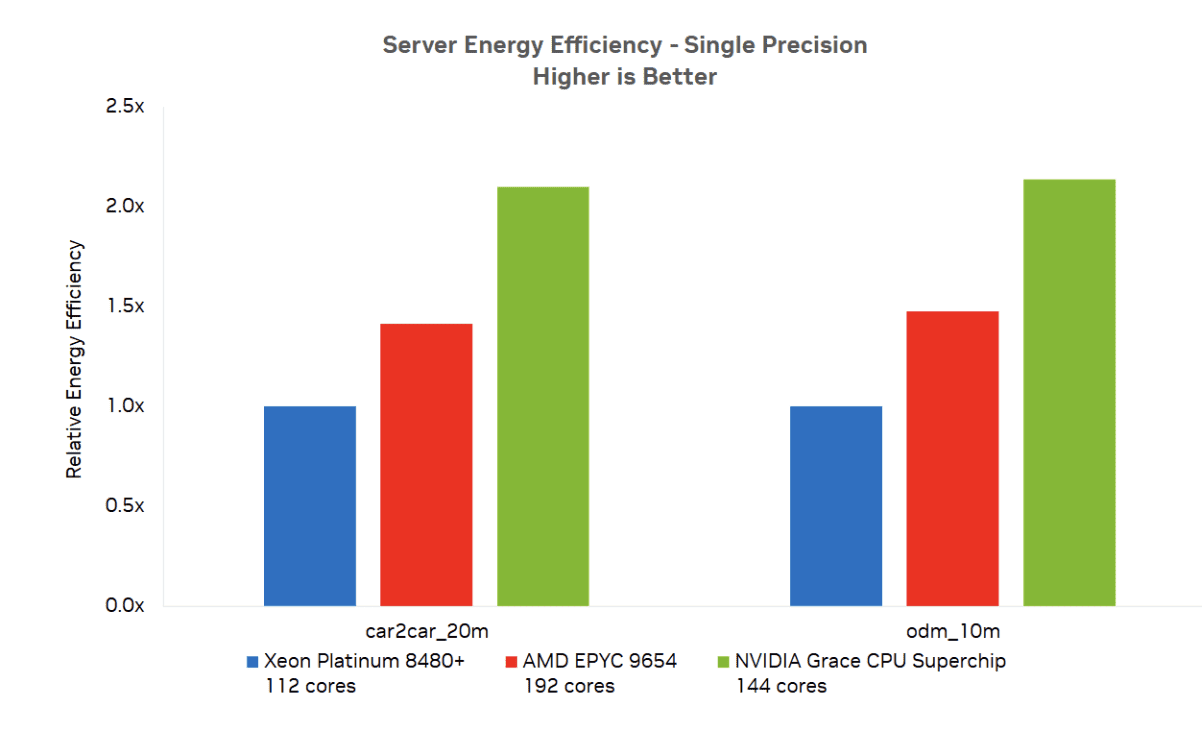*The NVIDIA Grace CPU provides superior energy efficiency compared to a range of x86 architectures for* [*this*](https://developer.nvidia.com/blog/advancing-ansys-workloads-with-nvidia-grace-and-nvidia-grace-hopper/?ref=creativestrategies.com) *Ansys computer-aided engineering crash analysis.*
## NVIDIA’s Strategic Imperative for Custom CPU Development
NVIDIA’s pursuit of custom CPU development addresses specific technical requirements essential for next-generation accelerated computing:
### Single-Thread Performance Optimization
While parallel processing dominates accelerated computing, Amdahl’s Law underscores that sequential processing segments ultimately limit overall application performance. By optimizing single-thread performance, NVIDIA targets these critical bottlenecks to enhance system-wide acceleration potential. This approach recognizes that as more workload components become accelerated, remaining non-parallel segments become increasingly significant constraints.
### Memory and Interconnect Optimization
Data movement is a critical bottleneck in AI and HPC workloads, necessitating high-bandwidth, low-latency communication between CPUs, GPUs, and memory. Traditional architectures rely on PCIe for CPU-GPU communication, which introduces higher latency and bandwidth constraints. NVIDIA’s custom Grace CPU addresses these inefficiencies by integrating LPDDR5X memory with up to 1 TB/s bandwidth, reducing memory contention and preventing GPU stalls. Unlike generic x86 architectures, the Arm-based Grace CPU is designed for coherent memory sharing, ensuring GPUs have seamless access to CPU memory without unnecessary data duplication.
A key advantage of custom CPU design is deeper integration with proprietary interconnects like NVLink-C2C (Chip-to-Chip), which extends beyond PCIe’s limitations. NVLink-C2C provides direct cache coherency, allowing the CPU and GPU to access shared memory with lower latency while maintaining data consistency. This architecture reduces redundant memory copies, optimizes power efficiency, and increases overall throughput—critical for large-scale AI models and scientific simulations. Unlike standard off-the-shelf solutions, NVIDIA’s tight CPU-GPU co-design ensures hardware-level optimizations that accelerate workloads by minimizing memory bottlenecks and improving data locality.
By leveraging a custom CPU, advanced interconnects, and optimized memory hierarchy, NVIDIA achieves higher computational efficiency, reduced inter-node communication overhead, and more deterministic performance in AI and HPC workloads.
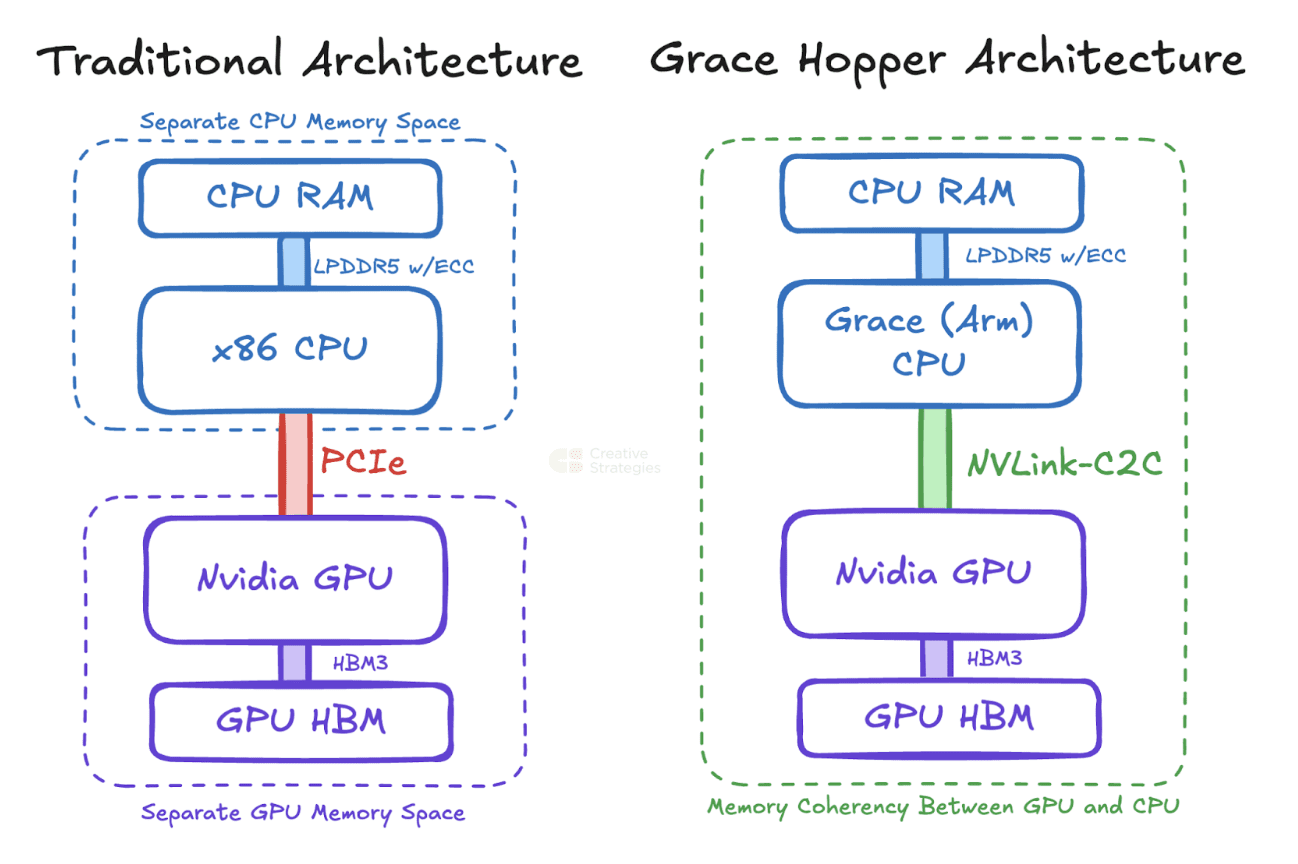*In traditional architectures, the CPU and GPU have distinct, separate memory spaces. This means that data stored in CPU memory (RAM) is not directly accessible to the GPU, and vice versa. Grace Hopper uses NVLink-C2C for coherent memory sharing.*
### Advanced Power Management
During AI training and inference, GPUs handle the bulk of computation, while CPUs manage orchestration, data preprocessing, and I/O—often operating below full capacity. Power steering dynamically reallocates power from underutilized CPU cores to GPUs, enabling higher GPU clock speeds and thus more computations per second. This accelerates model training, reduces inference latency, and enhances TCO. By intelligently managing power, AI data centers can unlock more GPU performance, maintain system balance, and minimize wasted power, ultimately driving greater efficiency and cost-effectiveness—without exceeding thermal or power constraints.
*NVIDIA’s Automatic Power Steering. Left: In a traditional system with a static power budget, the CPU often consumes a significant portion of the available power, even when underutilized in GPU-accelerated workloads. Right: Power steering dynamically reallocates power from the CPU to the GPU when the GPU has a higher computational demand, maximizing overall system performance and efficiency within the same power envelope.*
## The Strategic Value of Arm Architecture
NVIDIA’s selection of Arm’s platform for its custom CPU development offers multiple strategic advantages:
1. **Industry-Leading Efficiency**: Arm’s architectural and implementation approach delivers superior performance-per-watt metrics, addressing critical power constraints in modern data centers.
2. **Customization Flexibility**: Unlike fixed CPU designs, Arm’s licensing model permits extensive silicon and platform customization, enabling NVIDIA to implement acceleration-specific optimizations.
3. **Established Software Ecosystem**: By leveraging Arm’s growing data center presence, NVIDIA maintains compatibility with existing software stacks while introducing custom performance enhancements.
This approach allows NVIDIA to develop deeply tailored system architectures for accelerated computing while maintaining compatibility across a diverse computing landscape from cloud deployments to on-premises installations and client devices.
## Competitive Advantages and Market Implications
NVIDIA’s custom CPU strategy creates substantial competitive differentiation through several key mechanisms:
1. **Silicon Customization**: By developing CPU designs specifically optimized for AI-first datacenters, NVIDIA can deliver system performance and efficiency gains beyond what general-purpose host CPU alternatives offer.
2. **Superior Resource Utilization**: Custom CPU design enables better performance-per-watt metrics through acceleration-specific optimizations impossible with general-purpose processors.
3. **Developer Productivity Enhancements**: Simplified memory management and improved workload efficiency reduce development complexity while maintaining Arm ecosystem compatibility and workload portability.
4. **Legacy Constraint Elimination**: Breaking free from traditional CPU design limitations opens new possibilities for AI and HPC applications while maintaining value for CPU-only workloads through high single-thread performance, enhanced bandwidth, and optimized fabric connectivity.
## System Optimization
The AI and HPC-driven data center is shifting from a focus on individual component performance to full-system optimization. Compute, memory, networking, and software must work together efficiently. NVIDIA’s custom Arm CPU is central to this approach. Moore’s Law slowing is creating the need and opportunity for workload-specific CPU and CPU + GPU optimizations with a system-level view driven by hardware/software codesigns. Specialized hardware and tightly optimized systems are now the primary levers for performance improvement.
Arm provides silicon customization options for companies looking to optimize their systems. To help accelerate deployment, Arm last year introduced [CSS](https://www.arm.com/products/neoverse-compute-subsystems?ref=creativestrategies.com), pre-integrated and validated solutions that some hyperscalers, like Microsoft, are leveraging to pursue the same optimization advantages with a faster time-to-market.
By leveraging the standard CPU designs from Arm’s Neoverse product range, NVIDIA can concentrate on what matters for accelerated computing: memory bandwidth, interconnect latency, power efficiency, and deep CPU-GPU integration. AI data center performance is about more than raw compute—it requires optimizing the full stack. Grace is built for this, maximizing performance while staying within power limits, lowering inference costs, speeding up model iteration, and reducing training time.
For example, a [collaboration](https://developer.nvidia.com/blog/spotlight-university-of-tokyo-uses-nvidia-grace-hopper-for-groundbreaking-energy-efficient-seismic-research/?ref=creativestrategies.com) with the University of Tokyo’s Earthquake Research Institute provides a compelling example of NVIDIA’s system-level optimization. This project demonstrates how the tight integration of the Grace CPU and Hopper GPU, connected by NVLink-C2C, enables a dramatically faster approach to seismic simulation. Researchers achieved a significant breakthrough by overlapping CPU and GPU computation, which is difficult to achieve with traditional, loosely-coupled architectures. This was accomplished by leveraging the Grace CPU’s large memory capacity to store a history of prior simulation results. These results then fed a data-driven predictor, significantly reducing the number of iterations needed for the GPU’s computationally intensive calculations. This “data-driven method” relies critically on the high-bandwidth, low-latency connection between the CPU and GPU, facilitating efficient communication and shared memory access. The result was a 9x speedup compared to a GPU-only approach, with a corresponding 7x reduction in energy consumption. This exemplifies the shift from optimizing individual *chips* to optimizing the entire *system*; it is not merely about combining a fast CPU and a fast GPU, but about co-designing them to unlock new computational paradigms and achieve levels of performance and efficiency unattainable with discrete components.
## The Maturity and Momentum of the Arm Software Ecosystem
**Podcast:** [How Arm & NVIDIA Are Shaping the Future of AI and Data Centers](https://newsroom.arm.com/podcasts/nvidia-arm-accelerated-computing?ref=creativestrategies.com)
A key factor driving NVIDIA’s decision to adopt Arm for its custom CPU development is the growing maturity and momentum of the Arm software ecosystem. Historically, alternative CPU architectures have struggled to displace incumbents due to software fragmentation and compatibility issues, but modern Arm-based systems no longer face these barriers. Today, software designed for cloud, AI, and enterprise workloads increasingly runs natively on Arm, and new development often targets Arm first.
This transformation is largely driven by a standards-based approach. Initiatives such as [Arm SystemReady](https://www.arm.com/architecture/system-architectures/systemready-compliance-program?ref=creativestrategies.com) ensure broad software compatibility at the OS and driver layer, allowing hardware vendors to innovate on microarchitecture, interconnects, and system design while maintaining software portability. This approach allows Arm vendors to build CPUs optimized for acceleration-heavy workloads while running the same software as existing platforms. Applications, drivers, and system software all function seamlessly across Arm-based systems, eliminating the software fragmentation that plagued past alternative architectures.
Beyond application compatibility, the depth of the Arm ecosystem extends to infrastructure software. Low-level drivers, operating systems, and firmware now support Arm natively. This deep integration means that IT teams deploying Arm servers no longer face additional complexity compared to x86, making Arm a viable and scalable choice for data centers.
The increasing presence of Arm-native enterprise software further strengthens its ecosystem. Many workloads, including [open-source databases](https://cloud.google.com/blog/products/compute/try-c4a-the-first-google-axion-processor?ref=creativestrategies.com) and [llama.cpp](https://clear.ml/blog/benchmarking-llama-cpp-on-arm-neoverse-based-aws-graviton-instances-with-clearml?ref=creativestrategies.com), are already optimized for Arm. Open-source software has played a crucial role in accelerating Arm adoption, as these projects provide cross-architecture compatibility by default. Independent software vendors (ISVs) like [SAP](https://www.youtube.com/watch?v=%5FaAMoPP5FdE&ref=creativestrategies.com) and [Oracle](https://blogs.oracle.com/database/post/run-oracle-database-on-arm?ref=creativestrategies.com) are also embracing Arm; many ISVs now maintain Arm-native builds in-house, even if they have yet to formally market them. This growing ISV adoption reinforces that Arm is not an afterthought but a first-class enterprise platform.
The long-standing perception that porting software to Arm is difficult is now outdated. While tuning for peak performance always requires effort—regardless of architecture—simply running existing applications on Arm is straightforward and often seamless. Cloud-based Arm instances, such as those from AWS, Microsoft, and Google Cloud, further ease migration by providing Porting software to a new architecture is simple; the challenge lies in performance tuning, which is true for any processor transition.
Perhaps the most important shift is that Arm is no longer just a secondary option—it is a primary target for modern software development. As Arm-based CPUs continue gaining market share in hyper scale cloud environments, developers are increasingly prioritizing Arm optimizations in their roadmaps. Enterprise IT teams must prepare for a multi-architecture world, where x86 is no longer the default choice but rather one of several competing options.
This shift has profound implications for accelerated computing. As AI workloads scale and compute efficiency become paramount, a strong and mature software ecosystem is essential for supporting architectural innovation. NVIDIA’s Grace CPU strategy is a testament to Arm’s readiness for large-scale deployment. Unlike previous attempts to introduce alternative CPU architectures, Arm’s robust software support, ecosystem momentum, and seamless compatibility with modern workloads position it as a credible and competitive foundation for next-generation AI and high-performance computing infrastructure.
## Conclusion: Strategic Implications
NVIDIA’s custom CPU development represents more than incremental improvement—it fundamentally reimagines the role of CPUs in accelerated computing environments. By optimizing CPU design specifically for acceleration-first architectures, NVIDIA addresses critical efficiency and performance challenges that limit conventional approaches.
This strategy aligns with a broader industry shift toward specialized computing solutions optimized for specific workload characteristics rather than general-purpose versatility. As AI and accelerated computing continue transforming the data center landscape, the strategic integration of custom CPUs with specialized accelerators will likely become increasingly important for competitive differentiation.
For data center operators, technology strategists, and enterprise decision-makers, this development highlights the importance of considering integrated system architecture rather than individual component performance when evaluating next-generation computing platforms.
*\*This white paper was commissioned by Arm. The insights and analyses provided are based on research and data obtained through collaboration with Arm, their partners, and third-party developers. The goal of this paper is to present an unbiased examination of Arm’s technical position in the industry and growth prospects in the data center. While Arm has provided support for this research, the findings and conclusions drawn in this document are those of Creative Strategies, Inc and do not necessarily reflect the views of Arm.*
### Apple M4 MacBook Air – Apple’s Continued Aggressive SoC Power Management
URL: https://creativestrategies.com/apple-m4-macbook-air-apples-continued-aggressive-soc-power-management/
Last updated: 2025-03-11T16:59:04.000Z
Keeping up my theme of constantly analyzing the battery life of each new Apple M series silicon, I was excited to dive into the new M4 Macbook Air. Every year, gen on gen, Apple continues what their silicon design teams like to call the relentless pursuit of performance per watt. While the M4 is not new, running in the Mac Mini and Macbook Pro SKUs, it is the Air that is Apple’s battery life king and I was interested in how the M4 Macbook Air would compare to prior Macbook Air’s with later generation Apple Silicon. My Macbook Air model is the 15″ 16GB of Memory 6 E-core and 4 P-core CPU and 10 GPU cores.
**The Raw Battery Life Benchmarks**
I’ll keep this part pretty succinct since it is the most straightforward. We have our proprietary custom battery life script, one that admittedly puts slightly more stress on the device than the basic benchmarks that get used that test video or internet browsing time. Our test browses the web, watches YouTube, creates a document with 500 words of text, and does a 90-second CPU stress test. The total loop is \~15 min and it runs that cycle until the battery is dead. We run all our tests with the display at 150 nits. I like to run multiple tests, one where the system determines the battery mode and one where I leave it on low-power mode.
I like our battery test because it is more of a real-world, day-in-the-life test of how many hours one can expect to actively use the machine, screen on, during a normal day. Our battery benchmark in non-lower power mode (basically balanced mode) got 10 hours of straight usage. In low-power mode the 15″ M4 Macbook Air got 12 hours of continuous usage. Again, this test uses the system to do a wide range of things, meaning I’m confident those are continuous hours of usage doing “light” work. Just browsing the web, or just watching videos the battery lasts much longer. While the battery life is about the same as the M3 Macbook Air, what stood out to us is the addition of two E-cores with M4 which has 6 E-cores and 4 P-cores compared to the M3 Air has 4 E-cores and 4 P-cores. We have stated for multiple generations, really since the M2 Macbook Air, that Apple has continually made the E cores more performant and the P cores more efficient. That stands out in the M4 Macbook Air as we analyzed the system resources during various benchmarks and saw a few very interesting things.
**Continued System Optimization In macOS**
As I observed with the [M2 Macbook Air](https://creativestrategies.com/m2-max-under-the-hood-with-the-latest-apple-silicon/) optimizing software to utilize new CPU designs to get to zero state as often as possible is an efficiency technique. With M2 we observed the P cores being managed to do their task as needed and get to zero state while the E cores carried most of the system load. This has remained the trend, as a whole for the base M series of Apple Silicon as with Pro and Max versions we see more balance and more P-core work. With the M3 Macbook Air Apple’s software optimization started dropping the E cores to zero state as well which demonstrated increased system optimization as having the cores stay in zero state as often as possible keeps the system in its lowest wattage state as long as possible. The obvious benefits here are battery life and total system efficiency.
Apple has built upon the M3 CPU architecture with that enhanced efficiency of the power state of the E-cores but now by adding 2 more E cores to M4, Apple has again added to its lead in performance per watt while the 6 E cores are more than capable to carry the load of the vast majority of tasks on the Macbook Air. Doing a side-by-side analysis of the M3 Macbook Air and M4 Macbook Air taking into account how macOS managed each of them we found the following results.
**M4 Macbook Air Battery Benchmark Workload**
• **E-core frequency** dropped to zero **33.48%**
• **P-core:** dropped to zero **86.51%**
**M3 Macbook Air Battery Benchmark Workload**
• **E-core frequency:** Zero occurrence **23.54%**
• **P-core frequency:** Zero occurrence **81.69%**
The evidence here is Apple’s continued advances in system optimization to even better tune the software to silicon meaning the M4 Macbook Air, despite having two more E-cores, and a higher single-core (\~20%) and multi-core (\~50%) GeekBench score, actually spent more time in a zero frequency state than M3 Macbook Air. And given, that our battery life tests were in the same average range as the M3 Macbook Air, it means you get more performance without sacrificing any battery life in the new M4 Macbook Air.
Four generations of Apple Silicon are in and I think we see the clear trend lines of their silicon design team’s continued efforts to win on performance per watt. This includes slight microarchitecture tweaks, and tightly optimizing macOS to best utilize each new generation of SoC to maximize performance and efficiency. All the kinds of things that only Apple can do.
### A weekend with Apple’s Mac Studio with M3 Ultra: The only real AI workstation today
URL: https://creativestrategies.com/mac-studio-m3-ultra-ai-workstation-review/
Last updated: 2025-03-14T22:08:24.000Z
**Executive Summary:**
The Apple Mac Studio featuring the M3 Ultra represents the most powerful AI workstation currently available, tailored specifically toward AI developers’ demanding workflows. With its unprecedented unified memory (up to 512GB) and robust GPU performance, the M3 Ultra Mac Studio excels at running large language models (LLMs) efficiently, surpassing even high-end PCs in practical AI workloads. Its integration with Apple’s MLX framework provides optimized, user-friendly performance, establishing the Mac Studio as a uniquely capable machine for both current and future AI development.
**Key Points:**
- **Memory Matters Most:**
- Apple’s Unified Memory approach significantly enhances performance, particularly for memory-intensive AI tasks like running LLMs.
- M3 Ultra Mac Studio offers up to 512GB of Unified Memory, essential for high-quality AI models and large context windows.
- **AI Development Optimized:**
- M3 Ultra’s powerful GPU (80-core) paired with Apple’s MLX framework provides unmatched efficiency in running models without excessive memory overhead.
- Unlike other systems, MLX dynamically manages memory, enhancing workflow efficiency and enabling higher precision models.
- **Performance Benchmarking:**
- Real-world benchmarks demonstrate superior LLM inference speeds on the M3 Ultra Mac Studio compared to high-end PCs (Intel i9 13900K, RTX 5090).
- Context windows and model sizes are growing rapidly; Mac Studio’s extensive memory future-proofs workflows against this trend.
- **Comparative Advantage:**
- While Nvidia GPUs like RTX 5090 excel in GPU benchmarks and optimized client AI scenarios, Apple Silicon offers unmatched ease of use and consistent practical performance.
- Recommended developer setup: M3 Ultra Mac Studio for desktop AI workflows combined with rented Nvidia H100s for intensive server-based tasks.
- **Practical Implications:**
- Apple Silicon’s simplicity and native optimization (MLX) significantly reduce barriers to entry and improve development productivity.
- No competing workstation matches the combination of ease-of-use, practical performance, and available memory for running sophisticated LLMs.
---
I’ve been a huge fan of Apple Silicon since I got my first M1 MacBook Pro in 2020\. Going from an M1 MacBook Pro to M1 Max MacBook Pro to M3 Max MacBook Pro, one of my favorite parts of the machines was memory. It’s not only because I prefer Chrome as my browser of choice, but because RAM and memory have more or less always been the limiting factor in my opinion.
When I got the M3 Max, I decided to get the 128GB memory option because LLMs were finally running well on the machines with frameworks like Llama.cpp and MLX slowly becoming more popular and eating as much memory as you could provide. To be frank, for modern models and agentic workflows, 128GB isn’t even enough for a lot of AI devs.
Apple’s M3 Ultra SoC in the Mac Studio is insane because it’s the first workstation that seems to actually target AI developers, offering an insanely powerful GPU combined with up to 512GB of LPDDR5x Unified Memory and a memory bandwidth up to 819GB/s. Essentially, the perfect workstation for AI developers, especially since almost every AI developer I know uses a Mac! Essentially, and I am generalizing: Every major lab, every major developer, everyone uses a Mac.
The Mac I’ve been using for the past few days is the **Mac Studio with M3 Ultra SoC, 32-core CPU, 80-core GPU, 256GB Unified Memory (192GB usable for VRAM), and 4TB SSD**. It’s the fastest computer I have. It is faster in my workflows for even AI than my gaming PC (which will be used for comparisons below; it has an Intel i9 13900K, RTX 5090, 64GB of DDR5, and a 2TB NVMe SSD).
---
***Update: Since posting this article, I’ve gotten my hands on a Mac Studio with M3 Ultra SoC, 32-core CPU, 80-core GPU, and 512GB Unified Memory with an 8TB SSD. I’ve updated relevant sections based on new capabilities with more Unified Memory.***
---
Just to get it out of the way, here are some benchmarks from the M3 Ultra, M3 Max, and my gaming PC.
*\*Geekbench AI will be in Full Precision, Half Precision, and Quantized in order*
| Benchmark | M3 Ultra (32C/80G) | M3 Max (16C/40G) | Gaming PC (13900K/5090) |
| ---------------------------- | ------------------------ | ------------------------ | ------------------------ |
| Geekbench 6 CPU Single/Multi | 3,227 / 27,115 | 3,242 / 21,152 | 2,666 / 17,278 |
| Geekbench 6 GPU | 263,100 | 164,076 | 406,460 |
| Geekbench AI CPU | 5,303 / 8,192 / 6,427 | 4,750 / 7,430 / 6,425 | 5,447 / 5,370 / 13,660 |
| Geekbench AI GPU | 28,320 / 23,115 / 20,734 | 18,983 / 21,642 / 17,032 | 39,726 / 56,188 / 29,875 |
| Geekbench AI NPU | 5,348 / 30012 / 33339 | 4,697 / 27,188 / 29,809 | N/A (No NPU) |
| Cinebench 2024 CPU Single | 143 | 139 | 122 |
| Cinebench 2024 CPU Multi | 2,503 | 1,657 | 1,951 |
| Cinebench 2024 GPU | 19,493 | 10,247 | N/A |
---
**A Little Bit About LLMs**
Before actually talking about how LLMs run on the M3 Ultra Mac Studio (hint: best on any machine I’ve tested), let’s talk about how LLMs work and use memory. If you already know this, feel free to skip ahead; this is just good context to understand the need for memory.
There are two main parts of an LLM that use a lot of memory, and some can be optimized for. The first is model size; generally, models are in an fp16 format, so 2 bytes per parameter. Essentially, ***parameter count x 2 = size in GB*.**
Llama 3.1 8B is about 16GB, for example. Models like Deepseek R1 are native in an FP8 count, so the 685B parameters is about 685GB. The best open-source model as of writing this is Alibaba’s QwQ 32B model, matching Deepseek R1! This model is BF16, so around 64GB for the full model.
When you quantize down to 4-bit, you can cut that in half or a quarter depending on the model. An 8B parameter model in 4-bit quantization is around 4GB, QwQ 32B is around 20GB, and Deepseek is around 350GB. You can find models with smaller 1.5 to 2-bit quantization, but generally these lose so much quality it’s not worth using outside of demonstrations. It could be good enough for larger models like Deepseek R1, but that’s still \~250GB of memory needed to load it. The smallest version of Deepseek R1 is about 180GB, but this isn’t the full story.
The other part of the model that uses memory is the context window. Essentially, how much can you feed the model to generate a response off of? Most models now are 128K tokens for a context window, but users need significantly less, around 32K tokens is sufficient for most users (this is what the ChatGPT Plus tier has). This is called KV Cache, where it stores prompt and input tokens used to generate the output.
The most common framework for LLMs on the client, llama.cpp, will essentially load the entire context window cache as well as the model, so to load QwQ, which by itself is only 19GB, uses a total of \~51GB of system memory! This isn’t a bad thing, and makes sense for a lot of use cases.
Some frameworks like Apple’s MLX only use system memory for the KV Cache as it’s utilized, so it only uses 19GB when loaded and utilizes more memory as the model is used. At peak utilization, it will be \~51GB when the full context window is filled. Given M3 Ultra and M4 Max have way more than that available, it allows you to use much higher precision models. For example, the native BF16 of QwQ 32B could use over 180GB of memory at its maximum context window and quality. This is 180GB for a 32B parameter model! This is the reality of these models, they will use as much memory as you can give them.
Context windows are growing, and that seems to be where the majority of future-proofing around memory should be for client devices. Qwen already has a 1M token context window model, Grok 3 from xAI is 1M tokens as well (and will be open-sourced in the future). Scaling laws exist for model sizes; we’ll get smaller models that are powerful, but big models will still better. Context windows and actually using the models, small or large, will only require more memory. RAG works in some workflows, but I believe context windows will matter more, and that requires A LOT of memory. Mix a big model with a large context window? You need 512GB of memory or more.
You can actually connect multiple Mac Studios using Thunderbolt 5 (and Apple has dedicated bandwidth for each port as well, so no bottlenecks) for distributed compute using 1TB+ of memory, but we’ll save that for another day.
Look, all of this is to say: you can run an SLM or LLM on your phone or any laptop, and it’ll work. For it to work well, be able to use it in production and actually evaluate models, to have a REAL AI workstation, you need a lot of memory in the GPU. Mac Studio with M3 Ultra is the only machine that allows for this today. While buying H100s or AMD Instinct cards may be faster in the actual inference step, it’s also going to be 6-80x the price to actually own the silicon, especially since nearly everyone will be testing models that’ll be deployed on a cloud for production.
Training is a whole other mess that I’m sure the Exo Labs team will talk more about, since they are building an Apple Silicon-only training node for LLMs! I’m sure they’ll be a better resource in the memory requirements for training, but at the end of the day, I think the best way to put it is: more memory is better.
---
**LLM Performance**
OK, the important part now! I’ll keep it brief; the LLM performance is essentially as good as you’ll get for the majority of models. You’ll be able to run better models faster with larger context windows on a Mac Studio or any Mac with Unified Memory than essentially any PC on the market. This is simply the inherent benefit of not only Apple Silicon but Apple’s MLX framework (the reason we can efficiently run the models without preloading KV Cache into memory, as well as generate tokens faster as context windows grow).
This is not what I would consider a good comparison, because Blackwell as an architecture is great in data centers for AI, and on the client for consumer-focused AI. That’s not really what I’m testing here, so I would say **use this as a frame of reference for the practical performance of an LLM in a workstation**.
Below is just a quick ballpark of the same prompt, same seed, same model on 3 machines from above. This is all at 128K token context window (or largest supported by the model) and using llama.cpp on the gaming PC and MLX on the Macs.
\*OOM = Out of Memory
| Model | M3 Ultra 256GB | M3 Ultra 512GB | M3 Max | RTX 5090 |
| ------------------------- | -------------- | -------------- | ----------- | ----------------------------------- |
| QwQ 32B 4-bit | 33.32 tok/s | 36.87 tok/s | 18.33 tok/s | 15.99 tok/s (32K context; 128K OOM) |
| Llama 8B 4-bit | 128.16 tok/s | 135.22 tok/s | 72.50 tok/s | 47.15 tok/s |
| Gemma2 9B 4-bit | 82.23 tok/s | 88.50 tok/s | 53.04 tok/s | 35.57 tok/s |
| IBM Granite 3.2 8B 4-bit | 107.51 tok/s | 112.87 tok/s | 63.32 tok/s | 42.75 tok/s |
| Microsoft Phi-4 14B 4-bit | 71.52 tok/s | 75.91 tok/s | 41.15 tok/s | 34.59 tok/s |
| DeepSeek R1 4-bit | OOM | 19.69 tok/s | OOM | OOM |
I will say, there are ways to run larger models on the RTX 5090 with CPU offload and lazy loading, mixing system memory and CPU into the inference or loading layers of the model as needed, but that introduces latency and frankly isn’t really what’ll matter given the RTX card. There are also frameworks like TensorRT-LLM which let you quantize to the native fp4 datatype as supported by Blackwell, but when I tried to compile the model for the RTX 5090, I received quite a few errors and frankly didn’t have the time to debug it. **The theoretical performance of an optimized RTX 5090 using the proper Nvidia optimization is far greater than what you see above on Windows, but this again comes down to memory. RTX 5090 has 32GB, M3 Ultra has a minimum of 96GB and a maximum of 512GB.**
This leads to another Apple Silicon advantage: ***It’s just easy***. Everything here is optimized and works. MLX is the best framework, constantly updated by not only Apple but the community. It’s a wonderful open-source project to take advantage of the unified memory on Apple Silicon. As great as the RTX 5090 performance is, and yes it does outperform the M3 Ultra GPU at its peak for AI, the software like CUDA and TensorRT is a limiting factor when not going for scale in a data center, where those are second to none.
I see one of the best combos any developer can do as: M3 Ultra Mac Studio with an Nvidia 8xH100 rented rack. Hopper and Blackwell are outstanding for servers, M3 Ultra is outstanding for your desk. Different machines for a different use, while it’s fun to compare these for sport, that’s not the reality.
**There really is no competition for an AI workstation today. The reality is, the only option is a Mac Studio.**
### Nvidia Management on GPU vs. Custom ASIC Debate
URL: https://creativestrategies.com/research/nvidia-management-on-gpu-vs-custom-asic-debate/
Last updated: 2025-03-02T16:53:06.000Z
The GPU vs. Custom ASIC debate is easily one of the most talked about dynamics regarding AI compute infrastructure. I have dug deeply into the debate in this article here ([Understanding the Hyper Scaler Custom ASIC Strategy](https://creativestrategies.com/understanding-hyperscaler-custom-asic-strategy/)). There is no doubt this is a central question NVIDIA executives get from investors, so it was helpful to hear how management addressed that specific question during the investor call. We have debated and reviewed a wide range of material on this debate and share some common counterpoints to the specific points provided by NVIDIA management. Below is an analysis of the answer provided by CEO Jensen Huang.
**1\. Architectural Flexibility vs. Specialization Efficiency**
**NVIDIA’s Argument:**
NVIDIA’s GPUs offer broad versatility, supporting a wide array of AI workloads—from autoregressive and diffusion models to vision and multimodal systems. This adaptability not only fosters innovation but also makes NVIDIA the platform of choice for developers experimenting with emerging AI techniques.
**Counterpoint Analysis:**
While versatility enables NVIDIA to capture a wide market, it can also lead to trade-offs in performance efficiency. Custom ASICs, engineered for specific tasks, often achieve superior performance-per-watt ratios and cost efficiency. As AI models mature and workloads become more predictable, the tailored optimization provided by custom silicon may offer decisive advantages. Companies might then shift their focus toward these specialized chips to reduce energy consumption and operational costs, potentially limiting NVIDIA’s broader appeal.
**Anecdote:** In the mid-2000s I was in a meeting with Jensen where he walked me through a presentation on how technologies move from standardization to specialization. The insight here, at its deepest level, was on how technology moves through the maturity process. His point was in the early stages of a category, a singular solution is the standard that most people use and provides the basis for mass exposure. However, once the category is mature the industry starts to fragment, and more specialized solutions show up to solve specific problems which require unique solutions. Essentially, the market always moves from general purpose to specialized solutions once it matures. GPUs are the standardized solution for most general-purpose AI workloads today. Now, the GPU can also be flexible enough to be specific purpose as well, but it does run the risk of not being able to be specific purpose enough to compete with specific purpose ASICs. The GPU adaptability to be both general purpose and specific purpose will be the key factor in determining how many workloads GPUs can absorb and whether or not it can maintain its competitive advantage against specific purpose ASICs once the market starts to fragment many years down the road.
**2\. End-to-End Integration vs. Best-of-Breed Optimization**
**NVIDIA’s Argument:**
By offering an ecosystem that spans the entire AI development process—from data curation to inference—NVIDIA creates a cohesive environment that “locks in customers” (my addition of wording) and raises switching costs. This integration is a strong competitive moat against providers offering only segmented solutions.
**Counterpoint Analysis:**
However, an all-in-one ecosystem can also constrain customer choice, pushing organizations toward vendor lock-in. In today’s fast-evolving tech landscape, many companies prefer modular systems that allow them to integrate best-of-breed solutions for each segment of the AI workflow. As open standards and interoperable solutions gain traction, the advantage of a fully integrated NVIDIA stack may diminish. Enterprises might increasingly demand flexibility to swap components as needed, eroding the very switching costs that NVIDIA banks on.
That said, there is a counterpoint here, to the counterpoint, that enterprises will want architectural compatibility which you do not get with custom ASICs and do with NVIDIA GPUs at least, if not GPUs as a whole minus CUDA.
**3\. Universal Accessibility vs. Custom Deployment Optimization**
**NVIDIA’s Argument:**
With a strong presence across cloud providers, enterprise data centers, and edge environments, NVIDIA’s GPUs are ubiquitous. This wide-reaching accessibility creates network effects, making it difficult for specialized silicon to match NVIDIA’s scale and standardization. This speaks to the long-held point Jensen has made that one of the most compelling arguments for NVIDIA GPUs is the massive multi-million installed base and architectural compatibility.
**Counterpoint Analysis:**
Despite this broad deployment, major cloud providers like Amazon, Google, and Microsoft are developing their own AI chips. By leveraging in-house designs, these companies can tailor hardware specifically to their unique workloads, potentially offering better integration with their software ecosystems and cost structures. If hyperscalers increasingly rely on custom solutions, the network effects favoring NVIDIA might weaken, especially in environments where vertical integration becomes a strategic priority.
**4\. Economic Efficiency vs. Power-Constrained Alternatives**
**NVIDIA’s Argument:**
Huang argues that NVIDIA’s performance gains directly translate into revenue, particularly in power-constrained data centers. The notion that a “2x, 4x, or 8x” performance improvement equates to similar revenue growth is central to the economic case for NVIDIA’s architecture.
**Counterpoint Analysis:**
Yet, this performance-driven economic model may overlook the critical importance of energy efficiency. Custom silicon often delivers higher performance-per-watt, which is a crucial consideration for large-scale deployments where operational costs and power budgets are significant factors. In scenarios where energy savings are paramount—such as in massive data centers—the cost benefits of specialized chips could outweigh the raw performance advantages offered by NVIDIA’s general-purpose GPUs, shifting the economic calculus in favor of custom solutions.
**5\. Software Complexity vs. Open-Source Collaboration**
**NVIDIA’s Argument:**
The growth and sophistication of NVIDIA’s software stack, including CUDA, form a central part of its competitive edge. The rapid evolution of this ecosystem over just a few years has created a formidable barrier to entry for potential competitors.
**Counterpoint Analysis:**
However, the software landscape is not static. Open-source frameworks like TensorFlow, PyTorch, and initiatives such as OpenAI’s Triton are increasingly capable of supporting a wide range of hardware architectures. As the industry embraces more hardware-agnostic software solutions, the reliance on NVIDIA’s proprietary ecosystem could wane. This democratization of software tools might empower new entrants to develop competitive hardware solutions without the heavy burden of building a proprietary software stack from scratch.
**6\. Deployment Practicality vs. Market Diversification**
**NVIDIA’s Argument:**
Huang emphasizes that successful deployment goes beyond chip design—a chip must be adopted and integrated into real-world applications. NVIDIA’s established market presence and proven track record reduce the risks associated with adopting new technology.
**Counterpoint Analysis:**
Nonetheless, market dynamics are shifting as more organizations seek to diversify their hardware suppliers to mitigate risks associated with overreliance on a single vendor. Tech giants like Apple, Tesla, and emerging players are already investing in in-house AI chips to support their unique needs. Furthermore, geopolitical and supply chain considerations are driving enterprises to explore alternative suppliers, potentially fragmenting the market. Such diversification efforts could challenge NVIDIA’s position by offering viable alternatives that, while newer, are rapidly gaining credibility and adoption.
**Conclusion: A Delicate Balance of Strengths and Vulnerabilities**
NVIDIA’s strategy is undeniably robust, built on the pillars of flexibility, integration, accessibility, economic efficiency, software sophistication, and deployment credibility. Yet, each of these strengths comes with inherent trade-offs. Custom silicon’s specialization, modular system trends, in-house developments by cloud giants, the increasing importance of energy efficiency, the rise of open-source software, and market diversification all represent significant counterforces that could reshape the competitive landscape.
Ultimately, while NVIDIA remains a dominant force today, its future success will depend on its ability to adapt to an evolving ecosystem where specialized hardware and diversified approaches gain momentum. The interplay between these factors will likely define the next chapter in the AI hardware race.
### Nvidia Q4 FY2025 Earnings View from the Street – Analyzing Key Investor Sentiment.
URL: https://creativestrategies.com/research/nvidia-q4-fy2025-earnings-view-from-the-street-analyzing-key-investor-sentiment/
Last updated: 2025-04-03T22:42:27.000Z
A closer look at NVIDIA’s Q4 earnings call highlights key investor concerns that management tackled head-on throughout the discussion. The conversation sheds light on the company’s strategic direction and how the market perceives its leadership in the rapidly evolving AI infrastructure space.
## 1\. Blackwell Ramp-Up & Production Complexities
**Investor Concern**: Several analysts probed the complexities surrounding Blackwell’s production ramp, system-level integration challenges, and supply chain bottlenecks, revealing underlying anxiety about NVIDIA’s ability to meet surging demand.
**Management Response**: Jensen Huang offered remarkably candid insights into Blackwell’s manufacturing intricacies, acknowledging the “hiccup” that cost them “a couple of months” while emphasizing their successful recovery. His disclosure that each Grace Blackwell system contains “1,500,000 components produced across 350 manufacturing sites by nearly 100,000 factory operators” contextualized the scale of the challenge while reassuring investors about execution capabilities. Management’s revelation of $11 billion in Blackwell revenue for Q4—characterized as “the fastest product ramp in our company’s history”—served as tangible evidence of their operational resilience. Huang further defused concerns by detailing how subsequent transitions (particularly from Blackwell to Blackwell Ultra) would be less disruptive since “the system architecture is exactly the same.”
## 2\. Gross Margin Pressure
**Investor Concern**: The sequential decline in gross margins to the “low 70s” triggered multiple pointed questions about margin trajectory, with analysts seeking clarity on whether Q1 represented a bottom and how margins would recover.
**Management Response**: Colette Kress addressed this directly, confirming that margins would remain “in the low 70s” during the Blackwell ramp but would “return to the mid-70s late this fiscal year.” She articulated a deliberate strategic choice: “At this point, we are focusing on expediting our manufacturing… to make sure that we can provide customers as soon as possible.” This framing positioned the margin compression as a temporary investment in customer relationships and market share rather than a structural problem. Kress highlighted multiple margin improvement levers, including system customization options, networking configurations, and cooling solutions that would eventually yield cost improvements. This nuanced response suggested management views margin pressure as a controlled, temporary tradeoff to secure strategic positioning.
## 3\. Long-Term Demand Sustainability
**Investor Concern**: Analysts repeatedly probed the sustainability of demand beyond initial infrastructure buildouts, seeking tangible evidence of continued growth catalysts and visibility into future deployment cycles.
**Management Response**: Huang addressed this concern with a multilayered framework of demand signals, articulating “near-term signals” (purchase orders and forecasts), “mid-term signals” (infrastructure and CapEx investments), and “long-term signals” (the fundamental shift to AI-based software). His articulation of three distinct AI scaling laws—pretraining scaling, post-training scaling, and inference-time/reasoning scaling—provided a technological foundation for sustained compute demand. Huang emphasized that reasoning models (like DeepSeq R1) currently require “100x more compute” than earlier models, with future innovations potentially demanding “hundreds of thousands, millions of times more compute.” This technological progression narrative coupled with his observation that “AI has gone mainstream” across industries presented a compelling vision of expanding rather than contracting addressable markets.
## 4\. Competition from Custom ASICs
**Investor Concern**: Questions about custom silicon alternatives revealed persistent anxiety about potential disintermediation, particularly from hyperscalers developing proprietary chips.
**Management Response**: Huang constructed a comprehensive defense of NVIDIA’s value proposition across five dimensions: architectural flexibility (“we’re general”), workflow coverage (“we’re end-to-end”), deployment breadth (“we’re everywhere”), performance cadence, and software ecosystem complexity. His economic framing was particularly effective, noting that in fixed-size datacenters, NVIDIA’s superior performance per watt “translates directly to revenues” for customers. The observation that “the software stack is incredibly hard” and has become “10 times more complex today than it was two years ago” highlighted barriers to replication that extend beyond silicon design. Perhaps most strategically, Huang noted the gap between chip design and deployment: “Just because the chip is designed doesn’t mean it gets deployed,” suggesting that business decisions ultimately favor NVIDIA’s established ecosystem over experimental alternatives.
## 5\. Product Transition Management
**Investor Concern**: Questions about managing multiple product transitions—particularly between Blackwell and the upcoming Blackwell Ultra—reflected concerns about execution risk and potential disruption to customer deployments.
**Management Response**: Huang’s confirmation that “Blackwell Ultra is second half” maintained their annual product cadence while his explanation that the transition would be smoother than previous generations because “the chassis, the architecture of the system, the hardware, the power delivery” would remain consistent addressed operational concerns. His disclosure that they’re already working with partners on subsequent generations (specifically naming “Vera Ruben”) conveyed confidence in their product roadmap execution. The revelation that they’ve “been working with all of our partners and customers laying this out” suggested well-managed customer transitions. This forward-looking transparency served to reframe potential disruption as predictable evolution, reinforcing management’s strategic continuity amid technological advancement.
## 6\. Geographic Concentration and Regulatory Exposure
**Investor Concern**: Questions about geographic revenue distribution and China exposure reflected persistent concerns about regulatory risks and regional concentration.
**Management Response**: Kress provided specific clarification that China remained “approximately the same percentage as Q4” and represented “about half of what it was before the export control.” This quantitative specificity helped define the boundaries of regulatory exposure. Huang pivoted to a broader narrative about AI’s global proliferation, noting that “AI has gone mainstream” across geographies and industries. His emphasis that “no technology has ever had the opportunity to address a larger part of the world’s GDP than AI” reframed geographic concentration as a temporary state within a rapidly expanding global market. The mention of specific international initiatives like “France’s €2 billion AI investment and the EU’s €2 billion InvestAI initiatives” provided tangible evidence of global infrastructure buildout that could diversify revenue streams over time.
## Strategic Synthesis
During the Q&A session, NVIDIA’s leadership took a deliberate approach to addressing investor concerns, focusing on operational transparency, technological vision, and strategic positioning. Instead of reacting defensively to individual questions, Jensen Huang and Colette Kress framed short-term challenges within the broader shift toward AI infrastructure transformation. Their repeated focus on reasoning AI, physical AI, and agentic AI signaled confidence in long-term growth opportunities beyond the current deployment cycle.
A key theme throughout the discussion was NVIDIA’s emphasis on flexibility and optionality—through adaptable architectures, diverse deployment models, and broad industry applications. This versatility not only strengthens the company’s competitive edge against more specialized alternatives but also mitigates risks tied to any single market or region. Management’s message was clear: NVIDIA isn’t just a component supplier but the foundation of the emerging “AI factory” model, set to redefine computational infrastructure across industries.
### Alexa+: Amazon’s Home Assistant Grown Up to Be a Full-Fledged AI Agent
URL: https://creativestrategies.com/alexa-amazons-home-assistant-grown-up-to-be-a-full-fledged-ai-agent/
Last updated: 2025-04-09T21:22:32.000Z
The recent unveiling of Amazon’s enhanced Alexa with generative AI capabilities marks a significant milestone in the evolution of home-based AI assistants. As tech companies increasingly focus on generative AI capabilities, Amazon has carefully reimagined its digital assistant while preserving what made Alexa special in the first place: a personal and context aware helpful companion for the whole family.
##### A Unique Challenge from the Beginning
It’s important to recognize that comparing Alexa to interactions from ChatGPT and similar platforms has never been entirely fair. Alexa pioneered the personal assistant space with unique challenges: she relied solely on voice initially, later adding visual components, and had to operate seamlessly in our most private space – our home. Perhaps most challenging was addressing multiple users in the same physical environment, a technological hurdle that shouldn’t be underestimated.
Under the new leadership of Panos Panay, Amazon has taken a measured approach to enhancing Alexa. When I first heard the new voice, my immediate reaction was, “That’s not my Alexa” – a response that highlights the emotional connection many users have formed with her. Amazon understands this bond is fragile, making it crucial to deliver improvements while maintaining the trust and comfort established through millions of daily interactions. While consumer demand for AI outside productivity settings remains limited, Amazon faced a different pressure: the weight of an early mover in the assistant space. As the pioneer in the digital assistant space, the company couldn’t afford to appear complacent. Alexa’s long-standing presence in our homes created both opportunity and obligation – any evolution needed to be dramatic enough to make consumers reimagine their relationship with the technology, yet familiar enough to maintain their confidence. Amazon needed to craft an experience that not only showcased advanced capabilities but also empowered users to venture beyond their established usage patterns with a sense of trust and excitement.
##### Generative AI Powers the New Experience
Amazon’s announcement highlights how generative AI has fundamentally transformed Alexa’s capabilities. The new Alexa is powered by a custom large language model (LLM) specifically optimized for voice interactions in the home environment. This specialized architecture combines the conversational abilities of generative AI with Alexa’s established understanding of home contexts and user preferences.
The engineering team faced unique challenges in adapting generative AI for Alexa. Rather than simply implementing a general-purpose LLM, Amazon developed a hybrid system that integrates its custom model with Alexa’s existing skills framework. This approach preserves Alexa’s reliable performance for common tasks while adding the flexibility and natural language understanding of generative AI.
One of the most significant advances is Alexa’s new ability to understand complex, multi-part questions and maintain context throughout extended conversations. Users can now speak to Alexa in more natural patterns, including indirect references, implied requests, and conversational back-and-forth that feels remarkably human-like. For example, you can ask Alexa to “turn down the lights a bit” without specifying exact brightness levels, or follow up a weather request with “What about tomorrow?” without restating the full question.
The model also demonstrates improved reasoning capabilities. When asked about restaurant recommendations, the new Alexa can incorporate your past preferences, current time of day, and even consider factors like traffic conditions to provide truly personalized suggestions. This represents a significant upgrade from the command-based interactions of previous iterations, where specific phrases were required to trigger particular functions.
Amazon has also implemented a careful approach to response generation. The system is designed to provide helpful, informative answers while avoiding the excessive wordiness that sometimes characterizes generative AI responses. Alexa’s answers remain concise and actionable, maintaining the quick responsiveness that users expect from a voice assistant.
##### Consistent Vision, Evolving Technology
At its core, Amazon’s vision for Alexa remains unchanged: to create an indispensable home assistant. While the underlying technology needed time to catch up with this ambitious goal, the north star has remained consistent.
One significant challenge Amazon continues to address is enabling seamless interactions across multiple devices within a home. Unlike Apple Intelligence, ChatGPT, or Gemini – where interactions typically begin and end on a single device – Alexa must maintain context as users move between rooms and devices.
Today’s interactions are processed entirely in Amazon’s cloud infrastructure – an invisible but crucial detail in Alexa’s architecture. While most consumers care primarily about results rather than infrastructure, the future might have Amazon explore a hybrid processing model that could bring some computational capabilities into home-based hubs. This isn’t merely a technical distinction – it represents a strategic balance between competing priorities. Cloud processing provides unlimited computational power but introduces microseconds of latency and perpetual operational costs for Amazon. Local processing offers lightning-fast responses and functions even during internet outages but constrains AI capabilities. The ideal solution isn’t choosing one or the other, but finding the perfect balance where routine requests happen instantaneously on local hardware while complex reasoning leverages cloud resources. This approach would not only address the privacy concerns of the most security-conscious users but could substantially reduce Amazon’s massive cloud computing expenditures as Alexa usage continues to scale exponentially across millions of homes.
##### Removing Everyday Friction
Where Alexa truly excels is in removing friction from everyday tasks. Consider ordering food through a delivery app – navigating menus, customizing dishes, and managing changes requires numerous steps. Voice interaction can dramatically simplify this process, even translating generic requests (“meat lover’s pizza”) into specific menu items with different names.
Amazon has enhanced this capability by enabling Alexa to connect with various services and applications more intelligently. The new implementation can understand the intent behind requests and execute complex multi-step processes through simple voice commands, handling the complexity behind the scenes while providing users with a streamlined experience.
These frictionless interactions create user delight, building the foundation for increased engagement and loyalty. However, expanding these capabilities broadly requires business agreements across platforms, apps, and brands – explaining why the new Alexa is currently limited to US English with other languages and countries coming later in the year.
##### Privacy and Security Focus
Amazon’s announcement emphasizes their commitment to privacy and security in this new generation of Alexa. With generative AI processing more complex information, Amazon has implemented additional safeguards to protect user data. The company continues to provide transparency about how information is used and stored, maintaining the trust users have placed in bringing Alexa into their homes.
Users maintain control over their data with options to delete recordings and manage privacy settings. This balance between enhanced capabilities and robust privacy protections demonstrates Amazon’s understanding of the responsibility that comes with placing AI assistants in intimate home settings.
##### The Road Ahead: Discovery and Trust
Amazon faces two key challenges with Alexa+: discovery and trust-building. Most existing users rely on Alexa for basic tasks and smart home automation routines. Shifting this mindset toward more complex interactions requires users to discover new capabilities and then build trust through successful experiences.
This is a challenge all AI assistants face as they evolve into more capable agents. Amazon’s methodical rollout strategy acknowledges that early experiences will be critical to long-term adoption. Users who found value in timers, weather updates, and light controls need compelling reasons to expand their Alexa interactions. A standard timer evolves into something more complex when you tell Alexa, “I need dinner ready by 7PM,” and she instantly calculates backward—recognizing your planned lasagna requires precisely 2 hours and 15 minutes of preparation—setting your reminder for exactly 4:45PM without you specifying a single cooking time.
The gradual implementation also allows Amazon to refine the experience based on real-world usage and feedback, ensuring that Alexa continues to improve in ways that are meaningful to users rather than simply showcasing technological capabilities.
##### Opportunity and Pricing
As I look forward to experiencing the new Alexa in my home environment, I’m optimistic about what Amazon has accomplished. By thoughtfully balancing technological advancement with user experience considerations, they’ve created an evolution that honors what made Alexa special while opening new possibilities for how AI can meaningfully integrate into our daily lives.
Including Alexa+ in the Prime subscription represents a strategic move that aligns with Amazon’s customer base overlap, as most Echo device owners are already Prime subscribers. While critics may view the additional pricing as an artificial barrier designed to limit adoption, this perspective overlooks the significant value Amazon derives from Alexa engagement.
Through Alexa+ integration, Amazon creates new opportunities to connect its ecosystem of services and devices, delivering enhanced value to customers. Although the substantial costs of cloud-based AI operations have led some analysts to predict eventual Prime membership price increases to offset these expenses, this outcome isn’t inevitable.
Alexa+ offers Amazon numerous monetization pathways beyond simply raising Prime subscription fees. The enhanced AI assistant could drive value through increased shopping, media consumption, and service adoption, potentially generating revenue that mitigates the need for subscription price increases solely to recover operational costs.
I walked away from the Amazon launch feeling that Alexa+ is the most personal assistant yet. While she might execute tasks like an agent, her EQ, knowledge of me, and overall context genuinely make her my assistant. Looking at market competitors, Copilot excels in business but struggles with personal understanding, Gemini bridges business and personal better but can’t match Alexa’s personal connection with me. As for Siri, while there is no question she has the most comprehensive understanding of me, Apple Intelligence still has significant ground to cover.
### What’s the difference between Nvidia’s Blackwell family and when do you use them?
URL: https://creativestrategies.com/research/whats-the-difference-between-nvidias-blackwell-family-and-when-do-you-use-them/
Last updated: 2025-02-21T18:42:10.000Z
A few days ago, xAI announced Grok 3 and it’s easily the best LLM I’ve used. Good vibes, great quality, fast token generation, and happened to be trained on the most compute for any model (200,000 H100s). During the stream, Elon Musk said xAI is already working on Grok 4’s data center, which will be based on Blackwell chips. This, combined with Google Cloud announcing they are the first to offer both GB200 and B200 nodes, lead to an interesting thought: What’s the difference between B200 and GB200, and when would you use each of them?
---
**Nvidia GB200**
GB200 is, as it sounds, the Grace Blackwell 200\. It’s 2 Blackwell GPUs connected using NVLink C2C to a Grace CPU. A single GB200 is 2 Blackwell GPUs to 1 Grace CPU. A single GB200 chip has up to **384GB HBM3e at 16 TB/s memory bandwidth**. **The NVLink Bandwidth is 3.6TB/s. T**his is chip to chip interconnect (*not to be confused with NVLink C2C which is the chiplet interconnect)*, which matters a lot for the roofline arithmetic intensity for multi-chip training. Essentially the bandwidth between the two Blackwell GPUs on the GB200 and other GB200s in a node.
These GPUs are connected with a PCB level NVLink C2C interface (same interface connecting the two GPUS) to the CPU. The CPU is a Grace CPU with 72 Arm Neoverse V2 cores with up to 480GB of LPDDR5x memory and 512GB/s memory bandwidth.
GB200 comes in 3 main versions: GB200 Grace Blackwell Superchip, GB200 NVL4, and GB200 NVL72\. GB200 Superchip is a single version of the GB200, 2 GPUs connected to 1 CPU. GB200 NVL4 comes with 4 GPUs and 2 CPUs, essentially 2 GB200s on a single board already connected with NVLink. This is a good rack level solution.
GB200 NVL72, on the other hand, has 72 GPUs with 36 CPUs. This is a full rack/cabinet solution. It connects all 72 GPUs to function as one node, or a effectively a single GPU.
**TL;DR: GB200 is 2 GPUs to 1 Arm CPU, comes in 3 sizes: 2 GPU to 1 CPU, 4 GPU to 2 CPU, 72 GPU to 36 CPU.**
There’s a lot that goes into Transformer model AI training (LLMs), but simply put the higher the memory bandwidth between chips in a node, the more efficient the model training can be, and the more compute you effectively have access to. Because of NVLink’s bandwidth being so much higher when on the same PCB vs normal networking, GB200s have an advantage over B200s in training.
The benefit of Grace CPU here is the vertical control and NVLink. On other systems, you connect a CPU to GPUs over PCIe lanes and have 1-2 CPUs managing around 8 or so GPUs. PCIe Gen 5 x16 bandwidth is 128 GB/s. The just finalized and upcoming PCIe Gen 6 doubles that to 256GB/s. But that’s still a fraction of what Grace offers using NVLink in GB200s, which is 3.6TB/s. In order to limit latency, you need direct chip connections and that’s going to require some sort of vertical control. Nvidia has that in GB200 and is able to reduce the latency and bandwidth, which makes training more efficient.
**If you want the most effective compute with the best memory bandwidth to train the best models, some version of GB200 makes the most sense.**
---
**Nvidia B200**
B200, unlike GB200, is a single GPU. Each GPU has 180GB of memory and is, as far as I can tell, the same actual GPU die used in the GB200\. This is closer to the standard replacement for the H100\. Scales up the performance and memory with the Blackwell architecture, but still allows the data centers to use, and this is the important part, x86 CPUs.
GB200 is Arm through and through, its 2 GPUs connected at a board level to an Arm CPU. There is no choice, no option. If you want the best training on Blackwell, you need to use the Arm CPU. While this is something that makes sense for large scale training, it may not for inference.
I think it’s safe to say the majority of AI inference today is running on GPUs connected to x86 CPUs. I don’t think that changes. You also don’t need 72 GPUs connected to each other to run inference of a model like Grok 3, GPT-4o, DeepSeek R1, Claude 3.5 Sonnet, etc. These are all estimated to be between 300-800B parameters, or around 600GB to 1.2TB of memory needed to run the model.
It would be inefficient, though really fast, to run this on a GB200 NVL72\. Frankly, it makes sense to just get a node of 8xB200 and connect to an Intel or AMD CPU, and use those for inference. I believe this makes sense for hyperscalers and enterprises looking to install their own **inference** framework due to the maturity of x86 software, maintenance cost, and practicality.
---
So, after all of this, the difference is GB200 is a system connecting 2 GPUs to an Arm CPU and B200 is a single GPU you can put into any data center system. GB200 is best for training, B200 is the best value for inference. You can use GB200 for inference, just as you can use B200 for training but you want to use these pieces of silicon in the most effective way possible.
There’s a lot more that goes into the GB200 systems, like the NVLink switch chip, networking spine, etc, but in terms of comparing the Blackwell family, this is the easiest way to understand it!
What I think will be most interesting going forward is seeing which one has a higher install base within the next 18 months, GB200 or B200\. Do hyperscalers feel training silicon is more important than inference? Where and when do we see the pivot? What size customers buy which piece of silicon?
The expectation is many large organizations will begin to deploy their AI solutions to their organizations at scale in the second half of the year. While I’m not convinced this is the reality of AI models and ecosystem today, this matters because it means much more ROI in terms of customer dollars and inference at scale means monetizing their infrastructure investments. But, many customers still are chasing training and will need what GB200 brings offers in performance and efficiency. As the year rolls on, this mix of GB200 vs. B200 will be something we are watching closely.
### iPhone 16e Positioning in the Market and Apple C1 Strategy
URL: https://creativestrategies.com/iphone-16e-positioning-in-the-market-and-apple-c1-strategy/
Last updated: 2025-02-19T19:09:58.000Z
Today Apple officially announced the newest member of the iPhone family, which includes the newest member of the Apple silicon family: the C1 (Cellular 1), their first-party Apple-designed cellular modem.
**iPhone 16e Position in the Market**
Where does the new iPhone fit in the current iPhone lineup is one of the main questions that has come up. Obviously, it is now the most affordable iPhone entry point for Apple Intelligence. That said, I am still of the opinion that Apple Intelligence is not yet the pull for hardware buyers that it will be someday. I still maintain the stronger cycles being observed with iPhone are from the very large aged installed base of devices, where many consumer demographics are holding onto their devices for lengths of time we have not seen before.
Apple has typically released their entry-level iPhone in the spring and not the fall for the specific reason that the audience that would generally be more interested in a true entry-level iPhone is not the typical buyer for iPhones that launch in the fall. Those buyers skew more early tech and also skew more toward frequent upgrades. The buyer profile for iPhone 16e is going to skew more late adopter and much more price sensitive. This is more the market I think Apple has targeted iPhone 16e for, which is why price and battery life seem to be the strongest points of the product positioning. In fact, I’d wager the part of the installed base Apple is positioning iPhone 16e to is sitting on some of the oldest iPhones, which means they are dealing with some of the worst battery life of anyone in the iPhone installed owner base.
iPhone 16e sets itself up well to appeal to the aged device and price-conscious customer that makes up a significant part of Apple’s installed base, as well as many new customers who fit this profile in other parts of the world where carrier subsidies are less normal than the US and price is a much larger factor in purchasing.
**Thoughts on Apple Silicon C1**
Perhaps the most interesting part of the iPhone 16e is Apple’s first in-house custom-designed modem called the C1\. This is a result of many years of efforts for Apple to design their own modem, which was enabled by several factors including acquiring 5G modem assets from Intel and cellular license deals from Qualcomm.
Design-wise, Apple is noting specific battery life efficiencies gained by designing the modem themselves. For as long as I have been analyzing this potential of Apple doing their own modem, the question remained as to where they can differentiate and add value when it’s unlikely it is the fastest modem on the market in pure speed. It seems the answer to that question is battery life.
Like all modem designs, it is not just the chip but the total solution that makes up a baseband application processor. Apple’s ability to customize all of that directly to the design of the iPhone and to A18 is where they are getting up to 25% efficiency gains that are leading to less power draw and thus helping the battery life story with iPhone 16e.
Interestingly, the C1 is a discrete modem design. Part of my logic for Apple wanting to do their own modem was they wanted to put the modem on the SoC like Qualcomm and MediaTek do, since there are always efficiency gains when you integrate the modem onto the SoC. Given A18 was already in production and designed, it certainly makes sense C1 is a discrete solution, but now I question whether Apple needs to ever put their modem onto A series silicon. I specify A series because it is unnecessary to integrate a modem on M series silicon, and thus when they inevitably bring connectivity to Mac, I don’t think it will be on the M chip.
Given they were able to see such power efficiency gains by still doing a tightly integrated baseband application processor (AP), I can see them not wanting to make the design tradeoff for A series silicon, thus keeping that area on the die for CPU/GPU/ANE. One thing I’m very curious to watch for in future C-series modem designs.
Naming the modem C1 certainly makes it clear it is the first of many generations of modem designs from Apple, and I fully expect the Apple-designed modem to make its way to all of Apple’s products within the next two years.
### China’s Smartphone Golden Refresh: Don’t Call it a Super Cycle
URL: https://creativestrategies.com/research/chinas-smartphone-golden-refresh-dont-call-it-a-super-cycle/
Last updated: 2025-02-18T17:26:13.000Z
China’s smartphone market, the world’s largest, could be at an inflection point not seen since the initial smartphone boom. In recent quarters, the market has shown signs of recovery, with local brands benefiting from a surge in premium offerings as more Chinese consumers are willing to spend on new smartphones. The dynamics are changing not only in China but also worldwide. It’s no longer just about faster processors, sleeker designs, and unique features—although those still matter. A battle is brewing between on-device intelligence (Edge AI) and the raw power of cloud-based AI, reshaping what a “smart” phone even means. The stakes are high, with domestic giants like Huawei, Xiaomi, Oppo, and Vivo fiercely competing among themselves and against global players such as Apple and, to some extent, Samsung.
A significant government subsidy program that happened in January 2025, along side Chinese New Year, tilts the playing field toward local brands and their mid-range offerings. While these subsidies happened just for one month, we believe if it was effective, and believe more can come in 2025\. This isn’t just about stimulating consumer spending; it’s intertwined with broader goals of technological self-sufficiency and a desire to keep Chinese brands dominant in their home market. A goal of China we have continually pointed out in our smartphone market analysis for many years.
The core debate is this: where does the “smart” in “smartphone” actually reside? Edge AI promises privacy and real-time performance by processing data directly on the phone, a feature increasingly valued by privacy-conscious Chinese consumers and aligning with government regulations on data sovereignty. Cloud AI, on the other hand, can leverage powerful servers for more complex tasks, but potentially at the cost of user data security and responsiveness.
The Chinese consumer, particularly the young, urban professionals who dominate the flagship segment, is highly receptive to AI features. They want AI-powered photography that makes their social media posts shine, voice assistants that work instantly and reliably, and real-time translation that functions even without an internet connection. But, and this is crucial, they want all of this *without* constant data uploads to the cloud.
This preference for on-device processing is not solely consumer-driven, it is also a reflection of the regulatory environment. The situation creates a unique competitive landscape. Chinese manufacturers, having recognized this trend early, are aggressively integrating high end mobile silicon from Qualcomm and Mediatek with high power AI hardware (like Neural Processing Units, or NPUs) and optimizing their software to run efficiently on-device. This gives them a potential edge, especially when contrasted with companies like Apple, who, until recently, have been less vocal about their on-device AI strategies and face localization challenges for their hybrid cloud-based AI services in China.
The introduction of widespread subsidies, while technically open to all, has the practical effect of favoring the extensive mid-range lineups of domestic brands, adding another twist to this already dynamic market.
##### Chinese Government Subsidies Program – What is It?
The Chinese government’s short-term (for now) smartphone subsidy program is a multi-pronged initiative with both consumer-facing and industry-level implications. On the surface, it’s straightforward: consumers receive a 15% discount on eligible smartphones, tablets, and smartwatches, capped at ¥500 (roughly US$68) per device. This discount is applied at the point of sale, with retailers later reimbursed by the government. The program, funded by a substantial ¥81 billion (about US $11 billion) from the central government, with the potential for even greater total spending (up to ¥300 billion) when including contributions from provincial and city governments, is designed to be a broad stimulus, encouraging upgrades and boosting domestic consumption.
However, the devil is in the details, and those details reveal a clear strategic intent. First, there’s a price cap: only devices priced under ¥6,000 (approximately $818 USD) qualify. This effectively excludes higher end premium flagship models, many of which, especially those from foreign brands like Apple’s latest iPhones, fall outside the program’s reach. **While the policy doesn’t explicitly ban foreign brands – any phone meeting the criteria technically qualifies – the practical consequence is a significant advantage for domestic manufacturers.** Companies like Vivo, Huawei, Xiaomi, Honor, and Oppo have extensive lineups of mid-range and base tier flagship devices that fall squarely within the subsidized price bracket. It is a way to gently, but effectively, nudge consumers towards local options.
## Smartphone Subsidy Table
| Brand | Model | Pre-Subsidy Price (¥) | Subsidy (¥) | Post-Subsidy Price (¥) | Qualifies? |
| ------- | ------------------- | --------------------- | ----------- | ---------------------- | ---------- |
| Apple | iPhone 16 (Base) | 5999 | 500 | 5499 | Yes |
| Apple | iPhone 16 Plus | 6199 | 0 | 6199 | No |
| Apple | iPhone 16 Pro | 7499 | 0 | 7499 | No |
| Apple | iPhone 16 Pro Max | 8999 | 0 | 8999 | No |
| Honor | Honor Magic 7 Pro | 4799 | 500 | 4299 | Yes |
| Huawei | Huawei Mate 70 Pro | 6499 | 0 | 6499 | No |
| Huawei | Huawei P70 (Base) | 5199 | 500 | 4699 | Yes |
| Huawei | Huawei P70 Pro | 5799 | 500 | 5299 | Yes |
| Huawei | Huawei P70 Pro Plus | 6499 | 0 | 6499 | No |
| OPPO | OPPO Find X8 (Base) | 5899 | 500 | 5399 | Yes |
| OPPO | OPPO Find X8 Pro | 6299 | 0 | 6299 | No |
| OnePlus | OnePlus 13 | 5799 | 500 | 5299 | Yes |
| Samsung | Galaxy S25 | 5999 | 500 | 5499 | Yes |
| Samsung | Galaxy S25 Ultra | 6999 | 0 | 6999 | No |
| Vivo | Vivo X200 | 5499 | 500 | 4999 | Yes |
| Vivo | Vivo X200 Pro | 5699 | 500 | 5199 | Yes |
| Vivo | Vivo X200 Pro Mini | 5199 | 500 | 4699 | Yes |
| Xiaomi | Xiaomi 15 | 5099 | 500 | 4599 | Yes |
| Xiaomi | Xiaomi 15 Pro | 5999 | 500 | 5499 | Yes |
One of the things to note here is that devices from most domestic manufacturers have these discounts on the base model flagships, with Xiaomi and Huawei, the two largest domestic players in this AI-driven market, on both their base and pro tiers while the Pro Plus/Ultra tiers are not subsidized. Apple, the important international player, only has these subsidies eligible on the base iPhone 16 and as far as we can tell while writing this, does not offer these to consumers. This gives Xiaomi and Huawei a significant advantage in pricing for what many in China would consider equal or better hardware.
The program also has a “trade-in” or “upgrade” element, encouraging consumers to replace older devices. The program is designed to boost not just the smartphone industry, but also the broader electronics manufacturing sector. The government is also providing incentives for *industrial equipment upgrades* in sectors like *electronic information.* This provides support for electronics/smartphone companies to invest in new, high end manufacturing equipment, which helps domestic brands like Xiaomi expand their fully automated Smart Factory which currently have a capacity of 10 million annual units of their flagship product, as well as Foxconn to help slow down manufacturing which is moving outside of China.
The subsidies have been a clear advantage for domestic manufacturers. They have competitive line-ups of devices well below the ¥6,000, making most of their phones eligible for the program. The direct financial impact is substantial. Vendors and sales channels will need to handle subsidies that are claimed post-sales through government reimbursement. The program is designed to increase sales by the government footing part of the bill, and strengthening long term manufacturing capabilities. That said, details on the limitations on how many models per OEM apply, seem to also not want to impact Apple too much, given Apple’s massive manufacturing commitment in China and the sheer amount of dollars Apple manufacturing contributes to regional GDP.
The subsidy program, therefore, isn’t just about short-term economic stimulus. It’s a policy that aims to boost immediate sales, support China’s homegrown tech industry, and subtly strengthen China’s role in the competitive balance in the world’s largest smartphone market. It’s a clear signal that domestic brands are a priority, and that the government is willing to use its financial muscle to ensure their continued success.
##### Chinese Smartphone Market Share and Demographics
Understanding the Chinese smartphone market requires looking beyond shipment numbers (those do matter too!); it’s about who’s buying what, and why. The flagship segment, while not the largest by volume, is a crucial battleground for brand prestige and technological leadership. And within that segment, a specific demographic holds significant sway: young, urban professionals.
These consumers, predominantly aged 25-34 and residing in Tier-1 and Tier-2 cities, are the driving force behind the adoption of AI-rich flagship phones. They’re tech-savvy, digitally immersed, and possess strong purchasing power. Their demanding work in fields like finance, tech, and law, combined with fast-paced urban lifestyles, makes them early adopters of features that promise increased productivity and convenience. They are the trendsetters, the ones who influence broader market trends.
Market share data reflects this reality. While all major players are “all-in” on AI, Chinese brands, particularly Huawei and Xiaomi, have made significant inroads. By late 2024, these two companies alone captured over 60% of China’s AI smartphone market, with Huawei holding about a third of the total share. This success appears linked to their emphasis on AI capabilities, from Huawei’s Kirin chips with dedicated NPUs to Xiaomi’s AI partnerships and feature-rich devices. Their early embrace of on-device AI, aligning with consumer privacy concerns and government regulations, has clearly paid off.
The impact of the subsidy program, with its price cap favoring mid-range devices, further skews the competitive marketplace. While premium flagships from Apple and Samsung often exceed the ¥6,000 limit, the vast majority of devices from domestic brands qualify. This creates a price advantage, potentially swaying consumers who might have considered a more expensive foreign model.
**The competition isn’t just about capturing market share; it’s about building brand loyalty and ecosystem lock-in. On-device AI, by learning user preferences and storing that data locally, creates “stickiness.”** Consumers become less likely to switch brands if their personalized AI experience can’t easily transfer. This is the next frontier, the evolution of AI from a collection of features to an integrated, personal assistant – often referred to as an “AI agent.” Chinese vendors are actively pursuing this, envisioning AI agents that leverage long-term, on-device learning to offer highly tailored assistance. Some vendors, like Honor, already have AI Agents with platforms like YOYO Agent powered by Deepseek.
The demographic trends and market share shifts paint a clear picture: Chinese brands, with their focus on on-device AI and a product portfolio that aligns well with the subsidy program, are in a strong position. The young, urban professionals driving flagship adoption are increasingly choosing domestic options, drawn by the promise of powerful, privacy-respecting AI features. This creates a virtuous cycle, strengthening the position of Chinese OEMs not only in their home market but also globally, as they gain revenue and scale to invest further in R&D and international expansion.
##### How do Chinese Consumers Use AI, Who Provides it?
The market in China for AI apps, services, and experiences is already more mature than in the West. In China, AI on smartphones is already becoming *ambient* – it’s everywhere, all the time. Driven by the competition among domestic manufacturers, AI is deeply integrated into the user experience, making it less a “feature” and more a fundamental change in the experience of the phone.
## Edge AI Feature Comparison Table
| Category & Feature | Huawei | Honor | OPPO | Vivo | Xiaomi | Apple | Samsung |
| -------------------------------------------- | ------ | ----- | ---- | ---- | ------ | ----- | ------- |
| **Assistant & LLM**Multi-Modal Understanding | ✓ | ✓ | ✓ | ✓ | ✓ | ✓ | ✓ |
| **Assistant & LLM**Offline Voice Commands | ✓ | ✓ | ✓ | ✓ | ✓ | ✓ | ✓ |
| **Assistant & LLM**On-Device LLM | ✓ | ✓ | ✓ | ✓ | ✓ | ✓ | ✓ |
| **Camera & Imaging**AI Image Generation | ✕ | ✕ | ✕ | ✓ | ✓ | ✓ | ✓ |
| **Camera & Imaging**AI Object Removal | ✓ | ✓ | ✓ | ✓ | ✓ | ✓ | ✓ |
| **Camera & Imaging**AI Scene Detection | ✓ | ✓ | ✓ | ✓ | ✓ | ✕ | ✓ |
| **Camera & Imaging**Deepfake Detection | ✕ | ✓ | ✕ | ✕ | ✕ | ✕ | ✕ |
| **Productivity**AI Writing Assistant | ✓ | ✓ | ✓ | ✓ | ✓ | ✓ | ✓ |
| **Productivity**Real-time Translation | ✓ | ✓ | ✓ | ✓ | ✓ | ✓ | ✓ |
For the Chinese consumer, the most tangible impact of AI is, unsurprisingly, in the *camera*. AI-powered object removal that rivals professional editing software, but often running directly *on the device*. Enhanced night modes, generative AI that can tweak or even expand photos – these are becoming standard expectations, not premium add-ons. It’s about letting users create, not just capture, and social media is the driving force.
Voice assistants are evolving, too. Chinese users are increasingly turning to their AI companions (Huawei Celia, OPPO Breeno, Xiaomi XiaoAI, Honor YOYO) for *productivity*. Summarizing long articles, transcribing voice notes, drafting messages, even generating short social media posts – these are the tasks being offloaded to AI, thanks to the integration of powerful large language models (LLMs).
Real-time translation, both for text within images and for live conversations, is a killer app, especially for a globally connected population. Crucially, much of this is happening *on-device*, ensuring speed and functionality even when offline.
But the “invisible” AI is just as important. AI constantly works behind the scenes, optimizing battery life, pre-loading apps you’re likely to use, and intelligently managing resources for smooth multitasking. Chinese operating systems are becoming context-aware, offering proactive suggestions based on your current activity. Received a message with a meeting location? The phone might suggest opening maps. It’s about anticipating your needs, not just reacting to them.
The power behind this AI revolution comes from a mix of domestic players. Several Chinese manufacturers, like Huawei (with Pangu), OPPO (with AndesGPT), and Xiaomi, are building their *own* large language models, often tailored for mobile and prioritizing on-device processing. This gives them control and allows for deep integration with their hardware and software. Chipset makers like Qualcomm and MediaTek provide the silicon muscle (each with different technical differentiators), and strategic partnerships (like Honor with DeepSeek, or Xiaomi integration with WeChat for user data for the proactive assistant) fill in the gaps.
What truly sets China apart is the focus on *on-device* AI as much stronger driver than other parts of the world. Privacy concerns, government regulations, and the lack of a dominant, Google-like cloud ecosystem all contribute to this. It’s a fundamental design principle, not an afterthought. The result is a mobile AI experience that’s more pervasive, more integrated, and evolving much faster than in Western markets. Chinese consumers are experiencing a future where AI isn’t just a feature; it’s the very core of how their smartphones work.
##### The Apple Intelligence Advantage
While Chinese OEMs are aggressively pushing the boundaries of on-device AI features, Apple possesses a unique set of advantages that extend beyond raw processing power or feature checklists. It’s about the *ecosystem*, and that’s where Apple’s strength lies. This advantage is amplified by a crucial partnership in China: Alibaba.
At the heart of Apple Intelligence is a hybrid approach. The iPhone’s A-series chips, and now M-series chips in some iPads, coupled with a custom “Apple Foundational Model,” handle a significant amount of AI processing directly on the device. This ensures speed and, crucially, privacy. However, for more demanding tasks or broader knowledge queries, Apple Intelligence can securely offload processing to the cloud. This is where the Alibaba partnership becomes vital.
Chinese regulations strictly prohibit the transfer of Chinese user data outside the country. Setting up Apple’s “Private Cloud Compute” infrastructure within China would be a complex and costly undertaking, and at this point, it does not appear that is what they are doing. Partnering with Alibaba, a leader in cloud services within China, provides a compliant and efficient solution. Alibaba’s cloud infrastructure can handle the heavier AI lifting, while adhering to data sovereignty rules. This also opens the door for integrating Alibaba-powered features into Siri, extending its capabilities beyond the on-device model’s knowledge base – similar to how Apple uses ChatGPT for broader queries in the US.
But Apple’s advantage goes beyond infrastructure. There’s the matter of *trust*. Apple has cultivated a strong brand reputation for prioritizing user privacy and security. This resonates particularly well in a market where data security is a paramount concern. The tightly integrated nature of iOS, designed from the ground up with the “agentic era” in mind, also gives Apple a head start. The operating system itself is built to facilitate seamless AI interactions, making the experience feel more natural and intuitive.
It is also important to remember that American brands, specifically Tesla and Apple, have a sort of status symbol allure within the Chinese markets. This will make their products more attractive, even if the specs are not as competitive.
***However, it is also important to remember that Huawei and Xiaomi will be formidable competitors for Apple.***
This isn’t to say Apple is without challenges. The subsidy program, with its price cap, inherently favors the lower-priced devices of domestic competitors . And while Apple’s brand carries weight, Chinese OEMs are rapidly innovating, often outpacing Apple in terms of raw feature count. Market share wise, Apple still maintains \~70% share of smartphones over $800 USD sold in China and \~50-55% of devices between $500-700 USD. The ultra premium is likely to still favor Apple but it is the two price tiers below where local brands are continuing to gain the msot ground.
Ultimately, Apple’s play in China isn’t about matching every feature bullet point for bullet point. It’s about leveraging its ecosystem advantage – the seamless integration of hardware, software, and services, coupled with a strong brand reputation for privacy and user experience. The Alibaba partnership removes a major regulatory hurdle, allowing Apple Intelligence to function effectively within China. While the competition is fierce, Apple’s unique blend of brand appeal, ecosystem lock-in, and a privacy-focused approach to AI gives it a distinct edge in the battle for the minds (and wallets) of Chinese consumers. The question is whether that edge is enough to overcome the pricing and feature advantages of its domestic rivals.
##### The Golden Refresh (Don’t Call it a Super Cycle)
It is no secret the China market has been waiting for a smartphone recovery. Ever since the initial boom of rapid adoption of smartphones in China, the average age of a device was consistently in the 16-18 month range. The last few years, saw a significant slowdown of refresh as Chinese consumers were upgrading less often. The same dynamic we see world wide. While we were never fans of the word “super cycle” noting that–historically– only major hardware upgrades were drivers of pulling upgrade cycles forward. While we still do not believe there is a smartphone “super cycle” on the horizon we do believe AI smartphones will contribute to a stronger than average upgrade cycle.
The other dynamic to point is a technoloogical one. Devices today are still not built from the ground up for AI. Things like better camers, better microphones, better sensors, better sensor fusion, new innovations in SoC design, and more will lay a crticial foundation for AI experiences, and AI software.
The confluence of factors – the rollout of Apple Intelligence, the rise of on-device AI capabilities across the board, and the strategic positioning of Chinese OEMs, and new specific to AI hardware innovations – points to a significant refresh cycle in the Chinese smartphone market. We refer to this as the *golden refresh*, fueled by a combination of technological advancements and evolving consumer expectations.
The subsidy program, while seemingly targeted at the mid-range, but includes base premium prices as well, indirectly contributes to this refresh. This is also enabled by companies like Qualcomm who are aggressively waterfalling SoC advancements to be capable of providing rich AI features at lower price-points. By making a vast array of AI-capable devices more affordable, it lowers the barrier to entry for consumers who might have been hesitant to upgrade. This increased adoption at the mid-range puts pressure on the premium segment, forcing all players, including Apple, to offer truly compelling reasons to justify higher price tags.
For Apple, the Alibaba partnership is crucial. It allows Apple Intelligence to function fully within China, removing a major competitive disadvantage. The combination of Apple’s brand appeal, ecosystem lock-in, and a localized AI experience creates a powerful incentive for existing iPhone users to upgrade. While Apple might not see the explosive growth experienced during previous super cycles, a steady, sustained refresh driven by AI is a likely scenario.
For Chinese OEMs, the golden refresh represents an opportunity to solidify they continued growth and compete against Apple and Samsung. Their aggressive push into on-device AI, coupled with competitive pricing and a wide range of models, positions them to capture a significant share of the upgrading user base. They are not just competing on specs; they are offering a fundamentally different vision of what a smartphone can be which is also highly specialized and localized to the Chinese consumer. A tactic that is a bit more challenging for non-local brands.
---
The Chinese smartphone market is entering a new era, defined by the rise of AI. It’s a battleground where on-device processing, privacy, and ecosystem integration are becoming as important as traditional hardware specifications. The 2025 government subsidy program, while seemingly straightforward, adds a layer of strategic complexity, favoring domestic brands and accelerating the adoption of AI-capable devices. Apple, with its Alibaba partnership and focus on user experience, is well-positioned to participate in this “golden refresh,” but faces stiff competition from Chinese OEMs who are aggressively pushing the boundaries of mobile AI. The winners will be those who can deliver not just powerful AI, but also a seamless, trustworthy, and genuinely useful experience that resonates with the tech-savvy Chinese consumer. This isn’t just about selling more phones; it’s about shaping the future of how people interact with technology.
### Cisco’s Strategic Push into AI Infrastructure and Security at Cisco Live EMEA 2025.
URL: https://creativestrategies.com/ciscos-strategic-push-into-ai-infrastructure-and-security-at-cisco-live-emea-2025/
Last updated: 2025-04-09T21:22:44.000Z
At this year’s Cisco Live EMEA, the networking giant unveiled a comprehensive strategy that signals a decisive move into the AI infrastructure space while reinforcing its traditional strengths in networking and security. The announcements represent not just product updates, but a fundamental shift in how Cisco envisions the future of enterprise IT infrastructure and the role it plays in making it happen.
##### AI Infrastructure Transformation
The introduction of the N9300 Smart Switches with Hypershield is an interesting move in data center architecture evolution. By embedding services directly into the network fabric, Cisco is fundamentally rethinking how AI workloads should be handled at the infrastructure level. This approach addresses several longstanding challenges in AI deployments, particularly the need for adaptive infrastructure that can scale dynamically without creating new security vulnerabilities or performance bottlenecks. This is particularly important at this early stages of AI deployment as many organizations just do not know their needs quite as yet.
There is a certain architectural significance to this move. Traditional data center designs have struggled to keep pace with the unique demands of AI workloads, often requiring complex overlays and compromises that impact performance. Cisco’s integrated approach suggests a future where the network itself becomes an active participant in AI workload optimization, rather than just a passive transport layer.
The expansion of their AI server family through the introduction of the UCS C845A M8 server represents another significant step forward. Based on NVIDIA’s MGX reference architecture, this new offering demonstrates Cisco’s commitment to providing enterprise-grade solutions for AI computation. The decision to build on NVIDIA’s architecture is particularly telling, as it leverages industry-leading GPU technology while adding Cisco’s expertise in enterprise systems integration and management.
##### Security Evolution in the AI Era
Jeetu Patel, Cisco’s EVP and Chief Product Officer, made it very clear in his keynote, that Cisco is the only secure networking company. The announcement of the Hybrid Mesh Firewall represents a sophisticated response to the security challenges posed by distributed AI workloads. By integrating the capabilities of the N9300 Smart Switch with advanced firewall features, Cisco is creating a security architecture that understands and adapts to the unique characteristics of AI applications. This approach recognizes that AI workloads often have different traffic patterns and security requirements compared to traditional applications.
The extension of Universal Zero Trust Network Access with Hybrid Private Access demonstrates Cisco’s understanding that security architectures must evolve beyond traditional perimeter-based approaches. There is no denying that AI changes everything, including security needs. This solution addresses the complex reality of modern enterprises, where AI workloads may span multiple environments and require varying levels of access control. The integration of identity-first principles with network access control creates a more nuanced and effective security posture.
##### Service Provider Innovation and Market Evolution
The announcement of the Agile Services Networking architecture represents Cisco’s vision for how service providers can capitalize on the growing demand for AI connectivity. This architecture combines Silicon One-powered platforms with coherent pluggable optics to create a foundation for next-generation service provider networks. The timing of this announcement is particularly significant as service providers worldwide grapple with the challenge of monetizing their network investments in the AI era.
The architecture provides an opportunity for service providers to offer differentiated services that can command premium pricing. By incorporating advanced management and assurance software enhancements, Cisco is enabling service providers to offer guaranteed service levels for AI workloads, a crucial capability as enterprises increasingly rely on AI for business-critical applications.
##### Competitive Landscape Transformation
Cisco’s comprehensive approach to AI infrastructure positions the company uniquely in the market. While pure-play AI hardware providers focus on computational capabilities, and cloud providers emphasize their services portfolio, Cisco’s strategy leverages its unmatched expertise in networking and security to create a differentiated offering. The integration of Mistral AI’s technology for the AI Renewals Agent demonstrates that Cisco is not just providing infrastructure for AI, but actively applying AI to improve its own operations and customer experience.
This positioning has significant implications for the competitive landscape. Traditional networking vendors will need to respond with their own AI-ready infrastructure solutions, while AI-focused companies may need to build or acquire networking expertise to remain competitive.
##### Enterprise Digital Transformation Impact
The announcements made at Cisco Live EMEA 2025 address fundamental challenges that enterprises face in their digital transformation journeys. The integration of AI capabilities throughout the portfolio suggests a future where AI becomes a natural part of enterprise infrastructure rather than a bolt-on capability. This integration extends from the data center to the edge, with innovations like the expanded portfolio of Wi-Fi 7 access points and high-powered stackable access switches ensuring that AI capabilities can be leveraged wherever they’re needed.
The Cisco AI Assistant for Webex Contact Center, now generally available, exemplifies how AI can be practically applied to improve business operations. Features such as context transfer summaries, dropped call summaries, and automatic customer satisfaction scores demonstrate the tangible benefits that AI can bring to everyday business processes.
##### Ecosystem Development and Skills Enhancement
The introduction of the Engineering Alliances program recognizes that success in the AI era requires a robust ecosystem of partners and solutions. This program goes beyond traditional technology partnerships to create a framework for collaborative innovation. The emphasis on validated solutions addresses a crucial market need for proven, enterprise-ready AI implementations.
The AI Skills Journey program represents a strategic investment in market development. By providing a structured path from entry-level to expert-level AI infrastructure skills, Cisco is addressing one of the primary barriers to AI adoption: the skills gap. This program demonstrates Cisco’s understanding that technology alone is not sufficient; success in AI requires a workforce capable of implementing and managing these solutions effectively.
##### Future Outlook and Strategic Implications
The comprehensive nature of Cisco’s announcements suggests a carefully considered strategy that will influence the industry for years to come. The integration of AI capabilities throughout the portfolio, combined with enhanced security features and simplified management, creates a compelling vision for the future of enterprise IT infrastructure.
The success of these initiatives will depend on several factors. First, the ability to deliver on the promise of simplified AI infrastructure deployment while maintaining enterprise-grade security and reliability. Second, the effectiveness of the skills development programs in creating a workforce capable of implementing and managing these solutions. Third, the continued evolution of the partner ecosystem to create compelling solutions that address specific industry needs.
Over the past few years, I have been a vocal critic of Cisco’s siloed product lines as it prevented the company to best compete with brands like Zoom in the collaboration space and even with Microsoft that benefitted from a broader productivity offering. With Patel overseeing the full breadth of the portfolio the path to a platform approach that allows for a vertical integration that offers more but also is flexible enough to meet the customers where they are is a much easier to see.
### Understanding Hyperscaler Custom ASIC Strategy
URL: https://creativestrategies.com/research/understanding-hyperscaler-custom-asic-strategy/
Last updated: 2025-02-11T20:37:11.000Z
The GPU vs. Custom ASIC debate is one of the most talked about in our circles of tech executives and investors. It is also a debate that requires more in-depth analysis to fully understand. I want to look at the custom ASIC strategy in two ways relative to this debate. The first is how custom ASICs are primarily used today for first-party workloads. When I say first-party workloads, I mean both AI and non-AI workloads. Second, and this is a key part of the debate, I want to look at the opportunity for custom ASICs to move beyond first-party workloads and be adopted by third-party enterprises/software developers.
**Custom ASICs and First-Party Workloads**
The showcase example in custom ASICs for first-party workloads is Google. Google is now six generations into their cloud TPU architecture and has the largest custom ASIC installed base of any hyperscaler. The vast majority of Google’s internal software, both non-AI and AI, runs on TPUs, and most of their GPU installed base is for third-party developers on GCP. Using our accelerated compute installed base model, it is interesting to note that Google has the smallest number of GPUs available at GCP compared to AWS and Azure; however, when you look at the total accelerated compute infrastructure that includes GPUs and TPUs, Google has the highest share of accelerated compute silicon at \~35%. Noting the significant volume of TPUs over GPUs shows Google’s ability to foresee designing silicon for their own internal workloads and thus has the least dependence (some would argue no dependence) on Nvidia for their own software.
AWS has been in the custom silicon game for a while as well, but much longer with Graviton, which is their Arm-based CPU. Still primarily for internal workloads (Amazon.com), but now with multiple generations of Trainium and Inferentia, Amazon has the custom accelerated infrastructure they need primarily for their own internal non-AI and AI workloads. Again, looking at our accelerated compute installed base model, Amazon is split roughly 50-50 between GPU capacity and custom ASIC capacity, and is just below Google with total accelerated compute capacity at \~30%.
Google and Amazon have been very vocal when they talk about their custom silicon strategy, that the primary benefits they see are better performance-per-watt, TCO efficiencies, and more. Below is a visual of the primary benefits consistently highlighted with custom ASICs.
Understanding that these custom ASICs’ strategic goal has, for now, only been to optimize internal workloads across the efficiency metrics charted above is foundational. While we can argue that part of their strategy was to reduce reliance on Nvidia, I do not think this was the primary nor originating goal. Specific-purpose workloads, like those internal to Google and Amazon, were prime candidates for specific-purpose silicon. Going deeper on validating this, it is interesting to note that Microsoft has the largest GPU installed base of all three public cloud hyperscalers. In context, this makes sense given that Microsoft has largely been running AI workloads for OpenAI, which runs on Nvidia GPUs. Microsoft has recently developed Cobalt, their custom Arm CPU, and Maia, their custom ASIC, and has begun running internal workloads on that silicon. However, noting that OpenAI workloads are a foundational part of Microsoft’s strategy (for now) makes their ownership of the largest share of GPUs and the smallest share of custom ASICs a key observation.
**The Role of GPUs**
With the above foundation laid, the question now lies in the role of the GPU. It is safe to assume that, directionally, Microsoft, Google, and Amazon will continue to optimize their internal workloads for their custom ASICs and thus decrease their reliance on Nvidia GPUs for their internal workloads only. The question, then, is whether there is an opportunity for those custom ASICs in third-party workloads as well. Right now, we have little to no definitive evidence to support that theory. The vast majority of third-party AI workloads are still being run on Nvidia GPUs, and there is no sign of that slowing down. There are a few arguments against custom ASICs for third parties.
**The first is architectural compatibility.** This is a staple argument from Jensen Huang when he addresses the GPU vs. custom ASIC question. Developers want to know their workloads have some form of compatibility across platforms, and Nvidia GPUs provide that architectural compatibility. Much of that has to do with CUDA and its standardization for most AI/HPC software developers. If a company decides to do the lift and shift with their AI workloads to run on something like Google’s TPU, they will have to do all that software optimization themselves to be optimized specifically for the TPU, but as a result, will lose architectural and workload compatibility across clouds/compute architectures.
**Another argument Jensen Huang likes to use is the massive GPU installed base.** If you look at the installed base of Nvidia GPUs in both the datacenter and client PCs, it is roughly \~3M, with about half of that coming from datacenter/cloud installed base. There is no single other high-performance computing architecture/accelerator that comes close to the Nvidia GPU installed base. These two points together make the strongest case for Nvidia GPUs for third-party software developers as well as third-party enterprises looking to run their AI workloads in the cloud.
This point is proven even further in a recent AI workload survey by UBS that asked CTO/CIO decision makers where they intend to spend their money on inferencing their AI workloads. Approximately 64% said Nvidia GPUs will be their primary choice for inferencing. That number was even higher for training, obviously.
There is one other technical advantage to GPUs I want to point out. What is distinctly unique about GPUs architectures is their programability. This allows them to accomplish two critical things computationally. First, they can run standardized and general purpose workloads thus being a standard for workflows. Second, they can also be specific purpose, and in this case be programmed to do all the things custom ASICs can do, and more. This unique technical differentiator is another reason to believe GPUs, Nvidia GPUs, will remain the dominant platform for third party software.
My current thesis, which will adapt as new information comes to light, is precisely as I have laid out. Custom ASICs will remain primarily for first-party hyperscaler workloads. There is no question that the custom ASIC market will continue to grow as hyperscalers keep investing and scaling up their custom silicon strategy for their own internal workloads. I am skeptical they will scale those ASICs out to third parties, which means there is an upper limit to the custom ASIC market in terms of dollar upside for companies like Broadcom, Marvell, and TSMC/Intel.
If the third-party software market continues to favor Nvidia GPUs, then the majority of accelerated compute dollars through 2030 will remain with Nvidia.
In terms of what to watch for, I made a visual on a few of the key market dynamics to watch that can swing this pendulum one way or another.
### AMD Q424 Earnings – What’s Going on With AMD?
URL: https://creativestrategies.com/research/amd-q424-earnings-whats-going-on-with-amd/
Last updated: 2025-02-06T19:29:17.000Z
Key Takeaways
- The Narrative is clearly shifting as concerns the AI product roadmap is weaker than expected
- AMD’s datacenter GPU business faces a muted growth outlook in 1H25, with revenue expected to be flat versus 2H24 ($5.1B total in 2024). While management expects acceleration in 2H25 with the MI350 launch, this more backend-loaded growth profile led most name-brand sell-side firms to lower their price targets.
- AMD continues to execute well in server CPUs, with market share reaching 32-33% exiting 2024 and analysts projecting a 38-39% share by the end of 2025\. This is supported by strong customer traction for the Turin platform and Intel’s delay of Clearwater Forest.
- The company’s Q4 results showed strength in both traditional segments, with data center growing 9% QoQ and PC clients up 23% QoQ, demonstrating AMD’s ability to gain share in core markets even as it builds its AI/GPU business. However, both analysts view the current valuation (around 27-28x forward earnings) as fairly reflecting these opportunities, leading to their neutral stances.
---
**Understanding the Narrative Shift and What it Means**
In numerous industry conversations and our analysis of the competitive landscape, we have consistently emphasized AMD’s need to convince the market they are more than a CPU company. All eyes have been on the Instinct (MIXXX) line as the indicator of their AI roadmap. With the accelerator market growing at approximately 26% annually and generating an average of \~$42 billion per year just for AI accelerators/servers—projected to reach a TAM of \~$300 billion (excluding memory) in 2027—**investors hope to see faster adoption of AMD’s Instinct line as a percentage of this revenue increase, driven by expanding hyperscaler CapEx in the data center sector.**
Looking at the numbers, AMD’s Instinct line revenue (AI accelerator) will represent roughly 4-5% of the AI accelerator revenue in 2024\. Management has expressed confidence in strong double-digit growth, and current estimates, informed by the supply chain, place AMD’s Instinct line in the $7-9 billion range. However, even with year-over-year growth, based on the current trajectory of the AI accelerator market in 2025, AMD’s Instinct line would still only represent 4-5% of the AI accelerator market. **This stagnant market share is the root of investors’ financial concerns: while AMD’s AI accelerator business is growing, it is not keeping pace with the market’s overall dollar growth.**
The GPU versus ASIC debate is central to understanding this narrative. When we discuss the GPU market, we primarily mean Nvidia, which controls \~90% of total revenue in the category while holding only \~45-50% of total units when including custom ASIC unit volume. For context, if custom ASICs are excluded, Nvidia’s unit share rises to 85-90%.
Currently, the biggest question concerning merchant silicon is whether there **is a true GPU market or merely an Nvidia market**. While there is a custom ASIC market, our current view suggests this market’s composition is unlikely to shift significantly in AMD’s favor unless the custom ASIC thesis fails to materialize. **Currently, we have sufficient evidence that custom ASICs are well-suited for hyperscalers internal workloads primarily and select third-party custom workloads. However, GPUs’ advantages in parallelism, programmability, and flexibility—particularly in handling constantly evolving and increasingly complex AI software innovation—reinforce our conviction that GPUs will remain the standard for AI workloads across the majority of third-party software.** While we believe AMD will continue to capture meaningful revenue as the AI accelerator TAM expands, whether that growth can match the market’s overall dollar growth remains uncertain.
**CPUs Still Matter!**
We think it is important to remember the CPU still has a role to play, in client and data centers, but specific to the AI accelerator narrative/trend and the outsized attention on AI servers, the CPU still has a crucial role to play and growth in CPU shipments and ASP need to be appreciated as well. When it comes to AMD CPUs data center trends on public cloud instances:
- AMD’s total instances were up 1% month-over-month (m/m) and up 33% year-over-year (y/y) in December 2023
- AMD processor instances were flat m/m and up 33% y/y, compared to the previous month’s growth of +1% m/m and +35% y/y
- AMD’s overall processor market share was 24%
AMD has also signaled when you combine internal and external instances, they have a 50% share at two US hyperscalers. We believe those to be Azure, and Google (GCP) due to the strong double-digit share they have at both those clouds in public cloud instances.
We believe there is still innovation coming to CPU architectures as host processors to AI accelerators. We think new generations of data center CPU architectures provide an opportunity for a new class of AI CPUs for the AI servers, which could command higher ASPs than traditional general-purpose server CPUs. We view this opportunity as a net positive for AMD and Intel.
**Specifics on the Quarter**
AMD reported Q4 2024 revenue of $7.66B (up 12.3% QoQ, 24.2% YoY), slightly above consensus estimates, with gross margins of 54.1%. The results were driven by strong data center growth of 9% QoQ and better than seasonal PC client shipments (up 23% QoQ), partially offset by weakness in gaming and embedded segments.
For Q1 2025, AMD guided revenue to $7.1B (down 7% QoQ), slightly above consensus of $7.0B. The guidance implies data center revenue declining mid-single-digits QoQ, PC client and embedded declining low double-digits, and gaming declining low single-digits. Given this is a QoQ view, vs YoY view where we expect Q12025 to be up on all three categories, the QoQ decline is in-line with typical seasonality.
While AMD didn’t provide specific 2025 datacenter GPU guidance, management indicated datacenter GPU revenue will be 2H25 loaded, with 1H25 revenues expected to be roughly flat compared to 2H24\. AMD achieved around $5.1B in data center GPU revenue for the full year 2024, with Q4 estimated at approximately $1.7B. Datacenter GPU revenue is projected to grow to $7-9B in 2025.
On the server CPU side, AMD exited 2024 with 32-33% market share and appears well-positioned to reach 38-39% share by the end of 2025, supported by strong traction of its Turin platform and Intel’s delay of Clearwater Forest.
Key concerns include the muted first-half 2025 data center GPU growth profile and execution needed around the MI350 ramp in the second half of 2025\. However, we remain constructive on AMD’s server CPU share gain trajectory and competitive positioning versus Intel in 2025.
### Creative Strategies Welcomes Austin Lyons to the Team
URL: https://creativestrategies.com/creative-strategies-welcomes-austin-lyons-to-the-team/
Last updated: 2025-02-03T03:56:13.000Z
We at Creative Strategies, Inc. are excited to announce that [Austin Lyons](http://twitter.com/theaustinlyons?ref=creativestrategies.com), the author of the popular semiconductor newsletter [Chipstrat](http://www.chipstrat.com/?ref=creativestrategies.com) is joining our distinguished team. Austin joins the team after spending 2 years at John Deere as a product manager working on the autonomous tractor team. He also previously worked as a hardware engineer at Intel, as well as numerous entrepreneurial efforts with startups early on in his career. Austin brings a wealth of in-industry experience working at the cross-section of semiconductors and AI. Our commitment to enhancing the quality of our technical analysis within the technology industry continues to grow, driving us to deliver more insightful and comprehensive evaluations.
The Creative Strategies team prides itself on the depth of engagements we have with our clients.
We are privileged to work closely with our clients, advising them on strategic initiatives and enabling them to more effectively prioritize their competitive advantage.
Austin possesses a rare blend of technical expertise and the exceptional ability to articulate complex concepts, fostering deeper understanding that can be applied to real business outcomes. We are confident that both our clients and the entire industry will greatly benefit from his valuable insights and analysis.
The [Chipstrat](http://www.chipstrat.com/?ref=creativestrategies.com) brand and newsletter will continue and be a key part of Creative Strategies’ public and private analysis of the technology industry. Click here to read Austin’s note at Chipstrat announcing he is joining our team and below is his full biography.
**Austin Lyons – Senior Analyst**
At the intersection of emerging technology and practical innovation, Austin transforms bold ideas into reality. As a leading voice in AI, semiconductor technology, robotics, and consumer tech, he brings deep expertise shaped by hands-on experience across industries.
His journey spans pioneering autonomous systems as a Product Manager at John Deere, advancing chip development at Intel, architecting software solutions for venture-backed startups, and pushing boundaries in nanoelectronics research. This versatile background enables him to bridge the gap between cutting-edge technology and real-world applications.
Austin earned an MS in Electrical Engineering from the University of Illinois Urbana-Champaign and an MBA from the University of Iowa, Austin offers unique insights that blend technical depth with strategic thinking. His perspective is particularly valuable as technologies like AI and robotics reshape industries, combining practical engineering knowledge with business strategy to navigate the future of technology.
### Apple’s Q1 FY25: China Headwinds Test Growth as Company Awaits Stimulus Impact & Apple Intelligence Rollout
URL: https://creativestrategies.com/research/apples-q1-fy25-china-headwinds-test-growth-as-company-awaits-stimulus-impact-apple-intelligence-rollout/
Last updated: 2025-02-01T23:18:02.000Z
Apple delivered record Q1 FY25 revenue of $124.3 billion, up 4% year-over-year, driven by strong Services growth (+14%) and robust Mac and iPad performance. While iPhone revenue remained flat and China sales declined 11%, the company saw encouraging results from its new Apple Intelligence features and continued strength in emerging markets, particularly India. With an expanded install base of 2.35 billion active devices and record upgrader numbers, Apple maintained strong margins while laying groundwork for AI-enhanced features across its product line.
---
**Key Takeaways**
- Apple Intelligence Impact: Markets where Apple Intelligence was available showed stronger iPhone 16 performance compared to markets without it. According to Apple, the feature is driving notable user engagement across multiple capabilities including Writing Tools, Image Playground, and Clean Up. It is worth noting, however, that those markets where Apple Intelligence has been released usually show a good upgrade cycle the quarter following the launch of the new iPhone models.
- China Challenges: Greater China revenue declined 11% YoY, with over half the decline attributed to channel inventory changes. The company noted new national stimulus programs announced in January 2025 that could impact future quarters. Historically, Chinese consumers have shown more interest in new hardware design elements and features than those driven by software. This coupled with consumers waiting for Chinese New Year promotions as well as the arrival of Apple Intelligence in April might have contributed to the softness in Q1.
- Emerging Markets Strength: Record revenues in multiple emerging markets, with particular strength in India where iPhone was the top-selling model. The company is expanding retail presence with four new stores planned in India.
- Services Momentum: The services segment hit another record with strong growth across all geographic regions. Paid subscriptions exceeded 1 billion, with both transacting and paid accounts reaching new highs.
- Mac & iPad Recovery: Both segments showed strong growth, with Mac up 16% and iPad up 15%. Over half of iPad purchasers were new to the product, indicating successful market expansion
**What’s Significant**
- During the Q&A, Cook provided interesting insight into their manufacturing approach in India. Apple is pursuing a dual strategy – manufacturing both for domestic market and export which mean manufacturing diversification which could come in handy as the current administration imposes tariffs on China. Cook added that manufacturing needs certain economies of scale to make sense in-country, which suggests that Apple is taking a long-term view of India as both a market and manufacturing hub.
- Cook made a strong claim about Apple’s AI capabilities, stating: “believe we’ve got the best AI PC out there for running workloads” and adding that the M4 was designed specifically with AI workloads in mind. While I am sure Qualcomm, Intel and AMD will all have something to say about this claim, it is hard to ignore how the deep integration of silicon, OS and hardware can drive better results in the end. We are still at the start of what AI can do but it will be interesting to see if the higher-end Mac skews will start to eat into PC workstations share where data analysis are going to be running heavy workloads before mass market usage picks up.
- Cook described Apple’s user base as having a “barbell” distribution. One end consists of early adopters who upgrade very frequently, while the other end consists of users who hold onto devices much longer. On average our data shows a replacement cycle of 24 to 36 months but COVID threw things off as many consumers upgraded their devices off cycle in order to stay connected during the pandemic. Cook noted that the large number of units sold during COVID represents a significant upgrade opportunity for Apple.
**Key Numbers**
**Financial Performance:**
- Revenue: $124.3B (up 4% YoY, all-time record)
- EPS: $2.40 (up 10% YoY, all-time record)
- iPhone Revenue: $69.1B (flat YoY)
- Services Revenue: $26.3B (up 14% YoY, all-time record)
- Mac Revenue: $9.0B (up 16% YoY)
- iPad Revenue: $8.1B (up 15% YoY)
- Wearables Revenue: $11.7B (down 2% YoY)
- Active Device Install Base: 2.35B (all-time high)
- Gross Margin: 46.9%
**Business Highlights:**
- **iPhone:** Apple saw a record number of upgraders during the quarter, with the iPhone 16 lineup outperforming its predecessors. Strong performance in developed markets including Canada, Western Europe, and Japan. iPhone 16 was the top-selling model in key markets including US, India, UK, France according to third party data.
- **Services:** Record revenue with 14% growth. Strong performance across all geographic segments. Apple TV+ continues to gain acclaim with over 2,500 nominations and 538 wins. New services launched including luggage tracking with AirTag. During the Q&A, the new CFO Kevan Parekh provided insight into their strong 75% services margin, revealing that scale businesses like payments and iCloud become more profitable as they add users.
- **Mac:** Growth driven by new M4-based products. Double-digit growth in both upgraders and new customers Including a strong enterprise adoption including a large Deutsche Bank deployment. A 94% customer satisfaction in US
- **iPad:** The segment saw growth led by iPad Air and entry-level models which is not a surprise given the iPad Pro biggest addition was the silicon while the iPad Air had a new hardware design. Good for Apple and developers, over 50% of purchases came from new customers
- **Wearables:** The segment saw a slight decline that the company linked to the tough you comparison which included the introduction of the Apple Watch Ultra 2 in 2024.Apple recorded strong adoption of AirPods Pro 2 with hearing health features and overall high engagement with new health features. To note that Vision Pro expanded to additional countries during the quarter.
**Outlook:**
Despite macroeconomic headwinds, Apple projects resilient growth for 2Q F25, forecasting low to mid-single digit year-over-year revenue expansion. The company’s high-margin services segment continues to outperform, targeting low double-digit growth and highlighting Apple’s successful pivot toward recurring revenue streams.
While a 2.5% FX headwind presents a challenge, Apple maintains robust profitability with projected gross margins of 46.5-47.5% – a testament to the company’s pricing power and operational efficiency. This margin resilience suggests Apple’s premium positioning remains strong even in a potentially softening consumer environment.
Chinese New Year sales will provide crucial insights into iPhone performance in Apple’s second-largest market.
The broader adoption of Apple Intelligence depends on more than language support. Siri’s capabilities must evolve to enable more natural voice interactions in order to see accelerated AI adoption across Apple’s ecosystem. This must occur in order for AI to be come a purchase driver. This is true across all smartphone’s AI implementations as this is the device where consumers are most comfortable using their voice as input.
### Microsoft Earnings Q2 FY2025: AI Drives Record $69.6B Revenue as Cloud Surpasses $40B Milestone
URL: https://creativestrategies.com/research/microsoft-earnings-q2-fy2025-ai-drives-record-69-6b-revenue-as-cloud-surpasses-40b-milestone/
Last updated: 2025-01-30T06:56:24.000Z
In Q2 FY2025, Microsoft delivered strong financial results with revenue reaching $69.6 billion and net income of $22.4 billion , driven primarily by exceptional growth in its AI and cloud services, where the annual AI revenue run rate exceeded $13 billion, representing a 175% year-over-year increase.
---
**Key Takeaways**
- CEO Satya Nadella emphasized the massive opportunity presented by AI technologies, highlighting that Microsoft’s AI business has reached an annual run rate of $13 billion, indicating an impressive growth of 175% year-over-year .
- The Microsoft Cloud segment achieved a milestone by surpassing $40 billion in revenue for the first time, marking a 21% increase year-over-year, while commercial bookings showed remarkable growth of 75% in constant currency.
- The company’s strategic focus on AI infrastructure and expansion of Copilot products across platforms has continued to pay off, with Azure revenue growth projected between 31-32% for the next quarter, though this growth comes with increased capital expenditure of $22.6 billion as the company scales its AI infrastructure.
- Despite some short-term challenges in executing non-AI services, Microsoft maintains a strong outlook, supported by robust demand for its AI services and cloud solutions, with remaining performance obligations now at $298 billion, up 34% year-over-year.
---
**What’s Significant**
- Overall, there was a significant focus on how ongoing investments in AI infrastructure are balancing maturity in certain segments against the need for aggressive growth strategies .
- Microsoft has increased investments in AI infrastructure to expand its capacity and prepare for higher customer demand, which will support its cloud and AI product offerings moving forward
- The cash flow from operations also demonstrated strong performance, amounting to $22.3 billion, which is an 18% increase attributed to solid cloud billings and collections
- The Microsoft Cloud gross margin percentage was 70%, slightly declining due to scaling AI infrastructure
- Analysts had predicted that Microsoft’s revenue from its Intelligent Cloud segment, which includes Azure, would be strong, and while it achieved 19% growth to reach about $25.54 billion, it still fell slightly short of some analysts’ projections .
**Key Numbers**
**Financial Performance:**
- **Revenue:** Microsoft reported a total quarterly revenue of $69.6 billion, an increase of 12%, driven mainly by strong demand for cloud and AI offerings
- **Net Income:** Operating income grew by 17% and 16% in constant currency, indicating robust growth driven by the demand for Microsoft’s cloud and AI offerings
- **Earnings Per Share (EPS):** EPS stood at $3.23, reflecting a 10% increase from the previous quarter
- **Capital Expenditures:** Total capital expenditures, including finance leases, were $22.6 billion, underscoring the company’s commitment to long-term growth despite a cash flow of $6.5 billion being lower than the previous year
**Business Highlights:**
- Growth in AI and Cloud Services: Microsoft’s annual AI revenue run rate now exceeds $13 billion, showcasing a 175% year-over-year increase. This growth is driven by significant adoption of AI-driven Overall, Microsoft is poised for strong revenue growth in the coming quarters while also remaining focused on optimizing its service delivery across cloud platforms, particularly under the growing demand for AI applications products such as Microsoft 365 Copilot and Azure AI services.
- Strong Demand for Licensing: A diverse range of organizations, including major companies and educational institutions, has continued to amplify their usage of Microsoft’s offerings. For instance, top healthcare providers used DAX Copilot for over 2 million physician-patient encounters.
- Azure Commitment Growth: There has been a notable rise in Azure bookings, with new large contracts contributing to a substantial increase in remaining performance obligations, now at $298 billion, up 34% year-over-year.
- More Personal Computing: Revenue related to this segment was lower than expectations, coming in at approximately $14 billion, driven by diverse sources such as Windows OEM licenses and gaming. Concerns about this segment being below projected targets were noted, particularly in light of upcoming competitive pressures.
**Outlook:**
Microsoft expects continued strong growth across both AI and non-AI sectors, with Azure revenue growth projected to be between 31% and 32% in constant currency for Q3\. Higher demand signals for AI services are anticipated to persist as Microsoft expands its offerings.
While demand is strong, there are short-term challenges in executing non-AI services which may reflect in quarterly performance. Additionally, fluctuations in foreign exchange rates are expected to impact growth modestly.
Overall, Microsoft is poised for strong revenue growth in the coming quarters while also remaining focused on optimizing its service delivery across cloud platforms, particularly under the growing demand for AI applications.
### RTX 5090 – AI is the only path forward for gaming
URL: https://creativestrategies.com/research/rtx-5090-ai-is-the-only-path-forward-for-gaming/
Last updated: 2025-01-27T21:03:40.000Z
I know it sounds off, but after spending some time getting back into gaming thanks to the RTX 5090, and then looking at some of the technical details on the RTX 5090, I’ve been sold on Nvidia’s vision of neural rendering and AI-accelerated rendering. Frankly, I think it’s the only way going forward.
Let’s face it, the brute force approach to performance gains is hitting a wall. We’re looking at a 750mm² die with the GB202 in the RTX 5090, and the reticle limit – the maximum size a chip can be manufactured – is hovering around 858mm². We’re practically there. Squeezing more raw performance out of silicon through traditional means is becoming exponentially harder, and significantly more expensive. Node shrinks are still happening, sure, but the gains are increasingly marginal – we’re seeing 15-20% improvements every couple of years, largely through power efficiency gains, not raw transistor density increases. “Moore’s Law” isn’t dead, but it’s certainly on life support, relying on clever marketing around “effective” nanometer scales rather than substantial leaps in transistor counts.
So, if we can’t just make the chips significantly bigger, and we can’t cram exponentially more transistors onto them, how do we keep pushing the boundaries of visual fidelity and performance? The answer, as Nvidia has clearly realized, is intelligence, not brute force. It’s about working smarter, not just harder.
That’s where AI, and specifically neural rendering, comes in. DLSS, from its inception, was a glimpse into this future. But DLSS 4, with its multi-frame generation and specifically its shift to a transformer-based model, is the paradigm shift. It’s not just about upscaling anymore; it’s about changing how we render graphics.
The move to transformer models is, in my opinion, the most significant aspect of this whole announcement. Convolutional Neural Networks (CNNs), which powered previous DLSS versions, were revolutionary for image classification. But they have limitations. They analyze images in a hierarchical, localized way. Transformers, on the other hand, use “self-attention” mechanisms. They can identify long-range dependencies and patterns across a much wider area of the image. They essentially “understand” the context of the scene better.
Transformers also underpin the functionality of Large Language Models (LLMs) like ChatGPT. These models rely on attention mechanisms to weigh the importance of different words or tokens in a sentence relative to each other. The autoregressive nature of LLMs means they predict the next token in a sequence step by step, enabling coherent text generation. The self-attention layers help the model grasp relationships between words regardless of their distance within the text, capturing context in a way that traditional models couldn’t. This allows LLMs to generate detailed, contextually appropriate responses or perform tasks like summarization and translation with remarkable accuracy. This same architecture is what makes DLSS 4 so much better.
This improved contextual understanding translates directly into tangible benefits: better temporal stability (less shimmering and ghosting), enhanced detail in motion, and significantly improved ray reconstruction. Think about it: DLSS Ray Reconstruction (RR) is now capable of producing results that rival, and in some cases surpass, traditional denoisers, all while using *fewer* rays. That’s a massive efficiency gain.
And it’s not just about image quality. The efficiency gains are crucial for performance. DLSS 4’s multi-frame generation, which can generate up to *three* additional frames for every traditionally rendered one, is a game-changer. And the fact that they’ve managed to reduce the computational cost and VRAM usage of frame generation by 40% and 30% respectively, while also improving the Al model by 40% is a testament to the power of this approach. The enhanced Flip Metering, moving frame pacing logic to the display engine, further enhances the smoothness of the experience.
The introduction of the AI Management Processor (AMP) is another key piece of the puzzle, and it deserves a closer look. This isn’t just some generic task scheduler; it’s a dedicated **RISC-V processor** specifically designed for **AI workload scheduling** on the GPU. This is crucial because the demands of running multiple AI models concurrently are unique and complex.
You might have a game running, utilizing DLSS, while also having a background application using an LLM for voice transcription, and perhaps even a generative AI tool creating textures or assets on the fly. Each of these AI models wants to utilize the GPU’s Tensor Cores and CUDA cores to their fullest potential. Ideally, you’d want to dedicate *all* available resources to a *single* model at a time to achieve the best possible result with the lowest latency. But that’s simply not practical in a multitasking environment.
This is where the AMP shines. It intelligently prioritizes and schedules these competing AI workloads, taking into account the needs of both the foreground application (the game, in most cases) and any background AI tasks. It understands that a slight delay in a background task is far less noticeable than a stutter or frame drop in a game. It’s about maximizing the *perceived* performance and responsiveness for the user, not just raw throughput. The AMP ensures that AI tasks get the resources they need, when they need them, without negatively impacting the primary graphics workload. It’s a delicate balancing act, and the AMP is the conductor of this complex AI orchestra.
The benefits of this dedicated AI scheduling are significant. We’re talking about smoother frame rates in games, faster response times for AI-powered applications, and a more seamless overall user experience.
---
And the performance gains aren’t just theoretical. In real-world scenarios, the RTX 5090, leveraging the power of the Blackwell architecture and the AMP, shows impressive improvements in AI tasks. For example, consider the following benchmarks for running various Large Language Models (LLMs):
| Specification | R1 Distil Qwen 32B Q4 | Phi 4 14B | Hermes 3 Llama 3.1 8B | DeepSeek R1 Distill Llama 8B |
| ---------------------- | --------------------- | -------------- | --------------------- | ---------------------------- |
| Backend | llama.cpp CUDA | llama.cpp CUDA | llama.cpp CUDA | llama.cpp CUDA |
| Context Length | 4096 | 4096 | 4096 | 4096 |
| GPU Offload | 64 / 64 | 40 / 40 | 32 / 32 | 32 / 32 |
| Token Speed | 36.57 tok/sec | 79.57 tok/sec | 101.03 tok/sec | 85.06 tok/sec |
| Total Tokens Processed | 1186 tokens | 593 tokens | 318 tokens | 1498 tokens |
| Time to First Token | 0.05s | 0.02s | 0.02s | 0.02s |
As you can see the increased Tensor Core performance, and the intelligent scheduling of the AMP leads to substantial performance gains in LLM inference. While I’m not sold on limiting the datatype to 4-bit precision for all tasks, it’s obviously working well enough here. I don’t think this should be a universal trend, at least not yet, but for what it’s being used with in the RTX 50 series, it’s understandable. It is also worth mentioning for LLMs, I am using llama.cpp with CUDA backend over TenorRT-LLM or ONNX. Frankly, I think this is the most realistic show of GPU performance for an LLM right now in practical use, though not the theoretical best the GPU can perform. As Deepseek has shown us, it’s as much about software as it is hardware, and public access to proper software optimization just isn’t here. **That being said, it is still the fastest local inference throughput I have seen on any local GPU or SoC.**
When it comes to games, I think this Cyberpunk 2077 demo shows it best. You’re getting near identical fidelity at 4x the fps. You can play at 29fps, or you can play at 200fps. It’s your choice, but I know what I’d chose.
---
The other neural rendering techniques – RTX Neural Materials, Neural Radiance Cache, RTX Skin, and RTX Neural Faces – are all incredibly promising. They demonstrate the potential of AI to not just enhance existing rendering techniques, but to fundamentally change how we approach them. Imagine a future where complex materials, lighting, and even character models are generated or approximated by AI in real-time, freeing up artists and developers to focus on the creative aspects of game development, rather than getting bogged down in the technical minutiae. Some might not like this, some will. The fact is building this tech provides more options for creatives.
The bottom line is this: we’re reaching the physical limits of what’s possible with traditional silicon scaling. AI-powered neural rendering isn’t just a cool new feature; it’s the *only* viable path forward to continue delivering the exponential performance and visual fidelity improvements that gamers and creators demand. Nvidia’s Blackwell architecture, and the RTX 5090 in particular, is a bold step in that direction, and I, for one, am excited to see where it leads. It’s not just about better graphics; it’s about a smarter, more efficient, and ultimately more *creative* future for rendering.
### AI-Driven Smart Home Innovations: Transforming Life at Home
URL: https://creativestrategies.com/ai-driven-smart-home-innovations-transforming-life-at-home/
Last updated: 2025-01-24T20:17:17.000Z
In a rapidly evolving tech landscape, the discourse around Generative AI continues to spark excitement and innovation. On the back of Samsung Unpacked and the release of the new Galaxy S25 smartphone family, I had the pleasure to host a panel discussion on the role AI will play in our home. More specifically, we explored how leaning into generative AI will allow a shift from focusing on individual devices to a user-first, more personal and highly interoperable home experience. This article wants to highlight the key point of the conversation I had with Jaeyeon Jung, Executive Vice President and Head of SmartThings team, Samsung Electronics, Patrick Chomet, Executive Vice President, Product and strategy, Samsung Electronics and Tobin Richardson, President and CEO, Connectivity Standards Alliance.
###### The Promise of a Truly Smart Home
I kicked off the discussion by emphasizing the wealth of time people spend at home, highlighting its significance as a cherished space. From a technology perspective the home has been a prize many brands have been trying to win, but the complexities of the home make it difficult to obtain. The many brands that play a role in our home-tech as well as the people who live and share the home make it a more complex environment for a single brand to control. Despite the promise of a connected home through various devices, many people have felt the burden of managing interoperability between different brands and technologies. Chomet addressed this concern, pointing out that the past generations of smart assistants haven’t delivered the expected ease of use. He underlined three key advancements that Samsung is pursuing to revolutionize the smart home experience:
- User Interface Evolution: Leveraging large language models (LLM) and multi-modal AI technology to create a more intuitive interaction between users and their devices. This development aims to establish natural user interfaces that understand user intentions more effectively—moving beyond traditional settings and manuals.
- Platformization for Scalability: By establishing a robust platform that works seamlessly across various devices and applications, users will enjoy a unified experience. The goal is to create an environment where devices can communicate effortlessly, promoting ease of use across the entire smart home ecosystem.
- Personalisation: The ability to tailor user experiences based on individual preferences and contexts. This requires recognizing the diverse needs of all family members—whether children, teens, or adults—and ensuring that the smart home responds appropriately to everyone’s context.
###### Enhancing User Experience
In terms of user experience, Jung emphasized the progress made toward simplifying smart home management through AI. She discussed innovative features such as:
- Quick Access Controls: AI can anticipate user needs, including adjusting lights or climate settings based on time of day or specific user behaviors, making interactions more intuitive.
- Interactive Map Views: The introduction of visual representations of connected devices in a user’s home enables better navigation and management. Users can access a 3D layout where they can monitor energy use and air quality, among other metrics.
- Data-Driven Insights: SmartThings can analyze usage data from connected devices to assess energy consumption trends over a month, summarizing this information for users straightforwardly. The core idea is not just to collect data but to present it in a user-friendly manner. This transformation allows users to take actionable steps toward energy efficiency, leading to lower costs and a more sustainable lifestyle.
###### The Importance of Interoperability
Richardson, CEO of the Connectivity Standards Alliance, spotlighted the critical role of interoperability standards in driving the smart home industry forward. With over 800 member companies collaborating, the alliance works to standardize communication between diverse devices, ensuring a seamless user experience.
Richardson highlighted that achieving true interoperability would not only simplify user experiences but also foster innovation in the industry. The diverse standards currently present can complicate device interaction; by creating unifying standards like Matter, the industry is moving towards an environment where the complexities of connectivity are significantly reduced.
Brands must recognize that a lack of interoperability primarily impacts the consumer, but ultimately it has repercussions for all brands involved. When products fail to work seamlessly with one another—especially when users expect them to—friction is created in the user experience. This friction not only diminishes user engagement and satisfaction but also negatively affects the Net Promoter Score (NPS) of all brands in the ecosystem. To foster loyalty and drive success, it is essential for brands to prioritize interoperability and deliver cohesive, satisfying interactions for consumers.
###### Privacy and Security Considerations
An essential focus of the conversation was the delicate balance of privacy and security in the context of smart homes. With multiple users in a household, it’s crucial to have context-aware solutions that appropriately grant access to family members and guests. Chomet reiterated Samsung’s commitment to ensuring consumer data remains secure while enabling personalized experiences through platforms like Samsung Knox.
The dialogue delved into the dual aspects of privacy—managing personal data for appropriate usage and protecting that information from unauthorized access. The introduction of Samsung’s Personal Data Engine aims to enhance this security while allowing for effective context management.
While consumers may be open to sharing their data in exchange for enhanced experiences, increased convenience, or new capabilities, their tolerance for missteps is minimal. The complexity of the home environment plays a significant role here, as different individuals within the household may have varying opinions about what data to share and how much. Therefore, transparency regarding the data being collected and how it is used becomes even more crucial than with devices like smartphones. Brands must prioritize clear communication to build trust and ensure that all household members feel comfortable with the data-sharing process.While consumers may be open to sharing their data in exchange for enhanced experiences, increased convenience, or new capabilities, their tolerance for missteps is minimal. The complexity of the home environment plays a significant role here, as different individuals within the household may have varying opinions about what data to share and how much. Therefore, transparency regarding the data being collected and how it is used becomes even more crucial than with devices like smartphones.
###### The Road Ahead: Embracing AI for a Better Home
As the session wrapped up, the panelists reflected on their excitement about the future of AI in smart homes. They envisioned a future where homes adapt to the preferences and needs of inhabitants, enhancing wellness and overall quality of life.
I truly believe that the technology we develop should not just be reactive but proactive, forecasting user needs as a “living entity” that truly cares for its occupants.
Chomet echoed the sentiment, saying how the development of smart homes takes into account the variability of user needs and lifestyles—every home is unique. With powerful AI capabilities, it can be that ultimate companion in navigating daily life, enhancing everything from security to energy management.
###### Conclusion: A Smarter, More Personalized Home
The discussion made it clear: Generative AI has the power to transform our home from simply being connected to actually being smart. As technology continues to evolve, consumers can look forward to a seamlessly integrated home that truly understands and caters to their unique needs. From real-time health suggestions based on environmental conditions to energy-saving insights that benefit both users and the planet, the AI-driven smart home holds the promise of transforming our daily experiences for the better.
Samsung’s vision for this transitional phase is also clear: to lead the charge in delivering personalized technology solutions that transform a house into a dynamic living space tailored to the needs and well-being of its inhabitants. By prioritizing individual care, Samsung aims to create an environment that not only enhances the quality of life but also fosters genuine connections among family members, ensuring that each home becomes a nurturing and responsive sanctuary.
### Samsung Galaxy S25 Series – AI as the New Frontier in Mobile
URL: https://creativestrategies.com/research/samsung-galaxy-s25-series-ai-as-the-new-frontier-in-mobile/
Last updated: 2025-01-22T21:34:31.000Z
**Key Takeaways:**
**AI-First Focus:** Samsung positions the Galaxy S25 series as “true AI companions,” signaling a clear shift towards software and AI as the primary differentiator in a mature smartphone market.
**Google Gemini Powerhouse:** Deep integration of Google’s Gemini Advanced, including Gemini Live and extensions, is a major highlight, showcasing a powerful AI collaboration.
**On-Device AI & Privacy:** The series emphasizes on-device AI processing powered by a customized Snapdragon chip and a new Personal Data Engine, addressing growing privacy concerns while delivering personalized experiences.
**Iterative Hardware, AI-Driven Features:** While hardware updates are incremental, the focus is on maximizing performance and efficiency to fuel advanced AI capabilities, particularly in camera and user interface enhancements.
**New User Experiences:** Features like Now Brief, Call Transcript, Writing Assist, and Drawing Assist showcase practical applications of AI to daily mobile interactions.
---
The Samsung Galaxy S25 series launch event underscored a crucial evolution in the smartphone market: hardware commoditization is giving way to software and, most prominently, Artificial Intelligence as the key battleground for differentiation. Samsung’s latest flagship series squarely plants its flag in the AI domain, boldly declaring the Galaxy S25 as a “true AI companion.” This isn’t just marketing rhetoric; it’s a strategic pivot showcasing Samsung’s commitment to leading the charge in AI-driven mobile experiences.
Central to this narrative is the deep partnership with Google. The integration of Gemini Advanced across the S25 series is arguably the most compelling aspect of this launch. Leveraging Google’s advanced AI models, Samsung aims to fundamentally change how users interact with their phones. Features like Gemini Live, extensions across Samsung apps (Calendar, Notes, Reminder, Clock), and the enhanced Circle to Search demonstrate a practical and user-centric approach to AI. These aren’t gimmicks; they are designed to make everyday tasks more intuitive and efficient, from searching for information to managing schedules and creating content.
Samsung has also smartly addressed the growing consumer concern around data privacy in the age of AI. The new Personal Data Engine, coupled with Samsung Knox Vault, is presented as a core feature, ensuring personalized AI experiences are delivered with robust on-device data analysis and security. This “privacy-first” approach, analyzing user data directly on the device, is a crucial differentiator and resonates strongly with current market sentiments.
While the hardware of the Galaxy S25 series reflects a mature product cycle with iterative improvements – a customized Snapdragon 8 Elite for Galaxy chipset, enhanced thermal management, and Corning Gorilla Armor 2 – these upgrades are strategically focused on supporting the AI ambitions. Performance boosts across NPU, CPU, and GPU are framed as essential for delivering seamless on-device AI processing, enabling features like Generative Edit and faster, more context-aware interactions. The new 50MP ultrawide camera and ProVisual Engine are further testament to this AI-driven approach, promising enhanced image processing and creative tools powered by AI.
It’s also worth noting the subtle tease of the Galaxy S25 Edge, a potentially slimmer variant hinting at design diversification within the series while maintaining the core AI advancements. This suggests Samsung is exploring form factors to cater to different user preferences, all while keeping AI at the forefront.
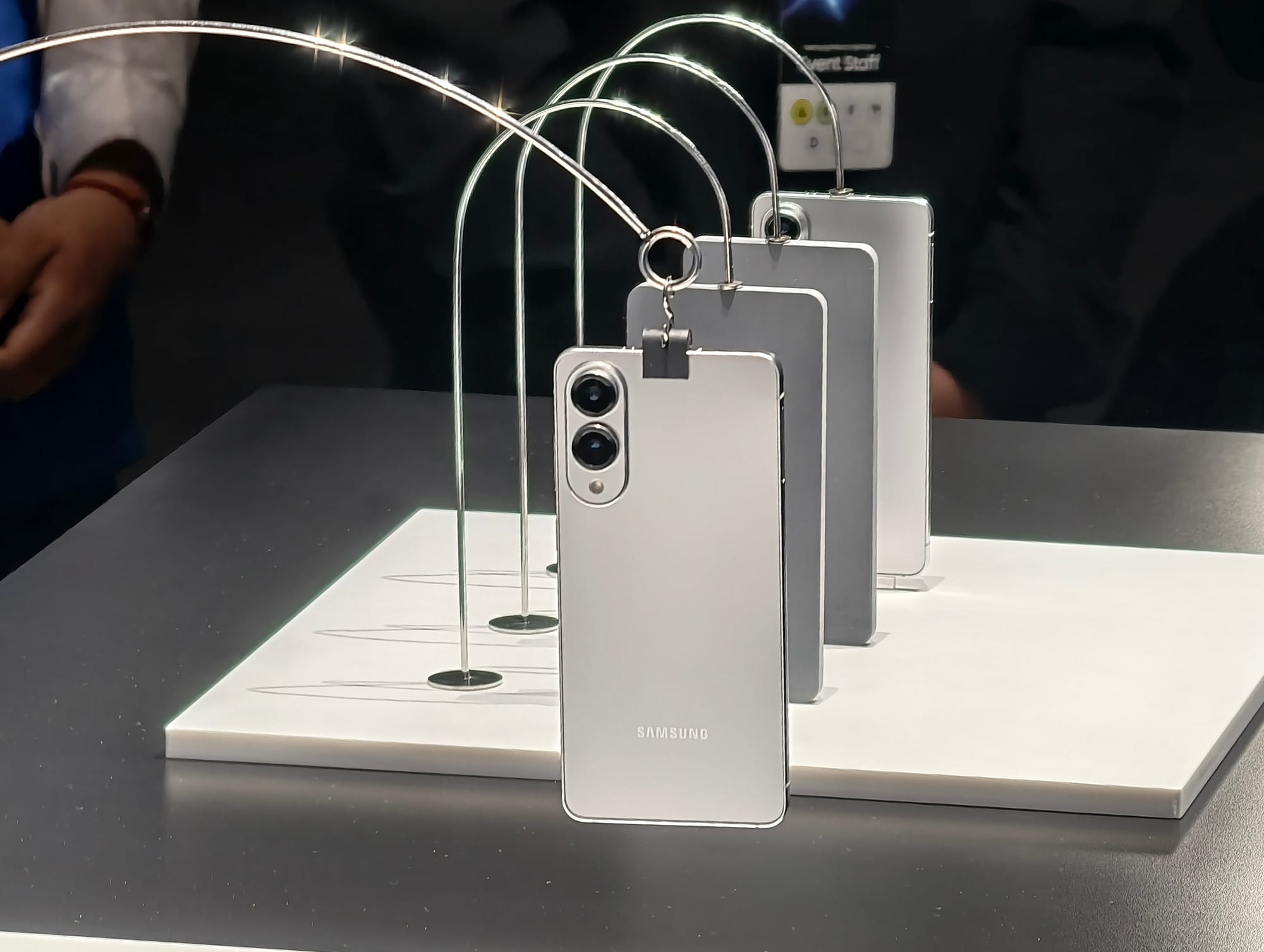
The Samsung Galaxy S25 series is a clear statement of intent. Samsung, leveraging its powerful partnership with Google, is betting heavily on AI to redefine the smartphone experience. While hardware remains important, the S25 series positions AI as the true catalyst for innovation, offering a compelling vision of a more intelligent, personalized, and ultimately, more helpful mobile future. The success of the S25 series will likely hinge on how effectively these AI features translate into tangible user benefits and differentiate Samsung in an increasingly competitive and mature smartphone landscape.
### CES 2025: Nvidia Blackwell RTX & Project Digits
URL: https://creativestrategies.com/research/ces-2025-nvidia-blackwell-rtx-project-digits/
Last updated: 2025-01-10T23:21:11.000Z
**What’s Important:**
- DLSS 4 introduces Multi Frame Generation, exclusive to RTX 50 Series GPUs, increasing frame rates up to 8x.
- A new transformer-based AI model replaces the convolutional neural network, improving stability, motion clarity, and reducing ghosting.
- Enhanced Ray Reconstruction is compatible with all RTX GPUs, improving ray-traced lighting and reflection quality.
- Broad game and application support, with 75 titles confirmed at launch.
- Project DIGITS is a personal AI supercomputer starting at $3,000, delivering up to 1 petaflop of AI performance.
- Equipped with the GB10 Grace Blackwell Superchip and 128GB of unified memory.
- Supports up to 200 billion parameter AI models and scalable to handle 405 billion parameters when linking two systems.
- Includes access to NVIDIA’s AI software stack and supports popular frameworks like PyTorch and Python.
---
The RTX 50 is an interesting card, not just because of the Blackwell silicon improvements on the TSMC 4NP, but because we’re seeing the limitations of silicon improvements being fixed with AI. In terms of silicon improvements, it seems like generation over generation, it’s around 20-40% depending on the card and workload. That’s pretty good, especially as the prices have help improve the overall value of the cards.
---
| Specification | RTX 5090 | RTX 5080 | RTX 5070 Ti | RTX 5070 |
| -------------------- | ---------------- | ---------------- | ------------- | ------------- |
| CUDA Cores | 21,760 | 10,752 | 8,960 | 6,144 |
| Boost Clock | 2.41 GHz | 2.62 GHz | 2.45 GHz | 2.51 GHz |
| Memory | 32 GB GDDR7 | 16 GB GDDR7 | 16 GB GDDR7 | 12 GB GDDR7 |
| Memory Interface | 512-bit | 256-bit | 256-bit | 192-bit |
| Memory Bandwidth | 1,792 GB/s | 960 GB/s | 896 GB/s | 672 GB/s |
| Tensor Cores | 680 | 336 | 280 | 192 |
| Total Graphics Power | 575 W | 360 W | 300 W | 250 W |
| Recommended PSU | 1000 W | 850 W | 750 W | 650 W |
| Price | $1,999 | $999 | $749 | $549 |
| Availability | January 30, 2025 | January 30, 2025 | February 2025 | February 2025 |
---
Of the 4 RTX 50 series cards that Nvidia has announced, 3 of them are cheaper than the earlier generations. The RTX 5070 starts at $549, compared to the RTX 4070 $599\. RTX 5070 Ti is $749, vs RTX 4070 Ti $799\. The RTX 5080 is now $999, down from $1,199 from the RTX 4080\. The RTX 5090 now starts at $1,999, up from the $1,599 of the RTX 4090\. I think these are fair prices for Nvidia to charge. The overall market for GPUs tends to go towards the lower end, with the Nvidia \_\_50, \_\_60, \_\_70 series being the most common video cards in the Steam PC parts survey, with most being 30 and 40 generations.
The best part of these new cards is the net effective performance on the cheaper ones. The RTX 5070 now matches the effective and perceived performance of the RTX 4090, thanks to DLSS 4.
This trend is bringing AI outside of just LLMs, AI agents, and the alike into a practical application of AI in gaming: using a transformer model to generate the vast majority of the pixels in a scene, increasing fidelity and net performance while keeping the prices lower. The raw performance may not be equal, but the net perceived performance is. I think this is an important distinction, because if it looks the same or better (I saw a demo of Marvel Rivals with the RTX 5070 and RTX 4090 side by side, and it does) then it shouldn’t matter if the actual performance is equal.
In terms of actual performance in the silicon, Nvidia has new FP4 datatype accelerators, allowing for native FP4 performance. This means nearly the same quality of inference output in some of the examples, Nvidia showed me a Flux.1 Dev demo with a native FP4 model, and said the quality was nearly identical to the FP8 native model while using around half the memory. This push from Nvidia for FP4 data type expands into the data center as well, and the Project DIGITS supercomputer. It’s more or less the stable of the Blackwell architecture.
Given the vast majority of cards in the Steam PC Spec survey are currently on RTX 30 and 40 series, I think these could be compelling upgrades for quite a lot of gamers. I expect these cards to be incredibly supply restrained, especially since it the TSMC 4NP node, which is the same as the Nvidia B200 data center GPU. With how much demand Nvidia has for the B200 in data center, I’d imagine most of the wafers will be dedicated to the B200 rather than RTX 50 series. It might be a while, and difficult, until gamers are able to get a Blackwell RTX GPU. Gamers are historically very loyal to Nvidia, so even if it takes 6-9 months to get a card, I expect most would rather wait and keep trying than switch to a card from AMD or Intel.
The other announcement, that I frankly think is bigger than the RTX 50 series, is Project DIGITS with the new GB10 chip. It’s a mini-super computer from Nvidia, with a 20-core Arm CPU and Blackwell GPU, connected with NVLink C2C (chip to chip). This was made in partnership with Mediatek, and has 10 Arm Cortex-X925 cores and 10 Arm Cortex-A725 cores, 128GB of Unified Memory, and 4TB of storage. The GB10 looks like a great supercomputer for AI developer and those looking to play around with Nvidia’s tensor acceleration and CUDA architecture.
It launches in May and starts at $3,000, and seems to hint at Nvidia’s broader goal to enter the PC market. There have been rumors for ages of Nvidia working on a PC chip for Windows, and while this is not that chip, it seems like the sort of architecture and what Nvidia will be working on for that market in the future. It could bring some high end competition with Intel, AMD, and Qualcomm to the Windows CPU market and Arm entry into the PC gaming market.
There were a few more launches from Nvidia including the new Thor automotive platform for AI and autonomy, as well as demos of a few robots and partners towards world models and autonomy as well as synthetic data generation for these robots, Nvidia is working on quite a lot towards getting into a more intelligent future.
### The GPU vs. Custom ASIC Competitive Landscape: A Deeper Cost-Performance Analysis
URL: https://creativestrategies.com/research/the-gpu-vs-custom-asic-competitive-landscape-a-deeper-cost-performance-analysis/
Last updated: 2025-02-11T18:35:14.000Z
Recent first-party benchmarking data provides crucial insight into the cost-performance dynamics between custom ASICs and GPUs across both training and inference workloads. The data reveals a nuanced competitive landscape where ASICs demonstrate meaningful cost-performance advantages, particularly in inference scenarios, though the implications for market share are more complex than raw performance metrics might suggest.
**Cost-Performance Dynamics**
##### Log in to keep reading.
###### Not a Client, request access/\* <!\[CDATA\[ \*/ var gform;gform||(document.addEventListener("gform\_main\_scripts\_loaded",function(){gform.scriptsLoaded=!0}),document.addEventListener("gform/theme/scripts\_loaded",function(){gform.themeScriptsLoaded=!0}),window.addEventListener("DOMContentLoaded",function(){gform.domLoaded=!0}),gform={domLoaded:!1,scriptsLoaded:!1,themeScriptsLoaded:!1,isFormEditor:()=>"function"==typeof InitializeEditor,callIfLoaded:function(o){return!(!gform.domLoaded||!gform.scriptsLoaded||!gform.themeScriptsLoaded&&!gform.isFormEditor()||(gform.isFormEditor()&&console.warn("The use of gform.initializeOnLoaded() is deprecated in the form editor context and will be removed in Gravity Forms 3.1."),o(),0))},initializeOnLoaded:function(o){gform.callIfLoaded(o)||(document.addEventListener("gform\_main\_scripts\_loaded",()=>{gform.scriptsLoaded=!0,gform.callIfLoaded(o)}),document.addEventListener("gform/theme/scripts\_loaded",()=>{gform.themeScriptsLoaded=!0,gform.callIfLoaded(o)}),window.addEventListener("DOMContentLoaded",()=>{gform.domLoaded=!0,gform.callIfLoaded(o)}))},hooks:{action:{},filter:{}},addAction:function(o,r,e,t){gform.addHook("action",o,r,e,t)},addFilter:function(o,r,e,t){gform.addHook("filter",o,r,e,t)},doAction:function(o){gform.doHook("action",o,arguments)},applyFilters:function(o){return gform.doHook("filter",o,arguments)},removeAction:function(o,r){gform.removeHook("action",o,r)},removeFilter:function(o,r,e){gform.removeHook("filter",o,r,e)},addHook:function(o,r,e,t,n){null==gform.hooks\[o\]\[r\]&&(gform.hooks\[o\]\[r\]=\[\]);var d=gform.hooks\[o\]\[r\];null==n&&(n=r+"\_"+d.length),gform.hooks\[o\]\[r\].push({tag:n,callable:e,priority:t=null==t?10:t})},doHook:function(r,o,e){var t;if(e=Array.prototype.slice.call(e,1),null!=gform.hooks\[r\]\[o\]&&((o=gform.hooks\[r\]\[o\]).sort(function(o,r){return o.priority-r.priority}),o.forEach(function(o){"function"!=typeof(t=o.callable)&&(t=window\[t\]),"action"==r?t.apply(null,e):e\[0\]=t.apply(null,e)})),"filter"==r)return e\[0\]},removeHook:function(o,r,t,n){var e;null!=gform.hooks\[o\]\[r\]&&(e=(e=gform.hooks\[o\]\[r\]).filter(function(o,r,e){return!!(null!=n&&n!=o.tag||null!=t&&t!=o.priority)}),gform.hooks\[o\]\[r\]=e)}}); /\* \]\]> \*/
### Contact
- First Name\*
- Last Name\*
- Email\*
- Message\*
- This field is hidden when viewing the form
Post requested
/\* <!\[CDATA\[ \*/ gform.initializeOnLoaded( function() {gformInitSpinner( 2, 'https://ghost-production-fd45.up.railway.app/content/images/creativestrategies-com/wp-content/plugins/gravityforms/images/spinner.svg', true );jQuery('#gform\_ajax\_frame\_2').on('load',function(){var contents = jQuery(this).contents().find('\*').html();var is\_postback = contents.indexOf('GF\_AJAX\_POSTBACK') >= 0;if(!is\_postback){return;}var form\_content = jQuery(this).contents().find('#gform\_wrapper\_2');var is\_confirmation = jQuery(this).contents().find('#gform\_confirmation\_wrapper\_2').length > 0;var is\_redirect = contents.indexOf('gformRedirect(){') >= 0;var is\_form = form\_content.length > 0 && ! is\_redirect && ! is\_confirmation;var mt = parseInt(jQuery('html').css('margin-top'), 10) + parseInt(jQuery('body').css('margin-top'), 10) + 100;if(is\_form){jQuery('#gform\_wrapper\_2').html(form\_content.html());if(form\_content.hasClass('gform\_validation\_error')){jQuery('#gform\_wrapper\_2').addClass('gform\_validation\_error');} else {jQuery('#gform\_wrapper\_2').removeClass('gform\_validation\_error');}setTimeout( function() { /\* delay the scroll by 50 milliseconds to fix a bug in chrome \*/ }, 50 );if(window\['gformInitDatepicker'\]) {gformInitDatepicker();}if(window\['gformInitPriceFields'\]) {gformInitPriceFields();}var current\_page = jQuery('#gform\_source\_page\_number\_2').val();gformInitSpinner( 2, 'https://ghost-production-fd45.up.railway.app/content/images/creativestrategies-com/wp-content/plugins/gravityforms/images/spinner.svg', true );jQuery(document).trigger('gform\_page\_loaded', \[2, current\_page\]);window\['gf\_submitting\_2'\] = false;}else if(!is\_redirect){var confirmation\_content = jQuery(this).contents().find('.GF\_AJAX\_POSTBACK').html();if(!confirmation\_content){confirmation\_content = contents;}jQuery('#gform\_wrapper\_2').replaceWith(confirmation\_content);jQuery(document).trigger('gform\_confirmation\_loaded', \[2\]);window\['gf\_submitting\_2'\] = false;wp.a11y.speak(jQuery('#gform\_confirmation\_message\_2').text());}else{jQuery('#gform\_2').append(contents);if(window\['gformRedirect'\]) {gformRedirect();}}jQuery(document).trigger("gform\_pre\_post\_render", \[{ formId: "2", currentPage: "current\_page", abort: function() { this.preventDefault(); } }\]); if (event && event.defaultPrevented) { return; } const gformWrapperDiv = document.getElementById( "gform\_wrapper\_2" ); if ( gformWrapperDiv ) { const visibilitySpan = document.createElement( "span" ); visibilitySpan.id = "gform\_visibility\_test\_2"; gformWrapperDiv.insertAdjacentElement( "afterend", visibilitySpan ); } const visibilityTestDiv = document.getElementById( "gform\_visibility\_test\_2" ); let postRenderFired = false; function triggerPostRender() { if ( postRenderFired ) { return; } postRenderFired = true; gform.core.triggerPostRenderEvents( 2, current\_page ); if ( visibilityTestDiv ) { visibilityTestDiv.parentNode.removeChild( visibilityTestDiv ); } } function debounce( func, wait, immediate ) { var timeout; return function() { var context = this, args = arguments; var later = function() { timeout = null; if ( !immediate ) func.apply( context, args ); }; var callNow = immediate && !timeout; clearTimeout( timeout ); timeout = setTimeout( later, wait ); if ( callNow ) func.apply( context, args ); }; } const debouncedTriggerPostRender = debounce( function() { triggerPostRender(); }, 200 ); if ( visibilityTestDiv && visibilityTestDiv.offsetParent === null ) { const observer = new MutationObserver( ( mutations ) => { mutations.forEach( ( mutation ) => { if ( mutation.type === 'attributes' && visibilityTestDiv.offsetParent !== null ) { debouncedTriggerPostRender(); observer.disconnect(); } }); }); observer.observe( document.body, { attributes: true, childList: false, subtree: true, attributeFilter: \[ 'style', 'class' \], }); } else { triggerPostRender(); } } );} ); /\* \]\]> \*/
### Micron’s Mixed Reality: AI Strength Collides with Consumer Weakness in FQ1 2025
URL: https://creativestrategies.com/research/microns-mixed-reality-ai-strength-collides-with-consumer-weakness-in-fq1-2025/
Last updated: 2024-12-19T17:50:13.000Z
Key Takeaways
- Record Data Center Performance: Data center revenue grew 400% year-over-year and exceeded 50% of total revenue for the first time, highlighting Micron’s successful pivot toward AI-driven markets. HBM revenue more than doubled sequentially with strong margins, and the company has expanded its customer base with high-volume shipments to a second major customer.
- Near-Term Consumer Market Challenges: The company faces more significant headwinds than anticipated in consumer segments, with elevated inventory levels in PC and smartphone markets. This weakness, combined with softness in NAND pricing, led to disappointing Q2 guidance of $7.9B revenue versus consensus of \~$9B.
- Strategic NAND Adjustments: In response to market conditions, Micron is taking decisive action in its NAND business by reducing wafer production by mid-teens percentage and slowing technology transitions. This represents a significant operational shift to manage supply and demand balance.
- Second Half Recovery Thesis: Management expects conditions to improve by spring 2025, driven by multiple factors including normalized customer inventories, continued AI infrastructure buildout, and potential catalysts like Windows 10 end-of-life in October 2025\. The company remains confident in achieving its target of HBM market share matching its overall DRAM share by second half of 2025.
---
Micron delivered a mixed fiscal Q1 2025, reporting in-line revenue of $8.71B but with concerning guidance for the next quarter that highlights both the opportunities and challenges facing the company. The quarter itself showed strong momentum in AI-related segments, with data center revenue growing 400% year-over-year and representing over 50% of total revenue for the first time, driven by robust demand for high-bandwidth memory (HBM) and data center SSDs.
However, the company guided fiscal Q2 revenue significantly below expectations at $7.9B (versus consensus of \~$9B), driven primarily by weakness in NAND flash memory and inventory corrections in consumer markets like PCs and smartphones. The guidance reflects a bifurcation in Micron’s business – while AI-driven segments remain strong, traditional consumer markets are experiencing softness that is more pronounced than previously anticipated.
The bright spot continues to be Micron’s execution in HBM, where revenue more than doubled sequentially in Q1\. The company raised its 2025 HBM market forecast from $25B to $30B and continues to expect the market to grow to over $100B by 2030\. Micron’s HBM3E product is now designed into NVIDIA’s next-generation Blackwell B200/GB200 platforms, and the company has begun high-volume shipments to its second major HBM customer with a third starting in Q1 2025\. Importantly, HBM gross margins are significantly accretive to both DRAM and overall company margins.
On the challenging side, NAND flash memory is experiencing more significant headwinds than expected, leading Micron to reduce NAND wafer production by mid-teens percentage and slow technology transitions. The company is also seeing lumpy demand in enterprise SSDs after several quarters of rapid growth, though this is viewed as temporary given continued AI infrastructure buildout.
The outlook suggests a tale of two halves for fiscal 2025 – after a challenging Q2, Micron expects customer inventories to normalize by spring, enabling stronger bit shipments in the second half of the year. This recovery thesis is predicated on continued strong AI demand, the ramping of HBM production, and an eventual cyclical recovery in consumer markets potentially driven by AI PC adoption and Windows 10 end-of-life in October 2025.
Management remains confident in achieving their target of reaching HBM market share commensurate with their overall DRAM share by second half of 2025, though analysts note some surprise that this timeline wasn’t pulled forward given strong execution. The company expects to generate “multiple billions” in HBM revenue in fiscal 2025, and maintained their capital expenditure guidance of $14B, with most spending directed toward DRAM and HBM capacity.
### With Android XR Google Bets on AI to Accelerate XR Adoption
URL: https://creativestrategies.com/with-android-xr-google-bets-on-ai-to-accelerate-xr-adoption/
Last updated: 2024-12-15T22:35:10.000Z
As we stand on the cusp of a new era of immersive computing, Google’s announcement of Android XR clearly highlights the role AI, Gemini, can play in broadening the use cases and appeal for extended (XR) technologies. This development comes at a time when the XR market is experiencing a surge of innovation and competition, with major players like Apple, Meta, and now Google vying for dominance in this rapidly expanding field.
**I had the opportunity to demo Android XR** both using a VR headset and AR glasses and I must admit I was impressed. Especially considering the phase of development of the platform that is now available to developers. I am not going into any detail about the mixed reality headset that Samsung calls Project Moohan or the glasses I used as these devices were not the final devices that Samsung will be shipping in 2025\. The attention today is on the platform itself and what kind of experiences it empowers for both developers and users.
For Android XR, partnered with Samsung and Qualcomm to cover the full range of XR experiences from the start. Trying out both the VR headset and AR glasses back-to-back was eye-opening. It really drives home the point that VR and AR are not competing for superiority but offering different experiences that suit various needs and preferences. The choice between them often comes down to personal taste, the situation at hand, or the specific experience you are after. This diversity in XR technology suggests a future where users have more options to engage with digital content in ways that best fit their lives and tasks.
##### Taking a Page from Apple’s Playbook
In the world of technology, a recurring lesson is the value of embracing established conventions, especially when they do not directly affect the unique selling points of a new solution. This principle was evident during my hands-on experience with Android XR.
The familiarity was striking, with many interactions mirroring those I had previously encountered in Apple’s Vision Pro. Gestures like pinching and zooming to select items, grabbing corners to resize content windows, and using eye-tracking for selection all felt intuitive and natural. This consistency in user interface design across platforms is not just about imitation; it is about leveraging proven interaction methods that users already understand and expect.
By adopting these familiar gestures and controls, Android XR smartly focuses on user comfort and ease of adoption. This approach allows users to quickly acclimate to the new environment, reducing the learning curve and potential frustration. It is a reminder that in technology, sometimes the best innovation is not in reinventing every aspect of user interaction, but in knowing when to build upon existing foundations to create a seamless and accessible experience.
Another aspect that both Apple and Google share are this XR experience is the important role AI plays in bringing experiences to life. The key difference here is that while Apple has talked about AI being a key differentiating factor in their XR experience, Google is already proving how much richer and broader certain experience are going to be. One of my demos with the AR glasses was looking at a bookshelf and being able to ask Gemini about the “blue book” on the shelf, getting a summary of the book, and being able to then ask for suggestions about similar books I might like. Another interaction equality powerful was having a conversation with a Spanish speaker and seeing the live translation in English displayed in the corner of my glasses. It will be interesting to see what Apple Intelligence will bring to the Vision Pro experience, but I admit the bar Gemini sets is pretty high. Being able to interact my my environment looking at a plant and asking for information about the plant and the best way to keep it healthy in Italian and comfortably switch between English and Italian during the dame conversation was pretty powerful.
The integration of Gemini in experience such as Google Search or Maps promises to make interactions with XR devices more intuitive and context-aware, potentially lowering the barrier to entry for users new to XR technologies. The emphasis on AI-driven interactions could give Android XR a unique edge in the market, especially as AI continues to evolve and improve.
##### Building on Existing Foundations
Exactly on the point of building on foundations, Google is building Android XR on Android across the board. If developers have built for phone, tablet or watch they will find a lot of familiarity in Android XR and lift needed to port will be minimal.
This decision also means that for most users the underlining experience will be familiar like the first time you enter the mixed reality world of Project Moohan you see a familiar layout of the apps you know and use every day on your phone.
Android XR will also incorporate Snapdragon Spaces, Qualcomm’s effort to support developers in the XR space up to now. The partnership with Qualcomm on Project Moohan also means that other vendors such as Sony and Xreal will also be able to leverage the platform going forward without having to start from nothing.
##### A Contextual AI Companion and Multi-Modality
Two other key ingredients to my experience were the context that Gemini acquires and how that context makes my experience richer, more personal and streamlined. The moment I turned on Gemini, I could see a logo and a green light in the middle of the Project Moohan viewer clearly signaling that Gemini could see and hear everything I saw and heard. This is great from a privacy standpoint. I asked Google what happens to the data used during the session and they said nothing is retinaied once you terminate the exchange with Gemini and nothing is used to train their model. Gemini is even able to retain context of things in my view I did not inquiry about or point out to it. For instance, 10 minutes or so after inquirieing about the blue book on the bookshelf I was able to ask Gemini what the tile of the yellow book on the shelf and get and answer, the author and a summary.
Lastly, multi modality of input was also critical in my experience. I was able to use my hands to point to a target as well as just my eyes which is very useful when you might be in a tight or busy environment, think of a coffee shop or a plane. I was also able to switch seamlessly between keyboard and mouse input and hands making navigation a google search page much easier.
##### 2025 Might Finally Be the Time for XR
I am very excited about the launch of Android XR because I believe it does the potential to make XR much more interesting to a broader audience. Considering what I tried were not commenrcial products I am confident Samsung will deliver great hardware because of the experience and understanding they have of the space coupled with their manufacturing apabilities. My demos were all centered around Google apps, Chrome, YouTube, and Maps mostly because this is where Gemini shines, but more will be needed to entice buyers, which is why launching to developers way ahead of the hardware shipping is a great move.
Lastly the intent to hit the market with a Project Moohan first followed by AR glasses will allow to broaden the market faster and by so doing, making it more worthwhile for developers to invest in and in turn providing more value to buyers.
If you have been following my journey, you will know that I have long been skeptical about VR’s potential. Apple’s Vision Pro was the first to nudge me towards reconsidering this stance. Now, after experiencing Google’s Android XR, I can confidently say that my outlook has completely shifted. I am genuinely excited about what 2025 holds for the XR landscape.
The impending rollout of Apple Intelligence to Vision Pro and the launch of Samsung’s Project Moohan are set to redefine our expectations of immersive computing. These advancements promise to bring AI-driven, context-aware experiences that seamlessly blend with our daily lives in ways we are only beginning to imagine.
While multi-modal input is already helping, it will be multi-modal AI that will prove critical to drive adoption into the mainstream as it will meet users where they are at with both habits and comfort level.
You might wonder why I have not mentioned Meta, a significant player in this space. While Meta has made strides with the Quest, I believe they currently lack the comprehensive ecosystem and AI prowess that Apple and Google bring to the table. The Quest, while popular, may struggle to compete with the sophisticated AI integration and seamless user experiences that Vision Pro and Project Moohan are poised to offer. As for Meta’s Project Orion, while very promising, it still seems a considerable distance from mainstream adoption.
The race for XR supremacy is heating up, and it is clear that AI will be the key differentiator. Google’s demonstration of Gemini in XR has set a high bar, showcasing how AI can transform our interaction with both digital and physical worlds. Apple, with its track record of refining user experiences, is sure to bring its own flavor of AI-enhanced immersion to the table.
The skeptic in me has been silenced, replaced by genuine excitement for the potential of these technologies to reshape our digital interactions.
### Vertiv Holdings (VRT) – The Critical Infrastructure Layer Enabling AI’s Next Phase
URL: https://creativestrategies.com/research/vertiv-holdings-vrt-the-critical-infrastructure-layer-enabling-ais-next-phase/
Last updated: 2025-07-31T03:57:08.000Z
Vertiv sits squarely at the intersection of two critical industry dynamics: the exponential growth in AI-driven compute demand and the infrastructure bottlenecks (power and cooling) this demand creates. As AI workloads increasingly strain traditional data center designs, Vertiv’s integrated power and thermal management solutions become essential for operators seeking to scale efficiently and reliably.
**Core Technical Value Proposition**
##### Log in to keep reading.
###### Not a Client, request access
### Contact
- First Name\*
- Last Name\*
- Email\*
- Message\*
- This field is hidden when viewing the form
Post requested
/\* <!\[CDATA\[ \*/ gform.initializeOnLoaded( function() {gformInitSpinner( 2, 'https://ghost-production-fd45.up.railway.app/content/images/creativestrategies-com/wp-content/plugins/gravityforms/images/spinner.svg', true );jQuery('#gform\_ajax\_frame\_2').on('load',function(){var contents = jQuery(this).contents().find('\*').html();var is\_postback = contents.indexOf('GF\_AJAX\_POSTBACK') >= 0;if(!is\_postback){return;}var form\_content = jQuery(this).contents().find('#gform\_wrapper\_2');var is\_confirmation = jQuery(this).contents().find('#gform\_confirmation\_wrapper\_2').length > 0;var is\_redirect = contents.indexOf('gformRedirect(){') >= 0;var is\_form = form\_content.length > 0 && ! is\_redirect && ! is\_confirmation;var mt = parseInt(jQuery('html').css('margin-top'), 10) + parseInt(jQuery('body').css('margin-top'), 10) + 100;if(is\_form){jQuery('#gform\_wrapper\_2').html(form\_content.html());if(form\_content.hasClass('gform\_validation\_error')){jQuery('#gform\_wrapper\_2').addClass('gform\_validation\_error');} else {jQuery('#gform\_wrapper\_2').removeClass('gform\_validation\_error');}setTimeout( function() { /\* delay the scroll by 50 milliseconds to fix a bug in chrome \*/ }, 50 );if(window\['gformInitDatepicker'\]) {gformInitDatepicker();}if(window\['gformInitPriceFields'\]) {gformInitPriceFields();}var current\_page = jQuery('#gform\_source\_page\_number\_2').val();gformInitSpinner( 2, 'https://ghost-production-fd45.up.railway.app/content/images/creativestrategies-com/wp-content/plugins/gravityforms/images/spinner.svg', true );jQuery(document).trigger('gform\_page\_loaded', \[2, current\_page\]);window\['gf\_submitting\_2'\] = false;}else if(!is\_redirect){var confirmation\_content = jQuery(this).contents().find('.GF\_AJAX\_POSTBACK').html();if(!confirmation\_content){confirmation\_content = contents;}jQuery('#gform\_wrapper\_2').replaceWith(confirmation\_content);jQuery(document).trigger('gform\_confirmation\_loaded', \[2\]);window\['gf\_submitting\_2'\] = false;wp.a11y.speak(jQuery('#gform\_confirmation\_message\_2').text());}else{jQuery('#gform\_2').append(contents);if(window\['gformRedirect'\]) {gformRedirect();}}jQuery(document).trigger("gform\_pre\_post\_render", \[{ formId: "2", currentPage: "current\_page", abort: function() { this.preventDefault(); } }\]); if (event && event.defaultPrevented) { return; } const gformWrapperDiv = document.getElementById( "gform\_wrapper\_2" ); if ( gformWrapperDiv ) { const visibilitySpan = document.createElement( "span" ); visibilitySpan.id = "gform\_visibility\_test\_2"; gformWrapperDiv.insertAdjacentElement( "afterend", visibilitySpan ); } const visibilityTestDiv = document.getElementById( "gform\_visibility\_test\_2" ); let postRenderFired = false; function triggerPostRender() { if ( postRenderFired ) { return; } postRenderFired = true; gform.core.triggerPostRenderEvents( 2, current\_page ); if ( visibilityTestDiv ) { visibilityTestDiv.parentNode.removeChild( visibilityTestDiv ); } } function debounce( func, wait, immediate ) { var timeout; return function() { var context = this, args = arguments; var later = function() { timeout = null; if ( !immediate ) func.apply( context, args ); }; var callNow = immediate && !timeout; clearTimeout( timeout ); timeout = setTimeout( later, wait ); if ( callNow ) func.apply( context, args ); }; } const debouncedTriggerPostRender = debounce( function() { triggerPostRender(); }, 200 ); if ( visibilityTestDiv && visibilityTestDiv.offsetParent === null ) { const observer = new MutationObserver( ( mutations ) => { mutations.forEach( ( mutation ) => { if ( mutation.type === 'attributes' && visibilityTestDiv.offsetParent !== null ) { debouncedTriggerPostRender(); observer.disconnect(); } }); }); observer.observe( document.body, { attributes: true, childList: false, subtree: true, attributeFilter: \[ 'style', 'class' \], }); } else { triggerPostRender(); } } );} ); /\* \]\]> \*/
### Qualcomm Q4 2024: Transformation in Full Swing: Q4 Results Showcase Successful Pivot Beyond Mobile
URL: https://creativestrategies.com/research/qualcomm-q4-2024-transformation-in-full-swing-q4-results-showcase-successful-pivot-beyond-mobile/
Last updated: 2024-11-07T03:35:00.000Z
---
Key Takeaways
- **Strong Financial Performance:** Exceeded expectations with $10.2B in Q4 revenue and $2.69 EPS, while delivering record free cash flow of $11.2B for the year. This performance came despite challenging market conditions, demonstrating the company’s operational resilience.
- **Successful Diversification Strategy:** Moving beyond just mobile chips, with remarkable growth in automotive (68% YoY) and IoT segments. The expansion into PCs is gaining significant traction, with platform designs increasing from 20 to 58 in just six months, showing strong OEM adoption.
- **AI-Focused Transformation:** Qualcomm is continuing to reposition itself as a “connected computing company for the age of AI,” securing partnerships with major tech leaders (Microsoft, Meta, Amazon, OpenAI) and launching new AI-capable products across all segments. This strategic shift appears to be resonating with customers and partners.
- **China Market Strength:** Despite broader market concerns about China, Qualcomm is projecting >40% sequential handset revenue growth from Chinese OEMs in Q1 FY2025\. This growth comes even without Huawei product revenue, suggesting strong positioning with other Chinese manufacturers.
- **Positive Forward Outlook:** Guidance suggests continued growth with Q1 FY2025 revenues projected at $10.5-11.3B, anticipating 50% YoY growth in automotive and >20% growth in IoT. The company expects the global handset market to grow by low to mid-single digits in 2024, indicating a stabilizing market environment.
---
Qualcomm’s latest earnings report demonstrates strong financial performance and strategic evolution. The company reported Q4 non-GAAP revenues of $10.2 billion and earnings per share of $2.69, exceeding guidance expectations. The fiscal year 2024 concluded with impressive results, including total revenues of $39 billion and non-GAAP EPS of $10.22, representing a 21% year-over-year growth. The company also achieved a record free cash flow of $11.2 billion, highlighting its robust financial health.
Across business segments, Qualcomm showed notable growth. The handset division generated $6.1 billion in revenue, with Android revenues growing over 20% year-over-year. The IoT segment reached $1.7 billion, marking a 24% increase from the previous quarter, while the automotive division achieved record revenues of $899 million, representing an impressive 68% year-over-year growth and 11% sequential growth.
The company is actively transforming from a wireless communications company into a “connected computing company for the age of AI.” This strategic shift is evidenced by significant partnerships with industry leaders like Microsoft, Meta, Amazon, and OpenAI. Qualcomm has launched several innovative products, including the Snapdragon 8 Elite platform with enhanced AI capabilities, the Snapdragon X Plus A Core Compute Platform for PCs, and new solutions for industrial and automotive applications.
Looking forward, Qualcomm expects global 3G/4G/5G handset units to increase by low to mid-single digit percentage in calendar 2024\. Their Q1 FY2025 guidance projects revenues between $10.5-11.3 billion and non-GAAP EPS of $2.85-3.05\. The company’s diversification strategy is showing strong momentum, particularly in the PC market where they now have 58 platforms in development, up from 20 at launch. The automotive segment is expected to grow 50% year-over-year, while IoT revenues are projected to increase by more than 20%.
The earnings report reflects Qualcomm’s successful execution of its diversification strategy beyond mobile, with growing strength in the automotive, IoT, and edge computing sectors. Their emphasis on on-device AI capabilities across all segments positions them well in the evolving technology landscape. The company appears to be effectively balancing its traditional mobile business while expanding into new growth markets, maintaining strong financial performance while investing in future opportunities.
**View from the Street – Analysis of Investor QA**
Following Qualcomm’s Q4 earnings call, we remain constructive on the company’s execution and strategic positioning, though several key questions emerged during the Q&A session that warrants attention. Management fielded numerous questions about the sustainability of their growth vectors, particularly in automotive and IoT segments, where Qualcomm’s performance notably diverges from broader industry trends. CEO Cristiano Amon provided compelling evidence that the automotive strength stems from design wins and share gains rather than market dynamics, suggesting a more durable growth trajectory than some investors might assume.
The China market emerged as a focal point of analyst inquiries, given the stark contrast between Qualcomm’s robust performance (projecting >40% sequential growth in Chinese OEM revenue) and weaker signals from competitors. Management’s confident response, emphasizing content increases and premium tier expansion, coupled with strong Android revenue growth despite the Huawei headwind, suggests their China strategy remains on solid footing. However, we believe investors should continue monitoring this dynamic, particularly given broader macroeconomic uncertainties in the region.
The IoT segment’s performance, which bucked industry-wide weakness, raised eyebrows among analysts. Management attributed the strength to new product launches across PC, XR, and industrial segments, along with inventory normalization. While encouraging, we’ll be looking for sustained momentum in coming quarters to validate this isn’t merely a temporary boost from channel dynamics.
Perhaps most notably, management addressed the elephant in the room regarding a major customer’s potential internalization of components (widely understood to be Apple). Their matter-of-fact response, maintaining previous assumptions about share reduction to 20% by 2026, suggests they’ve appropriately de-risked this aspect of the business. This transparency is commendable and allows investors to more accurately model future scenarios.
### Arm Q2: V9 & CSS Transform Growth Model
URL: https://creativestrategies.com/research/arm-q2-v9-css-transform-growth-model/
Last updated: 2024-11-07T03:20:22.000Z
---
Key Takeaways
- Strong Value-Based Pricing Power: Demonstrated by smartphone royalty revenue growing 40% despite only 4% unit growth, showing Arm’s ability to capture significantly more value per chip through V9 adoption and pricing power. This decoupling of revenue from units is a fundamental shift in their business model.
- V9 + CSS Creating New Growth Layers: V9 architecture enables continuous price increases through generational improvements (unlike previous versions), while CSS licenses (which can command 2x+ royalty premiums) doubled year-over-year. Current V9 penetration at 25% of royalties provides a substantial runway for growth.
- Licensing Business Healthier Than Expected: Despite a 15% YoY decline, licensing performed better than -25% guidance with ACV up 13% and RPO growing 10% sequentially. Management noted strong demand across all segments driven by AI compute requirements, with 7% annual price increases on ATA contracts.
- Cloud/AI Momentum Building: Major milestones with Microsoft Azure Cobalt and Google GCP Axion are now in general availability, plus NVIDIA Grace Blackwell shipments beginning. Management sees strong synergies between general-purpose Arm computing and AI workloads in data centers driving adoption.
- Maintained Strong FY25 Guidance: Revenue guidance of $3.8-4.1B (18-27% growth) maintained, with high-teens royalty growth expected. Management showed confidence in their visibility, citing 3-5-year customer roadmap visibility and a strong CSS pipeline, particularly in the automotive and mobile sectors.
---
Arm delivered strong Q2 FY25 results with a total revenue of $844 million, exceeding guidance. Royalty revenue grew 23% year-over-year to $514 million, hitting a record level driven by V9 adoption and CSS deployments. Notably, smartphone royalties increased 40% despite only 4% unit growth, demonstrating Arm’s pricing power and value-based strategy. Licensing revenue, while down 15% year-over-year to $330 million, performed better than expected (-15% vs -25% guided) with Annual Contract Value (ACV) growing 13% and RPO up 10% sequentially.
**Guidance and Outlook:**
Management maintained full-year FY25 revenue guidance of $3.8-4.1 billion (18-27% growth) with Q3 revenue expected at $920-970 million. They project high-teens royalty growth for the full year, driven by smartphone mix shifts toward Arm-based chips and CSS ramping. Operating expenses are expected to be around $2.05 billion, representing a 19% increase as they invest in R&D.
**Investor Sentiment:**
Questions focused heavily on three areas: licensing strength/sustainability, V9 adoption trajectory, and China market dynamics. Investors appeared encouraged by management’s detailed explanations of licensing visibility and the structural changes in the V9 business model that enable continued price increases. The clarity around smartphone outperformance (40% revenue growth vs 4% units) seemed to resonate well. However, some skepticism emerged around PC market penetration and AI catalysts, though management maintained confidence in their 50% PC market share goal.
**Market Positioning:**
Management effectively positioned Arm as a key enabler of AI across the computing spectrum, from edge to cloud. They highlighted significant wins with major cloud providers (Microsoft Azure, Google GCP) and NVIDIA’s Grace Blackwell while emphasizing their dominant position in mobile and growing automotive opportunities. The team’s confidence in achieving a 50% PC market share and their detailed explanation of the path to get there suggested strong visibility into future growth drivers.
**Future Catalysts:**
Several growth drivers were highlighted: CSS adoption in mobile and automotive, cloud deployment acceleration, PC market share gains, and AI driving demand across segments. Management appeared particularly confident about smartphone royalty growth continuing to outpace units and the expansion of CSS licensing, which doubled year-over-year. The emphasis on having 3-5-year visibility into customer roadmaps added credibility to their growth projections.
The overall tone of the call was confident but grounded, with management providing detailed support for their growth narrative while acknowledging areas of market weakness (IoT, networking) and competitive challenges. Their ability to quantify value drivers and provide specific customer examples appeared to resonate well with investors seeking to understand Arm’s evolving business model.
### Intel’s Necessary Pain: Why Pat Gelsinger’s Technology-First Turnaround Deserves More Time
URL: https://creativestrategies.com/intels-necessary-pain-why-pat-gelsingers-technology-first-turnaround-deserves-more-time/
Last updated: 2024-11-04T17:53:02.000Z
The recent Reuters article criticizing Pat Gelsinger’s leadership at Intel paints a stark picture of a struggling turnaround, but the reality is far more nuanced. As someone who has followed Intel closely for decades, I believe much of the criticism overlooks both the magnitude of challenges Gelsinger inherited and the fundamental necessity of his technology-first approach to addressing them. While the path hasn’t been perfect, understanding the full context is crucial for evaluating the progress and challenges of Intel’s transformation.
**The Technical Debt Challenge**
First and foremost, Gelsinger inherited what could be described as the largest technical debt paydown in corporate history. The two CEOs prior to Gelsinger took a primarily financial approach to running Intel, focusing on shareholder value and financial prudence rather than technological advancement. While this might have looked good on quarterly statements, it led to a significant technological deficit in both products and foundry capabilities.
**The Technology-First Approach**
Gelsinger’s initial strategy – putting technology back at the center of Intel’s turnaround – was fundamentally correct. As demonstrated by AMD’s successful turnaround under Lisa Su, regaining technological leadership is essential for semiconductor companies. However, there’s a crucial difference: AMD wasn’t saddled with a massive, high-fixed-cost foundry business. Intel’s challenges are considerably more complex.
**The Cost of Innovation**
The “spend whatever it takes” approach to regaining technological leadership has drawn criticism. While there might have been room for more balance between technological investment and financial prudence, the core decision to invest heavily in technological capabilities was necessary. The alternative – continuing to fall behind technologically – would have been far more devastating for Intel’s long-term prospects.
**Signs of Progress**
Recent earnings reports suggest that Intel is making progress on both technological and [financial fronts](https://creativestrategies.com/intel-q3-2024-reset-and-realign-watershed-quarter-marks-shift-from-technical-recovery-to-financial-discipline/). The company is showing more clarity on its strategy, particularly with its foundry business becoming its own subsidiary. They’re also demonstrating increased financial discipline, taking necessary steps like reduced headcount and more strategic spending decisions.
**The Path Forward**
The key for Intel now lies in focusing on its core technological strengths. Rather than trying to compete in every sector, they need to identify where their technological differentiators truly lie and double down on those areas. This might mean making hard decisions about where not to compete, but such focus could be crucial for navigating the challenging years ahead.
**Cultural Transformation**
Perhaps the most significant challenge isn’t technological or financial, but cultural. The company needs to maintain its drive for technological excellence while instilling greater fiscal responsibility throughout the organization. This means being more strategic about spending – from engineering teams to manufacturing decisions – while still maintaining the innovation necessary to compete.
**Conclusion**
While Gelsinger’s tenure hasn’t been perfect, many of the criticisms fail to account for the magnitude of the turnaround required and the necessary costs of regaining technological leadership. The true measure of his leadership will be whether Intel can successfully transform into a more focused, technologically competitive company while maintaining financial sustainability. The early signs suggest they’re on the right path, even if the journey is more challenging and taking longer than some would like.
### Google Q3 2024 Earnings Analysis: AI Monetization Hits Stride as Infrastructure Investments Show Returns, Cloud Margins Expand
URL: https://creativestrategies.com/research/google-q3-2024-earnings-analysis-ai-monetization-hits-stride-as-infrastructure-investments-show-returns-cloud-margins-expand/
Last updated: 2024-11-02T16:15:28.000Z
---
Key Takeaways
- Strong AI Adoption & Monetization: AI Overviews reached 1 billion+ monthly users with ads monetizing at similar rates to traditional search, addressing key investor concerns about the AI transition. Gemini API calls grew 14x in 6 months, while machine costs per query dropped 90% over 18 months despite doubling model size.
- Infrastructure Strategy Delivering Results: Google’s dual-track approach using both NVIDIA GPUs and custom TPUs (now in the 6th generation) is showing efficiency gains. \~60% of technical infrastructure spending went to servers (TPUs/GPUs) and 40% to data centers/networking. Management expressed strong confidence in their TPU roadmap.
- Google Cloud Momentum: Cloud revenue grew 35% YoY to $11.4B with margins expanding to 17%, driven by AI infrastructure and solutions adoption. Customer examples showed significant cost savings (e.g., LG AI Research achieved 50% faster inference and 72% lower costs using TPUs/GPUs).
- Capital Investment Clarity: CapEx was $13B in Q3, with similar levels expected in Q4\. The new CFO provided improved transparency on 2025 infrastructure investments, indicating an increase but not at the same percentage step-up as 2023-2024, helping investors better understand the investment trajectory.
- Strong Overall Financial Performance: Revenue grew 15% YoY to $88.3B with operating margins expanding to 32% despite a $600M real estate charge, demonstrating a successful balance of AI investments and cost discipline.
---
Alphabet delivered a strong Q3 2024 with revenue growing 15% year-over-year to $88.3 billion, demonstrating robust momentum across core businesses. Operating income increased significantly by 34% to $28.5 billion, with operating margins expanding to 32%.
The company’s AI infrastructure strategy and execution was a highlight of the quarter. Management emphasized Google’s differentiated “full stack” approach to AI, combining robust infrastructure, research capabilities, and product deployment. Pichai highlighted the company’s comprehensive AI accelerator strategy, leveraging both NVIDIA GPUs and their custom-built TPUs, now in their sixth generation (Trillium). The dual-track approach appears to be delivering results – Pichai pointed to external Gemini model pricing as evidence of their infrastructure efficiency, noting that costs are notably lower compared to similar capability models from competitors. This was further evidenced by a 90% reduction in machine costs per query for AI Overviews over 18 months, while simultaneously doubling the size of their Gemini model.
Google Cloud’s performance reflected this infrastructure advantage, growing 35% year-over-year to $11.4 billion with operating margins expanding to 17%. The company shared that Gemini API calls have grown 14x over six months, suggesting strong customer adoption of their AI offerings. While management didn’t break out specific training versus inference workload metrics, they did highlight customer examples like LG AI Research, which achieved 50% faster inference processing time and 72% lower operating costs using a combination of TPUs and GPUs.
Capital expenditure strategy and AI infrastructure investment was a major focus for investors. Q3 CapEx was $13 billion, primarily directed toward technical infrastructure, with approximately 60% allocated to servers (including both TPUs and GPUs) and 40% to data centers and networking equipment. New CFO Anat Ashkenazi provided increased transparency around infrastructure spending, noting Q4 CapEx would remain at similar levels with an increase expected in 2025, though likely not at the same percentage step-up seen between 2023 and 2024\. She emphasized the company’s flexibility to use both GPUs and TPUs based on specific customer and internal needs.
Core products showed strong AI-driven momentum. AI Overviews is now reaching over 1 billion monthly users with strong engagement trends. Importantly for investors, ads within AI Overviews are monetizing at similar rates to traditional search, helping allay concerns about potential revenue headwinds from the AI transition. The company also highlighted that 25% of all new code at Google is now generated by AI, demonstrating internal productivity gains from their AI investments.
The Q&A session revealed a strong investor focus on AI monetization and infrastructure efficiency. Management appeared confident in addressing concerns about AI product adoption and scaling. When questioned about Cloud margins, Ashkenazi provided a balanced view, acknowledging the opportunity for further expansion while noting the necessary ongoing investments in infrastructure. Pichai emphasized their forward-looking TPU roadmap, expressing strong confidence in future generations of their custom AI accelerators.
The overall tone of the call suggested management is successfully balancing aggressive AI investments with cost discipline while maintaining their competitive position in AI infrastructure. Numerous analysts raised their 2025/2026 revenue estimates by 1%/1.5% and free cash flow estimates by approximately 7%, reflecting confidence in both near-term execution and long-term strategic positioning in AI. While questions remain about the pace and scale of return on AI investments, analysts appeared satisfied with management’s clear articulation of strategy and improved disclosure around key metrics, particularly regarding their AI infrastructure approach and efficiency gains.
### More Core, More Power: The Apple M4 Pro Advantage
URL: https://creativestrategies.com/research/more-core-more-power-apple-m4-pro-advantage/
Last updated: 2024-11-01T22:40:56.000Z
**Key Takeaways:**
- Focus on performances cores for CPU and increased memory bandwidth.
- Several configurations available for the M4 series chips: M4, M4 Pro, and M4 Max.
- CPU core count varies from 8 to 16 cores, with combinations of performance and efficiency cores, but focus on performance cores at higher end SKUs.
- GPU options range from 8 cores to 40 cores.
- Memory bandwidth varies significantly across models, from 120GB/s to 546GB/s.
---
**Key Specs of Apple M3 vs. M4 Chip Series**
| Chip Model | CPU Core Count | GPU Core Count | Memory Bandwidth (GB/s) | RAM Capacities per SoC | NPU TOPS (int4 Datatype) |
| ------------ | -------------- | -------------- | ----------------------- | --------------------------------- | ------------------------ |
| Apple M3 | 8 (4P + 4E) | 10 | 102.4 | 8GB, configurable to 16GB, 24GB | 36 TOPS |
| Apple M4 | 8 (4P + 4E) | 8 | 120 | 16GB or 24GB | 38 TOPS |
| Apple M4 | 10 (4P + 6E) | 10 | 120 | 16GB or 24GB | 38 TOPS |
| Apple M3 Pro | 11 (5P + 6E) | 14 | 153.6 | 18GB, configurable to 36GB | 36 TOPS |
| Apple M3 Pro | 12 (6P + 6E) | 18 | 153.6 | 18GB, configurable to 36GB | 36 TOPS |
| Apple M4 Pro | 12 (8P + 4E) | 16 | 273 | 24GB, configurable to 48GB | 38 TOPS |
| Apple M4 Pro | 14 (10P + 4E) | 20 | 273 | 24GB, configurable to 48GB | 38 TOPS |
| Apple M3 Max | 14 (10P + 4E) | 30 | 307.2 | 36GB, configurable to 96GB, 128GB | 36 TOPS |
| Apple M3 Max | 16 (12P + 4E) | 40 | 409.6 | 48GB, configurable to 64GB, 128GB | 36 TOPS |
| Apple M4 Max | 14 (10P + 4E) | 32 | 410 | 36GB | 38 TOPS |
| Apple M4 Max | 16 (12P + 4E) | 40 | 546 | 48GB, configurable to 64GB, 128GB | 38 TOPS |
---
This week Apple unveiled the M4 Pro and M4 Max chips, which join the existing M4 chip to expand its lineup for personal computers. These chips use TSMC’s N3E 3-nanometer node, improving performance and efficiency with memory bandwidth up to 546GB/s compared to earlier versions. The new M4 chips also add Thunderbolt 5 support for faster data transfer. The updated chips are now available in Apple’s iMac, Mac mini, and MacBook Pro, enhancing performance for a range of professional and creative uses.
The M4 Pro and M4 Max are built for users with demanding tasks like 3D rendering, AI workloads, and video production. The M4 Pro has a 12-core CPU and a 16-core GPU, while the M4 Max offers a 16-core CPU and a 40-core GPU. Both chips include an upgraded Neural Engine, which is twice as fast as the previous generation, enhancing AI processing capabilities. These chips are featured in the latest iMac, Mac mini, and MacBook Pro, delivering improved performance for both everyday tasks and complex creative work.
The base model M4 chip features an 8-core CPU with four performance cores and four efficiency cores, providing a balance between power and efficiency. With an 8-core GPU and 120GB/s memory bandwidth, the M4 delivers solid graphics performance for a variety of tasks, from everyday computing to creative work. The Neural Engine also enhances AI-related tasks, making it a strong option for users seeking consistent performance in an efficient package.
The M4 Pro and M4 Max MacBook Pro models now have improved battery life, moving from a 22-hour rating to a 24-hour rating, even with the addition of more performance cores in the M4 Pro. This improvement is largely due to Apple’s efficient core design, which continues to lead in performance per watt. The performance cores are now more efficient, and the efficiency cores have been made more capable, allowing the devices to handle intensive tasks without significantly impacting power consumption. This results in better battery life, demonstrating Apple’s focus on optimizing both hardware and software for energy efficiency, even as they enhance raw performance.
### Not All TOPS are Created Equal
Analyzing Geekbench AI scores shows that a higher TOPS (Tera Operations Per Second) value does not always mean better real-world performance. Both Apple’s M4 series and Qualcomm’s Snapdragon Oryon use Neural Processing Units (NPUs) for AI workloads, but efficiency varies. Qualcomm’s NPU is rated at 45 TOPS, compared to Apple’s 38 TOPS, yet Apple’s M4 Max scores higher across various benchmarks.
For single precision tasks, the M4 Max scored 6006, while the Snapdragon-powered Galaxy Book4 Edge scored 2385\. In half-precision, Apple’s M4 Max reached 36,044 versus Qualcomm’s 11,218\. In quantized performance, the M4 Max scored 48,799 compared to Qualcomm’s 22,565\. This suggests that while Qualcomm’s NPU may have a higher theoretical peak, Apple’s hardware, Core ML integration, and Neural Engine provide more efficient and consistent AI performance that yields better effective performance.
While I can’t say for certain why this is quite yet, I believe it has something to do with memory bandwidth, the size of the SLC, and how CoreML optimizes tensor structures for the hardware. Specifically, the overall efficiency might be influenced by how effectively data is managed between memory and the compute units, leveraging the available memory bandwidth and reducing latency in tensor block movement. The SLC cache can help facilitate multiple tensor loads, which allows more efficient use of available processing power by reducing the frequency of memory swaps. When tensor and vector blocks are optimized for this balance, the hardware can perform closer to its theoretical maximum.
Optimizing tensor and vector blocks for NPU hardware is about arranging data to minimize memory access and maximize parallel processing. By efficiently organizing tensors into appropriate block sizes and aligning them with compute units, data movement between memory and processing units is reduced, allowing for better use of memory bandwidth.
Loading tensor blocks in a way that fits well into cache can significantly decrease memory swaps, which is especially important for hardware like the Apple M4 and Qualcomm Snapdragon Oryon, where memory bandwidth and cache size can be limiting factors. The M4’s CoreML likely helps by using the cache effectively and reducing unnecessary memory access, improving throughput.
Ultimately, efficient tensor optimization helps maximize NPU processing power while minimizing latency. By balancing tensor loading and computation, Apple’s M4 chips can achieve strong real-world performance even with fewer theoretical TOPS compared to other hardware, as reflected in the benchmarks.
Put simplify, even if the actual TOPS performance for other hardware, like Snapdragon X Elite or Intel’s Lunar Lake or AMD Strix point, which all have higher TOPS numbers in int4 data types, the Apple M4 still outperforms it due to silicon and software optimizations to maximize the utility of that block of the SoC.
As workloads become increasingly heterogeneous, the entire system-on-chip (SoC), not just the NPU, plays a role in accelerating AI performance. This means that different components—such as the CPU, GPU, and NPU—are all leveraged for AI workloads, contributing to the overall TOPS performance. With more tasks being distributed across multiple cores, including efficiency and performance cores, we are seeing a shift where the entire core architecture is utilized for AI processing. This holistic approach leads to a more effective utilization of computational resources, allowing the SoCs to maximize the total TOPS benefit rather than relying solely on NPU TOPS. The result is a more comprehensive performance boost that better supports modern, diverse AI workloads.
### Tesla AI’s New Architecture with FSD v13 Software Stack
URL: https://creativestrategies.com/research/tesla-ai-autonomy-fsd-v13-update/
Last updated: 2024-11-01T19:37:25.000Z
---
**Key Points**
- **Tesla AI FSD v13 Update Highlights**: Tesla has shipped its latest version to 50,000 customers, enhancing highway autonomy significantly.
- **Version 13 (v13) Upgrade**: v13 introduces major scaling and architecture improvements, including 3x model scaling, audio inputs for emergency vehicles, and a redesigned control system for smoother driving.
- **Silicon Performance**: AI4/HW4 silicon achieves 1.3 Giga Pixels per second of inference power, comparable to or exceeding NVIDIA A100 in key metrics, with near-zero latency.
- **Cortex Supercomputer Expansion**: Tesla deployed 29,000 NVIDIA H100 GPUs with a target of 100,000 GPUs, supported by a new cooling plant with up to 350 MW capability.
- **Gigafactory Supercomputer Power**: The supercomputer at Giga Texas will draw 130 MW initially, scaling to 500 MW, with enough liquid cooling capacity to support this level of power draw.
---
As October comes to a close, Tesla AI has provided a detailed update on their latest software releases and advancements with the Tesla AI FSD v13 Update. These developments highlight Tesla’s commitment to improving Full-Self Driving (FSD) capabilities, leveraging cutting-edge technology, and scaling AI infrastructure. Here’s a quick breakdown of the key accomplishments and we’re the company is headed before the end of the year.
**Recent Accomplishments**
- **End-to-End Highway Driving Deployment**: Tesla successfully shipped the latest version (v12.5.6.1) of its end-to-end highway driving system to approximately 50,000 customers. This release represents a significant milestone in deploying more intuitive autonomous driving experiences for Tesla owners.
- **“We, Robot” Event**: Tesla hosted the “We, Robot” event, during which 50 autonomous Tesla vehicles transported over 2,000 passengers safely. This achievement showcases Tesla’s growing expertise in operating large-scale autonomous fleets in real-world conditions.
**Upcoming Releases and Enhancements**
1. **Full Rollout of End-to-End Highway Driving**: Tesla is preparing to extend the end-to-end highway driving feature to all AI4 users by early next week. Enhancements will include improved stop smoothness, reduced annoyance from bad weather notifications, and other safety-related improvements. This update should provide a more refined and seamless experience for users.
2. **City Driving Model Improvements**: The company is also focusing on improving AI3 city driving models. The new v12.5.x versions will aim to enhance vehicle behavior in complex urban environments.
3. **Actually Smart Summon Expansion**: Tesla plans to release the “Actually Smart Summon” feature to new regions, including Europe, China, and others. This expansion will allow more users worldwide to experience improved summoning capabilities, enhancing convenience and usability.
**Major Upgrades with Version 13 (v13)**
Tesla is gearing up for the release of v13, which is a major architectural overhaul:
- **36 Hz Full-Resolution AI4 Video Inputs**: Improved sensor resolution and processing frequency for better perception.
- **Native AI4 Input and Enhanced Neural Networks**: Updates to the neural network architecture and adoption of AI4 inputs will increase accuracy and responsiveness.
- **Scaling Enhancements**: The v13 release includes 3x scaling of model size and context length, 4.2x scaling of data inputs, and 5x scaling of training compute power, enabled by Tesla’s new Cortex training cluster.
- **Enhanced Collision Avoidance and Navigation**: Using better reward predictions for collision avoidance and smoother navigation, v13 aims to make autonomous driving significantly safer and more reliable.
- **Audio Input for Emergency Vehicle Handling**: New audio input integration will help Tesla vehicles respond more effectively to emergency vehicles.
- **Redesigned Control System**: The controller system has been redesigned for smoother, more accurate tracking, and integrated with unpark, reverse, and park capabilities, making vehicle operations more seamless. This will also allow for users to select where they want the car to end the ride, such as finding a spot in a parking spot, finding street parking, pulling up to a curb, etc.
- **Improved Occlusion and Cleaning Mechanisms for Cameras**: Better handling of camera occlusions will ensure more consistent visual input, particularly in challenging environments.
Tesla’s silicon advancements, particularly with AI4/HW4 enable inference at a rate of approximately 1.3 Giga Pixels per second, achieved in a highly power-efficient manner. The AI4/HW4 hardware stack has been engineered to process high-resolution inputs at 36 Hz, allowing Tesla vehicles to operate with a level of responsiveness and perception that rivals human drivers. This performance is comparable to or exceeds NVIDIA A100 GPUs in key aspects such as latency, where Tesla achieves near-zero latency between photon capture and inference.
**Infrastructure Scaling and Compute Advancements**
In addition to AI model enhancements, Tesla continues to make substantial investments in AI infrastructure:
- **Cortex Supercomputer Training Cluster**: Tesla’s new Cortex supercomputer training cluster, based at Giga Texas, is playing a critical role in scaling FSD’s training compute. The upcoming v13 release is the first to be trained entirely using the Cortex cluster, representing a fivefold increase in training compute scaling.
- **NVIDIA H100 GPU Deployment**: Tesla recently deployed 29,000 NVIDIA H100 GPUs at Giga Texas, which has significantly increased their AI training compute capacity by 75% in Q3\. By the end of October, Tesla expects to expand this capacity to 50,000 H100 GPUs, with a future target of reaching 100,000 H100 equivalent capacity.
- **Cooling Infrastructure Expansion**: As Tesla’s Cortex data center continues to grow, an operational liquid cooling plant at Giga Texas becomes vital to sustain and efficiently manage the increased heat generated by the growing compute resources. The cooling plant is designed with enough liquid cooling capacity to handle up to 500 megawatts, ensuring the infrastructure can accommodate the immense thermal load as compute demands increase. Musk estimates the Gigafactory supercomputer will draw 130 megawatts on deployment, with growth up to 500 MW expected after Tesla’s proprietary AI hardware is also installed.
**Conclusion**
Tesla’s October updates reflect a push towards expanding Full-Self Driving capabilities, particularly with the v13 release set to bring significant model and architectural upgrades and enhancements. The substantial scaling in AI training compute capacity and the integration of new, advanced features in the Tesla AI FSD v13 Update demonstrate Tesla’s holistic approach to autonomous vehicle technology. With the upcoming full rollout of v13.3 aimed for Thanksgiving, Tesla aims to get one step closer to true autonomy. The upcoming infrastructure expansions, including GPU scaling and cooling facilities, will further enhance Tesla’s ability to innovate and deliver new features at an accelerated pace. As we’ve seen with all AI based on transformers to date, compute and data improve end result.
The developments from Tesla AI showcase their ongoing drive to innovate in autonomous driving, while also paving the way for the future of AI and EV integration. These advancements highlight Tesla’s dedication to making autonomous technology a part of everyday life, pushing the limits of what’s achievable, and reinforcing their leadership in the future of AI-powered transportation.
### AMD’s Data Center Surge: Q3 Revenue Doubles as AI Chips Gain Traction
URL: https://creativestrategies.com/research/amds-data-center-surge-q3-revenue-doubles-as-ai-chips-gain-traction/
Last updated: 2024-11-01T19:31:12.000Z
---
Key Takeaways
- Data Center Momentum: AMD’s Data Center segment more than doubled YoY to $3.5B, with the company raising its 2024 Data Center GPU revenue target to $5B+ from $4.5B+. Major wins at Microsoft and Meta demonstrate growing traction in AI acceleration, though still far behind NVIDIA’s dominance.
- AI Product Roadmap Strength: Management expressed confidence in their AI product trajectory, with MI325X launching to compete with NVIDIA’s H200, followed by MI350 series in 2H 2025 targeting Blackwell. The acquisition of ZT Systems will enhance their ability to deliver complete AI infrastructure solutions.
- Server CPU Resilience: Despite concerns about AI/GPU cannibalization, AMD’s server CPU business remains strong with Turin (Zen 5) launch setting 130+ performance records. Enterprise adoption is accelerating with significant growth opportunities, particularly in China where AMD is underrepresented.
- Client Recovery: The Client segment grew 29% YoY to $1.9B, driven by strong Ryzen AI adoption. While Q1 2025 may see typical seasonality, management sees 2025 as positive with AI PCs and Windows 10 end-of-support driving upgrades.
- Confident Outlook: Q4 guidance of $7.5B (+22% YoY) reflects continued momentum, with management demonstrating strong command of their strategic position while acknowledging the multi-year nature of gaining share in AI acceleration against entrenched competition.
---
AMD delivered a strong third-quarter performance, with revenue reaching $6.8 billion, up 18% year-over-year, driven primarily by exceptional growth in its Data Center segment which more than doubled to $3.5 billion. The company raised its 2024 Data Center GPU revenue guidance from $4.5 billion+ to $5 billion+, reflecting strong customer adoption of its MI300 AI accelerators, particularly at Microsoft and Meta. The Client segment also showed robust growth, up 29% to $1.9 billion, while Gaming and Embedded segments experienced declines due to console inventory adjustments and market softness respectively.
Management highlighted several strategic developments during the quarter, including the launch of Turin (Zen 5) server CPUs which set over 130 performance records, the announcement of the MI325X GPU offering 20% better inference performance versus NVIDIA’s H200, and the planned acquisition of ZT Systems to enhance AI infrastructure capabilities. The company also noted strong momentum in AI PCs with expanded Ryzen AI adoption and announced a new semi-custom SoC for the PS5 Pro.
Looking ahead, AMD guided for fourth-quarter revenue of approximately $7.5 billion, representing 22% year-over-year growth, with gross margins holding steady at 54%. The company’s commentary suggested continued strength in Data Center and Client segments while expecting a gradual recovery in Embedded and modest improvements in Gaming. Management’s responses during Q&A effectively balanced optimism about AMD’s competitive position and growth trajectory while maintaining realistic expectations about the pace of market share gains in the AI accelerator space.
**Investor QA Analysis**
Here’s a detailed analysis of the key Q&A exchanges from AMD’s earnings call:
AI/GPU Business Growth & Trajectory
Notable Response from Lisa Su: “Being able to talk about exceeding $5 billion of revenue in 2024, I think we feel really good about that… Going into 2025, we feel great about the market. The market continues to be the place where there are significant CapEx investments.”
**Key Commentary:**
– Clarified Q3 Data Center GPU revenue was “greater than $1.5B”
– Emphasized customer milestones: scale deployment, reliability metrics, workload optimization
– Highlighted meta-expanding from inference to training workloads
– Noted “lumpy” quarters ahead due to large customer deployment patterns
– Stressed software ecosystem improvements and out-of-box performance gains
**Competitive Position vs NVIDIA**
Critical Response from Lisa Su: “MI300, when we launched it was behind H100… and we have with our accelerated road map actually closed a good part of that gap. I think MI325 is a great product. It’s going to compete very well with H200 and the MI350 series will compete very well with Blackwell.”
Management emphasized:
– Easier data center retrofit compared to competitors
– Strong customer interest in their roadmap
– Infrastructure flexibility (air-cooled, liquid-cooled, rack scale options)
– Focus on TCO advantages
– Growing training workload adoption alongside inference
**Server CPU Market**
Key Commentary from Management:
– Enterprise showing “positive growth momentum” for the fifth straight quarter
– Cloud providers adding data center capacity and refreshments
– Strong adoption across product stack (Zen 3, 4, and 5)
– China market represents a significant growth opportunity
– Enterprise sales cycles longer but gaining traction
**Gross Margin Trajectory**
Jean Hu on GPU margins: “Once we continue to ramp the revenue, we do think we’ll have the opportunity to continue to improve gross margin… When you look at our Data Center segment performance, we more than doubled the revenue year-over-year, but we tripled the operating income year-over-year.”
**PC Market Outlook**
Lisa Su on 2025: “I think there’s generally some optimism about the PC market, let’s call it, maybe growing mid-single digits. And within that, we have the AI PC catalyst as well as some of the Windows 10 sort of end-of-support coming in 2025 as catalysts.”
The Q&A revealed management’s strong confidence in their AI strategy while acknowledging the work ahead. Lisa Su was particularly effective at addressing concerns about competitive positioning, using specific customer examples and technical details to support AMD’s strategic direction. The focus on software ecosystem development and customer deployment success suggests AMD is taking a comprehensive approach to building their AI business rather than just competing on hardware specifications.
### Apple’s Q4 FY2024 Earnings: Record Revenue Amid Strategic AI Integration
URL: https://creativestrategies.com/research/apples-q4-fy2024-earnings-record-revenue-amid-strategic-ai-integration/
Last updated: 2024-11-01T03:22:01.000Z
Apple reported a record revenue of $94.9 billion for the September quarter, marking a 6% increase year-over-year. This growth is attributed to strong iPhone sales, significant advancements in services, and geographic segment revenue records in the Americas, Europe, and the rest of Asia Pacific.
Apple’s Q4 2024 performance highlighted growth driven by product innovation and AI integration, resulting in record revenue. Despite the impact of a one-time $10.2 billion tax charge on net income, the focus on enhancing user experience through AI positions Apple for future growth. However, the cautious holiday quarter outlook suggests Apple will need to navigate market challenges and seize emerging opportunities.
---
**Key Takeaways**
- Apple’s services reached an all-time revenue record, growing by 12% year-over-year. The platform now boasts over 1 billion paid subscriptions, reflecting double-digit growth and highlighting the increasing significance of recurring revenue streams for the company.
- Apple continues to highlight its move into the enterprise market. Notable mentions of enterprise adoption include Nvidia’s choice of Mac for its employee program and Novartis selecting iPhone 16 for its standard mobile device. Additionally, UC San Diego Health’s testing of spatial computing apps on Apple Vision Pro in clinical trials showcases Apple’s penetration and innovation in enterprise solutions.
- Apple ended the quarter with significant cash reserves and continued its shareholder return program, declaring a cash dividend and engaging in open market repurchases.
**What’s Significant**
One-Time Tax Charge: Net income was impacted by a $10.2 billion tax charge due to a European Union ruling, resulting in a net income of $14.7 billion.
During the earnings call, invest analysts were curious about Apple’s AI strategy and how it could boost future growth. CEO Tim Cook shared that Apple Intelligence features have been well-received, with adoption rates doubling compared to last year’s updates. That said, there were also some concerns about the holiday quarter, with revenue expected to grow only in the low to mid-single-digit range.
- A potential concern around CaPex growth for 2025 was also called out during the call, with Luca Maestri confirming that investment in AI will continue to occur but that Apple is not quite like other players as only Apple Intelligence workloads use Apple’s Private Cloud Compute.
- Apple highlighted its progress towards carbon neutrality with the introduction of a carbon-neutral Mac and the option for a carbon-neutral Apple Watch, reflecting its continued commitment to environmental sustainability.
**Key Numbers**
**Financial Performance:**
- Revenue: $94.9 billion, a 6% increase year-over-year.
- Net Income: $14.7 billion, impacted by a $10.2 billion tax charge.
- Earnings Per Share (EPS): Adjusted EPS, excluding the tax charge, stood at $1.46, aligning with analyst expectations.
**Business Highlights:**
- iPhone 16 Series: Launched in September, the iPhone 16 lineup has seen strong initial sales, contributing to a 5.5% increase in iPhone revenue, totaling $46.2 billion.
- Services Segment: The services division achieved a record $24.97 billion in revenue, reflecting an 11.9% year-over-year growth, driven by increased subscriptions and service offerings.
- Geographical Performance:Sales in China experienced a slight decline of 0.3%, possibly due to the fact that Apple Intelligence is rolling out in 2025 might delay iPhone upgrades.
- In the recent quarter, Apple’s Mac revenue increased by 2% year-over-year, reaching $7.7 billion, largely driven by the MacBook Air with the M3 chip, which attracted many first-time Mac users, with half of its buyers being new to the platform. Meanwhile, the iPad segment also saw a robust 8% increase in revenue, totaling $7 billion.
- Revenue for Apple’s category encompassing wearables and accessories totaled $9 billion, reflecting a 3% decline year-over-year. Despite this, the launch of the all-new Apple Watch Series 10 has continued to attract new customers, with over 75% of buyers being new to the Apple Watch.
**Outlook:**
Apple’s outlook for the December quarter is cautiously optimistic, projecting low to mid-single-digit revenue growth year-over-year and expecting double-digit growth in services revenue. Tim Cook said he is optimistic about easing supply constraints on thei Phone 16 lineup that the company experienced in October. Cook also called out Apple Intelligence as an upgrade driver across the product families of Mac, iPad and iPhone.The staggered release of Apple Intelligence across different regions introduces complexity into forecasting future upgrade cycles, both from a market expectation and production standpoint. This phased approach, while ensuring quality and regional relevancy of features, suggests a meticulous strategy by Apple to balance innovation rollout with operational execution.
### Microsoft Earnings Q1 FY2025 Reflect Strategic AI Investments Amidst Cloud Growth
URL: https://creativestrategies.com/research/microsoft-earnings-q1-fy2025-strategic-growth-amidst-market-challenges/
Last updated: 2024-11-01T02:21:16.000Z
In Q1 FY2025, Microsoft emphasized its commitment to artificial intelligence (AI) and cloud services, aligning with its long-term vision of integrating AI across its product suite. The company reported a 16% increase in revenue to $65.6 billion, with net income rising 11% to $24.7 billion. This growth underscores Microsoft’s strategic focus on AI and cloud computing as key drivers of future profitability.
---
**Key Takeaways**
- Revenue Growth: With total revenue reaching $65.6 billion, marking a 16% increase from the previous year, Microsoft has exceeded analysts’ expectations. This growth is primarily attributed to the robust expansion of its cloud segment.
- Cloud Services Expansion: Azure and other cloud services revenue grew by 33%, driven by heightened demand for AI capabilities.
- AI Demand Outpaces Capacity: The company is experiencing AI demand that exceeds its current capacity, prompting significant investments in infrastructure. Early adoption signals remain strong, however, helping weakening concerns that AI uptake is a bubble, making the investments necessary to foster continued growth.
- Gaming Revenue Surge: Xbox content and services revenue increased by 61%, bolstered by the Activision acquisition, despite a 29% decline in hardware sales.
- Investor Concerns: Despite strong earnings, shares fell over 5% due to concerns about potential deceleration in cloud growth and the substantial capital expenditures required for AI infrastructure. The forward-looking statements addressed “challenges in supply chain” logistics for data center infrastructure which will affect the company’s ability to meet demand in the upcoming quarter. However, Microsoft’s CEO, Satya Nadella, showed optimism about resolving these issues in the latter half of the fiscal year.
---
**What’s Significant**
Strategic and Operational Moves:To meet the surging demand for AI services, Microsoft invested $14.9 billion in capital expenditures this quarter, primarily for data center expansion. This represents a 50% increase from the same period last year. The company also restructured its reporting segments, moving certain enterprise software businesses into the Microsoft 365 Commercial segment to better reflect its AI and cloud service offerings.
Product and Market Updates: Microsoft’s AI initiatives have gained significant traction, with Azure’s OpenAI service usage more than doubling in the past six months. The AI business is projected to reach an annual revenue run rate of $10 billion by the second quarter, marking it as the fastest-growing segment in the company’s history. In the gaming sector, the acquisition of Activision has contributed to a 61% increase in Xbox content and services revenue, despite a decline in hardware sales.
Strategic Partnerships Expansion: Microsoft expanded its network of partnerships, most notably with Nvidia and SAP. These alliances focus on enhancing cloud interoperability and advancing AI capabilities in data centers, allowing Microsoft to offer more robust solutions to enterprise clients and stay ahead in the competitive tech landscape.
**Key Numbers**
**Financial Performance:**
- **Revenue:** $65.6 billion, a 16% year-over-year increase.
- **Net Income:** $24.7 billion, up 11% from the previous year.
- **Earnings Per Share (EPS):** $3.30, exceeding analyst expectations.
- **Capital Expenditures:** $14.9 billion, primarily for AI and cloud infrastructure.
**Business Highlights:**
Cloud and AI Innovations: Microsoft prioritized the development of Azure’s AI capabilities, launching features catering to industries such as finance, healthcare, and manufacturing. These innovations not only meet current market demands but also position the company for long-term leadership in emerging tech sectors.
Advanced Cybersecurity Measures: Investing heavily in cybersecurity, Microsoft acknowledges the growing importance of data security in the digital age. Initiatives have included enhancing built-in security features of Windows and Azure, as well as introducing advanced threat protection tools, ensuring that Microsoft leads in offering secure, reliable solutions.
- Gaming Division Performance: The gaming sector showed robust performance, thanks in part to the successful launch of new titles and enhancements of the Xbox platform. This success highlights Microsoft’s strategy of leveraging content and services to drive growth, with gaming revenues contributing significantly to the More Personal Computing segment.
**Outlook:**
Microsoft’s outlook remains optimistic yet cautious, as it navigates a dynamic economic environment. The company plans to continue expanding its investments in AI and cloud solutions, recognizing these as the primary engines of future growth. The strategic partnerships established are expected to produce significant technological advancements and competitive qualifications. While potential economic challenges persist, Microsoft’s adaptability and innovative pipeline position it to sustain growth and deliver value, reinforcing its commitment to excellence and customer satisfaction in an ever-evolving tech landscape.
To sustain and enhance investor confidence, Microsoft should actively showcase compelling case studies that highlight the significant financial returns from Copilot+ deployments across diverse business sectors. These real-world success stories can powerfully demonstrate the tangible benefits and value that Copilot+ brings to organizations. Moreover, as Microsoft diversifies its product offerings, it is crucial to strategically adjust investor expectations for products with unique upgrade or deployment cycles, distinct from traditional revenue drivers such as Windows licenses. By aligning growth narratives with these evolving product dynamics, Microsoft can reinforce its position as a forward-thinking industry leader.
### Intel Q3 2024: “Reset and Realign” – Watershed Quarter Marks Shift from Technical Recovery to Financial Discipline
URL: https://creativestrategies.com/research/intel-q3-2024-reset-and-realign-watershed-quarter-marks-shift-from-technical-recovery-to-financial-discipline/
Last updated: 2024-11-01T17:59:42.000Z
---
Key Takeaways
- Massive Financial Reset: Over $20B in one-time charges and $10B+ cost reduction by 2025, marking fundamental pivot from technical catch-up to profitability focus
- AWS Deal: Multi-billion dollar commitment for custom Xeon and AI fabric chip validates Intel’s foundry strategy with premier cloud customer
- AI PC Strategy Impact: Lunar Lake’s high-volume success comes with significant gross margin pressure due to integrated memory design, though this is a one-time design choice
- Mixed AI Position: Strong in CPU-based AI workloads (70%+ share in head nodes) but struggling with Gaudi3 accelerator adoption, missing $500M target
- Manufacturing Insourcing: Bringing 70%+ of production back in-house with 18A/Panther Lake, critical for margin improvement in 2026+ but depends on successful execution
---
Intel delivered a quarter marked by strategic restructuring and operational progress. Revenue exceeded the midpoint of guidance, though profitability was impacted by significant restructuring charges as the company aggressively moves to lower costs and improve efficiency. The company made substantial headway on its cost reduction initiatives, targeting over $10 billion in savings by 2025, including completing the majority of planned headcount reductions aimed at a 15% workforce reduction.
On the strategic front, Intel announced several major organizational changes, including moving the Edge business into CCG and establishing Intel Foundry as an independent subsidiary. Capital expenditures were reduced by over 20% from initial 2024 plans, reflecting a more disciplined approach to investment. Product-wise, the company launched several key offerings including the Core Ultra 200 V Series (Lunar Lake) processors and Gaudi3 AI accelerator, though Gaudi adoption has been slower than anticipated. The company remains on track to ship 100M AI PCs by the end of 2025.
The quarter saw significant financial charges, including $3 billion in impairment charges mostly related to Intel 7, a $10 billion deferred tax asset impairment, $2.6 billion Mobileye goodwill impairment, and $2.2 billion in severance charges. These charges reflect the company’s aggressive restructuring efforts to position for future growth.
**On Gross Margins: Why Not report Adjusted GMs?**
Intel’s decision to report an 18% gross margin (including the $3.1B of 7nm manufacturing asset write-downs) rather than the adjusted 41% margin appears questionable from a standard reporting perspective, but may reflect a few strategic considerations:
- Conservative Accounting & Transparency:
- By including the full $3.1B write-down impact, Intel is being maximally conservative and transparent about real manufacturing challenges and costs
- This shows investors they are being upfront about technology transition difficulties rather than trying to mask them through adjustments
- Setting Future Expectations:
- By taking the full hit now, Intel creates an easier comparison base for future quarters
- The 18% reported margin sets a low baseline, making future improvements look more impressive
- This ties to management’s comments about gross margin headwinds persisting into next year but improving in 2026
- Strategic Messaging:
- The dramatic margin impact helps reinforce Intel’s broader narrative about the significant investments and costs required for their manufacturing transformation
- It provides tangible evidence of their commitment to the foundry strategy despite near-term financial pain
- May help in discussions with government entities regarding subsidies by highlighting the real costs involved
- However, the analysts appear somewhat skeptical of this approach, noting that excluding the write-down would have resulted in margins of approximately 41% vs guidance of 38%. This suggests Intel could have chosen to report adjusted figures to show better underlying business performance.
The key insight is that Intel seems to be prioritizing sending strategic messages about its manufacturing transformation over presenting optimized financial metrics, even if it means absorbing significant near-term hits to reported margins. This plays into their longer-term story about returning to process leadership, even at the cost of near-term results.
**Analysis of Q&A Sentiment and Management Responses:**
Investors focused heavily on several key areas: the progress of Intel 18A development, gross margin trajectory, AI strategy and competitiveness, foundry business development, and capital allocation. Management provided detailed technical responses about 18A development, showing confidence in the technology roadmap while being realistic about timeline and execution challenges.
The discussion of financial metrics was particularly noteworthy, with management providing clear explanations of gross margin pressures, especially related to Lunar Lake’s memory packaging impact. They were forthright about near-term challenges while emphasizing the path to improvement in 2026 and beyond.
On AI strategy, management articulated a measured view of Intel’s position, acknowledging areas where they need to improve (like Gaudi adoption) while emphasizing their strengths in CPU-based AI workloads and the growing importance of inference versus training. The foundry discussion revealed steady progress in securing new customers, though management was careful to set realistic expectations about the pace of revenue growth.
Overall, the Q&A reflected cautious optimism from investors balanced against ongoing execution concerns. Management’s responses suggested confidence in their technical roadmap while acknowledging the significant work still ahead. Their emphasis on cost discipline and portfolio rationalization appeared to resonate with analysts, though questions remain about the pace and magnitude of financial improvement. The tone was notably more focused on sustainable business model results and shareholder returns compared to previous quarters’ emphasis on technological catch-up.
### Artificial Intelligence – Arm at the Forefront of Heterogeneous Computing
URL: https://creativestrategies.com/research/artificial-intelligence-arm-at-the-forefront-of-heterogeneous-computing/
Last updated: 2024-10-31T19:34:50.000Z
The artificial intelligence revolution is reshaping the computing landscape, with profound implications for processor architecture and data center infrastructure. As AI systems grow increasingly sophisticated—from large language models to advanced reasoning agents—they are driving unprecedented demands for computational power. This evolution is particularly significant for CPU designers and manufacturers like Arm, who find themselves at the intersection of two critical trends: the need for specialized AI acceleration and the fundamental requirement for powerful host processors to support these new workloads. The relationship between AI development and CPU architecture has become more intricate and consequential than ever before, creating both challenges and opportunities in the quest to build more capable and efficient computing systems.
The rise of artificial intelligence, particularly generative AI and large language models (LLMs), represents a significant catalyst for Arm’s growth in the data center. These workloads are computationally demanding and require specialized hardware to operate efficiently. We know that a truly excellent host CPU is necessary to get the full compute capability of any AI accelerator, whether that accelerator be a GPU or a custom designed one like Google’s TPUs, Microsoft Maia and AWS Tranium and Inferentia.
While we are still only in the very early stages of AI development and mass deployment we are constantly reminded of how much can change in short amounts of time. It’s only been a few years since ChatGPT was launched into the world and the underlying foundational models which were developed since then have used a range of workloads that balance between the CPU and the GPU. However, it appears we are on the cusp of an entirely new foundational model approach that will only deepen the complexity of AI inference and require even more purpose built CPU architectures.
These new Advanced AI models are now capable of producing chains of thought before responding to queries, enabling more thoughtful and task-oriented inference. This “advanced reasoning” approach, demonstrated in Open AI’s 01 model, allows models to spend more time processing before generating outputs, resulting in improved performance. However, this comes at the cost of significantly increased computational demands, with some estimates suggesting up to 10 times higher inference compute costs compared to previous models. The long-term vision involves enterprises employing numerous “agents” capable of handling complex tasks, necessitating both more sophisticated training and increasingly advanced inference capabilities. This trend extends to previously “solved” domains like computer vision, where achieving human-level understanding and interpretation now requires much more intricate computational processes. The overall trajectory points towards AI systems that can engage in more nuanced, multi-step reasoning, but at the expense of substantially higher computational requirements.
Arm’s architecture, with its focus on energy efficiency, scalability, and customization, is well-suited to provide customers the foundational technology needed to address these demands.
- Arm processors are well equipped with highly efficient modern data types and vector operations that give them significant capabilities for performing inference in their own right – where latency or other concerns prohibit or make offload inefficient
- Arm’s technology is unique in offering the ability for adopters to explore higher-bandwidth, extremely low latency integration to GPU or NPU accelerators. Any accelerator will always still require CPU support for the surrounding business application, orchestration and the various pre & post-inference stages of the complete ML stack.
**AI-Driven Demand:** As this report has highlighted, AI workloads are changing the shape of the compute demands across multiple compute blocks. We firmly believe that these workloads will best be served by a symbiotic approach where the CPU, GPU, Accelerator, networking, and more are all working in cohort. Arm’s flexibility, while still
1. **Heterogeneous Compute:** Arm-based CPUs are proving to be excellent companion processors for AI accelerators like GPUs and TPUs, managing data flow and general-purpose compute tasks efficiently and playing a critical role in dealing with any bottlenecks in the workflow.
2. **Inferencing Efficiency:** While training large AI models often relies on high-performance GPUs, Arm’s energy-efficient processors are well-suited for inferencing tasks, both at the edge and in data centers.
3. **Scalability:** Arm’s architecture enables seamless integration of CPUs, GPUs, and specialized accelerators, critical for optimized AI systems.
**Rapid Adaptation to AI Requirements:**
In today’s rapidly evolving AI landscape, processor architecture plays a crucial role in determining the efficiency and effectiveness of AI systems. Arm has emerged as a key player in this space, offering a compelling combination of innovation, customization, and energy efficiency. Their approach addresses three critical aspects of modern AI computing:
1. Consistent Innovation: Arm’s regular release of new CPU architectures and focus on enabling custom silicon trend aligns with the evolving requirements of AI workloads.
2. Customization Potential: As AI models grow in complexity and scale, Arm’s flexibility allows for the creation of specialized solutions tailored to specific AI tasks.
3. Energy Efficiency: The power efficiency of Arm-based processors becomes increasingly valuable for managing the total cost of ownership of large-scale AI deployments.
**Conclusion: The Dawn of a New Era in Data Center Computing**
As we close out 2024, the confluence of evolving workloads, rapid innovation, and the demands of AI are creating a perfect storm for Arm’s continued role in the data center as well as the reliance on Arm custom semiconductor solutions from the largest hyperscalers in the world like Microsoft, Amazon, and Google. While x86 processors will undoubtedly continue to play a significant role, the trend towards Arm-based solutions is accelerating.
The maturation of the Arm software ecosystem represents a critical inflection point, removing one of the primary historical barriers to adoption. This software parity, combined with Arm’s inherent advantages in power efficiency and customization potential, suggests that 2024 may indeed mark the beginning of a new era in data center computing.
The flexibility of Arm’s IP and CSS model, its focus on energy efficiency and customization, and the growing support from major players like Amazon, Microsoft, Google, and NVIDIA all contribute to Arm’s potential to capture a substantial portion of the data center market in the coming years. As the debate shifts from “x86 versus Arm” to a more nuanced discussion of total cost of ownership and performance efficiency, Arm is well-positioned to compete on an increasingly level playing field.
While challenges remain and the transition will not happen overnight, the signs point to 2024 as a potential tipping point in the data center market. Arm’s journey from mobile devices to the heart of the data center appears to be reaching a critical milestone, heralding a new era of diverse, efficient, and highly customized computing solutions for the evolving demands of the digital age.
*\*This white paper was commissioned by Arm. The insights and analyses provided are based on research and data obtained through collaboration with Arm, their partners, and third-party developers. The goal of this paper is to present an unbiased examination of Arm’s technical position in the industry and growth prospects in the data center. While Arm has provided support for this research, the findings and conclusions drawn in this document are those of Creative Strategies, Inc and do not necessarily reflect the views of Arm.*
### Arm’s Software Ecosystem: Growing Breadth of Support for Critical Workloads
URL: https://creativestrategies.com/research/software-ecosystem-growing-breadth-of-support-for-critical-workloads/
Last updated: 2024-10-31T19:36:39.000Z
The server computing landscape is undergoing a fundamental transformation, challenging long-held assumptions about architectural dominance. While x86 processors have historically commanded the server market through their extensive software ecosystem and compatibility advantages, the rise of cloud computing and modern development practices has dramatically altered this paradigm. Today, we’re witnessing a shift as Arm-based processors gain traction in the server market, backed by substantial investments from major cloud providers and technology leaders. This evolution isn’t merely about hardware alternatives—it represents a broader technological convergence where cloud-native development practices, containerization, and standardized tools are creating a more architecture-agnostic computing environment.
The historical advantage of x86 in terms of software compatibility is rapidly diminishing, particularly in the cloud-native era. One of the most crucial factors driving the growing presence of Arm-based processors in the server market is the significant investment made by ecosystem participants, mainly the large hyperscalers (Microsoft, Amazon, and Google) as well as key infrastructure players like Nvidia and Oracle as well that is further expanding and supporting the Arm software ecosystem.
1. **Ease of Use:** A 2022 financial analyst report stated: “Whereas in 2018, it was painful to get Arm CPUs working, in 2022 they feel much more like x86 servers.”
2. **Linux Compatibility:** According to Amazon, Arm support for Linux is now largely complete, with more than [98% of packages in the Debian](https://wiki.debian.org/Arm64Port?t&ref=creativestrategies.com) distribution fully compatible with the arm64 architecture.
3. **Cloud-Native Development:** Modern applications are increasingly built using cloud-native principles, which are inherently more portable across architectures.
4. **Container Technologies:** Widespread adoption of containerization (e.g., Docker), CI/CD (e.g., GitHub) tools and orchestration platforms (e.g., Kubernetes) has enabled frictionless multi-architecture builds for developers.
**Ecosystem Support:**
The Arm ecosystem has evolved into a comprehensive software environment, supported by a rich array of tools, enterprise applications, and cloud services. From development utilities to enterprise-grade software, and from open-source frameworks to cloud infrastructure, the platform now offers a mature, production-ready foundation for diverse computing workloads. This robust support spans across multiple layers of the software stack, making Arm-based systems an increasingly practical choice for organizations of all sizes. For example:
- **Porting Tools:** Amazon supports a Porting Advisor for Graviton (a fork of Arm’s more general Porting advisor project) compatible with Python, Java, Go, and C/C++.
- **Enterprise Software Support:** Many critical enterprise software packages now support Arm architecture natively:
- Arm’s Software Ecosystem Dashboard lists over 700 OSS and ISVs that support Arm
- Ampere Computing lists over 140 workloads natively supported across various cloud and OEM providers with Ampere’s Arm-based servers.
- These workloads cover many popular and important enterprise platforms, including NGINX, Redis, Postgres, GitLab, MySQL, and MongoDB.
- [Amazon lists](https://github.com/aws/aws-graviton-getting-started/blob/main/transition-guide.md?t&ref=creativestrategies.com) more than 60 independent software vendors publicly supporting arm64 or Graviton.
- **Open-Source Support:** 100s of open-source projects and frameworks now offer robust support for Arm architecture.Arm architecture is natively supported across the entire open source software stack such as:
- Major languages such as Java, Go, .NET, C/C++, Rust, PHP, and Python.
- Libraries and frameworks including Machine Learning frameworks such as Tensorflow, Pytorch, ONNX, JAX
- Cloud workloads such as web tier, caching, databases, HPC/EDA, media and gaming
- **Compiler Advancements:** Improvements in cross-compilation tools have made it easier to port existing x86 applications to Arm when necessary.
- **Multi-Cloud:** the availability of Arm architecture in every leading cloud (AWS, Microsoft Azure, Google, Oracle Cloud Infrastructure) eliminates another barrier to adoption, for enterprises with a preference for a particular cloud vendor, or for those needing multi-cloud support.
Another interesting angle being observed that is helping Arm’s momentum is the rise in Arm based notebooks and desktops at use in the market. For four years, this has been driven by Apple which has seen an increase in Mac’s installed base along with Arm based computers in both consumer and commercial applications. Also this year, Arm-based AI PCs came to market and was rapidly adopted by many OEMs with more than 50 Windows PC OEM designs now in-market. With both Mac and Windows based Arm notebooks and desktops in the market that only helps bolster the ecosystem support, especially for developers writing Arm based applications, and add more momentum for Arm’s adoption in cloud and client computing.
[The introduction of Arm-native runners in GitHub’s CI/CD framework](https://newsroom.arm.com/blog/github-arm-integration?t&ref=creativestrategies.com) also represents a significant catalyst for Arm’s growing momentum in the broader computing ecosystem. This development addresses a crucial pain point for developers, making it easier to create, test, and deploy Arm-compatible software at scale. By removing barriers to Arm-native development, it encourages a wider range of developers and organizations to embrace the Arm architecture, potentially leading to a surge in Arm-optimized applications and libraries. This, in turn, creates a positive feedback loop: as more software becomes available and optimized for Arm, it increases the attractiveness of Arm-based hardware for both consumers and enterprises. Combined with Arm’s existing strengths in energy efficiency and the increasing adoption of Arm-based chips in various sectors – from mobile devices to cloud computing and edge AI – this enhanced developer support could accelerate Arm’s penetration into traditionally x86-dominated markets. Ultimately, this seemingly technical improvement in CI/CD infrastructure could be a pivotal factor in solidifying Arm’s position as a mainstream computing architecture across diverse computing environments, from embedded systems to high-performance servers.
Next: [**Artificial Intelligence – Arm at the Forefront of Heterogeneous Computing**](https://creativestrategies.com/artificial-intelligence-arm-at-the-forefront-of-heterogeneous-computing/)
### Arm in the Data Center: The Dawn of a New Era
URL: https://creativestrategies.com/arm-in-the-data-center-the-dawn-of-a-new-era/
Last updated: 2024-10-31T19:49:10.000Z
**Introduction: 2024 – The Tipping Point for Arm’s Data Center Momentum**
As we close out 2024, the semiconductor industry is witnessing a significant shift in the data center market. AI is the most important technology platform shift we have seen in a decade, and perhaps longer. This fundamental shift is causing the entire technology industry to begin to rethink its infrastructure and at the heart of that infrastructure is the silicon which powers this new AI era of computing. The impact of this reality is that the vast majority, if not all, of data center infrastructure needs to be upgraded, and in many cases redesigned. Computing backend infrastructure is moving away from a general-purpose platform to more specialized solutions built with AI workloads in mind. With any new platform shift, it opens the opportunity for incumbents to be disrupted as customers will consider any and all technology vendors. Moats that once existed may no longer be as wide or deep. It is within this context we look at the ways Arm-based processors are gaining traction in the data center. While Arm has been touted as a potential contender for years, several factors suggest that this time is different, with 2024 potentially representing the “tipping point” for Arm’s adoption in the data center.
**Market Growth and Proof Points:**
While much of the data center semiconductor content growth is coming from GPUs and AI accelerators, there is still growth to be had in CPUs. What is interesting, however, is during this time of infrastructure turnover the market seems to be segmented into AI servers and general-purpose (non-AI servers). Each category still needs a host CPU, however, the ratio of CPU to GPU or accelerator in AI servers may very well drop from general-purpose servers which have more CPUs to GPUs. This is one reason the data center CPU market is only projected to grow at 3% CAGR for the next four years.
However, the bright spot in CPU datacenter growth is Arm-based CPUs which are poised to outgrow the market.
## The Rise of Arm in the Server Market
While the overall server market shows steady growth, Arm-based servers are experiencing a meteoric rise. Forecasts from Wells Fargo project:
- Arm server shipments are forecast to skyrocket from 7.1% of shipments in 2023 to 22% of shipments by 2027.
- This represents a CAGR of 40% for Arm-based server shipments.
- In terms of market share, Arm-based servers are expected to grow from just 3.9% of total server shipments in 2022 to 17.9% by 2027\. To further cement this point, Arm is projected to outgrow the market by 4x.
*(\* *Note:* all projects and forecasts above are from third-party sources, our own research and analysis, and are not representative of Arm’s internal forecasts or models)*
The increased adoption and prioritization of custom silicon by the hyperscalers is another key reason for Arm’s growing adoption. Just to name a few initiatives.
- **Amazon’s Graviton Success:** AWS has reported significant benefits with their Arm-based [Graviton processors now 4th generation](https://docs.aws.amazon.com/whitepapers/latest/aws-graviton-performance-testing/what-is-aws-graviton.html?ref=creativestrategies.com#:~:text=Launched%20in%202019%2C%20Graviton2%20is,at%20re%3AInvent%202018.%29):
- 40% better price-performance compared to x86 alternative
- Up to 60% better energy efficiency
- **Hyperscaler Adoption:** Microsoft Azure and Google Cloud have announced custom Arm-based chips for both their own data center applications and as part of their respective cloud service offerings.
> “Arm engages at a fundamentally deeper level with our partners than any other compute vendor in the industry. We work together to enable a unique path to the custom compute that today’s computing infrastructure needs. This collaboration directly influences how Arm evolves its architecture – and how we implement the micro-architecture in our IP products.” – Dermot O’Driscoll, VP of Infrastructure Product Solutions, Arm
1. **NVIDIA’s Grace CPU:** NVIDIA has long been an Arm customer but in recent years their strategy to embrace Arm much more extensively has become more clear and in many ways more strategic to their ambitions in the data center and beyond. NVIDIA’s investment in Arm with their Grace CPU as the preferred host CPU to their current and future GPUs is further validation of Arm’s role in the data center.
Next, let’s look at some of the reasons driving Arm’s growth in the data center.
**Evolution of the Workload – From Chips to Systems**
The semiconductor industry is undergoing a fundamental shift from chip-centric to systems-centric computing, driven primarily by AI workload demands. While traditional approaches focused on improving individual chips, success now requires optimizing entire computing systems – from processors and memory to networking and software. Even minor system-level improvements can create substantial value, particularly in large-scale AI deployments.
Arm is well-positioned for this transition through its compute subsystems approach. Rather than just licensing processor cores, Arm provides complete computing solutions that partners can customize with accelerators, security features, and interconnect technologies. Their flexible model enables partners to optimize systems for specific AI workloads while maintaining software compatibility.
Arm’s established success in mobile computing, combined with their extensive partner ecosystem and system-level expertise, gives it a strong foundation in the AI infrastructure market. As companies seek customized AI solutions, Arm’s approach offers the scalability and flexibility needed while preserving a unified software ecosystem.
**Performance and Efficiency:**
The perception of Arm-based processors has undergone a dramatic shift in the server market, evolving from an alternative architecture to a performance leader. Today’s Arm implementations combine superior per-core performance with exceptional power efficiency, challenging traditional assumptions about server processor design. This technical approach to microarchitecture, coupled with inherent flexibility, has captured the attention of major cloud providers and data center operators who seek both performance gains and improved operational efficiency.
- **Performance:** once derided as “underpowered”, Arm’s per-core performance now exceeds that of leading x86 SKUs on many applications. And because the Arm architecture foregoes simultaneous multi-threading (aka, “hyper-threading”), Arm’s performance scales better with added core count.
- **Power Efficiency:** Arm’s RISC architecture and CPU implementations, originally designed for mobile devices, offer superior performance-per-watt metrics compared to x86 alternatives. For servers, the Arm Neoverse CPU IP was designed at the microarchitectural level for efficiency. This inherent advantage has become increasingly important as data centers grapple with rising energy costs and the need to reduce their environmental footprint.
- **Scalability:** Arm’s architecture allows for efficient scaling across a wide range of performance levels, from edge devices to high-performance servers.
- **Customization:** The ability to tailor Arm-based designs for specific workloads enables optimized performance for cloud-native applications.
- **Hyperscaler Focus:** Major cloud providers are aggressively pursuing energy-efficient solutions, with Amazon leading the charge through its Graviton processors.
**Flexibility and Pace of Innovation – Arm’s Key Differentiator**
The data center landscape is characterized by relentless innovation, with new technologies and architectures emerging constantly. In this dynamic environment, the ability to rapidly adapt and deliver cutting-edge solutions is essential for success. A great example of this is Amazon’s AWS has been able to launch 4 different generations of Arm-based processors in 5 years. Arm’s business model, centered around its IP licensing model and the development of flexible and adaptable architectures, positions it well to thrive in this fast-paced environment. Arm’s introduction of pre-configured, pre-validated “compute subsystems” (CSS), furthers this advantage.
**Custom Silicon at Hyperscalers:**
One of the biggest trends benefitting Arm is the continued investment by many of the world’s top technology companies to custom silicon. This is a trend our firm has predicted and has been following closely ever since Apple went all in on custom silicon.
The driving force for companies to continue to invest and scale their own custom silicon solutions is to expand their differentiation. The challenge with merchant silicon is your competitors can also buy the latest and greatest silicon solutions and thus your differentiation is limited.
Alan Kay famously said, “those who are passionate about software should also be passionate about hardware.” While that quote has been interpreted many different ways and is noted as a primary reason Apple has always strategically been deeply vertically integrated, the quote simply means a deep understanding of hardware can significantly enhance software development and innovation and lead to more specialized and highly differentiated solutions. We believe that quote applies today and must be interpreted as including semiconductor hardware, and we argue that any company that seeks to create and control a platform will invest in more custom silicon strategies. In the hyperscaler market, we see clear examples of this trend:
1. [**Amazon AWS Graviton**](https://aws.amazon.com/ec2/graviton/?ref=creativestrategies.com)**:** Now in its fourth generation, demonstrating Amazon’s commitment to Arm-based custom silicon
2. [**Microsoft Azure Cobalt**](https://azure.microsoft.com/en-us/updates/preview-azure-cobalt-100-armbased-virtual-machines/?ref=creativestrategies.com)**:** In its first generation, Microsoft created Arm-based chips named Cobalt for cloud and edge computing scenarios
3. [**Google Cloud Axion**](https://cloud.google.com/blog/products/compute/introducing-googles-new-arm-based-cpu?ref=creativestrategies.com)**:** Also in its first generation Google has developed Arm-based designs named Axion to complement existing TPU offerings.
Arm’s IP and compute subsystems (CSS) are especially well-suited to enabling the custom silicon trend due to its unique ability to lower the cost of design while simultaneously enabling chip designers to focus their resources on differentiation rather than commodity components.
- **Cost:** The cost of developing advanced SoCs at leading-edge nodes has increased dramatically, presenting a challenge for companies seeking to develop custom chips. Arm addresses this challenge by providing a more cost-effective way to develop custom silicon through its licensing model, which allows companies to leverage Arm’s existing processor architectures, IP blocks, and compute subsystems (CSS), rather than developing everything from scratch. This is particularly beneficial for companies that may not have the resources or expertise to design their own processors in-house.
- **Customization and Time to Market:** Arm’s Compute Subsystems, such as the Neoverse CSS N2, provide pre-validated and pre-integrated configurations of Arm’s IP, further reducing design complexity and time to market. These subsystems include a range of pre-configured options for core count, frequency, and other features, allowing customers to quickly assemble a customized solution that meets their specific needs. This approach significantly accelerates the design process, allowing companies to bring their custom silicon solutions to market faster and with lower risk. For example, one Arm partner was able to go from project inception to booting Linux on 128 CPUs in just 13 months using CSS.
- **Focus on Differentiation:** By leveraging Arm’s IP and CSS, companies can focus their engineering resources on developing the differentiating features of their custom silicon, such as specialized accelerators or customized I/O, rather than spending time and resources on commodity components like CPUs or interconnects. This is critical for companies seeking to create unique silicon solutions that provide a competitive advantage.
- **Software Ecosystem:** Arm also benefits from a robust software ecosystem, built up over decades of experience in mobile and embedded computing. This mature ecosystem makes it easier for companies to develop and deploy software on Arm-based custom silicon, further lowering the barrier to entry for companies seeking to adopt custom silicon solutions.
- **Addressing the Needs of a Changing Datacenter Landscape:** The rise of hyper-scale cloud providers and the increasing demand for specialized workloads like AI inference are driving the need for more customized and efficient data center solutions. Arm’s technology, with its focus on low power consumption, scalability, and customization, is well-positioned to meet these evolving requirements. For example, the company’s Neoverse platform, specifically designed for data center and networking applications, offers a compelling alternative to traditional x86-based solutions for many workloads.
- **The Rise of AI and Specialized Workloads:** The increasing use of AI, especially generative AI, demands immense processing power that goes beyond the capabilities of traditional general-purpose CPUs. These specialized workloads benefit from purpose-built hardware like AI accelerators, which are driving the adoption of custom silicon.
- **The Slowing of Moore’s Law:** As Moore’s Law, which predicts the doubling of transistors on a microchip every two years, slows down, companies are seeking alternative ways to increase performance. Custom silicon, with its ability to be tailored to specific workloads, offers a way to continue advancing performance even as traditional scaling methods become less effective.
- **The Growing Importance of Energy Efficiency:** Data centers consume a significant amount of energy. As these facilities grow larger to accommodate the demands of AI and other data-intensive applications, energy consumption is becoming an increasingly important concern. Arm-based processors, known for their energy efficiency, are well-suited for this environment. This focus on efficiency also extends to optimizing power delivery networks (PDNs) within data centers.
- **The Need for Data Sovereignty:** Companies are increasingly concerned about data privacy and security. Custom silicon, particularly for edge inference applications, allows companies to process data locally, potentially reducing the need to send sensitive information to the cloud.
The rise of custom silicon, particularly through Arm’s technology and licensing model, represents a significant shift in the data center landscape. Major cloud providers like Amazon, Microsoft, and Google are increasingly adopting Arm-based custom chips to address modern computing challenges. Arm’s approach, combining cost-effective licensing, pre-validated compute subsystems, and a mature software ecosystem, enables companies to develop specialized solutions while focusing on differentiation. This strategy is particularly timely given current industry challenges, including the slowing of Moore’s Law, increasing energy efficiency demands, and the rise of AI workloads. By providing a balance of accessibility, customization, and efficiency, Arm is well-positioned to support the industry’s evolution toward more specialized and efficient computing solutions.
Next: [Arm’s Software Ecosystem: Growing Breadth of Support for Critical Workloads](https://creativestrategies.com/software-ecosystem-growing-breadth-of-support-for-critical-workloads/)
### Meta Orion – The Future Pulled Forward to Today
URL: https://creativestrategies.com/meta-orion-the-future-pulled-forward-to-today/
Last updated: 2024-10-30T14:47:02.000Z
[](https://creativestrategies.com/content/images/creativestrategies-com/wp-content/uploads/2024/10/img%5F0471-scaled.jpg)
I had the opportunity to experience the full Meta Orion demo and, like many others who got to try the device, it was truly incredible. I’ll share my experience in the middle of this report, but I want to add some perspective on how Meta is approaching this vs. the way Apple has decided to approach the category.
To ground this perspective, we need to embrace that a glasses form factor is the end goal for any company serious about wearable, head computers (whatever we end up calling them). I think often people have missed that for Apple the Vision Pro is a stepping stone to a glasses form factor. What Apple did with Vision Pro was come to market with the best possible experience at a price point that is suited for early adopters, developers, and even corproate customers. No one credible belives Apple believes Vision Pro is a mainstream product. In fact, Tim Cook clarifies this in a recent article with the [Wall Street Journal](https://www.wsj.com/style/tim-cook-interview-apple-intelligence-vision-pro-48c59018?ref=creativestrategies.com).
> “I’d always like to sell more of everything, because ultimately, we want our products to be in as many people’s hands as possible,” he says. “And so obviously I’d like to sell more.” But there’s a limit to the number of faces this version of the Vision Pro will be on. “At $3,500, it’s not a mass-market product,” Cook says. “Right now, it’s an early-adopter product. People who want to have tomorrow’s technology today—that’s who it’s for. Fortunately, there’s enough people who are in that camp that it’s exciting.” – Tim Cook
Anyone who has tried Apple Vision Pro knows that some part of the future exists in that product. We just aren’t sure what part yet, but the fact that customers and developers can use Vision Pro to experience a part of the future today is a significant milestone in developing a category.
While we don’t know yet how much of a market there will be for fully immersive mixed reality headsets in the future, these devices, which include Meta’s Quest, are crucial parts of the iteration process.
**Meta’s Journey**
For me, what has been the crux of my mental model for Meta is whether or not they could pivot, or evolve, into a hardware company. This is no insignificant challenge, but it is one Meta has been investing in for many years, which includes growing a team of hardware engineers capable of developing things that turn into viable consumer experiences.
It turns out Meta’s hardware has become quite good. [A few years back, we ran our proprietary product experience benchmark, called the Delight Scale, on Meta’s Oculus headsets](https://creativestrategies.com/delight-scale-product-rating-oculus-quest/). To our surprise, the product scored quite well, and we discovered Quest owners were, on average, quite pleased with the overall experience of the Meta Quest.
By all accounts, Meta’s hardware team has proven quite capable, and the pinnacle of that, for now, is certainly Meta Orion. During a briefing I had with Ming Hua, VP, Wearable Devices, and Dan Katz, Product Manager, Wearable Experiences, they showed me the evolution of Orion. As any engineer will tell you, it takes many iterations and grinding on product development to achieve a vision for a product experience. Hardware is HARD, as anyone with experience will tell you. The challenge to miniaturize computers is incredibly challenging, as the below visual of Orion’s iterations will demonstrate.
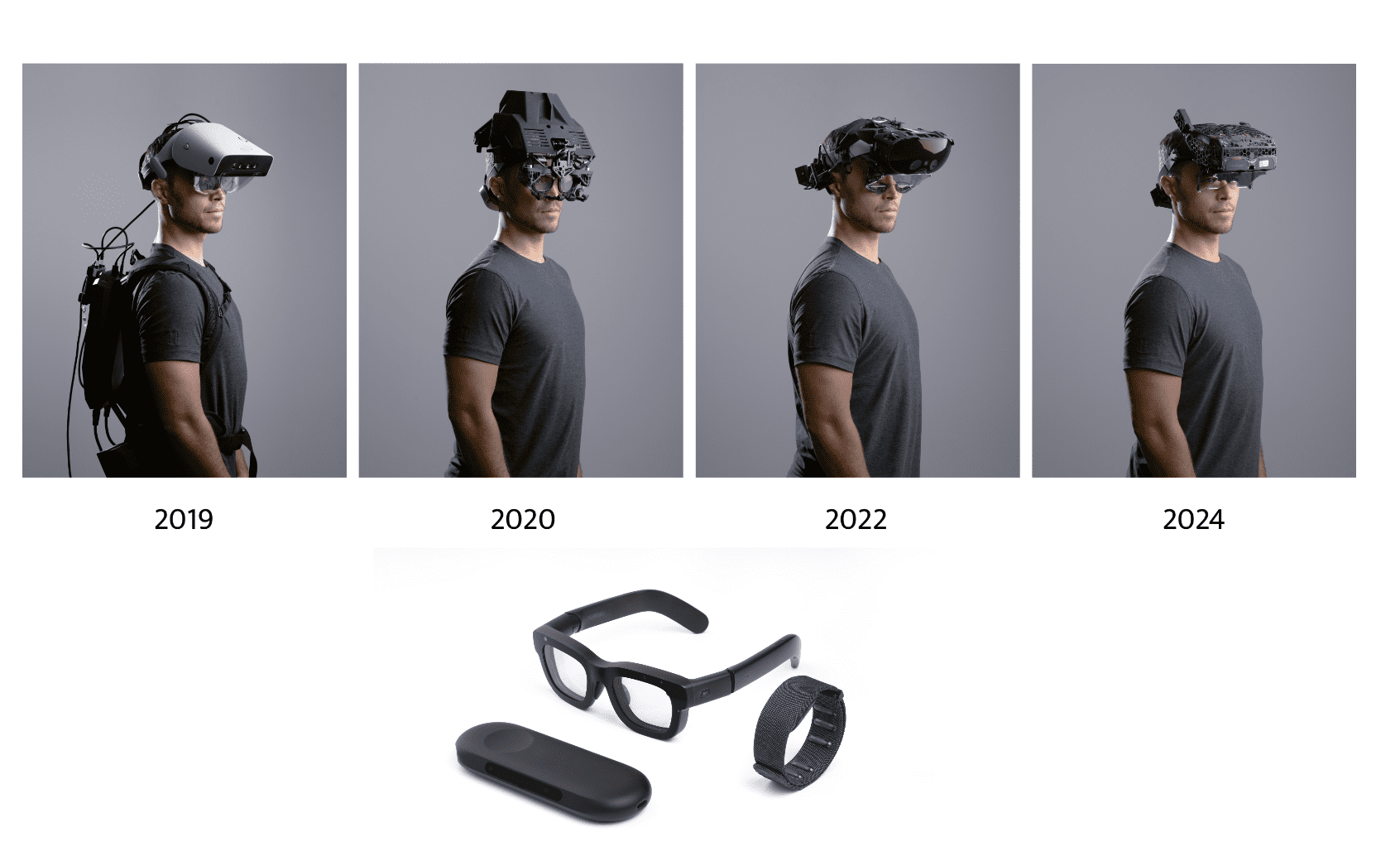
Miniaturizing key components is going to be the challenge facing everyone who aspires to get to a glasses form factor but, for now, a key decision for Meta was to offload the compute to the puck pictured above.
**Custom Components**
That puck runs a Qualcomm SoC as well as a custom designed discrete GPU made by the growing silicon team at Meta. In fact, Orion includes numerous custom pieces of silicon designed in-house at Meta. Which just goes to show how much delivering on the experience product designers have requires the ability to customize almost every key component when we are in the early stages of a category. But I’d also go out on a limb and say that more and more companies who will compete in mainstream consumer computing in the future will rely more and more on some level of custom silicon in order to differentiate their solutions.
As interesting as the custom silicon elements of Orion are, the optics and display are equally interesting. In fact, it is the display/lens technology that I feel will be most difficult for any company with ambitions in AR to develop in a way that is scalable and affordable. The glasses feature Micro LED projectors inside the frame that beam graphics through waveguides embedded in the silicon carbide lenses. The system specifically uses diffractive waveguides with complex nano-scale 3D structures to bend light and deliver images to the user’s eyes. Silicon carbide was also chosen due to its high refractivity, which is a key reason Meta could get up to \~70 degrees FOV with Orion. I asked Ming Hua, VP, Wearable Devices, during our meeting if \~70-75 FOV is about the max we can expect on a glasses form factor and she agreed. This makes sense given a pair of glasses only extends out to \~80 degrees total and due to the physical design simply won’t extend farther into your peripheral vision.
**The Experience**
My thoughts on the experience with Orion are in line with nearly everyone else who has taken the demo and shared their thoughts. Had Apple’s Vision Pro not existed, this would have been easily the most amazing thing I have experienced technologically. But while Apple Vision Pro is the best mixed reality experience I have used to date, Meta Orion is the best augmented reality experience I have used to date.
Because Orion is in a physical glasses form factor, with clear lenses, there is no virtual pass through to the real world required like there is on Quest and Vision Pro. While my first impressions with [Vision Pro](https://creativestrategies.com/apple-vision-pro-computing-without-borders/) were it was the highest fidelity pass through I have experienced in a mixed reality headset the fact that no pass through video of the world is requried in an AR glasses experience just ups the ante. With AR glasses the real world in all its high fidelity is preserved and graphics simply layered onto it.
From a visual perspective, I’d say the graphics quality was impressively rich and maybe just a bit shy of the graphical quality of Quest, with just a bit more pixelation. I was able to experience a video call in the demo of both a live video and an avatar representation, and both were high quality from a graphics standpoint. Games had quality graphics, with limited pixelation. Overall, the visual quality of the AR graphics experience was impressive, and it will only get better.
The wristband, which is central to the neural interface, was fascinating. The wristband detects the current in your muscles that react to your brain giving a signal for an action. I asked if it was theoretically possible to use this technology and not even have to move your fingers or use gestures, and Ming Hua said that it was. I had zero issues using the neural wristband, and it worked flawlessly for all the gestures needed to navigate and use Orion.
The eye tracking was spot on. If you have used an Apple Vision Pro, the eye tracking on Orion is as good, as responsive, and as accurate. Between the eye tracking and the neural band, I easily played interactive games that required precise eye tracking, in this case to pilot a spacecraft, and use the finger pinch gesture to shoot objects with near zero latency.
Lastly, the feel of the hardware was impressive. The glasses were so light that at times I forgot I was wearing them. Comfort is critical to get consumers to wear these for long periods of time, and Meta is on the right track having achieved a level of comfort that can easily be worn for long periods of time today.
**Looking Forward**
The Meta team was clear: they want to get to a consumer product that is affordable for the mainstream. For Meta, that means pricing something like a high-end smartphone, which would be in the $1000-$1500 range. They have quite a task ahead of them to get to this price point, and a good mix of innovation and invention is required to get there.
That said, I had been waiting for the best-of-breed augmented reality experience that I could try to confirm my broad thesis that this is going to be something someday. And I can say, without a shadow of a doubt, there is a future for AR glasses. While it will take many more years to get there, Orion represents an inflection point moment in AR development – the first time we can see the true potential of AR in a form factor that could feasibly become a mainstream product.
Right now, the battle is on between Apple and Meta to court developers to take their vision of the future seriously. This isn’t just a technical race – it’s a race to build the next major computing platform. The winner of this battle won’t just lead a new product category; they’ll shape how we interact with computing for the next decade or longer.
The battle for developers is on, and while Apple and Meta are currently leading the charge, the stakes couldn’t be higher. We’re witnessing the early days of what could become as transformative as the smartphone revolution – a shift that will redefine the boundaries between our digital and physical worlds. For developers, the opportunity to help shape this future is now. For consumers, the promise of truly useful, wearable AR is finally on the horizon.
### Tesla Robotaxi and the Future of Autonomy
URL: https://creativestrategies.com/research/tesla-robotaxi-and-the-future-of-autonomy/
Last updated: 2024-10-14T19:21:33.000Z
**Summary**
Tesla unveiled their vision for the future of transportation at the “We, Robot” event, showcasing the Robotaxi and Robovan. The Robotaxi is a sub-$30,000 autonomous vehicle designed for personal use and potentially part of a rideshare network. Tesla’s Full Self Driving (FSD) technology, powered by custom AI hardware and software, is rapidly improving and expanding to more vehicles. While Tesla has a history of overpromising on timelines, recent progress suggests that widespread autonomous driving may be achievable within the next few years.
---
What’s Important
- Tesla introduced Robotaxi, a sub-$30,000 fully autonomous vehicle with no steering wheel or pedals, designed for personal use and potential ride sharing.
- Tesla’s FSD technology is improving rapidly, with consistent updates and expanding capabilities for existing Tesla vehicles.
- Custom AI hardware (HW3 and HW4) and end-to-end trained models power Tesla’s autonomous driving capabilities. Robotaxi and Modle Y demos at the “We, Robot” event were running an early build of FSD 13 on HW4.
- Tesla’s vision-only approach (Tesla Vision) differs from competitors using lidar and radar, but shows promise based on real-world performance.
- While Tesla has missed previous deadlines, recent progress suggests autonomous driving technology is closer to widespread adoption.
- Tesla’s in-car experience and user interface are considered industry-leading, enhancing the overall autonomous driving experience.
---
Last thursday, Tesla had their “We, Robot” event. While it was technically a product launch, with a showcase of Robotaxi and Robovan, it was more a showcase of Tesla’s vision of the future. Futuristic looking cars, public spaces void of parking lots and turned into public parks and green space, cheap and safe transportation for all.
---
### Robotaxi
Before we get into the technical details, feasibility, and reality of it, Robotaxi! Tesla Robotaxi is designed to be a sub-$30,000 car with no steering wheel or pedals. It’s controlled entirely digitally and autonomously, with no manual controls outside of manual releases for the doors and windows in case of emergency. There is no physical charge port, instead it charges wirelessly with induction charging. The Robotaxi will automatically align with the induction coil and start charging and should achieve around 200 miles of range.
Robotaxi will be a consumer product, available to buy for your own personal use. They didn’t give range estimates, logistics, or show off much. Simply a demo of the vehicle, mention of AI5 hardware (this references both inference silicon and camera array), and some brief notes on supply chain.
The Robotaxi and Robovan will share parts with the current Model S, 3, X, Y, and Cybertruck in order to keep costs down and scale production. This includes the aforementioned AI5 hardware and actual parts in the vehicle. The side panels are the same as the 2024 Model 3, the buttons to open the doors are taken from the Cybertruck, the hinges and panels Model 3/Y. With all of this in mind, I have no doubt they’ll hit the sub-$30,000 price tag mentioned on stage, especially with the rumored 40kWh (36kWh usable) battery and 200 mile range, and target of 5.5 mile per kWh.
The reason for the 2-seat vehicle, well, [it’s that 82% of miles traveled in the US are with 2 or less passengers](https://x.com/EricETesla/status/1844818925361709553?ref=creativestrategies.com), according to the principal engineer on the Robotaxi. This makes sense when designing a mass market, high volume, autonomous car. You need to get the most bang for your buck, and this seems like it. This allows them to lower cost per ride, cost per mile, and have more cars available on the road. It makes sense.
---
### Ride-share vs. Consumer Vehicle
One thing I want to make clear from this event is that Tesla did not specifically announce a car share network or competitor to Waymo/Uber. While they’ve shown teasers and demos in the past and referenced it with photos and videos, they did not specifically mention it. It’s happening, Tesla has said it’s happening, they partly showed it, but did not mention it. The Robotaxi network would be a Waymo competitor, the Robotaxi itself would replace human drivers for consumer cars outside of a rideshare network.
In some of the slides where they showed Robotaxi, it specifically says “Most Affordable,” “Cheapest to Operate”, and “Always Your Car.” It’s just weird messaging, and takes context of previous Tesla earnings calls, AI days, investor decks, and Elon tweets to really put it together.
From my understanding, there will be two pools of Robotaxi’s (for simplicity’s sake, I’ll be calling the vehicle Cybertaxi and network of autonomous vehicle robotaxi from here on out): Tesla owned and consumer owned. These will function in an autonomous ride share service, similar to Waymo. The Cybertaxi can be purchased and managed as a fleet designed for the ride share network of Robotaxi’s, or you can have it join the network while it’s not in use by the owner or even never have it join the network and function as exclusively your personal driver. All Model S, 3, X, Y, and Cybertruck seem to be capable of joining this autonomous rideshare network and function as a Robotaxi, with a specific focus on Model 3 and Model Y first. Again, this seems to be a choice. If you own a Tesla, you have the option to share it as part of the network, but you do not have to. I like this option and choice. You could, in theory, have the car pay for itself while you’re not using it. That’s an insane concept.
The other thing is number of passengers. A Cybertaxi is a two-seat vehicle, but that doesn’t mean you are limited to a robotaxi being a cybertaxi. You could, in theory, call a 2, 5, or 7 seat vehicle depending on what you need. The Model S, 3, X, Y, and Cybertruck all come with 5 seats standard, and Model X and Y have 7 seat options. There are plenty of options taking advantage of Tesla’s existing and future vehicles.
---
### Tesla AI Hardware
Now, to the AI stuff. What makes this all possible is a new Unsupervised Full Self Driving model, which should be available in Texas and California next year, and expand as regulators approve it elsewhere. This will hit current Tesla with HW3 and HW4, so essentially any Tesla Model S and X since 2019 or any Model 3 since 2017\. Any Tesla since about 2016 with AP2/AP2.5 will be eligible for it with a retrofit to HW3\. This makes around 6 million cars already on the road eligible with either a just software update or hardware and software update.
All of this is in theory, of course. Tesla’s supervised FSD model isn’t perfect and continuously getting changed and improved. It’s an end-to-end trained stack with video feed from the vehicles 7-8 cameras and vehicle input as the training data, all from the aforementioned 6 million cars on the road. The final model is then video in from all the cameras, vehicle control out. This all runs on custom silicon designed by the Tesla AI team specifically for autonomous inference. Once upon a time (until 2019 on Model S & X) Tesla used Nvidia DRIVE PX 2, but switched to in-house silicon as their models became more advanced.
What I find interesting about the hardware, don’t worry I’ll get to the AI part in a second, is how it all works towards the end goal. While Tesla isn’t super open about how it all works, the general understanding is there are two computers in each car: FSD Computer and System computer. The system computer powers the infotainment system, car keys, bluetooth, media, nav, etc. It’s powered by an AMD Ryzen APU in new cars, Intel in older ones. Model 3, Y, and Cybertruck have 8GB of RAM, S and X have 16GB. I tend to think separating these is a good idea, if one system goes down, you don’t lose access to the core vehicle system.
The Tesla FSD computer is a custom chip, HW3 on Samsung’s 14nm US foundry and HW4 likely on TSMC’s 7nm node, though rumored to be 4nm class node. These computers have their own ARM based CPU, rumored to be based on Samsung’s Exynos IP, as well as multiple AI accelerators for redundancy. HW3 supposedly has 2 while HW4 has 3\. This means if one of the accelerators fails, it can swap to the other in real time. This also means running multiple models at once, in theory. These neural accelerators do use a slightly different architecture, but Tesla was able to emulate HW4 hardware accelerators on the HW3 kernel for feature parity. This is all pieced together from different sources, conversations, and my understanding of it and could be off, but my best understanding based on what is known.
---
### Full Self Driving (Today)
Now back to the Full Self Driving AI model, this stack is currently a single model across all hardware versions. The stack is made up of a few different models designed to power a few different features. Right now there is a model for roads, actually summon, auto-park, and highway. All of these are end to end models trained on real world driving data, as well as synthetic data from the Tesla AI team using Unreal Engine for edge cases.
These are all using exclusively Tesla Vision, the name of the vision-only technology Tesla uses. No radar, lidar, or ultrasonic sensors. I’m not going to debate the accuracy of camera only vs. radar/lidar/ultrasonic redundancy. Tesla believes they can do it, I trust them. This is an ideological difference between Waymo, Cruise, and others and we’ll see what plays out! I think Tesla Vision can work just as well as the others, especially given the data they have and the rate of improvement on Full Self Driving supervised.
Speaking of full self driving supervised, I have it on my 2024 Telsa Model 3 Long Range. It’s powered by AI4 hardware. Currently, I’m running the FSD 12.5.4.1 model. This has 3 E2E (end to end) models and one CNN (convolutional neural network) based model. Actually Smart Summon, normal roads, and auto park are all E2E models and these are great. As of October 11, 2024, my car has driven 65% of my miles over the past 14 days. That’s 321.3 miles out of 492 total. It drove me 131 miles round trip on both highway and road yesterday, and I didn’t need to touch the steering wheel once.
Smart summon makes mistakes here and there, but these mistakes are turning left rather than right in a parking lot and it takes a little extra time to get to me. Not a big deal. Auto park has been flawless since I got access to it, even to the point where it parallel parked in a spot in New York City that I would not have been comfortably able to do myself. Normal roads, well, it’s getting better with each update. During the day, it’s amazing. It goes at a safe and comfortable speed, largely avoids curbing itself (which was a problem on the 12.3.6 model), and all around feels smooth. At night, it does have issues with phantom breaking. This is where it thinks there’s something in the road and just stops. Generally, this happens when the main camera is blinded by an on-coming SUV. Phantom breaking never happens when there are cars behind me, and generally is more of an annoyance than a real problem.
These E2E models aren’t perfect, but there’s been an average cadence of an improved model every 8 or so days, with new models bringing new features every few weeks. Currently, FSD 12.5.6 is in testing with Tesla’s early access group and makes the highway stack E2E rather than a CNN, which makes highway driving more natural and safer. They’re working on adding support to the road stack for reversing, parking, and auto parking as well. This would mean the model could fully go from point A to point B without needing any extra human control, like selecting a parking spot or pulling out and getting to the street which is required now.
Again, Supervised FSD as it exists on my car today, and anyone with a Tesla from \~2017 to today, is not perfect. It has issues, it does things that would generally be considered rude or unsafe, and can make mistakes. The thing is, every time it gets an update those occurrences become more rare. I also believe Tesla is working on a single trained model that combines the 4 individual stacks, which they claim to be working on, before fixing individual bugs like phantom breaking. I believe it’s not worth fixing a bug that could be reintroduced when changing the architecture when you can finalize the architecture then fix the bug.
My thesis is that as Tesla builds out the compute at their Texas Gigafactory, the 100K H100 data center and in house Dojo supercomputer with System on Wafer processors, the models will improve exponentially. We’re seeing that already with the rate of improvement of the models on these cars. More compute means more memory, larger data sets, and faster training for improvements.
---
### The Reality of Autonomy and my take
All of this sounds great, and is realistic if you follow it closely, but Elon Musk has also made promises like this before. All of what I was talking about was supposed to be around years ago. The E2E highway stack was supposed to launch 2 years ago, Robotaxi’s in 2020, and more. He’s made promises on Cybertruck pricing and were off by around $20,000, though to his defense a lot unpredictably changed between 2019 and 2023 when deliveries start. The Roadster was supposed to launch years ago, after taking full payments, and still hasn’t.
I think the difference between then and now is we can now see how these new announcements are done. Using the current supply chain, where Tesla is able to make $35,000 cars and stipping away parts, seats, and making it smaller, I have no doubt in sub $20,000\. With FSD, years ago this was all a pipedream but now we’re seeing consistent improvement that’s hitting actual cars! The model is 80% there. Within a year, I could see it getting 95-99% of the way there. The years of promises were way off in terms of timeline, far too optimistic as Elon said himself at the We, Robot event, but now feels like it’s actually happening. As one Twitter user said, the vibes were right, and I tend to agree.
I believe we are finally at a point where the silicon is there, software architecture is there, vehicles are there, and data is there. Lots of companies are building out silicon and hardware stacks for autonomy. Nvidia has their Drive platform, which includes cameras, radar, silicon, and software SDK. Qualcomm has a whole suite under Snapdragon Automotive with ADAS, advanced driver assistance system, and connected cockpit. Mediatek has Dimensity Auto Cockpit with RTX graphics to accelerate infotainment systems.
The problem I see with this is data and architecture, Tesla seems to be the only one with it, and they are willing to license out the technology. This doesn’t mean these other companies have no place, as I explained earlier Tesla has a dedicated FSD computer and system computer, it might be worth improving the system computer and working with Tesla on FSD connectivity and support.
Mercedes’ is working with Nvidia on their ADAS system, and it’s apparently great. BMW is working with Qualcomm and AWS, and it’s apparently great as well. Ford and GM have in house ADAS systems as well. I can’t comment on these, as I haven’t tried them quite yet. Other automotive companies like Volvo, Polestar, Rivian, and Xiaomi are also working Nvidia on autonomy stacks and ADAS, but not as advanced quite yet as Mercedes’, BMW, or Tesla.
The interesting parts of these systems is the autonomy levels. The way it’s generally understood is Level 0 is no form of assistance. Level 1 is automatic features like steering or breaking assistance. Level 2 is ADAS where the vehicle can control acceleration, breaking, steering, and parking but still needs driver supervision to take over without alerts. Level 3 is a more advanced ADAS, where the system will alert the driver when they need to take over, but the driver can be doing other things and not paying attention. Level 4 autonomy is fully autonomous but with geofencing, like Waymo. Level 5 is fully autonomous, no geofencing.
Currently, Mercedes is the only manufacturer in the US with a Level 3 system. Tesla FSD is still technically Level 2\. The interesting parts of these rankings is even if Tesla’s Level 2 system outperforms Mercedes Level 3 or Waymo Level 4, it’s still a Level 2 system because of the requirement for unprompted manual takeover and driver awareness.
I believe the reason for Tesla continuing Level 2 is because of how the E2E model works. From my understanding of modern AI models, in order for Tesla’s E2E model to be able to alert the driver that they need to take over, it would an architectural change for the model to be able to understand it’s limitation, which then could cause it to force the driver to take control when the driver really wouldn’t have to. This seems like a deliberate choice, and focusing on producing a model so good that no human intervention is required seems like the logical next step.
Even beyond pure autonomy, in terms of experience Tesla is simply the best. I feel safe saying there is not a single in-car experience that is as good. Type in a location, press a button, the stack brings you there. The maps are great, audio and music playback is great. It’s simple, easy, and user friendly. It’s a great experience. That is not true for anyone else, even if the autonomy stack is equal.
Autonomy is coming within this decade, and AI is about to become a lot more interesting and useful than LLMs. The age of consumer robotics is coming, and it’s coming fast.
### AI Adoption Accelerates: Key Insights from Latest Industry Research
URL: https://creativestrategies.com/research/ai-adoption-accelerates-key-insights-from-latest-industry-research/
Last updated: 2024-10-09T23:19:12.000Z
Recent comprehensive research, which we have private access to, sheds light on the rapidly evolving landscape of AI adoption across industries. Based on a survey of 400 enterprises and an extensive analysis of company transcripts, the study reveals how businesses are increasingly leveraging AI to drive productivity, cut costs, and create new revenue streams. The findings paint a picture of accelerating AI integration, with over 40% of surveyed companies reporting AI projects exceeding their ROI expectations. Notably, larger companies with revenues exceeding $15 billion are 15 percentage points more likely to see better-than-expected ROIs compared to their smaller counterparts.
Productivity emerges as the primary focus for AI initiatives, with 61% of companies targeting increased production or output as a key goal. Improving customer service (58%), boosting revenue growth (54%), and increasing sales productivity (57%) are also significant objectives for many firms. These priorities underscore the broad potential of AI to transform various aspects of business operations.
##### Log in to keep reading.
###### Not a Client, request access
### Contact
- First Name\*
- Last Name\*
- Email\*
- Message\*
- This field is hidden when viewing the form
Post requested
/\* <!\[CDATA\[ \*/ gform.initializeOnLoaded( function() {gformInitSpinner( 2, 'https://ghost-production-fd45.up.railway.app/content/images/creativestrategies-com/wp-content/plugins/gravityforms/images/spinner.svg', true );jQuery('#gform\_ajax\_frame\_2').on('load',function(){var contents = jQuery(this).contents().find('\*').html();var is\_postback = contents.indexOf('GF\_AJAX\_POSTBACK') >= 0;if(!is\_postback){return;}var form\_content = jQuery(this).contents().find('#gform\_wrapper\_2');var is\_confirmation = jQuery(this).contents().find('#gform\_confirmation\_wrapper\_2').length > 0;var is\_redirect = contents.indexOf('gformRedirect(){') >= 0;var is\_form = form\_content.length > 0 && ! is\_redirect && ! is\_confirmation;var mt = parseInt(jQuery('html').css('margin-top'), 10) + parseInt(jQuery('body').css('margin-top'), 10) + 100;if(is\_form){jQuery('#gform\_wrapper\_2').html(form\_content.html());if(form\_content.hasClass('gform\_validation\_error')){jQuery('#gform\_wrapper\_2').addClass('gform\_validation\_error');} else {jQuery('#gform\_wrapper\_2').removeClass('gform\_validation\_error');}setTimeout( function() { /\* delay the scroll by 50 milliseconds to fix a bug in chrome \*/ }, 50 );if(window\['gformInitDatepicker'\]) {gformInitDatepicker();}if(window\['gformInitPriceFields'\]) {gformInitPriceFields();}var current\_page = jQuery('#gform\_source\_page\_number\_2').val();gformInitSpinner( 2, 'https://ghost-production-fd45.up.railway.app/content/images/creativestrategies-com/wp-content/plugins/gravityforms/images/spinner.svg', true );jQuery(document).trigger('gform\_page\_loaded', \[2, current\_page\]);window\['gf\_submitting\_2'\] = false;}else if(!is\_redirect){var confirmation\_content = jQuery(this).contents().find('.GF\_AJAX\_POSTBACK').html();if(!confirmation\_content){confirmation\_content = contents;}jQuery('#gform\_wrapper\_2').replaceWith(confirmation\_content);jQuery(document).trigger('gform\_confirmation\_loaded', \[2\]);window\['gf\_submitting\_2'\] = false;wp.a11y.speak(jQuery('#gform\_confirmation\_message\_2').text());}else{jQuery('#gform\_2').append(contents);if(window\['gformRedirect'\]) {gformRedirect();}}jQuery(document).trigger("gform\_pre\_post\_render", \[{ formId: "2", currentPage: "current\_page", abort: function() { this.preventDefault(); } }\]); if (event && event.defaultPrevented) { return; } const gformWrapperDiv = document.getElementById( "gform\_wrapper\_2" ); if ( gformWrapperDiv ) { const visibilitySpan = document.createElement( "span" ); visibilitySpan.id = "gform\_visibility\_test\_2"; gformWrapperDiv.insertAdjacentElement( "afterend", visibilitySpan ); } const visibilityTestDiv = document.getElementById( "gform\_visibility\_test\_2" ); let postRenderFired = false; function triggerPostRender() { if ( postRenderFired ) { return; } postRenderFired = true; gform.core.triggerPostRenderEvents( 2, current\_page ); if ( visibilityTestDiv ) { visibilityTestDiv.parentNode.removeChild( visibilityTestDiv ); } } function debounce( func, wait, immediate ) { var timeout; return function() { var context = this, args = arguments; var later = function() { timeout = null; if ( !immediate ) func.apply( context, args ); }; var callNow = immediate && !timeout; clearTimeout( timeout ); timeout = setTimeout( later, wait ); if ( callNow ) func.apply( context, args ); }; } const debouncedTriggerPostRender = debounce( function() { triggerPostRender(); }, 200 ); if ( visibilityTestDiv && visibilityTestDiv.offsetParent === null ) { const observer = new MutationObserver( ( mutations ) => { mutations.forEach( ( mutation ) => { if ( mutation.type === 'attributes' && visibilityTestDiv.offsetParent !== null ) { debouncedTriggerPostRender(); observer.disconnect(); } }); }); observer.observe( document.body, { attributes: true, childList: false, subtree: true, attributeFilter: \[ 'style', 'class' \], }); } else { triggerPostRender(); } } );} ); /\* \]\]> \*/
### Microsoft’s Big Consumer Play With New Copilot Features
URL: https://creativestrategies.com/research/microsofts-big-consumer-play-with-new-copilot-features/
Last updated: 2024-10-03T00:39:46.000Z
This week in New York, Microsoft revealed its new Copilot features focused on consumers. On stage, Microsoft AI CEO, Mustafa Suleyman spoke to the role AI is playing in redefining our everyday relationship with computers, the need for Copilot to be personable and relatable and the obligation of balancing innovation and consumers’ acceptance. Both on stage and in a penned memo Suleyman explained that we are currently witnessing an extraordinary technological paradigm shift. In just a few years, our computers have learned to speak our languages, see what we see, and hear what we hear. This remarkable evolution of technology raises a crucial point: while the capabilities of AI are impressive, it is the impact on human lives that truly matters. Technology must serve humanity, enriching lives, creating opportunities, and fostering connections.
A highlight of this extensive update is **Copilot Vision**, a feature allowing AI to actually “see” and interpret what users are viewing on their screens. This means Copilot can provide immediate assistance or suggestions based on visual context, enhancing user productivity by eliminating the need for manual input or searches for information related to on-screen content. The demo shown in stage showed a user asking about what movie they should watch based on the genre and mood they were in and while they had their browser on Rotten Tomatoes.
While some have expressed concerns about privacy, I am convinced that this feature offers a secure introduction for users to familiarize themselves with Copilot’s capabilities using public information, from a limited list of pre-proved sites, before delving into more sensitive matters. Crucially, it is important to emphasize that Copilot’s assistance is always user-initiated and that no query is ever stored. This ensures peace of mind, allowing users to confidently explore the potential of this advanced AI tool without compromising their privacy.
**Copilot Voice** represents a groundbreaking advancement, poised to revolutionize user interactions into seamless, natural dialogues. This state-of-the-art voice technology has been refined to feature human-like cadence, enabling it to gracefully handle interruptions and pauses, much like a genuine conversational partner would. This creates a more engaging and intuitive interaction that Microsoft envisions will make technology feel more approachable and less mechanical.
For instance, when I consulted Copilot about the pros and cons of owning a sausage dog, I received a well-rounded answer. During the response, I was able to interrupt to inquire about the preference for long or short hair varieties. Impressively, when I spoke over Copilot’s answer, it paused momentarily to assimilate my question before continuing, akin to how a human might pause to gather their thoughts if interrupted mid-sentence. The interaction felt remarkably natural, characterized by an appropriate tone, a touch of humor, and impressive accuracy and knowledge.
This enhancement in Copilot Voice transforms AI from a mere tool into an engaging digital companion, redefining our relationship with technology by truly reflecting the nuances of human conversation.
As Suleyman shared insights from user feedback, it became strikingly apparent that individuals are at vastly different stages in integrating AI into their daily lives. For some, AI like Copilot has become a trusted confidant, ready to provide insights on deeply personal queries. For others, it remains a transactional tool for basic tasks. This dichotomy presents both a significant risk and an exciting opportunity for Microsoft. The risk lies in advancing too rapidly towards crafting an overly empathetic AI companion that could ultimately disappoint. However, the opportunity is monumental: to forge an enduring, personal bond with an AI agent that users find indispensable—an agent they never imagine leaving behind.
Much like the Vision feature, Copilot’s new **Think Deeper** capability is designed to enhance Microsoft’s agent by making it more adaptable. Think Deeper equips Copilot with the ability to tackle more intricate problems, leveraging “reasoning models” that allow for thoughtful, step-by-step responses, according to Microsoft. Think Deeper seems to be utilizing a customized version of OpenAI’s o1 model is accessible to a select number of users within the Copilot Labs community in Australia, Canada, New Zealand, the U.S., and the U.K.
In recent years, Microsoft has been eager to extend its reach and capture consumer engagement beyond the realm of PC productivity and gaming. I strongly believe that Copilot could be the way to do it.
The new Copilot will be available on iOS and Android through a dedicated app. Although Microsoft’s lack of integration within operating systems has traditionally restricted its ability to engage users beyond Microsoft Edge, this app-based approach could enhance visibility and highlight Copilot’s value. With discovery currently being a challenge for both Gemini and Apple Intelligence, presenting Copilot as an accessible application creates an opportunity to bridge the gap between smartphones and PCs. By seamlessly delivering value across these platforms, Microsoft has the chance to make Copilot compelling enough for users to consider it over the built-in options on their smartphones.
For Microsoft’s Copilot to see widespread adoption, striking the perfect balance is essential. The company must meet consumers where they are now, while also inspiring them to explore and embrace new capabilities, enriching their interaction with their AI companion. By maintaining transparency and accountability throughout this process, Microsoft can cultivate the trust necessary to guide consumers on an exciting journey of discovery. As users grow more confident in these interactions, they’ll be more inclined to delve further, unlocking the full potential of their digital companion and transforming how they engage with technology.
### After a few days with Intel Lunar Lake, Intel is back!
URL: https://creativestrategies.com/research/after-a-few-days-with-intel-lunar-lake-intel-is-back/
Last updated: 2024-09-24T18:19:45.000Z
**Key Takeaways:**
- Intel is back(!) with a really good, really efficient core design.
- Intel’s tiled SoC with TSMC N3B compute tile and N6 I/O tile works really well
- We’re at a point where performance and efficiency among all major PC silicon providers is more or less equal, moving the differentiation from silicon to actual device and OEM software.
---
I’ve had a few days with the Asus Zenbook S 14 powered by Intel’s new Core Ultra 7 (Series 2), specifically the 256V SKU. For reference, the PL1, long term power draw, minimum is 17W and maximum is 22W. Asus didn’t give PL2 numbers, peak boost, but this SoC supports 37W for peak boost.
So this sets the scene for Intel Lunar Lake in this specific Asus machine, but, how does it perform? In our in house Battery Benchmark, the Asus Zenbook S 14 scored 15 hours 45 minutes on the balanced battery mode. For context of relative performance, in Geekbench the machine scores 2,661 single core and 10,245 multi-core. You can find the chart with some comparisons to other new laptops powered by Snapdragon X Elite and AMD’s Zen 5, but simply: battery is fantastic, performance is close but still slightly behind. Snapdragon X Elite and Snapdragon X Plus 10-core machines will likely outperform in CPU bound workloads, in GPU workloads Intel will have the lead, but all around it is neck and neck.
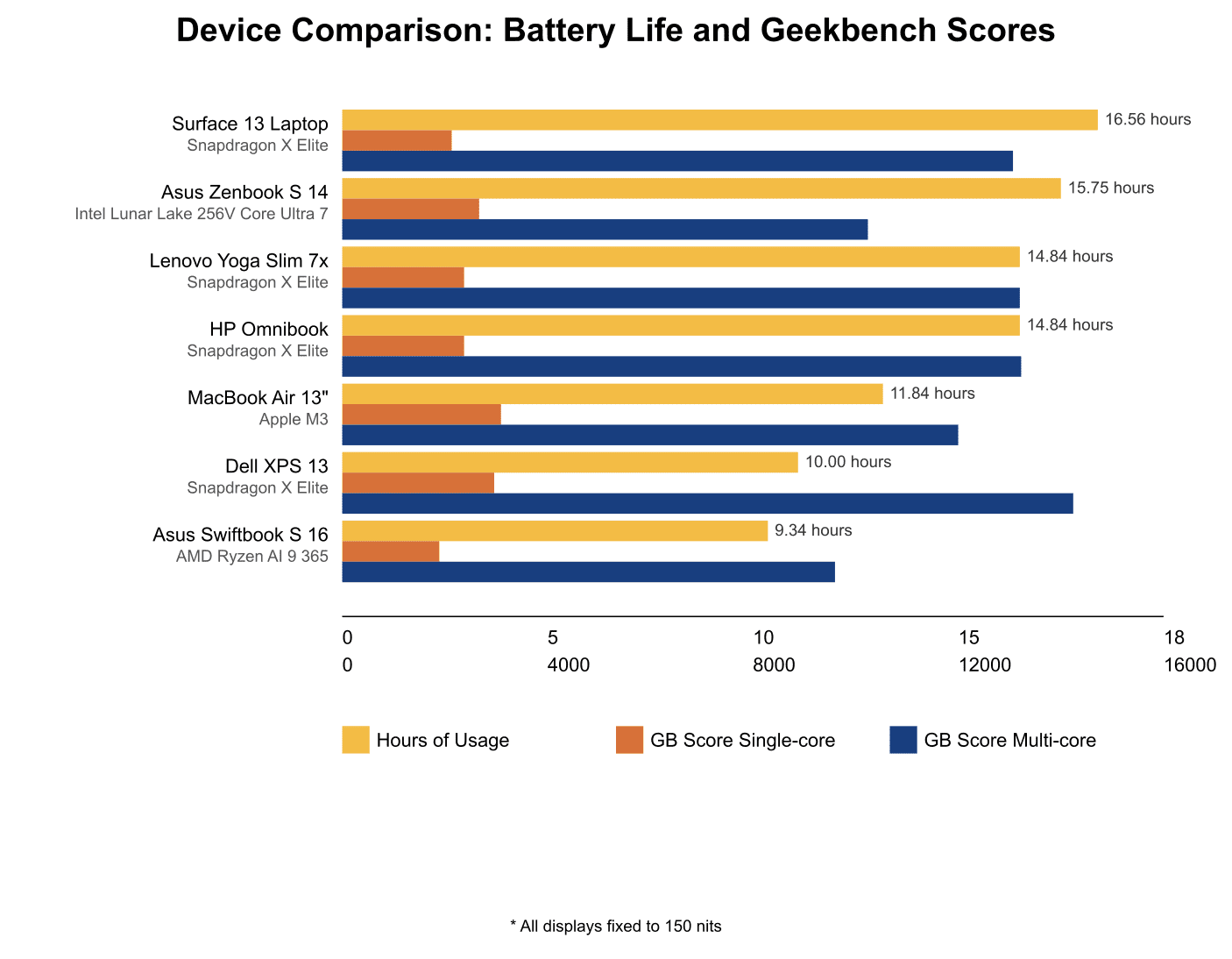
I haven’t had time to test out GPU performance in games or GPU heavy tasks quite yet, but speaking to a few tech journalists and reviewers who have spent more time with these systems, it’s great. Right now it seems Intel’s claims on Lunar Lake at their IFA press conference have been very fair to not only the competition, but conservative in their own numbers. Part of this is up to the OEM and how they decide to tune the cooling and power on the system, but the sheer silicon performance is there.
I think anyone would be happy with this machine or frankly any Lunar Lake powered machine. I’ve only had this laptop for a few days but it’s something I’d be happy to continue using. The fans rarely if ever turn on, it never gets hot, and somehow Windows feels smoother and faster than any x86 laptop I’ve used before.
---
I think this is a good sign for Intel, with the trouble the company has been in recently, and as Creative Strategies CEO Ben Bajarin has said before, [Intel’s recovery is all about product](https://creativestrategies.com/intel-the-path-to-full-recovery-is-product-product-product/). This is the good product. The tiled architecture on the TSMC fab is great, but this isn’t all TSMC. With the tiled architecture, packaging is just as important as the actual silicon fabrication node. All Lunar Lake chips, and likely future chips, are done with Intel’s in house packaging. Design, assembly, and packaging is all Intel, with TSMC for the node.
Given everything I’ve seen with Lunar Lake from Intel’s claims to actual units and production performance, I have no doubt Intel will be setup well for the future. As Panther Lake hits the market next year and Intel is able to swap from the TSMC node to Intel Foundry 18A, they’ll be able to start increasing the margin on their chips with a US production line for both fabrication and packaging, frankly I think they are setup well for the future. It may be difficult for Intel to regain trust from OEM partners, ISAs, and enterprises when it comes to client platform performance after years of failing expectations and Qualcomm and AMD coming in hot with 2 amazing chips, but I believe they can do it.
This space is about to become a lot more interesting.
### A Week With iPhone 16 Pro – My Favorite Feature
URL: https://creativestrategies.com/a-week-with-iphone-16-pro-my-favorite-feature/
Last updated: 2024-09-18T13:40:20.000Z
Having spent the last week with the new iPhone 16 Pro Max I wanted to share a few thoughts.
---
**Key Takeaways**
- iPhone 16 Pro vs. Pixel 9 Pro XL Image Battle
- My Favorite New Feature
- Pure Hardware Innovation Getting Harder
- New Experiences Unlocked by Apple Silicon Advances
---
### Image Battle
Camera photography is highly subjective. But, the camera that I’ve always felt is most competitive with Apple is found on Google Pixel. So I decided to put the latest Google Pixel 9 Pro XL to the test vs. the iPhone 16 Pro and see whose default (no editing) images look the best. Below are a handful of shots for comparison. Click to expand the images.
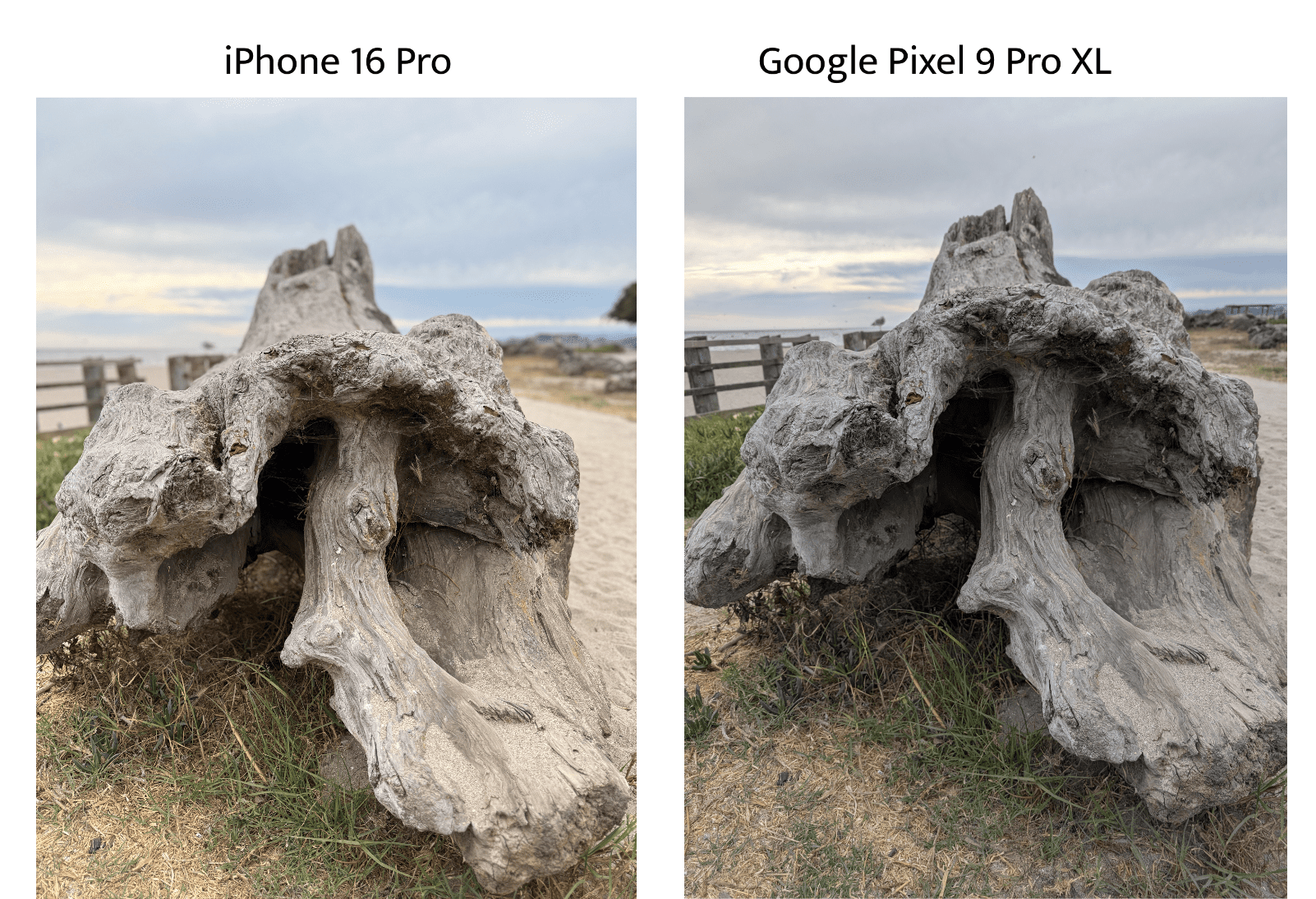

I share these comparisons because many people often just use the default settings for their images. What’s interesting here is how it seems there is a wider color palette captured by default on the iPhone 16 Pro with particular picking up more natural color tones.
### My Favorite New Feature
While I am by no means a professional photographer, I am fairly particular about the quality of my photos and often shoot in RAW, ending up doing some color correction post-process in Adobe Lightroom. There are, of course, ways to have more control over your photos on the device with built-in editing controls, but those who use these features are essentially aware that for them, the default settings, as good as they may be, are not good enough. Enter my favorite feature, the control pad.
The control pad is essentially professional-level color grading in real-time. The ability to do this while looking at your frame in real time is what I was impressed with the most. For me, this let me make small adjustments so the image I was trying to take looked as close to what my eye saw as possible. Here is an example using the mural I took a picture at a beach in Santa Cruz.
While the control pad can be used with any filter, I largely preferred using it with the standard (default) image since it allowed for the most subtle adjustments without distorting too many colors unnaturally, as most filters do. I appreciate the many style options iPhone provides, but I’m largely focused on capturing the most natural colors, as close to what my eye sees as possible. I most regularly achieved this using the control pad on the standard image. The user interface is quite simple, and it’s very easy to see how simple adjustments on the control pad slider subtly improve certain tones in the image versus altering all the colors across the board like a standard filter. This is Apple making pro-level color correction extremely simple and accessible to the masses.
What makes this feature even more interesting is that it is coming to the entire iPhone lineup in the 16 family. This is one of many reasons why I believe Apple’s base iPhone 16 is the strongest base-level iPhone Apple has released in many years, if not ever. And while there are specific hardware improvements in the iPhone 16 family from last year’s models, there is a deeper observation to point out.
This observation is one I have been vocal about lately, which is that pure hardware innovation gains are so difficult year over year that most of the exciting innovations to watch for will happen in software. This is why there is such excitement for AI, and in Apple’s case, Apple Intelligence, running on our devices to unlock new, more powerful ways to get things done and unlock new possibilities. This is not to say hardware advancements are not possible year over year, only that we can’t expect significant leaps in pure hardware the way we once did during the prime of the smartphone boom. And while Apple has made upgrades by way of increasing screen size, meaningful updates in camera technology, as well as battery life, Apple’s most critical year-over-year innovation that will accelerate this trend of unlocking powerful hardware with even more powerful software is Apple Silicon.
This point is emphasized even with the control pad feature I highlighted, as it uses some of the upgraded capabilities of Apple’s A18 family, which for the first time in a long time comes to the base iPhone 16 and is a big reason why so many new computationally rich software features are coming to the entire iPhone 16 family. The point here is that in the upcoming era where software experiences will get more attention than hardware features and upgrades, the spotlight will move to ways advances in Apple Silicon unlock new experiences via software.
With the optimism and early signals of ways AI can help us get more out of the hardware we have in our hands, we still have a long way to go. Most semiconductor architectures are still playing catch up to the advances AI software keeps making. But this only emphasizes how the behind-the-scenes innovations happening in silicon will be the things that lead to the most significant new experiences that revolutionize our interaction with technology. This symbiosis between hardware (silicon) and software advancements will likely define the next era of personal computing, where the true potential of AI is realized not just in the cloud, but right in the palm of our hands.
**Feature Honorable Mentions:**
- The larger display on iPhone 16 Pro Max doesn’t make the device feel much larger but yields some visual difference over iPhone 15 Pro Max.
- Battery life has improved year over year from my iPhone 15 Pro Max by at least an hour or two.
- The speakers are a welcome update feeling much more full and rich
### Microsoft’s Copilot Wave Two: Redefining Enterprise AI Integration and Productivity
URL: https://creativestrategies.com/research/microsofts-copilot-wave-two-redefining-enterprise-ai-integration-and-productivity/
Last updated: 2024-09-18T16:04:13.000Z
This week on LinkedIn Live, Microsoft unveiled the second wave of innovations for its Copilot AI assistant, marking a significant step forward in enterprise AI integration. Just 18 months after the initial launch of Microsoft 365 Copilot, the tech giant delivers more tangible value to users through a deeper integration of AI in the 365 tools millions of people use daily.
##### The Rapid Rise of Copilot
Microsoft CEO Satya Nadella highlighted the remarkable adoption rate of Copilot, noting that the number of daily users has nearly doubled quarter-over-quarter. This growth outpaces any other new Microsoft 365 suite, underscoring the transformative potential of AI in the workplace. Nadella emphasized that Copilot is rapidly becoming an organizing layer for work, reshaping workflows, and work artifacts for over 400 million Microsoft 365 users. I cannot help but think that the hype generated by Gen AI is also pushing organizations to move fast due to the fear of missing out. This is not that different from what we saw with Cloud except that with Gen AI, the impact on every knowledge worker feels much more profound than with the move to cloud.
##### The Three Pillars of Copilot Wave Two
As much as Microsoft is taunting the number of users that Copilot is seeing, I would argue that for most users we are still in the discovery phase. Microsoft still needs to provide tools and features that show real return for users. This is exactly what this wave of innovation and features will do.
**1\. Integration of Web, Work, and Pages**
At the heart of Copilot Wave Two is the seamless integration of web information, work data, and a new feature called “Pages.” This innovative AI-powered collaborative canvas allows teams to combine internet research with internal work data, creating a dynamic environment for ideation and collaboration.
Pages is the first new digital artifact designed specifically for the AI era. It enables users to start with web-based research, transform it into a collaborative workspace, and invite colleagues to contribute in real-time. This feature breaks down silos between different information sources, fostering a more integrated and efficient approach to knowledge work.
When it comes to collaborative workflows, most knowledge workers turn to Google Docs, even many of those who rely on Office as their primary productivity suite. Pages is a great opportunity for Microsoft to change this and be seen as the go to for solo as well as collaborative work.
**2\. Deep Integration into Everyday Work Tools**
Microsoft is doubling down on integrating Copilot into the core applications that drive business productivity:
Excel: Copilot in Excel is now generally available, offering advanced data analysis capabilities. A standout feature is the integration of Python, allowing users to perform complex data operations without coding expertise. This democratizes advanced analytics, making it accessible to a broader range of users. Data has never been more abundant, and most organizations are set on taking better advantage of it going forward. Data is also core to AI success which is why making sure Excel is still the go-to tool for analysis is critical. This is especially true when Microsoft is supporting no-code workflows, as there is more work to be done than there is trained talent out there. Features like Python integration in Excel and AI-assisted presentation creation in PowerPoint lower the barrier to complex tasks, enabling more employees to contribute at higher levels.
PowerPoint: The new “Narrative Builder” feature in PowerPoint leverages Copilot to assist in creating compelling presentations. It helps users develop the structure and flow of their presentations while maintaining brand consistency through the “Brand Manager” feature. Depending on Power Point for my own work, I have to admit that branding was high up in my feature requests as I would imagine it is for many organizations. The Narrative Builder also feels like AI will do the heavy lifting of a presentation beyond design which is mostly where the focus has been so far.
Outlook: “Prioritize My Inbox” is a game-changing feature that uses AI to analyze and prioritize emails based on content and context, such as recognizing messages from key stakeholders or time-sensitive information.
Teams: Enhanced meeting recap capabilities now include analysis of both meeting transcripts and chat conversations, ensuring no relevant details are missed. I really appreciate the inclusion of chat conversations in meetings summaries and transcripts. From an inclusion’s perspective, we need to remember that people show up differently in meetings. Some are less vocal than others and that can be because they have a quieter personality, language barrier, or simply do not want to “fight” to be heard and rely on chat to make their points. This does not make them any less engaged in the meeting and being able to capture their contribution is key to the meeting but also to their career progress.
Word: Copilot in Word now acts as a more powerful writing and editing partner, capable of accessing emails, meeting notes, and content from colleagues directly within the document. Keeping users in the flow by delivering AI support where they are is key to user satisfaction and key to long term engagement. This is what will make users stay within the Office suite instead of the wide range of apps we have seen pop up over the past year that leverage AI to help you write.
OneDrive: AI-powered content summarization and comparison features make it easier to find and understand stored information without opening individual files.
**3\. Introduction of Copilot Agents**
Possibly most revolutionary aspect of Wave Two is the introduction of Copilot Agents. These customizable AI assistants can be tailored to specific roles or tasks within an organization. Agents range from simple prompt-and-response systems to sophisticated; autonomous entities capable of orchestrating complex business processes.
Key features of Copilot Agents include:
– Ability to reason, remember, and learn
– Integration with existing business processes and data sources
– Easy creation and customization through a user-friendly interface
– Seamless integration with Microsoft 365 apps and SharePoint sites
Copilot Agents allow organizations to create AI helpers tailored to their specific needs, potentially revolutionizing how businesses handle repetitive tasks and process automation.
##### The Power of Continuous Improvement
Microsoft’s commitment to refining Copilot is clear in the extensive updates made based on user feedback. The company reports over 700 product updates and 150 new features since the initial launch. Performance improvements are significant, with response times now twice as fast and response satisfaction improved by a factor of three.
This iterative approach, coupled with the integration of advanced AI models like GPT-4 and potentially OpenAI’s GPT-4 Turbo, positions Copilot as a rapidly evolving tool that adapts to the needs of its users. We are so early with AI than being able to learn from users and adapt to their needs is paramount for the long-term success of Copilot.
##### Implications for the Future of Work
The introduction of Copilot Wave Two signals a paradigm shift in how enterprises approach productivity and collaboration. By integrating AI deeply into everyday work tools, Microsoft is not just enhancing existing processes but fundamentally reimagining them.
As these tools evolve and become more deeply integrated into business processes, they have the potential to dramatically enhance productivity, foster innovation, and enable organizations to tackle complex challenges more effectively. However, this transformation also requires careful consideration of the ethical, security, and workforce implications.
The integration of AI into the workplace promises to revolutionize tasks like coding, but its successful deployment hinges on more than just implementation—it requires a comprehensive approach to employee development. While organizations must invest in technical training to harness AI’s capabilities, the true challenge lies in transforming employee mindsets and workflows. This cultural shift is paramount, encouraging staff to view AI not as a threat, but as a collaborative partner. By fostering an understanding that AI is akin to a highly capable coworker, we can unlock its full potential. Embracing this perspective not only benefits employers through increased productivity and innovation but also propels individual career growth in an AI-driven future. The key to thriving in this new era lies in our ability to adapt, collaborate, and evolve alongside our artificial intelligence teammates.
### Apple’s iPhone 16 Launch: Debunking the Super Cycle Myth and Embracing AI
URL: https://creativestrategies.com/research/apples-iphone-16-launch-debunking-the-super-cycle-myth-and-embracing-ai/
Last updated: 2024-09-11T17:55:14.000Z
Apple’s recent unveiling of the iPhone 16 lineup has ignited discussions across the tech industry, focusing on its potential market impact and the role of artificial intelligence in driving adoption.
##### Debunking the Super Cycle Myth
The concept of a “super cycle” for iPhone sales has been a topic of considerable debate. Expectations of such a cycle are unrealistic in the current market context. The iPhone 6 and 6 Plus launch generated the only true super cycle in iPhone history, driven by unique circumstances including China Mobile’s network expansion and a significant form factor change as Apple finally embraced “Phablets”. The market dynamics today are vastly different, making it improbable to witness a similar surge in upgrades.
While a stronger-than-normal cycle is anticipated for the iPhone 16, we caution against expecting the dramatic pull-forward effect seen with the iPhone 6\. The smartphone market has matured, and upgrade cycles have generally lengthened. Consumers are holding onto their devices for longer periods, as software updates add every year to their overall experience and the incremental hardware improvements in each new generation, while significant, may not be compelling enough to trigger a mass upgrade event.
Interestingly, this year’s iPhone 16 base model appears more compelling than in previous cycles. For the first time in several years, Apple has equipped the standard iPhone with its latest A18 chip, bringing it closer to parity with the Pro models. This strategic move, combined with features like the new camera controller and action button, makes the iPhone 16 an appealing option for a broader range of consumers. Apple is able to do this because TMSC can sustain their unique volume needs of having the whole line up on the most cutting-edge process technology.
This approach may be aimed at encouraging more users to upgrade, enabling them to take advantage of Apple’s new AI-powered features without necessarily opting for the more expensive Pro models. This could lead to a shift in the sales mix back towards the base model, potentially altering the revenue dynamics for Apple’s iPhone line.
##### AI Integration: Beyond the Buzzword
The integration of artificial intelligence is a key focus for the tech industry, but it is important to look beyond the AI label to focus on the actual features and benefits it enables. The term “AI” has become overused and often lacks clear meaning for consumers. Instead, it’s more valuable to consider how these technologies enhance specific functionalities, such as improved photo editing, smarter text prediction, or more intuitive device interactions.
Apple’s approach of highlighting features rather than emphasizing AI terminology may resonate better with consumers who care more about practical benefits than underlying technologies. This strategy aligns with Apple’s historical focus on user experience and simplicity, making advanced technologies accessible to a wide range of customers without overwhelming them with technical jargon.
As Apple rolls out its Apple Intelligence features across different markets and languages, the company faces the challenge of balancing innovation with user accessibility. This is expected to be a gradual process, taking into account varying levels of tech-savviness among Apple’s diverse global user base. The company’s unique position in controlling the end-to-end user experience on its devices gives it an advantage in implementing these features seamlessly.
However, this advantage also comes with the responsibility of ensuring that new features are intuitive and beneficial to all users, regardless of their technical proficiency. Apple’s approach to AI integration reflects an understanding of this challenge, focusing on practical applications that enhance everyday tasks rather than showcasing AI for its own sake.
The initial rollout of AI features is limited to English-speaking markets, which presents both opportunities and limitations. While this allows Apple to refine its offerings in key markets, it also means that a significant portion of its global user base will not immediately benefit from these advancements. The company will need to navigate the complexities of language processing and cultural nuances as it expands these features to other regions more than other players might need to do as Apple is focusing Apple Intelligence on providing value that is personal and contextual.
As AI enabled these features become more widespread and users gain hands-on experience with them, the value proposition will become clearer. The focus is likely to shift from the underlying technology to the practical benefits it provides to users in their daily lives. This transition from novelty to utility is crucial for the long-term adoption and impact of AI in consumer technology.
The iPhone 16 launch also highlights the evolving nature of competition in the smartphone market. While hardware specifications remain important, the integration of AI and the overall ecosystem of services and features are becoming increasingly significant differentiators. Apple’s ability to control both hardware and software gives it a unique advantage in creating a cohesive user experience, but it also faces challenges in keeping pace with the rapid advancements in AI technology.
The company’s approach to AI also raises questions about privacy and data usage. Apple has long positioned itself as a champion of user privacy, and its on-device AI processing aligns with this stance. However, as AI features become more sophisticated and potentially require more data to function effectively, Apple will need to navigate the balance between functionality and privacy carefully. The company’s investment in end to end privacy from device to the cloud underlines its understanding of the challenge and the opportunity it has to retain existing customer as well as attract others as AI services roll out across ecosystems.
The coming months and years will be crucial in determining whether Apple’s AI strategy pays off in terms of user adoption and satisfaction. While the iPhone 16 may not spark a super cycle, it could set the stage for a more gradual but potentially more sustainable shift in how consumers interact with their devices and leverage AI in their daily lives. This might be even more profitable for Apple in the long run as higher engagement also drive higher loyalty.
As the smartphone market continues to mature, innovation in AI and software features may become the primary battleground for manufacturers. Apple’s approach with the iPhone 16 suggests a focus on meaningful, user-centric improvements rather than chasing specification upgrades or flashy but impractical features. This strategy could help maintain the iPhone’s position as a premium product while also broadening its appeal to a wider range of consumers especially considering a large segment of the Apple base is aging.
### Lenovo Unveils A Full Portfolio of AI-Powered Laptops at Innovation World 2024
URL: https://creativestrategies.com/research/lenovo-unveils-a-full-portfolio-of-ai-powered-laptops-at-innovation-world-2024/
Last updated: 2024-09-06T13:14:42.000Z
Lenovo has announced a series of cutting-edge products at Lenovo Innovation World 2024, designed to leverage artificial intelligence (AI) in its fullness and drive business transformation. The event, held in Berlin just before IFA, showcased the newly designed premium Lenovo ThinkPad X1 Carbon Gen 13 Aura Edition, powered by the latest Intel Core Ultra processors (Series 2), and the innovative Lenovo Auto Twist AI PC proof of concept.
The ThinkPad X1 Carbon Gen 13 Aura Edition boasts a thinner and lighter build, weighing less than 1kg, making it the lightest ThinkPad X1 Carbon ever. The new “**Aura Edition**” is meant to represent the crème de la crème in Lenovo’s PC experience and is the fruit of a collaboration with Intel that involved extensive global research, engaging over 14,000 users in qualitative and quantitative testing to identify, refine, and prioritize the most impactful usability concepts. The resulting Lenovo Aura Edition series represents a significant milestone in Lenovo’s mission to empower users with tools that adapt to their unique needs and enhance their computing experience. It offers technologies, such as Smart Modes, which adapt intuitively to user needs, optimizing performance and AI capabilities for various activities. The laptop also features Smart Share, providing smooth AI-enabled picture sharing between smartphones and laptops on both iOS and Android, and Smart Care, offering real-time problem-solving and dedicated support.
Lenovo also introduced the Auto Twist AI PC proof of concept, an industry-first design that adapts to multiple scenarios with Dual Degree of Freedom automatic rotation. This next-gen AI PC concept enhances user interaction through intelligent automation and AI, making it an ideal companion for both personal and professional use.
In addition to the ThinkPad X1 Carbon Gen 13 Aura Edition, Lenovo showcased the ThinkPad T14s Gen 6 and the all-new ThinkBook 16 Gen 7+, both powered by the latest AMD Ryzen AI processors. The ThinkPad T14s Gen 6 AMD offers exclusive AI experiences with a 3X performance boost compared to its predecessor, while the ThinkBook 16 Gen 7+ features the advanced AMD Ryzen AI 9 365 processor with up to 50 TOPS capability, delivering next-gen AI performance and exceptional speed for multitasking and content creation.
Lenovo also introduced the ThinkBook 16 Gen 7, powered by the Snapdragon X Plus 8-core processor, which combines advanced AI capabilities, sleek design, and robust performance for modern professionals.
To help organizations quickly transition to AI-ready devices, Lenovo announced AI PC Fast Start, a solution that provides AI-powered advisory and simplified deployment. While this is a lightweight solution compared to Lenovo’s services offering it can still help IT decision makers get a faster ROI from AI PCs. The company also emphasized its commitment to security with ThinkShield solutions, now integrating SentinelOne’s Singularity Platform for enhanced endpoint protection.
##### The Choice Challenge
The PC industry is undergoing a transformative era, presenting an unprecedented array of options for both business and consumer buyers. This abundance of choice, however, can be both a blessing and a curse, particularly when navigating the uncharted waters of AI and technologies like Copilot+. In this dynamic landscape, Lenovo has taken a bold and inclusive approach by collaborating with all silicon partners to create a diverse portfolio that caters to a wide spectrum of workloads and budgets.
Yet, amidst this sea of possibilities, customers may find themselves adrift, grappling with the complexities of unfamiliar territory. Without clear guidance and support, there is a risk that they may default to the familiar, such as Intel, or become paralyzed by indecision especially if they think the pace of innovation is too rapid at the moment to settle on a product.
Herein lies the critical role that Lenovo must play by providing comprehensive education, tailored recommendations, and hands-on support, Lenovo can empower businesses and individuals to make informed decisions that align with their unique needs and goals.
This is the vision that Lenovo must strive to realize – to be more than just a provider of technology, but a true partner in digital transformation.
##### The AI PC Pitch Challenge
As exciting as this moment is for the PC market, we cannot underestimate how challenging pitching AI PCs is today. Many consumers and businesses are yet to fully grasp the concept of AI and how it can benefit them in their daily lives or work. Educating potential customers about the advantages of AI-powered devices is crucial but can be difficult. AI technology can seem complex and intimidating to some users an so is the cost of the services offerings associated with t, making them hesitant to adopt AI PCs. Simplifying the message and highlighting user-friendly features is essential to overcome this barrier.
With AI-powered devices collecting and processing data, some users may have concerns about privacy and security. Addressing these concerns and clearly communicating data protection measures is necessary to build trust. This is why Microsoft took a step back and rethought the go to market of Recall. The current ecosystem for AI-optimized software and applications is still developing. Without a wide range of AI-powered tools and programs, users may not see the full potential of AI PCs, especially within a business context.
AI-powered devices may come with a higher price tag compared to traditional PCs, which can be a deterrent for some consumers and businesses. Demonstrating the long-term value and return on investment is crucial to justify the cost. AI workloads can be demanding, and not all AI PCs may offer the performance and efficiency users expect. Ensuring that AI PCs deliver on their promises and provide a seamless user experience is essential and this is particularly true for Copilot+ PCs.
Pitching AI PCs in the enterprise market comes with its own set of challenges, although there are some overlaps with the consumer market. Enterprises often have complex IT infrastructures and legacy systems. Integrating AI PCs into these environments can be challenging, and IT departments may be hesitant to adopt new technologies that could disrupt existing workflows.
Implementing AI PCs in an enterprise setting requires training employees to use the new technology effectively. This can be time-consuming and costly, and organizations may need ongoing support to ensure smooth operation and troubleshooting.
Enterprises need to justify the investment in AI PCs by demonstrating tangible benefits and ROI. This can be challenging, as the impact of AI on productivity, efficiency, and innovation may not always be immediately apparent or easily quantifiable. AI-powered devices generate and process large amounts of data, which can raise concerns about data governance, privacy, and compliance with industry regulations. Enterprises need to have clear policies and measures in place to ensure responsible data handling and adherence to relevant regulations.
Enterprises rely on a wide range of business applications and software. Ensuring that AI PCs are compatible with these applications and can seamlessly integrate with existing workflows is crucial for successful adoption.
I continue to believe that AI will represent a long tail opportunity for the PC industry not just in terms of units sold but in helping all OEMs with their transition into brands that offer both hardware and services.
That said, the opportunity will only materialize if the industry is able to set strong foundations based on transparency and trust. The more buyers are clear that their return may not come out of the box, but over a period of time, and that it might be dependent on the level of investment they put into learning and tailoring the services and applications they use the more their experience will exceed expectations.
### Intel Lunar Lake: Intel’s return to the top
URL: https://creativestrategies.com/research/intel-lunar-lake-intels-return-to-the-top/
Last updated: 2024-09-03T16:20:05.000Z
Today, Intel unveiled its highly anticipated Lunar Lake platform at IFA 2024 in Berlin. This launch marks a significant leap forward for the company, showcasing its commitment to leading the charge in AI-powered computing, high-performance graphics, and energy efficiency. With a focus on delivering exceptional user experiences through improved efficiency and performance in thin and light laptops, Lunar Lake promises to bring real competition to the PC market
Key Announcements
**Intel Core Ultra 200V Series Processors:** The heart of the Lunar Lake platform, these processors boast a new hybrid architecture combining performance cores (P-cores) and efficiency cores (E-cores) for optimal workload management.
**Skymont E-cores and Lion Cove P-cores:** These new microarchitectures deliver significant performance improvements, with Skymont boasting a 68% gen-on-gen IPC increase and Lion Cove claiming the title of “fastest CPU core” in the thin and light segment.
**Xe2 Graphics Architecture:** The second generation of Intel’s Xe architecture brings a massive leap in graphics performance, averaging 30% faster than the previous generation and enabling real-time ray tracing in thin and light laptops for the first time.
**Unmatched AI Performance:** Lunar Lake boasts the highest AI TOPS of any PC processor on the market, pulling a combined 120 TOPS across its CPU, GPU, and NPU, promising to revolutionize AI applications on PCs.
**50% Lower Package Power:** Intel claims a remarkable reduction in power consumption compared to the previous generation, even with the addition of on-package memory, leading to significantly longer battery life.
**Integrated Wi-Fi 7 and Bluetooth 5.4:** Lunar Lake is the first PC platform to offer integrated Wi-Fi 7, promising faster speeds, lower latency, and improved battery life for seamless connectivity.
### Technology Deep Dive
**Hybrid Architecture:** Lunar Lake’s hybrid architecture intelligently distributes workloads between the high-performance Lion Cove P-cores and the energy-efficient Skymont E-cores, maximizing performance while minimizing power consumption.
**Enhanced Thread Director:** Intel’s Thread Director technology has been further refined to ensure demanding workloads are directed to the P-cores, while lighter tasks are handled by the E-cores, optimizing performance and efficiency.
**New SoC Fabric:** A completely redesigned SoC fabric boasts significantly faster inter-core communication, with latencies as low as 23 nanoseconds, contributing to overall performance gains.
**On-Package Memory:** Lunar Lake utilizes LPDDR5x memory on package, reducing latency by 40% compared to the previous generation and 30% compared to AMD’s upcoming Strix Point platform.
### Partnerships and Ecosystem
Intel emphasized its commitment to fostering a robust software ecosystem around Lunar Lake, highlighting collaborations with key partners:
**Adobe:** Intel is working closely with Adobe to optimize popular applications like Photoshop, Lightroom, and Premiere Pro for Lunar Lake’s new GPU and XMX AI accelerators, promising significant performance gains for creative workflows.
**Canva:** The popular presentation software Canva will leverage Lunar Lake’s NPU and GPU to deliver AI-powered features like real-time background removal and noise suppression, enhancing the user experience for creating engaging presentations.
**Magix:** Magix’s Vegas Pro video editing software will utilize Lunar Lake’s GPU and OpenVINO toolkit to accelerate AI-powered features like object tracking and scene detection, simplifying video editing tasks for users.
**Trend Micro:** The cybersecurity company Trend Micro will leverage Lunar Lake’s NPU and CPU to enhance its AI-based security scans, enabling faster and more efficient threat detection on PCs while prioritizing user privacy.
---
### Key Takeaways
Lunar Lake is a game-changer for Intel, showcasing its commitment to AI, high-performance graphics, and energy efficiency.
The new Core Ultra 200V series processors deliver significant performance gains while consuming significantly less power.
Xe2 graphics architecture brings real-time ray tracing to thin and light laptops and challenges the dominance of discrete GPUs.
Dedicated AI hardware and a robust software ecosystem position Intel as a leader in AI-powered computing.
Lunar Lake’s innovations will extend to other product lines, including desktop and server processors, in the near future.
### Summary of News
Intel launched its new Lunar Lake platform, featuring the Core Ultra 200V series processors.
New CPU microarchitectures, Skymont (E-core) and Lion Cove (P-core), deliver significant performance improvements.
Xe2 graphics architecture offers a 30% average performance boost and enables real-time ray tracing in thin and light laptops.
Lunar Lake boasts the highest AI TOPS of any PC processor on the market, with a combined 120 TOPS across its CPU, GPU, and NPU.
Intel claims up to 50% lower package power compared to the previous generation, leading to longer battery life.
Integrated Wi-Fi 7 and Bluetooth 5.4 are included for faster and more efficient connectivity.
Partnerships with Adobe, Canva, Magix, and Trend Micro highlight the growing software ecosystem around Lunar Lake.
Pre-orders for Lunar Lake-powered devices begin today, with systems shipping on September 24th.
### What’s Significant
Intel’s Lunar Lake launch is a pivotal moment for the company, marking a significant shift in its strategy and positioning in the evolving tech landscape. By focusing on AI, high-performance graphics, and energy efficiency, Intel aims to reclaim its leadership position in the PC market and establish itself as a driving force in the AI revolution. The extensive software ecosystem and partnerships with key players further demonstrate Intel’s commitment to delivering a comprehensive and compelling platform for AI-powered computing. As the technology matures and finds its way into more devices, we can expect to see a wave of innovation and new user experiences emerge, transforming the way we interact with technology in the years to come.
### The Google Pixel 9 Family and the Pursuit of Helpfulness
URL: https://creativestrategies.com/the-google-pixel-9-family-and-the-pursuit-of-helpfulness/
Last updated: 2024-08-21T17:06:20.000Z
I have always found it helpful to view Google’s mission/ambition/product goals, etc., within the framework that Alphabet CEO Sundar Pichai consistently emphasizes whenever he speaks publicly. His eloquent statement of the mission is “To organize the world’s information and make it universally accessible and useful.” Within this framing, he has also stated that the ultimate end result of a Google product experience is that the customer finds it helpful in whatever task they were using the product or service for. A more helpful Google is the stated end goal and with Gen AI on the horizon, it seems Google is getting closer to fully implementing this stated goal.
While, we could talk about what this means for things like Google Workspace, the topic top of mind is the Google Pixel 9 Family. At the Made by Google Pixel 9 launch event last week, I was handed a Pixel 9 to play with for a week.
**The Hardware**
I’m not going to spend a ton of time on this topic but to say this Google Pixel family of designs between the Pixel 9, 9 Pro, 9 Pro XL, and Fold 2 are easily the best hardware-designed Android phones on the market and quite possibly ever. Yes, ever. It indeed has a very iPhone feel, but more specifically a feel that brings back the nostalgia of my absolute favorite iPhone design ever–the iPhone 4.
The hand feel of the Pixel 9 is superb. Not slippery, which has been my complaint with not only many Pixel designs but many Android designs in general. From the smooth, yet slightly tacky, brushed metal sides to the feeling of soft glass on the back, the hand feel of this product is fantastic.
There was one other feature I did not think I would like as much as I did and that was the dual secure authentication option of the under-screen fingerprint sensor, powered by Qualcomm’s 3D Sonic Gen 2 ultrasonic fingerprint sensor, as well as the option to securely login via face scan. What was nice about this experience was how fast the fingerprint scan is and how quickly you get to the home screen using it. Swiping up from the bottom gets you to the home screen using Facescan and is quick as well. But there were times when using the fingerprint sensor was just more convenient and often faster making both options an ideal experience. Google Pixel also has a few limitations if you log in via face scan where you can’t use Google Wallet and some apps will require a fingerprint biometric scan to complete a log-in like to a banking app, or for a wallet app.
But all of this has confirmed in my mind that what matters most going forward is not smartphone hardware but smartphone software.
**AI and Software Platforms**
We are on the cusp of variations of AI experiences being built into the operating system level of all of our modern-day computing devices. This is the clear new battlefield to win the hearts and minds of consumers with new software experiences that allow them to get things done faster, and easier, and solve paint points that otherwise could not have been solved. It is not a profound statement to say that the competitive battle has moved beyond hardware (except the constant pursuit of better battery life) which is a key reason we have seen consumer hardware replacement cycles elongate. Consumers are increasingly more content with the quality and capabilities of their current hardware and don’t feel the need to upgrade any sooner than they would normally. Whenever we discuss this upgrade cycle dynamic with executives in the consumer hardware sector, we have a mantra we repeat “The biggest reason to upgrade is when the device feels old and slow.” Other than the early adopter segment, the vast majority of consumers regularly state they feel the need to upgrade when their device is old and slow and that has remained a constant.
There is optimism in the promise of AI to lead a more aggressive upgrade cycle, but we are still taking a conservative approach to this dynamic for the time being. The way I’m analyzing this AI cycle we are in is the degree to which these AI features showcased solve real pain points for consumers. While I’m going to cite a great example that is a showcase feature on the Pixel 9 family, I believe that what will move the needle here for consumers is not one showcase experience that uses AI to solve a pain point but many. That said, the Pixel 9 feature called Add Me is remarkably useful and is a clear solution to a known pain point.
If you haven’t seen it, Add Me is a feature that uses a combination of computational photography and augmented reality to allow a person to take a group photo, and then swap places with another person who takes the picture and the original person taking the photos gets *added* to the group photo. I used this feature numerous times and each time it felt like magic. This feature is integrated in an easy-to-use way and helps make the experience seamless and helpful although it does cause you to have to think more about positioning/framing than if someone else took the picture. But, a tradeoff that seems reasonable given the convenience of the feature. Along with a host of other features of the Pixel camera like background and unwanted object removal, it could be argued that Google Pixels have the most helpful camera on the market.
As useful/helpful as that feature is, I do not believe that feature alone will cause people to upgrade their current smartphone any sooner than they usually would. However, the inclusion of these useful and helpful features plants the seed in a consumer’s mind to more strongly consider a Pixel when it is time to upgrade.
But this emphasizes my point that one feature alone, AI or not, will not be enough to cause any kind of more aggressive upgrade cycle than normal. However, should a platform include a plethora of new AI-infused experiences that as a whole solve enough apparent point points then I can see a larger reason to be optimistic about a stronger-than-normal upgrade cycle. In essence, it will require a compelling sum-of-the-parts experience around new AI features, which all solve known pain points, to drive a stronger upgrade cycle. I believe we are far too early in this cycle for that to be a present reality and my experience with all the AI/Gemini features on this Pixel 9 only confirms my belief.
**Last Thoughts**
I want to mention Gemini Live even though that is not a feature that will be exclusive to Pixel hardware. The best way I can explain this experience is how it is essentially what we all hoped engaging with a smart speaker was going to become. It is a total natural language/conversational experience that resembles quite closely talking with another human, except one more intelligent than most humans. Case in point, I had an extremely engaging, and surprisingly deep conversation with Gemini (while I was cooking dinner) that was in the realm of deep and engaging conversations I’ve had with some of my most intellectual friends.
While I’m convinced shorter interactions will be more common than long conversations, it was a surprisingly good experience talking with Gemini even for an extended period, and being able to talk to it as if I was talking to another person. This experience got me thinking quite a bit more about how and what our true smart assistant and smart companion future may enable when it is truly multi-modal and much more deeply sophisticated.
### Snapdragon X Elite and the New Era Battery Life on Windows
URL: https://creativestrategies.com/snapdragon-x-elite-and-the-new-era-battery-life-on-windows/
Last updated: 2024-08-21T19:05:14.000Z
While it is easy to get caught up in the excitement of AI features coming to Windows in the new category of PCs called Copilot + PCs, my conviction has always been that the transformational battery life experience would be one of the most compelling reasons to upgrade for consumers and enterprises. Currently, the “more than all day” battery life experience is being showcased on Qualcomm’s Snapdragon X Elite systems which have–easily– the best battery life I’ve ever experienced on a Windows Laptop.
I have personally been testing the Microsoft Surface 13 Laptop powered by Snapdragon X Elite 12-core SoC. This machine easily has the best battery life of any Windows laptop I’ve ever used. Broadly, we at Creative Strategies, have been testing five Snapdragon X Elite systems between myself, Carolina Milanesi, and Max Weinbach. We have also been testing the latest from AMD Ryzen AI 9 365 in the Asus Zenbook 16″ notebook.
One of my biggest complaints about battery life tests is how they rarely simulate real-world usage. They generally always show you the longest battery life possible, which is accomplished by only testing the most basic of use cases. Things like just browsing the web, or just watching videos on Netflix, etc. They don’t tell us how long a person can expect to use the machine doing normal tasks like writing documents and doing a range of other very light computing tasks. So we decided to build our own custom battery life test that we believe more closely simulates real-world “light work” usage that includes productivity tasks and entertainment tasks. We loop this test from 100% battery life until it dies and have charted our results below. Also note, all laptop displays were fixed to 150 nits and no adaptive display or power saving techniques were used for the tests we charted below.
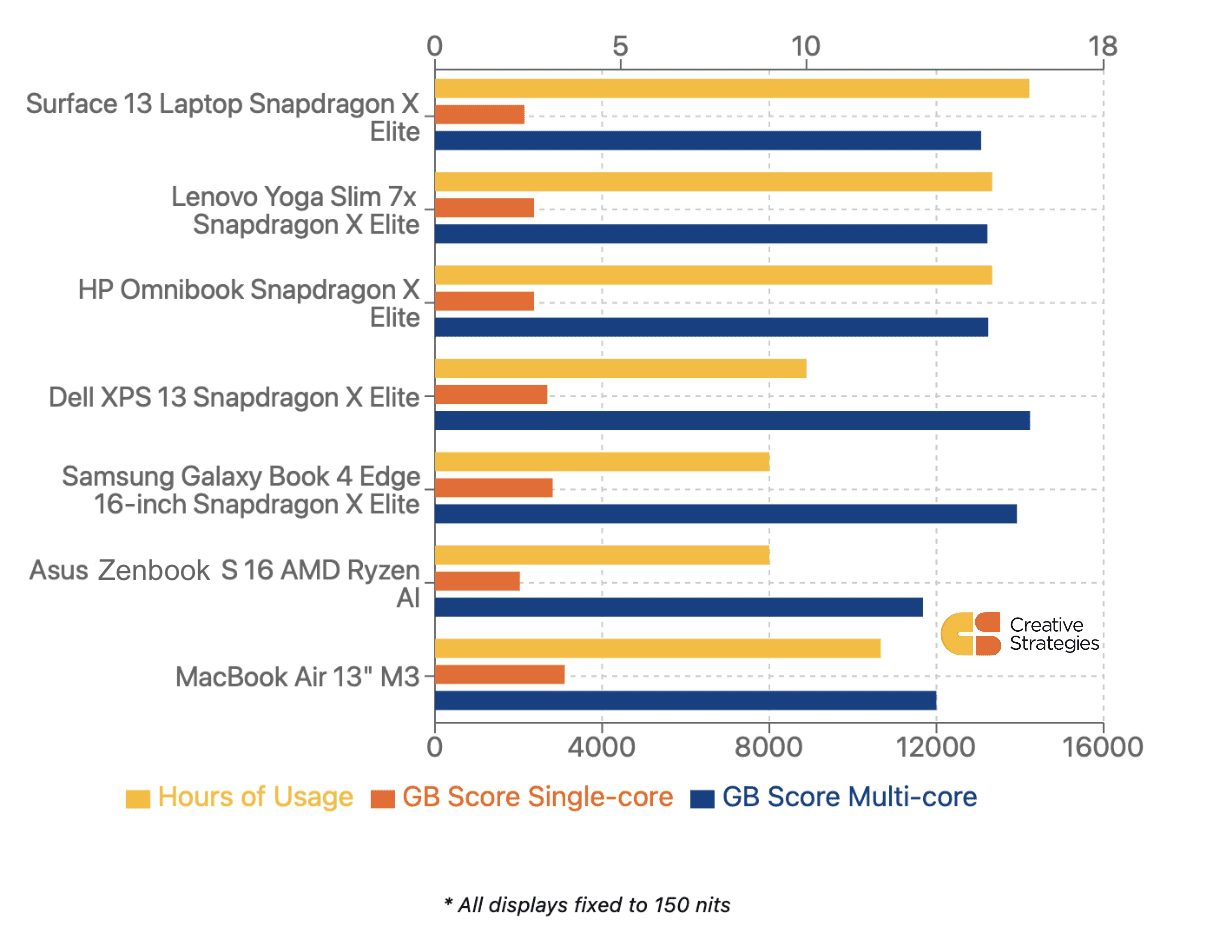
**Key Takeaways**
What this chart highlights is how much battery life mileage will vary across OEMs which is driven by design decisions they make for the specific experience they want to enable. For example, the Samsung Galaxy Book 4 Edge, the Lenovo Yoga Slim 7x, and the Dell XPS 13 all have OLED screens of varying sizes. The Dell XPS is a 13″ tandem OLED (which is the absolute best-looking laptop display I’ve ever seen) but because of this feature, and the smaller chassis, it gets 10 hours of light work usage. The Samsung Galaxy Book 4 Edge is also OLED but has a 16″ display and also has \~10 hours of light work usage. The standout for quality of display and battery life is the Lenovo Yoga Slim 7x that got \~15 hours of light work usage but is also in an extremely thin chassis and is easily one of the best overall designs of the crop. However, it achieves its stellar battery life, with an OLED display, thanks to an–on average– \~30% larger battery compared to the crop of laptops we tested. **The standout winner is the Microsoft Surface Laptop 13 which averaged \~16 hours of light work usage.**
Overall, testing this current crop of Copilot + laptops has proven to provide \~10 hours minimum of light work usage on a single charge which is a large step up as an average to systems from a few years ago that struggled to get 10 hours of light work usage even at low-power mode. We ran all these tests in balanced mode in Windows to ensure the best performance-to-battery life ratio.
**Comparing to Mac M3 Macbook Air**
The primary question, competitively, is how this new class of Copilot PCs compares to Apple’s Macbook Air, which had continually been the bar in laptop battery life. As we can see from our tests, the Macbook Air M3 got 12 hours in our light work usage tests. Also, as you can see the base Apple Silicon M3 performs on par with Qualcomm Snapdragon 12 Core X Elite even though it has 10 cores. Apple MacBook Air M3 also has a fanless design meaning it is entirely silent during its operation because it is running at a lower wattage than competing systems which allow it to operate in a fanless design. This emphasizes Apple’s leadership in performance per watt with their M series chips, where they can achieve equal to, and sometimes higher performance scores while also running at the lowest power possible.
We conducted the most comparisons to MacBook Air M3 with the Surface Laptop 13 because of price, size, display, and battery size in Mh, we felt it was the most comparable system. The main caveat here is that the Surface running Snapdragon X Elite is running at a higher wattage and is the 12 core vs. Apple Silicon M3 10 core. However, despite running at a higher wattage, with roughly the same size battery the Surface Laptop 13 was consistently delivering the best results in our testing, regularly lasting over 16 hours of light work usage.
Besides our custom light work battery test, I used the Surface Laptop 13 as a daily driver for a few days and was consistently shocked by how long the battery lasted. It is the first Windows laptop I’ve ever used that delivered the same feeling as using my Mac from a battery life perspective.
One interesting thing we found, was while HDR is a key feature of the Surface Laptop 13, enabling HDR did have a drastic impact on battery life. With HDR enabled, running our light work battery test, the Surface Laptop 13 only lasted 9 hours.
We also compared the Surface Laptop 13 with Snapdragon X Elite in power saver mode vs. MacBook Air M3 13″ in power saver mode which only gave it around an hour longer of usage, scoring just over 17 hours of light work consistently. However, it does this at a cost of performance where the GeekBench CPU scores in power saver were 1651 for single-core and 7819 for multi-core. Meaning power saver mode induced a 26% performance drop in CPU score and a 50% performance drop in multi-core yet only provided on average an hour to 1.5 hours better battery life.
The MacBook Air M3 13″ in power saver mode provided much more battery life lift getting \~15 hours of light work usage. But, the MacBook Air in low-power mode saw a 58% performance drop in single-core performance and a 64% performance drop in multi-core allowing for three more hours of light productivity. We did the analysis this way simply to show what the performance trade-offs may look like just to get a few more hours of usage. In some cases, it may be worth it, but in other cases, it likely will not.
The Microsoft Surface battery’s stellar battery life highlights an interesting advantage Microsoft has that I hadn’t fully appreciated at the experience level until now. Microsft had always positioned the Surface line of computers as the best expression and implementation of Windows. If you want the best of Windows and the surrounding Microsoft experience then the Surface is the showcase and the hero product for Windows/Office, etc. It is for that reason, that Microsoft was able to tune and optimize Windows in a more tightly integrated way with the Surface hardware and those optimizations are a big reason for the exceptional battery life we found on the Surface Laptop 13.
Ultimately, this new crop of Copilot + PCs is a big step forward in battery life and efficiency. Those OEMs that focused on the longer battery life of a feature easily exceeded past Windows laptops in all-day light productivity usage. As has always been the case with the Windows laptop ecosystem, mileage will vary with battery life depending on OEM decisions in specific specs and features, but we think the base level of 10-12 hours (very light usage of just videos/web will yield much longer battery life of course) of actual productivity and entertainment at a minimum is an excellent new bar for the Windows PC market. While we continue to test systems from AMD and look forward to the upcoming launch of new Core Ultra products from Intel based on the newest Lunar Lake architecture, for the moment Qualcomm’s Snapdragon X Elite-powered laptops have shown to have the best battery life of any Windows laptop in the history of the category.
---
**About our Testing/Methodology**
- All tests were run in balanced mode, with the display at 150 nits for the entirety of the test, and HDR turned off when available. No power saving or adaptive display settings were enabled to keep the display of the laptop fixed to 150 nits.
- The test was a programmed loop with automated scrolling for 300 seconds, and document creation/typing of 2500 words. YouTube play through a \~9-minute video and run through 3 synthetic tests to push different parts of the system. These push I/O by rapidly generating and deleting files, photo editing by generating an image and editing it, then stressing the CPU to use 75% of the total CPU cores aiming for 75% utilization of the CPU for 90 seconds. This loop is started with battery 100% and loops until dead.
### AMD Acquires ZT Systems and Goes Full Stack to Full Rack
URL: https://creativestrategies.com/research/amd-acquires-zt-systems-and-goes-full-stack-to-full-rack/
Last updated: 2024-08-19T22:31:31.000Z
Today, AMD announced they are acquiring ZT Systems for $4.9 billion. This move is highly strategic, as AMD looks to go from full stack to full rack as the basis of competition in the AI server market continues to change and a much more vertical approach than ever is needed.
---
**Key Takeaways**
- AMD has announced plans to acquire ZT Systems for $4.9 billion.
- Key points of the acquisition include:
- Gaining ZT Systems’ expertise in designing and optimizing cloud computing solutions
- Accelerating deployment of AMD-powered AI infrastructure at scale
- Strengthening AMD’s ability to deliver end-to-end data center AI infrastructure
- The acquisition aims to address a projected $400 billion data center AI accelerator market opportunity in 2027
- This move highlights the importance of fully integrated systems, which go beyond just the rack computer, but extend to networking, switches, storage, and advanced cooling techniques
- With this acquisition, AMD increases its lock-in/build-in potential with data center customers.
---
The entire basis of data center design is changing thanks to the shift from traditional servers to AI servers. As [I detailed in this analysis](https://creativestrategies.com/data-center-evolution-ai-changing-datacenter-design-strategies/), entirely new approaches to design are required as all data center infrastructure is being reimagined to solve new problems that emerge with the increased power/cooling needs of AI servers.
ZT Systems is a key supplier and designer of data center solutions for all merchant silicon vendors, including Intel, Nvidia, etc., and how AMD handles this side of the business will be interesting to watch as it provides some degree of counter-intuitive competition. CEO Lisa Su indicated they would divest this area, acknowledging it is a low-margin business but even that can be tricky and will require precision execution. It appears, that business will be offloaded via reference designs, or potentially sale to other ODMs to manufacture racks for AMD competitors.
While AMD sees this as an investment in supporting their scale as well as taking more vertical approaches to this now full-rack solution, it will be interesting to see how the hyper scalers view this when it seems more of them are favoring their designs, own custom silicon, and see their ability to design more efficient data centers as a key competitive advantage of their own. On paper, the premise of going from full stack to full rack sounds good but in some cases, it may be counter to how the biggest hyper scalers in the world choose to design their spaces and keep a degree of autonomy to not get stuck in any single vendor lock-in. That said, there is clearly a shift to a more homogeneous systems-design approach happening within merchant silicon competitors in the data center. This move from AMD only underscores this continued direction.
**Key Context From Management**
Below are some comments from AMD CEO Lisa Su that add additional context to the acquisition and AMD’s goals.
- **Strategic alignment with AMD’s AI roadmap:**
Lisa Su stated: “Our acquisition of ZT Systems is the next major step in our long-term AI strategy to deliver leadership training and inferencing solutions that can be rapidly deployed at scale across cloud and enterprise customers.”
- **Enhancing AMD’s capabilities:**
Su mentioned: “ZT adds world-class systems design and rack-scale solutions expertise that will significantly strengthen our data center AI systems and customer enablement capabilities.” The addition of ZT Systems engineers will allow AMD to more quickly test and roll out its latest AI graphics processing units (GPUs) at the scale of cloud computing giants such as Microsoft Su.
- **Building on previous investments:**
Su noted: “This acquisition also builds on the investments we have made to accelerate our AI hardware and software roadmaps.”
- **Ecosystem integration:**
Su explained: “Combining our high-performance Instinct AI accelerator, EPYC CPU, and networking product portfolios with ZT Systems’ industry-leading data center systems expertise will enable AMD to deliver end-to-end data center AI infrastructure at scale with our ecosystem of OEM and ODM partners.”
- **Focus on scale:**
Su repeatedly mentioned scale in her comments, emphasizing “rapidly deployed at scale” and “end-to-end data center AI infrastructure at scale.”
**View From the Street on The Deal**
Here’s a summary of the investor Q&A with key sentiment analysis and highlights of Lisa Su’s responses:
Key Investor Sentiment:
- Cautiously optimistic: Investors showed interest in the strategic benefits but sought more clarity on financial details.
- Concerned about financial specifics: Multiple questions probed for more precise figures on revenue, margins, and the value of manufacturing assets to be divested.
- Curious about competitive positioning: Investors were keen to understand how this acquisition positions AMD relative to competitors, especially Nvidia.
**Relevant Discussion Point From the AMD Investor Call**
**Strategic Fit and Integration**
1. **Open Ecosystem and Innovation**: Lisa emphasized that AMD remains committed to open standards and an open ecosystem. The acquisition is seen as additive, helping to deploy large-scale clusters faster without replacing existing open ecosystem solutions .
2. **AI Strategy and Capabilities**: She highlighted that the acquisition aligns with AMD’s AI strategy, enhancing their ability to offer optimized systems to cloud companies and OEM/ODM partners. This includes leveraging AMD’s leadership in CPU, GPU, and networking technologies .
**Financial Impact and Projections**
1. **Accretion and Revenue Growth**: Lisa mentioned that the acquisition is expected to be accretive by the end of 2025\. The revenue from service support and additional GPU sales is anticipated to offset any minor dilution from the transaction .
2. **Manufacturing Business Sale**: She confirmed that AMD will seek a strategic partner to acquire ZT Systems’ manufacturing business post-transaction, which is expected to be classified as held for sale and reported as discontinued operations .
**Competitive Positioning**
1. **Comparison with Nvidia**: Lisa stated that AMD’s investments in AI hardware, software, and now systems capabilities position them strongly, potentially even better than competitors in some areas. She emphasized the significant performance improvements in their ROCm software stack, which in some cases surpasses competitors .
2. **Networking Capabilities**: She noted that the acquisition would help AMD optimize their networking solutions, which is crucial for large-scale AI deployments. The addition of ZT Systems’ engineers, who have expertise in connecting large-scale AI clusters, will be beneficial .
**Operational Details**
1. **Leadership and Team Integration**: Lisa confirmed that key leaders from ZT Systems, including CEO Frank Zhang and President Doug Huang, will join AMD and play significant roles in the integration and future operations .
2. **Customer Enablement**: She emphasized that the acquisition will enable AMD to provide a stronger foundation for their customers, allowing for faster deployment of technology and giving customers more choice in optimizing their systems .
**Market Reaction and Future Outlook**
1. **Market Perception**: Lisa clarified that AMD will continue to work with OEM and ODM partners, providing them with optimized reference designs to bring to market faster. This approach is intended to enhance the adoption of AMD solutions without taking away customer choice .
2. **Long-term Growth**: She reiterated that AI is AMD’s #1 strategic priority and that the acquisition of ZT Systems is a significant step in their long-term AI strategy. The goal is to deliver leadership AI solutions that can be rapidly deployed at scale across cloud and enterprise customers .
### Geekbench AI and the State of the NPU
URL: https://creativestrategies.com/research/geekbench-ai-and-state-of-npu/
Last updated: 2024-08-15T19:24:19.000Z
**Key Takeaways:**
- Geekbench AI 1.0 is a new cross-platform benchmark suite designed for machine learning, deep learning, and AI-centric workloads.
- It provides three main scores: Single Precision, Half Precision, and Quantized, reflecting different precision levels used in AI tasks.
- The benchmark includes both computer vision and natural language processing workloads.
- Accuracy measurements are incorporated alongside performance metrics for each test.
- Geekbench AI supports various AI frameworks across different platforms, including OpenVINO, ONNX, and vendor-specific TensorFlow Lite Delegates.
- The benchmark uses extensive datasets to better reflect real-world AI use cases.
- All workloads run for a minimum of one second to account for performance tuning and real-world usage patterns.
**What’s Important:**
- The benchmark aims to provide a standardized way to measure AI performance across different devices and platforms.
- It considers both speed and accuracy, recognizing that AI performance isn’t just about how quickly a task is completed.
- The inclusion of different precision levels (single, half, and quantized) allows for a more comprehensive evaluation of AI hardware capabilities.
- Geekbench AI’s workloads are designed to reflect real-world applications of AI, making the benchmark results more relevant to actual use cases.
- The benchmark’s support for various AI frameworks makes it adaptable to different development ecosystems.
- The longer runtime for each test (minimum 1 second) helps to better capture sustained performance, which is crucial for real-world AI applications.
- Geekbench AI is designed to evolve with the rapidly changing AI landscape, with plans for regular updates to keep pace with new developments in the field.
- The benchmark is already being used by major tech companies, indicating its potential to become an industry standard for AI performance measurement.
**Inference Workloads:**
- Image Classification (using MobileNetV1)
- Image Segmentation (using DeepLabV3+ with MobileNetV2 backbone)
- Pose Estimation (using OpenPoseV2 with VGG19 backbone)
- Object Detection (using SSD with MobileNetV1 backbone)
- Face Detection (using RetinaFace with MobileNetV2 backbone)
- Depth Estimation (using ConvNets with EfficientNet-Lite3 backbone)
- Image Super Resolution (using Residual Feature Distillation Network – RFDN)
- Style Transfer (using Fast Real-Time Style Transfer approach)
- Text Classification (using Compressed BERT – BERT-Tiny)
- Machine Translation (using Transformer architecture)
---
**Let’s put this simply:** Geekbench AI v1.0 was just announced by Primate Labs and is on track to be one of the best standardized benchmarks for AI. Geekbench AI is a torture test for the NPU, testing not only the silicon but the software stack around it that allows models to run. This new update also provides three precisions options: full precision fp32, half precision fp16, and quantized int8\. At the risk of spoiling some of the results below, the only usable data types for these devices are full precision and half precision, the quantized int8 lose too much quality to be useful. While the int8 quantized numbers may be impressive, these int8 quantized models aren’t useful in production.
Geekbench AI v1.0 focuses on smaller models with very common system and application-level processes, listed above. If you’re Instagram or Snapchat looking to do real-time filters, you’ll use the models above. If you’re a developer trying to index photos for editing software or do on-device search, you’re going to use the text classification/translation, you’re going to use one of the models above. Each of these models is more or less the industry-standard open-source model for each task and uses the best practices for inference across each platform for the best performance and efficiency.
GenAI is noticeably missing from this list, mostly because there really is no set of best practices for inference yet. Most implementations, like Apple Intelligence and Gemini Nano, are proprietary and do expose some LLM access to developers, making it easier just to use those. There are also memory requirements, and not every device can run these models. For now, local GenAI is just too up in the air to really benchmark fairly or properly.
**One of the most important things to note with Geekbench AI is that all of these performance scores are at a moment in time. Just like GPU drivers improving performance on PCs, NPU compiler and runtime software will improve performance for AI models. The way the models are run on the NPU, data type and conversion layers used (like running fp calculations on silicon designed for int data types), and further optimization to the AI inference engines can all improve performance. Just like GPU drivers with performance optimizations for games, a simple update can improve performance across models and hardware.**
Another point to mention is how these updates happen. On Windows using ONNX and DirectML/QNN, both the applications and models will need to be updated and recompiled using the latest updates to ONNX, QNN, or DirectML to get improved performance. It is worth noting that right now, there is a bug with ONNX on Windows which is resulting in decreased and inconsistent performance on Snapdragon X Elite machines. While this likely will be fixed soon, this is simply the reality for developers looking to use edge models. The performance may not be great now; it may be worth looking into different APIs or optimizing for specific platforms. Qualcomm offers you the option to run QNN compiled models or ONNX, so while ONNX might be cross-platform and support GPU, CPU, and NPU across AMD, Intel, Nvidia, and Qualcomm, it might be worth using Intel’s OpenVINO, Nvidia’s CUDA, or Qualcomm’s QNN until ONNX is stable enough to provide consistent performance.
On Android, it’s a little up in the air. Google recently announced the transition from NNAPI (Neural Net API) for AI model acceleration to a new [TensorFlow Lite in Play Services architecture](https://developer.android.com/ndk/guides/neuralnetworks/migration-guide?ref=creativestrategies.com), and it’s yet to be seen how this will work. At the moment, the new hardware acceleration service in TensorFlow Lite only supports CPU and GPU, so there is no way to use the DSP or NPU for model acceleration outside of the silicon provider’s API. This means, as far as I can tell in public documentation, there is no way for developers to use TPU/NPU acceleration on the new Pixel 9 series.
Samsung has ENN for Exynos devices, and Qualcomm has QNN for Qualcomm devices; both are free and have good documentation. MediaTek has a NeuroPilot SDK for hardware acceleration of AI models, but you need to apply to MediaTek for access to precompiled models and basic documentation on how to use it. Right now, it looks like Samsung and Qualcomm-powered devices are the only ones that can even harness the NPU on Android.
CoreML for iOS, macOS, and iPadOS, on the other hand, is bundled with the operating system. For example, [iOS 18 beta saw a 25% increase in Neural Engine performance](https://9to5mac.com/2024/06/17/iphone-15-pro-max-neural-engine-up-to-25-faster-ios-18/?ref=creativestrategies.com) with an [up to 40% increase in some workloads](https://x.com/argmaxinc/status/1803072948632469857?ref=creativestrategies.com). The same model, just a system update. This isn’t to say updates to coremltools, Apple’s model conversion software, won’t help, but the majority of the work is done at the system level. This makes it easier for developers to just use one model and let the OS and device handle the rest. These models should also work cross-device, so one model can run on macOS, iOS, and iPadOS.
With all of this in mind, where do we go from here? What is this really useful for? I view this as a great way to track the improvements over time for not only pure silicon performance but also inference backends and model architecture. Sure, Snapdragon 8 Gen 4 will have better performance than the Snapdragon 8 Gen 3, the A18 will be better than the A17 Pro, and so on. These improvements are to be expected YoY as processing nodes improve as well as silicon architecture. Geekbench AI’s design also allows us to see improvements as Microsoft updates DirectML and ONNX or Google TensorFlow Lite in Play Services; we’ll be able to see the performance improvements over time on the same silicon.
---
All of this sounds confusing, and to be honest, it is. There is no easy option for developers of any size; you have to optimize for each silicon vendor on each platform and hope for the best. The end result is developers will likely just choose the platforms with the largest user base and optimize for that, or choose suboptimal inference pipelines and hope it improves with time.
These are still the early days for AI and edge inference, but a lot of work needs to be done to improve the experience and accessibility of information for developers. No company is perfect, and there is a lot of work to be done, but this is a good first step. As I said above, we can now basically watch the progression of model inference and different technologies at both a hardware and software layer progress; this really isn’t something that’s been easy to do historically.
### How CIO/CTO’s are Thinking About Generative AI
URL: https://creativestrategies.com/research/how-cio-ctos-are-thinking-about-generative-ai/
Last updated: 2024-08-13T14:26:29.000Z
Gathering feedback and synthesizing six CIO/CTO surveys from investment bank broker research, we summarize the key findings on how CIO/CTO’s are currently thinking about Generative AI investments and deployment.
Recent analysis of CIO perspectives reveals a nuanced and strategic approach to Generative AI (GenAI) investments. As organizations navigate this transformative technology, several key themes have emerged in CIO strategies, reflecting a balance between innovation and pragmatism.
##### Log in to keep reading.
###### Not a Client, request access
### Contact
- First Name\*
- Last Name\*
- Email\*
- Message\*
- This field is hidden when viewing the form
Post requested
/\* <!\[CDATA\[ \*/ gform.initializeOnLoaded( function() {gformInitSpinner( 2, 'https://ghost-production-fd45.up.railway.app/content/images/creativestrategies-com/wp-content/plugins/gravityforms/images/spinner.svg', true );jQuery('#gform\_ajax\_frame\_2').on('load',function(){var contents = jQuery(this).contents().find('\*').html();var is\_postback = contents.indexOf('GF\_AJAX\_POSTBACK') >= 0;if(!is\_postback){return;}var form\_content = jQuery(this).contents().find('#gform\_wrapper\_2');var is\_confirmation = jQuery(this).contents().find('#gform\_confirmation\_wrapper\_2').length > 0;var is\_redirect = contents.indexOf('gformRedirect(){') >= 0;var is\_form = form\_content.length > 0 && ! is\_redirect && ! is\_confirmation;var mt = parseInt(jQuery('html').css('margin-top'), 10) + parseInt(jQuery('body').css('margin-top'), 10) + 100;if(is\_form){jQuery('#gform\_wrapper\_2').html(form\_content.html());if(form\_content.hasClass('gform\_validation\_error')){jQuery('#gform\_wrapper\_2').addClass('gform\_validation\_error');} else {jQuery('#gform\_wrapper\_2').removeClass('gform\_validation\_error');}setTimeout( function() { /\* delay the scroll by 50 milliseconds to fix a bug in chrome \*/ }, 50 );if(window\['gformInitDatepicker'\]) {gformInitDatepicker();}if(window\['gformInitPriceFields'\]) {gformInitPriceFields();}var current\_page = jQuery('#gform\_source\_page\_number\_2').val();gformInitSpinner( 2, 'https://ghost-production-fd45.up.railway.app/content/images/creativestrategies-com/wp-content/plugins/gravityforms/images/spinner.svg', true );jQuery(document).trigger('gform\_page\_loaded', \[2, current\_page\]);window\['gf\_submitting\_2'\] = false;}else if(!is\_redirect){var confirmation\_content = jQuery(this).contents().find('.GF\_AJAX\_POSTBACK').html();if(!confirmation\_content){confirmation\_content = contents;}jQuery('#gform\_wrapper\_2').replaceWith(confirmation\_content);jQuery(document).trigger('gform\_confirmation\_loaded', \[2\]);window\['gf\_submitting\_2'\] = false;wp.a11y.speak(jQuery('#gform\_confirmation\_message\_2').text());}else{jQuery('#gform\_2').append(contents);if(window\['gformRedirect'\]) {gformRedirect();}}jQuery(document).trigger("gform\_pre\_post\_render", \[{ formId: "2", currentPage: "current\_page", abort: function() { this.preventDefault(); } }\]); if (event && event.defaultPrevented) { return; } const gformWrapperDiv = document.getElementById( "gform\_wrapper\_2" ); if ( gformWrapperDiv ) { const visibilitySpan = document.createElement( "span" ); visibilitySpan.id = "gform\_visibility\_test\_2"; gformWrapperDiv.insertAdjacentElement( "afterend", visibilitySpan ); } const visibilityTestDiv = document.getElementById( "gform\_visibility\_test\_2" ); let postRenderFired = false; function triggerPostRender() { if ( postRenderFired ) { return; } postRenderFired = true; gform.core.triggerPostRenderEvents( 2, current\_page ); if ( visibilityTestDiv ) { visibilityTestDiv.parentNode.removeChild( visibilityTestDiv ); } } function debounce( func, wait, immediate ) { var timeout; return function() { var context = this, args = arguments; var later = function() { timeout = null; if ( !immediate ) func.apply( context, args ); }; var callNow = immediate && !timeout; clearTimeout( timeout ); timeout = setTimeout( later, wait ); if ( callNow ) func.apply( context, args ); }; } const debouncedTriggerPostRender = debounce( function() { triggerPostRender(); }, 200 ); if ( visibilityTestDiv && visibilityTestDiv.offsetParent === null ) { const observer = new MutationObserver( ( mutations ) => { mutations.forEach( ( mutation ) => { if ( mutation.type === 'attributes' && visibilityTestDiv.offsetParent !== null ) { debouncedTriggerPostRender(); observer.disconnect(); } }); }); observer.observe( document.body, { attributes: true, childList: false, subtree: true, attributeFilter: \[ 'style', 'class' \], }); } else { triggerPostRender(); } } );} ); /\* \]\]> \*/
### Data Center Evolution: AI Changing Datacenter Design Strategies
URL: https://creativestrategies.com/research/data-center-evolution-ai-changing-datacenter-design-strategies/
Last updated: 2024-08-08T16:42:59.000Z
The landscape of data center construction and design is undergoing a rapid transformation, driven primarily by the surge in artificial intelligence (AI) workloads and their unprecedented power demands. This shift is reshaping how data centers are designed, built, and operated.
Central to this evolution is the stark contrast in power requirements between traditional and AI-focused server racks. Our research reveals that while traditional server racks typically consume 12-13 kW per rack, AI server racks can demand a staggering 50-60 kW per rack – a four to five-fold increase. This substantial difference is not just a matter of scale; it represents a fundamental change in the approach to data center architecture. AI data centers now require approximately 40% more overall power capacity compared to their traditional cloud counterparts, pushing the boundaries of what’s possible in terms of power delivery and management.
This increased power demand is driving a trend towards larger, more power-intensive facilities. Some new hyperscale data centers are being designed to draw over 1 GW of power, with facility sizes expanding to match these enormous power requirements. It’s not uncommon to see new projects approaching or exceeding 1 million square feet, representing a new frontier in the industry that we call “mega” data centers.
Understanding the economics of these massive facilities provides insight into the industry’s priorities. Typically, about one-third of a data center’s budget is allocated to power, cooling, building security, and related infrastructure, with the remaining two-thirds dedicated to IT equipment. This split underscores the significant investment required in supporting infrastructure to enable the deployment of cutting-edge IT equipment.
Cooling remains a major concern, both in terms of initial investment and ongoing operational costs. It accounts for about 30% of a data center’s power consumption, with 18-25% of building costs (excluding IT) allocated to cooling products. These figures highlight the critical nature of efficient cooling solutions in modern data center design.
As power densities increase, traditional air cooling methods are reaching their limits, leading to a growing trend towards liquid cooling solutions. Liquid cooling offers several advantages:
- Potential to reduce cooling power consumption by up to 60% compared to traditional air cooling
- Ability to handle higher power densities, making it ideal for AI workloads
- Improved overall energy efficiency, contributing to better Power Usage Effectiveness (PUE)
Hyperscale providers are leading the adoption of liquid cooling, with colocation facilities increasingly offering liquid-cooled options to attract high-density clients. Enterprise data centers are also gradually incorporating liquid cooling, often in specific high-performance pods.
The industry continues to use a tiered classification system to define levels of redundancy and reliability, ranging from Tier 1 (basic design with single power source) to Tier 4 (highest level of redundancy and fault tolerance). However, different types of data centers approach design with varying priorities. Enterprise data centers often opt for Tier 2 or Tier 3 designs, focusing on balancing performance with cost-effectiveness. Colocation facilities typically aim for Tier 3, with some offering Tier 4 options, emphasizing flexibility and scalability. Hyperscale data centers usually implement Tier 3 designs with some Tier 4 elements for critical systems, leading the way in advanced cooling technologies and energy efficiency. AI-focused data centers are designed for high power density from the outset, often incorporating liquid cooling, at the bare minimum, as a standard feature.
As the industry evolves, we can expect to see further innovations in power management, cooling technologies, and modular design. Key trends to watch include:
1. The continued rise of liquid cooling as a standard feature in high-density environments
2. Adoption of new technologies like direct-to-chip cooling
3. Increased adoption of modular, scalable designs to allow for rapid deployment and easy upgrades
4. Growing focus on energy efficiency and sustainability, driven both by cost considerations and environmental concerns
5. The potential emergence of new tier classifications or design standards to address the unique needs of AI-focused data centers
The data centers of the future will need to be more flexible, efficient, and scalable than ever before to meet the growing demands of our increasingly data-driven world. As AI and other high-performance computing workloads continue to push the boundaries of what’s possible, the data center industry stands at the forefront of innovation, continuously adapting to power the technologies that are shaping our digital future.
### Data Center Cooling Innovation: A Critical Imperative
URL: https://creativestrategies.com/research/data-center-cooling-innovation-a-critical-imperative/
Last updated: 2024-08-08T16:42:43.000Z
As data centers continue to proliferate and expand to meet the ever-growing demands of our digital world, the need for innovative cooling solutions has become increasingly urgent. This report examines why new methods of cooling data centers are critical, considering environmental, technological, economic, and operational factors. The rise of artificial intelligence (AI) and high-density computing is adding to existing challenges, making the development and implementation of water-efficient cooling technologies a top priority for the industry.
**Water Scarcity and Environmental Impact**
The rapid growth of data centers has led to a significant increase in water consumption, with global usage growing at 6% annually from 2017 to 2022\. Projections indicate that data center water consumption could reach a staggering 450 million gallons per day by 2030, making it one of the fastest-growing water-consuming sectors.
The advent of AI has further intensified this issue. For instance, training a single large language model like GPT-3 in Microsoft’s US data centers can directly evaporate 700,000 liters of clean freshwater. As AI applications continue to expand, this water demand is expected to grow exponentially.
In many regions, data centers are competing directly with agriculture, industry, and municipal needs for limited water resources. This is particularly concerning in water-scarce areas, where nearly half of China’s data center racks are located. The environmental impact of this water usage has become so significant that excessive consumption is now among the top reasons organizations cite for closing data centers.
**Energy Efficiency and Sustainability**
Water usage in data centers is intrinsically linked to energy consumption. Water is used both directly for cooling and indirectly in power generation. As data centers transition to renewable energy sources, the focus on reducing on-site water use for cooling becomes even more critical in minimizing their overall environmental footprint.
In response to these concerns, major tech companies including Google, Microsoft, Meta, and Amazon have pledged to become “water positive” by 2030\. These commitments are driving significant innovation in water-efficient cooling technologies and practices.
**Technological Advancements**
Traditional air cooling methods are becoming increasingly inadequate for high-density computing environments. Modern processors can emit between 200-600W of heat, far exceeding the 130W limit for efficient air cooling. GPUs and accellerators all normalize at 700W and can go well above to >1000W. This has necessitated the development of more advanced cooling solutions.
Liquid cooling technologies, particularly direct-to-chip systems, have shown promising results. These systems can reduce facility power needs by 18% and cut energy costs by 10% compared to air cooling in high-density environments. Hybrid systems that combine dry cooling with limited water use are also proving effective in significantly reducing overall water consumption while maintaining cooling efficiency.
The use of alternative water sources, such as reclaimed water, seawater, or harvested rainwater, is another innovative approach that can alleviate pressure on freshwater resources.
**Direct-to-Chip a Closer Look**
Direct-to-chip cooling is emerging as a critical innovation in data center thermal management, addressing the growing challenges of water scarcity and energy efficiency. This technology integrates cooling directly into computer chassis, using liquid coolants to remove heat from high-power components like CPUs and GPUs more efficiently than traditional air cooling methods.
The mechanism involves circulating coolant fluid through small tubes to cold plates attached to heat-generating components. This closed-loop system recirculates the coolant through a heat exchanger, significantly reducing water consumption compared to conventional cooling towers. The higher heat capacity and thermal conductivity of liquids allow for more efficient heat transfer, requiring less coolant to remove the same amount of heat as air-based systems.
Key advantages of direct-to-chip cooling include:
1. Water efficiency: It can reduce water usage by 20-90% depending on climate conditions.
2. Energy savings: Some implementations show a 10% reduction in energy costs.
3. Support for high-density computing: It can handle rack power densities of 50kW or more, crucial for AI applications.
4. Reduced reliance on facility-wide air conditioning.
The system typically consists of coolant distribution units, custom-designed cold plates, manifolds for even coolant distribution, flexible tubing, and heat exchangers. Major tech companies are actively implementing and refining this technology. For instance, Meta has deployed the StatePoint Liquid Cooling system, while Microsoft is testing two-phase liquid immersion cooling.
Despite its benefits, direct-to-chip cooling faces challenges such as higher initial costs, retrofitting difficulties in existing data centers, specialized maintenance requirements, and the need for careful coolant selection. However, its ability to handle thermal loads up to 100 kW per rack far exceeds traditional air cooling capabilities.
**Economic and Operational Factors**
Advanced cooling methods for data centers, particularly direct-to-chip liquid cooling, offer significant potential for long-term economic savings. While these systems often require higher initial investments, they can lead to substantial cost reductions over time, making them increasingly attractive to data center operators.
The primary areas of savings come from reduced energy and water consumption. Direct-to-chip cooling can decrease facility power needs by up to 18%, translating to roughly 10% savings in overall energy costs. Water usage can be cut by 20-90%, depending on the specific technology and climate, leading to considerable savings, especially in water-scarce regions. Over a 5-10 year period, these reductions can amount to millions of dollars in savings for large-scale data centers.
Additionally, these advanced cooling methods allow for higher density server configurations, supporting up to 100 kW per rack compared to 15-25 kW for air cooling. This increased density means more computing power in the same physical space, potentially reducing real estate costs. The systems also reduce the need for extensive facility-wide air conditioning, leading to savings in HVAC equipment costs and maintenance.
Other economic benefits include extended hardware lifespan due to more consistent operating temperatures, improved operational efficiency with fewer thermal-related equipment failures, and better scalability. While the exact savings depend on factors such as data center size, location, and specific technologies implemented, some estimates suggest ROI periods as short as 2-3 years for large-scale implementations. As these technologies continue to improve and become more widely adopted, the economic advantages are expected to become even more pronounced, making the transition to more efficient cooling systems an increasingly compelling proposition for data center operators.
**Innovation and Market Opportunities**
The growing demand for efficient cooling solutions is creating significant market opportunities. The global data center liquid cooling market is projected to grow at an impressive 40% CAGR through 2028, expanding from $0.6 billion in 2023 to $3.5 billion by 2028.
This market growth is driving rapid innovation in areas such as direct-to-chip cooling, immersion cooling, and smart management systems. Collaborations between tech companies, cooling specialists, and chip manufacturers are accelerating the development and deployment of these advanced cooling technologies.
The need for new methods of cooling data centers has never been more critical. As data centers play an increasingly vital role in global digital infrastructure, innovative cooling solutions are essential for balancing computational needs with environmental responsibility. These new technologies and practices will be key to addressing water scarcity, meeting sustainability goals, improving energy efficiency, ensuring regulatory compliance, reducing operational costs, and enabling the continued growth of data-intensive technologies like AI.
The data center industry stands at a crossroads where the adoption of advanced cooling methods is not just an option, but a necessity for sustainable growth. As we move forward, the success of data centers will be measured not only by their computational power but also by their ability to operate efficiently and responsibly in a water-constrained world.
### Qualcomm Q3 2024 Earnings: AI, Automotive Growth, and Diversification Strategies Drive Investor Interest
URL: https://creativestrategies.com/research/qualcommq324earningsanalysis/
Last updated: 2024-08-05T16:18:39.000Z
The standout for Qualcomm was the auto growth as the strength of the ADAS solutions from Qualcomm continue to drive this business. Because it is ADAS/digital, Qualcomm is providing solutions to not just EVs but traditional power train and that is a key area of current differentiation among the other semiconductor companies providing solutions to the automotive industry.
Overall, the Qualcomm growth story and more specifically, growth by diversification, continues to gain momentum. What is interesting about this growth is it continues to be slow and steady and less depending on AI tailwinds as other companies in the space. AI remians a possible boost, but not depending on this puts Qualcomm in a strong market position.
---
**Key Takeaways**
- Solid results and outlook: Qualcomm delivered better-than-expected revenue and earnings for the quarter, beating analyst estimates.
- Strong performance in China: Revenue from Chinese OEMs grew over 50% year-over-year, benefiting from the growing premiumization trend.
- Automotive segment growth: Auto revenues grew 34% quarter-over-quarter as design wins translate into revenue. The company remains on track for $4 billion in auto revenue by 2026.
- Diversification efforts bearing fruit: Strong performance in automotive and IoT segments demonstrates success in diversifying beyond smartphones.
- Content gains in premium smartphones: Qualcomm continues to benefit from increased content and share in high-end devices.
- Positive momentum in AI: The company is well-positioned in the edge AI theme, with initial AI PC sales exceeding expectations.
---
**Earnings Call Analysis**
Below is our interpretation of the bigger questions on investors minds, from the earnings call, and how management answered.
**Automotive Business Growth**
- **Question:** Will the strong automotive revenue growth continue in coming quarters?
- **Answer:** Cristiano Amon expressed satisfaction with automotive performance, noting that the pipeline is translating into revenue. He confirmed they’re on track for $4 billion in automotive revenue by 2026\. He also mentioned potential upside from AI applications in automotive, particularly for user interfaces.
**AI PCs**
- **Question:** What are expectations for PC market units/revenue in the next fiscal year?
- **Answer:** Amon stated that AI PC sales are exceeding expectations, with some models sold out. However, they expect a gradual ramp-up over time. More details on PC and IoT opportunities will be provided at their upcoming investor day.
**AI Smartphones**
- **Question:** Is there noticeable demand for AI-capable smartphones? Will AI features proliferate to mid-tier phones?
- **Answer:** Amon noted that AI has expanded the premium tier of smartphones, with 50% growth seen in China. They plan to bring AI capabilities to mass-tier phones as well. He expressed excitement about upcoming Snapdragon launches with custom CPUs enhancing AI capabilities.
**China Handset Growth:**
- **Question:** What’s driving the 50% growth in China handsets?
- **Answer:** Akash Palkhiwala explained that while the overall handset market is flat to slightly up, the premium tier (>$400) has grown from 21% to 31% of the market. Qualcomm is benefiting from this premium segment expansion.
**Market Share and Customer Relationships:**
- **Question:** How does Qualcomm view its market position with key customers like Samsung and Apple
- **Answer:** Amon expressed confidence in Qualcomm’s technology leadership, especially with upcoming custom CPU launches. For Apple, they’re operating within previously disclosed frameworks. With Samsung, the relationship remains consistent with recent product launches.
**Growth Opportunities:**
- **Question:** Which opportunity is more exciting in the next 12 months – automotive or IoT?
- **Answer:** Amon emphasized that Qualcomm is building multiple diversification opportunities, including automotive, PCs, and industrial IoT. He expressed excitement about all these areas, with more details on industrial roadmap coming soon.
Overall, management emphasized strong performance in automotive and IoT segments, growing traction in AI-enabled devices (particularly in premium smartphones and PCs), and ongoing efforts to diversify the business beyond traditional smartphone chips.
**View From the Street**
Investor sentiment appears cautiously optimistic. While the results and near-term outlook were solid, there are some concerns about growth sustainability. Below is our summary of the main themes from investor commentary:
- Conservative Q1 FY25 guidance: Qualcomm’s initial outlook for 5% year-over-year growth in Q1 FY25 was below consensus expectations of 9%. However, analysts believe this guidance may be conservative.
- Smartphone market uncertainty: Qualcomm is assuming flat to slight growth in the global smartphone market for FY25, despite healthier trends seen in the first half of 2024\. This conservative outlook is likely contributing to investor caution.
- Huawei impact: The loss of Huawei business due to licensing restrictions will be a 2% headwind to revenue growth in upcoming quarters.
- Potential share loss at Samsung: Analysts note Qualcomm faces challenges in maintaining share at Samsung in the second half of 2024.
**Looking Ahead**
1. AI-driven opportunities: Potential for AI to drive content increases in smartphones and PCs, supporting Qualcomm’s growth.
2. Automotive traction: Ongoing momentum in the auto segment as design wins convert to revenue.
3. Smartphone market recovery: Whether Qualcomm’s conservative smartphone market outlook proves too cautious.
4. Diversification progress: Continued success in growing non-handset revenues to offset potential headwinds in the core smartphone business.
5. Competitive dynamics: Ability to maintain share and content gains at key customers like Samsung.
6. Overall, while there are some near-term uncertainties, analysts generally see potential for upside if smartphone trends improve and AI opportunities materialize. The company’s efforts to diversify beyond smartphones appear to be gaining traction, providing some optimism for long-term growth prospects.
### Intel: The Path to Full Recovery is Product, Product, Product
URL: https://creativestrategies.com/research/intel-the-path-to-full-recovery-is-product-product-product/
Last updated: 2024-08-05T16:40:09.000Z
Talking about Intel after this quarters news feels like it needs to be more a deep conversation than a post, but given this is probably the hottest topc in semis right now, there are a few points to get across.
First, the cost reduction plan is clearly necessary. There has been mounting evidence that Intel was not only not running as leanly as needed, but also had a range of cost efficiency problems. So dealing with that is sound and strategic. From the CFO commentary of Dave Zinser, it sounds like those cost efficeincies–which include all the way down the pre-EUV wafer level, are well understood and will now be dealt with. There should be some confidence there that managment does understand the structural issues.
Another big issue hitting the quarter and outlook is due to weaker recovery in the PC market in the second half than they expected. However, a huge positive, is they feel the need to ramp up Lunar Lake, which was initally being viewed as a more niche product and is now being ramped to volume. While that will have some negative impacts on gross margins, if AI PCs drive a meaninful cycle in 2025 then that is a positive for the client business.
As of now, I’ve simplified how I look at this to one single factor i’m watching. Can Intel regain product competitiveness as it feels like everything hinges on Intel having the best microprocessors again. If this happens then a lot of structural benefits in cost leverage, as well as back to underlying manufacturing will begin to work in Intel’s favor. So all eyes, for now, are on product, product, product.
In the below note, I tried to do a few things. Outline key highlights. Share the core elements on the restricting. Some analysis of the investor QA from the call and how managment answered with salient points. And, a roundup of investor sentment from my conversations with them and about a dozen post earnings broker notes.
---
**Key Takeaways**
- Intel reported Q2 2024 revenue of $12.8 billion, down 1% year-over-year but up 1% sequentially.
- Q2 profitability was below expectations, with gross margin at 38.7% and EPS at $0.02.
- The company announced significant cost reduction plans, targeting over $10 billion in savings by 2025.
- Intel is suspending its dividend to prioritize liquidity for strategic investments.
- The company is adjusting its capital expenditure plans, reducing 2024 gross CapEx to $25-27 billion.
- Intel reaffirmed its commitment to its IDM 2.0 strategy and process technology roadmap.
---
**Details of the restructuring model**
1\. New operating model: Implementing a new structure with separate financial reporting for Intel Products and Intel Foundry to improve efficiency and decision-making.
2\. Workforce reduction: Targeting a headcount reduction of over 15% by the end of 2025, with the majority completed by the end of 2024.
3\. OpEx reduction: Aiming to reduce operating expenses to approximately $20 billion in 2024 and $17.5 billion in 2025, a 20% reduction from prior estimates.
4\. Capital efficiency: Scrutinizing capital investments more rigorously and aligning them with market signals and foundry commitments.
5\. Cost reduction in manufacturing: Implementing a $1 billion reduction in non-variable cost of sales in 2025.
6\. Accelerated product transitions: Moving production of Intel 4 and 3 wafers from Oregon to Ireland to improve long-term cost structure and efficiency.
7\. Focus on AI PC market: Investing in the AI PC category, which is expected to grow from less than 10% of the market to over 50% by 2026.
8\. Advancing process technology: Continuing to invest in leading-edge nodes (Intel 18A, 14A, and 10A) to improve competitiveness and reduce reliance on external foundries.
9\. Expanding foundry services: Growing the Intel Foundry business, with a focus on advanced packaging technologies.
10\. Portfolio optimization: Each business unit (client, networking, data center, and foundry) is reviewing its product portfolio to maximize efficiency and profitability.
**Analysis of the Investor QA from the Earnings Call**
Below are some of the main themes and concerns asked from investors on the call and how Intel managment answered.
**1\. Competitive Position and Market Share:**
Investors expressed concern about Intel’s competitive standing, particularly in the server market. There were questions about how Intel’s products compare to competitors and whether the company can regain lost market share.
Pat Gelsinger’s response emphasized:
– Stabilization of market share in the server space
– Positive early feedback on new products like Sierra Forest
– Optimism about Granite Rapids and Clearwater Forest
**2\. Gross Margin Trajectory:**
A significant focus was on gross margin performance and future expectations. Investors sought clarity on the factors affecting margins and the timeline for improvement.
Key points from management:
– Near-term pressure due to accelerated ramp of AI PC products and external sourcing
– Expectation of modest margin improvement in 2025
– More significant margin expansion anticipated in 2026 with Panther Lake and internal manufacturing
**3\. Capital Expenditure and Foundry Strategy:**
Questions arose about the reduced CapEx guidance and its impact on the foundry strategy.
Management’s response:
– Foundry strategy remains unchanged, but capital deployment will be more aligned with committed orders
– Focus on advanced packaging as an “on-ramp” for foundry customers
– Emphasis on capital efficiency and utilization
**4\. Restructuring and Cost Reduction:**
Investors sought details on the structural changes and their potential impact on Intel’s competitiveness and long-term targets.
Key takeaways:
– $10 billion in cost savings targeted for 2025
– Headcount reduction of over 15% by the end of 2025
– Assurance that cost cuts won’t impede strategic investments or execution of key initiatives
**5\. AI Strategy and Market Opportunity:**
Questions about Intel’s positioning in the AI market, both in PCs and data centers.
Management highlighted:
– Leadership in AI PC category
– Gaudi 3 accelerator for data center AI workloads
– Integration of AI capabilities across product lines
**6\. Data Center Market Recovery:**
Investors inquired about the timing and potential for a recovery in the traditional server market.
Management highlighted:
– Current focus on AI build-out in data centers
– Potential for an enterprise refresh cycle
– Optimism about Xeon as the “head node” for AI clusters
**View From the Street**
**Cautious Optimism:**
While investors acknowledged Intel’s strategic vision and restructuring efforts, there was an undercurrent of caution. Many questions sought concrete evidence of execution and financial improvement.
**Impatience for Results:**
The tone of some questions suggested impatience for tangible progress, particularly in areas like market share recovery and gross margin improvement.
**Skepticism about Competitive Position:**
There was a noticeable concern about Intel’s ability to compete effectively, especially given the strong performance of competitors in similar market conditions.
**Focus on Financial Metrics:**
Investors showed a keen interest in near-term financial performance, suggesting a desire for more immediate signs of turnaround success.
**Long-term Vision vs. Short-term Execution:**
There was a tension between appreciation for Intel’s long-term strategy and concerns about short-term execution and financial performance. Investors are frustrated with areas of short-term execution and executive decision-making. There is concern that management keeps getting hit with structural issues they did not see coming. But despite the concern about short-term execution, it is clear investors still believe in the long-term vision.
**Continued Interest in AI Strategy:**
Investors showed particular interest in Intel’s AI initiatives, both in PCs and data centers, indicating recognition of AI as a key growth driver.
While we had hoped Intel was out of the “prove-it” phase, it is clear they are not and they still very much need to prove consistency in short-term execution, establish and maintain competitive products, and the full realization of IDM 2.0\. Investors will still need to be patient but 2025 should deliver the sign posts that Intel will complete this turnaround before 2030.
### Apple Q3FY2024: Strong Performance But All Investors’ Focus on Apple Intelligence
URL: https://creativestrategies.com/research/apple-q3fy2024-strong-performance-but-all-investors-focus-on-apple-intelligence/
Last updated: 2024-08-02T18:28:59.000Z
Apple’s Q3 FY2024 earnings call revealed a new June quarter revenue record of $85.8 billion, up 5% year-over-year, surpassing expectations with a double-digit EPS growth to $1.40\. This performance was driven by strong demand across Apple’s product lines, including a slight decline in iPhone revenue to $39.3 billion, a 2% increase in Mac revenue to $7 billion, and a notable 24% increase in iPad revenue to $7.2 billion. The company also highlighted the launch of Apple Intelligence, integrating advanced AI across devices to enhance user experiences, and announced significant partnerships, particularly in the deployment of Apple Vision Pro for innovative spatial computing experiences. Despite a 2% decline in Wearables, Home, and Accessories revenue, Apple’s services reached an all-time high with a 14% growth, demonstrating the company’s continued expansion and innovation in its offerings.
---
**Key Takeaways**
In the Q3 FY2024 earnings call, Apple addressed its performance and strategic outlook in China with a nuanced perspective. The company reported a 6.5% year-over-year decrease in overall revenue from Greater China, attributing over half of this decline to currency fluctuations. However, this represented an improvement compared to the first half of the fiscal year, signaling a positive trend in the region. Tim Cook highlighted the iPhone 15’s performance, noting it outperformed the iPhone 14 for the same number of weeks post-launch, demonstrating continued consumer interest and approval of Apple’s latest offerings.
There was generally positive sentiment, with investors showing enthusiasm about Apple Intelligence and the company’s AI strategy and its potential positive impact on both hardware and services revenue.
- The regulatory environment, particularly in the European Union (EU) and China, was addressed during the earnings call but did seem to be a high concern for investors. Apple is focused on understanding and complying with regulatory requirements, especially regarding the staggered launch of Apple Intelligence features. Apple aims to roll out these features as swiftly as possible, balancing the need for innovation with regulatory compliance.
**What’s Significant**
The iPhone set June quarter sales records in several countries, including the UK, Spain, Poland, Mexico, Indonesia, and the Philippines. Customer satisfaction with the iPhone 15 family remains extremely high, with research measuring it at 98% in the US. The active installed base of iPhones grew to a new all-time high across all geographic segments. With Apple Intelligence rolling out to the iPhone 15 Pro/Max and beyond, there is an opportunity to drive upgrades, especially in the US market.
- Apple’s installed base of active devices reached an all-time high across all products and geographic segments. This is material for the long-term opportunity in subscription revenue. Revenue from subscriptions grew double digits in 3Q, with well over 1 billion paid subscriptions across services. That’s more than double what Apple had just four years ago. The size and level of engagement that Apple sees across devices make the ecosystem extremely appealing to developers, content creators—from video to gaming -and AI providers.
The iPad installed base continued to grow, reaching an all-time high. This growth is partly due to the fact that half of the customers purchasing iPads during the quarter were new to the product. Apple reported high customer satisfaction rates for its iPad lineup, with recent measurements indicating a 97% satisfaction rate in the U.S. While currently, the iPad outsells the Mac, I believe the opportunity for the Mac in the enterprise remains bigger than it ever was for iPad especially as Apple Intelligence rolls out.
**Key Numbers**
**Financial Performance:**
Apple reported Q3 fiscal year 2024 revenue of $85.8 billion, up 5% year-over-year.
EPS grew double digits to $1.40, achieving a record for the June quarter.
Services revenue reached an all-time record of $24.2 billion, growing 14% year-over-year.
iPhone revenue was $39.3 billion, down 1% year-over-year but grew on a constant currency basis.
Mac revenue was $7 billion, up 2% year-over-year.
iPad generated $7.2 billion in revenue, up 24% year-over-year.
**Business Highlights:**
Services reached an all-time revenue record of $24.2 billion, growing 14% year-over-year. This segment’s growth is driven by an increasing number of paid subscriptions, which now exceed 1 billion.
- Wearables, Home, and Accessories saw a 2% year-over-year decrease in revenue but indicates potential for growth, with nearly two-thirds of Apple Watch buyers being new to the product.
- Mac and iPad revenues grew by 2% and 24% year-over-year, respectively, indicating strong demand for Apple’s computing devices. While Apple does not provide specific numbers or guidance on enterprise sales, there is no question this segment has been growing in importance for Mac and will help Apple further in decreasing its dependence on seasonal consumer buying patterns.
- As expected, Apple provided no color on Vision Pro sales trend but did share insights into how leading organizations like Boston Children’s Hospital and Lufthansa are already leveraging Apple Vision Pro to create innovative spatial computing experiences. Cook also underlined the opportunity in the consumer space as developers created 2500 native spatial apps and one and a half million compatible apps for Vision OS. The announcement last month that Apple will be bringing some new immersive content to Vision Pro, including new series, concerts, films, and more, also highlights the opportunity to grow revenue specifically around content.
**Outlook:**
Apple expects foreign exchange to continue impacting revenue negatively, projecting a similar growth rate for the September quarter as observed in the June quarter.
The company anticipates double-digit growth in services revenue, consistent with the performance in the first three quarters of FY2024.
While specific guidance for product categories was not provided, challenges in comparing segments, especially for Mac and iPad due to previous launches, were noted. However, the continued growth in services and the potential impact of Apple Intelligence on product demand are positive indicators.
Apple’s Q3 FY2024 earnings call paints a picture of a company that continues to grow and innovate despite macroeconomic challenges. The financial performance underscores Apple’s profitability and cash-generating capabilities, while business highlights reflect strategic geographic expansion and investment in AI and machine learning. The outlook suggests cautious optimism, with services expected to continue driving growth and product revenue potentially facing headwinds from foreign exchange impacts.
During the earnings call, investors’ interest in Apple Intelligence highlighted its potential to impact Apple’s revenue strategy significantly. More than just boosting hardware sales, Apple Intelligence is a key innovation that could enhance service personalization and user experiences. This optimism suggests Apple Intelligence could be a game-changer, deepening user engagement with smarter, more tailored interactions and reinforcing Apple’s leadership by integrating advanced AI into everyday technology use.
### Microsoft Earnings: Fiscal Year 2024 Q4 Earnings Report Takeaways
URL: https://creativestrategies.com/research/microsoft-earnings-fiscal-year-2024-q4-earnings-report-takeaways/
Last updated: 2024-07-31T17:46:01.000Z
Microsoft has demonstrated robust financial health in its Q4 2024 earnings, showcasing significant year-over-year growth. The company’s determined push into cloud computing and artificial intelligence (AI) continues to pay off, with substantial revenue increases across its main segments. The integration of Activision has notably boosted its gaming division, exemplifying Microsoft’s strategic acquisition prowess. While the overall sentiment among investors remains positive, Microsoft navigates the landscape with an eye on potential challenges and the continuous evolution of its market strategies.
---
**Key Takeaways**
Microsoft’s strategy involves significant capex investments, particularly in building out infrastructure to support AI and cloud services demand. Security is highlighted as a priority, with initiatives like the “Secure Future Initiative” and a growing portfolio of paid security Copilot customers signaling a strong focus on protecting digital assets.
- Azure has experienced substantial growth in its AI customer base, boasting over 60,000 Azure AI customers. This represents an impressive increase of nearly 60% year over year, highlighting the expanding reliance on Azure’s AI capabilities by businesses across various industries. This surge not only demonstrates Azure’s robust AI offerings but also indicates a growing market demand for AI-driven solutions. Alongside the growth in customer numbers, there has been a notable increase in the average spend among these customers. This trend suggests that businesses are not only adopting Azure AI services but are also scaling their usage over time, further embedding Azure’s AI solutions into their operational frameworks.
Operating expenses grew by 13% year-over-year, while revenue growth moderated to 15% year-over-year, raising concerns about operating leverage and margin expansion. However, Microsoft’s FY2025 outlook suggests double-digit revenue growth with single-digit operating expenses growth, alleviating some concerns about operating leverage.
---
**What’s Significant**
- Copilot is changing daily habits among knowledge workers, indicating its significant impact on enhancing productivity and efficiency. The positive customer sentiment and the demand for additional seats reveal its perceived value in operational workflows. Over 50,000 organizations are using Copilot studio to create custom solutions, showing the platform’s flexibility and adaptability to varied business needs. Specific sectors like healthcare are experiencing rapid adoption, reflecting Copilot’s versatility and effectiveness across different industries. The biggest hurdle for Microsoft, when it comes to Copilot 365 adoption remains the reluctancy of businesses to invest in their talent beyond
- Copilot is playing a critical role in driving GitHub’s growth, with the platform’s annual revenue run rate now exceeding $2 billion. Remarkably, Copilot accounts for 40% of GitHub’s revenue growth in the past year. Over 76,000 organizations are utilizing GitHub Copilot, marking an 180% increase year over year. A specific case example includes Airbnb, where 70% of its developers use GitHub Copilot weekly, underlining its utility and integration into developer workflows. Microsoft’s strategic positioning of GitHub as the backbone of AI development is a game-changer that goes beyond short-term revenue. By making GitHub the go-to platform for AI developers, Microsoft is embedding itself deeply into the operations of businesses across industries. This move creates a powerful ecosystem where Microsoft is not just a technology provider, but a trusted partner in the AI-driven future.
- In Gaming, Microsoft announced over 500 million monthly active users across its platforms, indicating strong market presence and user engagement.This engagement is bolstered by a strong content pipeline, including 30 new titles and a robust performance from Game Pass Ultimate. The success of the Fallout series on Amazon Prime, leading to a five-fold increase in hours played on Game Pass, exemplifies Microsoft’s strategic expansion into new content distribution channels and audience engagement methods.
**Key Numbers**
**Financial Performance:**
Financial Growth: Microsoft reported a 15% increase in revenue, reaching $64.7 billion. Operating and net income also saw impressive rises, by 15% and 10% respectively, indicating strong overall performance.
Cloud and AI Investments: A pivotal area of success is in Microsoft Cloud, witnessing a 21% rise in quarterly revenue. This growth underscores the company’s strategic investment in cloud and AI technologies. Notable acceleration in Search and News Advertising revenues, jumping 19% year-over-year, indicating progress in AI-powered Bing.
Segment-Wise Expansion: Notably, all three main business segments contributed to the growth, with Productivity and Business Processes up by 11%, the Intelligent Cloud segment growing by 19%, and More Personal Computing by 14%.
Activision Acquisition Impact: The acquisition significantly catapulted Xbox content and services revenue, marking a 61% growth in this area, signifying a masterful move to bolster its gaming sector. The More Personal Computing segment, which includes Windows, Devices, Gaming, and Search and News Advertising, reported revenue of $15.6 billion, up 17% year-over-year. This growth was driven by strong performance in Gaming and Search and News Advertising.
Full-Year Performance: The company celebrated a strong fiscal year, boasting a 16% growth in revenue, 24% in operating income, and a notable 22% increase in net income.
**Business Highlights:**
Azure Growth Challenges: Azure’s growth, while robust, faces potential headwinds from capacity constraints and regional softness, particularly in Europe, necessitating careful future navigation.
AI Adoption and Monetization: Microsoft is at the forefront of AI adoption, but investors seek more concrete evidence of how it’s impacting revenue, especially in SaaS offerings like Microsoft 365\. Copilot daily users nearly doubling quarter over quarter, larger deployments of Copilot 365 within large enterprises (A notable example is Ernst and Young, committing to deploy Copilot for approximately 365,000 employees, underlining the enterprise-level trust and reliance on Copilot), all suggest Copilot is attracting attention for its utility and impact.
Gaming Strategy Post-Activision: Integration of Activision is closely watched by investors for its long-term payoff, with expectations for Microsoft to leverage this strategically for gaming segment growth.
**Outlook:**
Microsoft’s trajectory appears strongly positive, buoyed by its advancements in cloud and AI. However, to sustain and build upon this momentum, the company faces the task of overcoming challenges related to Azure’s capacity, enhancing AI monetization, and further capitalizing on its gaming sector post-Activision acquisition. The sentiment from the investor community points to cautious optimism, with a keen eye on how Microsoft’s strategies around AI adoption, cloud growth, and gaming synergies unfold.
In response, Microsoft is urged to provide transparent guidance and strong commercial execution. Showcasing tangible examples of AI-driven growth, elaborating on strategies for margin improvements, and maintaining robust gaming and AI partnerships will be crucial. As the landscape of technology continues to evolve rapidly, maintaining the agility we have seen over the past year in its strategies and execution will be key to Microsoft’s enduring success.
### AMD Accelerates Growth in AI and Data Center, Beating Expectations in Q2 2024
URL: https://creativestrategies.com/research/amd-accelerates-growth-in-ai-and-data-center-beating-expectations-in-q2-2024/
Last updated: 2024-07-31T16:17:43.000Z
AMD’s performance reflects its strategic emphasis on high-performance computing, particularly in AI and data center markets.
The company has raised its forecast for data center GPU revenue, projecting over $4.5 billion for the year. This upward revision suggests AMD’s increasing confidence in its AI acceleration capabilities and market position.
---
**Key Takeaways**
- Strong Q2 performance: Revenue of $5.8 billion, up 9% year-over-year, driven by data center and client segments.
- Data center revenue reached $2.8 billion, up 115% year-over-year, accounting for nearly 50% of total revenue.
- MI300 (data center GPU) revenue exceeded $1 billion for the first time in a quarter.
- Full-year data center GPU revenue forecast raised from $4 billion to $4.5 billion.
- Client segment revenue was $1.5 billion, up 49% year-over-year.
- Gross margin expanded to 53%, up 340 basis points year-over-year.
- Announced acquisition of Silo AI to enhance AI capabilities.
- Launched new Ryzen AI 8000 series processors for AI-enabled PCs.
- Introduced Ultra Accelerator Link (UAL) technology with industry partners.
---
**Highlights from the Earnings Call**
1\. AI Market Opportunity: Su expressed strong confidence in the AI market’s growth potential and AMD’s position within it. She emphasized the company’s commitment to long-term investment in AI hardware, software, and solutions.
2\. Data Center Strategy: Su highlighted the success of EPYC processors in both cloud and enterprise markets. She also discussed the ongoing ramp of MI300 accelerators and the expanded roadmap for future generations (MI325x, MI350, MI400 series).
3\. Client Segment Outlook: Su was optimistic about the PC market, particularly with the launch of Zen 5-based products and the emergence of AI PCs. She expects above-seasonal performance in the second half of the year.
4\. Competitive Positioning: While acknowledging strong competition, Su expressed confidence in AMD’s product roadmap and ability to gain market share in both server and AI accelerator markets.
5\. Supply Chain: Su noted that while they’ve made progress in ramping up supply, the overall supply chain remains tight and is expected to stay that way through 2025.
6\. Long-term Vision: Su repeatedly emphasized AMD’s focus on long-term growth opportunities, drawing parallels between the current AI accelerator ramp and the company’s earlier success with EPYC processors in the server market.
7\. Software and Ecosystem Development: Su highlighted the importance of software optimization and ecosystem development, mentioning acquisitions like Silo AI as key to enhancing AMD’s capabilities in this area.
Overall, Su’s commentary reflects a confident and ambitious outlook for AMD, particularly in the AI and data center markets. She emphasized the company’s strong product roadmap, improving competitive position, and commitment to long-term investment in key growth areas, while also acknowledging ongoing challenges such as supply constraints and intense competition.
**View from the Street Post Earnings**
1. **Cautiously optimistic:**
- Investors seem interested in AMD’s above-seasonal expectations for the client segment, indicating potential growth opportunities.
- There’s curiosity about the drivers behind this trend, particularly the impact of new product launches and AI PCs.
2. **Focus on growth areas:**
- Strong interest in the data center segment, which is seen as a key driver for both revenue and margin expansion.
- Attention to the MI300 product and its potential impact on gross margins, suggesting investors are watching AMD’s position in the AI hardware market.
3. **Margin concerns:**
- Some caution around the slight drop in incremental gross margin for Q3, as evidenced by the question about this trend.
- Interest in understanding the various factors influencing gross margin, including segment mix and product launches.
4. **Long-term outlook:**
- Generally positive sentiment toward AMD’s long-term margin expansion potential, especially in the data center and AI segments.
- Some implied concern about the pace of recovery in the embedded business.
Overall, the investor sentiment appears cautiously positive, with a keen interest in AMD’s growth drivers, particularly in high-margin segments like data center and AI. There’s also a focus on understanding the company’s margin dynamics and how various product launches and market segments contribute to overall financial performance.
**AMD AI-Related Focal Points**
1\. MI300 (AMD’s AI accelerator) revenue exceeded $1 billion for the first time in a single quarter.
2\. AMD raised its full-year data center GPU revenue forecast from $4 billion to $4.5 billion, primarily driven by AI demand.
3\. Microsoft expanded its use of MI300X accelerators to power GPT-4 Turbo and multiple Copilot services.
4\. Microsoft became the first large hyperscaler to announce general availability of public MI300X instances.
5\. AMD is seeing strong demand and an expanding customer pipeline for enterprise and cloud AI solutions.
6\. The company is significantly increasing investments in AI hardware, software, and solutions.
7\. AMD announced plans for an annual cadence of AI accelerators, including MI325X (later this year), MI350 series (2025), and MI400 series (2026).
8\. The company is working with the open-source community to enable customers to implement the latest AI algorithms.
9\. AMD supported the launch of new AI models, including Stable Diffusion’s SD 3.0 and the open-source Llama 2 models.
10\. AMD acquired Silo AI, Europe’s largest private AI lab, to enhance its AI capabilities and service large enterprise customers.
11\. The company has invested over $125 million across a dozen AI companies in the last 12 months.
12\. AMD announced the Ultra Accelerator Link (UAL) technology with industry partners to standardize high-performance AI data centers at scale.
13\. In the client segment, AMD introduced Ryzen AI 8000 series processors for AI-enabled PCs.
14\. Lisa Su emphasized the company’s focus on integrating industry-leading AI capabilities across their entire product portfolio.
15\. AMD sees the AI market as a significant long-term growth opportunity and is positioning itself to compete strongly in this space.
16\. The company is investing in software optimization and ecosystem development to support AI workloads on their hardware.
These points highlight AMD’s substantial focus on AI across its product lines, from data center GPUs to client processors, as well as its investments in AI software, ecosystem development, and strategic acquisitions to bolster its AI capabilities.
### IBM Q2 2024 Earnings: Consulting Growth Opportunity Remains a Concern
URL: https://creativestrategies.com/research/ibm-q2-2024-earnings-consulting-growth-opportunity-remains-a-concern/
Last updated: 2024-07-31T17:51:58.000Z
IBM’s Q2 2024 earnings present a mixed picture, with some areas of strength, notably in the Software segment and areas of concern, particularly in Consulting. The company’s financial performance exceeded expectations in some key metrics, leading Morgan Stanley to adjust its CY24 estimates slightly upwards. However, the broader sentiment remains cautious, with the price target modestly increased from $179 to $182, reflecting a 12% higher Free Cash Flow (FCF) base but an unchanged valuation multiple of 17x.
---
**Key Takeaways**
- IBM believes choosing the right AI model size is crucial for success in scaling AI cost-effectively. While large general-purpose models are good for starting AI use cases, smaller “fit-for-purpose” models are essential for more cost-effective AI strategies at scale. IBM’s Granite models, ranging from 3B to 34B parameters, can be \~90% less expensive than the largest models.
IBM believes the combination of right-sized open models, hybrid cloud flexibility for deployment across environments, leveraging enterprise data, and its software and consulting capabilities provides a differentiated approach as clients look to productize and scale AI vs. relying solely on large models from hyperscalers.
- The recurring software and services focus is expected to drive more consistent performance, but challenges remain in reaccelerating growth. Upside risks include success in General AI and further acquisitions, while execution and AI cannibalization present downside risks.
- Growth in Consulting was cut to low single digits from mid-single digits, reflecting weak discretionary spending. IBM acknowledged that General AI consulting is cannibalistic to other consulting projects, which raises concerns about the future growth trajectory of this segment.
---
**What’s Significant**
The software segment emerged as a strong performer, generating $6.74 billion, while consulting revenues slightly declined by 0.9% to $5.2 billion. The infrastructure sector experienced a modest growth of 0.7%, bringing in $3.65 billion, whereas financing revenues saw an 8.3% decrease, amounting to $169 million.
IBM’s remains strategically focus on integrating AI across its business operations. In the software domain, the company leverages AI in its suite of automation products, such as Apptio and Watson X Orchestrate. The impending acquisition of HashiCorp is expected to further enhance this integration.
The company continues to prioritize its hybrid cloud strategy, with a strong emphasis on AI, recognizing the importance of deployment flexibility and data sovereignty for clients.The burgeoning interest in generative AI is reflected in IBM’s business, with the company reporting a substantial book of business related to this technology.
**Key Numbers**
**Financial Performance:**
Revenue and Earnings: IBM posted a solid Q2 beat, with revenue and EPS estimates moving 1% higher based on the quarter’s performance. The revenue now stands at $63.2B, with EPS at $10.16.
Software Segment: The beat was primarily driven by the Software business, specifically Transaction Processing (TP), which materially outperformed expectations.
Gross Margins: Gross margins outperformed across all segments, contributing positively to the company’s overall financial health.
Free Cash Flow: There were positive surprises in FCF, with CY24 revenue guidance reiterating at the low end of mid-single-digit revenue growth in constant currency (\~3.5% Y/Y) and FCF guidance increasing to “greater than $12B.”
**Business Highlights:**
Revenue Mix Shift: The revenue guidance for CY24 remains unchanged at the low end of the 3%-5% range in constant currency, but there’s a shift towards revenue streams considered less secular, with Consulting’s outlook reduced significantly.
Red Hat and Software Performance: Red Hat’s growth slowed to 8% in constant currency, with expectations for acceleration in the second half. The overall software growth was supported by acquisitions and TP growth.
Overall, the investor sentiment appears cautiously positive. IBM’s strategy aligns with its enterprise focus and leverages its strengths in open-source (through Red Hat) and developer ecosystems. However, investors are likely looking for concrete results and market traction to validate this approach fully in the competitive AI landscape. Some investors might also worry about the potential loss of IP through open sourcing.
### Takeaways from Amazon AWS Summit 2024: AWS Well Positioned for AI Transition
URL: https://creativestrategies.com/research/takeaways-from-amazon-aws-summit-2024-aws-well-positioned-for-ai-transition/
Last updated: 2024-07-17T17:20:01.000Z
At Amazon’s AWS Summit in New York City, Generative AI was the primary focus, with AWS emphasizing its full-stack capabilities, extensive customer data, and security-oriented approach as key differentiators.
**Event focal points:**
**1\. Generative AI Focus:** AWS is heavily emphasizing its generative AI capabilities, which have become a multi-billion dollar business. The company believes this represents a “tens of billions of dollars” revenue opportunity over the next several years.
**2\. Customer Adoption:** AWS has “hundreds of thousands” of AI/ML customers, with strong demand across both enterprises and startups. Approximately 96% of AI/ML unicorns and 90% of Forbes AI 50 companies run on AWS.
**3\. Product Innovation:** AWS has launched 326 generative AI features since 2023\. The company is bolstering its offerings across the entire tech stack, including infrastructure (Graviton4), middle layer (Bedrock), and application layer (Amazon Q).
**4\. Cloud Transition:** Despite nearly two decades as a compute category, only about 15% of IT spending is hosted in the cloud today, indicating significant growth potential.
**5\. Cost Savings:** AWS drives down prices through efficient chip investments. The company has implemented 120+ price cuts since 2006 and expanded its free tier to over 100 services.
**6\. Growth Projections:** Analysts project AWS growth to accelerate through 2024, with estimates of 18% growth in Q2, 19% in Q3, and 20% in Q4, followed by 20% growth in 2025.
**7\. Competitive Position:** AWS maintains a strong position in the cloud market with an estimated 35% global market share. The company’s full-stack capabilities, large amount of customer data, and security-oriented approach provide a differentiated offering.
**8\. Financial Impact:** High-growing AWS and Advertising revenue streams are Amazon’s most profitable businesses, supporting overall margin expansion and free cash flow generation for the company.
According to AWS, customers are signing higher commitments with longer durations, and both GenAI and non-GenAI workloads are growing. A recent IT survey we studied supports this trend, showing increased adoption of AWS services across different segments of the AI stack.
The Summit included product announcements and enhancements across every layer of the tech stack, with emphasis on:
**1\. Amazon Custom Silicon:** The survey showed a growing interest in AWS’s custom silicon, with increased usage of AWS Trainium and Inferentia for AI workloads. In line with Amazon’s strategy to invest in custom silicon as a matter of offering more choice, at different price ranges, it is becoming clear the cost advantage offered by their custom silicon is attracting more customer workloads vs. more expensive competition with GPU, and merchant silicon CPUs.
**2\. Bedrock**: Described as one of AWS’s fastest-growing services of the last decade, Bedrock saw enhancements including Claude 3 Haiku fine-tuning, expanded data connectors, and new features for Agents.
**3\. Amazon Q:** The general availability of Amazon Q Business and enhanced functionality for Amazon Q Apps and Amazon Q Developer align with the survey’s findings of increased interest in AI-powered productivity tools.
**4\. AWS App Studio:** This new low-code GenAI service for building enterprise-grade applications addresses the demand for easier AI implementation, as indicated in the survey.
A recent IT decision-maker survey we read also highlighted some key points that complement the AWS Summit information:
- AWS held its ground as the second most popular cloud provider for hosting AI workloads/GPUs, behind Microsoft Azure but ahead of Google Cloud.
- 72% of survey respondents said that AI compute/GPU capacity constraints have improved, which aligns with AWS’s efforts to scale its infrastructure.
- The survey indicated that AI initiatives are positively impacting cloud migration plans, with 66% of respondents expecting AI to accelerate their move to the cloud. This trend benefits AWS as a leading cloud provider.
- In the data software category, AWS Bedrock was cited as a key player in the ML/AIOps sector, which the survey identified as likely to see significant AI-related growth.
Overall, the AWS Summit announcements align with a vast amount of survey data we have read and both paint a picture of AWS as a strong player in the AI space, with growing adoption across various AI services and a positive outlook for future growth in AI-related revenues during this massive shift of AI workloads to the cloud.
### Insights From Three CIO/CTO Reports
URL: https://creativestrategies.com/research/insights-from-three-cio-cto-reports/
Last updated: 2024-07-17T15:29:56.000Z
Our analysis of recent CIO surveys from Morgan Stanley, J.P. Morgan, and Piper Sandler reveals a cautiously optimistic outlook for IT spending in 2024-2025\. While overall budget growth remains moderate, there are significant shifts in prioritization towards AI, cloud, and security investments. This report synthesizes key findings and provides actionable insights for executives navigating the evolving IT landscape.
#### Key Findings:
**1\. Modest Acceleration in IT Budget Growth**
##### Log in to keep reading.
###### Not a Client, request access
### Contact
- First Name\*
- Last Name\*
- Email\*
- Message\*
- This field is hidden when viewing the form
Post requested
/\* <!\[CDATA\[ \*/ gform.initializeOnLoaded( function() {gformInitSpinner( 2, 'https://ghost-production-fd45.up.railway.app/content/images/creativestrategies-com/wp-content/plugins/gravityforms/images/spinner.svg', true );jQuery('#gform\_ajax\_frame\_2').on('load',function(){var contents = jQuery(this).contents().find('\*').html();var is\_postback = contents.indexOf('GF\_AJAX\_POSTBACK') >= 0;if(!is\_postback){return;}var form\_content = jQuery(this).contents().find('#gform\_wrapper\_2');var is\_confirmation = jQuery(this).contents().find('#gform\_confirmation\_wrapper\_2').length > 0;var is\_redirect = contents.indexOf('gformRedirect(){') >= 0;var is\_form = form\_content.length > 0 && ! is\_redirect && ! is\_confirmation;var mt = parseInt(jQuery('html').css('margin-top'), 10) + parseInt(jQuery('body').css('margin-top'), 10) + 100;if(is\_form){jQuery('#gform\_wrapper\_2').html(form\_content.html());if(form\_content.hasClass('gform\_validation\_error')){jQuery('#gform\_wrapper\_2').addClass('gform\_validation\_error');} else {jQuery('#gform\_wrapper\_2').removeClass('gform\_validation\_error');}setTimeout( function() { /\* delay the scroll by 50 milliseconds to fix a bug in chrome \*/ }, 50 );if(window\['gformInitDatepicker'\]) {gformInitDatepicker();}if(window\['gformInitPriceFields'\]) {gformInitPriceFields();}var current\_page = jQuery('#gform\_source\_page\_number\_2').val();gformInitSpinner( 2, 'https://ghost-production-fd45.up.railway.app/content/images/creativestrategies-com/wp-content/plugins/gravityforms/images/spinner.svg', true );jQuery(document).trigger('gform\_page\_loaded', \[2, current\_page\]);window\['gf\_submitting\_2'\] = false;}else if(!is\_redirect){var confirmation\_content = jQuery(this).contents().find('.GF\_AJAX\_POSTBACK').html();if(!confirmation\_content){confirmation\_content = contents;}jQuery('#gform\_wrapper\_2').replaceWith(confirmation\_content);jQuery(document).trigger('gform\_confirmation\_loaded', \[2\]);window\['gf\_submitting\_2'\] = false;wp.a11y.speak(jQuery('#gform\_confirmation\_message\_2').text());}else{jQuery('#gform\_2').append(contents);if(window\['gformRedirect'\]) {gformRedirect();}}jQuery(document).trigger("gform\_pre\_post\_render", \[{ formId: "2", currentPage: "current\_page", abort: function() { this.preventDefault(); } }\]); if (event && event.defaultPrevented) { return; } const gformWrapperDiv = document.getElementById( "gform\_wrapper\_2" ); if ( gformWrapperDiv ) { const visibilitySpan = document.createElement( "span" ); visibilitySpan.id = "gform\_visibility\_test\_2"; gformWrapperDiv.insertAdjacentElement( "afterend", visibilitySpan ); } const visibilityTestDiv = document.getElementById( "gform\_visibility\_test\_2" ); let postRenderFired = false; function triggerPostRender() { if ( postRenderFired ) { return; } postRenderFired = true; gform.core.triggerPostRenderEvents( 2, current\_page ); if ( visibilityTestDiv ) { visibilityTestDiv.parentNode.removeChild( visibilityTestDiv ); } } function debounce( func, wait, immediate ) { var timeout; return function() { var context = this, args = arguments; var later = function() { timeout = null; if ( !immediate ) func.apply( context, args ); }; var callNow = immediate && !timeout; clearTimeout( timeout ); timeout = setTimeout( later, wait ); if ( callNow ) func.apply( context, args ); }; } const debouncedTriggerPostRender = debounce( function() { triggerPostRender(); }, 200 ); if ( visibilityTestDiv && visibilityTestDiv.offsetParent === null ) { const observer = new MutationObserver( ( mutations ) => { mutations.forEach( ( mutation ) => { if ( mutation.type === 'attributes' && visibilityTestDiv.offsetParent !== null ) { debouncedTriggerPostRender(); observer.disconnect(); } }); }); observer.observe( document.body, { attributes: true, childList: false, subtree: true, attributeFilter: \[ 'style', 'class' \], }); } else { triggerPostRender(); } } );} ); /\* \]\]> \*/
### Samsung Galaxy Unpacked 2024: Foldables, AI and the Future of Mobile
URL: https://creativestrategies.com/samsung-galaxy-unpacked-2024-foldables-ai-and-the-future-of-mobile/
Last updated: 2024-07-16T15:49:58.000Z
In an age where technology is not just an extension of our capabilities but increasingly a core part of our daily experiences, Samsung Electronics at the Galaxy Unpacked 2024 event, presented a compelling vision for the future of mobile Artificial Intelligence (AI). Held on July 10, 2024, the event featured the unveiling of an array of new products including the Galaxy Z Fold6, Galaxy Z Flip6, Galaxy Watch Ultra, Galaxy Watch7, Galaxy Ring, and Galaxy Buds3 series. These new additions to Samsung’s product lineup not only underscore the brand’s commitment to innovation but also highlight a significant shift towards enhancing the AI ecosystem across all device categories.
###### A Confluence of Minds at Salon d’AI
The stage for discussing the trajectory of mobile AI was set at the Salon d’AI panel discussion held in Paris in front of over 350 global media, the day following Unpacked. This conversation, that I had the honor to facilitate, brought together top industry leaders and partners from Google, Qualcomm Technologies, the Organization for Economic Co-operation and Development (OECD), and the University of London, creating a melting pot of ideas focused on the advancement of AI technology.
###### Consumer-Centric AI Innovation
Emphasizing Samsung’s human-centric approach to AI, Won-joon Choi, Executive Vice President and Head of the Mobile R&D Office, Mobile Experience Business at Samsung Electronics, outlined the path taken by Samsung in developing its Galaxy AI. The initiative began with a thorough understanding of consumer needs, leading to practical features that transcend gimmicky functionalities, aimed at creating the most meaningful experiences for users. This consumer-first strategy has propelled Galaxy AI onto more than 100 million devices since its launch earlier this year, with anticipations to double this reach by the end of 2024.
Echoing the sentiment of empowering consumers with AI, Dr. Chris Brauer from the University of London, shared insights from a first of its kind global academic study conducted in partnership with Samsung.
The findings reveal that frequent mobile AI users are approximately 1.4 times more likely to report a high quality of life compared to those who rarely use AI. This trend is even more pronounced in certain countries, such as Korea, where frequent AI users are nearly twice as likely to report a high quality of life. Across almost every quality-of-life indicator, frequent AI users consistently come out ahead, highlighting the positive influence of AI on various aspects of life.
Moreover, the research indicates a strong desire among users for increased AI integration in their daily lives. Globally, over half of the respondents expressed their intention to use more mobile AI as the technology advances. This appetite for AI suggests a growing recognition of its potential to enhance and simplify various aspects of everyday life.
Perhaps the most compelling aspect of the research, explained Dr. Breuer, is the glimpse it provides into the profound ways people want to utilize AI. Frequent users are beginning to perceive AI as more than just a tool for automating tasks. More than half of them view AI as a means to open up new perspectives and possibilities for creative practices. Additionally, the same proportion of users express a desire to use AI to improve their overall intelligence. Notably, 56 percent of respondents want to leverage AI for cross-language communication, which is a strong point for Samsung given the uniqueness of this feature.
These findings indicate that people are starting to recognize the significant impact AI can have on their lives, extending beyond individual tasks and encompassing a deeper level of fulfillment across various facets of life, from productivity and creative expression to self-improvement and health.
###### The Importance of Hybrid AI
The engagement and success of AI features can be attributed to their usefulness and practicality, but the implementation of these features must also consider crucial factors such as privacy, security, safety, personalization, speed, and latency. The decision to process data on-device or in the cloud depends on the specific use case and the user experience layer.
###### Qualcomm and Samsung both agree that the future of Mobile AI is
For example, when scheduling and incorporating your schedule into a trip planning exercise, the AI can pull the necessary information from your device without the need to send it to the cloud, ensuring that your schedule remains private and secure. “This hybrid approach to AI processing is essential for both practical reasons and user experience considerations,” explained Don McGuire, Senior Vice President and Chief Marketing Officer of Qualcomm.
The importance of on-device AI processing becomes even more apparent when considering the ultimate mobile device: the car. As vehicles evolve into the next living space, AI must be able to make split-second decisions to ensure driving safety. In such scenarios, relying on cloud-based processing for every AI decision is not feasible, as even milliseconds can make the difference between avoiding or hitting a pedestrian. This practical example highlights the necessity of on-device AI processing in certain situations.
###### Collaborative Spirits
The discussions brought to light the power of collaboration in advancing AI technologies. Samsung’s ongoing partnerships with industry giants like Google and Qualcomm exemplify a collective effort to optimize AI functionalities across devices, ensuring a seamless and enriching user experience.
“The collaboration between Google and Samsung on the S24 launch and the introduction of Circle Search stands as a shining example of the ongoing partnership between the two tech giants,” said Jenny Blackburn, Vice President of User Experience for Gemini Experiences and Google Assistant at Google. The development process involved close collaboration between the teams, spanning from the initial selection of the most suitable device for the feature’s debut to ensuring a seamless and intuitive user experience across various modalities and usage modes. Samsung brought its deep understanding of user needs to the table, contributing insights from product definition to design implementation. Google, on the other hand, provided its extensive expertise in search and relevant data. The co-design process involved intensive discussions and consensus-building at every step, ultimately resulting in a groundbreaking search experience for Galaxy users.
“The sustained high usage rates of Galaxy AI features, with Circle Search leading the pack, underscore the importance of such collaborations in delivering the best possible user experience. Moving forward, Samsung aims to expand its collaborative efforts with Google and other partners to continue providing innovative and useful AI-powered features to its customers,” added Choi.
###### Ethical Frontiers
The role collaboration plays in a successful AI development and deployment also impacts ethics. Lucia Russo, Economist and Policy Analyst in the AI Unit, Digital Economy Policy Division at OECD underscored the OECD’s advocacy for responsible AI development, emphasizing the need for global cooperation to ensure ethical advances in AI technology.
In 2019, the OECD adopted ten guiding principles for trustworthy AI, which serve as the first intergovernmental standard on AI. These principles encompass critical aspects such as inclusive and sustainable development, the right to privacy and fairness, transparency, security, and accountability.
The OECD’s role also serves as a bridge between different governments and industry stakeholders. By facilitating dialogue and mutual understanding, the organization helps ensure that concepts like fairness and transparency are interpreted consistently across AI communities.
Privacy remains a central concern in the AI landscape. While innovation is essential, it should not come at the cost of ethics or privacy. The OECD emphasizes the importance of finding a middle ground between over-regulation, which could stifle innovation, and a lack of regulation, which could lead to a “free-for-all” scenario.
As a leading player in the mobile technology industry, Samsung is well-positioned to actively participate in discussions about AI best practices and contribute to the development of trustworthy AI. “As industry leaders, we recognize our responsibility to collaborate closely with partners and regulatory authorities to develop AI that positively impacts society,” said Daehyun Kim, Executive Vice President of the Global AI Center, Samsung Research at Samsung Electronics When exploring how to bring AI’s benefits to users, Samsung ensures that users have full control over their data, such as through the Galaxy AI Dashboard, which allows users to choose between cloud-based services or on-device feature operation.
###### Looking Forward: An AI-Integrated Future
Samsung’s vision for AI is not just about integrating cutting-edge technology into devices but creating an interconnected ecosystem where AI enhances every facet of human life.
As our world becomes increasingly digital, the initiatives showcased by Samsung at both the Salon d’AI and Galaxy Unpacked 2024 mark a pivotal moment in the evolution of AI. With a steadfast commitment to collaboration, innovation, and responsibility, Samsung is not only shaping the future of mobile technology but also ensuring that this future is inclusive, intuitive, and has the potential to improve lives across the globe.
When one considers Samsung’s commanding presence in the home, coupled with their unrivaled strength in mobility, it becomes abundantly clear that the company is poised to revolutionize the way we interact with technology and AI. This unique confluence of expertise across two critical domains of our daily lives positions Samsung as the vanguard of a new era, where the transformative power of AI is not just a concept, but a tangible reality that permeates every aspect of our existence.
This seamless integration of AI across Samsung’s mobile and home products is not just about making our lives easier; it’s about fundamentally reshaping the way we live. By harnessing the power of AI to understand our habits, preferences, and needs, Samsung is paving the way for a future where technology doesn’t just serve us, but empowers us to live our best lives.
### Day One of the NPU For Software Developers
URL: https://creativestrategies.com/research/day-one-of-the-npu-for-software-developers/
Last updated: 2026-07-18T23:23:04.000Z
Over the course of this series, we have been exploring ways developers have been utilizing the NPU, and taking advantage of its dedicated AI processing capabilities. While we still have more developer stories to tell, one clear insight has stood out from many of our discussions with a gamut of software developers.
When it comes to software development, a timeless phrase in the industry is for software developers there is never enough compute. Essentially, give software developers more computing capabilities and they will always utilize it. This has typically been true of the CPU, GPU, and now we expect this to be true of the NPU.
While the NPU has been around for many years, we are still in the early days of exploring the software development potential. A survey of the landscape of NPU capabilities on the market, and coming to market over the next 6-8 months, looks to average around 44 TOPS of NPU capable compute. That is the estimated average of NPU TOPS coming from Apple, Qualcomm, AMD, and Intel. So from a software development standpoint, specifically from an NPU capabilities standpoint, all vendors are in the same ballpark. This is why I say not only is it early days, but there is no clear NPU leader, which means there is a relatively level playing field for software development that utilizes this unique AI core.
This is a point that numerous software developers have made in our interviews as they recognize the level playing field today but have consistently said that they are extremely interested to see how the capabilities of NPUs evolve because they believe as NPUs become more capable, it will only open more opportunities for them to push the limits of their software experiences and add even more value and new features for their customers.
We expect the NPU to be one of the biggest beneficiaries of all cores on the SoC of gen on gen performance increases. It is not out of the question that 75-100 NPU TOPS is in our foreseeable future, which will undoubtedly unlock even more AI experiences on device and empower developers to create even more compelling software infused with AI.
**Not All NPUs May be Equal**
Where this gets extremely interesting in our continued exercise of evaluating the NPUs role in the future of computing, is how Apple, Qualcomm, AMD, and Intel all have entirely different IP and architectural approaches to their NPUs. Unlike a standard microarchitecture like Arm, or x86, there is no standard for NPUs. Every NPU recipe is unique and entirely different.
Where this excites us from an analysis standpoint, is the ability to truly evaluate each vendors NPU in a range of different benchmarks. However, the lack of standardization makes this analysis even more difficult. That said, when it comes to doing genuine architectural analysis, and one where we can truly appreciate the design variances from skilled semiconductor engineers, the NPU opens the door to some of the most interesting technical analysis on architectural design in some time.
This variance in NPU design brings up an interesting challenge for software developers. While tools exist to optimize their software specifically for different vendor NPUs, it is unlikely anyone other than the largest Tier 1 software vendors take the time to optimize their software for different vendors NPU.
In different venues, Sam Altman, CEO of OpenAI, has stated his conviction that this may be one of the most exciting times to be a software developer. Having talked to numerous developers now about the software opportunities the NPU opens up, I think of all the times to be a software developer, this is easily the most exciting and interesting time to write software. We are in the early stages of this AI software cycle but I’m confident that we have many years ahead of continual advancements in compute capability that will fuel an entire new generation of apps infused with AI.
### Unlocking New Possibilities: DJ Pro’s Innovative Use of NPU for Enhanced Performance
URL: https://creativestrategies.com/research/unlocking-new-possibilities-dj-pros-innovative-use-of-npu-for-enhanced-performance/
Last updated: 2024-07-15T17:50:37.000Z
**Unlocking New Possibilities: djay Pro’s Innovative Use of NPU for Enhanced Performance**
In the world of digital music production and performance, Algoriddim has always been at the forefront of innovation, continually pushing the boundaries of what is possible with their application djay Pro. A recent conversation with one of their developers revealed some groundbreaking advancements, particularly in their utilization of the Neural Processing Unit (NPU) to enhance the app’s performance and capabilities.
**Harnessing the NPU**
Traditionally, djay Pro for Windows has relied heavily on both the Central Processing Unit (CPU) and the Graphics Processing Unit (GPU) to deliver its gaming-like performance. This intense graphical performance underscores the significant resources required for other applications, highlighting how much the app utilizes the device’s capabilities. However, relying solely on the CPU and GPU has its limitations, especially when trying to introduce new features and experiences.
In a discussion with Federico Tessmann COO & Co-founder of Algoriddim, he framed the NPU as a third block, distinct from the CPU and GPU, with a crucial role in AI local processing. This on-device processing is essential as running expensive inferences on the CPU and GPU can be resource-intensive. Tessmann noted that while they could add more capabilities using just the CPU and GPU, this often led to a degraded user experience due to the constrained resources and increased latency when running neural nets on the CPU. In his estimation, the NPU was critical for enabling djay Pro’s newest feature the Neural Mix.
> “Thanks to the NPU, we are revolutionizing the way our users interact with music on Windows, bringing best-in-class AI features to djay Pro that make DJing even more accessible.” – Federico Tessmann
**Key New Experiences Enabled by the NPU**
One of the newest features of djay Pro enabled by the NPU is advanced source separation. This feature, called Neural Mix, instantly isolates beats, instruments, and vocals of any song, allowing DJs to play and remix singular elements from multiple tracks in real-time. Although djay Pro for Windows had previously implemented source separation, it was the raw power of the NPU that enabled them to achieve best-in-class separation quality with unprecedented low latency.
The introduction of the NPU has revolutionized this feature, bringing it to life in a way they had always envisioned. Now, the inference for source separation is performed entirely on the NPU, functioning like a smart equalizer to identify and separate source material continuously and seamlessly in the background during a session. This advancement has significantly enhanced the user experience, making it more intuitive and responsive.
**Efficiency and Future Potential**
Another key benefit of utilizing the NPU the Algoriddim development team noticed is the effective distribution of computational loads. By offloading specific tasks to the NPU, the full system is not maxed out, leading to better efficiency of the app within the System on Chip (SoC). This load distribution is crucial in ensuring that the app runs smoothly without overburdening any single component of the device.
Tessmann emphasized the potential for future advancements in NPU technology, hinting at even more sophisticated experiences and features that could be unlocked as the NPU evolves. This continuous advancement is vital for unlocking new levels of developer creativity and innovation.
**Conclusion**
djay Pro’s use of the NPU highlights the importance of leveraging specialized processing units to enhance application performance and user experience. By effectively utilizing the NPU, Algoriddim has not only improved the efficiency and quality of existing features but also paved the way for future innovations that will continue to push the boundaries of what’s possible in digital music production and performance. As NPU technology evolves, we can expect even more groundbreaking features and experiences from Algoriddim and many other developers.
Here is a video demo of djay Pro using the NPU on Snapdragon X Elite captured by [Max Weinbach](https://x.com/maxwinebach/status/1805713479397261462?s=46&t=%5Fha1muMSJao3XxIsWuvE2A&ref=creativestrategies.com).
> One of the coolest demos from [@Qualcomm](https://twitter.com/Qualcomm?ref%5Fsrc=twsrc%5Etfw&ref=creativestrategies.com) [#AI](https://twitter.com/hashtag/AI?src=hash&ref%5Fsrc=twsrc%5Etfw&ref=creativestrategies.com) day is this DJ Pro demo [pic.twitter.com/DJR72RB2Mt](https://t.co/DJR72RB2Mt?ref=creativestrategies.com)
>
> — Max Weinbach (@MaxWinebach) [June 25, 2024](https://twitter.com/MaxWinebach/status/1805713479397261462?ref%5Fsrc=twsrc%5Etfw&ref=creativestrategies.com)
### Revolutionizing Computing: Stevie Bathiche on the NPU and the Future of AI Enabled Always-On Computing
URL: https://creativestrategies.com/revolutionizing-computing-stevie-bathiche-on-the-npu-and-the-future-of-always-on-computing/
Last updated: 2024-07-16T15:24:27.000Z
In a recent conversation with Stevie Bathiche, a Technical Fellow at Microsoft, we discussed the potential of the Neural Processing Unit (NPU) and its role in powering the future of computing. Bathiche’s insights highlighted the NPU’s significance as an AI coprocessor due to its efficiency and ability to enable always-on, always-computing functionalities that power computers to be always learning, sensing, and computing on our behalf. Something that was not possible before the [NPU, the newest chip on the block.](https://creativestrategies.com/report-the-npu-the-newest-chip-on-the-block/)
**The Evolution of Processing Units**
Bathiche drew an interesting analogy between the introduction of math coprocessors in the 1990s and the development of modern Neural Processing Units (NPUs). In the past, math coprocessors were designed to alleviate the burden on the main CPU by handling complex mathematical calculations. Similarly, NPUs are now being developed to efficiently process the intricate data structures and mathematical operations required by artificial intelligence algorithms.
At the heart of AI lie tensors, which are essentially arrays of vectors, with vectors being arrays of scalars. Processing these complex data structures demands specialized hardware to ensure optimal performance. Just as math coprocessors were introduced to accelerate complex calculations, NPUs are being designed to tackle the unique challenges posed by AI workloads.
By offloading AI-specific tasks to dedicated hardware, NPUs allow the main CPU to focus on general-purpose computing tasks, thereby improving overall system efficiency and performance. This parallel between math coprocessors and NPUs highlights the ongoing efforts to develop specialized hardware that can keep pace with the rapidly evolving field of artificial intelligence.
> **“NPUs are AI coprocessors built to manage the structure of tensors and the math around AI. This specialization allows for highly efficient AI workload acceleration, similar to how GPUs revolutionized graphics rendering.”** *– Stevie Bathiche*
**Efficiency and Performance Gains**
The primary advantage of NPUs lies in their efficiency and performance. While CPUs and GPUs can handle AI workloads, they are not optimized for the specific demands of these tasks. NPUs, on the other hand, are purpose-built, resulting in significant gains in speed and power efficiency. Bathiche illustrated this with a comparison: an NPU can handle AI workloads 30 to 40 times faster than a CPU while consuming significantly less power. This substantial improvement can be attributed to the specialized architecture of NPUs, which feature circuits and data paths designed specifically for processing tensors and performing complex mathematical operations.
The power efficiency of NPUs is particularly crucial in scenarios where AI is deployed on edge devices or in power-constrained environments. The ability to perform AI tasks with significantly lower power consumption enables the integration of AI capabilities into a wider range of devices, from smartphones and smart home appliances to industrial sensors and autonomous vehicles. As AI continues to permeate our daily lives and transform businesses, the role of specialized hardware like NPUs will become increasingly important in ensuring the efficient and effective deployment of AI solutions.
> **“An NPU has a TDP (thermal design power) of around 4 watts, compared to the 20-30 watts of a CPU. This makes the NPU not just faster, but also five to seven times more power-efficient.”** *– Stevie Bathiche*
**The Always-On, Always-Computing Paradigm**
One of the more interesting aspects of NPUs is their potential to enable always-on, always-computing capabilities. Bathiche emphasized that this constant computation is essential for unlocking new software innovations and enhancing user experiences. For instance, Microsoft’s Recall project, which provides users with a form of photographic memory by indexing and semantically compressing information viewed on their screens, relies on the NPU to run continuously without draining battery life. This highlights a key architectural insight of NPUs given their ability to run in the background at low-wattage while also processing massively complex computational workloads. Compared to something like a CPU, or even a GPU, which is designed to run a workload as fast as possible and then try to get to a zero state to preserve battery life.
The ability to perform continuous computation without significantly impacting power consumption opens up a wide range of possibilities for AI applications. Always-on AI can enable proactive and context-aware experiences, such as intelligent virtual assistants that can anticipate user needs based on real-time data analysis. This constant computation also facilitates the development of more responsive and intuitive user interfaces, as well as the implementation of advanced security features like continuous authentication based on biometric data.
> **“Without an NPU, running such persistent inference workloads would drastically reduce battery life. But with the NPU, devices can maintain long battery life while performing complex AI tasks in the background.”** *– Stevie Bathiche*
**A New Era of Software Development**
Bathiche believes we are on the cusp of a revolutionary era in software development, driven by the capabilities unlocked by NPUs. This new hardware allows developers to create more complex, AI-driven applications that were previously impossible due to resource constraints.
> **“Every major leap in computing has been accompanied by new software that abstracts and leverages the increased compute power. Today is no different. The NPU enables a new class of applications and features, such as AI-driven productivity tools, advanced image processing, and real-time contextual assistance.”** *– Stevie Bathiche*
**Microsoft’s Vision for the Future**
Microsoft’s journey with NPUs and their integration into devices like the latest Surface models underscores the company’s commitment to harnessing this technology for the benefit of users and developers alike. Bathiche shared that Microsoft has successfully demonstrated running multiple AI workloads simultaneously on a Surface device without compromising performance, showcasing the NPU’s potential.
> **“We ran all AI models, studio effects, background blur, eye contact, audio denoiser, image generation, and a small language model—all at once—without any lag. This is the magic of shuttling the right workload to the right processor efficiently.”** *– Stevie Bathiche*
**Conclusion**
Stevie Bathiche’s insights underscore the transformative potential of NPUs in the tech industry. By enabling efficient, always-on AI computation, NPUs are poised to redefine the capabilities and performance of devices across various domains. As Bathiche puts it, **“The developer, company, or platform that figures out how to leverage this always-on computing power will make a significant impact on the future of technology.”**
In these exciting times for software development, as Bathiche encourages, software developers should seize the opportunity to harness the capabilities of NPUs and unlock new potential in their applications.
**View the full interview below.**
### AMD Zen 5 Tech Day: X86-citing Times for Laptop AI
URL: https://creativestrategies.com/research/amd-zen-5-tech-day-x86-citing-times-for-laptop-ai/
Last updated: 2024-07-15T14:27:47.000Z
At AMD’s Tech Day in Los Angeles last week, the company unveiled its latest salvo in the increasingly competitive laptop processor market with the announcement of the Ryzen AI 300 Series. These new chips aim to challenge the efficiency and AI capabilities that have made ARM-based processors from Apple and Qualcomm increasingly appealing options for laptop manufacturers.
Key Takeaways:
- AMD’s Ryzen AI 300 Series combines Zen 5 CPU cores, RDNA 3.5 graphics, and a next-gen XDNA 2 NPU, delivering a significant leap in on-device AI performance and efficiency.
- The XDNA 2 NPU boasts 50 TOPS of AI compute, surpassing the AI capabilities of current ARM-based competitors like Apple’s M3 and Qualcomm’s Snapdragon chips.
- AMD claims industry-leading efficiency with the Ryzen AI 300 Series, potentially challenging ARM’s traditional advantage in power consumption.
- Support for the innovative Block FP16 data format enables higher precision AI without compromising performance, a key differentiator from competing mobile NPUs.
Summary of News:
- At its Tech Day event, AMD announced the Ryzen AI 300 Series, its 3rd generation of AI-enabled laptop processors, combining Zen 5 CPU cores, RDNA 3.5 graphics, and the XDNA 2 NPU.
- The XDNA 2 NPU delivers 50 TOPS of AI performance and introduces support for the Block FP16 data format, enabling higher precision AI without sacrificing performance.
- AMD claims up to 2x power efficiency improvement compared to the previous generation Ryzen 7040 Series.
- The company highlighted collaboration with key partners like Microsoft, HP, Lenovo, and Asus to enable new AI-powered laptop experiences.
- AMD emphasized the importance of on-device AI processing for reduced latency, enhanced privacy, and lower cloud computing costs.
What’s Significant:
AMD’s Ryzen AI 300 Series represents a significant leap forward in the company’s efforts to compete with ARM-based processors in the laptop market. The integration of the powerful XDNA 2 NPU, coupled with efficiency improvements from the Zen 5 architecture, positions AMD to challenge the perception that ARM-based chips are inherently more power-efficient and better suited for AI workloads.
The 50 TOPS of AI compute offered by the XDNA 2 NPU is particularly noteworthy, as it surpasses the AI capabilities of current ARM-based laptop chips. This could give AMD an edge in enabling advanced on-device AI features that are becoming increasingly important in modern computing experiences.
AMD’s claimed 2x improvement in power efficiency over the previous generation is a direct assault on ARM’s traditional advantage in this area. If these efficiency gains translate to real-world battery life improvements, it could help x86-based laptops remain competitive against the long battery life touted by ARM-based machines.
The introduction of Block FP16 support in the XDNA 2 NPU is another significant development. By enabling higher precision AI without compromising performance, AMD is addressing a key concern in mobile AI processing. This could be particularly appealing for applications requiring more accurate AI inferencing on-device.
AMD’s partnerships with major OEMs and Microsoft for AI-powered experiences like Copilot+ demonstrate the company’s commitment to building a robust ecosystem around its AI capabilities. This ecosystem approach is crucial for competing with the tightly integrated hardware-software experiences offered by Apple’s MacBooks.
While ARM-based processors from Apple and Qualcomm have made significant inroads in the laptop market due to their efficiency and AI capabilities, AMD’s Ryzen AI 300 Series shows that x86 architecture can evolve to meet these challenges. The combination of high-performance CPU cores, powerful integrated graphics, and now a leading-edge NPU gives AMD a compelling platform to compete across a wide range of laptop segments.
As the lines between mobile and desktop computing continue to blur, AMD’s advancements in laptop CPU efficiency and AI capabilities position the company well for the future of computing. The Ryzen AI 300 Series represents a significant step towards AMD’s vision of bringing more intelligent, personalized computing experiences to users through local AI processing, potentially shifting the balance in the ongoing x86 vs ARM debate in the laptop market.
### Apple’s Transistor Budget
URL: https://creativestrategies.com/apples-transistor-budget/
Last updated: 2024-06-26T16:38:49.000Z
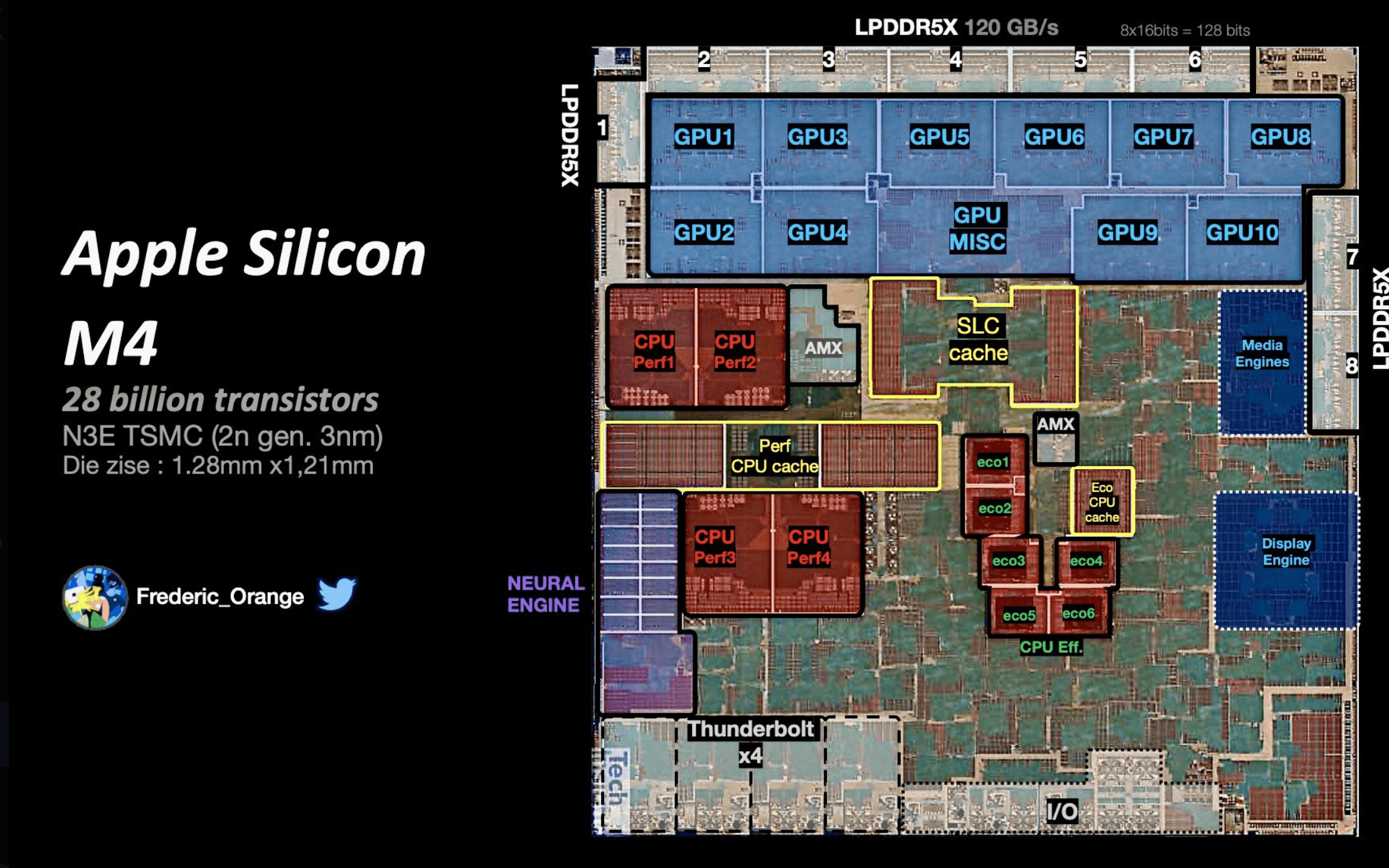
Apple’s M-series chips have revolutionized the Mac lineup, bringing a laser focus on performance and efficiency to the company’s laptops (portables), desktops, workstations, and even now cloud silicon. Thanks to the hard work of those dissecting Apple silicon X-ray images and highlighting blocks on the SoC, we can take a closer look at how Apple allocates its transistor budget across different components revealing insights into the company’s priorities and vision for the future of computing.
**GPU Prioritization**
Not just with M series silicon but A series as well, Apple has been continually spending more transistors on the GPU. A trend we believe will continue. That trend is shown as what percentage of the SoC has been given to the GPU over time.
– M1: \~25-30%
– M2: \~30-35%
– M3: \~35-40%
– M4: \~35-40% (including GPU MISC)
The priority of the GPU signals Apple’s commitment to the visual element of computing, which goes well beyond gaming although an increase in gaming graphical capability has clearly been a priority. Apple’s operating systems are highly differentiated from their competitors with visual/user-interface qualities and the increasing capabilities in graphics is a big way Apple will continue to differentiate their software platforms visually and enable new visual capabilities to third-party developers.
**CPU: Balancing Performance and Efficiency**
The CPU allocation shows a more nuanced evolution:
– M1: Performance \~15-20%, Efficiency \~10-15%
– M2: Similar to M1
– M3: Performance \~20-25%, Efficiency \~10-15%
– M4: Performance \~20-25%, Efficiency \~15-20%
Apple’s engineers continue to emphasize their relentless focus on performance per watt and we see that play out in their increasing of their transistor spend on efficiency cores. Apple does this in two ways however, their performance cores get more efficient and their efficiency cores get more performant. And, at each new node jump, both of these performance and efficiency elements get even better. While the M4 that was analyzed was for the iPad, when we see M4 for Mac, the same fundamental trend line will continue just increasing the number of performance and efficiency cores. With M4, Apple has adopted Arm-v9.2 which brings with it fundamental advancements in performance and efficiency cores as well, which should bring more than a modest upgrade in performance per watt to M4-based Macs.
**Apple Neural Engine: Investing in an AI-Driven Future**
The steady growth in transistor allocation to the Apple Neural Engine (ANE) is particularly telling:
– M1: \~5-10%
– M2: \~7-12%
– M3: \~10-15%
– M4: \~10-15%
[It’s no secret we love NPUs. ](https://creativestrategies.com/report-the-npu-the-newest-chip-on-the-block/)Apple’s Neural engine plays a key role in on-device AI capabilities and Apple has increased the amount of on-device AI processing ([TOPS](https://creativestrategies.com/report-tops-of-the-morning-to-you/)) with each new generation, they have remained steady with a 16-core NPU. Another interesting observation here, revealed by die-shot analysis, is it appears there are 8 core blocks for ANE which means each ANE core is a dual-core system of tensor/matrix processors. This consistent increase reflects Apple’s recognition of the growing importance of AI and machine learning in modern computing tasks. While Apple’s transistor spend has stayed steady between M3 to M4, we expect this to increase with M5.
When it comes to ML/AI acceleration, it is important to note ANE is not the only thing aiding in matrix operations. Apple’s adoption of Arm v9.2 includes CPU architecture improvements as well as SME/SVE extensions that will replace the AMX (Apple custom implementation) accelerator blocks that improve a range of calculations done on the P and E cores. Looking at M3 to M4, the dedicated blocks for these accelerators, are strategically placed by both the P and E cores taking up roughly 5-7% of the die area of M4\. Visual analysis suggests this is a slight increase over M3 and it will be very interesting to see if this increases in M5, although we argue giving more transistors to ANE makes more sense.
**A Few Observations**
- Specialization is Key: The evolution of Apple’s transistor allocation reveals a clear trend towards more specialized processing units. This approach allows for optimized performance in specific tasks like AI, media processing, and graphics rendering.
- Graphics as a Priority: The substantial and growing allocation to GPUs indicates that Apple sees graphics performance as a crucial differentiator in the competitive chip market.
- Efficiency Doesn’t Mean Compromise: Despite the focus on performance, Apple’s increased allocation to efficiency cores in the M4 shows a commitment to battery life and thermal management while maintaining competitive performance.
- AI Readiness: The consistent growth and stabilization of the Neural Engine’s allocation suggest Apple is positioning its chips to handle increasingly complex AI workloads.
- Balanced Approach: While certain areas see significant growth, Apple maintains a balanced allocation, ensuring that improvements in one area don’t come at the expense of others.
### Apple Intelligence: Unveiling the Future of AI Integration
URL: https://creativestrategies.com/research/apple-intelligence-unveiling-the-future-of-ai-integration/
Last updated: 2024-06-17T05:14:00.000Z
At the recent Worldwide Developer Conference, Apple made several pivotal announcements relating to generative artificial intelligence (Gen AI) —though they uniquely branded it as “Apple intelligence.” The naming aligns with Apple’s core principles and philosophy, emphasizing privacy, user experience, and seamless integration across its ecosystem.
##### Personalization at Its Core
Apple’s approach to AI is both innovative and user-centric. By leveraging small language models that process data directly on devices, Apple ensures a high degree of personalization. This is evident in features like email and notification summarization, where AI tailors responses and data based on individual user behavior. Another example is the ability to use stable diffusion to generate pictures in iMessages that are contextualized to the conversation you are having. Of course to create a personalized AI experience, Apple, like every other provider, needs to tap into users’ data. Apple is a highly trusted brand and Its strong stand on privacy and its business model help it retain such trust with its user-base thus allowing it to deliver meaningful value.
##### Privacy and Security: The Apple Way
A significant highlight of Apple’s AI strategy is its stringent adherence to privacy and security. Unlike other tech giants that rely on external cloud services, Apple leans into its Private Cloud Compute extending the privacy and security of Apple devices into the cloud.
With Private Cloud Compute, Apple Intelligence can flex and scale its computational capacity and draw on larger, server-based models for more complex requests. These models run on servers powered by Apple silicon, providing a foundation that allows Apple to ensure that data is never retained or exposed.
Transparency is also a key component of Apple’s implementation of Private Cloud Compute. Independent experts can inspect the code that runs on Apple silicon servers to verify privacy, and Private Cloud Compute cryptographically ensures that iPhone, iPad, and Mac do not talk to a server unless its software has been publicly logged for inspection. Apple Intelligence with Private Cloud Compute sets a new standard for privacy in AI, unlocking intelligence users can trust.
##### The Evolution of Siri
Siri’s support now spans everywhere users go, guiding them with device usage queries such as scheduling emails in the Mail app or toggling between Light and Dark Modes. Powered by Apple Intelligence, Siri is becoming more contextually aware, simplifying and speeding up everyday tasks with improved language-understanding capabilities. Siri can maintain context from one request to the next and can follow along even if users stumble over their words. Additionally, users can type to Siri and switch seamlessly between text and voice interactions.
To drive home how deeply integrated Siri is with the whole device Apple gave Siri a brand-new design featuring a glowing light that wraps around the edge of the screen when Siri is active.
Siri is evolving to deliver intelligence that’s deeply personalized and seamlessly integrated with a user’s on-device information through Apple Intelligence. For instance, a user could simply say, “Play that podcast Ben recommended,” and Siri will find and play the episode, regardless of whether the recommendation was mentioned in a message or an email. Or a user might ask, “When is Mom’s flight landing?” and Siri will provide the arrival time by cross-referencing the flight details with real-time tracking.
Interestingly, this type of functionality isn’t vastly different from what Microsoft attempted with its Recall feature on Copilot+ PCs—a move that faced such uncalled for resistance and criticism – that Microsoft decided to pull back its release on June 18, opting instead to offer it to Windows Insiders for the time being. While Apple’s decision to integrate this functionality into Siri was made long before the Recall PR headache, one can’t help but wonder if this integration feels less invasive to users precisely because Siri is a familiar, trusted entity that has been handling user data for years. By building on pre-existing trust, Apple may sidestep the pitfalls that tripped up Microsoft, positioning Siri as a seamless, intuitive assistant rather than a disruptive new entity.
Siri’s capabilities extend to taking hundreds of new actions across both Apple and third-party apps. With increased onscreen awareness, Siri can understand and interact with content across more apps over time. For instance, if a friend texts you their new address, you can simply say, “Add this address to his contact card,” and Siri will do it.
With richer, more natural language understanding and deeper system integration, Siri is set to become an even more indispensable part of the Apple ecosystem, making everyday interactions smoother, more intuitive, and highly personalized. Convincing users who had been previously disappointed by Siri to give it another chance will be Apple’s biggest challenge.
##### Building an Ecosystem of Intelligence
One of Apple’s strengths lies in its broad ecosystem. By embedding AI throughout its devices—be it iPhones, iPads, or Macs for now—Apple aims to create a seamless and cohesive user experience. This integration not only enhances the utility of individual devices but also encourages users to own multiple Apple products, potentially increasing brand loyalty.
As I’ve reiterated countless times, Apple’s strategy revolves around bringing value back to its hardware, and Apple Intelligence is no exception. While some critics argue that Apple Intelligence isn’t truly free since it requires newer devices and could be seen as a push to drive the upgrade cycle, I highly doubt Apple will hike device prices to offset the cost of this technology. The most plausible exception might be enhancing base models with higher storage options, accompanied by only a minimal price increase.
As anticipated, in just under an hour, Apple delivered a clear and compelling narrative around Apple Intelligence. However, the story could have been even simpler had Apple not partnered with OpenAI to support ChatGPT integration. There’s ongoing confusion about the distinction between Apple Intelligence and ChatGPT. Despite Apple’s efforts to clearly differentiate the two—ensuring users are always asked if they want to engage with ChatGPT—some still mistakenly believe that everything Apple unveiled is based on OpenAI’s technology. This isn’t the case.
ChatGPT is merely the first of several AI models Apple will allow users to access. Think of it like today’s web browsers: if Generative AI is the future of search, it makes sense for users to have the option to choose which model they want to interact with, just as they choose between Safari, Chrome, or Edge today. By providing choice and clarity, Apple positions itself to offer a more personalized and versatile AI experience, setting the stage for a future where users seamlessly navigate multiple AI models to fit their individual needs while trusting Apple with their most personal data so they see their biggest RoI coming from Apple.
Given its more limited cloud infrastructure, Apple mhas smartly ensured that the most meaningful and private exchanges run on Apple Silicon—both on device and in the cloud. This approach allows Apple to maintain high standards of privacy and efficiency for critical tasks. Meanwhile, more general but computationally intensive queries are offloaded to ChatGPT and other external AI models. This strategic balancing act effectively combines the best of Apple’s secure hardware capabilities with the expansive computational power of third-party AI, delivering a seamless and optimized user experience.
### Key Points in the Infiniband vs. Ethernet Debate
URL: https://creativestrategies.com/research/key-points-in-the-infiniband-vs-ethernet-debate/
Last updated: 2024-06-13T17:14:41.000Z
We have been digging through a host of resources, speaking with technical executives, and investors, to summarize a few key points in the debate about Infiniband vs. Ethernet for AI networking in the data center. Below are the key point and pros and cons of each.
The comparative analysis of Ethernet versus Infiniband for AI data centers dives into the core technical specifications, innovations, market dynamics, and use cases of each technology, providing stakeholders with insights into their respective advantages, challenges, and future prospects within the rapidly evolving field of artificial intelligence (AI) and machine learning (ML).
##### Log in to keep reading.
###### Not a Client, request access
### Contact
- First Name\*
- Last Name\*
- Email\*
- Message\*
- This field is hidden when viewing the form
Post requested
/\* <!\[CDATA\[ \*/ gform.initializeOnLoaded( function() {gformInitSpinner( 2, 'https://ghost-production-fd45.up.railway.app/content/images/creativestrategies-com/wp-content/plugins/gravityforms/images/spinner.svg', true );jQuery('#gform\_ajax\_frame\_2').on('load',function(){var contents = jQuery(this).contents().find('\*').html();var is\_postback = contents.indexOf('GF\_AJAX\_POSTBACK') >= 0;if(!is\_postback){return;}var form\_content = jQuery(this).contents().find('#gform\_wrapper\_2');var is\_confirmation = jQuery(this).contents().find('#gform\_confirmation\_wrapper\_2').length > 0;var is\_redirect = contents.indexOf('gformRedirect(){') >= 0;var is\_form = form\_content.length > 0 && ! is\_redirect && ! is\_confirmation;var mt = parseInt(jQuery('html').css('margin-top'), 10) + parseInt(jQuery('body').css('margin-top'), 10) + 100;if(is\_form){jQuery('#gform\_wrapper\_2').html(form\_content.html());if(form\_content.hasClass('gform\_validation\_error')){jQuery('#gform\_wrapper\_2').addClass('gform\_validation\_error');} else {jQuery('#gform\_wrapper\_2').removeClass('gform\_validation\_error');}setTimeout( function() { /\* delay the scroll by 50 milliseconds to fix a bug in chrome \*/ }, 50 );if(window\['gformInitDatepicker'\]) {gformInitDatepicker();}if(window\['gformInitPriceFields'\]) {gformInitPriceFields();}var current\_page = jQuery('#gform\_source\_page\_number\_2').val();gformInitSpinner( 2, 'https://ghost-production-fd45.up.railway.app/content/images/creativestrategies-com/wp-content/plugins/gravityforms/images/spinner.svg', true );jQuery(document).trigger('gform\_page\_loaded', \[2, current\_page\]);window\['gf\_submitting\_2'\] = false;}else if(!is\_redirect){var confirmation\_content = jQuery(this).contents().find('.GF\_AJAX\_POSTBACK').html();if(!confirmation\_content){confirmation\_content = contents;}jQuery('#gform\_wrapper\_2').replaceWith(confirmation\_content);jQuery(document).trigger('gform\_confirmation\_loaded', \[2\]);window\['gf\_submitting\_2'\] = false;wp.a11y.speak(jQuery('#gform\_confirmation\_message\_2').text());}else{jQuery('#gform\_2').append(contents);if(window\['gformRedirect'\]) {gformRedirect();}}jQuery(document).trigger("gform\_pre\_post\_render", \[{ formId: "2", currentPage: "current\_page", abort: function() { this.preventDefault(); } }\]); if (event && event.defaultPrevented) { return; } const gformWrapperDiv = document.getElementById( "gform\_wrapper\_2" ); if ( gformWrapperDiv ) { const visibilitySpan = document.createElement( "span" ); visibilitySpan.id = "gform\_visibility\_test\_2"; gformWrapperDiv.insertAdjacentElement( "afterend", visibilitySpan ); } const visibilityTestDiv = document.getElementById( "gform\_visibility\_test\_2" ); let postRenderFired = false; function triggerPostRender() { if ( postRenderFired ) { return; } postRenderFired = true; gform.core.triggerPostRenderEvents( 2, current\_page ); if ( visibilityTestDiv ) { visibilityTestDiv.parentNode.removeChild( visibilityTestDiv ); } } function debounce( func, wait, immediate ) { var timeout; return function() { var context = this, args = arguments; var later = function() { timeout = null; if ( !immediate ) func.apply( context, args ); }; var callNow = immediate && !timeout; clearTimeout( timeout ); timeout = setTimeout( later, wait ); if ( callNow ) func.apply( context, args ); }; } const debouncedTriggerPostRender = debounce( function() { triggerPostRender(); }, 200 ); if ( visibilityTestDiv && visibilityTestDiv.offsetParent === null ) { const observer = new MutationObserver( ( mutations ) => { mutations.forEach( ( mutation ) => { if ( mutation.type === 'attributes' && visibilityTestDiv.offsetParent !== null ) { debouncedTriggerPostRender(); observer.disconnect(); } }); }); observer.observe( document.body, { attributes: true, childList: false, subtree: true, attributeFilter: \[ 'style', 'class' \], }); } else { triggerPostRender(); } } );} ); /\* \]\]> \*/
### View From the Street – WWDC 2024 Investor Sentiment: Cautiously Optimistic
URL: https://creativestrategies.com/research/view-from-the-street-wwdc-2024-investor-sentiment-cautiously-optimistic/
Last updated: 2024-06-13T18:58:10.000Z
In discussions we have had with investors post WWDC, there is a consensus that Apple is well positioned to capitalize on driving new excitement and awareness to Apple’s hardware, software, and services ecosystem. Apple is one of, if not, the best positioned to bring AI to the mainstream in useful and functional ways that will deepen their value and engagement with their customer base.
We think most investors caught wind that Apple is doing the vast majority of Apple Intelligence with their [own proprietary trained and fine-tuned models](https://machinelearning.apple.com/research/introducing-apple-foundation-models?ref=creativestrategies.com). This is key for Apple to execute Apple Intelligence within its privacy philosophy. Another key point here is what Apple is doing with the [secure private cloud ](https://security.apple.com/blog/private-cloud-compute/?ref=creativestrategies.com)where Apple is running some of Apple Intelligence to deploy a hybrid cloud approach where how they create a secure cloud to client environment thus again ensuring customer privacy.
##### Log in to keep reading.
###### Not a Client, request access
### Contact
- First Name\*
- Last Name\*
- Email\*
- Message\*
- This field is hidden when viewing the form
Post requested
/\* <!\[CDATA\[ \*/ gform.initializeOnLoaded( function() {gformInitSpinner( 2, 'https://ghost-production-fd45.up.railway.app/content/images/creativestrategies-com/wp-content/plugins/gravityforms/images/spinner.svg', true );jQuery('#gform\_ajax\_frame\_2').on('load',function(){var contents = jQuery(this).contents().find('\*').html();var is\_postback = contents.indexOf('GF\_AJAX\_POSTBACK') >= 0;if(!is\_postback){return;}var form\_content = jQuery(this).contents().find('#gform\_wrapper\_2');var is\_confirmation = jQuery(this).contents().find('#gform\_confirmation\_wrapper\_2').length > 0;var is\_redirect = contents.indexOf('gformRedirect(){') >= 0;var is\_form = form\_content.length > 0 && ! is\_redirect && ! is\_confirmation;var mt = parseInt(jQuery('html').css('margin-top'), 10) + parseInt(jQuery('body').css('margin-top'), 10) + 100;if(is\_form){jQuery('#gform\_wrapper\_2').html(form\_content.html());if(form\_content.hasClass('gform\_validation\_error')){jQuery('#gform\_wrapper\_2').addClass('gform\_validation\_error');} else {jQuery('#gform\_wrapper\_2').removeClass('gform\_validation\_error');}setTimeout( function() { /\* delay the scroll by 50 milliseconds to fix a bug in chrome \*/ }, 50 );if(window\['gformInitDatepicker'\]) {gformInitDatepicker();}if(window\['gformInitPriceFields'\]) {gformInitPriceFields();}var current\_page = jQuery('#gform\_source\_page\_number\_2').val();gformInitSpinner( 2, 'https://ghost-production-fd45.up.railway.app/content/images/creativestrategies-com/wp-content/plugins/gravityforms/images/spinner.svg', true );jQuery(document).trigger('gform\_page\_loaded', \[2, current\_page\]);window\['gf\_submitting\_2'\] = false;}else if(!is\_redirect){var confirmation\_content = jQuery(this).contents().find('.GF\_AJAX\_POSTBACK').html();if(!confirmation\_content){confirmation\_content = contents;}jQuery('#gform\_wrapper\_2').replaceWith(confirmation\_content);jQuery(document).trigger('gform\_confirmation\_loaded', \[2\]);window\['gf\_submitting\_2'\] = false;wp.a11y.speak(jQuery('#gform\_confirmation\_message\_2').text());}else{jQuery('#gform\_2').append(contents);if(window\['gformRedirect'\]) {gformRedirect();}}jQuery(document).trigger("gform\_pre\_post\_render", \[{ formId: "2", currentPage: "current\_page", abort: function() { this.preventDefault(); } }\]); if (event && event.defaultPrevented) { return; } const gformWrapperDiv = document.getElementById( "gform\_wrapper\_2" ); if ( gformWrapperDiv ) { const visibilitySpan = document.createElement( "span" ); visibilitySpan.id = "gform\_visibility\_test\_2"; gformWrapperDiv.insertAdjacentElement( "afterend", visibilitySpan ); } const visibilityTestDiv = document.getElementById( "gform\_visibility\_test\_2" ); let postRenderFired = false; function triggerPostRender() { if ( postRenderFired ) { return; } postRenderFired = true; gform.core.triggerPostRenderEvents( 2, current\_page ); if ( visibilityTestDiv ) { visibilityTestDiv.parentNode.removeChild( visibilityTestDiv ); } } function debounce( func, wait, immediate ) { var timeout; return function() { var context = this, args = arguments; var later = function() { timeout = null; if ( !immediate ) func.apply( context, args ); }; var callNow = immediate && !timeout; clearTimeout( timeout ); timeout = setTimeout( later, wait ); if ( callNow ) func.apply( context, args ); }; } const debouncedTriggerPostRender = debounce( function() { triggerPostRender(); }, 200 ); if ( visibilityTestDiv && visibilityTestDiv.offsetParent === null ) { const observer = new MutationObserver( ( mutations ) => { mutations.forEach( ( mutation ) => { if ( mutation.type === 'attributes' && visibilityTestDiv.offsetParent !== null ) { debouncedTriggerPostRender(); observer.disconnect(); } }); }); observer.observe( document.body, { attributes: true, childList: false, subtree: true, attributeFilter: \[ 'style', 'class' \], }); } else { triggerPostRender(); } } );} ); /\* \]\]> \*/
### Computex 2024: Unveiling the Challenges and Opportunities Shaping the Future of the PC Industry
URL: https://creativestrategies.com/research/computex-2024-unveiling-the-challenges-and-opportunities-shaping-the-future-of-the-pc-industry/
Last updated: 2024-06-09T18:50:53.000Z
All eyes were set on Computex this week. Historically one of the world’s most influential tech expos in semiconductor business, Computex return to its glory as the who is who of the business descended onto Taipei to talk compute and AI. AMD, Qualcomm and Intel’s keynotes all provided a good opportunity to hear about product announcements but also to understand the challenges and opportunities the Windows PC ecosystem is facing in positioning Gen AI as a must have in consumers and business users’ computing experiences.
##### The Rise of Copilot+ PCs
AI’s integration into personal computing isn’t new, but what we’re seeing now goes beyond mere enhancements. Copilot+ PCs, a term that’s becoming synonymous with the next-generation laptops and desktops, are equipped with AI capabilities that promise to transform how we interact with technology. These machines are designed not just to meet but to anticipate user needs, offering a seamless blend of performance, intelligence, and efficiency.
Windows PC makers have today the broadest choice of silicon they have ever had giving them the opportunity to differentiate their offering and tailor designs to specific experiences and workloads. Yet choice brings complexity, especially in messaging.
I have pointed out many times before that when talking about a brand listening carefully how they position their products will help you understand what they consider their strength and differentiator. This is also true when it comes to the Computex Keynotes.
Qualcomm’s Snapdragon X Series chipsets are powering the first set of Copilot+ PCs that start shipping on June 18\. As Microsoft’s launch partner, the company underlined its NPU capability to deliver [45 tops](https://creativestrategies.com/report-the-npu-the-newest-chip-on-the-block/) while providing an exceptional battery life.
AMD announced it will have products coming later in the year built on the upcoming Ryzen AI 300 Series mobile processors and Ryzen 9000 Series desktop CPUs. By combining the latest Zen 5 CPU cores, RDNA 3.5 graphics, and the XDNA 2 neural processing unit, these SoCs are poised to deliver a massive leap in on-device AI performance and efficiency from AMD prior SoCs. The XDNA 2 NPU itself is a significant milestone, packing 50 TOPS of AI compute, which as of now, is the most NPU TOPS by any vendor. AMD claims this enables higher precision AI vs competing mobile NPUs without compromising performance.
And finally, Intel who kicked off talking up its data centers’s solution underlining how the entire Xeon-6 platform and processor family was specifically designed to help drive cost savings and achieve sustainability goals and includes both E-Core (Efficiency) and P-Core (Performance) SKUs to handle a wide range of use cases and workloads, from AI and other high-performance computing requirements to scalable cloud-native applications. On the PC front, Intel announced Lunar Lake the solution that by the end of the year will deliver 120 tops across its CPU, GPU and NPU for Copilot+ PCs. Gelsinger took time to explain that the future of computing will require a platform approach that brings together CPU, GPU and NPU so that developers can choose how to distribute compute how they prefer. Yet, because Intel’ s current solution Meteor Lake does not deliver the number of tops required by Microsoft for a Copilot+ PCs, the company used the term AI PC to refer to the design currently in the market. While Intel might be seen as playing catch up to Qualcomm, the company has considerably narrowed the time to market gap they had. Furthermore, it is important to underline that not everyone will need a Copilot+ PC so the long tail of AI capable PCs will be important for both PC markers and Windows.
##### The Compelling Value Proposition
One of the standout themes at Computex 2024 is the industry’s commitment to delivering real value through innovation. Unlike previous attempts to create new product categories with limited practical applications, Copilot+ PCs focus on tangible improvements:
**Enhanced Productivity:** AI in Copilot+ PCs assists in automating routine tasks, smart scheduling, and real-time optimization based on user behavior.
**Seamless Integration:** From voice commands to intelligent assistance in applications, these PCs aim to make computing more intuitive and less intrusive.
**Energy Efficiency:** Advanced AI-powered power management techniques ensure longer battery life without compromising performance.
##### The Ecosystem Challenge
However, the path forward is not without challenges. One essential component to the success of this new category has very little to do with tech and all to do with marketing. It is paramount for the entire ecosystem—PC manufacturers, Microsoft, and silicon vendors—to cohesively explain the value of Copilot+ PCs. There’s a risk of confusing both IT decision-makers and consumers if the communication isn’t clear and concise. Effective messaging is crucial to avoid a scenario where potential buyers hold off purchases or explore alternatives like Apple’s offerings. This is because Apple has the advantage of owning the end to end experience, has established its silicon and NPU as a top of the line solution and it can control the narrative which traditionally has been able where others failed to position features as a must have.
##### Avoiding the Bloatware Pitfall
As I sat through the different keynotes I noticed how the OEMs talked up their pre-installed software solutions a differentiator. While I understand the need to differentiate and the limited opportunity beyond hardware I want to warn PC manufacturers in going down this path as it might end up having the contrary effect. History has shown that additional software, especially when perceived as unnecessary, is quickly dismissed by users as bloatware. With Gen AI, there is also a question of trust and users might have reservations about their own data being used to deliver an AI experience they do not necessarily want.
It’s vital for PC makers to ensure that AI integrations remain useful and non-intrusive, enhancing the user experience rather than detracting from it. Lenovo spoke about Smart Connect which is a great example of a feature that delivers clear value to users on a real pain point of sharing workloads across devices. With Gen AI I can see a lot more automation being added to the experience.
##### Focus on Today’s Deliverables to Shape Tomorrow’s Desires
Computex 2024 has painted a vibrant picture of the future of personal computing. With Copilot+ PCs at the helm, we’re looking at a more intelligent, efficient, and user-centric era of technology. The advancements showcased offer a glimpse into devices that don’t just work for us but work with us, anticipating needs and delivering unparalleled performance. As the industry gears up for this next leap, it’s clear that the PC market is not just evolving; it’s being revolutionized.
It’s crucial to recognize that the industry is embarking on a transformative journey. Laying the groundwork for Generative AI to deliver its full potential will take time, but the rewards will keep expanding, driving substantial benefits for the PC market. To avoid disappointment, brands must deliver today’s abundant real value. This strategy will not only fulfill current expectations but also build excitement for the innovations of tomorrow. By focusing on delivering what’s achievable now, they can pave the way for a future brimming with even greater possibilities.
### Report: Comparing Cloud AI Strategies: Microsoft, Google, and Amazon
URL: https://creativestrategies.com/research/report-comparing-cloud-ai-strategies-microsoft-google-and-amazon/
Last updated: 2024-06-13T16:27:46.000Z
In the rapidly evolving world of cloud computing, the strategies of industry leaders Microsoft, Google, and Amazon reveal distinct approaches to integrating and leveraging artificial intelligence (AI) to stay ahead.
### Microsoft Azure: AI Integration and Custom Hardware
Microsoft’s Azure is positioning itself as a leader in the AI-driven cloud market through several key initiatives:
##### Log in to keep reading.
###### Not a Client, request access/\* <!\[CDATA\[ \*/ var gform;gform||(document.addEventListener("gform\_main\_scripts\_loaded",function(){gform.scriptsLoaded=!0}),document.addEventListener("gform/theme/scripts\_loaded",function(){gform.themeScriptsLoaded=!0}),window.addEventListener("DOMContentLoaded",function(){gform.domLoaded=!0}),gform={domLoaded:!1,scriptsLoaded:!1,themeScriptsLoaded:!1,isFormEditor:()=>"function"==typeof InitializeEditor,callIfLoaded:function(o){return!(!gform.domLoaded||!gform.scriptsLoaded||!gform.themeScriptsLoaded&&!gform.isFormEditor()||(gform.isFormEditor()&&console.warn("The use of gform.initializeOnLoaded() is deprecated in the form editor context and will be removed in Gravity Forms 3.1."),o(),0))},initializeOnLoaded:function(o){gform.callIfLoaded(o)||(document.addEventListener("gform\_main\_scripts\_loaded",()=>{gform.scriptsLoaded=!0,gform.callIfLoaded(o)}),document.addEventListener("gform/theme/scripts\_loaded",()=>{gform.themeScriptsLoaded=!0,gform.callIfLoaded(o)}),window.addEventListener("DOMContentLoaded",()=>{gform.domLoaded=!0,gform.callIfLoaded(o)}))},hooks:{action:{},filter:{}},addAction:function(o,r,e,t){gform.addHook("action",o,r,e,t)},addFilter:function(o,r,e,t){gform.addHook("filter",o,r,e,t)},doAction:function(o){gform.doHook("action",o,arguments)},applyFilters:function(o){return gform.doHook("filter",o,arguments)},removeAction:function(o,r){gform.removeHook("action",o,r)},removeFilter:function(o,r,e){gform.removeHook("filter",o,r,e)},addHook:function(o,r,e,t,n){null==gform.hooks\[o\]\[r\]&&(gform.hooks\[o\]\[r\]=\[\]);var d=gform.hooks\[o\]\[r\];null==n&&(n=r+"\_"+d.length),gform.hooks\[o\]\[r\].push({tag:n,callable:e,priority:t=null==t?10:t})},doHook:function(r,o,e){var t;if(e=Array.prototype.slice.call(e,1),null!=gform.hooks\[r\]\[o\]&&((o=gform.hooks\[r\]\[o\]).sort(function(o,r){return o.priority-r.priority}),o.forEach(function(o){"function"!=typeof(t=o.callable)&&(t=window\[t\]),"action"==r?t.apply(null,e):e\[0\]=t.apply(null,e)})),"filter"==r)return e\[0\]},removeHook:function(o,r,t,n){var e;null!=gform.hooks\[o\]\[r\]&&(e=(e=gform.hooks\[o\]\[r\]).filter(function(o,r,e){return!!(null!=n&&n!=o.tag||null!=t&&t!=o.priority)}),gform.hooks\[o\]\[r\]=e)}}); /\* \]\]> \*/
### Contact
- First Name\*
- Last Name\*
- Email\*
- Message\*
- This field is hidden when viewing the form
Post requested
/\* <!\[CDATA\[ \*/ gform.initializeOnLoaded( function() {gformInitSpinner( 2, 'https://ghost-production-fd45.up.railway.app/content/images/creativestrategies-com/wp-content/plugins/gravityforms/images/spinner.svg', true );jQuery('#gform\_ajax\_frame\_2').on('load',function(){var contents = jQuery(this).contents().find('\*').html();var is\_postback = contents.indexOf('GF\_AJAX\_POSTBACK') >= 0;if(!is\_postback){return;}var form\_content = jQuery(this).contents().find('#gform\_wrapper\_2');var is\_confirmation = jQuery(this).contents().find('#gform\_confirmation\_wrapper\_2').length > 0;var is\_redirect = contents.indexOf('gformRedirect(){') >= 0;var is\_form = form\_content.length > 0 && ! is\_redirect && ! is\_confirmation;var mt = parseInt(jQuery('html').css('margin-top'), 10) + parseInt(jQuery('body').css('margin-top'), 10) + 100;if(is\_form){jQuery('#gform\_wrapper\_2').html(form\_content.html());if(form\_content.hasClass('gform\_validation\_error')){jQuery('#gform\_wrapper\_2').addClass('gform\_validation\_error');} else {jQuery('#gform\_wrapper\_2').removeClass('gform\_validation\_error');}setTimeout( function() { /\* delay the scroll by 50 milliseconds to fix a bug in chrome \*/ }, 50 );if(window\['gformInitDatepicker'\]) {gformInitDatepicker();}if(window\['gformInitPriceFields'\]) {gformInitPriceFields();}var current\_page = jQuery('#gform\_source\_page\_number\_2').val();gformInitSpinner( 2, 'https://ghost-production-fd45.up.railway.app/content/images/creativestrategies-com/wp-content/plugins/gravityforms/images/spinner.svg', true );jQuery(document).trigger('gform\_page\_loaded', \[2, current\_page\]);window\['gf\_submitting\_2'\] = false;}else if(!is\_redirect){var confirmation\_content = jQuery(this).contents().find('.GF\_AJAX\_POSTBACK').html();if(!confirmation\_content){confirmation\_content = contents;}jQuery('#gform\_wrapper\_2').replaceWith(confirmation\_content);jQuery(document).trigger('gform\_confirmation\_loaded', \[2\]);window\['gf\_submitting\_2'\] = false;wp.a11y.speak(jQuery('#gform\_confirmation\_message\_2').text());}else{jQuery('#gform\_2').append(contents);if(window\['gformRedirect'\]) {gformRedirect();}}jQuery(document).trigger("gform\_pre\_post\_render", \[{ formId: "2", currentPage: "current\_page", abort: function() { this.preventDefault(); } }\]); if (event && event.defaultPrevented) { return; } const gformWrapperDiv = document.getElementById( "gform\_wrapper\_2" ); if ( gformWrapperDiv ) { const visibilitySpan = document.createElement( "span" ); visibilitySpan.id = "gform\_visibility\_test\_2"; gformWrapperDiv.insertAdjacentElement( "afterend", visibilitySpan ); } const visibilityTestDiv = document.getElementById( "gform\_visibility\_test\_2" ); let postRenderFired = false; function triggerPostRender() { if ( postRenderFired ) { return; } postRenderFired = true; gform.core.triggerPostRenderEvents( 2, current\_page ); if ( visibilityTestDiv ) { visibilityTestDiv.parentNode.removeChild( visibilityTestDiv ); } } function debounce( func, wait, immediate ) { var timeout; return function() { var context = this, args = arguments; var later = function() { timeout = null; if ( !immediate ) func.apply( context, args ); }; var callNow = immediate && !timeout; clearTimeout( timeout ); timeout = setTimeout( later, wait ); if ( callNow ) func.apply( context, args ); }; } const debouncedTriggerPostRender = debounce( function() { triggerPostRender(); }, 200 ); if ( visibilityTestDiv && visibilityTestDiv.offsetParent === null ) { const observer = new MutationObserver( ( mutations ) => { mutations.forEach( ( mutation ) => { if ( mutation.type === 'attributes' && visibilityTestDiv.offsetParent !== null ) { debouncedTriggerPostRender(); observer.disconnect(); } }); }); observer.observe( document.body, { attributes: true, childList: false, subtree: true, attributeFilter: \[ 'style', 'class' \], }); } else { triggerPostRender(); } } );} ); /\* \]\]> \*/
### AMD Computex 2024 Keynote: New AI-Driven CPUs and GPUs for the Future
URL: https://creativestrategies.com/research/amd-computex-2024-keynote-new-ai-driven-cpus-and-gpus-for-the-future/
Last updated: 2024-06-04T03:57:58.000Z
At Computex 2024, AMD painted a comprehensive vision for the future of AI computing, addressing everything from the cloud to the edge. The company’s rapid pace of innovation across CPUs, GPUs, AI accelerators and adaptive computing shows no signs of slowing down. By moving to an annual cadence of Instinct MI accelerators, AMD is putting the pedal to the metal to meet the insatiable demand for AI compute.
But perhaps the most exciting and tangible part of AMD’s Computex announcements was on the client side. The upcoming Ryzen AI 300 Series mobile processors and Ryzen 9000 Series desktop CPUs promise to put serious AI capabilities in the hands of mainstream consumers and commercial users.
The Ryzen AI 300 Series marks AMD’s 3rd generation of AI-enabled laptop processors. By combining the latest Zen 5 CPU cores, RDNA 3.5 graphics, and the cutting-edge XDNA 2 neural processing unit, these SoCs are poised to deliver a massive leap in on-device AI performance and efficiency.
The XDNA 2 NPU itself is a significant milestone, packing 50 TOPS of AI compute and introducing support for the innovative Block FP16 data format. AMD claims this enables higher precision AI vs competing mobile NPUs without compromising performance. Considering the 50 TOPS figure eclipses the AI horsepower in Apple’s M3 and Qualcomm’s Snapdragon chips, AMD appears to have a strong play for leadership in the red-hot AI laptop market.
On the desktop, the new Ryzen 9000 Series processors bring the Zen 5 architecture to enthusiasts and content creators. The flagship 16-core Ryzen 9 9950X, which AMD boldly deems the world’s fastest desktop CPU, should significantly elevate the performance bar for heavy workloads. With a max boost clock of 5.7GHz, the 9950X looks primed to snatch the gaming and productivity performance crown from Intel in the near term.
Beyond the silicon, it was encouraging to see AMD flanked on stage by key partners like Microsoft, HP, Lenovo and Asus. All these tech giants are rallying around AMD’s vision to bring more intelligent, personalized computing experiences to users through local AI processing.
Microsoft’s vote of confidence that Ryzen AI 300 Series will power a new generation of Copilot+ PCs is a strong endorsement of AMD’s AI technologies. The software giant’s Chairman and CEO Satya Nadella highlighted the transformative potential of the AMD partnership across cloud, edge and now AI. The fact that Microsoft is already using AMD Instinct MI300X accelerators to deliver leading price/performance for Azure GPT-4 workloads speaks volumes.
Looking up the stack to the data center, AMD continues to execute on its ambitious server roadmaps. The preview of 5th Gen EPYC “Turin” processors shows that AMD is not standing still after capturing over 30% of the server CPU market. By leveraging the Zen 5 core and promising leadership performance and efficiency, Turin aims to extend AMD’s momentum in the cloud and enterprise. Availability in the second half of 2024 sets the stage for an exciting showdown with Intel’s Granite Rapids Xeons.
On the AI accelerator front, AMD is making a bold commitment to an annual cadence of leadership Instinct MI products. The MI325X coming later this year ups the ante with a massive 288GB of ultra-fast HBM3E memory. And AMD is already charting an ambitious course for the future with CDNA 4 and CDNA Next architectures in 2025 and 2026, respectively. The projected 35X inference speedup of CDNA 4 over the current MI300 series is staggering if it pans out.
Lastly, AMD’s Versal AI Edge portfolio showcases the company’s differentiated ability to combine adaptive computing, AI engines, and CPU cores to accelerate full edge workloads. With the Versal AI Edge Gen 2 series sampling to over 30 early access partners, AMD is staking its claim in the nascent edge AI market. Versal design wins powering everything from genome sequencing to automotive ADAS show the architecture’s versatility.
Zooming out, Computex 2024 provided the clearest evidence yet of AMD’s multi-pronged, full-stack approach to AI computing. From the Ryzen AI 300 Series bringing serious on-device AI to laptops, to the Instinct MI300X powering Azure GPT-4 instances in the cloud, AMD is firing on all cylinders. With an annual cadence of leadership products across CPUs, GPUs, and AI accelerators, the company shows no signs of slowing down.
The partnerships and customer testimonials highlighted at Computex are perhaps just as important as the silicon itself. Broad ecosystem support is critical for democratizing access to cutting-edge AI technologies. In that respect, AMD’s collaborations with Microsoft, HP, Lenovo, Asus, and others to enable intelligent, personalized computing experiences is highly encouraging.
The age of pervasive AI computing is upon us. And with its comprehensive portfolio, robust roadmap, and deep partnerships, AMD is positioning itself as a key enabler of this paradigm shift from the cloud to the edge. The next few years will be a fascinating time as AMD’s technologies make AI more accessible and personal than ever before. Buckle up, it’s going to be an exciting ride.
---
**Key Takeaways:**
– AMD unveiled new leadership CPU, NPU and GPU architectures powering end-to-end AI infrastructure from the data center to PCs at Computex 2024.
– The expanded AMD Instinct accelerator roadmap introduces an annual cadence of leadership AI accelerators, including the new MI325X accelerator planned for Q4 2024.
– AMD previewed 5th Gen EPYC server processors with Zen 5 cores, on track for 2H 2024 launch, promising leadership performance and efficiency.
– New AMD Ryzen AI 300 Series laptop and Ryzen 9000 Series desktop processors deliver leading performance for AI, gaming, content creation and productivity.
**Summary of News:**
– AMD introduced an expanded multi-generational roadmap for its Instinct AI accelerators, moving to an annual cadence of leadership products. The MI325X accelerator, coming in Q4 2024, will deliver industry-leading 288GB HBM3E memory capacity.
– A preview of 5th Gen EPYC “Turin” server CPUs was shared, leveraging the Zen 5 core and continuing EPYC’s leadership performance and efficiency. The processors are on track for 2H 2024 availability.
– For PCs, AMD announced Ryzen AI 300 Series mobile processors, its 3rd generation of AI-enabled laptop chips. The SoCs combine Zen 5 CPU cores, XDNA 2 NPU, and RDNA 3.5 graphics to power next-gen AI experiences.
– The XDNA 2 NPU delivers 50 TOPS of AI performance and is the first to support the advanced Block FP16 data format for higher accuracy without sacrificing performance vs competitors.
– AMD Ryzen 9000 Series desktop CPUs were unveiled, based on the Zen 5 architecture. The flagship 16-core Ryzen 9 9950X was claimed as the world’s fastest desktop processor.
– Several key OEM and software partners joined AMD on stage to showcase their upcoming AMD-powered AI laptops and experiences, including Microsoft, HP, Lenovo and Asus. The Ryzen AI 300 Series will power a new generation of Copilot+ PCs.
– On the edge AI front, AMD Versal AI Edge Series Gen 2 adaptive SoCs are now sampling to over 30 early access partners. Versal combines programmable logic, AI engines, and CPUs to accelerate full edge AI applications.
**What’s Significant:**
AMD’s announcements at Computex 2024 demonstrate its strong commitment to advancing AI and high-performance computing across the entire technology stack, from the cloud to the edge. The company is aggressively pushing an annual cadence of leadership AI accelerators to meet the rapidly growing demand driven by generative AI.
AMD’s close collaboration with key partners like Microsoft, HP, Lenovo and Asus to enable intelligent, personalized PC experiences powered by Ryzen AI highlights the industry-wide shift towards pervasive AI. The new Ryzen processors with dedicated AI engines mark an inflection point that is expected to significantly drive PC demand in the coming years.
On the datacenter front, AMD continues to make strides with its next-gen EPYC processors and Instinct accelerators. The 35x projected AI inference boost of CDNA 4 over the current MI300 series shows AMD is not slowing down its pace of innovation. Microsoft’s endorsement of MI300X’s leading price/performance further validates AMD’s datacenter AI strategy.
### Dell Technologies: Seizing the AI Server Opportunity
URL: https://creativestrategies.com/research/dell-technologies-seizing-the-ai-server-opportunity/
Last updated: 2024-06-13T17:54:58.000Z
Dell Technologies is making significant strides in the AI server market, as evidenced by its recent earnings reports. We provide some of the key drivers of Dell’s success in this segment, the opportunities ahead, and the potential challenges that could impact its growth trajectory.
**Growth in AI Server Demand**
##### Log in to keep reading.
###### Not a Client, request access
### Contact
- First Name\*
- Last Name\*
- Email\*
- Message\*
- This field is hidden when viewing the form
Post requested
/\* <!\[CDATA\[ \*/ gform.initializeOnLoaded( function() {gformInitSpinner( 2, 'https://ghost-production-fd45.up.railway.app/content/images/creativestrategies-com/wp-content/plugins/gravityforms/images/spinner.svg', true );jQuery('#gform\_ajax\_frame\_2').on('load',function(){var contents = jQuery(this).contents().find('\*').html();var is\_postback = contents.indexOf('GF\_AJAX\_POSTBACK') >= 0;if(!is\_postback){return;}var form\_content = jQuery(this).contents().find('#gform\_wrapper\_2');var is\_confirmation = jQuery(this).contents().find('#gform\_confirmation\_wrapper\_2').length > 0;var is\_redirect = contents.indexOf('gformRedirect(){') >= 0;var is\_form = form\_content.length > 0 && ! is\_redirect && ! is\_confirmation;var mt = parseInt(jQuery('html').css('margin-top'), 10) + parseInt(jQuery('body').css('margin-top'), 10) + 100;if(is\_form){jQuery('#gform\_wrapper\_2').html(form\_content.html());if(form\_content.hasClass('gform\_validation\_error')){jQuery('#gform\_wrapper\_2').addClass('gform\_validation\_error');} else {jQuery('#gform\_wrapper\_2').removeClass('gform\_validation\_error');}setTimeout( function() { /\* delay the scroll by 50 milliseconds to fix a bug in chrome \*/ }, 50 );if(window\['gformInitDatepicker'\]) {gformInitDatepicker();}if(window\['gformInitPriceFields'\]) {gformInitPriceFields();}var current\_page = jQuery('#gform\_source\_page\_number\_2').val();gformInitSpinner( 2, 'https://ghost-production-fd45.up.railway.app/content/images/creativestrategies-com/wp-content/plugins/gravityforms/images/spinner.svg', true );jQuery(document).trigger('gform\_page\_loaded', \[2, current\_page\]);window\['gf\_submitting\_2'\] = false;}else if(!is\_redirect){var confirmation\_content = jQuery(this).contents().find('.GF\_AJAX\_POSTBACK').html();if(!confirmation\_content){confirmation\_content = contents;}jQuery('#gform\_wrapper\_2').replaceWith(confirmation\_content);jQuery(document).trigger('gform\_confirmation\_loaded', \[2\]);window\['gf\_submitting\_2'\] = false;wp.a11y.speak(jQuery('#gform\_confirmation\_message\_2').text());}else{jQuery('#gform\_2').append(contents);if(window\['gformRedirect'\]) {gformRedirect();}}jQuery(document).trigger("gform\_pre\_post\_render", \[{ formId: "2", currentPage: "current\_page", abort: function() { this.preventDefault(); } }\]); if (event && event.defaultPrevented) { return; } const gformWrapperDiv = document.getElementById( "gform\_wrapper\_2" ); if ( gformWrapperDiv ) { const visibilitySpan = document.createElement( "span" ); visibilitySpan.id = "gform\_visibility\_test\_2"; gformWrapperDiv.insertAdjacentElement( "afterend", visibilitySpan ); } const visibilityTestDiv = document.getElementById( "gform\_visibility\_test\_2" ); let postRenderFired = false; function triggerPostRender() { if ( postRenderFired ) { return; } postRenderFired = true; gform.core.triggerPostRenderEvents( 2, current\_page ); if ( visibilityTestDiv ) { visibilityTestDiv.parentNode.removeChild( visibilityTestDiv ); } } function debounce( func, wait, immediate ) { var timeout; return function() { var context = this, args = arguments; var later = function() { timeout = null; if ( !immediate ) func.apply( context, args ); }; var callNow = immediate && !timeout; clearTimeout( timeout ); timeout = setTimeout( later, wait ); if ( callNow ) func.apply( context, args ); }; } const debouncedTriggerPostRender = debounce( function() { triggerPostRender(); }, 200 ); if ( visibilityTestDiv && visibilityTestDiv.offsetParent === null ) { const observer = new MutationObserver( ( mutations ) => { mutations.forEach( ( mutation ) => { if ( mutation.type === 'attributes' && visibilityTestDiv.offsetParent !== null ) { debouncedTriggerPostRender(); observer.disconnect(); } }); }); observer.observe( document.body, { attributes: true, childList: false, subtree: true, attributeFilter: \[ 'style', 'class' \], }); } else { triggerPostRender(); } } );} ); /\* \]\]> \*/
### REPORT: Conclusions and Next Steps
URL: https://creativestrategies.com/research/report-conclusions-and-next-steps/
Last updated: 2024-05-20T19:43:04.000Z
NPUs (Neural Processing Units) are rapidly establishing themselves as the optimal platform for executing a diverse array of AI workloads, especially those requiring prolonged periods of inference. The unique architecture of NPUs, tailored specifically for neural network operations, guarantees efficient and high-performance processing. This architecture is adept at managing parallel computations, employing low precision arithmetic, and incorporating advanced power management techniques, making NPUs exceptionally well-suited for sustained AI inference tasks.
The integration of on-chip memory in NPUs further enhances their efficiency and power consumption. This memory integration allows for quicker access to data and reduces the need for data transfer between different components, thereby minimizing latency and energy usage. Optimized workloads that are specifically designed for NPU architecture also contribute to their superior performance and efficiency.
Looking forward, we plan to expand our NPU testing by including more specific use cases from Microsoft and third-party developers. This expansion will help in understanding the practical applications and benefits of NPUs in real-world scenarios. Additionally, we will continue to develop a series of benchmarks and analyses that will highlight the critical role of NPUs and their symbiotic relationship with CPUs and GPUs in handling AI workloads. These benchmarks will provide valuable insights into how NPUs, CPUs, and GPUs can work together to deliver optimal performance for various AI tasks.
In conclusion, the specialized capabilities of NPUs make them a cornerstone technology for AI inference, promising continued advancements and integration into diverse applications. Our ongoing testing and benchmarking efforts will provide deeper insights into their performance and efficiency.
**Table of Contents**
- [The New Chip on the Block](https://creativestrategies.com/report-the-npu-the-newest-chip-on-the-block/)
- [What Makes the NPU Unique](https://creativestrategies.com/report-what-makes-the-npu-unique/)
- [TOPS of the Morning to You](https://creativestrategies.com/report-tops-of-the-morning-to-you/)
- [Copilot+ PCs and a New Category of AI PC](https://creativestrategies.com/report-copilot-pcs-and-a-new-category-of-ai-pc/)
- [Developer Spotlight: Cephable](https://creativestrategies.com/report-developer-spotlight-cephable/)
- [The NPU Wattage Advantage](https://creativestrategies.com/white-paper-the-npu-wattage-advantage/)
- [Conclusions and What’s Next](https://creativestrategies.com/report-conclusions-and-next-steps/)
---
\*This white paper was commissioned by Microsoft. The insights and analyses provided are based on research and data obtained through collaboration with Microsoft and third-party developers. The goal of this paper is to present an unbiased examination of NPUs and their role in AI workloads. While Microsoft has provided support for this research, the findings and conclusions drawn in this document are those of the authors and do not necessarily reflect the views of Microsoft.
### REPORT: Copilot+ PCs and a New Category of AI PC
URL: https://creativestrategies.com/research/report-copilot-pcs-and-a-new-category-of-ai-pc/
Last updated: 2024-05-20T19:46:49.000Z
**CoPilot+ PCs and a New Category of AI PC**
Personal computing is at a unique inflection point with generative AI. Perhaps one we have not seen since the introduction of the graphical user interface. With a tremendous amount of excitement for AI enhanced software running on our computers, the NPU provides such an increase in local AI performance that a new era of Windows is enabling a new category of computers powered by AI.
This new era of Windows is taking advantage of chips like Qualcomm’s Snapdragon X Elite and Snapdragon X Plus. These systems have a significant performance increase in performance per-watt but most importantly they have the Hexagon NPU that is capable of 40 TOPS directly on the NPU. While Qualcomm’s X Elite is the first SoC to power Copilot + PCs, both Intel and AMD will have products by end of year that meet the 40 NPU TOPS required to power all the next generation features coming to Windows..
While Microsoft is building numerous AI features into are completely rearchitected Windows 11 that take advantage of these next generation SoC architectures, there is exciting upside to see how developers start building new classes of applications that uniquely harness these new NPUs.
This new class of PCs that come with a minimum of 40 NPU TOPS will open the door to developers to start to take advantage of this new chip on the block and its roadmap of increased performance. In many ways, we are potentially entering a new chapter of the GHz wars, where each new step function in computer processing led to observable innovation in computer software. Similarly, observing historical step functions in GPUs lead to significant improvement in gaming/visual software experiences. We believe the NPU, and its increases in capability, will lead to similar software innovation in AI apps and software on client devices.
Next
❯ [Developer Spotlight: Cephable](https://creativestrategies.com/report-developer-spotlight-cephable/)
### REPORT: TOPS of the Morning to You
URL: https://creativestrategies.com/research/report-tops-of-the-morning-to-you/
Last updated: 2024-05-20T19:45:59.000Z
Given there is a new standard in measuring NPU performance capabilities, it is critical we have a better understanding of the relationship between NPU TOPS and the relationship of TOPS as a metric and AI performance. While we completely agree, TOPS is a difficult metric to measure real-world AI performance, we think of it in terms of CPU GHz measurements in terms of knowing potential raw performance of the NPU. Below, is a brief explainer on some of the ways we expect TOPS to be leveraged, and communicated and the role TOPS will likely play in understanding absolute AI performance potential.
**Direct Proportionality**: Generally, a higher TOPS rating indicates better performance. An NPU capable of delivering a higher number of TOPS can process more neural network operations per second, leading to faster execution of AI tasks. For example, an NPU with 10 TOPS will theoretically be able to process AI tasks about twice as fast as an NPU with 5 TOPS, assuming all other factors are equal.
**Benchmark for AI Performance**: TOPS has become a standard benchmark for measuring the performance of AI accelerators like NPUs. It allows for a direct comparison of the raw computational power of different NPUs. However, it’s important to note that TOPS is a theoretical peak performance metric and doesn’t always directly translate to real-world performance.
**Influence on Model Complexity:** A higher TOPS rating allows an NPU to handle more complex neural network models. As AI models become more sophisticated with deeper layers and more parameters, they require more computational power. An NPU with a higher TOPS rating will be better equipped to process these complex models efficiently.
**Power Efficiency Consideration:** While a higher TOPS rating generally indicates better performance, it’s also important to consider the power efficiency of the NPU. The TOPS/Watt metric is often used to evaluate how efficiently an NPU uses its power to deliver its performance. A more power-efficient NPU can deliver better performance per watt, which is particularly important for battery-powered devices like smartphones, tablets, and laptops.
**Real-World Performance**: While TOPS provides a good indication of an NPU’s potential, real-world performance can vary based on factors such as the efficiency of the software stack, the optimization of the AI models for the specific NPU architecture, and the thermal constraints of the device. Therefore, TOPS should be considered alongside other factors when evaluating the actual performance of an NPU in practical scenarios.
Next ❯ [Copilot+ PCs and a New Category of AI PC](https://creativestrategies.com/report-copilot-pcs-and-a-new-category-of-ai-pc/)
### REPORT: The NPU Wattage Advantage
URL: https://creativestrategies.com/research/white-paper-the-npu-wattage-advantage/
Last updated: 2024-05-20T20:18:24.000Z
While all compute cores are capable of handling AI workloads, the NPU stands out the most here as its architecture allows it to run these AI workloads at significantly lower wattage than CPU and GPU cores. NPUs have power management technique advantages over the CPU and GPU, specifically on AI workloads. NPUs often include advanced power management techniques, such as dynamic voltage and frequency scaling (DVFS), which adjust the power consumption based on the workload requirements. They can run at lower power when full performance is not needed. Ultimately, this scaling is a primary benefit in NPUs that have a greater TOPS per watt advantage than other cores on the block.
Given the controversy over TOPS, and our acknowledgement it is not effective in real-world workload measurement for client devices, especially when it is a mobile device, for our benchmark methodology, we are measuring tokens per Joule (TPJ). The benefit of using this metric for local AI workloads is:
- Tokens per joule (TPJ) thus accounts for the total energy used to process a certain number of tokens, which provides a more comprehensive view of energy efficiency over the entire duration of the workload.
- When running AI workloads, the total energy cost (measured in joules) is more relevant for understanding the impact on battery life for mobile devices or overall energy costs for stationary systems.
- TPJ takes into account the time it takes to complete the workload, giving a more accurate representation of the total energy consumption.
- TPJ gives a clearer picture of how long a device can sustain a workload before depleting its energy resources.
- While TPJ is a good metric for transformer models like SLM/LLMs, which will be relevant in the near future, Stable Diffusion and Diffusion models do not use tokens as a metric for generation, so instead we are showing Joules of energy consumption per image generated as that is a better metric of the overall energy resources needed for this AI workload.
For our primary test we ran Stable Diffusion V2.1 which we ran across 25 workloads and normalized for averages. Below our our results, where the lower the number the better the score.
On M3 MacBook Air, 8-core CPU 10-core GPU with 16GB RAM spec, we see averages of **87.63 Joules (Energy (Joules) = Power (Average Watts of NPU + CPU) \* Time (Seconds)),** used per image generated. [1](javascript:void%280%29)On macOS and Apple Silicon, the stack that allows for ML models to run on NPU is Apple CoreML Unlike Microsoft’s DirectML or QNN from Qualcomm, there is no way to run a model directly on NPU alone. The CoreML runtime will utilize two blocks of the SoC, in our tests of Stable Diffusion 2.1 8-bit quantized, these happened to be on CPU and NPU, so we calculated the Joules of energy used per generation by tracking the CPU wattage corrected for idle draw added to the NPU wattage times second per generation.
For the Snapdragon X Elite system, we used a prototype Surface Laptop 15-inch with 16GB RAM, with the X1E78100 SKU of Snapdragon X Elite. We see an average of **41.23 Joules (Energy (Joules) = Power (Average Watts of NPU) \* Time (Seconds))** used per image generated. [2](javascript:void%280%29)The Stable Diffusion 2.5 demo was optimized for the Qualcomm Hexagon NPU and the entire workload ran 100% on the NPU.
**Analysis**
- **Energy Efficiency:** The Snapdragon X Elite system is more energy-efficient, using only 41.23 Joules per image compared to the M3 MacBook Air’s 87.63 Joules. This indicates that the Snapdragon X Elite system, running the task on the NPU, uses less than half the energy of the M3 MacBook Air for generating an image.
- **Time Efficiency:** The Snapdragon X Elite system also completes the task faster, with an average time of 17.59 seconds per image, compared to 20.89 seconds for the M3 MacBook Air.
| **Run** | **M3 CoreML Energy (Joules)** | **M3 CoreML Time (seconds)** | **Snapdragon X Elite Energy (Joules)** | **Snapdragon X Elite Time (seconds)** |
| ----------------------- | ----------------------------- | ---------------------------- | -------------------------------------- | ------------------------------------- |
| **Run 1** | **108.13** | **20.51** | **41.33** | **18.05** |
| **Run 2** | **92.11** | **20.31** | **41.89** | **17.90** |
| **Run 3** | **92.45** | **20.29** | **40.66** | **17.27** |
| **Run 24** | **90.05** | **20.34** | **41.91** | **18.22** |
| **Run 25** | **90.71** | **20.26** | **41.52** | **17.67** |
| **Averages** | **87.63 Joules** | **20.89 seconds** | **41.23 Joules** | **17.59 seconds** |
| **Additional Averages** | **CPU Power: 0.99 Watts** | **ANE Power: 3.23 Watts** | | |
While running Stable Diffusion is only one use for AI workloads, it is one that is extremely compute intensive, and one that consumes a lot of compute resources which makes it a useful test for showing the efficiency of these workloads when offloaded to the NPU.
Currently, Stable Diffusion is the best example of how efficient the NPU can be compared to other blocks of the SoC. As developers build more applications to take advantage of the NPU in their AI workloads, we can show this advantage using TPJ or total joules per generation in other applications.
Next
❯ [Conclusions and What’s Next](https://creativestrategies.com/report-conclusions-and-next-steps/)
- 1On macOS and Apple Silicon, the stack that allows for ML models to run on NPU is Apple CoreML Unlike Microsoft’s DirectML or QNN from Qualcomm, there is no way to run a model directly on NPU alone. The CoreML runtime will utilize two blocks of the SoC, in our tests of Stable Diffusion 2.1 8-bit quantized, these happened to be on CPU and NPU, so we calculated the Joules of energy used per generation by tracking the CPU wattage corrected for idle draw added to the NPU wattage times second per generation.
- 2The Stable Diffusion 2.5 demo was optimized for the Qualcomm Hexagon NPU and the entire workload ran 100% on the NPU.
### REPORT: Developer Spotlight – Cephable
URL: https://creativestrategies.com/research/report-developer-spotlight-cephable/
Last updated: 2024-05-20T19:47:59.000Z
**Developer Spotlight: Cephable**
[Cephable](http://www.cephable.com/?ref=creativestrategies.com) is an accessibility software platform that allows users to control technology using various input methods beyond the traditional keyboard and mouse. Cephable’s software enables users to control computers, applications, and digital devices using alternative inputs like voice commands, facial expressions, head motions, body gestures, and virtual buttons. Their software makes computing accessible to customers by providing adaptive voice controls, dictation capabilities, and the ability to map different physical inputs to specific actions or commands.
To date, Cephable has used CPU and GPU resources available to them on both Windows and Mac and have noticed some constraints around system performance and latency in specific use cases. By leveraging the Hexagon NPU built onto the SoC in Snapdragon X Elite they found 15% less CPU utilization and 20% less GPU utilization than an x86 system running an Nvidia 3070 ti. Compared to the M3 Macbook Pro, Cephable found 30% less CPU utilization and 50% less GPU utilization in their average user scenario workload testing. [1](javascript:void%280%29)Cephable “average real-world scenario” which is the user running: Powerpoint (with video and images in it) Visual Studio Code (with the same 10 tabs open) Microsoft Edge (same 20 tabs open) Cephable app running with Camera Controls actively running.
Regarding choosing to utilize the Hexagon NPU on the Qualcomm Snapdragon X Elite system, CEO of Cephable Alex Dunn said:
> *“We’ve been developing accessibility and assistive software for years now. When we learned where Copilot+ PCs were going with including NPUs, we knew it would present an opportunity to unlock even more experiences for our users. As we’ve moved more of our offline machine learning capabilities in the Cephable app like voice, face, and head controls to the NPU, we’ve seen a substantial drop in the CPU and GPU usage which allows for more complex applications to be used, better graphics settings in games, and overall better performance for our users. We’re seeing the potential to empower our users to do more, faster, and for longer from daily digital tasks, productivity, gaming, and beyond.”*
In talking with Alex Dunn about the integration of on-device AI and machine learning via a lot of computer vision, it was interesting to find out Cephable often leverages persistent inference in the background. The software uses cameras and microphones locally on device and analyzes customer face and head gestures and speech audio in real time for user interface input mechanisms. By offloading much of this inference workload to the Snapdragon X Elite NPU, Cephable found increased performance with lower latency, improved accuracy, and much lower power consumption allowing the customers to use their software for longer periods of time on battery. Offloading this workload to the NPU also allowed for a much lower CPU and GPU consumption which meant users could use more apps with more complicated workloads without compromising.
This use case solidifies that using the NPU to free up CPU and GPU resources in AI heavy applications enables a much better experience for a host of applications since it lets the CPU and GPU do their jobs more efficiently as well. It also highlights an area where the NPU is uniquely suited, which is sustained inference for long periods of time. Due to the significant power efficiency advantage the NPU has to execute AI operations at extremely low-wattage, any AI task that will run for long periods of time, either in the background doing inference, or on a workload that runs for longer periods of time, the NPU is perfectly designed for to handle that task.
Given all we have heard about NPUs through the years, we were excited to have the chance to test NPU workloads more specifically and see if they did have any real-world workload advantage in areas like speed, performance, and energy usage. The focus of our testing is always to bias toward wattage and energy efficiency and we took a similar approach when benchmarking the Snapdragon X Elite NPU.
Next
❯ [The NPU Wattage Advantage](https://creativestrategies.com/white-paper-the-npu-wattage-advantage/)
- 1Cephable “average real-world scenario” which is the user running: Powerpoint (with video and images in it) Visual Studio Code (with the same 10 tabs open) Microsoft Edge (same 20 tabs open) Cephable app running with Camera Controls actively running.
### REPORT: What Makes the NPU Unique
URL: https://creativestrategies.com/research/report-what-makes-the-npu-unique/
Last updated: 2024-05-20T19:33:29.000Z
**What Makes the NPU Unique**
Now that AI is front and center, the NPU has become more important than ever for computing devices. But what differentiates the NPU and why is it better suited than CPUs and GPUs for many AI workloads? When looking specifically at the NPU’s role, it is its dedicated role on AI workloads we think can’t be overstated. While the CPU and GPU have capabilities to run AI workloads, they also have a myriad of other jobs and functions. Running AI workloads on the CPU and GPU will disadvantage other system workloads that run exclusively on those blocks. The result could be drastic performance latency and sluggishness of the system. **The NPU’s one job is to run AI workloads and doing so will free up the CPU and GPUs for their primary jobs as well.**
There are other, very specific architectural reasons to run AI workloads on the NPU as well. Below are a number of key architectural advantages the NPU has over the other core blocks on the SoC.
**Specialization for Neural Networks:** Unlike general-purpose Central Processing Units (CPUs) and Graphics Processing Units (GPUs), NPUs are specifically tailored for the fundamental operations of neural networks. These operations include tensor operations, matrix multiplications, and activation functions. By optimizing their architecture for these specific tasks, NPUs can execute AI and ML algorithms with unparalleled efficiency.
**Massive Parallelism:** One of the hallmarks of NPUs is their ability to handle massive parallel processing tasks. With the capability to execute thousands of parallel tensor operations simultaneously, NPUs can process the vast amounts of data involved in neural networks and deep learning applications at breakneck speeds. This parallel processing prowess significantly accelerates AI computations, enabling faster inference times.
**Power Efficiency:** Power efficiency is a critical consideration, especially in mobile devices and edge computing applications where battery life is limited. NPUs excel in this aspect due to their specialized design. They can perform the required computations for AI applications while consuming less power compared to CPUs and GPUs. For many AI tasks the NPU consumes milliwatts of power instead of watts. This power efficiency makes NPUs an ideal choice for resource-constrained environments.
**Optimized Data Flow and Memory Access:** NPUs often incorporate novel dataflow architectures or in-memory computing capabilities to optimize data management and processing. By efficiently handling the flow of data through the processor, NPUs can reduce latency and increase throughput for AI workloads. This optimization is crucial for real-time AI applications where quick response times are essential.
**Low-Precision Arithmetic**: AI and ML applications can often tolerate lower precision arithmetic without compromising overall accuracy. NPUs leverage this characteristic by focusing on low-precision arithmetic. By performing more operations per cycle using lower precision, NPUs further enhance their computational efficiency for AI tasks. This approach allows for faster processing while maintaining acceptable accuracy levels.
**Scalability:** As AI models continue to grow in complexity and size, scalability becomes a critical factor. NPUs are designed with scalability in mind, allowing for the creation of larger and more powerful AI models and applications. This scalability ensures that NPUs can keep pace with the ever-increasing demands of AI workloads.
**NPU Cores: Tailored for AI Acceleration:** NPUs represent a shift in computing architecture, specifically designed to accelerate neural network processing. They adopt a “data-driven parallel computing” approach, optimizing for the types of parallel computations that dominate AI workloads, such as tensor operations and activations. NPUs often incorporate specialized cores, such as scalar, vector, and matrix cores, to efficiently handle different aspects of AI computations. More often than not, an NPU architecture will have a large cluster of matrix cores, but ultimately these decisions are up to the designer.
NPUs also prioritize keeping workloads in closed loops, minimizing data movement and reducing latency. They feature optimized memory access patterns and efficient data flow, ensuring that data is readily available for computation. Additionally, NPUs are designed to be flexible and programmable, allowing developers to customize and optimize their AI models and algorithms for specific hardware configurations.
Next ❯
[TOPS of the Morning To You](https://creativestrategies.com/report-tops-of-the-morning-to-you/)
### REPORT: The NPU – The Newest Chip on the Block
URL: https://creativestrategies.com/report-the-npu-the-newest-chip-on-the-block/
Last updated: 2024-05-20T19:29:03.000Z
**The New Chip on the Block**
The Neural Processing Unit (NPU) has evolved significantly since the introduction of deep learning models like AlexNet in 2012\. NPUs are specialized hardware accelerators designed to efficiently process neural network operations, such as the numerous multiplies and accumulations required for deep learning models. These units offer optimized control and arithmetic logic targeting extensive computing operations, making them particularly adept at handling the computational complexity and large datasets characteristic of machine learning and AI applications.
Neural networks, the foundation of modern AI, excel at identifying patterns within datasets, often outperforming human capabilities even with incomplete or noisy data. Initially, neural network models were implemented on Graphics Processing Units (GPUs), which provided a robust platform for training and early prototyping. However, the shift towards NPUs was driven by the need for more area and power-efficient solutions suitable for high-volume, cost-sensitive applications like mobile devices. NPUs offer a balance between being programmable for flexibility and optimized for the intensive mathematics of neural networks.
Apple first introduced the Neural Engine in the A11 Bionic chip that debuted in the iPhone 8, 8 Plus and iPhone X in September 2017\. This first-generation Neural Engine could perform up to 600 billion operations per second and was used for Face ID, Animoji and other machine learning tasks . Since then, Apple has included an increasingly powerful Neural Engine in each generation of its A-series chips for iPhone and iPad, as well as its M-series chips for Mac.
In 2017, Qualcomm started integrating dedicated NPU hardware into the Hexagon DSP, with the first Hexagon Tensor Accelerator appearing in the Snapdragon 845 in 2018\. Subsequent generations have significantly boosted AI performance.
While Apple and Qualcomm have been integrating NPUs for some time, the rest of the industry is now taking the trend seriously and all new client device SoCs from Intel and AMD are being introduced with NPUs specific for AI acceleration.
**Why the Need for an NPU, isn’t the CPU or GPU Good Enough?**
While CPUs excel at general-purpose computing and GPUs have proven valuable for parallel processing, they fall short in meeting the specific thermal requirements of AI workloads running on mobile devices. Below we look at some of the high-level differences of CPUs and GPUs that help set the stage for what makes the NPU architecture unique.
**CPU Cores – Versatile but Limited for AI:** CPUs have been the backbone of general-purpose computing for years. They are designed to handle a wide range of tasks, from simple arithmetic operations to complex decision-making processes. CPU cores are optimized for sequential processing, focusing on executing a broad range of instructions with high accuracy and reliability. This versatility makes CPUs suitable for a variety of applications, from everyday computing to running operating systems and complex software.
However, when it comes to AI and ML workloads, CPUs face limitations. While they can execute AI algorithms, they lack the specialized hardware necessary for efficient parallel processing, which is crucial for handling the massive amounts of data and computations involved in AI and ML tasks. As a result, CPUs may struggle to keep pace with the demands of modern AI applications. For example, benchmarks of LLM AI workloads on the CPU will consistently yield much slower time to first token (TTFT) and much slower tokens per second (TPS), or for visual workloads (LVMs or Computer Vision models) lower frames per second (FPS).
**GPU Cores – Parallel Processing Powerhouses:** GPUs, originally designed for rendering graphics, have found a new purpose in the era of AI and ML. Their architecture is optimized for parallel processing, allowing them to handle multiple tasks simultaneously. GPUs excel at matrix and vector computations, which are prevalent in deep learning algorithms. By leveraging their large number of cores and high memory bandwidth, GPUs can significantly accelerate the training and inference of deep neural networks.
However, GPUs are primarily oriented towards high-throughput floating-point operations, which can be more than necessary for certain AI tasks. This focus on floating-point precision may lead to suboptimal efficiency for AI workloads that can tolerate lower precision arithmetic. Additionally, GPUs may not be as power-efficient as specialized AI accelerators, which can be a concern for edge devices and resource-constrained environments. The GPU will remain a relevant part of AI workloads, but our view is there will be specific workloads better suited for the NPU. GPU benchmarks continue to yield fast TTFT and TPS but it comes at the price of thermals as the spike in performance on AI workloads also causes the GPU to run at much higher wattages. This is why we feel the GPU will still play a role in specific more visual compute AI workloads and those that benefit from a burst of performance rather than AI workloads that require persistence inference running in the background on device.
Next
❯ [What Makes the NPU Unique](https://creativestrategies.com/report-what-makes-the-npu-unique/)
### Google I/O 2024: Ushering in the Gemini Era
URL: https://creativestrategies.com/research/google-i-o-2024-ushering-in-the-gemini-era/
Last updated: 2024-05-15T14:58:28.000Z
During the anticipated Google I/O 2024 keynote, Sundar Pichai, CEO of Google, outlined the tech giant’s bold foray into what has been dubbed the “Gemini era”, marking a new chapter in the development and application of artificial intelligence (AI). During the two-hour keynote, the word AI was mentioned 121 times, as counted by Gemini itself, underlining a sense of acceleration in the number of AI-based features and services and the backbone to support them.
**A Decade of AI Innovation**
The keynote began with Pichai reminiscing about Google’s decade-long investment in AI. The company has pioneered innovations at every layer of technological development, including research, product, and infrastructure. As Google ventures deeper into the AI platform shift, Pichai emphasized the vast opportunities ahead for creators, developers, startups, and the global community. The Gemini era encapsulates this momentum, promising to harness these opportunities to their fullest potential.
Google I/O marks the beginning of the tech developers conference season, so there is no comparison to be made with other events yet. However, an interesting observation from this year’s keynote is that, despite Pichai’s point, the focus is on showcasing AI advancements primarily within Google’s own products rather than third-party applications. This approach aligns with previous years, indicating a consistent strategy.
What’s noteworthy is the clear distinction between Google’s consumer-focused services and Google Cloud’s enterprise solutions. Google remains committed to enhancing its own suite of products with AI, while Google Cloud is an enabler for businesses. This separation contrasts with Microsoft’s integrated approach, where AI tools like Copilot are seamlessly woven into Azure, delivering unified value across both consumer and enterprise segments.
**Introducing Gemini: A Multimodal Frontier**
Google has announced several updates across the Gemini family of AI models, introducing new capabilities and improvements:
- 1.5 Flash: A new lightweight model optimized for speed and efficiency, designed for high-volume, high-frequency tasks. It features a breakthrough long context window and is the fastest Gemini model served in the API.
- 1.5 Pro Enhancements: The 1.5 Pro model has been significantly improved, extending its context window to 2 million tokens and enhancing its abilities in code generation, logical reasoning, multi-turn conversations, and understanding audio and images.
- Gemini Nano Updates: Gemini Nano is expanding to include image inputs in addition to text. Starting with Pixel devices, it will support multimodal applications that understand text, sight, sound, and spoken language.
**Next Generation Open Models:**
- Gemma 2: A new generation of open models featuring a new architecture for enhanced performance and efficiency, available in various sizes.
- PaliGemma: The first vision-language model inspired by PaLI-3\. Additionally, the Responsible Generative AI Toolkit has been upgraded with the LLM Comparator for evaluating model response quality.
- Project Astra: As part of Google DeepMind’s mission to build AI responsibly, Project Astra represents Google’s vision for the future of AI assistants, aimed at developing universal AI agents to assist in everyday life.
As AI usage continues to grow, encompassing more users and diverse features, the emphasis on efficiency has never been more crucial. This focus is essential to provide a seamless and compelling user experience and manage the operational costs of running these sophisticated models. It felt as if Google believed it’s equally important to educate users about the nuances of AI models. Not all models are created equal; the number of parameters and processing speed can significantly impact performance and outcomes. Understanding these differences is key to leveraging AI’s full potential while maintaining cost-effectiveness and efficiency.
**The TPU Backbone**
Google also announced Trillium, its sixth-generation Tensor Processing Unit (TPU), which is designed to support the training and serving of the next generation of AI foundation models with increased efficiency and performance. This new TPU achieves a 4.7X increase in peak compute performance per chip compared to its predecessor, TPU v5e, by doubling the High Bandwidth Memory (HBM) capacity and bandwidth, as well as the Interchip Interconnect (ICI) bandwidth. Trillium also introduces the third-generation SparseCore, a specialized accelerator for processing ultra-large embeddings essential for advanced ranking and recommendation workloads.
Trillium’s advancements make it possible to train foundation models faster, serve those models with reduced latency, and lower the cost of operations. Moreover, Trillium TPUs are over 67% more energy-efficient than the previous generation, aligning with Google’s commitment to sustainability. Google’s introduction of Trillium underscores the company’s ongoing investment in custom AI-specific hardware to push the boundaries of AI research and application while lowering the dependence on Nvidia’s GPUs.
**Workspace, Search and Android**
Across these three areas, at its core, Gemini is making users’ lives easier.
Google has rolled out significant updates to its Search platform, incorporating advanced generative AI capabilities to enhance user experience. These updates are powered by a custom Gemini model, designed to streamline the search process by providing AI Overviews for quick, comprehensive insights into various topics. This feature, which has been popular among users during its experimental phase in Search Labs, is now available to all users in the U.S., with plans for global expansion. These updates mark a significant step in Google’s ongoing efforts to reimagine and enhance the capabilities of Google Search, making information more accessible and tailored to user needs.
In Workspace, Gemini’s updates include the integration of Gemini 1.5 Pro in a refreshed side panel across Workspace apps, offering advanced question-answering and insightful responses. Additionally, Gemini capabilities are now extended to the Gmail app on mobile, facilitating tasks on the go. The announcement also highlights Gemini’s role in connecting multiple applications through AI-powered workflows.
On Android, Google is making Gemini a more powerful replacement for Google Assistant. As the updates integrate Gemini more deeply into Android’s OS and Google apps. Users can now utilize Gemini to overlay on top of apps, drag and drop AI-generated images into Gmail and Google Messages, and use a new “Ask this video” feature on YouTube for specific information retrieval. At $19.99 per month, Gemini Advanced subscribers gain access to additional features like “Ask this PDF” for document insights without full reading. Additionally, Gemini Nano will be updated to support multimodal inputs, enhancing its processing capabilities across text, visuals, and audio.
Circle to Search, initially introduced at Samsung’s Unpacked event, now offers new capabilities designed to assist kids with homework directly from supported Android phones and tablets. When faced with a challenging problem, students can use Circle to Search to access step-by-step instructions that guide them through the solution process. Google states that this feature can handle various problems involving symbolic formulas, diagrams, graphs, and more.
**Embracing the Future with Responsible AI**
It was good to close the keynote with a commitment from Google that when it comes to AI, the focus remains not just on technological advancement but on doing so responsibly. Google announced new AI safeguards and tools designed to make learning more engaging and accessible, emphasizing the transformative power of AI to improve lives and make the world a better place when developed responsibly. The announcement highlighted the introduction of LearnLM, a new family of models fine-tuned for learning, which integrates research-backed learning science into Google products to make learning more personalized and accessible. LearnLM powers feature across Google’s products, including Gemini, Search, YouTube, and Google Classroom, offering educational enhancements like step-by-step study guidance in the Gemini app and interactive features in YouTube educational videos. Google also emphasized its collaboration with educational institutions to test and improve these models, extending LearnLM’s capabilities beyond Google’s own products. Considering Google’s presence in K to 12, particularly in the US, the push into education seems like a natural fit and a great opportunity to become even more entrenched in education but also to train the next generation of talent on its tools. I find the collaboration with the likes of Khan Academy, which has embraced Gen AI as a transformational force of how kids learn, extremely exciting. I truly believe that AI has the opportunity to disrupt education as we know it by providing a much more personalized way of learning and equipping kids with the skills they will need in their lives.
As I reviewed the long list of I/O announcements to write this article, I couldn’t shake the feeling that while Google is undoubtedly making strides to simplify and enhance our daily lives, it is also consolidating control over the information we access. The slogan “Let Google do the Googling” epitomizes this shift, representing perhaps the most significant redefinition of the web’s landscape to date. This duality—of convenience paired with control—raises important questions about the future of information accessibility and the level of trust users will have in Google.
### Navigating the AI Revolution in the Workplace: Insights from Microsoft’s Work Trend Index
URL: https://creativestrategies.com/research/navigating-the-ai-revolution-in-the-workplace-insights-from-microsofts-work-trend-index/
Last updated: 2024-05-13T16:00:42.000Z
In the rapidly evolving digital landscape, the workplace’s artificial intelligence (AI) has transitioned from a distant prospect to an immediate reality, marking a pivotal moment in modern employment and productivity practices. [Microsoft’s release of the 2024 Work Trend Index report](https://www.microsoft.com/en-us/worklab/work-trend-index/ai-at-work-is-here-now-comes-the-hard-part/?ef%5Fid=%5Fk%5FCjwKCAjw0YGyBhByEiwAQmBEWmlySeIrn1XhNqyOYUIhp5ZYah8obC3TBTM4-iUaSJWo3nq%5FjqAzPhoCKJoQAvD%5FBwE%5Fk%5F&OCID=AIDcmm9xzw3cn3%5FSEM%5F%5Fk%5FCjwKCAjw0YGyBhByEiwAQmBEWmlySeIrn1XhNqyOYUIhp5ZYah8obC3TBTM4-iUaSJWo3nq%5FjqAzPhoCKJoQAvD%5FBwE%5Fk%5F&gad%5Fsource=1&gclid=CjwKCAjw0YGyBhByEiwAQmBEWmlySeIrn1XhNqyOYUIhp5ZYah8obC3TBTM4-iUaSJWo3nq%5FjqAzPhoCKJoQAvD%5FBwE&ref=creativestrategies.com), titled “AI at work is here. Now comes the hard part,” sheds light on this significant shift, offering a comprehensive analysis based on extensive data, including a survey of 31,000 individuals across 31 countries, labor and hiring trends on LinkedIn, trillions of Microsoft 365 productivity signals, and research with Fortune 500 customers.
One of the report’s key revelations is the rapid adoption and integration of AI in the workplace, evidenced by a remarkable increase in generative AI usage in the past six months. **Nearly 75%** of knowledge workers use generative AI, and **46%** of users started using it less than six months ago. This surge reflects a broader trend of employees across various sectors striving to enhance their competencies with AI tools and technologies. While the value to individual contributors is clear, the study underlines that business leaders believe their organization lacks a plan and vision to use Gen AI to drive the bottom line. For knowledge workers, the incentive to explore AI is really grounded in alleviating their workload, with 68% of people saying they struggle with the pace and volume of work and 46% feeling burned out.
Microsoft’s findings also underscore the critical role of AI skills in the current job market, with most leaders asserting they would hesitate to hire candidates lacking in this area. While the past few years have been about hiring technical talent to develop AI-based solutions, it is all about hiring talent who can take advantage of AI. **Sixty-six percent** of leaders say they wouldn’t hire someone without AI skills, and **71%** say they’d rather hire a less experienced candidate with AI skills than a more experienced candidate without them. However, an underlying concern among leaders is the absence of a coherent AI vision within their organizations, coupled with apprehension over quantifying the productivity gains attributed to AI. Generative AI users are also apprehensive about admitting they are using AI for their most important tasks, and **53%** of people who use AI at work are concerned that using AI on important tasks makes them look replaceable.
Satya Nadella, Chairman and CEO of Microsoft, emphasized AI’s potential to democratize expertise across the workforce, highlighting the opportunity for organizations to leverage technology to improve decision-making, collaboration, and, ultimately, business outcomes. While time savings are an easy way to measure ROI, I strongly believe that quality of work, decreased friction, and better engagement should really be the ultimate measure of success when it comes to AI deployment.
The report pinpoints three crucial insights for leaders and professionals navigating the AI-integrated work environment:
The driving forces behind this Ai usage surge include the desire to save time, boost creativity, and concentrate on significant work. Yet, despite widespread recognition of AI’s importance for competitive advantage, many companies lack a clear implementation strategy, leading to a rise in “Bring Your Own AI” (BYOAI) practices. Seventy-eight percent of AI users are bringing their AI tools to work, with the number growing to 80% in small and medium-sized companies. This scenario presents a dual challenge: optimizing AI’s benefits at scale while safeguarding company data.
Secondly, AI is reshaping career trajectories and breaking traditional barriers, presenting new growth opportunities and stirring anxieties over potential job displacement. Nevertheless, the report suggests a more nuanced impact, indicating that AI could augment job roles and facilitate career advancement rather than simply eliminating positions. Much of this nuanced response to AI depends heavily on organizations’ transparency and intentionality with their workforce. By using AI to increase efficiencies and upskill talent, companies can unlock a world of opportunities for their employees to grow and flourish. However, this can only be achieved through open communication, employee involvement, and a clear sense of purpose from management. AI has the potential to liberate employees from mundane tasks, allowing them to invest in personal development and acquire new skills. By fostering a lifelong learning and adaptability culture, companies can ensure their workforce remains agile and ready for the future. The key lies in intentional, transparent, and employee-centric leadership that prioritizes the growth and well-being of their talent.
Lastly, the dynamic interplay between AI’s rapid development and the workplace necessitates a strategic approach to harness its full potential so that both individual contributors and the business overall can benefit. For companies to transition from experimental AI usage to achieving tangible business impacts, they must cultivate a visionary AI strategy that aligns with their core objectives and fosters an environment of continuous learning and innovation.
As AI continues to redefine the contours of work, the report calls upon leaders to embrace this transformation. Successfully integrating AI requires technological investment and a commitment to upskilling employees, fostering a culture of innovation, and developing ethical frameworks to guide AI deployment. AI’s promise of enhancing productivity, creativity, and decision-making is vast, but realizing its full potential hinges on thoughtful, strategic implementation.
The 2024 Work Trend Index highlights the urgent need for businesses to adapt to the AI-driven era, emphasizing that the time to act is now. By fostering an AI-literate workforce and devising strategic plans for AI utilization, companies can not only navigate the complexities of the digital age but also lead the charge in shaping a future where technology and human ingenuity converge to create unprecedented value and opportunities.
In conclusion, “AI at work is here. Now comes the hard part” encapsulates the current juncture at which the corporate world finds itself—on the cusp of monumental change. The transition from AI as an experimental tool to a fundamental business asset is equally full of challenges and possibilities. As businesses and professionals grapple with this new reality, the insights provided by Microsoft’s report serve as a guide for navigating the promising yet uncharted waters of AI in the workplace. The future of work is undeniably AI-infused; how we adapt, integrate, and innovate with AI today will shape the workplaces of tomorrow.
### Arm Q4 2024 Earnings: Positives, Negatives, and Investors Questions
URL: https://creativestrategies.com/research/arm-q4-2024-earnings-positives-negatives-and-investors-questions/
Last updated: 2024-05-09T15:53:54.000Z
---
**Key Takeaways**
- Strong Revenue Growth and Future Confidence
- Continued Strategic Expansion into Multiple Markets
- Investment in Advanced Technologies and Ecosystem
---
**What’s Significant**
Arm Holdings plc reported a significant year-over-year revenue growth of **47%**, reaching **$928 million** in Q4 FYE24, driven by record royalty revenue and strong growth in license revenue. The CEO Rene Haas expressed confidence in sustaining this growth trajectory, highlighting the successful adoption of Armv9, gains in the automotive and cloud sectors, and the impact of AI on licensing activity.
The company’s expansion into various markets such as infrastructure, automotive, client PCs, and smartphones, alongside the AI tailwind, has been a key factor in its unprecedented growth. The Haas’ remarks underscored the validation of Arm’s strategic directions laid out in previous years, now coming to fruition and significantly contributing to the company’s performance and outlook
Arm’s focus on developing and licensing advanced technologies, such as the Armv9 architecture and Compute Subsystems, is paying off with increased adoption across different segments. The company’s efforts to grow its ecosystem, evidenced by the increase in Arm Total Access and Flexible Access licenses, are enhancing its market position and setting the stage for long-term growth. This strategic investment in technology and partnerships is expected to drive Arm’s revenue and market share expansion in the coming year.
**Positives**
- Revenue Growth: Arm experienced a significant revenue growth of 47% year-over-year, with total revenue increasing from $633 million in Q4 FYE23 to $928 million in Q4 FYE24\. FQ424 royalties increased 37% YoY and 9% QoQ on higher mix of Arm v9 in smartphones and gains in auto and cloud.
- Operating Margin Improvement: The non-GAAP operating margin saw a substantial improvement, going from (-0.2%) in Q4 FYE23 to 42.1% in Q4 FYE24, indicating a strong operational efficiency.
- Free Cash Flow Increase: Non-GAAP free cash flow increased by 40% year-over-year, from $454 million in Q4 FYE23 to $637 million in Q4 FYE24, demonstrating robust cash generation capabilities.
- Expansion in Access Licenses: Arm expanded its Total Access licenses to 31, up from 18 in Q4 FYE23, and its Flexible Access licenses to 222, up from 203, indicating a growing ecosystem and customer base.
**Negatives**
- Operating Expenses Increase: GAAP operating expenses increased by 32% year-over-year, from $656 million in Q4 FYE23 to $865 million in Q4 FYE24, reflecting higher costs associated with scaling and investment in growth.
- Diluted Earnings Per Share (EPS): While there was an improvement, the diluted EPS on a GAAP basis was only $0.21 in Q4 FYE24, which, despite being an improvement from $0.00 in Q4 FYE23, suggests there is room for growth in profitability.
- Cost of Sales Increase: The cost of sales on a GAAP basis increased by 52% year-over-year, from $27 million in Q4 FYE23 to $41 million in Q4 FYE24, indicating rising costs that could impact gross margins if not managed.
- Share-Based Compensation (SBC) Costs: The total SBC cost (equity-settled) was $186 million in Q4 FYE24, contributing significantly to operating expenses and impacting the bottom line.
- Decrease in Chips Shipped: There was a 10% decrease in chips reported as shipped, from 7.8 billion in Q4 FYE23 to 7.0 billion in Q4 FYE24, which could indicate demand fluctuations or supply chain challenges.
**Main Investor Questions**
- Licensing Revenue and Market Entry: Investors were interested in the sustainability of the strong licensing revenue and Arm’s position as the logical choice for partners entering markets requiring AI, rich application ecosystem support, and broad OS support.
- Recovery in China’s Handset Market: There was curiosity about the recovery observed in China’s handset market, its impact on Arm’s revenues, and how shifts in consumer buying patterns between Chinese and non-Chinese producers affected royalty revenues.
- Arm v8 to v9 Conversion Rate: Questions were raised about the conversion rate from v8 to v9 architecture, especially in the context of the infrastructure business and premium handset segment, and how this conversion impacts revenue growth projections.
- Sequential Decline in Revenue: Investors sought clarification on the drivers behind the 7% sequential decline in revenue, particularly in networking, industrial, and IoT sectors, and how these trends might affect future growth.
- Infrastructure Business and Cloud Side Growth: There was interest in the growth trajectory of Arm’s infrastructure business, specifically in the cloud segment, and whether the design wins from hyperscaler customers were in line with or exceeding initial market share growth projections made during the IPO process.
### Apple’s M4 Chip: Revolutionizing the iPad Pro’s Design and Performance
URL: https://creativestrategies.com/research/apples-m4-chip-revolutionizing-the-ipad-pros-design-and-performance/
Last updated: 2024-05-08T04:06:44.000Z
---
**Key Takeaways**
- The 13-inch is a great addition to this popular model as it allows buyers to get more screen real estate and with that a more computer-like productivity device, without having to buy up to the Pro model.
- Apple is strategically positioning its silicon and hardware as the optimal platform for developing and showcasing AI-powered applications and services.
- Apple’s positioning of the iPad Pro as a creator-centric device makes sense, given the significant progress Macs have made in the business world since the launch of the previous iPad Pro model.
---
**What’s Significant**
Apple has just revealed the latest iteration of the iPad Air and iPad Pro. Both models emerge in two sizes: a mobile-friendly 11-inch model and a more expansive 13-inch variant. Additionally, Apple lowered the price of the iPad 10th generation by $100\. These model and the iPad Mini make the most extensive line up the iPad has ever seen.
Let’s start with the **iPad Air** now powered by the M2 chip. For the first time, customers can choose between two sizes, making the iPad Air lineup more versatile and powerful than ever. The M2 chip brings considerable enhancements, featuring faster CPU, GPU, and Neural Engine capabilities, which elevate the iPad Air to a device capable of performing some AI tasks. The iPad Air models support the new Apple Pencil Pro, Apple Pencil (USB-C), and Magic Keyboard. Available in new blue and purple finishes, in addition to the classic starlight and space gray, the iPad Air starts at $599 for the 11-inch model and $799 for the 13-inch. The 13-inch is a great addition to this popular model as it allows buyers to get more screen real estate and with that a more computer-like productivity device, without having to buy up to the Pro model. While adding Apple Pencil and Apple Magic Keyboard makes the price comparable to a MacBook Air there are users who prefer a touchscreen device and cellular connectivity. The app ecosystem including gaming available on iPad could make the iPad Air 13” a popular model in higher education.
The star of the show was of corse the new all new **iPad Pro**. A standout feature for these models is the Ultra Retina XDR display, powered by tandem OLED technology, basically two OLED panels placed back-to-back. The videos did not do the screen justice. The colors are deep and and rich and the screen is very vibrant making for a pretty amazing viewing experience.
Central to the iPad Pro’s enhanced capabilities is the introduction of the **M4 chip**. Apple positioned this next-generation silicon chip as the enabler of the device’s sleek design but also mentioned the leap in performance and thermo efficiency. The M4 chip integrates a new display engine, elevating the precision, color, and brightness of the Ultra Retina XDR display to unprecedented levels. Performance enhancements include a new CPU and a next-generation GPU, based on architecture first seen in the M3, alongside the most powerful Neural Engine to date. Apple had a little dig at the industry calling out that while others have been talking about NPUs in relation to the latest PC models, Apple has been doing NPUs for years, it just calls them Neural Engines. While Apple mentioned how the M4 can enable AI experiences, it did not provide the level of detail that people had been speculating leading into the event.
As I listened to the presentation, it became apparent that Apple is strategically positioning its silicon and hardware as the optimal platform for developing and showcasing AI-powered applications and services. While Apple did demonstrate its own AI capabilities through updates to Final Cut Pro and Logic Pro, it would be misguided to expect the company to directly compete with offerings like Copilot or Gemini. It’s crucial to recognize the distinct differences in the business models and primary revenue drivers between Apple and its competitors. For Microsoft and Google, AI serves as a means to encourage cloud adoption and bolster their enterprise-focused services. However, this is not the domain in which Apple operates. Apple’s primary focus, whether in the consumer or enterprise space, remains on delivering value to users through the seamless integration of hardware and software. This approach is evident in the company’s efforts to enable both first-party and third-party developers to create compelling experiences within the Apple ecosystem. By establishing its silicon and hardware as the foundation for AI innovation, Apple is not simply following industry trends but rather forging its own path. This strategy allows the company to capitalize on its strengths in developing intuitive and powerful tools that enhance productivity, creativity, and user experience.
And creators were certainly top of mind with the new iPad Pro, as Apple heavily emphasized the device’s capabilities in video capture, music production, and digital art. The latter also supported by the new Apple Pencil Pro. The introduction of the new display also highlights the iPad Pro’s potential for enhanced content consumption. Apple’s decision to position the iPad Pro as a creator-centric device makes sense, given the significant progress Macs have made in the business world since the launch of the previous iPad Pro model. With the Mac taking care of every day’s productivity allows the iPad Pro to be more focused. This targeted approach shows Apple’s understanding of the evolving needs of its user base. Instead of trying to be an all-in-one productivity device, the iPad Pro now stands as a specialized tool designed to cater to the specific requirements of creators across various disciplines. The iPad Pro has the potential to become a preferred tool for artists, musicians, filmmakers, and designers, enabling them to explore new creative avenues and produce compelling work with the support of AI.
Apple opened its video today with Tim Cook saying “today is all about the iPad” followed by a quick update on how Vision Pro has been used in business. While I am sure the script was design that way cause it made sense, there is no doubt in my mind that there is a very tight relationship between the iPad Pro and Vision Pro and not just cause Vision OS is based on iPad OS. Apple will learn a lot from the M4 in the iPad Pro before it will eventually make its way in the Vision Pro the same path as content and apps will also follow.
WWDC is only a month away and I am sure we will see more about how iPad OS will take advantage of the M4 as well as how else AI will show up across products.
### Qualcomm F2Q24: Lots of Positives with Auto and AI Tailwinds
URL: https://creativestrategies.com/research/qualcomm-f2q24-lots-of-positives-with-auto-and-ai-tailwinds/
Last updated: 2024-05-03T19:21:46.000Z
Overall take aways, positives and negatives, along with major questions we still hear from investors in our note below.
---
**Key Takeaways**
- Strong performance in a challenging market
- Extremely positive growth signs in auto and IOT
- Increasing strength of the sum of the parts/diversification story with AI on the horizon
---
Qualcomm had a strong quarter, with a surprising growth uptick in auto that seems to buck the trend of challenges by other semiconductor companies selling to auto OEMs. Which we view as a positive of the portfolio and that Qualcomm is taking share from other semiconductor companies auto product lines.
In said challenging smartphone market, the key metric that caught our eye is Qualcomm continuing to increase in the premium tier with OEM partners in key markets like China. We acknowledge the looming question of what will happen with Huawei from a competitive standpoint, but don’t think we see any sign of that impact in the tiers Qualcomm competes (more high-end) yet.
**Positives:**
- **Strong Performance in a Challenging Market:** Despite the ongoing challenges in the smartphone market, Qualcomm posted strong numbers, highlighting its resilience and ability to navigate difficult conditions. Particularly, its strength in the China Android market and notable gains in premium-tier handset shares were emphasized as key performance drivers.
- **Revenue and Earnings Beat:** The company reported revenues and earnings that either met or exceeded consensus expectations, underpinning its solid operational execution.
- **Growth in Automotive and IoT:** Qualcomm demonstrated robust growth in its automotive and IoT segments. The automotive pipeline, for instance, grew to $45 billion from a previously forecasted $30 billion, showcasing significant traction in this high-growth area.
- **Product Diversification:** Qualcomm’s strategic diversification beyond smartphones into areas such as automotive, IoT, PCs, AR/VR has started to pay dividends, providing sustainable growth drivers and helping to mitigate the impact of consumer spending headwinds in the smartphone sector.
**Negatives:**
- Seasonal Declines and Market Challenges:Qualcomm faced some seasonal declines and market challenges, especially in its forecast for the upcoming quarter, which projected only slight or moderate growth in certain segments.
- Competition and Market Dynamics: Qualcomm continues to navigate a complex market environment characterized by intense competition and changing dynamics. This includes the anticipated share loss within the Samsung platform back to historical levels and the loss of Huawei 4G business as Huawei transitions to internal 5G solutions.
- Mixed Guidance for the Next Quarter: Although Qualcomm’s performance this quarter was strong, its guidance for the next quarter was more cautious, reflecting the ongoing challenges and uncertainties in the global semiconductor market.
The major questions on investors’ minds regarding Qualcomm’s latest quarterly earnings, as derived from our conversations with investors.
- How is Qualcomm maintaining its market position, especially with the detailed competitive dynamics, including the challenges posed by large customers potentially insourcing key components?
- What are the implications of Qualcomm’s anticipated share loss within the Samsung platform and the transition of Huawei to internal 5G solutions for the company’s market share and revenue streams?
- Given the significant growth and expansion of Qualcomm’s automotive pipeline from $30 billion to $45 billion and the stated near-term target of more than $4 billion in FY26, how sustainable is this growth trajectory in the face of evolving market demands and competition?
- What are the specifics of the momentum in the automotive sector, including the ADAS wins mentioned for the 2026 model year, and how does Qualcomm plan to capitalize on this growth?
- With Qualcomm’s diversification into various end markets such as PCs, AR/VR, and more, leveraging technology developed for the smartphone market, what is the roadmap for these new ventures, and what revenue expectations does Qualcomm have for these sectors?
- How does Qualcomm view the upcoming PC processors launch at the Microsoft Build event, especially with the emphasis on higher TOPs than the competition and better operating system support?
- Given the beat-and-raise quarter Qualcomm has reported, with robust demand in the China Android market and 40% growth in China OEMs year over year, how does the company view its future financial health, especially in terms of earnings and revenue growth.
- In light of Qualcomm’s strategic initiatives, such as its expansion into automotive and IoT and its emphasis on diversified product development, how does the company plan to navigate the potential headwinds from the global semiconductor shortage, supply chain disruptions, and the changing competitive landscape?
- How will Qualcomm address the risks associated with customer in-sourcing and the reemergence of key competitors in the market, particularly in the Chinese market with Huawei’s return as a major player?
### Apple’s March 2024 Quarter Results: Positives, Negatives, and Major Questions on the Outlook
URL: https://creativestrategies.com/research/apples-march-2024-quarter-results-positives-negatives-and-major-questions/
Last updated: 2024-05-03T18:52:48.000Z
In this research note, we look at the positives and negatives from Apple’s March 2024 Q earnings. We also share what we gather are some of the main questions on investors minds from our recent conversations with the street.
---
**Key Takeaways**
- Services remains a standout revenue point and is a significant contribution to outstanding gross margins
- Strong case to be made Apple is entering a phase of re-accelleration
- Strong hints to significant developments around generative AI, which Apple is particularly well positioned to capitalize one
---
The main takeaway we think is worth continuing to reinforce, which is evidenced by Apple’s continued strength in services, is how the sum of the parts of Apple’s business is extremely strong. These two points from earnings are worth emphasizing.
- Revenue from subscriptions grew double digits, and we have well over 1 billion paid subscriptions across the services on our platform. That’s more than double from four years ago.
- Both transacting accounts and paid accounts reached new all-time highs, with paid accounts growing double digits year-over-year.
Apple has the most loyal customer base with well over 2 billion active devices, and the active installed base continuing to invest in Apple’s ecosystem, Apple has the strongest consumer business of any company in the world. We think this point is particularly interesting in light of what an AI paid tier/service could look like for Apple. We do expect Apple to integrate highly useful features leveraging AI into the base operating systems but also don’t rule out the idea of a more personal paid AI service that could be a la carte or bundled into Apple Premier. There are few companies as well positioned as Apple to offer AI as a service than Apple if they so choose.
**Positives**
- Apple’s March quarter revenue of $90.8B was largely in line with expectations, driven by better than expected results from Mac, Services, and Wearables.
- Gross margin of 46.6% was \~20bps ahead of street expectations, combined with slightly lower Operating Expenses (OpEx) resulted in an EPS beat.
- June quarter guidance was better than feared, with revenue expected to grow in the low single digits year-over-year (Y/Y). This includes double-digit Y/Y growth for iPad and \~13% Y/Y growth for Services.
- Apple announced a $110B increase to its current buyback authorization, marking the largest incremental authorization in the company’s history.
- Adjustments in Services Gross Margins (GMs), now reaching 74-75% on an annual basis next year versus \~71% previously.
- Resilient iPhone revenues year-over-year and significant revenue growth expected from iPads following a product launch.
- China revenue improved with iPhone revenues expanding year-over-year in the Mainland China region.
- The management hinted at Generative AI announcements to come, which strengthens the investment thesis.
- Significant reduction in channel inventory in F2Q, in line with seasonal trends.
- Strong double-digit growth in the India market, setting a new March quarter revenue record.
**Negatives**
- Despite in-line to better than expected results in some areas, overall March quarter revenue declined by 4% Y/Y.
- Phone and iPad results were slightly weaker than expected, with iPhone 1% below and iPad 13% below street estimates.
- The upcoming iPhone 16 cycle is expected to be similar to the iPhone 15 in terms of units, indicating that growth may remain challenging without significant innovation.
- iPhone revenue is expected to be down mid-single digits, highlighting the macro and competitive challenges facing Apple.
- Despite some positive trends, increased stock reaction creates an unfavorable risk/reward scenario based on the analysis that suggests consensus FY25 EPS may be too optimistic
**Key Questions On Investors Minds:**
**Growth Outlook for the iPhone 16 Cycle:** Investors are wondering how Apple will fare in the upcoming iPhone 16 cycle, especially given the checks indicating that it may be similar to the iPhone 15 in terms of units. This raises questions about Apple’s ability to drive volume growth in a highly competitive and saturated market.
**Impact of Macroeconomic and Competitive Challenges:** There’s curiosity about how Apple will navigate macroeconomic headwinds and intensifying competition, particularly reflected in the expected mid-single-digit decline in iPhone revenue. Investors are keen to understand Apple’s strategy for sustaining growth amid these challenges.
**Market Positioning Ahead of WWDC and AI Strategy:** With the Worldwide Developers Conference (WWDC) on the horizon, investors are curious about what Apple will unveil, especially in terms of generative AI technologies, and how it compares to competitors like Samsung. The effectiveness of Apple’s AI strategy is a significant point of interest, given its potential impact on future product competitiveness and innovation.
**China Market Performance:** Given recent soft industry data, particularly for smartphones in China, investors are looking for clarity on Apple’s performance and strategy in this key market. The expectations for a recovery or continued challenges in China are a major focus.
**Buyback Strategy and Shareholder Returns:** With Apple announcing its largest incremental buyback authorization in company history, investors are questioning the implications for shareholder value and the company’s approach to capital allocation, especially in terms of achieving net cash neutrality over time
**Services Segment Growth and Gross Margins**: The future growth trajectory of Apple’s Services segment and the expected improvement in Services gross margins are of particular interest. Investors are eager to understand how these factors will contribute to overall profitability and revenue.
**Valuation Concerns:** Given the stock’s valuation and the premium it commands relative to the market, there’s interest in whether Apple can continue to justify its valuation with its growth prospects, especially considering the concerns over its EPS growth projections.
### Microsoft Earnings: Cloud Strength Propels Q3 FY2024 Results
URL: https://creativestrategies.com/research/microsoft-earnings-cloud-strength-propels-q3-fy2024-results/
Last updated: 2024-04-28T22:01:13.000Z
Microsoft’s impressive performance in 3Q24 was fueled by the strength of its cloud offerings and the transformative power of Microsoft Copilot and Copilot stack, which are driving a new era of AI transformation across industries. The company’s ability to drive innovation and deliver quantifiable value to its customers promises continued success in the rapidly evolving technology landscape.
---
**Key Takeaways**
- Microsoft Cloud revenue reached $35.1 billion, growing 23% year-over-year. Azure and other cloud services revenue grew 31%, showing that AI is not the only driver while underlining the long-term opportunity to convert these Cloud relationships to include Copilot.
- From a revenue perspective, we must consider that Microsoft has only started to see revenue coming from Copilot deployments. This means we will see this segment continue growing as their infrastructure investment to support such growth accelerates.
- While Google Cloud takes pride in its penetration in startups and AI unicorns, Microsoft is showing off its wins in large multinationals. For example, Coca-Cola recently signed a five-year, $1.1 billion agreement to use the software giant’s Azure cloud services and AI technology.
---
**What’s Significant**
The strong growth in Azure and other cloud services revenue highlights Microsoft’s leadership position in the cloud computing market and its ability to provide scalable, secure, and innovative solutions. With its presence in large enterprises growing with Cloud and AI, Microsoft is driving engagement at the ITDMs and user levels. Over half of Azure AI customers using Microsoft’s data and analytics tools are promising even more growth opportunities for Copilot services.
Microsoft’s continued growth in its research and development investments in cloud and AI shows confidence in the future and determination to stay ahead of the competition as the preferred AI provider.
Devices revenue decreased this quarter by 17% (16% in constant currency). Microsoft is now expecting Q4 devices revenue to decline again “in the mid-teens,” according to Microsoft CFO Amy Hood. Windows OEM revenue growth should be in the “low to mid-single digits” in Q4, as the PC market volumes are expected to continue at pre-pandemic levels. When it comes to the PC market, however, the AI PC moment will matter much more to Microsoft than the Surface business in itself as the company continues to prioritize Copilot everywhere.
Microsoft’s gaming revenue increased significantly by 51% this quarter, largely due to the inclusion of Activision Blizzard’s revenue in the company’s financial results. The newly acquired gaming giant contributed a substantial 55 points of net impact to Microsoft’s gaming revenue. Without the addition of Activision Blizzard, Microsoft’s gaming revenue would have declined compared to the previous quarter.
**Key Numbers**
**Financial Performance:**
- Revenue: $61.9 billion, up 17% year-over-year, demonstrating strong overall growth across all business segments
- Operating income: $27.6 billion, up 23% year-over-year, indicating improved operational efficiency and cost management
- Net income: $21.9 billion, up 20% year-over-year, showcasing the company’s ability to generate profits and maintain healthy margins
- Diluted earnings per share: $2.94, up 20% year-over-year, providing increased value to shareholders and reflecting the company’s strong financial position
**Business Highlights:**
- Office Commercial products and cloud services revenue increased 13% (12% in constant currency), driven by Office 365 Commercial revenue growth of 15%, as more businesses adopt cloud-based productivity solutions
- Office Consumer products and cloud services revenue increased 4%, and Microsoft 365 Consumer subscribers grew to 80.8 million, highlighting the value proposition of the company’s consumer offerings. It will be interesting to see if the recently launched Copilot offering will capture consumers’ attention in a market that already sees a variety of apps and services aimed at consumers or individual buyers vs. enterprises.
- LinkedIn revenue increased 10% (9% in constant currency), demonstrating the platform’s ability to connect professionals and drive engagement while reflecting a soft job market.
- Windows revenue increased 11%, with OEM revenue growth of 11% and Commercial products and cloud services revenue growth of 13% (12% in constant currency), as OEMs prepare to navigate enterprises through the new era of AI PCs, balancing short-term upgrades with long-term sales opportunities and increased engagement.
**Shareholder Returns:**
Microsoft returned $8.4 billion to shareholders through share repurchases and dividends in Q3 FY2024, underscoring the company’s commitment to delivering value to its investors and its confidence in its long-term growth prospects.
### At Google Cloud Next, Google Workspace Unveiled AI-Powered Innovations
URL: https://creativestrategies.com/at-google-cloud-next-google-workspace-unveiled-ai-powered-innovations/
Last updated: 2024-04-13T21:54:37.000Z
During Google Cloud Next, Google announced a new wave of innovations and enhancements to Google Workspace aimed at revolutionizing the way people work and collaborate. The highlight of this update is the introduction of Google Vids, an AI-powered video creation app that brings real-time collaboration to video storytelling.
Vids, set to be released to Workspace Labs in June, is designed to make video creation accessible to everyone. It serves as a video, writing, production, and editing assistant, generating storyboards, suggesting scenes from stock videos and images, and even providing voiceover options. With Vids, anyone can become a great storyteller at work, regardless of their skill level.
Video storytelling is growing in importance across the board including in the workplace. The shift towards remote work has increased the demand for video content. Video conferencing, virtual events, and recorded presentations have become essential tools for communication and collaboration in distributed teams. Video content is highly engaging and can capture the attention of viewers more effectively than text or static images. It allows for a more immersive and interactive experience. Video also enables organizations to connect with their audience on an emotional level. It can convey messages, values, and ideas in a way that resonates with viewers, making the content more memorable and impactful. With the proliferation of smartphones and high-speed internet, video content is more accessible than ever. People can watch videos on various devices, making it easier for organizations to reach their target audience. Video can also communicate complex ideas and information more efficiently than text. It can be particularly useful for training, onboarding, and explaining products or services. Video can also be a great addition to text not just for internal communication but also to reach external audiences. The rise of social media platforms has made video content more shareable and viral. Organizations can leverage video storytelling to increase their reach especially into younger age groups.
In addition to Vids, Google is offering two commercial add-ons, each priced at $10 per user, per month. The AI Meetings and Messaging add-on brings AI-powered features like automatic notetaking, real-time translation for captions in 69 languages, and on-demand conversation summaries in Google Chat. These features are already making a significant impact at institutions like Pepperdine University, where they are enabling meetings and learning in multiple languages.
While most organizations have sadly pulled back on remote work, the need to keep employees connected across offices in different locations remains real and one productivity muscle that got stronger during the pandemic growing employee engagement as well as improved productivity by allowing more connections across teams.
On the education front, although the extent of online courses availability varies by institution and program, many colleges and universities have continued to offer a larger number of online courses even after the return to in-person learning. This allows them to cater to a wider range of students, including those who prefer remote learning or have scheduling constraints. Some institutions have adopted hybrid learning models, combining in-person and online instruction. This approach provides students with the benefits of face-to-face interaction while also leveraging the convenience and flexibility of online learning. There is no question that the pandemic has shifted student preferences, with many now more open to online learning. Some students have found that they prefer the flexibility and self-paced nature of online courses, leading to increased demand for these offerings.
As more organizations look at how they can leverage Generative AI to transform their business, enhance their workflows, increase productivity, there is no doubt data privacy and security is top of mind. The new Gemini Security add-on addresses these growing concerns by allowing IT teams to automatically classify and protect sensitive files company-wide in Google Drive using privacy-preserving AI models. Google is also extending DLP controls and classification labels to Gmail in beta and adding experimental support for post-quantum cryptography in client-side encryption.
Google Workspace is also making it easy for organizations to extend the power of their data and custom AI models by using Vertex AI with Workspace as a platform. This integration enables next-generation workflows that are built right into Docs, Gmail, and other Workspace apps. Bristol Myers Squibb, a global biopharmaceutical company, has already transformed its clinical trial documentation process using Vertex AI and Workspace, reducing the time to create Informed Consent Forms from weeks to minutes.
Other improvements coming to Workspace include voice prompting and instant polish in Gmail, new building blocks and notifications in Sheets, tabs and personalization in Docs, and increased member capacity and interoperability in Chat.
In a world where the pace of work is relentless and the demands on our time are ever-increasing, Google Workspace’s AI-powered innovations are not just saving minutes or hours, but transforming the very nature of how we work. These tools are empowering people of all backgrounds and skill levels to tap into their full potential, to outdo themselves in ways they never thought possible.
At Onix, employees are saving the equivalent of an entire day of work every month thanks to Gemini. That’s not just a productivity boost; it’s a game-changer. It means more time for creative problem-solving, more opportunities for collaboration and innovation, and more space for the kind of deep, focused work that moves the needle.
Meanwhile, at Sports Basement, the team has reduced the time it takes to craft responses to customer support requests by an astonishing 30-35%. That’s not just about efficiency; it’s about providing better, faster service to customers, building stronger relationships, and creating a more rewarding work experience for employees.
These time savings are undoubtedly impressive, and they mirror what Microsoft has been claiming with Copilot. But the true power of these AI-powered tools lies not just in their ability to help us work faster, but in their potential to transform the quality of our work and the quality of our lives.
When we talk about saving time, we’re really talking about unlocking human potential. It’s about freeing people up to do the work that matters most, the work that engages and inspires them, the work that makes a real difference in the world. That’s where Google and other Gen AI leaders need to be more vocal. They need to show us how these tools can help us create more fulfilling careers, build stronger teams, and shape a future of work that is more human, more engaging, and more purposeful.
It’s not just about getting employees to work more; it’s about helping them work better, smarter, and happier. It’s about creating a world where technology doesn’t just serve business goals, but human goals – a world where AI is a powerful ally in our quest for meaning, connection, and growth.
As Google continues to push the boundaries of what’s possible with AI in the workplace, it’s clear that the future of work is being redefined. With these new tools and features, Google Workspace is empowering people to collaborate more effectively, tell compelling stories, and focus on higher-value work.
### The Power of Efficiency: Edge Al’s Role in Sustainable Generative Al Adoption
URL: https://creativestrategies.com/research/gen-ai-edge-testing/
Last updated: 2024-04-03T16:16:48.000Z
When it comes to Generative AI, power efficiency matters. Whether it’s carbon emissions from data center compute, often referred to as the cloud, inference or client battery for mobile, efficiency can not be ignored. According to [Scientific American](https://www.scientificamerican.com/article/the-ai-boom-could-use-a-shocking-amount-of-electricity/?ref=creativestrategies.com#:~:text=These%201.5%20million%20servers%2C%20running,D.), “NVIDIA is forecasted to ship 1.5 million AI server units per year by 2027\. These 1.5 million servers, running at full capacity, would consume at least 85.4 terawatt-hours of electricity annually—more than what many small countries use in a year, according to the new assessment.” Efficiency is going to be the key to scaling AI affordably while minimizing environmental risk.
Last November, Carnegie Mellon and Hugging Face worked together to publish a study tracking CO2 emissions based on energy usage for different AI models. They used tools like CodeCarbon, ML CO2, and LLM Carbon to estimate power consumption of the CPU, GPU, and RAM needed for inference of different ML models based on regional carbon intensity of electricity. The most power-intensive of these models was image generation models, like Stable Diffusion.
According to the [*Power Hungry Processing: Watts Driving the Cost of AI Deployment?*](https://creativestrategies.com/content/files/arxiv-org/2311-16863.pdf) study, the mean energy consumption of image generation models in kWh per 1000 inference queries – generations in this case was 2.907 with a standard deviation of 3.31\. The image generation energy usage for Stable Diffusion v1.5 from RunwayML as stated in the study is 1.38 kWh of energy usage per 1000 generations.
Being able to analyze the power consumption of these models running in the cloud raised an interesting question: Is it more efficient to run Gen AI inference on the edge compared to the data center? There is an argument to be made that running many generative AI models on local hardware will be more energy and cost efficient. Considering Stable Diffusion has been one of the prime examples of local Generative AI for nearly a year, we decided to test this thesis.
In order to test data center inference vs. local inference, we put two Qualcomm systems against this. Snapdragon 8 Gen 3 and Snapdragon X Elite, both running Stable Diffusion v1.5 inference on the NPU.
For Snapdragon 8 Gen 3, we used a Xiaomi 14 Pro smartphone and ran SD1.5 in the background with the display off and device unplugged, running it from 100% battery until it died. We repeated this test three times, averaging 467 generations per full charge. With a capacity of 21.06 Wh, the phone was able to generate 22.17 images per Wh of power. With the data center using 1,380 Wh per 1000 generations, we get a simple 0.74 generations per Wh of power. **This makes Snapdragon 8 Gen 3 30.60x more efficient on a per Wh basis than data center generation.**
For Snapdragon X Elite, we took a similar approach. Using a Snapdragon X Elite reference design laptop with a 58.84 Wh battery capacity, we ran Stable Diffusion 1.5 on NPU on the machine from 100% to 0% battery capacity. Over three full charge cycles, the laptop averaged 1,185 generations, and 20.14 generations per Wh of power. **This makes Snapdragon X Elite 27.79x more efficient on a per Wh basis than data center generations.**
##### Why this matters
These results clearly show how much more efficient local NPU inference is compared to data centers using GPU. This is important to note for the environment. The study mentions a few striking comparisons for efficiency of these models like “t*he least efficient image generation model uses as much energy as 950 smartphone charges (11.49 kWh) \[per 1000 generations\], or nearly 1 charge per image generation*” and “t*he most carbon-intensive image generation model (stable-diffusion-xl-base-1.0) generates 1,594 grams of𝐶𝑂2 for 1,000 inferences, which is roughly the equivalent to 4.1 miles driven by an average gasoline-powered passenger vehicle.*”
The amount of carbon output by these AI models is not insignificant and as data centers scale to larger and higher quality models as well as to support higher demand in inference, energy usage and carbon generation will exponentially increase. Economists [have been estimating](https://www.spglobal.com/commodityinsights/en/market-insights/latest-news/electric-power/101623-power-of-ai-wild-predictions-of-power-demand-from-ai-put-industry-on-edge?ref=creativestrategies.com) that data centers powering Gen AI could reach anywhere from 3-4% of the USA’s power grid in the next 5 years. Furthermore on this point, limitations of the grid are one of the main concerns that could be a road block to the rapid adoption of generative AI. A good way to limit this is edge AI, specifically on NPU which is designed to be more efficient for AI inference.
I know it’s been said a few times, but the NPU story is just getting started and it’s important in enterprise and consumer GenAI will only grow with time.
### Insights and Takeaways from Nvidia GTC
URL: https://creativestrategies.com/insights-and-takeaways-from-nvidia-gtc/
Last updated: 2024-04-02T19:19:13.000Z
On the [latest episode of the Circuit](https://share.transistor.fm/s/6587ba20?ref=creativestrategies.com), Ben Bajarin and Jay Goldberg discuss their observations and takeaways from Nvidia GTC.
**Summary**
Nvidia’s recent keynote highlighted their dominance in the data center and their position as a platform company. They offer a full stack solution and are recognized for their sum of the parts story. While some customers may be concerned about getting locked into Nvidia’s ecosystem, many appreciate the simplicity and turnkey nature of their offerings. The importance of inference and the transition to generative AI was also discussed, highlighting the complexity of scaling and the need for compute power. However, there may be room for competition in the inference market, particularly in relation to Nvidia’s NVLink technology. The conversation covers various topics related to NVIDIA’s keynote, including the need for more compute power, the potential of robotics and 6G, the challenges of implementing 6G, the future of software at NVIDIA, and the uncertainty of NVIDIA’s software revenue. The conversation also touches on the future of AI software, the computing S-curve, and the longevity of performance gains. Overall, the conversation highlights the excitement and optimism surrounding NVIDIA’s advancements in AI and computing.
**Key Takeaways Discussed**
**Nvidia’s Comprehensive Approach:** Nvidia is positioning itself not just as a silicon company but as a full-stack, platform company. They offer a range of products from individual GPUs to complete data center solutions, emphasizing their capability to provide end-to-end AI solutions.
**The Significance of NVLink:** NVLink, Nvidia’s high-speed interconnect technology, was highlighted as a critical component for enhancing AI inference capabilities. However, its appeal might be limited for certain big tech companies due to architectural reasons, indicating potential vulnerabilities in Nvidia’s model.
**The Complexity of AI Inference:** The conversation underscored AI inference as a complex problem requiring significant computational power. Nvidia’s approach to inference, particularly through NVLink and its focus on GPU architecture, was discussed, with some skepticism regarding whether GPUs are the optimal solution for inference tasks.
**Export Controls and Market Strategy:** Nvidia’s strategy for navigating export controls to China was mentioned, including the adaptation of products for compliance. This reflects Nvidia’s pragmatic approach to maintaining its market presence amidst geopolitical challenges.
**Software and Revenue Streams:** The discussion touched upon Nvidia’s exploration of software as a potential revenue stream, including prepackaged inference microservices (NIMS) and Omniverse. Nvidia’s approach to software appears to be more about differentiation than direct monetization.
**AI Software’s Future:** The future of AI software is expected to go beyond transformer models to incorporate a variety of algorithms and approaches. This indicates a broad and evolving landscape for AI applications.
**Customer Flexibility and Market Demand:** Nvidia’s strategy offers flexibility to customers, allowing them to choose between complete solutions and individual components. This approach is seen as a way to address market demand and potentially counter concerns about vendor lock-in.
### Survey Highlights: Generative AI in Business, Insights from IT Decision Makers
URL: https://creativestrategies.com/research/survey-highlights-generative-ai-in-business-insights-from-it-decision-makers/
Last updated: 2024-03-19T15:31:43.000Z
Generative AI technologies, such as advanced language models like GPT-3/4, are rapidly gaining attention in the business world for their potential to transform operations, decision-making, and customer interactions. To understand how IT decision makers (ITDMs) view the integration of generative AI in their organizations, we conducted a survey among these professionals. The findings provide valuable insights into the recognition, trust, applications, concerns, and future outlook of generative AI from the perspective of those driving technology decisions in enterprises. Below are a few of the insights garnered from our latest research study on AI.
**Awareness and Trust in AI Technologies**
The survey reveals that GPT-3/4 is the most recognized generative AI technology among ITDMs, with a familiarity rate of 20.5%. This suggests businesses are particularly aware of the capabilities of advanced language models. However, other emerging technologies like PaLM 2, Codely, and Mistral have lower familiarity rates, indicating potential opportunities for exploration and adoption.
When it comes to trust in AI providers, Apple leads with 24.12% of ITDMs expressing confidence in their services, despite the company not actively marketing generative AI solutions. This implies that established brands may have an advantage in the enterprise AI market. OpenAI and Microsoft also garner significant trust, likely due to their visible efforts and breakthroughs in the AI space coupled with Microsoft’s strong position in the business technology landscape.
**Applications and Concerns**
Business analytics emerges as the top application of interest for generative AI among ITDMs (15.52%), followed closely by software coding and customer service. This suggests a focus on leveraging AI for data-driven decision-making and automating technical and customer-facing tasks.
However, security remains the paramount concern for businesses considering AI implementation (22.53%), along with the quality and accuracy of AI outputs and data privacy. These concerns underscore the need for reliable and compliant AI solutions.
**Evaluation, Deployment, and Future Outlook**
The survey indicates significant engagement with AI, with 76.47% of organizations either evaluating or deploying generative AI technologies. This active exploration of AI benefits is tempered by a minority that appear more cautious or have not yet initiated the evaluation process.
Looking ahead, 59.4% of organizations are likely to implement generative AI in the near future, suggesting a strong trend towards adopting AI for competitive advantage. However, 15.3% view it as extremely unlikely, possibly due to strategic or operational concerns.
**Challenges and Enablers**
Integrating AI with existing systems and the lack of skilled personnel are cited as the top challenges in AI projects. This highlights the importance of developing compatible solutions and investing in workforce training.
Confidence in security and data sovereignty is identified as the leading enabler for quicker AI adoption, along with the availability of skilled staff and compatibility with existing infrastructure. Addressing these factors could accelerate enterprise AI adoption.
**Workplace Perspectives and Preferences**
ITDMs express high levels of concern regarding security and accuracy in workplace AI applications. There is also a preference for on-premise AI solutions, likely reflecting a desire for greater control and oversight.
In terms of AI workloads, a hybrid approach is favored, with some businesses preferring public cloud solutions and others opting for local, on-premise workflows. This indicates the strategic decisions businesses are making to balance innovation with control and security.
**Expectations and Hardware Evaluation**
Businesses expect significant productivity gains of 20-40% to justify AI investments, emphasizing the focus on measurable outcomes and ROI in AI projects.
The ongoing evaluation of AI server and PC hardware in many organizations points to an active interest in the infrastructure necessary to support AI initiatives. This suggests a growing market and potential for increased adoption as AI becomes more integrated into business operations.
**Conclusion**
The survey results provide a comprehensive view of how IT decision makers perceive and approach generative AI in the business context. While there is clear enthusiasm for the potential of AI, significant considerations and challenges related to security, integration, and workforce readiness must be navigated.
These insights are valuable for enterprises looking to strategically adopt AI technologies and for AI service providers aiming to meet the evolving needs of the business market. As generative AI continues to advance and prove its value, it is likely to become an increasingly integral part of the business technology landscape.
### HP’s Work Relationship Index Highlights AI As Game Changer in Reimagining Work
URL: https://creativestrategies.com/hps-work-relationship-index-highlights-ai-as-game-changer-in-reimagining-work/
Last updated: 2024-03-06T18:56:43.000Z
On the first day of HP Amplify Partner Conference, the company released the latest iteration of their [Work Relationship Index](https://creativestrategies.com/content/files/www-hp-com/content/dam/sites/worldwide/apps/work-relationship-index/reports/ai-in-the-workplace/us-en%5Fai-in-the-workplace.pdf) shedding light on the strained dynamics of work in the current global workforce. The company’s expansive study engaging over 15,600 participants from 12 different countries, uncovers a critical insight: a mere 27% of knowledge workers believe they maintain a healthy relationship with their work. This is not surprising as organizations across the globe went back on their promise of flexible work practices made over the pandemic and instead opted to call their workers back to the office either full time or three days a week. Amidst escalating expectations and evolving workplace dynamics, Artificial Intelligence (AI) is emerging as a pivotal catalyst in enhancing work satisfaction and productivity.
With this study, HP wanted to understand the complex relationship we have with work to provide actionable, grounded advice and solutions for every stakeholder involved. The company, that serves a large enterprise client base across several product lines from computing to collaboration, sought insights into the evolving dynamics of how the world interacts with work and, critically, how to revolutionize this relationship for mutual benefit. The company’s conviction: transforming our work relationships is vital for the betterment of society as a whole.
#### A Strained Global Workforce: The AI Intervention
In an era marked by rapid technological advancements and shifting worker expectations, the relationship between individuals and their work has grown increasingly complex. The HP Work Relationship Index highlights a concerning trend: globally, 58% of knowledge workers have reported heightened expectations from their work relationships over the past three years—a figure that leaps to 71% in growing economies, signaling a universal quest for more fulfilling work engagements. According to 67% of business leaders the time is now to redefine our relationship with work and I could not agree more, considering that younger talent is much more driven by purpose and wants to feel in control of how they work whether it is where and when they work or what tools they use.
Workforce developments aside, leaders are also seeing AI as a powerful agent of business and work transformation. An impressive 75% of business leaders are convinced of AI’s capacity to simplify their roles, while a parallel optimism is shared by knowledge workers—55% of whom anticipate AI to not only make their jobs more interesting but also unveil new opportunities for work enjoyment.
##### The Essential Role of Business Leaders in AI Adoption
The optimism surrounding AI’s ability to revolutionize work dynamics is palpable among corporate leaders and decision-makers. Dave Shull, the President of HP Workforce Solutions, emphasizes, “AI represents a significant opportunity to transform our work dynamics and unlock a more positive and productive environment for all.” However, the shift towards AI-driven work processes calls for a proactive approach from business leaders in educating their teams on the potential of AI and leading by example in its integration.
Despite the widespread acknowledgment of AI’s benefits, a gap in understanding how to effectively leverage this technology persists. Nearly two-fifths of the workforce feel uncertain about when to deploy AI solutions, and another 41% feel inadequately equipped to harness AI’s capabilities fully. This underscores a critical need for organizations to prioritize AI literacy and upskilling, ensuring their workforce is poised to navigate the AI-enabled work landscape confidently. Sixty-six percent of knowledge workers and 73% of business leaders think their company needs to hold proper training on how to use AI.
The need to enhance skills extends to HP’s partners as well. Recognizing this, HP is set to introduce the HP Future Ready AI MasterClass through HP University, starting May 1, 2024\. This detailed program spans various topics, all aimed at preparing partners to guide and inform customers about the most suitable AI products and solutions for their specific requirements. HP is collaborating with NVIDIA to create the first set of advanced training modules. Future updates, which will incorporate additional Alliance Partners, are planned to continually expand the knowledge and skill sets of HP Amplify partners, ensuring they remain at the forefront of the rapidly evolving AI domain.
As the conversation around the responsibility of tech companies in deploying AI ethically and equitably continues, it’s important to highlight their significant role in empowering business customers and partners towards successful AI adoption. This is precisely the approach HP is taking with its new program, actively facilitating a path for effective integration of AI in their channel.
##### Looking Ahead: The Future of AI in the Workplace
As the corporate world grapples with challenges of engagement, retention, and a desire for enhanced productivity, AI emerges not just as a tool but as a transformative force, poised to redefine our concept of work. Stella Low, Chief Communications Officer at HP Inc., captures this sentiment, stating, “Knowledge workers around the world are looking to senior leadership to show them how to navigate the AI terrain effectively.”
The conversation surrounding AI in work is evolving from speculation to tangible action. As organizations worldwide brace for this shift, the responsibility falls on business leaders to not only articulate the vision of an AI-integrated future but also to take decisive steps in making it a reality. Business Leaders’ guidance and reassurance is particularly needed in emerging economies where 42% of knowledge workers is concerned about AI replacing their job. This number falls to 36% in mature economies. It is interesting however, that when looking at the opportunity that AI brings to make tasks easier and work more interesting, emerging economies are much more optimistic than mature ones. These signals underline even more the role business leaders play not only in reassuring workers but in providing them with the right tools so that the opportunity they see in AI comes to life.
When we look at how different generations think about AI it is interesting to see that the concern about AI is more widespread among young talent. with nearly half of Gen Z knowledge workers being concerned about their job being replaced by AI. This compares to only 26% of boomers and 34% of Gen X knowledge workers. This gap might be explained by the fact that, Gen Zers have not been on the job market long enough to have experienced a major technological revolution and while they are more digitally savvy they are less connected in the workplace.
As we peer into the future of our workplaces, it’s increasingly clear that AI is set to play a crucial role in evolving our work dynamics. This transition offers a promising opportunity for individuals to engage more deeply with their roles, shifting the balance from repetitive tasks to those that offer genuine fulfillment and purpose. With AI taking the helm on mundane activities, there’s a potential for workers to rediscover meaning in their work—an aspiration echoed by a modest 28% of respondents in the study. As we navigate this new chapter, it’s not just about the technological shifts but a gentle reimagining of our relationship with work, where the ultimate goal is finding a more balanced, engaging, and purposeful way to contribute. It’s a moment for cautious optimism, where the integration of AI into our workplaces beckons us towards a future where work is not only productive but also more rewarding and meaningful at its core.
### The Imperative for AI-First Semiconductor Designs
URL: https://creativestrategies.com/research/the-imperative-for-ai-first-semiconductor-designs/
Last updated: 2024-03-05T20:30:35.000Z
In the rapidly evolving landscape of artificial intelligence (AI), the demand for computational power is outstripping the capabilities of traditional semiconductor architectures. This surge necessitates a paradigm shift towards special-purpose and AI-first designs, as exemplified by groundbreaking innovations like IBM’s North Pole chip and Groq’s inference chip. These architectures are not merely enhancements of the old but rather represent a foundational rethinking of how we build the hardware underpinning AI technologies. Most of the current semiconductor architectures are repurposed for AI applications. In the case of the GPU this has held up given the GPUs specialty of massive parallel processing, however, CPUs are being taxed and even what we see in custom AI accelerators are still using legacy architectures. My bias, at the moment, is now that the AI era is in full swing, we will start to see AI semiconductor architectures which are built from the ground up for AI workloads.
**Addressing the Limitations of Traditional Architectures**
Conventional computing systems, rooted in the von Neumann architecture, face inherent limitations in meeting the demands of modern AI applications. The segregation of memory and computation introduces inefficiencies, particularly evident in the so-called von Neumann bottleneck, where the transfer of data between the processor and memory becomes a critical constraint. This architecture, while versatile, falls short in the face of AI’s need for rapid, parallel, and complex data processing. A few approaches, one from IBM Research and one from Groq, are worth highlighting as examples of AI first semiconductor architectures.
IBM’s North Pole and Groq’s inference chip offer a glimpse into a new era of computing, specifically tailored to transcend address current architecture limitations. By reimagining the relationship between memory and processing, these chips substantially reduce data movement, cutting down on latency and energy consumption, crucial for the compute-intensive tasks AI demands. On this topic, I chatted with Dharmendra Modha an IBM Fellow and IBM Chief Scientist, Brain-inspired Computing about the need for a complete rethink when it comes to AI semiconductor architecture. He stated “the legacy of the von Neumann architecture, separation of memory-compute are still the underlying theme and AI has been force fully fit into the paradigm like a square peg for a round hole. What was necessary was to rethink the very foundation of AI architectures from axiomatic first principles, which is what NorthPole represents. And, we expect to continue to learn and evolve.”
**IBM’s North Pole: A Leap into Neuromorphic Computing**
IBM’s North Pole chip epitomizes the shift towards neuromorphic computing, a design inspired by the human brain that integrates compute and memory units to dramatically minimize data movement. This architecture not only addresses the von Neumann bottleneck directly but also significantly enhances energy efficiency and processing speed, crucial for AI’s scalability and applicability in power-sensitive environments. A closer look at some of the details:
- **Brain-Inspired Design:** Mimicking the human brain, NorthPole integrates compute and memory units closely together, drastically reducing the energy and time spent on data transfer—a major bottleneck in traditional computing architectures.
- **Vector Matrix Multiplication Engine:** Each of the 256 cores in the chip includes a sophisticated engine capable of thousands of operations per cycle at various bit precisions, enhancing the chip’s computation density and efficiency.
- **Energy-Optimized Data Handling:** By eliminating the need for off-chip memory and reducing data movement, the chip architecture significantly boosts energy efficiency. This design approach not only minimizes latency but also conserves power, addressing two critical challenges in AI hardware deployment.
- **Speed and Energy Efficiency:** NorthPole is highlighted for its remarkable performance in AI tasks, being more than 20 times faster and around 25 times more energy-efficient than current microchips on the market. This efficiency is particularly evident in AI systems like the ResNet-50 image classification and YOLO-v4 object detection networks, where NorthPole significantly outperformed Nvidia’s V100 GPU in both energy efficiency and speed.
- **Inferencing Power:** The chip’s design focuses on inference tasks, with innate limitations in accommodating large neural networks due to its on-chip memory strategy. However, this is mitigated by segmenting networks into smaller, interconnected sub-networks across multiple NorthPole chips.
**Groq’s Inference Chip: Emphasizing Speed and Determinism**
Groq’s approach, with its deterministic computing model and specialized inference capabilities, underscores another essential facet of AI-first design: predictability. In real-time AI applications, such as autonomous driving or fraud detection, the value of being able to predict performance accurately cannot be overstated. Groq’s chip achieves precisely this, offering consistent, ultra-fast processing speeds by simplifying the programming model and optimizing the hardware for AI inference tasks. A few details on the Groq approach:
- **Simplified Programming Model:** Groq has streamlined the programming process, allowing developers to directly map neural network models onto the chip. This reduces the complexity and time needed to deploy AI applications, making sophisticated AI more accessible.
- **Unmatched Speed:** With the ability to perform trillions of operations per second, Groq’s chip is designed for speed. Its architecture facilitates rapid data processing, making it ideally suited for time-sensitive AI tasks.
- **Deterministic Performance:** One of the standout features of Groq’s chip is its deterministic nature. By providing consistent performance without variability, it offers a level of predictability that is crucial for applications requiring real-time processing.
**The Imperative for AI-First Semiconductor Designs**
The development of AI-first semiconductor architectures like those from IBM and Groq is driven by the need to unlock new possibilities in AI. These specialized chips not only make AI more efficient and environmentally sustainable but also enable the deployment of AI in scenarios previously constrained by power, speed, or complexity limits. As AI applications continue to grow in scope and ambition, from edge computing devices to complex neural network training, the demand for hardware that can keep pace is undeniable.
**Looking Ahead: The Future of AI Hardware**
As AI continues to advance, the interplay between software and specialized hardware will become increasingly critical. The innovations by IBM and Groq represent just the beginning of what is possible when hardware is designed with AI first in mind. Future advances in semiconductor technology will likely continue this trend, offering more specialized, efficient, and powerful solutions that cater directly to the evolving needs of AI systems.
The necessity for AI-first semiconductor architectures is clear: to realize the full potential of artificial intelligence, we must break free from the constraints of the past and embrace the possibilities of the future. In doing so, we not only power the next generation of AI applications but also open the door to a world where technology’s potential is bounded only by our imagination.
### Intel IFS Connect: Positioning Intel Foundry for the AI Systems Era
URL: https://creativestrategies.com/research/intel-ifs-connect-positioning-intel-foundry-for-the-ai-systems-era/
Last updated: 2024-02-23T15:39:48.000Z
Intel hosted an event, which was essentially the Intel Foundry coming out party. It is a historic event and a critical part of the puzzle for the Intel turnaround story.
---
**Key Takeaways**
- Intel Foundry Looks best positioned for “systems” manufacturing which encompasses chipsets/advanced packaging
- Microsoft announced as a customer for 18A along with $15B lifetime revenue already booked across all customers for Intel Foundry
- All eyes will be on Intel Foundry Economics to further understand how/when Intel Foundry can become sustainable on its own
---
Intel is setting itself up to the be foundry for the next era of leading edge chip design and manufacturing. Its investments in advanced packaging are much more robust than TSMCs and I think an important analogy can be used here for framing. The bulk of TSMC’s revenue and volume (capacity) comes from mobile SoC chips made by Apple, Mediatek, and Qualcomm. TSMC was and still is the foundry of choice for the mobile era. In a similar way, Intel is setting itself up for the next era of design and manufacturing and a huge bet is being made that chiplet designs and advanced packaging will be common place by everyone designing semiconductors for and in the AI era. Essentially the mobile era was about systems on a chip (SoCs) and the AI era will be about systems of chips in a package. If Intel is right that the AI era of chip design and manufacturing will move to systems of chips in package and away from monolithic designs then they are absolutely better positioned than TSMC for at least the next 3 years and possibly longer. In a way there is an element of disruption theory to tease out here that while TSMC is not yet in a position to spend massive capex on advanced packaging/chiplet design solutions because so much of their business still revolves around monolithic design. Intel doesn’t have that burden and can fully invest in the future of semiconductor manufacturing. The question will be, by the time TSMC starts to adopt this shift at scale, how far behind will they be.
That said, Intel Foundries needs to stand on its own without Intel product group having to front the entire bill and needed federal aid from the US government. In the near future, Intel will release financials for foundry and at that point we can more deeply analyze what the revenue growth potential is for Intel Foundry and at what point it looks like it can at least be sustainable. Pat Gelsigner has publicly stated that they want to be the #2 foundry in the world, which is not just a technology capability statement but also a financial one. In order to do that Intel Foundry needs to make north of $16B dollars a year and while they will get close to that with Intel product revenue alone, they need multiple other customers, with wafer scale, to accomplish that goal and maintain it. Announcing $15B of lifetime revenue from current contracts is a good start but that likely amounts to low single digit billions annually. This is a 5+ year journey for Intel to reach this goal but all the pieces are there and on paper this goal looks achievable.
Ultimately, however, I firmly believe we can put to rest any debate that Intel is not truly serious about its foundry efforts this time. This is a different Intel with a different leader. Intel is undoubtedly not only serious, but well positioned for the AI era of chip design. This does not mean they won’t or are not capable of making monolithic SoCs for mobile companies at scale, they certainly have the tools to do so, but that their true differentiation from TSMC comes around the systems approach for chiplet and advanced packaging of complex designs and that sets them up well for how semiconductors will evolve and be made over the next 10 years.
Summary of event news:
**Intel Foundry Launch and Sustainable Focus**
- Intel announced the launch of Intel Foundry, emphasizing a sustainable systems foundry business for the AI era.
- Aim to be the world’s first systems foundry optimized for AI, intending to revolutionize technology usage for societal improvement.
**Extended Process Roadmap and Node Innovations**
- Introduction of Intel 14A to the process technology roadmap, with special node evolutions planned.
- Intel’s ambitious 5-nodes-in-4-years (5N4Y) strategy, including backside power solutions, is on track.
- Assurance of regaining process leadership with Intel 18A in 2025.
**Customer Engagement and Ecosystem Support**
- Microsoft planning to use Intel 18A process for a chip design, underscoring customer support for Intel’s foundry approach.
- Intel Foundry boasts design wins across various process generations (Intel 18A, 16, and 3) and packaging capabilities.
**IP and EDA Vendor Collaboration**
- [Synopsys](https://news.synopsys.com/2024-02-21-Synopsys-and-Intel-Foundry-Accelerate-Advanced-Chip-Designs-with-Synopsys-IP-and-Certified-EDA-Flows-for-Intel-18A-Process?ref=creativestrategies.com), [Cadence](https://www.cadence.com/en%5FUS/home/company/newsroom/press-releases/pr/2024/intel-and-cadence-expand-partnership-to-enable-best-in-class-soc.html?ref=creativestrategies.com), Siemens, Ansys, and others have declared tool qualification and IP readiness for Intel’s advanced processes and packaging technologies.
- Collaborations on assembly technology and design flows for Intel’s advanced packaging technologies, aiming for faster development and production.
Emerging Business Initiative with Arm
- Launch of the “Emerging Business Initiative” with Arm to support startups in developing Arm-based SoCs by providing design expertise, manufacturing support, and financial assistance.
**Intel’s Unique Systems Foundry Approach**
- Offering optimizations across factory networks to software, aiming at total system innovation.
- Promoting continuous technology improvements, reference designs, and new standards contributing towards a full-stack optimization.
**Commitment to Sustainability**
- Intel aims for 100% renewable electricity worldwide, net-positive water, and zero waste to landfills by 2030
- Goals include net-zero Scope 1 and Scope 2 Greenhouse Gas (GHG) emissions by 2040 and net-zero upstream Scope 3 emissions by 2050
### Apple Earnings: Strong Beat With EPS Upside but China Questions Remain
URL: https://creativestrategies.com/research/apple-earnings-strong-beat-with-eps-upside-but-china-questions-remain/
Last updated: 2024-02-03T00:26:58.000Z
Apple had a strong beat and curious guide, which we will address. China has been interesting to watch and remains a concerning point.
---
**Key Takeaways**
- Solid beat with gross margin strength and EPS Upside
- Strong quarter for iPhone even with China weak
- No new iPads launched in 2023 made a tough compare and a down Q4
- Guidance provided for March indicates a $5B decline YoY. However, commentary mentions sell-in boost Q2 23 that was previously not known but explains the March quarter comp from 2023
---
Overall it was a strong holiday quarter for Apple. Two a few things are worth making observations about.
First, there was concern after hours about the March 2023 guidance looking like a $5B decline driven by iPhones. It was later clarified that the year ago March quarter had around a $5B push from the Dec Q to the March Q due to COVID shut downs. Which means we should expect management to point this out during the March quarter and specific the unusual YoY compare.
People pointed out iPads, which were down but also notable no new iPads were launched last year which again made for a hard YoY compare.
Lastly, China makes for an interesting story as several interesting factors are worth watching in China. The first is the re-emergance of Huawei. Apple was one of the most significant benefactors of the Huawei decline in China and Apple absorbed a good portion of Huawei’s share in the premium TAM of China. It will be interesting to see if Huawei can raise to prominence again and if that impacts Apple in any way. The other dynamic in China is a clear elongating of the handset replacement cycle which is causing the market to drag at points of the year when it typically doesn’t. Lastly, even though Apple is guiding some softness for the March Q of 2024 this is typically a better quarter for China due to Chinese New Year. So it will be interesting to see how China is for Apple in this coming quarter.
**Financial Performance**
- **Revenue:** Apple reported a December quarter revenue of $119.6 billion, a 2% year-over-year increase. This outperformance was driven by better-than-expected results across several segments: Mac (13% above consensus), Wearables (2% ahead of estimates), Services (1% ahead of estimates), and iPad (1% above estimates), slightly offset by slightly weaker iPhone results (1% below estimates).
- **Gross Margin:** Apple achieved a gross margin of 45.9%, approximately 30 basis points ahead of expectations and at the high end of its guidance range. This margin performance and in-line operating expenses resulted in a 5-cent EPS beat versus consensus. Management has guided toward gross margins between 46%-47% for the March quarter, hinting at continued margin strength.
- **Guidance:** For the March quarter, Apple has guided to approximately $90 billion in revenue, indicating flat performance year-over-year when excluding prior pent-up demand recapture (or a 10% decline as reported). Despite this, Services are expected to grow around 11% year-over-year.
**Additional Notes**
**Market Challenges:** Apple’s product demand, particularly in China (with a 13% year-over-year decline), appears to be challenged in the near term. However, emerging markets outside China are outperforming, and Apple’s Service segment continues to see low double digits growth year-over-year.
**Generative AI Innovations**: Apple plans to unveil its first Gen AI-enabled software upgrade at the some point this year. Management’s discussions suggest significant advancements in Generative AI that could catalyze growth in FY25, with revenue and EPS projections.
**Installed Base and Spend per User:** Apple disclosed a record high installed base of over 2.2 billion active devices as of the end of CY23, up by 200 million units year-over-year, showcasing the company’s ability to attract brand switchers and limit churn.
### Qualcomm Earnings: Strong Story Beyond Handsets
URL: https://creativestrategies.com/research/qualcomm-earnings-strong-story-beyond-handsets/
Last updated: 2024-02-02T00:46:40.000Z
Qualcomm beat exceptions and set strong momentum for the year. Insights below on the quarter highlights.
---
**Key Takeaways**
- Solid numbers, largely beating expectations, and highlight on operating margin
- Smartphone outlook remains positive in a recovery year for the segment, however, only slight growth is likely for 2024
- The business diversity story looks to benefit from a recovery year in semis with auto a key highlight where Qualcomm is bucking the trend of other auto suppliers having challenges
- Apple has opted to extend their IP licensing deal, which demonstrates a continued commitment to Qualcomm IP, and modems in particular
---
**What’s Significant**
Qualcomm continues to demonstrate its revenue diversity story. While the smartphone/handset outlook remains positive thanks to the recovery happening in 2024, there was some negativity due to commentary that Android handsets would likely remain flat. But as ASPs rise and the high-end of the market expands, Qualcomm’s handset business should be stable as they continue to get more content dollars per device.
Also notable was the announcement that Apple has elected to extend its global patent license with Qualcomm, adding two years, and it will now go through March of 2027\. Qualcomm also announced they have renewed long-term agreements with two significant smartphone OEMs.
A standout was the auto division, that announced 75 design wins in 2023\. The auto business was a standout for the industry as a whole as many other semiconductor auto providers had rough quarters. This shows Qualcomm’s auto product lineup is strong and they are gaining share and content dollars in more vehicles.
We recognize Qualcomm’s strategic positioning within the burgeoning Edge AI sector as a compelling opportunity for upside potential. The evolution of AI from cloud-based processing to local, on-device processing, particularly in smartphones, is driving a significant shift towards more advanced and expensive processors and memory. This transition, aimed at fostering a hardware replacement cycle, presents Qualcomm with a substantial opportunity for content gains. The company’s current valuation, trading at an undemanding multiple, suggests room for rerating around the Edge AI theme. This shift is part of an ongoing evolution, where the demand for more powerful processors in flagship phones has already led to strong content gains. However, the potential for features that can shorten replacement cycles and drive further growth remains a notable improvement. Qualcomm’s strategic focus on Edge AI, amidst this backdrop, positions it well to capitalize on these industry trends, offering a promising avenue for growth and value creation for investors.
**Financial Highlights/Performance**
- Revenue: Qualcomm reported a quarterly revenue of $9.922 billion, which represents a 14.5% increase quarter-over-quarter (q/q) and a 4.9% increase year-over-year (y/y). This figure surpassed both the Street’s expectations of $9.505 billion
- Earnings Per Share (EPS): The company’s EPS for the quarter was $2.75, significantly higher than the Street’s expectation of $1.37
**Segment Performance**
- QCT (Qualcomm CDMA Technologies): Revenue for this segment was $8.4 billion, marking a 14.2% increase q/q and a 6.7% y/y increase
- QTL (Qualcomm Technology Licensing): Revenue for this segment was $1.5 billion, up 15.7% q/q but down 4.2% y/y
- Gross Margin: The non-GAAP gross margin was 57.2%, showing an improvement of 138 basis points q/q but a decrease of 83 basis points y/y
- Guidance for the March Quarter: The company provided guidance for March-quarter revenue to be $9.3 billion at the midpoint, indicating a 6.3% decrease q/q but a slight 0.3% increase y/y.
- EPS guidance for the March quarter was set at $2.3, above both the Street’s expectation of $2.25
### Microsoft Earnings: Capitalizing on an Early and Aggressive Move Into Gen AI
URL: https://creativestrategies.com/research/microsoft-earnings-capitalizing-on-an-early-and-aggressive-move-into-gen-ai/
Last updated: 2024-02-01T16:45:45.000Z
Microsoft reported a 33% increase in profit and an 18% increase in revenue for the latest quarter. Investors are eager to see the company’s heavy heavy bet on artificial intelligence pay off.
---
**Key Takeaways**
- Microsoft is steadily positioning itself as a critical enterprise partner for AI-driven business transformation.
- AI is becoming a hook into Azure as Microsoft added more than 53,000 Azure AI customers over the past 12 months, with over a third of those new to Azure.
- Devices revenue remained soft, signaling that Surface might not have recovered post-pandemic as much as other PC OEMs have. That said, with the AI PC coming out party set for the summer, there is still an opportunity for Surface to turn things around for the year.
---
**What’s Significant**
- Microsoft doubled down on providing proof points on how AI is helping its customers with savings, revenue generation, productivity gains, and other benefits. This gives confidence to investors in the long-term opportunity but also helps potential customers in their decision-making.
- Copilot being pervasive within GitHub and Power Platform and with third parties creating APIs and plugins for AI empowers Microsoft to become the destination for developers’ engagement.
- Microsoft’s gaming business, especially after acquiring Activision Blizzard, has become increasingly important as a constant revenue opportunity through subscriptions. Xbox content and services revenue increased substantially by 61%. This makes gaming the third largest business within Microsoft.
- While investors have bought into AI and the opportunity it offers, there are some concerns about regulators limiting the reach AI could have.
- The ability of Copilot to address different parts of the business offers Microsoft the opportunity to have other entry points and the ultimate power of locking enterprises onto its tools because of the value that cross-business data will be able to drive with AI.
- Last week, Microsoft’s market capitalization surpassed the $3 trillion mark for the first time, positioning it as the world’s most valuable company by Tuesday’s market close. With a valuation slightly higher than Apple’s, Microsoft overtook its rival, the world’s largest company for the better part of the past three years, to regain the top spot earlier this month.
**Key Numbers**
**Financial Performance:**
– Microsoft’s revenue for the quarter ended December 31, 2023, was $62.02 billion, marking an 18% increase compared to the same period in the previous year. This growth was also evident in the operating income, net income, and diluted earnings per share.
– The constant currency impact should be noted, which contributed to a 16% increase in revenue, operating income, net income, and diluted earnings per share year over year.
**Business Highlights:**
– Revenue in the Productivity and Business Processes segment increased by 13% year over year, Intelligent Cloud by 20%, and More Personal Computing by 19%. These segments experienced varying degrees of constant currency impact.
– Dynamics 365 revenue grew by 27%, driven by 24% constant currency growth, while Azure and other cloud services revenue increased by 30% (28% in constant currency).
– Windows revenue saw a 9% increase, with Windows OEM revenue growing by 11% and Windows Commercial products and cloud services revenue increasing by 9% (7% in constant currency).
– Xbox content and services revenue increased substantially by 61% (60% in constant currency) driven by the impact of the Activision acquisition.
**Shareholder Returns:**
– Microsoft returned $8.4 billion to shareholders in the form of share repurchases and dividends during the second quarter of fiscal year 2024.
### Research Note: AMD Earnings and Managing AI Growth Expectations
URL: https://creativestrategies.com/research/research-note-amd-earnings-and-managing-ai-growth-expectations/
Last updated: 2024-01-31T17:12:29.000Z
AMD released strong earnings for the quarter and strong optimism on growth for the year. Investors were hoping for more growth, which outlines the current challenge of many companies to manage investor expectations around AI as a whole, not just their company’s outlook.
---
**Key Takeaways**
- AMD raised its MI300 AI chip forecast from $2 billion to $3.5 billion, a move considered slightly optimistic but still above expectations, amidst a quarter affected by weaker game console sales.
- Despite a mixed quarter, AMD’s focus remains strong on AI and the data center segments, with the data center business expected to account for more than 50% of AMD’s revenue this year
- The company anticipates a conservative guidance for the upcoming March quarter with expected revenue of $5.4 billion, indicating a sequential decline, yet with an improvement in gross margins to 52%
- AMD is positioned favorably against competitors like Intel in market share gains across PCs, servers, and FPGAs, even as it faces revenue growth headwinds from the gaming console segment
- AMD is optimistic about gaining traction in AI, supported by realistic year-one AI expectations and its ongoing execution on its product roadmap, signaling a strong potential for future growth in AI and data center markets
---
While the quarter was strong and all signs point to optimistic growth for AMD in 2024, investors were hoping for an even stronger growth projection. Which highlights the delicate situation in the market where a company like Nvidia that has outsized expectations but will likely meet those expectations is being applied to many companies in the AI conversation. Essentially, investors have more lofty expectations of growth, which was currently priced in to many stocks, and the rebalancing of those expectations is what is drawing AMD down today, and other names like Microsoft, Google, Nvidia, etc.
Rebalancing of expectations as a whole is a good thing but it demonstrates the balance many of these companies executives have to strike to remain bullish but not let investor expectation get out of a control. A very difficult needle to thread to be sure.
**Notes**
AMD experienced a mixed quarter but managed to meet outsized AI expectations. The company’s financials included highlights such as a raised forecast for its MI300 AI chip from $2 billion to $3.5 billion. This adjustment, while slightly disappointing to some, still exceeded expectations. The first quarter showed a slight downturn mostly attributed to weaker game console sales.
Despite challenges in the gaming sector, leading to a bigger than anticipated 1H:24 reset, AMD’s data center business is tracking to be more than 50% of its revenue this year. This is significant as the data center and AI opportunities are viewed as the main drivers of AMD’s investment case.
**Guidance and Outlook:**
AMD’s guidance for the upcoming quarters remains conservative with realistic targets, especially concerning the MI300 chip which has just started shipping and is still building ecosystem support. Concerns remain about the choppy server environment as well as pressures from weaker video game consoles sales.
For AI, AMD has adjusted its revenue target upward for the year, reflecting growing momentum in this segment. The company sees AI as a significant growth opportunity in the coming years, given the sizable markets for AI silicon solutions. AMD is expected to exit the year with earnings per share (EPS) potentially annualizing around $6, indicating a stronger second half, with projections for 2025 still on track.
**AI Focus:**
The raised forecast for the MI300 AI chip to $3.5 billion from $2 billion underscores AMD’s optimistic outlook on its AI potential. This adjustment points to a more substantial role for AI in AMD’s revenue mix, especially as the company has already suggested having supply well in excess of this number. Market analysis suggests significant upside to AMD’s new AI revenue targets, reinforcing the growing importance of AI to AMD’s strategy.
**Market Position and Competition:**
AMD remains in a strong market position despite a mixed quarter and sits in a share-gain position against competitors like Intel in several key areas including PCs, servers, and FPGAs. The outlook for AMD is strengthened by more realistic AI revenue expectations and the company’s ongoing execution on its product roadmap.
In summary, AMD has navigated a challenging quarter with strategic foresight, particularly in its AI segment. The company’s adjustment of its AI revenue forecast reflects confidence in its MI300 product and its broader AI strategy. Despite headwinds in its gaming segment, the strong momentum in its data center business, coupled with the AI opportunity, paints a positive outlook for AMD’s financial performance and market position.
The Print
- AMD reported quarter-on-quarter (Q/Q) revenue growth of 6.3% and year-on-year (Y/Y) growth of 10.2%, with the reported top-line results being $6.168 billion. This exceeded both the Street’s expectations of $6.126 billion and the estimate of $6.092 billion.
- In the Data Center segment, revenue was $2.282 billion, marking a significant increase of 42.8% Q/Q and 37.9% Y/Y.
- The Client segment reported revenue of $1.461 billion, showing a modest increase of 0.6% Q/Q and a substantial growth of 61.8% Y/Y.
- Gaming segment revenue faced a downturn, reported at $1.368 billion, which is a decrease of 9.2% Q/Q and 16.8% Y/Y.
- The Embedded segment also saw a decline, with revenue reaching $1.057 billion, down 15.0% Q/Q and 25.0% Y/Y.
- Gross Margin (GM) for the quarter stood at 50.8%, which is below the Street’s expectations of 51.5% and the estimate of 51.4%.
- Earnings per Share (EPS) was reported at $0.77, aligning with the Street and operational estimates of $0.77 and $0.76, respectively.
- The company provided guidance for the March quarter with anticipated revenue of $5.4 billion at the midpoint, indicating a sequential decline of 12.5% and falling below Street expectations of $5.738 billion.
- Gross margins for the forthcoming quarter are expected to rise to 52.0%, an increase of 120 basis points (bps) Q/Q and 218bps Y/Y, which is above the Street’s forecast of 51.3%.
- Changes to estimates now forecast $5.466 billion in revenue for the March quarter, with 52.0% non-GAAP gross margins and 20.5% non-GAAP operating margins, resulting in an EPS of $0.61.
- For the full Fiscal Year 2024 (FY24), the revised forecast is for:
- $25.692 billion in revenue, which is mostly unchanged from the prior forecast of $25.957 billion.
- 53.7% non-GAAP gross margins, slightly up from the previous 52.5%.
- A non-GAAP EPS of $3.60, adjusted from a prior $3.49.
### Exploring Apple Vision Pro: A Personal Journey
URL: https://creativestrategies.com/exploring-apple-vision-pro-a-personal-journey/
Last updated: 2024-01-30T14:16:35.000Z
After spending a week with the Apple Vision Pro, here are my first impressions of the device. While certain aspects may feel familiar to those accustomed to VR headsets, the blend of exceptional image clarity and superior sound quality elevates the overall experience to a new level of immersion.
#### User Experience
After the initial trial in June, several aspects of what my experience with Apple Vision Pro would be like were confirmed, while others came as a surprise. Remarkably, there’s practically no learning curve. Mastering the essential gestures, like selecting an object or icon and pinching to execute an action, quickly becomes second nature. Seeing my child use the Vision Pro with minimal instructions was fascinating. The most challenging part was teaching them to moderate their gestures, a habit formed from using other VR headsets and one not required with Vision Pro because of the ability to register the pinching gesture even when the hand rests on your lap.
The user interface (UI) is straightforward, yet some nuances might require a brief adjustment period. One example is accessing the Control Center, which ingeniously remains hidden until you physically look up, not just raising your eyes but as if peering over the top edge of the Vision Pro’s screen. This gesture brings the Control Center into view, allowing you to use it within any app, although its features may vary slightly from one application to another.
Despite some minor inconsistencies in the UI, the overall ease of use is impressive. The device lets users dive into the experience with minimal fuss, highlighting a shallow learning curve that enhances enjoyment and engagement.
#### The Future of Computing Needs Users’ Investment
Using the Apple Vision Pro with a Mac presents what I consider the most challenging aspect, not due to any setup complexities— in fact, the process is quite simple— but because it requires one to rethink one’s workflow to best take advantage of what each individual device has to offer. For instance, the Keynote app for Vision Pro offers a feature that allows a user to rehearse a presentation while standing on the stage of the Steve Jobs’ theater. The Mac app also allows a presenter to rehearse but to do so in a more traditional way. Although helpful, it might not help a nervous presenter gain confidence because it lacks the emotions that standing on a virtual stage can invoke.
#### EyeSight
I shot a couple of videos demonstrating the seamless transition from complete immersion in a virtual environment to interacting with the physical world, showcasing an intriguing feature of the Vision Pro called EyeSight. Since my first demo in June, I’ve emphasized how the device automatically detects someone entering the wearer’s space and enhances user comfort by promoting a sense of safety, especially in more public settings. Furthermore, the design allows outsiders to see the eyes of a Vision Pro user, not only maintaining a connection with reality but also eliminating the need to remove the headset frequently during conversations.
One of the most remarkable aspects of the Vision Pro’s immersive experiences is its effortless setup process. Unlike other VR systems where you need to define a play area, the Vision Pro eliminates this requirement, significantly flattening the learning curve. You simply put it on and start exploring. The headset’s cameras dynamically map your surroundings, allowing objects or people nearby to seamlessly pass through into your virtual environment. This feature enhances safety by preventing accidents and adds a fluid, natural feel to movement within the VR space. I’ve captured this in a video showcasing how objects in the real world can become part of the experience in a way that’s both safe and intuitive, a stark contrast to the constant boundary adjustments needed with devices like the Oculus Quest.
Amid recent discussions about Netflix’s skepticism towards the Vision Pro’s market viability, my experiences, particularly with Disney’s 3D movies and branded environments like Avengers Tower, stand in stark disagreement. The vast potential for monetizing unique, immersive experiences, especially those paired with Netflix’s exclusive content. They could leverage these for direct purchase or include them in a premium subscription tier, coinciding with new releases or series, thus offering a model for Netflix and other developers to follow.
The transition from traditional applications to those fully embracing the immersive qualities of Vision Pro shows developers the opportunity to create highly engaging content that offers the option to earn more. While using familiar apps and games with a standard controller or even hand gestures is enjoyable, the depth of engagement when fully immersed in a virtual environment is incomparable. This is true whether you’re navigating through game quests or surrounded by interactive, virtual objects.
It is worth pointing out that the compatibility of iPad apps with the Vision Pro presents a far superior experience than the early days of the iPad when iPhone apps were merely enlarged for a bigger screen.
#### Persona
I’m intrigued to see how people react to this particular feature. To me, it’s the most realistic representation of myself I have used as an avatar. The visuals have a somewhat ghostly appearance, likely a mix of the color palette and a certain translucency in the rendering. Yet, it still presents a convincing depiction of a human. The real question is about its practical applications – when will people choose to use it?
My own experience involved a few FaceTime calls where the caller appeared not just as a regular video but as a larger, floating screen in my space. This added a more personal touch compared to traditional computer or phone screens, though I’m not sure it’s something I’d use every time I need to make a Facetime call. The same goes for Zoom or WebEx meetings; it is an excellent alternative to keeping your camera off when you are not in a setting or a physical state that you deem professional. This aligns with Microsoft’s perspective on mesh avatars: utilizing them as an alternative to not using the camera. In professional settings, this feature can make interactions seem more polished and enhance connection. However, it’s important to remember that this technology is still in its beta phase, and while the facial expression capture – including smiles and frowns – is impressively accurate and responsive without lag, there’s potential for Apple to refine and enrich this experience further.
#### Siri
Using Siri With Vision Pro was captivating because of the capability to see Siri’s icon floating in my surroundings, which added a lively touch to the interaction. Requesting assistance and then seeing tasks completed, followed by telling Siri to disappear and watching the icon fade away, creating a unique sense of connection with Siri.
#### Guest Mode
As I mentioned, the onboarding process for the Vision Pro is impressively quick. Guest mode is designed for sharing the device with others without compromising the personalization set by the primary user. On occasions when I neglected to utilize guest mode, I needed to recalibrate the device for my eyes after another person used it—indicative of the Vision Pro’s sensitivity to different users. However, when employing guest mode, the transition between users was seamless, eliminating the need for reconfiguration.
Guest mode is not just a mere feature; it’s instrumental in preserving privacy and ensuring security, especially considering the personalized nature of the device, much akin to a personal computer but more intimate. When sharing the Vision Pro, one must be mindful of the apps and information accessible to the guest. Guest mode lets the device owner control app accessibility, ensuring private messages or sensitive data remain confidential. Apple also offers the option to purchase additional accessories for a better fit, enhancing the personalization and comfort of the Vision Pro experience.
#### Vision Pro And The Future Of Computing
Following Apple’s keynote in June, I shared my belief that Apple aims to dominate the future of computing. This has only solidified after my experience with the Vision Pro. Apple is undoubtedly aware that its current pricing strategy will limit widespread adoption. Yet, I’m increasingly convinced that the Vision Pro represents a more significant opportunity for Apple than the iPad ever contributed. Although adopting the Vision Pro necessitates users to explore and adapt to new workflows, this transition appears more straightforward than it was with the iPad. The potential pitfalls of attempting to replicate Mac workflows on the iPad, which often led to frustration, seem less likely with the Vision Pro, suggesting a smoother integration and adoption process for users.
#### More Random Thoughts
Apple needs a way to do face ID with Vision Pro to unlock the iPhone, so you do not have to remove the headset and create friction.
Vision Pro has two bands available, and both are comfortable to wear. I found the Dual Loop Band to provide more support than the Solo Knit Band. If I were wearing the Vision Pro for a more extended period of time, I would use that one.
Battery life wasn’t an issue for me. On occasions when I was connected for extended periods, I used a long USB-C cable to charge the device while using it. Honestly, for stationary activities like watching a movie, this setup was perfectly adequate. When I needed mobility, I conveniently carried the battery in my back pocket.
### Intel Earnings Note & Postive IFS News
URL: https://creativestrategies.com/research/intel-earnings-note-postive-ifs-news/
Last updated: 2024-01-25T23:40:48.000Z
Intel announced earnings today that despite the weak guide sets them up for a strong 2024 and the full road to recovery and leadership looks to continue to be clear.
---
**Key Takeaways**
- Continued execution of 5 nodes in 4 years remains on track
- Product recovery in data center and client leads to strong product revenues and suggests growth in 2024
- 4th new customer for IFS (4 total now) and three new customers for advanced packaging (5 total now)
- Announcement with UMC on collaboration on custom 12nm fab
- Strong OpEx discipline = comfortably achieved $3 billion cost savings goal
---
**What’s Significant**
**Earnings:** Management’s confidence in the turnaround remains clear. 5 nodes in 4 years remain on track and confidence to hit all milestones is evident. Q4 was strong but the focus for investors will be on the soft Q1 24 guidance. Management was confident this was a short team weak outlook, likely isolated only for Q1 2024 where data center and client seasonality were on the low end of the spectrum and business units being shed/sold, and adjacent ones like Mobileye impacted the soft guide. Management seems confident the next few quarters will grow YoY and hinted at overall growth for 2024\. Perhaps most telling to the year was management commentary that gross margins should hold. This confirms this soft guide is not a result of an excess of inventory but several macro factors that will resolve over the next few quarters as we see the entire semiconductor industry rebound from off-setting seasonality last year and the whole of the industry looks set up for a strong 2024.
On the IFS front, gaining another new HPC customer is significant, and management confirmed these new customers are providing positive feedback on IFS affirming the quality of the process roadmap and Intel’s ability at customer service. Intel now has a total of four customers for leading-edge processes and 5 for advanced packaging as they announced three new customers for their advanced packaging business as well.
**UMC News:** This is a big step forward for IFS with the main interesting element being Intel taking a page fron TSMC’s playbook and using already depreciated assets to attract customers, with UMC’s help, to a specialized trailing node. This is significant within the view that customers at the lagging edge (28nm) will look to move to more compute capable nodes and this collaboration puts IFS in a position to compete for those customers. Management emphasized their learnings from the Tower Semi deal, which was a pure contract manufacturing deal, helped shape this deal with UMC which is more collaborative by nature. All parties involved are bringing capital, tools/equipment, and people as a part of this foundry collaboration. This also sets IFS us well to bring a more modern trailing node to the US for domestic manufacturing which is clearly a need for many companies including government agencies and local companies.
**Earnings Summary**
– Fourth-quarter revenue: $15.4 billion, up 10% year-over-year (YoY).
– Full-year revenue: $54.2 billion, down 14% YoY.
– Fourth-quarter earnings per share (EPS) attributable to Intel: $0.63 (GAAP), $0.54 (non-GAAP).
– Full-year EPS attributable to Intel: $0.40 (GAAP), $1.05 (non-GAAP).
– First-quarter 2024 revenue forecast: $12.2 billion to $13.2 billion.
– Expected first-quarter 2024 EPS attributable to Intel: $(0.25) (GAAP), $0.13 (non-GAAP)
**Performance of business units:**
- Client Computing Group (CCG): Q4 revenue $8.8 billion, up 33% YoY; full-year revenue $29.3 billion, down 8%
- Data Center and AI (DCAI): Q4 revenue $4.0 billion, down 10% YoY; full-year revenue $15.5 billion, down 20%
- Network and Edge (NEX): Q4 revenue $1.5 billion, down 24% YoY; full-year revenue $5.8 billion, down 31%
- Mobileye: Q4 revenue $637 million, up 13% YoY; full-year revenue $2.1 billion, up 11%
- Intel Foundry Services (IFS): Q4 revenue $291 million, up 63% YoY; full-year revenue $952 million, up 103%
**The Main News Bullets on UMC Foundry Partnership**
- Intel Corp. and United Microelectronics Corporation (UMC) to collaborate on a 12-nanometer process platform.
- The platform targets high-growth markets such as mobile and communication infrastructure.
- This collaboration aligns with Intel’s strategy to partner with Taiwan-based companies to better serve global customers.
- The deal enhances semiconductor supply chain diversity and resilience.
- UMC gains additional capacity and accelerates its development roadmap.
- The 12 nm node will be developed and manufactured at Intel’s Arizona fabs, using FinFET capabilities.
- Production is expected to start in 2027, leveraging Intel’s manufacturing and UMC’s process leadership.
- The collaboration will support design enablement and integration with ecosystem partners.
### Delight Scale Product Rating = Oculus Quest
URL: https://creativestrategies.com/delight-scale-product-rating-oculus-quest/
Last updated: 2024-01-25T16:42:13.000Z
We recently surveyed owners of Oculus Quest VR headsets in order to gauge their sentiment regarding the overall product experience of the Meta Oculus Quest as a product. As we suspected, owners of the Meta Quest were overwhelmingly positive about the device, and the core experiences. Perhaps most interestingly, these owners of Quest, who lean more early adopters, felt the Quest was a good enough product that they gave it high recommendation scores. This speaks to the hardware quality, as well as the maturity of the OS/software/and user experience.
**Meeting/Exceeding Expectations**
A stable KPI of our Delight Scale is how well a product meets or exceeds a customers expectation. One of the primary ways we reward a product in the delight scale is when the product weighs heavily on exceeding the expectations of a customer who purchased the product with very high to high expectations to start. Somewhat surprisingly 49% of Quest owners, who purchased the product with very high/high expectations said the product exceeded their expectations overall. We always view this a strong signal of product quality and it appears owners of the Meta Oculus Quest, as a whole, indicated the product exceeded their already high expectations.
**Strong Recommendation**
The proportion of respondents who indicate they would recommend the Oculus VR headset to others is a strongly positive signal for the product. Specifically, the fact that over half of the users, 51.55%, are ‘Extremely likely’ to recommend it reflects high customer satisfaction and enthusiasm. This customer base is invaluable as they are likely to become brand ambassadors, sharing their positive experiences through word-of-mouth. Positive recommendations are a vital driver of consumer behavior and can significantly boost the product’s market presence without the need for traditional advertising.
This cumulative 81.7% of respondents poised to speak favorably about the Oculus headset creates a strong foundation for continued growth and market penetration. It underscores the product’s ability to meet or exceed user expectations, which is essential in the competitive market of virtual reality where user experience is paramount. Considering that satisfied users are more inclined to explore further products and services from the same brand, Oculus can leverage this high recommendation percentage to cross-sell and upsell, expanding their customer base and fostering brand loyalty. In an era where online reviews and shared experiences can make or break a product’s success, having such a high number of positive recommenders is not just a boon; it’s a critical asset in Oculus’s competitive strategy.
**Feature Satisfaction**
Analyzing customer feedback on the Oculus Quest VR headset reveals controllers as the top-performing feature with a commendable 92.53% cumulative satisfaction rate. This level of contentment among users indicates that the tactile, responsive nature of the controllers greatly enhances the immersive VR experience, marking them as a standout aspect of the product. Such positive controller sentiment is interesting as we debate the role of controllers broadly for these headsets. For many things like games, it is likely they are critical to the experience, but from an overall UI standpoint we think gestures will be most natural. Additionally, the display quality follows closely behind in user satisfaction at 89.82%. This high satisfaction percentage underscores the successful delivery of crisp visuals and a convincing immersive experience, which are central to VR technology’s promise of transporting users to alternate realities.
On the other side of the spectrum, the VR headset garners positive sentiment for its app and game selection with 88.05% user satisfaction, reflecting a diverse and engaging content library that is critical for user engagement and retention. This confirms our core believe that a rich app store/content library is an essential element of driving VR/Mixed reality adoptions.
Nevertheless, there’s an indication of areas ripe for improvement. Customer support, with a 12.31% dissatisfaction rate, suggests that enhancing the after-sales service could lead to an even higher overall user satisfaction. Adopting a more user-centric approach in resolving technical issues and customer queries could fortify brand loyalty. Furthermore, users expressed dissatisfaction with third-party accessories compatibility and the comfort of the headset, pointing to 13.58% and 13.60%, respectively. Oculus could leverage this feedback by refining the compatibility with peripherals and optimizing headset ergonomics in future designs, ensuring prolonged usage without compromising on comfort.
**Conclusion and Product Outlook**
At an overall Delight Score rating of 919, Oculus Quest headsets affirm Meta’s ability to make high quality software. While we recognize the current Quest customer base is still leaning early technology adopters, and a highly-engaged audience of VR technologies, the high degree of recommendation suggests this product is ready to move more into the mainstream.
This research was done before the Quest 3 launched. The Quest 3 has significantly better pass-through and mixed reality potential. Two things that prior generation of Quest owners stated frustration with the current products prior to Quest 3\. We believe that a base-level experience of pass through quality and mixed reality could create the catalyst that breaks this product, and the category, our from a niche and into the mainstream.
We recognize this product category is still very young, and early days, but the fact we have good enough hardware that will be regarded as a positive experience by mainstream consumers, means the market may be at the right timing to start scaling meaningfully.
With Apple jumping into the space with Apple Vision Pro, we will be very interested to see how an ecosystem to compete with Apple starts to emerge. Will Meta open up the Quest OS to third parties or will Google have a meaningful platform for third parties to start to build competing mixed reality headsets with? These are some of the main questions on our mind as this market begins to gain momentum.
### Highlights from CES for the Semiconductor Landscape
URL: https://creativestrategies.com/highlights-from-ces-for-the-semiconductor-landscape/
Last updated: 2024-01-19T18:47:11.000Z
[In this episode of The Circuit](https://share.transistor.fm/s/180c4a0a?ref=creativestrategies.com), Ben Bajarin and Jay Goldberg discuss their experience at CES and the presence of AI in various products. They explore the evolution of massage chairs and the AI wash in the industry. They also analyze the two tracks of AI at CES, with a more muted presence in big vendor booths and a greater focus in Eureka Park. The conversation delves into the role of AI in semiconductor vendors and the importance of on-device AI. They discuss the balance between cloud and edge AI and the outlook for semiconductors in 2024\. They also touch on the revival of VR and AR and the potential for exciting developments in the future.
CES 2024 witnessed a nuanced approach to artificial intelligence, as vendors showcased AI applications that extend beyond the hype and focus on practical usage. Ben Bajarin and Jay Goldberg, discussing their experiences at the event, emphasized the trend of AI technology becoming an integral but not overstated part of products and services—highlighting the industry’s shift towards substantiated and clear-cut utilities over the simple labeling of features as AI.
The presence of AI at CES 2024 was more subdued than previous sessions, where smart assistants pervaded almost every exhibit. Kohler’s smart toilet, for instance, was branded as utilizing AI for sensor fusion, exemplifying how features previously not labeled as AI are now comfortably placed under that banner—though these applications are not necessarily akin to buzz-worthy generative AI models like GPT.
On the company front, startups in Eureka Park used AI as a buzzword to attract funding, while the larger, established vendors were quieter about AI. Lenovo presented products such as the Yoga Book i9, demonstrating AI’s utility in battery life management without explicitly marketing it as an AI feature. This pragmatic integration was evident across various fields, with John Deere exhibiting an autonomous tilling vehicle with substantial capabilities yet an understated label regarding AI.
From a semiconductor perspective, the discussion predicted this year lays the groundwork for a future where AI, mixed reality, and next-gen silicon designed with specific AI applications in mind could create a surge in demand and innovation. This may take a few years to materialize fully, but the foundation is being set for a significant advancement in how devices perform AI tasks, both locally and in conjunction with cloud computing.
In summary, CES 2024 marks a turning point for AI in the tech industry—a step towards maturity in terms of application and integration, moving away from the flashiness of AI as a mere marketing term to its substantial role in solving concrete problems across various sectors. This trend suggests a hopeful trajectory for the semiconductor industry, particularly as new use cases emerge that leverage the balance of cloud and edge computing, driving forward the symbiotic growth of AI applications and the hardware that powers them.
### TSMC Earnings Sets Stage for Strong 2024
URL: https://creativestrategies.com/research/tsmc-earnings-sets-stage-for-strong-2024/
Last updated: 2024-01-19T22:05:01.000Z
TSMC latest earnings commentary provides a positive outlook for the semiconductor industry in 2024.
---
**Key Takeaways**
- Revenue Growth Forecast: TSMC expects 2024 to be a year of healthy growth with a projected increase in revenue of low-mid 20% in US$ terms. This growth is expected to outperform the wider semiconductor industry excluding memory (>10% YoY) and foundry industry growth (approximately 20%).
- Technology Leadership and Demand in Advanced Nodes: TSMC is driving its growth with the industry-leading 3nm and 5nm technology nodes. It anticipates strong demand for these technologies to continue given the ongoing requirements for high-performance computing (HPC) and AI applications. Advanced technologies (7nm and below) accounted for 67% of total revenue in 4Q23 and will continue to be key revenue drivers for TSMC in 2024.
- Investments in Capacity and Capital Expenditure (Capex): To support and capture the anticipated growth in AI, HPC, and 5G mega-trends, TSMC has a capital expenditure target of US$28-32 billion communicated in January 2023\. This capex is aimed at expanding the 3nm/2nm capacity and ensuring TSMC maintains its technological edge.
- Diversification and Expansion into New Markets: TSMC plans to expand its global manufacturing footprint with fabs in the USA (Arizona), Japan (Kumamoto), and considerations for expansion in Europe. By doing so, TSMC not only plans to secure a closer proximity to key customers but also aims to tap into new markets and global talent pools.
- Advanced Packaging and AI Revenue: TSMC sees a very strong demand for its advanced packaging technologies like CoWoS, SoIC, and 3D-IC and intends to double output capacity to support its customers. They also forecast that, by 2027, AI-related revenue will constitute a high teens percentage of TSMC’s total revenue due to the increasing incorporation of AI into devices, demonstrating the significant growth potential in the AI segment.
---
TSMC poised for strong growth in 2024 as the company marches toward $100B in revenue. The main growth drivers continue to be in HPC/AI and notable call outs for 2024 in advanced packaging as more chiplet architectures are designed for more advanced AI compute and high performance applications.
TSMC remains the choice for the leading edge and their 2nm nano-sheet technology with backside power remains on track and these two step functions in process technology will likely continue to keep them in the lead from the standpoint of leading edge demand.
We highlight a few key points from executive commentary from the earnings call:
- Insatiable AI demand for energy efficient compute power, TSMC most leading edge process technology at scale with dependable & predictable offering
- As capacity increases, engagement starts much earlier
- Almost all AI innovators working with TSMC
- Much higher interest & engagement in N2 compared to N3 from both HPC and smartphones at similar stage
From all our industry checks, from a foundry viewpoint, leading edge capacity remains the biggest challenge for the industry and the primary friction point holding back astronomical growth. This is why capacity buildout from not just TSMC but Intel as well as IFS starts to scale will become increased catalysts for the industry but that is more of a 2026 story to watch.
Another continued dynamic to watch is the role Apple plays in helping TSMC advance to each process node. We are interested to see if there is more diversity at 2nm from a wider customer set than just Apple. For context, Apple had >90% share of TSMC 3nm in 2023 and is estimated to have \~60% of 3nm in 2024\. We view it as a positive if TSMC can have more lead customers for 2nm and there appears to be executive commentary that may be the case.
**Growth Drivers**
**High-Performance Computing (HPC):** HPC, particularly tied to AI/CPU growth, is noted as a major driver, contributing 43% of sales with a 17% quarter-over-quarter increase in Q423\. The company is positioned to capture significant growth opportunities in AI and HPC sectors, with HPC expected to have the highest growth rate, much higher than the corporate average.
**3nm and 5nm Technologies:** A strong ramp-up of the industry-leading 3nm technology has been reported. Sales distribution across various technologies for Q423 include 15% from 3nm, 35% from 5nm, and 17% from 7nm, with advanced technologies (7nm and below) accounting for 67% of total revenue. For 2023, the 3nm technology represented 6% of sales, indicating it as a future area of growth.
**Smartphones Platform:** Smartphones have also been important growth contributors, representing 43% of sales and registering a 27% QoQ increase in Q423\. However, a decline is expected in smartphones in 2024.
**Automotive and IoT:** Automotive sales are reported to have a low base rebound with a 13% QoQ increase, and it is projected for moderate QoQ growth in 2024\. The IoT segment, in contrast, saw a decline but is identified as a potential area for the application of specialty technologies.
**Advanced Packaging Processes:** TSMC has noted very strong demand for its CoWoS, SoIC, and 3D-IC advanced packaging processes with plans to double output capacity. The growth rate for these technologies is expected to be more than 50% CAGR over the next three years at least.
**AI Revenue Growth:** AI-related revenue is expected to have a significant growth rate of around 50% annually, and by 2027, AI is projected to account for a high-teens percentage of TSMC’s revenue. This includes integration into edge devices like smartphones and PCs, where the amount of silicon used for AI applications will increase.
**Capital Expenditure and Capacity Expansion:** Despite a slower 2023, the company plans for 15-20% growth over the next several years supported by increased capital expenditures, especially for HPC, AI, and 5G megatrends. The capex target communicated in January 2023 was US$28-32 billion.
**Global Expansion:** TSMC plans to extend its manufacturing footprint globally, building on customer trust and reaching out for global talent. This includes the establishment of new fabs in Arizona, USA, and specialty fabs in Kumamoto, Japan, with discussions ongoing about expansions in Europe.
**Earnings Highlights**
**Q4 23 Performance:**
- Sales increased by 14.4% quarter-over-quarter (QoQ) to NT$625.5 billion, high-end of the given guidance range of +10-15%.
- High seasonal demand for smartphones, which represented 43% of sales, increased by 27% QoQ.
- High-Performance Computing (HPC) on AI/CPU growth contributed 43% of sales, up by 17% QoQ.
- Automotive sales rebounded by 13% QoQ, despite sharp declines in the IoT and consumer segments by -29% QoQ and -35% QoQ respectively.
**Profitability:**
- Gross margins (GM) were at 53%, operating margins (OpM) at 41.6%, both exceeding their respective mid-point guidance of 52.5% and 40.5%.
- Earnings per share (EPS) was reported at NT$9.21, surpassing the Street’s expectation (NT$8.71).
**1Q24 Guidance:**
- Sales are expected to decline marginally by 4-8% QoQ in US$ terms, which is in line with the typical seasonal slowdown following strong end-of-year sales.
- Profitability is expected to be stable with GMs/OpM range of 52-54%/40-42%, which is notably more resilient compared to the street’s expectations.
**Full-Year Projections:**
- The company is expected to grow in the low-mid 20% range, which aligns with expectations and suggests double the rate of growth for the semiconductor industry excluding memory, and for foundries specifically.
**Revenue by Platform:**
- There have been significant QoQ movements in revenue by platform for Q4 23 with HPC and smartphones being major sales drivers.
- The outlook for 2024 indicates flat year-on-year (YoY) performance for HPC, a decline in smartphones and IoT, and a moderate QoQ growth in automotive.
**Balance Sheet and Cash Flow:**
- TSMC reported strong cash and equivalents at NT$1.7 trillion.
- Cash flow from operations was NT$395 billion with a capital expenditure (Capex) that was not fully disclosed in the provided text.
The overall commentary reflects strong performance in Q423 and a sound outlook for Q124\. TSMC expects a mild decline in the subsequent quarter but resilient profitability and continues to anticipate significant growth for the full year of 2024.
### Galaxy S24 Samsung Unpacked: Mobile AI is Here
URL: https://creativestrategies.com/research/galaxy-s24-samsung-unpacked-mobile-ai-is-here/
Last updated: 2024-01-18T17:45:54.000Z
Today’s Galaxy Unpacked was Samsung’s first event that focused more on software and AI experiences over their new hardware. It was clear through the event that Google and Samsung’s partnership got stronger with AI, with some first and only experiences powered by Google and Google Cloud.
---
**Key Takeaways**
- Mobile generative AI is here and hitting devices, pushing edge computing for AI on the NPU
- Improving upon pain-points in mobile using AI to improve the experience is more important to Samsung than YoY hardware changes as it builds loyalty and offers greater opportunity to upgrade the larger base holding on to devices that are 3 or 4 years old
- Google is using their market position with Android to become the main AI data-center provider for mobile GenAI, powered by Google TPU silicon
- Galaxy S24 series is a really good first US device with Qualcomm’s new Snapdragon 8 Gen 3 with use cases that showcase real benefits to consumers
---
**What’s Significant**
This is the first major product launch of 2024 with a focus on AI over hardware. Samsung didn’t talk in much detail about the hardware of the Galaxy S24 series and saved mentioning it until the end of the keynote. Apart from a new titanium frame and Corning Gorilla Armor glass in the Galaxy S24 Ultra, not much has changed externally. The Galaxy S24 and Galaxy S24+ have received a new LTPO display, possibly indicating a reduction in scale and cost of LTPO panel technology, as well as slightly flatter rails. On the camera side, the Galaxy S24 Ultra has traded its 10x optical zoom lens for a 5x 50MP sensor with a 10x optical quality crop, while the S24/S24+ remain unchanged. There isn’t much to talk about in terms of hardware, but there are noteworthy year-on-year improvements that focus on refining user experience.
What Samsung really emphasized were generative AI experiences in some of the applications that matter the most to consumers. Google Messages, now the default SMS/RCS app on Samsung devices, can rewrite messages in different themes such as Shakespeare or formal, and it can also suggest replies for the user. It’s also capable of translating messages in real time. Samsung has even integrated a real-time translation feature into the phone app, allowing for conversations in different languages. All of this is processed locally through Samsung’s own AI models in conjunction with Google’s Gemini Nano model.
Not every AI feature is processed locally, as translation features in messages and calls, edit suggestions for photos, and photo ambient wallpaper all run on Google Cloud data centers using Google’s Imagen 2 photo model and Gemini Pro multi-modal LLM. Samsung will also be one of the first customers to have access to Gemini Ultra, which is the GPT-4 level LLM provided by Google.
This announcement is one of the first major ones for consumer-facing AI that runs on Google’s Vertex AI platform. This is significant because the inference for these models is processed on Google’s custom TPU (Tensor Processing Unit) silicon. TPU v5p clusters were announced a few weeks ago, and although it’s likely that these models are processed on those clusters, there is no official confirmation.
As far as sustainability goes, Samsung will now offer 7 years of OS updates and security updates. They are also using more recycled magnets and recycled cobalt for the batteries, as well as recycled TPU (thermoplastic polyurethane) internally. The box is made of fully recycled paper and printed with soy ink. All of this is a positive step towards Samsung’s goal of using one material per part of the phone by 2030, using recycled materials.
I was able to try out the new devices for a few minutes and all three of them felt good to use. Globally, the Galaxy S24 Ultra is powered by the Snapdragon 8 Gen 3 for Galaxy and it performs well. The NPU is being used for on-device AI. In the United States, the Galaxy S24 and Galaxy S24+ will use the Snapdragon 8 Gen 3 for Galaxy, while Samsung’s in-house Exynos 2400 will be used elsewhere. Samsung promises feature parity between Exynos and Snapdragon chips, but historically, the Snapdragon has performed and aged better than its Exynos counterpart.
To appeal more to the younger demographic, Samsung has also created a real-time video processing pipeline. This means that all the processing that happens in the main camera app for photos and videos will now also happen for third-party apps. This should result in good quality images and videos on apps like Instagram, Snapchat, and TikTok. Unlike previous attempts at this, developers will not need to update their apps to support this feature, as it should look good in every app. It has taken years to get here, but finally, we have arrived.
As the event came to a close, there was a “one more thing” moment: the Samsung Galaxy Ring. Carolina had the opportunity to see the prototype device in the flesh and while very reminiscent of the Oura ring it brings some differentiated design choices from an all round redesign with a slightly sunken middle and a might lighter body. As Samsung doubles down on health, it will be a good differentiator to be able to provide two different form factors for health tracking – watch and ring. Users can either chose between the two or wear them together for additional insights. Theoretically, the Galaxy Ring could also offer Samsung a way into the iOS ecosystem as using it with the iPhone will be the same as using an Oura ring today.
**Summary of Event News**
- Samsung unveiled the Galaxy S24 series, including the S24, S24+, and S24 Ultra, with enhanced AI capabilities.
- The series features Galaxy AI, enhancing communication with Live Translate, boosting creativity with the ProVisual Engine, and transforming search with gesture-driven capabilities.
- A partnership with Google Cloud brings generative AI to the S24 series, utilizing Gemini Pro and Imagen 2 on Vertex AI for text, voice, and image features.
- The Galaxy S24 Ultra is equipped with Corning® Gorilla® Armor for improved durability and screen clarity.
- The Galaxy S24 series uses Google Cloud’s generative AI with models such as Gemini Nano on-device and Gemini Pro and Gemini Ultra in the data center, powered by Google Cloud’s TPU units.
- Pricing starts at $799 for the S24, $999 for the S24+, and $1,299 for the S24 Ultra, available for purchase today and shipping on January 31st.
- The S24 series continues Samsung’s commitment to environmental sustainability, featuring recycled materials and aiming to reduce electronic waste.
- Enhanced camera capabilities include a Quad Tele System and Nightography for clear photos in various conditions.
- Devices support gaming with hardware and software improvements, including the Snapdragon® 8 Gen 3 Mobile Platform and thermal control systems.
- Displays are more vibrant with adaptive refresh rates and Vision Booster technology.
- Advanced security and privacy features are provided by Samsung Knox and related services.
- Samsung aims to incorporate recycled materials in every mobile product module by 2030, with the S24 series featuring recycled cobalt and rare earth elements.
- The S24 Ultra introduces a titanium frame and offers a flatter, more immersive display for productivity and viewing.
### Big Debates/Questions for 2024
URL: https://creativestrategies.com/big-debates-questions-for-2024/
Last updated: 2023-12-27T21:53:32.000Z
Rather than an end of year predictions piece, I find it is more helpful to look at what some of the big debates/questions for 2024 will be surrounding the technology industry.
**Winners in AI**
We are at the beginning of an infrastructure build-out cycle very much similar to similar build-outs around the personal computer and the Internet. The growth cycle of the Internet may be one of the more interesting to parallel with this current period, as there was a clear infrastructure winner in Cisco. This was a time where demand for Internet speed, increasing broadband, on a yearly basis was the race of all races. Our desire for more compute at the infrastructure level to train and inference AI feels very similar to that period in time. While there may not be a single dominant winner, we are looking for the dominant player in semiconductors as well as backend data-center. In silicon the race is on between Nvidia, Intel, and AMD and at the cloud/datacenter for the moment it is between Microsoft and AWS. On the cloud front, Google has ambitions here but is still a distant third.
As we enter 2024 the two leading candidates seem to be Nvidia on the semiconductor front and Microsoft/Azure on the cloud services front. We will see if that changes into 2024 and then into 2025.
**The Year of Mixed Reality**
As 2023 ended, it became more clear that mixed reality experiences with “VR” headsets will be the thing that ends up helping the category go mainstream. This was our conviction for some time, which we felt was confirmed by our experiences with Apple Vision Pro. But now we are seeing that evidence on the back of many reviewer, and consumer experience research reports on mixed reality as a core experience of head worn computers.
With Apple’s launch of Vision Pro imminent, we believe 2024 will be the turning point for mixed reality/spatial computing and we should begin to see more experiences emerge that will help shape the future of the category. While we expect Apple’s entrance here to set the foundation for a new category of computer and growth in hardware/software/services for Apple, a major question remains about the competition. Right now, Meta is the only game in town but if history is our guide it takes a village to compete with Apple. Making one of the biggest questions for the category being if Meta will continue to try and go at this alone or if they will open up their ecosystem and allow third parties to use the Oculus OS and build their own VR/MR experiences on top of the Meta platform. We believe the latter is the only way to truly take their category to the masses, and to compete with Apple.
**Will the AI PC Be a Thing**
It’s fair to say this concept of bringing more AI features to your laptop will eventually be a thing. But the question is will it be a thing in 2024 or will this be a 2025 story. The reality is, you are going to hear a lot about this concept in 2024\. The big questions surrounding the concept of AI PC, a term that is not universally loved, is if it will attract any market interest at the consumer or enterprise level. It seems likely, the two primary market segments that it may attract the most will be creative professionals and enterprises. These are at least the segments where recent research has indicated the primary use cases lie in terms of increased productivity.
It is wild to think we are only a year into the AI momentum and the hardware cycle is already in full steam. But it is important to remember we are still only in the very early beginnings of AI specific hardware at the client level and anything we see in 2024 will look dated in two years. That said, it is clear many organizations are accelerating their efforts to evaluate the role of AI enhanced hardware (laptops, smartphones) can play in their enterprises and as an enabler of more productivity for their workforce. Whether we see much demand for these AI enhanced PCs in 2024, we should at least see some early signs of the primary use cases they will enable in an effort to increase productivity and creativity.
To get some more depth on this subject,[ see the latest episode of our video podcast](https://youtu.be/2KEU-KfoC5A?si=AzTnrh48BqBdQ9TL&ref=creativestrategies.com), called BitbyBit, where we talk about the AI PC.
### Intel AI Everywhere: Architectural Leaps Set the New Foundation
URL: https://creativestrategies.com/research/intel-ai-everywhere-architectural-leaps-set-the-new-foundation/
Last updated: 2023-12-15T18:47:31.000Z
Intel’s AI Everywhere event showcased the formal launch of Intel Core Ultra and their next-generation server CPU. The event highlighted a turning point for Intel regarding product architecture and manufacturing.
---
**Key Takeaways**
- Intel emphasized its scale as one of the key reasons it will play a significant role in bringing AI to the edge in PC devices
- Next-generation architecture in Core Ultra sets a new era for Intel SoC design
- Server roadmap continues to mature with chiplet architectures and dedicated AI solutions like Gaudi
- 4 nodes in 5 years execution remains on track, and Intel is likely to deliver on being the #2 foundry by 2030
---
**What’s Significant**
A point was made by Michelle Johnston Holthaus, Intel’s EVP & GM of Client Computing Group that I think needs to be emphasized. During the official launch of Intel Core Ultra she said “Intel Core Ultra is our largest shift in architecture in 40 years.” Thinking about Intel’s client roadmap going forward, this point has to be emphasized. Intel Core Ultra represents a completely new architecture and SoC design approach for Intel where they leverage a chiplet architecture with advanced packaging for the first time in a client SoC. Another key point for Core Ultra is it is the first to use Foveros 3D packaging. It is also the first product built on any node that wasn’t already in production when the 5 nodes in 4 years initiative began. This new architectural approach will be a key milestone moment for Intel as this first generation Core Ultra sets the stage for Intel client product architecture innovation for the foreseeable future.
When it comes to AI, we believe we will continue to see a doubling down of AI accelerators as a part of next-generation architecture design. This is again evident with Intel Core Ultra as it is the first client SoC from Intel with an NPU, which will be a continued technical conversation around dedicated blocks on client silicon to accelerate AI tasks. We are working on a dedicated report on the NPU which will be out early next year.
Lastly, on the client story, it is hard to ignore Intel’s scale. Over the next two years, between 1st and 2nd generation Core Ultra, Intel will ship “conservatively” \~100m PCs into the market which will be capable of advanced AI running locally on-device. Meaning that from a Windows/x86 developer standpoint, Intel silicon will have the largest addressable installed base for software developers and enterprises looking to do more local AI software.
From a data-center standpoint, Intel continues to mature its advanced chipset architecture and advanced packaging techniques with Emerald Rapids. Performance gains look to be significant gen on gen with Emerald Rapids, and the key positioning around AI into this new architecture is Intel has built AI accelerators in every one of the processor’s 64 cores, which gives users 42% higher inference performance versus the previous generation creating a more cost-effective way to run generative AI models. It is again important to highlight the significant TAM expansion ahead for the data center. Intel’s continued execution and roadmap here will remain competitive in both the typical data center refresh and the billions of dollars being additive to infrastructure silicon spending each year. To highlight the growth potential here Morgan Stanley estimates total AI server market (including hardware, memory/storage and computing) growing from \~$55B in 2023 to \~$100B by 2025 (35% CY23-25 CAGR), adding \~ $45B of annual enterprise hardware spend over the next 2 years.
Lastly, at each event CEO Pat Gelsinger continues to state that the 5 nodes in 4 years initiative remains on track, and his confidence in Intel regaining process leadership with 18A can’t be understated. Gelsinger is not the kind of person who would continue to state such confidence in this execution if he had any doubt about delivering. I think this should be one of the continued biggest stories for the Intel turnaround thesis, as well as the high likelihood that Intel will execute and become the #2 foundry by revenue by 2030\. There is an AI silicon manufacturing story brewing here as well, as Intel’s advanced packaging technologies are in many ways more competitive than TSMCs and this point may very well become more evident as semiconductor designers begin to adapt their design strategies with AI silicon in mind and need a more robust manufacturing and packaging solution. From numerous semiconductor industry insider conversations I’ve had there is a belief that Intel will be well positioned not just for advanced process manufacturing but as a foundry with specific expertise in AI silicon manufacturing and packaging.
**Summary of Event News**
- The team is progressing successfully with its PC and production strategies, leading to the recent introduction of the Intel Core Ultra Processor (Meteor Lake). They are on schedule with their planned releases both in the near term and looking ahead. Intel’s Core Ultra processor has been unveiled, showcasing the Intel 4 process node with EUV lithography and Foveros packaging technology. This processor adopts a revolutionary multiple-chip die architecture which combines both the CPU and a neural processing unit within a unified system. This advancement is a significant leap in strengthening AI software development capabilities in the PC sphere. Intel anticipates integrating 300 AI-accelerated features into PCs and aims to collaborate with over 100 software allies, including prominent names like Adobe, Dolby, and Zoom.
- Intel’s server product trajectory is well-aligned with the introduction of their next-gen server CPU (Emerald Rapids) on Intel 7\. Their operational execution on product and technology roadmaps is evidenced by the rollout of the Emerald Rapids-based 5th Gen Xeon platform (Intel 7). Boasting a notable 21% average performance improvement over its predecessor, the 5th Gen Xeon processor has incorporated AI accelerators into each of its 64 cores. This enhancement delivers a 42% boost in inference performance, offering a more efficient solution for running advanced generative AI models like LAMA 2\. The servers powered by the 5th Gen Xeon are set to become widely accessible from the first quarter of 2024 through leading providers such as Cisco, Dell, and HPE. Additionally, the team has publicly showcased its Gaudi 3 accelerator for the first time, with availability slated for 2024.
### Lattice Developer Event: Continuing to Lead in Low-Power FPGA Performance
URL: https://creativestrategies.com/research/lattice-developer-event-continuing-to-lead-in-low-power-fpga-performance/
Last updated: 2023-12-12T18:15:43.000Z
At Lattice’s first developer event, the company continues to exercise its lead in mid to low range FPGAs with continued emphasis on low-power FPGA performance. Lattice Semiconductor estimates the amount of FPGAs to be deployed over the next 10 years to \~10B and their latest developer conference demonstrated how the company is well positioned to compete in the rapidly growing TAM for FPGAs.
---
**Key Takeaways**
- Lattice introduced two new innovative mid-range FPGA device families built on the mid-range Lattice Avant™ platform – Lattice Avant-G and Lattice Avant-X, designed for general purpose and advanced connectivity
- Increased capabilities in the software stack leading to more use cases supported
- Highlight customer testimonials showcasing the need for low-power performant FPGAs
---
**What’s Significant**
FPGAs are well understood by hardware engineers and those deep in the semiconductor industry but less appreciated by the wider market. What makes them unique is they can be almost anything. That makes them both interesting and challenging to understand. Lattice Semiconductor has navigated these waters by productizing their FPGAs into different segments, but more tactfully, developing specific software tools to better optimize their FPGA families for specific use cases. After attending the Lattice Developer day and discussions with Lattice customers on what problems they are solving with FPGAs, a few things stood out.
**Security and Root of Trust**
Lattice Semiconductor’s security demonstration with the Avant-X FPGA highlights a crucial advantage of FPGAs in defending against cyber threats – their ability to enable much faster secure boot processes compared to other solutions.
The reason boot time is so important for security is that the window between power-on and boot completion represents a vulnerability that hackers actively target to infiltrate systems. By taking control during the boot phase, before defenses are fully online, attackers can establish persistent footholds.
With an 85% reduction in time-to-boot over alternatives, the Avant-X makes the exposure window for pre-boot attacks milliseconds instead of seconds. This difference is monumental when defending against automated threats that strike in the blink of an eye. The brevity of the boot process severely limits the window of opportunity for hackers.
Moreover, the FPGA approach enhances security by enabling root of trust anchoring directly in immutable hardware. Rather than relying on easily modifiable software or firmware for launch integrity checks, the FPGA provides a hardware root of trust to authenticate boot code before execution. Tampering becomes extremely difficult.
The combination of blazing fast secure boot enabled by the reconfigurable hardware architecture with anchoring trust in the physical silicon fabric allows FPGAs to provide security on a completely different level compared to conventional embedded devices.
As cyberattacks grow more prevalent, securing devices at first power-on is no longer an option but a necessity. Lattice’s demo underscores why FPGAs are the future of embedded defense – their speed, adaptability and hardware-based trust mechanisms provide the last line of defense for critical systems across industries. The milliseconds saved during boot thanks to FPGAs could make the ultimate difference in thwarting the next major security breach.
**Emphasizing Edge AI**
One of the more compelling customer examples was from Nvidia showing how they are using Lattice FPGA for edge AI inference. The point is further emphasized by the economics shared by Nvidia, via their implementation with John Deere’s autonomous tractors, on the costs associated with generating data at the edge and moving to the cloud. The below charts, from the vantage point of an autonomous system, show how costly it would be if that was not processed and inferecnced at the edge.
- Data Ingestion = $0.0085/GB
- Data Consumption = $0.0085/GB
- Person/Vehicle Counting = $0.10 per min
- Person/Face Blurring = $0.10 per min
- PPE Detection = $0.10 per min
- General Object Detection = $0.10 per min
This is a significant data point that underscores the importance of edge inference for AI. Concerns over the costs to deploy AI remain a top concern of many CIO/CSO and ITDMs and was confirmed in a recent survey we conducted with that cohort where 24% of ITDMs listed costs as a top concern related to deploying AI in their enterprise.
**Sensor Fusion**
As the world expands to more and more sensors being deployed that need to work harmoniously together to do everything from image detection, climate measurement, to a host of needs from autonomous vehicles. Sensor fusion chips are going to become a much more important part of edge computing devices going forward. There are a few key beneficiaries to FPGAs for sensor fusion, although this list is not exclusive to only FPGA benefits in sensor fusion.
- **High Compute Density –** FPGAs offer a high compute density, meaning they can perform a large amount of processing within a limited space. This feature is crucial for sensor fusion, as numerous sensor data streams often need to be processed simultaneously.
- **Customization and Parallelization –** Sensor fusion often requires custom processing algorithms that can run in parallel to make the best use of sensor data. FPGAs can be customized to execute specific tasks, which can be designed to operate in parallel. This capacity for customization and parallelization leads to more efficient and speedy computations.
- **Real-time Processing –** Many sensor fusion applications, such as those in autonomous vehicles, drones, or robotic systems, require real-time processing to be effective. FPGAs can handle streaming data in real time without the latency often associated with general-purpose processors.
**Expanding Software Capabilities Key to Unlocking FPGAs**
Lattice Semiconductor’s expanded solution stacks highlight the growing importance of increased software layers to unlock the full potential of FPGAs. As FPGAs become more capable and widely adopted across industries, software plays a crucial role in making them more accessible, customizable, and powerful for a broader range of users and applications.
Lattice’s updates to their solution stacks in areas like AI, vision, security, and automation aim to accelerate development cycles and time-to-deployment for customers. The added software layers help simplify FPGA programming, provide optimized algorithms, interface with common standards, and integrate seamlessly with existing development environments.
These software advancements are key because, fundamentally, they software expansions tackle the complexity traditionally associated with FPGA development. They abstract away low-level hardware details with high-level APIs, pre-built modules, and out-of-the-box examples. This allows more developers to take advantage of FPGAs in their systems and harness their flexibility.
The benefits cascade down to shorter time-to-market for products, reduced maintenance overhead, and more flexibility to meet changing performance and functionality requirements via reprogrammability. It also allows organizations to consolidate multiple processing units with a single, adaptable FPGA platform.
As demands on edge hardware grow, the power of FPGAs is undeniable. However, fully harnessing that power depends just as much on intuitive, evolving software stacks that enable widespread innovation on top of reconfigurable silicon. Lattice’s latest solution stack upgrades provide a blueprint for delivering that critical combination.
### AMD Advancing AI Event: All Eyes on MI300X
URL: https://creativestrategies.com/research/amd-advancing-ai-event-all-eyes-on-mi300x/
Last updated: 2023-12-07T19:30:50.000Z
Yesterday, AMD held an event launching a range of new products focused on AI as the event was themed Advancing AI.
---
**Key Takeaways**
- increased its AI Accelerator TAM outlook to $400B+ in 2027 (up from $150B) driven by a faster pace of AI infrastructure buildout
- MI300X Official Launch with detailed specs and customer testimonials
- Advancements in the software ecosystem continue to mature around AMD platforms
- Ryzen AI, Ruben 8040 and NPUs as AI accelerators on SoC
---
**What’s Significant**
AMD today, made great strides in poking at the narrative that Nvidia is going to own the AI semiconductor platform for the next decade the same way Intel owned the PC boom. This debate looms large within the industry as well as in the investor community and therefore positioning against this is both a challenge and an opportunity. The first significant observation is related to the market upside CEO Lisa Su shared. We knew going into the event that AMD saw roundly \~$2 billion of AI accelerator upside. From comments shared on stage it seems the only thing holding that number back is availability of chips. But from the standpoint of the AI accelerator TAM, AMD updated their market outlook from $150B to $400B which again may only be limited by supply chain capacity. To put that into perspective, and this is why every semiconductor CEO is stating AI as the largest driver of TAM expansion for semis we have ever seen, but the entirety of the semiconductor industry is \~$600B annually today. If just the AI accelerator market grows that to nearly $1 trillion alone, then you can see the true shape of this upside to the semiconductor industry as a whole.
With that market context, the official launch of the MI300X was the star of the show. AMD was very intentional in positioning this product as an AI accelerator but one that was on par with Nvidia’s H100 in terms of training but far exceeded an H100 when it comes to inference. This was key for a few reasons. The first is Nvidia is strong in training but weaker in inference. Part of that is due to the current stage of the AI cycle is predominantly in training. But the our view is when the market moves to inference it will be far more competitive bringing opportunity to both AMD and Intel. This is why being competitive in training is a plus, but they did not show it beating an H100 in training but rather focused the MI300X’s differentiation to be on inference based AI workloads. This speak to positioning with where the market is going vs. just where it is today.
AI workloads require software platform maturity so that AI developers can train, tune, and optimize their models.The team has demonstrated exceptional advancement in their comprehensive software approach, notably in the areas of computing and networking ecosystem advancement, as well as in securing new customer commitments. They have been meticulously refining their software, with a keen emphasis on artificial intelligence (AI) frameworks, and the enhancement of their computing and networking infrastructure.
Within the scope of their full-stack software strategy, particularly with developments like ROCm 6, they’ve established a robust library and an array of tools crafted for their AI software stack, particularly tailored for optimized performance. This approach underlines the team’s commitment to creating an integrated and efficient stack that addresses various software needs end-to-end.
Their customer relationship strategy is noteworthy, with the announcement of pivotal partnerships with major cloud service providers—such as Meta, Microsoft, and Oracle—and with original equipment manufacturers (OEMs) and original design manufacturers (ODMs) including industry leaders like Lenovo, Dell, and Supermicro. These relationships highlight their dedication to fostering strong industry connections and signaling their software and service’s robustness and reliability for high-demand business operations.
Lastly, as we have been pointing out, 2024 is going to be the year of the AI PC. While architecture improvements to client silicon by way of the CPU/GPU will continue to progress, it is the NPU that will be talked about by silicon vendors as the dedicated AI accelerator for client devices. AMD spent far less time on their client silicon product other than to highlight the continued relationship with Microsoft as Windows itself starts to adopt more AI specific features by way of Copilot. We emphasize it is just the tip of the iceberg with regard to AI PCs and 2024 will set the stage for a much bigger narrative in 2025 in our view.
### Exploring the Edge of Tomorrow: Technology’s Frontier in Consumer Products
URL: https://creativestrategies.com/exploring-the-edge-of-tomorrow-technologys-frontier-in-consumer-products/
Last updated: 2023-11-29T04:44:17.000Z
In the [latest episode of the Circuit](https://share.transistor.fm/s/7b246032?ref=creativestrategies.com), Ben Bajarin and Jay Goldberg discuss the role technology exploration plays in showcasing the limitations of our current computing capabilities.
Below is a summary of the topics covered.
**Exploring the Edge of Tomorrow: Technology’s Frontier in Consumer Products**
In today’s fast-paced world where consumer products are integrating cutting-edge technology at an unprecedented rate, we see a continuous exploration of new possibilities that often push the boundaries of our current capabilities, particularly in the semiconductor industry. This blog post delves into the trials, triumphs, and tribulations that come with the pursuit of innovation in consumer technology. Let’s take a closer look at how companies are navigating the landscape of technology exploration and bumping up against the limitations of today’s semiconductors.
**The Humane Pin and Meta’s Ray-Bans: Lessons in Miniaturization**
In an era of relentless technological advancements, companies like Humane with their Pin product, are breaking new ground. While these explorations are applaudable and crucial for advancement, they also often reveal the current limitations, such as issues with the user interface, power, and overall design sophistication. Similarly, Meta has collaborated with Qualcomm and Ray-Ban to develop smart sunglasses that offer innovative features like capturing videos, taking pictures, and an integrated audio experience that rivals AirPods in transparency mode. Yet, despite their ingenuity, these glasses highlight limitations in miniaturization, processing power, and battery life — falling short of delivering a full-fledged face-worn computer.
**Software-Defined Cars and the Chinese EV Renaissance**
While small consumer gadgets struggle with miniaturization, the automotive industry appears to be on the brink of a semiconductor revolution. This space, especially within China’s vibrant electric vehicle scene, is filled with experimentation and trial-and-error. As companies attempt to redefine the car as a software-defined experience, we’re seeing vehicles with interiors and software interfaces that rival smartphones. Even Tesla, with its notorious over-the-air updates and unique user interfaces, continues to push the limits of what’s possible in automotive technology. Yet, these ventures are not without their hurdles — they have to confront and overcome the limitations imposed by current technology in terms of processing power, energy consumption, and chip design.
**Into the Unknown: The Future of Mixed Reality and Edge Computing**
The landscape of mixed reality is still largely undefined. Companies like Meta are fiercely competing with tech giants such as Apple to define the future of consumer hardware like smart glasses and virtual reality headsets. There’s a constant dynamic between software capabilities and the underlying hardware’s ability to support these ambitions. It’s a race to build systems that can maximize utility without overwhelming the current hardware’s capabilities. This interplay will ultimately shape the trajectory of mixed-reality technologies.
**The Semiconductor Challenge: Advanced Packaging and Processing Power**
One of the most significant challenges facing the industry is creating semiconductor chips that can deliver advanced packaging and high processing power while adhering to auto qualification standards. Companies like Intel are on the edge of this frontier, working to meet these demands for customers potentially like Tesla, who may need substantial quantities of advanced chips. Balancing the need for leading-edge chip processes with the rugged durability required by automobiles is a puzzle yet unsolved.
### AWS re:Invent – Custom Silicon Continues to Mature
URL: https://creativestrategies.com/research/aws-reinvent-custom-silicon-continues-to-mature/
Last updated: 2023-11-29T16:02:57.000Z
At Amazon’s yearly event, highlighting all the ways AWS is continuing to innovate around cloud platforms and infrastructure, they unveiled updates to two key parts of their custom silicon stack. Graviton 4 and Tranium 2.
---
**Key Takeaways**
- On it’s fourth generation, Graviton continues to offer increased value in performance and price efficiency
- Graviton 4 moves to 128 cores, which appears the baseline in Arm CPU cloud native designs to be competitive against competing roadmaps
- Tranium 2 continues to gain traction with new foundational customers standardizing on training their models on the new custom ASIC
---
**What’s Significant**
From a strategy perspective, Amazon’s custom silicon approach is the most mature of the top three cloud providers. AWS CEO Adam Seplinksy went out of his way to mention the maturity of this roadmap compared to competitors (Azure) who haven’t shipped their V1 custom silicon yet. The most mature is Graviton, which now in its fourth generation is up to 128 cores and still maximing performance per watt giving customers the most significant energy cost savings of any AWS instance.
From a customer panel we attended, two different customers using Graviton instances stated the cost/energy savings was the biggest benefit they saw as they moved from x86 to Arm based Graviton instances. This is consistent with other customer testimonials we have heard. Both customers cited the lengthy transition process but once they made the jump they don’t see themselves going back due to the cost savings.
While Amazon can see Graviton moving to HPC applications, we still believe it is best suited for cloud native workloads and we will watch how the Graviton roadmap evolves as both Intel and AMD are aggressively pursuing cloud native SKUs in their roadmap as well to shrink the gap in performance per watt against Arm based cloud native silicon.
Trainium 2, on paper, sounds like a significant upgrade in terms of training capabilities. This new of the chip was followed by Anthropic’s CEO saying they will be using Tranium 2 to train future models of Claude, which will be up in the trillions of parameters. Assuming the time to train/bring to market is competitive with Nvidia this will be a solid customer proof point for AWS with Tranium. We still have questions as to how competitive Tranium is vs. Nvidia GPUs and at the end of the day having the option for the customer to choose is Amazon’s main value proposition. Having Trainium 2 as an option both price competitiveness and availability, since there are wait times to use Nvidia clusters, helps make Tranium’s positioning more clear. Again, the question remains about the Tranium roadmap vs. merchant silicon roadmaps and what more Amazon can do to more tightly integrate and optimize its AWS software stack to its custom silicon roadmap and lead to more sustainable differentiators over merchant silicon efforts. That said, as we see more organizations/enterprises just want to train and fine tune their own domain specific models, these customers don’t need the most powerful GPUs and in these cases, which are numerous, Tranium should more than suffice.
**Announcement Details Summary**
- AWS unveiled next generation Graviton4 and Trainium2 chips delivering major price-performance and energy efficiency improvements
- Graviton4 provides up to 30% better compute performance, 50% more cores, and 75% more memory bandwidth than Graviton3
- Trainium2 delivers up to 4x faster training performance than first generation Trainium and improves energy efficiency up to 2x
- Trainium2 will enable training foundation models with hundreds of billions to trillions of parameters significantly faster and cheaper
- New EC2 instances powered by Graviton4 (R8g) and Trainium2 (Trn2) announced to leverage capabilities of new chips
- Major AWS customers and partners including Anthropic, Databricks, Datadog, Epic, Honeycomb, and SAP plan to use the new AWS-designed chips
### Nvidia Q4 2023 Earnings: Sustainable and Defendable Growth In Sight
URL: https://creativestrategies.com/research/nvidia-q4-2023-earnings-sustainable-and-defendable-growth-in-sight/
Last updated: 2023-11-22T17:53:02.000Z
As expected, Nvidia had a beat and raise. Below are key takeaways from the quarter and the call.
---
**Key Takeaways**
- Nvidia’s guide and commentary should quell any concerns about growth into 2024
- A key question from investors was on fending off competitors, CEO Jensen Huang articulated compelling cases for Nvidia’s competitive advantage.
- AI Factories and Sovereign AI Infrastructure are new growth concepts
- China revenue will be an issue, but commentary stated it will be more than offset by data center growth
---
The growth outlook was well summed up by this succinct comment from Nvidia’s CEO, Jensen Huang: “Generative AI is the largest TAM expansion of software and hardware that we’ve seen in several decades.”
Over the course of the next few years, all data centers, cloud service providers, bare metal colocation facilities, and on-premise server hardware will need to be refreshed due to the computing demands on AI. While being TAM expansive, the dollars up for grabs are both hardware refresh dollars and additional dollars to implement AI-specific solutions holistically in every computing part of the stack.
A main question, and narrative theme, surrounding Nvidia is how long they can remain the dominant beneficiary of AI hardware refresh in the data center. There were two answers shared by Jensen Huang worth highlighting.
First, he mentioned the installed base. Nvidia’s GPU has the dominant share of data center and enterprise installed base. It is for that reason they have such a large developer base. To draw a parallel here, I think a point about Apple is relevant. Apple has the largest third-party developer community of any platform company and a big reason is Apple’s installed base among the world’s most valuable customers. Develpers have the best chance at monetizing their software on Apple platforms because of this large installed base of customers who are more likely to have the means to pay for software. Similarly, Nvidia has a large installed base where many of the most valuable software workloads run on Nvidia GPUs. Because of this installed base, Nvidia’s developer loyalty is akin to Apple’s developer loyalty and needs to be strongly considered as a part of Nvidia’s sustainable competitive advantage.
The other key differentiator mentioned by Jensen Huang was architecture compatibility. Developers do not need to think about or target specific products in Nvidia’s offerings but only develop their software in CUDA, and they can be confident it will run on Nvidia’s platforms. The company’s dedication to this principle over many years has resulted in a stable platform that developers can rely on. This stability and compatibility are cited as reasons developers often build and optimize on Nvidia’s platform first. These two things, Nvidia’s large installed base and architecture compatibility, are key reasons to believe in their sustained competitive advantage.
Last comment on competition: as long as the main demand for computing remains in training, Nvidia is the clear winner. We believe that will be the case throughout 2024\. Once the market shifts to more inferencing of these models, we see more competition emerging.
**AI Factories**
On the call Jensen Huang outlined the new class of data center needed for AI as an AI factory. We explore, briefly how to think about this concept.
AI factories are described as a new class of data centers. Unlike traditional data centers that store many files and run many applications used by different tenants, these AI factories are used by one tenant and process data, train models, and generate AI. These AI factories are being built globally, and their expansion is seen in large language model startups, generative AI startups, and consumer internet companies.
In another discussion, AI factories as an example via Nvidia’s partnership with Microsoft. Nvidia’s AI factories, available on Azure as DJX Cloud, are part of the strategy to help customers build their own custom large language models. This can be likened to being a foundry for AI models, similar to how TSMC is a foundry for semiconductors.
**Sovereign AI Infrastructure**
Another new angle shared by Jensen Huang on the call was around sovereign AI infrastructure. Briefly, here is an outline of how to think about this.
Nations are increasingly recognizing the need to invest in sovereign AI infrastructure to support economic growth and industrial innovation. Countries are leveraging their own data to train large language models, fostering local generative AI ecosystems and technological self-reliance. For instance, India is collaborating with Nvidia and major tech companies to enhance its domestic AI capabilities. Similarly, a French cloud provider is building a regional AI cloud based on Nvidia’s technology to stimulate investment across France and Europe. These developments underscore the growing global investment in computing capacity as a new economic priority.
This sovereign AI infrastructure would also fall into our thinking about how large enterprises will want to keep some of their AI infrastructure at the edge meaning this concept applies to large organizations not just nations.
**China Risk**
Without supply chain constraints and China impact, it is interesting to consider how much larger the quarterly growth could have been.
The new US export regulations classify Nvidia products for China into 3 tiers based on performance thresholds – products clearly exceeding thresholds require a license, lower performance products still need a license but with easier approvals anticipated for commercial uses, and the lowest performance segment not needing any license. If Chinese domestic solutions become highly competitive for those products not subject to licensing requirements. So Nvidia may not see sharp demand growth in China until significant license volumes get approved for their higher performance offerings destined for non-defense applications.
If meaningful percentages of licenses succeed for those upper Nvidia product tiers enabling commercial deployments, substantial business improvement in China is possible relative to their currently projected declines. However, visibility on longer-term license approval trends remains limited. How this regulatory framework impacts the ability of Chinese firms to leverage Nvidia’s premier AI accelerators for next-generation use cases will be a crucial factor in determining commercial outcomes in this complex and evolving market.
**Quarter Details**
Details on the quarter: October revenue of $18.120bn (up 34.2% q/q and 205.5% y/y) beat Street expectations of $16.191bn and our estimate of $16.185bn.
**By segment:**
- Gaming was up 15.0% q/q and 81.0% y/y to $2.86bn
- Data Center revenue of $14.51bn was up 40.6% q/q and 278.7% y/y
- Professional Visualization was up 10.9% q/q and 108.0% y/y to $416mn
- Automotive was up 3.2.5% q/q and up 4.0% y/y to $261mn
- OEM & Other was up 10.6% q/q and flat y/y to $73mn
- Gross margin of 75.0% was above the Street of 72.4% and 73.0%
- Non-GAAP EPS of $4.02
**NVIDIA once again guided to sharp sequential revenue growth;** $20bn at the midpoint for January. Revenue of $20bn (up 10.4% q/q and 230.5% y/y) came in ahead of the Street estimate of $17.958bn and $19.434bn, respectively, with data center clearly driving the majority of the growth. The company guided gross margin to 75.5%, compared to the Street at 72.0% and our estimate of 73.6%.
### Microsoft the Now AI Powerhouse
URL: https://creativestrategies.com/research/microsoft-the-now-ai-powerhouse/
Last updated: 2023-11-20T18:40:30.000Z
With the news that Microsoft has hired Sam Altman and Greg Brockman, after the absolute debacle that has been Open AI over the past few days, Microsoft has now emerged as the most powerful force in AI.
---
**Key Takeaways**
- Microsoft is now in position to not be depending on an outside source for a critical piece of their AI stack
- This new division led by Sam Altman and Greg Brockman is likely the most important to the future of Microsoft
- Microsoft’s efforts in custom silicon got even more interesting from a point of differentiation
---
From a strategic standpoint, this is a huge win for Microsoft. From the very beginning of Microsoft’s relationship with OpenAI and how Microsoft was deeply partnering with the company, we always thought an acquisition made sense but would be difficult to pass regulatory scrutiny. Owning OpenAI, and specifically the ChatGPT foundational model, would put Microsoft in a position to own one of the most critical parts of the AI stack. Despite the massive amount of investment and close relationship with Sam Altman and Satya Nadella, there was clearly still risk associated with relying on a third party for a critical part of your AI stack. That risk was made more evident with the shakeup at OpenAI over the weekend.
Many wondered how investors and partners like Microsoft could have made such a big bet on a company with such a shaky governance structure. The only explanation was Sam Altman; those investors and partners were investing and partnering and betting on Sam.
In our view, most strategic concerns are quelled as Sam Altman and Greg Brockman are now leading a new division at Microsoft that is likely the most important division for Micrsosoft’s future. Recent news also suggests a good portion of the Open AI employees are also likely to join this division at Microsoft. Meaning, that Microsoft has now essentially acquired OpenAI with zero money down and no regulatory issues.
Our note last week around the news from Ignite emphasized Microsoft’s desire to go full-stack AI. The missing piece was owning their own foundational model. This move makes that path clear, and Microsoft’s ability to truly go full-stack AI is now in place.
For now, Microsoft will still need to collaborate with OpenAI, given the tight integration with Azure and into parts of Windows and Office 365\. But, we fully expect this move to mean Microsoft transitions away from OpenAI and moves to their foundational model, which could take up to a year, we are told from experts in the field we have spoken with.
Lastly, this move has made Microsoft’s efforts in custom silicon, announced last week, even more interesting. There were rumors Sam Altman had been discussing raising additional capital to create silicon that could eliminate the dependence on Nvidia. While that alone is a monumental task, Microsoft’s Maia custom accelerator, which Sam Altman aided with, could take that path going forward. The unique angle here is the ability to develop a foundational model deeply tied to silicon architecture for training and inference. The implications of this are extremely intriguing and could only help deepen Microsoft’s differentiation here as a truly full-stack AI company.
### Microsoft Ignite: Full Stack AI
URL: https://creativestrategies.com/microsoft-ignite-full-stack-ai/
Last updated: 2023-11-15T17:30:39.000Z
At Ignite today, Microsoft unveils transformative AI advances across industries with next-gen cloud infrastructure and expanded copilot capabilities.
---
**Key Takeaways**
- Microsoft’s Work Index report further confirms the significant productivity gains achieved with Copilot and AI software
- Microsoft is doubling down on Azure platform differentiation with custom-optimized silicon for Azure
- Azure AI – Models as a Service
- Copilot everywhere
- Greater developer choice with expanded Azure AI model catalog, including Llama 2
- Microsoft Fabric launched as a single AI platform for enterprise data management.
---
**Microsoft Custom Silicon**
In many industry presentations I give on the semiconductor industry, I’m keen on saying that those who are serious about platforms need to be serious about silicon. It’s a take on Alan Kay’s quote about those being serious about software need to be serious about hardware. What Alan Kay and, subsequently, Steve Jobs recognized was the unique and tight integration of software and hardware led to highly differentiated experiences. I maintain that those who can also tightly integrate and tune silicon to those software experiences will be the platform leaders of the future.
Microsoft unveiled what I’m sure will be the first of a roadmap of custom silicon products. Today, they announced Cobalt and Arm CPU for Azure and Maia and AI accelerator optimized and purpose-built for AI workloads. A few observations on this are important to call out.
Cobalt, Microsoft’s 128-core Arm-CPU for Azure, validates the continued opportunity the Arm architecture has in the data center. Microsoft positions this product very similar to Ampere with their Arm CPU around cloud-native workloads. Cloud-native applications are not the only data center workloads the Arm architecture will gain inroads, but for now, it is the most obvious given the benefits of cost and performance per watt.
Another important point here is while Microsoft is an Arm architecture licensee, they are using the Arm Neoverse CSS platform rather than going down the road of a fully custom ISA for their Arm strategy. This further validates Arm’s platform approach to IP and its appeal to companies as they desire to develop more custom silicon but put their engineering resources toward their differentiation.
The other piece of silicon Microsoft announced is Maia, which is a custom ASIC purpose-built for AI workloads. Maia is particularly interesting in the vein of where Microsoft can truly differentiate here from the competition. Maia is purpose-built to accelerate internal workloads running on Azure. Microsoft’s efforts in software, namely around Copilot, Office 364, and Windows, are likely key beneficiaries of this full-stack approach. When it comes to AI, purpose-built and fully optimized solutions are going to yield customer benefits in nearly every vector that matters. This move is significant as Microsoft can now optimize all layers of the stack for customers and developers. Maia, tied directly to accelerate all of Microsoft’s efforts to enable Copilot everwhere, is a key enabler and differentiator.
The battle here is for the future of AI developers. These moves only increase Microsoft’s competitive advantage to appeal to the future of AI software development.
**Relevant Stats from Microsoft Work Index**
Our discussions with decision makers evaluate the ROI on their AI investments for their organization. Quantifying the value is going to be critical for CIOs and IT decision-makers to justify the increased investment needed to manage and deploy AI. These stats from Microsoft’s Work Index are promising.
**Work Trends Index.** We’ll unveil findings from research we conducted that demonstrate the impact – and productivity gains – Copilot for Microsoft 365 is having. Key findings include:
- **70% of Copilot users said they were more productive** and **68% said it improved the quality of their work**; 68% say it helped jumpstart the creative process.
- Overall, **users were 29% faster at specific tasks** (searching, writing and summarizing).
- Users caught up on a missed meeting nearly **4x faster**.
- 64% of users said Copilot helps them spend **less time processing email**.
- **87% of users said Copilot makes it easier to get started on a first draft**.
- 75% of users said Copilot “**saves me time by finding whatever I need in my files**.”
- **77% of users said once they use Copilot, they don’t want to give it up**.
**Full Stack AI**
Most importantly, Microsoft’s news from Ignite shows the dramatic shift to a full-stack AI company. Given Microsoft’s total solution/systems approach, it is clear how well-positioned the company is to leverage their deep expertise and close relationship with enterprises large and small, as well as attract new platform developers in the age of AI.
Copilot everywhere and in everything Microsoft offers in the stack is a key differentiator for the company and their customers on the Azure cloud but also the billions engaging with Microsoft software on a daily basis.
We are in the early stages of this radical transformation around productivity and the future of software development, but Microsoft is leading this transformation in many ways and is set up to reap the benefits.
**Models as a Service**
We think it is important to not miss the Azure AI models as a service offering. We know more businesses are looking to fine-tune their own models and train them on their proprietary data. This Azure AI offering and models as a service is key in meeting the needs of organizations large and small. We expect many organizations to take this approach as they pilot AI projects over the next year and look to quantify the productivity gains achieved by their organization’s verticals.
**Summary of Copilot News:**
**Microsoft Copilot for Microsoft 365:** Now generally available with over 1,000 customers, featuring new personalization capabilities for user-preference tailored responses and role. It includes features for Outlook to prep for meetings and for Teams to aid with whiteboarding and note-taking during meetings, without requiring transcription retention.
**Microsoft Copilot Studio:** A low-code customization tool for Microsoft 365, enabling integration with business data and building customized copilots using connectors, plugins, and GPTs.
**Microsoft Copilot for Service:** Aims to accelerate AI transformation by providing role-based support and extending contact center capabilities.
**Copilot in Microsoft Dynamics 365 Guides:** Assists frontline workers with complex tasks and issues resolution without interrupting their workflow.
**Microsoft Copilot for Azure:** An AI tool designed to ease daily IT administration tasks.
**Wider Access to Copilot:** Bing Chat and Bing Chat Enterprise are being renamed to Copilot, with commercial data protection benefits for Microsoft Entra ID users, set to become generally available on Dec. 1 at no extra cost.
### Arm’s Latest Earnings: Things Learned and What’s Significant
URL: https://creativestrategies.com/research/arms-latest-earnings-things-learned-and-whats-significant/
Last updated: 2023-11-13T17:25:04.000Z
**What’s Significant**
Despite a beat, Arm’s stock was down after hours. One of the main challenges we feel facing investors is Arm is better evaluated on a yearly basis and not a quarterly one. Investors were negative due to a lower-guide for the next quarter which hinges solely on the timing of a customer deal. But licensing and IP business models are better evaluated on yearly performance. Within that context, Arm increased its yearly guidance, which signals a few important things:
If Arm increased its full-year guidance, it would generally suggest a few key points of significance:
**Business Strength:** Arm perceives that its business is performing better than previously anticipated, possibly due to increasing demand for its chip designs, higher licensing fees, or expansion in new markets.
**Market Confidence:** Increasing guidance signals to investors and the market that Arm is confident in its financial health and future prospects. This might attract more investment and positively affect the company’s stock price.
**Operational Efficiency:** It also indicates operational improvements or cost efficiencies within the company, allowing for higher profitability.
**Strategic Advancement:** It reflects the successful execution of Arm’s strategy, perhaps through winning new contracts, launching new products, or making successful acquisitions.
**Competitive Position:** Arm increasing its guidance may imply it is gaining a competitive edge in the semiconductor industry, which can be highly volatile and competitive.
**Sector Health:** It may also suggest overall health in the semiconductor sector or increased demand for technology products that include Arm’s designs.
Investors and analysts often view an increase in full-year guidance as a positive indication of the company’s performance and its outlook on the market it serves.
It still appears some of the dynamics of Arm’s business model are still not totally understood. Below is a summary of the pillars of their core revenue models.
**Key Changes to Arm’s Business Model**
- **Increased Royalty Rates**: With the introduction of v9 architecture cores, Arm is positioned to charge higher royalty rates, potentially up to 5% of the chipset price, which is a considerable increase from the roughly 1.5% for v7 designs and 2-3% for v8\. However, for customers doing extensive custom CPU work, the royalty rates might not see as much uplift and could remain closer to rates for v8 due to the value they add through their own designs.
- **Compute Subsystem Royalties:** Arm now offers compute subsystems for licensing, which could raise royalty rates to 7-8%. These subsystems support memory integration, GPU design, and other SoC components. Segments like mobile (‘TCS’) and infrastructure have their subsystems, with automotive expected soon. However, IoT is not likely to receive a one-size subsystem due to the diversity in design demands. The increased need for compute in automotive, coupled with the trend towards software-defined vehicles, positions Arm to play an integral role in setting new hardware compute standards.
- **Subscription Licensing Model:** Arm has shifted from a ‘pick and mix’ approach to a subscription-based model (Arm Total Access, or ATA), requiring an annual fee for full access to Arm’s IP offerings including v9 products. Aimed at smoothing out the erratic nature of quarterly licensing revenues, this model adopts an Annual Contract Value (ACV) metric that averages contract values across a three-year period. This new model includes:
- ATA: Appeals to large chipmakers with access to Arm’s entire portfolio on a subscription basis.
- Arm Flexible Access (AFA): Lowers initial costs, with payments due upon device shipment.
- Technology Licensing Agreements (TLA): Traditional single-use, term licensing.
- Architecture License Agreements (ALA): Offers full architecture access without being core-specific, used by companies for custom CPU work. Despite potentially larger licensing deals here, royalty rates to Arm might be lower.
**Short-Term Growth Drivers to Watch**:
**Cloud/Data Center Growth:** The infrastructure sector, encompassing networking equipment and cloud servers, is emerging as a promising growth avenue for Arm’s ISA despite the company not being a significant player in the Enterprise market. Growth in cloud-related capital expenditures, projected at 15-20%, aligns with increased demand for computing power, especially as cloud AI adoption accelerates. This sector is expected to boost Arm’s infrastructure royalties significantly, with a CAGR of around 53% projected up to FY26e. Additionally, the trend towards AI inference over training, where CPUs can outperform GPUs in cost efficiency, may further escalate Arm’s infrastructure revenue. With industry shifts towards high-value v9 Neoverse designs and notable collaborations, such as NVIDIA’s Grace Hopper chips and Amazon’s Graviton chips using Arm-based architectures, there’s potential for a broader market share and increased royalty rates for Arm, signaling an “AI, R&D supercycle” and enhanced growth prospects in this segment.
**Summary of Key Earnings**
- Total Revenue: Arm reported a total revenue of $806 million for the quarter, which is above the expected $744.3 million and significantly higher than last year’s $630 million.
- Earnings Per Share (EPS): The adjusted EPS was $0.36, surpassing the analyst’s estimate of $0.26.
- Shares Performance: Despite the positive revenue and EPS, Arm’s shares dropped due to the weaker-than-expected revenue forecast for the upcoming quarter, with an overall decline of over 7.52%, trading at $52.31.
- Future Projections: For the upcoming quarter, Arm forecasted revenue between $720 million to $800 million, with EPS guidance of $0.21 to $0.28, which is below the Street’s expectation.
- Full-Year Forecast: The company projects a full-year revenue for FY2024 between $2.96 billion and $3.08 billion with non-GAAP fully diluted EPS from $1 to $1.10.
Arm’s strong quarter results were dampened by the lower-than-expected guidance for the upcoming quarter and uncertainties around deal timings. Despite this, the company remains optimistic about its future revenue, particularly driven by AI and chip design activity.
### Arm Earnings: What We Learned About Growth, Competition, and Investor Expectations
URL: https://creativestrategies.com/arm-earnings-what-we-learned-about-growth-competition-and-investor-expectations/
Last updated: 2023-11-13T16:26:26.000Z
[In the latest episode of the Circuit](https://share.transistor.fm/s/ca914150?ref=creativestrategies.com), Ben Bajarin and Jay Goldberg discuss Arm’s latest quarter, which also happens to be their first earnings quarter as a public company. Below is a summary of topics covered on the podcast.
Chip designer Arm recently reported quarterly earnings that beat expectations and raised guidance for the full year. However, the stock dropped in after-hours trading due to confusion over quarterly guidance. This earnings report provided insight into Arm’s growth drivers, competitive threats, and how investors are still trying to model this complex business. Here are some of the key takeaways:
**Growth Drivers Still Unclear**
While Arm showed strong revenue growth overall, investors are seeking more clarity on the specific growth drivers going forward. Areas like Arm’s Neoverse solutions for AI workloads represent huge opportunities, but it’s uncertain whether Arm can fully capitalize yet. Adoption of Neoverse and other new products for emerging workloads will be important indicators to watch.
There also seems to be confusion around Arm’s new subscription-based business models and how licensing revenue will flow over time. The shift from upfront licensing fees to subscriptions has parallels to software-as-a-service models, but Arm’s economics are different. As analysts build detailed financial models of Arm’s various businesses, it will take a few more quarters for the street to get an accurate picture.
**Arm’s Custom vs. Non Custom Customers**
Arm’s competitive position in some markets appears weaker than investors expected. For example, several Arm architectural licensees like Apple and Qualcomm are designing custom Arm-based cores that outperform Arm’s off-the-shelf designs. This suggests Arm needs to keep innovating and improving its IP cores to be competitive – especially as workloads like AI evolve rapidly.
The next generation of Arm products needs to raise the bar against in-house Arm designs from architectural licensees. If not, more customers may take their business elsewhere. This competition is a major factor to watch going forward.
**RISC-V Threat Overblown**
While the open-source RISC-V architecture is gaining momentum in certain areas like IoT, it likely poses little threat to Arm’s core markets – at least in the next few years. Huge software and ecosystem hurdles remain for RISC-V to be viable in mobile devices and the data center. However, if RISC-V makes enough progress in lower-end applications, it could force Arm to adapt its business model to compete on cost.
Now that Arm is an independent company, it seems more willing to respond to competitive forces. The prior management team allowed RISC-V to gain ground in embedded applications without responding. Today’s Arm appears more focused on protecting its turf, which is good news for investors.
Investor Expectations Still Taking Shape
After being tied to Softbank for several years, Arm is still working to help investors understand its financials and growth potential as a standalone company. This will take time. The wide range of reactions to Arm’s latest earnings signals that analyst models and forecasts are still works in progress.
As we get more earnings reports, Arm’s commentary around growth opportunities and competitive threats should help set investor expectations around both near-term performance and Arm’s longer-term potential. While there are challenges ahead, Arm’s leadership position in powering the next generation of computing appears solid.
### Apple Silicon and the Mac in the Age of AI
URL: https://creativestrategies.com/apple-silicon-and-the-mac-in-the-age-of-ai/
Last updated: 2023-11-08T16:54:55.000Z
**Setting the Stage for AI On Device**
Perhaps unsurprisingly, the vast majority of inquiries I get from investors, founders, and the bulk of our client base from the tech ecosystem is on silicon and AI. For the better part of a year, I have been deeply engaged in these conversations, exploring the limits of current silicon as it relates to AI and how many AI developers and corporations, large and small, are thinking about AI.
While most of the AI conversation revolves around leveraging the massive computing resources found in public cloud providers today like Microsoft, AWS, and Google Cloud, as well as a host of “bare metal” co-location facilities, from our conversations with developers and enterprises, ISVs, and the broader corporate ecosystem, we believe a demand curve for AI to be run locally with on-premise hardware at both the enterprise edge infrastructure and on client devices like Windows PCs and Macs.
The reason for this is multi-faceted. Firstly cost is a big reason. Training and then running large models in the cloud increased costs for IT budgets as it relates to the broader cloud workflow budget already in place. In many cases, these cloud AI workflows are even more expensive than many other cloud workflows organizations are investing in. But the main one that keeps coming up in our conversations with CIOs/CSOs is data sovereignty. What makes AI unique, in a corporate context, is the data IP they have and how that data will uniquely empower productivity gains for employees. The idea of using a public cloud solution to train and then run the unique AI data models of a corporation is a hard stop no from many CIOs/CSOs we talk to. This is also something every infrastructure provider is hearing, as well as they are looking to sell AI servers and AI hardware.
Organizations with AI projects being explored are working to understand the size of their structured data and then how to train and fine-tune that data model in a way that can be used as a productivity gain via LLMs and more to organizations like sales, customer support, marketing, business analytics, etc. We believe running AI on devices and at the edge is the way forward for organizations, which means the capabilities of client silicon become even more essential going forward.
So why did I just outline where we believe AI at the edge is going when I’m about to talk about my experience with Apple Silicon in this context? Because Macs are an engrained tool in the enterprise, particularly in the US, in all sized organizations, and Macs continue to grow share in the workforce. Therefore, any future about AI in the enterprise has to include Macs.
That being said, the Windows ecosystem and its merchant silicon vendors like Intel, AMD, and Qualcomm all have strategies around the AI PC (something we will explain in detail in a coming report) that leverage AI-specific solutions on-chip to help accelerate AI/LLMs being used by corporations to boost productivity. While the solutions coming out around the AI PC are exciting and have the potential to cause a rethink in the role of the PC and hyper-productivity in the coming years, my time with Apple Silicon confirms that Apple is not left out of this conversation.
**Client Silicon and Local Large Language Models**
Bear with me as I add a few other points necessary to set the context.
When you try a server-side LLM today like ChatGPT, Anthropic Claude2, etc., you are using an LLM that has been trained on many, many millions of parameters. In the case of ChatGPT 4, which many would say is the most capable LLM, it was trained on 1.76T parameters. It is extremely likely that many more versions of these models will be trained in the trillion-plus parameter size and from a competitive and capabilities context that is necessary for something that is trying to be a general-purpose model covering the widest set of needs.
However, from purely a corporation standpoint, the interest is to ONLY run local models trained on their proprietary data for their employees. These models will not and do not need to be extremely large, especially when that company is training and fine-tuning a model just for one organization. It is more likely these enterprise-specific fine-tuned models are more in the 10s of billions of parameters than the 100s when it comes down to just an organization’s corporate and domain-specific data.
I lay all that out to say that when we think about the types of models that will run locally on client devices, looking at models in the 10s of billions is a good start to grasp their capabilities and their limitations.
**Apple Silicon and Local Large Language Models**
While the vast majority of people “reviewing” Macbook Pro and M3 silicon are running Geekbench and trying to strain their systems with 4k or 8k concurrent video encodes, I decided to benchmark the 16″ Macbook Pro with M3 Max and 48GB of RAM on some use cases I believe will be prevalent and computationally intensive in the future. So I decided to see how many different size LLMs I could run and judge key parts of an LLM benchmark, which are time to first token (this is the most resource-driven task), total tokens per second (which equates to words per minute), among of RAM needed for each model, and how taxing running these models is to the system in terms of performance-per-watt.
Below are the models I tested.
– Llama 2 7B Quant Method 4 Max RAM required 6.5GB
– Llama 2 13B Quant Method 5 Max RAM required 9.8GB
– Llama 2 34B Quant Method 5 Max RAM required 29.5GB
With each model, I ran it on the CPU only, and then GPU (Metal) accelerated. Key metrics in this benchmark were time to first token (TTFT), tokens per second (TPS), and total system package watts while running the model. For reference, 20 tokens per second is producing words at about the rate humans can read.
**Results:**
Llama 2 7B
– CPU TTFT = 3.39 seconds, TPS = 23, total system package = 36W
– GPU accelerated TTFT = .23 seconds, TPS = 53, total system package = 28W
Llama 2 13B
– CPU TTFT = 6.25 seconds, TPS = 11, total system package = 38W
– GPU accelerated TTFT = .40 seconds, TPS = 27, total system package = 42W
Llama 2 34B
– CPU TTFT = 27 seconds, TPS = 4, total system package = 42W
– GPU accelerated TTFT = .77 seconds, TPS = 13, total system package = 54W
**LLM Benchmark Takeaways**
- Compared to some prior similar benchmarks I found running the same models on M1 Ultra and M2 Ultra, the M3 Max is on par with M1 Ultra in token per second speed with each model and just slightly slower than M2 Ultra. This means M3 Max is in the same ballpark as Apple’s highest-end desktop workstation when it comes to its local AI processing.
- Another key takeaway from this exercise is how poor the CPU performs regarding local AI inferencing.
- The other standout observation is the speed of GPU acceleration, as all models I tested supported acceleration via Apple Metal. While doing so yielded no significant power advantage and, in some cases, drew higher power, it was significantly faster than when the inference ran on the CPU only.
These were impressive results and began to create a picture of what AI development can look like on a Mac as more AI developers and enterprises look to do more local processing of their AI models. But as interesting as this was to do on M3 Max, the highest-end of Apple Silicon today, running these tests on my base M2 Macbook Air was even more interesting.
**Results on M2 Macbook Air – 16GB RAM**
Llama 2 7B
– CPU TTFT = 6.79 seconds, TPS = 14, total system package = 20W
– GPU accelerated TTFT = .54 seconds, TPS = 17, total system package = 10W
Llama 2 13B
– CPU TTFT = 12 seconds, TPS = 4, total system package = 22W
– GPU accelerated TTFT = .60 seconds, TPS =10, total system package = 16W
I ran these tests on base M2 to demonstrate that even last year’s base M2 silicon appears to be competitive with similar model size benchmarks on the AI-specific silicon platforms launched soon by Apple’s competitors in the Windows ecosystem.
**The Big Takeaway**
For me, this exercise made it very clear that Apple’s Mac is not absent from the conversation when it comes to silicon capabilities of running local large language models despite what many competitors will say. In fact, one could argue that the most common model sizes being benchmarked for local computing, in 7B and 13B parameter models, run fine on a massive amount of Macs in use today. This means that developers and enterprises who are continuing to explore local processing for their apps and software can easily do so with a wide range of choices of Macs today.
While it may not be as evident now, 2024 is going to see a significant shift in the narrative from purely cloud-based inference of AI and LLMs to local on-device processing. I came across a report last night from Morgan Stanley research making the same key points I am sharing this slide as the key advantages to edge AI.
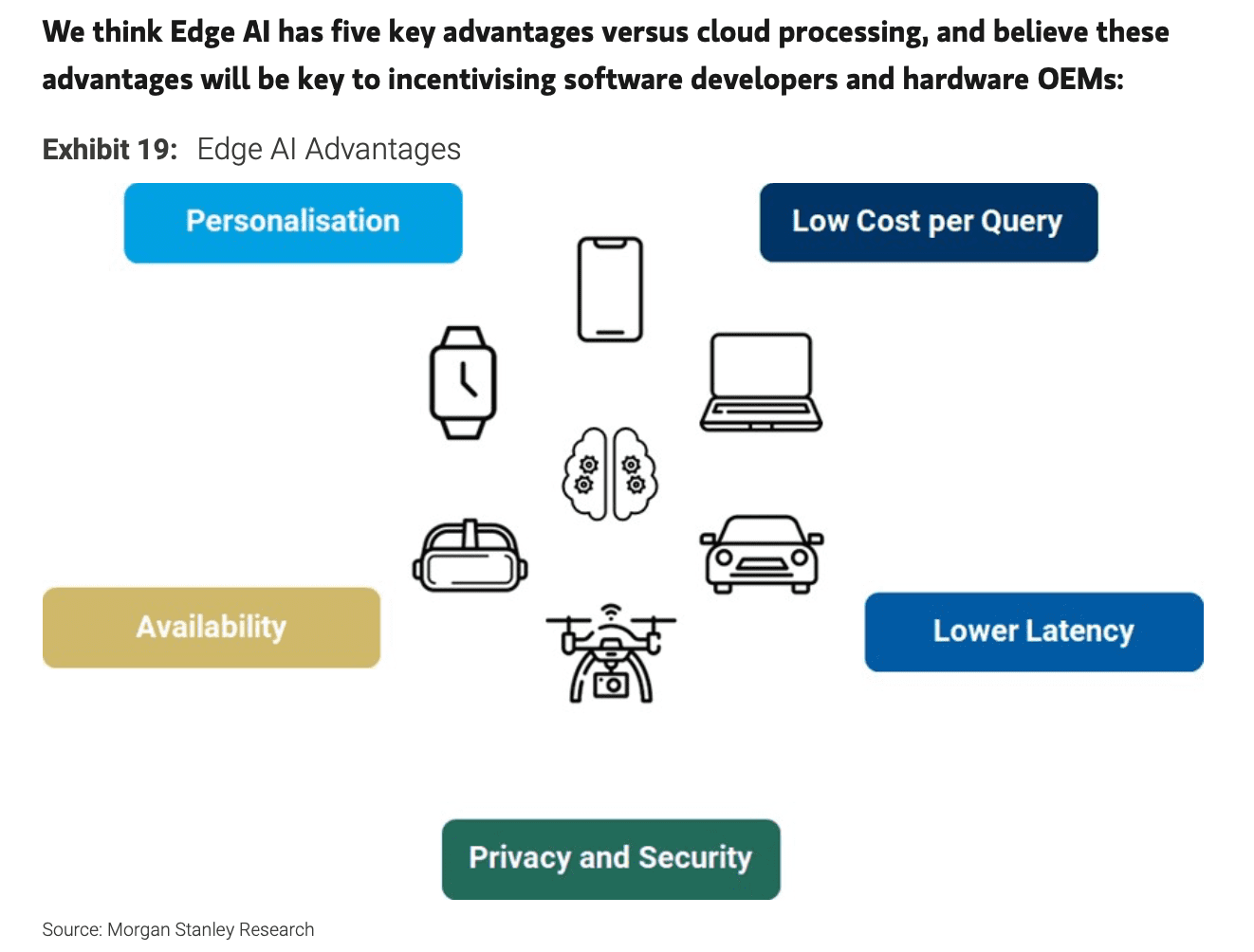
The trend line is clear to the importance of being able to run local models on client devices like workstations, laptops, tablets, and smartphones, and the only question that remains is what size the model will be. This exercise only confirmed to me that local LLMs, for the foreseeable future, are likely to stay under 34B parameters purely due to the memory constraints of running these models locally. Therefore, benchmarks that test the performance of models in the 7B, 13B, and 34B are sufficient to gauge the capabilities of client silicon related to local AI software development and enterprise use cases regarding their domain-specific fine-tuned LLMs.
Expect to hear a lot more about local on-device AI in 2024, and we will be publishing our own report on the AI PC as well as results from a generative AI survey we are running on generative AI use cases and IT decision-makers current thinking and plans around deploying generative AI in the workplace.
### Apple, Qualcomm, Arm, x86 and Increased Silicon Competition
URL: https://creativestrategies.com/apple-qualcomm-arm-x86-and-increased-silicon-competition/
Last updated: 2023-11-01T17:22:20.000Z
In the [latest episode of the Circuit](https://share.transistor.fm/s/50f4b1fd?ref=creativestrategies.com) Ben Bajarin and Jay Goldberg discuss the increased competition coming in semiconductors and specific to the personal computer space.
**Qualcomm Doubles Down on Custom Arm**
At Snapdragon Summit, Qualcomm confirmed that all of its future products will utilize its own customized ARM core designs rather than off-the-shelf ARM cores. This allows Qualcomm to fully optimize performance, efficiency, AI capabilities, and other metrics without being constrained by generic ARM core limitations.
While an expensive investment, returning to fully custom ARM gives Qualcomm engineers the freedom to innovate, it signals a major commitment to challenging x86 in PCs and data centers with its ARM-based Snapdragon processors.
**Snapdragon X Elite Benchmark Results Impress**
Qualcomm unveiled its new Snapdragon X Elite chip for Windows PCs at the event. The benchmark results revealed a significant performance leap over past Snapdragon processors, bringing Qualcomm much closer to parity with Apple’s M-series chips.
The custom architectures clearly make a difference – when using off-the-shelf ARM cores, Qualcomm struggled to match Apple’s performance. Now, with custom designs, the gap has narrowed considerably.
**Can ARM Gain Share in PCs from Intel/AMD?**
While Windows laptops running Snapdragon chips will soon compete performance-wise with MacBooks, it remains to be seen if ARM can gain significant market share from Intel and AMD.
Consumers still largely choose Windows vs. macOS rather than making purchase decisions based on underlying chip architecture. For ARM to disrupt the PC ecosystem, its real-world benefits will need to be compelling enough to overcome user familiarity with x86.
**Apple’s New M3 Chips Raise the Bar Again**
Apple’s latest M3 silicon establishes new performance records with both efficiency and raw power improvements over prior Apple chips. New optimizations like throttling P-cores all the way to zero frequency when idle demonstrate Apple’s expertise in ARM architecture.
The introduction of 3nm process technology to consumer devices is also notable, as Apple aims to lead the industry in advanced manufacturing capabilities.
**AI Benchmarking Remains a Challenge**
Both companies touched on AI performance, but quantifying AI capabilities with standard metrics remains difficult. While benchmarks like TOPS indicate raw neural processor power, real-world relevance depends on factors like maximum model sizes supported.
Apple declined to provide many technical details about its neural engine performance, instead simply positioning its chips as capable for developers building AI programs. This acknowledges that most consumers do not need the most advanced AI locally on devices.
**The Competitive Environment Spurs Innovation**
While Intel and AMD still dominate the PC and data center markets, Qualcomm and Apple are clearly raising the bar for ARM performance. Even if ARM remains a relatively small share of those segments, this heightened competition should spur all players to deliver better products benefiting customers.
### Apple Mac Scary Fast Recap and Insights
URL: https://creativestrategies.com/research/apple-mac-scary-fast-recap-and-insights/
Last updated: 2023-10-31T15:57:58.000Z
What Was Significant
Our view has consistently been that Apple’s ambition with the Mac business is to continue to grow to take share from Windows in the higher-end>$1000 segment of the laptop market. Apple, in the last few years, has hovered around 10% of WW PC sales, and while they have never been at 10% before, it has stalled around that number. 2023 was a very weak year for PC sales and it is unclear if that was the core drag of the Mac or if M2 was not enough pull to keep the Mac momentum going. Regardless, Apple is full throttle with the M3 family and from what we have heard from supply chain contacts, Apple is looking to ramp Mac even more in 2024.
The biggest changes to M3 are a brand new GPU architecture that leverages an industry-first memory implementation called dynamic caching. Dynamic memory may be a better way to understand what is happening. Still, this technique makes more efficient use of memory, only allocating the amount of memory needed for a workload in real-time.
Apple went to lengths to compare the new M3 P cores and E cores to M1 in an attempt to speak more to the audience of M1 owners to upgrade as well as the more than 50% of their Mac base that is still on Intel-based Macs. We believe the large portion of the Mac installed base that is still on Intel-based Macs represents the largest growth opportunity for Apple in terms of the Mac business.
Perhaps the biggest surprise was the price drop on the entry-level 14″ Macbook Pro. This SKU is among one of Apple’s best-selling models and a new entry point of $1599 should be seen as a significant market attraction. **Apple is now offering its fastest M series SoC on one of the most popular SKUs at the lowest price ever and thus appealing to an even wider audience.**
It was notable to us Apple did not emphasize TOPS (trillions of operations per second), where up to this point, the number of TOPS has been a key stat for all prior M Silicon launches. Apple mentioned the A17 Pro has 35 TOPS but did not call out a number for M3 during the event. On the Mac feature on Apple’s website, they list M3 has 18 TOPS, which is up from M2’s 16 TOPS. While this is a somewhat fuzzy metric, it does speak to the capability of an SoC NPU and its on-device AI capabilities. As more AI models run locally for reasons like privacy, security, speed, etc., NPU TOPS capabilities will be a relevant battleground for all SoC makers. While we did not expect Apple to mention anything specific to AI/LLMs they did talk about AI developers as it related to M3 silicon. We believe in the short term, particularly in the commercial market, many large organizations will look to run their generative AI/LLMs locally at the edge and not in public cloud providers. While this is an 18-24 month time frame, we think the low TOPS number is okay for now, but it could limit M3-based Mac’s local AI capabilities as those devices will still be used in the market but won’t be capable of running larger models locally. Essentially, there could be a concern these would not be future-proof for AI capabilities that are around the corner.
**What Was Announced**
**New Family of M3 Apple Silicon**
- Apple has introduced the industry’s first 3-nanometer chips for a personal computer, which will bring significant improvements in speed and efficiency to Mac users.
- The M3 family of chips boasts a next-generation GPU with cutting-edge rendering features, including hardware-accelerated ray tracing and mesh shading. These advancements will enhance the graphics performance and visual quality of Macs.
- In terms of CPU performance, both the speed and efficiency cores in the M3 chips have been enhanced compared to the previous M1 chips. Additionally, the Neural Engine’s speed has also been improved, enabling faster and more efficient machine learning tasks.
- The M3 chips feature an enhanced unified memory architecture, ensuring smoother data access and overall system performance. They also support extended memory capabilities of up to 128GB, allowing for more intensive tasks and multitasking.
- Custom engines dedicated to AI and video processing provide accelerated machine learning capabilities and advanced media capabilities, giving Mac users unprecedented creative possibilities.
- The M3, M3 Pro, and M3 Max chips offer different levels of performance, catering to a diverse range of user needs. These differences include variations in the number of transistors, GPU cores, CPU cores, and memory support, allowing customers to choose the chip that best suits their requirements.
**M3 Options In New Macbook Pro’s**
- Apple announced a new lineup of MacBook Pro models with the M3, M3 Pro, and M3 Max chips. These chips offer enhanced performance and capabilities.
- The 14-inch MacBook Pro with M3 starts at $1,599 and is designed for everyday tasks. It provides a seamless user experience with its powerful performance.
- The 14- and 16-inch MacBook Pro with M3 Pro offer even greater performance and are capable of handling more demanding workflows. These models are perfect for professionals in creative industries.
- The 14- and 16-inch MacBook Pro with M3 Max are designed for extreme performance and capabilities. They excel in tasks like machine learning and video editing.
- All MacBook Pro models feature a brilliant Liquid Retina XDR display, which offers stunning visuals with vibrant colors and high contrast.
- The new MacBook Pro models also come with a built-in 1080p camera for high-quality video calls, a six-speaker sound system for immersive audio, and impressive battery life of up to 22 hours.
**Refreshed iMac with M3**
- The new iMac is powered by the M3 chip, offering up to 2 times faster performance than the previous generation with M1.
- It is also up to 2.5 times faster than the most popular 27-inch models and 4 times faster than the most powerful 21.5-inch model.
- The iMac features a stunning 4.5K Retina display with 11.3 million pixels and over a billion colors for a visually immersive experience.
- It offers faster wireless connectivity and seamless integration with iPhones, enhancing the overall user experience.
- The iMac boasts best-in-class camera quality, speakers, and microphones, providing exceptional multimedia capabilities.
### TSMC Earnings: Canary in the Coal Mine, Competition in Process Technology
URL: https://creativestrategies.com/tsmc-earnings-canary-in-the-coal-mine-competition-in-process-technology/
Last updated: 2023-10-25T19:19:52.000Z
On the latest [episode of The Circuit](https://share.transistor.fm/s/6986ac40?ref=creativestrategies.com), Ben Bajarin and Jay Goldberg discuss how TSMC earnings give us indications into market trends, pockets of recovery, and how a coming battle in process technology is looming between TSMC and Intel.
**Steady Performance Across the Board**
TSMC reported solid results that were slightly better than expected.Their production, process technology, and margins all remain healthy. While some end markets like smartphones have been weak recently, TSMC sees signs of improvement as inventory congestion clears.
**Leading-Edge Nodes Gaining Traction**
TSMC’s latest 3nm node already accounts for 6% of revenue, ahead of where 5nm was at a similar point. This suggests strong demand from Apple and others for their most advanced process technology. Their target of 53% gross margins also remains achievable despite ramping new nodes.
**Capital Expenditures Moderating**
After record high levels of spending in recent years, TSMC is being more conservative with its capital expenditures. This helps maintain margins but could be risky as demand rises for leading-edge nodes like 3nm and upcoming 2nm. Competition from Samsung and Intel’s re-entry as a foundry customer in 2024 may also impact TSMC’s capacity.
**Geopolitical Factors Increasing Costs**
TSMC acknowledged that manufacturing outside of Taiwan comes at a higher cost due to talent availability, supply chain maturity, and other factors. Their new US fabs will likely require higher pricing to maintain margins. Partnerships with governments and local suppliers will be crucial to manage costs.
**Outlook on AI and Packaging**
TSMC sees AI driving demand for larger chip designs, which is positive as it means more silicon content per chip. But they need to improve their capabilities around advanced packaging, which will be key to delivering on these AI chips composed of multiple chiplets.
In summary, TSMC maintains its pole position in the foundry market but faces increasing challenges from competition and technology transitions in the years ahead. Their earnings call provides valuable perspective on the dynamics shaping the semiconductor industry today.
### Qualcomm Snapdragon Summit: Oryon Sets the Table for PCs with AI
URL: https://creativestrategies.com/research/qualcomm-snapdragon-summit-oryon-sets-the-table-for-pcs-with-ai/
Last updated: 2023-10-25T02:58:40.000Z
What’s Significant
Qualcomm has finally shared extensive details of their Oryon custom architecture purpose-built to take Arm-based Windows PCs to the next level. This is a result of years of work via their acquisition of Nuvia, and represents a significant moment for Qualcomm as they return to a proprietary custom Arm architecture.
Overall, Qualcomm shared some impressive specs with the new PC architecture named the Snapdragon X Elite. The benchmarks included better single-threaded performance than Apple’s M2 and better single and multi-threaded performance of select AMD and Intel’s current lineup.
Most important, in our view, are the specs around the custom Hexagon NPU, which has 45 TOPS performance capabilities and is the single most important metric and benchmark for running pervasive generative AI natively on client devices.
Another critical element of this announcement is the support of Microsoft, which is doubling down even more on AI with Windows and is leading the charge of bringing advanced AI features to Windows, which will have performance advantages on Snapdragon X Elite thanks to the NPU.
There is a question of market traction going foward for Arm-based Windows PCs given they represent a very small portion of the market today. We believe the technological differentiators Qualcomm now acheives with a return to a fully custom architecure makes the opportunity more attractive. That combined with a re-invigorated Microsoft around AI enhancing Windows and their prioritizing the Snapdragon X Elite in that equation give Qualcomm a window of opportunity we do not believe existed before. The big questioning remaining is how can Qualcomm start to attract enterprise buyers to OEM PCs running Snapdragon X The scale opportunity is even larger if Qualcomm can attract enterprise buyers who are ready to pivot to AI enhanced PCs.
**What was announced:**
- Qualcomm has unveiled its next-generation Snapdragon X1 Elite platform for premium Windows PCs, promising massive performance and efficiency gains.
- The Snapdragon X1 Elite features Qualcomm’s new custom Oryon CPU based on ARM architecture. With up to 12 cores and clock speeds up to 3.8GHz, Oryon delivers up to 2x faster CPU performance compared to competing x86 chips while using only one-third the power.
- The 4nm Oryon CPU utilizes new architectural innovations like dual-core boost, heterogeneous computing, and power-saving techniques to achieve the best balance of high performance and remarkable power efficiency. This results in laptops with multi-day battery life.
- For graphics, the integrated Adreno GPU provides up to 4.6 TFLOPS of power, enabling stunning visuals, smooth gaming, and fast rendering. The Spectra ISP supports up to 64MP cameras.
- The Hexagon processor drives AI acceleration, delivering up to 75 total system (CPU/GPU/NPU) TOPS and 45 TOPS on Qualcomm’s custom NPU alone to run powerful on-device AI experiences. Snapdragon X1 Elite can run AI models with over 13 billion parameters directly on the device for new intelligent capabilities.
- With the integrated FastConnect 7800 system, Snapdragon X1 Elite supports the latest Wi-Fi 7 and 5G wireless technologies. This enables PCs to achieve fiber-like speeds wirelessly with minimal latency for activities like streaming, syncing, and downloading files.
- Additional features include AV1 video codec support, Snapdragon Sound technology for high-fidelity audio, enhanced security, and more.
- The Snapdragon X1 Elite platform will power premium consumer and commercial PCs from major manufacturers starting in mid-2024.
### Qualcomm Snapdragon Summit: What’s new with Snapdragon 8 Gen 3
URL: https://creativestrategies.com/research/qualcomm-snapdragon-summit-whats-new-with-snapdragon-8-gen-3/
Last updated: 2023-10-24T21:35:35.000Z
Today at Snapdragon Summit, Qualcomm announced their 2024 flagship mobile chipset: Snapdragon 8 Gen 3\. Below is our thoughts on what is significant and a recap of the main announcements.
**What’s Significant:**
Gen AI is being a popular marketing term and also a differentiating factor for a lot of consumer and enterprise products right now. Qualcomm is heavily pushing the local Gen AI movement. They announced a new AI Stack for developers to run on their local AI Engine, which will use the GPU, CPU, and CPU simultaneously to run these models. They claim 20 tokens per seconds of performance on the 7B parameter Llama 2 model and Stable Diffusion image generation in under 1 second. While these are both useful benchmarks, it’s unknown how Qualcomm partners are going to use this raw power and AI Engine in first party apps and services. We know the SoC can run these models locally, or hybrid locally, but not how they will provide value to consumers and enterprise.
Qualcomm is using the a new 1+5+2 core setup for the CPU, with 1 ARM Cortex X-4 prime core, 5 ARM Cortex A720 performance cores, and 2 ARM Cortex A520 efficiency cores. This is a pretty classic core setup, and early benchmarks put the single core performance slightly behind Apple’s A17 Pro with multi core performance right on par with A17 Pro. Apple does have a silicon advantage with TSMC’s 3nm node vs the TSMC 4nm node Qualcomm is using for Snapdragon 8G3\. We’ll have to see how this performance plays out when devices with Snapdragon 8 Gen 3 start shipping, which will start with the Xiaomi 14 series in China in the coming weeks.
Google also announced that they had models meant for on device AI for their specific apps in the works, likely meaning the local Gen AI features from Pixel 8 series will not be exclusive to Pixel, but will roll out to high end flagship mobile phones in the future.
We’ll have to see how Qualcomm’s AI Stack, AI Engine, and performance stacks up to the competition as devices hit the market. We’re likely to see devices in Mainland China throughout October and November with global devices launching starting in December.
**What was announced:**
- New Qualcomm AI Engine supports large transformer models up to 10 billion parameters, enabling advanced on-device natural language processing and generative AI.
- New Qualcomm AI Stack for developers with over 20 models available at launch through Hugging Face.
- AI Engine delivers up to 98% faster performance and 40% better efficiency versus previous generation
- Supports stable diffusion image generation in less than 1 second
- New Kryo CPU features 1+5+2 configuration with one ultra high-performance core, five high-performance cores, and two efficiency cores
- Kryo CPU provides up to 32% higher performance versus predecessor
- New Adreno GPU brings 25% faster graphics rendering and 25% greater power efficiency
- Adreno GPU supports advanced gaming features like ray tracing, 240Hz displays, up to 240fps gaming
- Integrated Snapdragon X75 5G modem for cutting-edge connectivity. 10 Gbps downlink, 3.5 Gbps uplink.
- Overall major performance and efficiency gains across CPU, GPU, AI, camera, gaming, connectivity compared to previous Snapdragon flagship
### Research Note: Our View on Report Nvidia and AMD Arm PC Chips
URL: https://creativestrategies.com/research/research-note-our-view-on-report-nvidia-and-amd-arm-pc-chips/
Last updated: 2023-10-24T19:16:09.000Z
[The recent report from Reuters](https://www.reuters.com/technology/nvidia-make-arm-based-pc-chips-major-new-challenge-intel-2023-10-23/?ref=creativestrategies.com) about Nvidia looking to make a push with an Arm PC chip has been a long time coming. We have known about Nvidia’s interests in this space for several years as a part of a broader CPU roadmap on Arm moving from data center to PC. The report also highlights AMD’s intent for an Arm-based CPU, which we believe is not in the works. We will share some thoughts essential to know related to this topic.
First, competition in Windows client PC chips is coming, and it is a net positive for the market. Windows PCs running Arm are still a very small sliver of the overall PC market, under 2% of the annual sales share. But the emerging opportunity is around AI as Arm has a more mature NPU, and from what we can tell, Arm-based players will have a significant lead over x86 players in terms of the core metric that matters for AI performance on-device, which is TOPS. That said, the two factors in how many silicon providers can offer a solution on Windows are Microsoft themselves, who will need to bless any new entrants, and the market’s ability to embrace more than the three current Windows silicon providers. We believe quite strongly Microsoft understands the PC market can not support too many silicon providers and thus will limit it to the core three in Intel, AMD, and Qualcomm.
The Nvidia solution still may not come to market. Nvidia has much bigger fish to fry as they race to meet current demand for their data center solutions, and in no way would a small sliver of the PC market take priority over the cash cow they are sitting on in the data center. Even if this part comes to market, we believe it would be isolated to the high-end gaming segment, which is, again, a very small market.
For AMD, they have little reason to switch away from x86 with an offering. They are still struggling to gain share in client with their own x86 solution against Intel, and an Arm solution would not change that reality. x86 has a dominant position in the enterprise, and we are still skeptical of the Arm PC opportunity in the enterprise specifically. An Arm-based offering from AMD would not help either their x86 strategy for the enterprise.
The key point here that is important to get across, is the market’s inabilty to support this many PC vendors. OEMs have significant costs to add a new silicon vendor to their supply chain and they will only do that when the market opportunity is large enough. Intel remains the entrenched encumbant here with still \~80% share on average and while AMD and Qualcomm have a chance to chip away at that but how much is a question only the market will answer.
We remain cautiosly optomistic on the Arm Windows PC opportunity, particiularly as we enter the era of the AI PC which we believe could be a strong catalyst for the PC market to return to growth and leap forward as a productivity tool.
### Arm Embraces the Custom Silicon Trend with Arm Total Design
URL: https://creativestrategies.com/research/arm-embraces-the-custom-silicon-trend-with-arm-total-design/
Last updated: 2023-10-20T16:17:48.000Z
One of the biggest trends we have continued to reference is the move to custom silicon by numerous names in big tech. Almost every major player in technology has some aspect of custom silicon, and you would be hard-pressed to find a product or category in tech that is built purely from off-the-shelf silicon. Your options before, regarding Arm IP, were to either license core IP (off-the-shelf) or get an architecture license to do more custom work. Or, of course, work with an existing licensee to develop customized solutions. In most of those cases, though, Arm did not benefit financially. This makes the Total Design initiative interesting to Arm from a business model standpoint.
This program will make it easier for customers of Arm IP to develop custom solutions, in conjuction and in some cases in partnership with Arm (economically). Overall, this is a positive development for the industry and Arm which enables much more opportunity for customers to differentiate with Arm IP.
**Overview of the main news points**
**1\. Advancement in Chiplet Technology:** The collaboration between Arm and its partners in the Arm Total Design ecosystem highlights the focus on chiplet technology. Chiplets offer modularity and flexibility in chip design by allowing different components to be designed and manufactured separately and then integrated into a single chip. This approach enables more efficient and cost-effective development of complex System-on-Chip (SoC) designs.
**2\. Acceleration of Custom Silicon Solutions:** The Arm Total Design program aims to accelerate the development of custom silicon solutions by bringing together a diverse group of industry experts. This collaboration allows for pooling knowledge and expertise from multiple partners, streamlining the design and production process. By accelerating custom silicon development, the program enables faster time-to-market and delivery of innovative solutions.
**3\. Focus on Workload-Optimized Silicon:** The Arm Total Design ecosystem emphasizes the development of workload-optimized silicon solutions. This means that the custom silicon chips produced through this collaboration will be designed and optimized to meet the demands of specific applications and workloads, such as cloud computing, data centers, networking, and AI. By tailoring silicon designs to specific workloads, the program ensures higher performance, energy efficiency, and an overall better solution fit.
**4\. Collaboration and Partnerships:** The collaboration between Arm and its partners highlights the importance of cooperation and partnerships in driving innovation and advancing the semiconductor industry. By bringing together hardware and software partners, foundries, and Electronic Design Automation (EDA) technology experts, the Arm Total Design program creates an ecosystem that fosters collaboration, leveraging multiple stakeholders’ collective strengths and expertise.
### The Impact of US Export Controls on AI Semiconductor Landscape
URL: https://creativestrategies.com/research/the-impact-of-us-export-controls-on-ai-chips/
Last updated: 2023-10-20T15:28:02.000Z
The US recently imposed new restrictions on exports of advanced semiconductors and manufacturing equipment to China. These new controls primarily target AI chips, equipment, and computing systems destined for Chinese companies working on national security projects.
The new rules refine and expand on previous export controls from October 2022\. One major change is the addition of a “performance density threshold” that chipmakers like Nvidia will need to comply with. This metric calculates compute performance per area of silicon, which could sweep in more of Nvidia’s advanced AI chips like its A100 and H100.
**What does this mean for various players in the semiconductor industry?**
**Nvidia** – A setback but business still expected to exceed forecasts. Supply chain checks show GPU demand remains strong. But some upside to estimates removed given new license requirements.
**TSMC** – Unclear if Chinese customers can still obtain licenses for Nvidia chips. May slow TSMC’s leading edge production for China clients.
**Semiconductor Equipment** – New equipment export controls appear limited to logic chips above 14nm. Likely a benign impact for now.
**Memory** – Minimal impact expected for memory leaders Samsung and SK Hynix. Controls exempt memory and consumer chips.
**China Internet & Cloud** – Larger firms like Baidu have inventory/options, and smaller developers more exposed. Could delay AI product launches and data center buildouts.
**Other Notes:**
Dispite attempted lobbying to get RISC-V included in an element of these entity lists, it was not added, just as we [predicted](https://creativestrategies.com/the-complex-dynamics-of-us-china-semiconductor-trade-restrictions/).
The latest export controls are an evolution of prior restrictions, not a dramatic overhaul. But they do introduce new compliance challenges, especially for Nvidia. Over time, these technology access limits could slow China’s AI development and decrease its global semiconductor market share. But near-term impacts appear manageable for most industry players.
The geopolitical tensions underlying these export controls bear monitoring to assess if rules are expanded further or potentially relaxed. For now, advanced semiconductor and equipment companies exposed to China seem to face manageable, but not disastrous, repercussions.
### The Coming Spatial Computing Battle
URL: https://creativestrategies.com/the-coming-spatial-computing-battle/
Last updated: 2023-10-18T15:19:07.000Z
We are on the cusp of some interesting times in the technology industry as a battle is looming between Apple and Meta over spatial computing/mixed reality. In case it isn’t totally obvious, the battle will first begin as a war over words as Apple will look to standardize Spatial Computing and Meta will look to standardize Mixed Reality. Because of that, I am not sure where the industry will land, but if I had to bet on whose marketing will win, I’ll bet on Apple’s. Hence, I chose Spatial Computing for the title.
A few weeks ago, [I shared a brief overview of some recent market research](https://creativestrategies.com/the-chasm-for-virtual-reality-is-deep-and-wide/) we did on the current virtual reality space. Our study surveyed consumers who don’t own VR headsets but have tried them and current VR owners, with the vast majority of that group owning a Meta Oculus Quest. I stand by the analysis that these headsets, wearable computers, or whatever we call them, are still many years off from widespread mass adoption. But I think it’s important to contrast what is very likely Meta’s strategy here with Apple’s.
**Meta’s Strategy**
A somewhat subtle theme Mark Zuckerberg kept emphasizing at[ Meta Connect](https://creativestrategies.com/meta-connect-event-recap-and-analysis/) was making this technology affordable and approachable for everyone. I felt this language intertwined throughout the event, and the launch of Quest 3 was intentional in showcasing Meta’s strategy here as a whole and in particular, their positioning against Apple. Scale has, first and foremost, been in Meta’s historical favor (more people use Facebook and Instagram than any other single software product in the world), and I get the sense Zuckerberg and Meta want the same thing to be true with their hardware strategy.
The language repeated as Zuckerberg launched the quest kept coming back to innovation in this space, meaning improving the overall product experience and continuing to focus on bringing the price down so it can get into the hands of the masses. To use a smartphone market analogy Meta wants their platform enabling the Quest to basically be Android. But the question is, will they allow other hardware OEMs to run this platform, or are they attempting to blend the strategy of Google and Apple and build their own hardware but also relentlessly focus on price affordability and thus sheer unit scale.
Our research would suggest Meta’s best strategy here is to open up its software platform and ecosystem to other brands, but there is no indication this is their play yet. From our survey, Samsung and Google ranked much higher than Meta when we asked consumers which brands they were most likely to consider in a future purchase of VR/Mixed Reality headsets. This suggests that if Meta were to allow Samsung and Google, assuming they are willing and interested, then there is a much better chance of them reaching their scale ambitions of having as many people as possible on their platform. This is extremely relevant if they want a chance to compete with Apple because if Meta’s mixed reality platform it will come down to installed base and developers.
In my mind, Meta’s strategy is clear. They will relentlessly focus on scale, but it is unclear whether they will attempt to attempt that scale alone or with an army. The latter has historically been needed to compete with Apple.
**Apple’s Strategy**
Apple’s playbook seems generally straightforward. Focus on making the best hardware, on top of the best software, focus on simplicity ease of use, attract the market’s best developers, and focus more on the premium side of the market. Apple will never be the least expensive hardware product, but they believe their hardware is worth a premium, and the market seems to agree.
While Apple Vision Pro is likely to remain out of mainstream price points for several years, at least their efforts in setting the experience bar will not go unnoticed by the market. Despite debates about how many possible devices Apple will sell in year one, it will be enough that a vast majority of consumers will get to try one either at retail or at a friend or family member’s house. It may come as no surprise that in our VR survey, 71% of respondents indicated their first experience with a VR device was at a friend’s or family member’s house. This means the single best place for VR to sell itself will be experiencing it at someone’s house whom you know. I’ll put more stake in this scenario, being critical to driving these experiences to the mainstream over any traditional retail experience. And it is within this setting most people will experience Apple Vision Pro.
The challenge for competing headsets will be Apple Vision Pro setting the bar extremely high. Yes, the price will be out of reach for now, but people will remember those first experiences, and that will help Apple over time as Apple Vision Pro evolves and eventually reaches more mainstream price points.
A few other nuggets from our data that play in Apple’s favor. The brand most consumers overwhelmingly said they would consider if they were in the market for a VR device was Apple at 55%. This was significantly larger than any brand we tested.
Second, 20% of current non-VR owners indicated they would be willing to spend $1,000 or more on a VR headset. This was quite a bit of a surprise and, overall, led us to a new insight relative to this category. In prior VR surveys we have conducted, as well as many we have read from third parties, the vast majority of respondents signaled a low-price threshold (under $400) as the price they are willing to pay. Our survey saw a measurable increase in willingness to spend above $500\. This could suggest more people seeing the wider value of these experiences and perhaps ways to embrace new forms of entertainment and productivity. We believe a key factor in convincing consumers to pay more for spatial computing devices is that they see it as a potential replacement for their TV or laptop/desktop someday.
To test this, we asked current VR owners if they could see themselves replacing their TV and or laptop/desktop with a more advanced headset at some point and 57% said they could see replacing their laptop/desktop, and 60% said they could see themselves replacing their TV.
While we completely acknowledge a goggle form factor head-worn device is an interim step for spatial computing to a more glasses-type form factor, for at least the next 4-5 years, these larger head-worn devices will be what comes to market. The technology to miniaturize is still many, many years away. But, we think as consumers see these more as general-purpose entertainment and productivity devices, we could see a chunk of the market adopt these devices and perhaps reach 20% population penetration in the 2025-2026 timeframe.
### The Future of Semiconductors (Logic): Transistor Design and Advanced Packaging
URL: https://creativestrategies.com/the-future-of-semiconductors-logic-transistor-design-and-advanced-packaging/
Last updated: 2023-10-16T16:07:05.000Z
[This week on The Circuit](https://share.transistor.fm/s/96e15039?ref=creativestrategies.com), Ben Bajarin is joined by guest Huiming Bu Vice President, Global Semiconductor R&D. Below is a summary of the topics covered in their conversation.
The semiconductor industry is currently in a period of unprecedented complexity and competition. As we look to the future, major innovations will be needed across hardware, software, and applications to keep driving progress.
\## Moving Beyond FinFET Transistors
For the last decade, chip manufacturing has relied on FinFET transistor architectures. Now, we are transitioning to using nanosheet transistors which will take us to the 1.5-1.7nm node. After that, there is uncertainty around what comes next. Two possibilities are VTFETs (vertical transport field effect transistors) and more horizontal transistor designs. More research is still needed to determine the optimal path.
\## The Critical Role of Advanced 3D Chip Stacking
Moving to advanced 3D chip stacking and packaging will be essential but extremely challenging. New design and optimization tools are required to properly connect 3D chip technology with overall system architecture. This will likely need major innovations in the next 2-3 years to avoid slowing progress.
\## Collaboration is Key
Driving future innovation will require collaboration across the technology stack – from hardware to software to applications. It will also require partnerships across different companies and strengths. No single company can do everything alone. Building an ecosystem of partnerships will be critical for success.
\## A Competitive, Complex Environment
We are currently in one of the most competitive environments ever seen in semiconductors. There are more options and players than before across foundries, chip designers, tool providers, and more. At the same time, the industry faces unprecedented technical complexity. Solving the hard problems ahead will require creativity and tenacity.
\## The Promise of Chiplets and Heterogeneous Integration
For future systems, chiplets and heterogeneous integration will likely play a big role. As monolithic dies reach their limits, packaging together different chiplets allows for continued gains in transistors and compute power. This will require optimizing across system architecture, packaging, and software to make the most of these modular, mix-and-match designs.
The future of semiconductors will be challenging but also full of opportunities. With collaboration, innovation, and a “full stack” approach, the industry can pave the way for the next era of computing.
### Pixel 8 Pro: Google’s AI powered super phone
URL: https://creativestrategies.com/pixel-8-pro-googles-ai-powered-super-phone/
Last updated: 2023-10-12T00:21:35.000Z
The Google Pixel 8 Pro is the tech giant’s latest flagship smartphone, and it is a device that truly pushes the boundaries of what we can expect from on-device artificial intelligence (AI). The driving force behind these advancements is the Tensor G3 chip, Google’s semi-custom-designed system on a chip (SoC) that is built specifically to optimize machine learning and AI tasks.
### Key Takeaways:
- Google’s on-device Gen AI helps assist you while using the phone, meaning there is less focus on making sure everything you do is perfect. No more over pronunciation while talking to Google Assistant or using voice typing, everything just works naturally. You no longer need to worry about photos coming out perfectly or lighting being flawless, you can just fix it later and have it look nearly perfect.
- This is great not only for content creators, but also the “average consumer.” There is peace of mind in knowing you do not have to go out of your way to make sure a photograph is perfect, or the phone can understand you, but rather it will just work and adapt to you.
- Tensor G3 is not as performant as other chips released in 2023, but still provides an equivalent experience to those chips. While the raw performance is closer to a 2021 SoC, the effective AI performance is significantly better. While voice transcription on iPhone 15 Pro Max has a bit of latency and accuracy is not there, Google’s Pixel 8 Pro is near instant and just about perfectly accurate.
- The new body design is more comfortable with a velvet feeling glass texture, the new flat screen makes the device feel more premium while the augmented camera visor keeps Google’s recognizable design and improves it to fit their new hardware.
- The overall experience of the device rivals Apple’s iPhone 15 Pro Max, outdoing most of the Android competition. It’s $999 price tag at 128GB of storage is competitive, though given the size of AI models the device should have started at 256GB.
One of the most impressive features the Tensor G3 enables is real-time voice transcription. This isn’t just an incremental improvement on previous technology, but rather a transformative leap forward. The Pixel 8 Pro, thanks to an advanced speech recognition model running natively on the device, can transcribe spoken words into text with unprecedented speed and accuracy. The result is a voice typing experience on the keyboard that’s more fluid and intuitive than ever before, allowing users to dictate messages, emails, and other text-based communications faster than they could manually type them. This bleeds into other features as well, like transcription in the voice recorder app and Google’s Call Screening. I have been enjoying not having to worry about how quickly it processes because it is near instant and incredibly accurate.
Thanks to the new on-device LLM, the AI-driven enhancements do not stop there. In Gboard,there is now a proofread function that will look over and correct any text. It works similarly to Grammarly and Microsoft Editor. The Recorder app on the Pixel 8 Pro will soon feature an AI-powered summarization tool that can generate concise summaries of long audio recordings. This innovative feature has the potential to be a game-changer for professionals who frequently attend lengthy meetings or students who record long lectures. Instead of having to manually review hours of audio, users can quickly get the gist of the content via these automated summaries. This is on top of the speaker labels and text search for audio.
Audio Magic Eraser brings AI-powered audio editing capabilities to the Pixel 8 Pro. By analyzing the audio waveform in a video, the device can isolate specific sounds, enhance them, or even remove them entirely. This can be a boon for amateur video creators, allowing them to easily remove unwanted background noise and improve the overall audio quality of their videos without needing professional editing skills or software.
Google also leverages the power of the Tensor G3 chip to enhance the Pixel 8 Pro’s photo editing capabilities using an on-device Gen AI image model. The Magic Eraser feature, which was already impressive in previous iterations, now uses an intelligent scene completion algorithm to realistically fill in the background when users remove objects from their photos. This results in cleaner, more natural-looking images even after significant edits.
The Magic Editor feature takes this a step further by allowing users to modify various aspects of their photos with AI-powered tools. You can adjust the lighting, apply depth effects, and even reposition elements within the photo. All these edits are powered by generative neural networks, making them surprisingly intuitive and effective. Unlike the Magic Eraser, this does not happen on-device. Instead, it is processed on Google’s data centers. It takes around 15-20 seconds to process but provides much better results than on device AI.
[](https://creativestrategies.com/pixel-8-pro-googles-ai-powered-super-phone/pxl%5F20231010%5F163627753/)
Before
[](https://creativestrategies.com/pixel-8-pro-googles-ai-powered-super-phone/pxl%5F20231010%5F1636277533/)
After
While all these photo and video features are amazing, and they are, they need to be implemented at the system level rather than in apps like Google Photos. If I want to use Audio Magic eraser, a Pixel 8 feature, to fix audio in Instagram/Snapchat/TikTok, a very common use case, I should not need to record the video in the default camera app, go to Google Photos and fix it, then go to the social app, upload it, then edit it. Google needs to work with the Android team to expose these features as APIs app developers can use or find a way to provide them at a system level, like Apple does with portrait mode and portrait lighting on the camera feed.
While the Tensor G3 chip may not lead the pack in terms of raw processing power, with rivals like Apple’s A17 Pro and Qualcomm’s Snapdragon 8 Gen 2 offering higher benchmark scores, the Pixel 8 Pro still offers smooth and responsive performance in everyday use. More importantly, the areas where the Tensor G3 truly shines – namely, the AI-driven features – are areas where raw processing power is less important than optimized, efficient performance. Trust me, you will not notice this raw power in day-to-day usage, but you will notice the AI features day-to-day. It’s near instant and simply great. Efficiency as well, battery is easily an over 1-day battery.
Benchmarks put the raw performance of Tensor G3 CPU and GPU around the Snapdragon 8 Gen 1 and just shy of A15 Bionic performance.
> [#GooglePixel8Pro](https://twitter.com/hashtag/GooglePixel8Pro?src=hash&ref%5Fsrc=twsrc%5Etfw&ref=creativestrategies.com) Tensor G3 GPU performanc/efficiency test results. Apparently Samsung 4nm LPP node is just not as good as TSMC when it comes to efficiency. We’re looking at something that’s roughly 1.5-2 gen behind the current flagship SoCs. [pic.twitter.com/k1UVDbmqmS](https://t.co/k1UVDbmqmS?ref=creativestrategies.com)
>
> — Golden Reviewer (@Golden\_Reviewer) [October 10, 2023](https://twitter.com/Golden%5FReviewer/status/1711803706268864896?ref%5Fsrc=twsrc%5Etfw&ref=creativestrategies.com)
Aside from its impressive AI capabilities, the Pixel 8 Pro also boasts a refined design, a top-tier camera system, and an unmatched commitment to long-term software support, with Google promising a minimum of seven years of updates. This combination of features makes the Pixel 8 Pro an excellent choice for anyone in the market for a high-end Android device.
For the enterprise market, the seven years of promised system and security updates is even more important. Google has also promised to provide repair parts to partners for the lifetime of the device. This alongside the possible utility of the thermometer built into the device, which I suspect will be swapped for a LiDAR sensor within the next generation or two, makes it a unique but good toolkit for enterprise use.
However, it is the on-device AI capabilities that truly set the Pixel 8 Pro apart from its competitors. Google has always been at the forefront of AI and machine learning, and with the Pixel 8 Pro, they are bringing that expertise to the realm of smartphones in a way that is both innovative and practical. For professionals, power users, and anyone else who wants a smartphone that is not just powerful, but also smart and continually improving, the Pixel 8 Pro is a compelling choice that is hard to not recommend.
### IBM Watsonx – Scaling GenAI Responsibly
URL: https://creativestrategies.com/research/ibm-watsonx-scaling-genai-responsibly/
Last updated: 2023-10-10T15:40:54.000Z
IBM recently announced the general availability of WatsonX. Below is our thoughts on what is significant and a recap of the main announcements.
**What’s Significant**
With GenAI being a significant driver on enterprise interest, businesses still have more questions than answers in terms of how they will deploy, manage, and secure their company’s proprietary data. According to the most recent CIO Survey from Morgan Stanley, 66% of CIO’s surveyed indicate GenAI as an increasing budget priority in 2023 but only 5% indicate these initiatives are significant. From that same report, 33% of CIOs surveyed indicated that within the scope of the GenAI projects they are testing, they expect some form of the technology to be deployed in late 2024, with most CIOs stating 2025 as a reasobale expecation. This confirms the cautious approach most businesses are taking given they are hyper focused on scaling Gen AI responsibly and securely. This is why initiaties like IBM’s Watsonx are relevant to potentially help accellerate the adoption of GenAI within organizations large and small.
There are a few significant aspects that stand out in IBM’s announcement regarding the watsonx Granite model series and client protections:
**Business-focused AI models** – The watsonx Granite models have been specifically customized for enterprise use cases and optimized for precision and accuracy. This highlights IBM’s commitment to providing AI solutions tailored to business needs rather than general consumer applications.
**Responsible and ethical AI** – IBM has invested heavily in curating training data, implementing governance practices, and developing tools like watsonx.governance to ensure ethical and responsible AI development. This underscores their leadership in trustworthy AI.
**Client protections for data** – By providing standard contractual protections and IP indemnity, IBM enables clients to confidently leverage AI while safeguarding their valuable data assets. This reassurance facilitates wider business adoption of AI.
**Scalable and flexible AI solutions** – The Granite models are available in different sizes to meet diverse business requirements. The integration with third-party models also provides flexibility. This demonstrates IBM’s focus on scalable and adaptable AI.
**Driving innovation in enterprise AI** – The release of the Granite series marks an important milestone in making enterprise-ready AI accessible for businesses. IBM is spearheading innovation in this space.
**What Was Announced**
- IBM announced the availability of first models in watsonx Granite series, a new collection of generative AI models designed to advance the integration of generative AI into business applications and workflows
- Granite models are being developed in different sizes to fit the unique needs of various business use cases like customer service, document summarization, etc.
- Models can enable specific capabilities like retrieval augmented generation to search knowledge bases, summarization to condense long documents, and insight extraction for sentiment analysis
- IBM enables businesses to be AI creators by bringing proprietary data to IBM’s base models to build customized models
- IBM invested over the years in developing custom foundation models optimized for precision and accuracy required in business use cases
- Internal benchmarking shows specialized models deliver better accuracy with lower infrastructure requirements compared to generalized models
- IBM provides flexibility to integrate third-party models like Meta’s Llama chatbot and Hugging Face models based on business needs
- Granite models trained on curated, business-relevant datasets from 5 domains – internet, academic, legal, finance, code – and filtered for objectionable content
- IBM applying rigorous governance process and releasing watsonx.governance toolkit to enable trusted AI workflows for clients
- IBM extending standard IP protections, like those for hardware/software products, to watsonx models
- IP indemnity enables clients to confidently develop AI solutions using their data with IBM’s trusted foundation models
### The Complex Dynamics of US-China Semiconductor Trade Restrictions
URL: https://creativestrategies.com/the-complex-dynamics-of-us-china-semiconductor-trade-restrictions/
Last updated: 2023-10-09T17:03:32.000Z
This is a summary of the latest [episode of The Circuit](https://share.transistor.fm/s/7dbcc8fc?ref=creativestrategies.com) with Ben Bajarin and Jay Goldberg.
Congress has recently raised concerns about open-source architecture RISC-V and the potential need for restrictions due to its use by Chinese companies. However, experts agree it will be extremely difficult to actually restrict RISC-V given its open source nature.
The Biden administration’s October 2021 trade restrictions had noticeable gaps, such as not covering intellectual property (IP) or software. There are now discussions around potentially tightening restrictions, but it remains unclear how IP such as ARM could realistically be restricted given how embedded it is in the global semiconductor ecosystem.
The October 2021 restrictions have negatively impacted revenues for several US semiconductor companies, who are now actively lobbying to push back against further restrictions. However, the intent behind the restrictions was to limit China’s military modernization and access to advanced computing capabilities. With the US elections coming up in 2024, most expect the restrictions will get tougher as both political parties want to appear strong against China. This could lead to escalation if China chooses to retaliate against US companies in non-semiconductor industries.
For investors, the full revenue impacts are not yet priced into semiconductor stocks. In particular, semiconductor equipment companies selling to China could face increased scrutiny and limitations. Experts warn the situation could deteriorate much further if the US and China continue down the path of escalating tit-for-tat restrictions. While the direct revenue hits so far have been relatively minor, the worst case scenarios of a full-blown trade war are not accounted for in current valuations.
In summary, the complex dynamics around US-China semiconductor trade restrictions involve national security concerns, industry lobbying, political posturing, and uncertainty around how much escalation may occur. There are no easy solutions, so expect ongoing volatility around this issue.
### An Automotive Shift Into Software Defined Vehicles
URL: https://creativestrategies.com/research/an-automotive-shift-into-software-defined-vehicles/
Last updated: 2023-10-10T16:43:01.000Z
**Executive Summary**
The automotive industry is undergoing a major transition as original equipment manufacturers (OEMs) shift towards software-defined vehicles (SDVs). SDVs rely on integrated computing systems and software to manage core vehicle operations instead of mechanical controls. This transition presents opportunities and challenges for OEMs and suppliers.
This report analyzes the key drivers catalyzing this change, strategies OEMs are employing to adapt, and how leading semiconductor suppliers like NXP, Qualcomm and Nvidia are positioning themselves to enable SDVs. Key findings include:
- OTA software updates and new revenue streams are accelerating SDV adoption. By 2029 over 90% of vehicles may have OTA capabilities.
- OEMs are forming partnerships, moving to digital architectures, decoupling hardware/software lifecycles, and enabling centralized computing to support SDVs.
- Suppliers are investing in solutions spanning chips, platforms, and software stacks to power SDV computing needs.
- Automakers and suppliers that successfully embrace SDVs will be best positioned to lead the industry’s transformation.
**Background on the Rise of Software-Defined Vehicles**
Software-defined vehicles rely on integrated computing systems running an automotive OS instead of mechanical controls. This allows new capabilities to be added via over-the-air (OTA) software updates throughout the lifetime of a vehicle.
- Several interrelated factors are driving the rise of SDVs:
- Cost savings from remote software updates versus shop visits
- New revenue opportunities from subscription-based software services
- Improved customer experiences through added features
- Higher residual values as vehicles stay updated longer
According to Gartner, only 3.4% of vehicles in 2021 had OTA update capabilities. However, they forecast over 90% will be OTA-capable by 2029\. The production of SDVs is projected to grow at a 41% CAGR through 2030 per Infineon.
**Strategic Implications for Automotive OEMs**
The shift to SDVs presents opportunities and challenges for automakers. On the opportunity side, SDVs allow new revenue streams from software and services over the lifespan of a vehicle. However, OEMs must adapt their development processes and capabilities.
**Key strategies automakers are employing include:**
- Forming partnerships and collaborations to access needed software expertise. Volkswagen and Audi created a software JV called CARIAD to jointly develop SDV capabilities.
- Evolving vehicle architectures towards digital and electric platforms that can support SDV computing needs. GM’s Ultium battery platform and Ultifi software stack aim to underpin its SDV efforts.
- Decoupling hardware and software lifecycles to enable more frequent over-the-air software updates.
- Moving compute to centralized controllers versus distributed ECUs to reduce complexity.
- Enabling OTA software update functionality to deploy new features and improvements.
OEMs that fail to adapt their organizations risk falling behind competitors leading the way on SDVs.
**Strategies of Leading Semiconductor Suppliers**
Chipmakers like NXP, Qualcomm and Nvidia are making significant investments to supply key components and platforms for SDVs:
***NXP Semiconductors***
Here is a summary of the key points on NXP’s strategy for automotive processors:
- NXP introduced a domain architecture approach in 2018, allowing software reuse across domains with its S32 processor family.
- The S32 family spans low-end MCUs to high-performance MPUs, enabling vertical integration.
- NXP achieved early success by engaging OEMs early on multi-core processors and having a full automotive solution spanning connectivity, analog, and core processors.
- The new S32G3 processors offer 2.5x better performance, memory, and networking than prior generations to meet autonomous driving needs.
- The G3 uses both Cortex-M7 and Cortex-A53 cores for real-time and application processing, including safety functions.
- Hardware isolation and built-in cybersecurity features enable safety and security.
- The GoldVIP platform for G3 enables rapid prototyping of vehicle computers and cloud connected services.
- Overall, NXP is focused on high-performance multi-core processors with safety, security, and cloud connectivity to enable software-defined vehicle capabilities. Early OEM engagement and a full solution have positioned them well.
***Qualcomm***
Here are the key points on Qualcomm’s strategy for automotive processors:
- Qualcomm is moving beyond domain controllers to an integrated, Snapdragon-inspired central compute platform. Recent auto deals validate this shift.
- The Snapdragon platform leverages Qualcomm’s expertise in mobile processors and software stacks.
- It spans digital cockpit, car-to-cloud services, connectivity, and advanced driver assistance.
- Snapdragon Ride is an ADAS toolset with AI acceleration and vision/driving policy software stacks.
- The new Ride Flex chipset consolidates infotainment and ADAS workloads onto one SoC as a flexible platform.
- Qualcomm partners with AWS on cloud tools and infrastructure to enable software-defined vehicle development, testing and validation.
- Overall, Qualcomm aims to be an integrated hardware and software provider, leveraging mobile and cloud expertise to power centralized computing for next-gen vehicles.
***Nvidia***
Here is a summary of the key points regarding Nvidia’s role as a partner in autonomous vehicle development:
- Nvidia has an end-to-end autonomous vehicle platform called DRIVE that spans from the cloud to in-vehicle systems.
- The DRIVE AGX Orin chip provides high performance of 254 trillion operations per second to enable scalable autonomous driving capabilities from Level 2 to 5.
- DRIVE Hyperion is a development environment that allows automakers to customize sensor and compute configurations for different autonomy needs.
- The new DRIVE Thor chip consolidates autonomous driving and infotainment functions onto a single chip, replacing multiple ECUs. It provides 2,000 trillion operations per second.
- Nvidia offers a 3 layer stack for software-defined vehicles: DRIVE hardware, DriveWorks middleware for AI and parallel computing, and autonomous driving applications like mapping and digital assistance.
- Nvidia recently partnered with MediaTek to collaborate on autonomous driving solutions.
- With advanced hardware, software stacks, and development tools, Nvidia is positioned as a key technology partner for automakers pursuing autonomous driving capabilities in software-defined vehicles.
**Barriers to Adoption**
The shift to software-defined vehicles poses some key challenges that need to be addressed:
- Decoupling hardware and software lifecycles is a major challenge for automakers used to tightly integrated systems. OEMs will need to adopt more agile, modular software development practices that allow frequent over-the-air updates independent of the hardware.
- OEMs will likely develop new relationships with suppliers as software becomes more independent. Chipmakers and tier 1 suppliers may need to adjust their traditional business models.
- More cloud and virtualization technologies will likely be adopted to enable the separation of software functions from hardware. This could improve performance as OEMs focus on optimizing hardware.
- For chipmakers, a key challenge will be differentiating through performance while providing more software ecosystem support, rather than proprietary tie-ins. Striking the right balance between partnering with tier 1s and OEMs will be important.
**Broader Forecasts Looking Forward**
- Total automotive semiconductor sales are forecast to grow at a 9% CAGR from 2021 to 2030, reaching $126.6 billion in 2030\. This rapid growth aligns with the rise in adoption of software-defined vehicle capabilities over the next decade.
- ADAS semiconductor sales are expected to grow the fastest, at a 22% CAGR over the forecast period. This highlights the key role advanced driver assistance systems will play in enabling higher levels of vehicle automation and self-driving capabilities.
- Powertrain semiconductor sales are forecast to grow at a 12% CAGR, reflecting the growth in electrification and the semiconductor content needed to manage electric drivetrains.
- Infotainment semiconductor sales are expected to grow at a 5% CAGR over the forecast period. This shows the continued importance of in-vehicle infotainment and emerging opportunities around digital cockpit experiences.
- Sales of body electronics and chassis systems will grow at a more modest 3-4% CAGR. This indicates that while still important, these domains will rely more on existing microcontrollers and see less disruption from the shift to centralized computing architectures.
- Overall, the rapid growth forecasted across key domains like ADAS and powertrain align with the migration to more software-defined vehicles over the next decade. Semiconductor suppliers enabling these capabilities are well-positioned to see surging demand.
**From Our Automotive Research**
**Insights into consumer motivations to purchase EVs**
The data provides insights into what is driving consumer interest in purchasing electric vehicles (EVs), with several key factors emerging:
- The high cost of gasoline is a major motivator, with 49% of respondents strongly agreeing and 29.3% agreeing that they are tired of paying so much at the pump. This indicates that the potential for fuel cost savings is a significant driver for EV interest.
- Environmental impact is important, with 48.9% strongly agreeing and 34.8% agreeing they want to have a positive effect on the world. This highlights that sustainability and reducing emissions are key reasons consumers are considering EVs.
- Tax incentives make EVs more accessible, with 23.1% strongly agreeing and 40.3% agreeing they make it easier to choose an EV. Financial incentives clearly influence the decision-making process.
- Maintenance is perceived as simpler and cheaper, with 28% strongly agreeing and 28% agreeing compared to gasoline vehicles. Reduced maintenance requirements are appealing to consumers.
- The overall driving experience is seen as better by some, with 23.9% strongly agreeing and 32.6% agreeing it is better than gasoline vehicles. This suggests performance and experience help drive interest.
- Availability of charging stations is not a primary driver, with only 11.1% strongly agreeing there are plenty where they live. However, many are neutral on this factor, so charging access may still be important for some.
By quantifying the consumer perspectives, it becomes clearer that fuel costs, the environment, incentives, maintenance, and experience are the leading factors attracting buyers to EVs. This data is valuable for policymakers and the automotive industry to inform strategies to further accelerate EV adoption.
**Key Auto Features Consumers of Interest to Consumers**
The data on feature importance provides insights into what consumers value most when purchasing their next vehicle:
- Price is the top priority, with 63.7% rating it very important. This suggests affordability and value are key purchase drivers.
- Driving range/fuel efficiency is highly valued, with 51.4% rating it very important. Consumers are focused on practical factors like range and mpg.
- Safety features like rear cameras and blind spot detection are important, with 48.6% and 57.9% respectively rating them very important. This indicates safety is a major consideration.
- Brand and styling do influence purchases but are secondary factors, with 35.7% and 31.8% rating them very important. Brand loyalty and aesthetics still play a role.
- In-car entertainment and autonomous features have fairly low importance, with only 22.2% and 16.4% rating them very important. These are not deal-breakers for most consumers currently.
- Social status from vehicles has very low impact, with only 13.1% rating it very important. Cars as status symbols are declining.
In summary, practical considerations like affordability, efficiency, and safety are the top priorities shaping what consumers value in their next vehicle purchase, while brand, styling, and new technology play a secondary role.
**What’s Keeping Consumers Away from EVs?**
The data highlights the key factors deterring consumers from purchasing electric vehicles (EVs) or hybrids:
- High upfront cost is the top barrier, with 46.5% citing it as the primary reason for not choosing an EV or hybrid. The price premium compared to gasoline vehicles is discouraging adoption.
- Range anxiety remains an issue, with 35.5% primarily concerned about distance limitations. Despite improving ranges, there are still doubts about EV capability.
- Lack of charging infrastructure is a major obstacle, with 43.9% citing insufficient charging stations in their area as the primary reason. More charging availability could alleviate concerns.
- Home charging installation cost deters some, with 39.4% calling it a primary reason. Making at-home charging more affordable could encourage EV purchases.
- Gasoline vehicle familiarity and perceptions around maintenance and simplicity keep some buyers away, with 38.6% citing this as the primary reason. Changing perceptions of EVs as overly complex may help.
- Performance doubts ward off certain consumers, with 25.8% calling it the primary reason. Improving power and acceleration could make EVs more appealing.
In summary, bringing down costs, expanding charging infrastructure, incentivizing home charging, and reshaping consumer perceptions around EVs will be key to unlocking wider adoption.
In conclusion, the automotive industry is undergoing a major transformation as software-defined vehicles become more prevalent. While this shift presents opportunities for added revenue and improved experiences, it also poses challenges requiring organizational change and new capabilities from automakers. Leading semiconductor suppliers like NXP, Qualcomm and Nvidia are making key investments to supply the platforms and components needed to enable software-defined vehicles. Automakers that adapt successfully stand to gain competitive advantages, while those lagging risk falling behind. However, consumer adoption remains a hurdle, with factors like high costs, limited range, and lack of charging infrastructure slowing EV purchases. The industry must continue to evolve both the technology and the ownership experience to unlock the potential of software-defined vehicles. Companies that embrace this change and align their strategies stand to benefit the most as intelligent, updatable vehicles become the new normal.
### HP Imagine 2023 Recap and Insights
URL: https://creativestrategies.com/research/hp-imagine-2023-recap-and-insights/
Last updated: 2023-10-06T19:03:00.000Z
During an analyst and press event held at its HQ’s Customer Experience Center in Palo Alto, HP showcased new hardware and services providing a glimpse of the opportunity the company has to deliver increased ROI as it leans into providing added value from the data captured by the devices customers use.
**What’s Significant**
Two devices that were recently launched the HP Envy Move and the HP Spectre Foldable PC showed some thoughtful design innovation born our of customers needs and desires rather than engineering capability. While the HP Envy Move, portable all-in-one concept has been tried before, HP’s decision to include a battery that lasts just over 4 hours, a pouch to carry the keyboard, a retractable handle to carry the device, and an amazing sound to prioritize content consumption all wrapped into a $899 price point, is bound to give this product a real chance in the market.
The HP Spectre Forlable PC is far from being a mass-market device and the price tag of $5K might even stop some early adopters but it shows a lot of promise for this nascent category. More importantly, some of the design choices, show that HP has been focusing on delivering a product that can be as versatile as possible, so to better justify the $ investment. The device that runs Windows 11 can be used at an angle and either with the keyboard sitting completely on the bottom half of the screen mimicking a 12-inch clamshell laptop or with it sitting on the bottom half of the screen but pulled toward you, leaving half of the screen visible. This allows to use that part of the screen for specific functions using Windows’ Snap features like commands to navigate through a video call.
HP has an opportunity to deliver much more value by creating a stronger connection across its products especially when it comes to hybrid work and collaboration. The Managed Collaboration Services offering is the first attempt at generating revenue from the analytics coming from its devices. There is certainly an opportunity for HP to deliver added value through his service but execution and timeliness will be critical. Customers are making decisions about hybrid work right now and they have different options as far as where they can get the data they need to make such decision, from Windows on PCs, collaboration services such as Zoom, Teams and Webex and even services such as Cisco’s Smart Buildings.
As Microsoft doubles down on Copilot, PC OEMs will struggle to differentiate based on AI. During the event HP talked about local inferencing delivering lower latency, better privacy and tighter security. These are certainly great reasons to run AI on client but a point all vendors will make. And while, privacy and security matter a lot in a enterprise context, they are still not a purchase driver for most consumers, especially as they believe that AI is delivered through the cloud and not on device. HP will have to start educating customers in both business and consumers market as to the value of AI on the edge and this might need some level of alignment with both Microsoft and the silicon providers.
Sustainability was also on stage with the new Renew Solutions, a program that helps enterprises assess which products need to be retired, which can be refurbished and which can of employee would most benefit from that refurbished unit. This service will allow HP to help their customers reach their sustainability goals as well as position itself as a trusted partner.
While not an area that usually gets a lot of interest, large format printing showed a lot of exciting opportunity for HP as well the need to talk about this segment in more mainstream media and as as part of a digital transformation story that in my view has failed to get the attention it deserves.
The pandemic represented a tough moment for HP, mostly due to how it handled its supply shortages. This left the brand having to do some work to regain trust, thought leadership and share. While this event does not solve all HP’s problems it certainly helped showcase its innovation, its leaders and the sense of urgency to turn their business around.
**What Was Announced**
**Managed Collaboration Services**
- HP is introducing Managed Collaboration Services, a conference room as-a-service subscription for managing, operating, and optimizing video conference rooms.
- The service includes cutting-edge Poly and HP technology to enhance the conferencing experience and improve productivity.
- HP Managed Collaboration Services can gather insights about room occupancy, availability, and usage rates to optimize room utilization.
- Features will be added to proactively identify and resolve issues, such as automatically canceling room bookings for empty conference rooms or rebooking meetings in alternative rooms if equipment is not working.
- Employees encountering issues in conference rooms can press a help button to connect with a network operations service professional who can remotely assist with troubleshooting.
- HP is launching Workforce Central, a cloud-based dashboard that allows IT managers to discover, configure, monitor, and manage HP services and solutions in one place.
- Workforce Central provides insights into the usage of employee productivity gear and enables proactive issue resolution.
- Ubiquitous telemetry will be enabled across HP’s entire portfolio of PCs, Poly systems, and printers to provide essential insights into fleet performance.
- Workforce Central’s Proactive Insights tool will leverage AI and telemetry data to anticipate issues, provide recommendations, and support IT management and employee experience improvement.
- HP Protect and Trace with Wolf Connect is a cellular-based PC find, lock, and erase solution that addresses endpoint security vulnerabilities.
- The solution allows customers to track devices, remotely wipe data, render PCs useless, and track fleet assets for financial efficiency and sustainability.
- HP Wolf Protect and Trace offers peace of mind and is the only PC OEM offering this service.
**Platform for Data Scientists**
- HP announced the Z by HP AI Studio, a data science platform that enhances their workstation solution to connect data teams, tools, and compute.
- The AI Studio platform promotes collaboration among data scientists and AI developers worldwide, enabling them to create shared projects, connect to data, and invite collaborators easily.
- HP’s AI Studio software allows teams to deploy models at their discretion and scale workflows across local, edge, and cloud environments, providing flexibility and predictable development costs.
- Features of HP AI Studio include simplified collaboration management, rapid project setup, simplified team management, and predictable AI development costs.
- HP is collaborating with NVIDIA to offer dedicated workstation solutions with the NVIDIA AI Enterprise software platform.
- The collaboration aims to simplify the building and customization of private AI models.
**Hybrid Work Collaboration Services**
- HP is expanding their Poly conferencing innovations to large rooms and huddle rooms with high-performing cameras and powerful computing.
- The Poly Studio Bundle is purpose-built for the Zoom Rooms intelligent director feature, providing an inclusive virtual collaboration experience. It is an all-in-one bundled solution that will be available in November.
- The Poly Studio R30+ Bundle enables flexible meetings in smaller rooms by connecting with a single USB-C cable for audio and video collaboration experiences. It is expected to be available early next year.
- HP and Poly enable seamless experiences, such as connecting a Poly Bluetooth headset wirelessly to an HP PC for exceptional call quality.
- Bluetooth Direct from Poly will simplify hybrid work by supporting fast and simple pairing, in-call experiences, management, and analytics without the need for a Bluetooth adapter. It will be available in late Spring 2024.
- The Poly Video OS provides a unified experience across video conferencing devices, with features like automated camera framing modes and precise participant framing.
- Poly DirectorAI smart camera technology offers various framing modes for equitable hybrid meetings, and Poly DirectorAI Perimeter technology ensures accurate participant framing in glass-walled meeting rooms.
**Consumer Hardware Foldable PC/All-in-One**
- The Spectre Fold is a versatile device that seamlessly transitions between three form factors: laptop, tablet, and desktop.
- It is the world’s first foldable PC with a continuous 17-inch screen and a physical keyboard, eliminating the need for extra cables for charging.
- The Spectre Fold leverages Windows Snap and HP enhanced mode to quickly adapt and reconfigure the Windows layout, providing a flexible user experience.
- It is equipped with built-in AI for security, wellness, and gesture controls, offering features like walk away lock, wake on approach, auto screen dimming, and privacy alerts.
- The Spectre Fold includes HP Presence 2.0 for enhanced productivity and collaboration, with a 5MP camera and Intel Unison support for easy connectivity to mobile devices.
- Powered by a 12th Gen Intel Core i7 Processor on the Intel Evo platform, Intel Iris Xe Graphics, long battery life, Wi-Fi 6E connectivity, and ample storage.
- The device is built sustainability in mind, incorporating eco-friendly materials with high percentages of recycled content and water-based paint.
- The Envy Move features a clever design with a discrete handle for easy movement between rooms and a self-deploying kickstand that adapts to any flat surface.
- It has a built-in battery with up to 4 hours of battery life, ensuring uninterrupted work and play anywhere in and around the home.
- QHD display for a premium viewing experience and adaptive surround sound for immersive audio in any room.
- It offers productivity features with up to a 13th Gen Intel Core i5 processor, up to 16 GB of LPDDR5 memory, and up to 1 TB of storage.
- The Envy Move includes the HP Wide Vision 5MP camera for video chats and privacy features like an integrated shutter.
- It has AI-based wellness reminders for screentime and distance and automatically adjusts brightness based on the environment and time of day.
**Device Refurbishment For Increased Sustainability**
- HP is introducing its first-ever PC refurbishment program as part of its Renew Solutions suite of services.
- The program extends the life of devices, addressing a growing market segment and aiming to reduce the environmental footprint.
- HP has been internally redeploying devices for its own workforce, refurbishing close to 20,000 devices per year.
- Every HP-certified refurbished device undergoes a rigorous refurbishment process, including memory enhancements and storage expansions.
- The devices are extensively tested and inspected to ensure optimal performance and reliability.
- Customers receive support from the HP global support network for their refurbished devices.
- Refurbished devices have a lower carbon footprint compared to new devices, helping customers advance their sustainability goals.
- The program initially focuses on notebooks and will expand to include printers, collaboration equipment, and other hybrid solutions.
### Made by Google Announcement Recap and Insights
URL: https://creativestrategies.com/research/made-by-google-announcement-recap-and-insights/
Last updated: 2023-10-04T21:48:24.000Z
Today, Made by Google held their fall devices launch. Below is our thoughts on what is significant and the recap of the news.
**What’s Significant**
The key takeaway from Made by Google’s 2023 hardware event is the emphasis on improved AI and ML capabilities. Google announced 7 years of security updates for the Pixel 8 and 8 Pro, making them more viable for enterprise use. The Pixel 8 Pro debuted Google’s own on-device AI models, beating Qualcomm and MediaTek to offering an on-device large language model. This enables features like autocomplete, summarization, and image synthesis directly on the device.
The second important announcement was the upgraded Pixel Watch. With a new Qualcomm chip, it has better performance and battery life. It also adds body response tracking to monitor stress and recommend actions for mental health. Finally, Google Assistant is getting more conversational abilities through a new AI system called Bard. This will allow Assistant to understand context better and have more natural dialogue.
Overall, the focus was on bringing more powerful AI and ML directly into Google’s hardware. Between on-device models, health tracking, and conversational assistants, Google is building devices that can dynamically adapt and understand users better over time. Advanced AI/ML is powering the next generation of Google’s products.
**Pixel 8/Pro Announcement Details**
- Google has released two new phones, the Pixel 8 and Pixel 8 Pro.
- The phones are designed for a more helpful and personalized experience.
- They are powered by the Google Tensor G3 and will receive seven years of software updates.
- The Pixel 8 has a 6.2-inch Actua display, contoured edges, and satin metal finishes. It comes in Rose, Hazel, and Obsidian colors.
- The Pixel 8 Pro features a 6.7-inch Super Actua display, a temperature sensor on the back, and a matte glass back. It comes in Porcelain, Bay, and Obsidian colors.
- Both phones have upgraded camera systems, including better low-light performance and improved macro focus.
- The camera app has a redesigned interface, and the Pixel 8 Pro offers Pro Controls for more creative control.
- New features include Best Take for getting the perfect group photo, Magic Editor in Google Photos for editing with generative AI, and Audio Magic Eraser for reducing distracting sounds in videos.
- Later this year, the Pixel 8 Pro will receive Video Boost for enhanced video processing.
- Other features include Summarize to quickly understand webpage content, improved speech recognition, and enhanced Call Screen to reduce spam calls.
- The phones come with seven years of software support, including OS upgrades, security updates, and regular Feature Drops.
**Google Pixel Watch 2**
- Google announces the Pixel Watch 2, a new smartwatch with upgraded performance and new health and safety features.
- The Pixel Watch 2 has improved heart rate tracking, with an all-new heart rate sensor that is up to 40% more accurate for vigorous activities.
- It features three new sensors: an electrodermal activity sensor for stress monitoring, a skin temperature sensor for sleep insights, and a continuous heart rate sensor for accurate health metrics.
- The watch is designed for all-day wear, with a 24-hour battery life and faster charging capabilities.
- Fitness features include Heart Rate Zone Coaching, Pace Training, automatic workout start and stop reminders, and access to Fitbit features.
- Safety features include fall detection, Emergency SOS, Medical ID, Emergency Sharing, and Safety Check.
- The watch runs on Wear OS 4, offering smarter notifications, improved accessibility, and customization options.
- It can be paired with the Fitbit app for a comprehensive view of health and wellness and comes with six months of Fitbit Premium.
- The Pixel Watch 2 can easily pair with other Pixel devices and offers features like Find My Phone and Automatic Call Screener.
**New Pixel Buds Pro**
- Google announces new features and colors for the Pixel Buds Pro.
- The Pixel Buds Pro now support Bluetooth Super Wideband, improving call quality and making voices sound fuller and clearer.
- Clear Calling reduces background noise during calls to enhance voice clarity.
- Conversation Detection automatically pauses music and switches to Transparency Mode when the user starts speaking, allowing for easy conversations without removing the earbuds.
- Pixel Buds Pro minimize audio latency for a more immersive gaming experience.
- The Pixel Buds Pro app provides suggestions for maintaining hearing wellness and is now available on Chromebooks.
### Innovations in Memory Technology
URL: https://creativestrategies.com/innovations-in-memory-technology/
Last updated: 2023-10-03T14:14:37.000Z
Memory is one of the most critical components of computing, yet most of us don’t think much about it. On a recent episode of [The Circuit podcast](https://share.transistor.fm/s/1d8ab94b?ref=creativestrategies.com), hosts Ben Bajarin and Jay Goldberg interviewed memory expert Steven Woo to discuss the latest developments in memory technology.
Here is an expanded summary with some additional details:
\# The Latest Innovations in Memory Technology
Memory is one of the most critical components of computing, yet most of us don’t think much about it. On a recent episode of The Circuit podcast, hosts Ben Bajarin and Jay Goldberg had an in-depth discussion with memory expert Steven Woo to explore the latest developments in memory technology.
**Key Memory Technologies**
The hosts asked Woo to explain the different types of DRAM memory and their use cases:
– DDR is the lowest cost, most widespread memory used in consumer devices and computers. New DDR standards are released every \~5 years.
– GDDR is optimized for graphics processing and used in graphics cards.
– HBM is a high bandwidth memory designed for artificial intelligence, machine learning, and high performance computing applications that require massive memory capacity and bandwidth.
**Driving Forces Behind Innovation**
What is propelling the need for better memory?
– AI requires massive models with trillions of parameters, so more memory capacity enables training without chaining multiple systems together.
– High performance computing needs greater capacity to increase the number of processor cores.
– Graphics-intensive gaming requires GDDR innovations for better graphics.
– Consumers want new features and better battery life from mobile DRAM.
**The Challenges of Memory Manufacturing**
Woo explained that memory manufacturing has become extremely complex, with precision now down to the nanometer. He noted that it takes many cycles to become highly proficient due to the trial and error involved. This is why new Chinese memory makers faces challenges in competing with established giants like Samsung and Micron.
**Milestones to Watch**
Over the next 12-18 months, look for improvements in:
– AI training speeds enabled by new memory architectures
– More CPU cores indicating memory capacity increases
– Better graphics in gaming driven by GDDR
– Battery life and new features in mobile indicating mobile DRAM advances
Memory may not be glamorous, but it’s critical for computing. This podcast explored why it remains an essential bottleneck and enabler.
### Meta Connect: Event Recap and Analysis
URL: https://creativestrategies.com/research/meta-connect-event-recap-and-analysis/
Last updated: 2023-09-28T17:26:42.000Z
Meta held their annual Connect conference Wednesday and at the event doubled down on their initiative to democratize specific technology experiences like VR, AR, and AI. They stated their primary goal and driving motivation to innovate is to improve each years technology platforms and offer them at more mainstream price points. Below is what we found significant and and overview of the key announcements.
What’s Significant
Oculus Quest 3 looks to be a significant improvement over Quest 2, primarily in the way of mixed reality. Which we view as a positive for the category given we believe mixed reality, or spatial computing in Apple’s vernacular, has much more potential for widespread consumer appeal. We are curious to see how Meta’s developers start to take advantage of mixed reality and the ways that increase the overall usage of the headset.
The Quest 3 is another good win for Qualcomm’s XR platform, affirming again Qualcomm’s XR solution is the only game in town for any brand/vendor looking to compete with Apple. Ultimately, we would love to see another brand like Samsung or Sony enter the market with a mixed reality headset to compete with Meta so there is more diversity in the marketplace as Apple gears up to scale Apple Vision Pro over the coming years.
AI avatars look attractive, and it is particularly important that Meta recognizes the need to bring AI to market responsibly and note the work they are doing to put safety and guardrails around these experiences. Ultimately, generative AI social bots are a brand-new experience for consumers, and how they are implemented will set the stage for broader adoption going forward. We are unsure how consumers will react to these AI profiles, nor if they truly desire them on their social platforms. However, this is another example of Meta wanting to bring these solutions/innovations far and wide to as many people as possible.
Meta’s relationship with Ray-Ban continues with the second-generation smart glasses. While we do not expect these to sell well, the most important takeaway is the learning by shipping between Meta and Ray-Ban as they work to miniaturize key components that will one day serve as the basis of augmented reality glasses. Gen 2 looks quite a bit more interesting than Gen 1 in terms of capabilities but this remains a tough sell in our view.
What Was Announced **Oculus 3**
- The starting price for Meta Quest 3 is $499.99 USD for the 128GB version and $649.99 USD for the 512GB version.
- Meta Quest 3 features mixed reality, allowing a spectrum of experiences.
- It includes high-fidelity Passthrough with over 10 times more pixels compared to Meta Quest 2, keeping the physical surroundings in sight.
- Users can seamlessly transition between fully immersive experiences and a blended environment by double-tapping the side of the headset.
- Meta Quest 3 is powered by the Snapdragon XR2 Gen 2 platform, offering double the graphics processing power of Quest 2.
- It has a 4K+ Infinite Display, achieving a nearly 30% leap in resolution compared to Meta Quest 2.
The slim profile of Quest 3 is 40% slimmer than Quest 2, without compromising visual immersion.
- Quest 3 offers a more customizable fit and balanced weight distribution, enhancing comfort.
Spatial audio on Quest 3 provides enhanced sound clarity and bass performance, with a 40% louder audio range than Quest 2.
The Meta Quest 3 represents a significant upgrade in display quality and visual immersion compared to its predecessor, the Quest 2\. With a 4K+ display and resolution improved by nearly 30%, the Quest 3 will offer much more detailed and crisp visuals.
Performance is also getting a major boost with the Snapdragon XR2 Gen 2 platform providing double the graphics processing power of the Quest 2\. This leap in processing capability opens the door for more advanced real-time rendering techniques and complex VR environments full of visual detail. The kinds of experiences that were previously only possible on high-end PC VR headsets are now feasible on the untethered Quest 3.
A new capability of the Quest 3 is high fidelity passthrough mixed reality that blends physical surroundings with virtual objects. The passthrough cameras have 10x more pixels than the Quest 2, allowing a seamless transition between real and virtual worlds. This technology paves the way for innovative hybrid real-world/VR applications known as Mixed Reality.
Finally, ergonomic improvements like a slimmer profile, balanced weight distribution, and integrated spatial audio will together make for more immersion and comfort. The Quest 3 shapes up to be Meta’s most advanced and well-rounded VR (Mixed Reality) to date.
**Social AI Profiles**
- New AI experiences were introduced during the Connect event
- Users can interact with 28 AIs with unique interests and personalities
- AIs can be interacted with via messaging platforms and social profiles on Facebook and Instagram
- Social profiles feature public figures representing the AI characters
- Visual content creation and profile management are handled by Meta
- AI-generated images will be marked with #ImaginedWithAI and a watermark
- Users in the beta product rollout in the U.S. can message AIs through their social profiles on Instagram or Messenger
- AIs’ responses are generated by Meta’s AI technology
- A list of AI social profiles can be followed on Facebook and Instagram
The introduction of 28 AIs with unique interests and personalities provides users with more personalized and interactive experiences. Being able to directly interact with these AIs through messaging platforms and social profiles adds a new dimension to how people engage with AI-powered systems. Additionally, the use of recognized public figures to represent the AI characters in their social profiles adds a familiar touch. The management of visual content and the inclusion of watermarks and hashtags also showcase the effort to ensure transparency and accountability in the generation of AI-generated images. Overall, these developments demonstrate the evolving capabilities of AI and how it is being applied to enhance user experiences and engagement. Whether or not consumers want these experiences engrained into their social platforms is another question.
**Next Generation Ray-Ban Smart Glasses**
- Ray-Ban Meta smart glasses launching in partnership with EssilorLuxottica, available for pre-order now starting at $299
- Redesigned from the ground up based on user feedback to improve core features like audio, camera, comfort, etc.
- New features like live streaming, Meta AI assistant, improved speakers, 12MP camera, faster computing, smaller charging case.
- Meta AI is an advanced conversational assistant optimized for hands-free use. Can access by saying “Hey Meta” to get information, spark creativity, and control features by voice.
- Multiple style options including new transparent colorways and prescription lens compatibility
- Hands-free convenience for capturing photos/videos, listening to audio, and accessing Meta AI assistant by voice
This is the first major redesign and upgrade to Meta’s smart glasses product since its initial launch.
Based on user feedback, Meta has completely redesigned the Ray-Ban Meta glasses to address key areas of improvement like audio quality, camera capabilities, comfort and usability. New features have also been added that are firsts for smart glasses, including live streaming and a voice-activated AI assistant. The Meta AI assistant is optimized specifically for hands-free use enabled by the glasses form factor.
By partnering with Ray-Ban brand, Meta is making smart glasses more fashionable and accessible to mainstream consumers. With a starting price of $299, and some of the technological improvements, it will be intersesting to see if the second generation of Ray-Ban smart glasses does better than the first. However, this launch demonstrates Meta’s continued investment in developing consumer AR products and experiences.
### The Chasm for Virtual Reality is Deep and Wide
URL: https://creativestrategies.com/the-chasm-for-virtual-reality-is-deep-and-wide/
Last updated: 2023-09-28T15:26:06.000Z
Over the summer, we ran a consumer survey exploring their interest and current ownership and usage of VR headsets. With Apple’s announcements of Vision Pro, we hoped to gauge the broader consumer opportunity for VR, and maybe someday AR, but also explore how non-owners of VR headsets and owners of VR headsets think about the products and experiences. In this article, the focus will be on a few key insights from our study on non-owners of VR headsets, and why we believe mainstream adoption of these devices is still many years away.
VR Demo’s Have Mostly Diffused = >40% of General Population
One of the more interesting takeaways from our study is that VR experiences have diffused. Amongst the US adults who participated in our survey, 46% have already tried a VR headset experience. I point this out because one of the main arguments for the slow adoption of ownership of VR is that most people have yet to try it to be convinced to buy one. Our data shows that this is not the case.
Another thing we were very interested to find out is how most consumers have been having their first few VR experiences. We felt this would show whether these products will best be experienced at retail or elsewhere. Perhaps not surprisingly, 52% of respondents said their first experience with a VR headset was at the home of someone they knew. This is important for several reasons, and in my opinion, only strengthens the position that these products still have a significant chasm to cross. Firstly, our data shows that current VR owners are huge proponents of the product. Meaning they are enthusiastic about VR and, from our study, 90% of current VR headset owners have recommended the product to a friend or family member. To add further context to this point, every consumer survey we have run consistently affirms the single driving force of a new product’s adoption is a trusted recommendation from a friend or family member. Yet, despite our data confirming that a solid portion of the US population has tried a VR headset experience and most likely heard positive things and possibly even recommended one by a friend and family member, less than 10% of the US population still owns one.
**Price Points Are Not the Issue**
Another argument for the slow adoption of VR headsets could be that they are still too expensive. However, that is unlikely the case. We know that products under $500 are a sweet spot for significant annual sales of consumer electronics. Using our model of annual sales of consumer electronics by price point, globally, \~350-400 million consumer electronics products a year are sold below the $500 price point. Quest 2 and Quest 3 are both in the $299-$399 price point.
We asked a price-specific question to non-VR owners to gauge the potential price ranges they are willing to pay should they ever become interested in VR. 70% of respondents indicated $500 or less would be their price range, with the vast majority saying between $100-$500 is the sweet spot.
**Slow Adoption Despite Positive Experiences**
Another argument for the slow adoption of VR headsets is that the experience is still insufficient to convince the masses to buy them. Again, our data does not indicate this is the case. Of those who have tried a VR headset, 68% said their experience was positive. Interestingly, only 10% indicated they had a negative experience with a VR headset.
When asked if your VR experience has convinced you to consider purchasing a VR headet, 77% indicated they remain unconvinced.
**Brand Preference Will Matter**
Most respondents in our study indicated their first experience with a VR headset was with a Meta Oculus headset. This makes sense, given sales estimate rumors indicate Oculus as the leader in sales volume, and a wireless VR headset is a dramatic experience improvement over a cabled VR headset. Despite high consumer awareness of Meta Oculus, and most people having their first experience with VR on an Oculus headset, Meta did not lead brand preference when we asked consumers if their interest would ever change and if they would be willing to buy a VR headset, which brand they would consider purchasing. Again, perhaps unsurprisingly, knowing the strength of Apple’s brand, 56% indicated Apple as the brand they would most consider in the future if/when they ever became sold on a VR headset.
The Chasm to Cross
Today, VR still remains a niche/enthusiast category. The fact that many US consumers have tried and had a positive experience with a VR headset and that current prices of very good products like Meta Quest exist at mainstream price points and adoption remains below 10% of the general population is not a great sign for the category.
From the beginning, our belief was the form factor, and the primary use cases remain challenged for a mainstream audience. We continue to believe there are compelling signs that there is a market here in the future, but we have no current evidence a drastic change in adoption is on the horizon.
### Virtual Reality Research Study: Key Findings Defining the Market
URL: https://creativestrategies.com/research/virtual-reality-research-study-key-findings-defining-the-market/
Last updated: 2023-09-26T22:27:31.000Z
**Key Takeaways:**
- Non-owners are most likely to try VR headsets with friends (52.3%) rather than in stores. Simulation games, YouTube/Netflix, and action games were the top experiences tried.
- The majority of non-owners (64.5%) had a positive first VR experience. 45.95% expressed potential interest in purchasing a headset.
- For non-owners, the most appealing VR experiences are visiting new places (19.62%), attending live events (13.45%), giant movie screens (17.98%), and impossible scenarios (17.36%).
- Current headset owners use their devices for gaming, fitness, socializing, and entertainment. Over 50% use VR headsets daily.
- Most owners (60.66%) are willing to replace their TV with an advanced VR headset. Key desired features are high-resolution, apps, audio, and social experiences.
- 57.97% of owners would replace their computer with a VR headset, valuing full software compatibility and hand/eye tracking.
- VR productivity applications like virtual meetings, collaboration tools, and 3D models are appealing to owners.
- Apple is the top brand non-owners would consider purchasing from, followed by Samsung, Google, and Meta.
**Introduction:**
Virtual Reality (VR) has transformed the way we engage with digital content, offering immersive and interactive experiences like never before. To better understand the adoption and perception of VR, we conducted a survey to gather insights from users who have tried VR headsets. In this blog post, we will delve into the statistics and highlight key findings from the survey, providing valuable information for VR enthusiasts and potential buyers alike.
We have broken the report into a few key takeaways from current non-owners and VR intenders, or those who specifically intend to buy a VR headset in the near future, and current owners of VR headsets.
Insights from Non-Owners of VR Headsets.
**Where the headset was tried**. Our survey revealed that people are more likely to try VR headsets in a familiar environment. While only 13.82% preferred retail stores like Best Buy, a significant 52.30% opted to try the headsets with friends. Some individuals (12.17%) even had the opportunity to test VR at their workplace. Surprisingly, 5.26% of respondents indicated they purchased a headset but ultimately returned it.
**Main experiences tried.** When it came to the main experiences users delved into, the survey highlighted some interesting trends. Entertainment-related activities, such as watching YouTube or Netflix, captured the interest of 20.19% of respondents. Simulation games, including popular titles like Blades & Sorcery and Among Us, dominated with 29.20%. Action games (21.65%), fitness games like Beat Saber and Supernatural (10.22%), and social experiences found in VRChat and Rec Room (8.03%) were also among the experiences users embraced.
**Overall experience using VR.** Evaluating users’ overall experience, we found that VR left a positive impression on the majority. While 23.40% considered their experience extremely positive and 44.15% deemed it somewhat positive, only a small percentage (1.89%) had an extremely negative encounter. Significantly, 21.51% reported their experience as neither positive nor negative, indicating diverse perspectives.
**Interest in purchasing a VR headset.** The survey results showed considerable interest in owning a VR headset. While 31.27% of respondents were unconvinced, 45.95% expressed a potential interest, falling into the “maybe” category. With an affirmative response, 22.78% signaled their intent to purchase a VR headset.
**Price point consideration for purchasing.** Understanding the price range that users were willing to consider is crucial for VR manufacturers and developers. The survey provided insights into varying budget preferences. The largest group (26.64%) expressed a willingness to spend between $250 and $499\. Possible entry-level options were also popular, with 24.71% considering a price range of $100 to $249\. Surprisingly, 20.46% were open to investing $1000 or more, hinting at potential demand for higher-end VR products.
There were a few experiences that those who have tried VR found most attractive in the future. Below is a summary of the key findings of aspects of VR we tested in which consumers found most attractive.
**Virtually visiting locations you have never been or cannot travel to.** For the wanderlust in us, VR holds the key to unlocking extraordinary destinations. According to our survey, 19.62% of respondents were captivated by the idea of virtually visiting places they have never been or places that are simply difficult to reach. Imagine exploring ancient ruins, walking along breathtaking natural landscapes, or strolling through bustling city streets—all without leaving the comfort of your own home.
**Virtually attending sports events or concerts as if you had front-row seats.** Missing out on sold-out concerts or not being able to secure tickets to the big game is a thing of the past with VR. 13.45% of respondents expressed their fascination with the ability to attend sports events or concerts virtually and feel like they were right in the front row. Imagine the energy and excitement of a live performance, the cheers and roars of the crowd, all experienced from the best seat in the house.
**Watch movies on what feels like a giant movie screen:** Experience cinema like never before with VR’s ability to transform any space into a personal movie theater. 17.98% of respondents were enticed by the idea of watching movies on a grand scale, feeling completely immersed in the story as if they were sitting in a giant movie theater. From action-packed blockbusters to heartwarming dramas, every film becomes a captivating and larger-than-life experience.
**Experiencing things otherwise impossible:** One of the most intriguing aspects of VR is its power to transport us to places and situations that may be impossible in reality. 17.36% of respondents were drawn to the idea of experiencing things that defy the boundaries of our world, such as exploring the depths of the sea or venturing into the mysteries of outer space. VR can turn dreams into vivid realities, allowing us to go beyond the ordinary and embark on extraordinary adventures.
Can VR Headsets Replace any Current Technologies in our Life Today?
**Would you use a VR headset for work instead of a computer?** When asked if they would use a VR headset for work rather than a computer, the responses were quite diverse. While a notable portion (19.69%) said they would definitely not prefer a VR headset, the majority fell into the “might or might not” category (33.98%). The “probably not” group accounted for 23.17% of respondents, while those who were more inclined towards adopting VR for work stood at 17.76% (probably yes) and 5.41% (definitely yes). These findings suggest that although VR headsets may not completely replace computers in the workplace, there is potential for certain tasks and industries where VR could prove beneficial.
**Would you replace your TV with a VR headset that provides a better experience?** The idea of replacing traditional TVs with VR headsets providing an enhanced viewing experience garnered mixed responses. Roughly 50.58% of respondents expressed hesitancy towards replacing their TVs, with 20.08% stating they would definitely not do so and 30.50% leaning towards “probably not”. On the other hand, there is a significant portion (22.39%) who showed openness to the idea, falling into the “probably yes” and “definitely yes” categories with 17.37% and 5.02% respectively. These findings indicate that although the majority may not be ready to part ways with traditional TVs, a subset of individuals see the potential of VR headsets to offer a superior viewing experience.
**Does the idea of having video calls in VR sound appealing to you?** Considering the appeal of incorporating VR into video calls, the survey results revealed a balanced perspective. While 31.66% of respondents either said they definitely or probably would not find the idea appealing, a significant number (37.44%) were open to the possibility, falling into the “probably yes” and “definitely yes” categories. Additionally, 30.89% of participants remained neutral on the matter, indicating that the appeal of VR video calls can vary greatly among individuals. These findings suggest that, although there is some resistance and ambivalence, a considerable proportion of individuals find the concept of VR video calls appealing and are willing to explore this technology for enhanced communication experiences.
**Conclusion.** The question of whether VR headsets can replace existing technologies is a complex one. Our survey findings reveal a diverse range of perspectives among users. While some are reluctant or uncertain about replacing computers, TVs, or traditional video calls with VR headsets, a notable portion shows openness to the idea. These statistics suggest that VR has the potential to complement and enhance our current technologies rather than replace them entirely. As technology advances and more immersive experiences become available, it will be interesting to see how VR evolves and integrates into our daily lives, offering exciting new possibilities while coexisting with established technologies.
**Looking Forward to Potential Purchase Intent from Non-VR Owners**
**Would you ever purchase a VR headset in the future?** When non-VR owners were asked if they would consider purchasing a VR headset in the future, the responses were rather optimistic. A significant portion of respondents showed interest, with 38.61% stating they would probably purchase a VR headset and 18.53% expressing a definite intention. The group that remained unsure or neutral about future purchases stood at 29.73%, while those who were more hesitant accounted for only 10.42% (probably not) and a mere 2.7% (definitely not). These statistics suggest that many non-VR owners are open to embracing this technology and may become future VR enthusiasts.
**If you are interested in a VR headset in the future, which brand would be most considered?** A clear frontrunner emerged in terms of preferred brands for future VR headset purchases among non-VR owners. Apple led the pack with a substantial 55.69% of respondents indicating a preference for their brand. Although trailing behind, Samsung still garnered notable interest with 11.76% favoring their brand, followed by Google with 10.98%. Meta (formerly known as Facebook) secured 9.41% as a strong contender. It’s worth mentioning that Sony also received a considerable share of interest at 5.49%. Other brands, such as HTC, Dell, HP, Lenovo, and Motorola, garnered more limited interest. These statistics indicate that, among non-VR owners, Apple is currently the most appealing brand for potential future VR headset purchases.
**Conclusion.** The future seems promising for the adoption of VR among non-VR owners. The survey findings suggest that a significant portion of non-VR owners are open to the idea of purchasing a VR headset, with many expressing a definite or probable intent to do so. Furthermore, when considering brand preferences, Apple emerges as the most preferred choice for future VR headset purchases, followed by Samsung, Google, and Meta. However, it is worth noting that the landscape of VR technology is constantly evolving, and the preferences of users can change as new products and innovations emerge.
As VR continues to advance and new experiences become available, it’s exciting to envision the possibilities that lie ahead. Whether it’s immersing oneself in virtual worlds, exploring new dimensions of entertainment, or unlocking new avenues for productivity, VR has the potential to reshape our digital experiences. As non-VR owners become increasingly interested in this technology, it will be intriguing to witness how brands cater to their expectations and entice them to take the leap into the immersive world of virtual reality.
**Key Insights and Takeaways from Current VR Headset Owners**
By analyzing survey statistics on the various use cases and usage frequency of VR headsets, as well as changes in usage since the initial purchase, we aim to provide insights into the diverse applications and evolving habits of VR enthusiasts.
**Which use cases have you tried/used on your VR headset?** Among the VR headset owners surveyed, a range of exciting use cases emerged. Simulation games and action games each captured 22.92% and 22.79% of respondents’ interest, respectively, suggesting a preference for immersive gaming experiences. Fitness games, involving physical activity, such as Beat Saber and Supernatural, were utilized by 17.99% of users, highlighting VR’s potential in promoting a healthy lifestyle. Social experiences were enjoyed by 16.71% of respondents, with VRChat and Rec Room being popular choices for connecting with others in virtual spaces. Additionally, 19.14% of users reported using their VR headsets for entertainment purposes, such as watching YouTube or Netflix. These findings indicate the versatility of VR headsets, catering to a wide range of interests and providing unique experiences beyond traditional gaming.
**How often do you use your headset?** When it comes to frequency of use, the statistics revealed a high level of engagement among VR headset owners. An impressive 53.03% reported using their headset almost every day, demonstrating the substantial integration of VR into their daily lives. A significant portion, 29.81%, utilized their headset a couple of times a week, further emphasizing frequent engagement. With 5.55% using their headset once a week, 3.99% every few weeks, and 1.82% once a month, it is evident that VR headsets receive consistent attention from their owners. Only a small percentage, 5.81%, reported using their headset less than once a month. These findings underscore the active and regular usage habits of VR headset owners, highlighting the ongoing interest and value they find in this technology.
**Compared to when you first purchased your headset, which best describes your current usage?** An intriguing aspect to explore was the evolution of headset usage over time. The majority of respondents, 58.75%, indicated that they use their VR headset more often than when they first purchased it. This indicates a growing appreciation and integration of VR technology into their routines. Additionally, 24.87% reported using their headset just as much as initially, suggesting a sustained level of engagement. A smaller proportion, 6.41%, stated that they use their headset somewhat less than before, while 3.38% reported a significant decrease in usage. However, it is important to note that a notable 6.59% indicated that they hardly use their VR headset anymore. These findings suggest that while the majority of owners have become more engaged with their VR headsets, a small group may have lost interest or found alternative sources of entertainment.
**Conclusion.** The survey results shed light on the diverse applications and usage habits of VR headset owners. From simulation and action games to fitness experiences, social interactions, and entertainment, VR headsets offer a wide array of immersive possibilities. The findings also highlight the high frequency of usage among owners, with a significant proportion using their headset almost every day. It’s encouraging to see that the majority of respondents indicate an increased usage compared to the time of purchase, revealing a growing appreciation for virtual reality. However, it’s important to acknowledge that a small percentage of owners may face waning interest or competing entertainment options. As VR technology continues to evolve, it will be fascinating to witness how these trends unfold and how VR headsets enhance the digital experiences of users in the future.
**Are Current VR Owners More Likely to Replace Current Technologies with VR Headsets?**
By analyzing survey results on the willingness to replace TVs and personal computers (PCs) with more advanced VR headsets, as well as the necessary features for consideration, we aim to highlight the potential of VR as a transformative technology.
**Replacing the TV with a more advanced VR headset.** Among VR headset owners, an overwhelming majority displayed a strong willingness to replace their TVs with more advanced VR headsets. A staggering 60.66% responded with a definitive “Definitely yes,” while an additional 19.50% leaned towards replacing their TVs. This indicates that VR owners perceive the immersive experience provided by headsets to be a viable alternative to traditional television viewing. Only a small percentage, 4.42%, firmly stated “Definitely not.”
**Features necessary for replacing the TV with a VR headset.** When considering the key features that respondents deemed necessary for replacing their TVs with VR headsets, several factors emerged. The highest percentage, 21.77%, emphasized the importance of at least 4K resolution to ensure a high-quality visual experience. More apps and content options were deemed crucial by 16.93% of participants, while an immersive audio experience and a better social immersive experience for watching content with others each garnered approximately 18% of the responses. Additionally, 16.05% expressed a desire for 3D video support. It is evident that VR headset owners value a combination of visual, audio, and social features when considering replacing their TVs.
**Replacing the personal computer with a more advanced VR headset**. In terms of replacing personal computers, VR headset owners again displayed a significant willingness to embrace this transition. A notable 57.97% firmly stated “Definitely yes,” while a further 21.84% expressed a leaning towards replacing their PCs. As with replacing TVs, a relatively small percentage, 4.51%, firmly stated “Definitely not.”
**Necessary features for replacing the PC with a VR headset.** Respondents highlighted several key aspects among the features considered vital for replacing personal computers with VR headsets. The highest percentage, 27.18%, emphasized the importance of full support with their Mac or PC and all supported software to ensure a seamless integration of the VR headset with their existing workflows. A sizable proportion, 20.12%, highlighted the necessity of a high-resolution display (4K/5K), while immersive audio was valued by 12.41% of the participants. Additionally, support for eye and hand tracking to eliminate the need for controllers gained traction, with 14.83% of respondents expressing interest. Overall, VR headset owners seek a combination of technical compatibility, visual quality, and intuitive user interfaces when considering a replacement for their personal computers.
**VR/AR headset applications for work or productivity purposes.** In terms of work or productivity-related applications, VR headset owners displayed diverse interests. Among the surveyed participants, 26.00% expressed interest in virtual meetings, utilizing platforms like Teams or Zoom to enhance collaboration. Virtual collaboration/whiteboarding was identified as a key use case for 17.44% of respondents while using multiple virtual monitors for workflow gained interest from 20.68% of participants. Having applications appear on a big screen was valued by 19.90% of respondents while interacting with virtual 3D models captured the attention of 15.29%. It is evident that VR headset owners recognize the potential of this technology to revolutionize work and productivity, enabling immersive and collaborative experiences.
**Conclusion:** The statistics clearly indicate that current VR headset owners are more willing to replace traditional technologies, such as TVs and personal computers, with more advanced VR headsets. The prospect of an immersive experience and the potential for innovative features have captured their interest and enthusiasm. The desire for high-resolution displays, immersive audio, and social immersive experiences emphasizes the importance of a comprehensive sensory experience. When considering work or productivity-related applications, VR headset owners are intrigued by virtual meetings, collaboration tools, virtual monitors, and 3D model interactions. These findings highlight the transformative potential of VR technology, suggesting a future where VR headsets may become integral to various aspects of our daily lives. As VR technology continues to advance, it will be fascinating to see how it evolves and how individuals embrace this immersive and interactive medium.
**Current Pain Points for VR Owners**
**Comfort and Weight.** One of the pain points 12.39% of respondents reported was the discomfort and heaviness of their VR headsets. VR enthusiasts often engage in prolonged sessions, and discomfort can deter them from fully immersing themselves into the virtual world. Manufacturers can address this by focusing on ergonomic design, lighter materials, and adjustable headbands to enhance comfort and reduce the strain on the user’s head and face.
**Awareness of the Surroundings.** A significant percentage of respondents, 14.25%, felt it was hard to sense what was happening around them while wearing their VR headset. This lack of awareness can lead to safety concerns and hinder the overall experience. Manufacturers should explore solutions such as incorporating external sensors or cameras to provide users with a better understanding of their surroundings without compromising the immersive nature of VR.
**Collisions and Navigation.** Approximately 15.04% of users reported walking into or bumping into objects while using their VR headsets. This issue stems from the limited visibility of the real-world environment while immersed in VR. To address this, manufacturers can invest in developing more advanced tracking systems using external sensors or implementing augmented reality (AR) pass-through technology to overlay virtual objects onto the real world, reducing the risk of accidents while maintaining the immersive experience.
**Display Quality.** Another common pain point reported by 12.10% of respondents was the visibility of pixels on the screen, which can diminish the overall visual experience. Manufacturers should strive to improve display technology, opting for higher pixel densities and reducing the screen-door effect. Advancements in screen technology, such as micro-LED or OLED displays, may help mitigate this issue and deliver a more immersive and visually appealing experience.
**Headaches.** VR-induced headaches were expressed as a concern by 14.11% of respondents. This discomfort can be attributed to factors such as the weight of the headset, improper IPD (interpupillary distance) calibration, or the user’s susceptibility to motion sickness. Manufacturers should provide better guidelines for headset adjustment, offer customizable fit options, and invest in technologies that reduce motion sickness to alleviate this pain point.
**Pass-Through and Battery Life.** A notable percentage of respondents, 9.44% and 13.43%, respectively, expressed dissatisfaction with their VR headsets’ pass-through functionality (black and white) and battery life. These features play important roles in user comfort and convenience. Developers should prioritize the enhancement of pass-through capabilities to provide more seamless transitions between virtual and real worlds. Additionally, advancements in battery technology are crucial to ensure longer playtimes without frequent recharging.
**User Interface.** A smaller percentage, 6.25%, found the user interface of their VR headset to be unintuitive. The fact that only 6.25% of respondents found the user interface of their VR headset to be unintuitive is encouraging news for VR adoption. User interface plays a crucial role in determining the accessibility and ease of use of any technology. A low percentage of users reporting issues with the user interface suggests that VR headset manufacturers are making significant strides in designing intuitive interfaces that require minimal effort to navigate. This positive feedback can inspire confidence among potential users who may have been hesitant to explore VR due to concerns about complex or confusing interfaces. By providing an intuitive user experience, VR headset manufacturers are removing barriers to entry and opening the doors for a wider audience to embrace this captivating technology. As the user interface improves, VR can become more accessible and user-friendly, driving increased adoption and mainstream acceptance.
**Highlights from Meta Oculus Quest Owners and the Features They were Most Satisfied With**
**Battery Life.** Battery life emerged as one of the most satisfying features, with an impressive 46.58% of respondents expressing high satisfaction. VR users value being able to enjoy extended playtime without interruption. The positive response indicates that manufacturers have made significant advancements in optimizing power consumption, extending battery life, and ensuring that users can fully immerse themselves in the virtual world without frequent recharging.
**Hardware Design.** The design of VR headsets also received high satisfaction ratings, with 42.17% of respondents expressing their satisfaction. Comfortable and aesthetically pleasing hardware designs contribute to an overall pleasant user experience. Manufacturers have invested in ergonomic designs, lightweight materials, and adjustable headbands to enhance comfort during extended use. The positive feedback highlights the success in merging both style and functionality.
**App/Game Selection.** The availability and variety of apps and games were another source of high satisfaction, with 46.31% of respondents expressing their contentment. A vast selection of quality applications and engaging games are essential to keeping VR owners entertained and continuously exploring new experiences. Developers and app stores have curated diverse libraries that cater to different interests, effectively attracting and retaining users, while also fostering the growth of the VR ecosystem.
**Controllers.** VR controllers prove to be a well-loved feature, with 46.33% of respondents expressing high satisfaction. Intuitive and responsive controllers play a crucial role in facilitating user interaction with the virtual environment. The positive feedback suggests that manufacturers have made significant improvements in controller design and functionality, enabling precise and natural movements, enhancing immersion and user engagement.
**Display Quality.** The visual quality of VR headsets also garnered high satisfaction ratings, with 47.46% of respondents expressing their satisfaction. VR owners appreciate immersive experiences with crisp and vibrant displays, where they can fully appreciate the virtual world’s details. Manufacturers have made strides in improving display technologies, such as higher resolutions and reduced screen-door effects, leading to heightened user satisfaction.
Conclusion and Report Summary
Based on the survey results, current VR owners are more likely to replace their current technologies, such as TVs and personal computers, with more advanced VR headsets. Among VR headset owners, a majority of respondents expressed a strong willingness to replace their TVs (at 60.66%) and personal computers (at 57.97%) with more advanced VR headsets. This indicates that VR owners perceive the immersive experience provided by headsets to be a viable alternative to traditional television viewing and computer usage.
When considering the necessary features for replacing TVs with VR headsets, respondents emphasized the importance of at least 4K resolution (21.77%), more apps and content options (16.93%), immersive audio experience (approximately 18%), and a better social immersive experience for watching content with others (approximately 18%). Additionally, 16.05% of respondents expressed a desire for 3D video support. This shows that VR headset owners value a combination of visual, audio, and social features when considering replacing their TVs.
For replacing personal computers with VR headsets, respondents emphasized the importance of full support with their Mac or PC and all supported software (27.18%), high-resolution display (4K/5K) (20.12%), immersive audio (12.41%), and support for eye and hand tracking to eliminate the need for controllers (14.83%). VR headset owners seek a combination of technical compatibility, visual quality, and intuitive user interfaces when considering a replacement for their personal computers.
In terms of work or productivity-related applications, VR headset owners expressed interest in virtual meetings utilizing platforms like Teams or Zoom (26.00%), virtual collaboration/whiteboarding (17.44%), using multiple virtual monitors for workflow (20.68%), having applications appear on a big screen (19.90%), and interacting with virtual 3D models (15.29%). This suggests that VR owners recognize the potential of VR headsets to revolutionize work and productivity.
Although the majority of current VR owners are interested in replacing their current technologies with VR headsets, it’s important to acknowledge that a small percentage of owners may face waning interest or competing entertainment options.
Overall, the survey results highlight the transformative potential of VR technology, indicating that VR headsets may become integral to various aspects of our daily lives. Manufacturers can address some pain points reported by VR owners, such as discomfort and weight, awareness of surroundings, collisions and navigation, display quality, headaches, pass-through and battery life, and user interface, to enhance the overall user experience and drive increased adoption and mainstream acceptance of VR technology. The survey also highlights positive feedback regarding features such as battery life, hardware design, app/game selection, controllers, and display quality, indicating that manufacturers have made significant advancements in these areas and have successfully catered to VR owners’ preferences and satisfaction levels.
### The State of Intel via Innovation Summit
URL: https://creativestrategies.com/the-state-of-intel-via-innovation-summit/
Last updated: 2023-09-26T15:04:31.000Z
Below a summary of topics covered in the latest episode of [The Circuit](https://share.transistor.fm/s/9691f51e?ref=creativestrategies.com) with Ben Bajarin and Jay Goldberg.
Last week, Intel held its annual Innovation event where it provided updates on its product roadmap and manufacturing progress. While there were no major surprises, the event gave some insights into Intel’s strategic direction. Here are some key things to look out for from Intel in 2023 and beyond:
**Manufacturing on Track**
Intel confirmed that its next-generation manufacturing processes – 20A and 18A – remain on schedule. Given the delays and setbacks Intel has faced, it was reassuring to hear their manufacturing transformation is progressing. Advanced nodes with EUV lithography will be critical to Intel regaining competitiveness.
**AI as a Standard CPU Feature**
For client processors, Intel is positioning built-in AI capabilities as a standard CPU feature rather than a separate processor. The company wants consumers to view “some AI” as a given, much like they see cores or cache today. While AI performance may not match rivals, Intel is still strong in the PC channel.
**The Rise of the AI PC**
Get ready to hear more about the “AIPC” or AI PC. Intel is defining a new PC category focused on localized AI processing. This will require new hardware capabilities not present in today’s systems. The AIPC concept plays to the strengths of Intel’s neural processor units while tapping into growing demand for AI at the edge.
**Gaining Foundry Customers**
Intel is making progress with its foundry services, but investors were hoping for commitments from high-profile customers. Landing major customers will depend on Intel delivering on its 20A and 18A nodes. But packaging innovations are already attracting clients and may open the door to foundry engagements.
**The Data Center Battle**
While Intel aims to be competitive in AI, its data center roadmap remains centered on traditional Xeon CPUs. With AMD chipping away at market share and Nvidia leading in accelerators, Intel faces an uphill battle in the cloud despite manufacturing improvements. The competitive landscape today is more wide open than ever.
The next couple of years will be crucial for Intel executing on these initiatives. While the Innovation event didn’t have big reveals, it sets the stage for what to expect from Intel as it aims to reclaim leadership in the semiconductor industry.
### Copilot: Microsoft’s Foray into Integrating AI in Everyday Life
URL: https://creativestrategies.com/copilot-microsofts-foray-into-integrating-ai-in-everyday-life/
Last updated: 2023-09-25T16:43:42.000Z
In a recent event in New York, Microsoft unveiled Microsoft Copilot, an AI companion that creates a unified experience across various Microsoft platforms apps and services. Microsoft Copilot promises a unique blend of web intelligence, work data context, and real-time PC activity to enhance user assistance, with a strong emphasis on privacy and security. The initial version of Copilot will be part of the free Windows 11 update, starting September 26, and will be extended to Bing, Edge, and Microsoft 365 this fall. This update is particularly significant, featuring over 150 new aspects and integrating AI-powered experiences into apps like Paint, Photos, Clipchamp, and more.
In addition to Copilot, Bing is set to incorporate the latest DALL.E 3 model from OpenAI, offering more personalized search results and enhanced AI-driven shopping experiences. It will also introduce updates to Bing Chat Enterprise, optimizing it for mobile use and visual interactions.
Enterprise customers can look forward to the general availability of Microsoft 365 Copilot from November 1, 2023, which will be launched alongside Microsoft 365 Chat, a revolutionary AI assistant designed to transform work dynamics.
Complementing these software enhancements, Microsoft has unveiled a series of Surface devices available for pre-order, which are designed to optimize these AI experiences for users and continue to offer the best Microsoft experience within the Windows PC ecosystem.
The newly unveiled Surface Laptop Studio 2 positioned on stage as the most potent Surface device yet is equipped with the latest Intel® Core processors and advanced NVIDIA® Studio tools, it boasts up to 2x more graphics performance than the MacBook Pro M2 Max. The most interesting update to this model was the enhancements in the haptic touchpad focused on improving accessibility by allowing a wider more precise and sensitive touch target, which makes it the most inclusive touchpad available in the laptop market today.
The Surface Laptop Go 3, Microsoft’s latest release, combines style and performance, making it a noteworthy addition to the Surface lineup, especially at a time where organisations are operating on a particularly tight budget.
**Straddling the Enterprise-Consumer Divide**
Satya Nadella, Microsoft’s CEO, underscored a point that I have been pontificating on for years: we are one and the same person whether we are at work or at home and this requires to address us and serve our needs in a comprehensive way that can straddle the different worlds we move in. This highlights the importance of delivering value across both spheres of life. Furthermore, within a work context, it is clear that Copilot, and general AI more broadly, has the ability to deliver clear value to both employees and employers in a way that we do not often see from technologies deployed in enterprise. The demos shown on stage demonstrated Copilot’s ability to address real pain points for a broad spectrum of users. The drive to make Copilot as pervasive as possible across applications as within the Windows 11 operating system will provide different hooks and meet users where they are to bring them into a comprehensive Microsoft experience.
**Facing the Giants: Microsoft vs. Amazon**
The keynote and hands-on were particularly interesting because of the timing, coming the day after the Amazon launch event. From a demo perspective it was notable that most Copilot features were ready to be experienced during demos on the day, while most new Alexa features were not available during the hands-on at the Amazon event. Not to read too much into this other than Microsoft seems to be operating with a much faster sense of urgency, possibly because the opportunity is so much bigger for the business.
I also believe that it is much easier for Microsoft to show value to the user than it is for Amazon. There are a couple of reasons as to why. The first is that interacting with voice and in a home context is adding much more complexity to the interaction, exactly like Amazon pointed out during its presentation. There is still a level of reluctancy in talking to objects. There is also a much lower thresholds for our patience when it comes to delayed or wrong responses. The biggest hurdle that Amazon has is to get consumers to talk to Alexa in such a way that creates more affinity and brand loyalty. Ultimately, even when consumers will be able to set up complex routines simply using their voice, the exchange will remain transactional and the value that the consumer will have is likely to remain a “nice to have” rather than a “must have.” This will not make Alexa less popular, but it will limit how much Amazon will be able to monetize from her. What Microsoft has shown with features like catching up on a meeting when joining late or summarizing an email thread with specific action points for me, are features that make my life more convenient, save time, improve my output, increase my efficiency.
**Building Trust in Generative AI**
Both Microsoft and other tech giants like Google face a critical challenge – fostering user trust. The success of Copilot and similar AI-driven agents hinges on users’ willingness to share their data. In the generative AI landscape, building trust is pivotal. Transparency, privacy, security, and accuracy of the assembled information play a crucial role in ensuring reliability.
In recognizing the criticality of transparency, features such as “sound like me” used in Outlook to compose an email come with a message for the recipients informing them of whether an email was AI-generated or edited by a human, thereby clarifying the origin of information. This clarity is especially important when dealing with sensitive company or personal information.
**Balancing Cost and Value in AI Deployment**
Running large language models is costly for any company using Generative AI, which is why we have seen most brands, independent of their size, come out with a price tag for anything but the basic features that are used to draw people in, get them hooked and wanting more. Microsoft’s mission to “empower every person and every organization on the planet to achieve more” has never seemed more realistic than from the moment it launched Copilot. However, how Microsoft monetizes from all the features will determine how equitable and inclusive Copilot will be.
**The Future with Copilot**
Microsoft’s Copilot presents a plethora of opportunities not just in simplifying tasks but in enriching the lives of users. If the company stays true to its company mission, Copilot could usher in a new era of enhanced learning and communication.
The development and evolution of Copilot reflect a transformative phase in Microsoft under the leadership of Satya Nadella. Moving away from a siloed approach to business and products, the company is now harnessing its collective assets to maximize impact, demonstrating a significant shift in organizational culture and strategy.
The launch of Copilot marks a significant step for Microsoft in integrating AI into our daily lives, both professional and personal. The tech giant’s approach to demonstrating practical value, fostering user trust, and balancing the cost of generative AI deployment sets the stage for the future of AI. Under Satya Nadella’s leadership, Microsoft’s transformative strategy showcases the company’s commitment to maximizing impact and improving user experiences across the board, making the future of AI integration look promising.
### Microsoft’s Fall Windows and Surface Event Recap and Analysis
URL: https://creativestrategies.com/research/microsofts-fall-windows-and-surface-event-recap-and-analysis/
Last updated: 2023-09-28T17:27:55.000Z
On September 21st, 2023 Microsoft held their fall event focusing on new capabilities of Windows around AI and launching new Surface hardware. Below are our thoughts on what was significant and a recap of the main news.
What’s Significant
Microsoft continues to weave AI into the total experience with Windows and Office, which in our view will only deepen the value of Microsoft 365 and ultimately make the Microsoft suite of software more attractive. With Office, Microsoft has been up against competitive dynamics where many consumer and business users were mix and matching productivity suite apps, often using several from Google and Microsoft simultaneously as part of their productivity workflow. One interesting thing about the deepened integration of generative AI across these software suites is that it will work even better when fully committed to just one software ecosystem. In our view, consumers may tend to gravitate toward one platform. We also think Microsoft has more creative levers to pull to discount or bundle assistance into corporate pricing models where Google may not with their current implementation of Workspace.
Surface continues its path as a showcase hardware product serving several purposes. Firstly, offering a competitive design and clean integration of Windows to provide competition to Apple in the $1000 and above price point. Second, to be the best expression of Microsoft’s vision for Windows and PC integration. From this vantage point, one of the more interesting opportunities for Surface hardware will be to also be the best implementation of Copilot as this generative AI assistant becomes more fully embedded into all of Microsoft’s products. As of now, we feel Surface is the primary competitive play to Apple in PC hardware and doubling down on Copilot as a productivity and creativity assistant can be a way Surface hardware stands out even more from the pack.
**What Was Announced** **Microsoft Copilot Deeper Integration**
- Copilot will be accessible from the taskbar and with a Win+C keyboard shortcut on Windows 11\. It will provide assistance and suggestions alongside apps and content the user is interacting with.
- On Windows 11, Copilot draws on web context, work data, and activity on the PC to offer personalized help. Microsoft emphasizes it has privacy and security as a priority.
- In Microsoft 365 apps like Word, Excel, Outlook etc., Copilot will use understanding of the user’s work content to suggest relevant images, write text, schedule meetings and more. It aims to automate tedious tasks.
- The Microsoft 365 Chat version of Copilot specifically understands a user’s work universe including emails, meetings, documents etc. It aims to give head starts on complex tasks like drafting strategy docs or planning trips.
- Copilot will also be integrated into Bing and Edge to power features like personalized search, shopping recommendations, visual search, and image creation.
- Microsoft sees Copilot as transforming productivity across work and life by combining AI capabilities from across its products. It can understand context and provide intelligent assistance.
- Copilot is in early stages but Microsoft’s vision is for it to be a unified AI experience that works seamlessly across Windows, Microsoft 365, Bing, Edge and more.
Here are some paragraphs summarizing the key points about Microsoft’s announcements around Copilot:
Microsoft’s unveiling of Copilot represents their vision for a unified AI experience that works seamlessly across their products. Rather than having siloed AI features, Copilot aims to provide an integrated AI assistant that delivers helpful insights and recommendations wherever the user needs them. This demonstrates Microsoft’s strategy to bring together AI capabilities from services like Windows, Microsoft 365, Bing and Edge to make them more useful.
A key benefit of Copilot is its ability to understand user context by leveraging Microsoft’s data and cloud services. This allows the AI assistant to be more personalized and relevant to each user’s individual needs. Microsoft is primarily positioning Copilot as a productivity aid for home, work and school. The integration into Office apps shows a practical focus on using AI to assist with everyday tasks.
On a broader scale, Microsoft seems to be aiming to mainstream advanced AI through Copilot. By baking it directly into widely used consumer products, they are making the technology more accessible to the masses. This could help Microsoft better compete with rival AI assistants like Google Assistant and Alexa. While still an early preview, Copilot signals Microsoft’s confidence in AI becoming an integral part of computing. It represents the beginning of a long-term AI initiative and shift to an AI-first future for the company.
New Surface Hardware
- Surface Laptop Studio 2 is the most powerful Surface yet, with 12th Gen Intel Core processors and NVIDIA RTX graphics. It has a 14.4″ touchscreen display and can transform between laptop, stage, and studio modes.
- Surface Laptop Go 3 is lightweight and portable with a 12.4″ touchscreen. It comes in new colors like Sage and has a fingerprint power button. It aims to deliver performance with 11th Gen Intel Core i5.
- Surface Go 4 for Business is a 2-in-1 targeted at frontline workers and educators. It’s lightweight and portable with a 10.5″ touchscreen.
- Surface Hub 3 is an interactive collaboration device with 50″ and 85″ sizes. It comes with Windows 11 and is optimized for Teams Rooms. New features include portrait orientation, auto-rotation, and intelligent camera framing.
- Surface accessories announced include new pen grips for the Surface Pen to improve accessibility. They can be 3D printed or purchased. This expands Surface’s inclusive design efforts.
- The new Surface devices showcase capabilities like Windows Studio Effects in the Pro 9, AI-enhanced collaboration on the Hub 3, and overall aim to bring Microsoft’s latest AI innovations to life through premium hardware.
### Amazon Event Announcement Recap and Insights
URL: https://creativestrategies.com/research/amazon-event-announcement-recap-and-insights/
Last updated: 2023-09-29T16:09:18.000Z
Amazon held its fall devices event and launched a number of new products that showcased their commitment to the consumer devices category. Below are our thoughts on what stood out and a summary of the main device announcements.
**What Significant**
In our view, the main push is the continued investment in FireTV. We believe Amazon sees the TV as a fundamental critical strategic point, and owning the TV operating system in the home remains their top strategic initiative. While we believe the idea of an ambient intelligence/voice-based assistant has merit as a broader part of the connected home ecosystem, the large-screen TV remains a central engagement point and in the same way one could argue the iPhone is the center of Apple’s ecosystem we feel the TV is likely to become the center of Amazon’s home ecosystem. We expect a continued doubling down on FireTV as a central strategy for Amazon’s consumer devices group.
**What was Announced**
- Amazon has announced a range of new devices and features, including the Fire TV Stick 4K Max, which is the industry’s first streaming stick with Wi-Fi 6E support. It also features 4K Ultra HD, Dolby Vision, HDR, HDR10+, and Dolby Atmos audio, with double the storage capacity compared to the previous generation.
- The Fire TV Stick 4K (2nd Gen) offers improved performance with support for Wi-Fi 6 and an updated quad-core processor. It provides vibrant 4K Ultra HD picture quality and Dolby Atmos audio, along with support for Dolby Vision, HDR, and HDR10+.
- The Fire TV Soundbar brings room-filling sound with support for DTS Virtual:X and Dolby Audio. It can be easily set up and is compatible with all Fire TV devices, while also allowing Bluetooth connectivity to phones, tablets, and other streaming devices.
- The new Fire TV search experience enhances search, browse, and recommendations using generative AI and allows customers to find and discover content in a natural and conversational way. Customers can ask Alexa detailed questions about TV shows and movies, and even request content based on specific actors, directors, scenes, genres, and more.
- AI Art is a new feature that allows customers to create artwork on Fire TV using voice commands. By giving Alexa an imagination-driven prompt, users can generate a personalized background on the Fire TV screen.
- A new Continue Watching row is being introduced to Fire TV, which aggregates favorite content from different streaming providers in one place. This makes it easier for users to pick up where they left off in movies or TV shows and quickly find what they want to watch.
- Echo Show customers can now watch over 420 live and ad-supported video channels for free with Fire TV Channels. This includes news, entertainment, sports, cooking, and lifestyle shows from popular brands like CBS, Martha Stewart, and NBC.
- Customers who purchase a new Fire TV device can enjoy a six-month subscription to MGM+ for free, which provides access to thousands of movies and original series.
- For the Fire Tablets, Amazon introduced the Fire HD 10 Kids and Fire HD 10 Kids Pro, both with faster processing, full HD displays, cameras, and longer battery life. These tablets come with 12-months of Amazon Kids+ included and offer a Disney bundle option.
- Additional features include Music Maker, which allows kids to become composers on Fire Kids tablets, and Play Together games that provide interactive gaming experiences for kids and adults to enjoy together.
- Ring introduced the Stick Up Cam Pro with advanced features like radar-based 3D motion detection, as well as Ring Routines that enable seamless control of Alexa Routines through the Ring app.
- Blink introduced the Sync Module Pro, which extends the range of Blink Outdoor 4 cameras and offers local video clip storage. They also introduced the Outdoor 4 Floodlight Camera with motion-triggered LED lighting and the Outdoor 4 Battery Extension Pack for extended battery life.
- Lastly, eero announced the eero Max 7, which is Amazon’s first Wi-Fi 7 mesh system and offers faster speeds and improved performance with TrueMesh networking technology.
### Thinking about AI
URL: https://creativestrategies.com/thinking-about-ai/
Last updated: 2023-09-21T17:08:52.000Z
A few weeks ago, I gave a presentation summarizing my current thoughts and observations related to this AI moment we are observing. The most important caveat here is we are in one of those moments where there are more questions than answers, and all we can do is rely on our experience and historical observations to help as a guide about what may happen.
**History as our Guide**
I showed this slide as a historical view of several industry cycles that drove an infrastructure buildout (of compute) and led a software boom. Essentially, there are three main events that shaped the industry as we have it today.
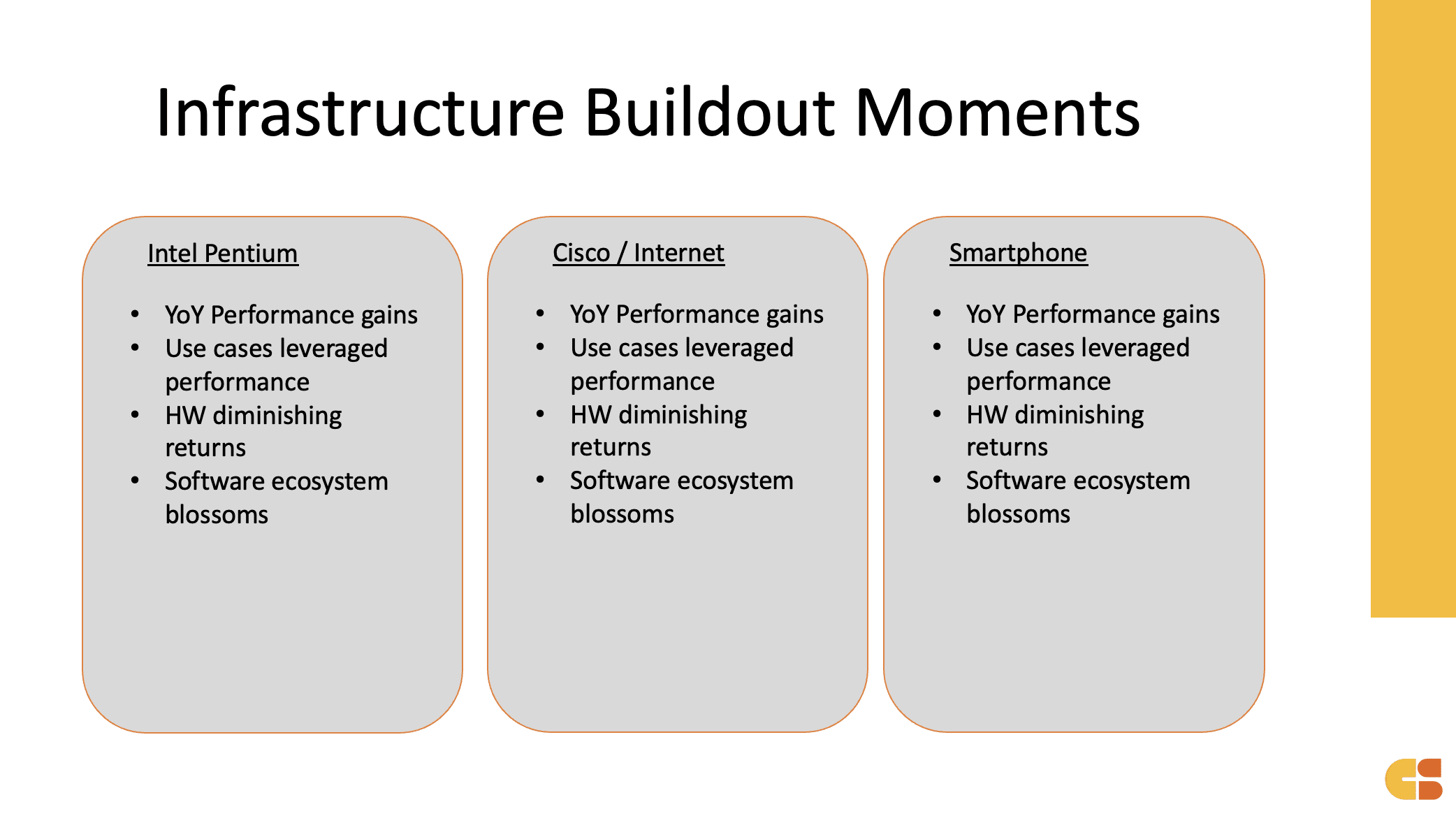
The basic read of this slide is the beginning of the cycle is focused on performance buildout, where it seemingly feels like an arms race for leading performance, and each year’s performance increase nearly immediately doesn’t feel like enough. Think about the early days of Intel Pentium advancements or the early days of the Internet when Cisco could move fast enough to bring us faster Internet year-over-year. The commonality in all of these cycles was each year’s performance gains were met with continued insatiable demand for performance. Until those YoY gains were nominal and essentially if felt like baseline performance was good enough.
We are currently in one of these moments with regard to AI where Nvidia can’t run fast enough to satisfy the insatiable demand for compute around training. Now, whether this is a 12-month cycle or a two-year plus cycle is a key part of this debate, but if history is our guide, there will come a point in time when GPU computing is good enough, and the YoY gains in GPU performance are nominal in terms of end-market demand.
What Makes This Cycle a Little Different
It is worth pointing out something about this cycle feels a little different. And that difference has everything to do with the immense amount of cloud computing, thanks to hyperscalers like Amazon AWS, Microsoft Azure, and Google Cloud Platform. In the prior cycles I mentioned, hardware performance (infrastructure buildout) had to happen first before software could evolve to take advantage of it. Case in point: the early Internet, where we needed a new modem to take advantage of each infrastructure performance upgrade. The same was true in the early PC era, as we needed a faster processor to have a faster software experience.
This cycle is a bit different in that the potential to use all the amazing AI software being developed can run on all existing hardware thanks to cloud computing. Now, we can observe its latency, or its cost, as a current friction point, but billions of people can experience AI today on their current devices. This is why ChatGPT was the fastest diffused technology experience in history. Even if people didn’t stick with using it, 100s of millions experienced it in less than a year. That has never happened before in the history of the industry.
This cycle is different because we have a simultaneous rapid pace of innovation happening with infrastructure buildout and software performance at the exact same time with the potential instantaneous diffusion of software. This is relatively uncharted territory. **We are simultaneously moving too fast and not fast enough.**
**What Happens Next?**
For now, demand for training products like GPUs and AI training accelerators will remain in high demand. At some point, most companies will have trained their data models, and even foundational model training itself will reach a point of diminishing returns. When that happens, the performance bars will move from training to inference (querying the data). It is at that point in time that the software ecosystem will blossom even more, and we will see increased innovation in AI software and its underlying capabilities. At that time, large corporations will likely move more of their data on-premise or in hybrid cloud deployment to keep their data more private and secure.
We can say with certainty that this journey we are on with the AI revolution is only just beginning. From what we can quantify and qualify thus far, AI will likely completely change how we interact with technology at a platform level. It will likely be infused into every software experience in some way, shape, or form. There will be periods that feel like a hype cycle and a bubble, but inevitably we will see a rich software cycle be built upon the infrastructure foundations of high-performance computing in both the cloud and at the edge.
### Intel’s Ambitions to Lead in Advanced Packaging
URL: https://creativestrategies.com/research/intels-ambitions-to-lead-in-advanced-packaging/
Last updated: 2023-09-28T17:30:09.000Z
At Intel Innovation, various announcements came out around Intel Foundry Services and Intel’s advanced packaging strategies. Below are our thoughts on what is significant and an overview of Intel packing offerings and a recap of recent news.
**Why It’s Significant**
While watchers will remain focused on Intel’s process technology execution, their initiatives in packaging are shaping up to be one of the most competitive in the industry.
Intel has several significant differentiators in their packaging toolkit that make it extremely likely they will get customers in the door for packaging even if they don’t win those customers for process technology.
Semiconductor design is transitioning from monolithic core designs to disaggregated designs (chiplets), allowing a more diverse silicon-on-package solution. As this inevitable shift occurs, Intel is well-positioned to compete with its diverse offerings in packaging technologies.
Key differentiators for Intel packaging technologies include the ability to mix and match tiles from any foundry (TSMC and Samsung currently do not do this), unique and proprietary inventions in to manage board warpage on large substrates, and thermal management.
Glass substrates could be key in Intel’s packaging differentiation. As the drive to larger die-size designs and larger systems in package solutions, organic substrates will run their course. Intel believes glass substrates are the answer and will allow for package sizes up to 240×240\. Glass has distinct advantages to organic in thermal management. Glass also scales more efficiently of making the substrate smaller in density to handle the growing needs of more dense stacking of logic dies.
Intel believes we could see glass substrates toward the end of this decade and is in development now to work to scale this technology and make it cost-effective.
Ultimately, we believe packaging is a key differentiator for Intel Foundry Services but also for Intel product groups as well. Moving forward, we believe chiplet designs will become the norm for data center and edge network infrastructure solutions. This move to disaggregated design, or away from an SoC to a SiP (system in package) allows for numerous efficiency gains along with system design differentiation. It also allows for chip designers to be more intentional in the markets they are designing for and allows for more custom-level products without doing fully custom solutions for customers.
For IFS specifically, we believe advanced packaging solutions will attract a wide array of customers whether or not they choose to manufacture their products on Intel’s process technology. That said, we believe getting these customers in the door is a key first step to begin to engage in customer relationships that can ultimately lead to more customers for Intel process technology with nodes like 20A and 18A specifically.
**Overview of Intel Packaging Technologies**
- EMIB (Embedded Multi-die Interconnect Bridge): A technology that uses a small silicon bridge to connect two or more chips in a package, reducing the need for complex interposers and enabling higher bandwidth and lower power consumption.
- Foveros: A technology that stacks chips vertically using through-silicon vias (TSVs) and micro-bumps, allowing for heterogeneous integration of different types of chips, such as logic, memory, and I/O, in a 3D package.
- Co-EMIB: A technology that combines EMIB and Foveros to create packages that can integrate both horizontally and vertically connected chips, enabling more flexibility and scalability.
- OMNI (One Module with N Interconnects): A technology that uses a common interface to connect multiple chips in a package, regardless of their size, shape, or function, simplifying the design and manufacturing process.
- ODI (Omni-Directional Interconnect): A technology that uses large TSVs to connect the top die to the package substrate, reducing the number of micro-bumps and improving the signal integrity and power delivery.
- MDIO (Multi-Die I/O): A technology that uses a standard I/O interface to connect multiple chips in a package, enabling high-speed data transfer and compatibility with existing platforms.
(New) Intel Announces Glass Substrate
- Intel announced new glass substrates for advanced packaging to enable continued transistor scaling and advance Moore’s Law for future data centers and AI.
- Compared to current organic substrates, glass offers higher interconnect density, better thermal/mechanical stability, and higher performance.
- Glass substrates will enable a 10x increase in interconnect density versus organic substrates.
- Initial use cases are large packages for data centers, AI, and graphics needing high speeds.
- Benefits include higher transistor density (1 trillion by 2030), lower power, better yields, and flexibility for optical interconnects.
- Intel has researched the reliability of glass substrates for over a decade and led previous packaging innovations.
- Glass substrates will be introduced in the second half of this decade to meet future scaling needs beyond current organic substrate limits.
**Details on Glass Substrate and Intel’s efforts to lead the industry**
- Intel has been developing glass substrate technology for over a decade, with significant investment in fabrication and R&D facilities in Chandler, AZ. This includes over $1 billion invested in a dedicated glass R&D line.
- The shift to glass substrates is motivated by their superior electrical and mechanical properties compared to traditional organic substrates. Key advantages of glass core substrates:
- Tunable modulus and coefficient of thermal expansion that can be matched closely to silicon. This enables larger panel sizes and improved dimensional stability.
- Through-hole densities are approximately 10x higher than organic substrates. This enables more routing channels and connections for improved signaling.
- Lower electrical loss, allowing higher speed signaling across the substrate. Glass has lower dielectric loss than organic materials.
- Higher temperature capability up to over 300°C. This enables the integration of advanced power delivery networks and power devices directly into the substrate.
- Intel’s test vehicles have demonstrated glass core substrates with three layers of redistribution layers (RDL) and high density through glass vias (TGV) with a 20:1 aspect ratio. The TGVs had a diameter of 75um in a 1mm thick glass core.
- The glass panels support large form factors exceeding six reticle equivalents in area. This allows the integration of multiple high compute-density die-like GPUs and AI accelerators.
- Intel has developed proprietary processes, materials, and equipment for the fabrication of glass core substrates. This includes over 600 patent inventions related to the glass substrate technology.
- The glass substrates will be manufactured in Intel’s advanced CH8 facility in Chandler, AZ which has over 250 specialized tools for the development and production of glass and organic substrates.
### Apple A17 Pro, Arm IPO, Huawei Kirin 9000, China’s Ambitions
URL: https://creativestrategies.com/apple-a17-pro-arm-ipo-huawei-kirin-9000-chinas-ambitions/
Last updated: 2023-09-18T19:18:46.000Z
This is an overview of the topics covered in [episode 34 of The Circuit](https://share.transistor.fm/s/91d65f22?ref=creativestrategies.com) hosted by Ben Bajarin and Jay Goldberg.
Here is an expanded summary report on the key semiconductor stories discussed in the podcast:
Arm IPO
Arm, the leading licensor of processor architectures, successfully completed its initial public offering (IPO) on September 13, 2022\. The IPO priced at $51 per share, at the high end of the expected range. On the first day of trading, Arm’s share price rose over 10% to close at $56.28, valuing the company at around $60 billion.
The successful IPO is a positive sign for Arm and validates the company’s business model of licensing IP rather than manufacturing chips directly. Arm licenses its processor designs to customers like Apple, Qualcomm, Samsung, and others who then manufacture the chip designs. As new technologies like AI, 5G, and autonomous driving take hold, demand for Arm-based chips is expected to grow.
The IPO was oversubscribed, indicating strong demand. However, Arm only sold a small portion of its total shares, so trading volume is expected to be limited initially. The first real test will come when Arm reports its first earnings results as a public company within the next couple of months. This will provide more transparency into Arm’s financial performance.
**Apple A17 Pro Chip**
Apple announced its latest A17 Pro chip which will power the new iPhone 15 Pro models. As is tradition, there was controversy around Apple’s claimed performance gains. The A17 Pro features an approximately 10% increase in instructions per cycle (IPC) versus the prior A16 chip. This was lower than the gain Apple achieved in a previous chip upgrade.
Some speculate that the lower gain indicates TSMC’s 3nm manufacturing process used for the A16 is not as big of an advancement as expected. However, others note Apple allocated more transistor budget to the chip’s graphics and neural engine portions, not the CPU cores, which impacted the IPC metric. The GPU gains are more significant at up to 40% higher performance and the neural engine doubled in size to 35 TOPs.
Apple’s chip performance and TSMC’s execution on leading-edge nodes will continue to be closely watched and hotly debated with each new generation. The increased focus on specialized processing like graphics and AI workloads is a growing trend in the industry.
**Apple-Qualcomm Modem Agreement**
Apple and Qualcomm announced a new multiyear agreement for Qualcomm to supply modems for Apple products through 2026, including for the iPhone. This indicates Apple will not have its own internally developed modem ready for iPhones until at least 2027.
Bringing modem design in-house has been an aim for Apple, as it currently relies on Qualcomm as its sole external supplier. However, developing a world-class cellular modem is challenging, as Intel struggled to compete in this market. The new Qualcomm agreement gives Apple continuity of supply as it continues its modem development efforts.
By 2026, 5G networks will be mature and the industry will be gearing up for 6G. Qualcomm is sure to lead 6G research and standard-setting, so Apple may be content to continue relying on Qualcomm’s modems rather than invest in its own 6G modem design.
**Huawei’s 7nm SMIC Chip**
Huawei introduced its first smartphone powered by a 7nm chip manufactured by China’s SMIC foundry. This is an impressive engineering achievement considering Huawei’s lack of access to leading-edge foundries like TSMC due to US export sanctions. However, it is unclear how much further Huawei and SMIC can advance without access to extreme ultraviolet (EUV) lithography equipment needed for 5nm and beyond.
The Kirin 9000S chip in Huawei’s phone appears to deliver performance approaching 5nm-class designs from competitors. There is debate around whether the strong performance is thanks to SMIC’s process maturity or Huawei’s chip design capabilities. Either way, it demonstrates China’s determination to advance its domestic semiconductor supply chain.
Huawei has invested heavily in chip design talent and may have provided significant assistance to SMIC to optimize the 7nm process for this mobile application processor. SMIC’s yields are also likely still low compared to mature foundries like TSMC or Samsung.
**Next Milestones**
The next milestones to watch for China’s semiconductor advancement will be 1) if other Chinese companies begin adopting SMIC’s 7nm process for products like AI accelerators, networking chips, and data center processors, and 2) how much further Huawei/SMIC can push with future chip designs manufactured at SMIC on 7nm or more advanced nodes.
### Apple Fall Wonderlust Event Report
URL: https://creativestrategies.com/research/apple-fall-wonderlust-event-report/
Last updated: 2023-09-13T22:16:46.000Z
Apple held its annual iPhone event on September 13th, 2023, to announce the new iPhone 15 lineup, Apple Watch Series 9, and Apple Watch Ultra 2\. This report provides an overview of the key announcements and new products revealed at the event, as well as analyst insights on what was significant from the event.
**Sustainablity**
- Apple has unveiled its first-ever carbon-neutral products in the new Apple Watch lineup.
- The design and clean energy innovations have resulted in over 75 percent reduction in product emissions for each carbon-neutral Apple Watch.
- This is a significant step towards Apple’s goal to make every product carbon neutral by 2030, including the global supply chain and the lifetime use of every device.
- As part of their environmental efforts, Apple has also eliminated the use of leather across all product lines and introduced fiber-based packaging for the Apple Watch.
- The carbon-neutral Apple Watch models meet strict criteria, including clean electricity for manufacturing and product use, use of recycled or renewable material, and reduced shipping emissions.
**Silicon Improvements**
**Apple Watch Series 9 Chip**
Features Apple’s new S9 System in Package (SIP) Apple did not disclose the manufacturing process node Claimed to be the most powerful Apple Watch chip Provides all-day battery life
**Phone 15 Pro A17 Pro Chip**
- Built on the leading edge 3nm process node.
- New CPU architecture
- 16 billion transistors.
- New custom GPU. Features 6-cores for 20% faster graphics and hardware-accelerated ray tracing.
- Neural Engine expanded to 35 TOPS to take advantage of more on-device AI
**iPhone 15 Lineup**
**iPhone 15 and iPhone 15 Plus**
- Feature the new Dynamic Island interface
- Powered by Apple’s A16 Bionic chip
- Improved 48MP main camera
- Come in new colors
- Starting price of $799 and $899 respectively
**iPhone 15 Pro and iPhone 15 Pro Max**
- Made from new titanium material
- Powered by new Apple A17 Pro chip, claimed to be the fastest smartphone chip
- Feature customizable action button
- Improved camera systems
- iPhone 15 Pro has 3x telephoto lens
- Phone 15 Pro Max has new 5x telephoto lens for longest optical zoom
- Starting prices remain the same at $999 and $1,199 respectively
**Apple Watch Updates**
**Apple Watch Series 9**
- Apple launched the Apple Watch Series 9, featuring new capabilities and achieving an environmental milestone.
- The watch is powered by the custom Apple S9 SiP chip, delivering improved performance and features.
- A new double-tap gesture allows users to control the watch with one hand and without touching the display.
- The display brightness has increased up to 2000 nits for better visibility in bright sunlight.
- Siri requests can now be processed on the device, resulting in quicker and more reliable responses.
- The watch includes the ability to find misplaced iPhones through Precision Finding and integrates with HomePod.
- It runs on watchOS 10, which brings redesigned apps, new watch faces, and additional features for mental health and outdoor adventures.
**Apple Watch Ultra 2**
- Performance updates, new double tap gesture, and carbon-neutral options
- Comes with the powerful new S9 SiP
- Brightest display ever at 3000 nits, great for harsh sunlight
- Modular Ultra watch face for real-time data
- Tested for use at extreme altitudes
- On-device Siri with the ability to access and log health data
- Precision Finding feature for locating misplaced iPhone
- Runs watchOS 10 with redesigned apps and new watch faces
**Other Key Announcements**
- Spatial video capture allows recording 3D videos on iPhone 15 Pro models
- Faster USB 3 support and external storage on iPhone 15 Pro
- New iCloud Plus plans up to 12TB of storage
- iPhone 15 series will be available for preorder on September 15th and launch on September 22nd
**What’s Significant**
- Apple’s continued innovation in cameras can not be understated. The iPhone is the most social camera on the planet, and there is no smartphone franchise consumers use to share more photos on social media. This is why visual realism in photography remains the goal, and the iPhone 15 Pro and Pro Max come closer to this goal. Consumers value capturing, preserving, and sharing memories and they will care that those pictures are captured as accurately as possible.
- Apple Silicon leaps forward with A17 Pro made on TSMC cutting edge 3nm process technology. Apple continues to focus on hardware differentiation through more aggressively innovating on the underlying silicon. With A17 Pro, Apple has a new CPU architecture, rebuilt GPU architecture, and used its transistor budget to drastically increase the capabilities of the NPU with a 91% increase in TOPS YoY. This new silicon architecture sets the technological foundation of where Apple is headed over the next few years in hardware, software, and services.
- The dedicated A17 Pro chip in the Pro line will likely help in the Chinese market, where consumers are much more driven by technology enhancement than form and design changes. Research has shown that Chinese consumers value top-of-the-line specs, and A17 Pro should cater to that specific market preference.
- Adding Dynamic Island to the iPhone 15 and 15 Plus should generate interest and upgrades. Pro users strongly received the feature last year because of its usefulness and because it made the phone feel new/different.
- Differentiating the iPhone Pro line is not about pushing consumers to the higher price point but more about making sure that mass market consumers are not offered much more than they want or can afford to facilitate their upgrade choice. That said, users will move from Pro to Pro Max because titanium makes that model much lighter now.
- Apple continues to show how it thinks about cross-product design language, this time with the Action Button first seen on the Apple Watch Ultra. Now, on the iPhone 15 Pro, the Action Button becomes a shortcut not just to silence your phone but to some of our most common actions throughout the day, like taking a selfie.
- Making sustainability entertaining was a smart move by Apple, especially if you consider the video created will be played way beyond the keynote. It allowed Apple to deliver some key numbers on their progress and underline the importance of sustainability and the need for transparency in a way that did not make the audience’s eyes glaze over.
- With the goal of being Carbon Neutral across the entire product portfolio by 2030, Apple had to look at maximizing its efforts rather than creating a “sustainable” skew for Apple Watch, the first Carbon Neutral product. This also allows consumers to choose a sustainable Apple Watch no matter what model and price point they are considering. All it takes is to pick the right band.
- We view this as a platform technology turning point as Apple is setting the stage for the underlying technology platform that will drive the iPhone the next few years.
### The Land of IoT
URL: https://creativestrategies.com/the-land-of-iot/
Last updated: 2023-09-11T15:28:41.000Z
This is a summary of the most recent episode of [the Circuit with Ben Bajarin and Jay Goldberg](https://share.transistor.fm/s/137642ce?ref=creativestrategies.com). On this episode, guest Stacey Higginbotham shared her excellent insights into the land of IoT.
The Internet of Things (IoT) refers broadly to adding computing power and connectivity to everyday objects and devices, representing a major infrastructure shift. While early forecasts predicted massive growth to trillions of connected devices, progress has been steady but more incremental as companies focus on practical use cases and problems to solve. The hype has slowed but real adoption continues in areas like industrial, consumer, and cities.
Key Challenges
Several key challenges remain to be addressed to enable IoT to scale further:
- Power consumption – devices need better energy harvesting and lower consumption
- Networking protocols – enabling high device density communications
- Security – securing many small, low-power devices
- Sustainability – ensuring recyclability with short device lifecycles
Key Semiconductor Companies
Major semiconductor firms that benefit from IoT include Qualcomm, ARM, Nordic, Silicon Labs. Startups like Williott in energy harvesting also have opportunities. Software and connectivity platforms are also important areas.
**Use Cases and Benefits**
Example IoT use cases span industrial (sensors for automation), consumer (smart home), and cities (smart streetlights with sensors). Benefits include efficiency, safety, convenience. In industrial, sensors enable automation and prevent problems. In cities, sensors can aid traffic management and public safety.
**AI and Machine Learning**
AI and ML will be critical for IoT, analyzing data from edge devices as well as the cloud. Startups like Edge Impulse focus on optimizing ML for edge devices. There are opportunities for specialty silicon to accelerate on-device ML.
Outlook
IoT will continue seeing incremental adoption as companies implement practical use cases and solve real-world problems. While the hype has slowed, steady progress continues as the technology matures. Key challenges around power, connectivity, security, sustainability still need solutions. AI and ML will become increasingly important to derive value from IoT data.
### Research Report: WWDC 2023
URL: https://creativestrategies.com/research/research-report-wwdc-2023/
Last updated: 2023-09-07T16:58:19.000Z
Apple’s Worldwide Developers Conference (WWDC) is an annual event that brings together developers from around the world to learn about the latest innovations in Apple’s software platform. The event is typically held in June, and it usually features a keynote address by Apple CEO Tim Cook, as well as a number of other sessions and workshops.
WWDC 2023 was no exception. The event took place from June 5-9, 2023, as an online event. The keynote address was livestreamed on YouTube, and it was watched by millions of people around the world.
Here are some of the highlights from the WWDC 2023 keynote:
- **iOS 17:** The next major version of Apple’s mobile operating system brings a number of new features, including a redesigned Lock Screen, new Live Text and Visual Look Up capabilities, and updates to Messages, Health, and Maps.
The new Lock Screen is one of the most significant changes in iOS 17\. It now features a customizable background, widgets, and notifications. Live Text and Visual Look Up are also getting some new features. Live Text can now be used to translate text in real time, and Visual Look Up can now identify plants and animals.
- **iPadOS 17:** The latest version of iPadOS adds support for Stage Manager, a new multitasking feature that lets users organize apps and windows in a more efficient way. It also includes new features for the Notes app, Weather app, and Messages app.
Stage Manager is one of the most anticipated features in iPadOS 17\. It allows users to create a virtual desktop where they can work with multiple apps at the same time. The Notes app is also getting some new features, including the ability to create tables and charts.
- **macOS 13 Ventura:** The next version of macOS brings a number of new features, including a redesigned Spotlight search, a new Messages app with SharePlay integration, and a new Stage Manager feature for multitasking.
Spotlight search is getting a major overhaul in macOS 13 Ventura. It will now be able to search through your entire Mac, including your files, apps, and emails. The Messages app is also getting some new features, including the ability to share your screen with others and the ability to play games together.
- **watchOS 9:** The latest version of watchOS brings new workout features, sleep tracking improvements, and a new medication management app.
watchOS 9 is focused on making it easier for users to stay active and healthy. The new workout features include a new running form coach and a new Tai Chi workout. The sleep tracking features have also been improved, and there is now a new medication management app.
- **tvOS 16:** The latest version of tvOS brings new features for gaming, including support for SharePlay and the ability to play games with friends over the internet.
tvOS 16 is making it easier for users to play games with friends and family. The new SharePlay feature allows users to share their screen with others, and the new ability to play games over the internet makes it possible to play with friends who are not in the same room.
In addition to these software updates, Apple also announced a new MacBook Air with the M2 chip, a new M2 Ultra chip for the Mac Pro, and a new version of Xcode with support for Swift 6.
The new MacBook Air is one of the most exciting products announced at WWDC 2023\. It is powered by the new M2 chip, which is up to 18% faster than the M1 chip. The MacBook Air also has a new design with a larger display and a notch for the camera.
The new M2 Ultra chip is the most powerful chip ever made by Apple. It is made up of two M2 Max chips, and it is up to 90% faster than the M1 Max chip. The M2 Ultra chip is designed for the Mac Pro, and it will make the Mac Pro even more powerful than it already is.
The new version of Xcode is a major update for Apple’s development tools. It includes support for Swift 6, which is the latest version of Apple’s programming language. Xcode 14 also includes a number of new features for developers, such as a new code editor and a new debugging tool.
The Vision Pro is Apple’s first standalone headset for both augmented reality (AR) and virtual reality (VR). It is powered by the M2 chip and features a micro-OLED display with 4K resolution per eye. It has 12 cameras, six microphones and five sensors to offer an immersive overall experience.
The Vision Pro can be used for a variety of tasks, including gaming, productivity, and entertainment. It can also be used for enterprise applications, such as training and design.
The Vision Pro is scheduled to go on sale early next year for $3,499.
Here are some of the key features of the Vision Pro:
- Micro-OLED display with 4K resolution per eye
- 12 cameras
- Six microphones
- Five sensors
- Powered by the M2 chip
- Support for AR and VR
- Can be used for gaming, productivity, entertainment, and enterprise applications
- Priced at $3,499
The Vision Pro is a major step forward for Apple in the field of AR and VR. It is a powerful and versatile device that has the potential to revolutionize the way we interact with technology. I am excited to see what developers and businesses do with the Vision Pro in the years to come.
Overall, WWDC 2023 was a major event for Apple. The company announced a number of exciting new software and hardware products, and it showed that it is still committed to innovation. I am excited to see what Apple announces in the future.
### Nvidia and the AI Raging Bull
URL: https://creativestrategies.com/nvidia-and-the-ai-raging-bull/
Last updated: 2023-09-05T15:29:08.000Z
Ben Bajarin and Jay Goldberg discussed Nvidia’s latest earnings report and the state of the AI market on a recent episode of their podcast, [The Circuit](https://share.transistor.fm/s/aed195cd?ref=creativestrategies.com).
Key points from the podcast:
– Nvidia reported very strong Q2 earnings, crushing expectations. Demand was unprecedented despite pre-quarter debates over whether they would miss.
– Some questions remain about Nvidia’s inference strategy, the extent to which demand is driven by hyperscalers, and their supply situation going forward.
– There is peculiar negative sentiment about Nvidia among some on Wall Street, with questionable attacks on the company. But it’s difficult to short a stock doubling earnings.
– The transition to AI is analogous to the RISC vs. CISC transition, moving from deterministic to probabilistic computing. Nvidia has a software edge with CUDA and their AI stack.
– Three scenarios were discussed for Nvidia’s future dominance, ranging from strong leadership to becoming the data center platform (unlikely due to hyperscaler competition).
– Nvidia’s own GPU success poses a threat by making GPUs expensive, pushing people to seek alternatives. But so far, no good alternative exists.
– There is mainstream hype about AI separate from questions of Nvidia’s valuation. Nvidia is expensive but may grow into its valuation.
– We are in a hardware infrastructure buildout cycle now that will eventually shift to a software value creation cycle on top of the hardware.
In summary, Nvidia reported standout earnings but faces some lingering questions around their strategy and future dominance in AI computing. The market is very bullish on Nvidia though some skepticism persists.
### The Gate-All-Around (GAA) Revolution in Chip Design
URL: https://creativestrategies.com/research/the-gate-all-around-gaa-revolution-in-chip-design/
Last updated: 2023-10-03T14:32:12.000Z
This research report analyzes the upcoming transition from FinFET to gate-all-around (GAA) transistor architecture and the significant implications for semiconductor manufacturing equipment and processes. Key findings include:
– GAA represents the biggest change in logic chip design since the introduction of 3D FinFET transistors in 2010.
– GAA transistors overcome limitations of FinFETs by providing gate control from all four sides of the channel, enabling continued scaling.
– GAA is the first truly 3D chip architecture defined by vertical rather than planar dimensions.
– The 3D nature of GAA will drive major changes in manufacturing equipment and processes related to deposition, etching, and metrology/inspection.
– Leading chipmakers Intel, Samsung, and TSMC are transitioning to GAA technology at 3nm/2nm nodes over the next 12-18 months.
– GAA ramp-up has potential to drive increased logic/foundry spending starting in 2025, benefiting semiconductor capital equipment suppliers.
**Introduction**
For decades, the semiconductor industry has relied on scaling transistor dimensions to drive gains in chip performance and density. However, as dimensions approach atomic scale, fundamental limitations of conventional planar and FinFET architectures arise. Gate-all-around (GAA) transistors overcome these limitations by transitioning to truly 3D structures. This report analyzes the manufacturing changes this transition will necessitate.
**GAA Transistor Architecture**
GAA transistors have horizontal nanosheet channels wrapped by gates on four sides. This structure provides full gate control from all directions, minimizing leakage while allowing dimensional scaling to continue. GAA also enables tuning of channel width, optimizing power and performance.
**Transition from Planar to 3D Architecture**
Planar transistors defined features using 2D lithographic patterning. FinFETs added vertical fins but still depended on etching. GAA is the first architecture where critical dimensions are defined by selective deposition and etching. The move from 2D to 3D architectures will drive significant manufacturing changes.
**Implications for Semiconductor Equipment**
The 3D nature of GAA will significantly impact major process areas:
– Atomic layer deposition tools needed to coat complex nanosheet shapes
– Selective epitaxy critical for superlattice channel formation
– Highly selective etch processes to remove sacrificial layers
– Advanced metrology/inspection to control 3D geometries
**Leading Chipmakers Adopting GAA**
Intel, Samsung, and TSMC plan to introduce GAA technology at the 3nm/2nm nodes over the next 12-18 months. This transition has potential to increase capital spending for leading-edge logic manufacturing versus prior nodes.
Conclusion
The GAA transistor revolution will enable the semiconductor industry to overcome the limitations of FinFETs and continue advancing Moore’s Law. The architectural shift to true 3D devices will drive major changes in manufacturing processes and equipment over the next decade.
### Arm F1, and IPO Prospects
URL: https://creativestrategies.com/arm-f1-and-ipo-prospects/
Last updated: 2023-08-28T23:39:06.000Z
This summary is from [Episode 31 of The Circuit,](https://share.transistor.fm/s/07ee9e74?ref=creativestrategies.com) which analyzed the Arm F1 filing.
Chip design firm Arm Holdings recently filed for an initial public offering (IPO), marking a return to the public markets after being acquired by SoftBank in 2016\. Arm licenses processor architectures and chip designs to major semiconductor companies like Qualcomm, Apple, and Samsung.
Arm’s business model relies heavily on licensing fees from chipmakers who use its designs in their products. This licensing-based approach leaves Arm exposed to fluctuations in the semiconductor market, especially the smartphone industry where its designs dominate.
According to a recent podcast discussing Arm’s IPO filing, the company gets around 24% of its licensing revenue from China. Collecting payments from Chinese firms has been challenging historically. Revenue is also concentrated in just 5 main customers, so losing any one of them could significantly disrupt Arm’s financials.
SoftBank will retain control of Arm’s board post-IPO and take all the IPO proceeds, raising corporate governance concerns. The rumored IPO valuation of $64 billion also appears high given Arm’s revenue concentration issues and unproven new growth initiatives.
If Arm’s stock stumbles after the IPO, it could dim prospects for other semiconductor IPOs like Ampere Computing. Investors will likely judge the entire chip startup space based on how Arm’s shares perform initially.
Arm and SoftBank must balance setting a high IPO price to maximize exit value against pricing reasonably to build credibility with public investors. But Arm’s dependence on a few large customers in the mature mobile market may cap its potential for expansion.
Expanding beyond mobile into new segments like servers, automotive, and IoT has been a gradual process. Arm’s new CPU subsystem licensing model could accelerate growth by capturing the value of high-performance cores. But existing licensing deals with top customers present obstacles to raising rates rapidly.
In conclusion, Arm’s IPO will test whether a licensing-focused chip firm can thrive as a standalone public company in today’s semiconductor landscape. While a successful IPO could pave the way for more chip startup public listings, a disappointing stock performance would likely hamper financing options for other players eyeing IPOs.
### The Competitive Landscape in the Global Semiconductor Foundry Industry
URL: https://creativestrategies.com/the-competitive-landscape-in-the-global-semiconductor-foundry-industry/
Last updated: 2023-09-01T15:30:55.000Z
This is a summary of [Episode 30 of the Circuit](https://share.transistor.fm/s/0e0add80?ref=creativestrategies.com) with Ben Bajarin and Jay Goldberg.
The semiconductor foundry business plays a crucial role in supplying leading-edge chips for everything from smartphones to data centers. As demand for semiconductors continues to grow, there is increasing attention on the competitive dynamics between the major foundry players – Taiwan Semiconductor Manufacturing Company (TSMC), Samsung, and Intel.
During the podcast, Jay Goldberg and Ben Bajarin provided analysis on the key factors that will determine market share between these foundries in the coming years. They highlighted that while process technology remains the most critical factor, customer service and support is also an extremely important consideration for foundry selection. On both fronts, TSMC currently holds significant advantages over rivals Samsung and especially Intel. Bajarin and Goldberg agree there is a TAM expansion in dollars at the leading edge, but how much is still a question.
TSMC’s process technology has consistently led the industry. But just as importantly, their customer collaboration, tools, and support for debugging and problem resolution is superior. This makes the process of working with TSMC much smoother for chip designers.
In contrast, Samsung lags on both process and customer service capabilities but is also deeply invested in competing at the leading edge and winning customers TSMC is unable to service. Intel is still driving their process technology forward and working to close the gap. But many challenges remain, and the Tower Semiconductor deal could have helped address gaps in the services side as well as talent skilled at running a customer-centered foundry. Even if Intel executes successfully on improving their process, convincing customers like Nvidia and Qualcomm to switch foundries will take considerable time and effort.
The experts estimate it would take over a year, even under ideal circumstances, for major customers to port their chip designs to Intel’s foundry process. This is because each foundry uses slightly different processes, tools and design rules. Migrating designs from TSMC or Samsung to Intel, therefore, requires significant re-engineering work.
Since foundry switching rarely happens mid-product cycle, Intel likely has to wait for next-generation chip designs to have a chance of winning back leading-edge business. TSMC’s process leadership and collaboration makes it difficult for customers to justify the costs and risks of swapping foundries. While Intel aims to compete for advanced foundry share by 2025, it faces immense challenges to catch up.
That being said, Intel and Samsung’s efforts suggest the market is headed for more intense competition between the major foundries. As Goldberg and Bajarin discuss, it is unhealthy for the entire electronics supply chain to rely solely on TSMC for the majority of leading-edge manufacturing.
But despite Intel’s efforts, TSMC seems poised to maintain its process technology advantage for the foreseeable future. The real battle will be between Samsung and Intel for second place in advanced foundry revenue. By 2025, it should become clearer which foundry establishes itself as the main alternative to TSMC at the leading edge.
In conclusion, while the foundry industry would benefit from more balance between the major players, TSMC’s dominance is unlikely to be seriously threatened in the next few years. For Intel and Samsung, it will require excellence in both process R&D and customer relationships to gain ground. But semiconductor leadership can change quickly, so the competitive situation will be one to watch going forward.
### The Globalization of Semiconductors: Challenges of Onshoring Production
URL: https://creativestrategies.com/the-globalization-of-semiconductors-challenges-of-onshoring-production/
Last updated: 2023-08-18T16:45:42.000Z
This brief highlights the main points discussed by Ben Bajarin and Jay Goldberg on [Episode 29 of The Circuit.](https://share.transistor.fm/s/24620796?ref=creativestrategies.com)
Semiconductors have emerged as an area of intense economic and political focus in recent years. With countries around the world seeking to reshore production capacity, the industry faces major challenges in localization. This podcast summarizes expert perspectives on the complexities of onshoring semiconductor fabrication and design.
A key tension highlighted is between countries wanting greater self-sufficiency in chip production and the realities of talent and supply chain distribution. The semiconductor industry grew up highly globalized, with centers of expertise concentrated in certain countries like Taiwan and China. Shifting production too aggressively runs up against shortages of specialized skills and higher costs.
At the same time, businesses and governments recognize risks in being overly dependent on foreign chip production. This is spurring investment to develop more local semiconductor talent through university programs and immigration policies. Companies also need to make semiconductor careers more attractive to compete with software and other tech sectors for engineers.
While politicians are increasingly engaged on semiconductor policy, industry experts worry about a lack of nuanced understanding. More education on the trade-offs and global interdependencies inherent in onshoring is needed. The semiconductor industry developed globally and still requires global cooperation, even as production may localize more.
This podcast summarizes perspectives from industry analysts on the complex challenges of localizing semiconductor fabrication and design capacity. Key tensions exist between national self-sufficiency goals and practical realities around cost, talent, and global supply chains. Further research on mitigating localization risks while supporting continued semiconductor innovation is warranted.
### The Rise of Custom Silicon
URL: https://creativestrategies.com/the-rise-of-custom-silicon/
Last updated: 2023-08-18T03:19:48.000Z
This is an excerpt from the latest Episode of [The Circuit](https://share.transistor.fm/s/a8607c40?ref=creativestrategies.com) with Ben Bajarin and Jay Goldberg.
While much of the technology industry relies on merchant silicon from companies like Intel, AMD, and Nvidia, research shows more major players are quietly turning to custom chip designs.
In a recent discussion, industry analysts Ben Bajarin and Jay Goldberg explored the expanding world of custom and semi-custom chips, especially among hyper-scale cloud providers and automakers.
Amazon Web Services (AWS) claims its latest ARM-based Graviton processors deliver 40% better performance for 60% less energy than standard x86 chips. AWS started with internal workloads on Graviton years ago to optimize its software stack before offering Graviton instances to clients. Experts believe AWS is positioning Graviton as a high-performance, not just budget, alternative to merchant silicon.
The hosts also revealed that semi-custom networking chips are surging in popularity, though rarely publicized. Google, Alibaba, Tencent and other giants use custom silicon to accelerate their data center networks. While opaque to end users, these chips allow hyperscalers to operate more efficiently.
Automotive also stands out for its embrace of custom designs, frequently using RISC-V instruction sets. Chinese electric vehicle makers are leading the charge. Unlike hyperscale semiconductors, car companies could eventually market custom self-driving chips as a key differentiator.
While ARM architectures still dominate mobile and compute applications, the analysts speculate we may soon hit an inflection point where more RISC-V cores ship annually thanks to massive adoption in embedded devices. With silicon playing an expanding role in product development, custom chips give companies unmatched opportunities for optimization and differentiation.
### Samsung’s Unpacked: Redefining the Future – The Responsibility of Shaping a Market
URL: https://creativestrategies.com/samsungs-unpacked-redefining-the-future-the-responsibility-of-shaping-a-market/
Last updated: 2023-07-27T12:19:51.000Z
Since Monday, I’ve been in South Korea to meet with Samsung’s executives and attend Samsung Unpacked. What has become the summer appointment with foldable saw the arrival of the 5th generation of the Galaxy Z Fold and the Galaxy Z Flip. These two devices hit the market as competition from brands such as Motorola, made by Google, OnePlus, Oppo, and Nothing intensifies in the foldable space.
The Z Fold 5 remains Samsung’s top model aimed mostly at professional users and the enterprise market. Overall many will see this year’s design as iterative. Yet, the design changes that Samsung implemented, such as the new “flex hinge” that allows the Z Fold 5 to fold completely closed without a gap around the hinge, Qualcomm Snapdragon Gen 2 chipset, a brighter internal display, a thinner S Pen stylus and a weight that comes in 10g lighter all make for an improved experience. The Z Fold 5 will start at $1,800 when it hits stores on Aug. 11.
The Z Flip 5, Samsung’s biggest opportunity to drive foldable solidly into the mass market, saw more of a redesign with the front screen, which goes from 1.9 inches to 3.4 inches. The new larger front screen allows the Flip to better compete with the Motorola Razr Plus and its 3.6-inch front display. The main difference between the two devices is more philosophical than technical. Samsung has limited the kind of applications and experiences that can run on the Z Flip’s front screen compared to what Motorola allows users to do. The decision will help consumers avoid running apps that do not properly scale to the unusual screen size. Like its biggest brother, the new Z Flip 5 runs on Qualcomm’s latest Snapdragon Gen 2 processor and sports a unique hinge that also closes completely flat. The Z Flip 5 will start at the same $999 as its predecessor.
At the event, Samsung also launched new Galaxy Watches and the Tab S8.
My time in Korea started with a meeting with TM Roh, President and Head of Mobile eXperience Business at Samsung Electronics, to discuss the opportunity in foldables and the current market dynamic.
In my view, it is essential to understand the context of the strategy that Samsung has embarked on with foldable. For many years, as the Samsung brand and the Galaxy brand were growing, the company was criticized for putting technology for technology’s sake as a higher priority than the overall device experience and the consumers’ needs.
This is no longer the case today. As we see Chinese brands bring more unique foldable designs to market, we need to understand better the different dynamics that drive a brand like Samsung compared to these.
**First is the ability to manufacture devices at scale with a high yield**. Samsung is a global brand that operates on much larger volumes than most of these brands do.
**Second, the importance that brand reputation has within Samsung’s culture.** This is not my first time in Korea where I’ve been able to experience the power of the brand, but also the highest sense of pride that everybody working at Samsung has for every product they bring to market. This sense of pride means that when there are quality issues with a product like what we saw with the Note Seven and the first generation of the Z Fold, Samsung takes full responsibility for the issue and puts in place practices that will minimize the risk of these issues reoccurring. We are now at a time when delivering what many will characterize as an iterative design is the best choice for consumers. As the market expands from early adopters to mainstream, there is a need for a higher degree of confidence in the investment being made in these new. Samsung is delivering two products that are solid from a design perspective as well as the value that they bring to the buyer. This is not the time to experiment with design to be different.
Lastly, considering Samsung’s success in the enterprise market with the Fold line, reliability is even more of a purchase driver than for consumers.
To some extent, Samsung has the advantage of being first to market and defining the market; it is on other brands to challenge and disrupt that leadership. That said, it is important to understand that the foldable market is not just about hardware. It is about software and application optimization. And this is where Samsung has put a lot of effort: creating that end-to-end experience, sometimes nudging along the whole Android software development to be able to support that tailored experience that delivers the higher return on investment buyers are looking for.
Market competition is great for consumers, and TM Roh made it very clear in his remarks that he welcomes competition because that’s the best thing for consumers. He also very emphatically said that he is not willing to cut corners at customers’ expense.
Samsung continues to believe there will be a sizable opportunity for foldable in the smartphone market. I tend to share that belief, especially as a proportion of the high end of the market. Listening to TM Roh, it was interesting how many times he pointed to serving consumers and delivering what is best for them as the best way for Samsung to remain ahead of the game in the smartphone market and overall as a consumer electronic brand. At the core of the belief is the idea that folding and unfolding is a natural action from a book to a wallet. We are used to unfolding an object to get more out of it. When it comes to foldable, that extra value doesn’t come purely from the hardware. It comes from the silicon, the hardware, the operating system, and the ecosystem of applications and services that run on it. And this is where I believe Samsung will continue to stay ahead of its Android competitors, at least in the US and Europe. TM Roh proudly said that Samsung takes its role as an ecosystem enabler to deliver value to the consumer seriously. As he continues to look at the opportunity for foldable, he is also looking at the opportunity and the responsibility of driving the market forward more sustainably.
A big part of hosting unpacked in Korea this week was for the international press and analyst community to experience the fabric of the culture influencing the products and the brand.
K-pop, which stands for Korean pop music, has gained immense popularity worldwide, with many Gen Zers being enthusiastic fans of K-pop groups and artists. K-dramas, or Korean television dramas, have also captured the attention of this generation with their engaging storylines and relatable characters. Furthermore, Korean cuisine, known for its diverse flavors and healthy ingredients, has become a favorite among Gen Zers. Korean dishes like kimchi, bibimbap, bulgogi, and Korean BBQ have found their way into the mainstream, reflecting the growing influence of Korean culture on a global scale. Combining these cultural elements has resulted in a strong and vibrant fandom surrounding K-pop and K-dramas, contributing to the appreciation of Korean food and promoting a deeper understanding of Korean culture among Gen Zers worldwide. Interestingly, as K-pop, Korean food, and K-drama are all growing in influence, younger consumers from Europe to the US are intrigued and captivated by Korean culture. I believe that Samsung has a bigger opportunity in the future if they embrace their culture more rather than trying to fit into the American or European culture.
### The AI Semiconductor Opportunity
URL: https://creativestrategies.com/the-ai-semiconductor-opportunity/
Last updated: 2023-08-18T18:05:10.000Z
This is a highlight summary of [Episode 26 of The Circuit](https://share.transistor.fm/s/beef8d92?ref=creativestrategies.com) with Ben Bajarin and Jay Goldberg.
Industry analysts recently debated the impact of AI on the semiconductor market and which companies stand to benefit most from this disruptive trend.
They see three critical questions shaping the AI chip sector:
1. Will AI spur net new semiconductor spending or just cannibalize existing CPU/GPU share? Consensus suggests AI should expand the market, with data center operators already accelerating expansion plans to support AI workloads.
2. How will the market for inference processing evolve? While Nvidia dominates training silicon today, most growth will likely shift to inference at the edge. This creates an opening for custom accelerators and on-device processing.
3. Can anyone challenge Nvidia in training? Though its CUDA software advantage is diminishing, Nvidia’s full-stack capabilities will be hard to replicate. However, large cloud vendors want to avoid reliance on one vendor and will explore alternatives.
The rapid shift to generative AI models like DALL-E and ChatGPT will further accelerate the need for specialized inference processing. Pushing more computation to the edge through devices like phones, PCs and cars may offer the only viable path given data center constraints.
Apple and Microsoft are well positioned to enable on-device AI thanks to their control of operating systems like iOS and Windows. Android fragmentation poses a greater challenge for Google.
While the AI chip opportunity remains hard to quantify, it should grow notably faster than overall semiconductor spending in coming years as more enterprise workloads incorporate AI functionality. Though training may stay concentrated, the expanding inference market promises to spread the benefits more widely.
### Navigating the Path to a Trillion-Dollar Semiconductor Industry
URL: https://creativestrategies.com/navigating-the-path-to-a-trillion-dollar-semiconductor-industry/
Last updated: 2023-08-18T03:20:12.000Z
This is a highlight overview of [Episode. 25 of The Circuit](https://share.transistor.fm/s/ca7c6bfe?ref=creativestrategies.com) with Ben Bajarin and Jay Goldberg
The semiconductor sector has set its sights on reaching $1 trillion in annual sales by 2030, more than doubling its current market size. However, industry experts warn this ambitious goal faces no shortage of competitive, resource, and design challenges that could constrain the pace of growth.
Central to the industry’s expansion is the competitive dynamics taking shape in the foundry business. For years, TSMC has dominated cutting-edge manufacturing with over 70% market share. But Intel aims to rejoin the leading edge after delays, while Samsung continues honing its advanced nodes. This should provide chip designers more manufacturing options, but TSMC retains significant advantages in packaging technology, overall process quality, scale, and customer partnerships that will be difficult for rivals to replicate quickly.
Scarcity of key resources could also hamper growth. Advanced fabs consume tremendous electricity, yet power grid capacity remains limited. Water was a concern in the past, though conservation efforts have eased deficits. However, emerging restrictions on chemicals critical to semiconductor manufacturing currently lack alternatives. Additionally, geopolitical tensions have pinched access to rare raw materials like gallium and germanium. While engineering solutions may emerge, materials shortages could disrupt near-term expansion plans.
Demand for next-generation semiconductors appears robust, led by AI-driven workloads. But supporting a trillion-dollar industry amid capacity limits will require strategic trade-offs. Some chip designers may need to rely more on multi-die chiplet architectures, mixing and matching foundry processes and packaging options to maximize output. This presents complex technical hurdles, however, perhaps delaying the trend’s adoption.
Sustaining growth further necessitates cultivating a new generation of engineering talent. RISC-V could gain traction as the open-source instruction set of choice for universities and semiconductor startups. Larger design automation firms must also modernize, as aging industry conferences suffer from weak attendance and outdated programming.
In truth, no single company or country can resolve these multifaceted tensions alone. But through sufficient collaboration and sustained innovation, the semiconductor industry seems poised for several more years of healthy expansion, even if the most optimistic forecasts prove elusive. What appears more certain is the need for creative new paradigms and custom solutions to shape the industry’s landscape for the next decade and beyond.
### Arm Chips Look to Expand Data Center Presence
URL: https://creativestrategies.com/arm-chips-look-to-expand-data-center-presence/
Last updated: 2023-08-18T03:18:39.000Z
This is a highlight summary of [Episode 24 of the Circuit](https://share.transistor.fm/s/dffc25ad?ref=creativestrategies.com) with Ben Bajarin and Jay Goldberg.
Arm-based processors have conquered the mobile world, powering nearly all smartphones and tablets globally. Yet the architecture has struggled to make similar inroads into data center servers, where Intel’s x86 has ruled for decades. However, Arm’s position now appears poised for meaningful growth.
Industry experts point to Oracle’s recent embrace of Arm-based cloud servers from Ampere Computing as a watershed moment. Oracle’s shift overcomes a longstanding barrier – the lack of software optimized for Arm in the data center. Though Arm’s share of server CPUs remains under 5% currently, evidence mounts it can deliver competitive performance, especially for cloud-native and AI workloads.
While Nvidia’s Arm-based GPUs already claim the lion’s share of AI model training today, most long-term growth resides in inference processing. Workloads are diversifying beyond CPUs, playing directly to the wide breadth of Arm’s IP portfolio spanning accelerators, networking, storage and more. Hyperscalers like Amazon and Google will likely develop custom Arm-based solutions in-house. But merchant silicon providers still have ample room to expand the Arm server ecosystem.
Yet pricing poses challenges for Arm in the data center. With production volumes far lower than phones, Arm must rethink its licensing model traditionally based on small per unit royalties. Its upcoming IPO prospectus may offer the first glimpse into whether Arm can increase its revenue base as data center IT budgets swell, especially for AI.
In conclusion, while Arm appears strategically positioned to capitalize on surging data center demand, competitive and pricing risks remain. Much depends on Arm’s ability to extract greater value from its data center partners while attracting new licensees beyond the largest cloud titans who design their own silicon. But with software and ecosystem barriers falling, Arm looks well placed to substantially grow its data center presence after years of gradual adoption.
### Apple Vision Pro Timing Debate
URL: https://creativestrategies.com/apple-vision-pro-timing-debate/
Last updated: 2023-07-05T22:51:22.000Z
A question I’m hearing coming up more frequently is about the timing of Apple Vision Pro. Before launch, my primary question for Apple launching a head-worn computer was, why now? While I agree with a broad consensus that there is a market for head-worn computers, I perhaps differ slightly with the view on when this market will emerge at any significant global scale. I’m still confidently in the camp that the market for head/face-worn computers is still many years away from being mainstream. And when I say many years away, I mean more than three and more likely five years at least. This was the primary reason I heavily questioned Apple releasing a head-worn computer in 2023, knowing any significant scale in this category is years away.
Fast forward to the launch of Apple Vision Pro. Part of my question was answered when I got the demo of Vision Pro. The answer to why it launched now is simply because it is ready. The experience is there, even if the price is not. For more on this point, I encourage a read of [this entire article by Benedict Evans](https://www.ben-evans.com/benedictevans/2023/6/15/vision-pro?ref=creativestrategies.com). Benedict makes [a similar point to mine](https://creativestrategies.com/apple-vision-pro-computing-without-borders/): Apple Vision Pro is the baseline experience, or minimum viable product, to mainstream this category. We have to now wrestle with two other dynamics circulating around this discussion of the Apple Vision Pro timing.
I’ve had several conversations with investors on the sell-and-buy side about this new category for Apple. Another question being brought up by this audience, and some others, is about Apple’s supply chain challenges. Everyone in deep talks with the supply chain knows Apple can’t manufacture this product at scale yet, and even [recent reports](https://www.reuters.com/technology/apple-forced-make-cuts-vision-pro-production-plans-ft-2023-07-03/?ref=creativestrategies.com) suggest it may be even more difficult to manufacture in even minuscule volumes than perhaps Apple previously thought. So even if the product experience is ready, neither the price nor the manufacturing is there. This brings us back to a why ship now situation.
Part of me wonders if Apple is taking some key learnings from Apple Watch and applying them to this product launch and roll-out. If you recall, Apple launched the watch with three pillars of experiences but evolved the product, or pivoted, to the core experience that seemed to have the most significant impact on market adoption–health. Where Apple Watch started was not what it evolved into becoming, and a lot of that was Apple taking market feedback and learning where to take the product.
Similarly, I think Apple themselves have many questions about where to take Vision Pro. Questions you can’t get answered until people outside Apple’s doors start using it and giving you feedback. This is why I believe this rollout will be highly controlled, tempered to a degree, so Apple can use the early customer feedback to evolve more of the product going forward.
The other obvious answer to why now, even if they can’t make enough devices to come close to satisfying demand, is to catalyze their developer ecosystem. This category requires a robust and active third-party developer community to develop in Apple’s favor.
Ultimately, Apple had to start somewhere. Even if the reports are true that Apple simply can’t manufacture more than 500k, potentially even less, due to supply chain challenges and complex manufacturing issues, Apple needs to work those issues out at a scale they could not get simply by doing prototype after prototype the next few years. To get the costs down, Apple needs to ship and at the end of the day they determined now is the time.
### The Semiconductor Cycle: Cautious Optimism Amid Market Softness
URL: https://creativestrategies.com/the-semiconductor-cycle-cautious-optimism-amid-market-softness/
Last updated: 2023-08-18T18:03:08.000Z
The semiconductor industry is known for its cyclical nature, and we currently seem to be in a down part of the cycle according to recent earnings reports from major chipmakers. Both consumer and enterprise markets are soft right now, leading to reduced spending on PCs, smartphones, and data center infrastructure.
However, there are some bright spots looking ahead, especially related to AI and new hardware needed to run AI workloads. While timing is uncertain, it’s likely that compelling consumer AI applications will emerge in the next 1-2 years. This could kick off a new device refresh cycle as consumers want devices like PCs and smartphones capable of running advanced AI.
Key points:
- Smartphone market is depressed right now after pull forward in demand during pandemic. Unlikely to recover strongly in 2H 2022 as hoped.
- PC market also soft with extended refresh cycles. Some recovery expected but muted for rest of 2022.
- Data center mixed but overall spend slowing. Shift towards AI-focused spending like GPUs. Remains choppy/uncertain. However, AI is massively expanding data center TAM by billions of dollars.
- On-premise enterprise could be sleeper for growth if AI drives more internal workloads. Less Nvidia dependency.
- Timing uncertain, but future AI use cases likely require new specialized hardware. This could restart device refresh cycles in 2023/2024.
Overall a cautiously optimistic view prevails despite current cyclical downturn. The crucial factor is emergence of consumer AI use cases requiring advanced hardware capabilities. This would provide the spark to reinvigorate many semiconductor end markets. The potential is there, but software needs to catch up to take advantage.
### Why users are switching from Windows PC to Mac
URL: https://creativestrategies.com/why-users-are-switching-to-mac/
Last updated: 2023-12-22T22:33:03.000Z
Apple’s Mac sales are at all time highs with pretty major growth, while there may be some post-pandemic correction in play for the whole PC market, the overall trajectory of Mac sales is looking great. Apple is doing something right with the Mac to convince PC users to switch from Windows PC to Mac. Based on some of our own data, we have a good idea of what Apple is doing that resonates with buyers, to the point at which they are switching at record numbers. As Apple said during WWDC, “there has never been a better time to switch to Mac.”
At the end of 2022 we conducted a survey that spanned 1,500 people, currently employed and representative of the US population. In this study we surveyed participants about their PC/Mac usage habits. Part of the study focused on what was driving Windows PC owners to switch to Mac. Below are some of the more interesting findings from the study.
### Apple Silicon (ARM architecture)
Over a third of survey participants selected Apple Silicon as one of the main reasons contributing to switching to a Mac.
Realistically, very few buying a Mac will know about the technical benefits of Apple Silicon and the Arm architecture over Intel x86-64 when it comes to their given workflow. Instead, the practical benefits are what matter to most consumers. These are superior battery life, little-to-no overheating outside of intense use, improved performance, fanless or quieter fans, and improved design of device.
In our research, we found it was important to 42.2% PC and Mac users that they to be able to use their computer for a full day’s worth of work, 31.3% that charging at the end of the day was ok, 29.5% want 2 or more day battery in order to travel without a charger. The inherent benefit to Arm of improved battery life is a major reason why Apple Silicon is a major selling point for switchers. Apple silicon was the primary reason participants in our study were switching to Macs with 47% listing Apple silicon as their top reason for switching.
### Hardware Design and Focus
Screen size, speakers, and better camera made up 26-35% of the main reasons users switched to Mac from Windows. Apple, as of WWDC, now offers MacBooks laptops ranging from 13-inches to 16-inches with variety by price and size in-between. You are almost guaranteed best-in-class speakers across all models, with best-in-class in the Pro lineup. As of the redesigned MacBook Air and MacBook Pro, also best-in-class cameras.
In the age of post-COVID remote work, all of these are massively important. Being able to limit the need for external purchases like webcams, speakers, or monitors with a single purchase of a Mac can also lower costs.
### Apple Support
One of the major benefits to buying an Apple product, this includes both Mac, iPad, and iPhone is Apple’s support and repair network. If any customer has a problem, Apple Support can generally get it fixed over the phone or refer a customer to an Apple Store or Apple Authorized Service Center, where a problem will be fixed or problem repaired usually within a few hours.
This support system is non-existent for Windows PCs. iPhone users know Apple Support, so while shopping for new computers the security and simplicity that comes with Apple Support when problems arise is there. If the laptop gets damaged, AppleCare+ is easy and reliable. There’s a guarantee of new updates with new features every year.
### What about the Apple Mac ecosystem?
According to our data for all age ranges, 18% of survey participants chose iMessage as a main reason to switch to Mac. 20% for macOS. 16% for the seamless integration with their iPhone.
The 18-24 age range is even more interesting, not just because I’m part of that but because only 2% listed seamless integration with iPhone, 7% listed macOS, and 24% listed iMessage. The desire for seamless integration is only a selling point towards the 25+ demographic, and becomes more highly selected as the age demographic becomes older. The younger demographics are happy with looking at their phones, while older users would prefer to use the larger screen.
I’ve seen this play out in school as well, as a current rising senior in college the idea of seamless integration isn’t important. Most people I’ve seen are just willing to pick up their iPhone to send a text, Snapchat, respond to a DM, or even search for something.
From what we can see, the Apple ecosystem is not a major reason people buy Mac. Instead, it’s the product Apple makes. The Apple ecosystem is more than just the software, it’s the idea of quality products that Apple produces. Whether it’s the ease of use of the software, the build quality and feel of the hardware, or simplicity in purchasing and setting up the device. There’s an assumption that it will be a pleasant and good experience.
Anecdotally, as a college student I’ve asked my friends if they really care that iMessage and FaceTime are on their Mac computers. The answer is always something along the lines of: it’s nice, but I don’t need it. This seems to be a common sentiment among most switching to Mac. Picking up a phone to answer a call or text isn’t difficult, being able to do it on their laptop isn’t a major selling point.
### Purchasing Experience
With Best Buy, Costco, and Walmart still being the biggest retail environments for Windows PC sales, a consumer using these computers is also an important part of the sales process. When it comes to Windows computers in the $800-$1500 price range, it’s likely most consumers will see a laptop with high end specs but lacking the fit and finish of a Mac.
Intel EVO did make a dent in the thin and light market at reasonable prices, but there is still variety in that between SKUs in terms of design, quality, and battery. In retailers like Costco, Intel EVO showcases give customers a chance to try them, but the experience of trying them ends up being similar to most other retail experiences, with cheap-feeling plastic or lightweight alloy frames with worse feeling and build quality at similar-to-higher prices than Apple.
In the big retail environments, Apple’s MacBooks will be just a few steps away. When comparing similarly priced laptops, it’s hard to justify the purchase of Windows computers in that price range.
When it comes to the social aspect of the purchasing experience, Mac owners are 94% likely to recommend a Mac. When it comes to Windows, this is only 73% for comparative Windows PC brands in the same class as Macs. Word of mouth recommendations are simply higher with Mac users, it also implies users have a simply better experience.
### Conclusion
With the lack of competition when it comes to efficiency, design, and branding at competitive prices with MacBook computers, Windows PCs become a hard sell in the retail environment. ARM-based chips in laptops with modern design, features, experience, and support is near-nonexistent.
With the anticipation of Qualcomm’s new 8cx Gen 3 Oryon SoC hitting consumer products next year along with Intel Meteor Lake on the x86-64 architecture promising similar performance, this could be a good start towards proper competition to MacBooks. Well, it could be a good start as long as the outside appearance and hardware match the power and quality on the inside.
Outside of a handful of machines, it’s hard to pinpoint a Windows PC right now that compares with the Mac in terms of build quality or experience. Most are trying to test out unique new form factors or compete on price to stand out. While this has worked in the past, it is becoming a lot less effective now. Now, the way to go is to compete on both quality and price alongside unique form factors.
### Apple Vision Pro: Computing Without Borders
URL: https://creativestrategies.com/apple-vision-pro-computing-without-borders/
Last updated: 2023-06-08T00:45:39.000Z
For the entire history of software development, developers have been constrained by the device screen size they are creating apps for. This is the paradigm shift in software creation Apple hopes to accomplish with Apple Vision Pro. Apple intentionally has stayed away from terms like VR or metaverse and is securely positioning Apple Vision Pro as a spatial computer. In their own words, Apple Vision Pro is the most advanced personal electronics device ever created.
From a pure technology standpoint, Apple Vision Pro is absolutely one of the most impressive pieces of technology I have ever experienced. Every Apple product, innovation, and breakthrough that has come before Apple Vision Pro served as learnings to make this product possible. Apple loves to talk about things that “only Apple can do,” and Apple Vision Pro may be the pinnacle of “only Apple.”
**The Experience**
Carolina Milanesi and I made a short video sharing our experience getting a demo of Apple Vision Pro, which you can watch below.
I’m hesitant to write too much about the experience with Vision Pro because I won’t do it justice. There are some parts of the device you just have to experience to believe. But I’ll make a few points I think are important.
First, Apple nailed eye tracking. I was extremely skeptical of this when it was announced, having tried many products that claim eye tracking that fails miserably and is highly frustrating to use. Apple’s eye tracking was essentially flawless, always letting me pinch to tap where I was looking. Upon first using Apple Vision Pro, you go through a brief eye-tracking setting up where you follow dots along a screen, and the device learns how to track your eyes accurately. I have never used a device that nailed eye tracking, and Apple Vision Pro did just that.
The second thing was the pass-through video experience. I have tried all modern headsets and many in labs, and I always encounter visual latency when the device passes through video from the external cameras. This creates instability in balance, dizziness, and somewhat disorientation when using it. Apple Vision Pro had little to no latency, and I could easily walk around the room, interact with objects, and had no disorientation. Beyond no latency, it was also extremely high resolution. While you knew it was a video and not an actual lens, it felt extremely close. This is due to the just more than 4k resolution in each eye. Still, yet another custom-designed piece of Apple silicon called the R1 that is responsible for processing all the camera and sensor inputs to eliminate latency which is the main issue most who have had dizziness, nausea, and other problems when trying VR.
Lastly, I wanted to highlight EyeSight. This technology is critical to the experience of giving people around you context, letting them see your eyes, or letting them know you are in a simulated environment, and letting you still have the context of others and your surroundings. What strikes me about this is that Apple did not have to put an outward-facing display on Vision Pro. That is added cost, innovation, compute strain, and more, but they did have to deliver on the experience Apple envisioned. And solve one of the main critiques of VR experiences that you are too disconnected from the real world. The most mind-blowing part of the demo to me was when you are in a fully immersed environment, and someone starts talking to you, they enter the scene out of nowhere in a blended reality experience. It was one of the most amazing things I’ve ever experienced technologically.
I need to ensure I say it, but I have been one of the [biggest skeptics of Apple’s timing in this category](https://creativestrategies.com/tech-products-i-loved-in-2022-and-predictions-for-2023/). I knew how challenging the technology hurdles were for Apple to release something that needed Apple’s standards in an experience. I struggled greatly with why Apple would want to launch something now, knowing this product would take a long time to get broad market adoption. But I walked away from the demo really in a sense of shock and awe. The hardware and the experience were so much more mature than I thought possible technologically at this moment. The price is high because so many technological breakthroughs went into this product. And my experience with Vision is the baseline experience I think is necessary to remotely believe tens of millions of people will want to use a product like this for hours per day at some point in the future.
During this next section, I’ll provide some analysis of what I think the market opportunity is I just want to say from the perspective of a technology enthusiast at heart, Vision Pro is a remarkable innovation.
**Market Opportunity**
While I acknowledge there are still many unknowns about this segment and any prediction or forecast is likely to be wrong, I think it is worth wrestling with the question of market opportunity and maintaining a thesis as it develops. I remain convinced this is a very slow adoption cycle, and Apple’s end goal is not a goggle form factor but more glasses, but there are a few important points to make about this market opportunity.
The first is to recognize the potential for a new computing paradigm with spatial computing. Apple is intentional about using this term and attempting to peak developers’ creativity with the idea of an infinite canvas as a software development opportunity. This mixed reality market will ultimately be defined by software developers that create apps and software experiences not found on other pieces of hardware. The only way a mixed reality device becomes mainstream, in any significant way, is if developers (en masse) create a rich and vibrant software/services ecosystem for it. That point is true about Apple Vision Pro, Meta’s Quest, and any other company that has ambitions to enter the space.
This, to me, is the most interesting part of the market development to watch. We know the technology hardware and software will only improve, but developers need to embrace it if this category is to scale. And that is a primary reason so many in the industry are betting on Apple in this space. Apple has the developer advantage when it comes to third-party app ecosystems, and there is no reason to doubt that advantage won’t continue into their spatial computing platform.
Competitively, Meta is at a strategic crossroads. Either they decide to go toe-to-toe with Apple in hardware, something I do not think they can do, or they need to focus on the platform and let other companies build hardware for their platform. In this case, they become like Android and Windows for mixed reality. The trade-off in this scenario is that they will cede the high-end to Apple just like every category in which Apple competes. Apple will absorb the most valuable part of the market and the most valuable customers, and others will compete for the rest of the market, whatever size that ends up being. Apple has 1.3-1.4 billion customers and growing, and that is essentially their potential market size someday BEST case scenario.
Fully recognizing any market prediction is wrong, I’ll at least throw out how I think about this category. For any real short-term adoption, potential customers for a mixed-reality device need to see what use cases the device can absorb from other things they are familiar with. For example, let’s take TVs. If Apple, and anyone else like Meta or others, can convince consumers this can replace their TV, then we can use the TV market size as a comparable. Roughly 200 million TVs are sold every year. Far less at prices above $1500 dollars. But using TVs as a comparison is at least a thesis.
The other is game consoles. Could a mixed-reality headset be the next gaming platform? If so, the gaming hardware market is \~50-60m units a year, most at prices below $600\. Lastly, for now, what if it can replace your laptop or desktop someday? If that is comparable, then we are talking about 270-280 million units a year.
But here is the real idea behind the thesis, what if this device can do all those things? If we believe it will absorb tasks from a number of the best-selling consumer and enterprise hardware devices, then the market potential is much larger, even at higher a higher price point. If it can replace your TV, Game console, and laptop/desktop, the combined ASP of those categories is $1400\. And the total unit potential in annual sales of those combined categories is \~600 million units a year.
Now, that is a BEST case scenario. And one that is many many years away, but that is how I think about this market and how it can evolve if every upside scenario we can think of comes true. It may not, and this may be a much smaller market, but if that’s the case, it isn’t good for anyone but Apple.
### The Developer Battle and On-Device AI Compute
URL: https://creativestrategies.com/the-developer-battle-and-on-device-ai-compute/
Last updated: 2023-05-25T23:18:08.000Z
This is essentially two different but interlinked analyses of the opportunity looming for AI development. On the back of Microsoft BUILD, where Microsoft outlined the fundamental computing platform shift we are witnessing, I wanted to set the broader market context, opportunity, and evolution of computing relative to AI.
**Imminent Market Opportunity**
Within the context that AI, and really what we mean, is a true natural language interface deeply integrated into an application’s user interface, it is clear we are on the cusp of the next major user interface evolution. When you look at how generative AI is being integrated into applications like Office, Adobe Suite, Google Workspace, Windows as a whole with Copilot, and many more examples, it is clear generative AI is changing how we interact with the applications we use on a daily basis. The power of this technology gets unlocked in its promise to save us time, help us get more done, and be more productive in a short time. This promise of higher productivity with less monotonous work is likely the driving force that is making generative AI tools the fastest-adopted technology in industry history. I believe it is abundantly clear generative AI (AI broadly) will touch every workflow we do with computers today over the next two-three years.
This cycle is different from past technology adoption cycles because no new hardware is technically required to take advantage of these new technologies. Developers right now have an active and interested addressable market in the billions of people range. Past technology cycles have required new hardware to roll out before developers can capitalize on a new computing paradigm at any scale. Because many of these new AI-driven apps and services are run in the cloud, they can be accessed by anyone with a modern desktop/laptop, tablet, or smartphone. There may be no more exciting time to be a software developer than right now.
**The Battle For Developers**
As with all new technology platforms, developers are essential to boost an ecosystem and driving economic value. Last year, Apple announced they have 34 million registered developers at their World Wide Developer Conference. The number of developers for Apple’s platform is many times higher than their closest competitors. Much of the gap in Apple’s developer community comes from smaller/independent developers who primarily develop apps only for Apple platforms. In a study we conducted on Apple’s developer community, we found only 4% of Apple’s smaller independent developers wrote apps for Windows. But many of them did write apps or services for web-based applications.
While the latter point, specific to developers integrating more AI into their software, is good for Azure, Microsoft would love more developers to write native apps for Windows as well. This is why at Microsoft BUILD this week, Microsoft told a compelling story about the industry-leading AI infrastructure they have with Azure and the newly released tools to make Windows development even easier for all developers.
This may be the most exciting time to be a developer at any point in the technology industry history and that makes this platform battle for developers even that much more interesting.
**On Device vs. Cloud AI**
On a semiconductor indsutry focused podcast I have with [Jay Goldberg called The Circuit](http://www.thecircuit.fm/?ref=creativestrategies.com), we spent a [whole episode](https://share.transistor.fm/s/7cded877?ref=creativestrategies.com) discussing the inevitable evolution of AI computing workloads to move from being primarily in the cloud as they are today to offloading relevant workloads to on-device silicon. But the main point to be made is why AI workloads will inevitably move to the edge. I assumed it was a forgone conclusion this would happen, but apparently, it is a more common belief that these workloads remain in the cloud. That isn’t feasible.
Even as innovations in deep learning and machine learning algorithms will get better, the hurdle that will remain is cost. Running all these AI workloads in the cloud is not economically viable. Furthermore, to the point, even it was there is no foreseeable future where data centers can secure enough critical silicon components to scale their data centers to meet the demands of tens of millions of developers hosting AI applications and services only in the cloud. Beyond it remaining extremely expensive and data centers already up against struggling to meet the compute demands on AI workloads today, there are numerous reasons to push AI workloads to devices. Below is a list of a few of the main value propositions for on-device AI workloads.
- - **Speed**: Cloud-based workloads will have latency. When using a generative AI product today, you may notice that the speed or responsiveness varies. Sometimes you may get a paragraph or more a second, and other times you may get 20-30 words a second or less. As more of these generative AI workloads move to the device, there will be little to no latency. So using generative AI to write your email will be nearly instantaneous. Thus fulfilling the core promise to save us time in our day-to-day workflows.
- - **Security and Privacy:** On-device AI processing can help to protect user data from unauthorized access. This is because data is never sent to the cloud, where it could be intercepted by hackers or other malicious actors. This will become increasingly important as organizations are sensitive to cloud company data or IP vulnerability. As workplace AI evolves, many companies will likely mandate numerous generative AI applications run only on the device.
- - **Personalization:** As we begin to integrate more AI into our daily workflows, we want these tools to adapt to our styles and work with us. At Microsoft BUILD this week, they positioned a new feature in Windows called Windows Copilot as not being an “auto pilot” but truly being more a companion helping you in your creativity or productivity life. So what if these tools can learn our unique workflows, language preferences, calendar priorities, and more and were able to provide a unique AI-enhanced experience for its owner? This would require much more computing than is on any silicon company’s roadmap today, but it is something that will only happen with on-device AI.
- - **Accuracy:** The last point for on-device AI I want to make is on accuracy. We all know these larger models like Bard, Bing CoPilot, and ChatGPT tend to get things wrong occasionally. That won’t always be the case, but the smaller, more finely tuned models running on devices will tend to be more accurate, which is something that matters in mission-critical workflows.
Like the data center, it will be very easy for on-device AI workloads to outstrip compute capacity on things like smartphones, tablets, and laptops/desktops. Things like ChatGPT are large language models with hundreds of billions of parameters. The largest model I could find running locally on a device today was 17 billion parameters. It seems for the next few years, between 10-30 billion parameter models will be the max size that can run on devices. Overall, I think this AI boom could cause some interesting silicon design changes as companies try to meet the demand for on-device processing of AI workloads. This makes for exciting competition among all those working on relevant SoCs for said device categories, like Apple, Intel, AMD, Qualcomm, and MediaTek.
The AI SoC race is on to empower more AI workloads on-device and it will be fascinating to see how these companies use their chip design prowess and transistor budget to expand the capabilities further of on-device AI capabilities and absorb more primary AI workloads on our personal computers.
### World IP Day: Safeguarding Intellectual Property for a Thriving Tech Ecosystem
URL: https://creativestrategies.com/world-ip-day-safeguarding-intellectual-property-for-a-thriving-tech-ecosystem/
Last updated: 2023-04-26T16:11:11.000Z
Working in the tech industry, I would be remiss if I allowed World Intellectual Property Day to go by without a nod or a tip of the hat to the fact that without IP (intellectual property), and strong, reliable, good-faith IP protections, the tech industry as we know it today would not exist. That’s because without an IP protection regime built on strong, reliable, good-faith foundations and enforcement, patents wouldn’t be worth the paper they are printed on, ideas would be nearly impossible to protect and monetize, technology licensing and interoperability would be a nightmare, and there would be little profit motive driving funding to R&D and innovation. Without reliable IP protections, the startup ecosystem would be barren, R&D funding anemic, the state of innovation decades behind where it is today.
In other words, everything we have come to rely on in our modern lives, tech-wise, relies on a simple, almost entirely invisible framework of IP protections and enforcement that we scarcely ever have to think about. And just as we take it for granted that the technology that surrounds and assists us 24/7 will work as intended, we take it for granted that the regulatory framework that makes this ecosystem possible will also continue to work as intended. Why wouldn’t we? If a system has been so successful for this long, it seems safe to assume that it isn’t all that vulnerable to attacks or erosion or disrepair anymore. But as we have learned in recent years, those types of assumptions aren’t all that safe to make anymore: As resilient as they may seem, all of the systems and frameworks we take for granted are inherently vulnerable, and if we don’t take proactive steps to keep them safe, someone or something always comes along to break them. And so, just as Earth Day a few days ago was an opportunity for us to appreciate the importance of taking care of our one and only planet, and consider ways to protect it from a breadth of ecological catastrophes, World IP Day is an opportunity for us to appreciate the importance of taking care of the U.S. IP system and consider ways to protect it from its own threat matrix of potential catastrophes.
No need to launch into a TL;DR deep dive or a full SWOT analysis today. If you only take one thing away from reading this, let it be an awareness that the U.S. IP system’s vulnerabilities are, as we speak, being probed and undermined by regulatory, legislative and strategic efforts. Make a mental note to keep an eye out for some of those efforts and you will start to see them pop up in your newsfeed. I can also provide you with a brief summary of what to keep an eye out for:
The low hanging fruit in the U.S. IP system’s threat matrix is, of course, China. China has patiently spent the last decade or so simultaneously working to broaden its foothold in international standards setting bodies, to undermine U.S. technology leadership around the world, and to use its considerable influence to weaken IP protections in the West to gain a strategic advantage over its U.S. and European rivals. We have even seen China attempt to weaponize regulators, legislators, media pundits, and even rival Western tech companies in their efforts to undermine IP protections in the U.S. and Europe, particularly with regard to tech companies, and the more foundational the technologies, the better.
While many of those weaponization efforts have failed thus far, China’s strategy may have shifted attitudes just enough to poison the well from within: The most direct emerging threat to IP protections in the U.S. is now domestic in nature. (Yes, the call is coming from inside the house now.) A presumably well-meaning but misguided cadre of regulators and legislators appears to have tripped down a meandering rabbit hole of reform thinking aimed at “fixing” (or modernizing) the U.S.’s system of IP protections, and somehow rescue it from itself. The problem, obviously, is that it doesn’t need fixing or rescuing or modernizing.
The danger with this push for reform for reform’s sake is that the IP system is as critical to the US economy as it is easy to unravel from within. The ripple effects of even minor changes to its equilibrium, like with all complex, finely-tuned, symbiotic ecosystems, could blow the rails right out from under US innovation, disincentivize investments in tech startups (and R&D as a whole), and damage one of the most critical drivers of the U.S. economy, job creation, and economic prosperity. (To say nothing of how breaking the wheel of U.S. technology investments and innovation would shift the balance of power in the world squarely towards China for at least the next decade.) None of these outcomes would be positive, no matter how well-intentioned the motivation behind them may be.
To be clear, the question isn’t whether the U.S. (and more broadly, the world) can make a case for “reigning in“ tech giants (presumably by way of thoughtfully considered and carefully calibrated regulatory adjustments). That is a separate discussion that touches primarily on consumer protections, civil rights, geopolitical shifts, and antitrust concerns. And that is precisely the problem: By conflating all corrective legislation and regulation aimed at “reigning in big tech” into a all-inclusive soup of corrective action, legitimate regulatory adjustments to new tech-driven paradigms can easily become Trojan horses for action designed to undermine the U.S. IP system. It is therefore crucial that U.S. legislators, regulators (and voters) understand the importance of segregating these challenges and the solutions required to address them so as to avoid breaking the vital parts of the economic engine that actually work and require no corrective action.
It bears saying that the U.S. IP system isn’t broken. Quite the contrary, it continues to be the clearest example of how healthy regulatory equilibrium can, by systematically protecting IP, reward innovation and drive competition in an open market of ideas. It continues to be one of the U.S.’s most critical economic and strategic assets. This is why great care must be taken to preserve, protect, and insulate it from unwarranted regulatory action, unintended regulatory backsplash, and clumsy, even reckless overcorrections. Recent statements and actions by the FTC and some lawmakers on Capitol Hill suggest that a national push for a *first, do no harm* and an *if it isn’t broken, don’t fix it* approach to all regulatory reforms might be needed, but particularly as it relates to IP protections. This is all the more relevant as generative A.I. begins to weave itself into every layer of our economy. If for no other reason than to properly manage and derisk the integration of A.I. in tech, media & entertainment, banking, transportation, manufacturing, agriculture, healthcare, transportation and shipping, telecoms and public safety, maintaining a strong, stable and resilient IP framework is going to be more critical than ever.
Happy Earth Day and World Intellectual Property Day.
### The Year AI Goes Mainstream
URL: https://creativestrategies.com/the-year-ai-goes-mainstream/
Last updated: 2023-03-16T16:04:02.000Z
We are witnessing an inflection point for AI. Before the release of ChatGPT, much of the debate was centered on what would cause AI to move beyond the monotony of backend system processes, automation, and other things there were largely invisible to end customers and cause us to have fundamentally different interactions with computer systems and software. That answer turned out to be ChatGPT-3.
No, this is not a fad. But I won’t sit here and tell you the coming boom will be sustainable. There will be a ton of experimentation. There will be a ton of misuse of the term AI (something for later analysis). Still, we are in a traditional boom period where we will see an increase in experimentation, innovation, creativity, and more which will end up rooting many new behaviors and expectations. **We are about to witness a Cambrian explosion of AI-infused apps and causing us to reconsider what we knew was possible with computers and develop a new mental model of the future.**
**Why Is This Not a Fad?**
I was fortunate enough to have some early access to ChatGPT-3\. Being able to experience it before anyone talked about it was a benefit for the behavioral researcher in me. When I had the chance, I let friends and family experience it for the first time but gave them no instructions on what it was or how to use it. I observed as each person tried to figure it out, looked at the prompt box, and inevitably tried to use it like a Google search. Some queries had a range of success, and some did not, but most quickly realized this was not a traditional search engine. I let them all experiment and see how ChatGPT is conversationally engaged. Still, almost no one noticed that it remembered the context of the conversation or had hidden powers of hyper-productivity.
With some guidance, I said, “ask it to write a 500-word essay on something you are learning or curious about.” It was at that moment everything changed. Not only did I observe universal facial expressions of shock and awe and many verbal “holy crap” moments, but once some of these hidden powers became clear, the floodgates of how they interacted with it and what they tried (even if it failed) changed dramatically. The usage went from using it like a traditional search query to figuring out what it can’t do and how far it can go in sorting through and presenting information of all types.
This is not a fad because, ultimately, what the masses experimenting with ChatGPT-3 showed us was that people gravitate to and get excited by tools they encounter that will save them time and make them more efficient. This is precisely what we see with many initial market successes around generative AI. This enabling technology holds the power to make us more efficient, productive, and creative, ultimately letting us get more done in less time. This is why some form of generative AI will likely come into nearly every person’s workflow around creativity and productivity in some form or function. This is evident as Google is infusing generative AI into Google Workspace. Microsoft is infusing generative AI into areas of [Office 365 with Copilot](https://blogs.microsoft.com/blog/2023/03/16/introducing-microsoft-365-copilot-your-copilot-for-work/?ref=creativestrategies.com). And many more leading apps and services will likely integrate a form of generative AI soon.
Every current value proposition around generative AI that gets the most excitement is around workflow automation. We are observing AI-infused apps and services that eliminate monotonous steps in our workflows and get us to our end goals more quickly and efficiently. AI also will enable us to be more productive AND get more out of the apps or services we use today. In today’s announcement of Copilot into Office, Microsoft stated that “most users of powerpoint only use 10% of the features. Copilot will help unlock the other 90%.” This entire movement is about helping make humans more productive and efficient and even augment some human limitations. That’s why when the dust settles on this Cambrian explosion, apps, and services that hone in and emphasize speedier and more efficient workflows will have the most impact and staying power.
**A New Software Developer Cycle**
Interestingly, our current cycle feels like the early app stores for smartphones. Almost daily, we see a new app/service pushing the limits of what we thought was possible and getting us excited about something that enables us to do something new, faster, better, etc.
One of the more interesting questions this raises is who will capture most of the value during this new developer cycle. Microsoft, via Azure, appears in the lead as many of these apps and services use Azure and OpenAI as a staple of their generative AI strategies. [Google recently released](https://cloud.google.com/blog/products/ai-machine-learning/generative-ai-for-businesses-and-governments?ref=creativestrategies.com) its own set of APIs looking to bring developers into the Google Cloud backend. Amazon is working with Hugging Face as an enabler of AWS for developers wanting to infuse their apps or services with generative AI. But will this be primarily a cloud software revolution, or will there also be a client-side component for developers? Meaning that Andriod, iOS, macOS, and Windows will evolve their APIs to support continued client-side development for apps and services that utilize this new generation of AI technologies. [Qualcomm’s demonstration](https://www.qualcomm.com/news/onq/2023/02/worlds-first-on-device-demonstration-of-stable-diffusion-on-android?ref=creativestrategies.com) of Stable Fusion running on Android is an example of how models can benefit by running locally on the device.
Other questions arise amidst this next developer boom. Will marketplaces remain the same, or will new players emerge that help us aggregate and discover new apps or services? Are we back into a platform race dominated by only a few players who can afford to control and maintain massive foundational models? How do the major players foster and develop this new technology responsibly? Is it possible that the pace of innovation will be so fast around generative AI and future breakthroughs that customers will have trouble keeping up? Another question arises around economics. Will these tools only be available to those who can afford them thus creating a productivity gap between haves and have-nots? We are in an exciting period where are significantly more questions than answers.
**Ultra Quick Diffusion Into the Mainstream**
Lastly, generative AI and future iterations and innovations around generative AI will diffuse extremely quickly. One primary reason is that this technology is reachable with devices the masses already own. Whether functional applications of AI/generative AI comes as a feature to existing software suits or as the cornerstone of entirely new apps and services, the masses can readily adopt them on computers of all shapes and sizes, which they already have on their desks or pockets. Meaning from day one, the addressable market is billions of people. This is a crucial reason why ChatGPT raced to 100m people experiencing the technology in the shortest amount of time of any technology in history, as no new hardware was required.
This ultra-quick diffusion into the mainstream creates both opportunities and challenges. This technology can play a role in solving real pain points for people today. Saving time, being more efficient, getting more done, and more are things that will drive the adoption of these new AI-enhanced solutions. But, in such early days, we also run the risk that the excitement level, or specifically the expectations or hope of the end market, falls short. These technologies have a great deal of promise but also a wide range of limitations, making it a challenge for companies to integrate and put the proper guardrails around to protect themselves and their customers.
**Just the Beginning**
With all we are seeing, Microsoft deeply embraced generative AI into all of Microsoft Office, Google embedded it into Workspace, and 100s of new apps and services are coming out weekly/monthly. It is wild to think we are only in the first inning of this AI Cambrian explosion. I’m glad companies emphasize the importance of responsible AI, and that trend must continue. There is much work to be done but a lot of excitement justifiably so. As I see all that is being announced as generative AI is integrated into all forms of computing, it hits me that all we see around generative AI feels like magic. We see a broad sweep of said Arthur C. Clarke quote almost daily. “Any sufficiently advanced technology is indistinguishable from magic.”
### Why We Should Not Use ChatGPT To Shame Alexa
URL: https://creativestrategies.com/why-we-should-not-use-chatgpt-to-shame-alexa/
Last updated: 2023-03-13T18:55:36.000Z
As Microsoft started rolling out new Bing and Google launched Bard, I have seen many comparing these new generative AI services to digital assistants like Alexa, Google Assistant and Siri, only to point out the gap in capabilities between the two. Even Microsoft’s CEO, Satya Nadella, made the point during an interview with The Financial Times earlier this month: “They were all dumb as a rock,” he told the newspaper last month. “Whether it’s Cortana or Alexa or Google Assistant or Siri, all these just don’t work. So we had a product that was supposed to be the new front-end to a lot of \[information\] that didn’t work.”
I understand that it is natural wanting to make the comparison because we are talking about AI and also because these new experiences from ChatGPT to Microsoft Copilot have been referred to as chatbots which, as it happens, was also how we used to refer to digital assistants.
There are two main reasons why making this comparison is unfair.
### The Job To Be Done
The first is that digital assistants have a different job to do. Even new Bing agreed when I asked, “Are you like Alexa?” It answered: “Alexa is Amazon’s voice AI that can help you with various tasks and requests. I am Microsoft Bing’s chat mode, that can help you find information and generate content. We are both powered by AI, but we have different features and capabilities 😊”
New Bing is correct. By and large, digital assistants were created to perform tasks for us, whether it was to provide simple information like the weather, add something to our shopping list or help us navigate our smart homes.
What started as simple, transactional voice-based interactions developed into pre-emptive, contextual suggestions. Navigating our private life, especially our home, is no easy tasks as privacy and different comfort level come into the equation more often than you think. There is also a core difference in our exchange with new Bing and ChatGPT versus Alexa, Siri or Google Assistant. In the former, the knowledge needed for a successful task delivery is with them. In the latter, it is with us.
This leads me to the next component of success.
### The Investment
Maybe an even more critical component of why these experiences are so different is the investment made in the chatbots vs. the assistants. I am not only talking about the financial investment that the likes of Open AI and Microsoft have made, or the compute power these exchanges require but the investment we, as users, have made and, consequently, the data available to the services.
ChatGPT or any other generative AI service, they are fueled by tons of data points, and their performance depends on the information they hold. So we interact with them by either leveraging their knowledge database, asking a question and getting information packaged in a format that makes the information easy to digest, or we task them with creating content for us still based on all the available information they have.
With digital assistants, the investment has to come from individual users. There is no way for a brand, whether it is Amazon, Apple or Google, to know all our personal information to help the digital assistant be more efficient or conduct more human-like interactions.
The focus over the years has been on conversational AI so that the prompts that we have to give to digital assistants are not strict, basically shifting tom learning how to speak to a digital assistant to just being understood. But as a user, I had to invest. I had to decide that I wanted to train the assistant with my data and interactions. This is an aspect of the relationship that we have with digital assistants that is not necessarily clear.
The more I do, the more I share, and the better the system becomes. This is no different than what a real human assistant would do. Whether digital or real-life, an assistant learns from your behavior, learns your preferences, and over time it starts doing things for you. As a result, our confidence in them grows and empowers them to do even more as they get it right.
Digital assistants and these new chatbots share the same opportunity: as their behavior results in more correct output to satisfy our needs, we trust them more. The more we trust them, the more we demand of them. This is where some friction started to arise in the early years of digital assistants when simple tasks were performed flawlessly, and users began to want more, but expectations were not always met. That “more” took a long time coming. We haven’t gotten there yet with these new chatbots as we are just getting, and for now, it’s just a wow moment. But let’s be honest with ourselves. It was a similar wow moment, the first time that you used Alexa to get an answer to a question spoken into a smart speaker or saw your lights go out through a voice command. It all seems a little dull now that most users keep on performing the same tasks they did back in 2014.
We want more, but we’re unwilling to put much effort into it. And this is another aspect of his interactions that will also be true about generative AI. How much effort will I put in as a user to vet some of the information I get back from my queries? Is it comparable to how much effort I need to put into creating a Siri shortcut so that when I say good night, my lights go out, my doors lock, and my thermostat changes to a lower setting? Or is the output so brilliant that my effort will seem less because of the higher reward? Will my trust in these new chatbots wither when I find out the information is not correct?
Generative AI is magic to some extent, but the real value comes out when there is a consistent investment in it, whether it is about Microsoft and Google updating their models and continuing to inject fresh data so that the information that we have is current and is correct or whether it is us teaching our digital assistant what our morning routine is.
There’s always something fascinating about a thing, whether it is a smart speaker, a computer or a search bar, behaving in a human-like manner. Both chatbots and digital assistants, whether you call them copilots or give them a human name, are here to enhance us, remove friction from mundane tasks and ultimately try to make our everyday life a little bit easier. That doesn’t happen, though, without us changing. Whether it is changing the comfort level in hearing an unprompted question about reordering our toilet paper or seeing an automated thank you email sent to all our guests who attended this weekend’s party. What we can get from our experiences will always be proportional to our acceptance level. Easier to do that in a consumer context with simple tasks that do not pose a threat than in a corporate setting where we might have to rethink the way we work and what our worth is.
### Considerations On Mobile World Congress 2023
URL: https://creativestrategies.com/considerations-on-mobile-world-congress-2023/
Last updated: 2023-03-03T18:58:51.000Z
Mobile World Congress (MWC) returned to Barcelona in full force this week. While I write this on my flight home, I have not seen the final number, but I had heard we had around 90 thousand people. It certainly felt like we were back to a pre-pandemic show with a fair amount of cautious optimism on the show floor. Yet, on stage, most of the presentations seemed more negative, possibly reflecting a submission schedule that requires material way ahead of the conference rather than signaling a disconnect between attendees and speakers. This timing might also explain why the hottest tech topic of the past couple of months, generative AI, was not dominating the stage or the booths’ demos except for Qualcomm’s Stable Diffusion, an on-device generative AI that creates pictures based on a user’s request.
Part of the doom and gloom coming from the stage was also easily linked to yet another identity crisis many carriers are going through. Over the years, first with the arrival of apps and then with streaming services, carriers have felt they were relegated to providing the plumbing with no value add they could further monetize. Now, as we move into AI, cloud computing, and a more and more connected world, carriers face the same issue. Of course, we all know that this is only possible thanks to the networks, but that does not mean they should charge proportionally to what others make on them. During a keynote, Netflix co-CEO Greg Peters addressed this contentious point head-on: “I believe in a clear and direct symbiotic relationship between a thriving creative industry and a thriving network ecosystem. It shouldn’t be a binary choice between big telco and entertainment companies.” Adding that Netflix’s operating margins are significantly lower than BT or Deutsche Telekom and arguing: “We could argue that *they* should pay entertainment companies for the cost of our content which is what happened under the old pay-tv model.”
I was asked a few times whether these kinds of shows will continue to be relevant in the future, and I am still deciding. Similarly to CES, most of the excitement at MWC came from seeing people in real life after not seeing them for three years. This is probably even more important for MWC, a show that has historically been more about customers’ and partners’ meetings. But I do wonder if the three-year gap and the longer technology cycles might mean that people will learn to attend these shows less religiously than in the past, either by rotating the attendees or simply deciding to attend every other year or so.
As I was commenting on the show, I pointed out that the show felt very different from 2019, the last year I attended. No more cars, much fewer consumer-focused devices, the absence of some big brands like Sony, the dominance of Chinese brands and 5G as a given. In reality, though, is not that the show has changed but that the market has, the show is a mere reflection of that.
In the smartphone world, Chinese brands like Honor, Oppo, Xiaomi and OnePlus hold share and drive innovation into mass-market price points as they do with foldables. For an analyst like me, based in the US, MWC was a great opportunity to touch some of these new products, and, more often than not, it was easy to see some of the shortcuts taken to reach that price point. Despite the current economic environment, the size of these brands’ booths and the marketing investment they are making speaks to the real challenge that a brand like Motorola faces. Build quality and software for Motorola and, of course, Samsung remain way ahead. While Samsung has a large enough business to justify its marketing investments, Motorola remains a small piece of the big Lenovo pie. Yet, if the buzz about the Motorola RIZR concept device is something to go by, there is plenty Lenovo should enable Motorola to capitalize on from a marketing perspective. Over the past couple of years, Motorola has also mastered storytelling, and Samsung has dramatically improved it. As factors such as sustainability grow as a purchase driver, but more importantly, as a focus of regulators’ scrutiny in Europe, Chinese brands will have to integrate it into their storytelling and abide by the reporting rules to remain compliant in certain markets. It was interesting to see early attempts at that alignment on the Honor booth, where there was a QR code to download its sustainability report.
VR and AR had a stronger present at MWC than at CES. Walking the booths, you could see many different iterations of glasses, visors, and headsets, all attempting to provide value to businesses. B2B solutions are where the use cases are obvious, and more importantly, the return on investment is clear compared to the consumer market. As it was the case for the early PC market, adoption in enterprise will help adoption in consumers because it will positively impact price points. But also, the higher the penetration, the more interesting the market becomes for developers. The more applications and use cases, the easier to justify the investment. An investment that today for consumers does not seem proportional to the return. What is interesting in this space is that Qualcomm is the SoC of choice for all the MR headsets currently on the market making them the only option brands have to compete against Apple.
MWC has always been more about business than consumer, but it was even more so this year—a reflection of where many brands see opportunity. With COVID, digital transformation did more than accelerate. It became a tool not just to transform processes but to transform the business, do better, do more, and do different. Despite the economic downturn, that desire to continue to drive the business into the future versus fighting the future to stay tied to the past is still there. While investment might slow in certain areas, it still offer opportunities to many brands that focus on networks, edge and cloud computing and security to capitalize on further growth.
Lastly, I can’t write about Mobile World Congress, or anything else in tech for that matter, without commenting on diversity and inclusion. It was great for somebody like me, who’s been attending Mobile World Congress since the early 2000s, to see more women and representation from Africa, the Middle East and South America. But it still felt that the audience remained disproportionally men. I was encouraged by the diverse panels I saw on stage and not just as part of the D4T (Diversity for Tech) summit. These were technology panels and business panels where you saw much more diverse participation than in previous years. It is easy to be thoughtful. It is not about having the right person to tick the diversity box. It is about not defaulting to inviting who has come before or reaching out to the same brands from the same countries.
See you next year, Barcelona!
### OpenAI Fuels Microsoft Bing’s Race Reset in Search
URL: https://creativestrategies.com/openai-fuels-microsoft-bings-race-reset-in-search/
Last updated: 2023-02-08T20:09:48.000Z
I was in Redmond this week to witness what we might look back on as a turning point in tech. Microsoft’s CEO, Satay Nadella, took the stage to introduce the evolution of Bing and Edge. On the back of the newly renewed partnership with OpenAI, Microsoft took what it referred to as OpenAI’s newest artificial intelligence (AI) model – which is significantly more capable than what has been available to people up to now – and intertwined it with Bing search data. The new Bing uses ChatGPT’s foundational model to understand questions and generate answers based on the available data. This new version of Bing will enhance Microsoft Edge creating new experiences such as the ability to summarize documents and create content such as emails or blog posts, all in 140 languages that are supported out of the gate. Microsoft was referring to this as the Edge copilot. The new Bing went live right after the keynote in a limited preview and will roll out to millions of users in the coming weeks. If interested, you can sign up for the waitlist.
Many people wondered how ChatGPT, whose current foundational model relies on a fixed data set, could be used for search, requiring dynamic and current information. The answer is that Microsoft is using ChatGPT to enhance the user experience by allowing them to ask questions conversationally and refine them through a chat-like feature. It also uses OpenAI models to present the answers in a rich and organized way. But the source of the answers is the up-to-date information that Bing collects.
**Why start with Search?**
According to Microsoft, half of the questions users are asking go unanswered. This is mostly because of the mismatch between how the answer is asked and how the search engine interprets the question. This means there is an opportunity to delight users.
There is also the fact that Microsoft wants to grab search market share from Google, and its underdog position allows for more freedom to disrupt the category. Microsoft knows all too well how difficult it is to change when you have millions of users depending on your technology and, let’s be honest, set in their ways. Remember the start button in Windows? In this case, Google is in this position, not with users but with advertisers. Changing the underlying model of search has significant implications for ads. When searching for a product, users now see a traditional results page and a sidebar that offers a pre-digested set of data, all organized and summarized for the user. Microsoft provides links and references to where the information is coming from, and it is easy for the user to click on it. But, over time, as we get more confident that the information we receive is best tailored to our needs, we will click less and less.
**From a user perspective, there is also very little emotional attachment to search as a service and a huge opportunity to delight**. We all know that Bing and Edge are just the starting point for Microsoft. The power Microsoft has is to tie in all its Microsoft 365 assets that millions of users rely on daily. So, delighting with Bing and Edge today will make users want more and even be prepared to change their workflows because they know they will have a guaranteed return on investment.
**Branding**
Going into the event, I was convinced that, if the rumors were true, this would have been the perfect moment for Microsoft to rebrand Bing. I had the opportunity to ask Yusuf Mehdi, Corporate VP and Consumer Chief Marketing Officer at Microsoft, why they didn’t. Aside from saying that they love the brand, of course, he pointed out that sentiment for Bing is actually neutral, not negative. More importantly, he explained that this investment is about evolving search, not starting new. The more I thought about it, the more I thought Mehdi was right. Beginning with a new brand would signal there is something fundamentally wrong with Bing, which is certainly not the case. If Microsoft delivers on this initial promise also makes for a great success story for the company.
**Beyond the Tech**
As I write, Google is holding an event in Paris to show more about the recently announced Bard and its approach to AI-powered search. So, it would be irresponsible to already talk about winners and losers. Both companies have strengths and weaknesses in their relationship with consumers. Microsoft will continue to serve users better for productivity, linking business and personal. Google has more “out in the world” data because of maps and Android. So, search, like mobile, might actually end up with two companies serving a large enough base to make it profitable to their business and valuable to the users.
Features and services aside, there is something else that will determine users’ usage and engagement in this new world of search: **trust**. As I pointed out earlier, more and more of the information users will be provided with will be based on pre-packaged information that I need to trust as a user. As our data has clearly demonstrated in the past, consumers trust Microsoft more than they do Google. The big focus at this week’s event on responsible AI, the efforts in addressing inclusion and access from the start, and the guardrails that Microsoft has put in place with its Responsible AI Council and the Environmental, Social, and Public Policy Committee only help to grow that trust.
Another component of the success of this new AI-driven world will be the ability to change people’s mindset around the role AI plays in both the workplace and education. Microsoft has become a great storyteller in many areas, from the future of work to ethics, and it must be showing people how to take advantage of these new tools. As Brad Smith said in his blog and during the panel at the event, “this is the time to be curious, not judgmental.” Sadly, we have seen more resistance to the impact that ChatGPT technology will have than curiosity.
I am going to leave you with what the new Bing thinks about this move:
The new Bing is a bold move by Microsoft to reinvent search and challenge Google’s supremacy. It is also a showcase of the potential of AI to transform how we interact with information and create content. Whether the new Bing will succeed in attracting and satisfying users remains to be seen, but one thing is clear: Microsoft is not giving up on search, and it is willing to use the most cutting-edge technology to make it better.
### Theme to Watch in 2023: Cybersecurity and Closing the Detection Gap
URL: https://creativestrategies.com/theme-to-watch-in-2023-cybersecurity-and-closing-the-detection-gap/
Last updated: 2023-02-02T20:03:44.000Z
If there was one pocket of the technology industry that truly benefited the most from a global pandemic that forced workers from the office into remote locations it was the security industry. A mass exodus from the office to the home caused many CSOs headaches and anxiety as office-based tools, hardware assets, and information left the building. The enterprise security strategy to build an impenetrable wall of defense broke wide open when it had to also include employees’ homes. While the pandemic did force many organizations to rush forward their digital transformation efforts, it also forced a paradigm change in the way many CSOs thought about security protocols, technology, and architecture. What has become more clear is the inability of the existing malware detection systems to detect truly dangerous and insidious malware. All of this, and more, has caused early detection of threats and attacks to be more of a priority in modern security architectures.
**The Problem**
For most CSOs, it is no secret their organizations are constantly under attack. Most enterprise security architectures focus first on protection, attempting to build an impenetrable wall (spoiler there is no such thing). Essentially, the current security architecture priorities go: protect, detect, respond, and recover. The issue, however, goes to the fallacy of the impenetrable wall, which was significantly exposed thanks to the pandemic and shift to remote work. Pouring resources into protection only goes so far. This is why there is a trend to reshuffle security architectures to put an increased investment in detection and limit dwell time.
In IBM’s 2022 report titled [Cost of a Data Breach: A Million Dollar Race to Detect and Respond](https://www.ibm.com/reports/data-breach?ref=creativestrategies.com), they shared some staggering statistics.
- The average cost of a data breach is $4.35 million USD
- 83% of organizations had more than one data breach
- 45% of the breaches were cloud-based
- 277 days was the average time it took to identify and contain a data breach
Even though a stated priority, detection remains a challenge for many organizations. I had the opportunity to talk with Alex Gray, former Chief of Staff of the National Security Council at the White House. During his time at the NSC, he was responsible for the broader protection of the White House but also for how the US Gov was thinking more broadly about cybersecurity and national security. During our conversation, we talked at length about the current detection gap. Something he was keenly aware of from a matter of national security but also for many US companies who struggle with the same problem as many organizations large and small face millions of attacks each year. He stated “The protection against intrusions is flawed. There is no such thing as an impenetrable wall. There is a detection gap that is extraordinary and damaging. The paradigm needs to change from being reactionary to proactive.”
The continued impact on internal resources was a constant theme in my conversation with Alex Gray as well as many CSOs I have chatted with over the last 12 months. The detection gap leads to a non-stop drag on security operations teams and until the detection gap is closed, this will not change. In our conversation, Alex Gray articulated the importance of going on offense, and not allowing internal SecOps forces to continue to take endless attrition during cybersecurity warfare.
I also had the chance to talk to Doug Fisher, CSO of Lenovo. He gave a presentation on security I attended and based on his experience, I wanted a chance to have a follow-up conversation specifically on the detection gap in cybersecurity but also around how he is leading efforts to bring a more security-conscious culture inside Lenovo. Something I think Lenovo is paving the way with as an organization. During our conversation, Mr. Fisher shared some insight not just from his efforts internally at Lenovo but from conversations he has had with other global CSOs. He shared how for an organization’s security efforts to be successful, in this modern era of increasing cyber threats, requires a culture of security to be ingrained into the entire organization. The IBM report I mentioned earlier, highlighted that 59% of the organizations IBM studied didn’t deploy zero trust procedures. What Doug Fisher shared about his strategy to bring a more security-minded culture to Lenovo goes beyond zero trust. He outlined during our conversation that “One goal I have internally is reducing trust level, thus increasing the amount of authentication. Building deeper on the theme of zero trust. One of the main ways we are doing this is to require re-authentication again if we have any suspicion of where a device is logging onto our network.” My takeaway, in this shift to increase the amount of authentication, is **every device is guilty until proven innocent.**
One important point Mr. Fisher made during our conversation was how most CSOs tend to get hesitant when being attacked. This goes back to the overall point of emphasizing detection as a priority so CSOs can more frequently be on offense rather than defense. This point is a good one, and one I have heard from other CSOs as their concern is often not knowing the quality of the attack alert and whether or not it is a false positive. Shutting down a part of the organization’s infrastructure would have an impact on the organization. But he pointed out the impact of being hesitant is more disruptive than immediately responding even if it is a false positive. But this goes back to a new culture of security being ingrained into more organizations. Employees need to understand the true impact of these data breaches on their business continuity. It may feel like an inconvenience but that is where cultural buy-in at the highest levels of an organization is essential.
Lastly, during our chat, Doug Fisher outlined some helpful suggestions for other CSOs. He encouraged better modeling of the cost-per-minute as a whole to the organization to be down and use that as motivation to increase processes that allow more quick recovery.
The doubling down and going beyond zero trust approach was a theme that came up in my conversation with Kenneth Bible, the Chief Information Security Officer at the U.S. Department of Homeland Security. Mr. Bible referenced an Executive Order (EO) 14028, Improving the Nation’s Cybersecurity, issued by the President that led to a memorandum aimed at “[Moving the U.S. Government Toward Zero Trust Cybersecurity Principles.](https://creativestrategies.com/content/files/www-whitehouse-gov/wp-content/uploads/2022/01/m-22-09.pdf)” In our conversation, he echoed the importance of doubling down zero trust and creating security procedures that take a more granular approach to network and corporate assets. During our conversation, Mr. Bible stated, “Given the executive order on zero trust as a mandate has emphasized the shift to prioritize detection sooner as a security architecture strategy. We face the same challenges on how to prioritize resources and we see the need as well to shift resources to prioritize early detection of cyber security threats”
One of the ways DHS is working on early detection is with the [“Hack DHS”](https://www.dhs.gov/news/2022/04/22/hack-dhs-program-successfully-concludes-first-bug-bounty-program?ref=creativestrategies.com) bug bounty program. During our conversation, Mr. Bible emphasized the importance of this program in the DHS’s efforts to be more proactive with early detection “This program is an important way we at the DHS are partnering with the cybersecurity research community to try and identify and plug vulnerabilities before the bad guys do. The Hack DHS program has helped identify several hundred findings that could have resulted in system degradation or impacted mission-critical services.”
Every conversation I had with CSOs in the Fortune 500 and high-level Government officials confirmed there is a detection gap that needs to be closed in cybersecurity.
**How to Close the Detection Gap**
How to close the detection gap is the key question CSOs need to address in their security architecture. There is a benchmark called the 1-10-60 rule. This goes as follows: One minute or less to detect, ten minutes or less to investigate, and 60 min or less to remediate. This seems like a lofty goal, when in industries with some of the best cybersecurity practices the average is one hour or more to detect, four hours to investigate, and more than four hours to remediate.
Everyone in the security space I talked to agreed that something needs to change in our posture toward cybersecurity and the consensus is better technology, and better solutions will play a role in equipping security teams to be more proactive against attacks. We are already seeing innovative approaches to early detection start to take shape. I want to highlight a few approaches that are interesting on their own but also represent the opportunity in security architecture to prioritize early detection and being more proactive to threats than reactive.
In many of the emerging cybersecurity solutions I looked at, a common goal was to move to a better architecture that allows for continuous monitoring and higher accuracy in actionable security alerts. A key challenge to getting to this end goal was a common security architecture approach that used a large, resource-heavy agent, often 1gb or more in size, on as many assets as possible. This approach is resource heavy and does not scale. A company taking a different approach to this is [Crytica Security](https://www.cryticasecurity.com/?ref=creativestrategies.com). Crytica’s approach is specifically designed to cut down dwell time to under 180 seconds and yield only critical alerts to security operations teams. Their approach uses an extremely small probe/agent (<70 kb) that can scale from server to IoT endpoint, continuous monitoring for any changes to a device’s executable code resulting in no false positives, and a distributed intelligence approach that leads to the detection of never seen before malware. Dr. Kerry Nemovicher, CEO of Crytica Security, stated as he was articulating the Crytica Security solution “We need detection that can stand on its own, with the ability to detect malware infections continuously, in close to real-time, as they occur. We need detection systems that cannot be defeated by nor bypassed by sophisticated malware. Crytica provides exactly this type of rapid, resilient, and reliable detection capability.”
Another emerging approach is the use of AI in cybersecurity. IBM listed [AI in cybersecurity for automation and threat management](https://www.zurich.ibm.com/security/aithreatmanagement.html?ref=creativestrategies.com) as a trend in cybersecurity. I had a chance to speak with J.R. Rao an IBM Fellow and CTO, Security Research. In our conversation, J.R. Rao outlined how AI-powered defenses will become more relevant and needed as attackers start to use AI as a tool to enhance their attacks. Hackers are constantly evolving and as the tools to defend get better so do the tools to attack. IBM has been advocating for AI as a foundation approach to cybersecurity and has been investing in AI-powered solutions to be integrated into each part of the threat management cycle. During our conversation, J.R. Rao highlights that “IBM has been developing AI solutions around automation, continuous machine learning, and AI for detection which will equip SpecOps teams to be more proactive and less reactive to attacks. AI threat detection, using trusted advisors, will help the security operation center to prioritize serious threats and be able to respond to alerts prioritized by criticality.”
IBM highlights some early successes in using AI, in their report. Stating:
- AI plus automation increases visibility and productivity across security operations. Leading AI Adopters are monitoring 95% of network communications and cutting time to detect incidents by a third.
- Top performers increased their return on security investment (ROSI) by 40% or more and reduced data breach costs by at least 18%.
With the rapidly increasing capabilities of AI, integrating specifically trained and optimized AI techniques into security architectures seems an essential part of modern security architectures.
As it stands today, most organizations’ IT leaders agree they do not currently have the tools or the approach to contain a breach within an hour. A 2020 Crowdstrike report indicated 31 hours as the average time to close a breach once it is discovered. In total, the average company would need 162 hours to detect, triage, and contain a breach. Even though the Crowdstrike study was done in 2020, from talks with many experts in the field it does not seem like much has meaningfully changed in closing the detection gap.
This is why new tools, new technologies, and a better culture of security is necessary for all organizations in the modern age.
### M2 Max: Under the Hood With the Latest Apple Silicon
URL: https://creativestrategies.com/m2-max-under-the-hood-with-the-latest-apple-silicon/
Last updated: 2023-01-23T19:43:37.000Z
Many years ago, I used to give a presentation to business school students specifically about the semiconductor industry. Part of that presentation focused on the wonder of semiconductors where we can marvel at the bigness and smallness of these magical pieces of science. Appreciating the bigness refers to how many billions of transistors can exist at a nanoscale on any object created by a human. The smallness relates to the fact that those billions of transistors can exist on something as small as a fingernail.
Apple didn’t start focusing on the specs of Apple Silicon when they first started launching A-Series processors. For a number of years now, Apple has not just been doubling down on the specs of Apple Silicon but also sharing the number of transistors on new Apple Silicon products. This trend began with the introduction of the A7 chip in the iPhone 5s where Apple announced they were moving to a 64-bit architecture and the new A7 had just over a billion transistors. Fast forward to the latest M2 processors where the M2 Max has 67 billion transistors. Now, while this is a big number, the number of transistors themself is not the whole story. The true genius of chip architects is how they spend that transistor budget. That is the area I want to focus on, as we seek to discern how Apple spends its transistor budget with Apple Silicon.
**Apple’s Relentless Focus on Performance-Per-Watt**
Apple’s chip design team, led by Johny Srouji, has consistently emphasized the Apple Silicon team’s ambition to double down on performance-per-watt. Their stated goal and their strategy with Apple Silicon are in plain sight. As reviewers get their hands on these new M2 Macbook Pros, there will be a lot of time spent benchmarking Apple’s performance vector but I want to focus on the per-watt vector.
For five days now, I’ve been using the new 16″ Macbook Pro with M2 Max. My prior Mac was the 16″ Macbook Pro with M1 Max. Battery life with M-series processors is already industry-leading but Apple has made a few changes architecturally to M2 Pro and Max with the addition of 2 more E (efficiency) cores compared to M1 Pro/Max. Apple stated the M2 Pro and Max have next-generation CPUs and GPUs over their predecessors and I was curious about what subtle changes to the CPU/GPU architecture were. Throughout these past five days, and using a tool to monitor M2 Max’s wattage use and frequency of the e-cores and p-cores, I believe Apple made two subtle changes. First, **they made high-performance cores more efficient**. When designing chips to be more efficient, and thus draw less power, one goal is to optimize to perform their workload and then get to a zero state as quickly as possible. While monitoring my Mac with M2 Max and my old Mac with M1 Max, I noticed the high-performance cores reach a zero state, and interestingly the M1 Max cores do not. Here is a side-by-side image of normal usage (web browsing, watching YouTube videos, working on editing a document, etc., on both Macs.
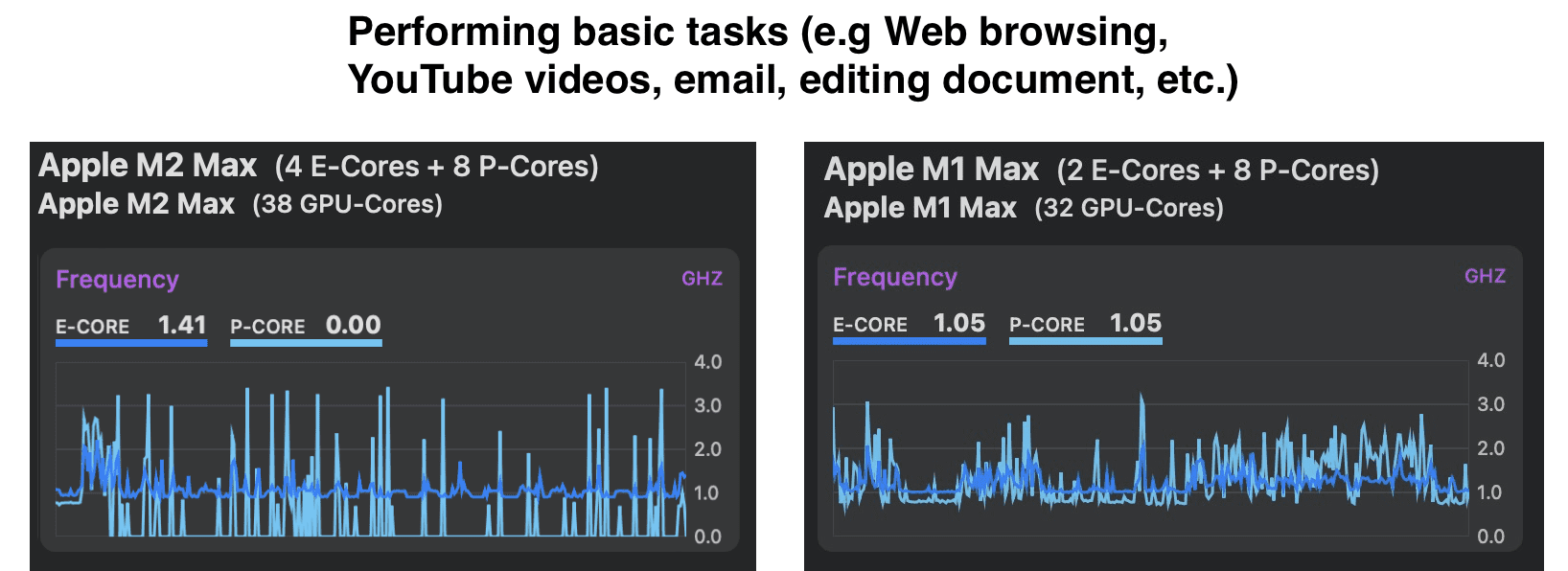
Perhaps more to the point, the same observation can be made while M2 Max handles a more robust workload. Below, I took two random screenshots of the e-cores and p-cores during a GeekBench benchmark test. You can see the high-performance cores during the performance benchmark both reach a higher frequency of \~3.5 GHz and drop to a zero state whereas the M1 Max performance cores do not throttle as high or as low. **This appears to be the first time Apple M-series silicon was designed to have the high-performance cores reach a zero state.**
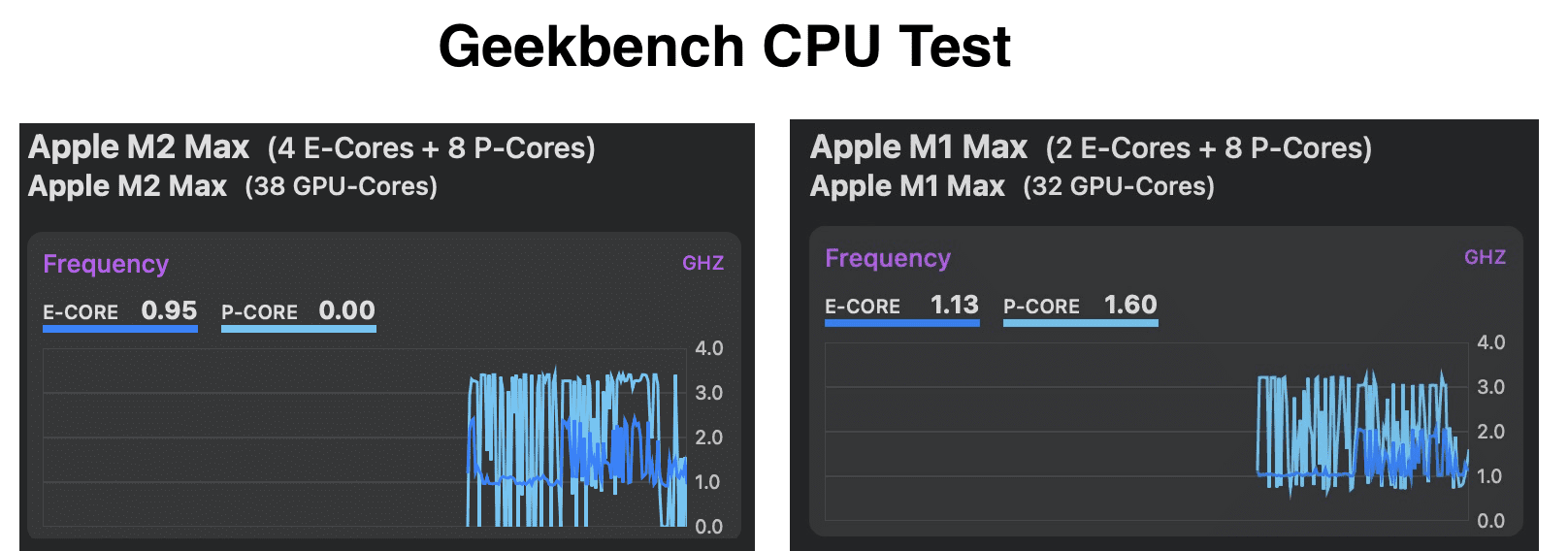
Apple didn’t stop at just making M2 Pro/Max high-performance cores more performant AND more efficient. **They also made the efficiency cores more performant!** I didn’t notice it until I looked at the above image more closely, and looked at the log files of core frequency more closely over the course of my working day. The efficiency cores on M2 Max can operate at a higher frequency than M1 Max. In the above image, during a GeekBench CPU benchmark, the efficiency cores throttled to \~2.5 GHz on M2 Max. While M1 Max, during the same workload, the efficiency cores throttled to \~2.0 GHz.
These subtle generational improvements in the M2 CPU design are the reasons I think Apple is able to tout around an hour of battery life increase over previous M1 Apple Silicon. While battery life is always difficult to truly test, my default is simply how many hours can I use my Mac during the day without plugging it in. Obviously, the amount of battery life largely depends on the tasks you do on a daily basis but with what I consider average workloads, this M2 Max got 12.5 hours of screen on usage. That’s about two hours better of screen on usage than my M1 Max doing the same kinds of daily workloads.
**Gen on Gen Performance**
While performance has definitely increased with this next generation M2 silicon in three vectors being efficiency cores, performance cores, and GPU cores, I feel it is not terribly helpful to focus so much on M2 over M1\. I find it extremely unlikely that owners of M1 Mac feel compelled to upgrade to M2 Macs. Which makes the target market the portion of the Mac installed base that is still on Intel Macs.
While it is difficult to estimate the exact percent of the base on Intel Macs, a study we did recently on the PC market in the US suggests \~41% of the US Mac installed base is still on Intel Macs. Given the US is Apple’s largest Mac market and other countries tend to upgrade devices more slowly, it’s safe to assume more than 50% of Apple’s worldwide Mac base is still on Intel-based Macs.
While current Geekbench multi-core tests conclude M2 Max multi-core CPU is \~20% faster than M1 Max the more eye-opening number is that M2 Max’s Geekbench multi-core CPU score is 123% faster than the last MacBook Pros to run Intel chips and 82% faster in single-core applications. With the lineup of Apple Silicon what it is, it’s even more enticing for the base of Macs still on the Intel platform to upgrade to Apple Silicon.
What makes analyzing how Apple spends its transistor budget intriguing is how Apple has the luxury to use that budget exclusively for its operating systems. In this case, the addition of two more efficiency cores and more GPU cores in M2 Max combined with next-generation CPU and GPU and new overall SoC design proves to be even more efficient and performant than previous generation Apple Silicon. It is the tight integration of silicon, hardware, software, and services, that allows Apple to optimize Apple Silicon specifically for Apple products. It is this union of Apple technology teams that leads to an experience that is differentiated and valued. Some may think consumers don’t care about Apple Silicon but that could not be further from the truth. In the same PC study I mentioned earlier, we looked at what factors drove Windows PC owners to switch to the Mac. Top of the list was Apple Silicon. Consumers, [and enterprises](https://creativestrategies.com/macs-in-the-enterprise-a-cisco-case-study/), understand the effort Apple is putting into Apple Silicon and the overall impact it has on the Mac experience. Apple Silicon is not the only reason but is both a big and small reason Mac sales will continue to grow.
\*All tests performed between 16″ Macbook Pro M2/M1 Max were on a full battery, on battery (unplugged), and the automatic setting that allows macOS to automatically choose the best level of performance and energy usage.
\*I did not test M2 Pro but M2 Pro but given it has the next gen CPU and next-gen GPU many of the same performance-per-watt efficiencies will apply.
\_\_\_\_\_\_\_\_\_\_\_\_\_\_\_\_\_\_\_\_\_\_\_\_\_\_\_\_\_\_\_\_\_\_\_\_\_\_\_\_\_\_\_\_\_\_\_\_\_\_\_\_\_\_\_\_\_\_\_\_\_\_\_\_\_\_\_\_\_\_\_\_\_\_\_\_\_\_\_\_\_\_\_\_\_\_\_\_\_\_\_
**Bonus Benchmark**
Below is a side-by-side view of a 4k video export. Several interesting observations can be made.
- The high-performance cores in M2 Max are reaching a higher frequency (in Ghz) than M1 Max. M2 Max hit \~3.6 Ghz while M1 Max hit \~3.1 Ghz.
- The efficiency cores in M2 Max also reached a higher frequency of \~2.4 Ghz compared to M1 Max of 2.0 Ghz, which appears to be M1 Max’s e-core ceiling.
- M2 Max appeared to have better temperature management dropping the temperature of the performance and efficiency cores much more quickly compared to M1 Max.
- Lastly, M2 Max seemed to utilize all cores (load balance) better compared to M1 Max. M1 Max hit a sustained GPU core utilization of over 80% while M2 Max sustained utilization was 60%. The result meant far less power draw from the GPU which could be a strong contributor to an increase in battery life even while do more performant heavy workloads.
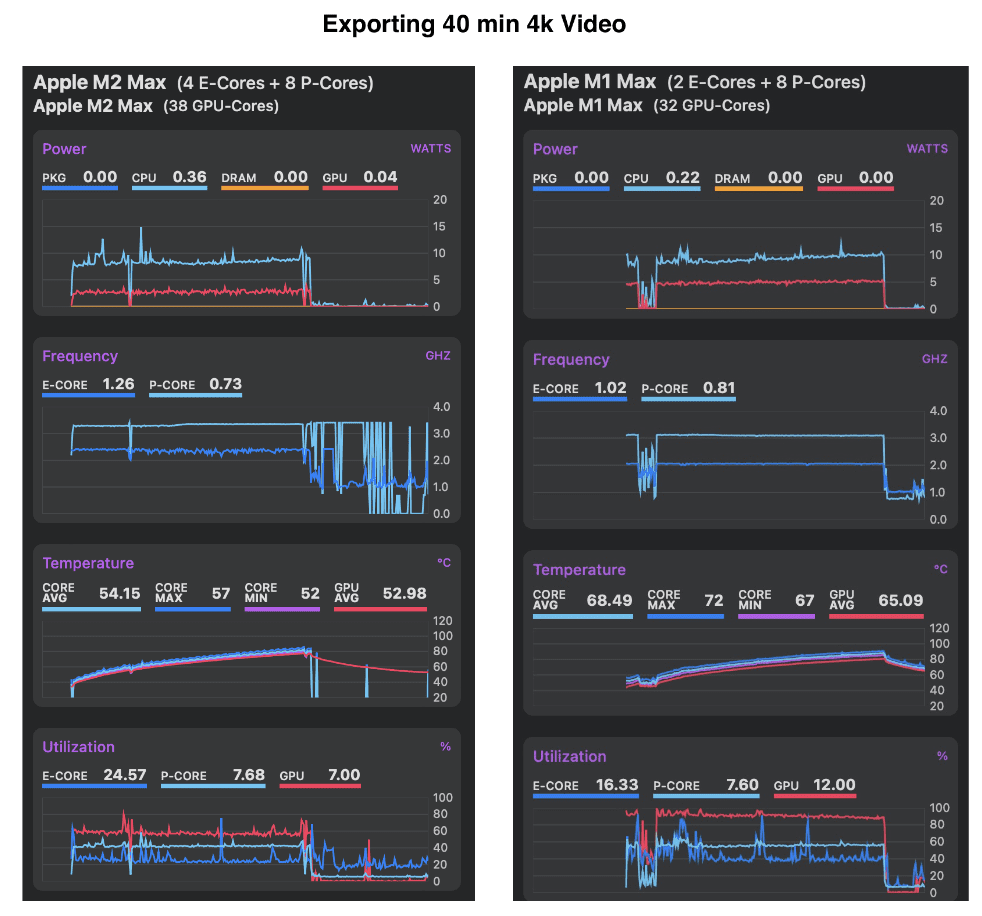
### Macs In the Enterprise: A Cisco Case Study
URL: https://creativestrategies.com/macs-in-the-enterprise-a-cisco-case-study/
Last updated: 2023-01-20T23:12:07.000Z
Last fall, [I wrote about the growth potential](https://creativestrategies.com/macs-at-scale-in-the-enterprise/) for Apple’s Macs in the enterprise. I mentioned some research Cisco shared about their Mac choice program and the benefits they have seen as an organization by offering Mac as a choice and supporting Macs on equal footing as Windows.
Cisco’s stated goal with the Mac@Cisco program is “reimagining the Mac experience to support, engage, and empower employees to do their best work.” Cisco has a distinct emphasis on employee experience, driven by their CIO Fletcher Previn who has been quoted saying “The state of IT is a daily reflection of what the company thinks and feels about its employees.” This emphasis to provide employees with the right tools for how they want to get their job done coupled with the focus Francine Katsoudas, Executive Vice President and Chief People, Policy & Purpose Office has put on creating a workplace that puts their people first has contributed to landing Cisco as the top-rated workplace and number one on Fortune’s top 100 places to work for two years in a row.
I had a chance to speak more in-depth with those in charge of the Mac@Cisco program and I’d like to share what I learned.
**Offering True Choice**
A common term among PC OEMs, when outlining their device roadmap was “port of choice.” This was the vernacular to describe what mix of ports would be included in a laptop or desktop in order to give IT admin’s the most flexibility when deciding which devices to deploy in their organization to meet their employee’s needs. I’d like to steal that term but stay true to its intent by using the phrase platform of choice. In the same way that IT departments knew they had different users, who needed different port/connectivity options and offered hardware that allowed for port of choice, modern IT organizations need to also offer platform of choice. That was the old IT paradigm where decision-makers and OEMs focused on personas based on location and job role. Fast forward to today and it is clear to me that modern IT must take that model and shift it to platforms. Doing so will only have positive implications for their organizations and their employees.
It is no secret that most organizations do not fully embrace Macs for their employees. There are always ways employees can get Macs, but those who choose Mac rarely get the full support of their organization’s IT/Support department. Often it means getting cut off from managed upgrades, support tickets, and often lack of access to applications. Despite extremely high desire from employees to use Macs (66% according to a study we did last year), most IT organizations keep the Mac users in their organization at arm’s length.
Offering true platform of choice matters when it comes to employee experience and employee satisfaction with their workplace, tools, and IT departments. This is exactly what Cisco found when they studied internal employees. A Cisco report on IT satisfaction of employees found **satisfaction to be significantly lower when employees were not offered their platform of choice in a laptop**. This speaks to the simple reality that Windows has been the only option for too long for most employees and employees should be offered the chance to use their platform of choice for their day job. Modern enterprises will have no choice but to confront this reality and provide platform of choice to their employees. If they don’t they are hampering their employee’s ability to use the tool they prefer to get their job done and they risk losing employees to go work for organizations who better provide the tools they prefer to use.
Now that Cisco offers a full Mac program, the number of employees who state they don’t use their preferred OS has dropped dramatically. And while not every employee or department is choosing a Mac, **Cisco finds that 59% of new hires are choosing a Mac and 65% of employees eligible for a refresh of their laptop are choosing a Mac**. Cisco also found that when employees with a Windows laptop were up for a refresh, 24% chose to switch from a Windows PC to a Mac. These stats stand out to me as clear evidence there is pent-up demand for Macs in the workplace.
**Gold Standard Support is the Key**
While third-party tools from Jamf, Kandji and Jumpcloud make it much easier for IT organizations to embrace Macs, the issue of help desk support remains a key piece of the puzzle. As I mentioned, most large and small organizations have Macs in their workplace. But those Macs are often managed in a much more limited capacity and often cut off from help desk support, applications, and OS upgrades.
Cisco created a dedicated Mac Admin team and a dedicated Mac@Cisco helpdesk. From an employee experience standpoint, this strategy is working. Cisco has been tracking key performance indicators relative to the Mac@Cisco helpdesk and found extremely high satisfaction among employees using Macs who needed support. A key goal was to decrease the amount of time it took to respond to a support ticket and their efforts have paid off with an average of fewer than 90 seconds to respond to a support inquiry.
In an [employee experience study](https://creativestrategies.com/employee-experience-and-modern-it/), which we conducted last year, we studied employee satisfaction with their IT organization and technical support. Support response time was an area where we found higher levels of dissatisfaction among employees. Cisco’s strategy to reimagine the support experience for the Mac@Cisco program undoubtedly played a role in the success of this program.
Cisco is executing several key points, [I outlined](https://creativestrategies.com/macs-at-scale-in-the-enterprise/) that need to be done in order to successfully deploy Macs, build a dedicated Mac admin team and create a streamlined Helpdesk focused on Macs. The excuses used against supporting Macs at scale in the enterprise have nearly all been debunked. The Mac has become an essential workplace tool and there is no escaping that reality. More organizations would be wise to follow Cisco’s example of deploying a well-thought-out and mature Mac choice program as it would be to the benefit of their employees and their corporate culture.
### ChatGPT and beyond: Why generative AI’s inflection point might be Tech’s most promising new market opportunity
URL: https://creativestrategies.com/chatgpt-and-beyond-why-generative-ais-inflection-point-might-be-techs-most-promising-new-market-opportunity/
Last updated: 2023-01-12T19:25:32.000Z
ChatGPT represents an important inflection point for AI, and an important one for the tech industry at a time when consumers, worn down by perhaps one too many hype cycles, have begun to lose faith in the sector’s ability to deliver on its promises.
The tech industry’s current headwinds aren’t limited to inflationary pressures, a global economic cooldown, supply chain issues, and COVID resurgences. There is one other key factor at play: the impact that consumer perceptions of new and emerging tech regarding trust, value/utility, and excitement have on demand. The feedback I have consistently received from the consumer trenches over the last three years suggests that years of tech hype, endless streams of vaporware and grandiose but empty promises have made consumers both confused by and suspicious of new and emerging technologies that either keep being delayed or that systematically disappoint. I refer to this phenomenon as *hype fatigue*, and tech companies need to start taking the role this plays into their marketing, PR, and product development more seriously. Hype fatigue doesn’t just lower consumer interest (demand) in new tech, it also tends to make them distrustful of the messengers that keep carrying hollow tech hype to them on a regular basis. The below are examples of too much hype and not enough substance.
- The colossal clown shows that the crypto and NFT spaces devolved into last year certainly didn’t help, but the problem runs much deeper: Privacy and data security still struggle to inspire confidence.
- Mark Zuckerberg’s head-scratching vision for “metaverse” is drawing more side-eyes than traction, and is at best a decade away.
- Bringing augmented reality glasses to consumers has been a predictable annual exercise in kicking the proverbial can down the road.
- The promise of fully autonomous vehicles being just a year away has been stalled by crashes and terrifying failures.
- The evolution of the smart home fizzles out as soon as the excitement of CES is over.
- Artificial intelligence has, for the most part, proven itself to be more artificial than intelligent; VR and XR, for all their promising and exciting use cases, have failed to justify investments at scale outside of gaming.
In short, the biggest and most exciting technology plays consumers keep being told are right around the corner has, for the most part, either failed to launch or haven’t exactly impressed. “Wake me up when \[insert technology here\] is actually ready” seems to be the attitude in most households, and that isn’t the consumer perception trajectory that will help the tech sector bounce back from what is shaping up to be a difficult 2023\. “Where’s the beef?” the old ad went.
“Where’s the beef,” indeed.
What the tech sector needs to disrupt hype fatigue isn’t exactly rocket science. (Well… it might actually be rocket science, but I digress.) Conceptually, it’s a simple fix: less hype, more beef. That’s it. Replace overpromising with overdelivering. More specifically, on the UX and product development front, new tech solutions can’t just be okay or pretty cool, but legitimately remarkable. And by that, I mean surprisingly good, and if possible, shockingly better than expected. New tech should dazzle, enchant, bring magic and excitement back into people’s lives, not just on paper or in promises, but when they actually get their hands on it. Short of that, new tech needs to actually be useful. I don’t mean as cool solution in search of a problem (a hurdle that VR still struggles to overcome) but as something that creates immediate, undeniable value for users. Ideally, new tech does both, but one or the other will do for now. 2022 and 2023 were low bar years, after all. And that is where generative AI enters the chat, and specifically ChatGPT.
##### Why ChatGPT and generative AI’s unexpected evolutionary leap is a massive market opportunity for the tech sector
Despite a flurry of exciting AI-related announcements from tech giants like Intel, Amazon, Google, Microsoft, Apple and Qualcomm last year, along with some encouraging implementation tailwinds, consumer perceptions of AI remained mixed, with the technology continuing to feel confusing, at times frustrating, even untrustworthy. That all changed when people started playing with ChatGPT and seeing for themselves just how uncannily good it was not only at understanding queries but at generating replies and content.
To be fair, it wasn’t the first time that an AI product has delivered for consumers. As limited as they still are, Google Assistant and Alexa have been remarkable advancements (more so than Siri, in my view) in the voice interface/virtual assistant space, for example. Less obvious to consumers but equally valuable are AI solutions that optimize processes at scale, from ad targeting, pattern recognition, and data analysis to ADAS systems and computational photography. But ChatGPT is different in that it seemingly came out of nowhere and unsaddled by hype or expectations, managed to blow everyone away by being so surprisingly powerful and fun to use. It is so surprisingly good, in fact, that it immediately raised a flurry of questions about the potentially devastating impact it might have on job security, academia, and creative industries. The degree to which ChatGPT instantly felt disruptive and fun but dangerous speaks to how much of an inflection point it created for AI, and generative AI in particular.
Educators immediately realized the danger this posed to educational models that rely on research papers to evaluate students: If ChatGPT could write papers as well as a human, many students would naturally lean on the technology to save time and improve their grades without necessarily learning the material. Every problem is an opportunity, though, and this one needs to scale quickly: ChatGPT has shown us that the market needs effective AI detection tools capable of the kind of nuanced analysis that can differentiate between AI-authored copy and AI-edited copy. Every school in the world is going to need to fold this into their tech stack now, with appropriate policy frameworks. This could be an instant mass market opportunity for the right software vendors.
What about the threat this tech poses to journalism and copywriting? Will generative AI tools like ChatGPT accelerate layoffs in funding-strapped newsrooms, marketing firms, web design firms, and ad agencies? Can generative AI write code faster and as well as human web developers? The collective gasp from professionals who suddenly realized that their job could be done by an AI is, in its own way, another indicator that ChatGPT and generative AI changed the world virtually overnight. The market opportunity this challenge has created is more granular than it is for academia, but that isn’t a bad thing for solutions vendors. That’s because generative AI tends to be more powerful and economically sound as an optimizing tool for human workers than as an outright replacement of human workers. Unless an organization’s model is to produce junk mail, it is going to need talented, qualified, experienced workers. Writers, attorneys, accountants, paralegals, problem-solvers, decision-makers, leaders, and so on. How an organization maximizes the power and potential of generative AI tools is by empowering their staff to incorporate them into their workflows. **The true potential of generative AI, at least for the foreseeable future, isn’t *job* automation, but rather, *task* automation.**
In other words, generative AI solutions should be used to *enhance* human workers, not replace them outright. Once decision-makers and technology users understand that nuance, the “how does generative AI fit into my organization/role” question becomes much easier to answer. Reframed from that perspective, the question now becomes “how can generative AI tools help me work faster and better instead of just working harder?” Also: “How can generative AI save me time? How can generative AI allow me to focus on more valuable tasks? How can generative AI give me more time to do other things?” The value equation shifts.
**Examples of how generative AI tools can help specialized staff become more effective:**
- An executive can use a generative AI tool to summarize news items or bring clarity to a complex topic. It can also be used to quickly generate drafts for up-to-date reports and deck content for meetings.
- A copywriter, journalist or researcher can turn to a text-based generative AI tool to shorten a piece to fit within a specific word count limit, or explore different styles of writing to find the right tone and voice for a piece, or organize their work to conform to a specific style of writing.
- Educators can similarly use a text-based generative AI tool to better organize their lesson plans, ensure that they fit within the right time windows, emphasize key points for students, and generate homework assignments, lesson summaries, and test questions.
- For students, a text-based generative AI can help summarize a lesson or topic, essentially working as a tutor to help them better understand, study, memorize, apply, and retain lessons. When used ethically, it can also help a student organize their notes and thoughts around a topic to develop outlines and drafts for research papers and essays, and speed up proofreading and editing.
- For attorneys and their paralegals, a text-based generative AI can be leveraged to draft contracts and review them faster, proofread or search for keywords in depositions and court transcripts, speeding up these processes and allowing them to take on more clients and/or increase their billable hours.
The opportunities for generative AI solutions are close to limitless, both for the enterprise and for individuals, and landing on the optimal price points for a tiered monthly/annual subscription model won’t be difficult to figure out. The fundamental foundation powering things like ChatGPT and the recent breakthroughs with large language models will likely help with that.
The bigger the inflection point, the bigger the disruption, and the bigger the disruption, the bigger the market opportunity. Since VR, AR, ADAS, EVs, the metaverse, and other potentially transformational technologies may take a while to scale and deliver the value we were promised they ultimately will, 2023 offers the tech sector a unique and welcome lifeline – one it can use to reverse hype fatigue with, create entirely new revenue streams from, and leverage to expand existing market share and/or user base. For investors, the opportunity is equal parts investing in solutions vendors with an obvious head start and market advantage, and backing disruptive startups and challengers with the right focus, talent, and ability to execute.
### Tech Products I loved in 2022 and Predictions for 2023
URL: https://creativestrategies.com/tech-products-i-loved-in-2022-and-predictions-for-2023/
Last updated: 2022-12-29T19:16:55.000Z
Last year, I started a yearly theme highlighting my favorite tech products of the year. Last year, I highlighted the Remarkable 2 tablet and now believe that e-ink notepads may be more of a trend than I initially thought. If that’s the case, I’m glad I called it.
This year, I’m combining my list of favorite tech products from the year and making a few predictions for 2023.
**Favorite Tech Products of 2022**
Apple Watch Ultra: By far, my favorite product of 2022 is the Apple Watch Ultra. I’ve consistently proclaimed that the Apple Watch Ultra is the best Apple Watch to date, and there are several reasons why I believe this.
First, is the battery life. Not having to charge the Apple Watch daily is a game-changer. Many Garmin users, including close friends of mine, have known this for a long time. But the Apple Watch Ultra, with my normal usage patterns, lasts about 2.5 days. I generally start charging it after 48 hours. I exercise every day and have the Ultra connected to my carrier, often leaving the house without my iPhone. All of these factors would normally drain the battery on previous Apple Watch models, but with the Ultra, I don’t have to worry about battery life.
Second, is the screen. I love the larger, brighter display and the fact that it’s flat. While I’m not opposed to the curved designs of other Apple Watch series, I find that the flat display is easier to read at an angle or glance.
Third, is the overall design. The added ruggedness is a major advantage for me personally. In addition to being very active, I also live in a rural setting and do a lot of “country lifestyle” things on my property. In the past, I was hesitant to wear my Apple Watch while working in the yard or doing farm-related tasks for fear of scratching or denting the casing. However, I have no such worries with the Ultra and have knocked it against the tractor and other metal surfaces without a scratch.
Lastly, the design of the Ultra gives it a distinct advantage over Garmin for rugged or adventure use cases. It can withstand rugged adventures and also be fashionable enough to wear out at night.
After speaking with numerous Garmin owners and fans, including those who have added or switched to the Apple Watch Ultra, it’s clear that Garmin still has distinct advantages for sports and fitness-related use cases. Many Garmin owners believe it to be more accurate and its battery life is still unmatched. However, several Garmin owners have pointed out that while Garmin is the best sports watch, the Apple Watch Ultra is the best general-purpose smartwatch. They noted that the Ultra covers most, if not all, of their core use cases while also offering a wider and more diverse set of capabilities. This is why, outside of a few core use cases where Garmin has advantages, the general-purpose nature of the Apple Watch Ultra makes it highly attractive when comparing the two.
Lumen: Last year, I shared about my love for my Tonal smart gym and throughout most of 2022, I’ve been focusing on improving my health, fitness, and nutrition. It’s true that muscle is built and fat is lost in the kitchen, and this is something I didn’t fully understand at the beginning of my fitness journey. Everyone has different nutritional needs and understanding how to properly fuel your body for your goals is a luxury that only elite athletes often have with the help of their nutritionists.
In addition to being addicted to my Tonal, I also play competitive tennis. I realized that my nutrition was lacking when, in the months leading up to the National Championships, my activity level increased significantly as I trained for the event. I frequently didn’t feel well and was overly exhausted, and I realized that I wasn’t giving my body what it needed. While I did end up working with a nutritionist, Lumen has helped me understand the food I eat, including my macros, to better understand how my body is reacting to my current nutrition plan.
For those who haven’t seen it before, Lumen is a device that you breathe into to measure whether you are burning more carbs or fat at that moment. You take measurements throughout the day for it to be most effective. When our body uses the food we eat for energy, a good portion of it is expelled as we breathe. This is how a device like Lumen, which measures our CO2, can be an effective way to understand our metabolism. When you take a reading with Lumen, it gives you a rating from 1 to 5, where a 1 means you are burning all fat and a 5 means you are burning all carbs.
Like all things related to health and fitness, Lumen works best when you are disciplined and consistent. However, from my experience with it, I have noticed that on my lower-carb diet days, I get more of a 2 to 3 reading, indicating that I am burning more fat than carbs. During the Christmas weekend, I was not diligent with my diet and used my Lumen, which read 4 to 5s. I would say this was accurate given my holiday diet.
Overall, from a health and fitness standpoint, it’s fascinating to see new devices like Lumen emerge that help us get more information about our bodies’ relationship to our diets. This will become increasingly important in our overall health and fitness journeys.
**Predictions**
**One of my predictions for 2023 is that Apple will not release a VR/AR headset.** While many are expecting such a launch, I believe it goes against Apple’s typical philosophy of launching products. The theory is that Apple will release a headset that is more like a developer beta, just to give developers the opportunity to start experimenting with AR/VR/MR, even though the technology is not yet ready for mainstream adoption. Apple has never done anything like this before, and it feels like a stretch to believe they would now, especially when there is no evidence of a market for AR/VR/MR outside of niche enterprise applications. Believing that Apple will release a headset in 2023 means we have to believe that Apple has abandoned its noted product launch strategies–patience.
When I shared my opinion on Apple not launching a product in 2023 around VR/AR/MR on Twitter, I received responses pointing to the iPod and iPhone as examples of products that were launched early and not yet perfect. However, I disagree that Apple launching a headset in 2023 would be anything like the launch of the iPod or iPhone.
First, both the iPod and iPhone were extremely polished and were clearly game changers from the moment they were used. Any VR/AR/MR headset that Apple launches in 2023 will not be as polished. There is no secret micro-lens or micro-display technology that Apple is sitting on, and the current technology still has a long way to go in terms of the camera sensors, battery, core computer (CPU/GPU), and other hard technology problems. While there is excitement for Apple to do something in this category, there is no need to rush and risk ruining the reputation of a new product category with an experience that is not ready for the market.
Second, both the iPod and iPhone were launched on a mature foundation of common consumer behavior. Before the iPod, portable music, even in analog form, was a well-entrenched consumer behavior. The iPod simply shifted the idea of a portable CD player to a digital MP3 player with 1000 songs and addressed a pain point. The iPhone launched to a mature market of mobile phone users, PCs, and the internet. Apple’s three pillars at the launch of the phone, iPod, and internet were each already mature behaviors, so having all three in your pocket was a no-brainer. It is difficult to see what foundation of common behavior exists for a head-worn computer at this time. This may change in the next two years, but it is not the case now.
Again, I’m happy to be wrong, but my core belief is it is still too early for Apple to enter the market in AR/VR/MR.
**One of my predictions for 2023 is that AI will go mainstream in a significant way.** I believe that the launch of ChatGPT-3 will mark an inflection point for AI. Over the holidays, I showed ChatGPT-3 to many of my non-technical friends and family, and their reactions were ones of shock, awe, disbelief, and reservation. It’s rare to see technology have such an eye-opening impact on everyone who tries it, but that is what happened with ChatGPT.
AI and natural language interactions with AI machines will increase in capability at a staggering rate in the coming years. The underlying framework of ChatGPT-3 and soon ChatGPT-4 will enable the creation of all kinds of spin-off experiences, leading to a gold rush around AI and a likely bubble with hundreds of spin-off ideas and businesses built on top of the platform. While most of these will not survive, this type of early innovation bubble lays the foundation for future successes and drives experiences into the mainstream.
We must navigate this new world of AI and mainstream consumer applications wisely. The relationship between humans and AI has changed, and ChatGPT-3 will be something we look back on as the beginning of this inflection point.
### Macs–At Scale–In the Enterprise
URL: https://creativestrategies.com/macs-at-scale-in-the-enterprise/
Last updated: 2022-10-19T18:29:23.000Z
You would be hard-pressed to find a large modern enterprise, in the US, that doesn’t have at least a few Macs running around its halls. As was with the early days of the iPhone, executives and board members, and specific employee levels/recruits, will get any technology they want. And, of course, Macs have long been staples in the creative departments of companies. The question is not whether Macs are in the enterprise, the question is whether Macs are being managed the same way their Windows PC counterparts are managed and deployed. Even more interesting, is to inquire if Macs are managed at scale. Outside of a few showcase organizations like IBM, Cisco, SalesForce, SAP, Google, Facebook, and a host of startups, the answer to both those questions is usually no.
Last month I attended a conference put on by Jamf, the largest software platform for managing Apple devices in the enterprise. Their user conference, JNUC (Jamf Nation User Conference) has the largest attendance of Mac admins in the country. While there, I had numerous conversations with Mac admins in large and small companies across all major industries like retail, technology, healthcare, government, and more. Thanks to an entirely new enterprise dynamic, in the cloud/digital-first world, I believe Apple is on the cusp of seeing the Mac finally cross the enterprise chasm and formally be embraced by every modern organization.
**Macs on Parity with Windows in the Enterprise**
Apple’s iOS devices are no stranger to the enterprise and are now fully embraced and supported by nearly all organizations. For a range of reasons, Apple’s Macs have not been widely embraced by large organizations, and when they are, they are often treated as a special class, separate from Windows PCs. Companies like Jamf, Kandji, JumpCloud, Moysle, etc., have grown and matured and provide organizations with the tools needed to support employees’ iOS devices and give them secure access to the company’s enterprise software and services. The key thing to note about iPhone’s success in the enterprise is these are employee-owned devices that are given the necessary enterprise keys and permissions. It is a much different scenario when it comes to PCs and Macs which are generally owned, managed, and provided to the employee. This is a key reason why in most large organizations employees simply don’t have the same choice of technology as they do with their smartphones which they own. While many organizations may evolve to support employees bringing their own Macs to work, the consensus from most IT decision-makers I talk to is employees prefer their notebook or desktop to be provided by their employer.
While not every employee can freely choose a Mac, many organizations have Macs running and deployed. They are just lightly to moderately managed whereas their Windows counterparts are fully managed. This is the most common scenario for most large organizations. In fact, while at JNUC, I attended a session from Cisco on their evolution from an immature employee Mac program to a fully mature employee Mac program which now manages more than 56,000 Macs internally. Cisco shared they had 15,000 Macs deployed internally before they embarked on the work to fully adopt Macs and macOS and give them full support parity with Windows. And now that Cisco has fully embraced the Mac when given a choice Macs are chosen at a 2:1 ratio.
What Cisco is finding internally, lines up [with our research](https://creativestrategies.com/employee-experience-and-modern-it/) where we found that 60% of employed adults who took our survey said they wanted their organization to give them the choice of using a Mac. As the employee experience, and employee satisfaction with their workplace, become increasingly important to an enterprise’s success, it is inevitable Mac users be given parity to Windows PC users in the enterprise. To get there, a few things need to happen.
**Macs Need a Spark**
The point I’m about to make is relevant for large organizations that are largely Windows-based. From my discussions with Mac admins and Mac teams, the commonality I discovered that played a significant role in their company beginning their journey to fully support Macs began with a champion. Someone had the conviction that Macs needed to be fully embraced and supported and championed that effort. Interestingly, the more I heard people tell stories of the projects happening internally to bring Macs fully into the fold, the more I was reminded of when iPhones started to gain enterprise adoption and were up against the entrenched position of RIM/Blackberry. The iPhone’s journey to full corporate support began with champions (often C-level executives) who pushed their organization and helped work out the details, so iPhones could be fully embraced and allowed by IT. Those early days of iOS feel remarkably similar to what I’m hearing about Macs and macOS in large organizations today.
What is different today, than back in the early days of iOS, is we have companies like Jamf, Kandji, and JumpCloud that have emerged as viable third-party solutions that help organizations manage Apple devices, including Macs, at scale. These organizations fully support all the specific enterprise needs from enrollment, management, permissions/policies, security, and more and equip organizations with the tools to successfully deploy and manage Macs at scale.
Organizations, where Macs are not yet fully embraced, are more open to hearing the pitch of the Mac champion than at any point prior largely thanks to COVID. The COVID pandemic and its immediate impact on organizations that had to rely on their cloud infrastructure more than ever, made it glaringly clear, most–if not all–their apps and services work across computing platforms. COVID forcing 5+ years of digital transformation into 18 months did more for Apple’s opportunity with Macs in the enterprise than we could have known.
**A Dedicated Team With Dedicated Tools**
Another interesting learning for me was organizations that are starting to manage Macs at scale, or already manage Macs at scale, have a dedicated Mac admin team. The more I thought about this, the smarter I think this organization of IT is for the true success of both Apple devices and Windows devices in the enterprise. Having a team of experts on both platforms is the smartest way to ensure all the needs of the organization and the needs of the employee from a technical administrative level are being met. Recognizing each platform is different, and each employee who has chosen each platform has different needs will have a positive impact on employee experience. This might be a bit of a shift for many IT organizations, but it would be a shift for the better as enterprises move into the modern era.
I appreciated a principle shared with me by Jamf CEO Dean Hager during a conversation where he stated that Jamf’s mission is not to help their customers be successful with Jamf but to help their customers be successful with Apple. Similarly, CIOs and IT decision-makers need to embrace dedicated Mac/Apple admin teams and dedicated Apple/Mac management solutions so their employees can also be successful with Apple products if that is what they choose to use.
What was clear to me from my conversations with Mac admin teams, was the overwhelmingly positive impact on employee experience observed when organizations fully embrace the Mac, and its users. Commentaries from the likes of IBM and Cisco echoed the same and only gave me more confidence that for modern enterprises to compete both in their industry and for talent, they will have no choice but to embrace Macs the same way they embrace Windows PCs. This is a paradigm shift, no doubt, but one that will come with many rewards in employee experience and satisfaction.
### Working out Meta Kinks
URL: https://creativestrategies.com/working-out-meta-kinks/
Last updated: 2022-10-20T15:41:39.000Z
There are numerous challenges facing Meta’s vision and ambition for AR/VR/XR, whatever term you prefer. The most important thing from Meta’s posture is their recognition of how difficult AR/XR will be from both a technological standpoint and a user adoption standpoint. And the reality they have embraced is that this market will take a really long time to develop. These two recognitions from Meta are clever for a few reasons.
Firstly, by acknowledging developing solutions humans want to use for any length of time will be extremely difficult, expensive, and take many years, Meta is positioning itself for the long haul in a way that tells the market they have the ability to be patient and work out the kinks with the market. Every new technology has to start somewhere, take its licks, and go through growing pains. Meta is saying they are willing to put in the work, take the licks, and listen to the end market and the software developers to see where this whole thing goes.
Meta, like many of us, is under no illusion this market develops anytime soon. Recognizing this again sets them up as the large organization with the financial resources to invest in technologies needed to make AR/XR/VR a mainstream market and suggests to the market very few companies are positioned to do so. Meta is essentially saying no startups will threaten them, and only other big tech companies like Apple, Amazon, Google, and Microsoft, have a shot at playing a role in developing this market in some shape or form from a hardware standpoint.
**What’s the Point of Quest Pro?**
Every new technology has to start somewhere. Meta has decided to embark on what’s more of a public RND project than work out the kinks internally. Personally, I have no problem with this, as opposed to Apple’s approach where we won’t see something until Apple believes it’s ready. But, by taking this approach, in many ways as Google did with Google Glass, Meta will face criticism and in some ways, people may turn more bearish on the potential as they experience things that feel awkward and not fully finished.
Quest Pro is more of a technological example of how blending reality of the physical and digital world has far more potential than VR but requires much more technologically sophisticated hardware. Meta is putting into the hands of the market, a product that contains early technology around mixed reality but is baked just enough for the market to experiment and discover what use cases, user-interface paradigms, and software have the most upside potential and where it falls short. Sometimes, and for some companies, these solutions have to be worked out in public because there are so many more questions than answers regarding what is valuable and what is not with regard to mixed reality.
**Our AR/XR Future is in the Hands of Developers**
Any future in AR/XR, and even VR, rests solely in the hands of developers. Hardware and platform companies can only do so much to make a category. Their efforts are on the hardware technologies that can unlock software potential from creative developers. This is perhaps the main thing I’m looking for with the Quest Pro’s early market trials. What will developers do with this new technology and will they focus on repeating the past or creating something entirely new? The latter is the way markets get made but adoption cycles for brand-new experiences take much longer. The entire software paradigm is likely going to shift in mixed reality, and no one has any idea what experiences humans will gravitate to as of yet. Hopefully, Quest Pro gets into enough hands of early innovators to start experimenting so we can look for signposts of things that may have the most future potential.
For developers, it will be less clear how they make money but that is not entirely necessary in this early stage. What matters is some showcase experiences emerge that give us confidence there will be a market around mixed reality at some point in time in the near future. That is why understanding Quest Pro as more of a public RND project and developer beta is the perspective I’m taking at this point in time.
There is a vast sea of fair criticisms to make around the current technology, platform, and software implementation around Quest Pro and this ambiguous term of the metaverse. But this is the path that has to be taken to work out the kinks. Whether Meta is the right company or not to develop this market is an entirely different question, but at least–for now–many of us who study and observe these markets can hope to learn from Meta’s early efforts and gain a glimpse at what may be possible in the world of computing someday in the distant future.
### Three Fundamental Problems Still Plaguing Meta’s Enterprise XR Ambitions
URL: https://creativestrategies.com/three-fundamental-problems-still-plaguing-metas-enterprise-xr-ambitions/
Last updated: 2022-10-19T17:12:14.000Z
Meta’s goal to build a scalable on-ramp for XR and the metaverse in the enterprise would be hard to pull off without Microsoft’s help, which is why neither last week’s announcement that both companies had renewed their Metaverse-focused partnership, nor the announcement’s timing, should have come as a surprise. On the one hand, Microsoft’s interest in Meta’s hardware suggests a possible shift in the trajectory of Microsoft’s XR strategy — one more agile and perhaps less tethered to HoloLens than it has been. On the other hand, Microsoft’s credibility and solid install base in the enterprise opens doors for Meta that it would be hard pressed to open on its own. The partnership feels so natural that the headlines practically write themselves: “Best-in-class XR vendor joins forces with business software giant to bring the metaverse to the enterprise.” Why, then, am I not all that enthusiastic about it? Perhaps more to the point, why does almost no one else seem enthusiastic about it either?
Broadly, the whole thing feels forced, or at least premature. Despite Mark Zuckerberg’s enthusiasm for his vision of the metaverse, Meta’s pitch has thus far failed to convey a clear and measurable value to its intended market. The question I keep hearing over and over from virtually everyone I talk to about this is still “why?” Outside of niche use cases, why do we need this? More specifically, when business leaders are doing the asking, the question branches off into a broader tree of questions ranging from “what problem does this solve” and “how will this make employees more productive, more creative, more collaborative, more engaged, more motivated, happier, and less stressed,” to “can any of this be measured,” and “what is the ROI?” Meta can expect resistance in the market until it comes up with credible answers to every single one of these questions.
I have no doubt that XR as an experience platform can, beyond the narrow range of existing use cases like gaming, design, engineering, healthcare, training, and law enforcement/military, help make work feel more fun, fluid, and rewarding, potentially reducing stress, apathy, burnout and even quiet quitting. How exactly Mark Zuckerberg’s metaverse aims to deliver on that potential, however, remains nebulous at best. Zuckerberg’s somewhat tone-deaf metaverse demos so far feel oddly pointless and unfocused, and don’t exactly inspire confidence in Meta’s direction. As for the retro Wii aesthetic of Meta’s avatars and environments, they seem friendly enough, especially if children are an intended market for Meta’s virtual spaces (education could present a lucrative opportunity for Zuckerberg’s metaverse ambitions), but they do little to convey how they will deliver useful, let alone rewarding Windows, Office, and Teams experiences for adult professional users in enterprise and SMB environments. I hope that Meta’s partnership with Microsoft will provide an opportunity for both companies to figure this all out sooner rather than later.
The most glaring problem I currently see with Meta’s vision for an enterprise-friendly metaverse, particularly as it relates to immersive remote collaboration and productivity UX, is that it doesn’t seem to solve any discernible problems for organizations or their staff. I realize that it is still very early in the game but Meta should at least have some idea of the problems that it is attempting to solve and of how XR might tackle them. The challenge at this juncture should be in the execution — the *how*, not the *what* and the *why*. To make matters worse, instead of looking to XR and the metaverse to eliminate common pain points for organizations, Meta seems to have gone out of its way to inexplicably design entirely new ones:
**The first point of friction in Meta’s enterprise metaverse play is the cost of entry of its hardware**: Even under the best economic tailwinds, adding $1,500 per head to budget allocations that already include phones, tablets and PCs would be hard to justify, especially when the reason behind the extra spending is an XR headset whose purpose and value for the average employee remain difficult to quantify. Granted, $1,500 per unit isn’t a lot of cash for large orgs so long as the value is there, and we have seen the math work well in niche use cases. But if Meta and Microsoft are setting their sights on mass adoption and scale, either the ROI of that investment will have to be made clear and indisputable, or the pricing will have to come down. Way down.
**The second point of friction is the form factor of the hardware itself**. As impressive as the Quest 2 Pro’s specs and capabilities are, it still looks and feels more like a deconstructed fighter jet helmet than a pair of AR glasses: Bulbous, wide, on the wrong side of light and comfortable, and not particularly portable. The question almost asks itself: Does anyone really *want* to wear a cumbersome XR headset at work all day? Probably not, at least not unless you absolutely have to.
Even for a few hours per day, consider the likely increase in vertigo among new users. Consider the eye strain, the headaches, the overheating, the rashes where the headset rests and presses against the skin, the possible hair loss, even. Consider the neck and back pain that might result from having to wear an XR headset for hours on end at work, day after day after day. Even for remote workers, large XR headset form factors like the Quest 2 Pro are likely to continue to face persistent adoption headwinds: Anyone can already get into a Teams call using a mobile phone, tablet, or laptop, all of which can easily fit into a pocket or in a low-profile backpack. Why complicate things by adding an unnecessary and inconvenient extra device to their bag? None of this sparks joy, and all of these issues may impact the pace and scale of adoption at least as much as cost is likely to. The friction math is simple: if the benefits of the solution don’t clearly outweigh its pain points, it won’t be successful at scale.
The assumption, of course, is that XR headset form factors will become smaller, slimmer, lighter and more portable over time. Today’s XR headsets aren’t 2025 XR headsets or 2030 XR headsets, let alone 2035 XR headsets (at least I hope not). Most if not all of the pain points outlined above *will* be solved over time, but until they are, they will continue to make XR adoption at scale, at least across the enterprise. My fear in the interval is that premature market tests at scale could result in organizations and technology users at large forming a poor opinion of the technology and of its usefulness to the enterprise before it can have time to evolve into a smaller and more task-appropriate form factors. Regardless of the invaluable experiences XR might deliver to the enterprise once the technology becomes a bit more mature, allowing too many pain points to persist as the market “tests” the viability of XR in the enterprise over the course of the next few years could backfire.
Even if Teams, Windows, and Office experiences can be enhanced and transformed by XR (and I believe the opportunity is there for Microsoft to take its software stack to entirely new UX heights with the help of XR), it will have to be at a much lower cost and by way of more user-friendly, near-frictionless form factors. To that end, Meta may soon have to come to terms with the reality, disappointing as it may be, that for the vast majority of enterprise users, Windows 365 and Office 365 experiences don’t really need to be fully immersive in order to play well with XR, and headsets like the Quest 2 Pro, including future iterations of it, may simply be overkill for most non-niche use cases involving everyday productivity and collaboration.
It may behoove Meta to explore the possibility of delivering a broader range of Microsoft-compatible enterprise XR hardware in the next coupe of years. A triple Pro/Ultra/Light tiered framework could make sense for future iterations of the Quest product family, with a Pro line delivering best-in-class XR capabilities for designers and creators, the Ultra line trading some top-end performance and features for a more streamlined design, lighter weight and all-day comfort for an agile range of enterprise-friendly use cases, and the Light line essentially serving as a low-cost, highly portable, and unobtrusive enterprise-ready pair of AR glasses designed for the average enterprise Office 365 user.
**The third point of friction is Meta’s unfortunate dehumanization of collaboration in the metaverse.** As cute as it may initially seem to transform coworkers into Wii-themed digital avatars (with or without digital legs) I worry that replacing human faces with digital ones will have a negative emotional and psychological impact on remote workers over time, and we would do well not to overlook or underestimate this potential problem in the making.
The entire point of remote collaboration solutions is to connect people in spite of the distance and the layers of technology standing between them. One of the metaverse’s fundamental promises is that it will create increasingly convincing *immersive* experiences that drive towards eliminating the screens that separate us, both physically and metaphorically. In gaming, those immersive experiences don’t necessarily have to be realistic. Gameplay has its own set of rules and expectations after all, complete with a broad range of creative role play. Business, however, is a very different animal. Relationships and meaningful human connection are essential, and can prove more difficult to achieve and maintain in enterprise settings. If immersive metaverse experiences are intended to convincingly merge the digital world and the real world in a way that makes enterprise users feel as present and connected to each other as possible, Meta’s avatars deliver the precise opposite experience: They add unnecessary filters between users, erasing their humanity, their faces, their traits and mannerisms and micro expressions by turning them into stripped-down digital cartoons.
If Meta were working on delivering lifelike 4K or 8K quality 3D captures of users’ faces to build truly immersive, next-gen collaboration experiences, that would be one thing. But the company’s inexplicable effort to dehumanize collaboration and disconnect remote workers from one another through cartoon-like avatars makes me seriously wonder if Mark Zuckerberg’s Meta should be driving the design of these immersive enterprise collaborative spaces at all.
This isn’t to say that Meta isn’t onto something with its friendly, cartoon-like, somewhat anonymized metaverse aesthetic. It seems well suited for immersive childhood learning use cases, and could be easily adapted to a broad range of other categories of immersive experiences like gaming, social spaces, skill-building workshops, shopping, and banking. For the enterprise user though, it may make more sense for Microsoft to handle the design of its own XR-specific UX and spaces, including its ecosystem of Teams experiences. Between its growing partnership with Meta and its own in-house Xbox talent, the task wouldn’t exactly fall outside of its wheelhouse, and the company’s decades of insight into the global spectrum of enterprise cultures and collaboration would find itself put to good use.
In closing, as cool and exciting as the intersection of XR, the metaverse and the enterprise sounds in theory, most of it still feels like a solution in search of a problem, or rather, a product in search of a market: Instead of asking how XR and the metaverse can help advance the enterprise beyond extremely niche use cases, Meta’s question seems to instead ask how the enterprise might help accelerate, scale, and even justify XR and metaverse adoption, pitching the entire value proposition of an enterprise-focused metaverse upside down. That doesn’t seem like the strongest of foundations upon which to build the kind of widespread enterprise demand for XR and metaverse experiences that Meta and Microsoft are likely banking on. Hopefully, working more closely with Microsoft will help Meta better calibrate its efforts to address the needs of the enterprise.
### Ten Years On, Surface Becomes The Best Stage For Microsoft
URL: https://creativestrategies.com/ten-years-on-surface-becomes-the-best-stage-for-microsoft/
Last updated: 2022-10-14T15:40:02.000Z
This week, Microsoft held its Microsoft Ignite conference and just before kicking that off, it held what has become the traditional Surface Fall event. This year, Surface turns ten, and it is fascinating to see how far it has come in this time, not so much on the hardware, which was already ahead of the market but on its comprehensive vision and goal of becoming the best implementation of Microsoft.
Opening the event, Panos Panay, EVP and Chief Product Officer, said:
“We challenged conventional form factors to remove barriers for you. And together with Windows over the past ten years, we transformed the industry and, on our journey, connected with people like you. Now we’re at another inflection point.… We’re asking ourselves again .… what’s the next wave of innovation for the Windows PC? What can we do to push that even further? Because it’s not about how we replace it. It’s about how we expand it. How do we tap into the full power of the technology? All that technology that’s available to make it even better.”
The answer became quite evident by the end of the presentation. Expanding the reach of the Windows PC and maintaining the engagement we have seen with PCs during the pandemic really depends on how hardware, silicon, software platform, cloud and apps are all coming together. In this next phase, there is no question that Surface is the best showcase of Microsoft’s offering.
If you had attended previous Surface events, you would have noticed a difference in focus during this week’s presentation. While the Surface Laptop 5, Surface Pro 9, both on Intel and Qualcomm and, finally, the Surface Studio 2+ were the stars of the show, they were part of a bigger story, not the main story. As users look more to buy an experience, that bigger story becomes more important. Yet, I could not help but feel that Surface got a little bit lost in the process, and I think that is a shame. I have not been shy over the years to share how much I love the Surface hardware, and I know I am not alone in that. Our data has shown how users see Surface as the best of what the Windows ecosystem offers and the best alternative to a Mac if someone ever wants to change the ecosystem. Our research also shows that part of the reason why users feel that way is because of the tight integration with Microsoft, but this is only second to the quality of the hardware.
Microsoft has been playing a balancing game for years, especially since Panos Panay took over the Windows leadership. It is no easy task to balance lifting the Surface brand so it can live up to its full potential without aggravating the OEM partners. I feel the pendulum has always swung toward the OEMs. Over these past ten years, that could have been ok, but I strongly believe that now is not the time to be shy. Surface’s success is the success of Windows and Microsoft and with that of any player within the ecosystem, including the OEMs, because the common competitor, especially in the high-end, that everybody should be focused on fencing off is Apple.
Talking about Apple, it was interesting to hear that Windows is making progress in addressing the needs of the many iPhone users who have a PC. To start, iCloud Photo will be integrated into the Windows 11 Photos app taking away all the friction a user has today having to import photos from the iCloud app. In the future, photos taken with an iPhone will appear automatically in Photos. Also, Apple Music and the Apple TV apps will launch on Windows next year while they are now both available on Xbox. I know I am getting ahead of myself, but I hope the collaboration with Apple will continue with other apps like AirDrop and iMessage. Given the current pressure from Android on RCS and the continued scrutiny from governments and regulators, offering a more basic version of iMessage on Windows PCs might actually be good for Apple. I also feel that those who benefit from the move are iPhone users directly rather than Android users who communicate with iPhone users.
The Surface team’s focus on putting users first by looking at how they want to use their computing devices has been as revolutionary as the design of the first Surface Pro. Yet, in order for that vision to come to fruition, Surface has had to wait for Windows and, to some extent, Microsoft’s apps to catch up. Now all the pieces are coming together, and having Panos Panay drive Windows means that the future will see an even tighter integration of hardware and software for the whole ecosystem to take advantage of. Just look at the capabilities around audio and video on the new [ARM-based Surface Pro 9](https://creativestrategies.com/microsoft-surface-pro-9-a-tale-of-two-chipsets/) as a great example of how the Windows ecosystem can get as close as it has ever been to deliver an end-to-end experience that many think possible only on an Apple device. Windows still has work to do, but I am excited by what I have seen this week and encouraged by the direction the team is taking for the next phase of Windows PCs.
### Microsoft Surface Pro 9: A Tale of Two Chipsets
URL: https://creativestrategies.com/microsoft-surface-pro-9-a-tale-of-two-chipsets/
Last updated: 2022-10-14T16:45:17.000Z
Microsoft has been embarking on a multi-year strategy to enable Windows OEMs to have silicon diversity. It has been within Microsoft’s best interests to help OEMs embrace multiple silicon partners, not just Intel, to leverage each unique solution for what is has to offer. Microsoft did this a few years ago with AMD, working on a custom chip for Surface Laptop that showcased AMD’s technology and added needed credibility for AMDs solutions in the premium tier of the PC market. Not to give Microsoft all the credit for AMD’s market share gains in recent years, but Microsoft’s endorsement of AMD played a big role in more OEMs starting to adopt AMD in specific designs. Now AMD is being designed into nearly every major OEMs future lineup to some degree.
Microsoft is now putting the gas pedal to Windows on ARM and the move is likely to increase OEMs adoption of Qualcomm’s line of PC-specific chips. Microsoft and Qualcomm have been collaborating for years now on a chip labeled the SQ. On the third variation, the SQ3 (a performance-enhanced chip based on the Snapdragon 8cx Gen3), Microsoft has embraced Qualcomm and Arm across the entire Surface Pro 9 lineup. Which, given they used to have a specific variant Surface Pro X for the SQ chips, indicates a huge step forward. This is a significant endorsement of the maturity of Windows on Arm given Surface Pro is Microsoft’s best-selling product for the enterprise and commercial segments. For Microsoft to make such a move and have the confidence to offer the SQ3 in its flagship product for commercial speaks volumes of Microsoft’s confidence that Windows on Arm is ready for mass market adoption.
**Differentiated on Arm**
Connectivity is a standout feature of the SQ3 Surface Pro 9 variants. In fact, connectivity, and in this case 5G, remains one of the most differentiated features for Windows PCs on Arm vs. Apple’s Macs. There is a luxury to having an always-connected PC for the utmost mobile workers that is hard to appreciate until you have tried it. Beyond that, we have spoken with large corporations who have deployed connected PCs, at scale, for their field workers and more often than not they remark on how critical connectivity has been for their worker’s PCs. The reality is WiFi can be extremely inconsistent in both coverage and speed. As we increasingly move to a cloud-connected era for mission-critical productivity and collaboration, connectivity itself in PCs becomes mission-critical.
Battery life is another standout differentiator for the SQ3 variants of the Surface Pro. Testing performed by Microsoft has them claiming battery life for the SQ3 variants for Surface Pro at 19 hours. That is \~4 hours more than the Intel versions which according to Microsoft’s testing are capable of 15.5 hours. As always, these results will vary with specific settings, but as Apple continues to push battery life and performance as differentiators for the Mac, having Windows-based designs that are thin, light, performant, and have more than all-day battery life is important.
One of the most interesting moves Microsoft has made with Surface, and with Windows, is to bring to market specific and exclusive features for Windows on Arm. Most of the highlight features Windows is enabling on the SQ3 versions of Surface Pro pertain to AI. Around Camara/visuals features like better background blur, eye focus/gaze, and portrait mode for video meetings. Better background audio suppression and noise cancellation as well are exclusive to the SQ3 variants. Microsoft states these enhanced AI features are capable on the SQ3 due to the neural processor and the chip’s capabilities in TOPS (trillions of operations per second) which is a key performance metric for AI specifically. It will be interesting to see if these differentiated features of Windows on Arm create more pull for the SQ3 variants over the Intel models.
Some have wondered why AMD was not in any new Surface products this year. A lack of an AMD product is not a knock on AMD. Rather, Microsoft is looking to help make the market for Windows on Arm, in many ways they helped make the market for AMD. I fully expect future AMD products with Surface as Microsoft embraces a silicon diversity strategy in their portfolio. What Microsoft Surface laptops, desktops, and 2-in-1s have shown the market is that silicon competition is alive and well. Intel, AMD, and Qualcomm all bring something unique to the table and we should expect every major PC OEM to leverage the advantage of each chipset’s capabilities uniquely in their lineup.
### Amazon and Made By Google’s Intelligent Marketing
URL: https://creativestrategies.com/amazon-and-made-by-googles-intelligent-marketing/
Last updated: 2022-10-11T03:25:55.000Z
The commentary on the latest Made by Google launch has been primarily on hardware. Still, I thought it would be more interesting to share some considerations on the overall strategy that transpired from the actual presentation, especially around Artificial Intelligence (AI) and how it compares to what we heard just a couple of weeks ago from Amazon.
AI is a term that has been used and abused so much that it has left consumers either confused about its role or, even worse, dismissive of its value. As a result, vendors need to be more precise about the importance of AI and how their offering differentiates from competitors.
Amazon has been referring to it as Ambient Intelligence. Made By Google refers to it as Personal Intelligence. Others call it ambient computing, but most consumers don’t call it anything at all. They just enjoy a cross-device experience that pre-empts their needs, lowers friction in their connected home and offers moments of delight.
For Amazon, the differentiation is the ability to connect devices in your home directly through Alexa or indirectly and deliver an orchestrated experience to the user. More recently, that experience has expanded outside the home to the car, almost making it an extension of the home. Alexa bridges from the car to the home to set lights, open or close doors, check on appliances and more. Whether it is through voice, an app, a screen or even a Robot, one can ask Alexa to perform tasks that are made more accessible by her awareness of one’s preferences, the environment, shopping habits, calendar and any other information one cares to share or that the devices themselves are collecting through sensors.
In 2018, I wrote that the flop of the Fire Phone freed Amazon to create the first Echo and Alexa with a focus on the home. Not having a screen that people carried around with them all day allowed them to lock Alexa into a black cylinder driving early adopters to let go of all the muscle memory we have with our phones to try and operate this new presence in our homes with our voice. The bet paid off, and now Amazon, which according to some market share numbers, is present in more than 50 million American homes with at least one Echo device. After the launch event, in an interview with Wired, Limp agreed with me, saying that Amazon’s strategy became a necessity when Amazon’s attempt to compete with iOS and Android failed. He said: “We weren’t planning failure. But sometimes a phoenix does rise—it allows us to accelerate our focus in the home.… Our view isn’t that you start with the phone and emanate outwards. Instead, you start with intelligent devices that are placed throughout the house or the car, that when they interact together, they act better. They’re always there.”
Amazon has successfully established Alexa as a helpful, if not trusted by all, companion in many homes. This allows Amazon to remain the preferred home ecosystem even when users might turn to Apple or Google outside the home. This is no trivial task, as data shows consumers are much more critical of what technology and brands they let in their homes. Whether it is because of privacy concerns or personal technology preferences, winning a home requires more effort.
Made By Google wants to differentiate through personalization. The company started to talk about it last year with the launch of Material U, a software design that intelligently customizes the Pixel phone and now Pixel Watch UI around the user’s color preferences and photos. Made by Google is pushing this idea of Personal Intelligence across devices that fit together from a design language perspective but are really brought together by the Google services users rely on. It was no accident that Made By Google is giving three months of free YouTube Music and six months of free Fitbit Premium subscription to buyers of the new devices. Using Google Assistant across these devices, in the same way, we might be using Alexa across our Echo devices in the home, creates stickiness to the ecosystem.
Google has more comprehensive data about us than Amazon has, at least for your average American consumer. Still, for Made By Google to be able to take advantage of that, there was a need to double down on the number of devices that link to the Pixel phone would add value to the user.
At the September Apple Launch event, Tim Cook spoke precisely to the value of a multi-device ecosystem. Interestingly, Apple did not call it intelligence but magic. Referring to the iPhone, the Apple Watch and the AirPods, Tim Cook said: “On their own, each is industry-leading. Together they provide a magical experience.” And he is right. Apple has been focusing on bringing these devices closer together so that users see the value of one device blur into the other. Maybe to this point, the new AirPods Pro can now be charged with an Apple Watch charger.
The value the user is receiving from these products spreads across them and increases at the same time, making it harder for a user to pinpoint where the value actually comes from. More importantly, even when the user can see which device is the weakest link, there is no incentive to try something different, as all the value received from other devices would be compromised. So creating an intelligent personal experience across devices is good for lowering churn and increasing engagement. It is also something that the tech-savvy Pixel users have been asking for quite some time. The Pixel Buds were a start, but the Pixel Watch was far overdue. And because the value users will be looking for is in the phone and watch working together, the Pixel Watch does not have to match the Galaxy Watch or Apple Watch feature by feature to be a successful product. Pixel Watch must deliver on core features and the experience of Google services. And so during the launch, the heart rate accuracy was highlighted as well as sleep tracking and the Fitbit Premium service.
Solidifying the phone plus watch experience will lead consumers to want more in the home as well, which is where the Pixel Tablet comes in. I’ve seen a few people comment that if there’s one area that Made By Google doesn’t want to go head-to-head with Apple on is a tablet. But this is not the goal with the Pixel Tablet, which could have been brought to market under the Google Nest brand as it looks more like a smart display on a stand that doubles as a tablet. Lenovo has been quite successful with its own smart display following the same design concept. Calling this device a tablet might have just made it easier for Made By Google to avoid being seen as getting into direct competition with Google Nest and possibly create less confusion for consumers. From a brand perspective, more consumers might be willing to let a Pixel product in the home rather than a Google Nest product. Interestingly, most consumers would refer to Pixel as such rather than by its full name Google Pixel. Yes, I know, all are part of the same company, but if it works for Instagram over Facebook, why not for MadeByGoogle over Google?
Of course, how successful these endeavors will be won’t just depend on the price point that we’ve seen being aggressive. The distribution channel is going to be essential. It was great to finally hear MadeByGoogle talk about a broader distribution for Pixel7, but we didn’t really hear the extent of the availability of the tablet and the watch. While I would argue that the success of this strategy is most needed in the US, both for Made By Google and Android, Europe offers a strong opportunity, given the current limitations Chinese brands face.
Consumers might still not care about fancy terms like Ambient Intelligence or Personal Intelligence. Still, it is clear that they care more and more about experiences, and that might just be how Amazon and Made By Google will be able to sell us on AI.
### The Silicon Big Five: Intel
URL: https://creativestrategies.com/the-silicon-big-five-intel/
Last updated: 2022-10-05T19:27:47.000Z
What is Intel’s fate? Curiously, this is not a question that has much grey area in the public arena, even though it should. Commentary, at least the discord I monitor and read, seems to either think Intel is on the right track or a dead company walking. Investors on the sell-side I chat with agree that Intel’s product story, the chip/architecture story, and the manufacturing story are sound. However, Intel’s PE correctly tells the investor narrative that profits to be gained from Intel products and Intel manufacturing services are not in the foreseeable future and, therefore, not priced into the stock price. Intel has a lot of work ahead, and I want to outline my current thinking around the company. I will start with the product story.
**Intel Architecture**
Intel is one of my [Silicon Big 5 companies](https://creativestrategies.com/the-silicon-big-five/) because they meet the criteria I set in my overview, that they own critical IP needed to create their own proprietary semiconductor architecture that is unique and exclusive to Intel. Any critical analysis of Intel and its products must also look at the nature of Intel architecture and how Intel silicon engineers design solutions at the silicon hardware and software layers that differentiate Intel’s products from competitors.
Throughout the years when Intel dominated the computing industry, its architecture was always a key part of its success. With Intel falling behind in process technology at their own foundries, it has been hard to truly analyze the quality of their architecture since it has been made on process technology that was not as cutting edge as competitors. I’ve always wondered what would happen if Intel started making their highest-end CPU cores on TSMC’s cutting-edge process. Would we see the superiority of Intel’s architecture outshine competitors or, at the very least, would Intel’s products be more competitive–specifically on performance per watt– to AMDs if both companies were on cutting-edge TSMC process technology? Interestingly, we may soon find out as Intel will make some products entirely using TSMC process. However, TSMC likely cannot currently support all of Intel’s chipmaking needs. While Intel is committed to having some of their CPU tiles built at TSMC, that will be with TSMC 3nm process and we still don’t know how many CPU tiles Intel will have built with TSMC.
While there is no or limited, capacity at TSMC with their 5nm and 4nm process, if Intel decided TSMCs foundries are more a strategic fit than their own, it is possible they could secure enough at 3nm with TSMC. But here is where the challenge with Intel and the United States CHIP Act may limit how much Intel could rely on TSMC even if they wanted to by adding legislation to disincentives US tech companies to use overseas technology.
Looking at Intel products for the next few years as it is related to Intel Architecture, there are some positive signs. Historically, even though Intel has been designing CPUs on two-three-year-old process technology, their performance has not been the lagging indicator. What has lagged the most competitively is performance per watt as Intel chips at full performance ran significantly hotter than competitors. As Intel begins architecting new products using chiplet architectures, it will be interesting to see how much ground they can gain back when it comes to performance-per-watt. With Intel moving to a chiplet architecture going forward, it should give us more insight into the state of Intel architecture and if this remains a key potential differentiator.
**Intel Manufacturing**
Historically, Intel architecture and Intel process technologies were one and the same when it came to Intel’s differentiators. Under the leadership of Pat Gelsinger, Intel has created Intel Foundry Services (IFS) with the goal of supplying manufacturing needs for semiconductor companies other than Intel. Some may remember Intel made somewhat of an attempt at being a foundry for others before, but it’s fair to criticize its previous attempt as one without a true commitment to the cause. This time certainly feels different and the environment for Intel to succeed as a foundry is quite different than at any time in history.
One could argue in an era of deep geopolitical conflicts, which could have drastic impacts on the tech industry’s global supply chain, it is more important than ever that Intel succeed with its foundry ambitions. This is a matter of national security for the United States. It is also a matter of strategic importance for US companies that may need to rely more on domestic silicon manufacturing as their global supply chains could become more challenging with increased political tensions. The bottom line is that every US technology company will benefit if Intel can compete with TSMC in process technology.
The US government is stepping in with the CHIPs Act to help Intel invest in leading-edge foundry efforts. The US government could instigate legislation that requires companies who want to sell technology products in the US to be required to use a percentage of their product’s technology to be made in the USA. Even if this happens, Intel needs companies to WANT to use their foundry services based on quality or superior technology, not be FORCED to use their foundry services. To that effect, I think Intel’s Foundry Service has two interesting potential differentiators.
**Transistor Innovation.** One of the things Intel has historically done very well is transistor innovation. And while it has been some time since they last innovated at the transistor level, they announced a new transistor design that will hit their roadmap in 2024/2025 called RibbonFET. This new transistor architecture combined with a new power delivery technique called PowerVia may turn out to be some of the most innovative work in process and package Intel has created in decades.
If Intel’s roadmap manufacturing timeline stays intact, it could be quite competitive with TSMC in 2025 with process technology. Even if Intel does not surpass TSMC to regain process leadership, something I don’t think is entirely necessary, the card up Intel’s sleeve that I think is most interesting is where their foundry is going around packaging technology.
In an era where Moore’s Law has slowed drastically, at least the traditional understanding of the law that cost per transistor decreases, packaging technologies are likely to become more important than process technology. This is an area I think Intel foundries may have the most differentiated advantage. And it comes because of the slow-down in Moore’s Law as the semiconductor industry moves to chiplet architectures.
**Packaging Innovation.** Intel, along with dozens of other companies, is a part of the [UCIe](https://www.uciexpress.org/join?ref=creativestrategies.com). A consortium of all the main semiconductor companies and foundries to create a standard for chiplet interconnects. What makes this interesting is technology companies will be able to source different technologies from different companies and foundries to create proprietary silicon solutions. The tricky part to this will be how the different chiplets are connected together and manufactured, and this is where Intel Foundries may play their most important role.
By leading in package innovation and being the foundry of choice when it comes to packaging design and manufacturing, Intel Foundries could find value to the broader industry of customers whether or not they choose TSMC, Samsung, or Intel for chiplet designs. The packaging part of this equation is going to be extremely difficult and Intel appears to be the foundry most interested in solving this problem for the broader industry. Another key part of Intel’s value here is its ability to aid in the supply chain for manufacturing chiplets. Industries with very little semiconductor supply chain, like automotive, for example, will find great value in Intel being able to not just manufacture complex packaging solutions for them but also aid in managing the supply chain.
The success of innovation at Intel Foundry will greatly benefit the broader technology industry. Not only is it critical to have a leading edge foundry on US soil, but competition with TSMC and, to a degree, Samsung is healthy for all technology companies. But successful innovation at Intel Foundries will also help Intel with Intel architecture further compete as well. But it is important to separate the future of Intel architecture and Intel Foundries. Each can succeed on its own independence and, to a degree, should be accountable for the quality of the technology products each product and technology as well as the business/revenue growth of each independently.
### Apple Watch’s Evolving Pillars
URL: https://creativestrategies.com/apple-watchs-evolving-pillars/
Last updated: 2022-09-08T14:23:37.000Z
Before I dig into a few product-specific observations about Apple Watch Series 8 and Apple Watch Ultra, I want to make a broader point.
Apple Watch has been one of the more fascinating product evolutions I have seen from Apple. I say that because since it came to market, it has evolved well beyond where it started. This might seem like a natural product evolution, but in reality, this product took somewhat of a pivot. If you recall, when Apple first launched Apple Watch they outlined the pillars of value they thought the market would care about on day one. Those pillars were an extremely accurate timekeeping digital watch, communication (notifications/digital touch), and health. While those were the pillars of value, health is the main one that most Apple Watch customers gravitated toward.
With this particular product, I believe Apple knew they had something, but they weren’t entirely sure what specific features to emphasize for the market. I think Apple was more than willing to be a quick learner with Apple Watch and observe where the market gravitated to and then double down on those features. This is why health and fitness remained the emphasis of their innovation roadmap and the value of that pillar is a primary reason now over 100 million people own and use an Apple Watch. The main point I’m making is Apple was willing to launch a great product but let it evolve to more broadly fit the market needs and expand the total addressable market. What became clear from Apple’s fall launch event, and not just features around Apple Watch but also of the iPhone, one of the next main pillars Apple will lean on is safety.
**Safety as a Service**
I thought it was particularly interesting how Apple emphasized safety, not so subtly, with features that come to Apple Watch and the iPhone 14 Family. Looking at Watch specifically, which has proven itself as an intelligent guardian of your health, and the future of health on your wrist (Apple’s marketing lingo), it is now moving into also being something like a guardian angel. In fact, many of the customer testimonials Apple shared in their event film were stories where Apple Watch helped them from a safety perspective.
Apple Watch’s move deeper into personal safety aligns extremely well with the vision and product philosophy of Apple Watch. From the beginning, Apple stated the Apple Watch was the most intimate product Apple has ever created. With this product philosophy, it is easy to see how health and safety can become two significant pillars in the Apple Watch value story.
I mention the importance of safety as a pillar of the Apple Watch story because it helps us then think about where this product can continue to go. Speculation around Apple Watch’s upcoming health capabilities gets discussed the most but we can now add safety features into the conversation. When you layer on health, safety, and the blanket of privacy Apple brings to Apple Watch this product continues to evolve into something indispensable for its owners. And, perhaps even more interestingly, it becomes the kind of product that someone wants not just for their own health and safety but for their loved ones as well.
**Apple Watch Ultra**
What got quite a bit of attention during the Apple Watch announcement was a new form factor and product emphasis on adventure seekers and extreme athletes. Apple Watch Ultra is larger, vastly more durable, and has a much longer battery life than all other Apple Watches. It also has increased capabilities in GPS and an 86-decibel siren in case you are in an emergency situation.
With Apple Watch Ultra, Apple is striking right at the heart of Garmin which is the market leader in the extreme fitness product categories. Not to take anything away from the great products Garmin makes, but where I think Apple will separate itself is in all the other features beyond just extreme athletes that Apple Watch has to offer. Garmin still has Apple beat with several extreme smartwatch options that can go a week, or more, on battery. Garmin also offers InReach, which adds similar satellite safety features to the new iPhone 14 line at a monthly fee. I do hope Apple brings the satellite SOS feature to Apple Watch Ultra in the future.
While Apple is positioning Apple Watch Ultra for extreme athletes and adventurers, I do believe this product will appeal to a somewhat broader market as well. The increase in battery alone (36-60 hours with low-power mode on) could make it attractive to more than just extreme athletes. There may even be some who desire the bigger screen as well as the overall aesthetic of the Apple Watch Ultra. It is also interesting to think about Apple Watch Ultra, along with its connectivity and safety features, for first responders and front-line workers. The added durability here could allow it to be used in environments that other Apple Watch models can not.
Ultimately, it is interesting to see Apple expand the line of Apple Watch into new categories. Which will ultimately continue to expand the total addressable for Apple Watch and grow Apple’s opportunity in the space even more.
### Apple Blurs The Lines Of Hardware and Software with iPhone14 Pro
URL: https://creativestrategies.com/apple-blurs-the-lines-of-hardware-and-software-with-iphone14-pro/
Last updated: 2022-09-08T18:22:19.000Z
This week, we were back in person at Apple Park for the traditional September iPhone launch. This year three products were on stage: iPhone14, Apple Watch and AirPods Pro. From the opening, Tim Cook made it clear why these products take the stage together, and their updates hit the market at the same time: “On their own, each is industry-leading. Together they provide a magical experience.” And he is absolutely right. Apple has been focusing on bringing these devices closer together so that users see the value of one device blur into the other. Maybe to this point, the new AirPods Pro can now be charged with an Apple Watch charger.
**Addressing Real Pain-points**
Across the portfolio, Apple has focused on addressing real pain-points consumers have been feeling, which turn into purchase drivers when handled correctly, from battery life to personal safety. Our dependence on these devices means we always want to use them more. So it is no surprise that longer battery was a common feature across the three product families. Apple is addressing battery through a more efficient iPhone processor and a new Low Power Mode on Apple Watch. This new mode maintains key features such as Fall Detection and Activity but turns off others like always on display and automatic workout detection.
Another real pain point addressed with the new AirPods Pro is finding a lost AirPod or a case, something that happens almost daily in our home. Now a microphone on the case allows users to hear the beep of the case being pinged by Find My more clearly. Find My also allows one to find individual AirPods Pro and the case itself. Adding the Memoji engraving on the AirPods Pro case helps homes with multiple users quickly distinguish their case without having to open it and try to pair it with their iPhone.
While not a pain point per se, safety is something that is always top of mind for consumers and, of course, something that, as we start going back into the world after more than two years of limited mobility and travel, is very much timely. Apple delivered two new features to iPhone14: Crash Detection and Satellite. The first is pretty much self-explanatory. The second, which allows users to send SOS messages to emergency services as well as quick updates to the family via Find My when out of cellular coverage, shows the power of Apple to deliver a solution that crosses hardware, software and infrastructure in a way that provides value right away and is scalable. Hard not to think that both new features can be used in the future for Apple Car. Or that they could have come out of the work that Apple has been doing for the car. A purchase driver that will get consumers to pick an iPhone 14 over another phone? Not on its own, but consumers have proven time and time again that peace of mind is a strong value add.
**Sales Opportunity**
So if Satellite is not going to be a big purchase and upgrade drive, what is? There are two things, in my view, that will drive iPhone sales for Apple into 2023.
First, the iPhone14 Plus. As much as the iPhone 13 Mini addressed the need some users had for a smaller model and a lower price tag, the sales volume it offered was limited. With the iPhone 14 Plus, Apple has a much larger addressable market of users who want the larger display but not necessarily all the bells and whistles of the Pro Max model or its price point.
The second is the new Dynamic Island on iPhone14 Pro. As much as I wish Apple found another name for it, this new feature, which uses the notch to display contextual information to users, makes the iPhone14 Pro feel pretty different. While Apple might not have wanted to drive attention to the highly contested notch by calling it Smart Notch, that is really what it is, and it solves a couple of problems. One, it uses the notch space in a more elegant and valuable way. Two, it helps with both notifications and multitasking by letting you see the information you need from one app while using another. For instance, the ability to see a timer or have music controls a tap away while doing your emails.
I have seen some comments comparing Dynamic Island to the Touch Bar Apple put on the MacBook in 2016, and I think the comparison is off. The most significant difference is that the Dynamic Island has no learning curve for the user. The second and maybe more critical point is that the Dynamic Island is part of the UI, so users will see it seamlessly come to life daily.
**A Camera for the Pro**
Apple seems to continue to push features for pros, not necessarily edge use cases. The focus was on big pain points like low light and doing more with the phone itself without needing accessories such as a gimbal. But we did not get the ultra zoom that other manufacturers have, and the one update I was hoping for, to be honest. Instead, Apple showed how details are retained thanks to the 2x telephoto option on the iPhone14 Pro, as shown in the picture below.

Adding the first 48MPx camera to the iPhone 14 Pro will certainly catch people’s attention. Now that the iPhone 14 is in the lineup, the Pro is clearly associated with a pro camera experience.
**Economic Context**
It is hard to talk about any new gadget without framing its opportunity within the current economic context.
First, let me reiterate that overall, Apple has the largest proportion of higher-end users within its ecosystem. This means that these users are less likely to feel extreme economic pressure. Second, we all know how critical mobile phones are in our everyday life, and we have seen the mobile segment ride previous economic recessions with limited impact.
For the iPhone14 family, Apple has kept prices in US Dollars the same as in 2021, which is a good thing, given we have seen other consumer electronics manufacturer increase their prices due to currency of supply chain. More importantly, though, is that the rebates for trade-ins offered both by Apple and the US Carriers are quite aggressive. These rebates might sweeten the deal for consumers on the fence about a possible upgrade, especially from an iPhone 13 or 12.
Focusing on actual pain points, safety and privacy makes for a much easier pitch than adding technology for the sake of technology. This is true no matter what the economic environment is like but particularly true when money is tight.
Apple is also keeping previous models in the lineup as always, including the iPhone SE starting at $429, giving more options for users who are either new to iPhone or have much older models.
Finally, the assurance of regular software updates that deliver more value to users and improve their experience also makes the iPhone an easier investment to make, especially when you want your money to go further.
### What the EU’s DMA can teach us about proposed U.S. legislative action targeting “Big Tech”
URL: https://creativestrategies.com/what-the-eus-dma-can-teach-us-about-proposed-u-s-legislative-action-targeting-big-tech/
Last updated: 2022-08-25T14:41:28.000Z
In light of upcoming debates in Washington, D.C. on proposed new U.S. legislation that takes aim at the U.S. technology sector, today seems like a good day to start addressing growing concerns about the potentially harmful impact that these bills could have on U.S. innovation, global competitiveness, and national security. Part of that conversation will touch on how Europe’s newly minted Digital Markets Act (DMA) can help us catch a glimpse of which aspects of these bills could be helpful, and which could cause more harm than good.
This will not be a *pro* versus *anti* regulation discussion. Markets and industries need rules and clearly defined lanes to function properly and fairly, and I believe in the necessity and value of healthy, cautious, responsible regulatory regimes designed to adapt to evolving market conditions. Properly crafted adaptations and change are not at issue here. My worry is that in an effort to bring well-meaning but radical changes to U.S. law and regulation, lawmakers and political appointees will end up overcorrecting, and in doing so, breaking the very system that they aim to improve. If this were to happen, it would likely 1) cause a swell of unintended harm to an ecosystem that has, to this day, been as beneficial to consumers as it has to inventors, investors, and governments, and 2) undermine the very foundations of the future of the U.S. economy.
I cannot stress enough the critical importance to the U.S. economy and to the technology sector of maintaining and nurturing healthy IP and competition regimes in the United States. That is because the same balanced IP and competition ecosystem that fueled the rise and growth of companies like Apple, Microsoft, Amazon, Google, Qualcomm, and Intel will enable the next generations of tech giants that will deliver new waves of innovation, progress, job growth, and socioeconomic opportunity. If we throw a wrench into a model that has, by all metrics, worked exceedingly well for the U.S. tech sector and consumers at large for decades, today’s most innovative startups might never again get the opportunity to grow and disrupt incumbent technology companies like they have until now. In other words, caution ahead. Take a breath. Lawmakers and regulators must consider the unintended consequences of forcing radical shifts on a model that is, at best, in need of a small handful of judiciously-applied micro-adjustments.
To make these legislative and regulatory discussions a bit easier to follow from here on out, here are three of the primary themes that they will tend to break down into:
**Data and Privacy:** Many agree that consumers should have more control over how technology companies may capture and use their data, and have called on regulators to resolve their privacy concerns through more transparent data use disclosures, clearer terms of service, and more choice about how user data is to be used and not used. Others, meanwhile, argue that data and privacy are not only the currency of the digital economy but also the lifeblood of its ecosystem of data-driven applications. Therefore, giving users the ability to block access to data that these applications need in order to deliver valuable services to them diminishes the quality of the user experience and chips away at both the utility and value of those services.
Both sides make good points, but as a proponent of consumer protections, transparency and choice, I tend to side more with empowering users to choose how their data will be used and not used. On this, I feel that empowering users to make the most of their experience is a better business model than exploiting or misleading them. While determining whether or not it is even the government’s role to step in and force digital platforms to empower rather than exploit users can be an entertaining philosophical exercise, a more useful and practical question focuses on *how far* governments, in their efforts to protect consumers from exploitation and potential harm, should insert themselves into the relationship between digital platforms and their users? Perhaps a better way to approach the problem is to ask if we can somehow come to a consensus on basic requirements guiding transparency, consent, and opt-in vs opt-out when it comes to data, privacy regulations, and making digital platforms’ terms of service contracts more user-centric?
**Competition and M&As:** Concern that very large platforms sometimes see promising but still vulnerable startups as potential future competitors and conspire to acquire them in an effort to “neutralize” them, is also driving proposed legislation in the U.S.
The counterpoint to that concern is that platform companies tend to grow and improve their services and capabilities through strategic M&As. Because acquisitions, when executed in good faith like this, are *not* examples of anticompetitive behavior, legislators and regulators should exercise extreme caution while considering new rules that may ultimately hinder large U.S. tech companies’ ability to grow and remain globally competitive.
Another unintended consequence of enacting regulatory overcorrections of this type is that they could also pump the brakes on venture capital backing promising startups. Here’s why: If investors no longer believe that startups whose ultimate business aim is to be acquired by a tech giant are likely to achieve that objective, why invest in them at all? If investors no longer see tech startups as viable ROI channels and move into other areas, the impact on the U.S. innovation pipeline, and consequently on the U.S. tech sector as a whole, and U.S. competitiveness, could be dire. Not to mention that without a lively ocean of properly funded startups driving tech innovation, only incumbent tech giants will have the funding to continue to innovate anymore, which will result in less competition, not more competition, and therefore will achieve the precise opposite result from the intended objective of said regulations.
As dangerous as this would be for the U.S. technology ecosystem and for the massive economic engine that it fuels, it pales in comparison to the negative impact that a cooling off of investment in U.S. innovation would have on U.S. national security and global competitiveness with regards to China. The ripple effects of an overcorrection here could be catastrophic.
**Intellectual Property (IP) protections:** Many also fear that a change in U.S. policy towards I.P., and particularly SEPs (standard essential patents), could also negatively impact U.S. innovation and, again, leave the U.S. and its allies vulnerable to perilous encroachments by Chinese technology firms. While this topic may not seem as interesting on its face as privacy and M&As, it is equally, if not more vital to the future of U.S. innovation, and we cannot afford to overlook efforts to undermine SEP protections.
All of this to say that we can’t talk about the U.S. tech sector without also talking about IP, antitrust legislation, and policy. And with new legislative and regulatory proposals on the way in Washington D.C., we may need to spend a little bit of time in the next few months discussing the threats and opportunities that come with them.
To that end, I very recently had the opportunity to moderate [LeadershIP](https://ipleadership.org/?ref=creativestrategies.com)’s [*EU DMA vs. US Legislative Proposals: Lessons and Path Forward*](https://ipleadership.org/events/leadership-dma-virtual-event/?ref=creativestrategies.com) panel, which focused on new legislation in Europe and the U.S. aimed at addressing these very challenges. Specifically: competition, consumer protection, and privacy challenges posed by the unprecedented scale and reach of very large technology platforms like Amazon, Google, and Apple. The informative fireside chat between Michael König, advisor for Digital Markets Act with the European Commission, and Leah Nylen of Bloomberg News, laid a solid foundation for our discussion.
The experts I had the privilege of chatting with are Gene Burrus, director of global competition policy at Spotify; Alexandre de Streel, director of CERRE and professor at the University of Namur; Marco Iansiti, professor at Harvard Business School; and Amanda Lewis of Cuneo, Gilbert & LaDuca, LLP. We discussed how Europe’s new Digital Markets Act (DMA) aims to tackle many of these novel problems, and how proposed U.S. legislation and regulatory policies aim to solve many of the DMA’s objectives in the United States.
Perhaps most critical to me was the part of the conversation that focused the pros and cons of bringing DMA-like regulations to the U.S., and how two U.S. bills specifically — the *American Innovation and Choice Online Act* and the *Open App Markets Act* — might serve that purpose (or not). We touched on some of the most critical points of focus of these bills, from self-preferencing, interoperability, and data portability to sideloading, security, and privacy.
We also had a chance to talk briefly about the so-called “Brussels effect,” in which the practical effects of the EU’s DMA might be felt outside of the EU regardless of U.S. legislative or regulatory action. The theory behind this is that designated platforms will find it easier to comply with the DMA’s obligations (or at least some of them) on a global basis instead of trying to operate differently in Europe than everywhere else. The prevailing logic, assuming that the Brussels effect is real, is that if European regulations force major tech platforms to change the way they operate, perhaps other markets, like the United States, could just sit back and let Europe do most (if not all) of the regulatory heavy lifting.
The principal counterpoints to the “Brussels effect” theory are, in no particular order:
- Hoping that European law will impact platforms’ behavior worldwide isn’t exactly a sound legislative or regulatory strategy for countries and markets outside of the European Union.
- Hoping that European law will shape platforms’ behavior globally won’t provide countries like the United States the requisite legal arguments in court, should those platforms decide to deviate from European regulations outside of the EU.
- Allowing Europe to shape legislation and regulations robs U.S. agencies, U.S. lawmakers, and U.S. courts of their initiative and authority.
In other words, it makes sense for the U.S. to create its own regulatory and legislative regime regarding tech platform behaviors separate from what the European Commission decides to do. The more potent question, in my view, is whether seeking to harmonize U.S. and European regulations on these matters is preferable to the U.S. diverging from the DMA’s model to create regulations better suited for the U.S. market. On the one hand, I understand the value of harmonizing platform behaviors across major markets and of making global enforcement simpler. On the other hand, given the United States’ very different view of competition, patent protections, and freedom of speech from Europe’s, harmonization with Europe should *not* be a priority for U.S. legislators and regulators, nor should it take precedence over the U.S. market’s specific needs. Noble intentions aside, the risk of applying European regulatory thinking to U.S. markets isn’t just that the U.S. will surrender its regulatory independence to Brussels. That’s a secondary political argument. The real and immediate threat of applying European regulatory thinking to U.S. markets is that it could force an unnecessary and harmful shock to the tech industry, and therefore pull the rug out from under the U.S. economy.
On the one hand, U.S. lawmakers and regulators should therefore feel free to carefully, thoughtfully, and strategically adapt *some* of the DMA’s least disruptive provisions to their regulatory language, with the aim to disrupt the U.S. tech sector as little as possible. On the other hand, they should take deliberate care to ensure that they do not also adopt provisions that will inadvertently harm competition, innovation, and investment *in the U.S. tech sector*. This means not trying to rush bills through Congress just to score political points, and taking a more deliberate, piecemeal, and negotiation-centric approach to an eventual (and perhaps partial) bilateral harmonization with Europe. Better to get this right than botch it in the name of expediency.
A perfect example of where this type of approach should be applied immediately is with proposed DMA-aligned M&A legislation: Because it could simultaneously facilitate *and* harm competition in the U.S., its language and provisions need a few more passes in committee as well as more opportunities to be reviewed externally before it will be legitimately ready to be voted on, let alone enacted. We started discussing this point during the panel but didn’t quite have time to go as deep with it as I would have liked. I hope to pick this up again with my panelists soon. Until then, look for that specific exchange towards the end of our discussion.
The replay of both the fireside chat and the panel can be accessed [here.](https://ipleadership.org/events/leadership-dma-virtual-event/?ref=creativestrategies.com) I encourage you to watch and bookmark both sessions, as the topics they cover will become increasingly relevant in the next few months.
### Unpacking The Foldables’ Opportunity
URL: https://creativestrategies.com/unpacking-the-foldables-opportunity/
Last updated: 2022-08-16T14:38:21.000Z
This week, at its August Unpacked event, Samsung launched its foldable smartphones: [Galaxy Z Flip4](http://www.samsung.com/galaxy-z-flip4/?ref=creativestrategies.com) and [Galaxy Z Fold4,](http://www.samsung.com/us/galaxy-z-fold4/?ref=creativestrategies.com) together with two new smartwatches, the Galaxy Watch 5 and the Galaxy Watch 5 Pro, and the new Galaxy Buds Pro 2\. While the smartwatches and earbuds are exciting upgrades, the show’s star was the foldables.
The Galaxy Z Flip4 build stays true to the original design while adding more customization through a more capable Cover Screen and the Bespoke option. It also sports a larger battery and an upgraded camera experience now optimized for the most popular social apps. The Galaxy Z Fold also improves on its iconic design with a hinge that makes the phone tighter and a screen that improves in aspect ratio without growing the device’s overall footprint. But the real improvement for the Z Fold is on multitasking, now made easier by being the first phone running on Android 12L, with a dedicated taskbar and a longer list of optimized apps. The Z Fold also improves on its camera, which has an upgraded 50MP wide lens and 30x Space Zoom lens. This is a critical purchase driver in previous models felt a step down from the latest Galaxy S model. With a larger pixel size and a 23% brighter sensor, users can now enjoy “nightography” – Samsung’s term for night photography. In addition, the camera UX has improved to support a variety of modes, such as the larger Zoom map activated on Capture View Mode, Dual Preview, and Rear Cam Selfie, all custom-built to take advantage of the Z Fold’s form factor.
Both phones run on Qualcomm’s latest chipset, the Snapdragon 8+ Gen. Thanks to a newly signed multi-year agreement between the two companies, Snapdragon is the chipset of choice globally, not in selected markets only as it used to be, and this will be the case for all Samsung’s higher-end devices. Given battery life, overheating, and a weaker performance had been the main complaints from users with Exynos-based devices, this change is great news for Flip4 and Fold4 potential buyers in European and Asian markets. I also expect the deal to lend itself to deeper collaboration that could lead to better optimization around features such as the camera. While not called out on stage, it is also worth highlighting that both the Flip4 and Fold4 have Qualcomm’s FastConnect 6900 and, for the first time, Wi-Fi 6E already confirming that deeper integration.
The prices of the new models remain the same as last year in the US, which considering currency, supply chain constraints and the current geopolitical environment, is a win for prospective buyers, and I am sure a conscious effort by Samsung, given the deliberate push in taking foldables mainstream.
As with any other new flagship phone, many pictures have been posted comparing the Z Flip4 and Fold4 to their predecessors in a game of “spot the difference.” But consumers might struggle to see much difference for both devices as Samsung has focused on hardware enhancements to improve usability while keeping its original formula the same. While some industry watchers might lament a lack of “design innovation” in trying different form factors that push the boundaries of a phone and an origami experiment, I appreciate the discipline to stick to designs that have proven durable and engaging. This is the discipline that favors more affordable pricing and provides more peace of mind to mainstream consumers, who are always more pragmatic buyers compared to early adopters.
**The Market Opportunity**
*President & Head of MX Business, Dr. TM Roh,* penned a blog leading up to Unpacked saying that the industry shipped “almost 10 million” foldable smartphones in 2021, up 300% from 2020\. Of all foldables sold by Samsung, almost 70% were Z Flip. This is not surprising given the price and the lower learning curve associated with the Flip. Market expectations are for foldables to reach 25-30 million by 2024, a forecast achievable if prices decline a little further and the ecosystem of apps optimized for the Fold increases.
Samsung is no stranger to making categories. In 2011 with the launch of the first Galaxy Note, it created the “phablet” category, which kicked off the trend of larger smartphones which soon became the norm. Applications are an even more critical ingredient to user satisfaction than in 2011\. This is why I was delighted to hear Samsung talk about app optimization during the launch event. As foldables move into the mainstream, they must give consumers a reason to buy them. This is probably truer for the Fold than the Flip, which is more of a lifestyle device. Higher productivity does not come from a larger screen alone but from better multitasking and applications that take full advantage of the larger display. This is why, to me, the emphasis on Microsoft Office optimization as well as Instagram, TikTok, Spotify, and Netflix is an excellent sign, as is the fact that the Fold is running Android 12L, the first Android version designed for larger screens.
While I don’t believe every smartphone user needs a foldable, I do think that foldables will become mainstream as our lives are more and more dependent on digital workflows for work, entertainment, shopping and more. I also believe that, as we move into the Metaverse, and early adopters will gladly embrace glasses and goggles, foldables might be the way into the Metaverse for mainstream users.
It is impossible to discuss foldables and their higher price tag without putting them into the current economic environment. As we are at the very beginning of the mainstream push, I do not believe the economic recession in the US will negatively impact the category as early adopters tend to be more affluent consumers. There might be a slight impact on the enterprise side for the Fold, as businesses are starting to pull the purse’s strings, but the reality is that foldables have so far been BYOD or on the approved device list for executives.
Lastly, it is also impossible to talk about a smartphone category without wondering what Apple might be doing. Speculations here run wild, with 2024 as the most likely time frame and an iPhone expected to have a larger display than the current Fold. My crystal ball is fuzzy, but I wonder if Apple could test the category first on an iPad rather than an iPhone, and I am pretty intrigued by such a product, I must admit.
### MediaTek had a very good 2021. Now what?
URL: https://creativestrategies.com/mediatek-had-a-very-good-2021-now-what/
Last updated: 2022-08-04T13:24:19.000Z
I have been thinking even more than usual about chipmakers lately. Between ongoing global supply chain constraints, our growing reliance on microchips to power everything from our phones to our thermostats and our vehicles, and the likelihood that inflationary pressures will impact discretionary spending for the rest of this calendar year and possibly into the next, there’s a lot to talk about here. Chipmakers play a vital role in creating value and opportunity in today’s largely tech-driven global economy, particularly in this phase of our transition to vehicle electrification and an intelligently connected, AI-enhanced ecosystem. If innovation is the fuel of progress, chips are the vehicles by which that progress is realized in the world. Chipmakers have become as critical to global economic health as oil and gas companies used to be.
I haven’t written much about MediaTek in the past year, so I thought I would remedy that this week by sharing a few thoughts about how the company is doing and what I see as some of its more interesting opportunities and challenges for the coming year.
MediaTek had a very good 2021\. Let’s break it down:
The company’s Q1 2022 earnings confirmed 32.1% year-over-year growth, jumping from $10.9 billion in 2020 to $17.6 billion in 2021.
- 53% stems from mobile, which MediaTek grew 28% in 2021;
- 39% came from smart edge platforms, which MediaTek grew 35% year-over-year
- 8% came from Power IC, which saw an impressive 52% year-over-year growth.
MediaTek also held on to enviable chunks of market share across a number of profitable segments. Among them:
- Smart TVs, with >65% share, (higher in 4K)
- Chromebooks (#2 in total Chromebook share, and #1 in Arm Chromebooks)
- Connectivity (>40% revenue share in retail, broadband and CE)
- Mobile,( where MediaTek enjoys a significant chunk of Android market share, primarily in Latin America and China).
These numbers are great news for the company, and suggest that its growth strategy is on the right track**.** When set against 2021’s [anemic growth](https://www.idc.com/getdoc.jsp?containerId=prUS48830822&ref=creativestrategies.com) for overall handset shipments, MediaTek’s Android market share growth in all four of its key markets (North America, Latin America, Europe, and China), and in the double digits in three out of four of those major markets, is especially impressive:
- North America: from 24% to 37%
- Latin America: from 40% to 46%
- Europe: from 27% to 40%
- China: from 28% to 47%
MediaTek’s focus on capturing as much market share as it can even as handset shipments were beginning to contract suggests that the company’s mobile growth strategy may have already taken into account a looming slowdown in handset shipments, particularly in China: If overall shipments flatten, the next logical strategy is to capture more market share, and MediaTek executed well on this in 2021\. The company’s strong relationship with TSMC, strengthened by a consistent focus on volume, certainly doesn’t hurt its ability to fill gaps in the market where it can find them, supply chain friction or not.
**Why 2021 may have been an outlier:** While I interpret MediaTek’s success with that strategy as an encouraging indicator of its resiliency in the face of dwindling handset shipments, there are caveats to my enthusiasm:
The first is that I suspect that MediaTek was able to take over a chunk of market share that once belonged to Huawei. Now that it’s done, it may be more difficult for MediaTek to continue to grow its Android market share at the same pace this year, let alone in 2023.
The second is that while MediaTek’s release of premium mobile SOCs like the Dimensity 9000 and 9000 Pro (and its first mmWave-capable mobile SOC in the lower-performing Dimensity 1050) give the company solid ammunition against rival chipmaker Qualcomm outside of the US, not having viable industry partners in the US means that MediaTek is still boxed out of the flagship and premium tier segments there. With its market share growth limited to the sub-$600 tiers in the US, MediaTek doesn’t have the strongest foundation upon which to build the kind of top-down market share growth it needs to deliver on.
Its strong market share growth in 4G handsets notwithstanding (\~40–50% of global shipments), MediaTek simply *has* to find a way to penetrate the >$600 Android handset tier in the North American market in order to keep driving its market share expansion.
**All of these points together suggest to me that MediaTek can’t rely on Mobile to be its primary vector of growth in 2022 and 2023 as it did in 2021\.** And so I find myself wondering where else, if not Mobile, can MediaTek realistically look to meet its growth targets in the next 12 to 18 months.
**Identifying 2022-2023 growth vectors for MediaTek (outside of Mobile):** As we have seen with other silicon companies, especially among the traditionally mobile-centric, continued growth lies in diversification. One great example is Qualcomm’s “One Technology Roadmap” pivot, which essentially leverages premium mobile innovation and adapts it to the needs of adjacent high-growth segments ranging from automotive and XR to wearables and the industrial IOT. My search for MediaTek’s best potential growth vectors for 2022-2023 begins here, with how well MediaTek is already diversifying. More to the point: which segments of its own technology roadmap can it leverage right now to meet its near-term growth objectives? Those would be mature categories through which MediaTek can replicate the market-share play it executed in Mobile last year, or new solutions ready to scale in the next 12-18 months that MediaTek is well-positioned to leverage as a first or second mover in the market.
One obvious growth vector for MediaTek is PMICs, which are already on a steady growth trajectory, but the category accounted for less than 10% of the company’s business last year, so that won’t be enough to make up for Mobile.
Automotive is obviously a massive opportunity for chipmakers, and MediaTek’s telematics business recently scored a few design wins with Chinese OEMs, but I don’t see enough there to make a real difference in the next year. Not enough volume yet.
XR and the metaverse are potential vectors of growth as well, but again, it’s far too soon for MediaTek to see significant results from either before 2024, so let’s set them aside for now.
Looking at MediaTek’s portfolio, this leaves us with PCs, connectivity, and the IOT (mostly smart home solutions and wearables) on the consumer side, and PMICs, connectivity, and industrial IOT solutions on the enterprise side. Aside from any upcoming M&A moves, I think that’s where MediaTek’s 2022-2023 growth vectors live outside of Mobile. I’ve already addressed PMICs, so let’s quickly break down Connectivity, PCs, and the IOT.
**Connectivity:** One of the areas that I think holds a lot of promise for MediaTek over the course of the next few years is the 5G FWA (fixed wireless access) category and its estimated $4B+ global TAM. While rival Qualcomm is also working hard to speed up the release of wireless fiber solutions for OEMs, a bit of competition here will help accelerate shipments and adoption, and it seems to me that MediaTek is uniquely positioned to engineer a high-volume play here, including in the US. Having said that, the category is still in its relative infancy, at least when it comes to delivering 5G FWA solutions to both the enterprise and the public, so it may be 2023, perhaps even 2024, before MediaTek begins to show significant financial results here. This timeline mirrors expected Wi-Fi 7 adoption, which makes sense.
**PCs:** PCs could also turn out to be a decent growth vector for MediaTek next year. For instance, the company reports a pipeline of over 40 Intel PC OEM SKUs and all AMD PCs from major OEMs for its connectivity solutions (Wi-Fi and 5G), which is encouraging. But while MediaTek was the #1 Arm vendor for Chromebooks and remained #2 globally in Chromebook market share last year, the company is currently facing challenges in that segment: Q1 2022 saw a 64% drop in Chromebook shipments year-over-year. (Note that North America accounts for 72% of worldwide Chromebook shipments.) With the near-term outlook for the category uncertain at best, MediaTek may have to rely on its growing connectivity solutions partnership with Intel and AMD in the next year or two to make up for the underperforming Chromebook category, instead of looking to those investments as net new vehicles for growth. In other words, unless Chromebooks bounce back in H2 2022, MediaTek could find itself stalled in the PC space in the next 12 months.
**The IOT:** MediaTek’s strength in the IOT, and the opportunity it sees in what it calls the AIOT (AI-powered, intelligent IOT), looks pretty solid. The company’s broad footprint in smart fitness solutions, smart home appliances, and retail payment/POS solutions looks to me like a firm beachhead from which to continue to expand into adjacent IOT categories. This includes the IIOT, where it can continue to serve key segments ranging from gateways, HMIs, and AIDCs to Robotics, and push into the 5G-powered IIOT.
A key accelerator for MediaTek’s IOT ambitions is its Genio platform, complete with a unified AIOT open platform SDKs, partner ecosystem, and developer resources. Its new Genio 1200 solution specifically, designed to power smart home appliances, IIOT solutions, and embedded AI capabilities, is extremely flexible, delivers high-end, low-power performance, and promises adequate expansion potential. Deep expertise and strong relationships with partners like Advantech, Adlink, and Kontron also don’t hurt.
My only concern here is timing: Realistically, MediaTek’s latest push into the IIOT is likely to start bearing fruit sometime in 2023, leaving a bit of a gap between now and then in terms of delivering new growth outside of Mobile in 2022\. Having said that, the consumer, enterprise, and industrial IOT segments all look to be on strong growth trajectories for the next few years, and MediaTek is well positioned to help drive that growth.
**Summary:** Overall, I think MediaTek’s technology roadmap remains well adapted to continue to serve its needs and those of the markets and partners it serves.
In Mobile, I am encouraged by some of the Dimensity 9000’s performance benchmarks and by the introduction of a mmWave SOC, albeit in a lower price tier. (I would have liked to see MediaTek go after Qualcomm’s Snapdragon 8 Gen 1.) Solid market share gains in the Android space last year despite some structural hurdles in North America are indicative of MediaTek’s resiliency.
The company has also shown impressive smart edge and PMIC growth, with strong potential for growth in FWAs and CPEs, healthy momentum in the IOT and IIOT, and some interesting moves in the PC space that could yet pay off. I can’t help but feel that MediaTek may have missed the boat a bit in the automotive space, but its telematics business shows promise, and I look forward to seeing how it grows in the coming year, especially in China.
Looking at 2024 and beyond, MediaTek’s trajectory looks solid. My biggest concern in the very near term is that if in fact Mobile becomes an unreliable vector of growth in the next 12-18 months, MediaTek may find hitting its growth targets between now and 2024 especially challenging. Given the company’s impressive 2021 results, expectations of a repeat may have to be tempered this year and perhaps in 2023\. The good news is that since many of the market segments that MediaTek is well positioned to leverage over the next decade could start paying off at scale as early as H2 2023 or 2024, whatever disruptions to the company’s growth trajectory might take place in the next 12-18 months should be short-lived.
Something else to keep in mind is that inflationary pressures in the next year and half could force undue strain on low- and mid-tier chipmakers, who already operate inside of very narrow margins. This squeeze on margins, along with a potential slowdown in mobile and Chromebook shipments, could mean additional headwinds for MediaTek. For all of those reasons, maintaining the company’s steady growth trajectory in the next year or so will be no easy feat.
### Better Together Adds Value to Apple’s Portfolio
URL: https://creativestrategies.com/better-together-adds-value-to-apples-portfolio/
Last updated: 2022-06-08T18:15:14.000Z
No, I did not get the events confused, this was Apple’s WWDC and not Google i/o, but the mantra we have been hearing from Google about its software and devices coming together to deliver a better experience to its users was actually delivered on the keynote stage by Apple. What is interesting to me is that the philosophy goes way beyond hardware. Still, the delivery is the same: find an essential product – not limited to hardware – to anchor the experience around and add others to it so that they both deliver and receive value.
We have a couple of clear examples of the extra value coming from devices working together on the **hardware front**.
**Continuity Camera** extends the benefits of the biggest purchase driver in the iPhone, the camera, to what has been consuming a lot of our day-to-day over the past two years, video calls. The simplicity of the solution that lets you mount your iPhone on the back of a MacBook or the new Studio Display to take advantage of the more advanced features of the iPhone camera is what underlines the better together story. There’s no setup required with Continuity Camera. The user just needs to bring their iPhone close to a Mac, put it on a stand, and FaceTime or any video conferencing app will automatically recognize it. No software update is required at their end. The experience goes a step forward with a new feature called Desk View, which uses the iPhone’s ultra-wide camera to show both your face and a view of the desk as an overhead camera so a user can create video tutorials or use it during a meeting for a show and tell.
With **iPad** getting full external display support and Stage Manager, its flexibility as a primary computing device grows significantly. Stage Manager allows you to create groups of 3 or 4 windows, and when used with an external display, you can now have up to 8 apps running simultaneously, considerably improving the iPad’s multitasking capability.
Looking across **software apps and services** is about the simple things that make your experience seamless and end-to-end solutions that give you peace of mind. Here are a few examples.
**FaceTime** is adding support for calls to go across devices. You can start a call on your iPhone, and when you are close to your Mac, the computer sees the call on your phone and gives you the option to move it across and take advantage of the larger screen if you so wish.
**Apple Pay is adding Apple Pay Later and Order Tracking** to integrate services you might have gotten from other services into one experience. Apple Pay Later lets you split the cost of an Apple Pay purchase in four equal payments, spread over six weeks, with no interest or fees of any kind. There was some confusion on social about this feature being limited to purchases of Apple products, which is not the case. Like Continuity Camera and meeting apps, even for Apple Pay Later, there is no work required for developers and merchants already working with Apple Pay. It will just work. Apple Pay order tracking enables merchants to deliver detailed receipts and tracking information directly to the customer’s wallet. This has been a personal pain point for me when using Apple Pay thus far as you need to rely on third-party apps such as Shop, and online retailers use different ones, so as a customer, you end up tracking your orders all over the place.
Safari and the new **Shared Tab Groups** are other good examples. This gives you the ability to collaborate with people by sharing tabs, see who suggested them, and even have the ability to connect directly with the people you are collaborating over messages or FaceTime. Apple also added a new app called **Free Form** that you can open right from a FaceTime call. Free Form can be used for brainstorming sessions, taking notes, sharing files, drawing diagrams, and everything else you do when you collaborate. Photos, video, audio documents, PDFs, and web links can all be brought onto a Free Form board.
While Apple talked about these last two features in a consumer context, it is easy to see how it could be very relevant in an enterprise context. Our research data shows a high reliance on both iMessage and FaceTime as collaboration tools in business and not only in small businesses but in groups within large organizations as well. iMessage even gets a collaboration option now so that you can easily share and work on a document while staying in the workflow.
Sometimes better together relies on third parties like in the Home, where Apple has joined Matter to drive higher interoperability across devices. Or in the car, where the future version of CarPlay will have a much deeper integration with the in-vehicle data and system.
The pandemic has grown the number of devices we rely on every day. While our mobility is increasing, our dependence on these devices will remain because the overall time we spend performing tasks digitally has gone up. The complexity of our digital tasks has also increased. The combination of these factors means that our need to pick the right device for the task and move seamlessly across devices and apps has also grown. In more ways than one, Apple has showcased how its ecosystem can deliver simplicity and richness at the same time. Yet Apple does not, at least not yet, play a part in all the aspects of our life, and the same is true for other big tech companies, whether we think of Google, Microsoft, or Amazon. It will be fascinating to see how consumers will choose their preferred “enablers” for the many digital activities. Even more relevant when they move into the Metaverse, a topic that, despite rumors of a “realOS,” was absent from Apple’s keynote.
### WWDC 2022: M2, Macbook Air, Mac Gaming, and What’s Old is New
URL: https://creativestrategies.com/wwdc-2022-m2-macbook-air-mac-gaming-and-whats-old-is-new/
Last updated: 2022-06-08T18:15:45.000Z
**M2 Debut: Next Generation of Apple Silicon** With heavy anticipation, Apple’s next-generation silicon design for the Mac was unveiled. Unsurprisingly called the M2, new details were shared by Apple, which sets the stage for this year’s Apple Silicon platform to push the Mac forward. I always paid particular attention to the language used to put Apple silicon into context every time Apple executives talked about it publicly. As I pointed out with M1, Apple positions its silicon efforts in several specific ways. Flexible, entire solutions (SoCs), and power-efficient. Apple is not shy in stating its singular focus on performance-per-watt, and the release of M2 was no different. “Today, we begin our second generation of Apple silicon designed specifically for the Mac. M2 starts the next generation of Apple silicon and goes beyond the remarkable features of M1\. Unlike others in the industry, who significantly increase power to gain performance, our approach is different. We continue to have a relentless focus on power-efficient performance. In other words, maximizing performance while minimizing power consumption. – Jony Srouji” That, in a nutshell, encapsulates Apple’s guiding philosophy when designing SoCs and precisely when designing SoCs for the most performance-hungry form factor. The M2 brings a few key technical enhancements over the M1\. The main ones being it is manufactured on second-generation 5nm process technology, and it is now based on the A15 architecture where M1 was A14\. Both those advancements will bring a slight performance boost of 18% to multi-core performance and overall power efficiency and battery life in more performance-heavy workloads. It will be interesting to see if other M2 chips stay on second-generation 5nm process technology or if Apple embraces 4nm or 4nm+, which is ready to be used from TSMC in future M2 chips, or if they wait until M3 jumps to the next process node. The most salient performance takeaway from M2 is that it competes with 10 and 12 core processors in performance but uses far less power. **MacBook Air: The Best Selling Mac** Apple is following its pattern from M1 by updating the Macbook Air first. Interestingly, Apple noted, what many of us in the analyst community have known for a while, that the MacBook Air is Apple’s best-selling Mac. It has always been priced more at the entry-level for the Mac line, but consumers, students, and business professionals alike buy this particular Mac in droves. The timing of releasing an updated Macbook Air now is perfect for the back-to-school market. I believe this specific Macbook Air may set all-time annual sales records over all other Macbook Airs. I say that for a few reasons. First, it is an updated design with the most color options seen in a Mac in years. I went to the hands-on area after the WWDC keynote and got to hold and use the new MacBook Air, and its size, weight, and overall look and feel will be compelling for the market. The second reason is that the market will view the M2 as more mature than the M1\. The market had a little hesitancy in adopting the M1 as it was Apple’s first silicon for Mac. We know from history that the broader market likes to wait for a version or two after the first release to make sure all the kinks are worked out. Apple has established its credibility as a silicon designer for notebooks and desktops. I don’t believe there are any issues standing in the way of the market more broadly adopting and trusting Apple’s M series chips in their primary notebook and desktops. Given all the markets where the MacBook Air has sold well, the combination of the redesign and second-generation Apple silicon M2 positions it well for success. **Gaming: AAA Titles Come to Mac?** One of the most frequent questions I get about the Mac is whether or not Apple cares about more hard-core gamers. I use the term hard-core here to specify the AAA titles we see come to gaming platforms like Windows and Xbox, and Playstation that do not come to the Mac. Apple cares about gaming, but the most successful games for iOS and macOS tend to be more casual. This was the first WWDC and keynote in general, where Apple made more specific points to appeal to a much broader swath of game developers, including those that make AAA games for platforms like Windows, Xbox, and Playstation. Interestingly, Apple did not necessarily position the Mac itself as the reason to start taking game development more seriously but their unified silicon architecture that spans iPhone, iPad, Mac, and even AppleTV. Looking more at Apple silicon as a development platform makes it even more appealing to develop than if you just looked at the Mac. While Apple silicon is fueling the Mac to record sales, it still does not have the potential market size of Windows gaming or that of Xbox or Playstation by itself. But if you look at the market size for Apple silicon as a gaming platform, it drastically increases game developers’ addressable market for AAA software titles. I have heard rumblings of Apple starting to hire internally more folks with rich AAA gaming development backgrounds, which makes me think they are starting to get more serious about the Mac platform as a rich gaming platform that can appeal to casual and hard-core gamers alike. It is still a big question mark whether Apple’s silicon platform can sway AAA game developers, but if they can, it will provide another massive lift for the Mac. When it comes to gaming on the Mac, it will be a challenge for them to pull off one title at a time. They will need a library or catalog which means a broader deal with a big AAA publisher could be the right approach to act as a catalyst. That said, it is unlikely AAA game publishers would push exclusives to macOS which means the desktop/notebook market would remain extremely competitive even if AAA games game to the Mac. However, strategically it is smart since Windows has a big differentiating value proposition around gaming and a AAA title library that the Mac does not have. **What’s Old is New** I’ll close on this observation. Apple’s largest short-term business and revenue growth opportunity are not with the shiny unreleased product. It’s not even with the single best-selling consumer electronics device of all time (iPhone). It is with the product that started it all—the product that changed the technology world forever–the Mac.
### The Mainstreaming of Augmented Reality
URL: https://creativestrategies.com/the-mainstreaming-of-augmented-reality/
Last updated: 2022-08-16T01:04:23.000Z
There is little doubt that augmented reality, specifically computing products that blend the physical world with the digital world, is going to be the next frontier of computing. Most of the conversations we are having with the broader tech industry have circled around the core technologies themselves that will be required to bring augmented/mixed reality devices to market. While it is important to understand the components roadmap from everything from optical lenses, sensors, SOCs, and more, the other relevant part of this conversation is what will bring augmented/mixed reality experiences to the mainstream.
I am not a fan of “killer app” nomenclature. I say this because there is a flaw in the “killer app” logic. While it is true a new category of computing needs a few key experiences for anyone to notice, history has shown that mainstreaming a technology requires having an ecosystem of killer experiences in order for it to go beyond early adopters. This means it will not be one specific experience that will drive AR into the mainstream, but rather many will be required.
**Developers, Developers, Developers**
As all prior technology platforms have proved, developers are essential for AR to go mainstream. Whoever attracts the most developers and provides them with the most innovative tools to create their software vision will be the winners of this next technological shift. This is a main reason why so many people believe Apple is best positioned to bring AR to the mainstream. Apple’s platforms are blessed with one of the largest dedicated software developer bases who continue to invest in Apple’s software platforms and development tools. While it is entirely logical to believe Apple can leverage its developer base and lead them to whatever augmented or mixed reality experiences lie ahead, it is not a foregone conclusion.
The caveat that needs to be mentioned when we talk about AR/Mixed Reality and anything referring to the “Metaverse” is we are many years away from any technology or platform in this category becoming mainstream. Predicting any consumer adoption timeline with accuracy is nearly impossible, but given the numerous technological breakthrough needed to mainstream AR/mixed reality hardware, I think it is reasonable to assume 5+ years before we see the fruit of work being done today to bring AR/mixed reality at scale to a receptive consumer audience.
That being said, what interests me most is to see what creative developers are doing today in AR/Mixed reality and look for things that are a signpost to the future. This is why I was interested in attending Niantic’s Lightship summit earlier this week. [Lightship is Niantic’s dedicated AR development platform](https://lightship.dev/?ref=creativestrategies.com). Meaning every single developer on this platform is developing only AR applications. One announcement from the summit that caught my interest as a signpost to the future was [Lightship VPS](https://lightship.dev/products/vps/?ref=creativestrategies.com) (Visual Positioning System). Two elements of this announcement, and the experiences it will yield, stood out to me.
With Lightship, VPS developers can now create AR/Mixed reality experiences that are fixed to specific locations. Imagine a museum, landmark, or sports stadium, for example, creating AR experiences that are fixed around points of interest. Niantic demonstrated this by creating a virtual environment in the venue where Lightship Summit was held. When you held your phone up and looked around, what we saw was not a boring conference room but instead virtual architecture, gardens, ponds, and more which you could explore as you walked around the venue. These AR experiences that are fixed to locations have a great deal of potential to get more people to use and try out AR experiences, even if just through their phone, and get consumers to start exposing them to AR/Mixed reality experiences.
The other element of creating fixed virtual experiences is it opens the door for interactive and dynamic objects to interact with both the physical and virtual world. To use a Pokemon Go example, when a Pokemon appears at a specific location, it could interact with the world around it. Like jumping into a tree and interacting with its branches or onto a statue or light pole. Given locations contain numerous objects that are stationary, this opens up all kinds of possibilities for the blending of dynamic virtual objects to interact with the physical world.
One brand I am particularly interested in to see how they use technologies like this is Disney. With technology like VPS, Disney could create entirely digital experiences that blend with the physical locations in Disney Parks and add an entirely new digital experience overlayed onto locations and structures. Visitors would be able to follow their favorite Disney characters around the park and see them interact with physical locations as if they were physically there. Mini-games of all kinds could be integrated for fans to play all around the parks. If anyone has the brand and innovative spirit to bring mainstream AR experiences to the masses, it is Disney.
I make these points because this is the beginning process of an adoption cycle. Consumers have first to be exposed to a brand new technology or solution before they can see its value and be willing to adopt it more fully in their life. A company like Apple, Meta, Google, and others can’t simply release a fully-functioning headset or glasses and expect consumers to adopt it until they fully understand how it will add value to their life. That is why having a few foundational AR experiences is critical to AR going mainstream.
We know it is still early days, but as I point out, developers are key, and companies creating development environments that enable developers to experiment and create unique AR experiences is the first step. Niantic seems farthest along at this point with dedicated developers building AR experiences, and Apple is likely to keep innovating with AR Kit with new features at WWDC in a few weeks. For now, all we can continue to do is see what creative developers bring to the market and hope for showcase examples that point to a bigger future for AR/Mixed reality.
### The Great Tech Wall of China
URL: https://creativestrategies.com/the-great-tech-wall-of-china/
Last updated: 2022-05-19T17:01:36.000Z
My fascination with the Chinese market started at the beginning of the smartphone era. The market itself, and the Chinese consumer, represent one of the largest economic opportunities for both companies local to China and global companies looking to provide goods and services to the Chinese people.
One of the more interesting developments to watch of late has been China’s move from a mostly copycat style of innovation to beginning to have some unique and differentiated homegrown products and services. The main difference between these and imported technologies, though, is that these unique offerings are largely successful only in China and not adopted at scale and universally accepted by the rest of the world. While a small number of Chinese smartphone OEMs like Huawei and Xiaomi have had limited success in certain foreign markets with their smartphones, many of their same-branded products have not gained any traction internationally. In my mind, a Chinese global success story would look more like Samsung, whose product portfolio is widely accepted in nearly all global markets.
China, as a whole, has a great deal of ambition technologically. And foremost in that ambition is technological independence from the rest of the world. The Chinese government has been funding technologies that range from semiconductors to software platforms and operating systems, all with a hope to replace their dependence on foreign products. I refer to this strategy of striving for full technological independence, and as a result keeping foreign tech companies out, as the great tech wall of China.
With that context, it was interesting to see [this news break](https://www.bloomberg.com/news/articles/2022-05-06/china-orders-government-state-firms-to-dump-foreign-pcs?ref=creativestrategies.com) that Chinese officials were looking to mandate that government agencies and other state-sponsored or -operated firms stop using PCs from foreign brands like HP, Dell, Microsoft, and Apple. Such a move would favor local PC companies like Lenovo and Huawei in particular. This seems like just the first step in mandating more support for local tech companies and making it difficult for foreign companies to compete in the Chinese market.
All that being said, I think the journey will be extremely difficult if China decides to go down this road.
**Core Technologies Are Lacking**
One of the biggest challenges facing China’s technological independence is the fact that the country’s core technological IP is lacking. One of the primary areas in which this becomes obvious is semiconductors. China has been pouring hundreds of millions of dollars into developing core semiconductor IP and yet they still lag drastically behind the rest of the world in everything from process technology to packaging, manufacturing, architecture, and more. This has been a pain point for China, and continues to irk them as they have tried to acquire a number of foreign companies that own proprietary IP around semiconductors, but have failed due to other governments blocking the sale.
Operating systems, and the ecosystems that surround them, are another critical point of weakness for China. This became painfully evident when the US government blocked China from using some of the most critical features Google offers for Android, including many apps and services, which led to Huawei unsuccessfully attempting to recreate critical parts of the Android ecosystem on its own. Users not having access to all of Google’s apps and services led to one of the weakest sales years Huawei has seen in recent times, with sales dropping by double digits percentages in markets outside of China.
President Trump’s ban on China is easily the best example to showcase how deeply China relies on technology from the US and many other countries. And without access to those critical technologies, Chinese companies were hurt financially.
**Domestic Prosperity Requires International Success**
The last challenge I want to point out has to do with the Chinese governing party’s promise of economic prosperity to its people. My contention is that China’s ambition of technological independence, which leads it to put up walls making it hard for foreign companies to get in, will also have the adverse effect of keeping their homegrown technologies from getting out.
The economic prosperity China promises its citizens is not possible if proprietary Chinese innovations are only economically successful within China. Despite a country of \~1.3 billion people, China needs its tech companies to achieve economic success on a global scale to truly bring about the economic prosperity promised to its people. A main reason I make this point is that a key strategy of Chinese companies is to compete on price, along with exceptionally low margins, and so scaling at a global level is necessary to create any sizable profit. Therefore, to bring their technological ambitions fully to fruition, China not only needs a plan for how to catch up on core technological IP but also the ability to compete in the global market. It is difficult to see either of those needs panning out, given the technological challenges China has faced in the past and the increased pressure on Chinese products from many western governments.
Ultimately, my hunch is the deeper China entrenches itself behind its tech wall and alienates foreign companies, the more their technology will be alienated by foreign countries, making it that much harder for Chinese companies to be successful anywhere but within their own borders.
### How Technology Fluent Consumers Drive Demand for EVs and Advanced Automotive Features
URL: https://creativestrategies.com/how-technology-fluent-consumers-drive-demand-for-evs-and-advanced-automotive-features/
Last updated: 2022-08-05T17:06:48.000Z
After focusing on [the inflection point in purchase intent for hybrids and EVs among North American consumers](https://creativestrategies.com/new-research-purchase-intent-for-hybrids-and-evs-has-reached-an-inflection-point-in-north-america/), and [EV adoption hurdles keeping the majority of young car buyers locked into gasoline-powered cars](https://creativestrategies.com/why-so-many-young-north-american-car-buyers-plan-to-stick-to-gasoline-for-now/) (for now), we turn our attention to the role that consumers’ relationship with technology plays on influencing their vehicle purchasing decisions. This topic has significant implications for automakers and their technology partners, as we are about to explain.
**1\. The more technological-savvy consumers are, the more likely they are to plan to make their next vehicle an EV**
One of the fascinating aspects of our study is that it helps us better understand the relationship between consumers’ overall technology savvy and their preferences when it comes to their next vehicle purchase. Specifically, our data suggests that **technology fluency is an indicator of preference when it comes to buying gasoline-powered vehicles, hybrids, or EVs.**
For instance, we asked likely car buyers in North America if they consider themselves to be very technologically savvy, somewhat technologically savvy, or not technologically savvy, then looked at which category of vehicle they intended to purchase next: gasoline powered, hybrid, or EV. What we found is that 72.7% of consumers who self-identify as “not tech savvy” planned to make their next vehicle purchase a gasoline-powered car, but only 40.8% of consumers identifying as “very technologically savvy” planned to stick to gasoline. Consumers who consider themselves to be only “somewhat technologically savvy” seemed more on the fence about gasoline-powered cars, with 53.3% planning to give gasoline one more go.
Confirming that less technologically-savvy consumers feel more comfortable sticking with tried-and-true engine technology for their next car is all fine and good, but the part of our data that I found most interesting is that only 5% of not technologically-savvy consumers plan to make their next car an EV, 32.5% of “very technologically-savvy consumers plan to do so. In other words, **tech-savvy consumers are 6x more likely to purchase an EV than consumers who wrestle with new technology.**
For reference, 13% of consumers who consider themselves somewhat technologically savvy plan to make their next car an EV, or 2.5x more likely than non-technologically-savvy consumers, but nearly 3x less likely than very technologically-savvy consumers.
What this suggests:
- - - **The more technologically-savvy consumers are (or become), the more likely they are to transition away from gasoline engines** to hybrids and EVs.
- **Technological savvy can help predict preference and demand for certain types of vehicle. For example, the** least tech-savvy consumers prefer gasoline-powered cars, moderately tech-savvy consumers prefer hybrids, and the most tech-savvy show the most purchase intent for EVs.
- **Highly tech-savvy consumers are 6x more likely than tech-challenged consumers to be considering an EV for their next vehicles.**
- Even the difference between being *somewhat* tech-savvy and being *very* tech-savvy can result in a nearly 3x difference in purchase intent favoring EVs.
The lesson here is that **automakers and their technology partners should focus on designing** ***for*** **and marketing** ***to*** **highly technology-fluent consumers when it comes to EVs.**
**2\. The more consumers think of themselves as early adopters, the more likely they are to plan to make their next vehicle an EV**
We also asked the same consumers if they consider themselves early adopters, middle-of-the-crowd adopters, or late adopters of technology. Unlike our question about tech-savvy, which speaks more to interest in and fluency with technology, the adoption question aims to gauge purchasing behaviors relating to new and emerging technologies.
What we found is that when it comes to purchasing intent for new vehicles, tech-savvy and tech adoption produced nearly identical responses, with early adopters purchase intent for EVs almost perfectly matching that of the most tech-savvy, and late adopters almost perfectly matching the EV purchase intent of the least technologically-savvy:
- 33.4% of early adopters intend to make their next car an EV versus only 5.4% of late adopters and 17.4% of middle-of-the-crowd adopters.
- Compare with 32.5% of “very technologically-savvy consumers, 5% of not-savvy consumers, and 13% of somewhat tech-savvy consumers.
- If we were to draw a Venn diagram showing the overlap of high tech-savviness and early technology adoption, it would look like a near-perfect circle. The same is true of low tech-savviness and late adoption.
This second dataset confirms the link between consumers’ fluency and interest in new technologies and their purchase intent relating to EVs: **Early adopters, like tech-savvy consumers, are 6x more likely than late adopters (like not-tech-savvy consumers) to be considering an EV as their next vehicle.**
This also suggests that consumers broadly think of engine technology much in the same way as they do other features in a vehicle, like touch-screens, wireless connectivity, rear cameras, and ADAS, with a similar fluency and adoption trajectory.
While it may be tempting to think of demand for high-tech vehicle features being engine-technology agnostic (similar consumer demand for touchscreens, wireless connectivity, rear cameras, and ADAS regardless of what kind of engine the vehicle has), what this data shows us is that this is not the case. **Consumers treat engine technology just like the rest of a vehicle technology feature set.**
**3\. The more likely a consumer is to plan to make their next vehicle an EV, the more likely they are to also prioritize advanced technology features**
Coming full circle, we also find that **the more likely a consumer is to purchase an EV, the more likely they are to find advanced features important to their purchase. For example, we** asked likely North American buyers to rate the importance of rear cameras, console touchscreens, CarPlay and AndroidAudio, blind-spot detection, lane departure alerts and correction, adaptive braking, collision avoidance, and adaptive cruise control to their next vehicle purchase. What we found is that EV buyers consistently rate those features as significantly more important than gasoline-powered vehicle buyers, with hybrid buyers falling in the middle. This trend mirrored our data about tech-savvy consumers and early adopters preferring EVs to gasoline tech.
As an additional point of reference, **when asked about in-car entertainment experiences, highly tech-savvy car buyers and early adopters were 3x more likely to consider them very important to their next vehicle purchase than not-tech-savvy car buyers and late adopters.**
Thus, we observe that the more technologically savvy a consumer is, the more likely they are to purchase an EV, and the more likely they also are to expect advanced technology features built into their EV’s design.
This provides two additional insights for automakers and their technology partners:
- When it comes to EVs and attracting consumers most likely to purchase them, the more advanced features can be packed into the car, the better. **The value proposition for EVs trends towards more tech, more features, and more “wow” capabilities for high tech consumers.**
- Conversely, efforts by automakers to create budget EVs that are deliberately light on advanced technology features (presumably to cut down on cost and attract budget-conscious tech-savvy consumers currently priced out of the EV market) risk missing the mark completely. **Despite the popular expression, when it comes to EVs, less is not more.**
This isn’t to say that advanced features don’t *also* belong in hybrids and gasoline-powered vehicles. On the contrary: all of the above features were generally rated as important by the majority of car buyers regardless of vehicle type. Our data even suggests that some features, like rear cameras and blind-spot detection, may have reached a high enough degree of maturity that many car buyers consider them to be almost standard at this point. (We will circle back to this discussion in another post.) Opportunities for automakers and their technology partners to develop and implement advanced features in all vehicles, regardless of engine type, are boundless.
Moving forward, however, **understanding how consumers’ relationship to technology and technology adoption as a whole informs their vehicle purchase intent will be especially useful for automakers.** For their product groups it will **help designers and engineers decide how and where to implement advanced vehicle features and for whom and why.** For marketing and sales teams, such insights will **help better optimize messaging, targeting, and other core demand generation efforts.** As for their technology partners and vendors, **gaining a better understanding of end-users’ preferences, expectations, and relationship with technology will help fine-tune R&D and accelerate product development toward the types of user-centric experiences that will make their solutions more valuable and attractive to automakers.**
### Why So Many Young North-American Car Buyers Plan To Stick To Gasoline For Now
URL: https://creativestrategies.com/why-so-many-young-north-american-car-buyers-plan-to-stick-to-gasoline-for-now/
Last updated: 2022-05-03T14:58:04.000Z
**The younger car buyers are, the less likely they are to make their next car a hybrid or EV**
One of the most interesting stories already emerging from our new automotive study is the contradiction between a [high degree of consumer favorability towards hybrid vehicles and EVs](https://creativestrategies.com/new-research-purchase-intent-for-hybrids-and-evs-has-reached-an-inflection-point-in-north-america/) and softness in near-term purchase intent for hybrids and EVs for a few key demographics. For instance, roughly one-third of North American car buyers who signal a high likelihood of buying a hybrid or an EV at some indeterminate point in the future intend to stick to a gasoline vehicle for their next car purchase. Specifically, our data indicate that **the younger car buyers are, the less likely they are to choose a hybrid or EV as their next vehicle purchase**.
This seems paradoxical for three reasons:
**1\. Likely car buyers in the youngest age group (18-24) show** [**the highest two-year improvement in positive sentiment towards hybrids and EVs.**](https://creativestrategies.com/new-research-purchase-intent-for-hybrids-and-evs-has-reached-an-inflection-point-in-north-america/)
- 60% of likely car buyers 18-24 report being *more* positive about hybrids and EVs than they were two years ago.
**2\. Likely car buyers in the 18-24 age group express** [**the highest probability of future hybrid and EV ownership**](https://creativestrategies.com/new-research-purchase-intent-for-hybrids-and-evs-has-reached-an-inflection-point-in-north-america/)**.**
- 68.6% of likely car buyers 18-24 who are not planning to make their next car a hybrid or an EV, signaling that they are nonetheless open to owning a hybrid or EV at some point in the future.
**3\. Younger consumers tend to be generally more comfortable with technology adoption than their older counterparts, making new types of automotive technologies easier to adapt to for younger consumers.**
And yet, **61.2% of likely car buyers aged 18-24 plan to stick to gasoline-powered cars for their next car purchase.** That number is significantly higher than the market average of 48.9% and stands out from every other age group considering a vehicle purchase in the next 36 months.
Looking at this data through another lens, **nearly 2 in 3 buyers aged 65 and older plan to make their next vehicle a hybrid or an EV, but only 1 in 3 buyers 18-24 plan to do the same.** Our data signaling a large proportion of older consumers plan to purchase hybrids and EVs isn’t surprising, but we were curious as to why so many young car buyers didn’t seem ready to invest in the hybrid and EV market just yet, despite having signaled very strong favorability towards hybrid and EV ownership.
**Exploring The Gap Between High EV Favorability vs Low Near-Term Purchase Intent Among Younger Car Buyers**
As it turns out, the number one explanation for the gap between enthusiasm for hybrids and EVs and short-term purchase intent is price: **46.5% of consumers not currently planning to make their next car a hybrid or an EV pointed to price as their primary reason.** An additional 37.2% of likely car buyers planning to stick to gasoline for now signal that price is a somewhat relevant reason. In contrast, only 16.4% of car buyers sticking to gasoline, for now, consider price to be not at all relevant to their purchasing decision.
We wondered if we might discover a difference between men and women in this regard, but there doesn’t appear to be: 45.3% of men and 47.6% of women highlight price as the primary hurdle keeping them from moving away from gasoline, making the price hurdle fairly evenly between men and women.
Age, however, turns out to be a factor when it comes to price accessibility: While **46.5% of consumers across all age groups not currently planning to make their next car a hybrid or an EV point to price as their primary reason for their decision**, a whopping **58.6% of likely car buyers in the 18-24 age group list price as their primary short-term purchasing hurdle** keeping them tethered to the gasoline pump for a little while longer.
Compare that number to other age groups in our study: Only 43.2% of buyers aged 25-34 and 39.7% of buyers aged 35-44 list price as their primary reason for making their next car gasoline-powered instead of a hybrid or EV. Car buyers in the 45-54, 55-64, and 65+ age groups highlighted price as their primary hurdle to short-term hybrid and EV adoption at rates of 51%, 45.7%, and 50% respectively. What we see from this data is that even accounting for a slight uptick in price friction among middle-aged and older consumers, the 18-24 age group seems especially affected by the high price of hybrids and EVs relative to other options.
**Additionally, 50% of prospective car buyers in the 18-24 age group expect their next car to be pre-owned.** This number stands out when compared to how the other age groups approach the *new* versus *used* (or pre-owned*)* car-buying question, with only 39.9% of buyers 25-34, 37.5% of buyers 35-44, 40.3% of buyers 45-54, 38.2% of buyers 55-65, and only 24.6% of buyers over the age of 65, planning to go with a used car for their next purchase.
This difference is significant when looking at how the economics of car buying impact different age groups. **Half of likely car buyers aged 18-24 planning to buy used or pre-owned** **for the time being suggests that the economic hurdle keeping younger car buyers locked into the gasoline-powered vehicle ecosystem isn’t *solely* about the high price of hybrids and EVs**. That bit of insight also suggests, more broadly, that **likely car buyers aged 18-24 are also largely steering clear of the new vehicle market in favor of the generally more affordable pre-owned vehicle market**, at least for the time being.
And so, if a large proportion of the types of hybrids and EVs that car buyers in the 18-24 age group are interested in remains largely made up of new and upcoming vehicles, combining the relatively higher cost of new vehicles *and* the relatively higher cost of hybrids and EVs may be locking out buyers 18-24, whose budget and credit may drive them towards less economically straining alternatives: used cars (many of them gasoline-fueled cars by default), and more affordable gasoline-powered cars.
Case in point: **When asked about their budget for their next vehicle purchase, nearly 60% of buyers aged 18-24 responded that it was under $25K, effectively pricing them out of the new vehicle market for hybrids and EVs**. That number dropped to the mid-to-low 40% range for buyers between 25 and 54, before plummeting to 36% for buyers 55-64, and below 30% for buyers 65 and older. In the end, **buyers in the 18-24 age group were twice as likely as their 65+ counterparts to be limited to a budget of $25K or less for their next vehicle purchase.**
**Does the cost of gasoline also play a role in the economics of car buying?**
Does the high price of gasoline also play a role in the economics of hybrid and EV car buying? The short answer is yes, but for many consumers, not yet enough to offset the high upfront (or monthly) cost of buying a more expensive car. We will soon dive into our data on key drivers of hybrid and EV adoption among consumers, and what it says about the role that high gasoline prices play in shifting purchase intent towards hybrids and EVs. In the meantime, think of this question as one of both a short-term and long-term pain-at-the-pump, and as a variable economic challenge versus a non-variable economic challenge.
Short-term pain at the pump versus long-term pain at the pump can be somewhat of an abstraction for car owners: Gasoline prices go up, gasoline prices go down, and there is no way to really gauge precisely how bad or not so bad things will get in the next two to five years. The economic strain caused by high gas prices today could be offset by low gas prices six months from now, or two years from now, or five. The variable nature of gas prices makes pain at the pump a factor in the decision to eventually switch to hybrids and/or EVs, but that argument may come and go based on where gas prices happen to be at any given time. It’s a fickle motivator.
Unlike gasoline prices, however, monthly car payments, vehicle taxes, and insurance premiums, are not especially variable. These expenditures tend to have a more significant impact on the real cost of vehicle ownership than fluctuating gas prices. Regardless of how high gas prices get, many consumers simply cannot afford high monthly car payments, high vehicle taxes, and high insurance premiums, especially during their early adult years, when they are still building their credit and have not yet tapped into their full earning potential. Therefore, a vehicle’s sticker price tends to be a more important factor in many car buying decisions than fuel prices, particularly among younger car buyers.
We also note that car buyers in the 18-24 age group are less likely than their older counterparts to be homeowners yet, and may therefore, in addition to other challenges already mentioned, be less likely to enjoy unrestricted access to charging stations (including the ability to install one) where they live. This additional layer of challenges is likely to also make owning an EV less practical than owning a gasoline-powered car, at least at this juncture, steering them towards the temporary convenience of gasoline-powered vehicles.
### Tesla Delivers Automotive Delight
URL: https://creativestrategies.com/tesla-delivers-automotive-delight/
Last updated: 2022-04-19T15:48:14.000Z
Could Tesla be the most delightful automotive experience? Using our [Delight Scale](https://creativestrategies.com/what-is-the-delight-scale/), we can make a strong case that Tesla provides the most delightful, mainstream automotive experience based on our product research. I point out mainstream automotive experience because I’m sure Ferrari, Porsche, Maserati, and many other owners of high-end automobiles would say their cars are delightful. However, those cars are out of reach for most people. A customer rarely uses a product that ultimately challenges everything they knew about the category. However, based on our customer experience research on Tesla automobiles, it is clear for most Tesla owners, that not only did their Tesla overwhelmingly delight them, but it also set a new bar for what automobile experiences should be. In many ways, Tesla owners’ first experience with their Tesla was similar to many iPhone owners’ first experience switching to an iPhone from a flip phone. Once you used it, there was no going back. Tesla cars could very well be the iPhone moment of the automotive industry for owners. We offered Tesla owners the chance to share some of their experiences with us. Below are a few sentiments that we found which were commonly shared by the hundreds of customers in our survey. One of the core elements in the Delight Scale is to measure a customer’s product experience compared to their expectations. One of the main contributing factors to Tesla’s high Delight score was that we saw some of the highest ratings from customers, stating their Tesla experience was much better than expected. This was underscored by 44% of Tesla owners saying they had very high expectations of Tesla prior to purchasing and their Tesla exceeded those already high expectations. **Tesla is Highly Recommended**
Another standout experience indicator of Tesla automobiles was how highly recommended Tesla’s are by owners. 87% of Tesla owners are highly likely/likely to recommend a Tesla to someone in their social circle. Furthermore, 91% of Tesla owners have recommended Tesla to another person. Going even further still, 80% of Tesla owners are extremely confident/confident that someone buying a Tesla will have a positive experience. The high recommendation and Tesla owners’ confidence in recommending a Tesla to someone else speaks volumes to customers’ overall positive experience with their Tesla. Understanding this dynamic is key to understanding any great product. Great products get talked about, and this is undoubtedly true about Tesla. Half of all Tesla owners in our survey indicated they shared a positive experience about their Tesla, unprompted, with someone in their social circle. **Tesla Owner Behavior Insights** What made studying Tesla owners interesting to us was not just benchmarking how delightful a car it is for owners. We also know Tesla has the largest installed base of EVs of any automotive brand. We were quite confident the Tesla owner base would shed some insights into the broader market and technology around EVs. Battery-powered EVs (BEV) require a big change in behavior around charging which requires more intentionality in how you get your car ready(charged) to be used. This goes from charging at home the night before you head to the office in the morning or planning your trips based on where you know you will have charging stations. One of the biggest factors in Tesla’s favor is its network of charging stations that give Tesla owners the confidence to complete long trips and still have opportunities to charge their Teslas while on their journey. We wanted to look at what the charging behaviors of Tesla owners were, and below are some of the highlights:
- **46% charge their Tesla’s at home daily. 41% charge at home a few times a week**
- **45% charge at a Tesla Supercharging station weekly**
- **68% of Tesla owners indicated they rarely to never worry about having enough range to complete a trip**
- **67% said they rarely to never had to wait more than 30 min to charge at a Supercharging station**
Tesla is arguably the most advanced EV on the market, offering a range of future-forward technologies not offered by other EV automotive companies. We asked Tesla owners how much trust they have for some of these advanced technologies.
- **80% of Tesla owners indicated high to moderate trust of Autopilot**
- **Of those who have tried Summon, 49% have high to moderate trust of the feature**
- **55% have high to moderate trust of Tesla’s ability to park itself**
- **48% have high to moderate trust of Tesla’s full self driving mode**
Somewhat unsurprisingly, we saw the lowest levels of trust when it came to full self-driving features. 31% of Tesla owners had low to no trust of this feature. I spoke with a handful of Tesla owners who have been using the FSD (Full Self Driving) beta, and they unanimously agreed it is not ready for the market and still needs a lot more work. Tesla is the farthest ahead of any brand regarding full autonomous driving mode. Despite Tesla’s lead, the low level of trust for this feature just demonstrates how far off fully autonomous cars are from reality. **Tesla Critiques** While the overwhelming majority of Tesla owners were quite positive on their Tesla experience, there were a number of critiques and criticisms that came out in both our qualitative interviews with Tesla owners and our quantitative study. The most common critique was related to some kind of manufacturing defect or issue upon delivery of the vehicle. These issues were generally small and related to fit and finish more than function. But despite the small number of owners we encountered with issues, they still gave their Tesla high delight scores which underscored the transformative experience they had overall was enough to overlook a few defects, which were eventually fixed by Tesla. Another critique we heard quite often, was from owners who were starting to have some negative sentiment toward the Tesla brand due to Elon Musk’s public actions and antics. The owners we spoke to were clear they still loved their car but were starting to frustrated with Elon Musk as a brand ambassador. Interestingly, product loyalty was one of the areas where Tesla ranked lower than other products/brand we have tested via the Delight Scale. Only 58% of Tesla owners said they were extremely likely to buy another product from Tesla in the future. While only 5% of Tesla owners said they were unlikely to buy another product from Tesla, the 37% who were only moderately to slightly likely to buy a Tesla again in the future is positive for other automotive companies who have a chance to compete for these customers in the future. With a Delight Score of 965, Tesla ranks amongst the highest products we have benchmarked with the Delight Scale. Similar to what we found with Peloton, the software upgrades which improved the features and functionality of the car over time was a large factor in Tesla’s high score and customer delight. This affirms the pattern we have seen with products that are not stand-alone hardware experiences but include software and/or service components that keep making the product feel fresh and engaging.
---
The Delight Scale is built on the ten best questions prepared to capture product experience across a series of products from hardware to apps as well as services. It captures willingness to recommend the product prompted and unprompted, customer satisfaction in relation to expectations, sentiment on price, intention to repurchase, and more. The results are scored, weighted, and aggregated into a product’s Delight Score. The Delight Scale utilizes questions with a 7-point satisfaction scale that ranges from one extreme attitude to another with one neutral option. The Likert Scale is a popular and well-known question format used to measure opinions and behavior. Likert-type questions provide more granular feedback about a product compared to binary questions with their two answer options. The maximum Delight Score a product or service can achieve is 1200\. In order to achieve such a score, respondents would have to select the top 2 boxes for all the scoring questions. Rather than allocating a score to all possible answers, the Delight Score uses a Top 2 Box score (sometimes called T2B) in the way of summarizing the positive responses from a Likert Scale. The Top 2 Box score technique is used across research to help with ad testing, product development, and brand tracking. This approach has proven to lead to a much more holistic measurement of customer experience, actionable product insights to truly separate great products from average ones. Selecting the top 2 boxes for 60% of the questions would place a product or a service on a Delight Score of around 700**.**
### New Research: Purchase Intent For Hybrids and EVs Has Reached An Inflection Point in North America
URL: https://creativestrategies.com/new-research-purchase-intent-for-hybrids-and-evs-has-reached-an-inflection-point-in-north-america/
Last updated: 2022-05-03T14:57:38.000Z
We have just completed new research into consumer perceptions of the changes taking place in the automotive sector. The study, which focuses primarily on likely car buyers in North America, gathered insights from over 1200 adults 18 and up in the United States and Canada. Among the key themes that our research helps us gain more clarity on are changes in sentiment and purchase intent for hybrid vehicles and electric vehicles (EVs) versus gasoline vehicles, and key drivers of purchase intent for consumers relative to each of the three engine technologies. As expected, the data is already turning out to be fascinating, and we look forward to sharing many of our findings with you in the coming months. Let’s start things off with the fundamentals: How do consumers currently view hybrids, EVs, and gasoline vehicles;, and what does their purchase intent for each vehicle category look like? **North American Car Buyers Shift Near-Term Purchase Intent to Hybrids and EVs** Our data suggests that purchase intent for EVs and hybrids has reached an inflection point, with 49.2% of respondents signaling that they want their next car to be a hybrid or an EV, versus 48.9% of respondents signaling that their next car will be gasoline-powered. In other words, not only are likely car buyers in North America currently split almost 50/50 between those planning to stick with gasoline-powered vehicles for their next car purchase and those turning to hybrid or EV alternatives, but purchase intent for hybrids and EVs combined appears to have overtaken purchase intent for legacy gasoline-powered cars. This is a significant demand-driver milestone for automakers to consider as they race to bring more hybrid vehicles and EVs to market.
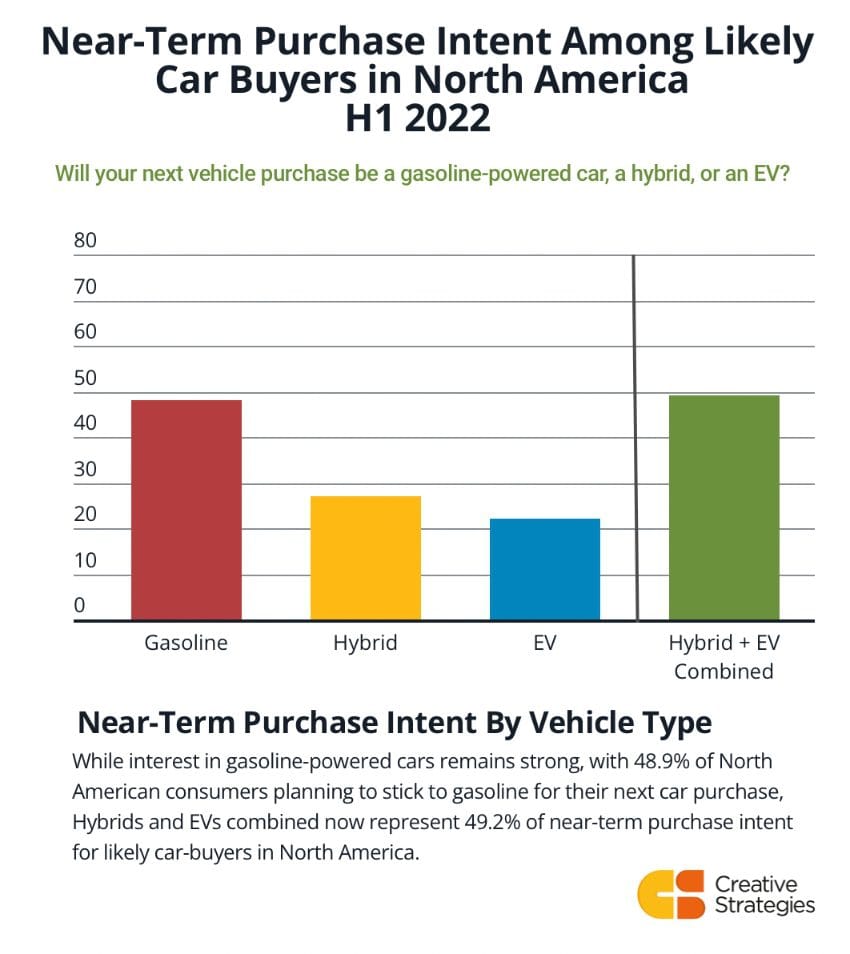
**Favorability For Hybrid Vehicles and EVs is Also Growing, Signaling Growth in Future Demand** Our research also shows that among the 48.9% of consumers who plan to stick to gasoline engines for their next vehicle purchase, 62.3% signal that they are open to owning a hybrid or an EV at some point in the future, just not right now. Reasons for putting off an EV purchase for now range from pricing friction and technology anxiety to concerns about range per charge and uncertainty about access to charging infrastructure. We plan to discuss these reasons in more detail soon, so keep an eye on this space. An additional bit of good news for automakers focusing on expanding their offering of hybrid vehicles and EVs is that 47.3% of likely car buyers have become more positive about hybrid vehicles and EVs in the last two years. In contrast, only 7.8% of likely car buyers feel *less* positive about hybrids and EVs than they did two years ago. The remaining 45.1% report that their opinions (positive or negative) have remained unchanged in the same timeframe.
To recap:
- Nearly half (47.3%) of likely car buyers in North America have become more positive about hybrid vehicles and EVs in the last two years.
- Nearly half (49.2%) of current likely car buyers in North America plan for their next vehicle to be a hybrid or an EV.
- Nearly 2 in 3 (62.3%) of likely car buyers whose next car will likely still be powered by a legacy gasoline engine are open to owning a hybrid or an EV sometime in the future.
Looking at these data points together, my three biggest takeaways for the automotive industry are:
1. Favorability towards hybrid vehicles and EVs among North American consumers has significantly increased in the last 24 months.
2. Growing favorability for hybrid vehicles and EVs continues to drive a shift in consumer demand in North America away from gasoline and towards more energy-efficient alternatives.
3. Purchase intent for hybrids and EVs combined now exceeds purchase intent for gasoline-engine cars among likely North American car buyers.
Taken together, these market signals are good news for automakers already working to increase hybrid and EV production to meet future consumer demand in North America, and help validate expectations of growing hybrid and EV demand. Additionally, these signals may, over time, help automakers gauge both the pace and degree to which they should realistically plan to phase out gasoline vehicles altogether in favor of more popular energy-efficient and ecologically-friendly alternatives. These insights barely scratch the surface of our research. Look for more analysis soon.
### New PlayStation Plus Subscription Makes It Easier To Find Value
URL: https://creativestrategies.com/new-playstation-plus-subscription-makes-it-easier-to-find-value/
Last updated: 2022-03-31T15:55:53.000Z
This week, PlayStation launched a new PlayStation Plus subscription, a simplified subscription service that brings together PlayStation Now and PlayStation Plus. Currently, the two subscription services combined have about 50 million subscribers, most of which subscribe to both services. In the past, users had to choose whether they wanted the streaming service offered by Playstation Now or the online multiplayer capability offered by PlayStation Plus and a handful of free games to download and keep. The new PlayStation Plus delivers a tiered approach to the service, making streaming available only in the Premium offering. Here is what you can get:
- **PlayStation Plus Essential** costs $9.99 per month (or $59.99 yearly). Players will get online multiplayer access, cloud storage for saved games and two games to download and keep per month. This matches what PlayStation Plus as it is now.
- **PlayStation Plus Extra** is $14.99 per month (or $99.99 yearly). It grants you everything in the Essential tier, plus access to a library of the “most enjoyable” PS4 and PS5 games for download.
- **PlayStation Plus Premium** brings together the other two tiers’ offerings and adds cloud streaming of PS3 games and streaming or downloading original PlayStation, PS2, and PSP games. At $17.99 per month (or $119 yearly).
Many are interested in making a comparison with Xbox Game Pass, which right now offers two tiers:
- **Game Pass** is $9.99 per month ($119 yearly), giving Game Pass access on a PC or console without support for multiplayer gaming. PC Game Pass subscription holders also get access to EA Play.
- **Game Pass Ultimate,** $14.99 per month ($179 yearly), unlocks Game Pass for Console, PC, EA Play offerings, and online multiplayer.
As tempted as we might be to compare the two services, the reality is that most consumers are not choosing where they game based on the subscription but based on the content and the devices they can use to game.
When it comes to streaming, PlayStation and Xbox see eye to eye. There is no question that streaming will play a big part in the future of gaming. However, as we have seen very clearly during the pandemic, today’s reality is that good connectivity is not yet ubiquitous, not even in the US. Fast broadband and higher data caps are also expensive. These two factors make associating streaming with the premium tier of the subscription the most logical thing to do. Of course, associating streaming with the premium tier also sets these platforms up for a better return on investment in the future, as running these services incurs higher infrastructure costs for them.
Where I see a marked difference is how these two platforms think about the relationship between subscription and content. It seems clear to me that Xbox sees content as driving value to their subscription. Microsoft wants consumers on Game Pass Ultimate, and even better if those subscribers also buy into Microsoft 365\. The future for Microsoft is about creating stickiness across all their platform through a value add of subscriptions that also drive additional revenue. Of course, this is easier to do so when you own your cloud to enable it all.
While many AAA publishers are reluctant to add their most recent releases to a subscription, there is an opportunity for further monetization that comes from in-game purchases, which the wider audience of a subscription offering might enable. In addition, including bigger titles to the subscription will also allow for better discovery and ultimately capture more players than those who would have invested in one-off game purchases.
PlayStation agrees with AAA publishers. In a recent interview with [Gamesindustry,](https://www.gamesindustry.biz/articles/2022-03-28-playstations-jim-ryan-our-games-could-suffer-if-we-put-them-straight-into-ps-plus?ref=creativestrategies.com) PlayStation CEO Jim Ryan explained:
> “We feel like we are in a good, virtuous cycle with the studios, where the investment delivers success, which enables yet more investment, which delivers more success yet. We like that cycle, and we think our gamers like that cycle. \[In terms of\] putting our games into this service, or any of our services, upon their release… as you well know, this is not a road that we’ve gone down in the past. And it’s not a road that we’re going to go down with this new service. We feel if we were to do that with the games that we make at PlayStation Studios, that virtuous cycle would be broken. The level of investment that we need to make in our studios would not be possible, and we think the knock-on effect on the quality of the games that we make would not be something that gamers want.”
While I understand first-party games have always been the pride and joy of PlayStation, I think consumers might be getting more critical about having to wait a couple of years to see the great content included in the subscription. After all, the video content streaming providers are getting them used to have great content as part of the subscription. For example, take Apple and their current lineup for Apple TV+ that now includes Oscar-winning CODA. Or Netflix and HBO Max, including home productions such as Bridgerton and Euphoria.
Considering Ryan also said, “All I’m talking to today is the approach we’re taking in the short term. The way our publishing model works right now doesn’t make any sense. But things can change very quickly in this industry, as we all know.” I am also confident that including PlayStation Studios game might be a question of making the numbers work. As the subscription numbers grow, the economics of adding PlayStation Studios games to it might just make more sense. The aggressive annual pricing for new PlayStation Plus subscriptions bodes well for attracting new users. In particular, the Premium tier offers PlayStation the opportunity to upsell current PlayStation Plus subscribers from the Essential Tier they will be on when the new plans kick in this June. If I am right, Ryan might be reconsidering the distribution of first-party games sooner rather than later.
### The Business Case for the Mac
URL: https://creativestrategies.com/the-business-case-for-the-mac/
Last updated: 2022-03-25T15:31:12.000Z
As a part of our broad research into the hardware and software tools that make up critical parts of employee experiences in businesses, we also looked deeply into the opportunity for Macs in the enterprise. Apple has had an interesting relationship with the enterprise. Most, if not all, IT professionals would tell you Apple does very little to satisfy the needs of most large IT organizations. Complaints often arise over support, hardware repair, device management, security protocols, etc. This friction has often been more the barrier for large IT organizations to fully embrace Macs in their companies than the higher price of Macs vs. many competing Windows notebooks and desktops.
Despite Apple’s entirely different and much more consumer-minded approach to the enterprise, Macs find themselves in use in many business settings. I spoke with several IT decision-makers at several companies, large and small, that had not fully embraced Macs, and even they admitted anyone at a certain level can get a Mac if they want. Even if a Mac is not on the menu for employees broadly, Macs are unofficially off-menu at most corporations as executives or other high-ranking employees can often get them.
**Apple Silicon Is Fueling the Business Case for the Mac**
Since the release of Apple Silicon, Apple has emphasized Mac’s growth and increased interest by enterprise customers to deploy Macs more broadly. Apple Silicon has undoubtedly contributed to Mac’s growth and enterprise interest. Since COVID and the supply issue Windows PCs faced, IT managers welcomed anything they could get their hands on, including Macs. Of course, small businesses have always been more accepting of Macs, mainly because they have a less formalized IT structure or rely more on third-party support, which they can pick and choose to include Mac support. As our conversations with Mac support vendors confirmed, the footprint in small and medium businesses is broader than most people think.
We have been interested in answering whether the environment for Macs in the enterprise could turn a corner and see more widespread acceptance by IT organizations and officially offer them to all employees. In our most [recent study of employee experience](https://creativestrategies.com/employee-experience-and-modern-it/) in a business setting, we discovered plenty of appetite by employees who wish their organizations would give them the options to use Macs. It was also interesting to notice that we found a correlation between panelists who were not planning to leave their job and their use of Mac at work.
There is mounting evidence that Macs are net positive to an organization when offered to employees. In 2019, a Forrester report revealed that the total cost of ownership is lower with Macs than with PCs in many cases. Since 2019, and the addition of Apple Silicon, you can make a strong case that the current Mac offerings have even more longevity and fewer issues than Macs in 2019, meaning the total cost of ownership story may be even stronger now. Forrester, even [updated their report](https://tools.totaleconomicimpact.com/go/apple/TEI/docs/TEI-of-Mac-in-Enterprise.pdf?ref=creativestrategies.com) to reflect the better total economics with M1 Macs. In talking with several large organization IT decision-makers who deployed Macs, they found fewer support tickets by Mac owners and generally fewer issues overall with employees on Macs than with other platforms. In some cases, IT managers I spoke with indicated Macs even being easier to manage when Apple’s platforms, iPhone/iPad, and Mac were managed separately from Windows and Android devices using third-party services like [Jamf](https://www.jamf.com/?ref=creativestrategies.com) or [Kandji](https://www.kandji.io/?ref=creativestrategies.com).
The more I talked to IT managers in organizations with a hybrid OS environment, the more it became clear there are very strong opinions on whether management should be done with a single pane of glass or OS-specific tools. The debate was around a single pane of glass where one management software platform managed devices of all platforms, or whether it was better to manage Macs/iPhones/iPads separately in their environment built specifically to manage iOS and macOS. For example, both Jamf and Kandji offer dedicated platforms for IT to handle the MDM of Macs and customize their internal process, software, and security measures around Macs. Interestingly, I found larger enterprises tended to skew toward the separate management platforms of Macs and Windows devices, and smaller businesses tended to lean toward the single pane of glass solution.
**A Growing Ecosystem of Mac Management Software and Services**
Where this environment starts to reveal potential momentum for Macs is the number of third parties building specific solutions to manage Macs. I mentioned Jamf and Kandji, but other companies like Moysle and Jumpcloud are rising in popularity by making it extremely easy for organizations to add Macs to their companies. Apple’s lack of a first-party solution to manage their devices has always been criticism from IT and the fuel for the perspective that Apple doesn’t care about the enterprise. Microsoft offers robust tools to IT departments to manage Windows devices. But companies like Jamf, Kandji, [Moysle](https://mosyle.com/?ref=creativestrategies.com), and [Jumpcloud](https://jumpcloud.com/platform/mdm?ref=creativestrategies.com) have risen up and done what Apple has not for larger enterprises.
The recent announcement of Apple Business Essentials is the first step by Apple to provide management services of Apple hardware. ABE includes some important features beyond just MDM like storage, support, and repairs. However, it has some limits as far as how much it can help Apple grow its Mac market share in the enterprise. First, it is only for smaller businesses, which I believe is smart given the volume of small businesses deploying Macs. Second, Apple Business Essentials is great if you are 100% Mac organization, but that is not exactly common. Search any organization, large and small, and you will always find finance people who will never give up their Windows PCs. Given the insight we found that small businesses favor the single pane of glass management solution which creates a potential challenge for ABE to scale broadly.
Lastly, a rising number of third parties offering IT outsourcing or white glove assistance helps businesses large and small get up and running, bringing Macs into their organization. The growing third-party ecosystem for supporting Macs in enterprises would not be flourishing if there weren’t increasing demand to bring Macs into their organization.
**The Door is Opening for the Mac but Not Fully**
The business market is crucial for Apple’s Mac business to see double-digit growth consistently. And the fuel for the growth for Mac is larger enterprises. Small businesses have much more open arms for Macs, but large enterprises are where the scale of Apple’s Mac business can be found. Apple is the oddity amongst all the top notebook/desktop OEMs where the vast majority of Apple’s Mac sales are to consumers. But in the case of HP, Dell, and Lenovo, the vast majority of their sales are to enterprises. Most of them sell more PCs to enterprises than Apple sells Macs in total each quarter.
IDC estimates Macs have roughly 24% share within US enterprise installed base of notebooks/desktops. Of course, a good portion of that is likely small businesses, but it demonstrates the headroom for growth the Mac has among businesses, which would fuel the growth of the Mac business.
Apple still has hurdles to clear with large businesses. The main one is hardware servicing/repair. Other hurdles include volume discounts, multi-country purchases, and organizations with legacy software/platforms that are not yet optimized for Macs. There is also a knowledge gap, even if perceived, for many IT departments. Lastly, in many large organizations, there are stringent security protocols that have been established and standardized around Windows. Apple has made great strides in evolving macOS to meet these security protocols, but the IT decision-maker is no longer the sole customer Apple has to appeal to. The security department has entered the scene and has increasing influence in what hardware is deployed in their enterprise.
Ultimately, our research revealed the environment for Macs is drastically different than it was three to four years ago. An ecosystem has emerged and matured that is breaking down barriers that used to exist for Macs to be fully embraced by businesses. As a result, the Mac business has room to grow if Apple continues to make meaningful advancements with macOS it could only be a matter of time before the widespread acceptance of Macs in business.
### Best Product Beats Best Bundle
URL: https://creativestrategies.com/best-product-beats-best-bundle/
Last updated: 2022-03-16T16:14:14.000Z
Conventional wisdom in software, especially in enterprise software, is the company that sells the most robust bundle will generally see the apps in that bundle become the default for customers. This has historically been proven true time and again by Microsoft. This was the basis of their main antitrust lawsuit when it became unlawful for them to bundle Internet Explorer with Windows. Even though it was inferior to Netscape in many ways, bundling IE with Windows made it logical for most people. The same wisdom has been applied to Microsoft 365/Office and that the apps in the Office bundle are more likely to be used by customers than any stand-alone piece of software. This has been the thesis for many when we look specifically at Microsoft Teams. It is believed that because Teams comes along with Windows 365, it was likely to be the default meeting, chat, and collaboration hub for most people. Results from our latest research study on workplace tools and collaboration software indicate that this is partly true and partially not true. Our employee productivity tool and collaboration study, now in its third iteration, has surfaced insights into the tools people use to be productive in their jobs and collaborate with their coworkers. One of our main takeaways from last year’s study was how employees in an organization used a diverse set of productivity tools, often going across different suites of bundled apps. We saw organizations paying software licenses for a range of software tools and giving employees the options to use whatever solution they and their teams see fit. Each study we have run has confirmed a fascinating overlap of usage of bundled software. For example, we saw teams using Google Docs to collaborate and edit a document and then move to Microsoft Word to format and structure that document in ways that fit their end goals. We saw employees using Zoom for video and simultaneously using iMessage to text with team members in real-time. These were just a few examples of many where employees used various tools, not just one bundle of software tools, to be productive and collaborate effectively. This mix and match of workflows seemed odd at first but then made sense when put in the context of people using the best tool for the job at any point in their workflow to get the best result most efficiently. Our most recent study yielded another example of mixing and matching tools but also brought along a clear observation that the bundled package of software doesn’t always win when another product does a better job at a task than one offered in the bundle. But, effectively, the better product will win—case in point, Microsoft Teams vs. Zoom for video meetings. We observed a fascinating overlap of users of Zoom and Teams in our study. Zoom was the most used video meeting platform per the chart below, while Teams was the most used workplace chat platform. This was surprising initially as we looked over the data. Why would people standardize on Teams for chat and not use Teams for video meetings? Especially since employees know that chat is used synchronously during video meetings. This behavior means many employees are messaging each other on Teams while on a Zoom video meeting. Given that Teams does video meetings, the only explanation for this behavior is that more people prefer Zoom for their video meetings and have vetted it as the superior video meeting platform of the two. At the same time, Teams Chat is much more robust because of its richness, deeper integration with Office, and integration with the company backend. In this case, and for a large portion of our respondents, the better product beat the similar one that was included in the software bundle. We did notice some nuance here based on the size of the business. Larger enterprises *(1000+ employees)* were more likely to use Teams for video and chat, but Zoom was still the video meeting leader even with large businesses. Small businesses *(250 employees or less)* were more likely to use Zoom for video meetings and Zoom chat or Slack to collaborate via chat. Regardless of business size, a diverse set of options and mixing matching tools remained constant. Are the days of the bundled software approach over? Of course not. But the days of assuming bundled software offers advantages to the company providing it when it comes to new apps or services is likely over—for Teams, making the video meeting part of the experience more integrated into the full synchronous collaboration experience could be a way to gain back those Zoom users. While the bundle is convenient, each piece of software has to compete on its own merit in the new enterprise world where a wide variety of software tools will be offered to employees for them to choose what works best for their and their team’s workflows. This bodes well for competition, particularly for enterprise software startups. Companies may have struggled more against an incumbent software bundle in the past. But knowing that the existence of a similar solution in a bundle does not necessarily guarantee its victory is encouraging for challengers looking to improve an experience with their solution. The trick is to be blessed by IT and be presented on the menu of software tools supported within the organization. While this is no easy task, just as Slack, it is essential for scale. But the point remains, the better product, or the better product experience, will win because at the end of the day, people want to use the easiest, most efficient, and least time-consuming solution to get their job done.
### Apple Silicon: Ultra Clever
URL: https://creativestrategies.com/apple-silicon-ultra-clever/
Last updated: 2022-03-14T20:55:24.000Z
I have been arguing for years, and I will die on this hill. Apple silicon remains one of the most innovative products Apple creates on an annual basis. You may disagree with the framing of Apple silicon as a product, but knowing Apple as I do, they view almost everything they create as a product even if it is an ingredient like Apple silicon. Saying Apple silicon is innovative or the most innovative does not take away from product innovations that come to iPhone, iPad, Mac, AirPods, etc. Still, it recognizes the amazing science that goes into silicon design and how difficult it is to truly innovate around silicon. Viewing Apple silicon as a product also helps us better understand how it is a differentiator for Apple for every product they release with Apple silicon inside. To quote Tim Cook, “Apple silicon helps us create products we could not imagine before.” For example, during the Mac part of the presentation, Apple’s speakers went out of their way to emphasize how Apple silicon has transformed the Mac and insinuated it was a contributing factor to Mac’s record-breaking quarters and growth outpacing the PC industry. I have long believed that Apple could not truly build the Macs they wanted until they put their silicon inside, and I am more convinced than ever that is true. Before I dive into the M1 Ultra and its significance and potential foreshadowing of future Apple processors, I want to emphasize what Apple’s goal, architecturally, is with their silicon strategy. It should be no secret because executives from Tim Cook to Johny Srouji repeat this phrase that Apple’s design ambition is to lead the industry in performance per watt. Other companies may create laptops or workstation SoCs with more performance than Apple’s, but Apple’s goal is to beat them in performance per watt. Competitors may come up with SoCs that have longer battery lives than Macs, but they won’t have the performance and battery life of a Mac. We can not fully analyze Apple silicon and its role in Macs without always bearing in mind **Apple’s goal of leading in performance per watt.** **Enter the Ultra**
Apple’s commentary during the event was their newest chip is the last chip in the M-Series family which now consists of M1, M1 Pro, M1 Max, and M1 Ultra. The M1Ultra is the newest edition and perhaps the most clever design that also does some future signaling of Apple’s architecture evolution. With the family now set, we can expect the next M-series family to be M2, M2 Pro, M2 Max, M2 Ultra, and so likely an annual cadence. But the M1 Ultra does something extremely clever that gives Apple a number of interesting advantages architecturally. M1 Ultra is, to my knowledge, the first die-to-die or monolithic SoC to Monolithic SoC implementation. Apple calls the architecture they used to fuse these two chips together UltraFusion. Apple used a technique using an interposer at the substrate level as well as the silicon package itself to allow for 10,000 connection points, thus rendering two M1 Max chips as one single monolithic SoC. This approach allows the software to see only one SoC but leverage all the CPU cores and GPU cores as if it was a single chip rather than two. Remarkably, this approach is potentially more power-efficient than if Apple simply designed a new SoC the die size of the M1 Ultra. This technique also offsets many of the challenges in developing a single monolithic SoC the same size as M1 Ultra. Apple’s own charts show that M1 Ultra is still extremely efficient from a performance per watt standpoint. Fusing these SoCs together leverages the efficiency of the M1 Max design and combined gets double the performance with approx double the power consumption. Again, it underscores Apple’s efforts to be the industry leader in performance per watt. **Where this gets really interesting to me is how Apple is starting to innovate at the package level of silicon, not just the architectural level of design**. This is extremely relevant because as leading-edge process nodes slow or become harder to achieve on a predictable cadence, the packaging will start to matter more to get additional gains and efficiency on all performance vectors per watt. This approach helps Apple on several fronts. It gives them a solution for when semiconductor foundries hit a wall with process technology. While it seems clear, 3nm is achievable, there are still question marks on the most efficient way to get to 2nm and even more questions for 1nm and beyond. There is a real chance the predictable cadence of process technology Apple has seen from TSMC slows significantly after 3nm, and nearly inevitable that getting beyond 3nm continues to increase in costs. By having an approach, as Apple has taken with M1 Ultra, Apple has come up with a way to hedge against process node advancement slowdowns/challenges and the rising costs of leading-edge processes. While I can’t confidently say Apple will take this approach with future SoCs in the family beyond the Ultra, it certainly gives them the option to apply this approach to future M Pro or M Max SoCs and have longevity both at a current mature process node as well as the economics of mature nodes. **Foreshadowing and Competition**
While we are on future speculation, having this design and package innovation on hand would stop Apple from leveraging this die-to-die design and connecting more than two SoCs? For example, could M2 Ultra have four M2 Max’s connected via UltraFusion? And suppose this architecture design does continue to be highly power efficient. In that case, it could make more sense to leverage this approach frequently and reap the rewards of the dramatic increase in performance per watt it delivers. So what does this mean for the competition? Well, it presents a challenge. Nearly every academic article on the use of silicon interposers points out that this approach favors vertically integrated players. This does not rule out someone like Intel, AMD, or Qualcomm to take this Approach if needed but they are likely to hit a wall at the end-product level. Apple’s advantage is that they design all the core silicon bits but also make the products that silicon goes into. Apple’s verification process is quite different from silicon competitors’ verification processes who have to support a much wider range of products. Intel, AMD, or Qualcomm can take this approach, but the same advantages Apple gets as a much more fully integrated player will not all extend to others in the same ways. Where it makes sense for Apple to take this approach, it may not make the same sense for their competition. Not too long ago, people speculated the Mac was dead, or a forgotten product. People ranted that Apple has abandoned creative and studio professionals. Looking back, it seems Apple was just waiting on Apple silicon to fully execute their vision for the Mac and build the laptop and desktop computers worthy of their customers.
### Apple’s Peek Performance Event Delivers to the Pros and the Mainstream
URL: https://creativestrategies.com/apples-peek-performance-event-delivers-to-the-pros-and-the-mainstream/
Last updated: 2022-03-09T21:00:41.000Z
Apple’s Peek Performance event had something to offer to the most tech-savvy users, creators in particular, as well as mainstream users. Underlining the move to take ownership of its own silicon development is now allowing Apple not only to take care of its highly differentiated user base but to get into new markets and opportunities to both strengthen that base and reach into new areas like the enterprise market. I will let Ben Bajarin get into the technical and business implications of the new M1 Ultra chipset, probably the event’s biggest surprise. I will instead concentrate on how Apple is deliberately addressing the more pragmatic part of its user base with devices that open access to features, services, apps and what the ecosystem has to offer without overwhelming users or their wallets. Let’s start with the **iPhone SE**. Probably the safest bet among the devices the rumor mill was expecting from the event, the iPhone SE is the iPhone model that Apple does not need to refresh every year, but what I have come to think of as the “catch-up” model. This is the iPhone that allows Apple to get the most pragmatic part of its user base to upgrade as well as the device that might be the first foot in the door to the Apple ecosystem. **Many often equal the value of the iPhone SE to its compact form factor. Yet, while that might have been true to start with**, **the addressable market for the iPhone SE has grown to include late adopters who value a good balance between price point and features**. There are also users of older iPhone models like the iPhone 6, 7 and 8 that were not considered small when they first became available, but that might make an upgrade to an iPhone 13 uncomfortable. Newer models with features like face ID might be something that takes away from the familiarity of Touch ID. With the iPhone SE, **users can find familiar and future-proof technology** like 5G or a vastly improved camera system that, while on a single lens, can take advantage of the latest chipset for features like portrait mode. At $429, the iPhone SE comes into the least talked about but competitive segment of the market that carriers are counting on to move users off of LTE and onto 5G. Contrary to most Android brands that opt to step down on their chipset choice in mid-range phones both for cost and battery life, **Apple uses its latest chipset in the iPhone SE, the A15 Bionic, which will also future proof the phone as new software features roll out. Interestingly, by using the latest chipset, Apple does not limit what users can do when it comes to services and most apps while Android brands seem to decide there is a limit to what a user buying a mid-range phone will need. Considering almost all Android phone makers are hardware makers and not also ecosystem enablers, this makes sense. Why add cost when the result will benefit others? But for Apple, there is more monetization opportunity from these users.** The new **iPad Air** lineup was also expected. What we might not have anticipated; I certainly didn’t expect it was for the iPad Air to be running on an M1 chip. **Apple clearly is not precious about limiting the power of the M1to the iPad Pro family, but instead is using the power of the M1 to increase the return on investment for mainstream products** such as the iPad Air by driving features such as Center Stage and smoother multitasking to create more stickiness. The time is certainly right as the tablet category seems to be having a revival of its own, albeit not as strong as that experienced by the PC market. With more of our workflows now being digital, we seem to be relying on more screens, some of which we dedicate to specific tasks from video calls to content consumption or gaming. Apple has enjoyed a very healthy demand for iPads, especially at the start of the pandemic and the portfolio with a **refreshed iPad Air opens up more opportunities with frontline workers and higher-ed segments where that much of functionality is needed, but the price point limits the opportunity for the iPad Pro and family**. The least expected product launched at the event was a new 5K display introduced together with the latest Mac Studio. As I was listening to the presenter list the features of the **Studio Display**: 27-inch, 5K, up to 600 nits of brightness, six-speaker, an A13 chip, built-in three-mic array all I could see were Dollar signs. Considering the last display Apple introduced in 2019, the Pro Display XDR was priced at $5K. I expected the Studio Display to be in the $2500-3000, and I was surprised to see a price point of $1599\. But **if you think about the reach that this new display could have within the current Mac installed base, you can see how critical that price point becomes**. Not just because of the volume of sales per se, driving revenue for Apple, but really how this product could free other products like the newest iPad Pro family to be more than they have been thus far. **For those always ready to criticize Apple for putting larger profits over volumes, it is clear that Apple knows when to favor one of the other.** **This is the first time that Apple addressed the two ends of its user base during the same event going from the most pragmatic buyers of an iPhone SE to the most tech-savvy and demanding Apple users who will consider a Mac Studio. Its fast pace of development on the silicon side allows for the features to cascade down or scale-up, and its brand is able to stretch from one side to the other without feeling out of place or getting hurt. I made these points before, but it is worth doing it again. As services become a more significant part of Apple’s revenue, we will see pricing strategies that will fuel almost a co-dependent relationship between hardware and services where the line is blurred as to what is driving value to what, thus making it much harder for users to leave Apple.**
### The Power of Technology Sanctions
URL: https://creativestrategies.com/the-power-of-technology-sanctions/
Last updated: 2022-03-07T19:48:22.000Z
As we look on and observe the absurdity of what is happening with Russia invading Ukraine, it has been fascinating to see most of the world power unite against a foreign power acting badly. I recall commentary from world leaders when Russia attempted to invade Georgia, and the message was clear that countries don’t invade other countries in the modern world. Yet, here we are as Russia attempts to expand its empire and world power again. There are many learnings from this war from the critical role of the internet to keep people informed and the threat of censorship to smartphones documenting yet again critical life moments. What is different this time around, and the observation I’d like to make is the role of the technology industry and the private sector in crippling Russia’s ambitions. Sovereign nations uniting together will enforce sanctions by using the resources available to freeze assets, impact trade, and other strategies to weaken the bad actor. But what is fascinating about this particular conflict is the power the private sector, and largely big tech and beyond, have to use their influence and power to cripple the efforts of the bad actor dramatically. Private industry companies providing critical goods and services are unanimously stopping doing business with Russia. The impacts could be dramatic such technology sanctions led by the private sector have the chance to do more damage in thwarting Russia’s efforts than any efforts by governments. In the past, it was not uncommon for the private sector to join forces with defense departments in times of war, usually at a contractual level, to provide the technology needed to win the fight. What we observe today, however, is the evolution of something akin to the United Nations but with technology companies rather than countries uniting to cut off access to their goods or services to an aggressor – in this case, Russia. This echoes basic principles of siege tactics, in which forces surround a city and cut off its trade route access, thus denying any goods to enter the city. This tactic has historically been used to cut off food from a city or nation, but we are now witnessing how the cutting off of critical technology to a country may achieve the same ends. What is developing is a new world of influence and power-driven by technology and technology companies. Most companies and many not asked by their governments have gone above and beyond by cutting Russia off from their goods and services and doing what they can to help Ukraine. The list of technology companies playing some role in cutting off Russia is now well over two dozen. Another fascinating example has been SpaceX leveraging its massive satellite network to help Ukraine monitor Russian forces and provide valuable intelligence. Many companies, including Apple, Microsoft, Google, Netflix, and Samsung, are stopping sales of their products in Russia. An interesting tactic and one that can impact the underlying economy but will have more of an impact on citizens of the country than anything else. One interesting angle here is how this strategy could create more unrest among citizens who are frustrated with their government’s actions and create a wave of waining support or lack of confidence in their leaders and their actions. Interestingly, the companies that can damage Russia are companies that provide critical components or infrastructure to a country. Particularly, semiconductor companies, like Intel, AMD, Samsung, and TSMC have announced cutting off-chip and component supply to Russia. This can do some real damage to Russia’s cloud computing infrastructure and the vast need to maintain military equipment, oil refinery equipment, etc., which all require microprocessors, sensors, controllers, memory, etc. By being cut off technologically in this way, it could significantly cripple Russia’s continued efforts of invasion and impact the Russian economy in even more profound ways than anticipated. Recognizing the power private industry technology companies have to cut off cutting-edge technology to a nation essentially could cause many countries to accelerate their technological sovereignty, which means their government-funded efforts to be self-sufficient to produce essential technology on their soil. Nearly every major nation understands the need for technological sovereignty, and in many ways, their efforts are as much offense as they are defense from a strategic standpoint. From a US perspective, this is why it is so important to be producing a wide range of semiconductors on US soil. But it seems more nations understand their weakness when it comes to reliance on companies in other countries for cutting edge semiconductors and other vital components and are continuing to invest in local manufacturing of critical technology. The importance of technology to the world, and as something that is at the underlying fabric of society, can not be understated at this point. **This moment could be something of an inflection point, and perhaps a warning, of the power of private industry to go above and beyond any governments efforts to aid in war or thwart war and ultimately become a critical component of helping keep the peace–in other countries as well as their own.**
### Considerations on Mobile World Congress 2022
URL: https://creativestrategies.com/considerations-on-mobile-world-congress-2022/
Last updated: 2022-03-04T15:52:40.000Z
Mobile World Congress 2022 came to an end today, and it seemed like a big success, mainly for people’s spirit and morale. The GSMA released preliminary attendance numbers at around 60,000, roughly half of what was recorded in 2019, the last time the industry came together before Covid. The combination of people’s strong desire to return to normalcy as well as the need, especially for smaller companies, to have the opportunity to showcase their capabilities will continue to make shows like Mobile World Congress a success. Talking to some of my colleagues on the ground, it seems that what was already a show that thrived on closed-doors meetings doubled down on personal connections, which is what I expect most events to be doing post-Covid. Personally, I think the GSMA missed the opportunity to make the show even bigger by keeping the online portion of the show as strong as possible. Unfortunately, when it came to the conference sessions, the majority were offered as in-person only and did not cater to an online audience. I understand the desire to bring people together. Still, if there’s something that we’ve learned during the pandemic about democratizing access through technology, it is that you can expand your audience through online experiences that add to the in-person ones. Let’s switch to the announcements that took place at the show. The show that has always been more focused on telcos and business felt even more so this year. The combination of some consumer products like PCs and smartphones been announced before the show, to make sure that they got the most attention resulted in most announcements at the show being focused on network optimization, future technologies such as 6G and Wi-Fi7 and enabling businesses to harness what is here today from 5G to Cloud. We are also at a time when what has been the star of the show for quite a few years, 5G (in fairness, way earlier than it needed to be), has finally moved on from smartphones to connecting devices and experiences that drive a much bigger vision. From connected cities to cars to the cloud. While 5G is well established, most consumers have yet to experience it, which makes talks about 6G a tad premature. Fortunately, it did not feel that brands were hyping that, and more time was spent talking about 5G network optimization for both consumers and enterprises, public and private. And while we might smile or roll our eyes at the mention of 6G, there are a couple of things worth bearing in mind. First, the world is headed to be more and more digital. The Metaverse, which has been mentioned several times throughout the week, will require connectivity no matter how you think of it. While that connectivity is Wi-Fi7, 5G or 6G will depend on location, network coverage and cost. But there is no question that the world will need more connectivity, not less. In the meantime, we talk about optimizing networks and infrastructure, of devices working more together to deliver a better user experience. Second, the transition from 5G to 6G will be more evolutionary in nature than that from 4G to 5G, which might result in a shorter time to market as business models are being worked out now. It also felt that the show was also relatively light on American participants, still due to some of the travel complexities. This meant we didn’t have many consumer brands that we have recognized in the past, such as Meta and Netflix or that brands like Google had a smaller presence. Interestingly cloud vendors such as AWS had a considerable presence at the show, possibly pointing to the fact that it mainly was consumer brands that stayed away possibly because of the more challenging European regulatory environment. Of course, the economy and the recovery from Covid-19 also require a bigger focus on business, both from how companies have evolved during the pandemic and new opportunities that digital transformation has opened up for businesses. The show was clearly also a bridge between two realities: the pandemic and the promise of crypto, Metaverse and NFTs. Especially from a devices perspective, we saw PCs in the limelight following the resurgence experienced in the pandemic and the desire for OEMs to keep the momentum with the introduction of devices that fit hybrid work and a higher volume of digital workflows. It was interesting that Huawei had a dedicated e-ink device that was e-reader and notepad, the MatePad Paper and TCL had the NXTPAPER MAX10 offer a paper-like canvas to accommodate drawing and note-taking. What we did not see much of, at least from a news perspective, were VR and AR glasses raising the question of whether we will have another chicken and egg phase for the Metaverse like what we initially had with VR. Then we asked whether we needed more apps to drive hardware sales or better hardware to drive content creation. Now we might wonder if we need to build the Metaverse before major hardware investments are made or if we need to start with hardware to open the door to the Metaverse. Or maybe the market is waiting for Apple at the end of this year and reset from there? If I had to pick winners and losers of the show, I would certainly say the people and the industry won, but there was not a clear brand or theme that won. It was clear to me that the current geopolitical environment and the great suffering from the pandemic have put some sense of sobriety on what many companies have been focusing on. This meant that we saw a greater emphasis on big societal issues and how technology can help address them. Top of the list was sustainability, connecting the unconnected and driving digital equity. I look forward to MWC23 in person!
### Qualcomm’s Diversification Strategy Takes Shape at MWC22
URL: https://creativestrategies.com/qualcomms-diversification-strategy-takes-shape-at-mwc22/
Last updated: 2022-03-04T03:16:03.000Z
Every year, the Mobile World Congress in Barcelona provides the perfect setting for technology companies and their partners to showcase innovative new solutions that leverage the mobile ecosystem to help solve problems, create new categories of services, and transition industries forward. If exhibitors can also differentiate themselves from their competition by creating unique value, more power to them. Companies large and small all get a shot at proving their worth and making their mark, which makes the event so important to keep an eye on.
For Qualcomm, the event is usually a chance to follow its December Snapdragon Tech Summit with some new connectivity solutions and upgrades, announce its latest partnerships, and reiterate its overall strategy. But this year, bucking convention, Qualcomm entered the chat with a barrage of [pre-show announcements](https://www.qualcomm.com/news/media-center/press-kits/mwc-barcelona-2022?ref=creativestrategies.com) almost too numerous to list. These announcements, which Qualcomm CEO Cristiano Amon somehow managed to cover [in just under sixty minutes](https://www.youtube.com/watch?v=w0xQzJZ1fm4&ref=creativestrategies.com), ranged from an assortment of new product releases to a dizzying bevy of industry partnerships spanning half a dozen mobile-adjacent markets. At first glance, Qualcomm’s unusual volume of announcements might seem a tad overwhelming, perhaps even a bit fragmented, but it all makes perfect sense once you are able to see it all through the lens of the company’s [*One-Technology Roadmap*](https://www.qualcomm.com/news/releases/2022/02/28/qualcomm-showcases-future-technology-roadmap-drive-connected-intelligent?ref=creativestrategies.com), which Amon articulated during its [Investor Day event](https://www.youtube.com/watch?v=rUWPzROYn2E&ref=creativestrategies.com) in New York this past November.
Qualcomm’s new gambit involves a $700 billion market opportunity laid out over the next decade, which the company has positioned itself to address by way of its highly versatile and adaptable Snapdragon platform. Key growth vectors for Qualcomm, in what essentially amounts to a 7x growth plan over the next 10 years, naturally include Mobile, but also expand into computing, automotive, AI, XR (combining AR, MR, and VR), the broad IoT, and the increasingly critical RF Front End (RFFE) market.
Initially best known for its leadership in the Mobile industry, Qualcomm quietly started pivoting more aggressively towards diversification over the course of the last few years, but under Cristiano Amon’s leadership, that pivot has become the company’s core strategy for growth. At its center is the Snapdragon platform, which combines low-power, high-performance computing with a full array of premium end-to-end connectivity solutions, all of which can be adapted to a broad range of use cases and mobile-adjacent sectors. Qualcomm’s announcements this week mostly addressed seven core markets that are key to the company’s diversification strategy:
- Traditional mobile
- Computing (specifically next-gen connected Arm-based PCs)
- XR/VR/AR (the metaverse)
- Infrastructure (modern wireless networks)
- Automotive (Qualcomm’s vision for what it calls the Digital Chassis)
- Wireless Fiber (Wireless connectivity matching fiber performance)
- Industry 4.0 (the IIoT and smart logistics)
Note that although many of Qualcomm’s growth opportunities now live outside of Mobile, the company’s One-Technology Roadmap doctrine is still driven by innovation sprouting from Qualcomm’s core Mobile business and being adapted to adjacent markets. (Great way for Qualcomm to maximize R&D, shorten time to market, and make the most out of its legion of Snapdragon features.) It is therefore not surprising that Qualcomm’s first major announcement focused on its new 5G modem-RF solution, the [Snapdragon X70 5G](https://www.qualcomm.com/news/onq/2022/02/28/snapdragon-x70-powered-worlds-first-5g-ai-processor-pushes-smarter-faster-5g?ref=creativestrategies.com), which sports the world’s first 5G AI processor built right into a modem-RF system. Bringing AI right into modem-RF systems makes sense now that AI is becoming increasingly critical to the optimization of features like mmWave beam management, adaptive antenna tuning, and power consumption. Case in point: the X70 also introduces Qualcomm’s new 5G AI Suite, which provides sub-6 GHz and mmWave 5G optimizations to deliver speed, latency, link robustness, coverage, and power efficiency improvements. These innovations, though initially designed for mobile devices, have an extremely high likelihood of finding their way to other use cases, from connected PCs, XR, the IoT, and the automotive space, to what Qualcomm refers to as the connected intelligent edge. That’s how Qualcomm’s One Technology Roadmap essentially forms the building blocks of its platform play.
Another example: Qualcomm also took the opportunity to bolster its overall portfolio of wireless connectivity solutions with the introduction of [FastConnect 7800](https://www.qualcomm.com/news/onq/2022/02/28/mwc-2022-qualcomm-fastconnect-7800-makes-wi-fi-7-and-next-gen-bluetooth-audio?ref=creativestrategies.com), which brings Wi-Fi 7 specs, significant Bluetooth audio advancements, and ultra-low latency to Wi-Fi. One of the key features being introduced is High Band Simultaneous (HBS) Multi-Link technology, which improves the performance and value proposition of Qualcomm’s Snapdragon Sound, Bluetooth LE Audio and Bluetooth 5.3 in four ways: by extending connection range, by making Bluetooth connection transitions between devices smoother, by enabling devices to deliver reliable CD lossless quality wireless audio, and by reducing Bluetooth power consumption. Great stuff, but it gets better: Now, think about all the possible use cases for FastConnect 7800 in phones, PCs, XR, IoT (wireless speakers and headphones, for example), gaming, and the automotive space. Here again, we see how Qualcomm’s One-Technology Roadmap consistently finds its way to every key vector of growth to help drive and scale the company’s diversification strategy.
Some vectors require their own hybrid approaches and strategies, however. Take Qualcomm’s [next-gen ARM-based PC opportunity](https://www.qualcomm.com/news/onq/2022/02/28/connected-enterprise-snapdragon-redefines-computing-modern-enterprise-mobile?ref=creativestrategies.com), for instance. On the one hand, Qualcomm’s focus on [enterprise ecosystem expansion](https://www.qualcomm.com/news/releases/2022/02/28/qualcomm-expands-snapdragon-compute-ecosystem-next-generation-enterprise?ref=creativestrategies.com) with partners like [Microsoft](https://www.qualcomm.com/news/releases/2022/02/28/qualcomm-collaborates-microsoft-transform-enterprise-connectivity-end-end?ref=creativestrategies.com) doesn’t directly speak to automotive opportunities (yet) but does draw on the company’s success with and investments in adjacent areas of focus like network, wireless fiber, and semi. On the other hand, Qualcomm’s One-Technology Roadmap is more clearly visible with its partnership with Lenovo. The latest example of this is Lenovo’s new work-from-anywhere [ThinkPad X13s,](https://creativestrategies.com/content/files/www-qualcomm-com/media/documents/files/thinkpad-x13s-gen-1-datasheet.pdf) built on Qualcomm’s [8cx Gen 3 compute platform.](https://www.qualcomm.com/products/snapdragon-8cx-gen-3-compute-platform?ref=creativestrategies.com) That platform draws on Snapdragon’s premium Mobile performance and engineering to deliver multi-day battery life, 5G mmWave connectivity, advanced camera and audio performance, and end-to-end security to enterprise-class Arm-based laptops. And in a world where Qualcomm’s x86 competitors are still battling over performance per watt, Qualcomm is differentiating itself by not only competing on performance per watt, but by *also* competing on connectivity, imaging, and audio because it can. Here again, we see how Qualcomm’s ability to adapt its Mobile expertise to the needs of another market segment and create value there, is the company’s secret sauce.
Qualcomm’s partnerships with Microsoft and Lenovo in the PC space also open the door to a cross-pollination of XR and PC solutions that are very likely to lead to a merging of XR and PC capabilities. In other words, augmented computing (laptops being used with VR and AR headsets) is coming. Qualcomm is especially well-positioned to help drive (and capitalize on) that technological shift because its One-Technology Roadmap approach to innovation and growth is the foundation upon which Qualcomm is able to already innovate and support industry partners simultaneously in the PC space *and* in the [XR space](https://www.qualcomm.com/news/releases/2022/02/09/qualcomm-expands-investment-xr-and-metaverse-formation-xr-labs-europe-xr-rd?ref=creativestrategies.com).
Qualcomm’s [latest automotive announcements](https://www.qualcomm.com/news/releases/2022/02/28/qualcomm-unveils-new-snapdragon-digital-chassis-connected-car-technologies?ref=creativestrategies.com) follow the same trajectory: the newly announced Connectivity-as-a-Service (CaaS) offering is made possible by Snapdragon’s existing Car-to-Cloud Services, integrated analytics, and on-device and cloud-enhanced apps/services. The combination of Wi-Fi 6E four-stream DBS and Bluetooth 5.3, which promise to deliver faster Wi-Fi speeds and increased bandwidth for connected applications and services in the automotive sector, can be traced back to the Snapdragon mobile platform. Every announcement from Qualcomm at Mobile World Congress this week, from its [smart grid collaboration with Gridspertise](https://www.qualcomm.com/news/onq/2022/02/28/qa-robert-denda-ceo-gridspertise-accelerating-digital-transformation-electric?ref=creativestrategies.com) and[ partnership with Bosch](https://www.qualcomm.com/news/releases/2022/02/28/qualcomm-and-bosch-rexroth-showcase-industrial-automation-time-synchronized?ref=creativestrategies.com) in the Industrial 4.0 space, and its collaboration with TikTok parent ByteDance in the XR space, to its private 5G network partner program announcement, perfectly fits into the company’s One-Technology Roadmap for growth.
Qualcomm’s cascade of announcements at Mobile World Congress this week makes perfect sense once you understand the company’s broader strategic shift. Properly decoded, what we are seeing is Qualcomm’s market diversification strategy, propelled by its One-Technology Roadmap, playing out at scale in real-time. And based on the breadth of announcements this week, only a few short months since Qualcomm’s Investor Day presentation in New York, Cristiano Amon’s plan already appears to be off to a solid start.
### Beyond VR and AR: Why The Real Metaverse MVPs Will Be Silicon Companies and Cloud Providers
URL: https://creativestrategies.com/beyond-vr-and-ar-why-the-real-metaverse-mvps-will-be-silicon-companies-and-cloud-providers/
Last updated: 2022-02-22T20:39:39.000Z
The term “metaverse” was originally coined by science fiction author Neal Stephenson in his 1992 novel *Snow Crash*. In the book, the metaverse was a virtual three-dimensional space that users could access via virtual reality goggles and experience through first-person virtual avatars. Virtual real-estate and other virtual assets could be sold and purchased by users in the metaverse, and so on. Even if you aren’t familiar with Neal Stephenson’s seminal book on the subject of hypothetical metaverses, you are probably familiar with *Ready Player One* (at least the 2018 movie if not the 2011 novel by Ernest Cline), and perhaps even Linden Labs’ *Second Life*, the multiplayer virtual world launched in 2003, which in many ways serves as precursor to whatever broader and more mainstream version of the metaverse many of us will be likely be interfacing with in the not-so-distant future.
Technology has evolved since *Snow Crash* and even *Ready Player One* were written, however, and one significant change brought on by this evolution is that the concept of virtual reality that inspired the metaverse has now expanded to Augmented reality (AR) and Mixed Reality (MR) – which allow users to interact with virtual objects layered onto the physical world instead of being immersed in a virtual one. The significance of this expansion of the metaverse from VR into AR and MR is that it is likely to both accelerate and scale adoption of the multiverse to user tiers that may not initially be interested in immersive VR experiences, or that may be looking for more useful everyday functionality from virtual technologies. (As with any new technology, success depends on utility: What problem does this solve? How does this make my life better? What new value does this bring to our collective lives?)
For VR, gaming is a given as a use case, and has driven most of the growth in the category. Other scalable uses include education, entertainment outside of gaming, engineering and design, healthcare, defense, but also productivity and communications. Caveat: Because VR headsets tend to be a little uncomfortable and restricting, the value that VR experiences bring to users has to exceed the cost of that discomfort and hassle, meaning that VR is unlikely to be able to, on its own, serve all of the metaverse needs of technology users. AR and MR, partly because of lighter, smaller hardware form factors, and partly because the experiences they provide is built on augmenting the utility of the real world around users as they sit, walk, drive, play and work, seem better suited to address the less immersive, more naturally social and ambulatory daily needs of technology users. Because of this, I suspect that as AR begins to mature, it will eventually bypass VR to become the dominant metaverse interface, both for consumer and enterprise use cases, particularly if Apple chooses to enter the AR space.
The case can therefore be made for a spectrum of use cases including VR, MR, *and* AR, with many consumers opting to use VR for some applications, like gaming, education, and entertainment, for example and MR/AR for other applications, like work productivity, shopping, fitness, and travel. In other words, don’t think of the metaverse technology equation as a binary battle between VR and AR/MR, but rather a more additive VR+AR+MR calculation, with all three coexisting and serving different purposes for users.
The additive nature of that equation has implications not just for hardware sales but for monetization opportunities by a broad ecosystem of critical metaverse players, which we can break down into the following categories:
- VR, AR, and MR hardware vendors like Oculus/Meta, HTC, DPVR, Pico, Microsoft, Alphabet, Samsung, and Apple (eventually)
- Silicon and SOC companies like Qualcomm, Intel, and Nvidia
- Application platform providers like Meta, Alphabet, Amazon, Apple, Sony, and Microsoft
- A bubbling ocean of software and app developers
- Network and service providers like Verizon, AT&T, T-Mobile, and Comcast
- Secure payment and banking solutions providers
- Cloud providers that will power the metaverse, among them AWS, Microsoft Azure, Google Cloud, IBM Blue, and so on
- Retail partners and advertisers
Although we tend to focus on metaverse interfaces, like VR headsets, AR/MR glasses, and applications because they’re cool and fun and tangible, the real MVPs of the metaverse may ultimately be chipmakers and Cloud providers. That’s because there’s no metaverse without them. They provide the foundation for it all. And for some of them, it won’t really matter who sells the most headsets or glasses or apps or subscriptions, or whether AR adoption outpaces VR adoption, or which platform attracts the most daily active users. Some metaverse players will win no matter what happens in the consumer-facing market-share war, and the more brand and category-agnostic they are, the healthier their bottom-line is likely to be.
On the silicon side, since VR headsets and AR/MR glasses hardware needs CPUs, GPUs, and connectivity solutions, the more hardware ships, the more SOCs and RF modules will ship as well. Qualcomm seems especially well positioned here, especially in the premium tier, since it can provide end-to-end VR, XR, and MR solutions that include CPU, GPU and low-latency wireless connectivity, but the market is wide open for silicon companies to help drive the growth of the category with highly specialized solutions across all price tiers. Key chipmakers like Nvidia, MediaTek, and Intel also stand to win big in the space.
On the infrastructure side, Edge computing aside, all of that VR, MR and AR usage is going to require a lot of cloud compute power and data storage, meaning that cloud providers like AWS, Microsoft, Google, and IBM are also very well positioned to reap the rewards of broad metaverse adoption. Circling back to silicon, more demand on Cloud providers also means more chipsets, so silicon companies are set to win on the front end of the metaverse *and* on the back end as well.
It is also important to acknowledge that since network capacity, bandwidth, and low latency will be crucial to the metaverse’s user experience, 5G networks and robust new Wi-Fi solutions will also play an essential role in that ecosystem. This means that ISPs, carriers, and OEMs delivering consumer and enterprise Wi-Fi solutions are also extremely well positioned to make the most of the monetization opportunities that broad metaverse adoption is likely to bring.
To be continued.
### Samsung’s Galaxy Tab S8 Ultra: Elevating the Android Tablet Experience
URL: https://creativestrategies.com/samsungs-galaxy-tab-s8-ultra-elevating-the-android-tablet-experience/
Last updated: 2022-02-10T14:51:44.000Z
During the latest Unpacked event that Samsung held virtually this week, the smartphone leader launched its latest flagship phone as well as three new Android tablets: the Galaxy Tab S8, the S8+ and the S8 Ultra, its first-ever Ultra tablet.
Looking at the specs, it is immediately obvious these latest tablets are all born out of lockdown and ready for hybrid work. Large screen, quad speakers, ultra-wide cameras, three mics with noise-cancellation and intelligent auto-framing software all speak to long hours of video calls. Given the impact of Omicron and habits that have now cemented in our day-to-day lives, it is fair to assume that some behaviors are here to stay. Samsung, for instance, remains confident that video consumption will remain strong, coming to represent more than 80% of consumers’ online traffic in 2022.
The Galaxy S8 Ultra pushes the boundaries for a tablet with a 14.6-inch Super AMOLED display, the largest screen seen on a Galaxy Tablet thus far with also the thinnest bezel yet really maximizing the screen real estate for the user. The 120Hz refresh rate of the display and the quad speakers with Dolby Atmos make the Galaxy S8 Ultra an excellent choice for entertainment whether you want to game or watch video content. From a productivity side, Samsung’s DeX support and the in-box S Pen add versatility to the device to support the blended life we all live where the lines between work and play are more and more blurred. DeX has a new feature that allows users to work in portrait orientation and turn the Tab S8 Ultra into a wireless touchscreen monitor for a paired PC or phone. In addition, the S-Pen prediction algorithm has been improved to reduce latency by more than 30%, and support has been given to Microsoft apps.
Given the Tab S8 Ultra size, many users are likely to want to buy the optional keyboard that Samsung has revamped with wider, backlit keycaps now glass-coated, customizable shortcut settings, and adjustable standing angles. Whether with S Pen or with the keyboard that supports Wireless Keyboard Share, Samsung has shown during the event the ability to use phone and tablet together to enhance an experience. I wrote about the importance of bringing computing experiences together in my article last week when talking about [Windows PCs](https://creativestrategies.com/how-microsoft-and-windows-can-retain-pc-engagement-long-term/), but the same point is relevant here. Whether it is using the phone as a color pallet for a painting app like Clip Studio Paint on your tablet or using the tablet to quickly reply to a text message on the phone, users will be able to focus on the task at hand rather than where to get it done.
The Tab S8 family uses the Snapdragon Fast Connect to deliver Bluetooth 5.2, and Wi-Fi 6E cause something else the pandemic made clear was that one could never have enough bandwidth. While I am and always will be an advocate for cellular connectivity in any computing device, I can understand why 5G was not a talking point for these tables. Considering we have yet to return to a pre-pandemic level of mobility, adding additional cost to a lineup that is already competing with laptop price points would have been difficult, especially as the carriers might not be as keen right now to subsidize these devices as they are more focused on 5G phones.
### The Opportunity
Samsung has been consistently releasing Android tablets, admittingly alongside Microsoft ones, over the years. According to IDC’s market share, the South Korean brand holds second place behind Apple in the worldwide ranking, followed by Lenovo. One of Samsung’s strengths has always been the ability to customize its tablets for business customers, assuring that these devices were not just entertainment devices on a free-fall price tag but considered primary computing devices for specific business roles. So, it only seems timely that as organizations finally start to pay the right level of attention to front-line workers, Samsung decides to double down on its offering with the Tab S8 family.
The time also seems fitting, as we have seen just this week that Google appointed one of the founders of Android, Rich Miner, as its CTO of Android tablets. This, coupled with the better support offered by Android 12L to larger screens and foldables, might help address one of the most significant shortcomings of Android tablets over the years: software!
While in 4Q21, worldwide tablet shipments recorded a decline for the second time since the pandemic began in 2020, reaching sales of 46 million units according to preliminary data from IDC, sales for the full year 2021 were up 3.2% year over year. They reached 168.8 million units, the market’s highest level since 2016\. Meanwhile, Chromebook shipments declined 63.6% year over year in 4Q21 but managed to grow 13.5% for the entire year. Long term, I believe there is more opportunity in the tablet space than in the Chromebook space, especially in the enterprise. Chromebooks grew during the pandemic despite the poor experience they often delivered. Yet, as the clear decline showed in 4Q, with the PC supply chain improving slightly and the education emergency ending, buyers are returning to have more choice.
Another opportunity for tablets is the Metaverse. While the full-blown Metaverse is still a long way away, I thought it was interesting that Samsung built a version of its New York event space in Decentraland, a cryptocurrency-focused virtual playground. The audience could access the experience through a browser and navigate the space with a good old-fashioned mouse. This proved my initial suspicion that Samsung might be thinking there is an opportunity for tablets, and of course phones, to play a role at the beginning of the Metaverse but also as the long tail of deployment while VR headsets might remain out of reach for most users.
Starting at $700 with the Tab S8 and going up to $1099 for the Tab S8 Ultra, these tablets are getting to PC prices, which might make most people pause. Yet, Samsung delivers on a high-resolution and high-refresh-rate display, a wide-field 12mp front camera and a tight integration with the phone addressing users’ most critical wants and needs. It has been a while since I got excited about trying out an Android tablet. I really hope the experience will match what seems like great hardware.
### The Arm Wrestle
URL: https://creativestrategies.com/the-arm-wrestle/
Last updated: 2022-02-08T19:30:44.000Z
What many of us believed was inevitable has finally come to pass. [Nvidia’s bid to buy Arm has failed](https://techcrunch.com/2022/02/07/nvidia-calls-off-its-efforts-to-acquire-arm/?ref=creativestrategies.com). This entire saga has been fascinating to follow. I have heard, or read, all the major arguments for and against this deal and there has been some truth to both sides of the arguments. But, ultimately, it has been made clear Arm must remain a completely neutral entity but by doing so, it may very well struggle to grow the business to its full potential. **The Strength in Nvidia’s Argument**
There were two points Nvidia and Arm both made on why the deal should go through that I completely agree with. The first was that there needed to be more competition to x86 in the data center. CPUs running on x86 from Intel and AMD dominate the data center/server market with \~98% share. We can all agree competition is good, and choice should exist in the market which means having more options for core CPU compute beyond x86 is a healthy environment. The second point Nvidia and Arm made that I agree with is that Arm requires more resources than it has access to currently in order to create an IP roadmap to compete with x86 in the data center. Nvidia believed their financial backing and willingness to invest in IP and Arm’s roadmap and ecosystem would go a long way to help make Arm more of a viable competitor in the data center/server market. As we speculate about Arm’s future, it is important to add some context here as to why the strongest arguments made by Nvidia and Arm are related to the data center/server market. **Silicon’s Gold Mine**
When you take a step back and look at all the markets for silicon content in terms of dollar amount, the data center/server market distinctly stands out. There is no market as profitable for silicon suppliers as the data center and it is not even close. Products like smartphones and PCs contain hundreds of dollars of semiconductor content. The data center/server market as of 2020 averaged \~$3000 dollars of semiconductor content per unit in 2020 and is forecast to \~$6,000 of semi content per unit by 2025\. By dollar value, the data center/server market is the gold mine for semiconductor companies. Nvidia knows this since their GPUs have the lion’s share of the data center. Nvidia also has plans to build a data center/server CPU, which they can and will continue to develop even though they won’t own Arm. But this takes us back to the main Nvidia argument that Arm needs a cash infusion into the technology roadmap and the ecosystem in order to create a CPU competitor in the data center. Nvidia would know as well as any, how Arm’s IP would stack up against x86 given they are making a competing CPU part. Nvidia wants more of the datacenter dollars and they know a CPU part, or even an Arm-based accelerator, can help them greatly grow their dollar TAM of the datacenter. But I sense Nvidia themselves believed that Arm IP as it is will face significant hurdles displacing x86 in the data center. **What Happens to Arm Now?** All signs point to Arm making a run at an IPO. With current Arm CEO Simon Segars turning the reins over to Rene Haas, I believe this is the first signal and step toward an IPO. Rene has a proven track record with his role both at Nvidia and Arm and investors will respond well to Rene’s leadership. However, if we believe Nvidia’s argument that a cash infusion is necessary for Arm, I have my doubts they will get this from the public market. There are a wide range of challenges to Arm’s economics as a whole. While billions of chips are shipped each year Arm’s annual revenue is around two billion a year. Licensing businesses have always been looked down upon by public market investors. They realize the value is more fully realized by the company licensing the IP than the company the IP is licensed from. Arm is up against an economically challenging business model, in its current state. Arm will need to sell a strong enough story to the street to get them to believe enough in their data center/server story to price into their valuation share gains in that market. Even then, I’m not sure they would get the war chest Nvidia was going to offer. In my opinion, if Arm wants to be competitive in the data center, they can’t just rely on the public market. Perhaps Nvidia will still be willing to give some of their IP back to the Arm community as they offered if their acquisition deal went through. Perhaps other Arm partners like Qualcomm, Broadcom, Marvel, etc., would be willing to collaborate, or even invest, more deeply in order to help Arm with their IP portfolio and roadmap. What has always made Arm interesting to me is they can acquire an army to go compete with an incumbent. But in this case, Arm will need their army to also support their efforts in a much closer collaboration than ever before if they hope to truly compete with x86 in the data center. **Intel’s Strategic Alliance with Risc-V**
Intel today yesterday they have built an accelerator fund for Risc-V companies to create a new generation of chips based on Risc-V but made on Intel process technology. This was a fascinating move on its own but now made even more interesting with the Nvidia-Arm deal no longer happening. Risc-V is not yet, and may never be a threat to x86 CPUs in the datacenter. Interestingly, it may actually be a complementary architecture rather than a competing one. But either way, Intel Foundry Services is looking to capitalize on the growing accelerator and hyperscaler companies creating data center/server chips by having them made at Intel Foundries. Intel has the capacity, and the money to invest in the Risc-V ecosystem and that is exactly what they are doing. If Risc-V does become a companion process to x86 it will make it that much more difficult for Arm in the datacenter. I don’t know if Intel is thinking that far ahead strategically, but this certainly feels like that kind of a chess move.
### How Microsoft and Windows Can Retain PC Engagement Long Term
URL: https://creativestrategies.com/how-microsoft-and-windows-can-retain-pc-engagement-long-term/
Last updated: 2022-02-03T18:52:51.000Z
Last week, the Head of Windows, Panos Panay, [penned a blog](https://blogs.windows.com/windowsexperience/2022/01/26/a-new-era-of-the-pc/?ref=creativestrategies.com) reflecting on the state of the PC industry and celebrating the success Windows 11 has enjoyed thus far. In 2021, the PC market saw the biggest growth in a decade, with Windows powering 1.4 billion monthly active devices with overall time spent on Windows up 10% over pre-pandemic levels. According to Microsoft customer insights data, there was nearly a 50% growth in people wanting to use their PC. Since its launch in October, Windows 11 has seen the highest satisfaction scores of any version of Windows yet, and the number of people accepting to upgrade to it was twice as high as that recorded by Windows 10\. What is critical is that Windows 11 is driving increased engagement with people spending 40% more time on Windows 11 PC compared to Windows 10. So, the big question that Microsoft now must answer is: will this engagement remain, or as we all start to return to a more mobile daily routine, will PCs be left behind once again? There are some new behaviors many of us picked up during the pandemic, which are likely here to stay. From shopping to telehealth to gaming and video consumption, we have gotten used to spending more time in front of a computer screen besides our smartphones. As a result, for many of the activities we wanted or needed to perform, our preference shifted to a larger screen. In addition, in many households in mature markets, we saw the number of PCs grow with a ratio of one to one, PC to human. **This means that PCs have returned to be more personal allowing for an individual set up, which delivers higher value which in turn will drive more time spent.** But even with all these positive trends, Microsoft must continue to evolve its business strategy when it comes to Windows in order to maintain high engagement. Three factors will be vital in keeping PC engagement as high as it has been during the pandemic, and they all require intentionality and a different approach from Microsoft and the Windows ecosystem.
### Going Beyond Productivity
The need to be productive is never going away. While we will have new devices come into the foray of the tools knowledge workers use every day, it is hard to believe the PC will not maintain a key role in driving productivity in the near and medium-term. While this means engagement, it is not enough to foster a more visceral connection with the PC. During the pandemic, engagement grew because we worked, learned, killed time, connected with people, shopped, and so much more. Microsoft and Windows must stay focused on delivering delightful experiences across a comprehensive set of activities so they can appeal to a broad audience and retain time spent on a given device. Delivering on these experiences might come through different aspects of Windows like Microsoft Edge and some of the shopping features that have rolled out, such as lists and coupons. Or new first-party apps such as Journal driving new use cases with inking. Gaming will remain a strong point of engagement on PC as Microsoft continues to build on Xbox Game Pass, but with gaming, the risk is that the engagement built is with the titles and the platform, which in this case is Xbox and not necessarily Windows.
### Focusing on the PC as Part of an Ecosystem of Products
The second important point is as tempting as it is to talk about the PC renaissance and think that users have found a renewed love for the PC that will never be challenged, it would serve the Microsoft ecosystem to look at PCs, not in isolation but rather as one of the options users have to get stuff done. So the strategy should be looking at the PC as part of the ecosystem of devices users have both in their private and their work-life. How can Windows facilitate those connections so that transitioning from a phone or a dedicated video device or XR glasses and the PC will be a seamless experience? Adopting this strategy will ensure that the PC is seen as adding to that one experience that matters to me and to the other devices I am using. This was the critical point of failure when both smartphones and tablets hit the market. Devices were seen as an “either” “or” rather than an “and,” The past two years have proven that we all have time and space for more devices in our life. So as much as we want to keep people on a PC, we cannot just think about the PC in isolation. This approach will also offer a broader opportunity to Microsoft from a service and apps perspective as well as first-party devices to broaden the reach and have points of contact with users no matter what device and platform they are on.
### Shifting from Market Share to Market Value
Lastly, while growing market share is always nice, I firmly believe that the opportunity for revenue growth for Windows and Microsoft will come not necessarily from new users and licensing but from how they can monetize from the user base that is now engaged. Whether it is Xbox Game Pass, or Microsoft 365 or new services linked to intelligent productivity, educational classes, video or design creation…. there is a massive opportunity for Microsoft to deepen the return-on-investment Windows users see from the different brands that link back to Microsoft.
### Employee Experience and Modern IT
URL: https://creativestrategies.com/employee-experience-and-modern-it/
Last updated: 2022-01-27T19:46:04.000Z
Our first research study of the year was an encompassing look at the modern employee experience from a range of vantage points. One of the lenses we looked through, and the one I want to focus on today, was employee experience as it relates to modern IT. Anyone who has worked at an organization big enough to have an IT department of some kind knows there are often frustrations, to put it kindly. There is overwhelming evidence that COVID has forced most IT departments to speed up their digital transformation, and as a result, we see increasing opportunities for companies to modernize their practices and, as a result, better empower employees to succeed in their roles. **Grading IT** We asked employees a range of questions looking to gauge areas where their IT department is doing well and others where employees face frustrations. Interestingly, for those employees who were working remotely, 77% agreed their IT department handled the transition from office to remote well. Given the abruptness of COVID and the rapid shift for many to move from in-office to remote, strong sentiment around IT handling this transition highlights a much more nimble enterprise environment than we had even five years ago, and much of that is due to the shift to cloud-based solutions. Another positive for IT departments is around the software options provided for employees. 74% of respondents agreed they were happy with the software options their IT departments supported. 78% of respondents also agreed their IT department made it easy for them to acquire and use the software/apps that were critical to their everyday tasks. Looking at some of the broader frustrations of employees with their IT departments, a few areas stood out. This subject became much more nuanced when we isolated small businesses from large enterprises. Small businesses, those with 500 or fewer employees, tend to have (but not always) more flexible options when it comes to hardware and software supported in their workplace. The highest levels of negative sentiment were recorded within larger organizations, those with 500 or more employees, and specifically around their hardware options. Within this cohort, 20% of respondents indicated dissatisfaction with the options provided to them around notebook/desktop and accessories/peripherals. **What Employees Want from IT** Many IT decision makers would be the first to tell you that their purpose is not about harnessing the love of the employees they serve. Yet, there is no question that providing employees with the best tools to do their job highly correlate with a positive sentiment towards IT. Making sure employees have the tools they need to work efficiently and securely is a big part of a corporation’s success. When we look at employee satisfaction within a range of areas regarding their IT department, a few important insights stand out. The most satisfied employees with their IT department experience had a few foundational things in common. **Flexibility.** The more flexible an organization was in supporting a wide range of hardware and software, the higher sentiment on both IT and the overall workplace experience. Purely from an employee satisfaction viewpoint, employees who indicated a wider choice of software, hardware, and accessories were much more satisfied with their employee experience than those who had more restricted options. And within hardware and software, having wider support of hardware options seemed to impact employee satisfaction more than software options. This could be because more organizations already have a wide range of software options but are still limited on their hardware (laptop/desktop/accessories) support. **Better Communication.** Something that came out of both our qualitative interviews as well as our quantitative study was a high degree of frustration with their IT department’s communication around upcoming plans. This could be things like updating software, security protocol rollouts, etc. Employees understand the need to be on the latest software, and required processes around security and device management are necessary, but these changes can often be poorly communicated or forced upon someone before they are ready. Clear communication on process, timeline, and, more importantly, what IT expects in terms of compliance can all aid in more positive experiences for employees. As an additional note on this topic, this was another area where employees had more frustrations with IT at larger companies than at smaller ones. **Support Macs**. Lastly, our research showed loud and clear that employees want Macs to be supported by their enterprises. This stood out clearly in a few ways. First, 60% of respondents in our study stated they agreed with the statement, “I wish my company would give us the option to use Macs.” Interestingly, 27% of respondents strongly agreed with this statement. Second, we saw a much higher degree of employee satisfaction with enterprises that supported Macs vs. those that did not. It was interesting to discover that the number of enterprises that support Macs is higher than we had initially thought. Yet they do so in a somewhat limited fashion leading us to believe the support offered is mostly performative. Either you have to be at a certain level in order to get or request a Mac, or you have to make a special request and jump through many hoops. As more enterprises every year add more premium Windows PCs to their options list, the cost is less of a point now than any point in history for an organization to fully embrace the Mac. Along those lines, with valid solutions like Jamf, Kandji, and more that exist to make Macs as easy to support as Windows devices, fully supporting Macs at all levels of enterprise compliance is easier than ever. At the end of the day, employees want the option for Macs was a request that we heard loud and clear. From an employee experience perspective, understanding how IT departments can better serve their employees and empower them to get the most done with as little friction as possible remains a strategic goal. This is particularly true in the current environment we see today, where competition for talent is at an all-time high. Organizations that do not provide the flexibility in all aspects of employee experience run the risk of losing top talent to organizations that provide the environment they desire. Interestingly our data indicated some leading signals in this direction. Looking at employees who had already left their job, or were planning to leave in the next 6 months, this cohort tended to be less satisfied with their IT department experience, dissatisfied with their range of options of devices and software, and their company did not officially support Macs. A follow up survey will be necessary to tie specific correlation to these instances, however, the data does suggest a higher level of dissatisfaction with a company experience when these variables are isolated.
### Could Intel, Nvidia and Qualcomm’s Radically Different Automotive Strategies Create Opportunities for OEMs But Pain Points For Consumers?
URL: https://creativestrategies.com/could-intel-nvidia-and-qualcomms-radically-different-automotive-strategies-create-opportunities-for-oems-but-pain-points-for-consumers/
Last updated: 2022-01-20T16:53:04.000Z
[I recently wrote](https://creativestrategies.com/ces-2022-the-automotive-sector-is-the-new-battleground-for-intel-nvidia-and-qualcomm/) about the automotive sector being the new competitive battleground for semiconductor companies, and announcements from three key chipmakers – Intel, Nvidia and Qualcomm – at CES earlier this month highlighted the extent to which that competition is heating up across four specific vectors: the electrification of vehicles (EVs), autonomous driving and semi-autonomous driver assisted features (ADAS), infotainment (digital cockpits), and connectivity (5G, C-V2X, etc.) With CES now in the rear view mirror, I want to share two observations about the intersection of silicon and the automotive space that deserve a little more attention. One involves the opportunities that all three chipmakers’ very different approaches to the automotive market present to OEMs and automakers. The other addresses the potential aftermarket pain points that these different approaches could create for consumers.
**Three chipmakers, one market, completely different strategies**
Intel, Nvidia, and Qualcomm have taken radically different approaches to tackle the overall automotive market opportunity: While Intel and Nvidia are currently leaning on a *software-defined vehicle* strategy, essentially empowering carmakers to build or piece together custom hybrid systems on top of (and around) their solutions like [Drive](https://developer.nvidia.com/drive?ref=creativestrategies.com) and [Mobileye](https://www.mobileye.com/?ref=creativestrategies.com), Qualcomm is pursuing a more one-stop-shop approach with its [*Digital Chassis*](https://www.qualcomm.com/news/onq/2022/01/04/how-snapdragon-digital-chassis-transforming-automotive-industry?ref=creativestrategies.com), which presumably aims to simplify integration and implementation for automakers.
Qualcomm’s digital chassis is currently composed of four cardinal components that address ADAS, infotainment and telematics, car-to-Cloud Services, and connectivity, all of which are designed to work seamlessly together and provide OEMs with a complete modular platform. A system of systems, if you will. It can naturally be fully customized to create brand-specific UX and implementations, but automakers can opt to integrate only one or several of these components in their vehicles according to their needs if they want to mix and match vendors. Since Qualcomm’s roster of automotive partners and implementers already reads like a who’s who of automotive brands, with Renault Group adding its name to that already impressive list and GM selecting Qualcomm to power its Ultra Cruise feature, that approach appears to be off to a solid start.
Caveat: In this competitive equation, Qualcomm may come across as something of a Jack of all trades, but the “master of none” caution that usually comes with that expression does not apply here. Right out of the gate, the company’s leadership in connectivity gives it a strong competitive edge in a market that needs vehicles to be connected as much as it needs them to be intelligent. That piece of the tech equation for connected, intelligent vehicles is as foundational as the connectivity component in mobile devices, including laptops and XR headsets. Moreover, Qualcomm is also very much an AI company, particularly when it comes to edge AI. It therefore stands to reason that combining both connectivity and AI into its automotive platforms is already providing the chipmaker with a compelling sales pitch to automakers, all of which are looking to combine cloud, edge cloud and edge compute capabilities into their vehicles. That can’t happen with a reliable and robust connectivity platform that integrates naturally with AI, and Qualcomm can deliver that.
Intel and Nvidia, for their parts, seem to be focused more on deep specialization in ADAS and adjacent systems. Intel has been pretty open about its strategy for [Mobileye](https://www.intel.com/content/www/us/en/newsroom/news/ces-2021-mobileye-avs-on-move.html?ref=creativestrategies.com#gs.lrvxqs): achieving market-wide adoption at scale, and being the world’s #1 ADAS platform provider. To that end, the company just updated its automotive SOC to serve three distinct price tiers and ADAS levels: Its premium offering is the new 5nm L4-capable SOC, the EyeQ Ultra, which can deliver 176 trillion TOPS and 4.2 teraflops. EyeQ 6 High serves the L2+ and L3 market, and EyeQ 6 Light rounds out the more economically scalable L1 and L2 segment of the market.
One of the things I find most interesting about Intel’s approach to ADAS platform design is that it looks at consumer AVs and robotaxis differently. And because it seems to have found the right approach to make robotaxis more affordable for OEMs and operators, Mobileye’s install base could see itself significantly boosted by an early mover advantage in that growing market.
The work that Mobileye is also doing in driving policy logic (ADAS predictive modeling of other road users) is also pretty fascinating, and may be key to giving it an additional competitive edge against other ADAS platforms as automakers gauge which platform is most likely to make the right decisions in the most unpredictable road scenarios. The short of it is that Mobileye is still laser-focused on creating the best possible ADAS system for each automotive pricing tier, and that focus has paid off so far, with thirteen of the world’s biggest automakers using EyeQ products, and over 100 million chips already shipped.
Like Intel’s Mobileye, [Nvidia’s Drive Hyperion platform](https://blogs.nvidia.com/blog/2021/11/09/drive-hyperion-orin-production-ready-platform/?ref=creativestrategies.com) is designed to be easily integrated with other vehicle solutions, in part thanks to partnerships with Desay, Flex, Quanta, Valeo and ZF. But a closer look reveals an acceleration of Nvidia’s expansion into adjacent systems. *Drive Concierge* is a prime example of how Nvidia is already coloring outside the lines of ADAS and expanding its capabilities into intelligent cockpit functionality. The new concierge platform draws on other solutions like Nvidia Omniverse, AV 4D perception, Riva GPU-accelerated speech AI SDK and neural networks to connect speech AI, computer vision, natural language processing, and recommendation engines into a concierge avatar that can assist drivers with helpful tasks like planning, navigation, scheduling, and so on.
One way to look at this is that Nvidia is leveraging ADAS as the springboard from which to launch and scale additional connected automotive platforms, much in the way that Qualcomm approaches its own Digital Chassis strategy. Another way to look at it is that ADAS will simply morph into an AI-first automotive platform model that encompasses autonomous driving, assistant/concierge/chauffeur features, adaptive connectivity, power management, and the management of infotainment and telematics. The latter would essentially transcend the “software-defined” vehicle concept that we are discussing today and evolve into a more intentional “AI-defined” vehicle design approach.
This may seem like a mere semantic difference but it isn’t. AI-forward design is different from a broader software-forward design in both form and function, to say nothing of the impact that a deeper focus on AI is likely to have on UX. To consumers, AI-defined translates into UX-defined, and as automotive platforms continue to move towards fully autonomous driving functionality, so will the AI interfaces inside vehicles that will manage and create experiences for their occupants. Nvidia looks to be on that evolutionary path, and that is an exciting prospect for car owners and robotaxi operators. Yes, here we are, talking about robotaxis again. They’re going to be a big part of this ecosystem.
Taking a big step back, what we see emerging here is a competitive debate between the three most important chipmakers in the automotive space that pits three approaches against each other: deep specialization into ADAS (Intel’s Mobileye), a one-stop shop of automotive platforms (Qualcomm’s Snapdragon Digital Chassis), and a little bit of both that falls somewhere in the middle (Nvidia Drive). On the plus side, this will give automakers a lot of choices to pick from, and that is good for them and for consumers. On the less positive side, the complexity of these new systems, whose combinations may not be consistent across all makes and models, could translate into a nightmare scenario of maintenance, repairs, and TCO for consumers.
**Maintenance concerns: could too much heterogeneity in automotive platforms create new headache for consumers?**
Because automakers looking to land on the right cost/benefit equation for their smart, and connected vehicles could end up with any combination of Intel, Nvidia, *and* Qualcomm solutions packaged together in the same vehicle. These combinations are likely to vary depending on the make and model, which means that potentially, every model of an automaker could ship with entirely different combinations of new system components (hardware and software). This is bound to put a strain on repair shops, especially outside of dealerships, as few are likely to be able to service every single technology solution packaged into smart and connected cars, and EVs.
The problem is simple: the more heterogeneous a vehicles’ buildout, the more difficult it may be to have it reliably serviced in one place. This creates a potential new friction point for vehicle owners who fear that they will have to find a half as many as a dozen new types of certified auto specialists to help fix or tune up these individual new systems. That concern grows in less densely populated areas where that breadth of technical expertise required to work on so many systems and platforms may be in short supply for some time.
To address this pain point, automotive chipmakers have been busy building an entirely new aftermarket service model that enables secure OTA software updates via broadband and other SaaS services. But is enough being done to train and equip auto mechanics outside of the approved dealer ecosystem with the right skills and tools to work on these vehicles? Is there also an opportunity to empower vehicle owners themselves to manage and optimize their cars through apps and other frictionless interfaces? These are questions that automakers and their platform vendors are going to start addressing more clearly.
On the one hand, this aftermarket issue could push automakers towards more homogeneous platform builds, which would give Qualcomm’s *Digital Chassis* an edge. In other words, the appeal of Qualcomm’s complete Digital Chassis approach might not be limited to providing OEMs with a fully integrated one-stop design-build solution. It may also enable a one-stop aftermarket maintenance and service model for car owners as well, which automakers could seize upon to create a compelling case for why their vehicles will be less of a headache to service and more cost-effective to own. Simplicity on the front end *and* on the back end.
The flip side of that argument is that a high degree of specialization applied to one or two automotive technology platforms, particularly ADAS, could be worth the extra aftermarket/maintenance complexity. This is especially true if that particular platform is the most commonly found in vehicles. This would obviously give Intel’s Mobileye enough of an edge to make maintenance concerns moot, as most service centers that focus on ADAS systems will be likely to have experienced Mobileye-certified staff on hand. It is too soon to get a clear picture of how well Nvidia’s platform maintenance and service will scale outside of the dealership ecosystem, but Drive’s install base growth will determine what that footprint will look like.
It is also possible that some automakers may turn this consumer friction point into a business opportunity for their dealership ecosystem by providing a complete no-stress, one-stop maintenance, upgrade, and repair shop option for their customers, and recapture a lot of the aftermarket dollars that they had traditionally not been able to hold on to. The economics and logistics behind that strategy will need a fairly significant reboot, however, especially over the course of the next decade, as automotive service centers expand their breadth of specialization, staff, physical footprint, and warehousing volume to be able to handle a higher volume of vehicles and a higher degree of platform complexity. As this is likely to add cost to a model that already drives consumers to look for more budget-friendly alternatives, it will be interesting to see how the automotive industry and its aftermarket ecosystem innovate to respond to that challenge.
It will also be interesting to see how much consumer-facing marketing, if any, Intel, Nvidia and Qualcomm will put behind their automotive platforms, and how that could help drive consumer preference. Conversely, assuming that consumers become more aware of whose platforms power their vehicles, will this awareness create a risk of blowback against specific chipmakers when something goes wrong with one of their systems, instead of the negative press being limited to the carmakers, as has traditionally been the case?
Our upcoming auto research study may help shed some light on some of those questions, so be on the lookout for it.
### CES 2022 Key Trends Setting the Stage for 2022 and Beyond
URL: https://creativestrategies.com/ces-2022-key-trends-setting-the-stage-for-2022-and-beyond/
Last updated: 2022-01-10T16:52:02.000Z
CES 2022 has come to a close, and while many of us participated virtually, there was still a lot of news to take in. Like past years, there were some main themes that dominated the flow of announcements as all the major tech players set their sights on growing their business by expanding their offerings to new markets and new industries. While there were still many concept ideas launched, most of the main themes focused on solutions looking to solve real problems today instead of concept ideas of tomorrow.
When analyzing all themes, it is interesting to think back at past CES’ and how those themes have panned out. Most notable was the theme of a few years when smart assistants and smart home/everything dominated the narrative. As we predicted, some of those areas have slowed like smart assistants, and consumers are now starting to assume everything is becoming smart and connected. Essentially the theme of a few years ago has become a baseline feature to compete in the market. As we stepped back and examined the major themes a few key ones stood out to our team. The main three are core computing devices, automotive, and semiconductors that sit at the foundation of all digital transformation. Our team has compiled a three-part report covering these themes and can be accessed via the below table of contents:
1. [The PC Showcase Aims at Maintaining Momentum](https://creativestrategies.com/ces-2022-the-pcs-showcase-aims-at-maintaining-pc-momentum/) – Carolina Milanesi
2. [The Automotive Sector Is The New Battleground for Intel, NVIDIA, and Qualcomm](https://creativestrategies.com/ces-2022-the-automotive-sector-is-the-new-battleground-for-intel-nvidia-and-qualcomm/) – Olivier Blanchard
3. [Key Semiconductor Trends](https://creativestrategies.com/semiconductor-trends-from-ces/) – Ben Bajarin
### Semiconductor Trends From CES
URL: https://creativestrategies.com/semiconductor-trends-from-ces/
Last updated: 2022-01-07T22:17:04.000Z
This year at CES, many of the dominant semiconductor companies, including four in my [Silicon Big 5](https://creativestrategies.com/the-silicon-big-five/) list, showcased their latest solutions for 2022\. When it came to core computing devices, both AMD and Intel showcased their latest chips for notebooks and desktops. But, what I found most fascinating from both these companies was a renewed emphasis on performance per watt. Looking back at both these companies’ roadmaps from the last few years, they were both fighting it out with more of an emphasis on performance when it comes to their architecture designs. And, the last few years have been a showcase in the performance capabilities of both these companies. But Apple entering the market with M1, and more specifically M1 Pro and Max, has led to a competitive environment where both AMD and Intel needed to bring performance per watt back to the center stage. I made mention of the 16″ Macbook Pro with M1 Max in my [favorite tech of 2021](https://creativestrategies.com/tech-products-i-loved-in-2021/) column a few weeks ago. The primary reason I listed the Mac over so many amazing Windows machines I got to try last year was because of Mac’s battery life. Macs running the M1 are like the Energizer Bunny. They just keep going. Many of the Windows machines I used last year, including standouts like the [Surface Laptop Studio](https://creativestrategies.com/surface-laptop-studio-the-first-convertible-worth-having/), shined when it came to performance. Battery life \~8-9 hours was also not too bad, but it is not the 14-16 hours I consistently get with MacBook Pro and M1 Max. But, if Intel and AMD’s latest performance mobile parts do what the companies claim, 14 + hours may be the standard battery life for all notebooks in the future. The reason for this is the emphasis back to performance per watt. The M1 Max at peak performance can reach \~60-70 watts. In my own usage and tracking, even rendering 4k video didn’t push the M1 Max past 50 watts. Having a good sense of the impact on battery life with a range of power draw, it is encouraging that both AMD’s 6000 series chips and Intel’s 12th gen chips can keep peak performance wattage below 75 watts per the companies claims. With their 6000 chips being made on TSMC 6nm process, AMD may see slightly better performance per watt, but we will have to wait and see once real-world testing becomes available. AMD did make a claim that they expect notebooks running on their newest silicon platform to achieve 25 hours of battery life. This trend has been a long time coming. And I am glad the thriving competition from AMD, Apple, Intel, and Qualcomm has led to an environment where the next few years will bring some of the best performance and battery life the industry has ever seen in notebooks. **Automotive is the Next Big Semiconductor Battleground**
The automotive industry is going through a digital transformation, and it is happening fast. Again, driven by competition from Tesla, CES saw the launch of dozens of car brands laying out their products and plans for electric vehicles, including a wide range of technological features like driver assist, onboard entertainment, and more. A useful data point is to understand some of the economics of semiconductor content in cars. In 2015, globally, there was an average of $310 of semiconductor content in an automobile. In 2020, that number only grew to $460\. Estimates are in 2025, and semiconductor content will be in the range of $700 and grow to over $1000 of semi content by 2030\. This dollar amount of semi-content in automotive would make it the second-largest category for semiconductor dollars after the lucrative data-center market, which is estimated to be a whopping $5000 of semiconductor BOM in 2025\. This is why we can expect data centers and automobiles to be the main growth areas many semiconductor companies will focus on. The list of semiconductor companies that will provide solutions to automotive companies is long, but there are three I think are in a position to capture more of the BOM of that $600-1000 of anticipated semi content in automotive. Those companies are Nvidia, Qualcomm, and Intel. Each company shared product roadmaps for automotive that included platforms and solutions for modern-day EVs around ADAS (which includes a wide range of safety features) and entertainment features and options. The latter highlights how important the in-car experience, from everything to entertainment options and visual UI, will be and how those are areas where car companies will look to differentiate their offerings. One interesting aspect I’m watching with the growing relationship between automotive companies and tech companies is how much of the semiconductor supply chain car companies want to manage. I’m genuinely curious if a car company will just pick a company like Nvidia, Intel, or Qualcomm and use as many of their solutions as they can or if they will piece together solutions from all three and more who provide a wide range of offerings. One could argue it is easier to just buy from one sole vendor but that also leads to a potential lock-in that I suspect automotive companies are concerned about. Lastly, I think it is important to bear in mind that while people are getting hung up on future ideas like the “metaverse” and “web3”, real life-changing innovations happening over the next few years will bring great value to consumers. Not just automotive, but the coming digital transformation of healthcare like remote diagnostics and monitoring and remote visitations. Transformation of retail around digital and more streamlined and assisted in-store shopping, checkout, and more. I am personally more excited about these practical innovations than buzzword technology. For some, the innovation in these areas may not be terribly exciting but for the masses, it will be extremely useful.
### CES 2022: The Automotive Sector Is The New Battleground for Intel, NVIDIA and Qualcomm
URL: https://creativestrategies.com/ces-2022-the-automotive-sector-is-the-new-battleground-for-intel-nvidia-and-qualcomm/
Last updated: 2022-01-07T21:42:39.000Z
Whether you attend CES in person or virtually, it is easy to become overwhelmed with the sheer volume of announcements, gadgets, innovations and products on display at the annual Vegas show. Even with a plan, it’s a lot to take in in such a short timeframe, let alone process, but having a plan helps somewhat. What works for me is a threefold approach: First, focus on specific themes or technologies, like automotive, IoT, and VR, for example. Second, look for trends and megatrends, including shifts and inflection points in trends that were already well underway. Third, give your brain space to capture random innovations that have nothing to do with your primary focus. In other words, let the most clever and delightful innovations at the show sort of bubble up to the surface, and enjoy their cool factor. One of my primary interests at this year’s CES was catching up on what the automotive sector is up to. More specifically, my focus was on the four most critical trends driving automotive innovation today: electrification (EVs), connectivity, infotainment, and ADAS. I plan to do a much deeper dive into the week’s most important announcements, but for now, here is a short list of what jumped out at me: **The automotive market is the new competitive battleground for chipmakers** One of the most crystal-clear trends in automotive innovation today is the partnership between automakers and silicon companies. Although form factors for cars, trucks, and SUVs tend to remain somewhat consistent year over year, the technology-driven systems that cars are built upon are being entirely rethought, and [the world’s leading chipmakers](https://creativestrategies.com/semiconductor-trends-from-ces/) are enabling the digital transformation of consumer and commercial vehicles with entirely new SOCs and advanced automotive platforms. ADAS is obviously top of mind, but I am also seeing an aggressive push to bring vehicle connectivity and entertainment into the mainstream. **Intel, NVIDIA, and Qualcomm are leading the way in new automotive systems like ADAS and infotainment** Two years ago, it would have been fair to say that traditional automakers were trying to catch up to Tesla on the ADAS front. Today, it seems that the race towards L3 and L4 ADAS capabilities is looking a lot flatter across the automotive industry, and will continue to flatten in the next few years. The three chipmakers most responsible for this shift are Intel, NVIDIA, and Qualcomm, with competing (and sometimes overlapping) platforms. Intel has Mobileye, which landed 41 design wins with 30 different OEMs in 2021, and 188 different vehicle models launched last year with Mobileye inside. NVIDIA has the equally impressive Drive platform, which has already turned up in Mercedes, Volvo, and Hyundai vehicles, and looks to be especially attractive to EV and autonomous vehicle startups, which is an interesting and potentially high growth niche for the platform, particularly as robotaxi services begin to scale in the next few years. Both Intel and NVIDIA have thus far adopted an overall “software-defined vehicle” approach to their automotive technology stacks, which is somewhat different from Qualcomm’s broader and more integrated “Digital Chassis” approach to its platform design. Qualcomm’s Digital Chassis concept can be roughly broken down into four main components: Snapdragon Car-to-Cloud Services (SaaS), the Snapdragon Ride platform (ADAS), the Snapdragon cockpit platform (infotainment and telematics), and the Snapdragon connectivity platform, all of which are designed to work seamlessly together and provide OEMs with a complete modular system of systems that can be fully customized to create brand-specific UX and implementations. Qualcomm’s roster of global automaker partners is a literal who’s who of automotive brands, and momentum for its automotive platforms appears to be accelerating still, with the addition of Renault Group, GM selecting Qualcomm to power its Ultra Cruise feature, and an expansion in Europe to work more closely with EU automakers. Tesla aside, Intel, NVIDIA and Qualcomm are the most important chipmakers powering the auto industry today, and the speed of their innovation, driven by competition and demand, is exciting for the industry and for consumers. **Even Sony is getting into the automotive game** Towards the end of Sony’s press conference on Monday, I noticed that the electronics and entertainment giant was introducing a Vision-S concept SUV, announcing an upcoming EV launch, and showing renderings of infotainment systems. A few thoughts came to mind: The first is that Sony is uniquely positioned to bring a radically different (and potentially much cooler) vehicle entertainment platform to the automotive market. Whether or not Sony is able execute on this potential is a big question mark, but I hope to see something special come from the company that used to essentially be Apple before Apple was Apple. Second, I can’t help but see Sony’s entry into the EV market as a harbinger of an actual Apple EV launch at some point. Yes, I know that Apple has been working on a vehicle for a few years now, but I have been skeptical about the company’s plan to actually ever release a commercial vehicle. I have long suspected that the project might be more of a platform innovation and integration exercise. Sony’s possible release of an EV later this year changes my mind on that point. **BMW’s e-ink color-changing car shows that cool automotive innovation still exists outside of ADAS, connectivity, and infotainment** As impressed as I am with the advancements in important automotive tech, particularly ADAS systems and other AI-driven platforms and features becoming integral to the automotive experience, I was extremely impressed with BMW’s color-changing car. As superficial as that feature may be, the demonstration was striking and delightful, and immediately tugged at my purse strings. It’s basically James Bond tech that provides instant gratification, and there is something to be said for that dimension of automotive features. It is also interesting because it brings a gaming / metaverse customization feature into the real world at the exact moment that everyone else is looking to bring real world features into the nascent metaverse. I also like the feature because of all of its potential applications beyond cosmetic enhancements and instant customizations: Changing colors on a car can be used to indicate if an EV is fully charged or not, or if a robotaxi is available. The feature can be used to signal that the driver is in distress, or enhance traditional safety features like braking or turn signals. And perhaps more importantly, the technology could be applied to other devices like laptops, phones, XR headsets, fashion accessories, retail spaces, commercial buildings, and so on. Stay tuned for a deeper dive into the most important automotive announcements I spotted at CES.
### CES 2022: The PCs Showcase Aims at Maintaining PC momentum
URL: https://creativestrategies.com/ces-2022-the-pcs-showcase-aims-at-maintaining-pc-momentum/
Last updated: 2022-01-07T21:41:20.000Z
CES has been traditionally a sound stage for PC manufacturers to showcase what is coming to market for the first 6 to 9 months of the year ahead. However, as the show has broadened its scope and PCs lost their shine over the past few years, fighting for attention was much more difficult. This year, however, it feels the excitement is back. Maybe the hybrid nature of the show limited some of the extra noise generated by thousands of people picking up all kinds of gadget news on the show floor, which made it easier to find the more meaningful announcements. We can’t, of course, ignore that the PC market has seen one of the best years yet. According to IDC, PC sales in 2021 are expected to show a 13.5% year-over-year growth reaching a volume of around 350 million units, and this is despite very challenging supply chain conditions. 2020 closed at a 13.1% growth delivering the biggest annual growth seen since 2010 when the market grew 13.7%. The PC market recorded six straight years of decline in the ten years. As refreshing as the past two years have been, there are signs of a slow down in demand in parts of the consumer segment as well as education and enterprise, there are pockets of strength, like gaming, that keep overall demand higher than pre-pandemic levels. PC manufacturers are very well aware that targeting younger users both in business and consumers is critical to their long-term success. As a result, at CES, OEMs have seen a much more focused effort to drive interest by delivering sleeker designs, addressing the needs of remote and hybrid workers, and showing commitment to bringing to market more sustainable products. Probably the best example of appealing to a younger audience comes from Lenovo and its ThinkPad Z13 and Z16\. A new take on the well-known ThinkPad brand, the Z series models, are made from recycled aluminum in gray or black with bronze or gray accents or even recycled black vegan leather on the lid. The packaging is made from 100% recyclable and compostable bamboo and sugarcane, and the AC power adapter uses 90% Post-Consumer Content (PCC). Given we are spending most of our time on video calls, Lenovo added a new feature to the iconic red TrackPoint: double-tap the TrackPoint to launch a Communication QuickMenu for quick access to standard camera and microphone settings. The HP Elite Dragonfly G3 also focused on delivering a rich collaboration experience with audio by Bang & Olufsen and four discrete amps working together to create an immersive sound. HP also added Dynamic Voice Leveling, which automatically optimizes voice clarity even when using a mask. In addition, AI comes in to improve the experience further by delivering AI-based noise reduction 2.0. But the nod to remote and hybrid work does not relate only to collaboration, connectivity is central to that experience. As we rely more on the cloud for our day-to-day workflows, reliable connectivity becomes indispensable. During the pandemic, the lack of fixed broadband, data caps, and congested networks highlighted the challenges many still face. Wi-Fi 6E is becoming the standard and so is support for USB4 and Thunderbolt 4\. What we did not hear much talk about at CES was 5G, and that is not necessarily a bad thing. While I am a firm believer in connected PCs, the reality is that PC buyers in 2022 are very unlikely to be asking for 5G connectivity in their PCs. Dell pushed its popular XPS 13 to a new premium price point with the XPS 13 Plus. A clean and minimalistic take on the well-known sibling, the Plus, set itself apart by delivering on performance and adding a new capacitive touch experience that allows users to switch between media and function keys easily. As much as most PC manufacturers stuck to practical solutions that addressed specific pain points, a few models seemed to better fit the purpose of showcasing what is technologically possible rather than helpful. The Asus Zenbook 17 Fold is an excellent example of a design that catches your attention, but it is likely not to fit most people’s workflows or bank accounts. Coming in at 17.3-inch, it is “the world’s first 17.3-inch foldable OLED laptop,” according to Asus. Hardware innovation and Windows 11 will certainly help keep demand strong, but retaining engagement will be critical long term. This is really what changed during the pandemic. PCs were upgraded because users needed them, and they wanted a better experience than their older models could ever deliver. Enriched experiences drove more consistent engagement, and while PCs might still fail to generate the kind of love we all have for smartphones, they sure have been able to create a strong dependence. Retaining engagement will only in part be possible through hardware and operating system. Apps will also play a critical role, and so will be the relationship between the smartphone and the PC. This is where Windows cannot deliver on its own, but it needs the collaboration of Google and Android. During CES, the good news is that Android reiterated the commitment to working better together with Windows in ways that go beyond gaming. While there were no further details in the [blog](https://blog.google/products/android/ces2022-bettertogether/?ref=creativestrategies.com) published by Erik Kay, VP of Multi-Device Experience, I have to believe that Android understands the importance of delivering a tight integration with Windows PCs. Why? Because Apple will continue to leverage the tight multi-device experience that it can provide across iPhone, Mac and iPad and for some users even further by including Apple Watch and AirPods. Windows and Android have the potential to offer consumers a similar tight integration while still allowing them to select best-of-breed products of their liking. The big question is whether Google and Microsoft fully see that opportunity and are prepared to make some choices that might negatively impact other parts of the business but ultimately end up limiting Apple’s move into the enterprise.
### Tech Products I Loved in 2021
URL: https://creativestrategies.com/tech-products-i-loved-in-2021/
Last updated: 2021-12-29T20:59:28.000Z
Spending time using and researching a wide range of products is part of our day job. Few things make us more excited than when we discover a truly amazing product that adds value to our life. Our passion for great products is also a reason [we launched the Delight Scale](https://creativestrategies.com/delight-scale/) this year. While not all the products on this list were launched in 2021 they were among the list of products I had a chance to experience this year and have become staples of my life.

[Tonal](https://www.tonal.com/?ref=creativestrategies.com): I had wanted a Tonal since the start of the pandemic lockdowns. While most people I know bought a Peloton, which I strongly considered as well, I knew a Tonal would be more up my alley. I purchased a Tonal in August and it was delivered in September.
There are a number of things that make Tonal extremely unique when it comes to home gyms. The main one is the smart AI system and digital weights. The initial setup process highlights this experience by running you through a few movements that assess your strength and give you a strength score. This is relevant for tracking your progress but also allows Tonal to set your weights for you during every workout.
My personal favorite feature is the smart weight modes. These modes include Smart Flex, Chains, and Eccentric mode. Smart Flex increases the weight at varying times during your motion. Chains mode increases the weight near the apex of your movement. Eccentric mode increases the weight during the negative movement. All of these accomplish things not possible with free weights or at a gym and add to the unique experience. My only regret was not purchasing Tonal much sooner!
[Remarkable 2:](https://remarkable.com/?gclid=Cj0KCQiAq7COBhC2ARIsANsPATGCZzmvr20oF091y-aWQTOfM1c8SSjikblfVdO-MWkpfBSgLQ7ll%5FcaAuheEALw%5FwcB&ref=creativestrategies.com) Not many people have heard about the Remarkable E-ink tablet but I have been watching this product since its first iteration. Now on version 2, I have been using it for a few months now. While carrying a dedicated digital notetaking device seems like just an extra device to have and carry, it has truly been worth it.
One of my frustrations using iPad or a product like Surface, which does a great job of notetaking, is how taking notes means losing part of the screen and limiting my ability to multi-task with the device. Where the Remarkable 2 stands out is how it was purpose-built for digital notetaking. In this case, being purpose-built delivers on the simple value proposition I was hoping to accomplish that no other general-purpose tablet could accomplish. I wanted something that truly felt like writing on paper but had all the digital promises like organizing, syncing with my devices, and searching notes.
I have since completely overhauled how I take notes during meetings and have been using Remarkable for brainstorming and during my creative thinking and writing process. Overall, Remarkable 2 has become a valued part of my digital workflow and has gone above my expectations with the digital note-taking experience.
[](https://www.apple.com/macbook-pro-14-and-16/?ref=creativestrategies.com)
16″ Macbook Pro with M1 Max: There is no debating the M1 addition to the Mac product line is playing a role in Mac’s growth as a business for Apple. While I appreciate the updated design of the Macbook Pro and the overall performance of the M1 Max, there is a single reason this product is on my list — battery life.
I get to test a lot of great notebooks every year and the entire PC ecosystem is making some of the best notebooks in the history of the industry. While there are some competitive notebooks performance-wise to the Macbook Pro with M1 Max, I have never had a battery life experience as I do with this Mac.
On average during my daily workflows, I can get between 14-16 hours of battery life of constant screen-on usage. The caveat with that battery life is when I was using all M1 optimized apps. Battery life varied when using apps not yet optimized for M1\. I tried using a few non-M1 optimized apps on a full charge and could still get 10-12 hours of constant use. None of the apps, or workflows, were terribly CPU or GPU intense and I imagine tas,s like processing 4k video would impact battery life more significantly than the things I do regularly. However, I did notice that even some cloud apps and SaaS apps still took up quite a bit of the processing power of the M1\. Emphasizing the point that even in a cloud-based software world, performance will still matter but maintaining more than all-day battery life hopefully be table stakes features for all notebooks going forward.
### Save Arm!
URL: https://creativestrategies.com/save-arm/
Last updated: 2022-01-25T19:07:26.000Z
It is becoming increasingly clear lately that the Nvidia acquisition of Arm faces more mountains to get approval. With the UK Competition and Market Authority as well as the FTC filing complaints, I struggle to see how the deal goes through without significant new remedy proposals from Nvidia on how to keep Arm neutral. Should the deal be shot down by regulating authorities, we have the reality that its current owner, SoftBank, wants to sell its stake and recoup some of its money. SoftBank purchased Arm for $31 billion dollars which is a significant multiple of Arm’s annual revenue. For some additional context here, SoftBank’s annual revenue in 2020 was \~$47 billion dollars. A final outcome on the Nvidia/Arm deal is not likely to happen any time soon. I will continue to analyze that journey over the course of the next year as it plays out. The question at hand is what comes of Arm as SoftBank looks to sell and a few options seem the most likely. **IPO:** Arm was a public company. During that time, I did a wide range of analyses for four of the top 5 investment banks on Arm. I am intimately familiar with the financial models of a licensing business, in this case, Arm. Arm was roughly a $600m firm at the time I did much of this analysis on their business, markets, and financials. Today, Arm is just shy of a $2 billion a year business, and that growth took roughly a decade. The hard reality is licensing companies are first, not big business, and secondly, they grow very slowly. I could write an entire article on why Arm would not be a good public stock but for now, I am just stating it–Arm would not be a good public stock. **Private Equity:** Anyone who has been owned by a private equity firm rarely has nice things to say. These companies are most often revenue pirates and the common end result by companies owned by private equity firms is the dicing and slicing of companies for sheer return on investments. During my 21 years in the technology industry, I have personally been involved in the negotiation of two acquisitions of clients by private equity firms and my dealings with them have been nothing short of terrible. Granted, I do know there are PE firms that exist and can make the best of their investments over the long haul. But the reality for Arm is they need significantly more money than PE firms would be willing to invest in order to push their innovation efforts forward in the growth areas identified by Arm and Nvidia. **Joint Venture/Consortium:** Those who know their history will recall that Arm was initially invested in and “owned” by a series of companies including Apple. Qualcomm has already pledged \~$40m to invest in Arm if need be. I imagine other partners and customers, including Nvidia, would front some money to keep funding Arm’s innovation. The challenge that will be brought out in this solution is how slow consortiums will move around joint IP decisions and technologies like Arm that function as a standards body. Could Arm IP be invested in by the partner ecosystem and provide a standardized IP framework like FRAND? Possibly. Would it be extremely complicated? Yes. While none of these options are truly ideal, a JV/consortium where Arm’s customers, partners, and the ecosystem at large can invest in Arm’s future is the most likely candidate should regulators block Nvidia’s acquisition. But an overarching point needs to be made when having this discussion. Arm needs strong financial backing to keep spending the necessary R&D to keep innovating on the architecture and empower the Arm ecosystem to compete with x86\. Arm is also looking to make a run into new categories like automotive, robotics, IOT/edge computing, AR/VR, and more. Arm’s success depends entirely on its ecosystem and customer success. And much of that success today is predicated on the collaboration and partnership of Arm’s partners. Any future for Arm going forward has to include deep collaboration with its customers and operating as a neutral entity and not within the agenda of any single company. A neutral and independent Arm is essential if the technology and the ecosystem are to reach their true potential and reach. That point will remain true regardless of whether it has a single owner or many.
### The Necessity of Device Repairability
URL: https://creativestrategies.com/the-necessity-of-device-repairability/
Last updated: 2021-12-16T18:23:20.000Z
There are now more than a few examples of device repairability announcements to declare hardware repairability in specific categories a full-scale trend. Despite legislation like the Right to Repair Act, many companies have been moving toward device repairability for many years now. The two main categories this trend will move forward with are smartphones and PCs. Furthermore, we believe hardware repairability in these two categories will become table stakes to compete in the market. There are two main points to emphasize around repairability. There is a sustainability story and an economic story. The sustainability story is more fleshed out than the economic one. No one would disagree that creating hardware that is more easily recycled, re-used, broken down, and enabled not to sit and rot in landfills is a good thing. Anything that can be done to limit waste and limit the need to use energy to manufacture things that could have used a recycled good is positive for our planet and any company looking to reduce their carbon footprint. You would have thought forward-thinking minds would have started with this process as they scaled their hardware manufacturing but, sadly, it was cheaper not to take the sustainability route in many instances. Companies are now beginning to shift sustainability into their forward design roadmaps as it will become necessary to compete in the future. Nevertheless, companies often need economic incentives, and such a move does not need to impact their bottom line drastically. This is why **it must also be economically attractive.** Not too long ago, the idea that you could not quickly repair a computer would have been laughed at. During the first growth era of the personal computer era, computers being used in corporate and consumer settings would have been easily repaired using standard parts by any IT organization or third party. Today, if you have to send your device to the manufacturer for a hardware issue, it can take 5-7 days or sometimes weeks to have it back. In today’s world, being without your smartphone or laptop/desktop for 5-7 days or longer is unacceptable. A good case study to dig into here is Apple. Apple recently [announced their self repair program](https://www.apple.com/newsroom/2021/11/apple-announces-self-service-repair/?ref=creativestrategies.com) starting with iPhone 12 and 13\. For reasons I am going to layout, it is inevitable that Apple expands this program to every iPhone and Mac going forward. With iPhone, Apple has a significant scale worldwide. With an iPhone installed base of \~850-950 million devices, if even a small portion of those devices have hardware problems annually, we are talking about tens of millions of devices that need some degree of hardware repair annually. From a customer service standpoint alone, it is in Apple’s best interest to be able to make hardware repairs as quickly as possible in their own retail stores and incentivize third parties to also offer repair services so their own Genius Bars are not overwhelmed, like they are today, with hardware repairs. Given hardware issues will always exist, I think the phrase “with great scale comes the need for great repairability” will be a mantra that rings true. No consumer who relies on a core computing device like a smartphone or laptop for their daily needs will tolerate being without that product for any length of time. And if they have to be without their beloved device for any length of time, it will drastically impair their opinion of the company who made the product. Apple is not alone here. Microsoft has been integrating repair and serviceability into a number of their Surface products, like the Surface Laptop, and just recently [announced a partnership with iFixit](https://www.theverge.com/2021/12/14/22833120/ifixit-microsoft-surface-repair-tools-partner-professional-service?ref=creativestrategies.com) to sell tools and distribute guides to repair a number of Surface products. Dell also [recently announced concept Luna](https://www.pcmag.com/news/first-look-dells-concept-luna-targets-laptop-sustainability-with-modular?ref=creativestrategies.com), that is not only a very cool looking laptop design but also significantly more modular and thus allowing for more ease of repairability and recyclability. While there is a consumer scale story here, there is also a commercial/enterprise scale story as well. More and more companies will look to buy hardware they can responsibly deploy, service/support, and extend the life of the device to maximize their investment and company productivity. Making easily serviced and repaired products will become necessary to compete for commercial hardware sales going forward. In discussions with businesses large and small, I have heard countless stories of employees being without laptops for days, sometimes weeks, while they were sent to the OEM to repair hardware issues. During that time, most employees used a personal laptop or one that was far less feature-rich than their current one, which led to security, usability, and productivity issues. Empowering IT organizations, third parties, or the OEMs themselves to quickly turn around device repairs is one of the strategically significant things they can do to serve their customers better and compete for new business. As Device as a Service becomes even more adopted commercially, repairability will play an important role in ISV/VAR and OEMs ability to refurbish and reuse core hardware as well. We are in the early days of this trend, but I am convinced it is inevitable. It will require, in some cases, a total rethink of the hardware design and manufacturing process. But I am already hearing from assembly ODMs that they have been planning for this for a while and expect it to be a regular part of their manufacturing DNA. This is a positive trend on many fronts but also one that will not happen overnight. It will be a multi-year transition but the positive impacts all around.
### The Silicon Big Five
URL: https://creativestrategies.com/the-silicon-big-five/
Last updated: 2022-05-09T23:20:35.000Z
There has been an overwhelming focus on the so-called tech giants aptly named FAANG. With Facebook rebranding to Meta, this will be reorganized, but the acronym is for Facebook/Meta, Apple, Amazon, Netflix, and Google. The common thought was this group consisted of the tech companies driving the tech industry from an economic, platform, and leadership position. Of course, these companies all play a role in the overall tech industry in their unique way. But there are a group of companies that power these companies at a fundamental level and who are more influential to the future. I call them the Silicon Big Five. This group consists of AMD, Intel, Qualcomm, Nvidia, and Apple. These companies are the driving force behind a much broader future of computing. They will be responsible for pushing all hardware, software, and services forward in the future via their innovations. Throughout my career as an analyst, studying the semiconductor industry has proven to me that once you understand the roadmap of semiconductor companies, it is much easier to see what is possible in the future. Marc Andreessen famously wrote an Op-Ed stating how [software is eating the world. ](https://www.wsj.com/articles/SB10001424053111903480904576512250915629460?ref=creativestrategies.com) Taking a spin-off of his column, I[ wrote about](https://techpinions.com/semiconductors-are-eating-the-world/39783?ref=creativestrategies.com) why semiconductors have to eat the world before any software (or services) can. The reality is, **every major software or services breakthrough has come and will come because of innovation or invention from the Silicon Big Five.**
##### Why These 5 Companies
While it is true, there is a wide spectrum of semiconductor companies that play important roles in every technology category, I am choosing these five companies: AMD, Intel, Qualcomm, Nvidia, and Apple as the Silicon Big Five. Because each of them owns proprietary IP related to a critical part of what drives all modern computing devices, each of them brings something proprietary to the CPU or GPU and a host of other companion processors as well. These companies design the central brain and most critical components for running the world’s software. What these companies develop is the piece of the puzzle that does the heavy lifting. The other criteria I’m including is the scale on which these companies ship their silicon platforms to customers. When you look at the sum of their parts being the unique IP related to core computing tasks, the scale they achieve, and the influence they have on the broader hardware, software, and services ecosystem, these five companies are the ones whose silicon most greatly influence the rest of the industry. It might seem odd to have Apple included in a list of pure semiconductor companies when the silicon they design is not strictly a product in the same sense it is for the rest of the big five. Yet the unique and proprietary IP Apple brings to a central part of their products computing DNA coupled with its significant scale on its devices and platform earns them the right to be included. The other four companies are obvious inclusions into any semiconductor industry discussion. Intel, Qualcomm, Nvidia, and AMD are the 800 lb gorillas in the semiconductor industry.
- - **Intel:** Still the market share leader in data center/server and desktop/notebook x86 shipments. Despite having a decade of challenges, Intel remains competitive in every market they play. Under Pat Gelsigner’s new leadership, Intel is looking to right the ship with a cleaner product strategy, a more aggressive manufacturing roadmap, and re-invigorating Moore’s Law for growth into new categories.
- **Qualcomm:** The undisputed leader in wireless technologies. Qualcomm ships \~900m chips to customers annually, and their technology runs on billions of devices. Qualcomm is heavily focused on innovation beyond just their presence in mobile and investing heavily in AR/VR, the intelligent edge (including PCs), entirely new cellular network technology, and autonomous machines.
- **Nvidia:** Nvidia has transformed beyond their heritage in graphics, though that heritage remains strong, and is responsible for the industry trend of using GPUs for general-purpose computing tasks. Nvidia’s efforts to turn the GPU into a programable platform is an industry game-changer. Nvidia’s solutions run some of the most sophisticated machine learning and computer vision tasks on both client devices and data center solutions. Nvidia has successfully made the GPU one of the most important parts of the future of computing and is continuing to push the boundaries of general-purpose GPU computing.
- **AMD:** is one of the more remarkable turnaround stories and is continuing to compete with Intel and Nvidia effectively. AMD is in the unique position of challenging Nvidia and Intel from the bottom up with a fully mature CPU and GPU architecture. AMD is continuing to push the envelope in performance and efficiency architectures and process manufacturing using TSMC as a partner for leading-edge CPU and GPU designs.
Something important to keep in mind when thinking about these companies. The trap many make is to think about silicon just as a physical chip and nothing more. These companies do not just design physical semiconductors. **All of these companies are actually software companies that create computing platforms**. Silicon is just part of their platform story. This is one of the reasons it is so important to recognize the future shaping role these companies play.
##### The Future Hangs on the Silicon Big Five
In the next few months, I will be broadening this series on the Silicon Big Five and sharing my analysis of each of the company’s efforts in silicon and what it means for the future. I’ll dive into where their strengths and main differentiators lie. I’ll analyze their position in the market and outline broader growth opportunities. And lastly, I’ll look at some of their competitive challenges from others in the Silicon Big Five. As I outlined [in this article on the semiconductor golden era](https://read.creativestrategies.com/semigoldenera?ref=creativestrategies.com), a focus on architectural improvements, customizations, and total solution, has led to one of the most healthy competitive environments around semiconductors the technology industry has ever seen. This dramatic increase in competition is what will spur the backbone and innovation of all the necessary semiconductor breakthroughs still necessary for us to realize all the exciting futures being envisioned. Every exciting new technological frontier being discussed today like autonomous cars, robotics, AR/VR, the metaverse, artificial intelligence, health tech, fintech, and more will all be made a reality on the back of the efforts of the Silicon Big Five and the years of innovation still ahead from the semiconductor industry at large. Microprocessors may be largely invisible, but they are the key to the technology industry’s future.
### Metaverse Platforms
URL: https://creativestrategies.com/metaverse-platforms/
Last updated: 2021-11-04T20:09:39.000Z
As of now, a handful of companies are being vocal about the Metaverse and the role they want to play in bringing it about. But, like all early trends, there are more questions than answers related to the Metaverse. So, while presenting early vision casting as companies like Microsoft, Nvidia, and Meta (formerly Facebook) have been doing, we need to keep our excitement in check by realizing whatever Metaverse comes about is still a long way off. As I mentioned in this article on [Metaverse and Reality](https://read.creativestrategies.com/Metaverse?ref=creativestrategies.com), we don’t know if the Metaverse becomes more like the web, which is relatively open and built on open standards, or if it is more like an operating system like macOS, Windows, iOS, Android, etc. I argued, in that article, that the ideal scenario is the Metaverse is more like the internet as we know it today, built on open standards, creating a relatively unified platform. But as history has proven, more often than not, competition drives companies to close their platform more than open them due to the positive economics involved. The other point I would make here is the market conditions that allowed for a more open internet to emerging are vastly different than the market conditions we have today. With several substantial and very powerful platform competitors that highly influence what gets into the hands of consumers. Understanding that it is essential for platforms to create value for others to be successful at a foundational level. The degree of this success can vary, but to use an investor term, the best platforms consistently create unicorns. Unicorns here simply mean very large economic opportunities for a business. Windows has done this, and Apple has done this, to a degree, the Internet as a platform has done this. Meta (Facebook) largely has not, and ultimately that is why this is a make or break for Meta, in my opinion. Facebook was facing a slow decline to irrelevance. Hence, the brand change to Meta signals the attempt to capture a new greenfield market growth opportunity. Along with many others, I have stated that Oculus was the future for not Facebook, Instagram, or WhatsApp. Ultimately, whatever the Metaverse evolves into, and whoever is the main platform players within it, value needs to extend to a broad marketplace of players, and economic opportunity must abound for it to succeed. Lastly, as great as the vision casting and attempt to set some Metaverse trends are, there is a generally inherent risk with being too early to a market. It’s often said that being too early can sometimes be the same as being wrong. A core observation here is that by being early, companies may learn the wrong market lessons as they go to market and observe customer behavior. Thus, building a strategy or betting a company on the potentially incorrect early market observations can be dangerous. The Metaverse is still many years away from being any even small market reality. There are too many pure technological breakthroughs that still have to happen, and many of them revolve around semiconductors, material and physical science, optics, miniaturization, and more. This is where the early investment must come into play, which many companies looking and planning decades out are working on today. But that doesn’t mean the Metaverse will come any sooner. This category will require a great deal of patience, and patient capital, which is something only the largest tech companies in the world have.
### Music to my…Home
URL: https://creativestrategies.com/music-to-myhome/
Last updated: 2021-10-20T02:49:07.000Z
This week at a second Apple Event in just over a month, Apple launched the 3rd generation AirPods, HomePod Mini in new colors, two new chipsets, M1 Pro and M1 Max and two new MacBook Pro. You can find my colleague Ben’s take on the M1 Pro and M1 Max [here](https://creativestrategies.com/apple-takes-mac-silicon-to-the-max/).
Apple also launched a new Music subscription called Apple Music Voice Plan for $4.99 a month. I must admit it took me a second to understand the significance of this new plan. The price is certainly aggressive, but how many people who want Apple Music and possibly find the price point for the individual ($9.99) or the family ($14.99) too high just want to use Siri? The more I thought about it, the more I came to conclude that the plan has all to do with increasing the use of Apple Music in the home and the car and with it our reliance on Siri. After all, it would not always be practical and convenient to use voice to ask Siri to play what we want when out and about.
Are consumers asking for Voice Plan? Not really, but from Apple’s perspective, the new plan makes a lot of sense.
The timing is perfect with the expansion of HomePod Mini’s availability to more countries in Europe and the additional colors that make it compete in yet another way with Amazon’s Echo dot. Europe is the strongest market for Spotify. The support for AirPlay allows users to happily have their cake and eat it too by playing their music on Apple devices without paying for the individual plan Apple Music subscription. Native integration, however, removes a lot of friction for the user and unlocks a better sound. At 4.99 Euros a month, it would be more attractive than Spotify Premium 9.99 entry price. Talk about eliminating friction. Users can subscribe to the Apple Music Voice Plan by simply asking Siri, “Hey Siri, start my Apple Music Voice trial.” They can also sign up through the Apple Music app.
Apple has a similar problem in the homes in the US, but the competition here is Amazon and Echo devices. The new plan helps Apple compete with the new Amazon Music Echo plan, which in a similar fashion, lets users ask Alexa to play songs for a $3.99 monthly subscription. But unlike Apple’s plan, Amazon limits its service to only one Echo device or Fire TV.
OK, you say, but what about Siri? While Siri continues to trail behind Alexa and Google Assistant in overall performance, it does pretty well with music. Apple said to have added hundreds of new mood and activity playlists that users can easily access by asking “Siri play something relaxing” or “Siri play some party music.” In addition, having users rely on Siri on a regular basis for actions that can be correctly executed will drive satisfaction which will encourage more usage.
#### AirPods 3rd Generation
The new Apple Music Voice Plan works with AirPods as well, and at the event, Apple introduced the 3rdgeneration AirPods. At $179, the updated version of the most popular model packs a new design, longer battery and two features that will make the most significant difference to consumers: wireless charging and Spatial Audio.
Spatial Audio, in a few words, is Apple’s version of surround sound plus head tracking. The feature creates a very immersive experience when watching movies, listening to music or playing games. While many obsess over active-noise-canceling (ANC), I believe Spatial Audio creates more stickiness to AirPods as well as drives higher satisfaction with the content consumed using the feature.
Apple is always very thoughtful about which feature trickles down into lower price points, and it is always those that give the best return to users and the brand that gets selected. ANC is extremely useful to many, but it creates no magic when it comes to user experience. Apple also invests in features that will drive a return in the future. Rumors are pretty consistent now on Apple launching a set of AR glasses in 2022\. Needless to say, Spatial Audio would be a great complement to that experience.
Apple Silicon and the new MacBook Pro models stole the show. While the products mostly attract pro users, the promise of Apple’s ability to deliver a deeply integrated experience built on software, hardware and services is there for the whole installed base of users to appreciate.
### Apple Takes Mac Silicon to the Max
URL: https://creativestrategies.com/apple-takes-mac-silicon-to-the-max/
Last updated: 2021-11-10T17:52:43.000Z
“The transition to Apple silicon is all about bringing its incredible performance, custom technology, and relentless focus on power efficiency to the Mac.” These were the succinct words spoken by Johny Srouji, Apple’s senior vice president of Hardware Technologies. Srouji kicked off the segment of Apple’s M1 Pro and M1 Max announcements and provided the foundational framework for thinking about Apple’s approach to silicon. If you notice, Srouji was making a blanket statement about Apple’s vision and ambition in designing their own silicon. He stated three foundations: **Performance, customization, and efficiency.** These three buckets represent the goal and mission of the Apple silicon team with all the chips they design. And that does not just apply to Macs but to iPhone iPad, and more. Understanding these three buckets that are the bedrock of Apple’s silicon ambition helps us to understand why design decisions are being made around Apple’s architecture both now and in the future. As I watched the event, a few things stood out to me about Apple silicon. The first was increased clarity on how Apple will move their M chips forward. Baring another process for the Mac Pro, it seems Apple’s chip lineup will be M, M Pro, and M Max. My hunch is next chips Apple develops for Mac will be M2, M2 Pro, and M2 Max, and so on. These current chips are made on TSMCs 5nm process technology, and it will be interesting to see if Apple develops the next series of M chips on the upcoming TSMC 3nm process slated for production end of next year. My biggest takeaway was about how robust Apple’s architecture is with its silicon. Apple does not go into deep technical details on their architecture as companies like Intel, AMD, Nvidia, and Qualcomm do, so we are forced to piece together different observations and glean insights whenever Apple lets little technological details drop. Johny Srouji did that during Monday’s keynote when he specified that he and his team scaled up the M1 architecture to create the M1 Pro and M1 Max. This means we now understand that Apple’s architecture is scalable. This means it is more dynamic and flexible than other architectures. Digging into benchmarks and details of the M1, it appears that Apple’s architecture can fluidly manage the frequency of the clock speeds and dynamically throttle up or down based on the task. And now we have details that reveal their architecture is also flexible in its ability to scale up in size, allowing Apple to pack more CPU, GPU, and accelerators onto its SoC. And remarkably, this architecture can scale in both those areas (frequency and size) and not sacrifice power efficiency. Apple proved this by showing the size difference of M1 Pro and M1 Max over the M1.
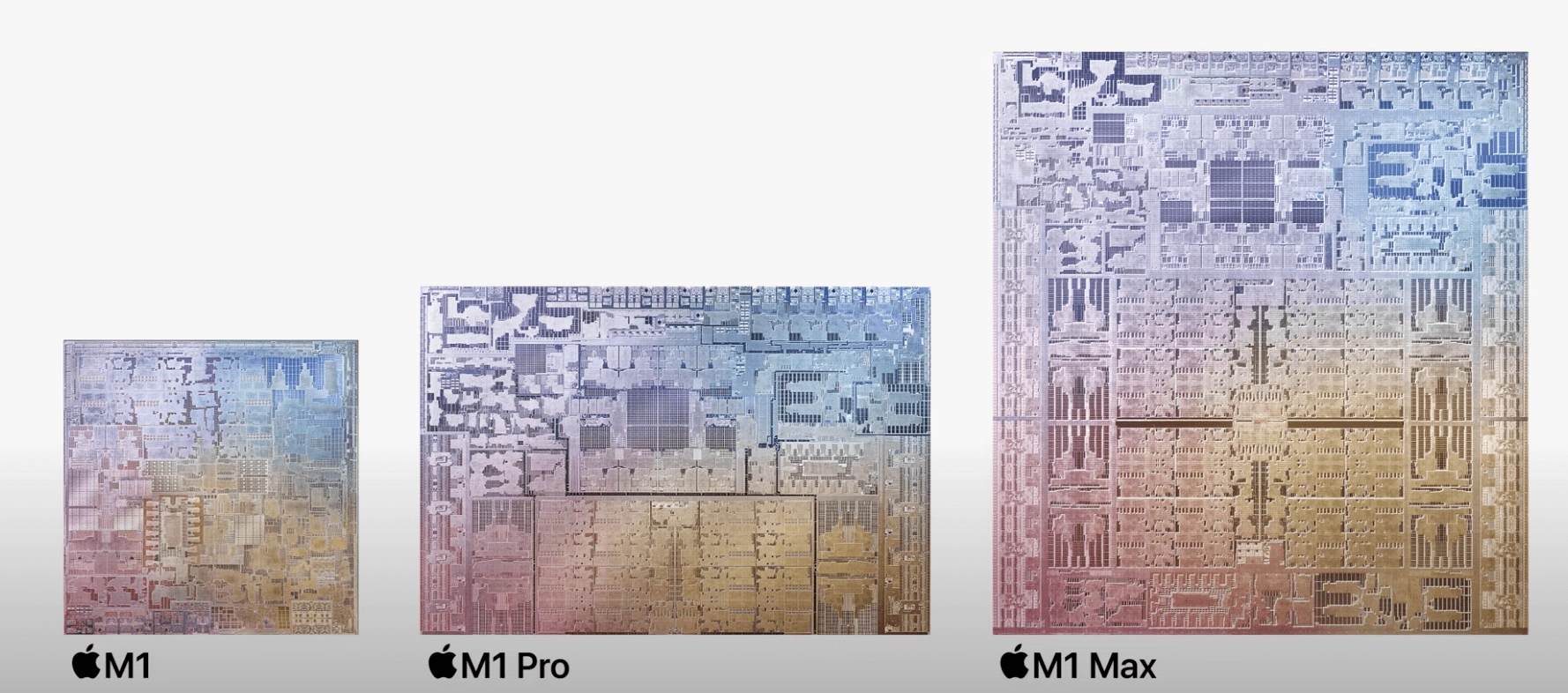
Generally, when a silicon company makes a chip larger to pack more cores onto the SoC and get more performance, it comes with the tradeoff of power draw and efficiency. For example, if you look at some of the most advanced workstation processors on the market sporting 10-16 cores, they are similar in size to Apple’s M1 Pro and M1 Max. However, Apple’s charts revealed that peak CPU performance for these chips is \~30w, and peak GPU performance is \~60w. Apple’s custom architecture, remarkably, allows them to create massive cores and still have industry-leading performance per watt. Some may be tempted to say that Apple’s industry-leading performance per watt is because they are on the TSMC 5nm process while their competition is still on 7nm and 10-14 nm process technology. There is some truth to that claim, but the architecture is the secret sauce that allows for frequency scaling and size scaling while not incurring much efficiency penalty. So while the process these chips are made on is relevant, the architecture deserves more of the credit. In terms of the products themselves, Apple’s new Macbook Pro’s are high-end pro machines. These are not mass-market devices, but it is important to remember how much creative pros, influencers, artists, etc., influence the mass market. This is why when the collective pundit commentary years ago was that Apple was abandoning the pro segment of the market, many competitors saw an opportunity to jump in and steal these customers. Everyone knows how important pros and their influence are to the broader consumer PC market and it is why shrugging off Apple’s pro lineup is not wise. Ultimately, the big takeaway for me was how Apple has set the stage with the M series processors and built a foundation that will guide all Macs in the future. I firmly believe Apple wants to increase their share of notebook and desktop sales and grow the already significant share of premium computer sales they have today. And just looking at their strategy with clear eyes informs us their plan to accomplish that is “incredible performance, custom technologies, and relentless focus on power efficiency.”
### The Seemingly Never Ending Chip Shortage
URL: https://creativestrategies.com/the-seemingly-never-ending-chip-shortage/
Last updated: 2021-10-21T20:46:53.000Z
The component shortage keeps making headlines as technology companies from every sector of the market are struggling to get the necessary components to meet their manufacturing needs and satisfy their customer demand. This makes for interesting thinking when you factor in the record-setting pace of certain technology categories, like PCs and some smartphone brands, for example, that are already hitting record sales and would have likely sold in greater numbers if there was no component shortage. But the main question we have been engaging in with industry stakeholders is how much longer is this shortage is going to last? Unfortunately, this problem is not going away any time soon. Before diving into the challenges within the silicon supply chain, it is worth pointing out the other compounding factors. You may have heard about the coal shortage China is facing. This issue with coal has led the Chinese government has to ration power which led to some factories having no power for blocks of time. Parts of China have also been facing issues getting the water they need for silicon production due to areas facing drought. And lastly, shipping issues are factoring into components themselves being moved in a timely fashion, as well as the final products themselves getting to retailer’s shelves and customer’s hands. I bring this up to point out all the compounding factors that are contributing to the component constraints and how many of these factors need to be solved as well in order to right this ship. When it comes to the actual chip shortage, the issues stem mostly from legacy silicon node manufacturing, and in many aspects, this is impacting the analog semiconductor manufacturers significantly. Both analog and digital legacy products are being impacted, but analog components tend to be more legacy node products as a whole. Most of the legacy silicon manufacturing factories are located in mainland China, not Taiwan. Part of the solution here is to increase the world’s capacity in legacy node manufacturing, which is the goal of Global Foundries and a number of other government + private collaborations like the one [making news](https://finance.yahoo.com/news/tsmc-sony-eye-joint-chips-102401241.html?ref=creativestrategies.com) by Japan, TSMC, and Sony this morning. The US government has announced its intent to collaborate with private companies to increase the US semiconductor manufacturing capabilities, but significantly more capital is going to be necessary in order to have both leading-edge and legacy node silicon being manufactured at scale, for the global supply chain, in the United States. One of the short-term impacts of this shortage is going to be the inevitable price increases across the board by foundries. TSMC has announced price increases for their leading-edge products, and supply chain analysts already see price increases at the trailing edge as well. I make this point because it is tied into the timeline for the overall chip shortage discussion. If the industry is stating this issue will go deep into 2022 and potentially into 2023, then it is reasonable to assume those price increases will last until this issue is resolved. This means pricing pressure will hit every technology vendor for the foreseeable future. The last issue I want to highlight is this shortage may impact new product launches when it comes to new categories. We have all be hoping/waiting for some new technology and product breakthroughs, but I fear this component shortage will force vendors to focus more on their current roadmap for the time being than their future product roadmap until these issues are resolved. There is simply no short-term or quick fix for this problem. Foundries over-invested in the leading edge node manufacturing and under-invested in the trailing edge. But even the leading edge, where large investments were made, are facing constraints that highlight how deep of a hole the industry is in with regard to trailing edge silicon manufacturing. No company will be immune to this issue. The question that looms largest in my head is how much of the pricing challenge the vendors will eat vs. pass on to customers. My hunch is those who live with small margins will have to pass more of that price increase onto their customers. While those vendors who have higher margins can absorb more of the price increase, but potentially not all of the price increase. I wish there was better news to report on this front but 2022, at the very least, looks to be as challenging if not more than 2021 when it comes to the supply chain challenges and component shortages.
### Surface Laptop Studio: The First Convertible Worth Having
URL: https://creativestrategies.com/surface-laptop-studio-the-first-convertible-worth-having/
Last updated: 2021-10-08T18:04:41.000Z
I am not one for sensationalistic titles when talking about a product, but I must admit talking about the new Surface Laptop Studio like the first convertible worth having is the best way to summarize how I feel about this product.
At what has now become an annual Fall appointment, the Microsoft Surface Team announced several new devices in addition to the Surface Laptop Studio: the Surface Pro 8, the Surface Go 3, the Surface Duo 2, and a refresh of the Surface Pro X. An impressive line up that serves a broad spectrum of users with a well-established design like the Surface Pro 8, more compact design like with the Surface Go and the new form factor of the Surface Laptop Studio. Aside from the classic clamshell posture, thanks to what Microsoft calls a “dynamic woven hinge,” the Surface Laptop Studio’s screen folds over the keyboard, leaving the trackpad exposed to create a “stage mode” for gaming with a controller or video streaming. The screen also folds over almost flat in “studio mode” for users to draw or write.
Convertibles are far from new. They were an initial response to the iPad and what many, me included, believed to be the start of the end for PCs in favor of tablets. As such, they focused on providing a highly mobile experience for users who wanted to create and consume content on the go. Because of their mobile-first nature, most of these devices were compact and not necessarily the most powerful.
Since then, mobility has become a much more mainstream need no longer delivered at the expense of performance, and the Surface Pro 8 is a particularly good example of that winning formula.
However, PC manufacturers continued to think of these devices in terms of creation and consumption as two separate workflows for a user who was willing to sacrifice function over form when it comes to convertibles. With data showing that most users buying a convertible were really after a laptop that could occasionally convert to a tablet, PC vendors fostered this misconception that the laptop posture mattered the most. For me, this approach always delivered a compromise experience.
To be fair to PC manufacturers, those early-day hybrids also suffered tremendously from running on Windows 8\. While things got a little better with Windows 10, switching from laptop to tablet mode was not necessarily the best experience with a UI that did not properly accommodate the less precise touch of a finger over a pen or a cursor.
With the Surface Laptop Studio, the focus is on enabling a continuous workflow that allows you to use different input mechanisms as well as adopt different postures. It is about a more balanced experience for a user who, in terms of time, might well be using the device more as a laptop but who values equally any time spent in stage or studio mode. In terms of performance and screen, the Surface Laptop Studio remains true to its category predecessor, Surface Book, which was always seen as the workhorse of the portfolio, leaving you with a feeling that you are really not compromising function over form.
The importance of all postures is underlined by the 120Hz screen and the very clever charging capability for the Surface Pen 2\. Maybe a nod to the fact that for most users, inking will still not be an everyday thing, the Surface Pen 2 does not ship in the box. If you purchase one, however, it easily tucks under the front of the device to charge. That way, any time you need the Pen, there is no fumbling in a bag or on your desk and, even more important, no more finding out it needs charging. It might seem simple, but you would be surprised how much proximity helps drive the adoption of inking.
New with Surface Pen 2 is the support for haptics. This needs experimenting a little as we all have different sensitivities to the vibrations. I had to push my setting up to experience the more natural ink-to-paper sensation Microsoft talked about in their demos. Once you find your setting, it is much more engaging than writing on glass.
Finally, on the hardware side, I need to give a shout-out to the keyboard. The well-spaced-out keys, the travel, the quietness, and the bigger touchpad all make me appreciate the keyboard. Interestingly, the larger touchpad can now be pressed anywhere to register a click rather than for your fingers having to move back to a corner every time you want to click.
Lastly, part of the good experience I have been having comes from Windows 11, which officially launched this week. The user interface is much more sensitive to the needs of touch, albeit no longer having a dedicated Tablet Mode. For instance, when moving the Surface Laptop Studio from clamshell to stage mode, the icons spread out to better support the lesser precise input of a finger. Windows 11 also supports a series of gestures very similar to those you would find on Precision trackpads. There is also better spacing in the new touch keyboard and support for split view to use it with one hand.
When I first started to use the Surface Laptop Studio, I wished Stage and Studio mode had an interim position that covered the keyboard as well as the trackpad, mostly because I am more of a “wedge writer” than a “flat writer” and the angle that Studio mode offers is not quite enough for me. Yet, I came to realize that such a posture would have compromised sturdiness. It would have also prevented users from mixing screen touch and touchpad touch if a more precise interaction with content was ever needed.
Because of Covid-19, my travel has remained limited, so I have yet to take Surface Laptop Studio on the road. It has been years since I traveled with a laptop, thanks to the iPad Pro that has been my travel companion since its launch. With the Surface Duo 2 just around the corner and the latest iPad Mini, however, I might just have a choice of a great companion for the Surface Laptop Studio to go on the road with.
### iPhone 13 and Apple Silicon
URL: https://creativestrategies.com/iphone-13-and-apple-silicon/
Last updated: 2021-09-23T16:00:18.000Z
For years now, Apple’s tight integration of its products and Apple Silicon have evolved in lockstep. From my point of view as an analyst, and one that has been doing semiconductor industry analysis for over 20 years, Apple’s silicon strategy has been fascinating to analyze. From a big picture viewpoint, Apple is not a semiconductor company in the same way that Intel, AMD, Qualcomm, Nvidia, etc. Yet, their silicon often finds itself in the same competitive conversations as those traditional semiconductor companies. Apple is in the interesting position of competing with all the traditional semiconductor companies indirectly as they compete in end markets with their products where all other semiconductor companies also compete. Yet, Apple is not a semiconductor company. The part of Apple’s silicon strategy that intrigues me, and one that gets lost often when pundits talk about Apple silicon, is how the chip is only part of the product and not the product itself. For pure semiconductor companies, the chip is the product. For Apple, the chip is just part of the product but a critical part of the product experience. This subtle difference allows Apple to make different architectural decisions with their silicon parts. I found this line found on Apple’s website explaining the tight integration of the hardware teams, software teams, and silicon teams demonstrates the unique way all three groups collaborate. “What’s truly unique about Apple is that we don’t just start with a superfast chip and build features around it. Instead, we start with an idea about a great experience we’d like you to have, and then we all work together to bring it to life.” This subtle point often gets overlooked amidst talk of Apple’s silicon performance. To a degree, Apple is to blame since they have frequently called out their silicon performance against competitors. And while performance is a relevant metric, especially over time, as I will explain, where most consumers will see the advances in Apple silicon is in the key features and experiences that silicon is designed to enable. While it isn’t always obvious, Apple’s integrated product design approach of hardware, software, and silicon has led to many of the advances in camera, battery life, AI, video capture performance, and even ProMotion on iPhone 13 Pro. Apple has a luxury other silicon companies don’t. They custom-tune their architecture and silicon design specifically for iPhone and the feature they want iPhone to have. **This allows them to spend their transistor budget on features instead of just pure performance.** While thinking about your phone’s performance, speed, etc., it is relevant people often get caught up in year-over-year performance since that is the way most in the silicon industry have been trained to think. As I mentioned, this is a relevant benchmark for a variety of reasons, but from the perspective of a normal consumer, looking at their experience upgrading every 3-4 years is a much more relevant analysis. Apple Silicon Every 4 Years While I will admit there is a small percentage of Apple customers who upgrade every year and a percentage more who upgrade every two years because they are on upgrade plans, the vast majority of consumers upgrade every 3-4 years. I thought it would be interesting to look at some basic iPhone benchmarks through the years and look at how much performance improvement happens every four years.
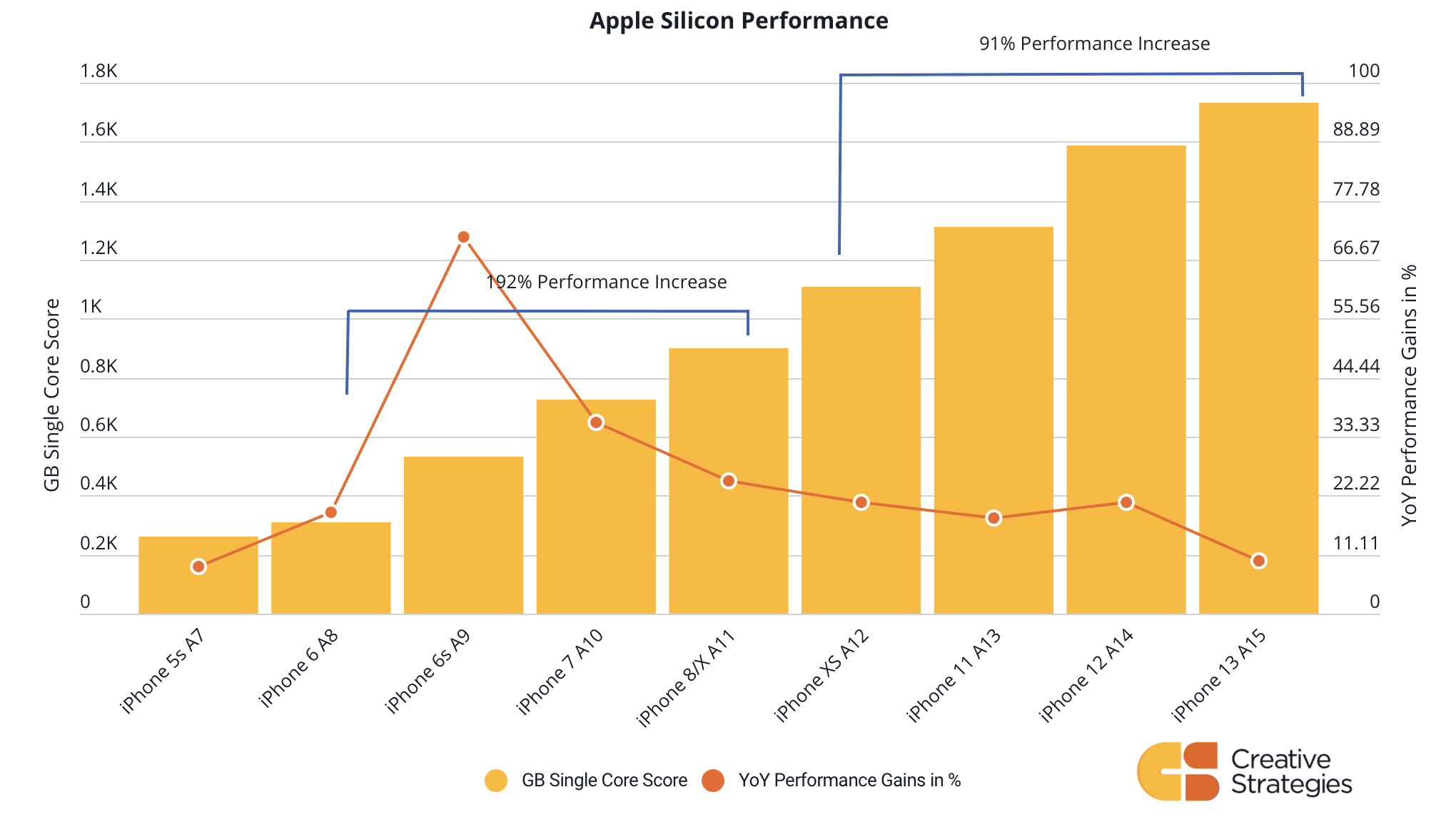
Going back to iPhone 5s, Apple has averaged 133% performance increases every four years. Most interesting, for this iPhone 13 cycle, are those Apple customers coming from an iPhone X or Xs are going to see a 91% performance increase. Our continued research in the smartphone category consistently reveals that most customers upgrade when they feel their current device is old and slow. Those customers upgrading every 3-4 years, which is the norm, would see between 80-91% performance increases during their refresh cycles. Apple still has a large current installed base of iPhone 8, X, and Xs smartphones which I believe will lead the iPhone 13 cycle. Those customers are up for a huge upgrade in their total iPhone experience. As I benchmarked the A15 Bionic in different ways and pondered how Apple spends its transistor budget with each A-series chip cycle, an interesting shift emerged for iPhone 13\. Going back to how Apple spends their transistor budget on features, not necessarily performance, for the A15, Apple looks to have had the most GPU gains YoY since the A9\. For the past five years, Apple has had an average of 19% GPU gains YoY but for the A15 Bionic, **Apple has increased GPU performance by 52%.** This intentional increase in GPU performance over CPU performance speaks to the more graphically intense features Apple had in mind for iPhone 13 that is demonstrated in things like macro photography, macro video, and Cinematic Mode. Developers also now have a dramatically increased GPU at their disposal to create new app experiences around and can leverage new augmented reality techniques, visual computing and AI, and more. **Macro iPhone 13 Pro Experience** Lastly, I briefly wanted to highlight the macro photography experience I had with iPhone 13 Pro. Of all the camera advances from Apple in the last few years, the addition of macro photography is easily one of my favorite. I have always been a fan of macro photography but never invested in a capable DSLR and macro lens. Trying out iPhone 13 Pro macro feature was impressive, to say the least. Interestingly, there is no “macro mode” just open the camera and get as close to the subject as you can. iPhone takes care of the rest and knows you are taking a macro and adjusts the lens and focus. This was one of those features you try and can’t believe it actually works. It seemed no matter how close I got to the object, iPhone still focused and capture the image. Here are a few macro photos I took.



Taking macro photos with a smartphone was mindblowing, actually. It felt as if no matter how close I got to the object, the lens would still focus, and the main limitation was the fact that I literally could not get any closer to the object without hitting it with the iPhone lens itself. Coming back to my point about iPhone every four years. While the dramatic increase in performance will be felt by consumers upgrading on these typical upgrade cycles, it is the features around the camera, battery, video, and other media where they will feel the most dramatic impact when they upgrade. This is the benefit to Apple thinking about the total experience of hardware, software, and silicon and intentionally creating each chip to be uniquely optimized for the newest set of features.
### Putting Apple’s California Streaming Into Context
URL: https://creativestrategies.com/putting-apples-california-streaming-into-context/
Last updated: 2021-09-15T15:30:24.000Z
As is always the case with high-profile launches, we got to Apple’s California Streaming event with plenty of rumors to consider. Of course, most of what was expected did materialize on stage, but many of the details certainly helped paint a much better picture of Apple’s view of the market and how they plan to compete in it.
Here are some considerations worth highlighting.
##### Upgrades Matter More to Users of Older Products
The industry might be measuring every new product on how it compares to the previous generation. Still, the real opportunity is how the new products compare to products from two or three years ago. For example, looking at the current iPhone installed base, I would say 75 to 80 percent of the US iPhone users have a model older than the iPhone 12\. Those are the users that need to look at the iPhone 13 and find enough reasons to upgrade. And those are the users who will also be able to take advantage of the particularly aggressive trade-ins offered by carriers, some accepting phones in any conditions.
The same reasoning applies to Apple Watch Series 7\. The picture comparison below is possibly the best way to understand the impact that the updated screen on Series 7 will have on users of an Apple Watch Series 3, the model that has the largest user base to date. For Series 6 owners, faster charging, and the ability to get 8 hours of battery life in 8 minutes to track your sleep will have a great deal of appeal as early adopters also tend to use their Apple Watch more extensively, thus benefitting more from a longer battery or faster charging.
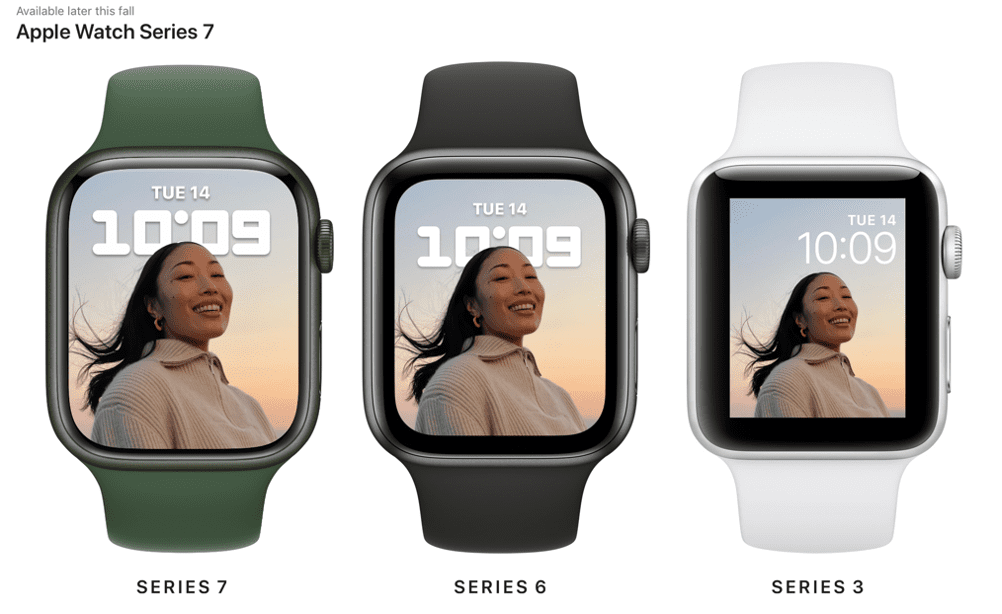
Source: Apple
This leads me to my final point on the topic of upgrades which is that for many early adopters, the decision to upgrade is not necessarily driven by the features, but rather the desire to have the latest and greatest, even if that means incremental improvement. Early adopters also tend to have more disposable income allocated to tech and lean more heavily on programs such as the Annual iPhone Upgrade Program offered by Apple.
##### Apple Is Highly Intentional on Which Features End Up in What Products
Apple has proven over time to be very intentional on how specific features trickle down in the price point and across products. This tactic allows Apple to test how sticky a feature is and then attract users to other products or make an upgrade more appealing. Two features stood out during this launch: Center Stage and Cinematic Mode.
First introduced to iPad Pro, Center Stage is the ability for the iPad camera to always keep the subject centered in the picture and adapt when more people enter the frame. The feature is supported whether you are doing a video call or shooting a video. Now, this feature has been added to both the new iPad and the iPad Mini. With video calls being part of everyday life and video becoming a form of expression embraced by so many, it makes sense for Apple to add Center Stage to these new iPads that include education and frontline workers as a target audience.
Cinematic Mode is a new feature added to the iPhone 13 line up that allows users to change the focus point after shooting the video and, maybe even more impressive, having the camera hold focus on a moving subject while allowing for focal transitions to happen automatically between objects as the subject looks away from the phone. The feature is driven by AI and powered by the new A15 Bionic chip. Apple could have chosen to release Cinematic Mode only to the Pro models but enabling it across the portfolio highlights the capability of the chipset as well as the single chip strategy across price points, which aligns with Apple’s selling point of delivering an uncompromised experience across the portfolio. For brands with a broader portfolio, we have seen chipsets being tactically used to limit cost at lower price points and being justified by the belief, not always correct, that users who pick a lower-priced device have a lesser need for performance.

Source: Apple
##### Video is the New Battleground
I have already touched on the importance of video in the previous section. Apple wants to own mobile video in the same way as it has come to own mobile photography. This should not come as a surprise considering how historically Apple has always appealed to creators and how much video is now part of creators’ output. Everything from gaming to teaching to music and, of course, social relies on video. While the trend accelerated during COVID, there is no question that the importance of video as an art form and a means of communication is here to stay. What is fascinating is also that the appeal of video has no age limit. From teens on TikTok to grandparents on Facetime, video plays a significant role in what many of us do. The ability to deliver an experience that is intuitive, simple, and yet masterful is why features such as Cinematic Mode will appeal to a broad set of users.
##### All iPhone Models Shipping Simultaneously Might Suggest Fewer Supply Issues
During the latest quarterly earnings call, Apple CFO Luca Maestri said: “We expect supply constraints during the September quarter to be greater than what we experienced during the June quarter. The constraints will primarily impact iPhone and iPad.”
Yet, it is interesting that Apple chose to make all products available simultaneously rather than staggering them like last time. Of course, Apple can still prioritize models like the Pro, which tends to be the favored model by early adopters. Keeping an eye on pre-orders and delivery lead times might give us a better indication of how things are shaping up.
##### iPad Mini is an iPad Pro in Disguise
As the Android ecosystem is turning to foldables and consumers are increasingly dependent on technology and screens, I would argue the iPad Mini upgrade is particularly timely. With more video calls taken, more content consumed, more games played, and with the micro-mobility of the home in mind, the iPad Mini can play a much more significant role than in the past as a companion device to a computer a phone. The iPad Mini is now closer to an iPad Pro than a regular iPad. Still, Apple leaned into the tablet-first use case by adding support for Apple Pencil 2 rather than making it a mini version of the Pro by adding a Magic Keyboard to it.
Some argued that the iPad Mini should have been a phone given the added support for 5G, but the reality is that the form factor would not be as convenient for most users. Furthermore, in an enterprise context, a market that Apple highlighted on stage, not making the iPad Mini a phone has some advantages from who can procure them to how they are managed.
Part of me also wonders if this strong upgrade might be an indicator that, when the time is right, we might see the iPad Mini in a foldable design.
### AirPods and AirPods Pro: Delighting Customers by Exceeding Expectations
URL: https://creativestrategies.com/airpods-and-airpods-pro-delighting-customers-by-exceeding-expectations/
Last updated: 2021-09-09T15:25:28.000Z
In a first for the Delight Scale, we are publishing the scores for two products by the same brand in the same family. Our product research on AirPods and AirPods Pro yielded some consistent insights across Apple hardware products. One of the staple benchmarks of the Delight Scale is the ability to measure product performance in relation to customer’s expectations. Users are first asked about their expectations prior to using the product and then how that product faired against those initial expectations. What makes Apple unique, compared to other brands we have measured, is the high expectations Apple buyers have for the products they are purchasing. **Expectations Exceeded** One of the primary reasons for AirPods and AirPods Pro’sPro’s high Delight Scale scores is to be found precisely in the high number of users who started to have had high expectations for the products prior to purchase, and yet the products exceeded their expectations. With AirPods (Gen1 and Gen2) over 90% of owners said AirPods met or exceeded their expectations. With AirPods Pro, 86% of owners said AirPod Pro met or exceeded their expectations. The number of AirPods and Airpods Pro owners who stated the products exceeded their expectations is impressive. Yet what set these products aside is the fact that over 90% of owners stated they had high to somewhat high expectations for the product prior to purchasing. Satisfying customers who have low expectations does not set them apart as a brand. All the Apple products that we have run so far through our Delight Scale have shared this common trait of having owners going into their purchase with high expectations and feeling their expectations were met or exceeded. Marketing might be responsible for the high expectations buyers have for Apple’s products, but it is product design and execution that make sure those expectations are met. **Strong Recommendation** Another standout data point from our AirPods and AirPodsPpro research was the high recommendation score both products received. AirPods and AirPods Pro had some of the highest levels of recommendation we have seen in all the products we have measured using the Delight Scale. We believe a key measurement that separates great products from average ones is that great products get talked about. And our research has validated that AirPods do indeed get talked about. Both products also received extremely high scores for an unprompted recommendation of the product to friends or family.
!function(e,i,n,s){var t="InfogramEmbeds",d=e.getElementsByTagName("script")\[0\];if(window\[t\]&&window\[t\].initialized)window\[t\].process&&window\[t\].process();else if(!e.getElementById(n)){var o=e.createElement("script");o.async=1,o.id=n,o.src="https://e.infogram.com/js/dist/embed-loader-min.js",d.parentNode.insertBefore(o,d)}}(document,0,"infogram-async");
**Highest Rated Features** When we dove into the features of AirPods and AirPods Pro that consumers consistently rated the highest, a few features stood out. The highest-rated features were battery life, sound quality, comfort, design, initial setup/pairing, and time to charge. Each of these features had over 60% of owners ranking the feature excellent or very good.
!function(e,i,n,s){var t="InfogramEmbeds",d=e.getElementsByTagName("script")\[0\];if(window\[t\]&&window\[t\].initialized)window\[t\].process&&window\[t\].process();else if(!e.getElementById(n)){var o=e.createElement("script");o.async=1,o.id=n,o.src="https://e.infogram.com/js/dist/embed-loader-min.js",d.parentNode.insertBefore(o,d)}}(document,0,"infogram-async");
**Returning Customers vs. New Customers** Lastly, a question may be asked as to why AirPods Pro did not score as high as AirPods. For this, we have a few theories. The first is that AirPods Pro is a bit more pricey than AirPods. We have noted a relatively consistent pattern where higher-priced, more “Pro” products tend to see slightly lower recommendation scores. A reason for this is their owners tend to self-identify as more premium buyers and understand that it’s not for everyone in their social circle. Another theory is that AirPods Pro owners were almost universally owners of the original AirPods. This means that while AirPods Pro still exceeded their owners’ already high expectations, these were not new users for the product family. AirPods Gen 1,2, in general, saw even higher expectations exceeded because it was their first exposure to the product for many. As with all the products we test, we will continue to track the journey of AirPods and AirPods Pro owners to see if their product experience changes in any way over time.
---
The Delight Scale is built on the ten best questions prepared to capture product experience across a series of products from hardware to apps as well as services. It captures willingness to recommend the product prompted and unprompted, customer satisfaction in relation to expectations, sentiment on price, intention to repurchase, and more. The results are scored, weighted, and aggregated into a product’s Delight Score. The Delight Scale utilizes questions with a 7-point satisfaction scale that ranges from one extreme attitude to another with one neutral option. The Likert Scale is a popular and well-known question format used to measure opinions and behavior. Likert-type questions provide more granular feedback about a product compared to binary questions with their two answer options. The maximum Delight Score a product or service can achieve is 1200\. In order to achieve such a score, respondents would have to select the top 2 boxes for all the scoring questions. Rather than allocating a score to all possible answers, the Delight Score uses a Top 2 Box score (sometimes called T2B) in the way of summarizing the positive responses from a Likert Scale. The Top 2 Box score technique is used across research to help with ad testing, product development, and brand tracking. This approach has proven to lead to a much more holistic measurement of customer experience, actionable product insights to truly separate great products from average ones. Selecting the top 2 boxes for 60% of the questions would place a product or a service on a Delight Score of around 700**.**
### The Metaverse and Reality
URL: https://creativestrategies.com/the-metaverse-and-reality/
Last updated: 2021-08-19T16:26:01.000Z
I’m fond of saying that all science fiction is a self-fulfilling prophecy. Whatever we see in science fiction inspires human ingenuity to pursue it. In a way, this is happening with the Metaverse because when you hear “visionaries and futurists” talk about it, it ends up sounding a lot like the Matrix. Without the humans being controlled by sentient mechanical beings part. I hope. The Metaverse is a buzzword no doubt. And with [Facebook showing](https://www.theverge.com/2021/8/19/22629942/facebook-workrooms-horizon-oculus-vr?ref=creativestrategies.com), what is essentially just an evolved version of their workspace platform for VR, but many using metaverse terminology around it, the buzz is continuing. It is way too early to separate hype from reality at this point. The Metaverse may be nothing, or it may be something. Regardless, I do think it is important to recognize where we are today and where we are heading as it relates to immersive digital experiences. Firstly, let’s understand the vision/concept behind the metaverse. In a perfect world, the Metaverse will be a singular standardized platform for an immersive digital experience. In many ways, it needs to be more like the Internet as a digital platform and less like a walled garden platform if it is to truly succeed on the vision behind it. It can be something where the physical world is richly simulated, or worlds of total fiction can be created. It seems likely both will exist, but I’d stake an early bet human will spend more time in fictional digital experiences than ones that simulate the real world. At least in the short term. In my mind, the Metaverse is simply the evolution of the one or maybe two-dimensional digital experiences we have today. For example, video games are current examples of a metaverse today, just a very rudimentary one. Doing video conferencing with a friend, family member, or your work team is all very simplified metaverse experiences. If we understand it this way, then hundreds of millions of people already have a simplified metaverse experience today. Some are attempting to simulate the real world, and some are simulating fictional worlds or environments. I make this point because I think it is important to understand the Metaverse as an evolved experience or set of experiences from current digital environments we are all familiar with today. If we understand it this way, then the adoption cycle becomes more clear, and potential time frames for adoption are slightly more optimistic. **An adoption cycle truth that I’m yet to observed proven wrong is that solutions to pain points get adopted quickly, and brand new experiences are adopted very slowly.** If we understand the Metaverse to evolve in a way that enhances already known experiences, then it will get adopted more quickly. If it tries to be something entirely brand new, then it will be adopted very slowly. I mentioned that I expect worlds of fiction to become more mainstream before real-world simulation. I say that for a few reasons. Primary because simulating the real world will be much more difficult, and despite the metaverse optimists, most humans won’t abandon the real-world environments until the virtual is indistinguishable. At least for large amounts of time. And second, because fictional metaverse environments can fit into buckets of entertainment, creativity, and a range of other experiences where immersive digital environments are already experienced today in a fashion that will only be enhanced and more immersive in a metaverse. I’ll end with this point. I’m not saying all our digital experiences today are a simplified metaverse. I am saying that there are things we do today that are fundamental building blocks of said future Metaverse. The reality is that we have very simplified metaverse experiences today that will only be enhanced as the digital world, that of hardware, software, and services, evolve to be more immersive and visually rich. This is no short-term journey, but there are signposts pointing us in this direction if we have eyes to see them.
### Samsung Galaxy Unpacked Delivers Confidence on Galaxy Z Fold Line
URL: https://creativestrategies.com/samsung-galaxy-unpacked-aimed-at-delivering-confidence-on-galaxy-fold-line/
Last updated: 2021-08-12T18:25:28.000Z
For Samsung, summer has traditionally been synonymous with the Galaxy Note, but in 2019 the top-of-the-line model had to share the limelight with the Galaxy Z Fold line. Then, in 2020 the Note even had to share the stage with the Fold family. If you follow the smartphone market, you can understand why the absence of the Note in this year’s lineup makes sense. Yet, the strong loyalty to the family led TM Roh, Samsung Mobile President, to pen a blog last month saying that this year Unpacked will be all about foldables and the role they can play in the future of smartphones. While Roh did not right out, say there will be no more Note models, the addition of pen support to the Galaxy Z Fold chips away at the need for a Note line. Yes, the Galaxy S Pen is not stored within the Fold device, but I reckon we are a year away from seeing that level of integration. For now, if you are interested in using the Galaxy S Pen Fold edition, you can either store it in a case or use a Galaxy S Pen you use on your Galaxy Book, where the tip has been redesigned to avoid excessive pressure on the Fold’s display. The addition of pen support really opens new use cases for the Galaxy Z Fold, both from a creativity and productivity perspective. I can already foresee some attempts to use the Galaxy S Pen to damage the Galaxy Fold. Yet, the addition underlines the continued work Samsung’s engineers have put in delivering a higher level of durability, whether by making it water-resistant or making the display more robust. Samsung sees foldables as the future of smartphones. If they are the future, they will always boast the latest and greatest technology, a bragging right that historically belonged to the Galaxy Note. When you consider this dynamic, it is clear that the Note no longer has a role to play in the portfolio, but the qualities that defined it will be found in the Galaxy Z family. From an audience perspective, The Galaxy Z Fold offers Samsung a broader opportunity than the Note, as it appeals to users who love the Note for its pen support as well as buyers who are into cutting edge tech and buyers who want to stand out from the crowd with a different look. Durability was not the only focus of this generation of products. Increased flexibility in how these foldable devices can be used was clearly top of mind. Samsung’s design remained consistent over the three iterations, both on the Galaxy Z Fold and the Z Flip. While some might find this boring, it shows that Samsung landed on the right design from the start (except for the screen protector) and what we see are minor tweaks made to a winning formula. The external display is probably what we have seen evolve the most over time, both for the Galaxy Z Flip and the Fold. At the core of the different designs is the need to strike the right balance between making the outside display useful enough without preventing people from experimenting with the foldable display. The front camera is another area that has evolved from a somewhat awkward forehead to an elegant notch to this year’s under-display camera. The journey here is not necessarily about the best camera per se but the relationship between the best camera and the most immersive viewing experience. So far, under-display cameras have been criticized for delivering lower-quality pictures than traditional cameras. Choosing to use one in the new Fold 3 has much more to do with providing an undisturbed viewing experience than it does making a “technology first” statement. The lack of the notch opens up the Fold’s display to its full 7.6-inch glory both for entertainment and productivity needs. All the enhancements displayed in the Galaxy Z Fold and Flip are exciting and certainly move the category forward. Yet, there are two aspects of these new models that increase the appeal to a broader audience: price and app ecosystem. During the event, Samsung showed a slide full of logos representing different optimized apps for the Galaxy Z Fold, including Spotify, YouTube and TikTok. Of course, having a larger screen real estate is excellent for video. Still, apps can use the extra screen more intelligently, either by how information is presented or by flattening part of the UI to lower friction. Starting at $999 for the Galaxy Z Flip and $1799 for the Galaxy Z Fold, Samsung is really pushing foldables into the mainstream. The combination of increased robustness and the lower price point puts these new Galaxy Z models at the same level as a high-end smartphone. This makes it much easier for consumers to consider the Galaxy Z Flip and Fold as an alternative to a traditional smartphone. As is the case in the overall smartphone market, the foldable market is not homogeneous. I explained in the past, I see the Galaxy Z Fold and the Galaxy Z Flip appeal to two very separate segments focused on productivity on one side and detoxing on the other. The Fold, with the support for Microsoft apps, clearly bridges smartphone and tablet while the Flip bridges smartphone and wearable. A user can now launch Samsung Pay, access quick settings, read notifications and use widgets for music, weather, schedules, alarms, Samsung Health, Galaxy Buds controller, voice recorder and timer, all without ever opening the Z Flip 3. Users preordering the Galaxy Z Fold or Z Flip will receive a year of protection from Samsung Care Plus, the premium support service that protects the phone from accidental damage and includes a one-time screen replacement. This is a nice touch to deliver extra peace of mind to buyers. Affordability was the theme across the whole event, with the launch of the noise-canceling earbuds Galaxy Buds 2 at $149.99 and the Galaxy Watch 4 starting at $249\. While it would be easy to put the more affordable pricing on the pandemic, we need to remember that the smartphone and accessory markets have been pretty healthy during the pandemic. Sales could have been even better had it not been for the component shortages that impacted the whole industry. At the end of the day, Samsung understands that multi-device ownership drives loyalty and engagement, the best deterrent to churn.
### Intel Returning to Form
URL: https://creativestrategies.com/intel-doing-what-intel-does-best/
Last updated: 2021-07-28T15:19:01.000Z
On Monday, Intel held an event to outline the next 5 years of their process technology roadmap. In addition, there were a number of technical announcements where they highlighted some of the benefits of their transistor design and packaging technology that will come to their latest chips over the next four years. Rather than get too technical, for now, I want to share a broader perspective around Intel as a company. It is no secret Intel has had some major missteps this last decade. The main debate surrounding the company was whether these were just missteps or something else, something more concerning. What is the new normal for Intel? Is it getting back to the innovator and leader it once was, or will it never be the same company again? This theme was constant in my conversations with industry stakeholders as well as investors. As I reflected on this, a sports analogy comes to mind. Intel is like a sports team superstar, who suffered a major injury, and is yet to play in its first regular-season game post-injury. When your star players suffer a serious injury, the question always lingers on if they can get back to peak performance as a player. Those questions will linger, pundits will speculate, fans will worry, all until the player gets back into real competition and answers the question. In many ways, this is how I view Intel. They suffered an injury, and we all wonder if they can get back to their superstar self as a company. With Intel’s new leadership and now robust roadmap, everything looks good on paper, but until Intel starts consistently delivering on its roadmap and innovation, questions will still linger. Generally, it is not until your star player proves they are back to full strength that confidence in your team can rise. **Intel Passed the First Test**
Intel passed the first test, in my opinion, Monday. This was a test for management to start highlighting Intel innovating, returning to leadership, resuming a posture of leadership, and presenting confidence in their abilities. It was refreshing to see Intel acting the way we expect Intel to act and exuding a posture of confidence in their ability to innovate in package and transistor design. The two things we have always historically counted on Intel to do. Pat Gelsinger and Intel’s technology leaders shared a robust technology roadmap that–on paper–has them establishing competitive parity with their foundry competitors by 2024, with a small chance to regain process leadership in that 2024/2025 timeframe.
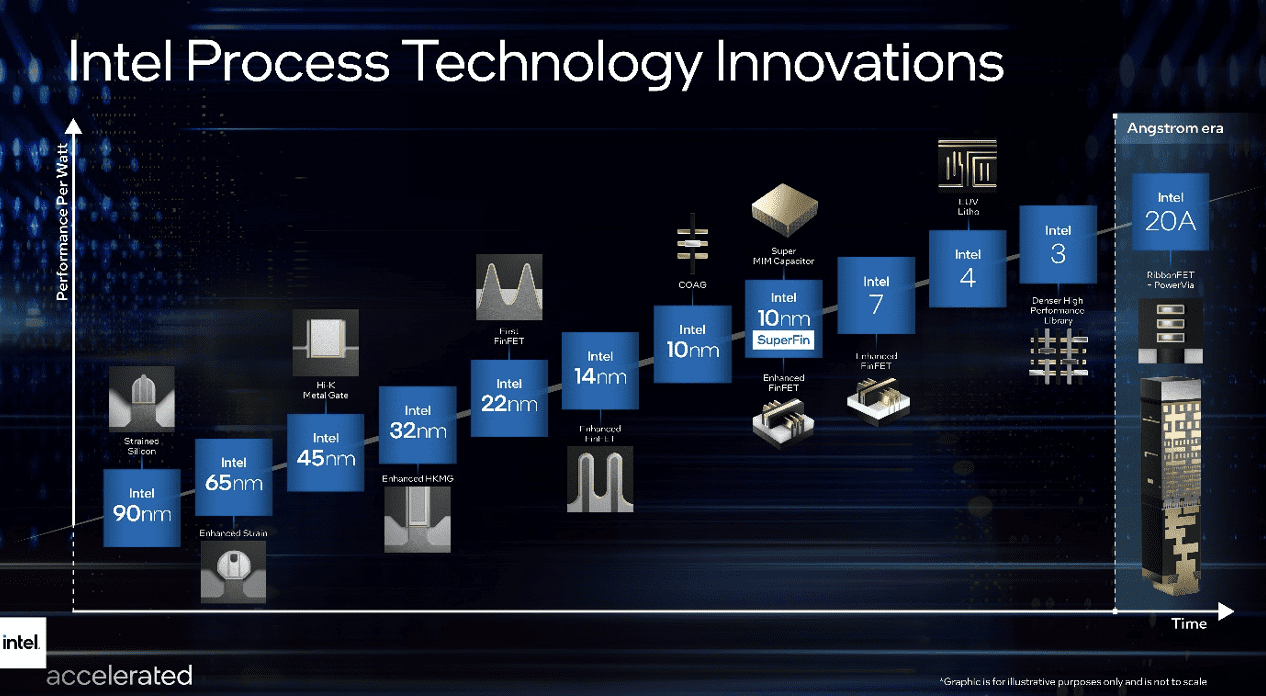
Intel publicly presented their technology roadmap, along with performance gain estimates for each new technology process and a timeline for several new processes and package technologies they are bringing to market. With this very public and detailed roadmap, the pressure is now on Intel to execute on the timeframe they presented. This was a bold move, but Intel’s leaders made this move with extreme confidence they can deliver and execute on this product roadmap. I have a hard time believing such a detailed roadmap would have been presented if there was any doubt. This only adds to the pressure for Intel to deliver and execute, in my opinion. We are about to see if Intel is back to their peak performing selves as they are up against major delivery milestones end of 2021 and throughout 2022\. I believe if their timelines stay true and they deliver on Intel 7 and Intel 4, then confidence will rise that Intel is back. **Looking Farther Out than 2024**
I do want to point something out regarding Intel and beyond 2024\. Intel returning to form and getting to parity with the process and the product means they stay competitive in the markets they compete in today, which are largely data centers, notebooks, and desktops. So in my mind, Intel returning to form is not just about the competitive market today but also of tomorrow. Yes, Intel needs to answer the questions about its ability to execute on current products, but what does Intel have up its sleeve for the next era of computing, which will include things like wearables (AR/VR, etc.), automotive, IoT, and many of the other areas where the next big semiconductor scale opportunities exist. Intel has to balance maintaining competition in current markets but also developing the roadmap for the next era of computing. If Intel can execute on all these cylinders, it will certainly be a comeback story for the ages.
### Alexa’s Evolution Into An Ambient Assistant
URL: https://creativestrategies.com/alexas-evolution-into-an-ambient-assistant/
Last updated: 2021-07-22T18:47:50.000Z
At Alexa Live 2021, Amazon’s annual developer conference focused on skills and services built for Alexa-enabled devices, the company shared a long list of improvements both from a features and developer tools perspective. Seven years in the making, Alexa now counts hundreds of millions of devices in use, driving billions of weekly interactions across the continents. In fact, the number of customers engaging with skills is growing at 40%, year over year, with solid growth in many categories, including music, audio games, and more. Of all Echo devices, the Echo Show is the fastest growing one. On average, multimodal skills built with the Alexa presentation language see more than 3x the amount of monthly active customers compared to voice-only skills on these devices. And when developers implement API features like API video, they get nearly double the customer engagement of voice-only skills on multiple devices. This is a testament to how Alexa and how we interact with her have evolved over the years in a multimodal exchange that uses voice, touch and motion. I talked in the past about how not having a smartphone offering freed Amazon, at the start of this market, to pivot fully to voice-first interaction. This was necessary for users to change the very entrenched habit of relying on a screen as the primary way to interact with content. By weakening that dependence from the device that is always with us, we have been able to distribute our compute needs across more devices leading us to what we now think of as ambient computing. Then, it is only natural that Alexa herself transitions from a voice assistant to an ambient assistant. Alexa Live opening keynote had two audiences in mind: users and developers. First, Amazon addressed Alexa’s users, outlining the goal of Alexa as an ambient assistant governed by privacy and transparency.
##### Proactive, Personal And Predictable
This is what Amazon wants Alexa to be both inside and outside the home, whether through your phone, in your ear or in your car. It also wants Alexa to get smarter, whether this means empowering more natural and personal interactions or using context to offer tailored suggestions or content proactively. The more natural the interaction with Alexa is, the more engaged users feel. With the AI developments we have seen over the past couple of years, the focus has been on making sure Alexa adapts to you rather than the other way around. As a regular user, I have certainly noticed how Alexa is trying to self-learn by asking if she understood and answered a question correctly or if the device that replied to a question is the device I expected to hear from. Alexa can also now adapt responses based on the context of the conversation and adjust her tone, stressing certain words and adding pauses and even breaths. Nothing adds more friction than a cheerful tone giving you the wrong answer to a question! Alexa has also been getting more proactive, and Amazon added two more features to build proactive experiences: Event-Based Triggers and Proactive Suggestions. For instance, Alexa might suggest a workout playlist when a user starts a run. Of course, these options are only available to users who provide permission for a skill to utilize them. Amazon reminded us that privacy and transparency are at the core of how its products and solutions are designed. It minimizes the amount of data collected, limiting it to what is needed to power or improve customer experiences. I think of this as the RoD, the “return on data” – what do I get back from Amazon or Alexa for sharing my data? As long as there is value and trust, users will share data. Ease of use is one way to increase engagement, but, of course, new use cases help too. For example, Amazon added a few new skills focused on entertainment:
- **INTERACTIVE MEDIA SKILL COMPONENTS + SONG REQUEST SKILL COMPONENT** – this shortens the time it takes for radio podcasts and music providers to launch interactive experiences on Alexa, starting with song requests. Including Q&A with the show hosts, voice-driven polls and contests are planned further down the line.
- **SHARED ACTIVITIES API** – this brings asynchronous multi-player gaming to Alexa.
- **AMAZON MUSIC SPOTLIGHT FEATURE** – a way for music artists to connect directly with fans by highlighting a song album or playlist together with a personal message.
##### Discoverability, Engagement And Monetization
Skills suffer a similar faith as apps. The more skills, the harder it is to find what you are looking for, especially when the device you are using might not have a screen. So being able to surface skills that are relevant to the users certainly increased the opportunity for developers. The addition of Featured Skill Cards to the home screen of smart devices is one way for users to discover new skills and interact with them right from the home screen. Another way is to use the new APL widgets for rich, customizable glanceable, self-updating widgets views of skill content accessible from the home screen. Last year, Amazon announced Name Free Interaction (NFI)687, which saved users from remembering the exact words to invoke a skill. On this framework, Amazon is now adding Skill Discovery Via Popular Phrases. For example, users can use popular phrases like “Alexa, I need a workout” to have Alexa offer a music streaming service with a workout playlist. Amazon also wants to make it easier for customers to keep using skills they love, which Personalized Skill Suggestions allows. With the big scrutiny app stores are getting around payments, it is no surprise Amazon focused on diversifying how developers can earn money. First, by benefitting from a broader set of payment options, including the new Paid Skills. Not every skill experience lends itself well to subscriptions and entitlements. Paid Skills offers the ability to charge a one-time fee upfront to access the content in a skill. This is ideal for premium skills when customers are more likely to pay once to access the core skill experience. Another new monetization feature is Amazon Associates on Alexa, which gives developers the ability to get a commission on items they recommend to users from Amazon.com. So, for instance, you could have a yoga skill and recommend a mat from Amazon.com. Naturally, all these new features aimed at helping developers would mean very little without devices. There are over 140,000 Alexa-compatible products on the market today. To continue to grow this number, Amazon also announced during Alexa Live that Alexa Connect Kit, the service that allows device makers to integrate Alexa into their devices easily, would soon be available in over 25 countries adding support for multiple new languages, including Spanish, French, Italian and Japanese. Furthermore, to increase device interoperability and time to market, Amazon announces it will upgrade its Echo Family of devices to support the new interoperability protocol Matter developed by the Connectivity Standards Alliance. Seven years in, assistants might not be as hot a topic of discussion, but this, in my view, is simply the result of having come down the initial hype to deliver value to users. In the same way that the number of apps in a store no longer matters, it is not the number of skills but the time users spend using them, the range of activities those skills cover and the consistency of the engagement that tells the story of how the relationship with Alexa and her users is developing. So while I do not expect consumers to have the same love affair with smart devices as they have with smartphones, I expect the dependency on ambient assistants to continue to grow.
### The PC Category Resurgence
URL: https://creativestrategies.com/the-pc-category-resurgence/
Last updated: 2021-07-21T18:52:24.000Z
Few technology categories have taken more abuse and had opinions formed than the PC category. While the PC is not the primary computing device of billions of people, that crown belongs to the smartphone, it is still the second most adopted category of computing on the planet. The current PC installed base is north of 1.5 billion, with nearly every desk worker in the world using one and almost every household in developed markets owning one. The PC category had a good run, as prices came down and were designed in, how can I put this nicely, less boring ways. Then around 2014, the category growth fell into steep decline, and it looked like selling between 260-275m PCs a year was the new normal. Then COVID hit, and the PC resurgence happened. The question today is whether the PC category will fall back to the 2014-2019 levels mostly driven by the same longer replacement cycle we had seen before. If this happens, the category will see steep year-over-year declines. However, I would like to offer a different perspective and a few key reasons I think the PC category can maintain its current momentum. The meta point here is the COVID years of PC growth will be hard to maintain. In some quarters, the PC saw north of 20% growth, which is remarkable on many levels. The following years will not make significant comparisons, but I think some key things have changed in terms of where the PC category was 2014-2019\. So I offer this perspective on why the PC market has a different set of dynamics going for it than it had during its down years. The PC Installed Base Has Grown The active number of PCs in use has increased. At one point in time, estimates for active PCs in use were \~1.2 billion, and today that number is \~1.5\. This is one of the main factors, in this analysts opinion, why annual PC sales going forward are likely to be higher than the PC drought of 2014-2019\. In those years, the base was smaller, and even with predictable refresh cycles of 3-4 years for enterprise and 5-6 years for consumer sales were less than 300m annually, working off an active base of 1.2 billion PCs. Assuming the same refresh cycles, even though a case can be made in some segments, we will see more frequent refreshes going forward. The sheer growth of the active installed base of PCs means more annual device sales. PC sales in 2020 surpassed 300m units for the first time since 2014, and both 2021 and 2022 look to be stronger than 2020\. Keep in mind that those sales estimates still contain the challenge of getting components and demand outstripping supply. Meaning, more PC sales would happen in a perfect world than they actually will for the next few years. At this point, for the PC category to drop down beneath 300m units, the end user’s relationship with the device would need to change significantly. One critical point that COVID brought out was a renewed relationship with PCs by many. The recognition of dependence for Work or School, the deepened engagement with all the many new features of PCs, and perhaps the reality that PCs have gotten drastically easier to use since they last had a new computer. All these things are leading to a different relationship with [PCs today than ever before](https://creativestrategies.com/what-is-next-for-pc-sales/). During the PC’s downturn, I strongly argued that a critical failure was to make it easy enough for people to get the most out of it. That, in my opinion, is no longer the case, and the breadth of form factors and the evolution of the interface of both Windows and Mac have made for the most user-friendly environment in the category’s history. COVID’s BUMP and Economic Geographic Independence A few weeks ago, I came across a column Marc Andreesen wrote called [“Technology Saves the World.”](https://future.a16z.com/technology-saves-the-world/?ref=creativestrategies.com) This post may be as important, in the big picture, as his [“Software Eats the World”](https://a16z.com/2011/08/20/why-software-is-eating-the-world/?ref=creativestrategies.com) column. However, this specific paragraph hits an important point. “Finally, possibly the most profound technology-driven change of all — geography, and it is bearing on how we live and work. For thousands of years, until the time of COVID, the dominant fact of every productive economy has been that people need to live where we work. The best jobs have always been in the bigger cities, where quality of life is inevitably impaired by the practical constraints of colocation and density. This has also meant that governance of bigger cities can be truly terrible, since people have no choice but to live there if they want the good jobs. This is, I believe, a permanent civilizational shift. It is perhaps the most important thing that’s happened in my lifetime, a consequence of the internet that’s maybe even more important than the internet. Permanently divorcing physical location from economic opportunity gives us a real shot at radically expanding the number of good jobs in the world while also dramatically improving quality of life for millions, or billions, of people. We may, at long last, shatter the geographic lottery, opening up opportunities to countless people who weren’t lucky enough to be born in the right place.” The idea that economic opportunity, as a part of the workforce, education, business, entrepreneurship, and more, can now truly be separated from geography is among the most positive technology stories for human flourishing I’ve heard in some time. And, for the arc of this narrative, the PC will play a key role in this permanent civilizational shift Andreesen highlights. Competition is More Fierce Than Ever Chief among the points of what makes this environment for the PC different than its down years is competition. Intel has been the unquestioned and dominant leader providing the chips that power PCs for most of the PC’s life. However, today, AMD and now Apple are arguably at the top of their game when creating chips that set new bars for the PC category. I’d also like to point out that today’s Intel is not the Intel of the last PC downturn. Not only is Intel up against the most competition they have ever had in their history, but they also see a renewed vigor. They are [positioning themselves](https://creativestrategies.com/intels-unleashes-a-turnaround/) to face their competitors head-on with a new leader in Pat Gelsinger at the helm. A strategy change that will yield more fruitful and predictable product timelines. And an increased effort in manufacturing will benefit Intel’s products and others. All of this competition is not only healthy but will lead to some of the most impressive products that fit into the PC category than we have seen in a long time. The result of the factors I mentioned above are the core reasons I feel momentum can be sustained in this category. I firmly believe that new owners of the PC form factor are on the horizon in both commercial and consumer. For example, in an enterprise, it is estimated that between 800 and one billion people do a job every day that requires them to be on their feet most of the time. Most of them use a simple handheld device, but their job can be significantly enhanced by something like an iPad or Windows slate computer. Essentially, these new form factors create opportunities for the PC to go into areas it never could before.
### Apple and Developer Satisfaction With App Store
URL: https://creativestrategies.com/apple-and-developer-satisfaction-with-app-store/
Last updated: 2021-07-21T18:51:19.000Z
536 developers for Apple’s software platforms participated in a study Creative Strategies fielded in late May. What makes our study results particularly interesting, is the makeup of our panel ended up being small business developers making less than $500,000 a year from their apps. With 55% of them making their apps for a living or aspire to make their apps for a living. And 90% make apps exclusively for iOS. We were fortunate to gather feedback from a large base of developers, who I consider as those providing the backbone for Apple’s platform differentiation. For the purpose of this narrative, I’m going to focus on this developer cohort because of how valuable I believe they are to Apple–both in the present and in the future. Big developers, with big brands and or big budgets, will offer their apps on all platforms. Therefore, those developers are not unique to Apple and play a limited role in Apple’s platform differentiation. On top of that, it is the continued relationship with this developer cohort that Apple needs to nurture and incentivize to innovate more than any other developer segment. These developers are also generally the least vocal about their frustrations. They often don’t have the largest social media presence, or way to have their voice heard. This was another reason exploring our study from the perspective of these developers was of particular interest. Two other things stand out about this developer community. The two biggest categories of apps this developer segment makes fall under productivity (20%) and utility (15%) categories. And, perhaps most importantly, this developer cohort is using monetization rather than advertising as the primary means of revenue generation. 52% of this cohort is using Apple’s IAP (in-app purchase) for some kind of one-time transaction and another 28% uses a subscription business model. This is significant because this cohort is actively trying to create apps and experiences their customers find valuable enough to pay for in some way. **Are These Developers Happy with Apple?** Well, it’s complicated, and understanding what is working and where there is tension is the key to future success for the developers and Apple and increased satisfaction for consumers.. First of all, we asked developers a traditional customer satisfaction question, since Apple asks the same one in its own internal developer studies. This developer segment had a 52% satisfaction level with their App Store experience. Within this 52% of satisfied developers, 12% said they were very satisfied with the App Store, 22% saying satisfied and 18% saying somewhat satisfied. Within the 42% of dissatisfied developers, 18% stated they were very dissatisfied with their App Store experience. While the App Store itself had a fair split of developers between satisfied and dissatisfied, developers seemed overwhelmingly pleased with Apple’s developer tools themselves. Swift, UIKit, Xcode, and Testflight all received satisfaction levels higher than 60% with Swift having the highest satisfaction rating at 75%. A few more positive data points for App Store:
- 58% of developers agreed with the statement “Apple’s developer tools are innovative and make it easier for me to bring my app ideas to life.”
- 70% of developers agree that Apple’s developer tools and APIs have gotten better during the time they have been developing apps for Apple platforms.
- 71% of developers agreed that developing apps for iOS and macOS have gotten easier.
- 55% of developers agree their app/business would not exist without the iPhone.
- 94% of developers said they are “likely” to keep developing apps for Apple’s software platforms. And of that 94%, 66% said they were “very likely” to continue.
For this developer cohort, it seems clear that there is a level of appreciation for Apple’s software platforms, and the opportunity they offer to them to make a living doing what they love. We had to look elsewhere to understand why overall satisfaction was not higher and looking through the data we found one major source of frustration and contrary to the current hot discussion topic it was not Apple’s commission. **App Review** Prior to crafting this study, I had dozens of discussions with smaller indie developers so I could get a better understanding of their perspectives around developing apps for Apple’s platforms. Not being a developer myself, it was helpful to hear the successes and challenges firsthand. It was during this discussion I sensed the theme of their frustrations with Apple’s App Store review process. We asked developers if they felt inclined, to openly share some of their frustrations. I’ve curated a few of the more articulate (and less colorful) feedback. “updates get rejected sometimes for what seems like arbitrary reasons, and it’s difficult to work with the reviewers to resolve things” “I find app review to be inconsistent” “Low-quality support from Apple around app rejection and resolution” “Review process is consistently complex” Inconsistent, complex, challenges resolving issues around rejection, and frustrations around lack of clarity of some rules were the most common frustrations we uncovered in this research. We asked developers a series of true/false questions around the App review process, and 80% of developers checked “true” to the statement “App Review has rejected my app for trivial issues (e.g forgetting to add screenshots, submitting build with wrong version number, etc.) While I am sure to Apple the rejection was not arbitrary, the number of developers who feel they constantly face arbitrary rejection is a critique of the process itself. From a big picture standpoint, what became clear from my developer interviews and the quantitative research, was most developers are staying in their lane, and playing it safe to a degree because of challenges they face with App Store Review. When you make a living with your app, time is money, and the faster your app gets approved the better your chances of paying your bills and providing for your family next month. If a developer decides to take a risk, and it gets rejected for reasons they don’t understand or can’t resolve in a timely manner, then that is money lost. To emphasize this point, 60% of developers in our study agreed with the statement “I have completely abandoned an App idea because Apple may reject it.” And 71% agreed that “Apple is limiting innovation in apps because of its app store restrictions.” I pointed out that this segment of developers I’m focusing on is critically important to Apple’s app ecosystem differentiation. This is the group that Apple should be most focused on to inspire innovation and get them to push the envelope and create compelling, unique, and exclusive apps for Apple’s platforms. Yet, the sentiment is clear they are up against a review process that does not give them the confidence to innovate. This is something Apple needs to resolve in my opinion. **The Future is at Stake** The main takeaway, for me, is what happens with this developer base when a new platform from Apple emerges, perhaps something like AR or visual computing. We did indeed quantify this segment of developers will remain loyal to Apple with 94% saying they are likely to keep developer apps for Apple’s platforms. But that is today. What about tomorrow? Something particularly interesting stood out to me when we asked developers about the tools they use to make apps on iOS. What we discovered was the most unused developer tools were the ones that are more about the future than the present. 69% do not use ARKit. 68% do not use CoreML and 62% do not use SiriKit. All three of these contain elements that hint at the future for Apple, and the fact the developers who drive Apple’s app ecosystem differentiation do not use them seems like a potential problem. These percentages can be partly explained by the fact that AR is still a nascent technology and developers might be just waiting to jump into it when the addressable market is wider. Nonetheless, this low engagement should raise some alarm bells for Apple. While developers are more than likely to remain loyal to Apple, with regard to app development today, I wonder if this will be true in the future. What if another company offers more developers the freedom to innovate than they feel they get with Apple? Will this large and exclusive to Apple developer community entertain another platform that offers more innovation and better economics? It is at least a reasonable question to ask, and one that I only ask because of the clear frustrations that exist within Apple’s unique developer community.
### Microsoft Broadens The Meaning of Collaboration With Teams, Dynamics 365 And Collaborative Apps
URL: https://creativestrategies.com/microsoft-broadens-the-meaning-of-collaboration-with-teams-dynamics-365-and-collaborative-apps/
Last updated: 2021-07-15T04:28:28.000Z
Lately, you can’t talk about work without talking about hybrid work. As the world starts to go back to regular business, brands and industry watchers begin to hypothesize what work will look like going forward. We can certainly disagree on whether the future of work will be remote or hybrid or a plain and simple back to the office. Yet, I think you will find it hard to disagree with me that no matter where you will be working, our workflows have become more digital than ever before and this will not change.
When you think about the expansion of digital workflows, you also think about collaboration in a broader sense. Collaboration is not just about people coming together for a video meeting or working together in real-time on a task. It is also about accessing and sharing data when and how you need it. With more of the process online, we are creating more data that, theoretically, can be all shared and accessed in a timely and seamless manner. We can also use more data to automate some of the more mundane tasks to be better focused on what matters the most. With all these considerations in mind and to continue to push companies forward on their digital transformation journey, this week at Microsoft Inspire, Microsoft doubled down on making Microsoft Teams (Teams) a comprehensive future of work platform. A platform to support hybrid work where hybrid is not about where we work but how we work.
Microsoft announced that Teams customers will receive access to view and edit Microsoft Dynamics 365 data in Teams at no extra cost, whether or not they have a Dynamics 365 license. Smart move to get companies to see the value of Dynamics and evaluate when, how and for whom they purchase licenses. This new level of access means that employees with a Teams license can see Dynamics 365 records directly within Teams, with companies deciding the level of permissions and data access users can have. Users who require advanced features or analytics will have to purchase a Dynamics 365 license to further interact with the data. The new integration creates a more seamless workflow across marketing, sales and customer care by cutting back interim steps like manually sharing data across functions with a broader reach than we would see with a typical Dynamics 365 subscription. It will also give more control over data to companies that might have used third-party apps to bridge those functions in the past. For example, think about the ability for sales to pull up and share information like details on the sales opportunity, customer history, health of the customer relationship or key contacts while in a meeting or chat without having to collect the information and share it over email before or after the meeting. Or customer service representatives sharing the customer case record, sourcing troubleshooting steps, and tracking follow-up tasks with the person they are escalating the case to.
While I do expect some organizations to acquire additional Dynamics 365 licenses, it is clear that the more significant benefit for Microsoft is to grow stickiness with Teams and better compete with Zoom, Cisco WebEx and Google Meet but also with Salesforce and Slack.
The integration with Dynamics 365 showcases what can be achieved with a new set of enhanced Collaborative apps Microsoft is also launching. These Collaborative apps are coming to Teams thanks to a partnership with independent software vendors (ISVs) and include Atlassian Confluence, Salesforce, SAP Cloud for Customer (C4C), ServiceNow and Workday. At a minimum, these new integrations bring structured business processes and data together into a collaborative workflow. For many companies, they will also offer the opportunity to actually rethink their processes based on the data they want to take advantage of.
Apps play a more critical role in advancing digital transformation. Still, with more apps, the complexity for IT managers to deploy and manage them and for users to leverage the information across them increases. The power of integrating apps with Teams will extend to some new benefits that have been introduced for independent software vendors (ISVs) who want to build and market Modern Work apps for Teams and Microsoft Viva. Eligible ISVs, including those planning to build Teams and Viva app for B2B, will receive access to Microsoft technology, curated training, one-on-one consultations and marketing resources. ISVs will also soon be able to sell their apps directly within Teams, offering new economic opportunities and providing a simplified experience for Teams IT admins to purchase apps and subscriptions directly from the Teams admin center on behalf of their organization.
There is no question that Teams has become Microsoft’s full-fledged productivity platform, not just a collaboration platform. However, it might seem daunting when you stop to analyze all the tasks one can perform within it. You might even wonder if having so much built on it will become a burden for the user. While the answer to the question will rest on the user experience Microsoft will provide, it is also true that not every Teams user will see all these features. Depending on the services the organization is relying on and the role a user has within that organization, the experience will be different and yet consistent for IT managers. From a user’s perspective, getting the information you need when you need it has always been critical. Still, it will be even more so in a digital world of work when, right or wrong, coworkers and customers alike expect everything to be just a few clicks away.
### For Peloton Owners, Hardware + Software = Delight
URL: https://creativestrategies.com/for-peloton-hardware-software-delight/
Last updated: 2021-07-15T17:36:22.000Z
We were excited to run our Delight Scale on Peloton and see if it truly stood up to the glowing fanfare coming from consumers on social media. Sure enough, Peloton scored a 960, out of the possible 1200, on our Delight Scale with some of the most overwhelming positive sentiment of any consumer product we have studied thus far. I can think of few companies that benefited more from the COVID-19 pandemic than Peloton. As gyms closed and consumers wanted to stay fit and active, Peloton was easily the consumer hardware darling of the Pandemic. To confirm this point, we asked Peloton owners how much they agreed with the statement “The COVID-19 pandemic influenced my decision to purchase a Peloton,” and 67% of respondents had some level of agreement, with 28% strongly agreeing with the statement. As we studied Peloton the hardware product, it became clear to us that Peloton the software and service product played a much more significant role in Peloton’s overall Delight score. It was the combination of great hardware and great software service that led to the continued delight of Peloton owners. As the chart below depicts, Peloton owners were delighted with a range of Peloton features that extend beyond the hardware and into the service provided.
!function(e,i,n,s){var t="InfogramEmbeds",d=e.getElementsByTagName("script")\[0\];if(window\[t\]&&window\[t\].initialized)window\[t\].process&&window\[t\].process();else if(!e.getElementById(n)){var o=e.createElement("script");o.async=1,o.id=n,o.src="https://e.infogram.com/js/dist/embed-loader-min.js",d.parentNode.insertBefore(o,d)}}(document,0,"infogram-async");
One key finding that came out from the study is the ability of hardware, software and service to drive a higher Delight Score than any one of these three single components of the product. The total Peloton experience is measured with more than hardware, which is relatively unique in consumer markets. Peloton owners showed equally high levels of delight with the Peloton software/service as they did with the Peloton hardware. Together, Peloton created a highly engaging and sustainable customer value proposition. Key to the Peloton product story is also the community of Peloton owners and their ability to engage with each other and the trainers. In a qualitative study we ran leading up to the quantitative study, a clear sense of community amongst the customer base transpired. As part of the quantitative study, we asked a range of questions to gauge how engaged the community is with each other. Giving high-fives to the leaderboard and returning high-fives were among the most frequent activities. Engaging with the leaderboard in a race or reviewing stats of those on the leaderboard were also consistent activities. Maybe the result of the isolation coming from the Pandemic, 38% of Peloton owners frequently use the video chat feature with a friend while actively riding. The trainers also play into the overall experience since they help make the Peloton service active and dynamic. We asked Peloton owners who their favorite trainers were, and the most popular, in order, were Alex Touissant, Ally Love, and Cody Rigsby. The top three most listed reasons why these trainers were their favorite were:
- They are inspirational
- They give clear instructions
- They are funny
Perhaps one of the most interesting discoveries of our study was how Peloton was able to attract and sustain engagement with entirely new customers to the category. For example, exactly 40% of respondents in our study did not consider themselves avid cyclists, nor did they regularly participate in any indoor or outdoor cycling activity. Yet, this “new to cycling” cohort maintained an average workout time of 45 minutes three times a week. Moreover, this workout routine remained pretty consistent with this cohort even for those who owned the Peloton for more than six months, which is generally when new product honeymoon phase ends. Peloton scored highly in nearly all our Delight Scale benchmark questions. In addition, it maintained extremely high overall product quality scores. It received 4.6 out of 5 stars. And knowing much of the momentum Peloton gained from the pandemic came from extremely high praise and word of mouth recommendations. So it was not a surprise that a whopping 94% of Peloton owners in our study did recommend Peloton to another person.
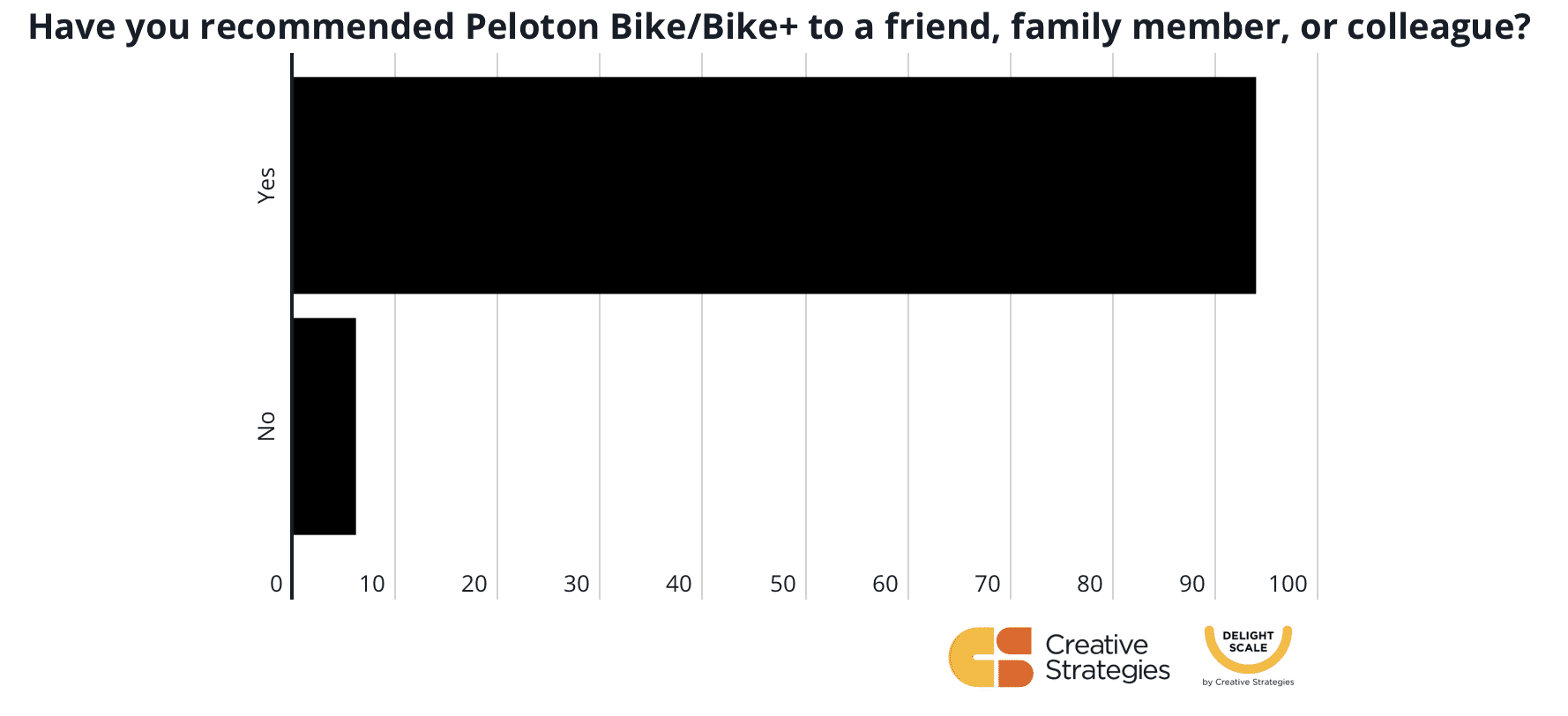
Peloton has impressively grown its market beyond just hardcore cyclists and has been able to sustain engagement across the board. Our benchmarks with the Delight Scale confirm Peloton is a hit with consumers, and the sustained engagement and strong word-of-mouth endorsements from fans bode well for the product and Peloton as a company. *Methodology:* The study was run in the US in February/March 2021 across 900 consumers who answered the questionnaire online and were not compensated for participating in the study. The Delight Scale is built on the ten best questions prepared to capture product experience across a series of products from hardware to apps as well as services. It captures willingness to recommend the product prompted and unprompted, customer satisfaction in relation to expectations, sentiment on price, intention to repurchase, and more. The results are scored, weighted, and aggregated into a product’s Delight Score. The Delight Scale utilizes questions with a 7-point satisfaction scale that ranges from one extreme attitude to another with one neutral option. The Likert Scale is a popular and well-known question format used to measure opinions and behavior. Likert-type questions provide more granular feedback about a product compared to binary questions with their two answer options. The maximum Delight Score a product or service can achieve is 1200\. In order to achieve such a score, respondents would have to select the top 2 boxes for all the scoring questions. Rather than allocating a score to all possible answers, the Delight Score uses a Top 2 Box score (sometimes called T2B) in the way of summarizing the positive responses from a Likert Scale. The Top 2 Box score technique is used across research to help with ad testing, product development, and brand tracking. This approach has proven to lead to a much more holistic measurement of customer experience, actionable product insights to truly separate great products from average ones. Selecting the top 2 boxes for 60% of the questions would place a product or a service on a Delight Score of around 700**.**
### Windows 11: Microsoft’s Most Holistic Approach To An Operating System
URL: https://creativestrategies.com/windows-11-microsofts-most-holistic-approach-to-an-operating-system/
Last updated: 2021-06-24T16:07:41.000Z
We all saw the leaks last week, and while I was left with more questions than answers, it was evident that Microsoft focused on a much more modern, fresher, simpler user interface. What was unclear till today was why Microsoft thought that the update it delivered was worthy of a step-change in number rather than making it a variant of Windows 10\. Now I know, it is the end-to-end experience that Windows 11 delivers, which includes improvements to the Microsoft Store and the integration of services and apps for a much more streamlined experience consumers and business users alike can appreciate.
Leading up to the official launch, I was asked several times if I thought there was a need for something else beyond Windows 10 and, more importantly, what I thought the updated OS should deliver. As someone who was really excited about Windows 10X, I thought Windows 11 should deliver on the promise of Windows 10X. The promise of a modern, agile operating system that could support users seamlessly across devices and across operating systems through the cloud.
The pandemic took Windows 10X off course as far as dual-screen and foldable support. Because users’ needs changed, the development of those form factors was put on the backburner. But some of the components Microsoft had planned to roll out into Windows 10X were integrated into Windows 10\. I would like to think that the pandemic drove Microsoft to reprioritize, given the PC became a window into the world for so many of us, delivering a skew might not have seemed the right approach to take. The key to success is, of course, providing something new yet familiar and, most of all, something that does not require heavy lifting from IT managers. Windows 11 seems to hit on all these areas. For PCs that meet the technical requirements updating to Windows 11 will be like doing a Windows 10 update.
As I observed Microsoft go through the pandemic and deliver on critical tools like Microsoft Teams and Microsoft Viva, It seems to me that the company is much more willing to take people wherever they need to be by meeting them wherever they are. This is quite a different attitude compared to how Microsoft used to continue to support OS versions and features in order not to upset the enterprise balance. Maybe the best example of this new attitude, outside of the very pro hybrid-work stand, is Surface Duo, a pocketable computing experience running on Android that bridges mobile and PC. With Windows 11, Microsoft is further focusing on bridging mobile and PC by delivering experiences built deep into the OS and leveraging applications such as Microsoft Teams to empower cross-device and cross-OS collaboration and communication.
The reason why I think Windows 11 is the most holistic approach to an operating system Microsoft has ever taken is that, at launch, we didn’t only hear about the new Windows PCs that will arrive in the market for the holidays or about app compatibility and system updates. These are all absolutely critical, don’t get me wrong, but no longer isolated components to consider when evaluating the impact of an operating system.
Microsoft also addressed app availability by creating a more welcoming environment for developers who can now bring as a Win32, Progressive Web App (PWA), or Universal Windows App (UWP) or any other app framework. Developers will then have the choice to use Microsoft commerce with an 85/15 revenue split or bring their own commerce and keep 100% of their revenue. Later this year, the Microsoft Store will also start to showcase Android Apps that users will be able to go and download from the Amazon Appstore and then run on their PCs thanks to Intel Bridge Technology. It will be interesting to see how developers will respond to these changes and how rich an experience the Android apps will deliver to consumers. On paper, this seems like a great idea. Creating a rich ecosystem on Windows with the apps millions of consumers use every day on their Android phones. For developers, the opportunity to also deliver Windows apps using their own payment systems so as not to share revenue should be pretty compelling, coming at a time when consumers have never been more engaged with their PCs. And of course, developers will not be the only ones who will notice the store revenue change practice: competitors, as well as politicians and regulators, will also.
Over the past six months, two topics have dominated many of my conversations with the press and customers: future PC demand and Apple’s M1 Macs growth. After seeing Windows 11, there is no question it will have a significant role to play in impacting both. The richness and simplicity of experience that Windows 11 promises to deliver will help sustain the engagement we have built with our PCs during the pandemic. As our mobility increases, so will the time spent on our smartphones, but the quality of our engagement with the PC can remain strong. Only a continued engagement will drive hardware upgrades long term. The tighter integration between Android and Windows and the deeper integration of cloud and first-party apps will also get PC OEM a step closer to how Apple differentiates its M1 Macs beyond the silicon.
Finally, it is impossible to look at Windows 11 and not see the influence Panos Panay has had on this release both in its look and feels and its determination in helping us get stuff done without getting in the way. More importantly, though, in putting users, not IT managers, first or at least on the same level so that Windows 11 can bring you closer to what you love, including getting you closer to love Microsoft.
### Google Workspace Emphasizes How Work Gets Done, Not Where
URL: https://creativestrategies.com/google-workspace-emphasizes-how-work-gets-done-not-where/
Last updated: 2021-06-15T14:40:16.000Z
Google Workspace had undergone a transformation since October 2020 when G Suite was rebranded to Google Workspace, and a series of skews were released to address the enterprise market. In February, Workspace was brought to the education market, and at Google I/O, the team launched Smart Canvas, a new experience that brings Docs, Sheets and Slides together in a more fluid workflow.
Workspace is also opening up over time to the three billion-plus Google account owners. There is no denying that work and personal are no longer as siloed as they used to be, especially when it comes to the tools we use daily. For most knowledge workers calendars and email bring their work and private life together. During the pandemic, video services were added to email and Calendar as they became the primary way we worked together and socialized with friends and family. Another trend that reflects Google’s move to support individuals with Workspace is the steady growth of solopreneurs registered over the past couple of years. In 2019, in the US alone, 42 million individuals identified themselves as consultants, freelancers, or solopreneurs contributing more than $1.3 billion annually to the economy.
Those individuals running their business on Gmail will get access to premium Workspace capabilities and features without having to give up their Gmail address and move to a custom domain. For many sole business owners, work and life are even more blended, and their relationships with their customers and partners are even more personal. Some argue that a custom domain email helps position a business as more professional, building trust with customers. This might be true if an email bears no link to the business or the personal identity, but the @gmail.com domain is so established by now that it is hardly unprofessional.
The new Workspace Individual will allow users to turn on Google Chat which will then grant them access to Rooms. Workspace Individual will be available soon in six markets, including the United States, Canada, Mexico, Brazil, Australia and Japan.
During the extended remote work period, we have had, we have seen collaboration spread across video, chat, messages and email with a different type of content shared across several people. This resulted, at times, in workflows that grew more complex than it was necessary. As many prepare to go back to the office and maintain collaboration equity, much of those digital workflows will remain in place. Google Workspace hopes the new Spaces will bring some welcomed rationalization of workflows around the task at hand. The way I think about it is that there is a move from Rooms in Chat being focused on people to Spaces being focused on the task. Spaces will use in-line topic threading, presence indicators, custom statuses, and expressive reactions. It will integrate files and tasks seamlessly to organize and intelligently guide workflows.
Google continues to develop tools that build on its strengths to drive deeper engagement and add value to those tools that might be more under the threat of competing products. Companion Mode for Meet, coming in September, is an excellent example of that. Google Meet usage numbers have grown over the past six months, but it is fair to say that it is not the first service that comes to mind when users think of Workspace. When it comes to hybrid work and ensuring everybody both in the office and remote are sitting at the same table, most competitors have focused on the video portion of the experience addressing the video feed portion but not necessarily collaboration as a whole. With Companion Mode, Google takes a more holistic approach by providing every meeting participant, independently from where they are located, access to interactive features and controls like screen sharing, polls, in-meeting chat, hand raise, Q&A, and live captions. Colleagues who are in the same meeting room together will be able to leverage the audio and video hardware. At the same time, by enabling Companion Mode on their personal devices, they will have their own video tile in Meet and allowing them to have a personal connection with their remote colleagues.
Knowing from where people join the meeting will be extremely useful, especially when the offices first reopen. This is why Google added a feature in Calendar that will allow participants to accept a meeting request by adding their join location, indicating whether they’ll be joining in a meeting room or remotely.
Security was very much top of mind during the pandemic and will remain so as organizations embrace hybrid work, and business travel gets back on people’s calendars. This and the ever-growing data privacy requirements led Google Workspace to add Client-side encryption so that customers could adequately address data sovereignty and compliance requirements. Workspace will give customers direct control of encryption keys and the identity service they choose to access those keys. With Client-side encryption, customers can continue to use Workspace collaboration tools and access content on mobile while the data remains indecipherable to Google. Client-side encryption is particularly beneficial for organizations that store sensitive or regulated data, like intellectual property, healthcare records, or financial data.
With Spaces and Smart Canvas, Google Workspace is really delivering on a seamless collaboration experience that showcases the breadth of Google’s solution made smart by an intelligent cloud-first approach to collaboration. As I look forward to testing the different features, the big question is whether users, consumers included, will experiment with it or fall back on a usage pattern they know and are comfortable with. Discoverability will be critical, and so will create steppingstones that will drive users deeper into Workspace.
### Three Big Themes at Apple’s WWDC
URL: https://creativestrategies.com/three-big-themes-at-apples-wwdc/
Last updated: 2021-06-10T14:27:26.000Z
I am not sure if it’s the lack of down time for stage walk-ons or that Apple has got this digital event thing down to a science, but the pace of this year Apple’s Developer Conference (WWDC) was incredible. The overall impact of the announcements across iOS, iPadOS, macOS, watchOS and tvOS will take a little bit longer to assess, but when looking at the breadth of the news, I would summarize the keynote under three areas:
- Deepening multi-device and cross-service value
- Privacy and security as enablers
- Building the foundations for the future
**Deepening multi-device and cross-service value**
I have argued for a very long time that Apple’s long-term goal has always been to deliver more value to those users who engage with multiple Apple devices. The WWDC’s keynote paraded a long list of examples across devices and services that made it clear that while Apple doesn’t lock customers in (as Tim Cook recently said at the Epic vs. Apple trial), it focuses on not giving them a reason to look elsewhere.
***Universal Control***
Universal Control gives users the ability to use a single mouse and keyboard to move between a Mac and an iPad, supporting up to three devices. Given the new iMac and iPad Pro launch on the M1 silicon, I can see users planning to pair iPad for on-the-go computing needs to a home/office iMac welcome this added functionality as driving higher return on their investment.
***Shared with You***
Shared with You is a new feature that takes articles, music and pictures that people shared with you in iMessage and creates a tab in Apple News, Apple Music and Apple Photos for you to consume from within the apps at your earliest convenience. This is not just convenient; it creates more stickiness to apps such as News that a browser could easily bypass.
***Apple Music and Memories***
The Apple Photo app added Memories back in 2018\. Memories is an intelligent curation of your favorite moments brought together by stitching photos and videos into a movie that adds music tailored to its length and mood. Now users will be able to use music from their Apple Music subscription as a soundtrack. Using the new feature called Memories Mixes, a user can intelligently pick songs, pacing, and an overall look. Experts curated sets of songs based on music taste and the user’s listening history to choose from.
***FaceTime***
It is also clear that for Apple, opening up services and features to devices built on non-Apple operating systems only makes sense when doing so adds value to its customers. Look at the difference between opening up FaceTime to Android and Microsoft devices as well as browsers while not doing so for iMessage. Limiting FaceTime to iOS devices meant that as a user, I was unable to call friends and family who relied on non- Apple devices. At work, the limits of running on a single vendor are even more marked as, despite the high penetration of iPhones in business, no workplace can afford to standardize on only one vendor. With iMessage, users are not prevented from communicating with people on other devices. They might have a less rich experience, but the core functionality remains.
**Privacy and security as enablers**
Privacy is a human right has been a slogan we have heard Tim Cook and other Apple executives say at many events, and the WWDC keynote was no different. A lot of attention has been given to iOS 14.5 new app tracking transparency feature, which increases visibility for consumers of what data apps are tracking and gives them the power to decide whether they want to be tracked or not. With iOS 15, Apple expands that transparency by adding a privacy dashboard that clearly summarizes which app has access to what data and when. Apple also added the ability for Mail to block invisible trackers and a lot more on-device intelligence for Siri.
As Apple dives deeper into privacy to the point of launching a new service for iCloud, it is obvious that the benefit is not just a nice marketing slogan but a business differentiator that might help add value that competitors cannot easily replicate not because of the technology they have access to but because of business model they run on.
***Health and Wallet***
Apple added the ability to share health data, not just lab data, with your doctor. It also added the ability to view the health data of your children or your parents. As we start to reconnect with people, it is evident that the pandemic highlighted needs that had not been top of mind before, such as monitoring the potential deterioration of our parents’ health when we cannot connect with them in person or regularly.
Apple Wallet has grown to store our credit cards, reward cards, car keys, house keys, hotel keys and now ID cards.
With so much valuable information in one place, users must be confident in the level of security used to keep it safe. But security is not the only concern. Users must also trust that this information will not be accessed and used by Apple or their partners. Trust is also required by business partners such as hospitals, health insurances, hotel chains, car manufacturers and state governments who decide to make the feature available on Apple’s devices. Their brand will be damaged too if users face any issues.
***iCloud+***
The new iCloud Plus provides a VPN called Private Relay, Hide my Email that lets you create single-use email addresses that will forward to your actual email and unlimited storage for HomeKit-enabled home security cameras.
iCloud is a service that you might have come to rely on if you are entrenched in the Apple ecosystem with multiple devices. Yet the reality is that there is a lot of competition from Google, Microsoft and Dropbox. Some providers have proven more generous in their free storage allocation, and others offer a much more seamless cross-platform experience. Apple’s focus on privacy might grow in appeal as we store more data in the cloud, both generated by us, such as photos and also by our devices such as wearables and cameras.
**Building the foundation for the future**
The last thread I noticed throughout the keynote was an investment in the future. Whether it was about driverless cars or AR, Apple provided the tools for developers to start building apps and some initial experiences for consumers to start building confidence.
***3D object design and Maps***
To make it easier for developers to create realistic 3d objects, Apple launched Object Capture, a new macOS API that uses photogrammetry to turn a series of 2d images into photorealistic 3d objects. The new API cuts down the time and the development cost, potentially accelerating the catalog of 3D objects available but also increasing fidelity by making the process timelier.
In Maps, Apple added a great deal of information that helps drivers today but will be even more critical for self-driving cars. From turn lanes to bus and taxi lanes to navigate traffic and crosswalks and bike lanes to help navigate intersections and busy city centers. For highways, Apple added the rendering of overlapping complex interchanges in three-dimensional space, making it much easier to see upcoming traffic conditions or to know which lane you need to be in. To experience AR in real life, iOS 15 catches up to Android by adding three-dimensional directions to a selected number of cities.
There were other announcements that I look forward to experiencing, such as multitasking on iPadOS, Quick Notes and the improvements to Safari tabs. Developers have already been sharing first impressions on social media, and users will be able to get a glimpse in July when the beta rolls out.
### Content Execution and Brand Promise Give Disney+ a 793 on the Delight Scale
URL: https://creativestrategies.com/disney-scores-793-on-the-delight-scale/
Last updated: 2021-06-08T07:27:49.000Z
We are excited to publish our first [Delight Scale](https://creativestrategies.com/what-is-the-delight-scale/) post covering some of the many key insights we gathered on how subscribers to the Disney+ streaming service think and feel about their experience. We strongly believe that a key driver of product experience delight is centered on how the product or service performs in relation to customers’ expectations. It is easy for a product to score well on satisfaction if your initial expectations were low. Much harder to exceed your expectations if those were already high. Disney+ did quite well in this regard, with 50% of current subscribers saying the service was better than expected. This is even more impressive when 90% of Disney+ customers stated they had high expectations of the service before signing up. Satisfied customers are great, delighted customers are even better. Being able to expand your base often relies on recommendations both from people you know and people you don’t know. We continually find a customer’s willingness to recommend a product hinges on both the product delivering a quality experience and containing experiences that appeal to a mass-market consumer. The Disney+ focus on family-friendly content was also a factor in Disney+ having a high recommendation score on the Delight Scale. As a result, 88% of customers were likely to recommend Disney+ and, perhaps more impressively, 74% of Disney+ customers did recommend the product to someone in their social circle. Disney+ hits both on service quality and on how relatable the service is to a broad set of the addressable market. This combination led to the highest recommendation score of any media service we have tested to date. The following chart highlights some of the key experiences around Disney+ and why the service ranked so high on overall quality. The above chart shows how consumers rated specific Disney+ experiences. You can see the family-friendliness of content was the feature with the highest positive sentiment, followed by the content selection, and quality of original content. Disney has a number of brands it can leverage and launching with the Mandolorian, part of the much loved StarWars franchise, was a smart way to generate interest. That being said, Disney being aggressive with a back catalog of Disney content helped make the overall experience of Disney+ feel more robust than other upstart direct-to-consumer media services. It is reasonable to think, these factors played a key role in Disney+ exceeding the expectations of many customers. The other area Disney+ shined was in price to value. The overwhelming majority (85%) of Disney+ subscribers indicated the price of Disney+ was fair. Fairness in price and a strong return on investment is clearly creating a high degree of stickiness to Disney+ as 87% of Disney+ subscribers indicated their intent to continue subscribing to Disney+. Streaming services see a high degree of churn or simply content-driven sign-ups and cancellations and while intention does not always turn into conversion, an 87% score is good news for the service. The a-la-carte option of monthly payments makes it easy to stop subscribing once a customer has consumed all the relevant content and then resubscribes later. The weekly content releases are a contributor here to the longevity of Disney+ stickiness and the continued release of new series around noteworthy Disney brands. Another noteworthy point to consider is how Disney+, and Disney’s content strategy, play out from a competitive standpoint. The three most popular services Disney+ customers also subscribed to were Netflix, Amazon Prime, and Hulu. There are only so many hours in a day people can watch entertainment content, but the lure of consuming content as a family, frequently, is a strong differentiator for Disney+. **Key Insight** In studying multiple media streaming services, what stands out with Disney+ and their content strategy, is the way Disney+ content aligns to the overall Disney brand and Disney’s target customer. Disney has an exceptional understanding of its customers, and the Disney experience consistently aligns with its brand promise. It shouldn’t surprise us that Disney+ shattered everyone’s, including Disney’s, first-year target subscriber goal given the equity in the Disney brand both of their theme park experience and the blockbuster movies put out by their studios. By focusing on content that aligns with the Disney brand promise and experience, Disney+ sits atop the ranks for a media service on our Delight Scale.
---
- The Delight Scale is a proprietary customer experience measurement tool. With the Delight Scale, we crafted the 10 best questions to capture customer experience. The results are scored, weighted, and aggregated into a product’s Delight Score. This approach has proven to lead to a much more holistic measurement of customer experience, and actionable product insights and truly separates great products from average ones. Delight is the bedrock of every loyal and engaged customer.
- A product’s Delight Score is derived from a proprietary algorithm that totals the sum of the points awarded for each question/answer which is reflected toward positive customer experience sentiment.
### The Tech Industry Build Out Cycle
URL: https://creativestrategies.com/the-tech-industry-build-out-cycle/
Last updated: 2021-06-10T14:27:33.000Z
One of the more interesting conversations to be happening around the tech industry currently is what kind of a cycle we are in? In the last few years, I’ve noticed an interesting tension that emerged because, as a whole, the tech industry has just come off a period of significant rapid invention and innovation. From the mid-2000s until the mid-2010s, we saw an incredible innovation cycle around computing where over half the planet became connected to the internet via a primary computing device. Unfortunately, humanity has no real historical precedence for the rapid innovation and adoption of computing devices into the hands of more than 3 billion people in a span of fewer than 10 years. And this tension that is emerging is more of one of the expectations than anything else.
When your most present memory is a decade of innovation around PCs, smartphones, tablets, and wearable technology, once that innovation slows down, it can create the perception that tech is no longer innovative, or it is mature, or as I’ve heard it often said the tech industry is “boring.” I made several points years ago discussing this that the pace of innovation of the last decade simply was not sustainable, and we can’t expect that to the norm.
What is happening is actually what many predicted would happen when the first tech boom hit in the late ’90s. I [wrote about this, what many call the boom, bust, buildout theory](https://techpinions.com/the-best-innovations-are-still-ahead/15330?ref=creativestrategies.com). Nearly every mega-industry since the industrial age saw this pattern where there is a boom equaling a flood of capital to a market, followed by a bust due to overflooding of capital to a market, and that is followed by a long sustained period of building out the industry via innovation and adoption.
Having studied consumer adoption of technology for over 20 years now, the way I think about this cycle is the boom, and bust part of the market helps to enable product creation due to its flood of capital followed by falling prices due to the bust. This enables new entrants to innovate and also provide solutions at costs that the mainstream can then afford. Sometimes this happens quickly, and sometimes it takes a while, but the buildout part of this phase is the mass adoption of the solution into the general public.
While it may seem boring, we are still in the buildout phase as a tech industry. What makes this cycle different than others is the role the Internet plays. The Internet is the backbone that makes computing relevant. If all our hardware was not connected to the Internet, it would be largely useless. And unlike things like boats, railways, engines, and other technologies where this pattern has emerged, the Internet is dynamic, not static. The dynamic nature of the Internet is what will enable the continued innovation of our digital devices. What this does, is causes the build-out cycle to be longer and larger than any other previous mega-industry.
**The Next Big Thing**
In the framing I just provided, my thinking has clarified this question around what is the next big thing. Of course, we can say something easy like augmented reality, virtual reality, robotics, or automation, but the reality is the next big thing is the evolution of the Internet. Because the truth is, all this interesting hardware we like to envision is simply just a new way to interact with the Internet. We interact with the internet today on 2D flat screens, but in the future, we will Interact with it via 3D displays, and with robotics and AI, the internet will start to interact with us.
The rapid period of innovation of the last decade was the creation of hardware to interact with the Internet version 1.0 or 2.0, according to some people. That manifests itself with web browsing and apps. Internet 3.0 will consist of more AI, augmentation, and automation, and the devices we experience the Internet with will look and feel much different than today. But, I find thinking about the future helpful if we start with the evolution of the Internet around cloud, AI/ML, automation, etc. First, think about devices vs. think about devices and then the Internet’s evolution. Simply because the Internet’s evolution (what is capable on the backend) will dictate what is capable within the hardware we create to experience it.
But, all of this means we are still a long way off from mass adoption of topics that get people excited today. Augmented reality is a 10+ year journey to mass adoption. Automation, specifically self-driving cars, is a 10+ year journey to mass adoption. We haven’t even scratched the surface of AI and robotics yet, which is more like a 20+ year journey.
This buildout phase is important, and it doesn’t mean there isn’t still innovation ahead. But, it won’t be as exciting as the last 10 years in terms of hardware invention.
### Google and Samsung Get Closer To The Benefit of WearOS
URL: https://creativestrategies.com/google-and-samsung-get-closer-to-the-benefit-of-wearos/
Last updated: 2021-06-10T14:27:40.000Z
There were plenty of rumors leading up to Google I/O that we might see the next generation of Samsung’s Galaxy Watch models embrace Google’s wearable platform [Wear OS](https://blog.google/products/wear-os/wear-io21/?ref=creativestrategies.com). The rumors turned out to be quite right. The next Galaxy Watch will be running Wear OS, but the news is actually much more significant. Samsung and Google are merging Wear OS and Tizen, the platform that Samsung has been using for its wearable portfolio as well as its TVs.
Most people will agree that Wear OS had been neglected for way too long, as Google seemed to have reprioritized its software initiatives and then decided to address this market with the investment in Fitbit. The Android ecosystem had certainly been in need of an Apple Watch rival. It was clear that Samsung’s persistence with a separate effort was not going to deliver such an experience. The hardware was not the issue. Samsung’s designs and technology integration has been picking up pace over the past couple of years, and its bands and watches have been very competitive hardware-wise. Software and apps let users down primarily because of the friction out of the desire to build a separate ecosystem rather than putting key Google services front and center for consumers. Samsung can continue to differentiate by delivering unique experiences across Galaxy devices, which will arguably offer higher returns in the long run.
As I have mentioned over the past six months, the change in leadership at Samsung signaled a shift in prioritization. DJ Koh had undoubtedly made his ambitions clear when it came to both the software and services ecosystem, two worlds he knew very well. It seems to me TM Roh feels differently about it, and he is more tactical with partnerships both with Google and Microsoft. Developing and maintaining a broad and engaged community of developers is no easy task. One that might take too many resources away from other significant areas Samsung is investing in, from foldables to PCs.
Some of the enhancements coming to Wear OS mentioned during the Google I/O keynote are faster navigation – up to 30% shorter apps load time – through shortcuts and longer battery life, an expanded collection of tiles that provide users with easily glanceable information. The tiles will also have a new API, so developers will be able to create them for their apps, and users can customize their screen carousel. There is also a promise of revamping the wearables app experience through Material Design starting with Google apps such as Google Maps that now users will be able to access even when they leave their phones at home. Both YouTube Music and Spotify will also support offline downloads.
Fitbit co-founder James Park was on stage to share how the renewed Wear OS platform will also benefit from the expertise Fitbit has developed over the past 14 years. Now part of Google, Fitbit will lend its most popular features such as tracking your health progress throughout your day and on-wrist goal celebrations to Wear OS devices. It was unclear if these will remain limited to MadebyGoogle devices or made available to all OEMs working with Wear OS. The stakes are now different as Google will prioritize larger ecosystem gains over Fitbit gains.
While the smartwatch market might never be as big as many market watchers initially expected it to be, there is no question that wearables, including hearables, have become a platform play and are no longer accessories. Furthermore, they play a critical role in driving engagement and increasing loyalty, especially among the most valuable users. For Wear OS, such loyalty and engagement positively impact Android and Chromebook products as well as Google services. To me, Fitbit’s acquisition was a nod to this realization rather than simply an easier way to get market presence.
It will be interesting to see if a Pixel-branded smartwatch will hit the market – many expected one at I/O – or if Samsung’s stronger bargaining position at the negotiation table included an agreement that gave them that preferred partnership role. Either way, consumers will certainly benefit from this week’s announcement, and I look forward if the execution lives up to expectations.
There was so much more than wearables and smartphones in the two-hour keynote, really underlining how the developer festival has grown to cover a much broader set of opportunities ranging from computing to cloud to AI and productivity tools. The “helpful technology” mantra we have heard Sundar Pichai mention over the past few years resurfaced this week but with a slight spin. To me, it was clear that while talking about security and privacy being central to all its businesses, Google built a strong case for consumers to want to share data with its services because the return will be worthwhile. The [Shopping Graph](https://blog.google/products/shopping/more-ways-to-shop?ref=creativestrategies.com) is an excellent example of what I am referring to. Google’s ambitions were also in strong display at the keynote with Project Starline, which gave us a glimpse of the future of virtual interactions, a new health tool that uses the camera to diagnose skin conditions and the commitment to build a commercial quantum computer by 2029.
Apple WWDC is now only three weeks away, and there will be plenty of compare and contrast. While natural, I would argue that these companies are moving further and further apart as far as their overall business focus and the impact they can have on the world.
### A New Era for Creative Strategies
URL: https://creativestrategies.com/a-new-era-for-creative-strategies/
Last updated: 2021-05-07T19:17:47.000Z
Creative Strategies was founded in 1969 by Larry Wells and David Norman. They were both at SRI and saw a need for a dedicated tech market research firm. Together they created what, at that time, was one of the first real tech market research firms in the world that studied the impact of tech on the market. In 1971, David Norman left to start DataQuest and Larry Wells sold Creative Strategies to Global Econometric Consulting firm, Business International. CS became Business International’s tech arm and provided technology market research and consulting to their clients and the broader market. I joined CS in 1981 and became their first PC analyst. In reality, I was one of the first to ever have the title of PC analyst since this was a nascent market and very few other tech market research companies were following PC developments at that time. The exception was IDC and Forrester was founded around the time the IBM PC came to market. I had the privilege of tracking the PC market since its inception and was able to help Creative Strategies grow its business. Through various market factors, I was able to acquire Creative Strategies in 1992 and moved it to more of a strategic research and consulting company. That business model allowed us to provide custom research and consulting to most of the major companies in the tech industry and today Creative Strategies is trusted by 80% of the top 10 Fortune 500 tech companies. In October of this year, I will celebrate my 40th year at Creative Strategies. I have seen the technology industry market grow and thrive over this period and also change dramatically. I believe the time is right for Creative Strategies to have new leadership to guide it to even more success in the future. In 2000, Ben joined us after helping start two startups and gaining valuable experience building a company and its products. Ben will take over as CEO and I could not be prouder of all he has accomplished in the industry thus far and I am excited about what lies ahead for him. Carolina Milanesi, who we were extremely lucky to have joined us five years ago, will become President. I can honestly say our business would not be in the strong position it is today without Carolina’s insights, leadership, and passion. Carolina and Ben make a stellar team! Their complementary skill sets, their ability to build on each other’s ideas to deliver more value, and their drive to always aim higher are a true asset for our customers’ success. They have an incredible vision for the company, and the next era of Creative Strategies, and that vision is previewed with their launch of [the Delight Scale](https://creativestrategies.com/delight-scale/). While I am not quite ready to retire, I will move to Chairman and shift to focus my efforts on areas where my historical perspectives can add value. In an article, I will share soon on Tech.pinions, I will lay out my next big focus over the next five years, and share about a book I will be writing with a good friend about what I consider to be the next major disruptive technology over the next 10-years. I am excited about Creative Strategies’ future and feel fortunate to be able to see a business I care so much for continue to live on and thrive.
### Samsung Is Finally Serious About PCs. Intel and Microsoft Seem Delighted
URL: https://creativestrategies.com/samsung-is-finally-serious-about-pcs-intel-and-microsoft-seem-delighted/
Last updated: 2021-04-30T21:26:44.000Z
In the first Galaxy Unpacked event ever dedicated to introducing new laptops, Samsung’s Head of Mobile Communications Business, Dr. TM Roh, [presented](https://news.samsung.com/us/galaxy-book-pro-series-mobile-computing-for-the-connected-world/?utm%5Fsource=pr%5Fmedia&utm%5Fmedium=email&utm%5Fcampaign=General) the Galaxy Book Pro series. The Galaxy Book Pro and the Galaxy Book Pro 360 run on the 11th Intel Core processor and leverage a deep integration between Microsoft 365 apps and Samsung’s features such as Samsung Gallery and Samsung Notes.
These products represent the start of a new chapter in Samsung’s role in the PC market. These are clearly not the first Samsung’s PCs, but reading between the lines of the dedicated event, the presence on stage of both Dr. TM Roh and CMO Stephanie Choi, there is a stronger commitment to the category going forward. Dr. Roh talked about Samsung’s customers’ desire to see the brand move more into the PC space. There is, of course, a revenue opportunity at a time when consumers have redefined their relationship with the PC. There is also an opportunity to deepen the engagement with the current Galaxy phones’ users by creating value from all the devices working together to elevate Samsung’s experience.
### PCs And, Not Or, Smartphones
Throughout the event, Samsung highlighted what makes their brand different compared to the rest of the market. While I would not go as far as saying these products re-invent the category, there is no denying Samsung’s deep understanding of what it takes to deliver a great mobile experience. The tagline used throughout the event was “why can’t a PC be more like a smartphone?”. This is certainly a question that consumers have been asking for quite some time and a vision that PC manufacturers tried to deliver on with different degrees of success.
During the digital event, Intel and Microsoft joined Samsung on stage, welcoming the brand to the ecosystem and sharing some of the work done together to differentiate the experience on these products.
Over the past year or so, I made no secret that I believe there is an essential role for Samsung to play in the PC market that would be mutually beneficial to the Korean brand and the broader ecosystem. The relationship reset between consumers and PCs brought forward by the pandemic did not come at the expense of our love affair with smartphones. If anything, consumers have been either appreciating or longing for a tighter relationship between their smartphone and their PC. When smartly brought together, these two devices can deliver a more flexible, personal and modern computing experience.
Samsung did not need the pandemic to understand the importance of this relationship. We all saw the kind of work done to bring Office and Windows and the Galaxy Note family closer. What has changed with the pandemic is the opportunity to leverage the new sentiment towards the PC and the consumer willingness to spend by delivering on the PC front as well as the phone front. In other words, why should Samsung make the Windows ecosystem stronger by making Galaxy phones the best companions without benefitting from the effort by also bringing to market some new laptops?
From an ecosystem perspective, Microsoft could benefit from another strong player in the market, especially one who understands mobility and is well entrenched with carriers. This is also a good time, given the uncertainty that remains on Huawei’s choice of the operating system for its phones going forward. For Intel, as more PC makers embrace silicon diversity, having a new brand to work with is a plus, especially on EVO-certified products. I would expect Samsung to continue to slot Qualcomm’s powered devices in its portfolio and possibly, over time, also consider AMD. Yet in this new push working closely with Intel allows Samsung to add credibility to its effort, especially in the enterprise market and, of course, provides some extra marketing Dollars.
### Software Differentiation
Over the past few years, Samsung has been focusing more on software and UI on its Galaxy phones, and I was delighted to see that some great features designed to enrich users’ experience on the phones made it to the Galaxy Book Pro Series. In particular, I would call out Galaxy Book Smart Switch to transfer data from your existing Windows PC to the Galaxy Book Pro. If you are entirely sold on the cloud or work with a Microsoft account, you will have little use for Smart Switch. Still, you will also be a member of a very selected group. When it comes to mainstream users, especially those that have been using their PCs as an emergency computing device for the past few years, most data is just sitting on a hard drive.
As we saw highlighted in the latest Galaxy A Series Unpacked, video streaming and video calling also took center stage with the Galaxy Book Pro family. Samsung is trying to streamline workflows that matter to its target segment, from dedicated keys to turn the camera and mic on/off to Intelligent Noise Cancelling.
Of course, you cannot talk about Samsung products without mentioning connectivity, and the galaxy Book Pro Series is Wi-Fi 6E Ready and supports LTE and 5\. However, it is unclear which US carriers will sell the newly launched models. The [Galaxy Book Pro](https://www.samsung.com/us/computing/galaxy-book-pro/?ref=creativestrategies.com) 13″ will start at $999.99, and the 15″ starts at $1,099.99\. The [Galaxy Book Pro 360](https://www.samsung.com/us/computing/galaxy-book-pro-360/?ref=creativestrategies.com) 13″ starts at $1,199.99, and the Galaxy Book Pro 360 15″ will start at $1,299.99 and be available for retail purchase beginning May 14.
As we all know, market share in the PC market is not made overnight. Momentum comes by building a portfolio that is reliable both in its performance and its launch cadence. I will be able to say more on the former in a few weeks, but only time will tell on the latter.
### Surprised by Apple
URL: https://creativestrategies.com/surprised-by-apple/
Last updated: 2021-04-30T16:29:13.000Z
The only thing that keeps surprising me about Apple is that people keep being surprised by their ability to keep delivering great quarterly revenues. But, of course, I know the point I’m making is more of an industry and investor one since most of Apple’s customers pay no attention to their earnings.
I have participated in countless investor debates on the sustainability of Apple’s business. While most investors have come around to the resiliency of Apple’s business and adjusted their models accordingly, there is still a general sustainable growth concern.
I find most fascinating, and perhaps the biggest reason I’m confident in Apple’s sustained growth is how the growth contributions can come from unexpected areas. One quarter maybe iPhone, one quarter it may be Mac and iPad, one quarter it may be services, one quarter it may be wearables, etc. While multiple of these lines of business can contribute to varying degrees, what has to be appreciated is all the revenue levers Apple has, which continually contribute to top-line growth.
While I appreciate the debate around how much more the iPhone can grow, being stuck on that point misses the fact that the rest of the Apple product and service ecosystem is underpenetrated compared to the iPhone. Meaning that not every iPhone owner has a Mac, iPad, Apple Watch, AirPods, or HomePod. Not every iPhone owner subscribes to Apple’s digital services. In that light, the growth story looks a lot more interesting and sustainable.
While the iPhone will continue to see a cadence of upgrades, generally over a four-year time frame, and be stable on an annual basis of shipments, Apple keeps sharing their active iPhone installed base keeps growing. This means they are continually adding new customers, even if relatively slowly compared to other products.
To give out some numbers for context, **the iPhone global installed base is \~1 billion. Mac is \~110m. iPad is \~250m. Apple Watch is \~100m, and Airpods likely in that range as well.** So compared to the iPhone installed base, every other hardware category from Apple is owned by less than 30% of their global customer base.
I’ve seen several global surveys on iPhone customers, which indicate that no single service has more than 30% penetration into the global iPhone customer base. iCloud appears to be the most subscribed to service at around 30% of iPhone customers subscribing to the storage service.
Now to the important takeaway in the Apple growth narrative. **\~70% of Apple customers don’t own an additional piece of Apple hardware or subscribe to Apple’s digital services**. While I do not expect 100% of all iPhone owners to own multiple pieces of Apple hardware or subscribe to all of Apple’s services, there is still a great deal of growth headroom for every offering from Apple beyond iPhone.
Once Apple acquires customers, they generally do not leave. Apple has loyalty, engagement, and brand equity on its side, and all those things factor into the continued reliance and strength in its business. Apple has a history of putting out great products, and as long as they continue to put out great products, there is no reason to be surprised by their performance in the marketplace.
### Intel’s Unleashes a Turnaround
URL: https://creativestrategies.com/intels-unleashes-a-turnaround/
Last updated: 2021-04-25T19:40:05.000Z
Yesterday, Intel [announced a series of efforts](https://newsroom.intel.com/news-releases/idm-manufacturing-innovation-product-leadership/?cid=em&source=elo&campid=smg%5FWW%5Fbracbu%5FEMPR%5FEN%5F2021%5F0323%5FIDM%5FManufacturing%5FIn%5FC-MKA-22955%5FT-MKA-23578&content=smg%5FWW%5Fbracbu%5FEMPR%5FEN%5F2021%5F0323%5FIDM%5FManufacturing%5FIn%5FC-MKA-22955%5FT-MKA-23578&elq%5Fcid=1485982&em%5Fid=67655&elqrid=c3d08141ea49495cb98c791d88898ecf&elqcampid=43328&erpm%5Fid=4084616#gs.x0zdrh) that may one day be looked back at as foundational for their turnaround. Despite Intel being in a strong market position in many of the areas they compete in, the leadership zeal Intel once brought to the technology industry had been waning, and when it came to looking for points of innovation in computing, Intel is not the first company to come to mind.
In many ways, Intel is in a position very similar to Microsoft before Satya Nadella took over. Microsoft, like Intel, remained dominant in many markets. But the issue was a staleness surrounding the company that was leading to fading relevance as an industry and category leader and technology innovator. Nearly overnight, Satya Nadella brought renewed vigor to Microsoft, and Pat Gelsinger appears to be having the same impact on Intel. With the right leader, no company can ever be ruled out. Microsoft proved this, and Intel may very well prove this with Pat Gelsinger at the helm.
**Intel’s Renewed Foundry Efforts**
One of the main announcements is Intel’s renewed efforts at being a competitive foundry making semiconductors for companies other than Intel. Some may remember, Intel has tried this before, but those efforts failed for a variety of reasons. The main one being the priority for Intel was always their own products and not others. So what has changed this time around?
The first is a very different market than when Intel first attempted being a foundry. There has never been more demand for semiconductors than right now, and that demand will remain and grow stronger for years to come. Amidst significant semiconductor demand, leading to chip shortages for every segment, Intel remains one of the only semiconductor manufacturers with the capacity to offer immediately.
Another significant difference is Pat Gelsinger is a different leader, with different ambitions and goals than those who led Intel’s previous foundry efforts. Intel Foundry Services is a stand-alone business unit, which reports directly to Pat Gelsinger. Intel Foundry Services will have its own PNL, revenue goals, and growth targets. This is a much different model than what Intel had set up in their prior foundry efforts.
Lastly, Intel Foundry Services will have one of the more robust I.P. portfolios for foundry customers. This statement from the press release is succinct “IFS will be differentiated from other foundry offerings with a combination of leading-edge process technology and packaging, committed capacity in the U.S. and Europe, and a world-class I.P. portfolio for customers, **including x86 cores** as well as ARM and RISC-V ecosystem I.P.s.” Two things about this are unique to Intel foundry customers.
The first one being x86 cores, which assume some x86 I.P. At the moment, AMD is the only other company offering a cooperative effort to build custom x86 products for customers in their semi-custom business. While it is unclear how deep down the customization efforts would extent for Intel x86 I.P., but it will be extremely interesting to see how foundry customers take advantage of x86 I.P.
The other element of interest to me is Intel’s packaging technology, particularly their 3D packaging technology, which is quite innovative and unique. Foundry customers can take advantage of this unique technology which could turn out to be a significant differentiator for Intel Foundries, as well as Intel’s own products going forward.
While there is no slam dunk for Intel Foundry Services, I remain conservatively optimistic about their efforts. As I’ve outlined before, Intel being competitive as a foundry is extremely important for U.S. technology companies, so I personally believe it is in the best interests of many that Intel succeeds in this area.
**Catching up in Process Technology**
A fundamental part of Intel’s turnaround efforts is to close the gap between their foundries and TSMC and Samsung in process nodes. Intel will roll quickly past 10nm, something they should have done years ago, and look on track to deliver 7nm in a timely fashion and then quickly move to 5nm on a regular cadence going forward. Part of the reason I have more confidence Intel can do make these process node advancements going forward is due to their embracing of EUV and their less aggressive density targets. Both of these recipes are what TSMC has used to remain a steady cadence, and there is no reason to believe Intel can’t do the same.
Assuming Intel can close the gap, even if not catch up, there is reason to believe they will remain extremely competitive even if they are not making products on the same nodes as TSMC and Samsung. A lot of that has to do with Intel’s packaging technology which Gelsinger argues is the best packaging technology in the world, and there is some truth to this claim.
Intel is not actually as far off as its competition when it comes to performance. They are a bit farther when it comes to performance-per-watt but not in sheer performance. This is a testament to their architecture, and as we will see with future competitive products is a testament to their packaging and transistor design.
Getting to the point of at least some parity on process technology is essential for both Intel’s own products manufactured by Intel and customers of Intel Foundry Services. The next few years will be critical at an execution level for Intel to deliver on this front and for us to gauge their success at meeting regular cadence schedules.
I’ve always been curious to see what it would look like for other companies to collaborate with Intel to have their architecture designs run on Intel’s advanced packaging technologies. Hopefully, soon we may finally see if Intel process and package technology is truly that differentiated. I’d also love to see what Intel packaging technology looks like designed on Arm (hint Apple).
**Outsourcing Intel Chips**
As interested as I’ve been to see what other semiconductor companies can do with Intel’s packaging technology, I’m also quite interested to see what Intel architecture looks like running on other company’s process technology. We have been watching to see if Intel would outsource its CPU designs on a different process, and it looks like we may see that reality.
As a part of Intel’s announcements, it became clear that they would now start outsourcing some CPU designs to TSMC and possibly Samsung in the future. While this may be a trial run at first, I’m extremely interested to see how Intel CPU designs perform on a leading-edge TSMC process. Again, this will bring quite a bit of clarity to the quality of Intel’s architecture and potentially their process as well.
The other area of intrigue this creates is the competitive dynamic between Intel Foundry Services and other foundries. If Intel (who is Intel Foundry Services’ largest customer) sees significant benefits from their products made at TSMC, then it creates a competitive dynamic that did not exist before. Intel should be building its products on the best technologies, and if that becomes clear it is not Intel Foundry Services, then IFS will be truly competing for Intel’s business. A fascinating storyline to watch develop.
What is also new to this equation, and one that will be interesting to watch is the dynamic of Intel now competing with any outside foundry they make their products with. Intel may be partnering with TSMC, but they will also be trying to compete with them, directly, with Intel Foundry Services. This, in my opinion, is the most awkward part of the overall new structure and announcement. We will watch this new dynamic closely.
Overall: I am significantly more bullish on Intel now than I was a year ago. Pat Gelsinger is the right guy at the right time, and as I mentioned with the observation on Microsoft, sometimes all it takes is the right leader. These announcements are a huge step in the right direction, but as Gelsinger continued to emphasize during his presentation, it will all boil down to execution. That being said, now more than any time in the last decade, I’m more optimistic Intel can execute going forward.
### The Apple Card’s new feature tackles one of credit’s biggest problems
URL: https://creativestrategies.com/the-apple-cards-new-feature-tackles-one-of-credits-biggest-problems/
Last updated: 2021-04-30T17:03:55.000Z
At its Spring Loaded event held virtually on Tuesday, the very first thing Apple announced was a new Apple Card feature called Apple Card Family. Available in the U.S. in May, Apple Card Family allows two people to co-own an Apple Card credit card, merging their credit lines while building credit together equally. Apple Card Family also lets parents share an Apple Card with their children.
This comes almost a month after the New York State Department of Financial Services (NYDFS) [released](https://www.dfs.ny.gov/reports%5Fand%5Fpublications/press%5Freleases/pr202103231?ref=creativestrategies.com) a report that cleared Apple and Goldman Sachs of gender-based discrimination. That followed an investigation initiated by online complaints shared shortly after the card’s initial launch in 2019\. At the time, tech entrepreneur David Heinemeier Hansson [tweeted](https://twitter.com/dhh/status/1192540900393705474?s=21&ref=creativestrategies.com) that he had received a credit limit that was 20 times higher than what his wife [Jamie was offered despite her higher credit score](https://www.fastcompany.com/90429224/i-applied-for-an-apple-card-what-they-offered-was-a-sexist-insult?ref=creativestrategies.com).
In its investigation, NYDFS found that gender was not a factor influencing Apple Card eligibility. Still, spouses’ credit scores, debt, income, missed payments, how they used their credit, and other credit history elements were considered. In the end, NYDFS concluded that none of the factors identified was an “unlawful basis” for a credit determination.
Despite this finding, there’s still a need for more transparency regarding the current credit score system. In Apple’s press release about Apple Pay Family, Jennifer Bailey, the company’s VP of Apple Pay, acknowledged that issue saying, “we designed Apple Card Family because we saw an opportunity to reinvent how spouses, partners, and the people you trust most share credit cards and build credit together. There’s been a lack of transparency and consumer understanding in the way credit scores are calculated when there are two users of the same credit card since the primary account holder receives the benefit of building a strong credit history while the other does not.”
The path to women’s credit independence started with the Equal Credit Opportunity Act of 1974, which put an end to lenders requiring women to have male cosigners on loans. Before then, women might have also been required to make larger down payments on homes than men with similar credit profiles.
While these practices became illegal, other factors also impacted women’s ability to access credit. Income is usually a primary qualifier for creditors, and considering the income gap between women and men, it is easy to see how that would negatively impact women’s credit. According to Payscale, as of March 2021, women earned 82¢ for every dollar a man makes. That pay gap does not affect credit alone. It also impacts the ability to repay debt such as student loans, which in return negatively impacts credit.
According to the American Association of University Women, women take out roughly 14% more student loans than men. At the end of their degree program, women typically have $1,500 more in debt than their male counterparts, and it will take them two years longer to repay those loans compared to men. According to the Bureau of Labor Statistics, women are more likely to help a member of their family pay for student loans.
Women are also more likely to be a primary caregiver and earn no income. These women can be added as authorized users on their spouses’ credit cards. But since they aren’t responsible for making the payments, their history does not hold the same weight with some lenders.
## THE POWER OF SHARING
Apple Card Family aims at addressing some of these challenges by allowing both the owner and co-owner of the card to build a credit history. Apple Card Family can be shared with up to five people who are part of the same Family Sharing group and are 13 years or older. Only users who are 18 or older can be co-owners and can build credit history. Monthly statements will show each other’s spending and make both owner and co-owner responsible for payments. If participants opt in, their account activity, including payment history, will be shared with credit bureaus such as Experian.
When Apple first introduced Apple Card improving users’ financial health by making interest charges clearer and allowing for easy and flexible payments was a big talking point. With Apple Card Family, developing healthy spending habits is extended to kids 13 years or older, who can be participants on the card. Parents can set overall spending limits and individual purchase limits, creating a spending safety net but allowing young adults to start managing their own spending. Thirteen is also the age a user is eligible to use Apple Pay.
There are debit cards specifically created for children that can be linked to Apple Pay, such as Greenlight, but the ability to link an Apple Card provides a higher degree of control for the parent thanks to the tighter integration with users’ iPhones. Being the mom of a 13-year-old myself, I see the appeal of teaching children about managing their own money in a more modern way than using pocket money in cash form, especially at a time when so many purchases are made online due to the pandemic.
While I found it a tad disingenuous that Apple did not admit to Apple Card’s initial shortcomings when it came to fair access to credit, I can only welcome Apple Card Family’s potential to offer a better credit opportunity to women. Considering that in 2019, as reported by the Mobile Ecosystem Forum, 51% of iPhone users were women, this also seems like a good business move for Apple and Apple Card.
*This article was originally published on Fast Company*
### Enterprise Workplace Epiphanies
URL: https://creativestrategies.com/enterprise-workplace-epiphanies/
Last updated: 2021-04-30T17:24:30.000Z
The last year has led to a number of what I call “COVID Epiphanies” by employees and employers. One of the main concerns I’ve heard was what the impact COVID would have to corporate culture going forward and how much more in control of their destiny employees will become.
We have never seen such a disruption to the workforce in the tech era, and it appears many employees have had profound enlightenment about their own work style and corporate position. One of the main implications COVID will have on many enterprises is empowerment to the employee themselves over how and where they work. We have run several research studies at our firm and have concluded the hybrid workplace is the new normal. I[ recently found another study](https://www.axios.com/post-pandemic-job-turnover-04cdedcb-ddd6-4b20-b936-70b1cc2595aa.html?utm%5Fsource=twitter&utm%5Fmedium=social&utm%5Fcampaign=editorial&utm%5Fcontent=economy-business-jobs) that found similar results, stating 68% of employees surveyed want the option to work from home and the office—confirming that employees want the choice to be in office or remote. Similarly, in our own research study from November, 31% of respondents wanted to continue to work from home a couple of days a week, and 46% wanted to continue to work from home as much as possible. The reality of the new enterprise is giving employees the flexibility of being remote or in person.
The challenge is this will cause turbulence for many companies, and the result will be a higher degree of talent churn, which goes back to one of the COVID epiphanies I mentioned that employees are contemplating their workplace with a much higher level of scrutiny. For many, they now realize their work-life balance is out of whack and seek to rebalance their lives. Particularly as COVID has brought many to appreciate how fragile life is and can be and therefore prioritize their own life and family. This is a good development in my opinion. Others have the epiphany that they do not like their corporate culture, or their managers, or their location and are contemplating how to put themselves in a better situation for life and career ambitions.
Ultimately, what this will lead to is corporations having to adapt to provide their employees with the flexibility they desire, or they risk losing the talent to another company. Talent acquisition and retention is going to become even more of a challenge in the post-pandemic world, and the result could have a dramatic impact on a companies ability to compete.
One of the interesting wrinkles from our research and others has been the difference in sentiment between young employees and older ones who are more set in their career and life stage. Younger employees are continually looking for upward mobility, and in-office networking interactions are often the things that help them find upward opportunities. This is obviously much more difficult in a fully remote environment. Even in a hybrid situation, figuring out how rising stars in an organization can get the right interactions with managers and execs will be important if they are to retain younger talent.
Quite literally, we are going to see a hotbed of opportunity as employees look to be more in control of their destiny, and software and services companies look to provide enterprises with what they need to retain talent and adapt in this new world. Enterprises and the tools we use to get work done still have a long way to go to provide employees with the flexibility they desire.
### AirPods Pro Score 828 points on the Delight Scale
URL: https://creativestrategies.com/post-13/
Last updated: 2024-06-13T15:56:53.000Z
Apple released AirPods Pro too much fanfare. We applied the Delight Scale to AirPods Pro and found customers were overwhelmingly happy with the experience and features.
Condimentum et non penatibus sagittis ac duis mus enim a parturient ac faucibus convallis a ullamcorper parturient arcu a est potenti rutrum proin class tristique. Eros sociosqu montes parturient amet eget vulputate parturient adipiscing primis erat sociosqu dolor consectetur fringilla quam euismod sociis consectetur nisi ullamcorper feugiat a. Elit condimentum a sodales et per dapibus tristique parturient orci gravida neque sagittis tempus parturient torquent nascetur. Ultricies suscipit aliquam cum adipiscing facilisis varius netus volutpat a feugiat cursus diam venenatis class ac at taciti parturient etiam. Metus at id rhoncus parturient natoque ac scelerisque fames dolor at ut eleifend a orci varius ut litora urna imperdiet eu a viverra consectetur.
##### Log in to keep reading.
###### Not a Client, request access/\* <!\[CDATA\[ \*/ var gform;gform||(document.addEventListener("gform\_main\_scripts\_loaded",function(){gform.scriptsLoaded=!0}),document.addEventListener("gform/theme/scripts\_loaded",function(){gform.themeScriptsLoaded=!0}),window.addEventListener("DOMContentLoaded",function(){gform.domLoaded=!0}),gform={domLoaded:!1,scriptsLoaded:!1,themeScriptsLoaded:!1,isFormEditor:()=>"function"==typeof InitializeEditor,callIfLoaded:function(o){return!(!gform.domLoaded||!gform.scriptsLoaded||!gform.themeScriptsLoaded&&!gform.isFormEditor()||(gform.isFormEditor()&&console.warn("The use of gform.initializeOnLoaded() is deprecated in the form editor context and will be removed in Gravity Forms 3.1."),o(),0))},initializeOnLoaded:function(o){gform.callIfLoaded(o)||(document.addEventListener("gform\_main\_scripts\_loaded",()=>{gform.scriptsLoaded=!0,gform.callIfLoaded(o)}),document.addEventListener("gform/theme/scripts\_loaded",()=>{gform.themeScriptsLoaded=!0,gform.callIfLoaded(o)}),window.addEventListener("DOMContentLoaded",()=>{gform.domLoaded=!0,gform.callIfLoaded(o)}))},hooks:{action:{},filter:{}},addAction:function(o,r,e,t){gform.addHook("action",o,r,e,t)},addFilter:function(o,r,e,t){gform.addHook("filter",o,r,e,t)},doAction:function(o){gform.doHook("action",o,arguments)},applyFilters:function(o){return gform.doHook("filter",o,arguments)},removeAction:function(o,r){gform.removeHook("action",o,r)},removeFilter:function(o,r,e){gform.removeHook("filter",o,r,e)},addHook:function(o,r,e,t,n){null==gform.hooks\[o\]\[r\]&&(gform.hooks\[o\]\[r\]=\[\]);var d=gform.hooks\[o\]\[r\];null==n&&(n=r+"\_"+d.length),gform.hooks\[o\]\[r\].push({tag:n,callable:e,priority:t=null==t?10:t})},doHook:function(r,o,e){var t;if(e=Array.prototype.slice.call(e,1),null!=gform.hooks\[r\]\[o\]&&((o=gform.hooks\[r\]\[o\]).sort(function(o,r){return o.priority-r.priority}),o.forEach(function(o){"function"!=typeof(t=o.callable)&&(t=window\[t\]),"action"==r?t.apply(null,e):e\[0\]=t.apply(null,e)})),"filter"==r)return e\[0\]},removeHook:function(o,r,t,n){var e;null!=gform.hooks\[o\]\[r\]&&(e=(e=gform.hooks\[o\]\[r\]).filter(function(o,r,e){return!!(null!=n&&n!=o.tag||null!=t&&t!=o.priority)}),gform.hooks\[o\]\[r\]=e)}}); /\* \]\]> \*/
### Contact
- First Name\*
- Last Name\*
- Email\*
- Message\*
- This field is hidden when viewing the form
Post requested
/\* <!\[CDATA\[ \*/ gform.initializeOnLoaded( function() {gformInitSpinner( 2, 'https://ghost-production-fd45.up.railway.app/content/images/creativestrategies-com/wp-content/plugins/gravityforms/images/spinner.svg', true );jQuery('#gform\_ajax\_frame\_2').on('load',function(){var contents = jQuery(this).contents().find('\*').html();var is\_postback = contents.indexOf('GF\_AJAX\_POSTBACK') >= 0;if(!is\_postback){return;}var form\_content = jQuery(this).contents().find('#gform\_wrapper\_2');var is\_confirmation = jQuery(this).contents().find('#gform\_confirmation\_wrapper\_2').length > 0;var is\_redirect = contents.indexOf('gformRedirect(){') >= 0;var is\_form = form\_content.length > 0 && ! is\_redirect && ! is\_confirmation;var mt = parseInt(jQuery('html').css('margin-top'), 10) + parseInt(jQuery('body').css('margin-top'), 10) + 100;if(is\_form){jQuery('#gform\_wrapper\_2').html(form\_content.html());if(form\_content.hasClass('gform\_validation\_error')){jQuery('#gform\_wrapper\_2').addClass('gform\_validation\_error');} else {jQuery('#gform\_wrapper\_2').removeClass('gform\_validation\_error');}setTimeout( function() { /\* delay the scroll by 50 milliseconds to fix a bug in chrome \*/ }, 50 );if(window\['gformInitDatepicker'\]) {gformInitDatepicker();}if(window\['gformInitPriceFields'\]) {gformInitPriceFields();}var current\_page = jQuery('#gform\_source\_page\_number\_2').val();gformInitSpinner( 2, 'https://ghost-production-fd45.up.railway.app/content/images/creativestrategies-com/wp-content/plugins/gravityforms/images/spinner.svg', true );jQuery(document).trigger('gform\_page\_loaded', \[2, current\_page\]);window\['gf\_submitting\_2'\] = false;}else if(!is\_redirect){var confirmation\_content = jQuery(this).contents().find('.GF\_AJAX\_POSTBACK').html();if(!confirmation\_content){confirmation\_content = contents;}jQuery('#gform\_wrapper\_2').replaceWith(confirmation\_content);jQuery(document).trigger('gform\_confirmation\_loaded', \[2\]);window\['gf\_submitting\_2'\] = false;wp.a11y.speak(jQuery('#gform\_confirmation\_message\_2').text());}else{jQuery('#gform\_2').append(contents);if(window\['gformRedirect'\]) {gformRedirect();}}jQuery(document).trigger("gform\_pre\_post\_render", \[{ formId: "2", currentPage: "current\_page", abort: function() { this.preventDefault(); } }\]); if (event && event.defaultPrevented) { return; } const gformWrapperDiv = document.getElementById( "gform\_wrapper\_2" ); if ( gformWrapperDiv ) { const visibilitySpan = document.createElement( "span" ); visibilitySpan.id = "gform\_visibility\_test\_2"; gformWrapperDiv.insertAdjacentElement( "afterend", visibilitySpan ); } const visibilityTestDiv = document.getElementById( "gform\_visibility\_test\_2" ); let postRenderFired = false; function triggerPostRender() { if ( postRenderFired ) { return; } postRenderFired = true; gform.core.triggerPostRenderEvents( 2, current\_page ); if ( visibilityTestDiv ) { visibilityTestDiv.parentNode.removeChild( visibilityTestDiv ); } } function debounce( func, wait, immediate ) { var timeout; return function() { var context = this, args = arguments; var later = function() { timeout = null; if ( !immediate ) func.apply( context, args ); }; var callNow = immediate && !timeout; clearTimeout( timeout ); timeout = setTimeout( later, wait ); if ( callNow ) func.apply( context, args ); }; } const debouncedTriggerPostRender = debounce( function() { triggerPostRender(); }, 200 ); if ( visibilityTestDiv && visibilityTestDiv.offsetParent === null ) { const observer = new MutationObserver( ( mutations ) => { mutations.forEach( ( mutation ) => { if ( mutation.type === 'attributes' && visibilityTestDiv.offsetParent !== null ) { debouncedTriggerPostRender(); observer.disconnect(); } }); }); observer.observe( document.body, { attributes: true, childList: false, subtree: true, attributeFilter: \[ 'style', 'class' \], }); } else { triggerPostRender(); } } );} ); /\* \]\]> \*/
### Microsoft’s Remote Trend Index Draws From 2020 For A Better Future Of Work
URL: https://creativestrategies.com/microsofts-remote-trend-index-draws-from-2020-for-a-better-future-of-work/
Last updated: 2021-04-30T17:16:08.000Z
Today Microsoft announced the findings from its first annual Work Trend Index. Titled “[The Next Great Disruption is Hybrid Work – Are We Ready?”](https://www.microsoft.com/en-us/worklab/work-trend-index/hybrid-work?ref=creativestrategies.com) the report uncovers seven hybrid work trends every business leader needs to know as we enter this new era of work. The report outlines findings from a study of more than 30,000 people in 31 countries and analyses trillions of aggregate productivity and labor signals across Microsoft 365 and LinkedIn. It also includes perspectives from experts who have studied collaboration, social capital, and space design at work for decades.
Jared Spataro, Corporate Vice President for Microsoft 365, encapsulates the study’s results in one key warning: hybrid work should not be seen as business as usual. Leaders must adopt a growth mindset and be prepared to rethink how they hire and retain talent, foster collaboration and shape company culture.
The report uncovers seven hybrid work trends every business leader needs to know to be prepared and thrive. Here are the trends highlighted by the study and my thoughts.
**Flexible work is here to stay**
Seventy-three percent of workers surveyed want flexible remote work options to continue. Yet, with 67 percent of workers saying they are craving more in-person time with their teams, there might be a need to rethink what going to the office might look like. Interestingly, 66 percent of business decision-makers are considering redesigning physical spaces to accommodate hybrid work environments better. Yet, 42% of employees say they lack home office essentials, including 1 in 10 saying they do not have a good internet connection to get their job done. Even more disheartening is to read that only 46% of workers say their employer is helping with remote work expenses.
*Prioritize tools, both hardware and software, to make sure remote workers do not face a financial burden or more cumbersome workflows, which will likely lead them to feel inferior to in-person employees. Hybrid work or flexible work will not be successful unless companies invest in tools, training and culture to ensure the democratization of remote work we saw during the lockdown remains.*
**Leaders are out of touch with employees and need a wake-up call**
When it comes to how the pandemic has impacted leaders and employees, the data clearly points to a significant disconnect between the two groups. Sixty-one percent of leaders say they’re “thriving” right now — 23 percentage points higher than those without decision-making authority. They also reported stronger relationships with colleagues (+11 percentage points) and leadership (+19 percentage points) and a higher likelihood of taking all or more than their allotted vacation days (+12 percentage points). As expected, and sadly so, business leaders surveyed were also more likely to be Millennials or Gen X, male, information workers, and farther along in their careers. In contrast, Gen Z women, frontline workers, and those getting started in their careers reported struggling the most over the past twelve months. Possibly because they are remote or perhaps because managers live a different day-to-day reality from that of their team members, the study found that 31% of the global workforce says their companies are asking too much of them under the circumstances.
*While the circumstances might have been unprecedented during the pandemic, leaders must learn to care for the whole human being, not just the employee. For years we have been trained to leave our personal life outside the office, but Covid-19 highlighted how unrealistic that expectation actually was. We might cover, even successfully so, but at a price both for us and the business.*
**High productivity is masking an exhausted workforce**
Nearly one in five global survey respondents say their employer doesn’t care about their work-life balance. Fifty-four percent feel overworked. Thirty-nice percent feel exhausted. Looking at the growing number of meetings, chats and docs respondents were involved with explains the feeling but not the underlying reasons that drove them to engage in such away.
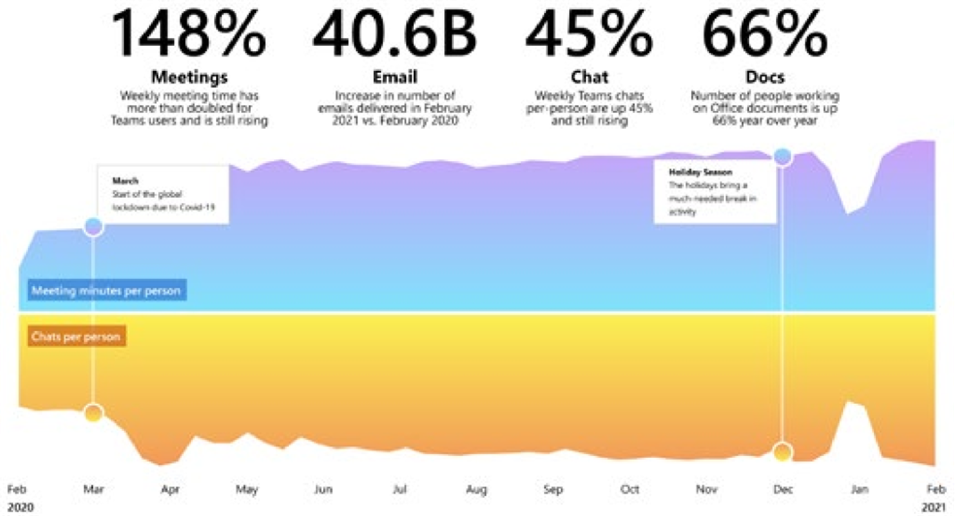
Growth in digital collaboration over the past year – Microsoft Remote Trend Index
MICROSOFT
*For remote work and hybrid work to be successful long term, we must get to the bottom of this digital intensity. I would argue that many workers felt the pressure of proving they were working and productively so in a world that lacked some of the typical parameters, such as when we arrive and leave the office. Such a need is born from insecurities that leaders will have to eradicate by rethinking how to measure and evaluate not just the output but the entire workflow.*
**Gen Z is at risk and will need to be re-energized**
Sixty percent of Gen Zers — those between the ages of 18 and 25 — say they are merely surviving or flat-out struggling. They also reported more difficulty feeling engaged or excited about work, getting a word in during meetings, and bringing new ideas to the table when compared to other generations.
*This should not really come as a surprise given this generation is just getting started in their career and might miss the networking connection to navigate their company, even more so in a remote environment. This is also the generation that typically benefits the most from office perks such as free or subsidized food and facilities such as the office gym. It might also be the one group businesses might have felt they could lean in more because they are often single and have no children. However, not having children does not mean a lack of family responsibility. Being alone might have also been particularly emotionally taxing for many who might not have wanted to voice their issues precisely because they are early in their careers.*
**Shrinking networks are endangering innovation**
Anonymized collaboration trends between billions of Outlook emails and Microsoft Teams meetings reveal a clear trend: the shift to remote shrunk our networks. Chats followed the same path. The report highlights the importance of the network in relation to innovation and productivity. People who said they felt the most productive in the survey also reported strong workplace relationships and feelings of inclusion at work.
*As critical innovation and productivity are, I would argue that a broad and robust network is the cornerstone of an even more crucial piece of the puzzle: company culture. Creating social opportunities for employees to widen their digital network will be vital during office time in a hybrid work environment.*
**Authenticity will spur productivity and wellbeing**
Compared to one year ago, 39% of people in our study said they are more likely to be their full, authentic selves at work, and 31% are less likely to feel embarrassed or ashamed when their home life shows up at work.
This is not the case for all demographics, Black and US Latino workers in the U.S. reported more difficulties building relationships with their direct team (19% and 18%, respectively, compared to the 12% national average), feeling included (21% and 28%, compared to a 20% national average), and are less likely to bring their authentic selves to work than a year ago than the broader population (26% and 24%, compared to a 17% national average).
*At the start of the pandemic, I argued that remote work would lead to a more diverse workforce, but this does not mean remote work is inclusive by default. Especially during the pandemic, we saw underrepresented groups struggling with sharing their feelings of life issues in fear of being deemed unprofessional. Leaders must be aware of how race, gender and other socio-economic circumstances make specific conversations particularly difficult for some employees.*
**Talent is everywhere in a hybrid work world**
An analysis of the LinkedIn Economic Graph shows women, Gen Z, and those without a graduate degree as the groups most likely to apply for those jobs. In the U.S., the study found that Black, US Latino workers and women are more likely than white workers and men to say they prefer remote work.
*The level of ethnic and racial diversity in America differs dramatically from state to state. This means that companies in less diverse places might need to recruit outside the area and expect new employees to relocate. For many workers from underrepresented groups, the daily office reality includes covering and micro-aggressions. The strain does not end with the workday. Newly relocated employees might also struggle to find a community culture that offers the food, or services, or places of worship they’ve grown up with*.
*I’m not suggesting that remote work is a panacea for the multifaceted diversity issues facing many organizations. Any company leader in any sector should condemn racism and intolerance and foster inclusion so that workers from underrepresented groups feel valued. Alongside that effort, remote work can help boost those diversity numbers a little faster. Leaders should purposefully use remote work to foster a more diverse workforce because remote work is good for diversity, and diversity is great for business*.
If you are a business leader and have read thus far and are still left wondering why you should care, allow me to make it very clear for you. The study says that 41% of the global workforce is likely to consider leaving their current employer within the next year. This number is even higher for Gen Z (54%). At the same time, 46% are planning to make a significant pivot or career transition. Uncovering how the seven key trends highlighted by the report impact your business and how you can address them will make the difference between being among those organizations employees flee or being a workplace people cherish and wish to join.
This article was originally published on Forbes
### Augmented Computing (In Concept)
URL: https://creativestrategies.com/augmented-computing-in-concept/
Last updated: 2021-04-30T17:28:08.000Z
I want to add a perspective to the idea of augmented reality (AR) that I don’t hear discussed much. When most people, who are familiar with augmented reality, talk about AR, the concept is rooted in overlaying the digital world with the physical. Common use cases surrounding the AR vision include things like getting directions and having more details revealed to you on your route. Shopping and having lists, product information, and more revealed to help you shop more efficiently. Communications where your emails, or texts, or contact information can show up right before your eyes. I could go on, but there is a fundamental point lost in these use cases that I feel will shape the category.
**What is Augmentation?**
First, we need to understand what the foundation will be for augmented reality. We can start with recognizing the definition of augmenting. **Augment, in its verb form, means “to make (something) greater by adding to it.”** If we start with this simple understanding of what augment means, we can then have a more productive conversation about the future of augmented reality. Just looking at the word, augmented reality, in definition, would mean to make reality greater by adding to it. The challenge I’ve run across with several vision pieces for augmented reality is how the use cases discussed make reality worse, not better.
I think this conversation about the future of computing and augmented computing needs to center on at this moment in time is what exactly we are trying to augment. More specifically, are we trying to augment (make it better by adding to it) the computer or the human? I would argue that if we flip our thinking from augmenting the computer, which is what most people think, to augmenting the human, we will get closer to a reality where computers make our lives better and not worse. And in that viewpoint, I’d argue that people will have far less tolerance for the inefficiencies most of our smartphones and PC experiences encompass.
**Augmenting the Human**
In case it isn’t clear, I have personally landed on the side of augmenting the human and not the computer. I mean that whatever form a computing device focused on augmentation takes, its sole purpose should be to make the human’s capabilities better. For example, I believe health and fitness wearables are a form of augmented computing. If you use one of these devices and use the Apple Watch, you realize it increases my health potential in various ways. For me, Apple Watch increases my fitness and overall health by monitoring many vitals (with more to come in future versions) and bringing a computational element to health that is not achievable without it. By definition, Apple Watch is augmenting my health.
Another area of great interest to me is devices we have in our ears. From my perspective, a simple hearing aid gives us a basis for augmented hearing. Hearing aids enhance hearing for those who need them, but there are applications for this for everyone. For the last six months, I’ve been trying the [IQBuds Max from Nuheara](https://www.nuheara.com/products/iqbuds-max/?ref=creativestrategies.com) and it has been truly enlightening for me under the premise of augmented hearing.
These earbuds are not just noise-canceling music devices. Their true value is the sound-enhancing features, particularly around voices. They have an active microphone that listens to outside sounds and can eliminate white noise and isolate sound to hear everything better, even if you have good hearing in general. The software includes different modes that can isolate sounds in certain directions as well as in real-time.
My experience with the Nuheara IQBuds Max has shown me a vision for what an ear-worn computer could do in augmenting my hearing. It is not just helping me hear noises or conversations better, but also digitally managing the sound levels, helping me isolate sounds that are softer by boosting them or softening sounds that are too loud all in real-time. These, not just active noise canceling but active noise listening earbuds, have shaped my perspective on augmented computing more than any other product I’ve tried up to this point. They are the definition of augmenting, to make better, my hearing by using a microcomputer with AI that sits in my ears.
Lastly, let’s talk about augmented vision. If we use my basis that the primary way to think about augmented computing is computers than enhance the human’s capabilities, then vision becomes quite clear, literally. Yes, a computer I wear over my eyes will bring elements of our experiences with computers today. Still, as I said, our tolerance for inefficiencies will go up dramatically when it comes to our eyes. **I’ve come up with a saying that I’m fond of is while the wrist and ears are prime real estate for computing devices, the eyes are sacred ground.**
In 2019, I did a project for a company working on an augmented reality product. We brought consumers in and tested a wide range of current AR solutions. From this research, it became abundantly clear to me the eyes will be an extremely difficult place to put computers. Rather, the eyes will be an extremely difficult place to bring the current smartphone or PC-centric thinking of computing. The core challenge is nearly every use case that exists today distracts from our vision instead of enhancing it. Showing me a text message gets in the way of my vision. Even how directions are shown will need to be re-imagined as not to obstruct or getting in the way of what I see in the world. This is why I’m convinced this will be the most difficult place to bring a computer over my eyes and why we are still a long way off from any true mainstream smart glasses solution.
Whatever ends up becoming mainstream, that is, a computer for my eyes will have to, at its basic level, augment my vision in useful ways. Sight is precious, and humans know this, so enhancing our sight will be one of the most useful features of smart glasses. Letting me see farther, closer, in the dark or low-light, are all core augmented vision use cases. How the computational/digital world overlays will need to recognize sight is precious, less is more, and focus on truly adding to the visual experience, not detracting from it.
Ultimately, augmented computing by way of devices we wear, that give us “superhuman” capabilities, could be the purest manifestation of Steve Jobs’s perspective that computers are [bicycles for our mind](https://www.brainpickings.org/2011/12/21/steve-jobs-bicycle-for-the-mind-1990/?ref=creativestrategies.com). The observation that Jobs makes is that what humans create is added to our efficiency as a species by way of computers. Augmented computing will enhance our capabilities as a species and take this concept of computers, making us more efficient in all we do to a new level.
It’s a great vision, but also one that is extremely difficult and still very far off.
### Microsoft Mesh Empowers A Heterogeneous Holographic Collaboration
URL: https://creativestrategies.com/microsoft-mesh-empowers-a-heterogeneous-holographic-collaboration/
Last updated: 2021-04-30T17:09:39.000Z
On day one of the winter edition of Ignite, Microsoft announced the launch of Microsoft Mesh, a new collaboration platform powered by Azure, that allows people to have a shared virtual experience on a variety of devices from Mixed Reality (MR) and Virtual Reality (VR) headsets to PCs and Macs and phones. In his opening remarks, CEO Satya Nadella compared Microsoft Mesh to Xbox Live’s launch in 2002\. The service made online multiplayer gaming for consoles mainstream by making it easier for developers to connect their games to the internet. The launch’s result was a rapid growth in online multiplayer titles for the Xbox and Xbox 360, giving Microsoft an advantage over Sony and Nintendo for years. It will be interesting to see how Mesh will change the approach taken by companies like Spatial, a brand that many already associate with virtual collaboration. In my mind, a common platform is the only way to achieve a level of collaboration that can be genuinely inclusive and natural. Yet, I realize all too well that business models sometimes get in the way, and it is much easier for Microsoft to focus on a common platform when monetization comes not from the platform itself but the cloud that powers it.
Microsoft’s Alex Kipman, the mind behind Kinect and HoloLens, spent an hour on the keynote stage talking about the opportunities this platform opens up as several guests from the science and entertainment business, all appearing in holographic form, bore witness to his belief that the future is paved with potential for shared virtual experiences.
I had the opportunity to experience the keynote, not through my PC, as I have been accustomed to for the past year, but as an avatar by the edge of the stage where Kipman’s hologram stood. While Kipman looked like himself, my fellow participants and I appeared as much more basic AlspaceVR avatars. The fact that I could not tell who was in the audience, even if I was aware that there were other fellow analysts and reporters I knew, did not make the experience less engaging. I could see people moving around, using emojis to react to the presentation, and even being annoying when they teleported themselves too close for comfort.

It is not a secret that I am not a great fan of VR. I usually find the effort I put into setup and the experience always to outweigh the perceived value I get from it. So I was surprised to find the keynote experience quite engaging. While there was still a gimmicky side to it, like having a whale shark circling over my head, it clearly gave me an idea of what events like Ignite could be like in the future. More importantly, though, it showed me what collaboration might be like. Maybe it is because I have not been in a room with as many people in over a year, but the experience did feel more personal than watching it on a computer screen. Having experienced HoloLens as well, I can certainly say I prefer the holographic experience in the room I am in, especially when it comes to collaboration. When working with someone, the experience is created more so by the interaction you have than the environment. This is why we have been struggling so much with remote work during the pandemic.
One of the aspects of workflows and collaboration I have been highlighting over the past year is how heterogeneous the set of applications and operating systems we work with every day really is. Whether you are a Microsoft Office or a Google Workspace user, you are most likely jumping between the two environments and using apps like Zoom or Slack on top, even if both productivity suites offer chat and video solutions. This might be because of personal preference or because of the people you work with. Either way, it is rare to be all in with just one solution. You might be able to do it within your organization but not when you work with external people.
Now think about a real-life meeting. While our work might be on a PC, a Mac, or a phone, shared across several apps, what we bring to the meeting is, first and foremost, us. Now think about how not having a common platform would limit that experience. Mesh offers developers a full suite of AI-powered tools for avatars, session management, spatial rendering, synchronization across multiple users, and “holoportation” to build collaborative solutions in mixed reality. More importantly, however, Mesh allows people to meet others where they are. The ability to benefit from this future even without a top-of-the-line device like HoloLens means that, hopefully, we will all have a seat at the table. Mesh also guarantees consistency in the way I show up to my meetings. I am me, and in real life, I show up in the same way. This is, of course, critical if you want to create a realistic experience, and right now, it is not possible. The way I showed up at a Spatial meeting a few weeks ago was very different from how I materialized at the Ignite keynote. It goes without saying that these inconsistencies prevent you from creating a genuine connection with the people you interact with.
The proximity with our office co-worker will make collaboration easier, but at a societal level as well. I loved what filmmaker James Cameron (Avatar, the movie) said about MR driving more empathy because we can share more with someone. Again, think about the past twelve months and how being in your colleagues’ home office, kitchen, or living room helped us increase our empathy, and that was simply through a screen.
Satya Nadella wrapped up his opening remarks with one of his favorite lines used to describe the possibilities for HoloLens: “When you change the way you see the world, you change the world you see.” It will certainly be fascinating to see what people build on Microsoft Mesh. Still, there is no doubt in my mind that building a platform that brings different devices together is an excellent example of a growth mindset; something Nadella has instilled throughout the company.
### Chip Shortages and Foundry Monopolies
URL: https://creativestrategies.com/chip-shortages-and-foundry-monopolies/
Last updated: 2021-04-30T17:23:43.000Z
One of the biggest issues facing the tech industry right now is significant delays and a backlog of semiconductor foundries. Almost every tech category has seen a boost to demand, and that led to a dynamic of significant demand and not enough supply of semiconductors.
While an unanticipated surge of demand is a chief cause of the chip shortage, China’s initial shutdown this time last year due to the pandemic was going to cause delays for the entire year regardless of an uptick of demand. The surge in demand exaggerated this problem even more, which now brings an important observation to bear.
When [I wrote last week](https://techpinions.com/how-apple-can-extend-an-arm-to-intel/60461?ref=creativestrategies.com) about Apple perhaps partnering with Intel, I was only scratching the surface of what should be on every tech companies mind if their products rely on semiconductors in some way. This shortage is brought about because of the lack of foundry options for semiconductor companies. TSMC has had the clear lead for several years, and if you want a product on leading-edge process, your only option was TSMC. Samsung kept pace, but they hit some snags with their 10 and 8nm product which led some of their customers to go to TSMC.
While TSMC is not a semiconductor foundry monopoly yet, we are seeing a glimpse of what the world may look like if TSMC either is the last foundry standing or, at the very least, having a multi-year advantage on leading-edge process technology.
In either scenario, competition is painfully impacted. If only a few of the biggest tech companies, with scale and money, have access to leading-edge process technology and transistor designs, then those companies will maintain an edge on everyone else because they will be the few who can actually secure inventory. Everyone else will have to wait to get their chips to market. This is not a good scenario.
While TSMC is investing in foundries in the US, right now in Arizona, it will take several years to build out and be ready to start producing wafers. But the dynamic of TSMC having a monopoly on the leading-edge process, at a minimum, is concerning since they control who can get supply AND they could control pricing. This is why it is of the utmost importance that foundry competition is established and remain.
Yesterday Joe Biden signed an executive order to investigate the issues surrounding the chip shortage and look to strengthen the supply chain. Many hope for a renewed focus and more investment around the Chips Act and actively look to make US-based foundries more competitive.
Semiconductor foundries are not startup opportunities. Therefore, the US government’s options are Intel and Global Foundries to support US-based semiconductor manufacturing. While I do hope there is more around the Chips Act that can be established, I do not have the most faith in the government to help solve this. Which is a key reason I mentioned [Apple](https://techpinions.com/how-apple-can-extend-an-arm-to-intel/60461?ref=creativestrategies.com), as I feel it makes more sense for private enterprise to help Intel via joint ventures or supply commitments.
**The Art of Dual Sourcing Foundries**
Given the reality, both short and long-term is the industry will only have a few viable foundries supporting the growing demand and need for semiconductors, companies who can strategically execute a dual-source strategy will be well-positioned.
This was always something Broadcom did well. I recall many conversations with their executives who were proud of the fact their chip design libraries were portable, and they could make them at whatever foundry they saw fit. Qualcomm is similarly executing a dual-source foundry strategy as they have versions of the same chipsets made at both TSMC and Samsung.
Companies that dual-source will be extremely well-positioned to weather a number of different storms that could come their way. From the geopolitical that I have outlined before, national economic issues, global catastrophes, etc. While this isn’t discussed as much publicly for obvious reasons, it is top of mind for many executives in the supply chain and those whose companies make products via semiconductor foundries.
While I keep circling the wagon on this, the fundamental point that needs to be addressed in the long term is how to keep foundry competition alive. I believe Intel is critical to that future, which is why the industry needs to be concerned with Intel’s future whether they buy chips from Intel or not.
### What Is Next For PC Sales?
URL: https://creativestrategies.com/what-is-next-for-pc-sales/
Last updated: 2021-04-30T17:07:19.000Z
There’s been a lot of excitement around the trajectory of PC sales in 2020\. The pandemic clearly reinvigorated demand for PCs, and sales could have been even greater had the market not faced component shortages. Working from home, learning from home, and fighting boredom at home drove upgrades as well as new sales, expanding the overall userbase. Sales reached volumes we had not seen for almost 20 years.
Many were eager to point out that the rise of smartphones at PCs’ expense was rebalanced as consumers and enterprise users alike rediscovered the PC. I think a more realistic read of what 2020 brought to the PC market is that more time was spent on PCs at home than ever before. And this was rooted in the fact that everything was done more at home than ever before, and with that, more was also done digitally. If you’re looking at the time that a typical knowledge worker would have spent on the PC at the office, it probably didn’t change much. It just so happened those working hours on a PC were taking place at home. One trend that did change with everybody transitioning to online life was that with more time spent doing things online, sharing devices became much more difficult. This meant that, on average, household penetration grew, with many seeing a one on one PC to human ratio.
As we look forward, of course, the big question that PC vendors are asking is what happens to this base when we return to a more predictable life pattern that involves activities outside the home. I purposely don’t want to call it the new normal or back to normal, mostly because I hope that what we will go forward rather than back both in working and school embracing a richer, more equitable digital transformation. Everybody is trying to predict how this new base is going to behave going forward. Yet, for the chip vendors, Microsoft, and every PC brand in the market, the focus should be on keeping these users engaged with that PC they might have bought in 2020\. Only continued engagement will move that 2020 sale to a 2025 upgrade. Focusing on an upgrade is certainly better for the industry than focusing on a sale.
The state of the consumer PC market pre-pandemic was characterized by a large number of users that had what I would call “an emergency PC”. Most of their computing needs were taken care of by smartphones mostly, but they would use a PC for those tasks that required a larger screen, a keyboard, and maybe some applications that just did not run on mobile. That emergency PC did not drive any emotional attachment or a strong need for an upgrade. Even when a user would consider an upgrade, the budget they would allocate was limited because the PC’s value was seen as limited, except for gaming. 2020 changed that. 2020 emphasizes quality computing experiences, from video calling to connectivity to brighter and larger screens. Consumers realized the need for a better PC experience, and with that realization came the willingness to invest more in their purchase. This is great news for the industry, regardless of where overall sales end up as average selling prices had been falling outside of the premium segment for quite some time.
**So what now?**
If most of us transition back to a more smartphone-first computing experience, where does that leave the brand-new PC we bought over the past year? Will PC life cycles return to a pre-pandemic average, or will they shorten? I would argue that a few things have changed in favor of shorter life cycles and continued engagement on a PC. I would also argue that every vendor in the PC ecosystem has his work cut out to continue to show the value by focusing on strengthening the app ecosystem, continuing to drive designs that highlight the overarching experience rather than individual features, and finally showcasing what can be done with these new PCs.
**What are the factors that I think play in the PC favor?**
First of all, that our digital life has grown. Whether you’re thinking about gaming, or entertainment, or online shopping and telehealth, we have been doing a lot more through a screen, and some of these experiences have been better or more convenient than doing them in person. While some of this time will return in person, I firmly believe the overall time spent online will remain higher than before the pandemic and the kind of activities we will be done using a PC will be more engaging than in the past.
When it comes to business, there are two factors positively impacting demand. First is the recent awakening of many organizations on the importance of driving employee engagement and satisfaction through the tools, hardware, and software provided to get the job done. While I do not expect every employee to benefit from this newfound awareness, I anticipate knowledge workers and first-line workers will. The second factor is the continued increase in security threats and the high risk associated with that. This, coupled with a higher number of remote workers, will get organizations to broaden their portfolio of enterprise liable devices to adequately cater to their users.
Aside from returning to increased mobility, what plays against PC demand are two main factors: continued supply chain constraint and limited budgets. The supply chain will likely return to normal by the second half of the year, vaccine rollouts and Covid variants permitting. Spend will vary depending on the markets. There is more clarity in mature markets, where especially on the commercial side, organizations might shift some spent from other budgets such as travel to ensure every employee is taken care of. What is certain is that the pandemic caught many businesses unprepared, and this is not something they want to repeat. On the consumer market, it might be time for some out-of-the-box thinking when it comes to financing and other incentives that work so well in the smartphone market.
Some bullish forecasts see 2021 PC volumes above 350 million units. While that might be possible from a production perspective, I would expect some inventory replenishment will occur, leaving sell out to be flat to only slightly up 2020 volumes.
### Why Apple Should Extend an Arm to Intel
URL: https://creativestrategies.com/why-apple-should-extend-an-arm-to-intel/
Last updated: 2021-04-30T17:30:10.000Z
Helping Intel stay in the semiconductor manufacturing game should be among one of the highest priorities for all US-based technology companies. While TSMC is the leader in manufacturing process technology, they remain a geo-political risk should China decide to enforce its will on the region. Samsung is not far behind, but being a Korean company, again, future politics guarantee no safe bets. Having a leading semiconductor company founded and based in the US is incredibly strategic given how critical semiconductors are to our digital future. Apple may be one of the only companies that can help Intel right the ship.
**Why Intel is in this Position**
It took a combination of slowing CapEx spends for leading-edge fabs and technical hurdles transitioning from one process node to the next for Intel to now be two process nodes behind TSMC and Samsung. [As I wrote for subscribers last week](https://techpinions.com/the-fork-in-intels-road/60455?ref=creativestrategies.com), there are reasons for Intel to hold out hope internally that their process and their architecture are good enough to keep their current course. But when you analyze how Intel got here, it hangs heavily on the volume of premium and cutting edge semiconductors moving to Arm and not x86.
At its best, the x86 market is a 330-350m a year in total shipments for client and server CPUs. Arguably, only a small fraction of that market sells at premium price points necessary to justify the investment in cutting edge process technology. Once upon a time, Intel was increasing their CapEx annually and roughly every 18-24 months, building out a new foundry for cutting edge process. As the PC market matured and refresh rates dramatically slowed, it made it harder for Intel to justify the CapEx for leading-edge nodes on a two-year cycle, and thus they moved more to a 3.5 to a four-year cycle.
The story is a bit different with Arm. When you see the economics of smartphones and the sheer volume of annual smartphone shipments \~1.2 billion, with premium smartphone sales being \~300-350 million (compared to 60-70m for PCs), it is easier to see how this market was large enough and economically stable enough for TSMC to keep investing in leading-edge process technology so aggressively. But, while few may want to admit it, Apple is a big reason TSMC is able to confidently keep investing in cutting edge process technology. Because the bottom line is, you need to have a customer(i.e., product demand) to justify the investment. Apple is a big enough customer of premium smartphone chips and thus worth it for TSMC. Intel alone is no longer a big enough customer of premium PC and server chips, and thus their ability to spend on leading-edge fabs suffered.
The hard truth for Intel is the x86 market alone is not big enough for Intel to justify the CapEx for leading-edge foundries. And that challenge is compounded by the fact that Apple was Intel’s largest customer for premium x86 chipsets, and now Apple has moved to Arm, and x86 chips are not Apple’s future. If Intel continues in the foundry business, they have no choice but to make chips for other customers, AND they need to be a full Arm foundry. Something they attempted and failed at for a variety of reasons. There is where a joint venture between Apple and Intel could be strategically beneficial to both companies.
**How Apple Helped TSMC Achieve Process Leadership**
I don’t want to dismiss the technological achievement of TSMC by being the first foundry to 7nm, 5nm, and likely the first to 3nm. Anyone who knows transistor designs knows how hard it is, at a micro level, to keep shrinking silicon. However, Apple helped make it easier for TSMC to justify the RND and CapEx costs and to continually invest in leading-edge process technology by being their largest customer, always committing to the latest node. I am not convinced TSMC would have the clear lead they do in process tech without Apple.
As a customer of supply chain components, Apple likes to buy in advance, in bulk, and write big checks to secure pricing and inventory. This played a role in TSMCs confidence to keep striving and investing in cutting edge foundries. While there is no official joint venture between Apple and TSMC at a foundry level, it is a deep partnership. TSMC has committed space, equipment, and supply to Apple. Even if not a JV or partnership on paper, it is very close to that in reality. But, TSMC is the only game in town for Apple to build their A series and M series chips on the leading-edge process. And this is where the real risk comes in and why Apple may want to have Intel as a plan B.
**TSMC and Geopolitics**
There is no secret among semiconductor insiders that TSMC, based in Taiwan, is a strategic technology asset for both the US and China. It is also no secret, China is spending large sums of dollars trying to develop semiconductor independence, and a lot of that strategy hangs on their own local foundry, SMIC.
If you follow the news, there are worries of increased tension between China and Taiwan. Taiwan is independently governed. But China considers it part of its territory. While a lot of my logic is game theory at this point, should China consider TSMC essential to their plans for semiconductor independence, which would also grant them semiconductor leadership, it is not out of the realm of possibility that China could officially reclaim the region. Nearly every technology executive dealing with the supply chain I know has been worried about this and I’m sure it is on Tim Cook’s radar as well given his deep knowledge of the Asian supply chain.
In that scenario, the risk for Apple and the many other companies who manufacture their semiconductors with TSMC is China either prioritizing their needs at TSMC over others or cutting off supply as a whole. Again, not a great business, but not out of the realm of possibility given how central semiconductors are to our digital future.
Samsung is another option as Samsung Semiconductors is rolling out their 5nm solution, and it appears to be quite good. Samsung Semiconductors also makes chips in the US at a foundry based on US soil, and Samsung as a backup is a viable option. Unless, of course, semiconductors’ importance does indeed become a national strategic asset for the future, and thus Korea decides to pull Samsung back locally. Even if one doesn’t buy Samsung is geopolitical risk, should the worst-case scenario happen with TSMC, Samsung would be in a position to be the only leading-edge fab companies like Apple, Qualcomm, Nvidia, AMD, could use and could create price hikes and supply constraints.
**Back to Intel**
What I’m laying out is a worst-case scenario, but it is a plausible scenario. Intel is the only future-forward guarantee to a foundry from the perspective of US-based companies making computing devices. And because Apple is the largest purchaser of premium semiconductors on the cutting-edge process, Apple is the best positioned to do a joint venture with Intel to help them invest in future nodes and secure space in their foundries for all their future Arm-based products. **This would position Apple to make their Arm-based chips on US soil with a US company.**
A move like this would be highly strategic and beneficial for both Apple and Intel, and the US. Of course, Apple could be a part of a JV between TSMC and Intel where TSMC 5 or 3nm chips are made for Apple and Intel foundries, but there is still a risk and no guarantee Apple would have continued access to TSMC technology should China be aggressive. As I said, Intel is the only guarantee in what may become an actual chip war between nations.
### Hybrid Work Is Here To Stay, But Not Without An Effort
URL: https://creativestrategies.com/hybrid-work-is-here-to-stay-but-not-without-an-effort/
Last updated: 2021-04-30T16:57:53.000Z
So much has changed since the start of the pandemic. Our lives have been turned upside down in so many different ways and it isn’t over! Yet we find ourselves thinking about what it will be like when we are allowed back into the office, or back to school, or when we can travel again. Maybe we want something to look forward to after a year of limited human interactions. Or perhaps we want to feel more in control of what other changes might come our way. What is clear is that many companies are asking what will come next as far as work and while there is still a lot of uncertainty, one thing is quite clear: working from home and hybrid work are high on many employees’ wish list.
In a study conducted in the United States by Creative Strategies among 750 employed participants, 610 of whom have been working remotely during the pandemic, employee’s sentiment about working from home shed light on where organizations will need to focus on driving satisfaction as well as productivity.
Fifty-eight percent of respondents say they have settled into a routine and they are much more comfortable working from home now than at the start of the shelter in place. I have often said that working from home during the pandemic should have been referred to as “being home trying to work.” Having children at home from school trying to learn or having partners or roommates sharing the same space creating an environment that for many people was not your “business as usual” working from home. Only 48% of panelists who are always remote found their routine during the pandemic.
The level of uncertainty remains indeed high, with 30% of the panelists who say they have not been told how long they will be able to work from home. Another 7% have been told they can work from home till March and 11% have their deadline set for the summer. Only 19% have been told they can work remotely indefinitely, unless they work in a group that needs to be in the office, such as manufacturing or research.
This wide range of responses seems to mostly account for the practicality of returning to the office, leaving out of the equation what the employees might want to do when the time comes to reopen the office doors. A whopping 46% of the panelists have expressed that they want to work from home as often as possible, with another 31% who wants to work from home a couple of days a week. Only 17% can’t wait to go back to the office.
When panelists were asked what it would take to make them more comfortable about returning to the office, 28% said they wouldn’t go back until there is a vaccine. On the other hand, twenty-three percent feel quite comfortable going back because they have a dedicated office. Interestingly, many companies are rethinking their offices’ layout to encourage in-person collaboration, which is what 31% of the panelists missed the most about working from home.
From all these data points, it is evident that the back to office reality will be quite different, but it is safe to say it will include a mix of office and remote employees. Making this mix successful will require more than employees’ determination to stay home or go to the office. The pandemic was the great collaboration equalizer. With everybody working remotely, we all have an equal voice in a meeting. Yet, the concern is that, as people return to the office, we will lose that equal footing to return to favoring people in the meeting room over remote participants. Companies will require the right tools to cement new workflows born during the pandemic that will keep collaboration as digital as possible.
### The Right Tool for the Job
When it comes to tools, only 34% say that work has adapted well and provided them with the tools they need to maintain their usual productivity level. Among the strongest drivers of frustration the panelists experienced during remote collaboration, 31% called out sound quality and 26% video quality. The strongest reason for frustration was found in the sound of emails, text messages, or other notifications. These frustrations correlate quite well with 77% of the panelists using an external microphone and another 31% using an external camera.
The return to the office and the official status of remote workers bestowed on those who will not make it back will raise the stakes of what is expected in terms of collaboration quality. While I hope the greater empathy level in welcoming barking dogs, nosy cats, and screaming kids will remain, I am sure that remote workers will be required to have a minimum standard for their home office physical environment and tools. This push is not only linked to performance but also and arguably more importantly, to employee wellbeing. Quality of video and sound being a frustration adds to stress and makes employees work harder during meetings.
Such a need to deliver the right tool for the job will likely drive more PC upgrades and support devices like monitors, mics, cameras, lights and control decks. This opportunity will undoubtedly attract companies leading in the enterprise PC market and the collaboration market. Yet, winning the home office will require different skills and different products. Whether we are talking about a PC or a camera, brands will have to deliver products that show greater attention to design, satisfy IT when it comes to security, deployment and manageability while allowing user to self-support. Towards the end of 2020, we saw Cisco bring to market three new products aimed at the home office (the Webex desk Camera and Webex Desk) and new office hotdesking practices (Webex Desk Hub). Today Poly, a leading brand in collaboration, is making an early move to address this market with the Poly Studio P Series, which includes the Poly Studio P5 Webcam, Poly Studio P15 Personal Video Bar, Poly Studio P21 Personal Meeting Display. The name could not be more perfect “P” for professional and personal, exactly what users want.
A professional delivery from a device that fits a home environment is easy to set up and manage. Poly’s DNA, born from Polycom and Plantronics’ union, seems to be perfect for this new market. Yet competition will be fierce. Poly is betting on the idea that hardware alone will not be enough and I could not agree more. Tools like Poly Lens Desktop App to help manage the devices and even a new support service Poly+ to complement an existing IT department or simply be one for those organizations who don’t have one all add to a differentiated and more tailored experience.
### Culture Will Be as Critical As Tools
Tools alone will not be enough to make the new hybrid work successful. Culture will be critical to success. Companies will have to be deliberate in keeping workflows digital so they remain as inclusive as possible, separating office presence with the idea of what constitutes productive work and instead encouraging the office to focus on socialization. Managers will have to show employees that being remote does not mean a hindered career and less opportunity to have their work recognized. We have proven that we could be productive under the harsh conditions the pandemic brought on us. Collaboration technology leaped into the twenty-first century after years of neglect. All we need now is not to fall prey to old habits. The temptation will be strong, but we owe it to ourselves to resist.
*This article was originally published on Forbes*
### Microsoft Bets Big On Employee Experience And Launches Viva
URL: https://creativestrategies.com/microsoft-bets-big-on-employee-experience-and-launches-viva/
Last updated: 2021-04-30T17:20:01.000Z
A lot has changed about how we work due to the pandemic. Whether we are working from home or at an essential business, technology has been supporting us at a time when how we interact with our coworkers and customers has drastically changed. Most of our interactions have moved online, which ironically brought us close to people who were far while pulling us away from the closest people. In a recorded video, Microsoft’s CEO Satya Nadella could not have said it better: “We are participating in the largest at scale remote work experiment the world has seen. And it has had a dramatic impact on the employee experience.”
As businesses are starting to look at getting people back into the office, [it is essential not to fall back to how things used to be](https://www.forbes.com/sites/carolinamilanesi/2021/02/02/hybrid-work-is-here-to-stay-but-not-without-an-effort/?sh=7b0e03777c84&ref=creativestrategies.com). Employees are asking for flexible work to remain a reality and businesses would be foolish in dismissing such demands and expect no consequences. Yet, empowering employees to thrive when working remotely, even for a few days a week, might be challenging without making an effort. Culture, sense of belonging, team engagement cannot be taken for granted. They are also not inherent in the office environment. Physical presence might help us feel connected with our coworkers, but it does not necessarily make us feel connected with the business.
Microsoft believes it can help organizations deliver on four aspects of the employee experience: connecting, content, learning and well-being. Reiterating a thought shared during the most recent Microsoft earnings call, Nadella explained that anything people work on does not start and end within a meeting, nor do their interactions. Collaboration is only part of what makes our work successful. Information either within the company or externally, a growth mindset empowered by constant learnings and each employee’s well-being all contribute to that success. This is what the Microsoft Viva platform, centered around Microsoft Teams and fueled by Microsoft 365, is setting out to enable. Jared Sparato, Corporate VP, Microsoft 365, reminds us that employee experience is a big business, with organizations spending 300 billion a year. So, it is no surprise that Microsoft wants a slice of it!
For now, there are four areas the platform is focusing on:
**Microsoft Viva Connections**: a destination where leaders and employees can come together with company town halls and access official information such as company news policies and more recreational information such as clubs. It is the digital way to create an inclusive organization. This is critical as some people return to the office and others remain remote. Being a remote worker does not change your level of commitment to the company’s success nor lowers your enthusiasm for being part of a team. However, it is often easy to forget about those who are not in the office and facilitating touchpoints and exchanges will undoubtedly help avoid that.
**Microsoft Viva Topics** uses artificial intelligence (AI) to connect people with knowledge and expertise in the tools they use every day and people looking for experts or information. The goal is to speed up content discovery and lower the risk of wasting time and effort replicating work that already exists. Technology has helped create a wealth of data as never seen before and ironically, we now turn to technology to sieve through it and effectively make sense of it. Wasting time looking for relevant information impacts productivity and increases stress, impacting employee well-being. Viva Topics builds on the Microsoft 365 apps and content an organization already uses every day and the connections you have with people across your organization. Over time Viva Connections will also integrate more than 130 data sources, including Salesforce, ServiceNow, MediaWiki, file shares, and Microsoft Azure services.
**Microsoft Viva Insights:** a pool of data about how people work as well as how they feel that empowers managers with real-time information, at an aggregate level, on how much pressure team members are under. It also provides each employee with insights into their own data
Microsoft Viva Insights provides data on team work and sentiment
MICROSOFT
shared exclusively with them. The fear of burnout has been very real during the pandemic, but it is not new, especially in the US, where many companies create a highly competitive work culture. In December, Spring Health, a behavioral health benefits provider, [found](https://www.prnewswire.com/news-releases/study-finds-76-of-us-employees-are-currently-experiencing-worker-burnout-301191279.html?ref=creativestrategies.com) that an online study of 1,136 employed U.S. adults conducted in the same month found that 76% of respondents experienced worker burnout. Of these, 57% say their concerns about COVID-19 have contributed to their experiencing burnout, while 33% say worries about political issues have contributed to burnout. Admitting to being tired or overwhelmed is never easy, especially for employees of underrepresented groups, because of concerns about how managers could perceive it. Providing this critical information to managers might help avoid getting to this point or, at the very list might encourage a safe conversation.
**Microsoft Viva Learning:** a repository of courses and learnings assets from LinkedIn Learning, Microsoft Learn and third parties such as Coursera and Skillsoft so that learning becomes part of regular day-to-day. With data from a recent LinkedIn report showing that 94% of employees would stay at a company longer if it invested in their learning and development, organizations really need to take personal employee growth seriously both to retain talent and because the business directly benefits from the acquired skills.
Microsoft Viva Learning a repository of all training materials available within the business
MICROSOFT
Microsoft says the connections between employee learning, engagement, and business performance are clear and I tend to agree. Employees who have opportunities to learn and grow are 3.6 times more likely to report being happy than those who do not have such options. Highly engaged organizations report five times higher market capitalization per employee, 21 percent greater profitability, and 51 percent less employee turnover.
Employee experience plays into another big trend that has emerged from the pandemic: business agility. No question in my mind creating the proper connections, continuing to learn and making sure the right content is available when needed will empower businesses to make informed decisions in a much more timely fashion.
It is clear why Microsoft is getting in the business of employee experience, but why should organizations, even those who buy into the importance of the concept, believe Microsoft can deliver the best solution? The answer for me is found in the intersection of the strength of Microsoft 365, the integration of third-party solutions and the smarts generated by the Microsoft Graph. This is “new Microsoft” thinking well reflected in the Viva branding. It leans into the broader Microsoft ecosystem and uses the company core assets, Cloud and AI, to drive added value and grow reliance on its tools. It will be interesting to see once all these modules are made available how all the information will be displayed within Microsoft Teams. There could be a risk of adding too much in the one place born to bring people together over a video call.
This article was originally published on Forbes
### Why Apple Should Extend an Arm to Intel
URL: https://creativestrategies.com/why-apple-should-extend-an-arm-to-intel-2/
Last updated: 2022-03-02T17:04:15.000Z
Helping Intel stay in the semiconductor manufacturing game should be among one of the highest priorities for all US-based technology companies. While TSMC is the leader in manufacturing process technology, they remain a geo-political risk should China decide to enforce its will on the region. Samsung is not far behind, but being a Korean company, again, future politics guarantee no safe bets. Having a leading semiconductor company founded and based in the US is incredibly strategic given how critical semiconductors are to our digital future. Apple may be one of the only companies that can help Intel right the ship.
**Why Intel is in this Position**
It took a combination of slowing CapEx spending for leading-edge fabs and technical hurdles transitioning from one process node to the next for Intel to now be two process nodes behind TSMC and Samsung. [As I wrote for subscribers last week](https://techpinions.com/the-fork-in-intels-road/60455?ref=creativestrategies.com), there are reasons for Intel to hold out hope internally that their process and their architecture are good enough to keep their current course. But when you analyze how Intel got here, it hangs heavily on the volume of premium and cutting-edge semiconductors moving to Arm and not x86.
At its best, the x86 market is a 330-350m a year in total shipments for client and server CPUs. Arguably, only a small fraction of that market sells at premium price points necessary to justify the investment in cutting-edge process technology. Once upon a time, Intel was increasing their CapEx annually and roughly every 18-24 months, building out a new foundry for cutting edge processes. As the PC market matured and refresh rates dramatically slowed, it made it harder for Intel to justify the CapEx for leading-edge nodes on a two-year cycle, and thus they moved more to a 3.5 to a four-year cycle.
The story is a bit different with Arm. When you see the economics of smartphones and the sheer volume of annual smartphone shipments \~1.2 billion, with premium smartphone sales being \~300-350 million (compared to 60-70m for PCs), it is easier to see how this market was large enough and economically stable enough for TSMC to keep investing in leading-edge process technology so aggressively. But, while few may want to admit it, Apple is a big reason TSMC is able to confidently keep investing in cutting edge process technology. Because the bottom line is, you need to have a customer(i.e., product demand) to justify the investment. Apple is a big enough customer of premium smartphone chips and thus worth it for TSMC. Intel alone is no longer a big enough customer of premium PC and server chips, and thus their ability to spend on leading-edge fabs suffered.
The hard truth for Intel is the x86 market alone is not big enough for Intel to justify the CapEx for leading-edge foundries. And that challenge is compounded by the fact that Apple was Intel’s largest customer for premium x86 chipsets, and now Apple has moved to Arm, and x86 chips are not Apple’s future. If Intel continues in the foundry business, they have no choice but to make chips for other customers, AND they need to be a full Arm foundry. Something they attempted and failed at for a variety of reasons. There is where a joint venture between Apple and Intel could be strategically beneficial to both companies.
**How Apple Helped TSMC Achieve Process Leadership**
I don’t want to dismiss the technological achievement of TSMC by being the first foundry to 7nm, 5nm, and likely the first to 3nm. Anyone who knows transistor designs knows how hard it is, at a micro level, to keep shrinking silicon. However, Apple helped make it easier for TSMC to justify the RND and CapEx costs and to continually invest in leading-edge process technology by being their largest customer, always committing to the latest node. I am not convinced TSMC would have the clear lead they do in process tech without Apple.
As a customer of supply chain components, Apple likes to buy in advance, in bulk, and write big checks to secure pricing and inventory. This played a role in TSMCs confidence to keep striving and investing in cutting-edge foundries. While there is no official joint venture between Apple and TSMC at a foundry level, it is a deep partnership. TSMC has committed space, equipment, and supply to Apple. Even if not a JV or partnership on paper, it is very close to that in reality. But, TSMC is the only game in town for Apple to build their A series and M series chips on the leading-edge process. And this is where the real risk comes in and why Apple may want to have Intel as a plan B.
**TSMC and Geopolitics**
There is no secret among semiconductor insiders that TSMC, based in Taiwan, is a strategic technology asset for both the US and China. It is also no secret, China is spending large sums of dollars trying to develop semiconductor independence, and a lot of that strategy hangs on their own local foundry, SMIC.
If you follow the news, there are worries of increased tension between China and Taiwan. Taiwan is independently governed. But China considers it part of its territory. While a lot of my logic is game theory at this point, should China consider TSMC essential to their plans for semiconductor independence, which would also grant them semiconductor leadership, it is not out of the realm of possibility that China could officially reclaim the region. Nearly every technology executive dealing with the supply chain I know has been worried about this and I’m sure it is on Tim Cook’s radar as well given his deep knowledge of the Asian supply chain.
In that scenario, the risk for Apple and the many other companies who manufacture their semiconductors with TSMC is China either prioritizing their needs at TSMC over others or cutting off supply as a whole. Again, not a great business, but not out of the realm of possibility given how central semiconductors are to our digital future.
Samsung is another option as Samsung Semiconductors is rolling out their 5nm solution, and it appears to be quite good. Samsung Semiconductors also makes chips in the US at a foundry based on US soil, and Samsung as a backup is a viable option. Unless, of course, semiconductors’ importance does indeed become a national strategic asset for the future, and thus Korea decides to pull Samsung back locally. Even if one doesn’t buy Samsung is geopolitical risk, should the worst-case scenario happen with TSMC, Samsung would be in a position to be the only leading-edge fab companies like Apple, Qualcomm, Nvidia, AMD, could use and could create price hikes and supply constraints.
**Back to Intel**
What I’m laying out is a worst-case scenario, but it is a plausible scenario. Intel is the only future-forward guarantee to a foundry from the perspective of US-based companies making computing devices. And because Apple is the largest purchaser of premium semiconductors on the cutting-edge process, Apple is the best positioned to do a joint venture with Intel to help them invest in future nodes and secure space in their foundries for all their future Arm-based products. **This would position Apple to make their Arm-based chips on US soil with a US company.**
A move like this would be highly strategic and beneficial for both Apple and Intel, and the US. Of course, Apple could be a part of a JV between TSMC and Intel where TSMC 5 or 3nm chips are made for Apple and Intel foundries, but there is still a risk and no guarantee Apple would have continued access to TSMC technology should China be aggressive. As I said, Intel is the only guarantee in what may become an actual chip war between nations.
### Apple Fitness+ Built to Help You Keep Fit Wherever You Are
URL: https://creativestrategies.com/apple-fitness-built-to-help-you-keep-fit-wherever-you-are/
Last updated: 2021-04-30T17:11:19.000Z
This week marked the launch of Apple Fitness+, the workout service that Apple announced back in September, together with the new Apple One subscription bundle. I spent some time checking out the trainers and some of the videos across a range of workouts. While jumping around to check everything out and have a sense of the service, I was glad to see that diversity and inclusion were clearly top of mind for Apple. There’s a good mix of female and male trainers. There are different body types, skin colors, ethnicities, and even accents all represented. The trainers are making an effort to be as inclusive as possible by suggesting modifications to the workout for beginners and using sign language to welcome and encourage users who might be hearing impaired. I also noticed different-limb people are working out in the studio with the trainers.
As expected, the overall number of trainers is still limited, but I do not doubt that it will grow over time as the user base grows. It will certainly be interesting to see if the talent acquisition battle in tech will expand to include trainers, given how much of the experience is directly linked to them.
## Apple Fitness+ vs. Peloton
The first class I took was a cycling class as I was curious to compare it to my Peloton experience.
First, let me say that I’m not a hardcore Peloton user. I just started at the end of September, and I am on ride 61! I got to Peloton with a good dose of skepticism. I really wasn’t interested in the whole Peloton Tribe, class and instructor fandom thing that I saw so many users talk about all the time. And yet, in such a short while, I came to change my mind about those instructors and how much they drive the actual engagement. Peloton also offers quite a range of instructors in a similar way to what I explained about Apple Fitness+. I made an effort to try out different instructors gravitating towards US-based and UK-based instructors and ultimately favoring women over men. I then landed on two particular trainers, Tunde Oyeneyin and Ally Love, who I find to offer the right balance of carrot and stick, but most of all, some inspiration and mind release at a time when we all can do with some. I also appreciate the effort by Peloton in creating theme-based classes rooted in celebrations like Black History Month, International Women Month, or LGBTQ or different music, which is used as a way to open people up to something new.
With this as my experience backdrop, the other day, I got on my Peloton, I set it on “just ride” where you see your stats, but there is no instructor, and I started a workout with Apple Fitness+ and Sherica.
You start the workout, and your Apple Watch is in total sync with the device you are using, being the iPad, Apple TV, or the iPhone. You can control your workout from the device or right from your wrist. I used my iPhone set on the side of the bike for this specific workout but I would turn to Apple TV and the larger screen experience it would offer if it were not so early in the morning. I could see my heart rate data, where I ranked on the Burn Bar, and the workout’s elapsed time. The data displayed made up for some of the data I usually see displayed on the Peloton screen. Sherica was an excellent instructor, maybe a bit less polished than those I rely on the most with Peloton but effective nonetheless. One thing that struck me was how much she was panting, which made me feel better about my own panting, of course. This is not something I ever notice with Peloton instructors even when they say they are finding the workout hard. What I missed the most in my workout experience, which shows Apple’s limitations of not being able to tap into the equipment you might be using, was the resistance set up. The instructor could only suggest increasing or decreasing resistance, but there was no base of reference for any adjustment I was making. This made me feel a disconnect between the call out on the RPM and how hard the instructor wanted me to work. In the end, I burned more calories and reached a higher output goal than I usually do when not taking a class, proof that I worked harder than I do on my own even if I did not benefit from an “informed” instructor.

The more I thought about my experience, the more I came to conclude that the narrative around Apple not wanting people to go back to the gym when they reopen is a false one. On the contrary, Apple is clearly thinking about the opportunity that the gym will offer to drive value through the Apple Watch’s connection to the equipment. Remember that Apple already started to drive integration between Apple Watch and gym equipment such as treadmills, ellipticals, indoor bikes, and rowers. Think about going back to the gym and using any equipment, your Apple Watch, and AirPods and do a class without having to pay a personal trainer or pay extra for a class. It seems like a compelling proposition to me.
## One Service Can Fit All
The ultimate hook Apple Fitness+ offers that will create real stickiness to the service is flexibility. It ranges from providing a quick workout with no equipment needed while you’re at home or on a business trip, to coming with you to the gym and be that loyal fitness coach who supports you through your effort to stay fit and healthy.
One interesting thing I noticed with Apple Fitness+ is that the workouts seem to end quite abruptly at the end of the allotted time, but this is because the different workouts are intended to be added to one another to create a longer workout session. So while Peloton has a warmup and a cooldown period with the ability to add more if you want to, Apple offers a warmup but no cooldown. Apple also provides specific videos that walk you through equipment setup, posture, and so on, while Peloton reminds you of how the bike works at the start of every workout. As a user, you can skip this part, but I am guessing given that Peloton is responsible for the bike, they are addressing any possible liability by providing the reminder.
I will continue to explore workouts and take more bike classes, but I will not cancel my Peloton subscription just yet. I am curious to see how Apple will grow Apple Fitness+ because it seems to me that this might be the first product that they aimed at the broadest set of users by appealing to first-time users and fitness enthusiasts. One aspect I am particularly interested to see is how Apple intends to facilitate discovery. This is not something you can walk into an Apple Store and try, which makes me think that the tie into gyms makes even more sense if Apple can link the subscription to the gym and users log into equipment through their Apple ID. Time will tell, but considering Apple made Apple Watch the center of the Fitness+ experience, I expect Apple to make a significant and prolonged investment in the service.
### Qualcomm Vindicated and Enlightened Antitrust
URL: https://creativestrategies.com/qualcomm-vindicated-and-enlightened-antitrust/
Last updated: 2024-04-05T00:01:27.000Z
Yesterday, news broke that the US Court of Appeals overturned the 2019 ruling in favor of the FTC over Qualcomm on antitrust behavior. There is so much to unpack in this ruling, many that have specific implications on future antitrust rulings, but also critical elements in IP protection law.
I’ve written many articles on the battle between the FTC and Qualcomm. I attended two days of the trial in San Jose as key witnesses took the stand to help make a case for the FTC. From the two days, I attended, and the subsequent material I read, I never personally felt the FTC met its burden to demonstrate both competitive harm and consumer harm. After I read the opinion ruling reversing the decision in favor of the FTC, I’ve concluded that any antitrust body, in today’s tech economy, will have a much more difficult time proving the burden of both competitive and consumer harm than I would have thought a week ago.
I want to unpack a few things, but for anyone that is desiring to go deep in the weeds like me, I recommend [reading the full ruling of the ](https://creativestrategies.com/content/files/cdn-ca9-uscourts-gov/datastore/opinions/2020/08/11/19-16122.pdf)reversal and the opinion of the appeals court since this may need to be referenced should any antitrust suits come against the likes of Amazon, Google, Apple, etc.
Below are a few things from this reversal opinion that strike me as important to internalize.
**Monopolies are Not Illegal**
I’ve alluded to this point before, that many tech companies acquire dominant market position not because they acted like a monopolist but because they have superior products. In an earlier analysis on the FTC v. Qualcomm trial, I made this point which is highlighted by the [FTC’s own definition of monopolization](https://www.ftc.gov/tips-advice/competition-guidance/guide-antitrust-laws/single-firm-conduct/monopolization-defined?ref=creativestrategies.com):
> Obtaining a monopoly by superior products, innovation, or business acumen is legal; however, the same result achieved by exclusionary or predatory acts may raise antitrust concerns.
The US court of Appeals opinion similarly underscores this point here on p.25″
> “The mere possession of monopoly power, and the concomitant charging of monopoly prices, is not \[itself\] unlawful; \[instead,\] it is an important element of the free-market system.” Verizon Commc’ns Inc. v. Law Offices of Curtis V. Trinko, LLP, 540 U.S. 398, 407 (2004) (“Trinko”).
>
> “The opportunity to charge monopoly prices—at least for a short period—is what attracts ‘business acumen’ in the first place; it induces risk-taking that produces innovation and economic growth.” Id.
>
> “To safeguard the incentive to innovate, the possession of monopoly power will not be found unlawful \[under § 2\] unless it is accompanied by an element of anticompetitive conduct.”
Keeping all of this in mind is incredibly important anytime we think about, or read the headlines about companies being monopolists. In many ways, all these points above resonate quite succinctly with comments both Jeff Bezos and Tim Cook have made about their passionate obsession with the customer and their drive to make the best products in the market. If they acquire dominant market positions because of that bent, there is nothing wrong with that, and the free market system encourages it. The element that then comes under scrutiny is the competitive behavior said companies with market power engage in when it comes to harming competition, which has to be followed with as harm to the consumer. In the case of both Apple and Amazon, I’m increasingly convinced any suit will have a hard time fulfilling the burden of sufficiently proving both competitive and consumer hard. Specifically, since both company’s practices, in many ways, dramatically benefit the consumer. I’m sure some will disagree with this point.
Just to emphasize what the Appeals Court opinion specifically calls out regarding my point (emphasis BOLD mine):
> Accordingly, plaintiffs are required to prove “anticompetitive abuse or leverage of monopoly power, or a predatory or exclusionary means of attempting to monopolize the relevant market.” Allied Orthopedic, 592 F.3d at 1000 (quoting Foremost Pro Color, Inc. v.Eastman Kodak Co., 703 F.2d 534, 545–46 (9th Cir. 1983)); see also United States v. Grinnell Corp., 384 U.S. 563, 570– 71 (1966) (distinguishing “willful acquisition” of monopoly power from “development as a consequence of a superior product, business acumen, or historic accident”). “**\[T\]o be condemned as exclusionary, a monopolist’s act must have an ‘anticompetitive effect’”—that is, it “must harm the competitive process and thereby harm consumers.”** Microsoft, 253 F.3d at 58\. **“In contrast, harm to one or more competitors will not suffice.”** Id.; see also Spectrum Sports, Inc. v. McQuillan, 506 U.S. 447, 458 (1993)
I also found this sentence helpful. Antitrust laws are directed “not against conduct which is competitive, even severely so, but \[only\] against conduct which unfairly tends to destroy competition itself.” Again, these cases will be quite hard to make against the bigger tech firms because of the actual competitive environment they have created from a free-market context.
**A Ruling for IP Protection**
Specific to Qualcomm, in this case, I want to highlight how this ruling will be seminal when it comes to IP protection. Which I think is important in the context of encouraging innovation. This ruling quite clearly justifies Qualcomm licensing business model practice. Something that has come into question frequently before and during the 2019 trial. What sat at the center of this case what Qualcomm’s dealings when it came to their contractual agreements with FRAND (Fair Reasonable and Non-Discriminatory). FRAND in itself is open to interpretation as what is fair and reasonable is entirely subjective depending on the context. Plaintiff’s complained about licensing, and royalty mandates placed on them in order to deal with Qualcomm. Qualcomm felt their IP was valuable and wanted to be fairly compensated for it. There are two sides to this coin whenever FRAND is in dispute.
Where I think this debate starts to get interesting, and it is a bit specific to Qualcomm’s IP and RND, is when it has become clear how valuable the IP and Qualcomm’s RND investment in wireless actually is. The FTC used Intel quite extensively as a case study in a company wanting to compete but being bullied by Qualcomm and making it difficult. Other cases of competitors listed were Samsung, Huawei, and MediaTek. In every case, the competition’s products were not as good as Qualcomm’s, and I don’t believe this is even disputed. Qualcomm’s negotiations in the license and royalties were not the issue competitors could not make chips that could go toe to toe with Qualcomm. It’s because wireless is exceptionally hard, and no company, other than Qualcomm, spends all its energy solely on being the best in wireless technology.
It’s worth mentioning here that even before this reversal, and even after it looked like the FTC had won, Qualcomm succeeded in acquiring every single smartphone OEM as a licensee. And just last quarter, they finally resolved a years-long battle with Huawei over licensing technology. A fundamental reason for this was 5G. Consider this point about Apple.
I have it on extremely good authority that the main reason Apple decided to finally acquire a license from Qualcomm was because of their struggles building a 5G device, and specifically around Intel’s challenges to succeed in 5G. Again, challenges Intel faced simply because this is not a core competency, not because of Qualcomm’s licensing or royalty fees. It became clear to Apple they needed Qualcomm and the access to their portfolio to get a quality 5G device out the door. I think the difficulty in 5G transition and Qualcomm’s extensive expertise and portfolio for 5G is the main reason they have now secured a license with every smartphone OEM. Again, emphasizing how difficult wireless is.
In this context, then, should any claim around FRAND interpretation be taken into consideration when it is nearly essential that the company providing the technology be involved for the OEM even to begin to compete? This is again not by nature of discriminatory practice since the US Court of Appeals’ opinion affirmed Qualcomm does not engage in OEM discriminatory practices but uses the same practices with all of them equally.
The point I’m making here is the access to Qualcomm’s SEP portfolio is essential to compete, others simply can’t without it in any meaningful way. Qualcomm’s continued investment in RND and IP is the sole reason OEMs can compete in the first place. For what it’s worth, I think it has to be taken into consideration that undoubtedly, Qualcomm’s technology enables competition AND that even those who license their technology and build competitive products still fail to compete with them at any scale. It is this point that makes this entire debate that difficult. There is not another company that can make as good of modems as Qualcomm, so whether or not they would behave in an anti-competitive way to that hypothetical competitor, we may never know.
At the beginning of the Appeals Court opinion, they make a specific point between anti-competitive and hypercompetitive practices. All the points I just made, were among those that the court reasons Qualcomm fell more into the enabling of hyper-competition and not anti-competitive practices. And the point I made about pricing and licensing, and the challenge of wireless sticks out here. Qualcomm actually makes it easier by these practices, and their spend on RND to meaningfully move forward and compete. I could argue it would be much more expensive for a company to go at it alone and attempt to spend the RND themselves necessary to compete. This is why I think this ruling is well-positioned as protection for IP business models and ultimately good for innovation in many ways.
### Working from home is great for diversity. Let’s keep it going
URL: https://creativestrategies.com/working-from-home-is-great-for-diversity-lets-keep-it-going/
Last updated: 2021-04-30T17:02:59.000Z
Since the start of the coronavirus outbreak, the conversation around remote work has been growing. It started with companies encouraging employees to stay at home. Within two weeks most companies, especially in tech, were mandating employees to work remotely and to suspend any business travel.
Right now, the boom in remote work is due to social distancing, the necessity for people to keep their distance from each other to slow down the advance of the coronavirus.
But there are many other positive impacts from remote work beyond just not catching a virus. Working from home cuts commute time, which is often wasted time. It’s green, since it reduces the fossil fuel burn and carbon release of car commutes. It erases the high cost of business travel.
Remote work can benefit businesses in other valuable ways. It can improve diversity. Any major company, especially in tech, will tell you that one of its top business concerns is a lack of talent. Attracting and retaining good people is critical. Remote work can open the door to talent pools that are more diverse in three key areas: gender, accessibility, and race.
## GENDER
Flexible work and remote work, in particular, can help women return to work after having a baby or while caring for a family member. According to a 2015 [AARP report](https://creativestrategies.com/content/files/www-aarp-org/content/dam/aarp/ppi/2015/caregiving-in-the-united-states-2015-report-revised.pdf) on caregiving in America, 6 in 10 caregivers are women. This ratio has been pretty stable over the years, and with the 65+ population in the U.S. projected to almost double by 2060, the number of women expected to care for others will only grow.
For a long time, moms returning from maternity leave have had very little choice in balancing their new duties at home with work. The best option has often been a reduction in hours, which, more often than not, has led to reduced career opportunities. Remote work allows women the flexibility to be part of their children’s lives, while also maintaining a consistent presence at work.
Remote working empowers women to pursue a career, not just employment. Often, women coming back into the workforce were limited to service and support roles, such as administrative jobs. Technology advancements, coupled with a higher degree of acceptance for digital services, have started to open new career opportunities for women in fields such as education, medicine, data analysis, and marketing.
## ACCESSIBILITY
According to the 2018 Bureau of Labor Statistics [report](https://creativestrategies.com/content/files/www-bls-gov/news-release/disabl.pdf), just over 19% of people with self-identified disabilities are employed. Succeeding in the workplace is not easy for employees with physical or mental disabilities, who often face discrimination, especially in highly competitive industries such as tech.
The most obvious advantage remote work offers to people with disabilities is avoiding the commute to the office. Depending on location and type of disability, a commute can mean a lengthy and stressful process of finding van pools and wheelchair-accessible public transportation. Remote work positions look more appealing to people who don’t live within a reasonable commute distance and who don’t relish the thought of relocating.
Being able to work in a home environment, already designed around the needs of the individual, allows for higher productivity and job satisfaction. Working from home also allows the employee to fit doctor or physiotherapy visits into their schedule without disrupting their work and adding more commute time to their day. Lastly, being on their own turf empowers people with disabilities by letting them be seen for their work skills more than their physical disability.
## RACE
The level of ethnic and racial diversity in America differs dramatically from state to state. This means that companies in less diverse places might need to recruit from outside the area and expect new employees to relocate. But new hires might not like the idea of moving to a less diverse place. They might find themselves struggling to fit in both at work and in the community.
Let’s take the tech sector and Silicon Valley as an example. According to the United States Census Bureau, in 2018, Silicon Valley had just over 2 million people, and only 2% of those were black. If companies relied solely on the local talent pool, the annual diversity reports many publish wouldn’t show much progress. Attracting diverse talent from outside the area is also complicated by the high cost of living in tech centers such as the Bay Area and Seattle.
It seems absurd that in 2020 we are still talking about the level of energy required for minority groups to fit into the office culture. Yet, for many minority workers, the daily office reality includes code-switching (switching between two languages) and micro-aggressions. The strain does not end with the workday. The newly relocated employee might struggle to find a community culture that offers the food, or services, or places of worship they’ve grown up with.
Remote work would let companies find new talent pools, and also let employees stay in the environment where they’re happiest and most productive.
## NO PANACEA
I’m not suggesting that remote work is a panacea for the multifaceted diversity issues facing many organizations. Any company leader in any sector should condemn racism and intolerance and foster inclusion so that minority workers feel valued. Alongside that effort, remote work can help boost those diversity numbers a little faster.
There is a lot of debate on whether working from home is more or less productive than being in the office. Some think creativity might be at risk when employees can’t work directly with their peers.
In truth, the success of remote work depends on the person’s job, the company they work for, their personality, and other factors such as commute time, the kind of office they normally work in, how many other people on their teamwork remotely, and the list goes on.
For many of us, as “shelter in place” has rolled out to many counties around California and is being considered in other major cities, whether we enjoy working from home or not doesn’t really matter—it’s our new reality, at least for the time being.
But when the crisis eventually passes, I hope the companies that rushed to get their employees working from home will not be too quick to fall back into their work-happens-at-work mindsets, but rather incorporate remote work practices into their businesses for the long run. They should purposefully use remote work to foster a more diverse workforce, because remote work is good for diversity, and diversity is great for business.
*This article was originally published on Fast Company*
### The Semiconductor Golden Era
URL: https://creativestrategies.com/the-semiconductor-golden-era/
Last updated: 2021-11-10T18:01:32.000Z
In the wake of the Spectre and Meltdown, it seems odd to write a post making the point I hope to make today. However as hard as it may be to believe, we truly are entering the golden era of the semiconductor industry. I recall many personal conversations with Broadcom co-found Henry Samueli, where he would re-enforce his noted statement that there would be no more silicon/semiconductor startups. His conviction was because of how capital intensive it is to be a semiconductor company. In reality, we are seeing a semiconductor industry renaissance which is driven by a continuing increase of semiconductor performance in categories like cloud, automotive, AI, machine learning, etc. This renaissance is partly driven by a number of new semiconductor/silicon startups coming from many parts of the world, not just the US, but also the combination of ARM making their IP more diverse and more turnkey. There are also more foundries looking for new business to fill their factories and offering a range of competitive offerings for upstarts. As interesting as watching a number of semiconductor startups bloom, what is most interesting to me in this golden era is the approach each company is taking to unique designs of their architectures. In the past, there was a great deal of similarity in semiconductor architectures. This was during the speed race. Every company making processors was in a race to make the fastest. During that race, the focus was on the transistor design and the aggressive pursuit of Moore’s Law. But as I mentioned, the designs of the architectures themselves were quite similar. Interestingly, this is part of the pathway that led us to Spectre and Meltdown. The commonality in all CPU designs which led to Spectre and Meltdown was Speculative Emulation. Which in its own right is a very clever approach to speed up a processor, and an equally clever hack to exploit. But this simple borrowing of an architecture design to focus more on performance may very well be on its way out. **While the first big semiconductor era focused on speed, this next era will focus on efficiency.** Nearly everyone designing CPU/GPU/memory/ASICs/Co-processors/ISPs, and most other types of silicon is now focusing on efficiency over performance. This is where, I believe, we will see some fascinating and creative engineering in the area of architectural design. **Specifically, where we used to see many similarities in the architectural designs of Intel, AMD, Samsung, Qualcomm, Apple, etc., we will now start to see more originality from all the big names making semiconductors.** One area where we may see the most divergence is from companies like Apple, Samsung, and others who design chips mostly for use in their own products. A trend that we may see more companies follow like Microsoft, Google, Amazon, etc., over time. These companies have the most to gain from increased differentiation of their products and that is where architectural originality will ultimately benefit a company. The best example I can think of today to highlight this trend is Apple. I have written extensively about [Apple’s silicon design prowess](http://techpinions.com/apples-semiconductor-prowess/49304?ref=creativestrategies.com), but the main point about unique architectures is emphasized with Apple’s strategy if you look at it this way: Apple designs processors that are totally useless to any other company but infinitely valuable to their product experiences. Apple uniquely designs their chipsets in a way that can only be used in their products because it is purposefully designed for their hardware and software exclusively. From a competitive standpoint, Apple’s silicon strategy of highly customizing silicon to their hardware is one of the reasons the experience with iPhones, iPads, AirPods, and Apple Watch, is highly differentiated from the competition. Therefore, it stands to reason, that any company truly looking to set itself apart from the pack will, as often as possible, look to do more customization of their silicon solutions vs. use the same off the shelf parts that any competitor can use as well. This point can extend to cloud providers as we will likely see Amazon, Google, and Microsoft start to make some custom silicon for their server hardware. We may similarly see more automotive companies add highly customized chipsets in their automobiles, and in a range of consumer devices as we move to personalized AI platforms that may exist in products outside of our smartphones like computers in our ears or on our faces. As all companies look to increase their differentiation, **I’m convinced that will increasingly lead to highly tuned and customized semiconductors**. While not all companies may design them on their own, you may see Qualcomm, and Intel, do more of what AMD has done with their custom semiconductor division that helps companies customize solutions based on AMD architectures. Both the XBOX and PlayStation use custom semi-solutions designed in conjunction with AMD. In a few decades, I believe, we will look back not at the 80-90’s as the semiconductor golden era but the 2020-2030s where we saw true innovation in design and architectures that push the boundaries of the science, and may even lead to a few new critical breakthroughs.
### Semiconductors are Eating the World
URL: https://creativestrategies.com/semiconductors-are-eating-the-world/
Last updated: 2024-06-27T20:39:07.000Z
Marc Andreessen famously articulated that “software is eating the world”. However, embedded in this observation is the central point that, before software can eat the world, semiconductors must eat it first. Thanks to Moore’s Law, this is exactly what is happening.
We are on a journey to not just connect unconnected people and groups to the internet, but to also connect the unconnected things. Smoke alarms, thermostats, refrigerators, coffee pots, toasters, basketballs, tennis rackets, cars, water heaters, fuse boxes, golf clubs, pet collars, band-aids, thermometers, toilets, light bulbs, door locks, and more, all the things previously unconnected are being outfitted with small, power-efficient semiconductors.
It is a reality that semiconductors are eating the world which, in turn, makes it possible for software to thrive. **As semiconductors permeate the world, it creates opportunities for software and services to break into previously uncharted territory.**
#### The Invasion of Silicon
IC Insights estimates that, around 2017, one trillion semiconductors (integrated circuits and opto-sensor-discrete, or O-S-D, devices) will be shipped annually to mark a new milestone but also the new normal.
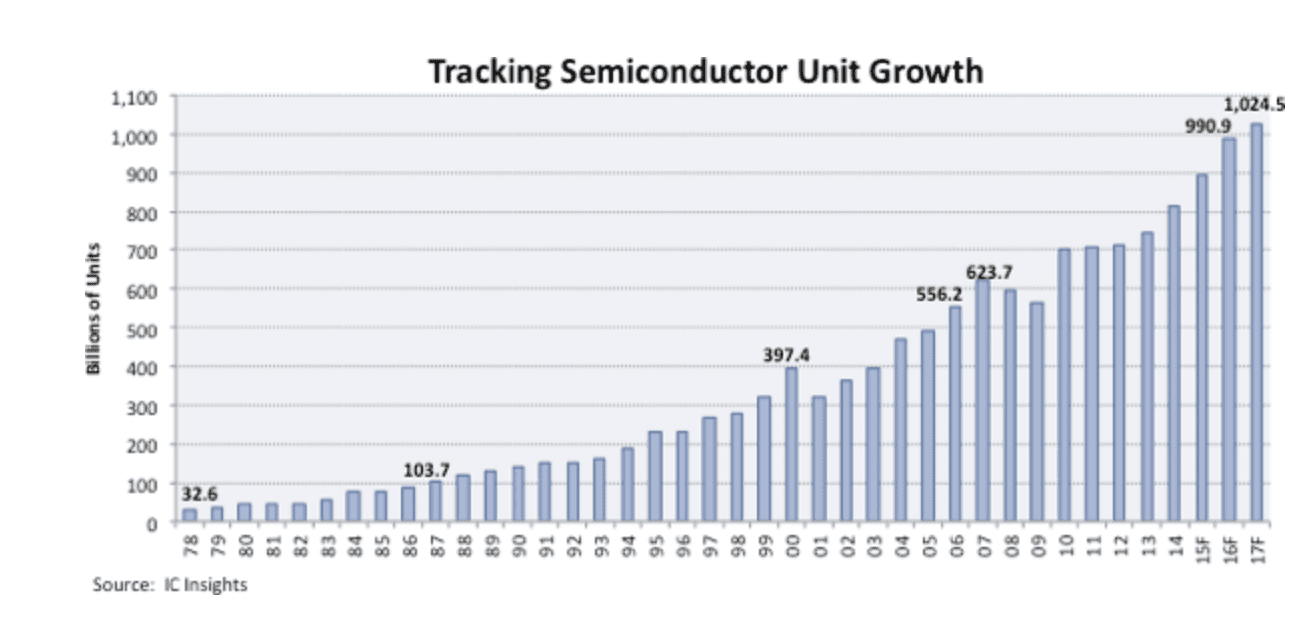
Notable milestones in semiconductor unit shipments include:
– 1987: semiconductor unit shipments first breached the 100 billion mark
– 2006: exceeded 500 billion units
– 2007: exceeded 600 billion units
When it comes to transistors, the numbers get even more staggering. It is estimated that, since the invention of the transistor, \~2.9 sextillion transistors have been shipped. That is two with 21 zeros after it. I also came across this tweet last week.
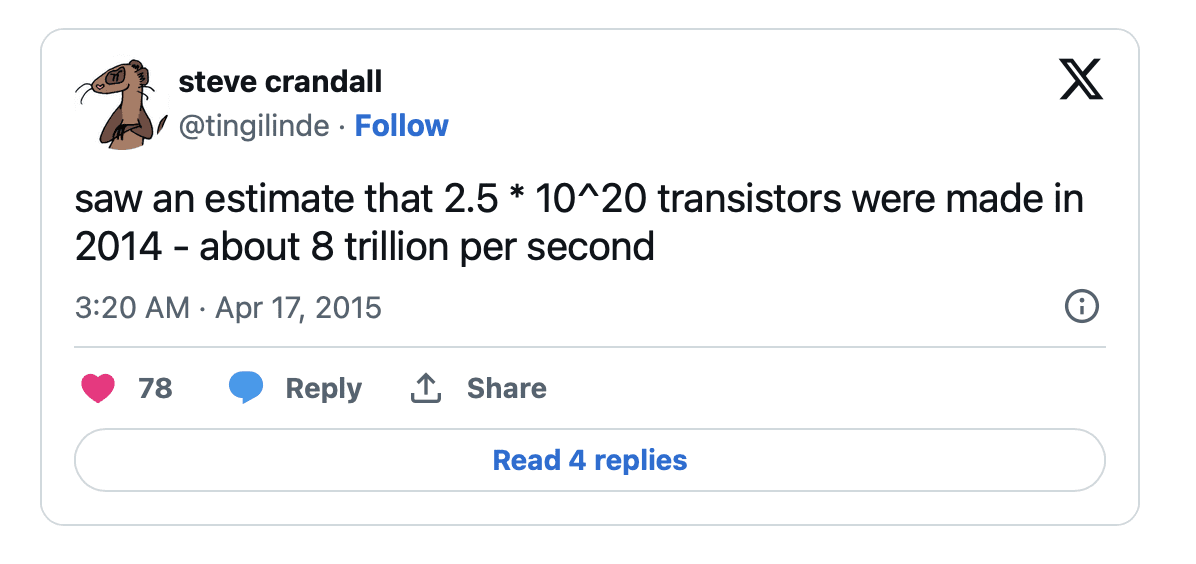
Eight trillion transistors per second. This number is only going to increase and at magnitudes of orders annually. That means, one trillion semiconductors annually by 2017, and this number will only grow for the foreseeable future.
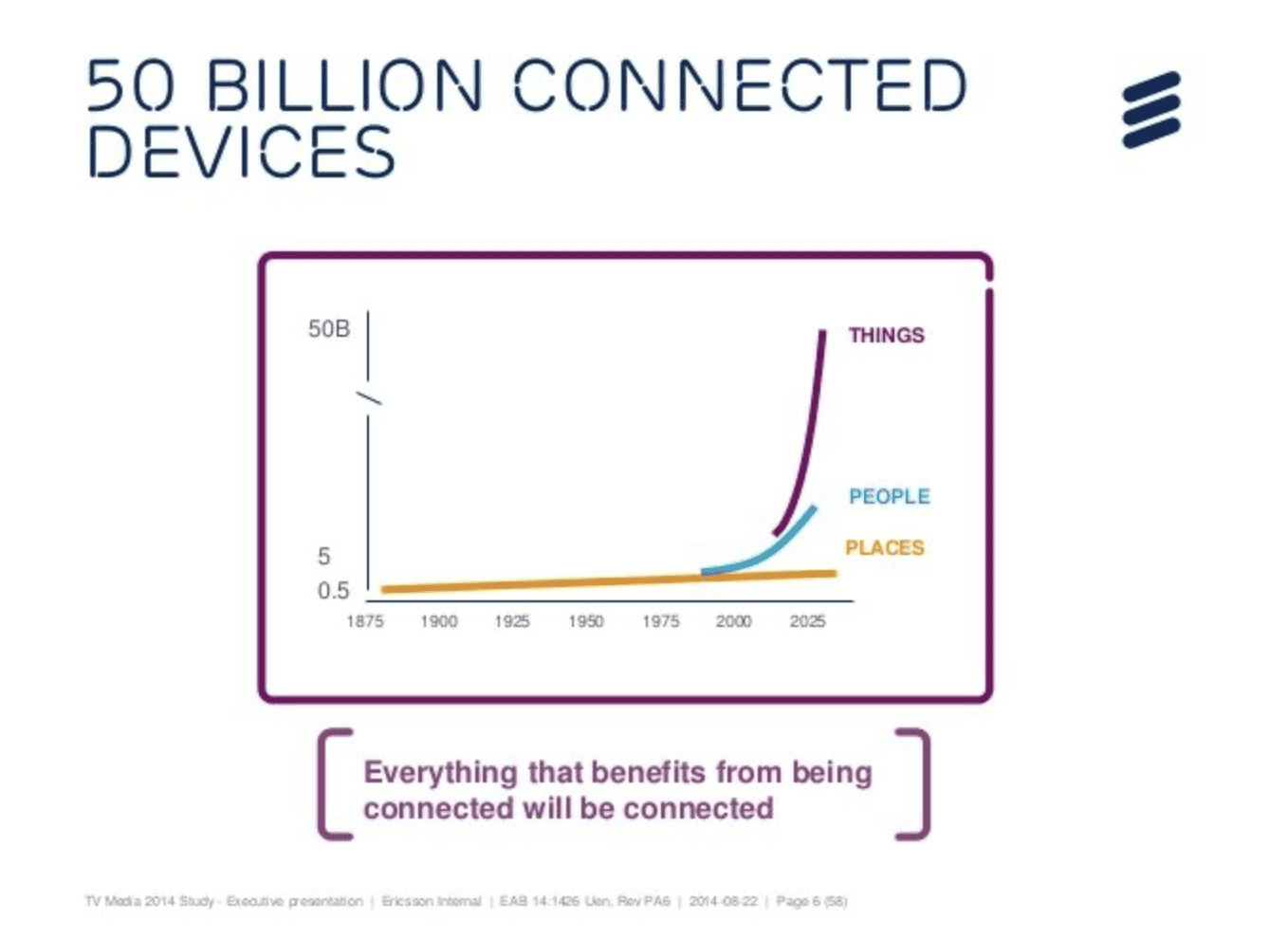
By 2025, there will likely be roughly five to six billion people connected to the Internet and over 50 billion connected products.
What is fascinating about where we are heading is today we can, for the most part, count the things we own that connect to the internet. Over the next decade, this will become impossible. Nearly everything around us will be connected in some way, shape, or form. This is the result of semiconductors eating the world. Semiconductors will enable a connected world where almost everything becomes technology, or at least enabled by it. In this future, technology disappears because everything is, essentially, technology. All of this is thanks to the pursuit of Moore’s Law.
#### The Relentless Pursuit of Moore’s Law
Yesterday marked the 50th anniversary of Moore’s Law. What always struck me about Moore’s Law is it’s more of an observation than a law. Even more interestingly, it could have ended at any time. It has been more of a benchmark and a goal to pursue for Intel. Intel has worked in relentless pursuit to keep Moore’s Law alive and the entire technology industry has benefitted from it. Other semiconductors like AMD, and the host of companies in the ARM ecosystem, have benefited from the pursuit of advancing process technology so semiconductors can invade the world. Thanks to the pursuit of Moore’s Law, we have computers that once filled up rooms that now fit in our pockets and on our wrists.
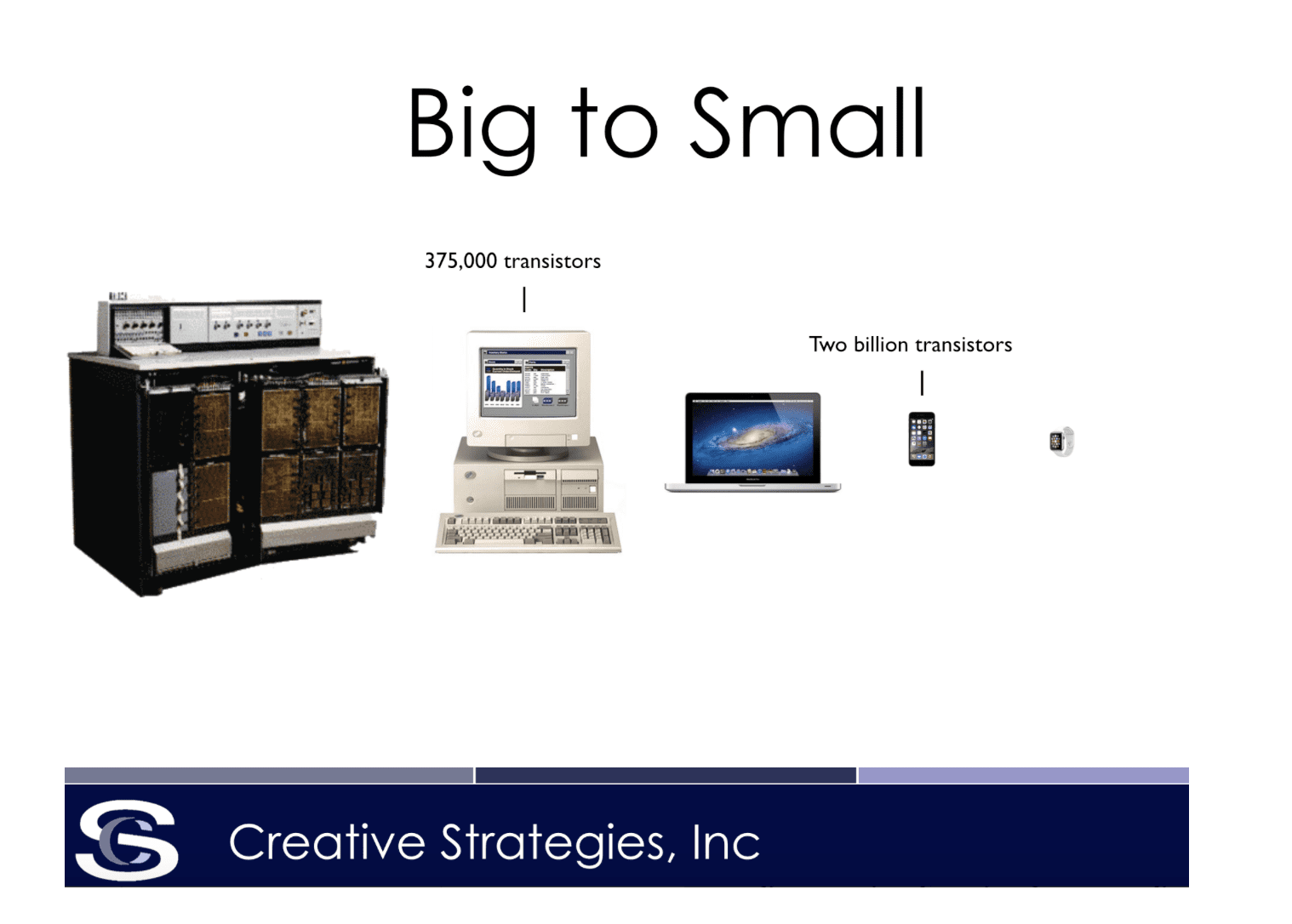
This pursuit of Moore’s Law will continue to make it possible for semiconductors to eat the world. As it happens, the unconnected world becomes connected. As Moore’s Law continues, connected things get smarter. We have a computer with two billion transistors in our pockets. In five to six years those same pocket computers could have eight billion transistors. What would we do with a pocket computer with eight billion transistors? We are going to find out.
Moore’s Law will continue to benefit the industry. Intel and Samsung both have semiconductors with the 14nm process technology. Next will be 10nm and then 7nm. With each step forward, semiconductors will continue to eat the world and provide the mechanism for software to follow and eat its fair share of it too.
Will Moore’s Law end? This remains the question we don’t have an answer for. But the threat of the end of Moore’s Law is nothing new. In all likelihood, the economic benefits of Moore’s Law will end, or at least be challenged, before the science does.
### The iPhone Is My Midwife
URL: https://creativestrategies.com/the-iphone-is-my-midwife/
Last updated: 2025-04-28T16:15:38.000Z

It’s the first time for both Betsy and me: she’s never given birth before and I’ve never helped a goat produce a kid. My heart races as I pace her pen, reviewing what I need to know to make sure she has a safe delivery. She seems as content in her element as if she were an experienced mother.
My days are mostly spent in a windowless office. I meet with clients, analyze data, and wear fancy clothes. Now I’m out in the bright sun in a slightly smelly goat pen wearing overalls and galoshes and about to assist with a birth. Betsy’s instincts kick in as delivery becomes imminent. Mine did as well. I was not altogether unprepared: I had my iPhone.
## Overgrown
My wife, Jennifer, and I began our journey the first year we planted tomatoes, zucchini, onions, lettuce, and strawberries. Each year the garden got bigger, and we experimented with new seeds and starters. The garden started to overflow our tiny backyard. Our front lawn was doing us no good, so we pulled it out and planted more crops in its place. In the very traditional suburban neighborhood in which we lived, our micro-farm became increasingly out of place. Our neighbors had nicely manicured green lawns and we had nicely manicured rows of vegetables.
Neighbors and passers-by thought either that what we were doing was inspirational or that we had gone crazy. To make peace with the latter group, we built some planter boxes next to the curb and planted vegetables for the neighborhood to pick from freely. We enjoyed giving fresh, homegrown goods to neighbors, friends, and family out of our abundance. We even started our own FSA (friend and family supported agriculture) to help others learn the benefits of growing your own food.
The more we “farmed,” the more we joked with friends and family that our next move should be to the country. It was appealing to think about sitting in our yard and looking out at an expanse of land rather than a solid wood fence 20 feet away, but it also seemed unrealistic. Our dreams had outgrown our boundaries.
It took a chance meeting to break through the fence. I ran into a friend with whom I’d started a company in the late 1990s, and we wound up talking about hobby farming. He mentioned that his father had looked at a house with lots of usable pastureland. We decided to check it out.
The farm was a 30-minute drive south of San Jose (add 15 in rush hour), where the sprawl of the Bay Area has dropped away and one enters something approaching real country. We took a look at the house and its fields, and we were sunk: we agreed that this was the place. The house was simple and came with three acres that already included a pool and two different playgrounds for our kids. We could see nearby hills from the house and hear and sense the quiet. We didn’t hesitate. We packed up and headed south.
It took just a few weeks until we settled into the calm and peace of our newly christened Bajarin Farm. Sitting and relaxing in the yard was like going on vacation. Everyone around us, and many we met in town, had similar gardening and farming interests. I knew we had made the right choice, though, the first time I saw two guys riding horses down our street, each with a beer in hand.
We rapidly expanded our gardening into farming and planting a greater variety of crops, and then we progressed into ranching — my idea. My wife resisted. “You do have a day job, you know,” she reminded me. I sold her on the chickens easily enough, as they don’t require much work and plenty of city slickers have them now. The taste of a fresh, free-range egg is the capper.
I agreed to take on all the animal duties, even if it meant getting up at the crack of dawn. We brought in two dozen chickens and shortly thereafter added three goats, two female and one male. Our goats quickly became family favorites. We knew it was likely that they would have babies, and we even fancied the idea of their kids running and jumping around our property. It simply happened much faster than I thought nature needed to take her course.
## Push technology
As I pace Betsy’s pen wearing overalls and galoshes, I picture a rancher sitting on the back of an old pickup truck watching me. He has a face weathered from seasons of working outdoors, his cowboy hat is pulled low, and a long strand of hay hangs from his mouth. He shakes his head and has a good deep laugh at the city-boy office worker.
But so far the Internet has delivered — figuratively to date and soon literally. Jennifer and I relied on the Web to supplement our suburban farming knowledge. For today’s work, there’s a bucket of warm water and some clean towels nearby, and an iPhone in my hand with a Web page loaded that contains step-by-step directions on assisting with a goat delivery.
Birth went quickly. In moments, the first two kids are on the ground breathing and starting to move around. I let out a sigh of relief, wipe the sweat from my brow, and sit down on the ground near the newborns, taking a minute to admire them. I imagine the faces of my daughters when they arrive home from school that afternoon and see the newborns.
I pat myself on the back that my digital assistant and I managed everything so neatly. That was premature, of course. Betsy begins to push again. I expected twins but she was carrying triplets, which I later learned is uncommon. I roll up my sleeves for the next delivery, but an hour passes and she’s not progressing. Something is wrong.
Betsy is pacing, and she is trying on her own every position that she can to get the baby out. I start searching for delivery position complications. It takes minutes, but I find a forum that helps me diagnose the situation: the third kid was positioned poorly and Betsy can’t get it out on her own.
The reality of what I have to do next hits me along with a jolt of adrenaline. I’m about to get my soft, uncallused expert-typist hands dirty. I have to work up the courage, and it takes a few minutes of deep breathing to get there. Betsy looks exhausted. She’s been through an hour of hard labor, and if she could talk she would say, “Are going to sit there and play on your phone or are you going to help me, you idiot?!”
Reluctantly and cautiously, I reposition the kid and give a gentle tug to get the process started. I watch and wait impatiently. At last the kid emerges and breathes on its own. If I was the goat’s midwife, then the iPhone was mine.
## No kidding
That was years ago, and while I’m not yet grizzled, I ride a tractor, wear cowboy boots, and occasionally snack on the wheat berries that grow in my pasture. Often new neighbors or friends from San Jose and beyond come over to see what we are up to and ask how to do it themselves. When people visit the first time, I usually have one rule: they have to try to catch a chicken. Purely for my entertainment purposes, of course.
I think back to Betsy’s first delivery at times, and remember my reaction when it became complicated. I didn’t call a vet; the thought never entered my mind. I’m a problem solver, and it seemed natural to turn to the same repository of information that serves my career to serve Betsy.
I probably should have had a vet’s number on hand, but being new to the community I didn’t yet know who to call. To save Betsy and the baby, I knew I had to act fast. That was where the Web came in, and it’s turned out that every fundamental bit of information we’ve needed to run the farm we’ve been able to find on the Internet, often from far-flung pocket farmers like ourselves, who share information that our grandparents and great-grandparents would have learned firsthand. The scale of a hobby farm has let us more recently connect in person, too, with local 4-H clubs, rather than the resources that family and larger farms rely on.
Every year around delivery time, I reflect on how a process that once seemed so foreign has now become second nature. Since that time, we have birthed 14 happy and healthy baby goats and I’m now the old hand. Neighbors come to consult me in similar situations, where I gladly offer any knowledge I have or teach them how to effectively use the Web for their needs.
Betsy is doing well to this day, and we have added more goats (and a sheep) in the years since and have helped them deliver happy, healthy newborns. Since moving we have also added ducks, geese, turkeys, and bees. But unquestionably, the highlight of our year is when baby goats arrive on the farm. Now, on to cows.